

Mental Fitness With Rob Roell
Posted by John Livesay in podcast | 0 comments


Who says fitness is all about the physical? Rob Roell, Executive Coach at Equilibrium Coaching, believes we also need the mental stamina to unlock our true potential for professional success. In this episode, he joins John Livesay to talk about mental fitness, what it is, and why we need it. He dives deep into the imposter syndrome, the ways social media amplifies it, and how we can overcome that through mental fitness. Offering some great tools, Rob discusses the book Positive Intelligence, where he highlights how we can be more productive and fight off what is called mental saboteurs. Achieving success is not just about having the physical capacity to work towards our goals. It is also about having the mental part taken care of that helps us see through the challenges along the way, especially in this modern world. Join Rob in this conversation as he helps us become mentally fit.
—
Listen to the podcast here
Mental Fitness With Rob Roell
Our guest is Rob Roell, who is an Executive Coach that helps clients unlock their true potential for professional success so they can increase their performance without all the anxiety and stress. He has created a wonderful book called Positive Intelligence, PQ if you will. It’s a simple yet powerful operating system that allows you to become mentally fit like with physical fitness require some practice. This Positive Intelligence is developed with coaching in mind. He has been able to improve clients’ progress with their goals.
—
Rob, welcome to the show.
Thank you very much. I need to correct you. The book is not my book. The book was written by Shirzad Chamine, which is a great opportunity to give him credit for the foundation that I work from.
I have had some people do that with other people’s work. They give credit, whether it’s Simon Sinek’s Start With Why. It’s so wonderful when someone creates something so valuable that other people can be credited and make it a basis for a foundation and get the training directly from that.
This stuff is incredible work. It’s foundational for me. I use it as a foundation for all of my clients.
Tell us a little about your own story of origin. You can go back to childhood or school. How did you get involved or interested in coaching and helping people?
Years ago, I was at a Tony Robbins program. One of the trainers that I was working with saw something in me that can happen like a bubble went off in my head. This was something that I wanted to do. When it came together like one of those meant to be moments, I was talking to a friend of mine after the program. He’s like, “Rob, have you ever done this before?” Without even blinking or missing a note, I said off the top of my head, “It’s funny. I have been doing this all my life. I’ve never got paid for it.” It’s true. I have always been that person in every group of friends that people come, seek out advice, knowledge from and the shoulder to cry on like, “Rob, can you come over here? I need to talk to you about something.”
It fascinates me because of your background. You have a Master’s in Electrical Engineering. Nothing against engineers but as a species, you guys are exactly known for being right brain, warm and fuzzy. You toggle back and forth.
There is a reason that we use that term binary. Engineers tend to be left-brain cerebral thinkers. History-wise, my last run in the corporate world was what would be called a sales or a systems engineer, which is the person on the sales team that helps the customer to understand technology. That’s something you wouldn’t traditionally think of as an engineering role. It’s one of those places that I have always been in that unusual space between what traditionally I was trained for and what comes naturally to me.
[bctt tweet=”Celebrate your wins.” username=”John_Livesay”]
In a way, you are a translator of tech to something understandable. The same thing seems to be happening to me with this Equilibrium Coaching because a lot of people say, “I’m great at decision making. People like and respect me and yet in my personal life, I feel like I don’t have the same skills.” You can help them translate that.
I’m a little bit of that. What we tend to focus on are those things that aren’t working optimally in the business realm. The beauty is, call it stealth coaching, call it whatever you want, all of those things that they learn to use in the business world to make themselves feel more productive, happier, less stressed, translate over into the personal life, whether it’s a relationship with a partner, with kids or fitness. Whatever it is, it all translates.
Many people, no matter how successful they are, even celebrities, suffer from impostor syndrome. Let’s define what that is and what that looks like. I know I have certainly struggled with it when I was speaking at a Coca-Cola summit. I looked at all the other speakers who had MBAs from Harvard and New York Times bestsellers, I’m like, “That’s going to trigger any insecurities that would do it.” I’m a big proponent of not comparing myself to other people. I find we still all tend to do that sometimes, don’t we?
A lot of it is cultural. Nowadays, we like to bang on social media. Social media is the source of many issues. I’m a fan of the fact that social media is the accelerator. All of that stuff was there. Social media made it easier to put it all out into the public. Impostor syndrome, at the end of the day, it’s a part of what goes on with people. It’s that part of you that doubts, that judges yourself about, “Am I good enough? Have I done enough about this?” It’s that thing that keeps us up at night thinking, “Did I do everything? Did I check all the boxes to move me on powerfully?” Unfortunately, we are in a society that reinforces this idea, “You’ve got to get it done. You’ve got to get through. It’s going to be tough. It has to be tough to be worthwhile.” In some ways, that may be true. It doesn’t have to be tough on you emotionally, physically and mentally. It doesn’t have to be Pollyanna but you can do everything that you do from a positive perspective, rather than trying to attack it from the negative perspective. It’s going to get you there. It’s going to get you some success. Are you going to be happy? Are you going to be fulfilled? Likely, not.
I will never forget. I was friends with an actress when I was living in LA that had the Malibu summer house on the beach with all the other celebrities and was on a sitcom. She was miserable. She said, “No one wants to hear it,” because she’s living the dream of an actor. Getting on a show and having that lifestyle, then you are still miserable. She didn’t like the show, not well written and was embarrassed to do it. The stress of it is going to be canceled or not. Nobody wants to hear that. They want to hear you on Malibu and show. You must be happy. If you are not happy, don’t talk about it.
We could go down a deep rabbit hole about all of our societal issues with mental health. People don’t want to hear when their version of you, what they see of you is everything they think that they want.
You are busting the illusion. As soon as I had this concept, if I had that, I would be happy. I understand why I’m not happy. If you tell me that if I get that, I’m still not going to be happy, you are going to blow my circuits.
A Buddhist saying or wherever it comes from, you think about what comes first is, is success generates happiness or is it happiness that generates success?

Mental Fitness: People don’t want to hear when their version of you and what they see of you is everything they think they want.
We see all these famous people like Kate Spade or that amazing chef who committed suicide, Anthony Bourdain. I ask myself, “There it is again.” If you are not happy, all the money, fame and whatever in the world that you could want, what you are doing is crucially important. If we do this as soon as I get this, I will be a happy game. It’s a zero-some game. We have to be happy where we are, is what I’m hearing you say. Many of us are going to need some coaching to get there.
Honestly, I love it. There was some point in reading your book. There was this one saying that we are kindred spirits here. You talk about this internal voice that tries to protect us. I have the quote here, “The internal voice that tries to protect us by diminishing us and critiquing our performance.” The world I work from the positive intelligence mental fitness, we call those the saboteurs.
It’s valuable to label it. You are like, “Who’s speaking?” If I’m the thinker thinking these thoughts, “Who’s in my head telling me all these horrible mean things?” What I’m fascinated by with positive intelligence is that it’s so measurable. We know if we have worked out, we can measure our waist or our biceps. We go, “I’m getting results.” There are actual ways not to try to boost your mental fitness but measure it. Can you explain how that works?
The way that you can measure your mental fitness, Positive Intelligence gives us some great tools. If you already go to their website, they have several assessments. One is you can measure your PQ score like you can do an IQ test. Nowadays, emotional intelligence and EQ is a big thing, especially in the executive business world. You can also measure your PQ. It’s a ratio of how often you use positive reinforcement and positive perspectives to rule your life versus how much you use the negative. Where it becomes important is you get a score of 0 to 100. The target is you want to be above 75%. If you want, I can go into the science that goes behind it.
Let’s hear a little bit about Science. Here’s what a friend of mine who writes for Inc Magazine told me, anything that they write with a headline or an article about how our brain works get more clicks than anything else. Good to know. I get a chance to interview someone as knowledgeable as you that understands and can give us some valuable information on how our brain works or why something works for our brain. It seems to me that the data is there that people are interested in this. Let’s hear the highlights of it.
Look at that ratio. 75% to 25%, that’s a 3:1 ratio. The idea is that the saboteurs I mentioned live predominantly in that primitive part of your brain. The part that wants to see the leaves rustling out in the jungle just in case there’s a tiger there to come after you. It’s served a purpose at some point in our human development. Not so much now. Aside from Houston, there are not many suburban areas you are going to find a tiger rustling the tree. What that does is your brain is tuned on this 3:1 ratio to look more for something that’s going to go wrong than for something that’s going to go right. You want to be above a 3:1 ratio to be able to have an opportunity to override that tendency of your primitive brain.
It’s a survival mechanism. I heard something similar when I interviewed Steve Rohr, who wrote Scared Speechless talking about you and I are both speakers. Our brain is wired to never be separate from the tribe. When you are standing in front of people, your fight or flight response is kicked in and says, “What are you doing? The tribe is out there. You are all alone. You are going to get picked off.” I think there are some interesting things there. This concept that we are always looking for what’s wrong or could go wrong is part of the pre-wiring. He talks about when you are standing on stage in front of people, your brain is wired to say, “The tribe is out there. You are up here by yourself. You are in danger. You could get picked off by a predator.” We have to override that. That’s why people get so scared to speak. The same thing is true in our everyday life about what is going on that feels like we are not enough. We think hard to try to do this.
Going back to social media as an amplifier, you almost get this badge for being in that negative space. You post something negative on social media and everybody goes, “That’s so cool.” There are a lot of positive voices. It would be interesting to see. Is there a 3:1 ratio in that sense on social media?
[bctt tweet=”Treat mental fitness like it was physical fitness.” username=”John_Livesay”]
In journalism, if it bleeds, it leads. All of that click-through. I wrote something about this whole process of moving. I have done this a few times. Every time, I’m like, “By the time I move in, all the joy has been sucked out.” With the endless requests for the loan, problems with this, delays and you have your house inspected. Your whole focus is on everything that needs to be fixed.
It starts with that 3-inch stack of paperwork you have to sign to finalize the house.
You are thinking, “I am determined.” Ten things need to be fixed in the house, even a new house. That’s part of the process. We always have a choice toggling back and forth of, “Am I going to complain or am I going to be grateful? I have a roof over my head.” It is challenging when you keep getting knocked down or it’s one thing after another. The movers break something. There’s a leak in your roof. The laundry list is huge of what you can focus on to be upset about or you take a breath and go, “You broke something. Take a picture. I will claim, next.”
In the positive intelligence contacts, what you are talking about there is switching. We mentioned these saboteurs. Saboteurs are all within us. Let’s start there. To counter that is another part of us that’s also within us is the sage. It’s that part of us that wants to operate from the good. The sage starts with a sage perspective that everything in life that every challenge brings with it a gift and an opportunity. That resonates where you are now.
I always think this is going to make a great story, even it’s horrible. I can turn this into a story. I have heard people who write for movies go, “They are always looking for all. This is going to make a great script.” With that sage advice for me, I would love your opinion on this about zooming out. I do the 555 thing I made up, which is will this matter in 5 minutes, 5 days, 5 weeks, keep going. You realize, “Five days, zoom out. I’m so upset because this happened.” You are like, “This ability to have a sage perspective.” Ideally, the longer we live, the more of a sage we become. I have lived through this. That’s some good times and bump times. I have seen them all. I’m still here. That philosophy is sometimes difficult if you are younger. I see people get so obsessed with, “I thought I would be more successful by the time I hit this age. I probably making the 30 under 30 Forbes lists,” whatever their mindset is. How do you help people who, even if they are not “older,” are still so unhappy with where they are? You think, “As soon as I’ve got this, I would be happy.” You get that and you are not happy.
When we get there, we tend to focus on the thing we miss. In reality, we haven’t taken account of all the things that we gained along the way. There’s a famous speaker and one of his quotes is, “Shoot for the moon and the worst thing that happens is you land amongst the stars.”
That’s from an old Bette Davis movie.
Realistically, that’s true, especially when you talk about high-achiever mentality people. We look at the goal. If we don’t reach the goal, it’s a total failure. We don’t celebrate our wins along the way. Quite often, we don’t even define clearly what that goal is.

Positive Intelligence: Why Only 20% of Teams and Individuals Achieve Their True Potential and How You Can Achieve Yours
It’s always elusive. I remember when I was ten years old, I thought my dentist was so great. I thought maybe I will be a dentist. I was talking to him about it. He goes, “I settled on dentistry. I wanted to be a plastic surgeon.” I was like, “What? You settled on being a dentist.” Everyone has got this, “I’m still not happy. It’s not my dream.” From the outside looking in, you think it is. As you said, we have similar philosophies. This concept of perfectionism is a curse. I would say we need to reinvent and come up with a new word progressionist. You and I are progressionist to help other people to celebrate their progress.
The human brain and existence are geared around progress like a core coaching tenant are helping clients create progress. We also know it was one of the big personal development quotes. It’s like progress over perfection. You will hear me quote Tony a lot, I volunteer in his environment. I hear his stuff continually in my head. Tony says, “Perfection is the worst goal of attainment because it’s unattainable.”
It creates a barrier. If you come across perfect, no one can relate to you. There’s no connection. I know you pride yourself as a speaker on having this bond with the audience. Talk a little bit about how you do that.
I know you are a fan of the story. For me, my story was speaking. I was speaking in the corporate world. I was very powerful as a systems engineer or sales engineer however, I never felt like I was connected to my audience. I could spew the data, tell good stories and do well in that sales environment. When I first hired my speaking coach, that was the one thing I wanted to tackle more than anything. He’s like, “Rob, it’s very simple.” Throw away all that BS garbage that speaking coaches tell you about looking over everybody’s head. He’s like, “Find one person in the room and have a conversation with them and then find another person and have a conversation with them.” I know you have spoken from stage. Anybody that’s ever spoken from stage, you get the fact that when you speak to that one person, you get that radius effect. 10 to 20 feet out, everybody thinks you are speaking to them and then you feel connected. They feel that. It builds on itself.
Even if you go to a concert where you listen, sometimes the singer will say, “I want to tell you.” You feel like they are talking to you. There are thousands of people that are in the dark. That is fascinating, whether it’s 300 people in a ballroom or how many people Staples Center holds. That successful banter in between the songs creates that emotional connection. The other thing that I’m fascinated to ask you about. I have noticed that people who stay curious are the ones that seem to live long, healthy lives. People who are bored easily seem to be miserable all the time and tend to have unhealthy lives and not live so long. It’s the people who are like, “I decided I learned another language.” You are 80 years old. They are like, “I want to learn something new.” You are constantly up-to-date on what’s going on in the world and staying curious. What are your thoughts on being curious? I know it’s a big outcome of what mental fitness looks like. Are there things that people can do to increase their curiosity if they are not naturally curious?
One is bringing attention to it. Creating intent, when you create intent around wanting to be curious, part of it is like anything else. Creating that mental muscle to be curious takes practice. You have to remind yourself consciously from time to time, it’s being intentional about being curious. I mentioned the sage earlier. The sage has five powers. One of those sage powers is explored. The power game we play around sage explore is the fascinated explorer. Think of yourself as Indiana Jones. You notice how I’m leaning in. It’s having that posture of leaning in, listening closely and intently. Being curious has all of that around it. I get goosebumps talking about that.
The outcome besides being happier is this increase in productivity. Can you speak to how mental fitness helps us be more productive?
We were talking about these negative voices that go on inside of our heads. If you were to sit down and journal about how much of your time you are spending combating that. If you were to minimize those voices in your head, how much more productive would you be? At the end of the day, the studies show us that average people are over 30% more productive when they are coming from a positive mindset rather than a negative mindset in everything they do.
[bctt tweet=”Social media is the source of so many issues.” username=”John_Livesay”]
That’s huge. I didn’t know it would be that high. That’s a very surprising statistic. I would think maybe 10%, but 30%. Imagine, if you decided, “I can start work 30%.” I don’t have to work five days a week if I’m hitting my goals if I’m thinking more positively.
The high achievers out there going, “I still work five more days.”
I would keep Elon Musk. I would go to the moon. I would take us here.
The thing that’s nice about that extra productivity, you are not only more productive, but you are also happier while you are doing it. One of the metaphors that I love that Shirzad loves to talk about. He used to be an instructor at Stanford. He would talk about these concepts at Stanford. His students nicknamed this Jedi Mind training. I remember when I watch Return of the Jedi, Luke training with Yoda out on that planet Dagobah. It’s like, “I want to train with Yoda.” That’s what it was all about. How could Luke be calm, clear and focused in the middle of all the chaos of battle and everyday life?
That reminds me of what I watched in the documentary about Tiger Woods and how his father would constantly distract him while he’s practicing so that he had to get into the zone. When all the pressure was on, he could tune it all out. If athletes have to do that, when we are called on to perform as a speaker, in a business situation, you are pitching to win new business or whatever it is, if you are distracted by the hum or a look someone gave you, 101 things can distract us. Your phone going off and all that. Maybe you turn the distractions off that way. As you talk about laser focus, your ability is so important to mental fitness. That requires some work, doesn’t it? It’s got to get cleaning away some stuff.
Let’s put some foundation around this idea of mental fitness. To state the obvious, it’s based on the idea of physical fitness. When you are physically fit, you can climb a steep hill. You can jog down the street without losing your breath and without having physical stress. The same thing with mental fitness. When you are mentally fit, you can deal with life’s challenges without all the stress, anxiety, doubt and frustration that can come up all of the negative emotions from being in life. To be mentally fit, it’s not something that you can turn on just like that for the average person. To be physically fit, you have to train regularly to be there. Michael Phelps didn’t become a world-class swimmer by going to the pool once a week.
I have a story. When he was young, his coach said to him, “Michael, are you willing to work out on Sundays?” He said, “Yes.” He goes, “We’ve got 52 more workouts from the competition.” People go, “It’s not his physique. It’s not he got lucky genetically. In the end, he put in that extra work.” That’s important for people to realize you don’t suddenly get into shape overnight physically. Why would you think you could mentally with a few affirmations?
At the end of the day, mental fitness is a concept of being more positive than negative. It’s creating a practice around that. It’s something you do regularly. For me, knowing that I was nervous coming in here, I did somewhat we call them PQ reps, positive intelligence reps. There are about ten seconds a piece that help you to become more body-centric and centered. To put it, it helps the part that minimizes those saboteur voices in your head nice. When you are there, that gives you that opportunity to choose to take on the sage perspective.

Mental Fitness: When you are mentally fit, you can deal with life’s challenges without all the stress, anxiety, doubt, and frustration that can come up from all of the negative emotions in life.
I call it stacking your moments of certainty. 2 or 3 times, when you knew you had a good interview, you are like, “I know John likes me. He’s going to make me look good. Whatever saboteur voices I have in my head, this is not one of those gotcha interviews. This is going to be fun. I’m going to be of service. People are going to love what I say. There’s a technical glitch here and there. Who cares? We will figure it out. It’s not the end of the world.” We have the perspective so we can zoom out.
One of the other things I love about your work and what you do is, as you mentioned at the beginning, go from, “I’ve got to get this out and white knuckle it almost,” to the concept of, “I can take action. I move through life with grace and ease. Things always work out for me.” Many people are presenting the concept. I have watched people have visceral, angry reactions. “That’s not true. It’s not about working smarter. You’ve got to work hard. Everything has to be hard.” There’s no such thing about being in the flow. That’s why I love teaching people how to become storytellers. When you tell a story, you are in the flow. You are pulling people in. The action they want to take is like landing a plane. It’s not this surprise push at the end. Speak to how you help people get in the flow.
Let me back up again, add a little bit of science to this. Realistic as to where Shirzad came up with all of this in his studies, he’s worked with hundreds of CEOs around the world. We talked about the Stanford students that he’s worked with. He’s worked with world-class athletes. At this point, hundreds of thousands of people that are participated in his Positive Intelligence program. In working with them, what they did is they work from this idea of what’s called factor analysis, specifically root factor analysis where you are trying to find the root of why things are. What root factor analysis gives us is a radical simplification of why things are and why. That’s what resulted in the nine saboteurs. There are ten. There’s the judge saboteurs, the principal, and nine accomplices and the sage with the five sage powers.
To give you an idea of what root factor analysis is, we all know that of all of the thousands of colors that exist in our beautiful world, three colors exist at the root of all of that, red, green and blue. That’s when you look at a monitor. Those of us that are old enough to remember used to refer to monitors as RGB monitors. It’s a similar thing here with mental fitness. The root factor analysis with all of these people resulted in these ten saboteurs. Be very clear about the 1 sage and 5 sage powers. Also, what we learned from the root factor analysis, three main muscles create mental fitness. The saboteur interceptor muscle. It’s the idea of understanding when a saboteur is in your presence and acting on your mentality. To put it very simply, the saboteur interceptor muscle is a negative emotion. When you recognize your negative emotion, you equate that with the existence of a saboteur.
Labeling that helps take some of the chaos in our head and rip above it, doesn’t it?
It does. Having that interceptor muscle be strong, whether it’s personal development or coaching. The difference between having that a-ha moment and acting on that a-ha moment is like, “What are those things? What are the saboteurs that are keeping me acting powerfully on this?” That comes from, “I’m scared of this or I’m getting stressed. I’m getting anxious about it.” Noticing that you have the opportunity to do something about it. That brings up the second muscle. It’s the sage muscle. Knowing that the sage operates from everything as a gift and an opportunity, you have these five powers of the sage with the power games that go along with them. You can leverage those to help you make that shift as well.
The third muscle is where these PQ reps come from. The idea of the PQ reps is to exercise that third muscle so that you recognize you are in saboteur mode. You can do PQ reps to bring that voice down in your head. Now, you can powerfully bring the sage up. All of these things are all ready, just like your physical muscles are part of you. All of these three mental fitness muscles are already a part of you. You have to exercise them. You have to create a practice around it to strengthen them so that when the saboteurs come up, you can go, “That’s a saboteur.” If you want to identify this saboteur, “That’s the controller or stickler. The stickler wants to get everything right.” You could identify it to that level. The idea of knowing that saboteur is powerful in and of itself, and choosing the sage perspective and making the shift.
If someone wants to get ahold of you, what’s the best way to do that?
[bctt tweet=”Creating that mental muscle to be curious takes practice. You have to remind yourself consciously from time to time.” username=”John_Livesay”]
The best way to get ahold of me is very simply my name [email protected].
Rob, any last thought or quote you want to leave us with?
I would love to offer to anybody that’s reading, if they want to have a conversation with me, schedule 30 minutes with me. You can go to my website, EquilibriumCoach.us/contact. If you go there, it will give you a website/contact/connect. You get access to my calendar. You can schedule a 30-minute. We can sit down and talk about how mental fitness might work for you.
Thank you. It has been fun hearing about how we can all get a little more mentally fit from you, Rob. Thanks again.
Thank you, John. I appreciate you.
Important Links
- Equilibrium Coaching
- Positive Intelligence
- Start With Why
- Steve Rohr – Past Episode
- Scared Speechless
- [email protected]
- EquilibriumCoach.us/contact
- Better Selling Through Storytelling Method Online Course
Wanna Host Your Own Podcast?
Click here to see how my friends at Podetize can help
Purchase John’s new book
John Livesay, The Pitch Whisperer
Share The Show
Did you enjoy the show? I’d love it if you subscribed today and left us a 5-star review!
- Click this link
- Click on the ‘Subscribe’ button below the artwork
- Go to the ‘Ratings and Reviews’ section
- Click on ‘Write a Review’
Love the show? Subscribe, rate, review, and share!
Join The Successful Pitch community today:
- JohnLivesay.com
- John Livesay Facebook
- John Livesay Twitter
- John Livesay LinkedIn
- John Livesay YouTube
How To Delight Customers And Retain Top Employees With Jason Bradshaw
Posted by John Livesay in podcast | 0 comments

When it comes to business, the customer is always right. Sounds obvious but putting this into practice is a lot harder than it seems, especially when we direct it to employees, also known as the company’s first customer. Joining John Livesay in this episode is Jason Bradshaw, a global guru on customer service and author of It’s All About CEX! The Essential Guide to Customer & Employee Experience. Jason shares how putting customers and employees first ultimately leads to greater returns and better employee retention. Doing business is not just about selling a product; it’s about the experience.
—
Listen to the podcast here
How To Delight Customers And Retain Top Employees With Jason Bradshaw
Our guest on the show is Jason Bradshaw, the expert on customer and employee engagement. He said, “If you get your customers’ and employees’ metrics, everything else follows. When you have a team of people, the way to get them to be engaged is to ask them to share their dreams. When you ask your employees for feedback, it’s not enough to just get the feedback. You must take action from it.” Enjoy the episode.
—
Our guest is Jason Bradshaw, all the way from Australia. He created his first business at the young age of fourteen, where he was selling telecommunications and computer equipment in the Australian Regional City of Toowoomba. The lead-up to this was he was inspired by books like, The Pursuit of Wow by Tom Peters, which opened his eyes to the power of customer and employee experience. Jason tested and implemented strategies for improving the experience in a variety of sectors, including telecommunications, retail, media, finance and many more. He’s worked with companies like Target Australia and Volkswagen. A cornerstone of his career has been this unwavering commitment to improving the lives of customers and employees. Jason, welcome to the show.
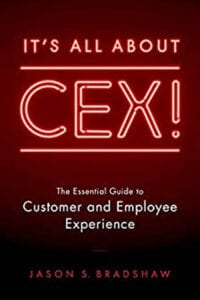
It’s All About CEX! The Essential Guide to Customer & Employee Experience
It’s great to be on the show. Thanks for having me.
It’s my pleasure. I always say, “Let’s start your story of origin and figure out where to start.” In your case, it makes me want to say, let’s please know the story of how in the world did you decide at fourteen that you wanted to start a business, and pick telecommunications and computers?
I know it sounds like I was on some great plan to conquer the world when it came to computers or telecommunications. It was simple. I like gadgets. I’m not fourteen anymore and I like more expensive gadgets. I needed to find a way to fund them. I decided instead of buying stuff at retail, I would buy it at wholesale, but I needed to be able to prove to suppliers that it wasn’t just for my bedroom. If you read a copy of my book, you’ll know that even before the age of fourteen, I was dabbling in different things. My parents and grandparents were all entrepreneurs. One of the many suits my father had was a gunsmith. I was sitting in the lounge room in our family home many times, bottling oil for people to clean their firearms and stuff with trade shows that would give me a small part of his display. I would sit there talking to anyone that came by, trying to pitch my oil to them.
You were encouraged at a very young age, which is not always the case. For myself, growing up, I didn’t even know what the word entrepreneur meant. They’re the ones who either worked for a company or owned a dry-cleaning or a plumbing business, but we still didn’t put an entrepreneur tag on that. Certainly, I didn’t know anybody inventing or starting anything from scratch. It’s fascinating that more young people are saying, “Hmm?” In your case, you saw it being modeled for you. Especially at fourteen, what’s there to lose? You might as well give it a shot. That’s a big part of why a lot of people are afraid to leave the security of a corporate job. The income is not steady and they’re not sure if their idea works. There are 100 reasons not to do it. If you get that out of your system at a young age and have some traction, I would imagine it encourages you to go, “I can do this.” How did you get from that into becoming this expert on helping people give their customers better experiences?
Life’s a wonderful journey, isn’t it? By the time I was 21, I had started three successful businesses. I went from telecommunications and computers into domestic and commercial cleaning. If you think about carpet cleaners and shop cleaners, I had the vans on the road. I had the telemarketers annoying you at dinner. I had an even crazier idea. I had what was perhaps a great learning lesson but I wouldn’t say that’s how I put the successful spin on it, but my third business was a video rental store. I’m dating myself now.
Like Blockbuster here.
[bctt tweet=”Make your customers and employees feel seen and heard. ” username=”John_Livesay”]
They say location is everything in real estate. Location is even more when it comes to video rental. I learned some lessons there. From there, I jumped into the corporate world. My entire career, whether it was a business that I was running or an organization I was working for, I was always the guy in the room saying, “What about the customer? What about the employee? Why do we need 300 steps in our process? It makes no sense to me. How do you think I’m going to delight the customer when I’m trying to follow steps 1 to 300?” Perhaps because of my readings as a young child, going to mom and dad’s place of work or their various ventures, I was always advocating for customers and employees. Naturally with that, as my corporate career took off, I continued to go up the corporate ladder, always with that customer and employee focus.
I haven’t always been the head of the customer and the chief customer officer. In fact, I worked for Australia’s largest government organization, the New South Wales Government Office of Procurement. I was the Director of Procurement Transformation. What’s the customer guy doing in an organization that’s designed to buy hospital beds, diesel, all things like that. Apart from changing processes, my job as a Senior Executive in the New South Wales government was to put the people of New South Wales back into the procurement process. As a government organization, we started thinking about our ultimate customer, as opposed to the agency down the road that needed to buy the hospital beds or diesel for the trains or whatever the case might be. I’ve always found a way in whatever job that I’m doing to bring that customer and employee lens into the fore. My experience is that if you take care of your employees and customers, all the other metrics follow. You sell more, make more money and have loyal customers.
It reminds me of the importance of storytelling, who’s in the story and what the focus is. If you’re in this government job, it’s easy to get caught up in the paperwork, not see the big picture and forget that you are serving the people who live in that country as the end-user, make them the hero of the story, and all of your actions from there as opposed to trying to get something done. This concept of, “If we take care of the customers and the employees, all the other metrics follow,” instead of being so focused myopically on, “What are the sales this quarter and this month?” If we go, “How can we delight the customer better?” That’s such an interesting insight. I want to know a little bit about your days as the Chief Customer and Marketing Officer. That would be a CCMO title instead of a CMO. It’s certainly a C-Suite level that you worked your way up to of doing Volkswagen in Australia. Obviously, it’s not from and in Germany. I worked with Lexus based in Southern California. There are Japanese companies in America like the luxury brands like Mercedes and BMW.
Everyone’s competing in an out-of-country environment. The thing that jumped out on your LinkedIn profile for me is that you have a loyalty program for cars. Most people think, “There are loyalty programs for airlines,” but I don’t think most people realize how important it is to get that repeat buyer or the person who’s leasing the car for two years to stay within the brand. Can you speak to what you did with customer loyalty as it relates to Volkswagen? I’m sure people can extrapolate for whatever industry they’re in and some ideas?
My role is Chief Customer Experience and Marketing Officer at Volkswagen Group Australia while focused on the Australian market. I did have the great privilege of working with my colleagues in North America. In Mexico, we republished the book that we wrote for the Mexican audience. It was great to work across both running a market but also to assist some colleagues in North America to understand the similarities more than what you might expect. One of those, as you alluded to, is the importance of the customer coming back during the lifetime of the ownership.

Retain Employees: Employees feel much more engaged with an organization if there is a continuous investment in them.
There’s this misconception out there. I certainly know I had it before I worked in the automotive industry that you go, buy your car, and the dealership has a 50% profit margin in the vehicle. I don’t know if that day ever existed but it certainly doesn’t exist now. The margins in an automotive dealership from the front end, the new vehicle out there are really small. Where dealers and automotive manufacturers make most of their money is in the service and accessories side of the business. It is extremely important for consumers to come back into the dealership to get the vehicle service.
If I put up my automotive hat, I’m going to tell you there’s a whole range of reasons why you should do that. The pure commercial reason is that’s where they make their money. From a customer lens, you should have a better product experience. I always think that when you buy a car, every single day when you hop in it, that product experience is what’s reminding you that you made the right or wrong decision. That service experience, getting the software updated, getting the oil changed and all the various other things that you do in the service, making sure customers get that completed by a trained professional should lead to a better daily product experience which should lead to loyalty. We launched in Australia a product called Service Packs or Volkswagen Care.
It was essentially a prepaid service package for your vehicle. You could pay for it upfront, package it in with your lease if you’d like, and every twelve months or whenever your vehicle was ready for a service, you’d come in and there’d be no more to pay. Interestingly enough, when we first package that product up, it didn’t sell and people weren’t interested. The sales teams in dealerships begrudgingly spoke about it. Why? There wasn’t value in it. We didn’t take a customer-centric view to create the product.
My team led a piece of research. We went out and asked her a range of people what they were looking for and what it would represent value for them in that post-buy purchase experience. We relaunched the product, renamed it and changed the inclusions. Interestingly enough, the price point didn’t change substantially. We had done some studies that showed that if we bring a prize to a particular point with these inclusions, it would maximize sales and retention. We made those changes all with the customer in mind. We had a 284% increase in sales instantly. Two and a half years on, that sales increased and that new sales run rate has maintained. I believe it’s simply because we created value from a customer lens.
If you don’t understand something, you’re not going to buy it. The confused mind always says no. If you make it hard for the salespeople to explain it or the customer to understand it, they’re like, “Do I want to increase my monthly lease?” No. Unless you frame it through their lens of convenience and not having to come up with the money. Do you have examples of brands that you as a consumer have experienced, not any place that you worked that did a poor job? You don’t have to name them. You can say it’s a hotel or a restaurant. We learn from both extremes. You described a great thing you did at Volkswagen, upping the consumer experience and customer experience of car owners or at least, people. What’s an example of somebody doing it wrong?
[bctt tweet=”Be sure you follow up with feedback your team gives you.” username=”John_Livesay”]
If I might, I’ll start with a B2B example. I’ve had senior roles in customer employee experience over many organizations. As a result, you tend to pitch multiple times for various solutions that you tried to create. As a result, sometimes you get to see the same people you hang with from company to company. I had this one company pitched to me four times in four different companies the exact same solution. They never once changed their pitch despite the fact that it was the same team pitching to me. The requirements were funny enough very similar, so I was leading it each time. After each pitch, I had given them feedback about why they didn’t win. Yet, the fourth time, they still hadn’t changed. I sat in the meeting going, “You’re here trying to tell me that you can help me with customer experience, yet you’re not listening to a potential customer.” It blows my mind away when people say, “This customer experience stuff is full B2C.” No, it’s B2Everyone.
Your book is It’s All About CEX!: The Essential Guide to Customer and Employee Experience. The fact that you’ve married the two, in other words, you can’t treat your employees badly and expect them to give customers a good experience. An example of a good company would be Starbucks, when Howard Schultz was giving his part-time employees health insurance here in the states way before other companies were. Those people felt seen, heard, valued and they would remember your drink order if you came in every morning at the same time. You can’t pay people to do that. Their job is to ask you what you want and give it to you but if they feel valued, “I’m getting healthcare and I’m only part-time, then I’m going to go the extra mile.” Those are the little details that a lot of people don’t see the ROI right away.
“Why would we do that for part-time? If we don’t have to, why would we ever give something to an employee?” That to me is an example of why you would do that. Let’s put on the hat of a manager, how important it is to keep top talent? We all know there are always the top performers, whether they’re in sales or whatever the department is. The line is that people don’t leave their job, they leave their boss. When you give keynotes to companies and you’re talking about not just how to delight the customer, what tips do you give them to keep their top talent?
There’s some research that’s come out that shows that 67% of employees feel that their company or manager asked them for feedback on their experience. That’s a pretty decent number. It could be higher but 67% is not a bad starting point. The alarming thing is that only 29% of employees feel that the company does anything with that feedback. The first thing that I say to managers in the board room is, “If you’re going to ask a question, be prepared to do something with the answer.”
Otherwise, you’re just blowing smoke and letting people talk. That’s more frustrating. You pretend to care and not care.
Quite often, when I say that people came back to me and said, “What if they ask for something that we can’t afford to do?” I’m not saying you have to do everything they asked for. I’m saying that you have to address their concerns. That might be saying no to something but explaining why it’s a no. It might be trying to find the middle ground in some instances. It’s not about doing everything at once. A focus on being a little bit better every single day is much better than spending six years trying to launch a new program for your employees to keep them only to have six years of people walking out while you say you’re working on something. People like to see progress. When it comes to experience, I don’t think there is a finish line.
Think about the number one selling motor vehicle in 1970 in America, it didn’t have airbags and seatbelts but the expectation of customers now is that there’s more than seatbelts and airbags. It’s the same with employees. That journey is a never-ending one that’s why it’s important to crystallize what is it that I promise to you as an employee. What am I going to deliver every time? In Starbucks, that’s things like healthcare and tuition assistance. For other organizations, that could be something smaller or bigger. That doesn’t matter what it is, but if you say you’re going to do it, you need to do it.
You need to ask for that feedback, be open and honest and say, “We’re not going to fix everything or we’re not going to agree with everything, but here are the three things that you told us that make you want to jump onto LinkedIn or Indeed job site. We’re going to focus on those over the next 90 days or over the next year. Every month, we’re going to communicate with you around what we’re doing on that journey.” That way, people don’t go, “I left some feedback but their companies not listening.” Often, their company has listened and done stuff but hasn’t told anyone.

Retain Employees: There’s a lot more learning that happens in the commission of getting it wrong than in the celebration of getting it right.
You’re not letting them in behind the scenes. I’ve heard from a lot of clients when they bring me to train their team on how to become better storytellers. Not only does it help them close more sales but they also feel like the company cares about their career. They’re learning a skill, in this case, storytelling, that is going to help them, whether they stay at 1 or 10 years or leave tomorrow. They’re getting something from that company that’s empowering them to be better at their job but also maybe better people. Have you seen this happening? Is there research that backs any of that up that you’ve seen?
There’s no doubt to suggest that employees feel much more engaged with an organization if there is a continuous investment in them. I want to make sure that we differentiate creating a website that people can go and do a whole pile of self-case studies. Some organizations have that these days. It’s nice to have but that only works for the employee that is a go-getter that’s a self-motivated learner. Certainly, across the board, there is research that shows, “If my boss understands that our biggest challenge is not being able to sell storytelling. He or she goes and sets up some training for us around storytelling, that shows that they care and importantly, they’re investing in my success.”
The worst thing you can do as a manager is to say, “The target this month is $1 million. I’ll see you on the 31st.” If it was that simple, sales leaders wouldn’t exist. As people leaders, our job is not to solve their problems but guide our people so that when we see that there’s a collective problem, we can bring in some help to fix that. At the end of the day, as a leader, our job is to help our teams be successful. Through this success, we become successful.
The other thing that you talk about in some of your keynotes is crisis leadership. You’re once accused of castrating the men of Australia when you were head of the customer experience with a major retail group? That begs me to know that story.
It’s not something that I ever expected to read. When I was working for Target, we decided to take off sale the game GTA 5, the Gran Turismo 5. It’s a PlayStation and Xbox game. For various reasons, we decided to stop selling it. There was a petition for us to stop selling it, and there was a petition for us to start selling it. In between, while letters were coming to me saying things like I was castrating the men of Australia because that was prohibiting the sale of GTA 5. The reality is in almost every location, you could have walked across the whole of the mall and bought it at another store. It wasn’t our store. I don’t have that power. It was certainly interesting to see how emotional people came about the perception that they couldn’t buy a product.
You could have bought it from us, but you could buy it anywhere else. We weren’t making a judgment about you or your product. Certainly, people felt that they were. While I was at Target, I also got called all things like killing babies. Discount department stores’ big box retail is full of stories. You could speak to any leader in a big box retailer and you’ll get everything. I remember a colleague of mine in the US. She said, “I used to hate getting the 2:00 AM phone calls about a fire in the store. Now, I got a 2:00 AM call because some cashier accidentally left off her rifle or a pistol.” Castrating the men of Australia was certainly one for the storybooks. Ultimately, we didn’t change our position. We took it off sale and left it off sale to this day. Target doesn’t have it on sale.
It’s fair for organizations to make a decision but it comes down to communication. In the GTA example, there were 40,000 social media comments about our decision to take GTA 5 off sale. Some organizations would have just told their teams to ignore those comments, don’t comment on them. I insisted that our social media team follow up on every single comment. There were some canned pre-scripted responses, but whether you were for or against it, you were engaging with the brand. I wanted you, the customer, to feel heard. The customer that wrote to me about being castrated, my response was dry compared to his letter. It’s important that during a crisis that you communicate, you help your employees and your customers when you’re next going to have some use for them so that you take away some of that unknown. A crisis is all about the unknown.
[bctt tweet=”If you take care of your employees and customers, all the other metrics will follow. ” username=”John_Livesay”]
I remember, at Target, we took off sale or recalled a range of denim products because the production process of denim included the use of a dye called an azo dye. There was some research that suggested that it could cause cancer in extremely rare situations. Their company wasn’t breaking any rules. The Australian guidelines were all being met. We weren’t the only ones doing it, that’s everyone’s excuse, but it was fairly commonplace to use this azo dye in denim products. The company made a decision boldly to take it off the shelves and to recall the product.
The advice that we were getting was changing and being updated by the hour. We bunkered down with the teams and said, “Every hour we’re going to give you an update.” To our consumers, we were saying, “Every day at 9:00 AM, we’re going to publish an update.” You still had people asking questions in between but you had a large number of people that said, “The company said at 9:00 AM. As long as they meet that commitment at 9:00 AM, that’s fine. I won’t engage.” Whether it’s being accused of castrating people, giving children cancer, the list goes on. In any crisis, the very first job as a leader is to create some milestones where people can start to get some certainty of comfort.
That’s been seen time and again if your plane is delayed. If they communicate how long it’s going to be, what the update is, versus leaving people sitting there hours on end with no information, how agitated they get. Let’s leave on a happier note. You also help people discover employees’ untapped potential. What is a tip you can give someone to either discover their own potential or someone on their team’s potential?
I’m a big believer in creating space for team members to share their dreams with me. If someone came into my office and said, “One day, I want to stand on a stage and deliver a keynote,” I might say they’re crazy but I would get them to tell me the story about why that’s important for them. I would find ways to incorporate experiential elements into their job so that they can learn that skill. I had a colleague of mine who moved to a new job and she was speaking to me. She’s like, “I am drawing on everything I’ve learned over the six years of working for you.” I said, “That’s fantastic. I’m glad that the job is going well for you. I knew you could do it.” She’s like, “Sometimes you gave me a task and said, ‘Get it done.’”
The tip would be this. Show your team members that you trust them to do the unexpected and what they haven’t done before. You know in your teams the people that no matter what, they are going to find a way to make things happen. You also know people in your team that are the shrinking violets, the solid achievers. It’s our job as leaders to give them permission to try. Importantly, if they don’t succeed, that might be okay as well. As long as they haven’t gone against your wishes, there’s a lot more learning that happens in that commission of getting it wrong than in the celebration of getting it right. I always encourage, “Give your people the chance to try new things. If they get it wrong, turn that into a teachable moment, not a, ‘You’re on my naughty list and I’m never going to let you do anything else again.’”
If someone wants to find out how to work with you as a speaker or consultant, what should they do and where should they go?
The easiest way to reach out to me is at JasonSBradshaw.com and on all the social channels, @JasonSBradshaw. It is important that you don’t forget the S in the middle. Otherwise, you’ll be buying yourself some real estate in California.
Thank you for coming on and inspiring us to have our team members share their dreams and remembering the importance of following up with feedback once we get it whether it’s from a customer or an employee.
Thanks very much, John. I appreciate it.
Important Links
- Jason Bradshaw
- The Pursuit of Wow
- LinkedIn – Jason Bradshaw
- It’s All About CEX!: The Essential Guide to Customer and Employee Experience
- Better Selling Through Storytelling Method Online Course
Wanna Host Your Own Podcast?
Click here to see how my friends at Podetize can help
Purchase John’s new book
John Livesay, The Pitch Whisperer
Share The Show
Did you enjoy the show? I’d love it if you subscribed today and left us a 5-star review!
- Click this link
- Click on the ‘Subscribe’ button below the artwork
- Go to the ‘Ratings and Reviews’ section
- Click on ‘Write a Review’
Love the show? Subscribe, rate, review, and share!
Join The Successful Pitch community today:
- JohnLivesay.com
- John Livesay Facebook
- John Livesay Twitter
- John Livesay LinkedIn
- John Livesay YouTube
Marketing Mastery With Mostafa Hosseini
Posted by John Livesay in podcast | 0 comments

What are the secrets in formulating the best marketing strategies to scale your business up? Join your host John Livesay as he talks with Mostafa Hosseini about lead generation, qualifying leads, implementing marketing plans, and much more. Mostafa Hosseini is an entrepreneur and business coach that could help you create and implement a one-page marketing plan in three days or less. He shares his story on why he decided to drop the digital marketing services and keep coaching and consulting. He emphasizes the importance of identifying your target market. With his top three values of growth, family business, and learning, there are many takeaways in this episode of marketing mastery. You are sure to take the leap to make a profitable business for yourself and your loved ones.
—
Listen to the podcast here
Marketing Mastery With Mostafa Hosseini
Our guest on the show is Mostafa Hosseini, who’s an expert in marketing. We talk about how nothing works when someone’s trying too many things at once and how important client retention is. That is an untapped vault of cash that people aren’t using properly. Finally, he says 70% of entrepreneurs suffer from depression and overwhelm, and he helps them solve that with a laser focused plan. Enjoy the episode.
—
Our guest is Mostafa Hosseini, who helps coaches and consultants create and implement their one-page marketing plan in three days or less. He is a serial entrepreneur, a business coach, and the Founder of Persyo, which he’s also the host of the Daily Confidence for Entrepreneurs podcast, he’s the creator of Simple Marketing Formula, and much more. He’s been coaching and consulting for many years, helping businesses in various niches and industries grow and scale. Welcome to the show.
Thanks for having me. It’s great to be here.
I would love to hear your personal story of origin. You can go back as far as childhood or college. How did you get into becoming such an expert in marketing?
I was born in Tehran, Iran and moved to Canada back in 2000. I finished high school and I was eighteen when I got here. I went to school here. When I got first got here, I did not speak English. I went to English school for a couple of years to be able to speak. I went to school for engineering for two and a half years, didn’t liked it, dropped out, got into business school, loved it, which is what I wanted to do since I was a child. I got a diploma in Marketing Management. I got my Bachelor’s in Business Management with a minor in Marketing. I went to school for a long time and I started Persyo Marketing back in 2010.
Let’s stop the story there for a second. How did you come up with the name of your company, and what does it mean?
When I was trying to pick out names, the names that I wanted were all taken, the domains were taken. I had to come up with the name. What happened was one day back in 2010, I was sitting at a food court here in a mall in Calgary and I saw this restaurant. I’m like, “What about Persyo?” Persyo because I’m Persian-Canadian. I made the name, Persyo did not exist. When I searched Google, it didn’t bring up any results. I’m like, “Bingo.” The domain was available. I went for it. I asked a few people, “What do you think?” They’re like, “It sounds good. We like it.” I started Persyo Marketing. We did full-service digital marketing along with coaching and consulting our clients.

Marketing Mastery: By knowing what you want, you increase your odds of winning by 10 times compared to a person who doesn’t know what they want.
Back in 2017 or 2018, it got a little too competitive for me. I’m in a hyper-competitive environment and I decided to drop out and drop the digital marketing services and keep coaching and consulting. That’s my story. I’m married. I got two boys. My top three values are family business and growth and learning. I spend 99% of my time with family, business, growth, and learning. I love nature, mountains, skiing, hiking, barbecue. I love my Persian kebab. If you ever come up here, if I see you anywhere, I’ll do some barbecue and go from there.
Now that you’ve worked with so many different kinds of clients, do you see them having similar challenges or making the same mistakes in their marketing? Are they too complicated typically? Is that why you’ve honed it down a little bit to help people focus?
The number one challenge that I asked people over the years when it comes to their marketing is not knowing what to do. They want to grow their business, get more customers, and the rest of it, but they don’t know how to do it. The other challenge that they have is they start trying too many things. They are poking around twelve different things at any given time and nothing is working. That creates a feeling of frustration, overwhelm, anxiety, and people get depressed because they don’t get results. Back in 2017 or 2018, I read three books that changed the way I think and changed my business. The first one was Zero to One by Peter Thiel, who is one of the Cofounder of PayPal. In the book, Peter Thiel talked about how competition is for losers. He says, “You got to be in a place where there is no competition or you have very few competitors.”
I had too much competition that I felt like a loser. I’m like, “I got to change this.” I had competition all over the planet. In the digital marketing world, the barriers to entry are not very strong. People wake up one day and they’re like, “I’m a digital marketing advisor.” I decided to drop out of the digital marketing services and stick with coaching and specialization. The next book that I read that made a massive shift in my thinking was The 80/20 Principle by Richard Koch. If there’s one thing I wish I knew many years ago was this 80/20 principle. The next one was Essentialism by Greg McKeown on what is essential and not. I went through this phase and within 4 or 5 months. I’m like, “I need to simplify and focus.” I came up with a Simple Marketing Formula where we consolidate and simplify everything into one page.
Most business plans, especially coming out of MBA, it goes on and you don’t know where to start even with an executive summary it’s still so overwhelming and the shiny object of, “We should be on TikTok?” I’m like, “It depends on who your audience is. Not necessarily.” I like that. This 80/20 rule, for those people who may not know exactly what it is, I certainly found that useful in my sales career that 20% of your clients give you 80% of your revenue and 20% of the time you spend give you 80% of your results.
Are you spending time with clients that aren’t generating that much revenue? Sometimes, the lowest 20% of your clients are taking 80% of your time. That reframing of all of that is so crucial. Are there some myths that people have like, “If I spend so much money on my marketing, I should get this much percent growth automatically guaranteed?” or anything like that you see people thinking, “You’ve heard that, but that’s a myth.”
You mentioned one of them that, “If I spend so much money, I’m going to be successful.” It could happen, but it may not necessarily be true. One of the bigger problems that I see is if I worked hard, I’m going to see results. You talked about the 80/20, if you work on the 80% that doesn’t produce results, regardless of how hard you work, you’re not going to get there. I heard Tony Robbins said, “If you run East looking for a sunset, regardless of how hard you run and work, you’re not going to see it.”
[bctt tweet=”Nothing works when you try too many things at once. 70% of entrepreneurs suffer from overwhelm because of the lack of a plan.” username=”John_Livesay”]
I also think of the people at Kodak and Blockbuster, I’m sure they were working very hard up until the last minute.
The company doesn’t exist anymore. The strategy was outdated and what they were doing didn’t work and it got wiped up. Those are some of the biggest things.
You hinted at it, but let’s double click on what is this simple marketing formula that you’ve come up with?
The simple marketing formula was I need to apply to 80/20 principle to marketing and break it down to a few simple steps that cover 80% of the stuff that you need to do. I came up with six steps. Number one, you need to set your goals. You need to know exactly what you’re trying to build and achieve. As an example, when you’re trying to build a house, you design it, you do the dimensions. How many bedrooms, many garage doors, and the rest of it.
Come up with a plan, hand out the plan to the builders, bingo, they start building. You barely ever build a house in a city, at least, without a plan. If you do, you won’t get any insurance for it, and/or you would not put your family under that roof. You need to plan and know what you’re trying to build. If you don’t have a plan and a goal, you’re not going to achieve it. It’s pretty hard to achieve a goal that you don’t have.
It goes back to even time management. If it’s not scheduled, it doesn’t get done.
Step number one, know what you want. By knowing what you want, you increase your odds of winning by ten times compared to a person that doesn’t know what they want. It makes logical sense. Step number two, identify your target market, who do you serve and what do you do for them? Stop saying things like, “I serve everybody and anybody.” The fact is, if you try to serve everybody, you end up serving nobody. Who do you serve and what do you do for them? Step number three, your offer. What do you offer to these people? How do you connect your offer to what they want, need, and their challenges? There was a connection there. Step number four is your lead generation. How do I find leads? What’s one system that I need to master? Again, people are poking around at twelve different things.

Marketing Mastery: If you work on the 80% that doesn’t produce results, you’re not going to get there regardless of how hard you work.
If you pick LinkedIn, then don’t be spending time and money on TikTok or vice versa.
My strategy is to figure out LinkedIn and get it to a point where it’s driving leads to you while you’re sleeping, then move on to Facebook, then move on to something else. In that one platform, I’m pretty sure if, it’s the place for you, there’s so much business that you may not even need to go somewhere else. LinkedIn is massive. Lead generation. The next step is lead conversion, step number five. What is the step-by-step process to turn a lead into an actual paying customer?
That’s my sweet spot of helping people tell stories. Once they’re talking to a qualified lead that makes their offer seem irresistible.
We map it out step by step and we try to identify bottlenecks. Going back to the 80/20 principle, try to figure out what is these 1 or 2 steps that take 80% of the time. What do we need to do to speed things up and make things more efficient?
It’s anticipating a common objection so that you’re not a deer in a headlight when you get one.
There’s a bunch of things that could be happening. The fact that we map it out, people get these massive a-ha moments because 99% of people don’t have it mapped out. When they put it out there, they realize, one, “Because we visualize the process, we see what’s happening and more importantly, we see what is not happening.”
The myth is, “I’m losing my lead conversion at the end of the conversation. I’m not closing them properly.” I say, “You lost that sale at the beginning of the conversation.”
[bctt tweet=”You need to set your goals. You need to know exactly what you’re trying to build and achieve. ” username=”John_Livesay”]
Maybe before you started, that’s another problem. Step number five, conversion. Number six, client retention. What do I do to keep my customers do repeat business from them, with them, and get referrals from them?
Is that an unoverlooked goldmine? I tell people it’s just like any relationship. Friendships, spouses, anything. You can’t take relationships for granted.
By far, in years of marketing in my own business, client retention is the easiest most profitable sure-fire marketing process and action we have done. It’s like an untapped vault of cash that you have to open and there’s cash.
That’s a great image. We’ll use that as a tweet.
That’s it. Six steps.
The importance of this is trying to get a plane without a flight plan or build a house without an architecture plan. You’re just wandering all over the place if you don’t know where you are in the process and where you’re going. Is there a story you can share of how it’s helped a particular business owner?
I got probably 100 stories. I was looking around a whole bunch of video testimonials from people that we have helped. Identifying your goal, it calms your mind down. The sense of, “Here’s what I want to build.” Think about the frustration and anxiety of not knowing what you want. I call it being like a floating particle into air. I go right one second, I go left the next second, up and down, we don’t want to have consistency. It gives you that feeling of assurance and calmness.

Marketing Mastery: Identify your target market, who you serve and what you do for them. If you try to serve everybody, you end up serving nobody.
Once we’re calm, we can make better decisions as opposed to making them out of fear.
It’s like, “Here is what I’m trying to build. I need to find four customers this month.” How assuring is that? How many phone calls do I need to make to find four customers? Next, identifying the target market. Again, it gives you the certainty that here is who I serve. For example, I serve accountants between the ages of 40 to 45 in the State of California. How hard would it be to go on LinkedIn and find a county in the State of California? What do I do for them? For example, I help accountants in the State of California create and implement their one-page marketing plan in three days or less. All I have to say is, “I specialize in your service,” then finding customers becomes a lot easier.
Then the secret sauce to that is what is life like for those accountants after the three days? Peace of mind, revenues start going up, they start getting the referrals, and they know who their target audience is. They’re not just an accountant for everyone.
Another way that they become more profitable is when they drop all the extra lead generation activities that are not producing, they save on costs, become more profitable, either saved the money or refocused the money few things that are producing, become more profitable, bring in more leads, and everything becomes a lot easier. At the end of the day, you can sleep a lot better, your quality of sleep goes up.
If we can keep getting research in how important that is, your metabolism, your health, your mindset, what wakes you up in the middle of the night and keeps you up, that stress. I love your analogy of when our brain is not calm, then it never shuts off. It’s trying to solve the problem or figure out, “What should I be doing next?” To me, it’s interesting because sometimes, when I’ve worked with people who sell insurance and helping them craft a story, I say, “On some level, you’re selling peace of mind to people.” You don’t have to worry about if there’s a fire or whatever. On some level, what you’re doing is peace of mind for one of the most important aspects of running any business, which is we need customers and cash.
We need to figure out how to do it in a way that works as opposed to guessing because that’s anxiety. We don’t get behind the wheel of a car going, “I can figure this out. I don’t need to be trained.” Yet some people go, “I’ll figure out the marketing on my own. I don’t need anybody’s help, I’ll figure this out,” then you’re like, “That’s an expensive, time-consuming, lethal way to do it.”
You touched on it and we talked about it in the beginning, that is the number one challenge was not knowing what to do. There are so many options that not knowing what to do affects our mental health. Up in Canada, it might be pretty closed down in the States, the chances of people experiencing a mental issue is about 1 in 5, about 20% with average people. With entrepreneurs, it’s 70%. We have a 70% chance to experience mental issues. I’m willing to bet that not having a simple plan and not knowing what to do has a lot to do with this. If I wake up in the morning and I have twenty options and I’m just poking around, not knowing what to do and not knowing what to focus on, that messes my mind up.
[bctt tweet=”If you’re going to have a plan or if you don’t have a goal, you’re probably not going to achieve it. It’s pretty hard to achieve a goal that you don’t have. ” username=”John_Livesay”]
When you’re having conversations with these lead gens, you’re speaking to somebody who has the money to pay for it and they’re having a conversation with you to see if this is the time, if you’re the right person. If you’re in that 70% of entrepreneurs or accountants that are mentally stressed out, it’s like dating. People can smell desperation, fear, and pressure. You’re like, “I need four clients this month. I don’t even have one, and the month is half over. I’m going to talk fast when I’m talking to you and hope I get you to say yes.”
I’m getting stressed out as you’re describing.
That’s my skill, telling a story where you feel like you’re in it.
It’s important to know what you want.
You can’t fake being calm. Ultimately, people buy our energy. I was up for a speaking gig and it was between me and two other speakers and my agent emailed me, “Congrats. They picked you, they liked your energy.” I went, “I forget that’s what we’re all selling.” Our energy. Money is energy and action. You’re offering a plan that takes all the energy and all the ideas that somebody has of what they could do for somebody and gets it into a laser beam-focused energy. We all know what a laser can do, cut through metal and all kinds of stuff. They do laser surgery now. If I had to describe to people why they should explore getting this one-page marketing plan done in three days, it’s the power of the laser, which then gives you the peace of mind that you’re not going to be one of those 70% of entrepreneurs who are struggling with wondering what to do next and the stress that comes with that.
One of the things that we showed during those three days is how to differentiate yourself from the rest of the pack and how to almost eliminate your competition. Usually, when you ask people, how are you different? They say, “We do a good job.” That’s not different, everybody promises that. Having these pieces figured out gives you that calming assurance and the calming effect where you can be like, “Forget about everything else, just do this.”
I cannot come up with my power offer. I’m just buried in this picture so deep. People are like, “You’re a marketing guy.” I’m like, “I can’t see my stuff. Give me feedback.” What I’m trying to say is what other people look at you and talk with you, they can give you an outside perspective and it’s a lot easier.
Let’s also give out your website for people who want to find out more about what you offer.

Marketing Mastery: If one platform helps you drive leads, it’s the right place for you. There’s so much business that you may not even need to go somewhere else.
The website is Persyo.com. You can also find me on Facebook, LinkedIn, and all of our social media if you search for Mostafa Hosseini. Hopefully, I will be there.
Thanks so much for taking us through step-by-step the six ways that you help people get their laser focus. Any last thought or quote you want to leave us with?
Always encourage people to know what you want, have a plan to get there, implement the plan, and get support along the way. By doing that, you will increase your chances of success and odds of winning by 80 times compared to a person that doesn’t have a goal and a plan, doesn’t implement the plan, and gets no support along the way. Think about that.
Even climbing Mount Everest, those people have support, how to get Sherpas, and all kinds of stuff. Mostafa, thank you so much again for being on the show. I’m looking forward to hearing stories of how you’ve helped some of the readers.
Thanks for having me. I appreciate the opportunity to share my message with your audience.
Important Links
- Mostafa Hosseini
- Daily Confidence for Entrepreneurs
- Simple Marketing Formula
- Zero to One
- The 80/20 Principle
- Essentialism
- Facebook – Mostafa Hosseini
- LinkedIn – Mostafa Hosseini
- https://TD865.IsRefer.com/go/one/thepitchwhisperer/
- Better Selling Through Storytelling Method Online Course
Wanna Host Your Own Podcast?
Click here to see how my friends at Podetize can help
Purchase John’s new book
John Livesay, The Pitch Whisperer
Share The Show
Did you enjoy the show? I’d love it if you subscribed today and left us a 5-star review!
- Click this link
- Click on the ‘Subscribe’ button below the artwork
- Go to the ‘Ratings and Reviews’ section
- Click on ‘Write a Review’
Love the show? Subscribe, rate, review, and share!
Join The Successful Pitch community today:
- JohnLivesay.com
- John Livesay Facebook
- John Livesay Twitter
- John Livesay LinkedIn
- John Livesay YouTube