

Earned Power With Alan Utley
Posted by John Livesay in podcast | 0 comments

Many promoted leaders are handed token power that runs out. To be a good leader, you need earned power. The show’s guest today is Alan Utley, MBA, a speaker, trainer, and coach who has shaped his career around helping leaders reach for their goals. Alan discusses with John Livesay that you create earned power when you tap your ability to influence. When you’re good at what you do and stay good at it, you build credibility. Join in the conversation and discover the power of leadership that lies inside you. Tune in and unleash your earned power!
—
Listen to the podcast here
Earned Power With Alan Utley
Our guest is Alan Utley, who’s an expert in leadership and HR. We talked about how leaders have earned power, not token power. He has three key elements that make a good leader and how to avoid the struggles that leaders face. He said that, “Leadership needs influence, which needs power.” Enjoy the episode.
—
Our guest is Alan Utley, who’s a San Antonio local. He’s a speaker, trainer and coach who shaped a career around helping leaders reach their goals. Tapping into over twenty years of human resources expertise, working across corporate, nonprofit and academic spaces, Alan consults with emerging leaders and senior executives on topics that range from careers to leadership, to organizational effectiveness. He’s very passionate and optimistic. He’s on a personal mission to help unlock and ignite human potential. He’s an overall interesting, well-educated, smart guy. I’m happy to have him. Welcome, Alan.
I’m not as smart as you made me sound but thank you for doing that. Thank you for having me. I genuinely love what you do. I’m a fan of all your shows. I’m glad to be part of it.
Let’s dive in. If you know, I love to ask about the story of origin. You can take us back to childhood or when you were deciding what you wanted to major in in school. What do you think was the genesis of you becoming you?
I’m going to show you, my inner geek. I love this question because it reminds me of superheroes. I love that they all have an origin story. My favorite part of any superhero story or movie is where they came from. I like it too when you think about it from the perspective of what I do with working with leaders and coaching leaders. I always like to start with who they are, where they came from, their origin, what shaped their career, the people and the experiences that define what kind of a leader they are and who they are. When I think about where I want to go back to, I’m going to go back to sixth grade. I grew up in Texas. For those who also grew up in Texas, you might remember in sixth grade you take Texas History. That’s the History class. We had an individual assignment. The assignment was to tell a story about the Battle of the Alamo.
[bctt tweet=”Your title is token power that runs out. ” username=”John_Livesay”]
The only real instruction was to be creative. I’m sure the teacher was expecting stories or something artistic colored written on paper. Back then, I decided I was going to grow up and become a film director in Hollywood. I’ve got all my friends, even some of my classmates in that same class. I hired my dad for the weekend. We went out and we scouted a bunch of locations that we thought looked like 1800s Texas, which they didn’t but we thought they did. I had the coonskin cap so I became Davy Crockett. We cast everybody. I directed this thing. We spent the weekend telling the story of the Battle of the Alamo. We are talking about a video camera with a VHS cassette inside of it. We would shoot it, we would stop, we would watch it and we would say, “That wasn’t any good.” We rewind it, and then we would record it again.
It was in-camera editing. We made it up as we went along. We thought it was being historically accurate. Who knows if it was or not? When the whole thing was over, I remember getting all my classmates together. We’ve got in front of my dad’s television. We watched it and rolled on the floor laughing at how bad it was. It was terrible. I’ve got an A though so there’s that. I did get an A for the level of effort. We did a sequel, John. We’ve got everybody together a few months later. We said, “We are going to do Texas Rangers.” Like any good sequel, it was a bigger cast. There were more deaths and a bigger budget. It was bigger and better. Why is this significant? When I think back, it was the first time that I took on any kind of leadership role. What inspired me to do it was doing something fun, doing something creative, getting to do something with people and tell a story.
If I think about it, what I was fascinated by back then, the reason I wanted to be involved in movies, acting and I continued acting all the way through high school and college is that I was fascinated with people and human behavior. Eventually, my studies took me into learning about organizational behavior and leadership. I eventually found my way into the human resources world working with leaders and teams, also getting to teach students in a university setting about leadership.
In this HR career professional world and being a practicing leader myself, I have been in a position to help shape leaders and be the best kind of leaders that they can be. It’s more behind the scenes like a director, more of maybe a producer role. I’m not necessarily the business owner or the business leader out there doing it. I’m the guy behind the scenes helping the leader be the best that they can be, focusing on their career, culture, leadership, organizational effectiveness and all these things. That was the beginning of what inspired me to get into what I’m doing now.
I always tell people, you are the movie director of your own life and your career. If you don’t like what’s happening, you can say cut. You can change the location, change the cast. The leaders aren’t very involved with hiring the right cast, the right team. In fact, at Disneyland, they call them cast members so that fits that culture. Let’s go to some basic concepts of what makes a good leader, Alan. Is it different than it used to be?

Earned Power: What makes a great leader is something you have to discover.
Some things are different than maybe they used to be. A perspective that I have gained over the many years working inside organizations and working with leaders across different industries is I have discovered that the leadership struggles are the same. No matter what you do, where you work or what kind of situation you are in. I find that a lot of leaders fall into the same kinds of mistakes, especially new leaders. What makes a great leader is something that they have to discover. I want to talk a little bit about what a new leader runs into. If you think about what gets someone into a new leadership role for the very first time, it’s often a promotion that comes from being a good individual contributor.
For example, if you are a great salesperson, sometimes they go, “We are going to promote you to be the sales director.” You are like, “I have never managed anybody in my life. What do I do?”
If you think about the entrepreneur who has a great idea, who has gotten the investment to start a business, they are going from innovator to actual business leader. In your example of a salesperson, it could be an engineer, an accountant, a marketing person or anybody. They are great at what they do but they haven’t yet proven any kind of leadership capacity. They haven’t necessarily learned how to be a leader and they don’t know what it takes to be a great leader quite yet.
What I find that they all tend to do is access the first thing that they can think of, which is their title. When they need to get something done, they go to that title, which I consider to be what I call token power. It’s bestowed upon them. It’s handed to them from the very beginning. It’s like a crutch. If you have ever used a crutch for a long time, you know that it starts to hurt. What they do is they become the boss. Sometimes they become the mean boss. They haven’t discovered that what made them a great individual contributor and maybe even a great teammate was their hidden ability to influence.
Leadership needs influence. Influence needs power but power is a limited resource. This token power idea is a limited commodity. This is going to be a little cheesy but think of it like a battery. A battery has built-in power. You take it out of the package. It’s ready to go. It’s like handing somebody a title. You’ve got power immediately but like any battery, it’s going to run out eventually. When you have run out of that initial source of power, what are you left with? You have to find another source. Where you have token power, you then have earned power. That is what makes a great leader. You have to discover and understand that to lead people and people can choose who they want to follow, you need to tap into your ability to create influence by creating power.
[bctt tweet=”Leaders need influence which requires earned power. ” username=”John_Livesay”]
Earned power comes from people respecting you first, not because of your title but they respect you as a person. Probably you have respected them as people and individuals so they return the respect. It’s not something you can demand, “You must respect me.” Unless you are maybe the king or something of a country or playing that character. If leaders would realize that if they show their team respect, then the team will respect them, which then gives them some earned power as opposed to demanding it or its token. “You must respect me because I have this title.”
I will never forget once I’m working for someone who was in the publishing industry. She went from ad director to associate publisher. I happened to be in her office when her new business cards arrived. You would have thought she won the lottery. She was so excited about it. I was looking at her like, “I don’t get it.” I was never motivated by that. That was a big goal for her to be able to say, “I’m an associate publisher. I’m on my way to becoming a publisher.” I was like, “Congrats.” It was so odd to watch somebody in their own internal head. It had nothing to do with, “Therefore I can make a better difference.” It was all about her and her need to feel okay based on that power. What else can a leader do to earn power besides giving respect first?
I’m in 100% agreement with you about respect. I break it down into three components for me that makes the most sense. One is simply being good at what you do. You’ve got to have that built-in credibility. Most people will have that. They’ve got promoted because they were good at what they do but they have to stay good. They also have to be good at managing, which everyone will agree that management and leadership are two different things. You’ve got to be good at that. You have to be trustworthy. For me, that’s being transparent about what you are trying to do. It’s being transparent about your agenda and not being manipulative. Not trying to play games and work an angle to get somebody to do something.
Let me think of an example of that. Let’s say if someone says, “We are going to have to have some layoffs but when the layoffs are over, that’s going to be it. We won’t do it again for the rest of the year.” Three months later, they have another round of layoffs. You have lost trust. Even if it was your intention and you didn’t know you were consciously lying, you would still have lost that trust factor because that’s the biggest disruption that people are always afraid of.
They often may have said that too because they wanted to keep that individual engaged and motivated, keep them from living on their own. They gave them this false sense of security, whereas if you had simply said, “Times are tough. We need to weather the storm. We need to make some big changes. I want you to be part of the solution. I need you to help me not be in this situation again. We could get here again but if you stick it out with me, imagine the possibilities.”

Earned Power: Be good at what you do because you need to have that built-in credibility.
Let’s jump back to what you said in some cases people go like, “Leading and managing, I would love a distinction.” Leaders earn power. Managing people, that’s a lot more day-to-day stuff. “You are not coming in on time. You are not delivering your projects on time. How do you handle that?” Is that an example of managing?
It is and thank you for going back to that. It’s about planning, organizing and controlling. I’m referencing a leadership and management concept that John Kotter wrote about many years ago. You think about management as short-term, leadership as long-term. Management is about being clear about what people need to do when they show up. “I’ve got a business. I have a job that I need to get done. I’m going to hire John to do that job. I’m going to be clear about his roles, expectations, responsibilities and what time to show up to work every day.” It’s about how you churn the machine to keep the business running. Leadership is the inspirational piece, the vision piece, the human aspect.
A lot of people are stuck in the weeds and they don’t ever express their vision. People feel like they are being micromanaged without any vision of what life could be for the company, them or anything. You need both. You can’t just give a vision without expectations. I remember hearing a story of a company hiring young people right out of college and getting so mad at them that they would show up at 9:30, 10:00. They said, “What time did you tell them?” “We didn’t.” They did an internship where people could stroll in whenever they want, as long as they’ve got the work done or they worked late. If your culture is different if you haven’t expressed that and expect because your generation showed up at 9:00 AM on the dot, is that important here depending on the jobs? Are the phones getting unanswered? Are they doing software development that no one is wondering where they are?
The other phrase I have heard so many times and I would love your expert opinion on is hire slow and fire fast. Many people go, “We’ve got a job opening. Let’s fill that as fast as we can,” especially if it’s a sales opening. “We don’t lose a lot of revenue and have that territory open too long.” They rush and they get somebody who doesn’t perform or isn’t a good cultural fit. They are like, “Let’s give them another chance way past the 90-day mark because we don’t want to go through that process again.” It takes a lot of emotional intelligence to wait for the right person, as well as confronting the awkward. “I made a mistake.” Let somebody go sooner than later. What are your thoughts on all of that?
I am familiar with that concept as well. I have been known to repeat it to many people and leaders because they have made a quick decision that ultimately didn’t pay off and then you need to part ways with them quickly. I thought about this. There needs to be a caveat. In the environment that we are in, companies need people. I think that people are being a little more careful. They are scrutinizing their options more and they have a choice of where they go to work. What we are dealing with is this war on talent. If we wait too long to hire somebody, then we are going to lose them because someone else is going to pick them up. I’m not saying hire the first person that comes along. I’m saying hire the first person that seems to be a great fit that you know is a talent. Don’t spend the time saying, “I have only interviewed one person. He’s great or she’s great but I need to look at least 5 or 6 other people before I make this decision.” If you’ve got a burden at hand, run with it.
[bctt tweet=”All superheroes have an origin story. ” username=”John_Livesay”]
It’s like buying a house. It’s either a buyer’s market or a seller’s market. If you find your dream house, it is probably not going to be around next week or there’s going to be multiple offers sooner than later. It’s a seller’s market with homes. There’s a shortage of homes. Buyers are bidding over asking. That can happen with talent, where people are having trouble finding good talent. Is there a big mistake that you see leaders make, whether they are new or not, on keeping talent? Is it that they are not giving them a vision of what their career could be and that they are not investing in helping them get new skills or they take them for granted as any relationship can happen? What’s the mistake you see people have that causes people to leave for a few thousand dollars more somewhere else?
That tells nicely to the third element that you need to earn influence and to earn the right to lead people. You are going to laugh and your readers are going to laugh at how simple this is but its likeability.
I won’t laugh at that. I have done a whole interview with Tim Sanders on his likeability book.
A little bit about me, I have always been the boy next door or the good influence for my friends. My friend’s parents would always say, “Hang out with that kid because he’s a good kid.” Even as an adult, some of my friends call me Mr. Nice guy. It’s because I believe in bringing this human element into the equation. That gets to the respect concept that you shared before. I have found that a lot of people disagreed strongly with this concept. I love your perspective on it too. I remember training a group of leaders talking about power, talking about influence and how to be a good leader. I shared this idea of likeability. I had one particularly vocal leader stand up. He was newish as a leader but he stood up and said, “I do not buy into that concept. I need to be respected or feared. I don’t need to be liked.” It gave me a pause. I spent time thinking, “Why is that. What’s so wrong with being a nice person? What’s so wrong with likeability?” I’m curious about your thoughts on this.
I have a couple of thoughts. One is this great phrase that people don’t leave their jobs, they leave their boss. It’s because they can’t tolerate that behavior, whether it’s micromanaging, outbursts, lack of empathy or whatever it is going on. Tim Sanders’ book The Likeability Factor shows research that doctors spend more time with patients they like, teachers spend more time with students they like. Your biggest way to up your likeability factor is to simply show empathy. It doesn’t mean you are weak. It doesn’t mean you let people walk all over you.

Earned Power: Long-term management is being clear about what people need to do when they show up.
I have worked for people and I have been fortunate enough to work for some wonderful bosses. Alice Alston, Nina Lauren comes to mind. They liked all of the people on their team so much. I liked and respected them. They certainly had their credibility. You go the extra mile for them when you like somebody. Your job requirement is just to do this and they need a favor. “Can you ask your client to move an ad from this month to another month?” You can go, “I asked them. They said no,” not even do it. They would never know because they don’t have the time to manage that many people and get in the weeds that much. You are like, “Let me try.” You are doing something for the team and because you want them to look good. They are sharing their goals with you and you see your part of being the big picture.
People work harder for people they like, as opposed to resenting people or being afraid of that. Let’s face it. We cannot stay in a fight or flight mode. We burn out. We are like, “I’m going to grind this out for the next year or until something better comes along.” You know this. People are like an actor. You have this framework in your age range, in your career. I would say 25 to 35 for actresses and actors. That’s the lead role. You have your first break and then you get the next one. You age out of being the rom-com guy as Matthew McConaughey talks about in Greenlights. He decided to reinvent himself. It’s the same thing in sales. You become Willy Loman, Death of a Salesman if you don’t get into management or you don’t reinvent yourself somehow.
Trying to stay in something and not grow is the kiss of death but within that framework, when you are being wooed all the time to, “Come work here. You’ve got enough experience and not too much that we can’t afford you.” Are you going to be wooed away with a few thousand dollars more because you are so young and naive you don’t do the math and go, “After taxes, that $5,000 bump is only whatever it is per paycheck? Maybe I’m jumping into something that I won’t like the people.” I’m like, “I would miss my coworkers and my boss too much and the flexibility they have shown me or when I had a tragedy and I needed some extra time off, they were there for me.” All those little things, you can never undervalue, in my opinion. That’s my long answer to your question of why I agree with you about likeability.
You have touched on so many things that I want to talk about. I talked about being Mr. Nice guy. You hear the phrase, “Nice guys finish last.” I think we need to rephrase this.
Tim Sanders says, “Nice smart people finish first.”
[bctt tweet=”Velvet hammer leaders can make somebody feel responsible in the right way for something that they did.” username=”John_Livesay”]
I love this guy. The idea is that people who believe in this non-likeability idea believe that civility calls it respect, call it kindness and accountability are on opposite ends of the same spectrum. They believe that you can’t hold someone accountable and also be nice about it. I strongly disagree. They are running on two different spectrums in parallel and it is possible. I have worked with people who we call the velvet hammer, who have the ability in one conversation to make somebody feel responsible in the right way for something that they did and will say thank you.
This person has fired people for not performing. They have hugged them, cried with them and thanked them for the experience, the opportunity and the honest feedback. That kind of skill is what we all should aspire to. This whole idea of civility is so important. That’s what we need to bring back into leadership. That is what the workplace needs. It’s this humanity, civility. It gets to people being willing to make sacrifices and be vulnerable.
When someone wants to work with you, they are either a new leader or they are looking for new leadership skills to stay current. Credibility is not forever and that because you had your heyday years ago, you still need to be keeping your skills up and learning new things to stay a better leader. What’s the best way for someone to know if you are the right executive coach for them? Who’s your ideal client? When do you love to work with people?
I spent some time thinking about this as well. I have worked with the emerging leader to the senior executive. I enjoy the space of working with someone newish to leadership or someone who needs to renew their leadership. Someone who has been doing it for a while and has found that they want to reinvent themselves or they have lost a passion, maybe they need to get refreshed on what does it mean to lead, what are these Millennials like and whatever behind Millennials is called. For me, the right kind of client is somebody who isn’t in a place where they want to be better. They recognize there is some opportunity, some skills and gaps to fill in. What I don’t do is try to teach them and tell them, “Here’s how to lead. Here’s what you need to do.”
The value that I offer is not in the advice that I give. It’s in the questions that I ask. A good coaching experience is about self-discovery. John, if you and I were working together, we would first spend time getting to know you. Who are you? What makes you tick? What got you to where you are? It would be about discovering what your passions are, what your strengths are and what are the areas that you feel like you are not being most effective? We would look for ways to fill in those gaps. We would find resources and people. We would have conversations. We would talk about real-life scenarios. “Let’s talk about this week. What did you do this week? What are the conversations you had? Why did you approach that situation in the way that you did?”

Earned Power: If you wait too long to hire somebody, you’ll lose them because someone else will pick them up.
“What did you get so triggered?”
“What could you have said or done differently? What other options do you have?” It’s about creating intentionality about how we lead every day.
What’s the best way to reach out to you? Do we connect with you on LinkedIn or your website for people to go to?
They can find me on LinkedIn. You can email me directly at [email protected]. You can find me on Facebook. Look for AD Utley Consulting. They can find some of my writing about leadership if they go to LeadChangeGroup.com. That’s not my website. It’s its own thing. They have guest writers so search for my name and you will find my articles.
Any last thought or favorite quote you want to share?
[bctt tweet=”A good coaching experience is about self-discovery. ” username=”John_Livesay”]
My favorite quote of all time is from John F. Kennedy. It’s that, “Leadership and learning are indispensable to each other.”
Readers are leaders is another way of saying that. Alan, thanks for sharing your expertise and your passion for helping make us all better leaders of our own life, whether we are managing people or not.
It’s my pleasure. Thanks for having me, John. This was fun.
Important Links
- The Likeability Factor
- Tim Sanders – Past Episode
- Greenlights
- LinkedIn – Alan D Utley
- [email protected]
- AD Utley Consulting – Facebook
- LeadChangeGroup.com
- https://LeadChangeGroup.com/3-secrets-of-great-leadership-in-3-seconds/
- Better Selling Through Storytelling Method Online Course
Wanna Host Your Own Podcast?
Click here to see how my friends at Podetize can help
Purchase John’s new book
John Livesay, The Pitch Whisperer
Share The Show
Did you enjoy the show? I’d love it if you subscribed today and left us a 5-star review!
- Click this link
- Click on the ‘Subscribe’ button below the artwork
- Go to the ‘Ratings and Reviews’ section
- Click on ‘Write a Review’
Love the show? Subscribe, rate, review, and share!
Join The Successful Pitch community today:
- JohnLivesay.com
- John Livesay Facebook
- John Livesay Twitter
- John Livesay LinkedIn
- John Livesay YouTube
The Attention Switch With Itzik Amiel
Posted by John Livesay in podcast | 0 comments

Did you know that networking is all about listening? John Livesay’s guest in this episode is Itzik Amiel, the founder of EyeRon™ Group and author of The Attention Switch. Itzik shares his deeply personal story about the hug of life. It’s when the bus he was supposed to ride in exploded. Do you know what made him miss the bus and narrowly escape death? It’s hugging his girlfriend, who’s now his wife. From then on, he never passed by any opportunity to establish true connections with fellow human beings.
The only way to make real connections is by giving attention. If you want to succeed in networking, you need to learn how to pay close attention to the people you’re interacting with. Are you ready to get the success you always wanted? Then this episode’s for you. Tune in!
—
Listen to the podcast here
The Attention Switch With Itzik Amiel
Our guest on the show is Itzik Amiel, who is the author of The Attention Switch. We go into great detail about the different kinds of attention, how to get attention and how to keep it. He said, “Where energy flows, that’s where the attention is going. Attentional networking is the art of being you.” Enjoy the episode.
—
Our guest is Itzik Amiel, who has extensive experience for decades, gained as an international tax and M&A lawyer where he’s worked with companies around the world in the trust and financial situations. He founded a company called EyeRon. It’s the leading global expansion company where he listens to client’s needs and helps them grow their business internationally. There are lots of things you can imagine that you need to know and each country has a different situation.
He and his team operate in over 27 countries with a special focus on BRIC countries and emerging markets. He also founded the Power Networking Academy, which is the number one provider of business networking and relation capital. He is traveling all the time, has been featured on all kinds of international business TV channels, and has a great book out called The Attention Switch. He is working on a new mastermind for those people who qualify. We’ll find out more about that. Welcome to the show.
Thank you very much, John. I’m so excited to be here. I was listening to how other people introduced me because I’m learning about myself. The older you get, you start forgetting what you’re doing in your life and not appreciating it enough. When somebody else is talking about it, what goes in your mind is, “Is that me? Is that everything about me?”
I love the quote about your book being considered the Dale Carnegie super upgrade for the cyber age, which is fascinating. I want to ask you your own story of origin. You can go back to childhood or school, call it law school, wherever it was. When did you start having an interest in law and international? Did that lead to networking or did it start with networking?
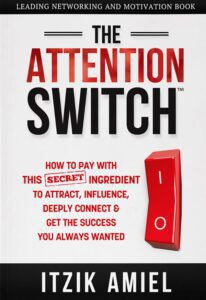
The Attention Switch: How to Pay with This Secret Ingredient to Attract, Influence, Deeply Connect & Get the Success You Always Wanted
You touched a very interesting one that nobody ever asked me in any show. You told about the book and about the fact that it was compared to Dale Carnegie. Here’s a secret I never share to nobody. The first book I ever read in my life was from Dale Carnegie, How to Win Friends & Influence People. I’m an Israeli originally. I read it in the Hebrew language. I remember finding it on the shelf in my room. It was owned by my father. He declined that he ever read that book. He doesn’t know about this book. I know it looks like, but I could not find this book anymore.
Since that day, it has influenced my life. I used to give it to a birth or for friends, but I never used to talk about it. It’s almost taboo in the legal world to talk about how to influence people and win friends while you are miserable. You have to do it. Nobody will understand. It’s almost like Napoleon Hill’s Think and Grow Rich. If people go, “I don’t want to be rich,” it’s not about that. It’s about thinking, mindset, ability and skills. We’re celebrating them but many years ago, nobody did.
I was embarrassed to say that I love people. Can you imagine? That’s a true story. This is my real story that my bestselling book, The Attention Switch, starts with. I hid this story for all my life as a lawyer. It’s from February 25, 1996. At the time, I used to live in Israel and work for a law firm in Tel Aviv. I’m originally from Jerusalem. My girlfriend then, which is my wife now, was working as an au pair in Jerusalem.
You know with boyfriend-girlfriend, I’ll sneak few times a week to Jerusalem and stay with my girlfriend. Early in the morning, I go to the bus station and from there to the center station to go to the Tel Aviv office. In that morning on 25th of February, ‘96, I woke up. If you work with me, I’ll have coffee. I was about to go to get the bus. At the station, my girlfriend hugged me. I ran and I missed the bus. It’s always the same routine. People stay in the same place. You’re going to know it because if you miss this bus, you miss the next connection and you’ll be late.
I remember being annoyed to wait there. Twenty minutes later came another bus. I was on the way to the center station in Jerusalem. There were police who stopped the bus. In the ‘90s, there was a lot of incidents in Israel, terrorists attack, all kind of stuff. We were curious about what was going on because we had to go from a different way to the central station. We asked the bus driver if he could open the radio so that we could hear what happened exactly. At that moment I heard that the first bus I was going to take exploded and everybody died.
You wouldn’t be with us if you got on that bus.
[bctt tweet=”Give attention when you love somebody.” username=”John_Livesay”]
I never shared that story. If you go over to Jerusalem, that’s a big place, though. It was the biggest terrorist attack we had. They had the same bus, same number and same hour the week after again, which was a very crazy incident. I will never think once I was miserable. I had power within myself. I was very successful. If you’re asking me, John, what was the time that I endorsed life and people? That was the moment.
My girlfriend is my wife now. This hug that I talked about is the act that I based all my life, the act of giving attention. It is the period of Corona. I guarantee you, John, if you go to an event, people meet and start hugging each other, count on me. Feel the feeling that people can transfer to each other but just warm hug. Without talking, pitching or anything, you can transfer it to another human being so much more warmth, love, care and empathy. “I’m here for you.” It’s everything you want with just a hug. That can be an act of giving attention.
That brings me to one of the things in your book, where you call it The Hug of Your Life. Can you tell us that story?
That’s exactly the hug of my life. When my girlfriend hugged me, because of that, I have my life. I will talk about this metaphorically, but also strangely enough, when I speak on stages around the world, it’s not in my culture. We don’t hug in Israel for business. People are thinking we hug, maybe in the Middle East but not in Israel. When I spoke on stage, people came around and hugged me. It’s unbelievable. I even caused people to hug each other. For me, more than the symbol, it’s a way of people understanding human-to-human. “I don’t care who you are or where you are from.” Nobody can ever convince me.
I don’t necessarily look like an Israeli or a Jewish. I could look like an Indian, Brazilian, Spanish or Arabic. I look like everything. I use that all my life to show people how miserable we are when we judge people. You’re missing so many opportunities. John, when I was speaking on the big stages and you know yourself, there are many very known figures. I’m the unknown guy doing the big stages. Everybody that’s there was Les Brown, Dalia Lama and Richard Branson. I’m the unknown guy.
I will not sit in the green room, John. There is so much bullcrap there. We don’t like that. I’ll sit between the audience somewhere in the back. I’ll talk to people. I look at the brochure. In the brochure, whose picture is there? It’s the speaker. They’ll say, “Who’s this guy? Who’s the speaker” It’s me, but I say, “Let’s see what they’re going to tell us.”

Attention Switch: Scientists prove that attention is a muscle of the brain. You need to practice the muscle of attention.
Suddenly from the big stage, they announced, “Ladies and gentlemen, our next speaker is Mr. Itzik Amiel.” “That’s my turn. I have to go.” People will look at me and say, “I’m sorry.” I’m going to use that because in the middle of my presentation, I’ll ask this person to stand up. “How did you feel you didn’t know who I am? I was not important, but you connect me out of authenticity.”
When people stand in line and they want to hug you and take a picture of you, I’m not sure what they want. I always believe you build a relationship for a reason, season or lifetime. I’m begging each one that’s reading to stop building a relationship for a reason or season because you’ll be miserable. Every relationship we build, build it for a lifetime. When I look at a person, I said, “Will I be a friend of this person the rest of my life?” If the answer is no, don’t walk away from them because it’s embarrassing. Run away from them. You don’t want these people in your life.
There are so many things you’ve said here that I want to recap for the readers. One is when you don’t have something go exactly the way you think it is. I was flying back from surprising my sister for her birthday party in Chicago to Austin. The plane was delayed. I’m like, “I’m not going to get home until after midnight.” You can get frustrated and annoyed or you can zoom out again and go, “There must be a reason I’m not supposed to be on that plane.”
The other thing I love about who you are as a person is I can feel your energy come through. That is a reminder to everyone that what you’re offering people is your energy. I remember once I was interviewed for a speaking gig and the agent emailed me, “Congrats, they picked you. They liked your energy.” I thought, “There it is in writing.” It’s not our credentials or the outcomes we’re going to give people. The client said, “I felt so good after talking to you. I figured you could make all of the people in the audience feel the same way. We want to learn about ROI and all that other good stuff.”
Whatever it is you’re selling, whether it’s to get funded, get people to join your team, start using your app or buy your product, if you can remember that you’re selling energy and money is energy in action, it totally shifts how you interact with people. You’re a walking talking example of that, which is why we become friends. I love it.
The other thing I want to ask about is this beautiful visual you’ve created called The Rainbow of Attention. You’ve got some great distinctions. Let’s go through all of them because they merit a chat. We all know what a rainbow is, but we don’t realize that there are some differences between giving attention versus getting attention. How did you come up with this wonderful concept of a rainbow?
[bctt tweet=”Build relationships for a lifetime, not a season. ” username=”John_Livesay”]
The first is out of frustration, for example, in our days in social media. If you look at it, every marketing on social media online is based on the act of getting and grabbing the attention of the audience. People measure your success by how many likes you get and how many people give you attention. I don’t care about that. I care about those people watching it. They say, “Why don’t I get likes? Why did I get only two? I’m miserable. I’m nobody.” You see all this stuff. I hate it because I feel bad for those people. It’s not true. I wanted to show it, so I’m helping more than 25,000 professionals that don’t go to some LinkedIn or somewhere else.
I’m doing everything behind the scenes, like in the messaging. I’d build the relationship. By showing them, they’re getting huge deals. If you look at the profiles, it’s like, “I’m a miserable person. I get only two likes and then a few posts,” but behind the scenes, the opportunities, the relationship building is unbelievable. We have the biggest scars in our world of getting and giving attention. How many people, when you talk to them, shut up their mouths and listen to your story? In networking, what I teach is you don’t need to speak. The introvert among us knows that. It’s not about talking. There are other network jerks many times. Listen from the bottom of your heart.
Stephen Covey talks about seven ways of listening, synthetic, inactive and disactive, whatever it is. Listen with all your heart and soul. Not dreaming what you’ll eat at dinner while speaking to another human being. Not floating around with a face while talking to somebody. Being there in the moment, you’re going to magnetize the soul of the other people. They don’t even know what happened, but they felt in their gut, “I want more from that.” You don’t even have to give them your business card or tell them the name. I promise you, they are going to find you who you are because they want more of that. They will find an only excuse to find again where you are to go there to invite you. They’ll pitch you on themselves.
John, don’t get me wrong. It’s frightening to a lot of people. Some people talk to me where they met me as a stranger and within minutes, they’re telling me the deepest secrets of their life. There comes a moment where they look at me and say, “I don’t know why I told you the story.” I said, “Relax. Enjoy it.” Attention is not an artificial thing. Attention, as proven by scientists, is a muscle of the brain like you have muscle on the body. It’s like if you go to the gym to practice your muscles, you also need to practice the muscle of attention.
Let’s give our readers a little exercise. Let us ask each one of you there, what do you hear in the room where you are? Maybe it’s the birds, a car driving, some screaming children, the pot or TV. What is out there? It was a tricky question, John. All those things are there all the time, but their brain is choosing to give attention to us. Do you see what the power of it is? From all the noises in the world, from all the sounds over there, they shut them all off and give full attention to one human being. That’s why in English, you say, “You pay attention.” It’s a financial term. Which other thing could you pay with? If you could pay with attention, they’d be a billionaire without money.
One of the biggest compliments I can ever give someone or that I can ever receive is that someone would say to me, “I feel safe to be myself with you.” That goes back to what you were talking about, the magnetizing of the soul that causes someone to open up because they feel like you’re not going to judge them. That sends any kind of basic rapport 101 because you’re getting an emotional connection, which is how we all want to connect.

Attention Switch: Speak slowly and articulate the word.
That’s why people are missing an opportunity in networking. A lot of interesting people in networking don’t stand in the middle of the floor. They’re somewhere on the side. Think about it. If you’re a CEO of a big company, you don’t want to see people to bother you if you want to come and listen to whatever lecture. You’ll sneak in the back and stand.
You’re a speaker. I’m a speaker. When we go and sneak in to watch another speaker on stage before we’re done, where are we going to go? We’re going to go in the back of the room. If you want to connect with people, find them in the side of the room. You will be surprised by what amazing people they are. Everybody will miss it because everybody looks at these people in the middle. They’re talking to everybody there. Talk to the one in the side. The one in the room, don’t worry. You’ll meet them one at a time. The one on the side, they are many times crazier than great people. I promise you. You’ll be surprised how amazing people you meet. Only give them attention. That’s all that you need to do.
You also have a distinction between positive attention and negative attention. My first thought is, “If I do something stupid like trip or drop food on myself, that gets me negative attention.” I’m guessing you have a different meaning here.
When I wrote this chapter, I was in a hotel in whatever conference. I was sitting with friends and talking about it. We start discussing philosophically. I don’t remember exactly the detail, but there was an incident that happened with the lady there. I could see the look on her. She didn’t have to say much, but it looked like, “I’m going to kill you,” with the eyes. You know that’s not positive attention, but she gave you the entire message by her two eyes looking at you.
I remember even when I was a child, my mother used to open her eyes and we know exactly that we didn’t behave nicely. These are the ability to transfer. You could use it. It’s positive-negative but not in the sense of discouraging you but more of warning you and stuff like that. Some of them is awareness alerts. “I’ll wait from here. You’ll be in danger. Don’t put yourself in danger.”
Attention is a muscle. You need to learn how to play with it. I’m playing with it a lot in airports, John. It’s also connected to body language. I used to think that attention is about eyes. I thought people give attention with their eyes. When I did the book, I found the research. It’s bullcrap. Do you remember the time you called somebody? You’re on the phone and suddenly they’re silent. “Are you still there?” We need the sign of attention. People do it in different languages, cultures or ways. They will do something or symbolize it. You know they’re giving you the attention. It has nothing to do with the eyes. A lot of it is based on the brain, how the brain works or the brain need symbols.
[bctt tweet=”Don’t put yourself in danger. Pay attention. ” username=”John_Livesay”]
Here’s another tip for people. If you want to get people to listen to you to know that you’re given attention and even you are the best expert in the world on this subject, you know so well everything about it, if somebody asks you a question, count 1, 2, 3, and now go out and answer the question. Why? It’s because the brain of the other person has to perceive you’re listening and giving attention. If you don’t give this time of silence and you answer right away because you’re the expert and you know the answer, the other brain said, “You didn’t give attention to me,” and then you lost them.
I’m big on teaching people about the concept that confident people are comfortable with silence and pauses. That completely supports what you said. You might be the expert. If you’re the expert, you don’t have to prove anything to someone else. You can be comfortable with that silence of three seconds or whatever it is before you answer, not without worrying about, “People think I don’t know the answer.” No, you own the room.
It’s the same thing when you get up to speak. You don’t necessarily have to start talking fast right away. You look at the room and the audience. You take it in and then you begin, but that takes a lot of confidence to be comfortable with not rushing through what you want to say. It’s a very unconscious thing sometimes when people talk too fast. It’s nerves plus the fear that, “I’m losing the audience. What I’m saying isn’t interesting enough, so I have to talk fast.” If you’re comfortable, you can take a pause between your thoughts.
That’s a very good one because I had to learn that myself. I tend to speak fast because I think fast, but with an audience, if I don’t think fast and I start speaking slowly, they’ll think I’m thinking they’re idiots, but it’s not true. What you said is exactly right. If the idiot will speak slowly, articulate the word and give poses, they let it sink and go even deeper in them. They get you more and they’re with you.
This is why I talk about speakers or people speaking. For example, if you go to the audience, you come in the morning and you know those speakers come in the morning, they say, “Good morning, everybody.” There are two people who answer, “Good morning.” Some of us goes, “I said good morning, everybody.” Everybody shouted. That moment, you lost the trust of the people because they gave you what they want and now you manipulate them. It takes fifteen minutes to get the attention back.
That’s why the pauses are so important because what you get is the biggest gift people give you and that’s the biggest commodity of their times, the thing that does not come back. It’s something that Microsoft did in 2005. Probably every entrepreneur know this, they do not know that Microsoft did it, but they searched the attention span of a human being. They found that in 2000 it used to be twelve seconds. 2013 was eight seconds. In 2021, who knows where it is? Do you remember what has one second more attention span from the human being? Do you know which one was that?

Attention Switch: When you let your brain relax, it will show you where the opportunities are.
Is it a goldfish?
Exactly. Don’t ask me how. I tried to see a goldfish in the aquarium. I couldn’t get its attention, but that’s what the research shows. That’s how sad it is. When it comes from that point of view that is declining, you need to know what people pay attention to because they’re going to be more and more things coming our way to steal this attention. More instruments, TV, iPad, telephone, people, all these things. How do you select what to give attention to? That’s the skill. If you know, you’ll succeed. If you give it to the wrong thing, you lose. The time’s gone.
It’s the same to network. You go to an event. You need to know who the people you want to meet are. You enter the room with 5,000 people. How will you know who to talk to? You have a two-day event. You know you’re not going to meet everybody. How will you meet the right people? Here’s a secret, John. It’s shown by research. When you go to the room, do you agree with me, John, that you are probably going to see maybe 10, 15 faces? You pick them up. The person with these glasses or the lady with the red scarf. What happened? Here’s what the research shows.
With all the 5,000 faces, your brain scans the room. The brain compares them to the library you have in your head because you have the library all the time. You cross the street. You see strangers. Your brain said, “Like, don’t like.” The brain is doing it all the time. It’s updating the library. When you’re in a room, the brain compares all these 5,000 people and shows you on the silver tray that you have 10 or 15 people you must go and speak to because something awesome comes out of it.
What most people do is push the delete button and start talking to everybody. Let the brain relax and it will show you. If you don’t have a good memory, take a pen and paper. Write it down, “The person with the red glasses. The lady with the blue scarf.” Now talk to these people. I promise you. You’re going to be so shocked. You’re going to find commonalities and opportunities in seconds. Within an hour of networking with ten people, you get opportunities. You have two days to enjoy. You have no stress. You don’t need to meet anybody else. Everything else is a bonus. This is a new thing.
The artificial intelligence inside of our brain is scanning. We just have to trust our gut. Is that what you mean when you talk about spontaneous attention versus planned attention?
[bctt tweet=”You have to be careful when you introduce the wrong people because you build relationships for years. ” username=”John_Livesay”]
That’s more out of frustration. In most of the professions I know, when they build relationships, they build it on most serendipitous attention. They go there and meet some nice people. They maybe follow up something to get you a referral. “Networking works.” To those people reading who want to build everything on serendipitous networking, do yourself a favor.
Don’t go to a networking event. When the world comes back to normal, sit at the airport in your country and meet awesome people. Each one of them could be a client. You’re not going to go wrong every day. If that’s what you want, but that’s not how you build a business because it’s not predictable. When you build a business, you need both, the planned and serendipitous.
Serendipitous is a cherry on the pie. It sounds nice, but if you have planned, then you know who you give attention to, why you give attention and when do you give attention, you’re going to get results and everything above it is an extra. This is the fun thing. Unfortunately, a lot of professionals build their business only on the serendipitous without any predictability on the model. In networking, most people don’t have predictability. They don’t know what they do. They just want somebody who told them to go to events.
All those are important things, we forget them. It doesn’t take the authenticity of it. It’s not manipulation. A lot of it is preparation. You prepare and you know who you meet. Nowadays, people are doing things online. Before you meet people physically, start building a relationship online. When you meet them physically, you feel like you met them years ago, but you just met them the first time. That’s the power of it.
I teased it out in the introduction that you have a mastermind. Can you tell us who that’s for and how you decide who you let in?
That’s a way to bring yourself back. As you know, I own Switch, which is a big training company, as well as Done For You Services for a lot of professionals around the world, but there’s one thing I was missing. My career was as a lawyer and accountant. I was helping companies expand internationally. This is my expertise in tax, legal and M&A but also in other subjects of the matter.

Attention Switch: Start building relationships online.
That’s where I started my career as an entrepreneur. I wanted to do that because I felt like the big companies know how to do it that maybe medium and a small entrepreneur doesn’t know. Some people have an amazing product, but they’re not okay. “I need to sell it somewhere else, but how do I do it? I don’t have the money to travel.”
I used to travel every two months to Brazil, India, China and Ukraine. I was traveling the world. No one paid me. The boss paid the bills. Each travel like that is $5,000, $10,000. That’s a lot of money for a small entrepreneur. The idea was, how do you find them the right opportunities faster? They don’t need to build twenty years of relationship, but they have the product. That’s all I did. It’s shaping and hopefully, we’ll go out with it for the first group. It’s very limited. It’s about 8 to 10 people because we wanted to get the business. It’s not theoretical teaching or something. All I did behind it was tap into what I call network intelligence or the power of the crowd.
There’s a lot of knowledge in there that people do not know and can solve the solution, thing that looks like, “How do I do it?” People solved it before. If you get your people to solve it and give you the answer, then you don’t need to look for consultants to do it. That’s always cheaper but also more valid and specific. They were in the franchise, so it’s not a book to read or something. We build it around global expansion. It’s mainly for entrepreneurs that are successful, maybe selling the product locally and want to expand to a new market but also those who have a good product that didn’t sell it locally. If you have lifeguard services, but you live in this area, you don’t sell it inside. You need to look.
Don’t get upset. Don’t bankrupt yourself. Maybe you’re in the wrong market. Maybe the other market is dying to have your product. I have a lot of companies that I helped in the past that I was shocked to see that they didn’t sell a single product in the local market. Let me tell you this. Many people who specialize are using that. They’ll buy it for pennies because they know they can take it to another market and sell it for a lot more money.
For example, the Canadian Goose, the coats. Once it starts declining, the German guy, after many years trying, has to sell it. The next person who bought it, within five months, sold it in a new market and made 100 times more money. People are doing things in the wrong market. There are lots of opportunities, but for me, it’s more selecting the right people that cannot be mass destruction with hundreds of people. It’s dedicated work and relationship-driven. They seem to know CEOs of company or top levels of relationship as well. You have to be careful when you introduce the wrong people because it’s something you have built for years.
When it’s up, I’ll let you know. We call it The Global Expansion Incubator. It’s not a mastermind. You know what a mastermind is. A lot of people, unfortunately, misuse the word mastermind to not make a mistake. It’s a place where you take people and expand the business internationally. That’s what I did behind it.
[bctt tweet=”Where attention goes, energy flows. ” username=”John_Livesay”]
You’re uniquely qualified for that. That’s for sure. The book is called The Attention Switch. If people want to reach out to you or follow you, what’s the best place to send them?
LinkedIn is the best place to find me. I’m always answering and active over there as well. Unfortunately, I don’t do much on Facebook. I have there a lot of followers but don’t look for me there. If you want to have the book, The Attention Switch, go to AttentionSwitch.com. The reason for it first is the limited edition. I have two versions of my book. The limited edition is four chapters more. I signed the book. It’s a free gift as training but also the most important thing, the money goes to charity to support the kidney foundation in the Netherlands because my mother died from kidney disease. It’s the same price like Amazon, I promise you, but it’s a different version of the book I made as a lawyer.
She’s 1 of the 4 women that you dedicated the book to, I saw as well.
My mother is the reason I’m speaking as a lawyer. People ask me, “How did you shift from being a successful lawyer? This is strange.” A lot of people don’t even know I was a lawyer because every brand is so good that I’ve hidden there. If you look at my profile, you won’t find it. I’m no lawyer than a speaker.
A short story is there were thousands of people at my mother’s funeral. I didn’t get it. I was like, “My mother is not a celebrity.” I asked one lady at my mother’s funeral, “How did you know my mother?” She said, “I don’t know your mother.” I said, “What are you doing at her funeral?” She said, “Your mother was a very special person. If somebody was sad in the corridor in the office, she would encourage them, speak to them, tell them good things and then she’d go back to her room. We didn’t know your mother, but we knew that’s the lady sits in that room.” When the lady in that room died, they all came to her funeral.
I remember sitting with my father and my four sisters on Memorial Day, which is the seventh day when we do it in Israel. I knew my mother never knew it. I said, “I hope she could see that because she never knew it in a lifetime that she touched so many people.” I promised myself that was the time for me. During my lifetime, I want to feel that I helped a lot of people. I don’t want to wait until I die. That’s the shift that I made of what I’m doing and the rest is history.
Thank you so much for bringing your energy, your wonderful stories and teaching us how to pay more attention and how to get it without being pushy.
Thank you very much, John, for the opportunity. Remember, where attention goes, energy flows.
Important Links
- The Attention Switch
- How to Win Friends & Influence People
- Think and Grow Rich
- LinkedIn – Itzik Amiel
- Better Selling Through Storytelling Method Online Course
Wanna Host Your Own Podcast?
Click here to see how my friends at Podetize can help
Purchase John’s new book
John Livesay, The Pitch Whisperer
Share The Show
Did you enjoy the show? I’d love it if you subscribed today and left us a 5-star review!
- Click this link
- Click on the ‘Subscribe’ button below the artwork
- Go to the ‘Ratings and Reviews’ section
- Click on ‘Write a Review’
Love the show? Subscribe, rate, review, and share!
Join The Successful Pitch community today:
- JohnLivesay.com
- John Livesay Facebook
- John Livesay Twitter
- John Livesay LinkedIn
- John Livesay YouTube
Unbias With Stacey Gordon
Posted by John Livesay in podcast | 0 comments


Unconscious bias stops you from seeing someone qualified enough to do the job. John Livesay’s guest in this episode is Stacey Gordon, author of UNBIAS: Addressing Unconscious Bias at Work. Stacey discusses with John how experiencing exclusion as a black female herself inspired her to write this book. People often hire people who look like them. We have a misguided notion that whatever we have done is the best way to do it. We dislike difference and change. Listen to this episode to discover how we can work our way to diversity and inclusion. Tune in and be unbiased!
—
Listen to the podcast here
Unbias With Stacey Gordon
Our guest on the show is Stacey Gordon, the author of UNBIAS. She said people recruit for differences but hire for sameness. Find out what she means. She also said a coworker is not a relationship, it’s a label and that real leaders do, in fact, see color. Enjoy the episode.
—
Our guest is Stacey Gordon, who is leading the intersection of diversity, inclusion and workplace culture. In her role as an Executive Advisor and Diversity Strategist, Stacey coaches and counsels executive leaders on these strategies while offering a no-nonsense approach to education for the broader employee population. She’s the creator of the number one resume course at LinkedIn Learning and an Unconscious Bias course which has consistently been the second-highest viewed course on the platform. It is translated into at least four languages and featured by LinkedIn, Microsoft, and Virgin America, which is now Alaska Airlines. Stacey, welcome to the show.
Thank you, John.
I see that you also teach at Pepperdine, where you got your MBA. My friend, Claudio Ludovisi, has been in the Marketing Department attracting people like you to come to take their MBA. It’s certainly a beautiful campus and a beautiful place. You have a book out called UNBIAS: Addressing Unconscious Bias at Work.
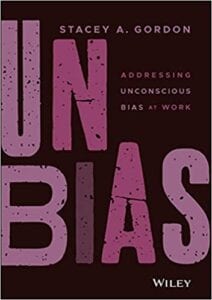
UNBIAS: Addressing Unconscious Bias at Work
It was released, and we are still promoting and talking about it and spending a lot of time focusing on the tenets of the book.
Before we dive into the book, let’s do a little background on your story of origin. You can take us back to childhood, school or wherever you want to start your story.
I always say, “Where do I start on this journey?” There are so many places I could go with it. I’d like to talk a little bit about the fact that the work that I do, I think my background, my childhood helped me prepare for this, which I did not know. Because I have always been the odd person out and it makes it very easy for me to relate to others, to be comfortable talking to different types of people and inserting myself in things even when I probably wasn’t invited or I wasn’t expected to show up. It’s like, “I’m here.”
Did you grow up in Southern California?
No. I grew up in London and then my family moved to Brooklyn, New York.
What was it about that place that made you feel like you didn’t fit in?
I did not fit in London because I was always one of the only black kids in my school. It was pretty tough for a little while there. I had friends that stopped talking to me because their parents told them that they couldn’t play with me anymore because I was black. I had kids that would hurl stuff at me and also, I remember being in that era too, where there’s a lot of very large Indian and Pakistani population. A lot of the cornerstones over there are owned by individuals who were Indian or Pakistani. There was a lot of hate crime, stores being burned down, swastikas being put up on the walls and a lot of riots and things going on. I was a kid and I don’t remember exactly what was happening, but I remember being scared.
One of the whole premises of childhood is to try and feel safe and I’m sure that was hard on your parents if they felt like you didn’t feel safe.
It was probably why we moved to Brooklyn. My mom’s family lives in Brooklyn and everyone there was black, so we’ll all get along. It’s like, “Not really,” because now I’m a black kid with a British accent in Brooklyn.
You still stand out. How did you decide you wanted to come to the West Coast, go to Pepperdine and focus on this particular niche? Obviously, you have lots of choices of what to do with your degree.
I spent a lot of time in New York City. It was expensive and again, being a person of color, it was like, “Do I want to stay in Brooklyn? At the time, we had a lot of crime and a lot of things going on. Is this where I want to grow up and raise a family eventually?” I lived in Manhattan for a couple of years. We couldn’t afford to continue to do that and realized that we had to leave in order to try to be able to make our dollars stretch, which is how we ended up on the West Coast and eventually in the LA area. We have been here longer than I’ve lived anywhere else.
That’s funny when you cross that mark. I grew up in the suburbs of Chicago for the first 21 years and then I remember passing 21 years in California before moving here to Austin and I was like, “I’ve been in California longer than I was in my childhood.” Let’s dive into the book and your website is Rework Work. That’s intriguing to me. Tell me how did you come up with that story.
[bctt tweet=”Coworker is not a relationship; it is a label. People recruit for difference but hire for sameness. ” username=”John_Livesay”]
I love the title and the name of our company. It came out of frustration as a lot of things sometimes do. I was working as a recruiter. I was running a recruiting company and at the time, I was operating under the Gordon Group. That was the name of my company. I was talking about that the usual, client work and the things that were going on. I was so frustrated. I said, “We need to rework recruiting, onboarding, training, advancement, and everything. We need to rework work.” I thought, “I like that. I wonder if anyone’s using that.” No one was using it. I did a trademark search and did the whole thing. It was like, “Wow.”
I’ve spoken to a lot of recruitment firms for their annual meetings, whether they’re Korn Ferry or another company, they all have to compete to sell themselves to get hired by a big company to find their next C-Suite level people. That was an interesting journey to look at their business model and how similar it is to other companies like architects. They have practice areas where people specialize in a special kind of thing.
A lot of recruitment firms are trying to get diversity within their own company, as well as offer diverse choices to companies that are hiring. The thing I keep hearing, and I want to get your opinion on this, is there’s not a lot of choices out there that fit that criteria. Has that always been the case? Do you see it changing if that is the case? For example, in the venture capital world, there are very few women, let alone women of color. If they want to fix it but don’t have people that have the skills to hire to fix it, how do you advise them?
They have the skills. There are very few women in the venture capital world because we won’t hire women in the venture capital world. They exist. I have to keep telling people like, “We’re not tooth fairies or the unicorns. We do exist.” The problem is that unconscious bias stops you from seeing me as somebody who was qualified enough to do the job when honestly, I’m probably twice as qualified as half the people there to do the job and I’m being real. There are people who are absolutely positively qualified to do it, but they are not seen as qualified as such. If we use the example of one of the women who is now going to be representing America in track, a black woman. She got blue hair. I’ve seen different pictures with different-colored hair. She’s got tattoos all over her. She is queer and got long nails. Here we are. We’re celebrating her. She’s going to represent the United States.

Unbias: Unconscious bias stops you from seeing someone qualified enough to do the job.
If that woman showed up at your job and said that she wanted to be hired, you would usher her out. She wouldn’t even get her foot in the front door. Here we are celebrating this person for being able to do the job she’s tasked to do regardless of how she looks. We have to realize that always we have been able to do the job, but because of how we look, we have not been seen as able to do the job. We have been turned away. We have been discriminated against, ignored and passed over. It is time for that to change.
One of the things you talk about is unconscious bias. It’s one thing if someone says, “I want to work with people that look and sound like me.” That’s obviously conscious bias.
Conscious bias is discrimination.
It’s one thing for people to know they’re doing it and maybe own up to it internally or whatever, but the problem from my perspective is there’s a lot of people who are unaware. That’s what your expertise is that it’s not biased, it’s unconscious bias. I’ve seen this when I was selling advertising at Condé Nast and I had worked at different magazines. I’m like, “All the women here are brunettes,” or at another place, “All the women here are blonde.” It was on some weird level, people are hiring people who looked like them and that’s within the same race. I can only imagine and I think that was an unconscious choice. The blondes wanted to hire blondes and vice versa.
We have a misguided notion that whatever we have done is the best way to do it. Others who do it the way that we do it, we like them. We don’t like difference and change. We recruit for difference, and then we onboard for sameness.
People hire for difference, is that what you’re saying?
We recruit for difference and we onboard for sameness or hire for sameness.
You’re saying, “I want to look at a lot of different kinds of people,” but at the end of the day, you hire someone who’s like everybody else in the company.
The thing is though, we go out there and we say, “We want diversity and difference,” but when you hire that person and you bring them in, you then say, “Do it the way it’s always been done.”
You need to fit into our culture. Don’t be yourself basically.
It’s like, “Why did you bother to go out and look for diversity in the first place?” When they don’t fit in the box that you want them to fit in, then you fire them or you say, “They weren’t a good fit. It didn’t work out.” The other thing is this notion that because there are fewer people that they’re not as qualified and that is so far from the truth. Every time I hear someone say, “I’d love to hire a woman in tech, but I don’t want to lower the bar.” I’m going to be honest. I want to punch them in the nose because that is so insulting. There are so many people who have not been given the opportunity and I get it all the time.
People say, “I treat everyone fairly. We hire people for skills.” That’s absolute BS because when you have your friend, Mark, who you’ve been hanging out with for months or years, that person gets the benefit of information and mentoring from you and learning the ropes informally. When it is time to promote, he’s ready because you’ve been grooming this person, but everyone else, you don’t talk to them. You don’t invite them to lunch, hang out with them on the weekends, golf with them and provide them with the same level of access.
One of the things you talk about is you help employee resource groups. Can you tell us a little bit about what that is and how that works?
[bctt tweet=”Conscious bias is discrimination.” username=”John_Livesay”]
Employee resource groups, you have an employee business group, business resource group, they used to be called affinity groups. A lot of companies now are creating them if they don’t already have them. There has been some controversy with that, too. It’s like, “Why are we separating? Why do we need to have a women’s group, black group, LGBTQ group, and Asian group?” The reason is that we have to focus on what are the systemic problems within the company that are affecting that so that we can all work towards fixing them. It’s not a group that is only for black people to join, it is a group that is focused on what is preventing black people from being promoted within your company. It’s not a group for only the gay people to join. It’s a group that everyone gets to participate in to look at what might be some of the barriers and some of the obstacles that we have created that would be problematic in this workplace.
It wasn’t that long ago. I would say even in the ’80s, they were looking for people who had families to promote because they’re like, “We like to have a guy who’s got a wife and maybe a kid or two, so they’ve got all this responsibility, mortgage, and child support to pay that they’re not going to take any risk and leave the company or start their own thing.” That’s our world. If you were single regardless of your gender preference or race, that alone used to ixnay you if you weren’t married. The list was so long of what was expected. Now that we’ve identified it clearly, I don’t think it’s a surprise to anyone reading, except maybe the depth of it might be a little eye-opening hopefully, but how do you help companies solve this problem?
The way that we do it is by exactly what you said. There’s a laundry list. There’s no point looking at the laundry list of things that we need to fix. It’s not about the individual laundry list of demographics and issues. If you’re single, you get discriminated against for this reason. If you have a baby, you’re discriminated against for that reason. You’re tall, short, blonde, fat, ugly, white, or whatever. As humans, we are always going to find reasons to exclude people. It is in our DNA.
The job is to know that and to counteract it. We have to be aware. That is the first step in the book. It’s awareness. We’ve got to be aware. We have to open ourselves up, be educated, and realize that this is a problem. We all do it and be open to realizing that this is what we all do, so then when we make decisions, we can remind ourselves that, “I need to make this decision and not make one that is going to be based on my gut feel, fit, or anything that I can’t quantify. Instead, I’m not only about to make a decision. I need to make sure that I’m going to make this decision based on facts and actual data that I have at my fingertips.”
So many people pride themselves on making gut decisions on the hiring and you’re saying, that’s probably going to tap into some unconscious bias. The other thing you talk about is leaders lead teams who trust and I’d love to hear how you help leaders build trust.
One of the ways that leaders build trust is by being open and being authentic, even getting to know people. We show up to work every day and we believe that we have a relationship with somebody because they’re a coworker. A coworker is not a relationship status, it is a label. We think that it’s okay. I’ll use this example because this used to drive me nuts. When I was pregnant, people would walk up to me and they would touch my belly without my permission. We’ve now come to realize that’s probably a little skeevy. We probably shouldn’t be touching people regardless of the fact that they’re pregnant. I used to complain about it and people would say, but they want to participate in the joy of you bringing a child into the world. “You, sir, are a stranger. I don’t care.”
It’s not about you. It’s not about what you want.
It’s the same thing. We want to get into these tough conversations. We want to have difficult conversations about race, sex, politics, etc., but I don’t know you. We haven’t created a relationship. Before you can dive in, we have to create a relationship. I need to get to know a little bit about you. I don’t need to know your intimate, deepest, darkest secrets, but I do need to know who you are as a person. I do need to know that you give a crap about me as a person. Once I know that, then we can start to develop some trust, then we can start to have some of these difficult conversations. Instead, we want to pull together a bunch of strangers, throw them in a room, and say, “Let’s have this conversation.” It’s like, “Whoa, Nelly! I’m not ready.”

Unbias: We have to focus on the systemic problems within the company affecting that group so we can fix them.
Until trust is built, then it’s someone’s sense of entitlement that allows them to touch a stranger’s belly without their permission. There are actual statistics taking females alone, let alone any other diversity, that female CEOs tend to outproduce men in the roles and yet, excuse predominantly male. There’s actual data, if I’m correct, that backs up that companies that have more diverse people working there have more diverse ideas and therefore, it can even be a competitive advantage than a company that does not. Is that accurate?
The statistics they are out there. If you look at Deloitte, McKinsey, and Catalyst, there are tons of statistics around the benefits of having a diverse workforce. The piece that’s missing though, is we also have to remember that we have to be inclusive because when you have a diverse workforce without inclusion, you have tokenism. We’re got putting people of color into positions strictly for window dressing.
We had a client and their job was to go out and do the sales pitch to get the work. They would make sure that they brought a woman and/or a person of color on that pitching team, but then those two people didn’t get to participate in the actual work. They didn’t get the opportunity to work on the project. Their face got to be on the project, on the documents and everything that went out. They got to be part of the pitching team, but they didn’t get to actually have the benefit of working on that project. That is tokenism. That is using somebody’s likeness to get ahead and that is not something that we want to be doing. That’s diversity with no inclusion.
You also talk about leaders’ need to not build trust, but listen. Obviously, if someone has, “I don’t like strangers touching my belly when I’m pregnant or anytime,” I’ve experienced this as an openly gay man where people say insensitive jokes and you feel like, “Should I say something? Who do I say it to?” If I say something, they’re like, “For God’s sake. Just get a sense of humor. Don’t be so sensitive.” Do you see that happening a lot around all kinds of things?
There are two things about that. One is, there is the sense that, “No one’s got a sense of humor anymore. We can’t joke anymore. Everyone’s so sensitive.” My response to that is we’ve always had to watch our mouths. We have parents. There are people in our lives who we respect and when we respect those people, we take into account their sensitivities and we pay attention to that. If my mother does not want me to curse, but I happen to curse like a sailor when I’m with my friends, when I get home, I find a way to somehow stop the F-bombs from coming out of my mouth. If I go to church and I talk to my pastor, I’m going to find a way to talk to that person and be respectful. Why is it that if you know that somebody doesn’t want to hear this specific joke or doesn’t think that’s funny that you want to be able to say, “No, it’s my right to be able to be an a-hole,” which is fully what it boils down to? You don’t respect that person enough to be sensitive to how they would like to be treated.
The final thing I want to talk to you about and you talk about it in your book, UNBIAS, is leaders see color. I think, again, an unconscious comment that white people can say to people of color is, “I don’t see color.” They think it’s a good thing to say and it sounds like you’re saying it’s not.
It’s absolutely not because it’s a lie. When we talk about building trust, how can I trust anything that comes out of your mouth when you start with something that is false on its face? You see color. You see that I’m black. This is not something that you do not see. You are not blind. It’s the first thing you see about me. You may even notice that before you notice that I’m female. When you say that, it puts everything else that you say into question because you start with something that is an absolute lie. What you should say is what you were trying to say instead, which is that I treat people the same regardless of color, ethnicity, or gender and then my question to that would be, “Do you? Let’s look into that.” The reason you won’t say that is because I can counter with that question and you would have to answer it, and that will be tough for you to have to do.
[bctt tweet=”When we respect people, we take into account their sensitivities, and we pay attention to that. ” username=”John_Livesay”]
Or even look at. It’s easier to gloss over it. I’ve never heard anyone frame it that way that it’s a lie and therefore, everything else is not based on truth. No relationship, work or personal without that foundation of truth is a house of cards. Any last thoughts or quotes you want to leave us with before we tell people how to reach you? Obviously, the book again, UNBIAS: Addressing Unconscious Bias at Work.
I want to say thank you. Our goal is to reach as many people as possible. However, we can do that, whether it’s purchasing the book, for your companies, for your company leaders, sending it to a friend, watching the Unconscious Bias course on LinkedIn Online Learning and all of those different things. What I’m seeing is that people are impacted positively and are realizing that they need to make a change. That honestly is the beginning and that’s what we need. We’ve got to start somewhere.
Let’s start with increasing our awareness. Stacey, thank you so much. Congratulations on all your success and I’m going to be cheering you on every step of the way as I watch you continue to grow.
Thank you.
Important Links
- Stacey Gordon
- UNBIAS: Addressing Unconscious Bias at Work
- Unconscious Bias – LinkedIn Learning
- Better Selling Through Storytelling Method Online Course
Wanna Host Your Own Podcast?
Click here to see how my friends at Podetize can help
Purchase John’s new book
John Livesay, The Pitch Whisperer
Share The Show
Did you enjoy the show? I’d love it if you subscribed today and left us a 5-star review!
- Click this link
- Click on the ‘Subscribe’ button below the artwork
- Go to the ‘Ratings and Reviews’ section
- Click on ‘Write a Review’
Love the show? Subscribe, rate, review, and share!
Join The Successful Pitch community today:
- JohnLivesay.com
- John Livesay Facebook
- John Livesay Twitter
- John Livesay LinkedIn
- John Livesay YouTube