
Sales Is a Team Sport
Posted by John Livesay in blog | 0 comments
The days of the lone salesperson going it alone and taking all the credit are over. Today is requires a team of people and not just people in the sales department to get a new sale.
When I interviewed Tim Sanders, author of Dealstorming, here is what he told me:
Dealstorming. Would you tell us that story of deal making and brainstorming from Yahoo days?
Absolutely. It actually traces all the way back to when I was at Broadcast.com. Basically, what happened is we got a new sales VP that came in. He had been with a variety of different startups that had gone from zero to a billion dollars. He knew that the problem for most of us is that we’re so underfunded in the startup. We’re just trying to do everything on our own.
He taught me in a meeting, “If you want to be successful, you’ve got to learn how to never go down alone.” That when you get stuck in a situation, say, trying to raise money, trying to make a sale, whatever. He says, “Build a team.”
What he taught me is the difference between a tall team and a wide team. A tall team is a team of people that work in line with each other all the time. In the business world, think of it like sales manager, salesperson, account coordinator. Those three, they work in a vertical line. A lot of times, that’s who’s collaborating to finish the sale.Those teams aren’t as successful as the wide variety of teams. For example, think of the account executive partnering with someone in the marketing department, partnering withsomeone in operations who actually delivers on the signed deal, and then partnering with someone in pricing, in the finance division.
That’s a wide team. Multiple disciplines coming together around an opportunity because they all have a stake in the outcome. The wide teams absolutely beat the tall teams in the market because when you bring together diversity, ideas bump into each other, perspectives collide together. That’s where innovation really happens.
When I went to Yahoo after the acquisition, I specialized in creating wide teams to conquer business development challenges. Whether it was trying to sell something, trying tobuy a company or look into an acquisition, trying to do partnerships.
We worked a lot on rapid problem solving because I believe that the speed in which we solve all those little problems that lead to the done deal is our only competitive advantage. Rapid, rapid, rapid problem solving is how companies stay great and get great.What can you do to build a team with rapid problem solving skills?To read more about selling, click here: https://johnlivesay.com/sales-keynote-speaker/
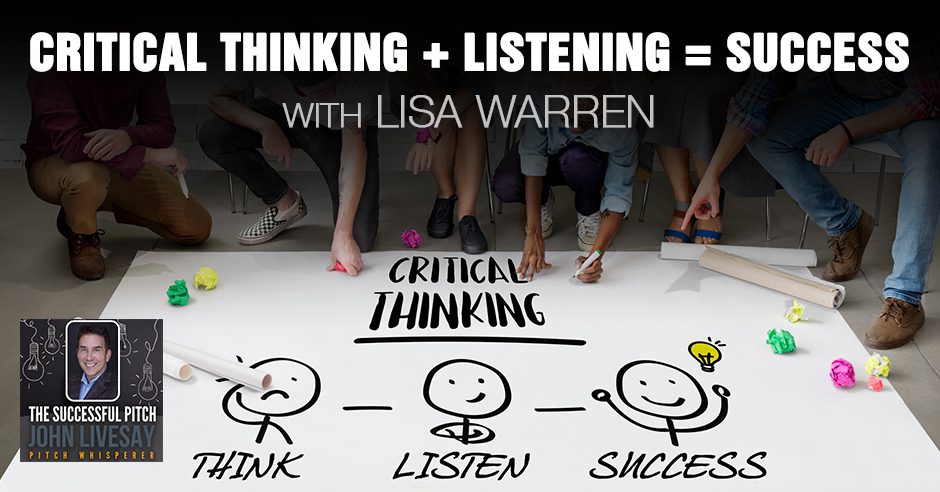
Critical Thinking + Listening = Success with Lisa Warren
Posted by John Livesay in podcast | 0 comments

Episode Summary:
Critical thinking and listening are two of the most important skills you’ll ever have in any kind of business. This is according to Lisa Warren, a partner at SpeakInc, which helps meeting planner clients identify and retain the brightest, most relevant speakers in the business. Lisa shares how she ended up working with speakers. She takes us through her journey and motivation and job transitions. Lisa enlightens us that along with business transactions, building a relationship is the key to be successful.
—
Listen To The Episode Here
Critical Thinking + Listening = Success with Lisa Warren
Our guest is Lisa Warren, a partner at SpeakInc, which represents top speakers around the country. Lisa started her career as a sports marketer and went to law school. While being a speaking bureau representative, she’s now a partner at the firm. She said, “Critical thinking and listening are two of the most important skills you’ll ever have in any kind of business.” She explains how she wants to go out and, “be in the trenches with the clients to see firsthand what’s going on.” While she’s doing that, she’s also checking out new speakers to represent. Before joining SpeakInc in 1998, Lisa has held various positions in sports marketing and PR. She became a partner in 2000 and she’s a graduate of the University of Colorado and of Concord Law School. She enjoys reading, writing and running as opposed to reading, writing and arithmetic. Lisa, welcome to the show.
Thank you so much. Thanks for having me on.
We had the opportunity to meet at a mutual friend’s event and I just loved your energy. You have this ability to smile and light up the room and make people feel instantly welcomed. Take us back as far as you want. It could be childhood, college or whatever when you started on this journey of becoming you and getting interested in communication.
My undergraduate work was at the University of Colorado. I’m a Colorado native now based in San Diego for about 25 years, but I was born and raised in Colorado. I went to CU Boulder and majored in journalism. At that point in my younger days, I desperately wanted to be an intrepid reporter. Back then, the newspaper was a big goal. It’s not so much the hot medium now, but I wanted to be a newspaper reporter. Fast forward through my journey as a journalism student, I quickly realized that I wanted to pair my love of sports with my degree. I began working in the sports information department working with the media and writing media guides and so forth. Coming out of undergrad, I decided I wanted to work in sports. To make the long story short, it’s a very difficult business to work in, especially as a woman back in the late ‘80s and early ‘90s. I had a wonderful opportunity to work with the University of Florida after I graduated. I was there when Emmitt Smith was there. I worked in that big-time college sports realm and did a lot of traveling and made very little money.

Critical Thinking And Listening: If you’re in your dream job traveling around and working with athletes, you will not mind not making a lot of money.
At the time, I didn’t need a lot of money. I’m traveling around and working with athletes. Media was a dream job and I had a lot of fun at that. That’s where I started off applying my journalism skills, doing a lot of writing and interacting with the media. At some point, I realized that I need to make some money here. I begrudgingly left the sports world and I ended up in San Diego working for a company which is now called Vistage. Back then it was called TEC, The Executive Committee. It’s an organization that works and operates on the theme of being lonely at the top. They organize meetings of small to medium sized company owners. They work in monthly meetings and I would book the speakers that would come in for these monthly meetings. The groups were comprised of leaders of different industries. They weren’t competitors so they felt free and open to speak about their business issues and come together monthly. It was a good opportunity for me to work with folks who were trying to better their companies and their organizations for their employees. That’s how I started off working with speakers.
That’s a great transition from working with athletes to working with top CEO people because there are a lot of similarities, discipline, focus, passion and personalities that come into play around all of that. Law school somehow happened in between there. What was the motivation there? That’s not something that you just see people casually doing.
I had been speaking for fifteen years before I decided to go back to school. I left Vistage at some point and came to SpeakInc. I started booking speakers and working with clients which I loved, but at the time, I just needed another challenge so I decided to go back to law school part-time. Fortunately, there’s a completely online law school, which at that point was Concord. It’s now owned by Purdue University. It’s a global law school. I was able to keep my full-time job at speaking and satisfy my need to engage my brain in a different realm and do law school part-time. It was a great and crazy journey.
[bctt tweet=”Listening skills and critical thinking are key. Get in the trenches with your clients.” username=”John_Livesay”]
Most people have relationship challenges during law school and the pressure that only one of the three of you is going to make it and all of that drama that goes with it. How have you used your law degree in contract negotiations for the kinds of speakers you’re doing?
That was one of the things that’s intriguing to me because I didn’t want to get out of the bureau business. I love what I do. I’m a partner with the company and have now been here for over twenty years. I wasn’t looking to leave, but I was looking for something that would challenge me and also compliment what I do every single day and that is negotiating contracts. That was super helpful. Law school is a great way of focusing your brain and you’ll think differently after going to law school.
I’ll never forget my sister coming out of law school and saying, “I don’t mean it in a pejorative sense.” I said, “What does that word mean?” She said, “Condescending.” I’m like, “Let me get this straight. You’ve used a condescending word that only lawyers use to say condescending and you don’t mean to be condescending?” We’re in a whole other world here.
You do talk a lot about reasonableness and whatever a person would think. There is lingo but it does sharpen your listening skills and your critical thinking. That can be applied in any business. Working with clients from all different industries in various levels and speakers who come from lots of different backgrounds helped me. It sharpens another tool in the toolkit.
I love that Maslow quote that if the only tool in your toolbox is a hammer, you tend to go around looking for nails to hit. I use that in my keynote talks as it relates to selling. The only way you know how to sell and get someone to close a sale is one hammer. There’s a whole new skillset available. I wanted to double click on what you said, Lisa, about critical thinking because it’s so important in these times of disruption. Almost every industry that I’m speaking to is being disrupted from technology to healthcare you name it. I’m assuming that critical thinking is a key way to handle disruption for your business.

Critical Thinking And Listening: Working with clients from different industries in various levels and speakers from different background can sharpen another tool in your toolkit.
It’s dovetailing on what you were saying about the sale. This business like many businesses is very much relationship. It’s not transactional. We work with clients that we’ve worked with for twenty-plus years and we’re very proud of that, but it does take a lot of critical thinking. It takes creativity. You’ve got to be prepared to meet the various challenges that come up in creative ways. Especially when you’re working with a long-time client, things are going to come up and competitors are going to come into the view. If you’re not willing to be creative, think critically, and be innovative with the way you engage your clients, you’re going to be in trouble.
What are some of the things you’ve noticed in the last five years out of the twenty that are ways that require some innovation both from your position as well as the speakers that you bring in or expected to innovate in some ways.
There are a lot of factors. Technology always plays a role not just in the last five years but I remember ten or twelve years ago, everybody was worried about disintermediation. Now their clients can go directly to the internet and look for speakers directly. They’re like, “Our bureau’s going to go out of business.” Fortunately, that answer has been resounding, “No, there’s always going to be a place for bureaus who take good care of their clients, know their preferences, go above and beyond, negotiate on their behalf.” The internet and just the access to information can be overwhelming. Another challenge that we find is having worked with some of our clients for so many years. We’ve got to constantly be finding new and up and coming speakers, but they can’t be so new. We’re worried that 100% they’re going to deliver. That becomes a big challenge and it’s a good challenge to have because it means we’ve got clients that we’ve been working with fifteen to twenty years. We’ve just got to always be on the lookout for new and interesting people to put a put in front of them.
The innovation comes in two places is what I’m hearing you say. One, technology has provided some access that wasn’t previously available. It’s almost like a travel agent, “If I can book my own flights, do I need the travel agent?” Yet it’s still a human connection that needs to come through when a keynote speaker up in front of an audience. It needs to come through in relationships because the technology can be very impersonal. The other part of what you just said that I find so fascinating is, “Bring us new speakers but make sure they’ve got qualifications that you trust because we trust you. We can’t keep having the same speakers over and over again.” Your ability almost reminds me of what I see here in Los Angeles of what agents need to do.
[bctt tweet=”Law school is a great way of focusing your brain which makes you think differently.” username=”John_Livesay”]
We’re going to give somebody a role in a movie that’s never been in a movie before. They have a movie but they’ve never been the lead or wherever the criteria is that allows you to tap into talent. There are a lot of people that always want to take their business up to the next level who are our audience. We use the speaking as a metaphor for everyone, whether they want to be a speaker or are a speaker. The concepts of what you look for of the speakers that you decide are, worthy enough being on your platform and that you feel confident recommending. Let’s talk about how important a book is, for example, in terms of authority and credibility.
A book can be very important. There are a lot of clients who have been doing this for a long time. They’ll say to me, “Great, he’s got a book but a lot of people have a book. A lot of people have access to self-publishing. What else did we get?” One of the things I’m focusing on for 2019 was when I go out to visit clients, which we frequently do. We find it very important to get clients. We do so much over email and phone. We make it our business to get out and travel and see our clients as often as possible. Speakers are in the area that I can tack on a trip and go see a speaker that I haven’t seen live. I can report it back to my client having seen with my own eyes and heard with my own ears.
It’s whole different energy. You see the people in the audience responding. It’s very different than a demo video.
I find that it’s hugely helpful and clients appreciate our ability to report from the field so I’m making a big push for that this 2019.

Critical Thinking And Listening: There’s always going to be a place for bureaus who take good care of their clients, know their preferences, go above and beyond, and negotiate on their behalf.
I’ve read and heard so many executives talk about the importance of getting out behind their desk. Let’s say if you’re Howard Schultz and you serve coffee at Starbucks or you’re at a factory. You own a business that has a factory making clothes or whatever and you’re hearing from your employees directly. My experience has been that, whoever can explain the problem the best is who the clients think has the best solution. What I hear you doing is going and hearing the clients tell you firsthand or watching it and say, “This is a problem. You’re a healthcare professional or you’re a tech company. I see the competition’s coming from you that hasn’t been there before.” Now, you’re pulling all your people together to handle this problem that you saw firsthand when you visited your factory or office. I now have a much clearer sense of who I’m going to recommend as a speaker because I’ve either watched their demo reel or heard from other people that have come in. They know exactly what to say to this audience to help them with this specific problem because you understand the problem at such a deeper level.
Even just small things like being at a client conference behind the scenes and seeing what the challenges are with the AV or how the speaker reacts and if something doesn’t go quite right, I call it being in the trenches with my client. Meeting planners have a tough job. It’s very visible. When things go right, they’re a hero, but when things go wrong, it’s the exact opposite. It cements the relationship when I’m onsite with the client and in the trenches. If the speaker does great, we’re both heroes. If he bombs, I’m right here with you in the trenches and we’re going to survive it together and have some lessons learned. They appreciate that.
Arthur Ashe has this great quote about, “The key to success is confidence and the key to confidence is preparation.” When I’ve given a keynote talk, I was down in San Diego speaking to KPBS when they needed to learn how to pitch to get funding, not for the network, but for a whole building. It was not the normal way of raising money and they needed to justify why they needed a new building and they didn’t know how to do it. Towards the last fifteen minutes of my presentation, their projector stopped working. I was so prepared and knew what the next slide was that I could keep going without the visuals. I’ve never had to do that before and you hope that your preparation will be there when you need it. I feel happy that I keep going in that situation because I was so prepared and knew my material so well.
It’s one of those things that a lot of people take for granted. It can happen and when it does, if you can’t roll with the punches, it’s going to be a big issue.
[bctt tweet=”Businesses are very much about relationships; it’s not transactional.” username=”John_Livesay”]
What tips do you have when you are approaching a new client and saying, “I know you’ve got all you these options of which speaker bureau to use. Here’s what we do and say that separates us so that you’re not seen us as a commodity?” Do you have pitch tips that you could share with us?
There are lots of wonderful bureaus and the separation between the top is tricky because, for the most part, we can all book the same speakers. It’s not a product consideration in terms of who owns the product. It’s not a pricing consideration because, for the most part, all the speakers are quoting the same fees. It is a bit tricky. One of the things that separate us from most bureaus is that we don’t have any exclusive speakers. We have no speakers under contract that we’re obligated to book a certain number of times. That frees us up to hone in on what the client’s objectives are for the meeting. We focus on their budget and the topics thereafter. We can, with a clear conscience, recommend the best speaker based on their parameters. We don’t have to push any particular speaker. That’s not the case for a lot of bureaus. That’s one thing that sets us apart. We also have been in the business for quite some time. We’re one of the oldest bureaus. In terms of our staff, the least tenured person has been here for over ten years so we’re not old. We’re just seasoned and wise.
Your president is a great guy and he clearly sets a culture that attracts and retains talent. It’s a key factor because of the costs for not creating loyalty at a company based on Millennials, in particular, known for not staying loyal. The fact that you create that culture and if that’s a problem that your clients are having, then you go, “I have a speaker that can speak on that. I know myself what we’re doing to keep loyalty at all.” You’re leading and keeping it together.
It’s a good culture. The other thing that we try to communicate with our clients is we’re very flexible and very creative. For example, I’ve got several clients for whom I have crafted custom contract. It’s just a huge time saver when they come to me and we book a speaker. They don’t have to go round and round with their legal team because I book them classes that we’ve decided in advance. I try to keep it stocked up.

Critical Thinking And Listening: Meeting planners have a tough job. When things go right, they’re a hero, but when things go wrong, it’s the exact opposite.
The traditional marketing tools they talk about and the four Ps and all that good stuff. That product and pricing and PR and packaging. You’re talking about the unique challenges in the speaking bureau world that as you said, the product’s the same. We all have access to almost all the same speakers and all the pricing. It’s not like we’re going in and saying, “We can get to that speaker for less.” That’s not how the industry works. You have to tap into this relationship integrity mindset. You describe the fact that you don’t have exclusive contracts and have an obligation to promote this person X number of times a year, almost like a quota and what that means to your clients.
That’s my favorite phrase to give people a benefit statement. They’re like, “If you don’t have exclusive speakers, I still don’t get why that’s important to me or why I should care.” You did it so beautifully when you said, “What that means to our clients is it frees us up to match their needs to their budget without any potential conflict of interest or a pressure to push things.” It’s almost like a financial planner that’s incentivized to push people into a mutual fund because they get a high commission. None of that is happening to you. I see now why you and speaking are so successful. It’s because of the trust and the willingness to be in the trenches and then this additional element of integrity that comes into play.
It’s what we had to do. It is tricky because we all need and want to get our message out there in a way that’s not pushy and not heavy handed. Having been doing this for so long and being able to get that message out at the right time with the right people without sounding like a big commercial.
There’s a level of confidence that comes with experience. Whether it’s an experienced speaker that can promise you as a potential bureau that would represent them or when they get on the phone for those shootouts. When it’s between you and somebody else, if they’re going to hire or invest in or buy a product or service or in this case, as a speaker by you, it’s not so much about the credentials. No one’s going, “What law school did you go to? How many books did you sell?” It’s about, “Do you understand our problems enough to give us a unique solution that’s going to change our business? Do we like you and do we trust you?” I talk about all of that all the time. If people trust you first, then they get to like you and then they get to know you. That’s the relationship building that you were talking about.
It takes us out of this old school way of selling. Even beyond the consultative selling, which has been popular now to a whole other level of, “Let me tell you a story of someone else I helped at their events.” Once that story starts happening and you can bring that to life like, “The last time I was in the trenches with my client, what I found was.” Then suddenly you have a new way of communicating with potential event planners on why they should pick you over somebody else that they go, “Lisa has empathy for what I do. She knows another person that’s facing the same challenges and she’s there for that person. Now I found my bureau.”
The relationships that we’ve built with the speakers we work with a lot is a huge piece of it. We find ourselves connecting with clients saying, “I’ve worked with a speaker and he raved about you. He’s worked with you for ten years.” That’s having other evangelists and we do the same for our speakers too. If you worked with someone multiple times and you know they’re going to do a good job, I’ve told my clients, “I can almost give you money.”
That’s that personal passion and connection, yet you’re still challenged with finding a new speaker that has experience. That’s a relationship building that requires, “Let me talk to some other speaking bureaus that maybe represent you. Let me speak to a client and beyond just the testimonial they wrote to build your own confidence level in your mind before you can get to hear them live yourself.” All of those are steps that allow people to get into your ecosystem. Are there any last thoughts or inspirations you want to leave us with before we say goodbye?
This is a great industry. It’s a pie. There are a lot of players but it is a big pie. It’s never a dull moment. I enjoy the chance to chat with you about it.
Thanks. What you’ve said reminds me of our mutual friend, Tim Sanders, who’s an amazing speaker and author. He was kind enough to write the foreword to my book and he talks about the importance of having an abundance mindset instead of a scarcity mindset. I find that I gravitate towards people with the abundance mindset in business and in my personal life and we keep meeting more of each other. You build your tribe that way is how I liked it. If people are interested in finding out more about you, the website is SpeakInc.com. Lisa, thanks again for being such a great guest.
Thank you so much. Talk to you soon.
Links Mentioned:
Wanna Host Your Own Podcast?
Click here to see how my friends at Brandcasting You can help
Get your FREE Sneak Peek of John’s new book Better Selling Through Storytelling
John Livesay, The Pitch Whisperer
Share The Show
Did you enjoy the show? I’d love it if you subscribed today and left us a 5-star review!
-
- Click this link
- Click on the ‘Subscribe’ button below the artwork
- Go to the ‘Ratings and Reviews’ section
- Click on ‘Write a Review’
How To Be Unstoppable with Shawn Ellis
Posted by John Livesay in podcast | 0 comments


Episode Summary:
When you combine passion and skill in your career, nothing can stop you from soaring. Shawn Ellis, founder and CEO of The Speakers Group, talks about being able to find an outlet for his passion for his personal and professional development in the meetings industry. His clients have included Fortune 500 companies, trade associations, and healthcare organizations. His story about his journey, experiences, insights, and strategies are definitely worth sharing to serve as inspiration for people to be unstoppable.
—
Listen To The Episode Here
How To Be Unstoppable with Shawn Ellis
Our guest is Shawn Ellis, the Founder and CEO of The Speakers Group, which represents top speakers around the country. He said that he has a special gift for the listeners, which includes not one but two gifts. The first one is you can download his free eBook, Unstoppable, which is all about your mindset. He’s giving us the ability to download his positioning worksheet which helps you answer the questions, “Who do you help and what problems do you solve and what makes you unique in the workplace?” Shawn never expected to find an outlet for his passion for his personal and professional development in the meetings industry, but he did. Since 1999, he’s enjoyed helping meeting planners and business leaders secure top speakers and thought leaders for their events.
After helping to lead a natural speaking bureau to become one of the 50 fastest growing privately owned businesses in Tennessee, he sent out to work with a smaller select group of speakers in 2003 and founded The Speakers Group. Through those years, his clients have included Fortune 500 companies and trade associations and healthcare organizations. He’s earned the reputation of being consistent, knowledgeable, trustworthy. He serves on the board of the International Association of Speakers Bureau. In fact, he was the president for his service back in 2010. He lives in Nashville and enjoys all of the things that someone who lives in Nashville is all about, which is music and enjoying the outdoors. Shawn, welcome to the show.
John, thank you so much for having me.
I always want to ask my guest their own story of origins. If you wouldn’t mind, you can go back as far as you want, childhood, high school, college. When did you have an interest in speaking or growth personal development? What was your first memory of, “This is the direction I want my life to go?”
[bctt tweet=”Be unstoppable in your thinking.” username=”John_Livesay”]
It’s been an interesting journey. I never imagined landing in this industry. I got a call from the owner of a Speakers Bureau. I was just out of college and I was happily employed. I had my five-year plan mapped out and all that thing. I got a call from somebody at the Speakers Bureau. Being in Nashville and having a little bit of music background myself, my first thought was, “It must be something related to bands and music and sound speakers.” I went in for the interview and had these conversations and I was intrigued. I look back on it. The more years go by, the more of the pieces of the puzzle fit together. I’m thinking back to when I was a kid and my dad had the Nightingale Conant tape sets on the top of our console TV. I remember seeing Zig Ziglar and Tony Robbins.
As a matter of fact, I’ve got some of those tapes sets in my office now that they cleaned out their house. They asked if I want it and I said, “I’ve got to have those.” It’s funny though. As a kid, I didn’t pay that much attention to it, but it was there. To go on and end up working with some of the people who were on those tapes sets, those are many of the legends living in and passed in our industry now. It all fit together as far as me branching out and starting speaking on my own in addition to working behind the scenes with speakers. I was the shyest kid in school growing up. I never imagine that I would get onstage and speak to people. It just brings it all together. Now, I couldn’t imagine doing anything else. It’s been an interesting journey to get here.
You have to pitch speakers all the time to clients. Since this is The Successful Pitch, let’s start there. How do you distinguish yourself from other people that are pitching speakers?
When I look back on all the years doing this, the one thing that I’ve learned how to do well and the thing I do most consistently is pitching and positioning speakers. That’s where it begins. Talking with a client, getting to understand their event, their needs, their budget, and all those details and then recommend the right speakers for them. For me, it’s all about figuring out what is right for them and then connecting the dots and going through my existing network of speakers. Sometimes if their needs are a little obscure or different than the zone I usually work in, it’s tapping into other resources in the industry, colleagues and other agencies or whatever the case may be. I try not to recommend more than three to five max speakers at a time. I try to keep it to three just because anything more than that, we know it gets into analysis paralysis and just gets overwhelming.

How To Be Unstoppable: In becoming a professional speaker, it’s better to have a book than not have a book.
I try to go to them with three speakers where each one is different. Each one I believe would be outstanding for further event and I’ll make the presentation. “Here’s why I’m recommending Bob or Joan or John,” whoever it might be. I’m pulling out my experience with the speakers to go along with their bio, their video, and all that stuff. You can find that anywhere on Google. Google has all that index. I help them see, “Why is this speaker the right speaker for our event?” Knowing that they’re going to want to make that final decision themselves. That’s why they don’t call on me to tell them who they should book, but to at least narrow the list to three strong candidates. I’m like, “You can pick any one of these three. It’s going to be outstanding, but which one resonates best with you.” They still got that freedom there.
People will say, “I want to talk to these five people you’ve put in front of me.” You take it a step further and help coach the speakers that work with you on what to say on those calls. Is that correct?
That’s part of it. It’s twofold there. One, all the speakers I work with, I want to help them be as successful as they can be but also I want to maximize the value of that time for our clients. When they get on those calls because they’re taking valuable time. Whether it’s talking with two speakers or three or however many it may be. They don’t want to get on those calls and just get into a pitch fest with their speakers or something that feels like the speaker is just selling themselves. It’s about how to have a real conversation and helping the speakers understand and give them a little bit of an insight into the meeting planner’s world. Help them identify the parts of their expertise or background that are going to be the most relevant to any given client.
I find that people make decisions on who they want to invest in or who they want to hire or what products they want to buy based on trust as a core foundation. First, the clients have to trust you to find a speaker, and then they have to trust you to curate for them. There’s a book out called The Paradox of Choice that talks about too many choices overwhelm us and it can be depressing. People don’t make decisions and don’t pull the trigger when they’re presented with too many choices. How do they find someone like you who can curate something to their needs? Can you talk about what you do especially in today’s world where a lot of people are picking a speaker based on the committee? How do you help them decide when it’s a committee decision? Which speaker to pick? Do you work with one person on the committee and then say, “Here’s how I would pitch this person to the committee?”
[bctt tweet=”Who do you help and what problem do you solve?” username=”John_Livesay”]
A lot of times it is a committee and unfortunately, I don’t get to speak to the entire committee. I always make myself available where I’d be happy to participate in one of those meetings. What I try to do with my one contact or two is to try to prepare them so they can go into that meeting. I want them to look good when they go into that meeting. They want to go in feeling confident because that group of speakers is the advocate going into that committee meeting. They don’t want to be ambushed there and not know the answers to the questions or whatever it may be. That’s part of also saying, “Here’s why I’m recommending this speaker,” knowing that gives them something. They can go in and have that information themselves so they’re not just saying, “Here’s the speaker’s bio.” Passing it around, they can make a case for each speaker. Everybody on the committee can those perspectives and chime in. Hopefully, that feedback comes back and we can keep the dialogue going to refine the selection from there
Part of that is, they’ve trusted you to do that. What you are good at is telling a personal story of why you trust that speaker. Can you give us an example of that?
First of all, I’ve got to trust the speaker. As I’ve told speakers and clients, if I recommend a speaker to a client, my reputation is on the line. Being in the business this long, that’s one reason I’m still here. They’ve learned that they can trust me and trust the speakers I represent.
For example, you helped me launch my speaking career to another level. When I was speaking near you, you took the time to drive and come hear me so you could personally see how the audience responded as opposed to just watching my sizzle reel.

How To Be Unstoppable: You would rather have no demo reel than have a bad demo reel because you never get a second chance to make a first impression.
There’s nothing like being able to see a speaker in person. By the time I saw you, we had already been working together. I had booked you and heard great feedback from clients so I knew I could trust you and I would recommend you with confidence. After I saw you in person, that took it to a whole new level. Now I’m not only relaying somebody else’s experience with you, but I can share my own experience like, “This is what I saw.” It’s not only about what I see on stage, but it’s also hearing the feedback afterward, seeing the enthusiasm. People come up and talk to you or when they come up and talk to a speaker afterward. That’s what I’m looking for because that’s how I can relay that to a client to say, “Not only you’re going to look good when you book this speaker. You’re going to look good because your people are going to be thrilled that you made the selection and brought this great resource to them.”
I’m constantly talking about the importance of telling a great story. You’re a great storyteller and pitching people who are storytellers. That’s what most speakers do. It’s fascinating to me to see your process of having to sell them to hire you versus another bureau. You have to sell them on which speakers you think are the best fit and why and help them get that through a committee. The person they hire has to deliver a great story that’s not just entertaining. It’s got to have some actual valuable takeaways that are going to make an impact on their bottom line to justify the fee. It’s a whole series of things that have to happen to make your business soar and take off. A lot of speakers get stuck and you help them get unstuck. How do you do that, Shawn?
There are different components of getting unstuck and different people might be stuck in different places. Sometimes it’s self-doubt or just believing in themselves. There are two ends to the spectrum. Some speakers come to me and they are so confident. They know they’re the best thing in the world and we have to reel that back in. They may be right, but I’ve got to tell them, “You’re one of ten, twenty or hundreds of speakers that any given clients are looking at. We’ve got to make sure we can put this in the language that matters to them.” In other cases, it’s speakers that feel intimidated because there are so many speakers out there and they feel like, “How am I ever going to cut through? How am I going to break through the market?” That’s for speakers who were early in their career and those who have been around for a while. They’d come to me and they say, “The market is more crowded than it’s ever been.” They’re feeling a little uneasy about this. The most popular topics, the sales motivation, leadership, these are basic topics. There are only so many principals to go around, but every speaker has a unique angle.
Everybody’s got their own perspective, their own experience and says it in their own way. There’s a need for everybody out there. Sometimes that’s the part of getting a speaker unstuck. It’s helping them uncover what is unique about you. It goes back to the story because it is helping them connect with their own story. If you just go out and say, “Here are the top seven principles to succeed in selling,” chances are they’ve heard a lot of those principles before. What connects those principals together is uniquely you. Sometimes it’s helping speakers see that, which then ties back into them. It’s helping them make their pitch to show how are they unique and how does their uniqueness serve their client. That’s where it all comes back to helping the speaker knows. In sales, we always hear the most popular radio station, WIIFM, What’s In It For Me. It’s helping speakers translate what they’ve got, which is so valuable into presenting it in a way that makes sense to the client.
[bctt tweet=”A great presentation is going to take an audience through ups and downs. ” username=”John_Livesay”]
You’re able to identify who you help and what problem you solve. You’re using stories as a tool to get people to see themselves in the story that they feel like, “You have empathy for what I’m going through because you’re telling a story that’s relevant to me.” It’s a whole way to differentiate yourself from everybody else in the pack.
It’s helping them see themselves in that story and see what’s possible to use your imagination. You bring out the power of storytelling and help your clients power up their storytelling because there’s nothing like it.
For people who are possibly interested in becoming a professional speaker, let’s go through some of the criteria for social proof. How important is it for someone to have authored a book in starting their career?
That’s a question that I get often. It’s better to have a book than not have a book. It’s not a requirement to get into the game. There’s plenty of speakers out there who don’t have books, but it takes your credibility up a notch for sure. The success of the book, the longevity of the book, all that plays into it as well. It helps with credibility. The other thing that it helps with is it gives people a chance to get to know your expertise and to hear your story. When they bring you in to speak, they haven’t just seen a five-minute demo video and read a couple paragraphs, but they have a better idea of your range of expertise. It’s not only about getting you jobs on the front end, but it also adds that much more depth to the events that you do.

How To Be Unstoppable: Everybody’s got their own perspective, their own experience, and says it in their own way.
Within the word of authority is the word author. Whatever you’re the author of, it creates you as the authority of that topic. That’s the relevant aspect of that. What about giving a TEDx Talk? Does that help someone’s credentials as a speaker?
It depends on the space that they’re in and the topic of their TED Talk. There are so many TED Talks out there and all these different topics. They’re all just brilliant. They’re so interesting to listen to, but not all of the TED Talks tie into the speaking market. You can go out and speak on anything, but it also depends on what do you want to speak about, what do you want to get paid to speak about. Do you want to get paid to speak? Getting paid to speak is a whole different genre from somebody that goes out and does community education talks.
That’s what would factor in on the TED Talk. What is the topic? Does it tie in with what’s a marketable topic for organizations? The notoriety of the TED Talk, the popularity of the TED Talk, that factors in as well. I know your TED Talk. I saw you had over a million views. When you can say that you’ve got over a million views on your TED Talk, that’s something I should pay attention to. That factor is in as well. I would say all of these spokes on the wheel. The more of these things you can put in place, that much stronger you are. If I’m pitching a speaker, if I can say, “Look at John, he’s the author of this book. He’s got this TED Talk.” That will elevate your position.
You mentioned a demo reel, which you send out with a description of the speakers you’re recommending from your list of people who are on your site. What are one or two key things that people should keep in mind when they’re creating a speaking demo reel?
[bctt tweet=”There’s nothing like being able to see a speaker in person.” username=”John_Livesay”]
One of the things that I always tell with speakers is I would rather have no demo reel than have a bad demo reel because you never get a second chance to make a first impression. Once somebody sees that video of you if it’s not representing you in the way that you want to be represented, it’s going to be a lot more difficult. It’s difficult to erase that image from their mind to convince them that, “I know you just saw that video, but I’m better than that.” That video is all they’ve got to go on. That’s the first thing. Let’s say if you want to speak in front of 500 people, then if you’ve got a video that shows you in front of six people around a conference room table, that’s not going to translate. I would rather see no video than have a video that shows you in that light. Try to get a video that shows you in the setting that you want to be speaking in.
That takes some time to get there and that’s all right to be patient with that or if you can invest the time and money and put something together and get the right video. Make sure it represents you well. Make sure that it shows the different sides of you because as we know, any great presentation is not always exciting. It’s not always happy. It’s not always sad or whatever it may be. A great presentation was going to take an audience through ups and downs. Maybe they’re not crying but at least it’s going to touch their heart in some ways. They’re going to laugh. If you can show some of those elements in your presentation or in your video, that certainly helps.
A variety not only in your tone of voice but in the messaging and a short little video. Making sure the sound and lighting are all professional. A good setting that people will think, “This person’s comfortable in front of a big crowd. They’re not going to be a deer in headlights.” You’re trying to mitigate the risk of someone hiring you as a speaker by having all these social proofs. It’s much like somebody who’s pitching to get a startup to an investor. Mitigate the risk or try to sell a product to somebody who’s never bought from you before. The theme that I hear consistently is showing them why you’re the right choice and that you can back up what you’re saying you can do with examples. When that all starts to flow into place and then they get to talk to you, that’s what comes across as, “This person gets me. That’s where I want to work with them.”
The risk piece is a big one right there because as I said, my reputation is on the line when I pitch a speaker. Whoever hires you, their job is on the line. They don’t want any surprises. The more you can show them exactly what they’re going to get, the more comfortable they’re going to feel. The more likely they’re going to work with you.

Unstoppable
You have two resources for everyone that have never been available for free. It’s only for people who have hired you as a consultant. One is called the Unstoppable eBook. Tell us what we will find in there.
That’s something that is fairly new and as I mentioned, I’ve been in this industry twenty years going on just celebrated fifteen years. I’m the Founder of The Speakers Group. If you’ve been doing anything for that long, there are going to be lots of twists and turns and ups and downs. That’s one thing that I’ve found from both on the personal side and professional side going through different challenges, but I’m still standing. One thing I can say is I’m unstoppable. I’ve been unstoppable and that’s true. In that eBook, I share a little bit of my story and just some of the key lessons I’ve learned along the way. I’m so grateful to have learned that and it allowed me to rise up and keep moving forward to be here this long. I hope that will be a great resource. If somebody maybe is struggling with uncertainty or change or whatever it may be, just have a quick jolt of inspiration there.
This mindset is the foundation for everything you do, no matter what your career is. You have some insights and proof that what you’ve done has not stopped you from being successful and happy. Most people think sometimes it’s mutually exclusive or you can’t have them both at the same time. You have shown people how to have both. You also have something that’s a positioning worksheet. What is that, Shawn? How can people learn how to position themselves better no matter what they’re doing?
That is a tool that I’ve only shared with my coaching and consulting clients in the past. I wanted to offer it to your audience because it ties in with this pitch themed conversation. It’s a tool I use with speakers to help them get clear on who do they serve, how do they help them, why do they help them. That ties into your story because you know very well why do you do this. Whatever we do, we don’t have to do this. We could go do something else. If you uncover why you do it, it’s good for us to know. It can help in your marketing. What happens if they don’t work with you? Why is their life going to be better if they do work with you? It’s designed for speakers, but it can be adapted for anyone leading them through this process that I go through with speakers. It’ll help them with their positioning and branding to uncover what’s unique about them. It’s a quick little worksheet, that I hope will give people some good insight and yield some good outcomes that they can use in their own marketing and pitching.
[bctt tweet=”There are different components of getting unstuck, and different people might be stuck in different places.” username=”John_Livesay”]
People can find that at ShawnEllis.com/Pitch. Shawn, any last thoughts of inspiration or ideas that you want to share?
John, thanks again for having me. This has been an interesting conversation. Going back to that trust factor, one thing that came to mind is something that a speaker did one time that helped to gain my trust. When I get to see you live, that’s great but that’s not always possible. One time I came to him with an opportunity and I said, “Here’s what the client’s looking for. Here’s what they’re doing.” He responded back and said, “That’s not the best fit for me. That’s not where I’m at my best.” That brought my respect and trust to a whole other level because now all of a sudden, I know, “He’s not going to say yes to anything I bring to him.” If somebody says yes to everything, that’s what scares me. That gets back to knowing who you are and trusting yourself that, “You don’t have to say yes to every opportunity that’s out there. There is an abundance of right opportunities for you.” Be willing to say no to things. That’s going to help people like me trust you that much more. You put yourself in positions where you know you can thrive and succeed. The results of that are going to be so much better. That’s just one extra thing I would throw in there.
Who we say no to and what we say no to is more important than who we say yes to. For example, if you asked me, “Would you like to speak to a group of CPAs about how to work their optimization and depreciation of their assets?” I would say, “No, thank you.” It’s not just a way to lead your life but a way to build trust. I’ve never heard anybody use that as an indicator of how to build trust, so that’s such a great takeaway. Thank you so much, Shawn. It’s ShawnEllis.com/pitch to get his free resources of the Unstoppable eBook and the positioning worksheet that will help you in every area of your life.
Links Mentioned:
- The Speakers Group
- https://www.TheSpeakersGroup.com/Storytelling-Sales-Secrets-John-Livesay/
- Unstoppable
- The Paradox of Choice
- ShawnEllis.com/Pitch
- Quantmre.com
Wanna Host Your Own Podcast?
Click here to see how my friends at Brandcasting You can help
Get your FREE Sneak Peek of John’s new book Better Selling Through Storytelling
John Livesay, The Pitch Whisperer
Share The Show
Did you enjoy the show? I’d love it if you subscribed today and left us a 5-star review!
-
- Click this link
- Click on the ‘Subscribe’ button below the artwork
- Go to the ‘Ratings and Reviews’ section
- Click on ‘Write a Review’