
Raising A Netflix Superstar with Greg Centineo
Posted by John Livesay in podcast | 0 comments

Episode Summary:
Many people don’t realize the work and the strategy that goes into any successful career. The road to success doesn’t come easy even for actors who most people believe have gotten their fame the easy way. Greg Centineo, the father of Netflix sensation Noah Centineo, shares what it’s like raising a Netflix superstar. Greg says getting his son to where he is right now is not an accident. They strategized it and went after it, and worked on it. He narrates how Noah’s passion for art and his energetic aura fueled him to his big break and become what he is today. As a father who cares and loves his child, Greg advises parents to never tell your children the steps to take, but point them into a direction. He says it’s a great experience to see somebody who goes after their dream and wills it into existence.
—
Listen To The Episode Here
Raising A Netflix Superstar with Greg Centineo
I’m thrilled to have back a friend of mine as his second appearance on the show. His name is Greg Centineo. You probably remember him because he was one of my more compelling guests and that’s why he’s back. If you had to come up with one word to describe Greg, it would be energy. That’s what he described himself as. No matter whether it’s a business project or something he’s helping with, he revitalizes you just being in his presence. I’ve had the pleasure of being with him in person as well as on phone calls and Zoom calls, whether it’s a small business or a huge production, it doesn’t matter to Greg. He sees things that others don’t see in themselves and draws that out.
He literally pulls potential where others only see failure and when fresh energy is needed, that’s when Greg is called in. He said, “Potential is limitless.” He attracts all kinds of large numbers of people to common goals by creating a seemingly magical process of transformation or creation. He’s done it not only for himself and clients but for his own son. You might recognize him if I say, “Noah Centineo who’s a multi-movie star on Netflix, one of their top stars.” Greg has appeared on the Today Show with his son, Noah. He knows about how to have energy and how to make himself successful, his son successful and some of his clients. Greg, welcome back to the show.
John, thanks. That was a lengthy introduction, but I appreciate it.
You have a lot going on. I had a gentleman named Isaac Lidsky who gave a TED Talk. He was going to tell people three or four things about himself and see if people could guess which one wasn’t true. He’s blind and he was on a sitcom when he was a kid. He was a supreme court justice clerk and all this other stuff. He goes, “I’ll let anybody want to talk about me being a sitcom star.” I’m guessing that my audience are the same way. They’re like, “You’ve got Noah Centineo’s dad. I want to know about that first please.” Let’s not torture our readers and talk about what’s it like to raise a child who their dreams become true. They get to be an actor, have huge success and watch all that pain.
It’s an experience. Sometimes it’s surreal and then sometimes it’s very normal. A lot of times somebody asked me, “How has life changed for you?” Not a lot. It still feels very normal. Outside of certain elements, you’ll see him on the Jimmy Fallon Show or you see him on Kimmel. You’re scrolling through Netflix, there’s your son’s movie or you’re walking into Starbucks and all of a sudden, there’s a crowd around him. Those are what I call peripheral changes, but everyday life for us has been the same. It’s been a great experience more importantly to see somebody who goes after their dream and wills it into existence. That’s where it becomes exciting and I become proud that he’s had a chance to do that. It’s not an accident. He strategized, we strategized, went after it and he worked on it so it’s great.
Let’s double click on that. The fantasy of being discovered in Hollywood or someone is like, “I’m going to create the next Facebook. I have a dream. I’m going to start this company out of my garage if I’m an entrepreneur.” Many people don’t realize the work and the strategy that goes into any successful career. When did you and Noah start strategizing on his acting career?

The earliest introduction to his dream was when he was about eight when he decided to act in school and put a foot into that trajectory. It got serious by the time he was ten because he was gravitating toward it. He’s 23. A few years ago, it got serious where he was pursuing this but it didn’t stop. He wasn’t 100% focus on what he was doing in acting. He was playing soccer and he was playing baseball. He was in school and he had friends. He had birthday parties to go to. It’s all part of your life. Parenting, for us, was about isolating on both tails on my daughter and Noah and trying to find what their natural bend was and what they were gravitating to.
At that early age, it’s not one thing. No one would allow them to do one thing because here’s planet Earth and they don’t know, so you let them lead. By the time he was ten, he was taking lead roles in plays and shows in school. His personality was developing and he was very outgoing. His energy and his early charisma were evident to everybody. That’s a sign. I always encourage parents to watch their kids. You’ll see things. Noah, strangely enough, at ten would command a room of adults. He wasn’t Noah Centineo at 23. He was Noah at ten, but he had a bunch of auras about him and I recognize that. I started to realize that this kid got something. It’s a God-given or universe-given. He’s got something. Typically with those gifts, it’s meant to do something on a larger scale in front of larger people. That’s when we started to begin to strategize a little bit at the age of ten.
What is it that someone can do either for themselves or someone they care about, whether their parents or not or their own team that they manage? Do you have any tips on staying energized because a lot of people get burnt out? They are maybe working too many hours or they’re doing something they don’t love. Is there anything you can give around this energy? Children have lots of energy and passion, but how can we recapture that if we’ve lost it?
There’s a Springsteen song called No Surrender. It says when hearts grow cold, renew that fire back into its normal. To find what it is that you want to do in life, and I don’t think it’s myopic, it’s a pathway. A lot of times people think it’s doing something and a lot of times, it’s walking in a direction. If you stop focusing on what is it that you want to do, “I want to drive a bus, I want to be in transportation,” you want to move people from one thing to another, you want to move into the direction on what you’re feeling, don’t look for the specific. That’s where people sometimes get discouraged because they don’t know what it is. Walk in that direction.
An old line I used to give my kids that sounded very paradoxical was, “I’ll never tell you what to do, but do what I tell you.” That’s true and it sounds like a paradox. I would never tell them the steps to take, but I will point them into a direction. As a father who cares and loves them, I see things about them that they might not see themselves. I’m not going to tell them the specific, but I’m going to point them into a direction, “You should walk that way and you’ll find what you want.” It’s more holistic. It’s not a single thing, but it’s finding your path and walking on your path even if your dream doesn’t come to fruition in the first five years because you’re walking in your path.
From ten-year-old Noah, when was his real big first break?
[bctt tweet=”Rejection is perspective. It’s all about how you view failure that matters, not how you see success.” username=”John_Livesay”]
At twelve was his first break. Everyone thinks that when everybody knows him, that was the break. No, it was thirteen to fourteen years of grinding and energy put into something and doubt and then renewing of belief to keep going. At twelve was his first big break and it was when he was cast for a movie called The Gold Retrievers, which was an independent live-action film with Steve Guttenberg and Billy Zane. He got the lead and that was his first massive break. As a matter of fact, I will tell you that it’s the biggest break of his career. It’s always your first, not the one that exposes you to everybody. If you don’t have the first one, you’re never going to get exposure because you’re green.
You don’t know how to carry a movie, you don’t know what a set is. It’s too big of a risk.
The biggest break of his life was when he was twelve and he got the chance to do that film. I remember him walking over to me on set. He looked at me and he said, “Dad, this is exactly where I need to be. I love this.” What he was saying was he’s on his path and what he was doing was what was in him. There was alignment and he felt that alignment. As a twelve-year-old, he thinks, “I want this for the rest of my life.” When you’re aligned, you don’t want to change it. That was his first big break doing Gold Retrievers. Then that gave him at least something on his resume that was big and his film.
He had a list of actors that he was starring with and that matriculated itself moving forward, but it wasn’t the end. We’re still navigating his career from Florida. I was doing all this with his mom from Florida. We would strategize and so forth. As a parent and an entrepreneur, I look at everything more of a disruptive way. Everybody does this. I’m looking at what everybody does to become an actor and I thought, “The percentages are low.” It’s not because they don’t have the talent, the path or the drive, but it’s because it’s all about getting in front of people. There’s a lot of luck involved.
It’s fascinating because being a keynote speaker, it’s very similar to acting. You’ve got to get an agent, you’ve got to get footage of yourself. How do you get the agent if you don’t have the footage? What was your insight? You have this great ability to connect the dots and see things that other people don’t see. How did you get Noah that big break if you’re living in Florida and he’s not even in LA? How does he even get in front to audition for a movie of that caliber?
He was doing the work. He was grinding hard at ten and eleven doing school play and flying out to LA occasionally. We weren’t doing LA yet, but he was doing the work in Florida. He was going to acting classes in Florida. He was going through the motions he needs to go through. I came across something in my path that I was doing business in the animation side at the time and I had come across the live-action film that these producers were doing as well. When I heard about the movie and they were looking for a twelve-year-old lead, I said, “I’ve got a boy who’s acting.” They gave him an audition.

It’s those warm introductions that cut through the clutter. Whether you’re trying to get your startup funded. You know that you need that introduction to an investor to have a little bit of sensibility and what you’re saying is relevant and things like that. Let’s fast forward a little bit because no matter how successful you are in any industry, you’re going to deal with rejection. Even Meryl Streep didn’t get everything she auditioned for, I’m guessing. How did you help Noah and how do you help your clients deal with rejection?
Rejection is perspective and it’s all about how you view failure that matters. It’s not how you see success. Failure is the major ingredient to success. If you’re not failing, you’re never going to succeed. That’s the problem. If you don’t fail, you won’t succeed. Most people don’t want to fail so they don’t try. It was about aligning Noah’s perspective of failure and success together. He was rejected. I might be wrong with the number, but I think it was something in the high 80s, where he auditioned and nothing was falling for him. He would get chemistry reads and then go and get it. He’d go to an executive level at Disney right to the top and right to the last minute, they chose somebody else.
I knew things were working for him, but he wasn’t getting the right role. His confidence level was sinking very quickly and he was having it affect him. This was going on for months and this is normal. I sat him down and he said, “I think I’m going to quit.” At seventeen he said, “I think I’m going to quit.” I said, “Why?” He goes, “I don’t know, dad. I probably need a plan B.” You get rejected. I understood that. This is a seventeen-year-old. I looked at him and I said, “Why do you audition?” He said, “To get the role.” I said, “That’s wrong. You audition to generate awareness. The chances of you getting a role when you audition are 1,000 to 1 if I’m kind. It’s not because you’re not good at what you do, it’s because they’re looking for something very specific. The chances of you being that specific needle in that haystack.” Chemistry reads with the star is everything that matters.
I said, “When you walk into a room, your job and your business is creating awareness for yourself.” Who’s in that audition? A casting director, a director, sometimes a producer and a camera person who’s doing that every day in the industry. When you look in that room, your job and role are to make yourself memorable so then when you leave, everyone in that room remembers you. That casting director is going to be casting for something else. That director is going to be directing for someone and one day, they’re going to go, “No,” because you were memorable.
He did something memorable. I work with clients all the time. I’m telling stories when they’re pitching to get them hired. That’s with La La Land. Do you remember that character Emma Stone played? She was a no-no until she told the story about her grandmother in Paris. If you have a personality in a story that makes you memorable outside of just reading the lines and the charisma that’s there back to the energy, then people pick up on that energy. It resonates with them and they go, “I want to be around that person’s energy in addition to the energy and talent they bring whether they’re on camera or in front of the audience as a keynote speaker.” There are so many similarities there on shifting that mindset and not being afraid of failure. Let’s talk about some of the clients that you’ve worked with Duncan Studio in particular, a lot of companies struggle. I’ve got this successful brand and maybe it’s not foreseen anymore as hip and new as it was and there are new competitors coming out. How have you worked with Duncan Studio to help them reinvent themselves?
It goes right back to mindset and everything is energy. Ken Duncan, one of your great animators in Disney history left as an artist-animator in 2007 and said, “I’m going to do my own studio right in the heartbeat of a recession.” He’s an artist. Artists aren’t typically entrepreneurs, but he does this with guts and he creates an amazing studio. His studio did Mary Poppins for Disney. His studio did Mary Poppins and all the animation. Here’s a guy for the last few years who succeeds in a CG animation studio and also they do a 3D hand-drawing animation, but he wants more. He’s got bigger dreams and he couldn’t get that they’re not happening.
[bctt tweet=”Failure is a major ingredient of success.” username=”John_Livesay”]
He succeeds in service. They’re doing films for other studios and so forth, but he wants to do his own and all these goals and all these dreams he had. We’ve been friends for many years. He said, “Can you help me?” I came in and helped. It was about changing the mindset. He’s thinking a certain way and you get what you think. Einstein said something very important. He said, “Everything is energy.” That’s all there is to it. Match the frequency of the reality you want and you cannot help but get that reality. It can be no other way. This is not philosophy. This is physics, Albert Einstein. Energy is a mindset. Energy is a belief. You changed the mindset.
I had to help them change him as a leader and his team their mindset from the energy they were giving off. The level was matching their reality. If you want this reality, we’ve got to change the mindset and we did. It goes from mindset and it changes in the culture of your company. Your culture shifts and it’s that same frequency. If it disseminates out to your organization, then the culture begins to change. That energy begins to rise to that frequency and then the vocabulary change. Cultures have vocabularies. It goes from mindset, culture and then to vocabulary. What ends up happening is your frequency now has risen and so is your reality and it changes everything.
I like that it’s based on quantum physics, metaphysical or whatever you want to call it. If you change your mindset and you’re changing the culture, the culture can be for huge companies or it can be your own one-person show. Noah is a brand and you constantly have to work with him, I’m sure. Even at 23, if he’s anything like you and me when we’re at 23, we’re still figuring some things out. We still need lots of support of, “How do I handle this or have I made it now? What is my brand? What do I want to be known for?” One of the things I’m very curious to ask you about, whether it’s a client like Duncan Studio or helping manage Noah’s career. Is part of the culture or the brand easy to work with? Are you a diva on the set? Are you demanding as a keynote speaker that you have twenty million things you need before you can come and give your talk or are you easy to work with? What are your thoughts around that, Greg?
There’s no question about it. There are some people who don’t have great qualities about them or aren’t kind or aren’t nice or successful. It’s not across the board, but it is a big part of who you are. Success is not money. Success is not fame. Success is you becoming the person you need to become. We never altered that with Noah. When Noah was thirteen, fourteen, fifteen on the set of Disney doing Disney shows, I remember pulling up in the parking lot and he’d get out of the car. We’ll start walking. The guy who sits in the little security house in the parking lot, Noah would walk over and shake his hand and say, “What’s was going on, my man?” He knew him. Noah knew the lighting people and the PAs. He would help. If somebody is pushing a cart up, he’d run over and help them push the cart. It didn’t matter if he was famous or not famous. He brought on to set the energy of kindness, of authenticity and of love.
When he blew up, he blew up not because he’s a great actor. He blew up predominantly. At Jimmy Kimmel, Jimmy said, “You’re growing 300,000 Instagram followers a day.” That’s on his way to eighteen million. Noah said, “There were a lot of people in the movie. It wasn’t just me.” He said, “Nobody else is growing to eighteen million.” It’s not that I’m demeaning any other actors, but I knew once Noah got a platform of awareness and the world had a chance to witness what we have all witnessed for 22 years of his life, the world would love him too. If he was known with 100 people at thirteen, 98 of them loved him. I just thought that if it meets 1,000, 996 will like him and the numbers keep going.
 What blew him up was his interviews as well. When he would interview, people were picking up his kindness. They were picking up his gentleness, his love, his authenticity and people fell in love with him. As a matter of fact, on the morning of the Today Show, he also had a New York Times interview that day. I flew into New York to be with him, I met him at his hotel and we had breakfast at the hotel. This is my studies. He’s 22. He’s all over the place, the media and everything is going on. I looked at him and he looked just an inch awkward for a minute like taking the crowd of people outside the hotel. Sometimes it happens. I looked at him and I said, “There’s no pressure on you.” He looked at me and he said, “What do you mean?” I said, “They love you for who you are.” He said, “What do you mean, dad?” I said, “It’s not like you ended up playing in the Hudson.” Everybody loves Sully because he saved 200-plus people’s lives because he landed a plane in the Hudson as a hero. They love him, but then they had to get to know him. The pressure on him was like, “Will you like me?” He went from not being famous Sully to being famous, but now he had to maintain that. I said, “You didn’t land the plane in the Hudson. They like you for who you are. Continue to do what you’ve been doing. Be yourself.”
That’s great advice because I see that sometimes with Olympic athletes. They win a medal and then they get in front of a camera and they’re not used to being interviewed. There’s no personality and they’re deer in headlights. Being on camera on set is very different than being out. The thing that strikes me about both you and Noah that I see why you both have such huge followings on Instagram and other social media platforms is the accessibility. There are a lot of people that are striving to be authentic, but it’s still through a window. You’re looking in through the glass window with their lives. You and Noah pull people in. You make it accessible like, “Come on, let’s have fun.”
There’s a playfulness in some of the posts, whether he’s climbing a street sign or something and he was like, “I could maybe do that. Maybe I can be a little more playful in my life.” When people see themselves in the story, that’s when they go on the journey with you. You have demonstrated that for him on how to be yourself. The thing that I think you’ve done most wonderfully is giving him the sense of who you are is enough. You don’t have to do anything else. You don’t have to be a hero to be liked. Who you are as likable. If more people had that mindset going around that they wouldn’t have to try so hard to be liked, that’s when the magic happens.
It’s the beauty of being authentic. To be authentic, you have to be self-aware. To be self-aware, you have to be alone with yourself. To be alone with yourself, you have to love yourself. That’s the problem. Most people don’t like themselves.
Let’s take it to the business world one more time. One of your former clients is Washington Mutual Bank. People go, “There’s nothing likable about a bank. There’s no warmth there.” Yet, you were able to transform them again with your word of mouth marketing brilliance. Tell us that story a little bit.
I still don’t like banks but Washington Mutual at the time was America’s premier bank. I got into the bank at that time. I had shifted. I was a minister. Most people don’t know that about me. I was a pastor for over a decade and decided to acquiesce out of that for reasons that I felt like I needed to explore the biggest spiritual ideas than containment. I thought religion was a little too containing. That was a big shift for me. I ended up working with Washington Mutual. I brought in the same thing I brought into every part of my life.
It doesn’t matter what business is to you. I say that in my bio. It doesn’t care what business. I’m Greg Centineo. I’m not a pastor. I’m not a coffee shop guy. I’m not a Michael Jackson hologram guy. I’m not an animation studio. I’m not Duncan Studios. I’m Greg Centineo. Wherever I go, I’m going to bring transforming energy. I’m going to try to succeed with what I’m doing. In what I do, it’s more important to me who I’m doing it with and what I’m doing. That’s the first principle in life and business. Segregate business any more from life, that’s what the Millennials are teaching us. They don’t want that segregation. They don’t want that dichotomy. It never was a dichotomy. It’s all one.
[bctt tweet=”You can do good things alone, but you can’t do great things alone. ” username=”John_Livesay”]
There’s a great quote you reminded me of from Wayne Dyer. He said, “If you squeeze an orange, you always get orange.” It doesn’t matter what time of day, whether you squeeze it in the corner or not. Sometimes we become different people when we’re squeezed into a corner under stress. I think what you’re saying is you’ve got to be authentically yourself all the time, whether you’re “on or off” camera, working or not working, that’s what people connect to.
That should come naturally. You don’t turn it on and off switch to authenticity. You just be who you are. I gave you that process. You have to be self-aware and to be so self-aware, you’ve got to be willing to be alone with yourself because you’ve got to understand yourself. To be alone with yourself, you’ve got to like yourself and love yourself. That’s where the issues fall in. When I got to Washington Mutual, it didn’t matter that I was dealing with the financing, the structure of finance and lending. I just brought myself to the table and study to understand structured finance and then find how I can bring value to my clients. I turn the startup for myself in that bank into a $200 million company. We did that by building my teams.
It wasn’t what I was doing. It was who I was doing it with, the teams I was building and people around me. That’s where the community of fun, the love, the kindness. If you’re going to show up somewhere to spend nine to ten hours a day working with people, it would be better than your family. I build community in what I do everywhere I go and people say, “What’s the ingredient to your success?” That’s the ingredients to my success because humans are involved and if humans are involved, they all have the same exact needs. They want a sense of belonging. They want something bigger than themselves. They want to be loved and believed it and they want to love and believe it.
That’s the perfect ending to the episode, which is your quote that’s on your website, GregCentineo.com. Greg says, “You can do good things by yourself, but you still will never accomplish anything great alone.” You gave us a good example of that. Building a community inside the company and then you build a community on social media. That’s why you and your son have such huge followings on social media. Greg, what a joy to hear your success and your son’s success. Anybody is fortunate enough to hire you to help them get part of that magic. Your energy is contagious. Thank you so much for sharing it with us.
John, thank you. I love coming on your show. I love talking to you. You’re a great one.
Links Mentioned:
- Greg Centineo
- Greg Centineo Guest – previous episode of The Successful Pitch
- Isaac Lidsky – past episode
- Ken Duncan
- https://www.Today.com/video/noah-centineo-on-bringing-new-life-to-the-rom-com-1313312323928
- http://GregCentineo.com/
- Quantmre.com
Wanna Host Your Own Podcast?
Click here to see how my friends at Brandcasting You can help
Get your FREE Sneak Peek of John’s new book Better Selling Through Storytelling
John Livesay, The Pitch Whisperer
Share The Show
Did you enjoy the show? I’d love it if you subscribed today and left us a 5-star review!
-
- Click this link
- Click on the ‘Subscribe’ button below the artwork
- Go to the ‘Ratings and Reviews’ section
- Click on ‘Write a Review’
Radio And Podcast Marketing In 30 minutes with Jim Beach
Posted by John Livesay in podcast | 0 comments

Episode Summary
One of the great ways to promote your business is through radio shows and podcasts. Jim Beach, entrepreneur and author of Free Radio & Podcast Marketing in 30 Minutes, guides us on how to do it. Helping not only your marketing but search engine optimization as well, Jim talks about making your content searchable and ranking out there. He shares the secret to creating a good pitch, laying down the do’s and don’ts of pitching and why you have to make it both informative and entertaining.
—
Listen To The Episode Here
Radio And Podcast Marketing In 30 minutes with Jim Beach
We have a returning guest whose name is Jim Beach. He’s an experienced author and entrepreneur and he hosts School for Startups Radio. He’s been dubbed the Simon Cowell of venture capital by CNN and he’s been interviewed by hundreds of media outlets including NPR, MSNBC and the New York Times. Jim has a book called Free Radio & Podcast Marketing in 30 Minutes. Jim, welcome to the show.
Thank you so much for having me. It’s an honor to be with you again.
You always bring such incredible energy and content and ideas that it’s always great to have someone like you back. You’ve got such a wide depth of experience in this area of radio and podcast marketing and having so many successful shows yourself. What made you want to write this book for people?
I hadn’t planned on doing it. It was very much serendipity. It had been something that I had put together mentally. I have done some presentations on it and I taught some classes on this. I was interviewing somebody one day for my show, the owner and publisher of the In 30 Minutes series. That series is like For Dummies, but if the For Dummies books are too confusing for you, then you go with In 30 Minutes. The For Dummies books are 300 or 400 pages sometimes. They have a lot of information. Our book was designed to be read in 30 minutes. This was the 21st in the series. I was speaking to the publisher. He was a guest and I said, “I got to talk to you afterward.” We finished the interview and I was like, “I have a book idea and this is it. I believe that this is something that’s valuable for small business owners. It can save them so much money. It’s been so successful for me.” In ten to twenty seconds, he was like, “I get it. I want that book. You’re signed up.” I got a book deal from conception. I had the idea to deal with the publisher in twelve minutes.
[bctt tweet=”Make your pitch unique, compelling and sexy.” username=”John_Livesay”]
That’s under 30 minutes, which is what you promise. One of the things that people have a misconception of is that AM/FM radio is not being utilized or listened to anymore. That’s not the case at all, is it?
Everything in the book is for radio and podcast. It’s the exact same. The methods are 100% the same. I used the words almost interchangeably in the book and in real life. Most podcasters think of themselves as communicators like a radio host. There is no real difference there. The distribution method is a massive distinction there. To your first point, AM/FM is still huge. The number of people who get in their car and simply let the radio wash over them as they drive home, especially with these channels that give the traffic and the weather is still very popular. They’re not growing and they’re having trouble financially. I don’t care if my stations are having trouble financially. That still has listeners. My 24 stations add up to about 200,000 listeners a day. That’s still 200,000 people that I’m reaching. I also do a podcast version of the exact same show and I get double the bang.
What I find so fascinating is how clear this book is of who this is for. It’s for anyone who has a book out, anyone who’s a speaker, but also someone who’s running for office or wanting to get their message out. This book shows the reader how to use radio and podcasting to get on shows and get your message out without having to spend hundreds of thousands of dollars on public relations, for example.
No matter what your business is or what you’re trying to sell, there are bunches of podcasts out there that want to have you as a guest. I was the world’s worst chemistry student. In the 10th grade, Dr. Ramsey kicked me out of chemistry because I was too stupid to take chemistry. A few months ago, I got my first patent for chemistry. I and a bunch of five other people invented a paint that blocks Wi-Fi signals. You will ask, “Why?” The single most detrimental thing worse than mothers smoking, worse than caffeine in your cereal, for a baby is Wi-Fi signal. The data from Harvard and everyone that has studied it has found overwhelming evidence that one of the worst things you can expose your baby to is Wi-Fi. It’s so bad that they have banned Wi-Fi in all schools in France and Europe is about to follow suit. I thought, “We need to solve this problem. That’s a problem. How can we protect my babies?”
[bctt tweet=”Quote the host you are pitching.” username=”John_Livesay”]
I have four children and I don’t want them exposed to this. The idea for a Wi-Fi blocking paint came about. There are over 4,000 podcast and radio shows for parents. How many of them are going to want to talk to me about my Wi-Fi blocking paint? I predict all of them. I get to go on for 12 to 30 minutes and get to talk about how awesome my Wi-Fi blocking paint is. I give out my URL and now I have convinced eight to twelve people to go buy my product. Now 1,000 other people know about it and half of them are going to tell their friends, “You’re not going to believe what I heard on the radio podcast the other day about how horrible Wi-Fi is. I know you’re decorating your new baby’s nursery and maybe you want to think about it.”
It can be an ideal gift for a baby shower, this paint, instead of another pair of booties.
For free, I have gone out there and gotten all of the marketing that I would have paid thousands of dollars for. There’s an additional advantage as well. When I run a commercial, I’m a jerk running a commercial. When I’m on your podcast talking about how much I care about my four babies, I am an expert, a thought leader and someone to be trusted. Therefore, my paint should be bought.
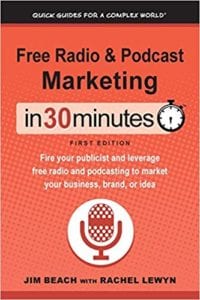
Free Radio & Podcast Marketing In 30 Minutes: Fire your publicist and leverage free radio and podcasting to market your business, brand, or idea
The other thing that your book, Free Radio & Podcast Marketing in 30 Minutes, talks about is that it’s also a great way to get yourself to show up in a Google Search. A lot of people are spending a lot of money on AdWords and they don’t know how to get to their business to pop up. Tell us a little bit about how being on radio and podcast can help our Google Search Optimization.
Every single time you’re on a show, the host or the producer puts up a page about you. It’s where the audio file you can be listened to on the host website. There is also a picture of you, a little bio and a link to your website. That link to your website gives you SEO, Search Engine Optimization, juice. They think that 70% to 80% of Google’s score for you or how high you rank in search engines is determined by how many websites linked to you. It makes sense. If two websites linked to you, are you important? A little bit. If 200 web sites linked to you, are you important? If 200 other people think your website is important enough to link to, therefore you deserve to rank higher. If I’m going on one or two podcasts a week, I go out there and I’m getting a new Google link to my website once or twice a week. These are quality links too, not from a directory or something like that. A podcast link is one of the best links you can get. Let’s say you’ve done 100 interviews over a year. You’re going to have 100 quality links that will drive your SEO juice. I promise you, if you have 100 links, you’re going to be on the first page of almost any search.
I have experienced that myself being on many podcasts and being called the Pitch Whisperer. If somebody googles the Pitch Whisperer, all that content comes up. They don’t have to remember my name or even the name of one of my books. People tend to remember that little hook and they can find me that way. That’s such great value. You also talk about how to use social media as a way to get on radio and podcast shows. Would you mind picking one or two of those platforms and explaining your secret sauce?
The platform is irrelevant, but every time I’d make a post on LinkedIn and someone comments on it, I get an email about that. We all do. That’s the way that the platforms work. I know who is posting about me. Let say if I were to comment on every other tweet, if I make six tweets in a week and you comment on three of them, eventually I’m going to notice that. I’m going to say, “Who is this person? Who likes me so much that every time I tweet, they are giving it a thumbs up or giving it likes?” You’re going to get curious. For example, Ken Blanchard who doesn’t do their own social media. You’re not going to be able to get to him. That’s not going to work with him, but for 99% of the people you want to get in contact with, this works for sales or venture capital or anyone that you’re trying to reach out.
If you follow them and pay attention to their social media, we are such a narcissist that we will notice that. You like five or six of my post, I’m going to know what your name is and then you reach out to me and say, “I’ve been following you on Twitter for six months now and you have some great things to say. I’ve been enjoying getting to know you. I think I’d be a great guest on your show also. I seem to have a lot in common with you, but I’d be a good guest.” The answer is going to be yes because you’ve already done me twelve favors. Every time you liked something of mine, I owe you. The first thing that goes through my mind is, “You’ve done me a bunch of favors. The least I can do is highlight your business for twelve minutes.” It’s a great way of getting on someone’s radar and it all goes back to narcissism. If you like me, I like the fact that you liked me.
[bctt tweet=”No matter what your business is and what you’re trying to sell, there are a bunch of podcasts out there that want to have you as a guest.” username=”John_Livesay”]
It’s almost the micro matching neurons. If somebody smiles, you tend to smile back at them. Except this is done digitally. You have a whole chapter devoted to the do’s and don’ts of pitch writing and you have ten commandments. The one that is so important is to be relevant to topical news stories. Can you explain what that is and how people can use that?
That’s the way to get on a generic radio. That’s not going to work for podcast quite as well because so many podcasts are delayed. Most podcasts are pre-recorded a week, two weeks, a month, three months in advance. It’s hard to be topical there, but if there is another article that comes out about Facebook giving away your data and you are a Facebook company, you should call every radio station in your city or in the United States. You should call them all and say, “I am a Facebook marketing expert. I’m an expert on the news article that you’re going to be talking about on the news. Quote me. I’m available at 7:22 when you do your live segment.” In other words, make yourself available on the topical news of the day and then let the reporters, the people, the podcast host, everyone know that “I’m an expert on this. If that topic ever comes up or if you ever need a hurricane expert because there was a hurricane coming your way, I’m the guy that you should call.”
Remind them when the hurricane is coming by saying, “We spoke six months ago about hurricane preparedness and there’s a hurricane coming in. If you need to get any reports, I’d love to be on your show to talk about it.” You can take this to the limit. It is the National Ice Cream Cone Day. I have a world record for ice cream cone eating. If that’s relevant to me, then that’s your hook. You call up the radio station or the host or the producer. We can talk about how to find that person and say, “I don’t know if you know, but a few weeks from now is national ice cream cone day. I was the eighth-grade ice cream cone eating champion of Dubuque. I think it would be a great segment to talk about that.” That would be the thing that they need. All these people are desperate for content. They have to fill up the time. They need somebody. The unique, compelling and sexy pitch is going to get you on the air. It’s going to get you on the podcast.
There are a couple of things you said there, have a unique, compelling and sexy pitch. You also talk about the importance of a good pitch being both informative and entertaining. Some people have one and not both. That’s a big part. The other thing you said that is so relevant is if you’re going to pitch yourself as the expert in anything from a hurricane to ice cream cones, don’t forget to remind people when that topic is coming up again. You build the relationship up front and then it’s already easy for you to reach out. Don’t wait for the last minute for that to be in the news. If you can build that relationship with a producer or a host before, it makes a big difference.

Podcast Marketing: People have to trust you first, then they like you, and then they decide whether they want to know you or not.
There’s a man here in Atlanta on one of the local TV stations and he’s been doing the news here in Atlanta for 30 years. He interviewed me for a thing. The interview went well and we connected. Six months later, I saw him at a train show. I wasn’t going to the train show. The room next to where I was speaking was a train convention. I bumped into him and said, “I don’t know if you remember me, but we’ve talked.” We had a long conversation about trains. I told him about my train set as a kid. Because we have a relationship, I can get anything I want on the air with him.
Another pitch secret from your book is bust a myth. Tell us what that means.
Anything that the entire world believes, if you tell me the opposite is true and say you can prove it, I want to hear about that. “I’m a little bit of a contrarian. I don’t believe that we’re ever going to run out of gas. I sat down and started researching it and I can prove it. We’re never going to run out of gas. Eventually, we’ll switch to another technology and there still billions of gallons of gas in the Earth.” People hear that and they’re like, “I’ve heard of peak oil, I know about gas. We’re going to run out of gas. We’ve been predicting that for 40 years.” Now the person is interested, they’re engaging and they’re fighting back. “Do you have some data that you can prove that?” “I will give you my seven reasons that were never going to run out of gas on my interview segment with you.” I’m booked. They love that.
They love things with numbers. They love things that are contrarian. The myth is this and this. I’m going to argue the opposite side. There are two guys that wrote a book saying that we’re not going to have twenty billion people 50 years from now on the Earth. The population of the Earth is going to peak twenty years then started going down, which is scarier than it is going up. They’re very contrarian and they’re everywhere now. They’ve done 200 interviews in the last six weeks promoting that book. Because it’s so contrarian, I’ve heard the same thing again and again. I’ve had vanilla every time and now you’re giving me chocolate. Now I want some chocolate because I’m tired of vanilla.
[bctt tweet=”Everyone in the world knows that entrepreneurship is 100% yes.” username=”John_Livesay”]
I loved that as one of the favorite ways of grabbing people’s attention too. The example I use is, the myth is if people know you, then they like you and then they trust you. I said, “That order is completely wrong. People have to trust you first. Then they like you and then they decide if they want to know you or not.” If you start trying to throw a bunch of information that people are thinking, “If they know enough about me and my product, they’re going to buy,” you’re doing it all wrong. That gets people to go, “That’s a myth that the order is wrong.” Anything can be busting a myth there.
My very first book was with McGraw-Hill. The thesis of that book was that entrepreneurship has nothing to do with creativity, risk or passion. Everyone in the world knows that entrepreneurship is 100% creative people taking risks, building businesses that they are passionate about. The thesis of the book was, “No, that’s entirely wrong.” McGraw-Hill said, “I want to see the defense of that thesis.” Then under a week, I had my first book deal with McGraw-Hill because that pitch was so compelling and so unique that they wanted to have it. It’s also sexy because what’s the takeaway? If it’s not about creativity, risk or passion, then anyone can do a sexy thought.
It also has to do with the way our brains are wired. As you said, “Vanilla, vanilla, vanilla. Chocolate, shiny new thing.” Our brain craves new information or looking at something in a different way. That’s how you break people up and break through all the clutter that’s in our brain from the constant barrage of ads and social media posts and tweets and everything else. You alluded that you have some tips on how to get in front of a host or producer. Can you share what those are since you are one? What are some of your favorite ways that people reach out to you?
The last thing I want you to do is to call me. That’s true for most people now. That leaves either the mail or email or what we were talking about before going in the back door through their social media and becoming their Twitter buddy. The easiest and best way to do it is still an old-fashioned email. I used to spend five or six hours every weekend watching football, watching something on television and researching the names of podcast hosts. It’s very simple. You go to Google and type in food health podcasts because I have a food book and I want to be on those podcasts that talk about healthy eating. You will find that there are thousands of podcasts that meet those exact requirements. The trick is to scour them and to try to find the host name. The host of a podcast is a narcissist. I googled food podcasts as I was talking about it and there are 4.2 million hits. That doesn’t mean there are that many shows, but it’s a popular thing to the podcast and talk about.

Podcast Marketing: You don’t buy the first time you see a product; it takes more than that.
Those podcasters or the hosts want to be in communication. Tons of the websites will have a button that says, “Be a guest,” and they’ll give you the instructions on how to be a guest. On my website, you will find it says, “To be a guest, simply email Jim,” and then it gives my email address. They want to be found. They’re not there to be invisible. You’d go through and create a list of 500 podcasts that are appropriate to your market and get the host information. If you’re good at this, you will learn something about the host. I don’t do it that way anymore. I go on Upwork.com and for $50 or even $30, I will have someone there create a list of 500 spirituality podcast host emails. For $30 to $50, I have bought 500 email addresses. They have to do that research. They go out and somehow, they scour the same way I do. Now I have 500 people to contact. I then sit down or hire some pitch whisperer to create the perfect pitch for my product and put together a beautiful email. I send it out to all these hosts. I’m going to say, “I love your podcast.”
They want to know that you have listened to their podcast. If you’re a podcast listener and can prove that you have listened to their show, those people are going to put you on their show. You say, “I listened to your episode with John. He was awesome and I thought he had some good points. I especially liked when he said this. I loved it when you said this.” Quote the host back to himself. He’s going to put you on the show. I build those lists of 500 people. I spend several hours crafting a four or five paragraph email. One of those paragraphs changes for each and every host. “I saw your pitch on your food podcast. I loved when you were talking with Sally Reaves about her no sugar diet. It was the funniest thing ever when you said this and this and I just connected with you. I am working on this and I thought I would be a good guest for your show.” You’re going to get on the show.
That’s specific, not just saying, “I like your show. It’s good. It’s funny.” Quoting the host back when you pitch yourself is the secret sauce that you just gave us. It’s important and few people take the time to do it. Few people know how to do it. Jim, that is gold. Thank you.
I don’t do it. I pay someone to create that moment for me to find the quote. I’m a liar. I didn’t listen to your show. I had someone find me a great quote from your show and I’m quoting it back to you, but I’m doing it in bulk.
[bctt tweet=”Market every day for 30 minutes.” username=”John_Livesay”]
I love stories and you’d have a whole chapter devoted to all in the stories and how people remember stories after we forget everything else. You’ve given us some great stories already, but let’s talk about the one that you talk about in the book, which is about your wife running an Amazon business.
The keyword there is Amazon. A good story is worth telling well. A good story has emotional things like anticipation and fear that I don’t hear the end of the story. If I’m doing an interview on that topic or on entrepreneurship, early in the interview I will drop, “Creativity, that’s totally useless. For example, my wife started a business with $500 on December 26th.” I add in the details because that makes the story truer. “I bought her a book for Christmas on how to start a business. The next day she read it. She was so motivated that she started her business on the 26th. She started making money in January and she made $78,000 in her first year while working a full-time job, while cooking dinner for four kids, while raising four kids, while putting up with an impossible husband like me on the weekends.” I’ll tell you at the end of the interview, “If you remember to ask me, Mr. Host, at the end of the interview, I’ll tell you what the business was.”
That’s an open loop and you were talking about the details of the exposition. What I like about what you wrote in your own book is the impact, what I call the resolution. The unexpected outcome after growing a business like that is and I’m going to let you reveal what that is.
My wife is a shy introvert. We used to go to trade shows together and she would point to something and tell me to go ask about it. Now, she goes to trade shows by herself and comes home with a bag full of 500 booths that she has visited. She now teaches classes on how to run an Amazon business and she organizes and puts it on in our living room. Her career has exploded. She’s had three major promotions and her salary has tripled because of the confidence that she gained by running her small little Amazon business. She now has learned that she can make a living from the living room if she has to.
[bctt tweet=”A good story is worth telling.” username=”John_Livesay”]
That would pull anybody in and that would get any host of any show to want to have somebody come on and talk about that. The outcome of not just making money but the self-esteem going up is what makes that story great in my opinion.
She’s become a whole new woman because of it. It’s amazing to see the progression of her career, her personality and her ability to do all of this stuff. That’s one of the things I love about entrepreneurship. It does that to people. The question you asked is the stories. I know when I go into an interview, I have a basket of ten stories. I’m going to have time to whip out three of them. I do know that a year from now you won’t remember my name, but you will remember the stories that I told.
The last thing that I want to talk about which is in your book, Free Radio & Podcast Marketing in 30 Minutes, is this post show carrot. Since we’re at the end of our time together, you can explain what it is and let us know if you have one for our audience.
The whole point of being on your podcast is to sell my paint, but 99% of the time you have to touch somebody on average seven times before they’re going to buy from you. That’s why ads are repetitious. You don’t buy the first time you see a product. It takes more than that. I can’t market to you if I don’t know who you are. The only way for me to know who you are is to get your email address. I will do anything to trick you into giving me your email address. You see this all the time. We all know about funnel marketing. You have to go and collect the names to start the funnel. How do you do that? You go on radio shows and offer something. I do happen to have a free carrot. If you email me and ask for one of my lists, I will give you my list of 500 sports podcast to be a guest on, 500 relationship podcasts to be on, 500 spirituality podcasts to be on, 500 small business podcasts to be on. I got three or four more topics that I can’t even remember, like religion. I got twelve of these lists that I have built over time. I will send you my list of 500 for whatever category your business is in and help get you started down the path.
The book is called Free Radio & Podcast Marketing In 30 Minutes. Jim, is there any last thought or quote or moments of inspiration you want to leave us with?
Anyone can be successful with this method and use radio and podcast marketing. Don’t worry about your accent. Don’t worry about anything. Sit down and plan out what you want to say. Create a great pitch and I promise this will work for any business. No matter what you’re trying to sell, it will work. I’ve seen it work in every category in the book. In the early chapters, there’s a list of 70 different industries that I’ve seen this work for. We have 10,000 recording opportunities a day for various podcasts. That number has gone up since the research, but that’s 10,000 opportunities a day for you to go out there and get free marketing. Do it. You’re crazy not to do this.
One of my big things is I spend the first 20 to 30 minutes of everyday marketing. Whether I have a business or not, whether I have a project due that day, I know that once the project is going to be turned in, I need a new customer so I better market. I spend fifteen to 30 minutes every day. The first thing I do is I send out three or four requests to three or four podcasters, “I’d love to be on your show.” Two of them say yes and there I am marketing. It works. You can do it. If you’re reading this, I’d love to have you on my show if you can figure out how to get in touch with me.
That is a great offer. I’d be fascinated to see how many people will take you up on that. This concept of scheduling marketing time because if it doesn’t get scheduled, it doesn’t get done. You left us with yet another great tip. Jim, thanks for being on the show.
It’s been my pleasure. Thanks for having me.
Links Mentioned:
- Free Radio & Podcast Marketing in 30 Minutes
- School for Startups Radio
- For Dummies
- Upwork.com
- http://TimelessChair.com/
- http://InternationalEntrepreneurship.com/
- http://SchoolForStartupsRadio.com/
- https://www.Amazon.com/Free-Radio-Podcast-Marketing-Minutes/dp/1641880201
- Quantmre.com
Wanna Host Your Own Podcast?
Click here to see how my friends at Brandcasting You can help
Get your FREE Sneak Peek of John’s new book Better Selling Through Storytelling
John Livesay, The Pitch Whisperer
Share The Show
Did you enjoy the show? I’d love it if you subscribed today and left us a 5-star review!
-
- Click this link
- Click on the ‘Subscribe’ button below the artwork
- Go to the ‘Ratings and Reviews’ section
- Click on ‘Write a Review’
Create And Elevate Your Value with Tim Riesterer
Posted by John Livesay in podcast | 0 comments


Episode Summary
Valuing yourself before valuing your business is an ideal order when gearing towards success. Chief Strategy and Research Officer of Corporate Visions Tim Riesterer believes that decision science is key towards delivering more value to anyone aiming to succeed both in business and life. He talks about how he has helped companies build messages that are aligned with the invisible forces at work in the customer decision. The values of conversion creating, elevating, capturing customer value, and creating expanded value are key in elevating value in a company. He shares about the implementation of all of these values, including the introduction of an unconsidered need in creating pricing uncertainty. Overall, Tim suggests that inspiring somebody to decide to change and considers doing it with a leader or mentor are what value creation and decision science are all about.
—
Listen To The Episode Here
Create And Elevate Your Value with Tim Riesterer
Our guest is Tim Riesterer who is a Chief Strategy and Research Officer of Corporate Visions. Tim is responsible for leading the direction of the company, thought leadership positioning and product development. He leads the company’s consulting team globally. He has more than twenty years in marketing and sales experience. Prior to that, he was the customer message management where he was the CEO until it was acquired. Before that, he worked in the whole world of marketing and communication. He’s the co-author of several books, Customer Message Management: Increasing Marketing’s Impact on Selling and Conversations That Win the Complex Sale: Using Power Messaging to Create More Opportunities. Tim, welcome to the show.
John, thanks for having me.
I always like to ask my guests to take me back to their story of origin. You’re living in Wisconsin now. Were you born there? Did you know that you wanted to get into messaging and marketing? How did this all come about?
I was born and raised in Wisconsin. I didn’t have a clue. I went to school for journalism. Nowadays, there is a job called a corporate journalist. This was back before there was such an idea. I was hired at a big company that did medical devices to go out, ride with salespeople, interview doctors, hospital administrators and technologists about their medical equipment. How it was impacting them and their market. What I discovered writing along with salespeople, asking customers questions and writing stories to put in trade magazines or newsletters, was that everything the company wanted to say about their products was nothing that the customer had to say about their products.
I say now that companies live in their own story and customers live in their own story. We have to stop forcing customers into our story. We have to join the customer story. Customers would talk about mission and outcomes. I wanted to talk about an MRI system, the algorithms and the features. That’s where companies’ stories and customer stories clashed. It sent me and my journalism in an entirely new trajectory to understand the science of how people make decisions, how they frame value, and how they make choices. I help companies build messages and tell stories that better aligned with these invisible forces at work in the customer decision.
You approached it from a journalistic standpoint and you have some data to back it up. Let’s double click on what is decision science and how can people use it.
I triangulate three disciplines. It’s neuroscience, social psychology, and behavioral economics. In every one of these cases, there are decades of studies and science that has been published by professors. The only problem with the existing science there in those three areas is it was most often conducted on grad students, convicts, and gamblers. The three of them are captive audiences who don’t require much incentive to participate in this study. What we’ve done is a contract with scientists at Stanford in the states and work with a business school outside of London. We run simulation tests, in this case, primarily on B2B decision makers because everybody tends to believe B2B decision makers use no emotion in their decisions.
What we try to validate is how do B2B decision makers respond to different messages and to different stories based on the scenarios they’re in. If they’re in a new purchase decision, do they react differently to certain messages versus if they’re in a renewal purchase decision, do they react differently to different messages? We put simulations on top of existing science and we go to the audience who were trying to help our clients sell to. After that simulations, we do controlled field trials to see these things at work in actual B2B engagements. The science of decision making is documented for 40 years. We’re bringing it into the B2B buying audience and building applicable frameworks for storytelling across the different parts of a buyer’s journey.
Can you give us an example or a story of a client you’ve helped you use this? How they were doing it wrong before using it and the insights they’ve learned?
If you think about most storytelling that companies do, if we look at their collateral, their PowerPoint decks, their website, they try to answer this question for customers and prospects, “Why us? Why we’re different? Why we’re better? Why you should go with us?” The problem is that in acquiring new customers, 80% of the people you’re talking to are not ready to ask or answer the “why you” question. They’re still trying to answer the “why change” question. Why should I change? Why should I do anything differently? The problem is most of your messaging, most of your content, most of your presentations are aimed at answering a question that only a fraction of the people you’re talking to want to know the answer to. The majority have not made a decision to leave their status quo.
The reason I get the number 80% is when we work with companies and look at their leads and pipeline, 60% to 80% end up making no decision. They don’t do anything different. They take you through your paces and they go, “I think we’re fine.” That wasn’t a loss to a competitor. That was a loss to inertia. That was a lost to risk aversion. That was a loss to no decision and that means somebody didn’t see why they needed to make a change. What happens is the psychology of asking someone to make a change is different than the psychology of trying to say, “Why you’re different from your competitor?” We focus companies in new customer acquisition, how to tell a why change story that disrupts their status quo bias enough, helps them see the need to change and do something different because their status quo is no longer acceptable. It’s no longer sustainable. It’s no longer safe. It’s no longer tenable.
You have to defeat the causes of status quo bias in your message. Most companies don’t even know that exists so none of their stories encompass that or address that. We’ve helped companies move from 60% stalled deals down to 50% stalled deals. That 10% is a huge upside opportunity. We had one company who took their new why change message and they went to 119 stalled deals. They looked at their pipeline and they said, “There are 119 deals over the last six months that landed exactly where you said. We built a new story using our wide change framework and the science behind it.” They reignited and created new opportunities with 115 of those 119 stalled deals. They didn’t change the salesperson. They didn’t change the product or service. They only changed the story. That shows you how powerful having the right story framework for the right moment can be.

Decision Science: In acquiring new customers, 80% of the people you’re talking to are not ready to ask or answer “why you” question; they’re still trying to answer the “why change” question.
It reminds me of a client I’m working with who’s in the executive search industry. They have two different kinds of challenges. They have obviously other executive search firms. They have big companies that are saying, “We’re not using any executive search firms. We’re having our own internal HR department to find people.” Their messaging is very different if they keep going in going, “Here’s why we’re the best search firm.” They’re like, “We’re not even looking for a search firm.” It was like, “Here’s a story of another company in your industry that had the same thought process and we don’t need all of your searches. We do have some searches that you may not have access to the people in India or Dubai that you need to find or you’re only limiting your search for the next CEO in the US when there are people in Europe that you could be looking at.”
They have to paint that picture of what you were describing of getting over this inertia of, “We don’t want to spend money. We’ll find that it’s been working so far.” That’s a very different message in that awareness of what’s more challenging. They’re being disrupted. Back then, everyone in a certain company level was just hiring recruiters. Now they’re like, “Why are we paying all those commissions?” Not only they have their competition, but they also have the internal struggle and it’s a fascinating use of your model here.
Status quo bias is the design point for your message. What you have to do is identify how many different status quo bias scenarios you speak to. There are two. One status quo bias is I already use an existing outsourced partner. Another status quo bias is “I’m a do-it-yourselfer.” Your message has to change based on what their status quo bias is. Here’s the problem most messaging and stories do is they go, “I’m going to talk to the head of HR. I need a head of HR message.” I’m like, “No, you don’t. You need a message based on the situation they’re in.” There’s an interesting piece of science called fundamental attribution error where we assigned way too much credit to that person’s disposition in terms of driving their behaviors and the real driver behaviors are their situation.
The reason this head of HR might make a change is if they have an outsource partner they’re not happy with or they have an internal situation they’re not sure of, but those are two totally different scenarios. If you aim at the head of HR and tell a generic head of HR story, you don’t aim it at the particular status quo bias, you will have missed the catalyst for change, which is their situation. It’s not their title, not their role, not their disposition. The catalyst for change is the situation they’re in and your story should start with what situation status quo bias are they living in.
There are three value conversations and that’s the key. No matter what industry you’re in, it seems oftentimes as a commodity or you’re a premium price company, whether you’re an architecture firm. You’re all the same. You’re all expensive. I don’t see the value of this. You said, “How to create it, how to elevate it, and how to capture customer value.” Let’s take a little step on each one. How do we create value, Tim?
I want to talk about the fourth value conversation that our new research found. It’s the expanded value. Let’s start with create value. Think of what you’re trying to accomplish with the customer. Create value is this idea of you have to create enough value for them to see the need to do something different. You need to create enough value for them to see you as different. Create value is about creating opportunity, creating that motion and that idea of, “I think I need to change and I need to do something different and I need to do it with someone different.” Create value is how you create a pipeline. You inspire somebody to see the need to change and consider doing it with you, but then you get stuck. I call this constipated pipeline.
[bctt tweet=”Do you use Decision Science when you sell?” username=”John_Livesay”]
A lot of people get stuff in the top of the funnel where maybe they inspired somebody to go, “Maybe I should change.” It just slams into a wall. It’s usually because now you’ve got to talk to a different kind of buyer. The business buyer or the financial buyer shows up. This excited person brings you in and says to the executive buyer, “What do you think?” The executive buyer says, “It’s interesting, but I’m going to need to have some business case, some justification, some ROI, some other things to help validate this decision and have the urgency to do it now.” The question that’s answered in elevate value is why now? In create value, we answer the question of why change, all the science behind the change and getting someone inspired to change but you’re not done yet. You’ve got to answer the question of why now so people make a decision and not differ. That’s a different story, a different framework, and a different question you must facilitate the answer to. That’s elevate value. We have create value and elevate value.
Capture value is this idea that you’ve built the demand. You’ve got some executive sign off, but they’re going to send you through a negotiation process before they’re done with you. There’s the gauntlet of procurement, purchasing or at a minimum, somebody is like, “We’ve got to change. We got a business case here. We can justify it. I want the lowest price possible.” It’s create, elevate, and capture value. Capture value is to make sure you capture all your value. You don’t leak it out in the negotiation process. You manage the tension. You continue to position and bring enough value to protect margin, avoid unnecessary discounting. You hold the line on your premium pricing.
What happens for people is these are three distinct moments with three different buyers’ psychologies. As a result, you as a communicator need to engage them differently in each of these moments yet string it together. We wrote a book that’s three sections, create, elevate, capture that distinctly tells you how to be great in each moment. Once you master those three moments, now you’ve mastered that whole buying cycle. That’s where that comes from. That’s how we distinctly identify those value moments. Why should I pay that much for you? You’ve got to answer those questions because, in the psychology of decision-making science, you are helping them facilitate a decision. You’ve got to realize it’s not one decision. It’s a series. Why Change? Why now? Why pay?
You have this new one called expand. What’s the why there?
Why should I stay with you and why should I do more with you? Once they become a customer, the big question is, “Why should I stay with you and why should I do more with you?” We call that why evolve. What happens is people came up to us and said, “Do you take the same approach psychologically if someone is a prospect working with someone else as when they’re an existing customer and you might have a subscription renewal or you might have an upgrade or an add on sale?” We said, “We better study that.” The reason now there’s expand value and it’s not just a rinse and repeat of the other three value conversations. Here’s the difference. When you are trying to disrupt their status quo bias, you’re the outsider trying to get in.
What happens when you are on the inside and you are their status quo bias, it turns out you better not disrupt it. Don’t disrupt the status quo bias when you are the status quo bias. In fact, lean into it. We call it the incumbent advantage. In politics, we all know what an advantage incumbent have holds true in business too. You have an unfair competitive advantage as the incumbent. If you start telling, a start all over story, “Here’s all my new stuff,” to your existing customer, you just opened the door to other new people coming in because they’re like, “If I’ve got to change that much and if it’s so new, I ought to investigate all my options.” Instead of talking about incrementally, “Here’s what we’ve done together. Here’s what you’ve accomplished with us. Here’s what you’ve already invested.”

Decision Science: Capture value is making sure you capture all your value and don’t leak it out in the negotiation process.
If you change now, you’ve got to put that progress and that investment at risk. Let’s keep moving forward. The discussion is looking like building on that upward to the right momentum as opposed to starting fresh with every conversation. The moment you talk to an existing customer in a revolutionary way, they throw it all open and everybody else going, “Why would I assume you’re the best at this? I better take a look at all the others out there if it’s so revolutionary.” Even if you have something revolutionary, the science says you should portray it not like that because it disrupts the bias towards you.
Has your research or your experience with clients helped you with this? A lot of clients will say, “We’ve got some part of the market share of this client giving us their business, but we want to expand it. Our strategy is simply more onsite visits. I make sure they know all the things we can do for them.” I’m like, “That’s a lot of information stuff again and I don’t hear any stories in there.” It’s spending time with them and keeping your face in front of them constantly pushing the sales people to go onsite and take them to lunch. They won’t leave. Relationships are fine, but I’m guessing that you have some other tips around that.
When you are an incumbent, you get to know the inside of their company well. Sometimes because you’re implementing something and doing something, you often get to talk to a lot of people across different departments and functions, not just that decision maker you’re taking to lunch. You might talk to people where you’ve got some insights that that person wants to know. You may be observing some challenges inside and some sticky areas. You should introduce them to emerging trends and share them some hard truths. The idea to evolve a customer from doing one thing with you to doing two things with you is you use your position as a partner and the inside information you have because you’re working with that company. The outside information you have because you work with many companies who look like them. You bring that into a story that says, “Here are the evolving trends that we’re seeing in the industry and here are the hard truths about how you are or aren’t responding to that.”
Because of your position as having other customers like them, you bring in the evolving trends. Because you’re working with them inside, which is a unique position that your competitors don’t have, you can share hard truths. They will thank you for marrying those two things. Here’s what we’re seeing other companies do. Here’s how we’re seeing it in your organization. We call it emerging trends and hard truths. Only as a partner, do you have that unique two-way view on this? That’s what you should talk about at lunch, not your new stuff. What’s your new stuff at third? It’s in the context of the emerging trends and hard truths that you say. What’s interesting is we got something for that. It’s contextualized to what you know from the outside, what you know from the inside and you have a view that is unique to you and particularly interesting to them.
You are also a keynote speaker on this very topic. What is one of your favorite keynotes to give and who’s the ideal audience for that?
I give speeches to marketers, salespeople or customer success people. That’s a new discipline inside of companies. They want to know how I handle renewals or quarterly business reviews. Salespeople want to know how I build pipeline, close that pipeline and upsell my clients. Marketers want to know all of the above because they’re the story builders. They’re trying to provide messaging and content in all of those situations. Many times, they’re not in the same room. I’ll give speeches at discrete events to each of those audiences. Sometimes when the planets align and I give a kickoff meeting keynote to a company, they’re all in the same room. That’s when I can stem wind it and talk about the alignment you must have between marketing sales and customer success to help enable the customers to decide.
[bctt tweet=”Why change versus why stay?” username=”John_Livesay”]
My favorite speech is to talk about the deciding journey using these questions and showing them the science behind each question, the science behind how customers think and the science behind the answer you must facilitate with a framework for each of those. Here’s your framework for why change, here’s your framework for why now, here’s how you frame up a why pay conversation, here’s a why stay conversation and later for upsells, the why evolve question. I love any keynote that allows me to talk about one or more of those and introduced the science and the framework behind it. The people in the audience leave going, “I learned how to do something slightly different and counter-intuitive.” As I sit back, I go, “That is stupidly obvious.”
That’s the favorite moment. It’s not like, “Is that hard? Is that different? Is that abstract? Is that theoretical?” No. Here’s your four-step why change the conversation. It’s four moves. It’s a simple choreography. Here’s your five-step why stay conversation. They leave with a framework. Either on all of those audiences, I love bringing the science because they’re like, “That’s legit. There’s some testing behind it. It’s not just my opinion.” Even not only my personal experience, I like pointing at all my scientist buddies and saying, “It’s not just my personal experience. This has been tested.”
Do you have a story of how you’ve helped a particular client with the structure on why pay because that’s such a valuable thing? You don’t have to give the whole structure. Maybe a couple of little hints if someone’s saying, “Why should we pay this design fee, this commission fee or whatever your premium price for anything.” As you said, there are different questions during the journey. As a salesperson, you’re responsible for answering those questions and having different stories that go along with it. This why pay and how do I capture value when someone says their budget has been cut or whatever the issues are. Give us a story of someone that walked out of there going, “It’s obvious, but they weren’t doing it.”
I don’t know if it’s always obvious. When you see it, it becomes obvious, but it’s certainly not like it’s under your nose. For example, in the why pay, I could tell you four quickies, but I’m going to start with one. In the why pay and capture value, what everybody tries to do is make you look and sound like all your competitors. They want to tell you that you’re the same. Humans use contrast to make a decision. How is this different? You think of contrast as the ultimate decision maker. If they can make the same, the thing that creates the contrast then it’s the best price. What you’ve got to do is give them another contrast. What we say is people will give you a list of needs, requirements and ask you how you will fulfill those needs and requirements.
Your job is to introduce additional needs, not additional capabilities. If you just introduce additional capabilities, people go, “That’s why you cost so much more.” If you introduce a couple of additional needs like, “These are important.” Companies like you are usually not thinking of this one and this one so that’s why we want to talk about. Those new needs are solved by a couple of additional capabilities. We call it introducing the unconsidered need in order to create pricing uncertainty. At that moment where they know exactly what the requirements are and every company is coming back with similar responses to those requirements, they have pricing certainty. Your job is to introduce pricing uncertainty and the best way to do that is to introduce a couple of unconsidered needs for them. They now can’t unseen and can’t unheard it. Why would we not want to solve for those? It seems risky.
In fact, the needs they didn’t think of are often the ones they think of as most risky because they’re like, “I didn’t see that one coming.” If you can put a little story around it like the size and the speed of that unconsidered need of how big is it and how fast is it coming, they have to add it to their consideration pile. Now that they see maybe it takes a couple of additional things to solve for it, they now don’t know what that should cost. That would be the big number one idea I’d give you. There are others like coming in with what we call set a high target. In negotiations, people used to talk about the one who speaks first loses and that’s not true. In negotiations, the first person to put a price on the table doesn’t lose. They win.

Decision Science: Contrast is the ultimate decision maker. Humans use contrast to make a decision.
If you say, “What’s your budget? What do you get for this?” They’re going to low ball you. Are you going to spend all this time trying to eke them up? If you come in and say, “This is what this cost,” now you might have to discount slightly. We know there’s going to be a big gap between discounting off your high target as opposed to trying to eke them up from their low target. We talk about setting high targets and expanding the range of reason. You give all these reasons unconsidered needs between there. Every time there’s a gap between you trying to eke them up and them taking you down a little bit, set high targets and make first offers. Don’t wait. It’s too late. There’s a little bumper there. Don’t wait because it’s too late when it comes to making the first offer and setting a high target for your price.
You’ve given such great value to the audience. This concept of when the buyers make you all look and sound the same, you are seen as a commodity. I see this time and again with architects or recruiters. They come in and they say, “We’re global.” The buyer says, “We know. We’re looking at everyone that is global.” That’s no longer a selling point. That differentiates you or justify your pricing. We’re a global company working with only global people. For you to come in and say that is some unique selling benefits or justification of pricing without a story to back it up or tell some additional needs of what this global can bring to you is great.
We did some research. When people introduce the so-called value-added services, that’s what they call those things. “Here are value-added services.” People don’t hear value-add. They hear cost add and complexity add. The receiver of the information process said, “This is why you cost more and this is potential stuff I won’t need so I’m paying for something I don’t need and something that could make this complicated.” Complicated things fail. It’s the science of choice overload. If you can keep dropping what you think are value-added services into your story, you will perform worse than if you would’ve just told a commodity story. That’s our research. You just made it harder for them to decide and they think you’re expensive, hard and complicated. To your point, you must tell a story about a need that leads them to that thing that’s interesting. When you push that interesting thing into the story as a value-added service, it backfires on you.
It’s like, “We’ll keep throwing as much stuff against the wall. You could do this and we could do this.” The confused mind always says no. Everybody is looking for the opposite. It reminds me back in the day when you would buy something to record your TV shows. You’re like, “I don’t need to record ten shows. I just want one.”
You and I can talk about those examples when there was a separate box to do that. They would oversell all the features and you would be overwhelmed. As a result, you’d say, “That’s why your boxes are too expensive and your box might make me fail because it’s too hard. I don’t want to fail and I don’t want to overpay.” That’s what they hear or hears.
If you have one last piece of advice for the audience on how to create value, what would it be?
[bctt tweet=”Don’t wait to give the first offer.” username=”John_Livesay”]
Value is an abstract complicated idea. Creating value and helping people see the need for change requires contrast. Inherently, the decision-making part of the brain that makes this choice to change is not the part of the brain that contains the capacity for language. It’s the emotional intuitive brain. The thing it reacts best to is simple concrete contrasting visuals. Too many people use PowerPoints and put bullets up there. Too many people use PowerPoints and put stock photography up there. Too many people create PowerPoints and they put metaphorical images up there. Even metaphor sometimes are powerful, but if done wrong, they’re distracting.
They take the reader, the listener or the viewer to a different place than you intended so you’ve got to be careful with that. We’re very big on simple concrete contrasting visuals that show you the current state and all the risks, all the challenges, all the threats, and all the missed opportunities. We show a corresponding contrasting future state where that’s all resolved and things are better. It’s in that contrast that the brain will perceive value, but you have to give it to that brain because it doesn’t intuit it from your words. You have to show it the contrast and help that part of the brain processed the contrast. Showing the current state versus future state visual stories is essential for change because the decision-making part of the brain needs that contrast to see the value. That’s how it makes a decision.
That’s why good stories always have a resolution. If you’re talking about somebody who helped as a case study and you say, “Now their life is like this after working with us.”
In fact, the great case study doesn’t just have the end. It has the beginning and the end.
This is what their life was like before us, this is how we help them, and now their life is like this.
Everybody wants to tell a story about the good ending, but the person that’s listening to you doesn’t even identify yet with that ending because they don’t even know they have a problem.

Decision Science: Creating value and helping people see the need for change requires contrast.
Tim, how can people follow you and what website should they be checking out your information?
The company is called CorporateVisions.com. We have a tab for all of our research and all the topics we researched. You should check out our new research on apologies. That would be an exciting place to start. On Twitter or LinkedIn, it’s Tim Riesterer. It’s not an easy name. I need a stage name like your name. Your name is too cool. Follow me on Twitter. I tweet about all our research. It’s a great way to get these nuggets of wisdom that we just give away. We believe in the abundance mentality. You can be better. We’ll help you be better. Maybe someday you’ll work with us, but at a minimum, we want you to be better.
When you give from that mindset, that is the key to attracting the right ideal customers who appreciate that. Thanks, Tim for sharing your great insights. We look forward to learning more about how we can all create value.
Thanks, John.
Links Mentioned:
- Tim Riesterer
- Corporate Visions
- Customer Message Management: Increasing Marketing’s Impact on Selling
- Conversations That Win the Complex Sale: Using Power Messaging to Create More Opportunities
- Twitter – Tim’s Twitter
- LinkedIn – Tim’s LinkedIn
- https://CorporateVisions.com/
- https://www.Amazon.com/Three-Value-Conversations-Customer-Long-Lead/dp/0071849718/ref=sr_1_2?keywords=tim+riesterer&qid=1558115565&s=gateway&sr=8-2
- Quantmre.com
Wanna Host Your Own Podcast?
Click here to see how my friends at Brandcasting You can help
Get your FREE Sneak Peek of John’s new book Better Selling Through Storytelling
John Livesay, The Pitch Whisperer
Share The Show
Did you enjoy the show? I’d love it if you subscribed today and left us a 5-star review!
-
- Click this link
- Click on the ‘Subscribe’ button below the artwork
- Go to the ‘Ratings and Reviews’ section
- Click on ‘Write a Review’