
(C)lean Messaging With Scott Brown
Posted by John Livesay in podcast | 0 comments

We all think that people make decisions based on rational numbers, but that’s not how humans work. How can you find a way to tap into the emotional side and deliver clean messaging that is memorable? In this episode, John Livesay, aka The Pitch Whisperer, talks to actor-turned-experienced startup founder, investor, and speaker Scott Brown. Scott reveals how he helps founders sound human and effectively deliver their message to their audience, may it be investors, employees, or customers. He touches on the challenges of building a company and how the founder of a startup is not the hero. Scott also discusses how trying to solve a problem and being able to communicate your solution is at the core of the game.
—
Listen to the podcast here
(C)lean Messaging With Scott Brown
Our guest is Scott Brown. Scott Brown is a former actor turned entrepreneur, having started eight companies over the past years. From topical analgesics to bounced emails, Scott’s background is diverse, to say the least. Scott is the Executive Director of UpRamp, which leads ventures and startup engagement for the global connectivity industry in Boulder. He has the dubious honor of spending $2.5 million on the 21st worst Super Bowl ad in history. As an active advisor, investor and author, Scott shares his unique blend of startup, grit, technology and clean messages with startups around the world. He’s also credited with inventing the world’s first bacon-wrapped tot. Scott, welcome to the show.
John, thanks so much. This is going to be a lot of fun.
It is indeed. I like to ask my guests to take us back to their own story of origin. For you, it can be childhood or college, whatever it was. You were a former actor, that might be an interesting place to start, then we want to know how that pivot became an entrepreneur experience.
It’s a funny story. I was in beautiful Milwaukee, Wisconsin in the early ‘90s. I had come in to do I think Henry V. I’m there and I got invited to this fabulous dinner party. I’m hanging out and we’re drinking and talking and I met this guy who had invented a new topical analgesic, this pain-relieving gel made out of red peppers. I’m talking to this guy and we’re drinking, laughing and having a great time. About 2:00 in the morning, he says, “Scott, I think you could help me sell this.” I’m like, “Yeah.” Lo and behold, the next day he calls me and says, “I was serious.” I’m like, “All right.” We wrote this little deal on the back of a napkin and it turned out the previous summer, I did a season at another Shakespeare festival and one of the board members happened to be the CEO of a large pharmaceutical company. Six months later, we sold the patent rights and now this thing is in every Walgreens in the world. I went from being an actor to an entrepreneur through dumb luck and happenstance.

Clean Messaging: When talking to your customers, share experiences other people have after using your product rather than talking about yourself.
It’s fascinating to me because I love to double click on this concept that following our passions will lead to success, even if we don’t have an exact step-by-step roadmap of how it’s going to happen. Being in the right place at the right time is something we’ve been taught as kids but there’s something besides dumb luck involved. It has to do with energy, purpose and alignment. Can you speak about that?
There’s something about the magic of happenstance, those happy accidents that happen in your life. When I look back, all of the amazing and great things that have happened to me are all attributed to leaning into those happy accidents. When that happens, great things can come about. That’s how I met my beautiful bride. It’s how I started my companies. Everything falls from moving into those opportunities as they appear.
I have to ask about creating a bacon-wrapped tot. I know what a tater tot is. I’ve seen bacon wrapped around little hotdogs sometimes in the Midwest where I’m from as well. That was considered fancy appetizers in my day. Tell us how you created this.
The bacon-wrapped tot is the culmination of human cuisine. Bacon and a tater tot, it’s the most perfect thing ever. It happened at a random restaurant here in Colorado. I was out with a number of startup founders. We were trying to come up with the best food ever and I stumbled on the bacon-wrapped tot. I convinced the restaurant to make it right there, they did and it’s on their menu as The Scott.
Going back a little bit to the Shakespeare launching you into the entrepreneur thing, you’ve got some food named after you. You’ve also been called Hamlet, the entrepreneur, I’m assuming that ties in somehow to your Shakespeare background?
There are amazing stories in Hamlet. It’s probably one of the greatest works of art ever written in the English language. I probably go back and read it once a year. One of the things that I found in that, is that most of the lessons we need as entrepreneurs as startup founders, as business people, it’s all buried inside that text. We could do an hour on Hamlet as entrepreneur.
Let’s talk about this whole concept, especially for people in the tech world, I love this phrase, “What if your message was as clean as your code?” You created something called (C)lean Messaging, but you put the letter C in parentheses. You’re trying to separate the word clean and lean, I’m guessing. Tell us how you came up with (C)lean Messaging while also using that double play on words.
I’ve spent the last years building my own company, as an advisor, investor and mentor to a number of startup founders around the world and one of the things we found is that the tools we have developed to figure out what to build, have changed the dynamic. The Lean Startup methodology that Eric Ries put out, build, measure, iterate, all of that stuff. It helped us figure out the what, then we had great tools to figure out who the value prop canvas to help us figure out who we’re building this thing for.
What I found in talking to these entrepreneurs is that they would get through that phase and then stop. They would have this brilliant idea, they knew what they were building, who they were building for. They’d go out to the market and try to sell it or try to find investors and then complain twelve months later that there was no market for their product. 42% of founders after the fact, say they shut down their company because there was no market but how could that be true? Nobody starts a business knowing there are no customers. We all do the work, we do that customer discovery.
What I figured out was that these founders were taking all of the information they gathered in those amazing customer discovery conversations and interviews. Repeating it back to random people, to customers or potential customers and all of that great data they got about the what, ends up hurting them when it comes to the why. That’s why I built (C)lean Messaging, it’s a framework that helps startup founders talk to humans. It’s the next evolution of that lean startup methodology, the what, the who, and now this is the why.
Can you give us a little story of how someone you worked with has used (C)lean Messaging?
I’ve been lucky to work with a lot of interesting founders but there’s a group in New York City, a young startup company called Mutable. These guys have the most incredible technology, some of the smartest people I’ve ever met. They’ve done good work to figure out how to take all of these data centers that exist around the world and put little computers inside of them to run hyperlocal low latency edge compute and when they sat down and told me that, I thought, “That’s cool.” Except, nobody understands what that means.
We got together with the founders of Mutable and worked through their product to try to figure out how to talk about this to real people. What we found is that first, I had an amazing origin story about the way the company was founded and how their team grew. Origin stories are great when you’re talking to investors who want to join your journey, but they start to fall down a little bit when you’re talking to customers. When these guys talk to customers, they talk about the experience that other people have after using their product, rather than talking about themselves. They talk about how webpages load 30% faster when they’re running on the system. They talk about how large service providers are generating hundreds of millions of dollars in revenue, rather than paying the taxes and the rent on the data centers they own.
[bctt tweet=”What if your message was as clean as your code? The goal of a pitch is to be memorable. It is about the listener not about you.” username=”John_Livesay”]
One of the mistakes that I see founders make when they make a pitch is treating an investor like a customer and they’re pitching them as if they want them to buy the service or start using it, thinking somehow that’s going to make them want to invest. Do you see that often? If so, how do you help them change that?
It’s subtle. Because an investor and I’m one, we want to understand how the product works and we want to see that founder as if they’re talking to a real human being, contrary to popular belief, most investors are also human beings. There is something cool about seeing a great pitch from a great founder talking as if they’re talking to a real customer and observing that in process. At the same time, an investor, they’re looking for slightly different things but they’re going to make that decision the same way that a customer makes the decision. We’ve got to move that elephant first, we’ve got to hit them in the gut, change their intuition first and let that lead to judgment. Eventually, lead them to the data or the words to help them describe why they’ve made that decision.
A lot of people say, “You get ten minutes to pitch an Angel group or an investor.” I tell people, “You have 90 seconds. You need to grab them at the beginning.” Do you have a favorite pitch that you’ve heard that said, “The minute that founder opened their mouth, I was in?”
There are so many good ones out there.
You only have ten minutes, and every word has to earn its spot. Do not waste time with cliché openings like, “Thanks for this opportunity. I’m excited to be here.”
Anytime I see a pitch that starts with, “Hi, I’m Bill. I’m the CEO and Founder of X.” Shoot me in the head. You’ve wasted the first 30 seconds of the conversation and that was the most critical. What I tell people is that the best way to start, the best way to lead in is to lead with the listener. Start with the person that you’re talking to and then follow up with how you can change their life rather than saying, “I’m Scott and this is what I do.” You could start with, “There are people like you who have this big problem and I’ve invented a way to fix it.”
Do you specialize in a particular industry that you’d like to invest in? I’ve had a lot of investors like, “I want to do mobile. I only do artificial intelligence.”
Most of the work that I do as an investor is around B2B. I’ve figured out after failing miserably at Super Bowl ads that I’m good at enterprise deals and how to talk to businesses and how to find solutions that solve big problems for companies. There’s something that I look for in a business like that, it’s a little different, and it’s not just about a product that you’re going to sell to other businesses. What I like to invest in companies that have figured out something about humans that nobody else knows, it could be in the buying process, it could be a problem or a challenge that a human has that nobody else has identified yet. I look for that human element in a B2B business.
You referenced the Super Bowl commercial. Everyone watches those commercials. Tell us the story there, I’m sure it’s a good one and any lessons learned?
That was my first venture-backed company and at that time, I believed what all of our venture investors said. This was 1999, in those heavy times, we believed that it was all about getting users and we could worry about revenue later.
Facebook was like that, right?
There are businesses that do work that way. Most companies are a lemonade stand, build something that people want and sell it for more than it cost to make and then do that over and over, that’s how it should work. At the time in ‘99, we thought if we get a lot of eyeballs, we get a lot of users, then money will come later or we’ll IPO before there’s a real revenue. We went hard at it and built a large company, 150 people, raised a bunch of venture capital. We had a tough decision to make in that winter of ‘99. We had an opportunity to do a Super Bowl ad and we pulled together the ad and the money. We had a big board meeting and all agreed that we were going to do it.

Clean Messaging: The goal of a great pitch is not only to deliver great content but about being remembered. Find a short, easy, clean, memorable way of communicating your message; then, you’ve won.
In the fourth quarter of that Super Bowl, February of 2000, if you recall, that was the Titans and the St. Louis Rams at the time. The game was close and they’re in that fourth quarter. There were still people watching the game and therefore watching the commercials. Our commercial hit and you had a huge spike of users and people signed up. It was successful by those standards, but of course nobody gave us a dime. Within a couple of months, we had to shut the business down and had to move on. I am on a list now. It is known as the 21st worst Super Bowl ad in history, and at least I got that going for me.
You made the top 30. You also travel the country speaking. Who is your ideal audience and what takeaways do you give them?
There are two groups that I talk to a lot, the first obviously are startup founders. For those founders out there could be around an accelerator or offense targeting startup founders, it’s about how do you find that message? How do you talk about what you’ve built in a way that will help people understand it and buy? It’s tactical, oftentimes about the (C)lean Messaging framework that we bring out there. I’ve been doing a lot more talking to innovation experts and government, strangely enough.
I happened to do a presentation in the beautiful Sunshine Coast in Australia. I was doing a whole session on messaging and afterward, this lovely gentleman came up to me and he said, “I’m the local representative on the council here in the Sunshine Coast.” This messaging idea, this idea of (C)lean Messaging, not only applies to startup founders and entrepreneurship but I bet we could use this to help figure out how to talk about the new initiatives we’re trying to help our region with.
I’m thinking you would be ideal in front of anybody caring about green messaging. If you’re talking about a clean environment and green, clean messaging and the problems because many people feel like, “That’s going to be expensive and you want me to get rid of all these products under my kitchen sink that might be toxic.” If anybody needs help with clean messaging about a clean product, it’s that industry. I know you like to play with words as I do with lean and clean. To me, that seems like a nice fit to help.
I’m all in, ScottBrown.co.
We’ve talked about what makes a good opening. Closing your pitch is as important as a good opening. I can’t tell you how many people will end their pitch with, “That’s all we got. Any questions?” I want to cry. What do you recommend people say at the end of their pitch?
It varies for every single pitch. For me, it’s important to remember that the goal of a great pitch, at least in my mind, obviously you have content you need to deliver but more importantly, it’s about being remembered. Somehow a decision is going to be made. If you’re talking to an investor, that investor has a partner meeting seven days from now, on a Monday afternoon partner meeting. If they don’t remember what it is you were talking about or what your business does, then it doesn’t matter. It’s the same thing with a customer. They’re going to have all of this great stuff and take all of your printouts and your pieces of paper, set them on their desk and they will not read them. Your job, in those meetings, conversations and opportunities, is to help that person remember you. If you can find short, easy, clean ways of communicating your message that are accurate also memorable, then you’ve won.
I tell people if you tug at people’s heartstrings, you can get them to open their purse strings.
It’s like, “What if your message was as clean as your code?” For a technical founder, they strive every day to polish that rock and make their code as perfect as possible. They don’t think about how they message or talk about their company. Something like that, message is clean as your code, goes right into that long-term memory for a startup founder.
The other thing is sense of urgency. I feel that when people are pitching, they have to answer two questions which are, why are they uniquely qualified to execute the idea and why is now the perfect time to do it? Do you have any thoughts around that?
[bctt tweet=”Nobody starts a business knowing there are no customers. ” username=”John_Livesay”]
That’s right on but you’ve got to lead with that. Too often, people put that stuff at the end, “Here’s all of the stuff. Here’s the history of the internet. Here’s the thing I’ve built,” then after they get through a bunch of other stuff, “Here’s a little bit about the team.” Especially in a seed stage funding opportunity, it’s about the team first and then the problem or the market that you’re trying to solve for and then about the product. As founders, we spent so much time building the product that we want to talk about and we forget that the decision is going to be based on, are you the right people to fill a need in this big market and do you have something interesting to do? That something interesting is further down the road.
What’s the one takeaway you want people to get from reading your book, (C)lean Messaging?
The thing I tell people often is that building a company is hard. It’s difficult and we have to invest a lot of time, energy, blood, sweat and tears to figure out what to build, but once you go out into the world, sadly, nobody cares. You have to remember as a startup founder that when you are talking to other people, it’s about them and not about you. Your message, the story that you tell, the big interesting clean messages that you build have to be focused on the listener. They will then imagine what their life is like after using your product.
I’m constantly telling people, “When you tell a story, you’re not the hero of the story, your client is.” You might be a Sherpa and someone climbing on a mountain or Yoda in Star Wars, but it’s not all about you, which is why we’re on the same page, from the same mom.
Brothers from another mother. There is something cool about this, this idea that you’re not the hero. That is absolutely true, especially when you’re talking to customers. There is an opportunity where you are the hero and that’s when you start to get into a deeper conversation with investors or potential employees. There, you want those listeners to join your journey, to join the journey of your company. You’ve got to be mindful of the duality of this.
Scott, how can people follow you? ScottBrown.co, standing for Colorado, which is where you live. Is that right?
That’s right, John. Beautiful Boulder, Colorado.
Any last thoughts? A book to recommend, a quote you like that you want to share with us?
If nothing else, if we remember that it’s about the listener and not about you. That’s going to be a big thing. I would love to chat with anybody about how to help build that clean message. There’s an opportunity here to help startup founders take all of the great work they’ve done and figuring out the what and now help communicate the why. John, I bet between you and I, we can solve this problem of all of these startups that only last eighteen months. Let’s do that together.
I would love that, Scott. Thanks for being such a great guest and sharing your passion, your humor and your wisdom.
Thank you.
Important Links
- UpRamp
- (C)lean Messaging: A Framework to Help Startup Founders Talk to Humans
- (C)lean Messaging
- The Lean Startup
- Mutable
- Better Selling Through Storytelling Method Online Course
Wanna Host Your Own Podcast?
Click here to see how my friends at Podetize can help
Purchase John’s new book
John Livesay, The Pitch Whisperer
Share The Show
Did you enjoy the show? I’d love it if you subscribed today and left us a 5-star review!
- Click this link
- Click on the ‘Subscribe’ button below the artwork
- Go to the ‘Ratings and Reviews’ section
- Click on ‘Write a Review’
Love the show? Subscribe, rate, review, and share!
Join The Successful Pitch community today:
- JohnLivesay.com
- John Livesay Facebook
- John Livesay Twitter
- John Livesay LinkedIn
- John Livesay YouTube
Creativity In An Age Of Artificial Intelligence With James Taylor
Posted by John Livesay in podcast | 0 comments

Artificial Intelligence or AI has been taking over varied industries and has become undeniably helpful in today’s fast-paced life. Today, John Livesay interviews James Taylor, founder of C.SCHOOL™ and host of The Creative Life Podcast and TV Show. James talks about creativity and innovation and the use of AI in different professions. He then shares with us his proven five-step creative process that includes preparation, incubation, insights, evaluation, and finally, elaboration. Be inspired by James’ creative mind as he discusses each step and how important it is to do it in the right order.
—
Listen to the podcast here
Creativity In An Age Of Artificial Intelligence With James Taylor
Our guest is James Taylor, who not only has his MBA, but he is a Fellow Royal Society of the Arts, FRSA. He’s an award-winning speaker and an internationally recognized leader in creativity and innovation. For over many years, he’s been teaching entrepreneurs, educators and corporate leaders, writers and literally rock stars, how to build innovative organizations and design the creative life they desire. As the Founder of C.SCHOOL and the host of The Creative Life Podcast and TV show, he’s taught hundreds of thousands of individuals and over 120 countries through his online courses, books, videos and keynotes.
After advising some of the world’s most creative individuals and companies ranging from Grammy-award winning music artists and best-selling authors to Silicon Valley startups, James designed a framework for creativity that helps individuals and organizations achieve exponential growth. Some of his clients have included Apple, Sony, Johnson & Johnson. He’s an in-demand creativity expert. He’s been on hundreds of media outlets. He was a subject of a 30-minute BBC documentary about his life and work. James, welcome to the show.
It’s my pleasure. I always love spending time with you.
[bctt tweet=”Green colors activate idea flow. ” username=”John_Livesay”]
You were always in a different country. I love your passion for sharing all of your insights into what it takes to become a great keynote speaker. I always like to ask my guests what’s your own little story of origin. Your mission is to inspire creative minds. You must have always had one yourself.
I believe we’re all born with unlimited creativity. The problem is as you go through schooling, education and you start work, it gets knocked you a little bit. I see my job is just reigniting that creativity that’s in all of us. Whether that’s the creativity to sell better, to create new products, to change the world, to run companies or countries better. I’m definitely there to re-ignite something I believe was already in you anyway. You need a little bit of help.
Tell us your own story of origin. We talked before that you sold guitars but didn’t play them.
I come from a musical family. My father is a very esteemed music jazz artist. My grandfather was a musician as well. My wife is a professional jazz singer, so I come from the music industry people. My very first Saturday job was working in a music store selling guitars. I don’t play guitar. It taught me the first lesson about selling, which is understanding the customer. It wasn’t about me. It was understanding not so much the technical things a customer wanted, but what did they want that thing to do for them? What transformation do they want?
I was very good at selling very high-end guitars. A lot of the time, it was to the market. They’d have a big 40th or 50th birthday with a zero on the end. I was able to help them reconnect with that thing that they had when maybe they were college and helped use that to sell them a $5,000 guitar. That told me as a fourteen-year-old about the power of selling. I remember reading books by Robert Cialdini and all these wonderful sales experts and that got me initially interested in sales and selling. From there, I moved into the world of managing music artists professionally. I manage a number of Grammy-Award-winning artists.
I’ve managed a band called Deacon Blue, which sold about six million albums. I managed the Rolling Stones. That helped me start to understand how the music industry works about building big global brands, scale, that people can feel passionate and they can feel connected when you can build a tribe and excitement around. In 2010, I received a call from a gentleman in California and he asked if I would move to California to help him grow a technology company. It’s a totally different game. That was the initial start of things.
[bctt tweet=”Breaking down silos is the key to growth. ” username=”John_Livesay”]
What do you see if anything in common between a startup and a musician that’s at a level of winning Grammys?
They’re very good knowing what they do well from that. They’re very good at connecting ideas with people. It always intrigued me spending time with these phenomenal Grammy-Award music artists. They could flip between this quite quiet person sitting there, coming up with ideas, thinking creatively, and then suddenly they would go on stage, it was the same person, but it was like them multiplied by ten. I was always interested in this. My living as a professional keynote speaker, companies bring me in to speak on big stages all around the world. I’ve spoken in 25 countries. I noticed that even looking at the creativity of those, there are a lot of similarities between people like top rock stars and the stuff that I do as a speaker and also when I see great CEOs.
I was speaking at an event in Amsterdam and there was a vice president there. He came up on stage. He is one of the most inspiring speakers I’ve ever seen because he looked around the audience. He could sense this audience was from a group within this company. They were primarily all MBAs, smart people all in their early 30s, mid-30s. He didn’t speak to them about climbing up the corporate ladder, stuff that you might have spoken to maybe someone that was a little bit older, a different generation. He spoke to them about how this company and growing this company could be a vehicle for helping all those people in the room achieve their own personal development, their own genes, their own freedom as well. I thought, “To be able to make that room feel like that, that is phenomenal.” I see that in great leaders. It doesn’t matter whether they are rock stars on stage or great professional speakers or whether that CEO up on stage is inspiring their team.
Speaking of your career, your most popular topic is super creativity, augmenting human creativity in the age of artificial intelligence. First of all, I want to applaud you for putting those two things together because a lot of people think innovation is all about technology and certainly artificial intelligence technology and creativity is a human thing like you’re going to write a song, paint or write. You’ve been able to combine the two. I don’t see anyone else doing this. Talk to us about how you said, “I think there’s something here that artificial intelligence can help us become super creative.”
We all see the stories about artificial intelligence. It’s going to take away everyone’s job. It’s going to be the terminator. Our robots will start taking over the world. That side doesn’t interest me so much. What I’m more interested is about how it changes the future work, what potential it can offer us as humans to augment ourselves. We often meet these terms, creativity and innovation. The way I think about it is there are different sides of the same coin. Creativity is about bringing new ideas to the mind. Innovation is about bringing new ideas to the world. Without creativity, there is no innovation. There are no new products and services. Creativity is the engine of innovation. It starts from there.
If you want to create that next winning company that makes a winning project or product service, it comes from that creativity of you as an individual, but more broadly within the team, the team that you’re working where you assemble to do something together. Where I’m interested in is where I see examples from lots of different industries is you’re going to get lots of jobs disappearing. That’s going to happen. You’re already starting to see that start to take hold.

Creativity And Artificial Intelligence: Creativity is bringing new ideas to the mind. Innovation is bringing new ideas to the world. Without creativity, there is no innovation.
I’m more interested in the people who are in the world of work. How they can start to use some of these technologies like AI and machine learning robotics to augment them, to allow them to do things that in their work, their skillset, their job that they might have thought unimaginable before. The companies I’ve been speaking for, they’ll range from some of the world’s top law firms, accounting firms, sovereign wealth funds, some of the largest financial and banking firms in the world, consumer products, companies, educators, fast food companies, aerospace, all different industries. Within all those industries, you see this happen more and more. Even to explain it from a very simple perspective of myself, my job is to be a keynote speaker.
Companies bring me in or associations bring me on to get on stage. I’m normally, like yourself, either the opening keynote speaker or the closing keynote speaker of a big conference. That’s not often the way. I think about how I use artificial intelligence to augment me in what I do. A few years ago, the way that most speakers had a conversation with the client was they would do a pre-event call and they would say, “Tell me who’s going to be in your audience.” They say, “We have people that are aged 40 to 50. They’re senior managers. They’re 80% men, 20% women, and they would do that.” That’s just the demographics. That’s not that interesting.
I’m more interested in the psychometrics of that room. We can use artificial intelligence. The way that I use it is before I even go in the room as part of my work on understanding the audience in the room, I will use AI to analyze the audience. I will essentially use different ways of doing this. You can use the same technology. If you’re selling and you’re going out and giving a pitch, analyze that key decision-maker in the room. It’s almost exactly the same process. This is how it works. I use IBM Watson, which is one of the many wonderful artificial intelligence systems or programs out there.
All I have to do, if I’m speaking to a large conference, most conferences will have a Twitter handle. I’ll go and give it to the artificial intelligence. What it will do is it will spider all of the accounts where the people are following and tweeting about this conference, for example. It will then give me across 72 different factors, a visual representation of the psychometrics of that particular audience, those people that are going to be attending. It tells me what their needs are, what their values are, what their wants are.
What I can do is I can give the AI my draft keynote presentation and it essentially analyzes that and it can overlay the psychometrics of my presentation with the psychometrics of the audience in the room. It could tell me what I need to work on, what needs to be boosted up, what needs to become down. The way we use this, let’s say, I was giving a pitch to a CEO in New York. The CEO, like many senior executives, didn’t do social media or if they did do social media, someone else is writing it for them. It wasn’t them who’s writing it. What they had done is they’d written an article for one of their trade magazines. All I had to do was I gave the AI 1,000 words that this person had written.
I could use 1,000 words that someone’s spoken. If they’ve done an interview or written, give it to the AI. It automatically told me the psychometrics of that person in the room, that key decision-maker I wanted to influence. I knew having looked at that that this person is authority challenging. As I give my pitch, I want to come across a bit more like a contrarian in my views. I could see that they valued practicality very highly. As I give my pitch, I’m going to say, “Here’s how my service product can be practically applied to help grow your business.” I could also see they valued trust highly, 99% super high.
[bctt tweet=”Caffeine reduces your creativity. ” username=”John_Livesay”]
You might call them case studies. You would call them case stories, which I love. You would tell case stories. You would tell examples because this is going to use more social proof. Robert Cialdini, that trust indicators, social proof and that will help that person feel that the key decision-maker in the room when you’re giving your pitch is going to feel like magic. It’s going to feel like, “This person understands me. He understands this challenge or this issue I’m thinking about, what I’m thinking about in the challenges I’m having in our business.” It’s not magic. It’s data.
You’re speaking their language. If somebody cares about trust being a key factor and that is going to be specific to their personality, whether they want to have proof of your authority or whatever it is. You’re addressing all those issues in advance. Is this something that you have to subscribe to IBM Watson to be able to access and create this analysis from Twitter handle?
If you go into my LinkedIn profile, James Taylor. I have a post there, an article which basically states exactly how it works and how to do it. This is something that you can subscribe to. There is a free version. You can go and test it if you want to go and try out. You can give some written words written by a key decision-maker or somebody who wants to influence. It’s fun. Do it on yourself first of all. If you take this onto the next stage, let’s say if I work in a car showroom, where are we going next with this is if I can take that data. Let’s say I’ve got all of my customers’ social media handles. I’ve had a series of correspondence with them so that is in the system. That will then create the psychometrics for everyone in my customer database, my CRM.
You can start to do very interesting things. Let’s imagine you can have the new Apple glasses that are going to be coming out. Unlike the Google glasses, but much nicer, much cooler. They will be connected to different artificial intelligence. You can connect that to your CRM and you can wear these glasses. Let’s imagine I’m a fourteen-year-old guy in a music store selling guitars. Five people come into the store. I’m wearing my glasses. It’s connected to the CRM of the company, so I know the psychometrics.
Using facial recognition as they come into the room, I can automatically see, “That customer is coming in here. They have a high FICO score. They have a low credit rating. This customer here is being on this webpage a number of times and spending a lot of time on that page about this product. This customer here has spent $10,000 within the past several years.” As a salesperson, who do you go and speak to? It’s all showing a heads up display like a fighter pilot would have. This is happening and I worked with a lot of companies that are starting to build these out across their businesses.
This is the super creativity bit because the AI is not going to write your pitch for you. It’s not going to give you a sales presentation, but it will make you a better presenter of your ideas. Sports teams use AI to analyze their players. Insurance companies use AIs to analyze their brokers. I believe every salesperson should be able to use a tool like this in order to analyze that prospective client, that prospect that they’re going for. When you go and give that pitch, it is absolutely landing on a very emotional level with that person as well. That’s the human bit. The creativity comes from us being able to create story arcs and be great storytellers. They all have side things that you’re brilliant at doing. We augment that with these technologies, which helped provide more data on the analytical side.
[bctt tweet=”Without creativity, there is no innovation. ” username=”John_Livesay”]
You use the AI to give you insights into the data that’s going to emotionally resonate with somebody and turn that data into a story. Would that be a good summary? You said something that I want to capture because I’d love to tweet out. It’s something about artificial intelligence is our mind and creative is the world. Do you remember what you said there?
Creativity is bringing new ideas to the mind. Innovation is bringing new ideas to the world. Without creativity, there is no innovation. Creativity is the engine of innovation. That’s how the two things exist. They cannot sit side by side. Usually what you tend to find is creativity exists more around individuals and teams working together to generate ideas, assumptions, tests, minimal byproducts, those things. Innovation tends to come around to what we call the five-stage of the creative process towards the end. It ends up as being slightly more process-driven, but they go well hand in hand together.
You teased us about the five steps to a creative process. I know that’s a core part of your keynote on this topic, but you’ve been gracious enough to give us a little snapshot of what those five steps are.
The creative process is about how you generate, develop and execute on ideas. Let’s say you have a product and you want to start generating new ideas to get that product to market, or you’re looking to go fundraise. We need to get creative here on the pitch that we’re going to be putting out there into the market or the types of investors that we want to be bringing this deal to. The first stage of the creative process is what we call the preparation stage. This is about generating ideas. It’s about taking and absorbing as much information as possible.
It’s where you’re doing your classic market research. That’s the very first stage. The second stage where a lot of people I see go wrong is they do their research and immediately hope to stop generating ideas. The second stage, which is called the incubation stage, is where you need to put ideas to the back of your mind. It’s almost like forget about it. Go and do something else, switch to another project. You’ll bring and continue working on things in the background. I was going to be looking for patterns, looking for opportunities all the time, but you have to put it to the back of your mind.
One of the fascinating things is even, for example, the colors that you have around you can affect your levels of creativity. There was a study done by the University of British Columbia up in Canada. They found that the color red is the best color to have around you when you do work, which requires high attention to detail. For example, if you’re doing your tax returns, you want to have that color red around you. What they found is the best color to have around you if you’re looking to generate ideas is the color green. One of the reasons we get some of our best ideas when we’re out walking in nature when that color green is all around you. Think about for yourself, do you have that color green around you in your workspace? Are you going out for a walk and talk to me? Are you going to the parks? Places where that color green is activating that part of the brain. You’re basically incubating all of this and this is the stage you’re mulling it over in the back of your mind.

Creativity And Artificial Intelligence: Caffeine is very good at focused work, but not so good for unfocused, open-minded thinking.
I want to give everybody a little story on that because you and I were having a conversation. I said, “I want to show you something to plant the seed in your brain, knowing the way you work.” I didn’t call it incubating, but that’s basically what I was talking about. It’s like let me show you something and I’ll know that will be in your subconscious and that might generate some ideas.
In the US military, at West Point, they teach a version of this. They call it preloading, which is about two hours before you go to sleep at night, ask yourself a question about that challenge that you’re trying to come up with. You sleep on it. You print it at the back of the mind and often when you wake up the next morning, the idea is almost fully formed sometimes. It’s strange. I’ve heard about this. Why is it that I’m a successful X, Y and Z? Fill in the blank.
The brain is a phenomenal, amazing thing. We go to this third stage, which is the insight stage. That’s the a-ha moment, the light bulb moment, however, you want to describe it. When it comes to creativity, it’s the shortest part of the creative process. It’s the bit they make the movies about, when you see the fast action scenes, a big light bulb seems going on. Most creative work is not necessary like that in terms of those moments. There are a couple of things you can do to increase those levels of creativity. One is to understand yourself when you are at your creative peak each day. John, for example, for you, when ideas come easiest to you or you feel that natural idea-generating flow, what time of day does that tend to happen?
First, in the morning, I let myself be open before I even get out of bed or even open my eyes and say, “What am I grateful for? What am I open to receiving? What’s my intention for the day? Are there any insights?” I literally asked myself that question. Are there any insights that I’m open to hearing? It’s amazing. Sometimes it starts and unless you said a few minutes later, I’ll be in the shower. That’s what that joke is about, why do I get all my best ideas in the shower when I can’t write it down? Before all the world comes in and starts with the emails and we’re reacting to everything or the news or whatever it is that distracts us. I’m a big believer of what you’re talking about here, James, which is letting yourself have some time, a little gap of what wants to come up. What is my intuition telling me? What do I want to say or do? Even preparing for this. I started thinking about you and our previous conversations and all the wonderful videos that I watched you do. I’m like, “What would be a great question that would help James get his message across and see what would come up during the conversation. I plant that seed.
You’ve described beautifully from a very poetic standpoint that sensation of what you feel in the morning. We use that time in the morning, that half-awake, half-asleep that other people might be late in the evening or the afternoons after lunch. I’ll describe what’s going on from a chemistry perspective. What’s going on is you’ve been incubating this awesome thing overnight. You might be thinking about it. You’ve been incubating it overnight. In the morning, what’s happening in your brain is fuzzy. You’re open to unconventional thoughts. Alpha waves are rippling through your brain directing your attention inwards to remote associations emanating from the right hemisphere. Also, the brain that says, “That’s a stupid idea,” that hasn’t woken up yet.
This is one of the reasons many people get their best ideas and that half-awake, half-asleep in the morning. Don’t just jump out of bed but give yourself that time to say you’ve been intentional asking those questions, or in the shower in the morning, a lot of people get their best ideas. This is the reason, but the main thing is not everyone’s morning people. Other people get a later in the evenings or the afternoons but know for yourself what time of day you are at your creative peak. As much as possible, use that time to do your deep thinking, your creative thinking, your strategic thinking, move all your calls, emails, meetings outside of that time.
[bctt tweet=”In terms of creativity, there’s a lot of similarities between top rock stars, speakers, and great CEOs. ” username=”John_Livesay”]
We start to generate these insights. It’s funny because even what we eat and drink can affect our levels of creativity. There was a great study done by Martha Farah, who’s a neuroscience professor at the University of Pennsylvania. She found that high levels of caffeine in your diet will reduce your chances of having ideas and insights. I was speaking in Bogota, Colombia and I told this story. I thought 2,000 people in the audience were going to kill me at this stage. Let me give you a little bit of background on that. Caffeine or coffee is very good for the preparation stage, the first stage of the creative process and the last stage because what we’re doing is, we’re looking to absorb what’s the new information. It’s a different thing. When you’re looking to be expansive in your thinking, it would benefit you to dial down your caffeine levels. Switch to tea, water, juices because caffeine is very good at focused work, but not so good for unfocused, open-minded thinking.
That explains it.
There’s stage for generating ideas. We go to this fourth stage of the evaluation stage. I’ve worked with some incredibly creative companies, creative individuals, especially senior advertising industry or some of the high-tech industries. Usually, the biggest challenge is not a lack of ideas. The biggest challenge is around evaluating those ideas and deciding which ones we’re going to pursue and test. That’s the evaluation stage. This is when you start to do things like more ideation, brainstorming sessions. I teach a whole different series of tools. They have to do that well. Also, to break down silos in organizations which is a challenge.
That’s the number one problem I see across every industry I’ve ever spoken, too. Everything is so siloed, no one’s communicating. There’s no database where they could share, the case stories of what’s work at other cities or countries. If you could help people breakdown their silos, then no wonder you’re speaking so often.
It’s also happening on different levels. You’ll see from a generational standpoint where Millennials are communicating in one way sometimes. The Boomers or Gen X are doing it in a slightly different way. Sometimes getting everyone in that same place. I speak a lot in the Middle East and South America where you have a different hierarchy in organizations than you would have in Silicon Valley or in London where it tends to be much more top-down or family businesses. The large family business could be like this as well. I also teach a number of tools there, which is about leveling out the hierarchy a bit so you get the best ideas from everyone in the organization. Not from a senior person that are always dominating the board with their ideas, which is very important. In the final stage is the elaboration, which is like Thomas Edison said, “Success is 1% inspiration, 99% perspiration.” This is the stage that you’re testing your minimum viable products, getting feedback and all these stages, they’re iterative. They go back and forth on this circular. You generate a whole bunch of questions, which then you have to go back to the preparation stage and find out the answers. That’s thinking of the five stages of the creative process.
Thank you for sharing that. To sum up, preparation, incubation, don’t jump right to ideas, insights, evaluation and finally, elaboration. That’s such a great framework for so many different things. We have a mutual friend who is a CMO at Domino’s Pizza. They’re using artificial intelligence to start predicting if you keep ordering the same pizza at the same day and time, the artificial intelligence can start predicting and start the order even before you’ve finished ordering again to help save the time and the delivery. I would love to know a couple of other stories how are lawyers using artificial intelligence?
[bctt tweet=”Creativity is the engine of innovation. ” username=”John_Livesay”]
There’s an event I was doing for one of the top ten law firms in the world and the particular challenge that they were looking at was the customer journey. That stage from someone first having contact with that prospective client all the way to a client for many years. How do you get them to refer other businesses to you to talk about that relationship? This tends to be a long and sometimes complex stage if we choose a couple of different areas that you’re seeing artificial intelligence being used a lot in taking away a lot of the more routine works. For example, there’s a law firm in California called Robot Robot and Hwang. It got started by a young gentleman called Robert Hwang. He trained as a computer scientist. He went and trained as a lawyer and started working for big law firms. He realized how mind-numbingly boring a lot of legal work is, especially the contract side. He would do his law work during the day, and at night, he would go home and he programmed an AI to do the work that he’d been doing during the day. By the end of the first year, he’d essentially replaced himself.
He went and started this new firm called Robot Robot and Hwang. There are three partners in this firm. He is the only human partner. The other two partners are AI. One AI specializes in mergers and acquisitions. The other specializes in intellectual property litigation. This is a very productive, highly profitable type of law firm and very fast-moving. If you have a law firm that you give your business to, asking the question, where are you using AI in your business? If they’re not using an AI, especially to analyze agreements, you might want to be a little bit worried about that because you’re going to start seeing this more and more. It’s a way of reducing risk in the markets. That’s one way. In a completely different way, more from the front end.
I know a lot of your readers come from a more sales perspective and you have things that we call conversational AI. I remember when I was getting started in my career and I was getting inquired for some of my music artists and we’d get ten inquiries a day for them to go and do shows somewhere. I could never quite work. I had to do telephone calls for all these ten people. Some of them had a very little budget, some had a good budget. Some of them it wasn’t right. It wasn’t a good fit. What we can use is a conversational AI to essentially help do the filtering process.
The way that this works, let’s say if you have a website, you have a service or product you provide and you have some online form. Normally what happens is people type in the form. “I’m interested in learning more about this product.” That goes directly to a salesperson. That salesperson picks up a phone and calls you, but it’s much better if you put that through an AI first. What would happen is you give the AI a name. If her name is Barbara and Barbara is your new sales assistant. When Barbara gets the email in, Barbara starts having an email conversation with that prospect. What she’s looking for is an intent, certain keyword phrases that she’s learned over the time that those things put together. Also based upon your email address, which you can tag that to your LinkedIn profile, that shows that your company is perfect for your size. The AI will then say, “Let me schedule a call time with one of our sales team, how is Monday at 2:00 PM or Thursday at 3:00 PM?”
It’s going to feel like a normal human conversation and that AI has access to your calendar so they can put that straight in that salesperson’s calendar. For those people that aren’t a good fit, AI can then recommend, “Here are some other resources, some other training, some other things. You might want to have a look at our blog post, or I’ll put you on our newsletter list,” or whatever the thing is. A salesperson doesn’t want to be doing a call with someone in the wrong stage of the sales process where they are very unlikely to buy.
If you could help salespeople save time on qualifications, then they’re going to be so much more productive and the revenues are going to come in because we are not wasting time on people who don’t plan on buying anytime soon or don’t have the money or whatever the problems are. I want to end this by asking you about why China’s richest man believes that creativity is the most important skill that any one of us are going to need to thrive in this age of disruption.

Creativity And Artificial Intelligence: Your job as a parent is to keep curiosity going in your children because that’s going to set them in a great place when they become adults.
That’s Jack Ma. He’s the Founder of Alibaba. Alibaba did $36 billion in sales in one day. This is massive. You’re having Black Friday or an Amazon sales, that makes that look like small numbers. Jack was very influential in his company in artificial intelligence. He was asked a question, “What skills should we be investing in our young people, in our teams, people at work in our companies, and our citizens and countries?” He said, “Don’t bother trying to compete with a machine on things it could do better, faster and cheaper. You need to focus on that one advantage that you have as a human, your creativity, your curiosity, your ability to innovate. That’s what you need to be focusing on.” That ties in perfectly to some of the things that I’m interested in about this connection between human and machine.
The number one question I get after having spoken at conferences and people come up to me at the end or people ask me on stages like, “I’ve got a son or a daughter and they’re eight years old. What should I be suggesting? What should I be telling them to do in order for them to get prepared for the future?” I say, “Give them exposure to as many different ideas, cultures as possible. Get them as being curious, being creative.” When I say creative, I don’t mean like liberal arts and music. I’m talking about creating a big science perspective as well. That thing that they had when they were very firstborn with of being curious asking why. Don’t let that go away. Your job as a parent is to keep that going in them. When they become an adult, they have that sense of curiosity in their lives and that’s going to set them in a great place.
The Japanese did that in Toyota seven different times. If anybody wants to get more of you besides hiring you as a keynote speaker, you also have products on creativity training. If anyone is interested in music training or speaker training. I’ve been wanting to recommend your speaker training. It’s so in-depth, specific and unique. People can find you at JamesTaylor.me?
That’s it. They can find all those things from there and feel free to connect with me on LinkedIn. I use LinkedIn a lot. That’s exactly how the AI things work that I mentioned. Those are great places to connect.
My big takeaway is we should not be afraid of AI, but we should embrace it and realize that it allows us to be more creative. Thank you, James.
John, thank you so much for having me on your show. It’s been an absolute pleasure.
Important Links
- James Taylor
- C.SCHOOL
- The Creative Life Podcast
- IBM Watson
- LinkedIn – James Taylor
- Better Selling Through Storytelling Method Online Course
Wanna Host Your Own Podcast?
Click here to see how my friends at Podetize can help
Purchase John’s new book
John Livesay, The Pitch Whisperer
Share The Show
Did you enjoy the show? I’d love it if you subscribed today and left us a 5-star review!
- Click this link
- Click on the ‘Subscribe’ button below the artwork
- Go to the ‘Ratings and Reviews’ section
- Click on ‘Write a Review’
Love the show? Subscribe, rate, review, and share!
Join The Successful Pitch community today:
- JohnLivesay.com
- John Livesay Facebook
- John Livesay Twitter
- John Livesay LinkedIn
- John Livesay YouTube
Building Genuine Connections With Maria Franzoni
Posted by John Livesay in podcast | 0 comments

In any field, but especially in business, being able to build genuine connections are an important skill, and that cannot be overstated. Connecting with clients on so many different levels is the lifeblood of business, and missing out on this might just put you in the position of missing out on a client as well. Maria Franzoni is a UK-based founder of the MFL speaking bureau and works with some of the biggest and best speakers and thought leaders. She joins John Livesay to discuss how to build and maintain these valuable connections that you have with your potential or existing clients.
—
Listen to the podcast here
Building Genuine Connections With Maria Franzoni
Our guest is Maria Franzoni, who has her own company called Maria Franzoni Limited, MFL. It was formed after years of working in both business and speaker bureaus with the support and encouragement of some other people that founded the London Speaker Bureau. Her company is a group of experienced people who want to make a difference to an organization and go beyond the speaker booking to create real change and continued momentum for clients. She’s not in the business to business, but she’s in the human to human, H2H. She has more than a Speakers Bureau, she is an agent of change and does all kinds of workshops. She has her own podcast called Speaking Business. Maria, welcome to my show.
You make me sound good. I barely recognize myself.
Who is that amazing woman? I would like to know her. Speaking of getting to know you, I love to share and give a shout out to people who introduced me to wonderful people like you and our mutual friend, James Taylor, who you represented. He’s a phenomenal speaker on innovation and was kind enough to make this introduction. No matter what business you’re in, those relationships that you form and you give before you ask is in my mind the way to get people to want to introduce you to other people. Let’s start there, Maria. What’s your philosophy on connections and the importance of it?
My entire life has been about connections. That’s interesting that you say that. Ending up in the Speaker Bureau was perfect because it’s not something that I knew about when I started working. It didn’t exist. It certainly wasn’t on my radar. I collect people, I always have. If I meet somebody who’s interesting wherever they come from, whatever background, I make sure I keep hold of them and I keep in contact. LinkedIn to me is wonderful because it helps me keep hold of people, but I don’t keep in touch as often as I would like because you get busy. I try not to forget them and I try to pick up where I left off. I love connections. It’s wonderful. It’s hard because there’s so much noise and so much going on, but life’s about connections.
When someone takes the time to remember your birthday or acknowledge an accomplishment or a promotion, or if it’s a company and their stock price is up, if you make those little connections and take the time to make significant specific feedback, I find it is where the emotional connections grow. Do you have a story around someone doing that for you? Are you doing that for someone?
What’s wonderful is people remember you over a long period. A few years ago, I was in touch with a speaker and things didn’t develop, nothing came of our interactions, but he remembered me. He came back a few years later with an opportunity for us to work together, which is coming off in 2020. It’s an enormous opportunity and I’m going to be positive and say when it comes off rather than if. It will be the biggest deal of my entire life. All from a relationship that goes back a few years and we barely have been in touch over the last few years, but something resonated. That connection was strong. I might have to come back and tell you what it is when the deal is done, but I’m a little bit superstitious about mentioning details.
We don’t count the chickens until they’re hatched, as they say, but the energy around that is what fascinates me. Those seeds get planted a few years ago. Many of us are impatient. The analogy I use is if you’re baking a cake, you don’t keep opening and closing the oven door to see if it’s risen or not. It won’t rise. We plant a seed and we don’t keep digging it up to see if it’s sprouted. Yet we expect relationships to be producing right away and we get impatient when things aren’t happening as fast as we can. Do you have a philosophy around that or any advice for people reading about how we can trust the process a little more and not be impatient?
It’s funny you say that because I like to interview my podcasts speakers. I remember speaking to somebody who said, “It’s taken me several years to become an overnight success.” It’s similar to the music industry and I think it’s the same for me. I’ve been in the Speaker Bureau world for many years, but it’s taken me this long to have the confidence to say, “I know the business. I understand the business. I want to tell you about what’s going on.” Sometimes, it takes a lot longer than you realize. I don’t know who the clever person was that said, “What you think you can achieve in a year, you overestimate it.” I don’t know who said that, somebody very clever, but I think it’s true. There are lots of examples about that, but in terms of the speaking business and booking speakers, it is becoming last-minute much more so than it used to be. That’s a mistake. That’s not great for us, for the client or for the speaker. Having the longer lead time and allowing time to settle, to think, to plan it is much better than doing a short-term lead time.
[bctt tweet=”Integrity is the key to success.” username=”John_Livesay”]
In my experience, good speakers are the ones that take the time to do a deep dive into preparation. If you’re given a month or less, you don’t have a lot of time to interview people that are going to be in the audience to find out what their particular challenges are that you can customize your talk to. Everybody’s scrambling then. That’s when problems can happen like, “We didn’t know you needed a lavalier mic. We have a handheld mic. Where are the slides?” All those little details because when you’re rushed, things can fall away. I want to ask you about your own story of origin. I dabbled in it a little bit at the introduction. Tell us about your encouragement from Tom and Brendan, who founded the London Speaker Bureau to start your own.
It’s interesting because I have run my own business in the past. I came into the Speaker Bureau world a bit later. I wasn’t a spring chicken. I’d had a couple of careers before that and I fell upon the Speaker Bureau world. Because I’d had my own business before, I had strong ideas about how things should be done. Tom and Brendan were fantastic in that they allowed me to put my views and make changes in the organization, but London Speaker has grown fast. As it gets bigger and bigger, you can’t keep tweaking and changing. I’m a reformed and former management consultant. As a manager/consultant, you’re always looking to improve, always looking to change.
My team is used to it. It’s never going to stop. You have to keep improving. I was also doing that internally with the London Speaker Bureau. It got to the stage like, “I want to do this. I think the business can do this.” It was, “I’d like to go out on my own.” Tom and Brendan said, “Don’t do that. Don’t compete with us.” It was flattering. They said, “Instead, start your own office and remain part of our network.” My team and my office run independently. We can do what we like. We wanted to start a podcast, so we did. We want to do training for speakers, so we do. We’re also part of the entire London Speaker group of companies. We’re involved board-level with meetings, communications and with all of the team. We all collaborate and assist each other. I’ve got the benefit of being local, but having that global reach, which I couldn’t have on my own. London Speaker has got 25 offices around the world. That’s useful in terms of having a global roster.
It sounds like you’ve got the best of both worlds. You’ve got the structure and the connections of an established brand while starting your own brand that allows you to be agile and turn on a dime. Without a lot of bureaucracy stopping you or slowing you down and a bunch of people having to hem and haw and approve budgets. You’re like, “This feels like the right thing to do.” You mentioned your podcast, it’s called Speaking Business. Tell us what the number one thing that you love most about it is?

Building Genuine Connections: Having the longer lead time and allowing time to settle, think, and plan is much better than doing a short-term lead time.
It’s so much fun. You must find that too as well. I always find out something different and new. The guests on my podcast are all speakers that we book through the Bureau. It’s my way of saying thank you. We have a good chat and I always discover something that I didn’t know. Some of the speakers I’ve been working with for many years. They’ll tell you something like, “Maria, I was sacked from my first job.” I thought, “Can I put that out on air? Is that okay?” or things like, “I’ve got a license to fire a cannon and I’ve got my own cannon at home.” I’m like, “Really?” The things you find out like, “I was homeless.”
In fact, on my latest podcast, both of us were crying because it was such an emotional revelation. I love the human bit, the human to human that you touched on. The original reason to do it was I wanted to show people, and the strapline at that time and I’ve changed it slightly now, is to get to know the person behind the mic, the person who is the speaker behind the mic, to know them better. It wasn’t about understanding in a short period of time, extrapolating some of their great knowledge because they are fantastic minds and brains. That’s why this business is exciting, but also to find out a little bit about them as well as people.
You touched on something that’s important for everyone reading, and that is this concept of being vulnerable. It’s important. That’s how we connect to people. I talk about all the time letting go of the need to be a perfectionist and being a little too slick that the audience can’t relate to you. If you’re talking about storytelling, confidence, you never had a bump in the road, you were never laid off and you don’t know what that feels like, then people can have a difficult time relating to you, “Easy for you to be confident, you’ve never had a challenge.” When I shared my story of being laid off after several years of Condé Nast in my TEDx Talk, of all the things that I talk about in the keynote and you love when people say, “I learned this or I’ve got this out of it.”
A lot of people resonate with this human thing that we all get knocked down. How fast did we get back up? Do we lose our identity when we lose our job? All those issues that allow them to look inside and realize, “We’re all human.” This concept of getting to know the person behind the mic is fascinating because a lot of people are interested to know what it’s like on the road as a speaker. Where else are you going? Where did you speak before here? Don’t you find that people are curious to know what a speaker’s life is? It’s not something that a lot of people do that you run into.
[bctt tweet=”You must embrace uncertainty.” username=”John_Livesay”]
People think it’s glamorous and it’s not always because you haven’t always got a choice of where the event’s going to be and how easy the travel’s going to be or not. Unless you are somebody who has a full-time role and is speaking four times a year and therefore is selective, a lot of speakers are speaking a lot more than that. It’s not always as glamorous. I’ve got speakers who will go out on a Sunday night and they’ll be traveling to several different countries and then coming back. It’s exhausting because when you’re on stage, you are giving 100% energy and it’s incredibly draining. Sometimes people don’t realize how fit you have to be in order to keep the pace up.
That’s important because you almost have to make a game out of it like, “How can I find something healthy to eat at this airport because there are lots of bad choices. If I get sick, I can’t do my next speaking gig. How do I take care of my voice?” All of those things that people don’t think about are part of the issue. I gave a talk and for people who are reading and wondering about the speaking industry in the world is you oftentimes have multiple audiences to please. It’s not just the person who hired you. For example, there was a private equity company that bought this video company that makes videos for the police to wear body cameras. They wanted to buy that company and improve their sales so they could turn around and sell it in 2 to 3 years.
The private equity company not only bought the video company, but they also hired a sales training company. The sales training company reached out to me to explore having me come to be the keynote speaker. At first, I was confused. I’m like, “Who’s my audience? Is it your company, the sales training? Am I speaking to sales trainers?” “You’re speaking to this video company that the private equity company hired.” I was like, “Let me wrap my head around this.” They’re like, “Okay.” The awareness of how the business operates from your management consulting background. Private equity companies buy companies that are doing well and they want to make them grow even faster so they can sell them. Part of that is let’s get a speaker in here and you think, “This ecosystem.”
I was working with the people who I was interacting with, the sales training team. They meet us in the ballroom at 7:00 AM. We do a mic check, all that good stuff. As I’m walking in, the vice president of sales of the video company recognizes my face and says, “I’m going to be introducing you.” I’m talking to him and meanwhile, the woman from the sales training company comes out to look for me. He grabbed me before I could walk in the ballroom. No worries. I walk in and then, “I’m so and so from the private equity company. I’m the one that followed you on LinkedIn and I’m the one that told the sales training company to hire you.” I’m like, “I’ve got a lot of people to keep happy.” Can you speak to that? How do you advise your speakers that are fortunate enough to be in your world?
As part of the briefing that we do because we get involved in the briefings with the speakers and we normally do it on the phone because often the speakers and clients are not in the same country, sometimes not even in the same time zone. One of the questions I always ask is, what does success look like? Make it as simple as possible so the speaker knows. That forms part of the briefing notes. It’s written on the briefing notes. It even goes on their travel summary as a reminder, “This is what success looks like. This is what the client has bought.” This is more often than not, what they’ve told me when they’d given me the brief to suggest the speaker and what I’ve told the speaker isn’t what they bought or what they want. The result is something different. Often, it’s much simpler than the original brief.
To go back to that example I gave this talk to, the description of what success would look like would be the sales team would start turning their case studies into case stories, which is what I teach. They’re going to start using storytelling instead of facts. The private equity gentleman sent me a short email. He said, “Everyone’s talking about storytelling now, mission accomplished.” I thought, “That’s it, isn’t it?” That is what success looks like when the client says mission accomplished.
It’s such a simple question, but it’s hard often for the client to answer. Once you’ve got total clarity, this is what you need to deliver.
Sometimes, what I often do if someone is struggling to define what success looks like is I describe previous clients I’ve spoken to and say, “Here’s what it looked like for Redfin. Here’s what it looked like for Coldwell Banker. Here’s what it looked like for Coca-Cola. Here’s what Honeywell said.” It starts their mind going, “I got it.” Sometimes I think you as the bureau executive and sometimes the speakers, we have to help the clients define that. One of the tips I have found is in fact to give them some examples if they don’t know instantly. You’re assisting them in creating the best event especially if they’re not quite sure yet what that would be. Let’s talk a little bit about some of the other services you do. You have masterclasses and leadership development. Tell us how that started, who that’s for and how it helps?
[bctt tweet=”When you make strong connections, people remember you over a long period of time.” username=”John_Livesay”]
That started because we have some amazing experts who have great expertise and who feel that they go in, they deliver a speech and they think, “I could do an awful lot more. I could help that company achieve more,” because the speech will do on an amount. It’s not going to cause a change across the whole organization. Sometimes, because they’re buying an expensive speaker, that speaker is going to change the organization in a 45-minute speech. That’s not going to happen. You have to have some follow-up.
It started with speakers, but also with our own desire to have a long relationship with clients, to understand much more about the business. If you do that, you can then preempt what they might be looking to do next. When you meet a speaker or see somebody, an expert and you think, “That particular person would be perfect for this organization. They’ve gone through that. They can take it to the next stage,” you can be thinking ahead and a great resource for them. Instead of a client coming to you once or twice a year for their conference, I’m thinking, “Let’s look at our internal development. Let’s look at our board meetings. Let’s look at our executives. Let’s look at our away days.” That’s a much more satisfying and enjoyable relationship.
That’s why we went on to do that. It’s a different thing to offer education if you like, development and offer a keynote speech. I brought in a specialist. I brought in Mary Tillson onto my team, who was one of my clients many years ago. She was my client at American Express, in-charge of talent and executive development. Now she’s part of our team helping clients who want to put speakers and experts in to deliver, etc. She helps support that. She helps to scope it and helps to support the speakers in their preparation of the sessions.
One of the things people are looking for is a return on investment and how we can continue what we’ve learned here from this event, so the people don’t go back to their daily lives and forget all the learnings and the energy around it and keep it going. It’s amazing how you can be brought in to help us learn how to tell better stories, for example. When I was speaking to Blue Cross Blue Shield during the workshop, there are some people saying, “We also need help with storytelling as a management tool. We’ve got Millennials and then we’ve got some people who are ready for retirement and they’re not communicating properly. How can you help us with that?”
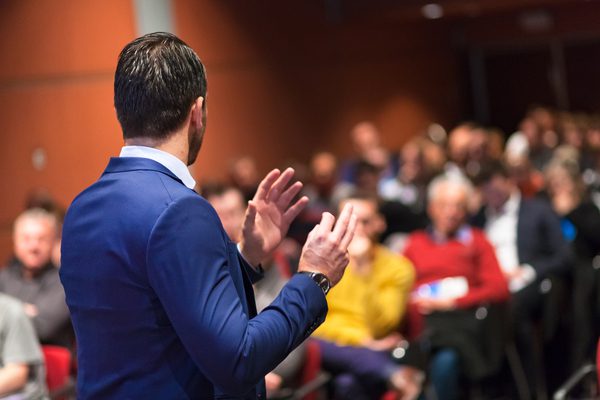
Building Genuine Connections: Being likable is important. If you can tell a good story about a speaker, the client will remember that speaker.
You uncover other things that people need and the fact that you continue that relationship with clients is fantastic. It’s something that I don’t see a lot of and I wanted to give it a special shout out to everyone. A lot of people who are reading might want to know what the 2 or 3 hot things that you see clients are seeking now. Is it about the future? Is it leadership? Is it help us make better sales? Are all of those things or other things that you see people looking to have speakers come to talk about?
I suppose the big one and it’s been around for a while. We’ve had a lot of it certainly in the UK. It’s dealing with uncertainty. How do we deal with uncertainty? How do we continue to be successful? How do we continue to grow? How do we lead? How do we keep going? We’ve had a lot of uncertainty. I think we still have some. That’s been a big one. That covers a lot of other areas. In order to deal with that, people say, “I need an expert. What’s going on in the future? I need an expert. Tell me about the AI situation. I want somebody to tell them about cyber risks. I want somebody to tell me about technology. Tell me about how I’m going to create higher performance when people don’t know.” It’s all underpinning that big thing. We’ve been through this whole Brexit situation and many people said, “The speaker bookings are going to go down because of uncertainty.” Over the few years that we’ve been going through Brexit, we have increased year on year because uncertainty means, “Help. Give me an expert.”
I talk about this in terms of embracing disruption mentally. It’s great to know that there’ll be driverless trucks eventually and what technology is coming, but there’s an emotional concept around it that I feel storytelling helps us through all the change. When people realize, “Is there going to be a need for my job, whether I’m in sales, customer service or whatever else is going on?” That I tell people now more than ever, the emotional storytelling connection, the AI still is not able to do that yet. AI is not great at empathy. It’s not great at making people feel listened to. When you realize that those are skills you have and can develop like any other skills. I’m happy to hear you say that because this concept of soft skills can make us strong through uncertainty.
If you’re realizing that you need to develop those, then people are like, “Oh.” I saw it myself with Gensler, which is the world’s largest architecture firm had me speak to their team about how to win more business through storytelling. They said, “It used to be enough to go in and show our designs. Now, we have to use virtual reality goggles so people can experience the design and that’s still not enough. We were told that a client said between you and two other firms and we’re going to hire the people we like the most because it’s a five-year project to renovate this airport.” They realized, “What? Get John in here. We’re architects. What do we know about likability? How do we do that in a presentation no less? How do we make ourselves likable?” I kept saying, “Tell your story so people can remember it.” That whole premise of everything is being disrupted. You’re being disrupted at a technical level. You have to have new tools, but you also need new tools as a person and communicator to embrace this disruption. You see this all the time between speakers. Clients say, “You’re going to give them maybe 2 or 3 options.” I bet you hear 9 times out of 10, we’re going to hire the speaker that’s the easiest to work with that we like.
[bctt tweet=”As you get bigger and bigger, you can’t keep tweaking and changing what you do.” username=”John_Livesay”]
The likeability thing is huge. One of the programs I always refer to when I’m talking about speakers, I like to match it to music. I’m a big fan of Simon Cowell. Simon Cowell often says, “You have that likability factor. You are likable.” Being likable is important. Going back to what you were saying about stories, if I can tell a good story about a speaker, the client will remember that speaker. A lot of speakers don’t have great stories that I can tell. If they do, they’re memorable. I remember them. We’ve got 4,500 speakers on our roster. I am not going to remember everybody. I remember the good stories.
Here’s an example of what I think is a good story. When Anthem Insurance hired me, they said, “We’ve got nurses and MBAs. None of them want to be perceived as salespeople and yet we need them to start selling our data.” I said, “Ask them to be storytellers, not salespeople.” Light bulb, great. I said, “What’s going on after my talk?” We’re going to do an improv session where the audience is going to shout out objections and see how they handle it in the role-play situation.” I said, “What if I stayed after the keynote and helped them during that improv? I could whisper in their ear if they got stuck.”
“Nobody offered that. That’d be amazing.” During the process they said, “Can you be in my ear all the time when I’m in the field? You are the Pitch Whisperer.” That’s a little story now that people go, “I remember, you’re different.” It’s like, “They love that,” and that’s a story that you can tell. “Is that something you want to do? He’s done it before. He’s combining improv and sales training. What? How does that work?” Those little stories like that, they don’t have to be long. They have to be memorable. That’s what I love about storytelling. Is it memorable and magnetic?
The other thing to add to that is nobody has to remember your name. They have to remember the story. They’ll remember Pitch Whisperer and that is easier. They’ve got an image in their head. It’s easier to remember and that’s important for speakers to have that because there are many speakers out there. I’ve been in this business for many years. When I started, we were looking for experts to speak. We call it the speaker circuit. In other words, you can book this person to speak and pay them. That’s what it means. It’s not a real circuit. They’re not going round and round. On the circuit many years ago, there were few speakers in each of the categories, each of the topics and you were looking for them. Now, I think I get approached twenty times a day. That’s just my office and me.
Building Genuine Connections: Video these days is more important than ever from a client’s point of view because they’re too busy to go out and see the speaker live.
Imagine the difference between a warm introduction versus a cold call and the same thing with your relationships with your clients that know, trust and like you. They said, “If Maria says James Taylor or another speaker is good, we believe her. You’ve de-risked our own anxiety about whether that person’s going to show up and do a good job or not.” That’s what people don’t realize. You and I talked about the importance of a speaker having great footage of themselves in a crowd so that people go, “That’s what we have. He can nail that.” Also, the images a speaker uses because you and I have a love of photography and design. I tell people the kiss of death is to read from a slide. You see many people who are not professional speakers, whether it’s executives of the company talking to their team before you get up to speak and you’re like, “You’re boring them to death.” Let’s talk about the big picture of the importance of visuals, whether it’s a video or an image that you’re using on your deck.
Video these days is more important than ever from a client’s point of view because they’re too busy to go out and see the speaker live. Back in the old days, you would go and see a speaker live and think, “I’ll book them for my next event.” You can’t do that now. The next best thing is video. You have to have a video. It’s absolutely essential. Does it have to show an audience? I don’t necessarily believe it does. Clients are sophisticated. They’re quite switched on. They can see if somebody can communicate a message, how they convey themselves. With regard to using visuals, it depends on you. If you’re a good storyteller, you can paint the pictures. A good storyteller can create better visuals in your head than you will ever see. I love that because then that’s unique to you. If you’re going to have visuals and it helps the audience to stay with you, that’s wonderful. It’s all about helping the audience to stay with you. That’s what it’s all about. I also like the use of video during speeches if it’s appropriate.
Do you have any last thoughts or suggestions, books you love, quotes you like that you want to leave us with?
I’m going to give you two quotes from one particular speaker. They were the best bits of advice I have ever had and I still use them now. I hope I remember both of them and getting them both correctly. One of them was, “Do what you say you’re going to do because it’s quite rare.” That was one of the best bits of advice and the speaker is Philip Hesketh, so that you know who he is. He’s an expert in persuasion and influence. The other thing he said which is brilliant is, “The rules of selling are ABC, always be selling.” I didn’t say always be closing. He says, “Always be selling.” People have to remember that this is a business. Always be selling.
[bctt tweet=”The life of a speaker is not always glamourous.” username=”John_Livesay”]
That old philosophy, Always Be Closing, ABC, I put a twist on that at the end of my workshops and I say it’s ABK, which is Always Be Kind. People love that. I say, “Put it on a Post-it Note in your car if you have road rage in traffic. Put it by your phone.” The things we say to ourselves are much meaner than we would ever say to anybody else. How can we possibly be kind to other people we work with, let alone our clients, if we’re not starting with this ourselves? A lot of salespeople struggle with the image of, “People don’t like salespeople or lawyers.”
They’re seen as pushy. If you reframe that to ABK, it’s a nice little memorable takeaway that people like, “I’m using that,” or people will come up to me like, “ABK.” It’s a fun little thing. Those little memorable sound bites whether you’re giving a talk, being interviewed on television, it’s important to figure out who you are and what your brand stands for. Maria, you have nailed that in many ways. It’s been an honor getting to know you more, hearing your story, sharing your particular vision of being a human to human agent of change. It’s been an honor. Thank you so much.
Thank you.
Important Links
- MFL
- London Speaker Bureau
- Speaking Business – Podcast
- Better Selling Through Storytelling Method Online Course
Wanna Host Your Own Podcast?
Click here to see how my friends at Podetize can help
Purchase John’s new book
John Livesay, The Pitch Whisperer
Share The Show
Did you enjoy the show? I’d love it if you subscribed today and left us a 5-star review!
- Click this link
- Click on the ‘Subscribe’ button below the artwork
- Go to the ‘Ratings and Reviews’ section
- Click on ‘Write a Review’
Love the show? Subscribe, rate, review, and share!
Join The Successful Pitch community today:
- JohnLivesay.com
- John Livesay Facebook
- John Livesay Twitter
- John Livesay LinkedIn
- John Livesay YouTube