
TSP068 | Ramphis Castro – Transcription
Posted by John Livesay in Uncategorized | 0 comments
John Livesay:
Hi and welcome to The Successful Pitch. Today’s guest is Ramphis Castro, who is the Kauffman Fellow. Only 30 people get invited to join that a year, so extremely prestigious. He’s the founder of Mindchemy, which helps startups in foreign countries, and finally, he’s the managing director of The Founder Institute in New York City, which is based in Silicon Valley. It is the world’s largest idea stage accelerator. He has amazing insights as to what’s going on in Cuba and compares it to Vietnam that there’s a lot of talent there and a lot of solutions that are waiting to be filled as a huge new potential for investors. He said, “The best way to start is to start small, and who you partner with is really key, so make sure that you check out those references.” He said, “Puerto Rico is the biggest startup place that you’ve never heard of,” and he talks about how to get free money if you are willing to move to Puerto Rico. Enjoy the episode.
Are you a founder struggling with your investor pitch? Do you need warm introductions to the right investors to get your startup funded? Do you need a funding road map to get you there fast? All of this and more can be found in Crack the Funding Code. Join host, John Livesay, and Judy Robinett, bestselling author of How to Be a Power Connector and board member of Illuminate Ventures, on their free Crack the Funding Code webinar. Simply go to judyrobinett.com – that’s J-U-D-Y-R-O-B-I-N-E-T-T dot com – and click on the webinar tab to see how to tap into their network of investors from around the world. There’s a link in the show notes as well. You’re only one click away from getting funded fast.
Welcome to The Successful Pitch Podcast. Today’s guest is Ramphis Castro, who is the New York City managing director for the Silicon Valley-based, Founder Institute, the world’s most successful idea stage accelerator, which helps aspiring founders across the globe build technology companies. Graduates from this program have raised over 500 million in venture funding and they generate 12 billion in investor value. He’s also a Kauffman Fellow, a community of over 500 innovation investors worldwide, and from what I’ve read, only 30 people get in a year to do this. So, that’s incredible. As if that wasn’t enough, he’s also the founding partner of Mindchemy, a full-stack startup ecosystem, acceleration, and support organization that helps managers in venture industries. He’s a friend of Judy Robinett. They met judging a pitching contest down in Puerto Rico. So, without any further ado, welcome to the show.
Ramphis:
Thanks, John.
John:
I don’t even know where to start. Let’s start with how did you get into the startup world? How did you decide this is what you wanted to do with your life?
Ramphis:
Sure. So, the story there starts early. I mean, my mom used to be our first investor as kids when we wanted to make a trip as a family and make us sell M&M’s. We had to pay her back first and then with the profits, we could buy airline tickets to be able to go to Disney.
John:
Wow, that’s a lot of M&M’s.
Ramphis:
It was, right? So, going door-to-door, having her, a few blocks away, in the car, just kind of watching us, just door-to-door and kind of get that done definitely got us started early. And as my career moved forward, I started computer engineering, I knew, after my time in Microsoft, that I wasn’t going to be an employee forever, that there was certain ideas that I had keen on to build because I wanted to get out there and that’s how I got the bug just to, when I came back to Puerto Rico, to really just push those forward, and I started my first analytics company. So, that’s a short version of kind of how that happened.
John:
Yes, and then you were in Puerto Rico. That’s your childhood, then you worked for Microsoft. Where in Microsoft did you work?
Ramphis:
Redmond.
John:
Oh, you worked at the corporate headquarters? Okay.
Ramphis:
Yeah, I worked at the Office services team, the guys that did the user experience for Office 2007. The time’s a while back.
John:
Mm-hmm, and you started teaching down in Puerto Rico at the university there, I see, in computer science and entrepreneurship, right?
Ramphis:
Yeah, so I made all my mistakes on my first company, and that blew up gloriously, and the product and the initial property was successful, but I made mistakes on the economy and bad partners and it was just a terrible, terrible experience.
So, I got involved into everything else on the ecosystem side to make sure that others didn’t have to go through what I went through then, and that’s part of the story around getting involved in the university and supporting stuff like engineering, how that’s taught more from the entrepreneurship side and the engineering side, and then also teaching graduate students on how to use their skills to build mobile companies, and a lot of other programs that I’ve been involved with over the years, always trying to fill the gaps of what was needed in the ecosystem and anything I wish somebody would have told me when I was in school and just working on my company.
John:
What are some of the things that you wish somebody had told you that you try to tell people now?
Ramphis:
Definitely the biggest lessons learned is the best way to start is just to start. There are all these workshops, all these page events, all these articles on the internet, and really, the best way to get the experience to meet and to run a company is actually run a company, and you start small. Don’t have this grand idea. Don’t necessarily even call it a company, but really just start with a small accessible project.
So, getting started is key. The other is make sure you know who you’re partnering with. This is a long-term endeavor. It will take you a good part of your career, of your life, so make sure that whoever you’re bringing in, you’re able to be fully transparent with them, and it’s a long-term relationship that you’re building. So, you want to want to make sure that you’re honest and open, and it’s a collaboration. So, you watch out for the red flags: dishonesty, bad ethics, those kinds of things, and really reference check people. Make sure that, you know, who knows them, who’s worked with them, and make sure that you’re having the right people for your team early.
So, those are two things. There’s a lot, obviously, but those are two that I always make sure they’re the first things that I tell new, aspiring entrepreneurs.
John:
Well, you just gave us two tweets right from the episode. “The best way to start is to start small” and “Reference check your team”. So, those are great takeaways. Now, you were judging a pitching contest down in Puerto Rico. You were also a part of a Start-Up Chile judge. Tell us what you look for when you’re listening to pitches, either in a contest or as an investor.
Ramphis:
So, I operate at what is called the pre-seed and seed stage. So, that is the earliest you can get involved, which is when there might or might not be a team. There might not even be a product, but really, something that is the inkling of the start of a great project. In that space, the number one thing I’m focused on is the team, and by the team, I mean, why is this the right team to run with this idea? What particularly qualifies them to do it? Like, why would I think that this is the team to win in this space?
The other key piece is, whatever traction they have, and by traction, I mean what have they actually done already? Do they have an early prototype up? Do they have even sign-ups, a landing page where they’ve collected a few hundreds, dozens, thousands of emails, how they followed up with customers. So, traction has many forms, but it’s have they done work and how fast did they do this work, and are they moving? Those are the two key pieces I look out for.
John:
I like that; that’s so helpful. What’s interesting about that is you’re not looking for them to give you a 10-minute product demo or a long lengthy explanation of how they came up with this concept, but it’s really about, “Tell me about you and why you’re uniquely qualified, and what have you done to show some traction and how fast is that happening?” which is not normally the focus a lot of people start pitching with. They start talking about, “Oh, this is a great idea and this is going to make millions,” and you’re like, “Tell me what it is you’re talking about and make it easy for me to understand.” I want to dig in to being a Kauffman Fellow. Can you tell us how you got selected, what that process was like, and what you do as a Kauffman Fellow?
Ramphis:
Sure. So, as I mentioned, the Kauffman Fellows is with the network of innovation investors, and it’s a two-year fellowship where, as you’re actively engaged in the VC industry with a fund or through other programs related to VC industry, you learn, one-on-one, with a cohort from the best of the best in the industry on how the sausage is made, really, as we get into the insides.
So, the process for me is I heard of it first through another Kauffman Fellow, Jorge Torres, who’s a venture partner with Silas Capital. They’re a consumer-focused VC firm here in New York and he was seeing my chart records, seeing that I was in the investing world and that was my general direction, and that’s really where I’m focused on moving forward. He said, “You should look into the program,” and he introduced me into it.
So, the process was, basically, me reaching out to a lot of other fellows, understanding the program and how it matched in my vision and where I wanted to be moving forward and it was just incredible to get to meet the other fellows and what they’ve done and what they represent in their own space in the industry.
So, there’s an application process where there’s two routes. One is an affiliate, so those that are just getting into an industry and they go through an interview process and something called a finalist process and they’re selected by a firm to move forward, and there’s the affiliate where there’s an existing relationship with a VC firm or program and we’ll move forward with supporting that candidate through the process. So, after application and interviews, you get the call that you’re part of a particular class that starts every year in June in Silicon Valley.
John:
It’s a very select group. It’s almost like getting into Y Combinator or something, right? I mean, lots of people apply and they only take 30 a year?
Ramphis:
Right. The way he felt or we’re going to sometimes call it, the YC of it, the wifey for VC.
John:
Fantastic. So, what have you learned now that you’re in this prestigious Kauffman Fellowship?
Ramphis:
Well, definitely, the biggest lessons learned has come from, obviously, everybody involved and by peers, but it really has been around how the global venture industry works. Not just one particular ecosystem, but more globally focused on how innovation happens and is supported by innovation investors and what’s the role in different areas at different stages, and what’s our focus, and how do I make sure that we support the entrepreneurs, which really are the rock stars here are the ones that make it happen, and how are we really able to focus and help them just achieve what they’re going to achieve.
Just to help accelerate that and just learn the best practices and everything from how to create new venture firms, new VC funds to running diligence from companies, how to syndicate in deals, bringing in other investors, who are the right investors in the right spaces, and really engaging the entrepreneurs through the process of really exiting that company, or running it forever, if that’s what they want to do.
John:
You also are the founder of the Institute, which is based in Silicon Valley. So, it’s a stage accelerator program. Can you speak to us about how did that become the world’s largest, and what do you do as the managing director?
Ramphis:
Sure. So, the program was founded by Adeo Ressi. Adeo is based on Silicon Valley and he’s a founder of the Founder Institute. The chapters are run worldwide through directors, through regular directors who operate on a part-time basis. Myself, as a managing director of New York, operates on a full-time basis where we have cohorts operating every three and a half months.
But, to take a step back, the Founder Institute is focused on helping entrepreneurs launch their company. So, it’s focused on, essentially, employees with, generally, 10 plus years experience that are really focused and committed to launching their company from anywhere on the world, launching a global venture-backable company in whatever ecosystem they operate in.
To do that, we have a 14-week, essentially, a three and a half month program where they can participate part-time as a — considered a full-time job and validate their model, and the way that’s supported is through mentors and structured curriculum where they are basically focused on building their company.
So, there’s nothing academic about it. They are in it building their mission. They’re revalidating their idea with customers who are figuring out what’s a revenue model, is there a real business around it. Understanding the fundraising process lead on everything that a founder should know about to be successful entrepreneurs, and they learn it from other successful entrepreneurs that have been there, have done it, and other investors that actively support and invest in companies at their stage and have experience in supporting how that grows.
John:
At the end of that three, three and a half months, do you have a demo day where they get to present and pitch to investors?
Ramphis:
Yeah, so one of the things to keep in mind is these are starting, so they are the earliest you can get. So, for many of them, demo days is way too early so they might have, by the end, a fully formed business model validated and a lot of different pieces, and a fully vetted due diligence ready company that’s able to accept a venture funding with our legal partners that operate in different cities around the world.
Here in New York, the money’s right and they support the companies getting launched and there’s basically a first look where we basically bring in the best pre-seed and seed investors in the community here in New York and wherever our chapters are operating to see the companies first.
So, we call it First Look Event, and some of them will be too early. It may require a little bit — or take three to six months extra where different investors at that stage will go in, and there will be other companies that have either quit their day jobs throughout the process and are moving forward full-time on the business and investors are able to get an early look before the rest of the investor community takes a look at them and wants to come in.
John:
So, that seems to really be a big differentiator from other accelerators, which most everybody who’s in those programs is doing this full-time, and you’re so pre-seed that you let people have a full-time job and do this part-time, is that right?
Ramphis:
That’s correct. They operate on a full-time load with their jobs, which could be anywhere, 50, 60, 80 hours a week, and on top of that, they do between 20 and 40 hours’ worth of work on top of that. So, the focus is on getting them to experience working 100, 120 hours plus what it feels like, and feel that pressure over the course of three and a half months. Just gets them into the cadence of running a company, just keeping up with the tempo and moving forward fast with limited resources, limited time, limited information. They need to keep moving forward, and after that time, it really transforms their thinking and they’re able to really just take the reins and just move forward. It’s really amazing to see the transformation.
John:
Do you start working with them that early on who they might be looking at to get on an advisory board?
Ramphis:
Yes, so the structured career program involves 10 different topics. Everything from their vision and the idea is just understanding why they want to start that particular company and why them and why now, those kinds of things. Then also, the topics around teams and advisers. Who are the right advisers for their company? They’re able to look at our global mentor network of over 5,000 CEOs and investors, and obviously, there’s a lot more in the ecosystem.
So, when they’re operating, they may not be a part of our network, which we can reach through our network as well. So, they think about that broadly and they really think about how to start engaging and how to start those relationships throughout the course of the program. So, by the end, they know they either have them already on board, or they know what they need to do in order to get that done.
John:
Well, this seems to me that the skill of pitching is needed not only to pitch investors for funding, but also to pitch potential people to join your advisory board and then pitch potential people to join your team, right?
Ramphis:
That’s exactly right. Everybody thinks that — when I say everybody, generally first-time entrepreneurs think that pitching is for investors. Pitching is everybody. You’re pitching your spouse, you’re pitching your team, you’re pitching your parents that you’re not crazy and you’re really pitching everybody on why this is going to work, or even if it’s not, why you have to do it. Money is a part of it, but you’re not aiming just for the money, you’re aiming because you have to put this out to the world and you’re the right person, you could build the right team to go after it.
So, pitching is an essential skill because you only have yourself in the beginning. You only have your dream, your background, your track record, your commitment, and with that, you have to pick somebody to quit their job to come and work with you on something that will most probably fail. So, pitching and being clear about what problem you want to solve, why you’re the right person to solve it, and what you’ve done to move that forward, and what’s unique about your approach, you got to get out there in 15, 30 seconds, right?
John:
Mm-hmm.
Ramphis:
Then if you’re graced with more time, then you go 30 seconds more to how you do it, what’s your product. If you get another minute, then you go into how do you make money, right? So, it’s really just buying every piece of someone’s attention when they engage with you.
John:
Mm-hmm, I love that. So, as part of the program at the Founder Institute, do you have a section where you teach them how to pitch?
Ramphis:
Yes. So, pitching is an essential component of the program and they pitch in different formats. I mean, there’s no right way to pitch so we do everything from 30 seconds, 60-second pitch, 3 minutes with a deck, with no deck, 5 minute with a product demo. So, they really go through everything and the way it’s done, instruction in the program, is that it builds on previous weeks.
So, in the beginning, they’ll pitch why they want to be an entrepreneur and what are they passionate about or what are they the best at, and that’ll evolve into sort of what problem are you solving and what is your unique — differentiate a unique approach, solving that problem, and it will continue to grow into the other pieces of your pitch, such as what’s your actual solution? How does it work? How do you make money? How big is the market? And those other pieces of a pitch.
John:
I love how you structured that, that it really starts with you being able to pitch, why you’re uniquely qualified and passionate to do this before you even get into how something works, let alone how it makes money. So, let’s also talk about that you’re the co-founder of managing partner of Mindchemy, which is a combination of, you told me earlier, “mind and alchemy”. Tell me about what you’re doing there.
Ramphis:
Sure. So, Mindchemy is a partnership between Marcos Polanco and myself where we’re both Kauffman Fellows and we both met doing ecosystem work in Puerto Rico and we’ve been collaborating and working on different aspects of ecosystem building over the past almost eight years now where our focus with Mindchemy started with bridging the gaps in ecosystem.
So, if you go into somewhere where there’s no startup community, that’s probably the first thing is to just say, “Well, I’m starting a startup community,” and that’s, essentially, what happened in Puerto Rico is when we started our own companies, at the time. I started in Puerto Rico and Marcos spent time in Silicon Valley, there was no ecosystem, really, to speak of and no community. So, we started with the startup weekends and organizing the pieces that move those communities forward.
But now, Mindchemy has evolved to more global focus and, over the years, we’ve been fortunate enough to advise governments over the world and ecosystems of the world around, really, how to really engage and support Grassroots leaders, and also now, more recently, engaging with emerging managers. So, the people that are starting new funds that basically operate like entrepreneurs, but these are VCs that have worked at VC firms, but now are setting off on their own to start their own firm to fill a particular gap in the funding ecosystem.
So, Mindchemy really has sort of evolved into, “How do we support programs globally and really support from other ecosystem builders that reach out to us where we, from experience, support ecosystems in Puerto Rico, Dominican Republic, Columbia, and now more recently, Cuba to really move those communities forward?”
John:
Well, let’s talk about an article you recently wrote about, Cuba, and comparing it to Vietnam in the early days and all the potential there with the talent and the solutions that are needed.
Ramphis:
Yeah, thanks for asking that because one of the key things when people think about Cuba, obviously, it’s 50, 60 years of, basically, unknowns. It was very difficult for us from — everybody, generally, from the outside to think about and understand sort of how the coach in the economy and other aspects of it works. So, when people think about it entirely, they would talk about it from a sort of past tense of things that are not up to date on what they have, and people lose sight of, sort of, the fantastic education system that they have.
So, when you think about the key ingredients for ecosystems and startups, it really starts with talent, number one, and that’s something that they’ve invested in for the past half century in more ways than most countries in the western hemisphere, the World Bank, and other organizations that have recently recognized Cuba as having the best education system. So, we’ve had the opportunity. We had the privilege to support some Grassroots organizers that are sort of outside of the politics and really are focused on supporting and growing their communities and their startup ecosystem.
In that perspective, people need to think about where we’ve already seen this evolve. So, our people lose sight of the world, kind of, in their day-to-day sort of seeing the new cycles and all these things. But, really, it’s nothing new. We’ve seen how some of it has played out in the process of Vietnam where it’s still a socialist government and you’re seeing some of the fastest growing companies in Asia coming out of Vietnam now. You have Fortune 500 companies operating there, like Microsoft and Intel. So, we’ve already sort of seen a piece of that movie, and now we really get the opportunity to be supportive in whatever the community wants to really grow into and how they want to evolve and what are the ideas that are going to come out of such a high quality talent that is sort of based on the island.
John:
Yes, I was reading in your article there about just some basic things like you need your medical things from the pharmacy delivered to you quickly, almost like an Uber version of medical pharmacy delivery. That’s one, and tourism, of course. So, there’s lots of different things going on there.
Ramphis:
Right, because things that we take for granted everywhere is something that, when you think about it, there are a lot of communities everywhere, not just in Cuba, that don’t have access to certain commodities. So, having somebody, or being able to access your medicine is something that if you go to rural places across U.S. and Latam, they might have the same challenges where they might not be able to find what they need, and that basically tells you, “Hey, this is where you can find what you need and get it.”
It’s something that, obviously, they’ve experienced over time in Cuba, and this is some ideas that came up directly from the community, but it’s something that you could easily see scaling through other ecosystems because it’s a real problem not just there, but in a lot of communities around the world.
John:
And of the internet connection, whether it’s Vietnam or Cuba, is pretty standard now, or is it still evolving?
Ramphis:
It is definitely evolving. Obviously, it’s one of the bigger challenges coming in, kind of, the first time I was there. It was very difficult. But, it may also appreciate the use and optimizing your time. So, there’s a lot of engaging and a one-on-one with people and just talking and just really engaging in human contact. But, the huge advantage that Cuba has is it’s just 90 miles away from one of the largest, most sophisticated Nox fiber optic connections in the world. There’s the Terramac Building is just in Miami.
So, it’s not as if you’re trying to interconnect all of Brazil, if you really just want to increase the balance in Cuba, the government is sort of moving forward with improving their technomic cases infrastructure, and as a relation to it, when the U.S. continue to improve, you’ll just fiber deployments. Maybe Google will come with Project Loons and others that they can initially test up.
So, there’s a lot of technology that we have now that can really enable economies, like Cuba’s, to just quantum leap other economies that have invested in other traditional telecommunications infrastructure over time. So, that’s a huge advantage that Cuba has over other economies is that they can take advantage of all the mistakes that everybody else has made in deploying their infrastructure, and now they can really get it right the first time because we all know how to do it now, how to interconnect in the role of fiber and other high-speed solutions, and they can learn from other governments like South Korea, right? I mean, that the leader in excellence in broadband, South Korea, Singapore, and they can sort of see what works and just really build on top of that.
John:
Tell me about P18. We briefly talked before the show a little bit about that.
Ramphis:
Sure. So, the next evolution of Puerto Rico is really break out as, essentially, the Hong Kong or the Singapore or the Caribbean. So, if you’re an Asian company, you’re thinking about doing business in China, you could do it in China, but you could build through Hong Kong and there’s very sophisticated business environment that you can take advantage of to really expand and really roll out your Asian strategy. So, when you think about Puerto Rico, it’s the same way. It’s basically inside the USA, but outside the IRS. So, that enables companies such as Microsoft to globally, really, capture and maintain and reinvest their capital abroad in expansion and supporting their operation.
So, that is something that is available for companies. So, as that evolves, the P18 programs, called Parallel18 after Puerto Rico is located in the Western Hemisphere is a way for companies that are U.S. companies that want to expand to Latam to take advantage of the same thing Microsoft takes advantage globally, or for Latin American companies that really want to expand into the U.S. really have a softer landing into the U.S. market that, basically, you have a fully Latino culture in Puerto Rico, but it is a U.S. based commercial engagement.
So, you’re able to have companies from all over the world that want to expand into the U.S. really, really have a taste of what being in the U.S. economy can be like and they can take advantage of the fantastic talent that Puerto Rico has to offer that has been a secret for decades now. We have Microsoft, Procter and Gamble, IBM recruiting for the past 30 years not telling anybody about it, and now having startups from all over the world come down from the P18 program to come down with a 40k, equity-free, and spend five months there like the Start-Up Chile, and if they decide to stay and leave some operations, they could get 75k follow on funding from the Puerto Rico Science and Technology Trust.
John:
What an amazing opportunity for somebody who’s willing to do what it takes and live where it takes, to move to Puerto Rico, and get some startup seed money, and even more if they stay, right? It’s great.
Ramphis:
Yeah, it is fantastic. Actually, one of the first ones to buy that pitch is Sebastian Vidal, which he was the former executive director of Start-Up Chile. So, you have a guy that’s been there, done that, we’ve seen the effects of that in Chile, and he believes so strongly in this that he moved his family, has a newborn that is sort of settled in Puerto Rico doubling down on this. It’s something they just — an Inc. article just came out today around how it’s the biggest startup hub you’ve never heard of.
John:
I love that. That’s fantastic. We’ll use that as a definite tweet. “Puerto Rico, the biggest startup hub you’ve never heard of”, right?
Ramphis:
Yep, exactly.
John:
What book would you recommend our listeners to read, either about business, startups, or just life in general?
Ramphis:
That’s a great, great question. One of the things I definitely love for startup founders to really dig into is a book called Venture Deals by Brad Feld and Jason Mendelson, and they’re the partners out of the Foundry Group, and basically, it walks founders through a lot of the thinking that investors go through from how to start your deal, how to think about investment, how to think about how things are structured, and what are the incentives for investors to support your company and really invest and follow on investing.
So, it’s really an opportunity for entrepreneurs to get insight into the minds of VCs, and also to know more than your lawyer. It’s very important that your lawyer supports what you’re doing but then you know enough so that you can ask smart questions about your company and the future of finance.
So, I think Venture Deals is definitely one. Another great one is Early Exits by Basil Peters. Early Exits is really around everybody — you know, Unicorn hunting nowadays really matters for those companies, but an 80-million, 100-million-dollar exit is the life-changing event for a founder, and you could go in that direction, and then just go again and launch your second company, like Elon Musk did after PayPal, and launched Tesla and SpaceX. So, that book is really about how to engage your advisers and think about an early exit strategy and think about how does that work and how do you position your company for acquisition, and really, the mindset around how to actually execute on that strategy.
John:
Those are both great, great recommendations. Thank you. How can people follow you on social media? What’s your Twitter handle, all that good stuff?
Ramphis:
Sure. So, I have a big advantage is that my name, Ramphis, is number 2 on Google. So, if you search “Ramphis”. There’s a moth on Wikipedia that’s sort of beating me out, so if somebody, someday, can do a Wikipedia entry, hopefully, I could be at number 1. But, easy enough to find if you Google. Then, definitely, Twitter, @jramphis, J-R-A-M-P-H-I-S. That’s sort of the easiest way to reach me. And across properties on the internet, AngelList, Twitter, Facebook, you name it, it’s still jramphis.
John:
Great. Well, I can’t thank you enough for being on the show and sharing all your wonderful global insights. It’s very exciting to hear about what’s going on in Puerto Rico and Chile and Cuba, and then of course, everything you’re doing here in the U.S. with the Founder Institute and the Kauffman Fellowship. Thank you again.
Ramphis:
Thank you, John. Really appreciate the opportunity.
John:
Thanks for listening to The Successful Pitch podcast. If you liked the show, please go to the iTunes and write a review.
How To Get Seed Money for Free – Interview with Ramphis Castro
Posted by John Livesay in podcast | 0 comments
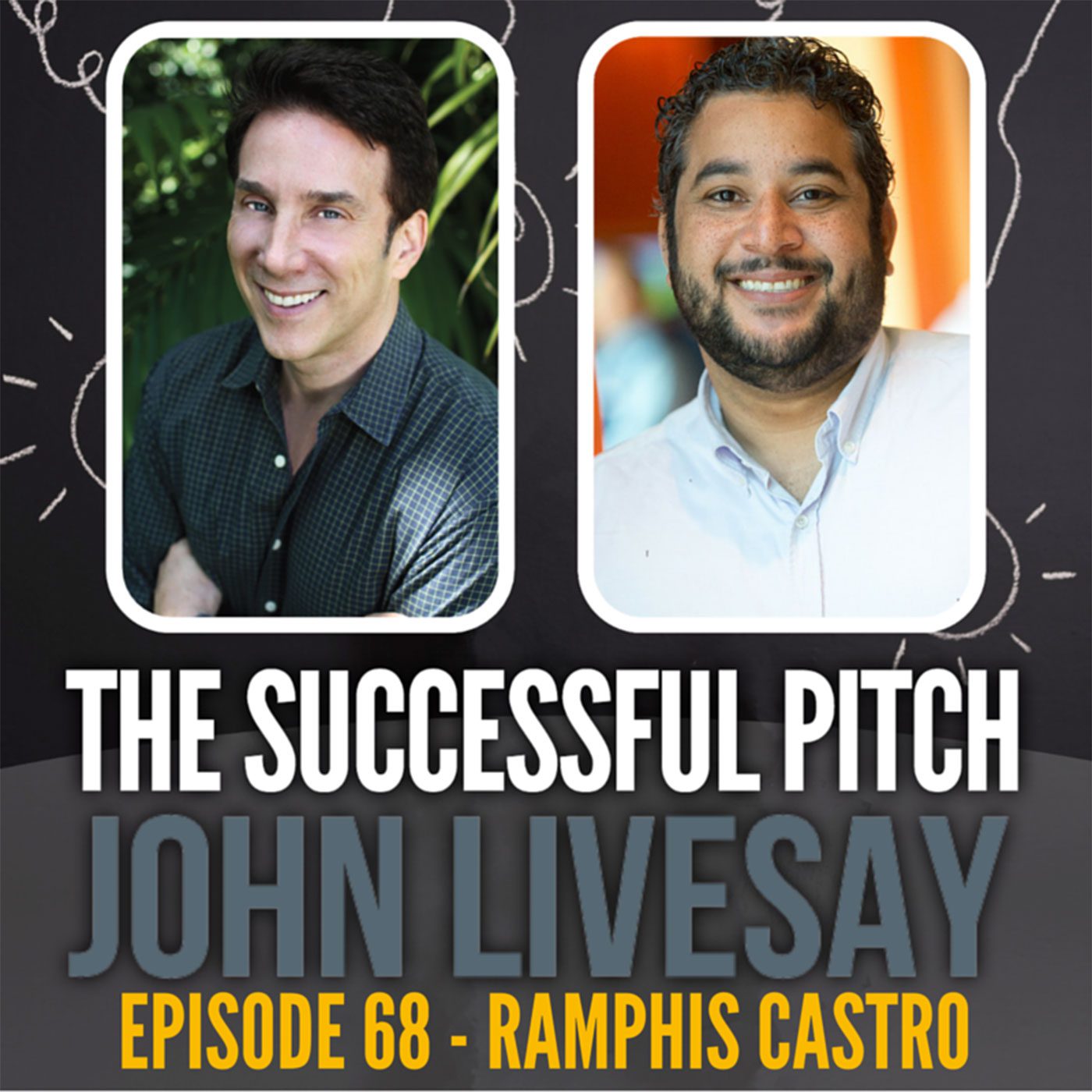
Listen To The Episode Here
Episode Summary
Ramphis Castro is the co-founder of ScienceVest and is a Kauffman Fellow, a community of over 400 innovation investors worldwide. He is also the managing director of The Founder Institute, which is one of the world’s largest idea-stage accelerators. Today, Ramphis sits down with John to discuss some of the potential entrepreneurial paths in Cuba and Puerto Rico as well as some of the benefits of being a Kauffman Fellow.
How To Get Seed Money for Free – Interview with Ramphis Castro
Hi. Welcome to The Successful Pitch Podcast. Today’s guest is Ramphis Castro, who is the New York City managing director for the Silicon Valley based founder institute, the world’s most successful idea stage accelerator, which helps aspiring founders across the globe build technology companies. Graduates from this program have raised over 500 million in venture funding and they generate 12 billion in investor value. He’s also a Kauffman Fellow, a community of over 500 innovation investors worldwide. From what I’ve read, only 30 people get in a year to do this. That’s incredible. As if that wasn’t enough, he’s also the founding partner of Mindchemy, a full-stack startup ecosystem, acceleration and support organization that helps managers in venture industries. He’s a friend of Judy Robinett. They met judging a pitching contest down in Puerto Rico. Without any further ado, welcome to the show.
Thanks, John.
I don’t even know where to start. Let’s start with how did you get into the startup world? How did you decide this is what you wanted to do with your life?
The story there starts early. My mom used to be our first investor as kids when we wanted to make a trip as a family and make us sell M&Ms. We had to pay her back first and then with the profits, we could buy airline tickets to be able to go to Disney.
Wow, that’s a lot of M&Ms.
It was. Going door-to-door, having her a few blocks away, in the car, just watching us, just going, “Got to get that done.” Definitely got us started early. As my career moved forward, I started computer engineering, I knew after my time in Microsoft that I wasn’t going to be an employee forever, that there was certain ideas that I had been keen on to build. I wanted to get out there and that’s how I got the bug just to, when I came back to Puerto Rico, to really just push those forward. I started my first company. That’s a short version of how that happened.
You were in Puerto Rico. That’s your childhood, then you worked for Microsoft. Where in Microsoft did you work?
Redmond.
Oh, you worked at the corporate headquarters?
I worked at the Office services team, the guys that did the user experience for Office 2007 at the time. A while back.
You started teaching down in Puerto Rico at the university there, I see, in computer science and entrepreneurship.
I made all my mistakes on my first company. That blew up gloriously. The product and the intellectual property was successful, but I made mistakes on the economy and bad partners and it was just a terrible, terrible experience. I got involved into everything else on the ecosystem side to make sure that others didn’t have to go through what I went through then.
That’s part of the story around getting involved in the university and supporting stuff like engineering, how that’s taught more from the entrepreneurship side and the engineering side and then also teaching graduate students on how to use their skills to build mobile companies. A lot of other programs that I’ve been involved with over the years, always trying to fill the gaps of what was needed in the ecosystem and everything I wish somebody would have told me when I was in school and just working on my company.
What are some of the things that you wish somebody had told you that you try to tell people now?
Definitely the biggest lesson learned is the best way to start is just to start. There are all these workshops, all these events, all these articles on the internet. Really, the best way to get the experience to run a company is to actually run a company. You start small. Don’t have this grand idea. Don’t necessarily even call it a company, but really just start with a small testable project. Getting started is key.
[Tweet “Best way to start is to start small.”]
The other is make sure you know who you’re partnering with. This is a long-term endeavor. It will take you a good part of your career, of your life, so make sure that whoever you’re bringing in, you’re able to be fully transparent with them and it’s a long-term relationship that you’re building. You want to want to make sure that you’re honest and open and it’s a collaboration. You watch out for the red flags, dishonesty, bad ethics, those kinds of things, and really reference check people. Make sure that you know who knows them, who’s worked with them. Make sure that you’re having the right people for your team early. Those are two things. There’s a lot obviously, but those are two that I always make sure they’re the first things that I tell new, aspiring entrepreneurs.
You just gave us two tweets right from the episode. “The best way to start is to start small,” and “Reference check your team.” Those are great takeaways. Now, you were judging a pitching contest down in Puerto Rico. You were also a part of Start-Up Chile judge. Tell us what you look for when you’re listening to pitches, either in a contest or as an investor.
[Tweet “How To Get Seed Money: Check your team’s references before you partner.”]
I operate at what is called the pre-seed and seed stage. That is the earliest you can get involved, which is when there might or might not be a team. There might not even be a product, but really something that is the inkling or a start of a great project. In that space, the number one thing I’m focused on is the team. By the team, I mean, why is this the right team to run with this idea? What particularly qualifies them to do it? Why would I think that this is the team to win in this space? The other key piece is, whatever traction they have, and by traction, I mean what have they actually done already? Do they have an early prototype up? Do they have even signups, a landing page where they’ve collected a few hundreds, dozens, thousands of emails, have they followed up with customers. Traction has many forms, but it’s, have they done work and how fast did they do this work and are they moving? Those are the two key pieces I look out for.
I like that. That’s so helpful. What’s interesting about that is you’re not looking for them to give you a 10 minute product demo or a long lengthy explanation of how they came up with this concept, but it’s really about, “Tell me about you and why you’re uniquely qualified. What have you done to show some traction and how fast is that happening?” Which is not normally the focus a lot of people start pitching with. They start talking about, “Oh, this is a great idea and this is going to make millions,” and you’re like, “Tell me what it is you’re talking about and make it easy for me to understand.” I want to dig in to being a Kauffman Fellow. Can you tell us how you got selected, what that process was like and what you do as a Kauffman Fellow?
[Tweet “How To Get Seed Money: What qualifies you to be a founder for this startup?”]
As I mentioned, the Kauffman Fellows is a global network of innovation investors. It’s a two-year fellowship where, as you’re actively engaged in the VC industry with a fund or through other programs related to VC industry, you learn, one-on-one, with a cohort from the best of the best in the industry on how the sausage is made, really, as you gain insights. The process for me is really, I heard of it first through another Kauffman Fellow, Jorge Torres, who’s a venture partner with Silas Capital. They’re a consumer-focused VC firm here in New York. He was seeing my chart records, seeing that I was in the investing world and that was my general direction. That’s really where I’m focused on moving forward. He said, “You should look into the program,” and he introduced me into it.
The process was basically me reaching out to a lot of other fellows, understanding the program and how it matched in my vision and where I wanted to be moving forward. It was just incredible to get to meet the other fellows and what they’ve done and what they represent in their own space in the industry. There’s an application process where there’s two routes. One is an affiliate, so those that are just getting into an industry. They go through an interview process and something called a finalist process. They’re selected by a firm to move forward. There’s the affiliate where there’s an existing relationship with a VC firm or program and would move forward with supporting that candidate through the process. After the application and interviews, you get the call that you’re part of a particular class that starts every year in June in Silicon Valley.
It’s a very select group. It’s almost like getting into Y Combinator or something. Lots of people apply and they only take 30 a year?
Right. We sometimes call it the YC for VC.
Fantastic. What have you learned now that you’re in this prestigious Kauffman Fellowship?

How To Get Seed Money: It really has been around how the global venture industry works.
Definitely, the biggest lessons learned has come from obviously everybody involved and my peers. It really has been around how the global venture industry works. Not just one particular ecosystem, but more globally focused on how innovation happens and is supported by innovation investors and what’s the role in different areas at different stages and what’s our focus and how do we make sure that we support the entrepreneurs, which really are the rock stars here, are the ones that make it happen. How are we really able to focus and help them just achieve what they’re going to achieve, just to help accelerate that and just learn the best practices and everything from how to create new venture firms, new VC funds to running diligence from companies, how to syndicate deals, bringing in other investors, who are the right investors in the right spaces and really engaging the entrepreneurs through the process of really exiting that company or running it forever, if that’s what they want to do.
You also are the founder of the Institute, which is based in Silicon Valley. It’s a stage accelerator program. Can you speak to us about how did that become the world’s largest? What do you do as the managing director?

How To Get Seed Money: A structured curriculum where they are focused on building their company.
The program was founded by Adeo Ressi. Adeo is based on Silicon Valley. He’s the founder of the Founder Institute. The chapters are run worldwide through directors, through regular directors who operate on a part-time basis. Myself, as a managing director of New York, operates on a full-time basis where we have cohorts operating every three and a half months. To take a step back, the Founder Institute is focused on helping entrepreneurs launch their company. It’s focused on essentially employees with generally ten plus years experience that are really focused and committed to launching their company from anywhere in the world, launching a global venture-backable company in whatever ecosystem they operate in. To do that, we have a fourteen week, essentially a three and a half month program where they can participate part-time as considered a full-time job and validate their model. The way that’s supported is through mentors and structured curriculum where they are basically focused on building their company.
There’s nothing academic about it. They are in it, building their mission. They’re revalidating their idea with customers who are figuring out what’s their revenue model, is there a real business around it, understanding the fundraising process. Really on everything that a founder should know about to be successful entrepreneurs. They learn it from other successful entrepreneurs that have been there, have done it and other investors that actively support and invest in companies at their stage and have experience in supporting how that grows.
At the end of that three, three and a half months, do you have a demo day where they get to present and pitch to investors?
Yes. One of the things to keep in mind is these are starting, so they are the earliest you can get. For many of them, a demo days is way too early so they might have, by the end, a fully formed business model validated and a lot of different pieces and a fully vetted due diligence ready company that’s able to accept venture funding with our legal partners that operate in different cities around the world. Here in New York, they support the companies getting launched. There’s basically a first look where we basically bring in the best pre-seed and seed investors in the community here in New York and wherever our chapters are operating to see the companies first. We call it First Look Event. Some of them will be too early. It may require maybe a few, three to six months extra where different investors at that stage will go in. There will be other companies that have either quit their day jobs throughout the process and are moving forward full-time on the business and investors are able to get an early look before the rest of the investor community takes a look at them and wants to come in.
That seems to really be a big differentiator from other accelerators, which most everybody who’s in those programs is doing this full-time. You’re so pre-seed that you let people have a full-time job and do this part-time, is that right?

How To Get Seed Money: It transforms their thinking and they’re able to take the reins.
That’s correct. They operate on a full-time load with their jobs, which could be anywhere, 50, 60, 80 hours a week. On top of that, they do between 20 and 40 hours’ worth of work on top of that. The focus is on getting them to experience working 100, 120 hours plus, what it feels like and feel that pressure over the course of three and a half months. Just gets them into the cadence of running a company, just momentum and keeping up with the tempo and moving forward fast with limited resources, limited time, limited information. They need to keep moving forward. After that time, it really transforms their thinking and they’re able to really just take the reins and just move forward. It’s really amazing to see the transformation.
Do you start working with them that early on who they might be looking at to get on an advisory board?
Yes. The structured curriculum involves ten different topics. Everything from their vision and the idea. Understanding why they want to start that particular company and why them and why now, those kinds of things. Also, the topics around teams and advisers. Who are the right advisers for their company? They’re able to look at our global mentor network of over 5,000 CEOs and investors. Obviously, there’s a lot more in the ecosystem. When they’re operating, they may not be a part of our network, which we can reach through our network as well. They think about that broadly and they really think about how to start engaging and how to start those relationships throughout the course of the program. By the end, they either have them already on board or they know what they need to do in order to get that done.
This seems to me that the skill of pitching is needed not only to pitch investors for funding, but also to pitch potential people to join your advisory board and then pitch potential people to join your team.
That’s exactly right. Everybody thinks that, when I say everybody, I mean generally first time entrepreneurs think that pitching is for investors. Pitching is everybody. You’re pitching your spouse, you’re pitching your team, you’re pitching your parents that you’re not crazy and you’re really pitching everybody on why this is going to work, or even if it’s not, why you have to do it. Money is a part of it, but you’re not in it just for the money, you’re in it because you have to put this out to the world and you’re the right person, you could build the right team to go after it. Pitching is an essential skill because you only have yourself in the beginning.
[Tweet “How To Get Seed Money: Pitch and be clear what problem you want to solve.”]
You only have your dream, your background, your track record, your commitment. With that, you have to pitch somebody to quit their job to come and work with you on something that will most probably fail. Pitching and being clear about what problem you want to solve, why you’re the right person to solve it and what you’ve done to move that forward and what’s unique about your approach, you got to get out there in 15, 30 seconds. Then if you’re graced with more time, then you go 30 seconds more to how you do it, what’s your product. If you get another minute, then you go into how do you make money. It’s really just buying every piece of someone’s attention when they engage with you.
I love that. As part of the program at the Founder Institute, do you have a section where you teach them how to pitch?
Yes. Pitching is an essential component of the program. They pitch in different formats. There’s no right way to pitch so we do everything from 30 seconds, 60 second pitch, 3 minutes with a deck, with no deck, 5 minute with a product demo. They really go through everything and the way it’s done, instruction in the program, is that it builds on previous weeks. In the beginning, they’ll pitch why they want to be an entrepreneur and what are they passionate about or what are they the best at. That’ll evolve into what problem are you solving and differentiating your unique approach in solving that problem. It will continue to grow into the other pieces of your pitch, such as what’s your actual solution? How does it work? How do you make money? How big is the market? And those other pieces of a pitch.
I love how you structured that, that it really starts with you being able to pitch, why you’re uniquely qualified and passionate to do this before you even get into how something works, let alone how it makes money. Let’s also talk about that you’re the cofounder, managing partner of Mindchemy, which is a combination, you told me earlier, of mind and alchemy. Tell me about what you’re doing there.
Mindchemy is a partnership between Marcos Polanco and myself where we’re both Kauffman Fellows and we both met doing ecosystem work in Puerto Rico. We’ve been collaborating and working on different aspects of ecosystem building over the past almost eight years now. Our focus with Mindchemy started with bridging the gaps in the ecosystem. If you go into somewhere where there’s no startup community, probably the first thing is to just say, “I’m starting a startup community,” and that’s essentially what happened in Puerto Rico. When we started our own companies at the time, I started in Puerto Rico and Marcos spent time in Silicon Valley. There was no ecosystem really to speak of and no community. We started with the startup weekends and organizing the pieces that move those communities forward.

How To Get Seed Money: We support programs globally and really support from other ecosystem.
But now, Mindchemy has evolved to more global focus. Over the years, we’ve been fortunate enough to advise governments over the world and ecosystems over the world around really how to really engage and support grassroots leaders, and also now, more recently, engaging with emerging managers. The people that are starting new funds that basically operate like entrepreneurs, but these are VCs that have worked at VC firms, but now are setting off on their own to start their own firm to fill a particular gap in the funding ecosystem. Mindchemy really has evolved into how do we support programs globally and really support from other ecosystem builders that reach out to us where we, from experience, supporting ecosystems in Puerto Rico, Dominican Republic, Columbia, and now more recently, Cuba to really move those communities forward.
Let’s talk about an article you recently wrote about Cuba and comparing it to Vietnam in the early days and all the potential there with the talent and the solutions that are needed.
Thanks for asking that, because one of the key things when people think about Cuba, obviously, it’s 50, 60 years of basically unknowns. It was very difficult for us, for everybody generally from the outside to think about and understand how the culture and the economy and other aspects of it works. When people think about it entirely, they would talk about it from a past tense of things that are not up to date on what they have. People lose sight of the fantastic education system that they have. When you think about the key ingredients for ecosystems and startups, it really starts with talent, number one. That’s something that they’ve invested in for the past half century in more ways than most countries in the western hemisphere.
The World Bank and other organizations have recently recognized Cuba as having the best education system. We’ve had the opportunity and we had the privilege to support some Grassroots organizers that are outside of the politics and really are focused on supporting and growing their communities and their startup ecosystem. In that perspective, people need to think about where we’ve already seen this evolve. People lose sight of the world in their day-to-day, seeing the new cycles and all these things. But really, it’s nothing new. We’ve seen how some of it has played out in the process of Vietnam where it’s still a socialist government and you’re seeing some of the fastest growing companies in Asia coming out of Vietnam now. You have global Fortune 500 companies operating there like Microsoft and Intel. We’ve already seen a piece of that movie. Now, we really get the opportunity to be supportive in whatever the community wants to really grow into and how they want to evolve and what are the ideas that are going to come out of such a high quality talent that is based on the island.
I was reading in your article there about just some basic things like you need your medical things from the pharmacy delivered to you quickly, almost like an Uber version of medical pharmacy delivery. Tourism, of course. There’s lots of different things going on there.

How To Get Seed Money: It’s something that you could easily see scaling through other ecosystems because it’s a real problem.
Because things that we take for granted everywhere it’s something that, when you think about it, there are a lot of communities everywhere, not just in Cuba, that don’t have access to certain commodities. Having somebody, or being able to access your medicine is something that if you go to rural places across LatAm US and LatAm, they might have the same challenges where they might not be able to find what they need. That basically tells you, “Hey, this is where you can find what you need and get it.” It’s something that obviously they’ve experienced over time in Cuba. This are some ideas that came up directly from the community, but it’s something that you could easily see scaling through other ecosystems because it’s a real problem not just there but in a lot of communities around the world.
The internet connection, whether it’s Vietnam or Cuba, is pretty standard now, or is it still evolving?
It is definitely evolving. Obviously, it’s one of the bigger challenges coming in the first time I was there. It was very difficult. It makes you also appreciate the use and optimizing your time. There’s a lot of engaging one-on-one with people and just talking and just really engaging and human contact. The huge advantage that Cuba has is it’s just 90 miles away from one of the largest, most sophisticated Nox fiber optic connections in the world. There’s the Terramac Building is just in Miami. It’s not as if you’re trying to interconnect all of Brazil. If you really just want to increase the bandwidth in Cuba, the government is moving forward with improving their technologies and infrastructure. As the relations with the US continue to improve, you’ll just see fiber deployments.
Maybe Google will come with Project Loons and others that they can initially test. There’s a lot of technology that we have now that can really enable economies like Cuba’s to just quantum leap other economies that have invested in other traditional telecommunications infrastructure over time. That’s a huge advantage that Cuba has over other economies, is that they can take advantage of all the mistakes that everybody else has made in deploying their infrastructure. Now, they can really get it right the first time because we all know how to do it now, how to interconnect the role of fiber and other high-speed solutions. They can learn from other governments like South Korea. The leader in excellence in broadband, South Korea, Singapore, and they can see what works and just really build on top of that.
Tell me about P18. We briefly talked before the show a little bit about that.
The next evolution of Puerto Rico is really break out as essentially the Hong Kong or the Singapore of the Caribbean. If you’re an Asian company, you’re thinking about doing business in China, you could do it in China, but you could build through Hong Kong. There’s very sophisticated business environment that you can take advantage of to really expand and really roll out your Asian strategy. When you think about Puerto Rico, it’s the same way. It’s basically inside the USA, but outside the IRS. That enables companies such as Microsoft to globally really capture and maintain and reinvest their capital abroad in expansion and supporting their operation. That is something that is available for companies. As that evolves, the P18 programs, it’s called Parallel18 after … Puerto Rico is located in the western hemisphere, is a way for companies that are US companies that want to expand to LatAm to take advantage of the same thing Microsoft takes advantage globally, or for Latin American companies that really want to expand into the US really have a softer landing into the US market.
Basically you have a fully Latino culture in Puerto Rico, but it is a US based commercial engagement. You’re able to have companies from all over the world that want to expand into the US really, really have a taste of what being in the US economy can be like and they can take advantage of the fantastic talent that Puerto Rico has to offer that has been a secret for decades now. We have Microsoft, Procter and Gamble, IBM recruiting for the past 30 years, not telling anybody about it. Now, having startups from all over the world come down from the P18 program to come down with a 40K, equity-free and spend five months there, like the Start-Up Chile. If they decide to stay and leave some operations, they could get 75K follow on funding from the Puerto Rico Science and Technology Trust.
What an amazing opportunity for somebody who’s willing to do what it takes and live where it takes, to move to Puerto Rico and get some startup seed money and even more if they stay. It’s great.
It is fantastic. Actually, one of the first ones to buy that pitch is Sebastian Vidal, which he was the former executive director of Start-Up Chile. You have a guy that’s been there, done that, we’ve seen the effects of that in Chile. He believes so strongly in this that he moved his family, has a newborn that is settled in Puerto Rico, doubling down on this. An Inc. article just came out today around how it’s the biggest startup hub you’ve never heard of.
[Tweet “How To Get Seed Money: Puerto Rico is the biggest startup hub you have never heard of.”]
I love that. That’s fantastic. We’ll use that as a definite tweet. “Puerto Rico, the biggest startup hub you’ve never heard of.”
Exactly.
What book would you recommend our listeners to read, either about business, startups or just life in general?

Venture Deals by Brad Feld and Jason Mendelson
That’s a great, great question. One of the things I definitely love for startup founders to really dig into is a book called Venture Deals by Brad Feld and Jason Mendelson. They’re the partners out of the Founder Group. Basically, it walks founders through a lot of the thinking that investors go through, from how to start your deal, how to think about investment, how to think about how things are structured and what are the incentives for investors to support your company and really invest and follow on investing. It’s really an opportunity for entrepreneurs to get insight into the minds of VCs and also to know more than your lawyer. It’s very important that your lawyer supports what you’re doing but then you know enough so that you can ask smart questions about your company and the future of finance. I think Venture Deals is definitely one.

Early Exits by Basil Peters
Another great one is Early Exits by Basil Peters. Early Exits is really around, everybody is unicorn hunting nowadays. An 80 million, 100 million dollar exit is a life-changing event for a first time founder. You could go in that direction and then just go again and launch your second company, like Elon Musk did after PayPal, launched Tesla and SpaceX. That book is really about how to engage your advisers and think about an early exit strategy and think about how does that work and how do you position your company for acquisition and really the mindset around how to actually execute on that strategy.
Those are both great, great recommendations. Thank you. How can people follow you on social media? What’s your Twitter handle, all that good stuff?
I have a big advantage is that my name, Ramphis, is number two on Google. If you search Ramphis. There’s a moth on Wikipedia that’s beating me out. If somebody, someday can do a Wikipedia entry, hopefully I could be at number one. Easy enough to find if you Google. Definitely, Twitter, @jramphis. That’s the easiest way to reach me. Across properties on the internet, AngelList, Twitter, Facebook, you name it, it’s still jramphis.
Great. I can’t thank you enough for being on the show and sharing all your wonderful global insights. It’s very exciting to hear about what’s going on in Puerto Rico and Chile and Cuba and then of course everything you’re doing here in the US with the Founder Institute and the Kauffman Fellowship. Thank you again.
Thank you, John. Really appreciate the opportunity.
Links Mentioned
J Robinett Enterprises
John Livesay Funding Strategist
Ramphis on Twitter
Venture Deals by Brad Feld
Early Exits by Basil Peters
Crack The Funding Code!
Register now for the free webinar
Fox 11 News Los Angeles John Livesay The Successful Pitch book
Share The Show
Did you enjoy the show? I’d love it if you subscribed today and left us a 5-star review!
-
- Click this link
- Click on the ‘Subscribe’ button below the artwork
- Go to the ‘Ratings and Reviews’ section
- Click on ‘Write a Review’
TSP067 | Jason Shuman – Transcription
Posted by John Livesay in Uncategorized | 0 comments
John:
Welcome to The Successful Pitch Podcast. Today’s guest is Jason Shuman, who is a VC at Corigin Ventures. He is one of the youngest VCs in New York because he is so focused. He said he was maniacally focused on becoming a VC and reading every blog, and that same kind of preparation is what you need to do before you go pitch a venture capitalist. He said, “A pitch deck won’t get you funding, but a bad pitch deck will not get you a meeting.” So, it’s important that you know a pitch deck will get you a meeting and get you another meeting, but if you don’t have a good one, you’re not even in the game. He said, “You need to write a narrative.” Tell us a story of what you have that makes you so unique. What is your unfair advantage, and what is it that makes your story so beautiful and believable that he’ll want to invest? Enjoy the episode.
Are you a founder struggling with your investor pitch? Do you need warm introductions to the right investors to get your startup funded? Do you need a funding road map to get you there fast? All of this and more can be found in Crack the Funding Code. Join host, John Livesay, and Judy Robinett, bestselling author of How to Be a Power Connector and board member of Illuminate Ventures, on their free Crack the Funding Code webinar. Simply go to judyrobinett.com – that’s J-U-D-Y-R-O-B-I-N-E-T-T dot com – and click on the webinar tab to see how to tap into their network of investors from around the world. There’s a link in the show notes as well. You’re only one click away from getting funded fast.
Hi, and welcome to The Successful Pitch. Today’s guest is Jason Shuman, who is a venture capitalist at Corigin Ventures in New York City. Jason has a really interesting background, coming from the University of Miami. He has been involved in some startups himself, but he is now a big time VC in New York City. So, Jason, welcome to the show.
Jason:
Thank you very much, John. How are you?
John:
I’m good. It’s great to have you. We met through Judy Robinett; the two of you were down in Puerto Rico judging a pitching contest, right?
Jason:
That we were. We got back from sunny Puerto Rico a couple weeks ago. Now, I’m up here in the cold and windy New York weather.
John:
Ah, yes, quite a contrast. Well, I always like to ask my guests: how did they get started? So, if you would, take us back to the days when you were in college and you were saying, “Hmm, what am I going to do with my life? I’m going to be a VC in New York.” How did that all happen?
Jason:
Yeah, so I think, you know, to go back even further, right, I was born and raised right outside of Boston. I really grew up in a family of nothing but entrepreneurs and they were people that gave me a lot of confidence to go out there and follow my passion of entrepreneurship and starting companies.
Really, I started getting into startups at around 17 years old when I graduated from high school a semester early. I went to work for an identity theft protection company that my aunt and uncle had spun out of a company my grandfather started way back in the day. They did background checks for the U.S. Federal Government, and had been really doing well growing the business. And I’ll never forget, they told me, “What do you want to go do?” and I said, “You know, I’d love to help create the consumer side of the business and really help build that up.”
So, it was there that I found one of my mentors in Rob Shavell who had come over from SoftBank, and I proceeded to shred papers for about two months, and shredded some incredible background checks while I was there, and as soon as those were done, they let me kind of run free and really put together a plan and help build that side of the business.
I decided to go to the University of Miami for college and study entrepreneurship there. Got my real estate license while I was there and started doing that when I was 18. I did identity theft protection again, and then actually started my first company while I was in college called Category Five, which is an e-commerce-based men’s footwear company where we made boat shoes and driving moccasins and grew that out for about two years, including for a year after graduation. And before you knew it, I was consulting for startups and got a phone call that ended up leading to introduction to a VC here in New York because I was making so many introductions between startups in Boston to VCs in New York, and finally somebody wanted to pay me for all those introductions, and that was Corigin Ventures. So, here I am today.
John:
What a great story. I like the spirit of giving so much and making introductions. You really are a walking case study of your network is your net worth.
Jason:
Yeah, I think that paying it forward is the most important thing here. Ever since I wanted to get into startups, probably around 14 or 15 years old, everyone paid it forward, and a big piece of that – you know, it also goes back into my background, which is the fact that I was born with something called primary immunodeficiency. It basically means that your production of white blood cells is a little bit lower than the average human being. So, I would have to get infusions every three weeks, and that whole growing up with a health condition like that led me to really be around doctors and donors a lot of the time for a non-profit that I was heavily involved in.
I was always about giving my time and my energy, and continue to do so today, which is one of the things I love about venture capital is that we can add value to a very wide range of people. Not only the people that we’re invested in, but people we just meet as well.
John:
Well, let’s not be shy about the charity that you’re involved with because we’re going to put that in the show notes. Tell us how people can be aware and contribute to the charity you’re involved.
Jason:
Yeah, so it’s called the Jeffrey Modell Foundation. It is a non-profit that was started by Fred and Vicki Modell in New York City after their son, Jeffrey Modell, had passed away from primary immunodeficiency back in the ’80s. Honestly, they’ve been another set of grandparents to me, and it’s really helping out with research and trying to come up with a cure for primary immunodeficiency, and they do some great things.
John:
And that’s now led to your passion for investing in health-related ventures?
Jason:
That it has. You know, it’s really interesting, outside of my own health issues, I’ve had a grandmother with Alzheimer’s, grandfather that’s had heart issues for a long time, I’ve had mental health issues in my family. I think that in today’s innovation economy, whether it’s the mobile phone or the IoT, there’s all these new different types of technologies that are truly powerful, and can really help assist and add value to our healthcare systems and us, personally as human beings, as well.
So, I really would tell people out there that the next 5 to 15 years, not only do I think that they’re going to be impacted personally, but I think our healthcare system’s going to start to save money because of it, and I think that it’s going to improve outcomes and increase access for consumers.
John:
How great. Well, let’s talk a little bit about Corigin Ventures. To me, it seems a little interesting. They’re a VC firm that does both early stage seed and series A, and I usually don’t see that. Usually, it’s just the angels doing the seed and the ventures doing the series A and B, et cetera. What is it that makes you guys do both and do you often find that the people you invest in for seed, you become the series A as well?
Jason:
Yeah, it’s a great question. So, Corigin has a unique setup here. Corigin, itself, actually is a holdings company where, on one side, we’ve got a billion-dollar real estate arm. The CEO here is a guy by the name of Ryan Freedman. Truly incredible story, but long story short is that Ryan started to invest in startups about four or five years ago, and when he was doing that, he was investing in companies that, a) he knew he could add value to, and b) that were in verticals that he really understood and had some expertise in.
So, he was being approached by these companies, but he was writing checks, which means 100k and $1.5 million. With that comes both seed and series A, and I think, for us, with seed and my background, my boss, David Goldberg’s background, we are able to be more hands-on and add more value because we’ve been in the trenches before. But with series A, we can add value in other ways as well, and that includes the check size. So we do prefer to follow along with our companies from seed to series A, but you don’t really see us leading too many deals in series A.
John:
Fantastic. Well, let’s talk about… are you one of the youngest people that has ever been hired by Corigin Ventures?
Jason:
Well, I guess as far as Corigin Ventures is concerned, I am the youngest person that’s ever been hired by Corigin Ventures. I was actually only the second hire here on the venture capital side. But, as far as New York City is concerned, I have some other young colleagues, whether that’s Heston Berkman over at BoxGroup, Ash Egan over at CommonAngels, Mike Falb at KEC.
I mean, you have a lot of young people in venture capital now, and I think my reasoning or the way I like to put it is that we grew up with technology, and for the most part, we understand consumers that are around our age, and it’s a target demographic that a lot of companies want to go after because our wallet’s only going to get bigger and bigger. So, between those two factors, I think you’re going to see a lot more younger VCs getting into the game, and hopefully, getting some good returns for investors as well.
John:
Well, I think I’m going to look back on this day and brag about being the first person to get to interview you on their podcast because of the branding awareness that you have that’s so smart where you talk about VCs like Brad Feld, for example, that have branded themselves. What are your plans to brand yourself and how does that help you get good deal flow?
Jason:
Yeah, it’s a great question. I think that the Brad Felds, the Mark Susters, the Fred Wilsons of the world, they have the ability to brand themselves because they’ve been around for so long, and they’ve seen so much. Therefore, they’re really talking and speaking honestly about their experiences and their opinions, which really do matter because there’s some substance and background behind that because they’ve seen it and they’ve proved that what they’re talking about can be right.
With younger VCs, positioning and branding is a very interesting thing. To me, what it means personally, is two things: one, I like to share my story, my personal story, and why I’m interested in certain verticals, how I look at certain verticals, how I try to look at certain companies, so on and so forth. But then, on the other hand, I want to be able to share my story on how I got into venture capital because I think that’s a big thing and a big question that I get a lot as well.
So, if I can, I guess, both a) add value and b) give people my opinion in the same way that the Susters, and the Felds, and the Wilsons of the world do, whether it’s right or not, who knows? But, I’ll tell you what, it’s better to put something on paper and look back ten years from now and be right than not put it on paper at all and everyone just say, “Oh, yeah, I thought that too.”
John:
Yes, absolutely. You have to put it out, what you think and feel at that moment, and if it changes, that’s fine, but you can’t be afraid to know what you stand for, because that’s what branding is all about. You know, you’ve shared your story of how you started at such a young age becoming an entrepreneur and leading into that. Is there any other details about how you got the job offer? Was it just strictly making introductions and then getting those connections and then they said, “We want to tap into you because you already have a good network”?
Jason:
That’s a great question. So, I was living in Boston, and if you ask Sumeet Shah at Brand Foundry, he’ll probably tell you that I was the only free venture capitalist, the only non-paid venture capitalist out there.
The reason why is dating back to November of 2014, I started doing a consulting for startups, and prior to that, during what I would call my first failed startup, I had met a lot of venture capitalists. And there’s kind of a gap in Boston right now for some seed stage startups, and a lot of that gap is in the consumer space. NextView Ventures and Dave Beisel and the guys over at Founder Collective like David Frankel, they do a great job investing in the consumer, but outside of that, there’s not a lot of seed funds that can do it.
So, I was making those introductions, and then at the same time, as far as how I got in, I was adding value before I got in, but I was also maniacally focused about venture capital and startups. I read every single blog post, every single news source I could. I came up with my own opinions, and I’ll tell you what, before I went into interviews – which, by the way, interviews in venture capital are very, very basic conversations with these people. There’s not one size fits all.
Before I went into these interviews, I made spreadsheets on my computer of every single venture capital firm that I was about to go into, every portfolio company of theirs, which partner did it, when they funded them, how much funding they had, the background of the founders, and I came up with my own thesis and my own opinion based on what was publicly available about those companies. God blessed me with somewhat of a photographic memory or good memory recall so I was able to pull up some of that in my meetings.
John:
Well, I think that’s one of the things we’re going to tweet out is “focus maniacally on what you want because that shows passion,” right?
Jason:
It does. Have you ever read the book, Think and Grow Rich by Napoleon Hill?
John:
Yes.
Jason:
That is one of my favorite books in the world because I think, in November, I was doing a lot of soul searching, candidly. I wasn’t sure if I wanted to go into venture capital or work for another startup, and once I figured out that I wanted to get into venture capital, I said I was going to get a job by January 15th, because I actually had to get a hip surgery later that month and I knew I was going to be out of commission. So, it’s like, “Look, go to work and say you will get a job in venture capital by January 15th,” and I said it every morning when I woke up and I said it every night when I went to bed, and luckily I did. So, it was great.
John:
I love that. That’s the same kind of passion and preparation that founders need to do before they go meet with an investor like you. It’s very complimentary, and it shows you’ve done your homework, it shows you’re serious. So, for you, you did that to get a job, and if someone’s pitching you to give them money, they need to do the same kind of focus: maniacal, read every blog post you’ve done. Sort of like what I like to do before I get a guest on the show, right?
Jason:
Totally agree.
John:
So, speaking of that, one of the things you wrote about is, while there’s long lead times, sometimes, or feedback loops, sometimes it’s a short one, and you spend some time with somebody helping them with their pitch and their narrative. So, please share with me that story and also what you look for in a pitch.
Jason:
Yeah, so first off, I got started here at Corigin and it was David Goldberg and myself, and one of the big things, like I said, is we like to add value to our companies. One of the ways that we like to add value is we like to help them go out and fundraiser, whether that’s to fill out the remaining part of the current round or to go raise series A. When I first got here, there was a portfolio company of ours whose name I won’t mention, but they were in the FinTech space, and the founders are brilliant. When I say “brilliant,” that is kind of an understatement. They are two of the smartest people I’ve ever met in the world, and their solution is pretty incredible.
But, one of the things is – and I don’t care if it’s a founder in our portfolio or outside of our portfolio – being in the company day in and day out sometimes blurs your vision, and it makes it very difficult to tell the story and the narrative and sell it in the way that is most effective for either, a) raising capital or, b) selling to a certain type of population, and investors are not the buyers of your traditional product.
So, the way that you need to position your company is a little bit different. So, with this specific company, they came in my first day, we had gone through their pitch, and then we went, “Look, let’s, candidly, we need to blow up this deck and we need to start from scratch.” It starts, to me, by the way, the pitch deck creation starts with nothing but blank slides, and then you write a narrative across the top of each one of those slides, and you work your way through that, talking about the problem, talking about the solution, what’s your unfair advantage, why you guys, how big’s the market. You make all these pieces of the puzzle come together to tell one beautiful story and why you guys are going to win, and I think that’s what gets people excited.
So, I will tell you, though, I spent more hours, probably, working on that pitch deck and the storytelling and networking my first two weeks than I did sleeping or hanging out with any of my friends that are living here in New York City.
John:
Yeah, and I think that’s so great for you to show how much preparation goes into a good pitch. The analogy I tell my clients is, “It’s like the Super Bowl of meetings. It’s your Olympic moment. You only have ten minutes but think about how much preparation athletes do before they go to a big game or a big Olympic moment, you need to do that same kind of preparation and focus and honing.” Because people think, “Oh, I’ll just wing it, and no practice, and I don’t really have an easy-to-follow story line,” you’re never going to get funded, right?
Jason:
Ever. You know, I put it this way. A pitch deck will never get you funded, but it will not get you a meeting. Meaning like, if you make a terrible pitch deck and you send it to an investor, they’re not going to even have you in their office. But, if you make a really, really good pitch deck, it’s going to get you in their office, it’s going to help prepare your pitch, actually better because getting – like for me, my opinion, in putting those into blog posts, it helps me flush out my ideas. A pitch deck does that for founders, and it does that for their pitch, and I think that that’s a very good way of getting the process going in the right direction when meeting with VCs.
John:
Yes, so let’s talk about the process. Let’s assume you get a warm introduction, because most of the investors that I’ve talk to, that’s their preferred way of meeting founders. Would that be true for you?
Jason:
Yes, 100%.
John:
Okay, so you get a warm introduction, and do you like to see the pitch deck first or do you like to have a chat with the person and then have them present the pitch deck? Do you have a preference?
Jason:
So, it depends on where the warm intro comes from. If it’s a very trusted source that knows what types of deals we like here at Corigin Ventures, I’ll take a meeting and I’ll look at things fresh as soon as the person walks in. The reason why I like to do that is we’re trying to analyze things on the spot as well, and it brings up some interesting questions. I’ll speak personally, my brain starts to move very, very fast, and I start to think about things that if I’d come up with those before the meeting, it’s a little bit different and it doesn’t flow, the conversation, as well.
If it’s just some good friends of mine that are introducing me to another friend of theirs, I may just take a look at the deck, and if it makes sense, I’ll have a meeting. So, that’s definitely the first step, right? It’s getting that meeting.
John:
And how important is it for you that someone you invest in lives in the New York area, or do you invest in people anywhere?
Jason:
Not that important. So, we’re going to invest in any company that has a presence in the United States. One of the other investments we made is in the company called ClassWallet, and they’re down in Miami. We had a company portfolio from a Chicago called Stylisted. We had one in the west coast called Vintana. I mean, to me, especially in this day and age, companies and investments can be anywhere, but as long as you’re transparent and have an open-minded communication with them.
John:
Great. Well, the things that you are particularly passionate in is anything related to healthcare, but I think Corigin is also interested in the Internet of Things, is that true?
Jason:
Yeah, the Internet of Things is a very interesting space in a variety of ways, too. You know, one of the ways is healthcare, like you had mentioned. You know, the Aging in Place Movement is a really interesting one where baby boomers are becoming seniors by the thousands right on a daily basis, by the way.
John:
I know.
Jason:
So, it’s pretty crazy, and I think that a lot of them, and the research shows, that a lot of them want to stay at home and not go into assisted living facilities, and with that, comes a pretty high level of discomfort for the caregivers, meaning their sons, and daughters, and grandchildren. I think that the IoT is going to play a very major role in how those people remain at their homes and increasing the level of comfort for their caregivers.
On another note, I also think that what people currently view as their daily routines or daily activities at their home are going to change completely for the masses because the IoT is really going to take over those daily routines, whether it’s like an Amazon Dash Button or a latch lock and it’s just going to get rid of the inconveniences of your life and just make it so much easier at home.
John:
Nice. Well, let’s talk about one of your other blogs, which is all about this great word you made up, which is hilarious. “Platformation”, did I say it right?
Jason:
Yeah. Was I too young to create a word?
John:
No, why would you ever put that restriction on yourself? I’m sure it’s the first of many you will create. You’ll have your own dictionary, your own book. So, if I understood it right, it’s basically when you’ve created a platform that’s so successful that it then generates the ability for other people to create platforms, i.e. Facebook has generated so many other spin-offs from it. Is that a pretty good definition?
Jason:
You got it. I think that we’re going through an interesting time, right? The mobile phone has already received mass adoption, right? And all these other companies and all these other new concepts have been built on top of the mobile phone or the smartphone, specifically, which was built as a platform to begin with. But, then there are these other companies out there, like Uber or Airbnb, that were not specifically built as platforms, but are now becoming platforms because they have reached such a scale.
So, for Airbnb, you have Smart Lock companies that are going after those user bases. You have property management companies that are going after only Airbnb owners. You have plenty of companies there for Uber, right? You have companies that are trying to put the taxi TVs in the back of Ubers to increase revenue for the drivers. You have a portfolio company of ours called SherpaShare, which is literally just trying to service the drivers and help make them better with managing their finances and keeping track of all their mileage and usage, and making themselves more productive and more efficient.
John:
Let me just ask about that. That’s an incredible focus. I mean, talk about a niche. It’s not just financial planning and keeping track of your finances for everybody’s taxes. This is strictly for somebody who is an Uber-like driver, is that accurate?
Jason:
Yeah, really, they’re going after 1099 workers as a whole, but that is probably the strongest use case that they went after originally, and I think that they were maniacally focused at going after those people. I think you get a lot of natural word-of-mouth marketing that goes around there, and they see such a great value proposition that they become more likely to tell friends about it, and then to eventually, if the market size gets large enough over time, the spending and the lead generation that may come through a platform like that, I mean, the possibilities are really endless for them. They’ve just created such a sticky product that it’s really incredible.
John:
Well, I love what you just said about that, and this is what I’m constantly telling the people I work with on their pitch, which is don’t try to cover everything that you could possibly do. Pick your lowest hanging fruit. Show the investor, like Jason, how are you going to make your money with one niche first. Get that before you start talking about everybody else. So, this applies to everybody who’s 1099, but we’re going to focus on Uber drivers or taxi drivers first, and then we can go into waiters and things like that, right?
Jason:
Yeah, it’s unbelievable, right? I think I’m a perfect example of somebody who was once a young entrepreneur that failed to focus, and every time I go in and I speak to college students at campuses across the country, the one theme that I actually speak about the most is the idea of being focused. The reason why is you can’t boil the ocean, right? And if you come into our office, one of the biggest mistakes that – uh, go ahead.
John:
What did you say? You can’t boil the ocean?
Jason:
You can’t boil the ocean, right? It’s easier to boil a cup of water than it is to boil the ocean.
John:
That’s such a great imagery. We’re going to tweet that out. “You can’t boil the ocean.” That’s fabulous. Okay.
Jason:
And the reason I say that is that if you come into our office as a 24, 25-year-old, or 23-year-old first-time entrepreneur, there are plenty of advantages. One of the disadvantages that we see, though, time and time again is a lack of focus. So, if you come in and say that you want to go after two, three, four different target demographics, you want to be a B to C company, and have a B to B side to your business, the first thing that – I mean, our heads start to spin and it’s just a huge red flag to us.
It’s a mistake that, I think, a lot of first-time entrepreneurs make, and then they realize and that’s why their second venture is a lot more successful because they know that they just need to absolutely dominate, saturate one market, take that business model that they’ve realized is, a) working, but b) scalable and repeatable, and then move out into other cities.
I think the more I get to hang around incredible entrepreneurs, like Sam, the founder of Zeal, I get to see that because they expand on a city-by-city basis, and he is very patient to kind of put the pedal on the metal and go into that next city unless he knows he’s ready.
John:
Well, what I like to use the analogy is – people don’t remember this probably – but Amazon used to just sell books.
Jason:
That is true. That was a long time ago, but that is very true.
John:
Until they figured that out and mastered that, they didn’t start selling anything else. So, that’s my favorite example of focus. Jason, do you have any other advice you want to leave our listeners with? Any other books you want to mention or anything at all about giving a good pitch?
Jason:
I’m definitely available for any specific questions that anybody has. Feel free to tweet me. You may put my Twitter out there, but it’s @BoatShuman, so B-O-A-T-S-H-U-M-A-N. Happy to answer questions, but I really think that fundraising is very difficult. The media in movies like The Social Network and the TV shows like Silicon Valley, they make fundraising and entrepreneurship seem very easy.
Well, I think I want to tell people that startups are not easy, and they’re not exactly a ton of fun. They’re a lot of hard work and it takes a very special human being to do a startup and it takes a very special human being and a very special type of business model to go get venture funding, and venture funding is not for everybody.
So, I think just make sure you’re going into the fundraising process prepared. Focus on it, make it a full-time job and continue to learn throughout the process and make iterations based on feedback, and hopefully you’ll get there and we’ll see you be successful. Because, at the end of the day, even if we pass on the deal, we’re all rooting for you.
John:
That’s so great. I like what you said, “It takes a very special type of human being to be an entrepreneur, as well as an investor,” and that’s certainly who you are, Jason. So, thank you for being on the show.
Jason:
Thank you very much. I appreciate you having me.
John:
Thanks for listening to The Successful Pitch Podcast. If you liked the show, please go to iTunes and write a review, and encourage your friends to write reviews too. It really helps get the word out.
You know, people say that the longest distance is between someone’s mouth and their wallet. People can tell you they’re going to invest but when it comes time to write the check, they don’t do it. So how do you get people to say yes and then follow through? Visualize yourself on the left side of a riverbank and you have to cross the river and on the other side of the river is where the funding happens.
So, first, you make up your idea, then you make it real and then you make it reoccur. Once you start dipping your toe into the water to get to funding, that’s where I can help. I get you across that river faster than you would on your own with a lot less frustration than you will get when you hear a bunch of no’s and you don’t know why. So, if you want some help getting funded faster with less frustration, go to my free funding webinar, sellingsecretsforfunding.com/webinar and sign up and get in depth information on how you can get funded fast. Thanks.