
Where The Magic Happens With Kevin Corcoran Jr.
Posted by John Livesay in podcast | 0 comments

 Episode Summary:
People say that the magic happens when we step out of our comfort zone. You’ve done it once or twice, and it clearly works. But what if you could step out of your comfort zone daily? Award-winning college professor Kevin Corcoran Jr. tells us how in his stunning new book, “Where the Magic Happens! The Science & Stories Behind Challenging Your Comfort Zone”. Blending the latest research, personal interviews and his own anecdotal experiences, Corcoran reveals how you can gain lasting confidence through confronting challenges big and small.
Kevin Corcoran Jr. holds an M.A. in Communication, teaches for National University, San Diego State University, and recently published his first book. With topics ranging from communication and leadership to mindfulness and teamwork, Kevin has worked closely with Apple, Sony, TEDx, Red Bull, Coldwell Banker, American Red Cross, and various startups in Southern California.
—
Our guest on The Successful Pitch is Kevin Corcoran, who is the author of Where The Magic Happens! He has some great tips about curiosity, comfort zones, kindness and secrets into the science behind yes. He said, “Yes is all about having an open mind and figuring out what your intentional choice is in life. Saying no to new things can keep you in your comfort zone. If you want to get into the place where magic happens, you have to be willing to step out of your comfort zone.” He has a great story about doing that in the cold waters of Iceland. Enjoy the episode.
Listen To The Episode Here
Where The Magic Happens With Kevin Corcoran Jr.
I have as my guest, Kevin Corcoran, Jr., who is an award-winning college professor and a professional speaker. Over the years he has worked closely with Apple, Sony, gave a TEDx Talk that I saw that I highly recommend, Red Bull, Coldwell Banker, American Red Cross, and several other startups. He owns an MA in Communication and teaches for the National University in San Diego State. When he’s not teaching, he’s speaking or writing. You’ll find him walking barefoot, wearing swim trunks and he lives life as an adventurer. Kevin, welcome to the show.
Thanks, John. I’m so happy to be on.
You’re the author of this wonderful new book called Where The Magic Happens!: The Science And Stories Behind Challenging Your Comfort Zone. I’m a big believer that there’s no such thing as a comfort zone anymore with change happening fast. I loved this book and want to take a deep dive into it. Before we get to the book, would you mind taking us back to your own story of origin as far back as you want? You can go back before college, in college. How did that you wanted to start being passionate about communication?
For me, it started a long time ago during a play in third grade. We were supposed to do a play on dinosaurs and I was given a monologue because the teacher thought that I was a pretty competent young child. I stood on stage before the curtain opens and I remember being absolutely terrified to the point where I couldn’t do it. As a third grader, you don’t have resilience yet. I ran off the stage, ended up collapsing, laying on my side, throwing up, and crying. That stuck with me for longer than I would’ve ever realized. In the moment I was traumatized. It was something terrible. As I progressed and fast forward to different parts of my life, it constantly was something that was holding me back, this idea of public speaking or basically just being public, being in front of people, being in front of an audience.
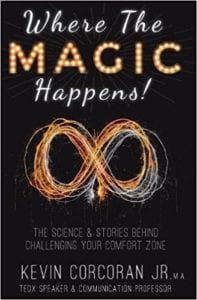
Where The Magic Happens Book: Where the Magic Happens!: The Science & Stories Behind Challenging Your Comfort Zone
When I became a musician and I wanted to play live music, that was obviously a huge hurdle and definitely an obstacle from the desire that I had. I remember constantly being uncomfortable and hating it. It wasn’t until I finally, as a musician, pushed myself to the other extreme of it by doing things on stage that I never thought I could do. At one point I pushed it a little too far extreme and I stepped out on the front of the stage and I put my foot on someone’s head. I played a guitar riff while I was basically floating on the audience. It took doing that for me to realize that there was nothing to worry about all along except for having the resilience and having the courage to go into that unfamiliar space. How I knew I had an interest in communication is that I started to crave and I started to desire that discomfort as a thrill. I started to become an adrenaline junkie for things like jumping off cliffs into water or going skydiving or something like that, but that same rush kept coming when I was public speaking or when I was in front of people. I reframed how I looked at it. Instead of it being something to hold me back or something that I’d never be able to do, I saw it as a challenge for me to learn things about myself that I never thought I could do and to find out what’s truly possible despite our mindset of limitations.
How did you go from being a musician to being a college professor of communication?
I played music and I ended up playing music professionally at one point but never as a full-time career. I worked in the tech industry for a number of years with companies like Apple and Linux Foundation. At one point I remember I was working at a conference and I used to travel the country for these companies. I would basically work on the technology aspect behind big conferences. I remember at one point I was laying cable on the floor and I was taping it and that was my job, taping cable to the floor so that people wouldn’t trip over it and setting up wireless internet networks for the audiences. At one point one of my jobs was to film all of the speakers at a conference and then run a remote workstation. At any point I had eight to sixteen cameras in a bunch of different rooms and I was running it all remotely. I remember watching the videos and thinking to myself, “I want to be up there, I don’t want to be back here.” It was that moment that I decided, “I’m going to go to grad school and I’m going to get a higher education in communication so that I can be the person on the stage as opposed to the person behind the scenes.”
You literally started from the ground up with your taping down cords.
I taped cable to the floor. We use the term tech support, but really what I did during that time is I sat out front of the rooms with a little walkie-talkie. Basically, if a power strip went out, I had to go into the room, flip the little switch and turn the power surge back on. That was my glorified position as a tech industry expert. I knew I wanted to be on this stage, didn’t know how to get there, and decided that grad school would be a good option. With a Master’s in Communication, I figured they would teach us practical communication skills that I could then transfer straight into consulting and straight onto the stage. What ended up happening is as a result of that degree, I had a chance to teach. The first day teaching I was like, “This is it, this is great.” Remove the idea of the stage and it’s still the same thing. I was standing in front of a group of people having a chance to influence and I loved it. Hands down, teaching is my favorite thing in the world. I see training, I see speaking and I see teaching as all brothers and sisters to the same family.
You talk about this in your book Where the Magic Happens! about what it was like to give a TEDx talk. It’s a different talk than to lecture to a class, isn’t it?
Yes, absolutely. It’s very different.
Tell us the story of what it felt like even with all your training and preparation to get on that stage.
At the point that I gave the TED Talk, I was a public speaking teacher for already three or four years. I had spoken professionally, been paid to speak, and gone through all different kinds of public speaking coaching and public speaking training courses. As much as I had experience, there was nothing that could compare to the gravity of something like a TED Talk. One of the things I do before any talk that I give is I like to walk around and put headphones in. I forget that our phones can track our steps and later on when I looked at my phone and I saw the health activity app, I had actually paced four miles before I gave a talk.
[Tweet “Saying no to new things keeps you in your comfort zone.”]
The nerves were high, the energy was high, the adrenaline was high. I walked around, I paced, I listened to music, I practiced breathing exercises, I did everything I could. The moment when I was behind the stage and the speaker before me was getting to their final sentences, you can always tell when someone’s ending and I could tell they were getting to their closure, in that moment it was like the most terrifying and most exciting experience I’ve ever had. That’s the thing; the whole point of the book that I wrote Where the Magic Happens! is the idea that the most terrifying things and the most exciting things aren’t that different from each other except for how we frame it. It’s all about the high levels of adrenaline and the high levels of chemicals that are going on in the body. I recognized that and instead of having fear and running away like I did in third grade, I saw it as an opportunity.
When I started to look at that way, it was an amazing experience to be living it right then, right there. I remember looking at the lights and trying to take in as much of my senses as I could. Even with that, it was still way too stimulating. There was way too much going on to take it all in. It felt like a rush. That’s the rush that I chase as a speaker because as a child, the little things bring us rushes. The first time that we talked to someone we’re attracted to, that brings a huge rush, or the moment when we try to get a phone number. All those different situations bring us that state of pure excitement, unfiltered, uncensored excitement. It was that moment before the TED Talk where I felt that. That’s the thing that I chase. I ran up onto the stage and I was super excited and I know right off the bat I was talking a little too fast. I checked in, I slowed down a little bit.
You only get one shot. It’s like live TV. You don’t get to say, “Let me start over again,” at a TEDx Talk. You’re talking too fast, you’re talking too fast.
With a TED Talk, the scariest part was the idea that everything I was going to be doing was going to be filmed and then broadcast to an unlimited audience. I wasn’t sure how many audience members I would have, but the potential is that it could go viral and there could be millions of people. That’s pretty scary place to be. I remember checking in and being like, “You’re going too fast, slow it down a little bit.” Another difference about TED Talks versus regular speeches is that there’s a little red carpet that you have to stay on. In trainings or in the classroom, I’m used to being able to run around the room, jump up on the tables, use the entire stage, and use the entire room. I was excited but there was nowhere for me to go, so I went up and down a lot. If you watch the video, you’ll see me bending my knees a lot. That’s honestly pure excitement. It’s my way of still showing animation to the audience even though I was limited with a side by side movement.
I have to say the weirdest part for me or the strangest part was that you couldn’t see the audience. The lights were so bright because the whole point of the TED Talk is for the audience to see you very well and then mostly for the video to be made. For that to happen, the lights have to be really bright. I remember the lights were shining in my eyes. I looked out to the audience and I couldn’t see anybody. I’m used to eye contact, used to small group trainings, used to classrooms where I can interact and see people. It was a very one to many approach that I wasn’t used to, but it was exhilarating. It was a blast and it was unforgettable. I wouldn’t trade it for the world.
You talk about in your book that there is that space between our comfort zone and where the magic happens. It sounds like you’re almost like a tornado chaser. You’re addicted. You love the adrenaline. One of the things in your book that I do to get out of our comfort zones is take a cold shower. I started hearing people talk about this as a way to reframe and reset your mind of, “I’m not constantly seeking comfort. I’m purposely seeking getting out of my comfort zone,” in this case, a cold shower. What I tell myself is I can tolerate something that’s not comfortable. I feel exhilarated after the cold shower, but every time you have to push yourself to do it. Can you talk a little bit about that comfort zone and magic zone?
The funniest part is where I discovered the entire idea about cold showers or cold water are really about comfort challenges. I was sitting in a hostel in Iceland during a snow storm. It was one of the coldest places I had ever been. It was this remote hostel that wasn’t well-insulated. The heater didn’t work that well. I was bundled up in all my snowboarding clothes, my big snow jacket. I was bundled up and I remember I was writing. Before I even had the book idea, this is years ago, I was writing and having a good time. I looked out the window and I swear to you, I saw two elderly women, I would have to guess somewhere in their 70s or 80s. They were in their swimsuits with swim caps on and they were walking down this little boat launch. They walked down it, they got into the water and they started swimming.

Where The Magic Happens Book: People who do acts of kindness tend to report higher levels of gratitude.
It blew my mind. I was watching as what I thought would be the worst thing you could possibly do. These two women looked completely at peace. They looked happy, they looked content, they looked satisfied, they don’t look excited. It wasn’t a rush for them. That was something they did. I found out later that every single day at the same time, these two women meet up together and then went for their daily swim. They do it all year, whether they’re sick, whether they’re healthy, whether it’s cold, whether it’s hot. I found out also later that they do it as a form of reminding themselves that the earth, world, and the universe is bigger than them. Whether it’s extreme or not, depending on the season, depending on the weather, they are just humans that are temporary living on this earth in this universe.
For me, that mindset helps let go of the need to try and control everything all the time. A lot of people who are in startups as a business, a lot of us can fall into this trap of control freak. “I need to control everything and things have to happen in my timeframe, and the outcome has to happen the way I need it to happen.” When you get out of that mindset and if you jolt yourself by jumping into cold shower, a cold ocean or whatever it is, you realize, “There are a lot of things I don’t control and it’s not always about me.” Would that be an accurate summary of what you said?
Yes, absolutely. That’s a lesson that I learned from surfing. The Iceland story involves the ocean as well. I grew up pretty close to the ocean. I was complaining about getting held under water and I was like, “I don’t like to be held under water. It feels I’m dying or stuff.” He looked at me and he was like, “Kev, think about it as a meditation,” and I was like, “You’re crazy. What do you mean? Meditating when you’re about to die? That doesn’t make any sense. You’re held under water and you’re peaceful?” He’s like, “Just try it.”
It took me awhile to get to the point where I understood what he was saying. After a couple of times, when I would fall and be held under water, I started to let go. It’s exactly what you’re talking about. I let go of the control. I let go of trying to fix things. I let go of trying to control my environment. Instead I let go, and I was like, “Cool. The ocean is bigger than me. The earth is bigger than me. The environment, the weather, everything in life is bigger than me and I’m going to let whatever happens happen.” In that peaceful place, I was able to make responsive choices about what I would do while I was underwater. It was an easy choice then to simply swim up to the surface and then breathe versus when I would panic and I would flail my arms. Sometimes I’d end up further away from the surface and deeper because I was in a state of trying to control everything and I was confused, I was lost, I was flailing, and not making sense of the actual situation. That’s true of a lot of startups and a lot of big businesses.
As leaders, as managers, and as thought influencers, we try to control the market. We try to control consumers. We try to control the outcome of certain things. If you look at an awesome principle called Chaos Theory, the idea is when we believe and have faith in the chaos of things, then we find a natural state of calm among that chaos. I love that. I live by that and the ocean taught me that in a lot of ways just like it taught those Icelandic women.
[Tweet “Yes is about having an open mind.”]
I want to tap into what you have in your book here about the science behind yes. I give a keynote talk myself on getting to yes through storytelling for brands who have sales teams, so I am all about getting to yes. Please expand upon what you wrote about the science behind yes.
There’s so much interesting content around the word yes, especially with popular movies like Yes Man. There was a recent book, Year Of Yes. There’s a lot of content surrounding this idea of yes. What yes is, is having an open mind. If you break it down, it’s not truly about the word yes, it’s about the outcomes that it brings versus no. I do want to clarify that it’s not even about the word yes or no, it’s about our intentional choices in the moment. The reason I encourage people to say yes more often is because the majority of people tend to say no in order to remain in their familiar or their comfort spaces.
Saying no keeps us in our comfort zone. Is that accurate?
Most of the time, yes. We say no, it’s a natural limiting word because if the request is anything new or different and we say no, then it’s safe. We’re staying where we are, we’re staying in a familiar zone, we’re staying in the comfort space. We’re keeping what we know to be, to be. We’re not expanding ourselves. We’re not opening ourselves up to change.
That’ll be the tweet, saying no to new things can keep you in your comfort zone. Of course anytime you’re asking someone to hire you, to buy something, to invest, you’re asking someone to get out of their comfort zone because they haven’t done it before, which is great. Obviously, changing behavior is what we people are requesting when you’re trying to sell them something.
I want to point out as well that saying no can also take you out of your comfort zone because some people are yes people. They passively say yes because they take on too much and they’re passive so they let a lot of things pile up and stack up and people are like, “Can you do this?” You’re like, “Yes, I can do that.” “Can you do this?” “Yes, I can do that.” “Can you do this project?” “Yes, I’ll do it.” For those situations, no would be the word that would get you out of the comfort zone.
If someone invites you to a party and you go to every party you ever been invited to because you don’t want to offend anybody, saying no to a party invitation could be a big thing out of your comfort zone.
That’s where my TED Talk and the chapter in the book about yes. It’s framed around the word yes because most people say no too often. However, I do make that distinction that the whole talk, the whole chapter; it’s not just about one word. It’s about momentary decisions and acting out of a place of intention as opposed to a place of expectation or a place of familiarity. I did a yes challenge where for a month I said yes to everything and it was wild. It was a captivating, it was fascinating but it was also stressful and it was tiring.
What’s the craziest thing you’ve said yes to during that month?
The craziest thing that I said yes to was going into the ocean without any clothes on at night while it was cold out and then staying in for a total of ten minutes. The ocean is scary at night in itself and then doing it when it’s cold out and then without clothes on, for me that was a huge challenge. I was so uncomfortable on many different levels, but someone found out and they didn’t tell me this until later. Someone found out I was doing the yes challenge. They’re like, “What if you did this?” I was like, “I’ll do it.”

Where The Magic Happens Book: Start to see compassion toward other people and start to seek acts of kindness.
I want to talk about the science behind kindness. That’s such an important philosophy part of the culture and the way we talk to ourselves. What have you found is the science behind kindness?
Kindness is fascinating for so many reasons. The other word that gets used for it is compassion, having compassion for other people, doing kind acts. There’s a ton of research that suggests that doing acts of kindness, whether they’re random or whether they’re intentional, can increase your perception of life satisfaction as well as increase your reporting of gratitude for everyday life or for small things. People who do acts of kindness tend to report higher levels of gratitude. It makes sense, but it’s so interesting because a lot of us are trying to figure out how do we be more grateful for the things we do have? Especially in startups, a lot of times we have more flexible time. We can be at the office when we want to be at the office, we can be autonomous, we can work on one thing one day, work on another thing another day. We know that it’s great, but how do we be more grateful?
One of the ways to do that is to start to see compassion toward other people and start to seek acts of kindness. The most fascinating part of the research that I found was the positive side of natural disasters. I know it sounds like a headline that belongs in a newspaper, but the positive side of natural disasters is that it brings out the genuine human goodness in people, it brings out acts of compassion and acts of kindness. If you look at the greatest disasters that have happened in history, you also see upticks, spikes, and peaks in people reporting generosity, kind behaviors, compassion, and empathy from other people. During a hurricane, the people who did have power, they opened up their front door, put a sign out and said, “Come use my house, come in.”
He let strangers into their house and he ended up having 30 people in his house all wired up to his electricity because he happened to have electricity while no one else did. I love that there’s this inherent part of being human that is compassionate. One of my favorite things that I learned from, it’s a friend and mentor of mine who started a business all about compassion and compassion cultivation. She told me that we are wired for compassion from the moment we’re born. I was like, “Explain that.” She was like, “Humans are one of the few species where when a baby is born, it literally takes a group of people being compassionate toward the baby to keep the baby alive.” A mother can’t pop out a baby, leave, and the baby has to be self-sufficient. It takes a number of people giving to the baby to be able to have the baby survive it. She goes on to talk a lot about how we’re basically hard wired for compassion and I love that idea.
You are all those things. You are kind, you’re curious, you are out of your comfort zone and you’re living a magical life for anyone who gets to hear you speak or anyone fortunate enough to be in your classroom. The book again is Where The Magic Happens!, the author, Kevin Corcoran, Jr. Kevin, how else can people follow you on social media and your website and all that good stuff?
My website is probably the best place for people to start, KevinCorcoranJr.com.
[Tweet “Doing acts of kindness, whether they’re random or whether they’re intentional, can increase your perception of life satisfaction”]
Any last thoughts or words you want to leave us with?
I want to thank you for giving me the opportunity to be on your show. You complimented me here at the end and I was going to compliment you. I wanted to say that through your podcasts, through your book and through your work, I feel a genuine sense of authenticity and I love that. In an industry that’s full of professional development books and people trying to be something that they’re not, I feel that you truly are who you are and I’m thankful for that.
That’s a great compliment. I love when people see that I’m being real and authentic because that’s how we connect to other people. Literally, into me I see is the definition behind intimacy. Thank you, Kevin. Thanks for being a great guest.
I love it. Thank you so much
Links Mentioned:
- Kevin Corcoran, Jr.
- Where The Magic Happens!: The Science And Stories Behind Challenging Your Comfort Zone
- Kevin Corcoran Jr.’s TEDx Talk
- Year Of Yes
- KevinCorcoranJr.com
Wanna Host Your Own Podcast?
Click here to see how my friends at Brandcasting You can help
Get your FREE copy of John’s latest eBook Getting To Yes now!
John Livesay, The Pitch Whisperer
Share The Show
Did you enjoy the show? I’d love it if you subscribed today and left us a 5-star review!
-
- Click this link
- Click on the ‘Subscribe’ button below the artwork
- Go to the ‘Ratings and Reviews’ section
- Click on ‘Write a Review’
Ownership Is The Ultimate Loyalty Program with Melinda Moore
Posted by John Livesay in podcast | 0 comments

Episode Summary:
Melinda Moore has always wanted to change the world and be in technology, and so every step of her professional career was a step towards understanding how much human information processing and technology was going to impact everything that we do. As a social entrepreneur and a seasoned digital marketer, Melinda likes to create companies that solve real problems. She has a new company out called iConsumer that not only allows people to save money when they shop online, but to become part of the company through consumer stock. She says that ownership is the ultimate loyalty program. She has a new book out, How to Raise Money: The Ultimate Guide to Crowdfunding, where she talks about all the resources and everything you need to know to launch a successful crowdfunding campaign.
—
On this episode on The Successful Pitch, our guest is Melinda Moore. She’s got an amazing story of how she has a successful exit with John Paul DeJoria of John Paul Mitchell Hair Care Systems. She has a new company out now called IConsumer.com that not only allows people to save money when they shop online but become part of the company. She says that ownership is the ultimate loyalty program and she has a new book out on how to demystify equity crowdfunding. You’re going to love her journey, her book and her new equity crowdfunding platform.
Listen To The Episode Here
Ownership Is The Ultimate Loyalty Program with Melinda Moore
My guest is Melinda Moore, who’s a social entrepreneur, a seasoned digital marketer, and a frequent speaker at leading technology conferences with over fifteen years as a startup leader, two successful exits, and a Fortune 500 experience. Melinda combines her passion and experience in health and sustainability, female empowerment, Yahoo! tech and digital media. Her work’s been widely recognized by Digital LA as one of the Top 50 Digital Women in 2015, the Green Business Bureau and the National Association of Women Business Owners. She’s also written a book called How to Raise Money: The Ultimate Guide to Crowdfunding. Melinda, welcome to the show.
Hi, John. Thank you so much for being here. It’s such a pleasure.
We were introduced by a mutual friend, Laura Wagner, at Digitzs, and that’s always the best way to meet people. I find that’s how I get my best guests. That’s how people get their network to grow and you’re a classic example of that with your expertise. Before we get into that, would you mind taking us back? You can start back as far as you want. You can take us back to high school, to college. When did you start saying, “I’m going to be an entrepreneur.”
It’s in somebody’s DNA. I’ve always been very adventurous and curious. When I was at UCLA, I was very fortunate that Peter Guber was running Sony Studios at the time and he had classes on entrepreneurship, motion picture marketing and technology. While I was at UCLA, I took his classes and it absolutely opened me up to how the future was going to be greatly impacted through technology. I decided back at that time I wanted to change the world and be in technology. My very first job out of college was producing educational software for Davidson & Associates, which then sold for $1 billion to the Ascendant Corporation. That was my very first job and it was understanding how much human information processing and technology was going to impact everything that we do.
That was like, “This is easy. I’ll do another company and sell that one.”
Unfortunately for that, when it was my very first job, so I was a producer, it was started by Joanne Davidson and her husband and so she was a teacher, but I essentially got an MBA, got the bug, and then after that I went on to my next company, which I had an exit in. It definitely got me excited and opened up the world of opportunity around entrepreneurship and making a difference.
I want to know about your successful eCommerce site, LovingEco to John Paul Dejoria in 2002. I met him several times. I used to call him in the John Paul Mitchell Haircare for advertising when I was at Condé Nast. He is quite the entrepreneur himself. How did you come up with the idea? How did you get the feeling enough to make him want to buy it?
I was born in Santa Monica, California, so I grew up surfing and hiking. I’m a little bit of a flower child and appreciate the planet. I was working at Rogers & Cowan running the convergence division. I thought to myself, “It’s time for me to get back into entrepreneurship.” I came up with the idea of LovingEco, which I knew women wanted to be healthier but they’re not going to sacrifice on style and they’re not going to sacrifice on price. I saw how successful the Gilt Groupe was at the time and flash sales. I created a green flash sale site called LovingEco. We guarantee that it had the lowest price on the Internet. We curated all the best natural products in beauty, health, fashion, accessories.

Loyalty Program: Most of us don’t fit into the profile, but it doesn’t mean that we can’t be fantastic business owners and create jobs and opportunities for others.
At the time John Paul Dejoria had started a company called JP Selects. LovingEco was started by myself and Justine Lassoff and we now have another company called LOVE GOODLY, which is based in Los Angeles. It’s like The Honest Company meets Bert’s Box. It’s a lifestyle company that gives back to charity and it curates all the best natural products. I’m an advisor to the company. Justine co-founded that company with Katie, who is another person who is on our team at LovingEco. What ended up happening and we were so successful that we got an offer to purchase the company about a year after we started it. We’re live by John Paul Dejoria. He folded LovingEco into JP Selects.
Did you have to pitch to get him to buy it? Did you have to pitch to get a co-founder? Did you have to pitch to get customers? Any pitching stories you have to share along that route?
I’m not Jessica Alba and not The Honest Company, but this was a little bit before that time. I’m always seeing what’s happening next, that’s just a talent that I had. It’s all about protecting the environment, so I thought the fastest growing segment of the beauty division was natural products and organic products and products that didn’t have chemicals because your skin is your largest organ. I knew that women didn’t want to pay extra, so I said, “I’m going to curate, do all the work for them and make it easy and I’m in to guarantee the lowest price.” That worked our cohort analysis, our lifetime value, all of the core metrics were very strong. In the combination of hardcore business metrics with the fact that natural beauty is the fastest growing category, that was the pitch.
When I pitched it to people on Sand Hill Road and as a woman, they’re like, “What do you mean natural products? What do you mean organic jeans and what do you mean you need to use dye?” It was almost as if I was speaking Chinese or a different language, which is partially why I went into crowdfunding and then wrote the book, How to Raise Money: The Ultimate Guide to Crowdfunding. Being an entrepreneur and recognizing that I’m not a male that went to Stanford or Harvard and wears a hoodie and a computer geek, then I wasn’t going to fit into the VC model. In fact, I’ve been a strong advocate for entrepreneurship, but leveraging crowdfunding and other methods to raise money. Because most of us don’t fit into that profile, but it doesn’t mean that we can’t be fantastic business owners and create jobs and opportunities for others.
That’s a nice transition. Usually, whether you’re starting a company or getting inspired to write a book, that’s because you see a problem that needs to be solved. Let’s take a deep dive into your book. How to Raise Money: The Ultimate Guide to Crowdfunding. We’re talking equity crowdfunding versus Kickstarter crowdfunding.
My book, it’s called How to Raise Money: The Ultimate Guide to Crowdfunding, which is available on Amazon for under $10. The book covers what is crowdfunding, what’s the history of it. It covers equity crowdfunding and it covers rewards-based crowdfunding, which is Kickstarter. Kickstarter has raised over $3 billion to date. It’s a huge industry and its surpassed venture capital. It also covers hybrid models. It’s a very comprehensive guide to my book that is available on Amazon, but ultimately, I am very passionate about entrepreneurship and ideas that can change the world. Whether somebody creates a hearing aid that allows somebody to hear for the first time. There’s so many innovations or they’re passionate about, electric bikes or a microbrewery or, in my case right now, I launched a company called iConsumer and I have a live campaign for crowdfunding. I’m very passionate about that, so I wanted to put that into a handbook. At the very end of my book, which is chapter ten, I put a guide of all of the leading platforms, their contacts, the marketing firms, lawyers, accountants so you can just literally, like I say, “Nike, just do it.” After reading my book, all the resources and everything are there to launch a successful crowdfunding campaign.
I’m interested in chapter nine about what works, what’s challenging, and what’s next. Can you give us a sneak peek on that?
What’s always challenging is people think it’s the field of dreams scenario. If I build it and if I take all the time to put a video in my deck and traction points to my business and great rewards, then the people will come. You have to understand that that does work. If you have a big database of existing customers that you can tap into that you can market it to, but you have to come up with an integrated marketing campaign almost as if you’re launching a new company to have a successful crowdfunding campaign, whether that’s rewards or equity. If you are not in a position to do that yourself, then you need to hire a firm, somebody like myself, someone like Darren Marble at CrowdfundX, so that you’re successful with the raise.
What services do you offer? You’ve given us a hint of the problem is. It’s not enough just to build it and expect people to come to it. Are you offering a service of, “Here’s exactly the five things you need to do to get people to want to fund this and share it in their network and make it a viral experience?”
What you need to do is think of it from an integrated marketing perspective. You have to have all the touch points. You have to have the right that you’re selling with the why you’re doing this. You have to have paid and earned media influencers. It goes down to having a fully integrated successful campaign. It’s all of those things.
Can you give us a story? I know that on your website, you have past work with some of your clients you’ve worked for. If you could walk us through what it’s like to have an integrated marketing concept, I think it would very much help people understand, “Don’t try to go this alone,” and that they need someone like you.
For instance, we raised a couple million dollars for Yao Ming, the basketball player. When he came to the states to play, he fell in love with a Cabernet from California and so he created Yao Family Wines. He put up a raise on Crowdfunder and at the time, I was the Chief Marketing Officer. What we did was created a fully integrated campaign. There was a lot of press and got into the Wall Street Journal. We did private dinners, investor dinners. We did a traditional marketing. We had him do marketing on his website. We marketed from the Crowdfunder website. It goes down to the experience and what are the assets that you have. In that case, we had Yao Ming, so to be able to have like a private dinner with the Yao Ming because you’re a shareholder, that has some very unique value. We were raising money for a tasting room, so you would be able to cheers and taste directly with Yao Ming if you put in the minimum of $5,000 into the deal. It comes down to unique experiential marketing.
[Tweet “Ownership is the ultimate loyalty program”]
It goes full circle from you being inspired by Peter Guber running Sony at the time. I believe that’s when that man seems to making these people their own star through crowdfunding. Let’s double click on IConsumer.com. What gave you the idea for that?
After writing the book, How to Raise Money: The Ultimate Guide to Crowdfunding, you have to then prove the model. I had met Rob Grosshandler because I was doing a lot of speaking. He’s the CEO of iConsumer and he approached me to co-found the company with him and be head of marketing to take it to the next level. It’s a massive B2C play. It’s essentially like Ebates or RetailMeNot where you’re getting discounts and cash back for shopping online. Who doesn’t shop online? By 2020, it’s going to be a $500 billion industry. Crowdfunding, there’s still a lot of mysteriousness around it and so you have to demystify it. A big B2C play where, as you’re shopping online, you’re getting cash back, but I’m giving you shares, actual ownership in iConsumer for just shopping online. When you sign up, I’ll give you 50 shares of iConsumer stock. Every time you shop, you’re getting cash back and you’re getting shares in the company.
What we wanted to do is essentially democratize the way companies are created, so we did a regulation tethered raise using equity crowdfunding to fund the company. That is what allows us to use actual equity as an acquisition and a retention tool so that we’re building and owning the company together. I always liked to create companies that solve real problems. What is a problem in the United States? There’s such income inequality. So much of the wealth is concentrated in the 1%. What about the 99%? When I looked at like what Blake did with Tom Shoes in the One for One movement, I said, “Why can’t we do the same thing with equity crowdfunding and prove in a big B2C model that people can be successful if you own the company together and then have people write another book and people copy what we’re doing with equity crowdfunding and what we’re doing with iConsumer so that you’re essentially voting with your wallet and you’re owning a piece of the company?”
It’s almost like saying to someone, “You’re going to be buying things on Amazon or wherever else you go online to buy something.” You might as well get compensated for it, not just like a coupon, but actually own part of a company that’s going to reward you for sharing this and using this. Is that accurate?
That’s exactly right. Our thesis is that ownership is the ultimate loyalty program. You’re already doing something, which is shopping online. You might as well shop smarter and get your share.
Ownership is the ultimate loyalty program. Everybody’s looking for that sticky factor when they get a new customer and it’s certainly investors are looking at that. What is it that keeps people loyal? I see this starting to happen a little bit in the cryptocurrency world that’s evolved out of the crowdfunding world. My guess is you’re going to write a book on that topic.
You now see the ICOs and people are creating platforms and they are rewarding people with cryptocurrency, blockchain. I know that Todd Chief raised like $1.5 billion to do these types of things. You’re seeing a lot of big business leaders moving into blockchain cryptocurrency for exactly what you’re talking about. It’s almost like Wild, Wild West.
If we take a look at IConsumer.com and you finish your round with this equity crowdfunding platform, do you anticipate that that’ll be all the money you need, or do you think, “I’m going to get a series from a traditional venture capitalist eventually?”
We launched the campaign on Crowdfunder, so it’s Crowdfunder.com/IConsumer and within the first 24 hours of the race, we had reached over 50% of our goal to get to a million. We have 50,000 members right now. We need another 200,000 to be cashflow positive, so most likely I will not do another round and most likely I will not include any venture capital. If I do anything else, I would open up another regulation a round. The current minimum investment is $1,000, but I could lower that to $50 or $100, so that our members could get more shares by opening up and allowing them to be investors. The whole goal here is to democratize access to people, being on Wall Street and in owning shares and understanding what that means. Rob, who is the CEO of the company, he also created another property called Shareholder Academy and that’s essentially a blog and a website for startups and for people understanding what equity crowdfunding is, what it means to be a shareholder. He was smart to basically help guide an education platform around shareholders in Shareholder Academy
Traditionally, if I understand Crowdfunder properly, you have to be an accredited investor to invest in that equity crowdfunding. Is that right?
That is correct. With the current raise that we’re doing on Crowdfunder, it is to accredited investors only.
However, if you go to IConsumer.com and sign up via Facebook or however you want to do it, you can start shopping and get 100 shares without being an accredited investor, which is the whole democratization that you’re talking about.
When you sign up, I give you 50 shares just for signing up and then the first time that you shop, because we want you to shop so that you’re using this site and that we’re making money, you’re making money, we give you another 50 shares just for the first time that you shop. If you refer somebody who shops, then we’d give you another 100 shares. I have about 1,700 shares just from shopping.
This earned impressions that’s part of this integrated marketing that makes it crowdfunding campaign successful is that whole sharing. Once you start getting brand ambassadors to promote, “This is the site.” If you’re going to spend the money anyway, you might as well own a little bit of it for that loyalty factor, but that earned impressions, brand ambassadors, word of mouth is the secret sauce.
The numbers are between 30% and 40% a week of our members are coming through referrals. People discover the site, they want to share with their friends, and they also benefit when they share. Definitely through referrals is a very strong way and an efficient way to grow a company and to grow brand awareness.

Loyalty Program: Definitely through referrals is a very strong way and an efficient way to grow a company and to grow brand awareness.
I’m on iConsumer and I see that you have Today’s Hot Deals on Amazon and certain things are for sale that you can buy and get credit for buying it on your site as opposed to the Amazon site, how does someone who is an Amazon vendor get to be considered part of your hot deal? Is it something Amazon decides or can people approach you to be a hot deal?
What we want is we want more small businesses to make sure that they are an affiliate and they’re signed up through iConsumer. That way, we can market the vendors directly. We have 1,700 stores and we’re adding new stores all the time. Amazon is the 800-pound gorilla in this space. I feel like we need to help smaller businesses and local businesses. Once they’re aware of iConsumer, they can sign up to be a vendor and promote their products. One of my girlfriends started Prelise, which is like a smaller skincare makeup line. Prelise is on iConsumer and we did a beauty newsletter and I was able to feature Prelise alongside Ultra Beauty and much larger brands. It’s really important for us to have an array of the big players but also the small players as well.
You’ve hit on something there that you probably take for granted because you’re such an expert at this, which is the co-branding effect. If you’re a small brand and you’re seen with other well-known brands that are much larger than you are, then there’s a little bit of a rub off effect that happens, “If they’re being featured this way, they must be at least as good a quality and maybe they might even be slightly less money. I might try them.”
The beauty of shopping is like discovery. If you do see bareMinerals next to Prelise, or sporting good company next to smaller electronics, people do associate credibility when they see one vendor on the same page or next to somebody else. It’s important too that we vote with our wallet, not for just the big companies out there, like the Amazons of the world, but also just smaller companies that are creating great products as well. They need the exposure.
I also see that you’ve got the hotel on here, which surprises me because I don’t think people normally think of e-commerce and travel as being that connected unless you’re on Expedia. How did that evolve?
Travel is a big vertical for us because the price points are high. If you’re going to go to Hawaii or Europe or New York and you’re spending somewhere between $300 to $1,000, why not get cash back and then earn shares for your ticket? We have Expedia and Priceline on iConsumer. You might as well shop through iConsumer because if you shop direct, you’re not going to get the same benefit as shopping through iConsumer. Part of that is an education process. Ebates is such a large company in that regard, so there are people familiar with Ebates but essentially, we’re Ebates but we give you shares in iConsumer as well.
It’s a double win, not just win-win. It’s getting that message out and you’re certainly incentivizing people to share it with their friends.
Whether you’re booking a hotel or you’re going to book Alamo or Hertz or Priceline, you might as well book it directly through iConsumer. We have Expedia. We make it easy because there’s departments and there’s different categories, so you can go directly to our travel and you can do that either on a mobile phone because we have an iOS as well as an android version and then desktop, so we try to make it as easy as possible for you to shop smarter and earn shares and cash back as you’re just doing what you do normally every day and every week.
I was impressed to see that you have a pet vertical on here because I know that’s a huge market, just like travel.
Pets are huge. It’s a multibillion dollar business. A lot of people don’t have kids and so they treat their pets like they’re kids, buying them toys, beds, clothes, food, and organic food. Pets is a very big area for us. Most people use PetSmart. You might as well use PetSmart or Petco through iConsumer. You go direct to Petco or Petsmart, you’re not going to get the cash back or the shares. You go shop through our mobile app or desktop, our buttoned browser, then you’re going to get 9.6% from PetSmart. You’re saving them as 10%.
[Tweet “There’s nothing more exciting than having an idea and wanting to bring that idea to life.”]
Any final thoughts or words that you want to leave our audience with? If someone’s thinking of starting a campaign, they should read your book. They should consider hiring you to help them so that it doesn’t just get up there and nobody uses it. Are there any life lessons you’ve learned along the way that you would say, “If I could say something to myself ten years ago, here’s the message I give.”
What I would say is there’s nothing more exciting than having an idea and wanting to bring that idea to life. When you’re doing that though, you have to be very methodical, very strategic. It does take planning and it takes money because if you don’t have that database or that existing customer database to market the campaign too. Then you have to figure out how you’re going to get influencers, how you’re going to get marketing to ultimately drive people to the marketing funnel of your deal. What you don’t want to do is just press go on a campaign because you’ve done all the work. It’s better to put a pause on that, either hire a firm that can help you. It goes down to having the right team and the right people and it’s about execution.
I was speaking to Darren Marble from CrowdfundX and he’s done getting Elio motors and big raises. We were saying sometimes people don’t understand how much work it is to be an entrepreneur. You have to make a choice. As an entrepreneur, it’s not a merry go round where you show up and you just attend meetings. It’s much more like a roller coaster. One day, you could have the highest high and you think you’re going to become a multimillionaire and the next day, you literally think you’re going to be broke. Things can swing so quickly. In order to be an entrepreneur, you have to be comfortable with being on a rollercoaster ride. If you’re the type of person that wants consistency and safety, then you need to get yourself onto a Merry-Go-Round and not the rollercoaster route of entrepreneurship. It’s hard work. The hours, the commitment, it’s not to be underestimated in terms of how much work it is. It’s fantastic and I wouldn’t have it any other way, but sometimes you just want to have a breakdown,
That’s so valuable and wonderful of you to let people in because from the outside looking in, it looks like you’ve never had a bad day in your life or even a bad hair day.
Entrepreneurship is sexy. Jessica Alba’s an entrepreneur. Gwyneth Paltrow’s an entrepreneur. Many top people are investing. There are celebrities and stuff, so it’s got this, “This is the next celebrities and stuff,” but what I want to say is it can be painful.
My big takeaway is that hope is not a strategy. If you just hope that people are going to find your equity crowdfunding platform, it’s not going to work. Melinda, how can people follow you? Would you give us your Twitter handle and everything else?
My Twitter handle is @Melinda_Moore. I have a website, which is MelindaMoore.com. That’s an easy way that you can follow me on Instagram. You can find me on Instagram and Facebook. It’s a great way to get more information. It’s been such a pleasure, John. Thank you so much for having me on your show.
You’re a fascinating person and a fascinating guest. I appreciate you sharing all those wonderful stories.
Thank you.
Links Mentioned:
- Melinda Moore
- John Paul Mitchell Hair Care Systems
- IConsumer.com
- How to Raise Money: The Ultimate Guide to Crowdfunding
- Davidson & Associates
- LovingEco
- JP Selects
- Justine Lassoff
- LOVE GOODLY
- CrowdfundX
- Yao Family Wines
- Rob Grosshandler
- Crowdfunder.com/IConsumer
- Shareholder Academy
- Prelise
- bareMinerals
- @Melinda_Moore – Twitter
- MelindaMoore.com
- Melinda Moore’s Instagram
- Melinda Moore’s Facebook
- https://www.amazon.com/How-Raise-Money-Ultimate-Crowdfunding-ebook/dp/B01F7O926G/ref=sr_1_1?ie=UTF8&qid=1506641434&sr=8-1&keywords=melinda+moore
About Melinda Moore
 Melinda Moore is a social entrepreneur, a seasoned digital marketer and a frequent speaker at leading technology conferences.With over 15 years as a start-up leader (two exits) and Fortune 500 experience, Melinda combines her passion and experience in health & sustainability, female empowerment, tech & digital media. Her work has been widely recognized by Digital LA (Top 50 Digital Women in 2015), the Green Business Bureau and the National Association of Women Business Owners’ Hall of Fame.
Her marketing campaigns have been featured by global brands including Ford, LIVESTRONG, Netflix, Obama for America, Orbitz, Sony, USA Networks, and YouTube. She has forgedstrategic partnerships with leading business, media, and entertainment figures including Jimmy Fallon, Laird Hamilton, Dr. OZ, Dr. Phil, Ryan Seacrest and Yao Ming. After co-founding and selling the successful e-commerce site LovingEco to John Paul Dejoria in 2012, she co-founded Tuesdaynights, a hosted invite-only networking organization of female executives andentrepreneurs.
Her growing list of event sponsors include Google, Lifetime and Silicon Valley Bank. While continuing to establish Tuesdaynights as a preeminent network event, Melinda is growing hermarketing and content creation technology practice. Melinda graduated from UCLA with a BA in psychology.
Wanna Host Your Own Podcast?
Click here to see how my friends at Brandcasting You can help
Get your FREE copy of John’s latest eBook Getting To Yes now!
John Livesay, The Pitch Whisperer
Share The Show
Did you enjoy the show? I’d love it if you subscribed today and left us a 5-star review!
-
- Click this link
- Click on the ‘Subscribe’ button below the artwork
- Go to the ‘Ratings and Reviews’ section
- Click on ‘Write a Review’
Selling To The Point With Jeff Lipsius
Posted by John Livesay in podcast | 0 comments

 Episode Summary:
In a field as competitive as sales, earning high commissions is top priority. Jeff Lipsius is the president and founder of Selling to the Point, which is a sales training and consulting umbrella platform. He developed Selling to the Point sales training during his 30 years of sales training experience. Back in the late ‘70s, he pioneered inside selling for the natural foods industry, successfully training the first sales force of this type in that industry. As a result, Jeff’s sales model is now being used by many natural food industry brands. Learn how to cultivate great relationships and enjoy your career as a salesperson – the Jeff Lipsius way.
—
Our guest on The Successful Pitch is Jeff Lipsius, who is the author of Selling to the Point. He has some great insights about internal conversations and internal confidence and internal choices and internal clarity that need to happen because most people are so focused on the external. He says, “What’s going on is they can’t hear you over your sales pitch,” and the best way to stop pitching is to start listening. Once you start listening, you learn by observing and when that happens, you get less distractions and your performance soars.
Listen To The Episode Here
Selling To The Point With Jeff Lipsius
Our guest is Jeff Lipsius, who is the President and Founder of Selling to the Point, which is a book and a sales training and consulting umbrella platform. He developed Selling to the Point sales training during his 30 years of sales training experience. Back in the late ‘70s, he pioneered inside selling for the natural foods industry and trained the first salesforce of this type in that industry. As a result of that success, his sales model is now being used by many natural food industry brands. He’s trained over a hundred sales people, both inside and outside, as well as sales trainers throughout his career, and the sales people that have been trained by Jeff are some of the highest commission earners in their industries. They are also able to cultivate great relationships and enjoy their career as salespeople and having been a former salesperson myself, I know how important it is to enjoy what you’re doing in order to be successful. The thing that stands out for me is that the salespeople who’ve been fortunate enough to be trained by Jeff have cumulatively sold over a billion dollars worth of products. Jeff, welcome to the show.
Thank you, John. Thank you for having me.
I’m always interested to ask my guests to tell us their own story of origin. You’ve been doing this for quite awhile and you weren’t always a sales expert. Would you mind taking us back to the days when you were working as sales and marketing manager for an allergy research group and how did you decide that you are going to become who you are?
Way back when, even in college when I was discovering who I was, the real theme would have to be applying conscious awareness to performance. These days a lot of people are talking about mindfulness and conscious workplace practices, but I was a little ahead of the curve. When I was nineteen years old still in college, I was pursuing a way to be able to be more conscious on the tennis court and play better tennis matches. I was a college team player and what I found was that as I became more conscious, in other words, as I put my state of mind in a more aware place, I was able to play better tennis and actually practice my state of mind to get mentally tougher on the court. Later, in my professional career, I decided to try the same thing. What if I was consciously aware during my sales performances, during my interactions with my customer? It was a mindfulness approach because I’m a mediator. You put the ego mind aside and focus on the customer and the interaction as it was rather than the distraction of, “Is this going well for me? Is this not going well for me? Do they think I’m smart? Do they think like me?” They were all distracting from what’s taking place in the interaction I discovered.
What that revealed was a second conversation taking place at the same time I was talking to my customer. It would affect the relationship. This second conversation is the internal buying conversation between my customers ears and as I would say one thing which is you could say conversation A, my external conversation with my customer, the customer would hear something uniquely different. They would assign a meaning to what I’m saying and come up with a whole different interpretation that I needed to know. Putting my distracting thoughts aside and really paying attention to the customer, I could begin to discern how the customer is receiving what I’m saying and lo and behold, I felt that was much more important because the goal of selling is buying.
[Tweet “Ask intriguing questions to get attention”]
Nobody’s going to give you credit for, “That was an incredible presentation, but nobody bought,” is what you’re saying there.
You, as a salesperson, don’t get a sale unless the customer decides you’re going to get that sale. It’s really the decision process that determines the salesperson’s success. The way I put it is a good salesperson is going to pay more attention to their customers buying performance, their salespersons’ selling performance.
In the world of startups, for example, if you’re pitching an investor and you’re trying to get that investor to “buy your vision and invest in your company,” then you would be smart to do what Jeff is suggesting, which is to look at what other types of companies that investor has “bought into and invested in.” When I was selling ads for Condé Nast, I would call on brands like Lexus and I would look at where else did Lexus by so that I can get a sense of what their past buying performances is as a criteria that might help me decide, “They liked that. If I can come up with something similar to that, then that might help me with their criteria to buy from me.
That helps when you have a background in the prospect’s buying performance, buying patterns, but I’ll take it one step further. You might have all that background and see that there is a certain type of buying style that this customer has, which is great. What I’m saying though is don’t be wedded to it. Don’t try to steer the conversation to mimic what you’ve learned because who knows? Maybe they had a bad cup of coffee that morning and they’re in a horrible mood. They’re not going to act today the way they normally would under other circumstances. You don’t know that until you begin paying attention at the moment to exactly how things are as it is and the awareness is going to allow us to modify what we need to do in order to make what we have to say well-received.
What you’re saying here is that this conscious awareness, being out of our head, we’re worrying about whether we’re liked or not. Trying to figure out what we think they might want, we can do all the due diligence in the world and preparation, which is great, but in the end we should be present in that moment to be able to zig or zag according to what that person is feeling and giving us this feedback.
Don’t let your preparation be a distraction.
Unfortunately, the majority of salespeople don’t even prepare. Let’s not discount the importance of practicing your pitch or your preparation or your sales presentation or whatever it is you want and what you can do to get your confidence up, but we can add to that of now that you’ve prepared almost like an actor. They memorized their lines, but then when the cameras start rolling for a movie, they are in the moment with the other actor and not wed to what all the rehearsals were, but they still rehearse.
That’s a good analogy. That nails it on the head what I’m trying to articulate. The connection between awareness and performance is learning. What you could say is we perform by learning and we learn by observing, by awareness. If we are less distracted, we’re going to be better observers, which will make us better learners, which will make us better performers. This is true in any performance activity, not just selling, but I’m using selling as a metaphor, and this is my greater purpose, is to be able to show people examples of how conscious awareness could be benefit in the workplace and in our performance so that more people can see the value of living life more consciously, ultimately will be the message I’d like to get out there.
Let’s say you as a salesperson are prepared and you’re in the moment and you’re not distracted and you’re willing to learn and perform at your best, what do you do or what suggestions do you have if the person you’re talking to is distracted? They’re constantly checking their phone while you’re talking. They’re clearly not interested in what you’re saying. What tips do you have to counter someone who’s distracted? Even if you’re playing tennis with him, if your tennis partner isn’t present there’s only so much you can do I suppose. I’d love to hear it in the sales analogy.
The main thing is to be asking questions. Salespeople need to be learners, not the teachers. Salespeople need to be great inquisitors, asking good questions because you see, the buying process that customer’s decision making is an internal process. The salesperson doesn’t know that conversation going on inside the customer’s head, but when you ask questions, that’s the salesperson’s window into getting insight. What is this customer’s decision process or what mood are they in? Like you said, in your example of the customer, it just looks distracted. If a customer’s distracted, it indicates that they’re disinterested, it indicates that for whatever reason, you haven’t established value, the value of paying attention to you. As soon as the customer starts paying attention, they’re no longer distracted. What you want to do with a question is steer the customer’s attention into something that’s going to be relevant to the decision to buying your product. When you ask a question that’s intriguing enough, the customer’s attention is going to shift from their iPhone on to you. How do you ask an intriguing question? You learn the customer’s values and priorities and beliefs and that will allow you to create the kinds of questions that are going to direct the attention.
Going back to the Lexus analogy, I knew from my research that Lexus was trying to get people to perceive Lexus as an emotional buy like they do a BMW as opposed to what they currently had, which is Lexus was rational buy. If I was to ask them a question about if we could show you a way to get people emotionally engaged with Lexus like they would BMW, would that be something that would be useful for our conversation? They’re like, “Now you’re talking about something that’s important to me and now I’m going to pay attention to that because that’s what I’m tasked with doing.” In order to ask smart questions, in my opinion, you have to do your research and be in the moment. Ask intriguing questions to get attention. That’s going to be one of the tweets from the episode. That was great. Let’s jump into this wonderful book Selling to the Point. You have a chapter they are called, “They can’t hear you over your sales pitch.” What a great title and since this is all about pitching for anything to get hired, to get people to buy from you, what have you, tell us what’s going on there when you wrote that? What’s happening when people can’t hear us over our sales pitch?
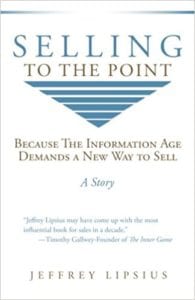
Selling To The Point: Because The Information Age Demands a New Way to Sell
The first thing I want to say overall about my book is consistent with what we’ve been saying so far. My book is one of the first selling books in the form of a fiction novel story. It’s got a plot with romance suspense. The reason I made it a fiction novel instead of a how-to book is because I want to show salespeople how to learn from conversation. I said salespeople are the learners, not the teachers. Where do sales people learn? They learn during the course of interaction, from dialogue. The customers will reveal their beliefs, their values, their priorities, their frustrations. As a salesperson learns his, the salesperson’s able to respond, and of course learning requires awareness, which is getting back to the original skill that I’m saying we need for our performance is good observation, good awareness.
What I was wanting to get across to the salespeople is that you can say whatever you want. If you’re talking to an unreceptive customer, it’s of no use. You could go through all kinds of training at the home office and get your pitch down and talk to the customer and relay all the selling points that you were trained and memorized and got them all out. If the customer is not interested, if the customer’s unreceptive, you haven’t accomplished a thing. Maybe one point that you might consider to be minor or almost irrelevant, you just happen to mention on the side of the customer really grabs on to that. In their own beliefs and values, this is very important. It’s not your pitch, but it’s how your pitch is being heard that’s going to determine whether you get the sale or not. I wanted to get that across in this particular chapter. The best sales pitch is a pitch that’s well received.
That’s also I think with the benefit to the readers of your book is instead of another how to book, you’ve put it into a fiction, so we are entertained while we’re learning as opposed to just learning and that makes it much more interesting and engaging and that’s the main reason for doing this. One of the things in your book and the story along the line is a character, Martin. He writes down that customers make the best buying decisions when they have the three C’s, Internal Confidence, Internal Choice and Internal Clarity. Let’s take a minute and go through each one of those. What is the emphasis on the word ‘internal’ around these three C’s?
The three C’s are what customers need to possess in order to make the best decisions. As a salesperson, you need to be skilled in decision coaching because sometimes you could say all the right things, but the customer still doesn’t buy because they might not be the best decision maker or they have a decision style that might not be optimal for this type of decision. They need to go into a coaching role. You need to shift from salesperson to decision coach, and if you’re going to be a decision coach, you have to gain a higher level of trust, which comes from letting the customer know that your goal is to help them make the best decision. That’s important because usually sales people’s goal is to get the customer to buy the product. The customer doesn’t share that goal. The customer’s own is to make the best decision. If the salesperson and customer are on the same page, then they work together as a team and you can have a coaching relationship.
One of the best things I’ve ever heard people say in the sales conversation is, “This may or may not be a good fit for you, let’s find out together.” That automatically goes, “Then you’re not so attached to me having to buy, that may not be the best decision if you find that I can’t afford it or it’s not what I need or whatever.” That also removes a lot of the pressure.
It does one more thing. It turns the conversation inward. You’re asking me what do I mean by internal with the three C’s and you gave a great example. If the salesperson is urging the customer, “You should buy, because I know this is a great product for you,” that’s outward. That’s about the salesperson’s point of view. If the salesperson says, “I don’t know. Let’s explore this.” Then it becomes more about the customer’s point of view, which is more inner. I’ll give you an example, I’ll start with internal confidence, which is one of my three Cs. If I ask any salesperson about confidence, they’re going to say, “Very important, confidence.” They try to get that, “With every sales call is to have the customer trust me. Customer is confident that what I say is actually what’s going on.” That’s external confidence.
Internal confidence is the customer’s self confidence in their ability as a decision maker. This is primary because the customer’s not going to trust the salesperson unless the customer first trusts themselves to decide if they’re going to trust that salesperson. What I’m trying to get sales people to do with this book and with my courses is turn your thinking around from external, which is about me and my performance to internal, what’s going to make the customers have the best decision performance. If you’re a coach and you’re coaching a customer and that customer has self-doubt in their ability to make a decision, then you’re going to have a compromised buying performance. For example, the customer may make an inappropriately conservative decision because of their self doubt and a salesperson skilled in asking the right questions can prevent this from happening and have the customer make a better decision. That’s internal confidence.
I was talking with someone who was thinking of hiring me to help them as their business coach with their pitch and modeling and they’re in this buyer’s remorse type of thing and it’s exactly what you described. They don’t trust themselves enough to make a good decision because they’re so afraid of making the wrong decision. They said, “On a scale of one to ten, I’m at a nine.” I go, “I’m going to feel so relieved if I get you to help me but then my internal monkey mind kicks in and I’m like, “How do I know he can help me and how does he know he can help me and on and on and on and on.” They just start spinning their wheels in such a crazy way. I have my own way of trying to help them calm that down, I’d love to hear your thoughts on that because that happens so many times no matter what you’re selling.
Ask a coaching question. For example, you could ask the customer, “If my services worked out well, what would you notice happening that would indicate that? Get the customer to start thinking about, “I would have this occurring and my people would be working more as a team with each other and there would be a better communication.” “Really, better communication, how would you measure that? How would you know the communication is better?” Getting them to focus on what they can know. From the scenario you’re describing, that customer is like, “I don’t have a crystal ball.” They want a crystal ball. If you bring it back like a coach would to a tangible, observable things, they realize that, “I can make this decision because I have a handle on the different indicators that would show me if it’s working out well or not.”
[Tweet “Shift from a sales conversation to a decision coach by building trust.”]
It’s future pacing them into things that they can measure, which then allows them to have more confidence in their internal decision process. Let’s jump into this internal choice. Let’s create a scenario. You and I are both keynote speakers. In this situation where the agent has said, “They like what you have to say. They’re just about ready to schedule a time to have a conversation with you before they decide but they think they like another speaker better and if they want to talk to that speaker first and if that doesn’t work out, then they’ll talk to you.” You’re like, “Their internal choice process is not really working in my favor. I have to hope that somebody else’s as opposed to let me get in the game.”
You have to take a little bit deeper dive into, “Why they feel compelled to listen to that person, the next presenters, and as a matter of fact, why don’t they want to hear three presenters, five or six? What’s going on? Typically, the low internal choice is the result of a self-limiting belief. When a customer has a self-limiting belief, it lowers the amount of options they feel they have at their disposal. You say that salespeople are selling options, selling choice. We’re selling solutions that the customer hadn’t previously considered. A lot of the times, it hasn’t been previous considered because there’s a self-limiting belief. An example could be somebody’s going to a company and looking at the org chart and they’re wanting to talk to the highest-ranking executive because they have the most choice, they have the most decision ability. Every salesman knows to do that. You get in front of this VP and start talking to them who extensively has the most choice because they’re ranked so high in the org chart and you hear them say, “I’m pressured by the board and I have regulators are getting in my way now and people are after me so I can’t make any mistakes, the shareholders are angry at me from last quarter so I really don’t want to make any decisions right now.” They have low internal choice even though their external choice, which is their positional power is very high, their internal choice is very low and you’re not going to get the sale.
It was almost like, “My hands are tied.” That’s a low internal choice, right?
Very much so. The self-limiting belief was when the executive said, “People are after me right now, people are wanting to watch me screw up so they could blame me for something.” It’s a self-limiting belief. They feel they don’t have options to choose from when it finds time to look for solutions. Internal choice is also very important to instill in a customer in order for them to make the best decisions. A customer with low internal choice is the most frustrating for salespeople because those are the customers that really liked the product, they really want the product. They think it’s the greatest product, but they won’t buy it because they don’t think they have the option to do so, even though they liked it so much. We all know customers like low internal choice.
Any recommendations on what to do when someone’s who’s got this? Maybe I don’t want to talk to a lot of salespeople. I get overwhelmed by all the choices or what to say?
That’s a perfect lead into my last and third C, which is the most important, which is what I call internal clarity. Internal clarity, if I talk to a salesperson about clarity, “You got to let the customer know about the products, all the features of the product, what it’ll do, how it’s better than the last model we made, and really make them clear.” That’s external clarity. Internal clarity is the customer’s self-awareness. Does the customer know what they need? Are the customers a clear on their goals? Is the customer in touch with priorities and values? If the customer doesn’t know what they need, how in the world can they figure out if your product features will satisfy that need?
I remember helping a real estate agent not waste his time with a bunch of potential buyers who was showing them endless amounts of houses and he hadn’t gotten them to define what would be the ideal house and when they saw it, they would pull the trigger because they didn’t have a criteria. They just go, “They always found something wrong with the house.” I’m like, “We’ve got to figure out the three things that when you see it in one place, you’re going to say yes to.”
The customer has to be clear and the salesperson can help customers get clear. I was talking to a financial planner and he had all these products that he wanted to present to me, but before he did anything, he goes, “What are your needs going to be after retirement?” He started asking me what’s going on with me? Then based on what I said, he was able to pick which product to present. That’s internal clarity. You could be lost, like lost in a mall or lost in a park or something and be looking at the most accurate map. If the map doesn’t have a, “You are here” mark, you’re still lost. You need that internal clarity in order to be able to work with the customer and getting back to your other question, internal clarity also increases internal choice.

Selling To The Point: Internal clarity also increases internal choice.
It’s all connected. Jeff, you have a special gift to offer the audience. Would you please share that?
Anybody that wants to hear more about what I have to say about this, I will have a free fifteen-minute consultation with you over the phone. You can reach me at [email protected]. My Twitter is @JeffreyLipsius. You can reach me anyway. I’ll be glad to talk to you and have a fifteen-minute conversation to see if I could give you any tips to help using the Selling to the Point method.
Who is your ideal audience that you love to give keynote talks to and workshops to?
All kinds of sales, but especially when salespeople have customers that reorder products, reusable products, or the relationship between the customer and the product is really important. That seems to be the sweet spot in terms of companies that really flourish hearing my keynote.
The renewable relationships, not the one-offs. Jeff, I can’t thank you enough for sharing your wisdom, your generosity, and most of all just helping all of us get better with realizing we need to shift from having external thoughts about confidence and clarity and choice to internal and that when we become conscious aware of what’s going on in the moment, it’s going to improve our performance.
Thank you so much, John, for having me on.
My pleasure.
Links Mentioned:
- Selling to the Point
- Selling to the Point – book
- [email protected]
- @JeffreyLipsius – Twitter
Wanna Host Your Own Podcast?
Click here to see how my friends at Brandcasting You can help
Get your FREE copy of John’s latest eBook Getting To Yes now!
John Livesay, The Pitch Whisperer
Share The Show
Did you enjoy the show? I’d love it if you subscribed today and left us a 5-star review!
-
- Click this link
- Click on the ‘Subscribe’ button below the artwork
- Go to the ‘Ratings and Reviews’ section
- Click on ‘Write a Review’