

Innovation Hacks with Josh Linkner
Posted by John Livesay in podcast | 0 comments

 Episode Summary:
To Josh Linkner, founder and CEO of ePrize, creativity and innovation are the lifeblood of all human progress. As such, he’s spent his career harnessing the power of creative disruption. His journey has been non-traditional at every step, using innovative hacks to topple competitors, fight through adversity, and achieve at the highest levels. In addition to his own startups, Josh has been involved with the launch, growth, or financing of over 100 other companies. Josh shares how he built the largest digital promotions agency in the world, ePrize, serving 74 of the Top 100 brands. He also touches on innovation, creativity, reinvention, and hyper-growth leadership. Josh states that focusing on not only inspiring audiences but also sharing actionable strategies is what drives meaningful outcomes.
—
Listen To The Episode Here
Innovation Hacks with Josh Linkner
My guest is Josh Linkner, who started his career as a jazz guitarist and he personifies innovation, entrepreneurship, and breakthrough disruption. He’s been the Founder and CEO of five tech companies, which sold for a combined value of over $200 million. He’s a New York Times bestselling author not once, but three times. His first book is Disciplined Dreaming and then he went on to write two other books, The Road to Reinvention and Hacking Innovation. I’m interested to have him share with us what hackers do that we can apply to our own way to be more innovative, but in a legal way. He’s also the founding partner of Detroit Venture Partners and he invests in over 100 startups. He’s been named twice the Ernst and Young Entrepreneur of the Year and is President Barack Obama’s Champion of Change Award recipient. He writes for Forbes and Inc. Magazine. He’s a big supporter of Detroit and he gives keynote talks all around the world about innovation and he helps other speakers. He’s someone who gives back and has a passion for making a difference. Josh, welcome to the show.
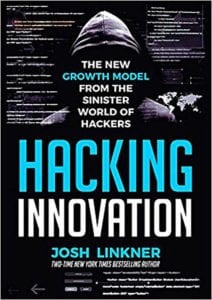
Hacking Innovation: The New Growth Model from the Sinister World of Hackers
Thank you so much. I’m delighted to be joining you.
I love your story of origin and I would love to have you share with us how you went from a career as a jazz guitarist into entrepreneurship and then on to this amazing international speaking career.
I grew up in Detroit and I started playing Jazz when I was about eight years old. I’ve been playing for 40 years and I love music. I love the art form, but clearly, it wasn’t the most lucrative career choice. I’ve equally found a love for creating similar types of art, but in business. To me, we can be artists whether we’re playing music or doing a Broadway play or writing code, it doesn’t mean you need to be less artistic. I’ve always taken that same creative approach to anything that I’ve done.
I’ve ultimately moved into entrepreneurship and venture investing. Ironically, your show’s around the pitch. The pitch had a lot to do with it. When we’re Jazz musicians trying to get a gig, you’re constantly pitching yourself. You’re trying to just get someone to hire you. The same works when you’re trying to raise capital, when you’re trying to land customers, when you’re trying to attract talent. To a degree, it’s salesmanship not in a bad way, but in a persuasive and authentic way that ultimately drives progress.
There are a lot of similarities between music and being fluid on stage and entertaining people. Let’s talk a little bit about the talks that you were hired to do and some of the clients you’ve spoken to around innovation. What are some of the secrets to being innovative in your business or an innovative way to pitch?
I’m very lucky I get to speak all around the world. I did 163 keynotes all over the place, mainly for large companies. We can apply the lens of innovation, that’s a core message that I share far beyond product development. We have to think of “innovation” as this big overwhelming word that only applies to CEOs or people wearing lab coats. I like to show this notion of everyday innovation and being innovative whatever we happen to be doing, whether that’s customer service or finance or in this case, pitching. As we think about pitching in a creative way, that could become the difference maker. If you’re pitching in a competitive situation, especially if your product or service is very similar to others, the innovative nature in which you pitch could be the difference maker between winning or losing.
[bctt tweet=”We underestimate the risk of standing still.” username=”John_Livesay”]
I like to do a few things. First of all, let people know that all of us are creative. Whether you’re good at music or not, doesn’t mean you’re creative. All of us, as human beings, have the creative capacity to solve problems in imaginative ways and use this creative muscle in our daily work. Once we were connected to that, what I like to share are some very practical tools and techniques that allow people to drive innovation into, not only the big stuff but the little stuff.
One thing I like to do is called the Judo Flip. It’s a very simple tool. Let’s say you’re selling life insurance and everyone in the industry sells life insurance the same way. You’re confused with the competition easily because everyone looks, act, sounds and smells the same way. The Judo Flip is simply asking yourself, “What is the exact opposite? What’s the opposite of what I’ve always done? What’s the opposite of what everybody else is doing?” If everybody else pitches in a three-piece suit, maybe you pitch on a black turtleneck. If everybody else come and hawk their wares, maybe you come in with no presentation and you simply engage in a dialogue. It’s a way of forcing yourself to look and list out what everyone else is doing, what you normally do and you’re simply asking the question, “What would happen if you Judo Flip it?” If you Judo Flip the tradition upside down in order to uncover a fresh approach.
That mindset of just because everyone else is doing something in a certain way, it reminds me of lateral thinking, which is that same way of, “How can I think out of the box?” Not just that but do something that’s memorable. That’s where storytelling comes in, whoever tells the best story when you’re pitching becomes memorable. Can you share an example of some of the times you’ve had to pitch yourself versus another speaker and what you’ve done to be Judo Flipping?
First of all, one of the messages of pitching is that it’s about the pitcher but it’s not, it’s about the audience. The first thing you have to do is getting yourself in a mindset that it’s not about you or what you’re trying to sell, it’s more about what you could do to add value and serve the other person. This nontraditional approach has worked for me in all aspects. One of my favorite stories, I had the chance to win some business as I was growing my company from a giant corporation. They were going to single source all of their purchases of our kind of work, we did digital promotions, and give a whole bunch of business to one supplier. A competitive shootout ensues and we made it to the finals.
At this point, there’s me and two other companies left standing. We were desperate it has to be a game changer if we want it. The problem is that the buyer, in this case, was a jerk. He was dragging the process out. He was difficult and abrasive and all that. I bumped into him and his wife at an industry conference. I kept running up to him at the coffee breaks and I’m trying everything I know to close the deal. Nothing worked, he was totally dismissive. What happens next is that I see him at the airport and it turns out that he and his wife were on the same outbound flight that I was. The guy gets an upgrade to first class, he’s a frequent traveler. Being the gentleman that he is, he takes the seat for himself and sends his wife back to coach. If I did that with my wife, that’s got to be it, game over.

Innovation Hacks: If you’re pitching in a competitive situation, especially if your product or service is very similar to others, the innovative nature in which you pitch could be the difference maker between winning or losing.
Next, what unfolds, I also got an upgrade. I walk on the plane and there he is sitting down and I had the seat next to him. All of us that are reading this is pitching like it allowed me in sales of some capacity or another were like, “You’ve got the seat next to your biggest prospect, two hours uninterrupted, sit down and sell.” To me, there’s an opportunity to be creative. It’s an opportunity to explore an unorthodox or a judo flip approach. I said, “I have the seat next to you.” He looks back up at me and he says, “We could chat.” I said, “I’d love that. Here’s the thing, I have much work I’m behind on. I need to catch up on this flight and I also noticed that your wife is sitting at the back. How about we switch seats? You two can enjoy some family time. I’ll get my work done back in coach.” He thanked me and I was a little nervous. Was that the stupidest thing I’ve ever done? I thought, “Let’s try the opposite approach.”
I walked back and present his wife my ticket. I said, “Go sit with your husband, have a great flight.” She gets a little choked up and she’s like, “Thank you so much, I’m so happy to be sitting with my husband.” The flight takes off, I don’t think too much about it. Once we land, all of us we check our mobile device. The first thing I noticed was an email from my office. It said, “Josh, deal signed.” Here’s what happened. The guy later told me, “I was looking for a tiebreaker. All three companies were solid but when you demonstrated some humanity instead of only chasing the bottom line, when you showed me that you could be innovative, that’s who I needed on my team.” Before the flight took off, he texted it to his office. Once we landed, that deal had already been signed. It was a $30 million deal.
It’s a bit of a risk. It is a great example of the Judo Flip. What I love is you’ve now shown us how to be innovative as it relates to the humanity part of it. I don’t think that people think of innovation applying to humanity and that can pay off. I also loved that you didn’t say, “I’m a great guy. I’m going to give your wife my seat.” You said, “I have work to do.” You were equally busy and that there were some things going on in your life, which is always, an important factor that you can’t be too needy or desperate for anything. “That if this doesn’t happen, this is my all or nothing,” world. That sets you apart as well in my mind.
I did it because it was the right thing not only because I’m trying to game it but it all paid off. My experience is that when we go and pitch anything, I raised over $250 million of venture capital through the years, I bought and sold several companies. I spent a lot of time pitching. Also as a venture capitalist, I’ve been on the other side doing 3,000 entrepreneurial pitches. I will say that what I’ve seen the best ones are not the ones that have the straight up the middle pitch. It’s the ones with the curveball. It’s our job to position our offering and to be persuasive in a nontraditional way because that’s going to yield a better result.
I’ve seen many examples of this innovative thinking. Can you give us another one? I watched one of your videos and I was amazed at how you came up with an innovative solution, so you didn’t lose business. It’s one thing to use innovation to get it, but how do you use it to not lose business?
Early on, we won a piece of business in my company from United Airlines and we were excited. I’m a little startup in Detroit and this is a major brand placing their trust with us. My company designs and runs digital promotions. We were part ad agency and part software company. When we run a promotion like sweepstakes, we’re also doing the legal stuff, the rules and regulations. This is a sweepstakes grand prize of $1 million and United flies at different countries. They wanted their customers from all the same countries to be able to enter the $1 million sweepstakes. We take the business, we’re all excited then we got into the legal research. We learned that in Brazil, which had to be an eligible country, a drawing of this nature, according to Brazilian law, must be done on Brazilian soil.
We’re thinking, “We’re going to Rio.” Until we learned that in Australia, which also had to be an eligible country, Australian law declares that prize draws must be done within the physical boundaries of Australia. I was a little tech company. This is not a small problem, this was a massive problem. I didn’t know what to do. I couldn’t give away two prizes. I couldn’t afford an extra million dollars. I’m not about to run an illegal sweepstake and I didn’t want to have to go back to my huge new client and tell them we’re too stupid to take their business. The answer didn’t come from me, as the CEO, I wasn’t smart enough, nor did it come from anyone with the fancy title, it came from an individual team contributor in my legal department.
Here’s what she says to me, “Josh, do the drawing at the Brazilian embassy in Australia.” It’s technically Brazilian soil, technically within the boundaries of Australia, which we did. I’m not kidding, it saved my company. The reason I like sharing this story is that if we want to drive creativity in our organizations, it’s not all about us being the creative wizard, it’s about empowering others. It’s about creating a safe environment where part of their job responsibility is to be creative and to share the crazy wacky ideas. The only thing I did as a leader here is I created an environment where this woman who shared her idea, she wasn’t nervous she was going to get fired. She wasn’t scared she was going to get reprimanded for sharing a crazy idea because we celebrated all ideas, big and small. I would encourage the audience to do the same.
[bctt tweet=”Everyday innovation requires practice.” username=”John_Livesay”]
The big takeaway is to create a safe environment where people don’t feel embarrassed or scared to share something that they’re going to be ridiculed for because that’s the creative process. That goes back to Jazz, which is a very creative way of improv and creating something new. You’ve heard a lot of pitches as an investor. I would be remiss not to ask you to either share one of your favorite pitches or, beside not doing a traditional pitch, any tips you have for someone who is pitching to you or any investor that you think will make them stand out?
When you listen to pitches, some of them are so bad that we created this funny list of what not to do. Here are a couple more tactical things. One is a great presentation is about discussion, not a monologue, so make sure that you’re listening as much you’re talking. Avoid the buzzwords, name-dropping, big, boastful and outrageous claims. Instead, make sure that your authentic self is coming through and that it’s a conversation. You want them to fall in love with you as much as they fall in love with your idea. What I’d like to see is storytelling and I love to see when people are pitching and focusing in on the problem that they’re solving. If someone comes in to pitch me for capital and they’re like, “Here’s this money I’m going to make.” I feel like they’re focused on the wrong thing. I want them to come in and say, “Here’s this burning problem in the world and it needs to be solved. I’ve committed myself to solve it. Here’s how we’re going to do it in a nontraditional way.” That to me is cool.
Another thing, we have a little venture capital rule called the 10X Rule. If someone comes and says, “I want to start a new auction site and it’s going to be 2% better than eBay.” My response is, “No way.” eBay already has won that and they have too much critical mass for you to compete. Our little simple litmus test was this, if someone pitches us an idea, we say, “Is that idea 10X better than what alternatives are already out there?” If it is, I want to learn more and I want to invest. If not, I’m probably going to pass because if there’s already an incumbent, if there’s already a market, how are you going to solve the problem in a ten times better way?
By the way, it doesn’t have to be your product. You could have a 10X advantage elsewhere. It could be a 10X cost advantage, it could be a 10X people advantage, a 10X brand advantage, 10X safety advantage, whatever. For us, we always say, “Is there a 10X somewhere in the mix? If there is, we’re excited. If not, we’re probably going to pass.” It’s a good way for someone who’s trying to pitch to say, “Can you position your alternative?” Whether you’re selling a product or service, or you raising capital, in some way 10X better than alternative choice. Even if you’re trying to raise don’t profit money. You’re trying to raise money for the American Heart Association, why should someone give money to you versus someone else? Your story better be ten times better.
Those are useful takeaways and in been doing that myself where I pitched my startup that I’m working on, quantmRE. We describe what the problem is when people have equity in their house and if they need to take the money out to remodel or send a kid to college, the only option they have is to refinance it. We’ve completely Judo Flipped that and are now giving people money without having them take on more debt because we buy a small percentage of their house. When that happens, we’re giving people the freedom to get access to money liquid without taking on more debt. That’s a way that is 10X better than people taking on more debt.
When people understand all of that, you can start to get people to say, “I’ve never heard of getting money without debt, tell me more.” That’s what you’re saying. We’re describing how we’re helping people, the problem that people are having when you’re asset rich, but cash poor. If you can solve that problem that intrigues a lot of people to say, “How do you do that? You’ve already done it and now you’re going to put that on the Blockchain on top of it and let people buy real estate without being a landlord. That sounds something that’s pretty revolutionary, I want to know more.” That’s all good pitches in my opinion. Also to intrigue people enough to say, “That’s interesting. I want to know more.”
You’re such a good example there because you’re not just sharing some little teeny feature. What you’re offering is profoundly better and different. Nobody wants another me-too solution. What the world craves are originality and unique and better approaches. When we’re talking about pitches, just a couple of quick things that I’ve learned. We would always ask ourselves when we would get pitches to venture capitalists and I would do this when I was raising capital. Here’s the question, “Are you selling vitamins or Advil?”
Here’s what I mean by that. If it’s 2:00 AM and it’s snowing and you’re in your nice warm bed, no one’s ever going to get up, get in their car, dust off the snow, drive four miles, and go to the all-night drugstore to buy vitamin. It’s not going to happen. If you have a headache and you could barely see straight, you’re going to do whatever it takes, pay whatever it takes, go through whatever extra discomfort it takes to get yourself that Advil. Back to pitching, is your solution something that it’s just nice to have? Vitamins are nice and convenient and you do it when you get a chance. Is it like a burning pain that you’re solving? The more you can position your product or service company as Advil addressing a real burning pain in the world as opposed to vitamins “a nice to have,” you have an easier chance of raising capital and ultimately succeed.

Innovation Hacks: It’s our job to position our offering and to be persuasive in a nontraditional way because that’s going to yield a better result.
I find that useful because we instantly know that one is a preventative and the other one is instant. You must address the “why now” factor when you’re pitching. Why is now urgent that this problem gets solved and the vitamin versus Advil paints that picture in a great way. Let’s jump to your book, Hacking Innovation. This concept of the Frogger is interesting. Can you expound on what all that is?
I grew up playing video games like many people. Back when I was doing that, there was the game of Frogger. For those who don’t remember Frogger, you’re this little frog and you’re trying to cross the street. The way you do that is you hop on moving objects that are flowing in the stream like the back of a lily pad or an alligator or a log. Eventually, you try to get across the street. The thing is that when you take a step and you’re on dry land which now you’re on a log, if you stay on the log, you then fall into the stream because the log is moving in increasingly faster paces. What you have to do is go from a dry surface and then right where you land, jump to the next dry surface and the next one in order to avoid the raging river of death.
I can’t think of a better example for what’s happening now in our business climate because today it’s like a giant game of Frogger. In other words, you have a good quarter. Now you’re on back to the lily pad, but if you stand still, that’s the riskiest thing you can do because you’re going to fall in the river and die. It’s about going from point of success to the next point to the next one. Those factors are increasing today at a rate like none other in history. It’s incumbent on us not to think of success as we’ve cracked the code and you’re going to do the same thing forever, but rather leaping from one point of success to the next and always moving forward because realizing that standing still, connecting to the status quo is probably the riskiest move of all.
That is spot on to my philosophy as well which is there’s no such thing as a comfort zone anymore. You’re Judo Flipping the traditional way of, “Let’s avoid risk.” You’re saying, “Nope, the hackers embrace it.” That’s what you need to be doing in your business in order to not be drowned in the Frogger example.
One thing I’ve learned in 28 years in business is that people tend to overestimate the risk of trying something new, but they underestimate the risk of standing still. That’s exactly what the Frogger thing is all about, is that realizing that we have to go in our careers and companies. From one point of success and then right when we land, it’s about re-imagining what’s next and continuously creating your way forward.
We underestimate the risk of standing still. You are the master at sound bites and giving great takeaways, which leads me to what you’re doing to help other speakers. A lot of people have a passion for speaking, but they don’t have the business model that you are applying from your expertise in the tech world to this. I was fortunate enough to attend this 3 Ring Circus Speaker Bootcamp. First of all, the branding and the tone is spot on for me and is literally magnetic. I’d love to hear you describe what made you do it and what it is.
[bctt tweet=”All of us as human beings have the creative capacity to solve problems in imaginative ways and use this creative muscle in our daily work. ” username=”John_Livesay”]
You and I are very blessed that we get to share ideas with people all over the world. When you give a keynote, you have the opportunity to change lives, move industry, and make the world a better place. It’s a wonderful opportunity. There are so many people out there with fabulous messages. It could be on lots of topics, business, health, relationships, on and on. There’s a wonderful training on how to be a better speaker. There are great speaking coaches and content coaches, but if someone wants to learn the business of public speaking, I’ve found that there are no good high-quality options. As I started doing this more regularly, I realized that most of the stuff out there was pretty cheesy. It was like the zillion dollar speaker or all this stuff that like it was a get rich quick nonsense.
For me, we figured it out. I applied the same rigor that I had when building a software company to the world of public speaking and we developed a systematic approach to build and scale a speaking business, driving both volumes of speech opportunities and fee. When we finally got to that point, I said, “I would love to share this with other people because if we’re able to help them get their messages out there, the world is even a better place and how cool is that?” We started this fun thing called 3 Ring Circus, the site is 3RingCircus.com. It was playful and a bit self-mocking.

Innovation Hacks: We’re hard-wired to be creative, but unfortunately, most of us were socialized out of it.
The idea is, “It’s a circus out there and wouldn’t it be nice to have some people helping you get your circus up and running?” We host a one-day speaker bootcamps and provide some additional coaching services and such to help people with a powerful message that they want to get out in the world and then teach them the business of speaking. They’re able to do so and get paid handsomely and get a lot of opportunities to speak on the biggest stages in the world.
It’s well-produced and you not only teach the business of speaking, but you have a speaking bureau, agents, and founders there who share their insights on how they select which speakers are going to represent. It was one of the best days I’ve ever spent on my career and you’ve been kind enough to offer the audience the ability to enter a code called Pitch 500, which would give them $500 off the cost of this speaker bootcamp. That was very kind of you to do. Do you have any last thoughts you want to share with us about what we can do to stay innovative whether it’s in our career or in our personal life?
[bctt tweet=”Practice micro-innovation as opposed to the breakthroughs.” username=”John_Livesay”]
If you think of creativity as an everyday habit instead of a once a decade initiative, it’s a healthy way to look at it. I would say practice micro innovation as opposed to the breakthroughs. If you walk your dog, is there a more innovative way to do that? If you answer the phone or send an email, how can I make it a little more creative? If you’re going to send a prospecting email, how could I go jazz that up a little bit? If you think about lots of little acts of creativity rather than waiting around for some change the world type idea, the big stuff will take care of itself if you’re practicing the little stuff. Just do lots of little creative acts. The thing I would encourage people to know is that the research is crystal clear that all of us as human beings have an enormous creative capacity.
I like to say if you’re breathing, you’re creative. We’re hard-wired to be creative, but unfortunately, most of us were socialized out of it. We’re taught not to be great, not to take risks, not to make any mistakes. If we can reconnect to that gift of creativity, amazing things ensue. Human creativity is the one thing that can’t be outsourced or automated. It’s the thing that allows us to be closers instead of second round, all the things that we want can be enabled through human creativity. It’s fascinating when you study the brain chemistry, the difference between you and me and Picasso, brain-wise, is negligible. It’s not that he was endowed with something from God, it’s just that he built those skills up more than perhaps you and I did. All of us can be the Picasso of our field or the Mozart are the Da Vinci. If we give ourselves permission and practice a little bit, we can go on to do incredible things.
What a great message that creativity is like a muscle. If you make it an everyday habit, then you start telling yourself, “I am creative,” and your brain will start finding solutions that it didn’t even think was possible because you believe that you are creative. I love that. Thanks so much for being on the show.
Thank you. It’s absolutely my pleasure. Keep doing great stuff. I appreciate it.
Links Mentioned:
- Josh Linkner
- Disciplined Dreaming
- The Road to Reinvention
- Hacking Innovation
- Detroit Venture Partners
- quantmRE
- 3 Ring Circus Speaker Bootcamp
- 3RingCircus.com
- www.JoshLinkner.com
- Quantmre.com
Wanna Host Your Own Podcast?
Click here to see how my friends at Brandcasting You can help
Get your FREE copy of John’s latest eBook Getting To Yes now!
John Livesay, The Pitch Whisperer
Share The Show
Did you enjoy the show? I’d love it if you subscribed today and left us a 5-star review!
-
- Click this link
- Click on the ‘Subscribe’ button below the artwork
- Go to the ‘Ratings and Reviews’ section
- Click on ‘Write a Review’
Stop Hoping: Start Hunting with Jennifer Hill
Posted by John Livesay in podcast | 0 comments

 Episode Summary:
Finding your dream job may not be what most people expect. For some, their dreams are only realized after life has thrown an unexpected curve ball. They find that they are on to a different path than what they had planned. Keynote speaker Jennifer Hill says its okay. She shares her own personal experience when she took a different route that later on led her to become a successful president of a recruitment company. Jennifer gives some great tips on how to go about pursuing your dream job and getting hired. She also gives entrepreneurs advice on going public and taking that step to selling their companies, stressing the importance of perspectives, integrity, and the value of storytelling.
—
Listen To The Episode Here
Stop Hoping: Start Hunting with Jennifer Hill
I have Jennifer Hill who is the President and also a Speaker of a company called JHill’s Staffing Services. She began recruiting back in 2003 and she’s recruited for top-tier law offices and she’s appeared on all kinds of major news outlets. She opened her own staffing company and it was recently sold in 2018. She remains on as the President. She hosts a weekly radio show on LA Talk Radio called Get Yourself the Job with over 30,000 listeners a month where she interviews experts and authors about landing your dream job. Jennifer, welcome to the show.
Thank you so much for having me, John.
I always like to ask my guest to take us back to their story of origin. When did you start to say, “I want to help people get their dream job,” or did you see other people, maybe your parents not having one? How did it all get started?
My parents were inspirational. My mom has been a nurse for 35 years and my dad was a captain at the Fire Department for over 30 years in North County, San Diego where I grew up. My origin story was probably more along the lines of when I graduated high school, I took the GED to go straight to college when I was sixteen. I get bored easily. I have Squirrel Syndrome, which means I like to have a lot of balls in the air and a lot of things going on. I went to college and I graduated college early. The few years, a year and a half or so that I was in high school, all I took was advanced placement classes. I’ve got a phone call from my college after I’d walked and graduated.
It was about two or three months after graduation and I was planning to go to law school. I was studying for the LSATs and this phone call comes in, “Is this Jennifer Hill?” “Yes. What can I do for you?” “This is Susan in admissions over at UC Irvine. We wanted to let you know that you didn’t graduate. You’re missing a class from high school, US History 101.” I cannot even make this up. I had reoccurring nightmares about this for about ten years afterwards. It turned out because I had taken advanced placement European History in lieu of US History 101 in the brief time I was at high school that that didn’t count.
The lovely admissions or counselor, whoever it was, called and said, “Jennifer, we’re going to give you two options. Option number one is that you come back to school for a semester, take the class and pass it. Option number two is that you take a thousand-page book on US History 101. Memorize as much as you can, and take a two-hour oral exam with the Dean of Social Sciences. Pass or fail.” I opted for the latter. I was fortunate that I did pass the two-hour oral exam, but because of rollover applications for law firms, I could not apply to law school that year. It was the best gift that ever happened to me.
I do a lot of motivational speaking. I did a talk with a lot of interns at a company yesterday. One of the things I tell them is sometimes in your career you think you’re going to go left. The universe is like, “No, you’re going to go right. Make a U-turn. Go backward.” You circumvent the direction you thought you were going to go, but it was the best gift that ever happened to me. In lieu of going to law school that year, I posted my resume on Monster and I got three job offers. One of which was to become a recruiter, which I didn’t even know what that was. Lo and behold, here I am running my own company for ten years, having sold it and having worked for some of the top corporations and law firms around the world. I feel fortunate to do what I do.
[bctt tweet=”To land your dream job, one has to feel that there’s a purpose besides making money.” username=”John_Livesay”]
Both of your parents are in the service caregiver/EMT world. You grow up in this environment of when you have a career, your career should be saving lives in one form or another. That seems to be the theme.
I never put two and two together on that. That’s a good observation.
I’m looking at your early influences of making a difference in your career, especially under the theme of landing your dream job. One has to feel that there’s a purpose besides just making money. You certainly had that modeled for you. The other irony in your story is here you are thinking you’re going to law school. The most core fundamental issue of US History and knowing the Constitution was something that somehow slipped between the cracks. If you were going to go do anything else besides a lawyer, of all the things to not have, that’s the prerequisite.
In all the years I’ve told those stories, I don’t think anybody has ever keyed in on either of those points.
The other part that’s fascinating for me is if we can have people who are reading realize that you’re in the situation, in my case, I got laid off after being at Condé Nast for fifteen years. In your case, you didn’t get to go to law school when you thought you were going to. All those things that we think are bad news with some perspective in your rearview mirror, you can see, “That was the right thing for me.” When the next thing that happens to us is something that we don’t think we want or like, maybe we can, while we’re in the moment, not hit the panic button so much.
There’s a talk that I do that’s popular on empowerment and perspective that I do around the country. One of the topics that we discuss is when we’re dealing with the subject of perspective. If you’ve ever studied neuro-linguistic programming or if you’re familiar at all with neuroscience, the way the human brain works and our perception works is moment by moment, we are bombarded with billions of bits of information, sights, colors, sounds, smells, touch and etc. However, our brain at any given moment is only paying attention to a couple thousand of those bits of information. What does this mean? It means what do we perceive? What happens to the rest of those multibillions of bits?
This is the analogy I like to use to help people better understand it. It’s like that Jennifer Hill, as a human being, is in this huge, black warehouse. It’s pitch black, you cannot see whatsoever. The only thing that I have is a headlamp on my forehead. That headlamp, depending on which direction I’m going to turn my head, is going to directly impact what it is I’m seeing or not seeing. That is our perspective. You have to keep in mind that you have multitudes of things to choose to look at all around you. For example, in your case with the layoff at Condé Nast or in my case, when I couldn’t go to law school, if you focus on how unfair it is that the world is unfair and that you’re a victim, you’re going to find evidence to prove that right because that’s where your headlamp is pointed. However, if you choose to look at, “What a great opportunity. I wonder where this is coming from and why this is the lesson I’m supposed to learn in this,” then you have access to a whole different path that you can take through life at the warehouse.

Pursuing Your Dream Job: If you focus on how unfair the world is, you’re going to find evidence to prove that right. But if you choose to look at the great opportunities it has to offer, you will have access to a whole different path.
A lot of people who are reading are entrepreneurs. One of the entrepreneurs’ dreams is to go public or sell their company for a nice exit for themselves and investors. You had that happen to you. Can you tell us a little bit about that story?
It’s a great story because it all came to fruition this exact time on my own radio show which is called Get Yourself The Job. I interview experts from around the world about how to be successful, whether you’re an entrepreneur or a job seeker, to get up every day and do what you love. The guest’s name was Gary Douglas, multi-bestselling author, 25 books. He joins me on the show. He tells me about this game called How Does Life Get Any Better Than This? Basically, the premise of the game is every time something good happens, you say out loud, “How does it get any better than this? How does life get any better than this?”
He gives us a great story of a woman who walks out of his program in New York. As she walks out of the program, she comes across a dime. She yelps with delight. Instead of walking by, she says, “How does it get any better than this?” She walks another twenty feet, and she comes across a $10 bill. She says again, “How does it get any better than this?” She realized that she has enough money to make it home in a cab rather than walking home in New York. She raises her hand, gets a cab immediately, and is saying out loud, “I don’t understand, how can it get much better than this?” She gets out of the cab, finds a diamond tennis bracelet with nobody around to claim it.
You can imagine, I started playing this game. Three weeks later, on the nose, I was not looking to sell my company. I had been playing this, How Does It Get Any Better Than This, game for three weeks straight. I’m just being grateful, appreciative and again, turning my headlamp towards whatever was wonderful in my life. Out of the blue, a company reaches out and says, “We want to buy you.” I said, “I can’t quite say I’m for sale. I’m certainly open to negotiations.” Six months of M&A attorneys later, here we are. I’m lucky that the company that acquired me is great. It’s been a wonderful opportunity to partner with them on everything we’re doing. The power of perception, what you focus on expands.
What do you think it was about you and your company that made the company that bought you wants to buy you in the first place?
I have to say it’s my brand equity. We’re one of the few staffing firms. If you search for my company, we have five stars. I’m lucky that I’ve spent the last ten years working on myself as an individual. The latest talk that I’m working on is called I’m a Recovering Asshole, because I am. Everybody who knows me from earlier in my career from about when I was 18 to 23 will definitely concur with that statement. I went from being a complete jerk, whatever you want to call me, to transforming myself into somebody who had integrity, who you could count on. If I give my word to something, you can guarantee that I’m going to do it. I was able to create a foundation for a successful company based upon that.
From there, some of the top talent in the industry kept approaching me and saying, “Please, can we come and work with you?” They told me outright, “We’re buying you.” When I came up with the company name of JHill’s Staffing, it was a joke. It was a gag. I did not mean when I opened my company in 2009 to actually build a company and sell it. I feel fortunate that I follow the leads of the universe. I allow things to be in the flow. Whenever I’m meant t to close one chapter, another one opens and I step through that door.
You also wrote a book which is great branding called Stop Hoping. Start Hunting!: A Job Seeker’s Guide To Finding A Dream A Job. You were able to get on Conan O’Brien with it. Tell us that story.
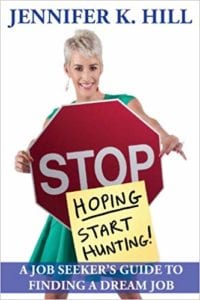
Stop Hoping. Start Hunting!: A Job Seeker’s Guide to Finding Their Job
It was in the middle of my book tour. I was lucky from a young age I had a wonderful PR guy, Richard Berman, who did all my PR. He was getting me TV appearances long before I even had written a book. When my book got launched, I was flying around the country doing different TV appearances. I had bought my mother-in-law tickets to see Conan O’Brien for her and her niece. We go to go see Conan, but that day I stopped by my office first. One of my colleagues, Scott, says to me, “JHill, grab a copy of your book.” I looked at him, I’m like, “Scott, I’m not appearing on Conan. It’s not my book tour. I’m going there as a guest.” He gives me side-eye and he says, “You never know. It might be a funny gag to sign the book for him and say, ‘Good luck one day finding your dream job,’” if he’d been fired from The Tonight Show. I signed the book to Conan. We get to the show. I talked to one of the PAs and I said, “As a gag, I brought a copy of my book for Conan. Here’s a copy if you want to give it to him. It’s a gag since he just lost his job.” The PA was nice and she said, “Conan’s sweet. Oftentimes after the show, he’ll come into the audience and greet the guests or greet people in the audience. If he does, give him the book then or give it to one of us at the end of the show. If he doesn’t, then we’ll give it to him then.” I said, “Okay, great.”
Five minutes and 55 seconds into Conan’s show, and we all know this because it went viral, Conan started doing a joke about oral sex. If you know anything about the legal industry, it is a conservative industry. Most of my clients are AM 100 Law firms, Fortune 500 companies. Conan starts doing this joke about oral sex and I laugh. I have an uproarious, loud laugh. It’s who I am. The camera pans to me. I see myself on the screen laughing about Conan’s joke. I tried to cover my face. All of my clients are going to fire me over this. I try to cover my face and then Conan’s like, “Somebody wants to talk about this.” We go back and forth. Everybody thought it was staged. I was mortified at that moment. I thought I was going to be fired by every client I’ve ever worked with.
Conan starts playing with me, doing this whole bit about it. When he comes up into the audience unexpectedly to hug me, I’m like, “Conan, it’s on. You damaged my professional reputation. I am totally promoting my book.” I hugged him with my book cover to the camera. Out of that, I handed him a book. It turned into a two-and-a-half-minute bit on Conan’s show called The Sex App Joke & The Audience Lady. I’m affectionately known. I have one million views on Conan’s website for that. It was great because as my PR guy said, “No publicity is bad publicity,” and it got me a lot of clients rather than losing them.
How wonderful would have it been if you had not listened to the person going, “You never know, just bring your book?” All of that happened because you were in this mindset of, “How does life get any better? I don’t have any expectations that my book’s going to be on the show.” Yet, if you didn’t have it there for that moment, that would be amazing.
It was fortuitous. That’s why I say, “You’ve got to be in the right place at the right time.” I’m a spiritual person. Since I’m a recovering A-hole, I spent about an hour of meditation every morning to make sure that I don’t fall back into my reactive ways. I call it the Red Mist. Some people have the Hulk. I turn into the Red Mist if I’m not balanced and thoughtful in my daily actions. I have to be responsible for that.
What’s up for you next?
What I’m doing is I’m partnering with the organization that bought me called Marcum Search. We’re looking to expand throughout California. It’s amazing how much you can do when it’s not your money. We’ve hired three people for the new company in the last three months. I love it that they fully support me. The company sponsors my new radio show. They support my speaking engagements. I get to have the best of both worlds. I get to grow a company, still be an entrepreneur, do what I love every day, and still help people by speaking and hosting a radio show.
You’re running this company, you’re hosting a radio show and you’re also giving keynotes. Who is your ideal audience to hear you speak?
Executives and staff. Some of the most popular talks that I’m doing is the How To Deal With An Office A-Hole talk is one I’m rolling out in Phoenix that everybody’s excited about. The How to Create An Empowered And Empowering Environment is popular among leadership teams. How do we empower our teams? How do you create a team that wants to continue working with you? Sometimes I lead a version of that program to people who are staff at different corporations of how to be empowered and indispensable to their employers. It’s a two-way street. It’s about helping to empower the managers and the leadership teams because it is a top-down phenomenon. At the same time, it’s also about empowering the staff who works there and making sure it’s a great culture that people want to stay in.
[bctt tweet=”Play the game and ask yourself, How does life get any better?” username=”John_Livesay”]
One of the things that I saw when I was in corporate and I still see it as an outsider is the cost of turnover. As a startup, in particular a small company, you’ve got to have something to grab people with talent to come to join your vision and your team, especially if you don’t have competitive salaries up front. How do you keep talent? Do you ever get asked that question? Do you have any insights there? Whether you’re a big company or small, that would be interesting for people.
That’s definitely something we talk about in the empowered, empowering environment and how you manifest that. What’s there is understanding the dichotomy basically of the two types of employees that you have. You have the traditional employee. I’ve written a white paper on this as it relates to the legal secretary, which is similar to all other industries. You have in the white paper I call a traditional legal secretary, or for the purposes of this discussion, we would call a traditional staff person. That would be somebody like my mom or my dad, who stayed at their job for ten, twenty years. They’re loyal. For them, the main motivating factor is stability, safety, good benefits. You have what I call in the white paper the legal secretary of the future. You could insert whatever job title there you’d like, the admin of the future, the broker of the future, whoever it might be. He or she is going to be much more motivated by change, upward mobility, appreciation, and also by having opportunities for growth both monetarily as well as titles.
There was a great guest who I’ve had on my show twice because I love the subject so much. It’s Dr. Paul White, The 5 Languages Of Appreciation In The Workplace. He explained to me on the show that out of the five types of appreciation, only 50% of the population responds to words of affirmation, which is, “Good job.” “Go, get them.” “Great job.” Only 50% of people respond to that. You’re appreciating your employees often in the wrong way unless you understand what their modality of appreciation is. I mix it up with my own staff. Whenever I travel, I bring them gifts. Whenever I go in the office, I give people high-fives, I’d give them verbal affirmations or I spend one-on-one quality time. I’ll ask anybody new who works with me, “What is your preferred method of appreciation so that I can appreciate you and make sure you feel known and respected?”
One of the things that you and I have in common is this concept of storytelling and asking the right questions. When I was being interviewed on television recently about how to have a great story to get a yes, the host asked me, “How do people do this when they’re trying to get a job?” I said, “When you get asked the question at the end of the interview, “Do you have any questions for us?” This is when the magic time happens as opposed to, “What are my benefits? When do I get a vacation?” It’s like, “What would it look like if I was to exceed your expectations in this job?” That one question helped one of my clients get hired. The person already saw this person as somebody who is thinking above and beyond the minimum. I know that shows an employer that this is the dream job for them. What are your thoughts on that?

Pursuing Your Dream Job: Storytelling is a critical element in success.
That’s brilliant advice because storytelling is a critical element in success. I had the Chief Diversity Officer of Randstad in my show. She said from a diversity standpoint, storytelling is tricky because the brain is designed to remember stories better. You might have candidate A who goes in and has the perfect qualifications. It might be a more diverse candidate. You have candidate B who goes in. He or she tells a better story. They will go with candidate and B because the brain sees stories as more sticky and will be more likely to remember that candidate even if they’re not the best candidate for the job. If you become adept at storytelling throughout the duration of the interview, not just at the end, but also look for opportunities to weave stories throughout your whole interview.
I’ll never forget when I was sitting with the CEO of Marcum. We were having breakfast at The Peninsula before the acquisition happened. He looked at me and I was sharing with him a story of what made me a successful recruiter. He says, “Jennifer, you’re good at this. You really know what you’re doing when it comes to interviewing.” I looked at him and I said, “Jeff, I better. I wrote a book on it. This is what I teach candidates.” It’s the same thing whenever somebody works with someone in my office, we train and develop people on storytelling and on making a positive impact in the interview so that they are the most memorable candidate in a positive and not a negative way.
[bctt tweet=”Get up everyday and do what you love.” username=”John_Livesay”]
Are there any last thoughts or ideas you would like to share?
Just to tie-in to your last point, one last thing to leave your readers with. Remember, if you ever have an important business meeting or if you have an important meeting for a potential interview, you want to write down your top five attributes. It might be that you’re detailed, have integrity, or organized. You want to come up with a story that illustrates what we call PEP: Productivity, Efficiency or Performance. Those are your five key talking points in any meeting that you walk into or in an interview. If you always weave to those points throughout the whole interview or meeting, you will be the one who is most memorable in a positive way.
What’s the best way for people to follow you on social media?
If people want to follow me, they can find me on LinkedIn. I have about 10,000 connections out there, under Jennifer Hill on LinkedIn. People can also find me on Instagram as well, under @JenHillJHCCS. I think I have a YouTube channel with some old interviewing tips on it, as well as Jennifer K Hill on Facebook. I post a lot of content on there as well. The radio show, Get Yourself The Job, which people can download on iTunes. Get Yourself The Job is live every week on LA Talk Radio and converts to podcast format after the show.
Jennifer, thanks again for being such a great guest. It’s been a fascinating conversation on how to get our dream job and get and keep top talent.
Thank you so much, John. It’s been a pleasure.
Links Mentioned:
- JHill’s Staffing Services
- Get Yourself the Job
- Gary Douglas on Get Yourself The Job radio show
- Stop Hoping. Start Hunting!: A Job Seeker’s Guide To Finding A Dream A Job
- Marcum Search
- The Sex App Joke & The Audience Lady – video
- The 5 Languages Of Appreciation In The Workplace
- Dr. Paul White on Get Yourself The Job radio show
- Jennifer Hill – LinkedIn
- Instagram – @JenHillJHCCS
- YouTube – Jennifer Hill
- Jennifer K Hill – Facebook
- Get Yourself The Job – iTunes
- Quantmre.com
Wanna Host Your Own Podcast?
Click here to see how my friends at Brandcasting You can help
Get your FREE copy of John’s latest eBook Getting To Yes now!
John Livesay, The Pitch Whisperer
Share The Show
Did you enjoy the show? I’d love it if you subscribed today and left us a 5-star review!
-
- Click this link
- Click on the ‘Subscribe’ button below the artwork
- Go to the ‘Ratings and Reviews’ section
- Click on ‘Write a Review’
Happiness From The Inside Out with Rob Mack
Posted by John Livesay in podcast | 0 comments

 Episode Summary:
Many people get stuck on thinking as soon as something happens then they’ll be happy. The fact of the matter is your circumstances only account for 10% of your overall happiness. People have to realize that the outside achievements are not the end all, be all to being happy and wanting to stay on the planet. Positive psychology expert Rob Mack you can achieve happiness from the inside out and the opportunity for happiness in this day and age is greater than it’s ever been in the history of time. Rob shares some insights into how to persuade and influence people easily and effortlessly, and how to have a sense of peace, confidence, and joy when you pitch anything so that you are happy regardless of the outcome.
—
Our guest is Rob Mack, the author of Happiness from the Inside Out. Rob talks about how many people get stuck on thinking, “As soon as something happens and then I’ll be happy,” when in fact, your circumstances only account for 10% of your overall happiness. He has some insights into how to persuade and influence people easily and effortlessly, and have a sense of peace, confidence, and joy when you pitch anything so that you are happy regardless of the outcome.
Listen To The Episode Here
Happiness From The Inside Out with Rob Mack
I’m honored to have my friend, Rob Mack. He is an Ivy League educated Positive Psychology Expert, a Celebrity Happiness Coach, an Executive Coach for those of us who are not celebrities, a published author, and a TV host and personality. He’s been endorsed by the likes of Oprah, Vanessa Williams, and many others. He is hosting and producing a show that I had been fortunate enough to be on called Good Morning LaLa Land, which is a daily live streaming morning show focused on positivity. He’s always being asked to come on camera and consult for shows on OWN.
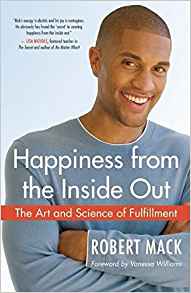
Happiness from the Inside Out: The Art and Science of Fulfillment
He was a Celebrity Love Coach for Famously Single on E! and he’s been on many different kinds of shows. His first book, Happiness from the Inside Out: The Art and Science of Fulfillment, is important to anyone who might be struggling with depression or anybody you know in your life. It is both an art and a science. He’s received his Bachelor’s Degree from Swarthmore College and he conducted his MBA coursework at University of Miami. He is an all-around nice guy that walks his talk. Rob, welcome to the show.
Thank you so much for having me, John.
I love to ask my guests to take us back to their own story of origin. You do that in your book, Happiness from the Inside Out, but I’m going to let you go back as far as you want. It could be college, high school, or younger than that. When did you start to get some insights into your own world of, “I maybe not as happy as I want to be and I’m going to figure out how to get there?”
I feel like at birth I was deeply in touch and in tune with my own stress and anxiety. I was aware of that from a young age. I felt uncomfortable, insecure and unsure about myself with respect to all people, all places and all things. At a young age as far as I can remember and as I grew up, that only increased. I became more of a ruminator. I think more about the stress, anxiety, and insecurity that I felt. As I moved into school and into sports, I found that on one hand I was able to do pretty well in sports with respect to academics in school. I didn’t feel any better for it, and I would keep upping the ante.
I’d get an A, and then the A wasn’t good enough. I would get a perfect score. I’d do well in cross country or in baseball. It was never enough. I could have hit two homeruns, but it should have been three. I could have gotten a perfect 4.0, but I should have gotten a 4.3 if I take that advanced class. That mentality, I continued to build on that unwittingly and unknowingly. It got to a place where I eventually was deeply, beyond dysphoric. I was deeply depressed and suicidal for many years.
What age did the suicide thoughts happen?
I would say probably about sixteen or seventeen, maybe a little younger. I remember reading a book, my first glimpse into the possibility that I could turn around my thinking, my confidence and my happiness. I probably read that book at around thirteen, it was Psycho-Cybernetics. It gave me a glimpse that something could be changed. I toyed with it but I didn’t find a whole lot of success because you’ve got to be persistent, you’ve got to put the time in and it doesn’t happen overnight all the time. I’d say thirteen, fourteen. When I think about it, that went at least through my mid to late twenties.
With some recent sad news about some relatively famous people like Kate Spade and Anthony committing suicide, it triggers a lot of issues in people. What I noticed is this mass consciousness illusion that if I had all those things, money and fame, I would then of course be happy. When you see someone having that at a high level, very few percentage of the population get that success or fame and they are not happy. It breaks the illusion a little bit that people think, “If I keep working hard enough and get more money, more fame or get famous, then I will be happy,” and then you’re like, “That’s not the answer?” When we talk about helping people with their pitch, whether it’s a pitch to get hired, a pitch to get their startup funded or even a pitch to get a new client if you’re in the business of anything, you always have to be selling to get new clients. Why now?
Why is now an important time for this product to come along? If you look back at Uber, without a majority of people in urban areas having smartphones, Uber wouldn’t have worked. The why now, Rob, is your mission. I’ve read your book, I’ve seen you on camera several times, I’ve heard your story and that’s why we’re so happy to get you on the podcast because your time is now more than ever. Your whole life, from my perspective, has led up to this very minute that you are being called to help people in the business world and other worlds, specifically in the business world. Realize that the outside achievements are not the end-all be-all to being happy and wanting to stay on the planet.
[bctt tweet=”Happiness is a science and an art. ” username=”John_Livesay”]
When you look at what’s going on, it’s like, “I went through all these struggles but for what? What’s my why? What’s my personal mission?” When someone else can hold a mirror up to you and go, “Here’s what I see. This is why you went through that,” and here’s why now is more important than ever to help all the people that might be reading this, going through whatever struggles, personal, business. The sense of wanting to give up, even if you’re not willing to give up in a dramatic way like checking out, but giving up on your dreams. How did you get from being this great athlete but still not feeling good enough to saying, “I’m going to get into being on camera,” whether it’s doing a movie with Vanessa Williams?
The one thing without question is that the opportunity for happiness in this day and age is greater than it’s ever been in the history of time. We’ve got more unhappy people on the planet now than ever, and we have those unhappy people on the planet despite the incredible technological advances that have been made in medicine, health and well-being. That has been made in the quality of our lives. This phenomenon of life getting objectively better, but people filling subjectively worse for it. Things on the outside getting better in general, on average, but people feeling worse on the inside is what we know is the progress paradox.
When I was going through this experience and contemplating suicide, I had stumbled upon this term and this idea that there was something happening in society that mirrored what was happening inside of me. That I was doing great athletically, I was doing great scholastically, but I was feeling worse for it, whatever reason. That began to allow me to begin to tease out what’s happening there and discern between true happiness and the happiness that was dependent on things outside of me. There was a difference between those two things.
As I began looking at this more closely, I found this program at Penn. The program at Penn is a Masters in Applied Positive Psychology. The study in science of what makes life worth living. It’s all this Ivy League science that’s accumulated over decades. They put it into one body of research and they call it Positive Psychology. As I began studying that more I thought, “I should probably do something here with this.” At the same time, in order to pay for that school because it’s a very expensive program, I moved on from my consulting career and I was trying to figure out what to do. At this time, I had moved to Miami. I was walking along the road. Some guy come up to me and said, “Have you ever thought about modeling?” I was the most insecure guy in the world. My high school class voted me Most Shy. I was the ugliest person on the planet. I had always felt that way, truly.
[bctt tweet=”The greatest challenge most people face is that they’re letting whoever they’re pitching to dictate what they’re thinking and feeling.” username=”John_Livesay”]
When he came up to me and said this to me, I thought, “I wonder what he wants. I certainly don’t have much money.” I didn’t take it all that seriously. He gave me a card. Another week later, another agent came up to me and said, “You should stop by the agency,” happened to be the same agency, different agent. I stopped by and I joined this modeling agency. I started doing modeling. I didn’t have any real future plans. I didn’t know what’s going to do with respect to my career at this point. The Positive Psychology ideas in my head weren’t all that clear. I hadn’t quite discovered the Positive Psychology world yet. I started the modeling thing. I was doing it basically to pay the bills while I figured out what I wanted to do with my life. Life is what happens when you’re busy planning for it.
Over a course of a couple of years I was doing this, enjoying my life, really focused on being happy. I’d given up this idea that success and money can make me happy. I was clear about that at that point in time. The more I read, the more I discovered how true that was. I’m doing the modeling. I had a female friend who was a model. She said, “Rob, are you go to this casting?” I’m at the pool, I’m going to relax. I’m not going to book whatever casting it is anyway. My hit rate with casting wasn’t great. I was sitting at the pool and she said, “Would you mind giving me a ride? You sure you don’t want to go?” I said, “I’ll come pick you up on the scooter. I’ll drop you to casting, I’ll wait for you and then we’ll go home.”
I get there, so I go and then the next thing you know, it was originally supposed to be a role for just a model, a model guy in a new show called South Beach that was airing on The CW. I was going to have no lines, walk the runway and whatnot. One of the producers comes over and says, “You three or four guys here, we’ve got this role. It’s for this guy named Paco. He’s an abusive model, boyfriend type of guy. Do you guys want to audition for that?” I was like, “No, I don’t think I could pull it off. I’m not an actor.” He ended up saying, “Give it a shot. Here are the lines.” Part of it was I was indifferent about whether or not I’ll book it or not. I had fun with it.

Happiness From The Inside Out: To find success, you’ve got to be persistent and you’ve got to put time in because it doesn’t happen overnight all the time.
The next thing you know I booked the role. It was opposite Vanessa Williams. That’s where my interest in the entertainment world began to take a look. I thought, “This is pretty interesting. I’m not even trying hard and things are happening in this direction, so I’ll trust that a little bit.” I was collecting notes on how to be happy for a long time and she encouraged me and said, “Rob, what are you going to do with those notes that you’re taking on being happy? You should share them with people. People always ask me about why you’re smiling and whatnot.” I thought, “Maybe I should,” so I eventually published it. It became Happiness from The Inside Out.
What a great story. The takeaway is when we’re not attached to the outcome of something and goes with the energy that’s flowing along and then people can feel that. You’re more relaxed during the audition process. Bringing it back to people who are in the mindset of pitching, if you are desperate to get an investor for your idea or if you’re desperate to get this client so you can sell a house, hit your quota the sales, get someone to join your startup or even get a job to get hired, people feel that. It’s a lot like dating. Since you were a Celebrity Love Coach, there’s some transference and some observations there that you might be able to share with us on what mistake or mistakes did you see people making when it comes to, “I’m attracted to this person. I don’t want to come across desperate, but I want to let him know I’m interested.” What’s the happy medium there?
For my executive coaching clients, we call it executive presence. It’s the ability to persuade and influence effortlessly, easily and enjoyably. I would say that at the root of it, the greatest challenge that most people face is that they’re letting the client, customer or whoever they’re pitching dictate what they’re thinking and feeling. This is a good thing. We want to calibrate and recalibrate based on our audience. That being said, you want to be able to do that in a way that your ability to regulate your emotions isn’t compromised. What do I mean by that? It’s an immovable, unshakable peace and confidence that I feel most people are challenged by.
The folks I see that are being at their most successful in terms of pitching anything, they have an immovable, unshakable sense of peace and confidence, and there I say joy. Regardless of the way in which the customer, client or the audience is showing up. They continue to persist and are consistent in this ability to regulate their emotions. When dating, what that means is that no matter whom I’m with or what I’m doing, my intention is always to have as much fun as humanly possible. To share as much love as humanly possible, and I don’t care whether I get it back or not. I don’t care if they’re having fun, that’s the challenge.
Normally what happens is, you’re not getting it back until you stop giving. You don’t have to continue to give to someone that’s being rude or disrespectful. We’re not talking about that. I find that same principle, this principle of deep, immovable, unshakable equanimity, confidence and joy that isn’t based on this quid pro quo idea that I’ve got to get it back. That isn’t even dependent on whether or not you sell anything.
[bctt tweet=”Have a sense of peace, confidence and joy when you pitch.” username=”John_Livesay”]
My brother and my sister are great. They’re both phenomenal sales folks. My brother does medical device sales. My sister does luxury homes. They weren’t always fantastic sales folks. The way they thought and felt was dependent on the responses they got from people that they weren’t very good. The second they detached those things that they detached the response they we’re getting from the way in which they were showing up. All of a sudden they would sell effortlessly, easily and they had a lot more fun. I would say that it’s a number of things. Mostly I’d say it’s being independent of the ways in which other people are showing up that you continue to show up in the same, positive, happy, confident, strong and you don’t make that dependent on anything or anybody.
Have a sense of peace, confidence and joy when you pitch. That’s my real takeaway there. It’s a constant, “Am I grounding myself? Am I centered?” One of the things I say to myself when I’m deciding, and it comes from branding. I do this with clients all the time, “What three words define you as a brand?” It empowers people, especially when they’re interviewing, to think of themselves as a brand going to work for another brand, and not some poor, desperate person. The three words are integrity, passion, and joy.
The people I might be working with are an integrity, I’m passionate about this and they are and it brings me or someone else joy. All three of those boxes get checked off then I do it, because that’s my moral compass and that’s my criteria. Having something behind that intention of always being peaceful, confident and joyful helps a lot. If you’re able to think on your feet, do you have three words that you would define the Rob Mack happiness within brand?
It’s going to sound cliché but it is. I would say that the very heart of it is peace, love and joy. The one thing I’m clear about as a Positive Psychology practitioner is that an emotion is more contagious than anything else on the planet. By far and large, that’s proven. My brand is being as deeply and independently peaceful, joyful, and loving as possible. My experience has been when I stay out of the results place, when I embody that fully and I’m deeply and truly present, that in and of itself is persuasive. I’m not trying to persuade you of anything. I’m not trying to influence you to anything. I find that all of a sudden you’re persuading, influencing directions that I love.
I would say it’s trying to embody that as fully and deeply as possible. It’s taking out all this reciprocity thing, it’s dangerous particularly when you’re pitching, particularly when you’re selling. I have to be intentional about that when I’m trying to pitch anything or I’m trying to sell anything, that I do it because I love it. I communicate that and stay out of reciprocity. It’s a little dangerous and people feel that. It’s hard to hide even if you don’t speak to it. People feel that you’re pitching, you’re selling something and attempting to get something from them and that’s not my approach. It hasn’t worked for me.
In the same way in the dating world and what you said really resonates with me about not all or nothing black and white thinking and that comes from your education. That’s one of the goals of therapy is to let go of having everything be all or nothing, black and white and there are shades of gray. If someone’s not returning the love and the joy in a dating situation back to me, it doesn’t mean I have to shut off being who I am. It’s just not right for them. The same thing when I’m offering someone an opportunity to buy something from me, it doesn’t mean they say no it’s no forever. Even if it is no forever, it doesn’t mean I suddenly dimmed my light because someone has said no.
It’s funny that you say that, by funny I mean interesting and profound. When I was modeling, I learned many things that I never expected to learn through modeling. I can be a little over analytical. I used to think of trying to get clear about what is it about the jobs I’m booking versus the jobs I’m not booking, and how is that related to my personality, my looks and all this stuff. It can drive you a little mad. I started discovering little things. I would always book the job that I had no interest in booking. The one that was I most indifferent about, I would book. The South Beach thing was a perfect illustration.

Happiness From The Inside Out: An emotion is more contagious than anything else on the planet.
I started asking friends, and I’d find another trend. One of the other trends was that some of the most successful models were trust fund kids at birth? They’d go into the casting or audition, and they did it because it was fun. They were having a good time, they’re totally relaxed, there’s no desperation when they hand you the comp card or they handed the book to the client. It was all coming through in every pore of their being that they didn’t need that job. They were there because it was fun. They enjoyed interacting with other people.
That being said, there are many shades of gray. It can become complex and every person’s a little bit different. Sometimes it’s good to be strong and even communicate it. You expect nothing in return if that’s the approach that works for you. I believe in what using what works, but in my experience, there’s no higher principle than been fully, truly, and deeply present and not thinking that anybody else is the source through which your abundance comes. That to me is deep.
In your book, Happiness, you say it’s both a science and an art. There are a lot of listeners that are structured, data oriented and measure things, but that’s not enough to being happy. It’s not like you lift many weights, so many times and increase the weight, do this kind of eating and then you’ll get this physique. There’s a little more to it when it comes to happiness that it’s not strictly a science like that. There’s an art to it. Can you explain how that’s worked in your life as an art form?
I believe in taking calculated risks. I want to take calculated, informed, and well-educated guesses when I can. Roll the dice if I can legally and ethically in the direction that is the best interest of everyone including myself. That means looking into the science and seeing what it says about happiness. What does lead to a happy life and what does not? We’ve got a lot of data there. You have to custom tailor and customize everything in your life, including the science. Science is changing all the time for one, for two, it doesn’t study Jesus or Buddha. It doesn’t study the Oprah’s of the world. It studies everyday people.
There’s a lot about science that isn’t necessarily included in every single study that you see, or even most studies. That means the truth of life, the truth of my life in particular is within me. I like to use my own experiences for the data that I want to learn from. It’s the data of my own life experiences that have been most valuable to me. That means a number of things. One, based on Positive Psychology research, after $70,000 additional dollars mean very little in terms of your happiness. Education doesn’t lead to happiness. Even great health doesn’t lead to happiness. Being married doesn’t lead to happiness. Having kids doesn’t lead to happiness. Nothing leads to happiness.
When you have a perfect life, that means when you have as much money as you could possibly imagine. When you’ve got the perfect partner or the perfect dating life, the perfect number of kids or none, depending on what your ideal life is. When your life is perfect circumstantially, all of that together only accounts for 10% of your happiness. That means 90% of your happiness are other things that are beyond the conditions and circumstances in your life. That’s where the art comes in. It’s trying to understand, based on science, what I personally need to do to make me happy. I found a number of things that worked for me. All that science says, “When you move to a sunny place, does it really change your level of happiness?” I found that it did for me. Little things like that.
[bctt tweet=”Happiness makes your life more successful and better.” username=”John_Livesay”]
The big awareness there is, “If I get all my ducks in a row, the life, the income, the house, the job, the car, the relationship, the money, the time to travel, I get all of that finally at the optimum level and then I’ll be happier.” That only contributes 10%. A lot of it has to do with your mindset and your genetics, because you can always find something to not be happy about is the bottom line to it all.
That’s the bottom line and you’re right. One thing I highlight real quickly, which is a great thing you’ve underscored here is that even with respect to genetics, they’re completely malleable. Meaning they’re changeable. Based on the thoughts you think, experience that you have and the feelings that you have, that DNA is malleable, it’s changeable. We often thought of our happiness as being something. It was at least partially hardwired. Not true at all.
It is the mindset as you nailed. It is also some of the behavioral things that we do. Do we exercise? Are we part of a spiritual community? Do we have social support? At the end of the day, remember that even within the context of all those additional things, there have been people in the world and there are people in the world. John, you’re a great example. Hopefully, I’m an example. There’s Jesus, Buddha, Lao Tzu and all these people are great examples that you can find and be happy, despite not having any of those things that most people think that you need to have in order to be happy. In fact, you can even be happier.
There’s a lot more to happiness and I would say success as well. The other interesting finding in this Positive Psychology body of research is that when you’re deeply, truly happy, you increase your odds of being successful in every single life domain. That means that the happier you are, the quicker, the earlier you get married, the longer you stay married. Even if you’re not married, the happier and healthier all your relationships are, the more money you make. You make $600,000 to $700,000 more than your less happy counterparts. Your health is objectively better, you live six to seven years longer. Even within those longer years, you’re healthier during that time. You experience less job burnouts. In every way, happiness makes your life more successful and better. That’s why it’s a huge key to being a pitch whisperer, if you will, like yourself.

Happiness From The Inside Out: When you’re deeply, truly happy, you increase your odds of being successful in every single life domain.
It’s the chicken and the egg, “As soon as I get all this success, then I’ll be happy.” What I hear you saying loud and clear is no. Choose to be happy now and then the other things will come or not come, but you won’t be attached to the outcome either way.
You’ve already got the ultimate success. That’s the greatest test in the world to be happy. The only reason we do, achieve, accomplish, acquire anything is because we think we’ll feel better. If you can feel better without doing all that stuff, you’re the smartest person in the planet.
The book is Happiness from The Inside Out. We can catch you Monday through Friday on Live Facebook, Good Morning LaLa Land. If someone wants to hire you for your executive coaching, how can they find you?
Everybody can find me at CoachRobMack.com.
Rob, I can’t thank you enough for being such an insightful and happy guest that allows us to feel happier.
John, I appreciate you so much. You have no idea. I mean that both as a professional but as a friend. You’re such a great guy with a huge heart. I learned so much from you. I want to thank you for your time and your energy.
My pleasure.
Links Mentioned:
- Happiness from the Inside Out: The Art and Science of Fulfillment
- Rob Mack
- Good Morning LaLa Land
- Psycho-Cybernetics
- Good Morning LaLa Land on Facebook
- CoachRobMack.com
- https://m.youtube.com/watch?v=FvYl-PqCcJE
- Quantmre.com
Wanna Host Your Own Podcast?
Click here to see how my friends at Brandcasting You can help
Get your FREE copy of John’s latest eBook Getting To Yes now!
John Livesay, The Pitch Whisperer
Share The Show
Did you enjoy the show? I’d love it if you subscribed today and left us a 5-star review!
-
- Click this link
- Click on the ‘Subscribe’ button below the artwork
- Go to the ‘Ratings and Reviews’ section
- Click on ‘Write a Review’