

TSP084 | Jon Levy – Transcription
Posted by John Livesay in Uncategorized | 0 comments
John Livesay:
Welcome to The Successful Pitch. Today’s guest, Jon Levy, is the author of The 2 AM Principle, and he said, “At 2 am, you should either have an epic adventure, or time to go home.” He really defines what an adventure is, including having some excitement, some risk, and some growth for you, personally, at the end of that adventure, and it sounds very similar to what the entrepreneur’s journey is.
When he talks about having fun, he says, “You create the fun. You don’t go out and have fun.” We really go through the epic model. Establish, push boundaries, increase, and continue that really will help you craft the right message when you get in front of an investor. He said, “The quality of our lives is defined by the people we surround ourselves with and the conversations we have with them.” He’s the expert at that as he hosts these secret, invitation-only, influential dinners that has changed his life and the number of people he’s met.
Most importantly, I think, he talks about routines are the enemy of excitement, when to have a good routine and when to change it up. Finally, he writes about Ben Franklin saying that, “People will like us more if we ask them to do us a favor, but there’s a good way and a bad way to do that.”
The interview begins in 45 seconds right after this information on how you can get funded fast.
Are you a founder struggling with your investor pitch? Do you need warm introductions to the right investors to get your startup funded? Do you need a funding road map to get you there fast? All of this and more can be found in Crack the Funding Code. Join host, John Livesay, and Judy Robinett, bestselling author of How to Be a Power Connector and board member of Illuminate Ventures, on their free Crack the Funding Code webinar. Simply go to judyrobinett.com – that’s J-U-D-Y-R-O-B-I-N-E-T-T dot com – and click on the webinar tab to see how to tap into their network of investors from around the world. There’s a link in the show notes as well. You’re only one click away from getting funded fast.
Hello, and welcome to The Successful Pitch Podcast. I am very excited to have Jon Levy on today, because Jon is the author of the 2 AM Principle. He is literally a human behavior scientist, a consultant, and keynote speaker. He is the expert on influence, networking, and most importantly for me, adventure, and that’s the element that people don’t usually have in their lives, let alone in their business. So, he’s going to give us some great tips on how to have your business become an adventure and what that does for your world. He’s known for having these incredible dinners that the New York Times has written about, and how that transforms your life when you give people a reason to get together in a unique situation. Jon, welcome to the show.
Jon:
It’s great to be on. Thanks for having me.
John:
Well, one of the things that I really find so fascinating about you is starting with your Twitter handle, not just your name, but the initials after it: TLB. Would you tell everybody what that stands for and why? Because, I think that’s a really fun place to start.
Jon:
Absolutely. So, I was about 17 years old. I was about to graduate from high school, and I was kind of thinking, “What do I want next?” and I noticed that a lot of the adults around me were seeming unenthusiastic about life. Kind of like the only reason that they got out of the bed was that they didn’t die the night before, and I wanted to understand why it is that I can hang out with my nieces and nephews and they’re excited about everything all the time. Then, there’s a certain point where things kind of changed.
So, I went back and started reading a lot of children’s books, and one of them that I read was Peter Pan, and Peter Pan has this group of rambunctious kids that go along with him on his adventures, and they’re called “The Lost Boys”. So, I wanted to dedicate my life to wonder and adventure, and in the hopes that suggests that same excitement that we see in youth is retained throughout life. So, it serves as a constant reminder that, in admiration of these characters, that it’s JonLevyTLB, or The Lost Boy.
John:
Isn’t that great? Well, one of the things I’m constantly telling my clients when they’re pitching for funding, is you have to be memorable and you have to brand yourself in a way that people instantly get who you are and what you do, and you do that better than almost anybody else I’ve ever had the pleasure of interviewing because it’s so specific, and it pulls people in. Can you tell a little bit about how you started the idea of these incredible salon dinners?
Jon:
Sure. So, just to give the listeners a sense of what these dinners are, 12 people are invited at a time, none of them know each other. They’re not allowed to talk about what they do or even give their last name. They cook dinner together. When they sit down to eat, they get to guess what everybody else does, and they find out that it’s a famous author sitting across a Nobel Laureate, the president of a television network sitting across from the editor-in-chief of one of the top magazines in the world, or a two-time Olympic gold medalist sitting across from a famous actor or actress.
So, I hosted about 900 people across close to 100 dinners and everything you could imagine from members of royalty through Grammy-award, or Tony, or essentially, any kind of award-winning artist, or even fields medal winners, or mathematicians. So, it’s developed into this community that’s pretty wild and incredibly humbling to spend time around.
John:
It’s so interesting because investors say all the time, “If you can’t figure out how to get a warm introduction to me, you probably can’t figure out how to get to your customers.” You have some amazing ideas not only of what you’ve done and how it’s changed your life. But, also, you have some suggestions, I think, from listening to some of your other interviews on how people can not have to spend a lot of money and make it their own, right?
Jon:
Oh, without a doubt. So, one of the things I suggest is that if you want to connect with people, the first thing is it’s not about networking. So, networking brings up ideas of people at conferences handing out business cards and trying to find clients. It’s a very one-way interaction, where I’m trying to collect as many names, or people for a specific objective, and there’s nothing wrong with that. It’s just not a very powerful context to be in.
The reason is that if you look at research by Nicholas Christakis and James Fowler. They wrote a book called Connected, and it’s all about the surprising impact of our social networks. And what they started off studying was the obesity epidemic. They were curious if it passes from person to person the way a cold does, or if it’s a percentage of the population kind of like Alzheimer’s. You don’t get Alzheimer’s because you’re hanging out with somebody who has it. It’s not contagious.
What they found was obesity actually transfers from person to person. If you have a friend who’s obese, your chances increase by 45%. Your friends who don’t know them, 25% increase, their friends by 10%, and their friends by 5%. Which means that if I meet somebody extraordinary — what they also actually found was, that everything passes through our networks like that, from happiness, to voting habits, to smoking habits, exercise, all that.
So, this also means that if I meet somebody extraordinary, it’s not only important that I get to know them and spend time with them, but that they end up spending time with my friends, because that will lead them to having a positive impact on my friends, who will, in turn, have a positive impact on me. So, it’s less about networking and more about community building.
John:
I love that. We’re going to tweet that out. “It’s not about networking. It’s about community building,” and what you’re describing, Jon, sounds like the ripple effect in the whole waves, the physics behind it right?
Jon:
It’s absolutely that, that if you can find the right people and bring them together, then by having a positive impact on each other and being able to change the cultural conversation taking place, you can achieve, essentially, whatever it is that you want for your life, your business, your community.
So, the mission of the Influencers became to impact the quality of our members’ lives, their communities, and hopefully, one day, the world with the understanding that by bringing extraordinary people together, we would be able to have further and further reaching goals. Not only that, but the age or the time when a single human being could have a dramatic impact on the world has kind of changed. Now, you need such a diversity of knowledge and experience to create major impact.
So, what you need to look at are groups of people from varied backgrounds. So, I’m a huge supporter that, let’s say, you have a startup, right? It’s a tech startup, you’re used to hanging out with tech people. Adding another tech person might be nice, but it won’t necessarily increase your knowledge. You all are reading the same books, you’re all hanging out in the same social circles. It’s a bit of a stagnant experience. But, adding somebody in finance, adding somebody in medicine, all these people that bring new ideas that can trigger inspiration and also expand your second-degree network significantly.
Because, a study was done that looked at how people actually get their jobs, and what they found is that most people get their jobs based on loose ties, so the people you kind of know, because there are far more of those than the people that we know closely. So, if we diversify our communities, then it increases, in general, the number of people that we kind of know or have ties to.
John:
Right, it’s so valuable. Well, speaking of reading the same kind of books and not reading the same kind of books, the 2 AM Principle is a very different kind of book for people to read and I love the title. So, let’s start with that. What does it mean? The 2 AM Principle?
Jon:
Well, let me start off with I spent a lot of my life searching for adventure. Last year, I went to all seven continents. Every ideal big travel project like I once did one where, every month, I travel to the biggest event in the world, wherever it was, and what I found is that there’s this kind of line in the sand where either things become completely exceptionally fun and exciting or you should just go home. There’s no benefit. In New York, that line is 2 am. So, the book title is “The 2 AM Principle: Discover the Science of Adventure”, and the 2 am principle is that nothing good happens after 2 am, except the most epic experiences of your life.
So, if you’re going to stay up past that point, you better make it incredible, and also know that, in different cities, it’s a different time. So, Chicago, it might be 1 pm, and certain Latin American countries, it might be 3 o’clock or 4 o’clock in the morning because you don’t even go out until 2.
John:
Got it. Well, in your book, The 2 AM Principle, you have a great definition of adventure. Would you break those three concepts up for us?
Jon:
Oh, gladly. One of the things I really was happy with, when I was looking to define adventure was, as an entrepreneur, to find the incredible overlap that it has with the entrepreneurial experience. So, as I see it, an adventure is an experience that is one, exciting and remarkable. Now, this is important because, as a society, or as a species, we’ve passed down our knowledge through an oral history. So, if it’s not worth remarking about, actually speaking about, it’s not culturally significant. As an entrepreneur, if what I’m doing isn’t remarkable, if it’s not worth talking about, it’s not relevant as a company.
John:
I love it.
Jon:
So, if you’re pitching, if you’re selling, whatever it is, you have to really be able to express that element of what you’re producing that is remarkable that people will then talk about. Two, possesses adversity and/or risk, preferably perceived risk. So, what does that actually mean? Well, in an adventure, you have to overcome an obstacle, but people often confuse these dangers, like climbing Everest, with perceived risks, like going parachuting. Now, the important thing is that, as an entrepreneur, there’s always this impression that we take on immense amounts of risk. But, if you look at the most successful entrepreneurs, they mostly take risks that are highly mitigated, highly calculated. Did you ever read Originals by Adam Grant?
John:
Yes.
Jon:
Excellent book, and Grant is a brilliant researcher and writer. One of the things I loved is he shares the story of the founders of Warby Parker, and these people are brilliant, because what they did was they kept their, I think, jobs and internships long past the point that Warby Parker was profitable and showing signs of success, and the reason was that there’s no need to take on the additional risk, that you can have a startup without throwing everything else aside that does great and that makes money and grows at a healthy pace, and once it’s fully established at a point where you can support yourself and you’re not spending your time worrying about how are you going to pay for lunch, or you’re stuck eating Ramen noodles, then you go full-time into it.
John:
It’s almost like the Maslow Principle, right? Get the basics handled of food and shelter and then you can start doing self-actualization. The Originals really talks about you can be yourself. Don’t think that if you’re not an early bird, you’re not going to be successful. That’s, I think, a big sink with what you’re all about too. It’s like be who you are, and no matter what time of day that is, then you can work, right?
Jon:
Without a doubt. People often ask me for advice on networking and so on, and one of the things that I often emphasize is that there’s this perception that the right way to be in American culture is this extrovert that is a larger than life personality and so on, and there’s no real evidence that that makes you more successful. In fact, you just have to be respectful of if you’re an introvert, that’s the way you are and you have to just take on different practices.
John:
Right. So, be remarkable, mitigate your risk, and then the third part of an adventure?
Jon:
Yeah, it’s exciting and remarkable, it possesses adversity and/or risk, and the third is it brings about growth. The person you are at the end is distinct from the person who started. Meaning that if you look at any great journey, it’s not necessarily reaching the objective that’s important. It’s the growth that the characters take on or experience as a byproduct. They get to be expanded versions of themselves.
John:
That really explains, in a new way for me, that whole phrase that I heard as a kid and never really understood, which is it’s about the journey, not the destination, and when I was a kid, it was like, “What are you talking about? These car rides are boring. I want to get to where we’re going.” Now, the way you framed it, I totally understand that it’s about the growth you experienced during that journey, not just arriving at whatever location you’re getting to.
Jon:
Yes. So, I go out on these wild adventures. I’ll like drop myself off in a foreign city, and I won’t have a place to sleep, I don’t know anybody, I don’t speak the language, and either I convince somebody to put me up for the night, or I sleep on the street. So, I have a clear mission and an objective, and it’s not necessarily about the success of it. If I have to pull an all-nighter and just walk the streets, I’ll survive. I’ll be fine. But, the type of person that I have to be in order to get a stranger to take me in is an expanded version of myself.
John:
A-ha! This is what fascinates me about you, Jon, and how it relates to getting investors to trust a startup to invest with them is they have to trust them first. You’re giving an extreme example of someone having to trust you that they just met you to invite you to spend the night on their sofa or what have you. It really is a microcosm of what’s going on when someone’s getting an investor to trust them to give them all this money, right?
Jon:
Without a doubt.
John:
Yeah, what’s an expanded version of yourself? How could someone take what you do – or I’m going to have you tell what you do – to expand yourself and then go, “Huh, so the next time I’m in front of an investor, or even just connecting with people at an event, how can I be an expanded version of myself to break down the initial trust issues?”
Jon:
So, one of the things I do as a practice is that if something scares me and it’s not going to kill me, it’s probably a good idea to do it.
John:
Well, that’s like that opening to your book, right? Tell that story really quick, because that’s so riveting.
Jon:
Okay, so it’s about 9 o’clock in the morning, July 7th, 2014. I’m in Pamplona, Spain and I’ve just made it through the running portion of running at the bulls, and I end up at the stadium, and inside — well, there’s this really weird thing called the “winner effect”, which is if you have a success, your body fills with testosterone to kind of prep you for the next battle so you have a higher chance of winning. The problem is that if you keep winning, and keep winning, and keep winning, you flood with so much testosterone that you don’t make really good decisions, and in nature, animals spend too much time in the open.
John:
Vegas?
Jon:
Yes. No, that’s exactly it. And they’ll get killed or they’ll get into unnecessary fights and die. So, in my case, what I thought would be a really good idea would be to run up to a bull and smack it. So, I do that a couple times, and then I realize, “Do you know what would be super cool? Is if I let a bull jump over me at the entrance. So, that’s how they get in and out. So, I take the safest position I could and the bull comes in full speed and it slips and tries to make the jump, but I realize I’m totally in a bad situation, and it misses its jump and lands on my back and crushes me, and I lose all feeling in my torso, and literally everything goes silent, time stops, and I’m pretty sure, in that moment, that I might be paralyzed, because I can’t feel anything, I can’t move.
So, I have this internal conversation where I’m like, “Okay, Jon, you’ve decided to live a life as this adventure and it may have totally screwed you. You have to be okay with the fact that you did this, and that it was just a fluke and you may not get out of this, and you may be in a wheelchair for the rest of your life.” I was like, “Okay, I can handle that,” and then time started again, and I somehow managed to stand up and search for medical assistance, but nobody could help me because they were literally dragging bodies out of the way from people who were hit 10 times worse than me.
Eventually, what we found out is that, I went to triage, and that it had crushed my left shoulder, and luckily, miraculously, nothing was broken, but the pain was so intense, I started going unconscious, and I ended up needing wheelchair service at the airports and all that, and six months of physical therapy.
John:
Woo! And a great opening to your book.
Jon:
Absolutely well worth it.
John:
Oh man! Thank you for that. I just had to let everybody hear that story personally, because reading it is a page-turner. So, now back to how do you, so we can learn from you, create an expanded version of yourself to create trust in a stranger to let you spend the night on their sofa.
Jon:
So, there’s a few things. One is I — well, there’s two ways to kind of look at it. One is understanding the science behind it, and the second is understanding the practices that fulfil on that. So, from the practices standpoint, I speak to everybody. I speak to everybody and embarrass myself pretty consistently, and the reason is that I’m willing to be uncomfortable. I believe that the scope or the size of your life is in direct proportion to how uncomfortable you’re willing to be.
John:
Oh, that’s fascinating. “The bigger your willingness to be uncomfortable is, the bigger your life will be,” would that be accurate?
Jon:
Yes. So, your tolerance for discomfort will define the size of your life. So, I am willing to be incredibly uncomfortable and it’s something that I embrace. I know not everybody’s like that, but I’m very clear that most of the concerns that I have are completely perceptual. I might end up feeling like a jackass after, but those feelings will fade. But, what I’ll learn in the process about engaging people is invaluable.
So, that’s kind of the practice. Now, the science behind it is interesting. So, there’s certain things that clearly make people trust you more, in general, assuming you don’t have a creepy smile. But, there’s also some interesting characteristics, like the “Ben Franklin effect”. The Ben Franklin effect, we all know that if I do you a favor, you’ll like me more. That’s reciprocity, right? These are general rules. They don’t apply to every single person, but in general.
Then, the Ben Franklin effect, Franklin had this contentious rival, politically, and rather than trying to win him over, he decided that what he would do is ask a favor, and that way, the rival will have to invest effort into their relationship. So, he asked to borrow this very book, the man does it, and what happened was his demeanor totally changed after that point, because now he’s invested into the relationship rather than fighting something.
So, I’m a strong believer in asking people for favors, because, one, it will get them to invest into the relationship, and two, then it will make you more likely to invest into them. So, it serves to build community, which is something that I’m always committed to. Now, when you’re asking for favors, there’s additional research that suggests that you should stack them from small to large, meaning, if I can get you to invest a little bit of effort, you’ll then invest even more effort, because I am seen as somebody worthy of your effort. So, if I wanted to ask a stranger for complex directions, I would first ask them for the time, and then for the complex directions, because once they’ve invested, they would be more willing to invest more.
John:
Love it. That’s so valuable because it’s almost counterintuitive to think, “Well, how can I ask somebody I don’t know a favor, but you’ve really explained it well.” Well, before I let you go, I want to dive into this last topic, because it’s so fascinating for everybody, which is, “Routine is the enemy of excitement.”
Jon:
So, I’m a huge fan of routines for productivity. I get up, I do my first most important thing every morning, I knock it out, and then I have routines for everything from fitness to communication habits. But routine, fundamentally, is not an exciting experience, because the more we’re exposed to something, the less novel it will be. So, if you want to lead an exciting life, you have to be willing to go outside of your routine. You have to go explore things that are novel and different from what you’ve already experienced.
John:
That’s great. Well, the other thing that’s a big takeaway from your book, and I highly recommend everybody get a copy instantly is you don’t have fun. You create fun, and the moment you stop creating it, it will disappear. I think that totally shifts everyone’s perspective, right? Like, if you go to Disneyland if you’re in Disneyland — you go, “I’ve had fun here before,” or I hear it’s a fun place. They brand it as the most magical place on Earth, I better have a lot of fun. Guess what? You could be miserable at Disneyland. You have to bring the fun, right?
Jon:
Yeah, it’s a mental state, it’s an attitude, and it’s something that requires practice. People often are surprised by the amount of effort I put into insuring my own happiness, but it is a lot of work. Our natural state isn’t happiness. We have to work at that the way that we work on our relationships, the way that we have a fitness routine for our health and wellness. Everything is a practice that’s deserving of its time and attention.
John:
And the benefits are so worth it, like you said. If you want to have a small life, stay in your comfort zone. If you want to have a big life, constantly push yourself. I can’t thank you enough, Jon. The book is the 2 AM Principle on Amazon, and wherever books are sold. Your Twitter is @JonLevyTLB for the Lost Boys, and how else can people follow you and keep track of your adventures?
Jon:
On Snapchat, Instagram, you’ll see completely insane photos, sometimes of my great friends that I met through the dinners, traveling around the world, and you can also find me on my website, jonlevytlb.com. J-O-N-L-E-V-Y T like Thomas, L like Lion, B like Boy.
John:
Love it. Thanks so much.
Jon:
Thank you.
John:
Thanks for listening to The Successful Pitch Podcast. If you liked the show, please go to iTunes and write a review, and encourage your friends to write reviews too. It really helps get the word out.
You know, people say that the longest distance is between someone’s mouth and their wallet. People can tell you they’re going to invest but when it comes time to write the check, they don’t do it. So, how do you get people to say yes and then follow through? Visualize yourself on the left side of a riverbank and you have to cross the river, and on the other side of the river is where the funding happens.
So, first, you make up your idea and then you make it real and then you make it reoccur. Once you start dipping your toe into the water to get to funding, that’s where I can help. I get you across that river faster than you would on your own with a lot less frustration than you will get when you hear a bunch of no’s and you don’t know why. So, if you want some help getting funded faster with less frustration, go to my free funding webinar, sellingsecretsforfunding.com/webinar and sign up and get in depth information on how you can get funded fast. Thanks.
TSP083 | Robert Friedman – Transcription
Posted by John Livesay in Uncategorized | 0 comments
John Livesay:
Today’s guest on The Successful Pitch is Robert Friedman who is the creator of Fearless Branding. He said a lot of people are afraid to be fearless and when you are fearless you stand out, you are more precise, you have more differentiation, and he’s all about helping people define and limit your brand. He said when you close many doors you can keep the right doors open. He has five questions that you need to be able to really focus on your branding with. It starts off with who are you, what do you do, what do you do for other people and what do they need. And the fifth question, I’m going to let you listen to the episode to find out what that is because it is the most important one ever. He said he’s got great books to recommend like Let’s Get Real or Let’s Not Play. You’re going to get so much information out of Robert and how to be fearless in your branding to attract the right investors.
The interview begins in 45 seconds right after this information on how you can get funded fast.
Are you a founder struggling with your investor pitch? Do you need warm introductions to the right investors to get your startup funded? Do you need a funding road map to get you there fast? All of this and more can be found in Crack the Funding Code. Join host, John Livesay, and Judy Robinett, bestselling author of How to Be a Power Connector and board member of Illuminate Ventures, on their free Crack the Funding Code webinar. Simply go to judyrobinett.com – that’s J-U-D-Y-R-O-B-I-N-E-T-T dot com – and click on the webinar tab to see how to tap into their network of investors from around the world. There’s a link in the show notes as well. You’re only one click away from getting funded fast.
John: Hello and welcome to the successful pitch, I’m thrilled to have today’s guest Robert Friedman who has a background as a brand manager of big names like Kraft and Nestle and worked at big New York agencies before starting Fearless Branding Manifesto almost 15 years ago. Robert welcome to the show!
Robert:
Thank you John! How are you?
John:
I’m great, I’m really excited to have you here because one of the things that’s so important for the listeners to understand is whether you’re pitching yourself to get funded, pitching to get customers, or pitching people to others to join your team. Branding is everything. You must have a brand that creates a culture that attracts the right investors and attracts the right people on your team, so you are the ideal guest to have on today. Let’s dive into how did you come up with the name Fearless Branding? I love that!
Robert:
Thanks! Well as you mentioned, for the early part of my career I was a brand manager for some big food companies. In my last assignment, I was working at Nestle, I was working on Coffeemate. I was living in Los Angeles at the time and one Saturday afternoon I was taking a hike and looking at the Pacific Ocean and saying just “I don’t want to do this anymore because Coffeemate is just artificial powder and that is not a good use of my life, it’s not a good of my talent so what am I going to do?” When I thought about it carefully I was thinking, do I need to become a therapist or a history teacher or something that had more meaning. Do I need to get out of marketing? I started looking around at other businesses and I thought you know, I may be working on Coffeemate but somebody else is working at Apple. The guy down the hall may be working on Carnation Instant Breakfast, but somebody else is working at Nike and there’s other ways to do marketing. It sparked an idea that was based on this insight that consumers love brands that fearlessly express their unique essence. That they are not just there to sell stuff, that they’re there to sell really great stuff and deliver a meaningful experience. I found that their not — But one of the key elements of this insight was that these great brands, what I ultimately started calling fearless brands weren’t trying to be all things to all people so if you were not in that segment of the audience that appreciated that meaning that’s okay, but if you are then you’re going to have deep resonance. So to answer your question after I did some deep thinking about what I really believed worked in the world of marketing and in the world of brands, I wrote that sentence. I had a naming session with a bunch of friends and colleagues. One of the guys said “What was that sentence,” I said “Consumer love brands that fearlessly express their unique essence. He said, “That’s it, Fearless Branding.” Everybody said yes, that’s right and I walked out the door and it was done!
John:
Nice.
Robert:
At first, it was just a name and over the past 15 years it’s become something that I’ve grown into and everything that I do in my work is built on that fundamental idea about what does it really mean to be fearless when you are building and developing a brand. What it really means is more precise, more differentiated, narrower, rather than broader. So Linda Galindo who was my client and was on your show a little while ago said “You know, the things that you taught me to do are define and limit.” Whether you’re an entrepreneur or whether you’re trying to build and establish business, one of the things that is most challenging for leaders to do is to limit. In other words, to close doors. Usually when you’re running a business, you want more sales so you’re saying all of those people out there, they can be my customers, they can be my investors. In fact, what I find when you do that, is that you become more generic, you become less relevant to anyone, but when you’re willing to close many doors so that the exact right doors remain open and you know, like that’s my door, that’s my path, that’s my strategy, when you’re willing to do that and it takes courage to close all those doors, all those opportunities — you say that’s not what I’m going to pursue, but when you focus on that right one, then that’s when you can create the greatest success. But —
John:
I love that, it’s so helpful.
Robert:
It takes fearlessness.
John:
Fearlessness, yes! Because when you said, “Close many doors so you can keep right doors open,” we’re going to tweet that out, that’s great. That really is a visual, you’re painting a picture for people that who you say no to is just as important as who you say yes to.
Robert:
Yes, that’s exactly right. You know what’s interesting though, you know a lot of times clients say — they ask me that question. Do I have to say no? Right. If somebody comes along and they’re not exactly in my ideal target market or the work is not precisely what I’ll say is my absolute best work, do I have to say no? The answer to that question is actually no you don’t have to say no. You can make a tactical decision based on that particular situation, but what’s most important is when you are projecting your message out to the world, to the audience, that’s when you say no and you are really clear. Whenever I’m telling you, here’s who my ideal client is, here’s what I do, I’m very precise. If somebody else says wow that sounds great but I’m not exactly like that, could you possibly help me? Then you can make a decision, it’s up to you to say yes or no at that moment. I find actually that the clearer you are the more people resonate, but I think, certainly for me, my kind of client, they’re going to resonate with wow you have the courage to put your stake in the ground and tell me who you are.
John:
Well let’s give listeners an example of that because I couldn’t agree with you more, Robert. For me, I really focus on — I help tech CEO’s craft a compelling pitch to make them irresistible to investors. Now if someone comes to me and says “I’m not a tech CEO but I really need help with my pitch and I want to get my start-up funded, can you help me?” I will make a decision about whether I think that person is coachable and fundable and if the business is scalable and I can say yes or no, but my real focus is tech CEO’s. Then other people sometimes will be attracted to that and commit, right. Is that what you’re talking about?
Robert:
That’s exactly what I’m talking about. Then, each one of us has to make the decision on where we draw the line. For me, the heart of my business is working with service firms so those are high level firms that need to go out and get clients that they’re providing some intellectually based service and what I do is I help them really define what that service is, where the value is, and who it’s for.
In my case, that definition of target market works. I decided not to focus only on lawyers or only on management consultants. It really is — branding is — there is something else you can tweet out. Branding is a tool that supports your business objectives. There’s many different ways to slice it, it can be based on geography, it can be based on psychographics or what that person believes and their world view, it can be based on vertical type. There’s all sorts of different way you can slice your market so that you’re talking to an audience that is big enough to support your business objectives whatever they may be and yet narrow enough that when you’re speaking to them they really resonate. If you have a national brand, you’re going to need a much wider slice of an audience than if your consultant like your name.
John:
Well for the start-ups the more specific they are of who they’re helping and what problem they’re solving and the type of investor they want to join their team, then the investor feels like oh you don’t just want anybody’s money, you want my money because i’m the perfect fit for your company and that makes all the difference.
Robert:
That’s exactly right. That’s exactly right. You just articulated two very important strategic decisions and it’s easy to say it but it’s hard to make those decisions like who is my market, who am I really serving, how do I define that? That’s an important decision. What kind of investor? That’s an important decision. That’s why on the manifesto that I showed to you, that’s why I call it making the tough decisions.
John:
The other thing you have in your manifesto which we’re certainly going to provide a link in the show notes is this moment of truth. Now the moment of truth applies to the start-ups in who do I hire, which investor do I decide to work with, so expand on us how you help people prepare to triumph in that moment of truth and how they have to position themselves.
Robert:
Right. Right. Well, I think you — you were really nailing it earlier. The moment of truth is that moment when you’re sitting down and you’re pitching a client or you’re pitching an investor and we have to figure out: are we a fit or are we just gonna kind of part as friends and go our own ways?
The way that I do that is through a brand strategy process that focuses on five key questions. Those questions are: Who are you? What do you do? Who do you do it for? What do they need? Then, what do they get? The first two questions are about you, who are you, and what do you do, your brand your business. The second two questions are about your audience. Who are they and what do they need. Then, the last one what do they get is where the connection gets made and that’s basically your benefit.
What I have found over many years of doing this is that most businesses, as simple as those questions are, most businesses answer those questions too generically. You have to put up a filter around what category are you playing in, and then who else can answer those questions in the same way or who else is answering those questions in the same way.
One of the exercises that I do when I’m teaching a branding class is I’ll put up an ad, often I use the brand Tiffany, and I’ll put my hand over the logo and say “Can anybody — You have no idea what’s under my hand. You don’t know the name of this business, can you figure it out?” When you use a brand like Tiffany everybody can figure it out.
John:
That blue, right?
Robert:
Exactly. Well, it’s that blue but it’s also they’re very specific with their imagery. So that’s one aspect of branding which is aesthetic differentiation but there’s other aspects of branding which are functional differentiation. So you actually have to do something different or make something different that is recognizable. Then, the last aspect of differentiation is emotional differentiation or meaning – based differentiation. All three of those things need to play together.
To get back to that story I was telling you, if you were working with a client and they’re a tech start-up and you say “What we need to do is just take the name of your business out of this. Now we’re going to look at your nearest competitors and we’re going to substitute their name in that same pitch and we’re going to mock trial it to that investor. Make it work. Would that investor say ‘No, no, no that’s totally wrong. That doesn’t make sense.” It’s only you that can say that or they are just going to nod their heads when you stick your competitor’s name into your pitch?” A lot of times, what I find is that pitches, whether you are trying sell a service or pitch to an investor, they all sound the same. It’s the same buzz words they use. It’s the same phrases. There’s so much generic stuff. It’s challenging to, as we said before, to narrow, define, limit, so that you really become the only one who’s telling that story to your specific target market.
John:
I know exactly what you’re talking about, Robert, because when I worked at Conde Nast, Conde Nast has multiple fashion magazines. It was so important that people would understand the difference between let’s say Vogue and W. Then, you couldn’t just substitute the images, or you couldn’t just substitute the pitch of “we both cover fashion.” You need to be so specific that only W would cover fashion from an artistic, edgy kind of point of view and Vogue would not do that because they have a more broader, mass appeal audience so it was very specific as to — It’s all fashion, but if you’re talking about your nearest competitor, I love that exercise. Let’s go back and talk about the five questions because they’re so valuable for the listeners to really grasp. I think the Tiffany example would be great to do if you don’t mind. So who are you? Well, how would you answer that for Tiffany? I mean I could do it, but I would love to hear you say it.
Robert:
I would answer that by “I am love” or “I am the lover.”
John:
Nice.
Robert:
One of the main concepts that informs my work is the concept of archetype. Archetype is the concept that was developed by Carl Jung, he was one of the foundational psychologists along with Sigmund Freud. He had this idea that there are energies out there that don’t need to be explained to people because we just get them, just because we’re human. The warrior, the scholar, the caregiver – none of those things are confusing, they’re very, very clear, we just have a picture right away when we see a picture or hear those words. When you can be that precise at an emotional level it’s about who you are, it’s not what you do —
John:
Yes, I love that distinction, yeah because you, you did not answer “Yeah okay Tiffany who are you, we make jewelry.” That was not your answer at all which is great, I think it really showed an example of oh this is something unique to tiffany. I am love, right. That’s great.
Robert:
Yes. That’s right.
John:
So then you go into what do you do? Well then you might say we make engagement rings, would that be the appropriate place to answer that way?
Robert:
Yes, absolutely. We make jewelry, in particular engagement rings. Then, so Tiffany’s a great example, engagement rings is a great example because did you know that Tiffany’s invented the concept of a diamond solitaire engagement ring?
John:
Nice. Yeah, yeah I did.
Robert:
Further, they developed this “tiffany setting” that lifts the diamond up instead of putting it deeper into the setting of the ring so that everyone can see the beauty of the diamond and they were the ones that created this. That’s what I mean by functional differentiation, is that you do something that your competitors are not doing.
John:
Nice. Now the third and fourth question you said was all focused on the audience, right? The third question is something along the lines of who do you help? Was that the question?
Robert:
Right, exactly. Who do you do it for? And the who do you help is a totally good substitute. So who do you do it for and what do they need. When you look at that question who do you do it for, there’s two ways to answer that. One is demographically – so those are all of the factors that you can actually see and touch. Somebody who makes a certain amount of money, has a certain level of education, lives in a certain zip code, those are all demographic ways to describe an audience.
Psychographic is somebody’s world view, what do they believe, what do they value? For example, we all know that Tiffany is a brand, it’s very successful brand. They built their business based on the strength and uniqueness of their brand. One of the great things from the brand’s perspective that that enables them to do is to charge a premium, a highly profitable business. One of the key takeaways is that when you have a brand that’s meaningful, that has both functional and emotional advantages, your ideal customer will pay more for that, right. So you’re getting that premium price and that translates into profitability.
If you look at the Tiffany customer, their customer — So you know, it’s a mass affluent brand. They’re not sheiks and princesses of the world but it’s lawyers and doctors, you know Top 5% people in the united States so that’s demographically who their audience is likely to be, but more important than that — When I teach a class and I use Tiffany as an example, and we say “How did you know it’s Tiffany?” A lot of people say “Oh, it’s that box”. Somebody in the audience will always tell a story “I gave my wife that present and she just went oh!” It takes your breath away because you’re getting that cool present in that blue box.
John:
Right. Even before they open the box they’re happy, right.
Robert:
Exactly, right. Now, think about that, right. That box maybe is worth, you know, whatever, fifty cents or a dollar? So it’s not the box, but they have viewed that box with meaning and so that meaning, as we were talking about, is love. Like this represents the fact that the person who is giving me this gift really loves me, they bought it at Tiffany.
John:
Yup, they went the extra mile. Nothing’s better then nothing’s higher, as far an expression of love so therefore if you spent anything, it doesn’t have to be a diamond ring but anything from tiffany at all, a key chain, whatever, I still feel the love, right. That extends to all price points within a premium price product.
Robert:
That’s exactly right, but if we look at the heart of what they’re doing which as we were talking about is something like an engagement ring and what I mean by segmentation and being willing to limit and define, there are going to be some givers and some receivers who buy into that story. That woman is going to say “Wow, he really loves me, because he gave me that present from Tiffany, that means something.” That giver is going to say I made the right decision even though maybe I spent 25% more or 50% more or whatever the number is, right. There will be other people, whether it be the giver or the receiver who would say “I don’t buy that crap. You know what? They have really good stuff at Costco. We’re going to get something really good. We’re going to be so smart because we’re only going to spend half of what we would spend at Tiffany and we can spend that extra money on a lawn mower or whatever.”
The point is that — To answer those two questions of who are they and what do they need, that Tiffany customer is somebody who really believes that a certain kind of gift can be a symbol of love and what they need or what they really want at a primal level is more love. They want that connection and they want it in that way. If you are not psychologically wired for that, you’re not going to be in their target market, right. I think if they’re smart enough to be able to be fearless to say that’s okay, because we’re not for everyone!
John:
Exactly. Then, it goes to the last question: what’s the big benefit, what do they get from buying the ring at Tiffany is they get validation that the person feels it’s way beyond the value of the ring, you can’t put a price on it, right. When someone feels that you love them that much.
Robert:
That’s right. You’re absolutely right and one simple way to answer that is what do they get? They get love. So it brings it back full circle.
John:
To who you are. Love it. Let’s connect the dots even one step further for the founders out there who are negotiating valuation. I love what you said Robert, about when you connect the functional with the emotional, which is what I’m constantly teaching people the importance of emotional story-telling when you’re pitching, that that commands a premium price like it does for Tiffany’s. When you’re negotiating with your investor on what the valuation of your company should be, when you say hey I need a million dollars for x percent equity, then that translates into well then you’re saying your company is worth more than it looks like on paper. But if you’ve shown to the investor that you have a functional difference from your competitor and an emotional meaning, and sometimes that emotional meaning can just be there’s other investors who are interested in this and willing to pay this so there’s a fear of missing out if you don’t jump in on this, that’s how you increase the valuation of your company from this branding strategy you have for us, right?
Robert:
Yes. I am so glad you brought that up. The best example of this is Apple. If you think about Apple and you think about the fact that it’s not just an apple, it’s an apple with a bite taken out of it, so that is a very specific apple. It’s from the Bible, it’s from the book of Genesis. Genesis is our creation myth. So if Tiffany is love, Apple is creation or creativity. If you think about the story of the Apple brand, they have their own Genesis story. Steve Jobs created it but then he went into exile, just like Moses had to go into the desert, right, they kicked him out. Then they were almost about to go bankrupt and have to shut the whole thing down and they didn’t want to do it but they brought Steve Jobs back because they had to. They had no other choice, they explored every other strategy and that was the only one left. So he comes back and there’s a video of this on youtube that you can see it’s fascinating. The first thing that he does is he focuses on the brand and he hire CHIAT\DAY and they developed a campaign and it’s the “think different” campaign. It’s this campaign that shows Ghandi, Martin Luther King, Maria Khalis, and Einstein, and all of these people are the most creative thinkers of their time and they’re all creating something out of nothing. They’re creating things that have never been seen or heard before so that becomes what the whole brand is about. He leveraged that idea, that emotional connection, to take a company that was basically about to close and being bankrupt, to the company that became the most valuable business from a market cap perspective on the planet. He did it in 25 years.
John:
I love this story so much Robert because when you say it’s not just an apple, it’s an apple with the bite which takes us to the creation myth but also for me part of that whole story of the creation myth was you were kind of breaking the rules in the Garden of Eden when you bite that apple. Not only does it take it into the Apple branding of creativity but also we’re going to break the rules and that’s why that initial Superbowl commercial against IBM and even this campaign line that you mentioned “think different” got a lot of feedback because people said “That’s not even grammatically correct, it should be think differently” and then they were like “We don’t care! We’re breaking the rules again! Think different!” It’s all so full circle that you say when a really good brand is in place, there’s so many layers, right. That’s the big takeaway.
Robert:
As you said, it’s breaking the rules. What is that? It’s differentiation. I mean it’s being willing, so if you think about most people, most people are not fearless, most people do not want to stand out, it makes them profoundly uncomfortable, right. Because when you’re right and you’re already successful then it’s easy but in those initial stages when you have to take that first step and you have to say “Look at all those people!” Whoever they are, whatever your category, so if it’s Steve Jobs, look IBM, look at Dell, look at Microsoft, they’re all wrong, right. You’re talking to Wall Street, the financial community and you’re basically saying all these companies that are so much bigger than you, they’re all wrong, right. We have another way to do it. It takes so much courage in the beginning. Now you look at it like of course, he was right. But then you apply that to a start-up entrepreneur and they need to have the same level of courage and the same level of conviction.
John:
Yes, absolutely, Uber, we can do this. Taxi’s have been run a certain way for years and we got a whole new idea. When people started pitching AirBnb a lot of investors said “You’re crazy, no one’s going to rent out a room in their home or apartment to a stranger.” It’s all so valuable, I love everything you’ve said so much, I could talk about branding all day long and you’re the expert. Is there a book that you want to recommend about branding or being fearless to the listeners?
Robert:
Yes, if you’ll indulge me I’ll recommend two.
John:
Sure!
Robert:
One is called The Hero and the Outlaw. It’s about using archetype to build a strong brand. It’s by Carol Pierson and Margaret Mark. That’s a really good primer for starting to think about it. Another one that I love, I have, whenever I start an engagement there’s two things that I focus on. One is meeting which we’ve talking about and the other is money. It’s all about connecting the two in my opinion. If we have something that’s meaningful but it’s not grounded in your financials then your success is really going to be limited. I always start my engagements by getting my clients – it’s the same thing, it’s define and limit. If you have a particular revenue objective, you need to get really granular and dig into the details and figure out how is that really going to happen, let’s build that, perform a client by client, engagement by engagement and see what it looks like. The other book that I would recommend is a book called Let’s Get Real or Let’s Not Play by Mahan Khalsa. It’s about selling and it’s about really being up front, talking about money, putting your cards on the table. It’s a great book because a lot of people are afraid to do it.
John:
I’ve never heard of that one. That’s a great, great title – Let’s Get Real or Let’s Not Play. It applies to business. It applies to dating, It applies to lot of things. It’s great.
Robert:
Yeah, that’s right.
John:
Robert, how can people best follow you?
Robert:
If you go to my website which is fearlessbranding.com. A couple of suggestions – you can download the Fearless Branding manifesto, it’s there on the homepage of my website, you can download that and then I will follow up with periodic updates. You can find me at Robert Friedman on Linkedin. There’s one other thing I’d like to tell you about. I’m giving a webinar in about a month. It’s sponsored by a company called Breakaway Funding and the webinar is called How to Build a Fearless Brand. It’s on May 26th at 11am and if you go to breakawayfunding.com/events what I will be doing is making a presentation with some visuals and it will be a deeper dive into many of the ideas that we talked about this afternoon.
John:
Great, How to Build a Fearless Brand is the name of the webinar is that right?
Robert:
That’s right.
John:
If people can’t make that one, will you be doing others in the future?
Robert:
I will.
John:
Cool.
Robert:
Yeah. I can let you know when they’re scheduled.
John:
Perfect. Well, I can’t thank you enough Robert for doing the show and showing us how to be fearless and how to make our brand stand out by defining and limiting who we want to reach because that’s everything to be successful.
Robert:
Thank you, John. it was great to talk to you, I really appreciate it.
John:
My pleasure.
Thanks for listening to The Successful Pitch Podcast. If you liked the show, please go to iTunes and write a review, and encourage your friends to write reviews too. It really helps get the word out.
You know, people say that the longest distance is between someone’s mouth and their wallet. People can tell you they’re going to invest but when it comes time to write the check, they don’t do it. So, how do you get people to say yes and then follow through? Visualize yourself on the left side of a riverbank and you have to cross the river, and on the other side of the river is where the funding happens.
So, first, you make up your idea and then you make it real and then you make it re-occur. Once you start dipping your toe into the water to get the funding, that’s where I can help. I get you across that river faster than you would on your own with a lot less frustration than you will get when you hear a bunch of no’s and you don’t know why. So, if you want some help getting funded faster with less frustration, go to my free funding webinar, sellingsecretsforfunding.com/webinar and sign up and get in depth information on how you can get funded fast. Thanks.
Fearless Branding – Interview with Robert Friedman
Posted by John Livesay in podcast | 0 comments
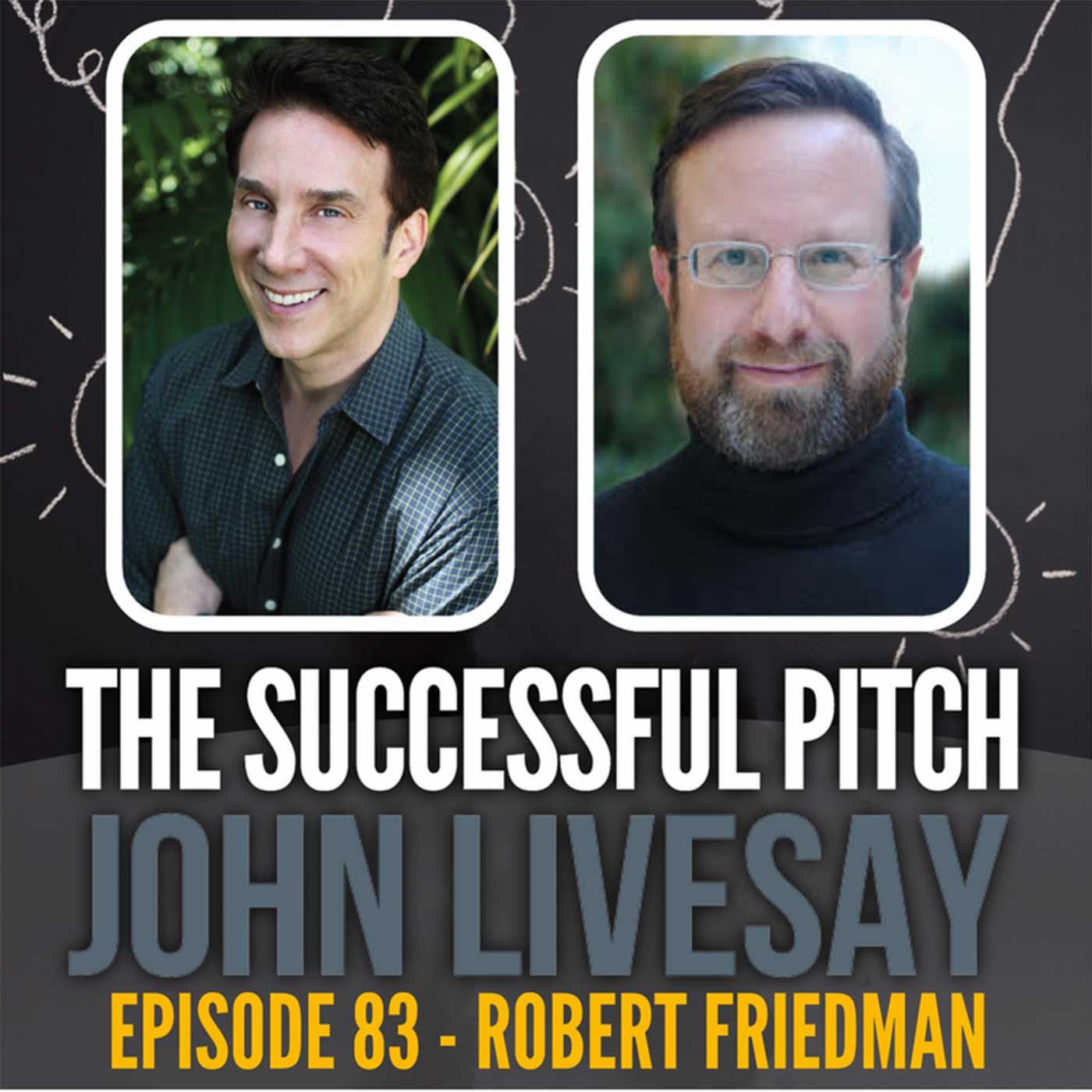
Listen To The Episode Here
Episode Summary
Robert Friedman is the Owner of Fearless Branding, and has five core questions that help narrow down your focus and get more specific with your brand. When you close many doors, you can keep the right doors open! Find out what his five core questions are on this week’s episode and get started developing the right brand image for your company today!
Fearless Branding – Interview with Robert Friedman
Hello. Welcome to The Successful Pitch. I’m thrilled to have today’s guest, Robert Friedman, who has a background as a brand manager of big names like Kraft and Nestle and worked at big New York agencies before starting Fearless Branding Manifesto almost fifteen years ago. Robert, welcome to the show.
Thank you, John. How are you?
I’m great. I’m really excited to have you here because one of the things that’s so important for the listeners to understand is whether you’re pitching yourself to get funded, pitching to get customers or pitching people to others to join your team, branding is everything. You must have a brand that creates a culture, that attracts the right investors and attracts the right people on your team. You are the ideal guest to have on today. Let’s dive into how did you come up with the name Fearless Branding? I love that.
Thanks. As you mentioned, for the early part of my career, I was a brand manager for some big food companies. In my last assignment, I was working at Nestle, I was working on Coffeemate. I was living in Los Angeles at the time. One Saturday afternoon, I was taking a hike and looking at the Pacific Ocean and saying just, “I don’t want to do this anymore because Coffeemate is just artificial powder. That is not a good use of my life. It’s not a good of my talents. What am I going to do?”
When I thought about it carefully, I was thinking, do I need to become a therapist or a history teacher or something that had more meaning? Do I need to get out of marketing? I started looking around at other businesses and I thought, “I may be working on Coffeemate but somebody else is working at Apple. The guy down the hall may be working on Carnation Instant Breakfast, but somebody else is working at Nike.”
[Tweet “Fearless Branding: Deep resonance requires fearlessness”]
There’s other ways to do marketing. It sparked an idea that was based on this insight that consumers love brands that fearlessly express their unique essence. That they’re not just there to sell stuff, that they’re there to sell really great stuff and deliver a meaningful experience. One of the key elements of this insight was that these great brands, what I ultimately started calling fearless brands, weren’t trying to be all things to all people. If you were not in a segment of the audience that appreciated that meaning, that’s okay. But if you are, then you’re going to have deep resonance.
To answer your question, after I did some deep thinking about what I really believed worked in the world of marketing and in the world of brands, I wrote that sentence. I had a naming session with a bunch of friends and colleagues. One of the guys said, “What was that sentence?” I said, “It’s consumer love brands that fearlessly express their unique essence.” He said, “That’s it, Fearless Branding.” Everybody said, “Yes, that’s right,” and walked out the door. It was done.
[Tweet “Fearless Branding: Consumers love brands that fearlessly express their unique essence”]
Nice.
At first, it was just a name. Over the past fifteen years, it’s become something that I’ve grown into. Everything that I do in my work is built on that fundamental idea about, what does it really mean to be fearless when you are building and developing a brand? What it really means is more precise, more differentiated, narrower rather than broader.
[Tweet “Fearless Branding: Be more precise to differentiate yourself”]
Linda Galindo, who was my client and was on your show a little while ago, said, “The things that you taught me to do are define and limit.” Whether you’re an entrepreneur or whether you’re trying to build and established business, one of the things that is most challenging for leaders to do is to limit. In other words, to close doors.
Usually, when you’re running a business, you want more sales. You’re saying, “All of those people out there, they can be my customers. They can be my investors.” In fact, what I find when you do that, is that you become more generic, you become less relevant to anyone. But when you’re willing to close many doors so that the exact right doors remain open and you know it, “That’s my door. That’s my path. That’s my strategy.”
[Tweet “Fearless Branding: Close many doors so you can keep right doors open”]
When you’re willing to do that, and it takes courage to close all those doors, all those opportunities. You say, “That’s not what I’m going to pursue,” but when you focus on that right one, then that’s when you can create the greatest success.
I love that. It’s so helpful.
It takes fearlessness.
Fearlessness, yes. When you said, “Close many doors so you can keep right doors open,” we’re going to tweet that out. That’s great. That really is a visual, you’re painting a picture for people that who you say no to is just as important as who you say yes to.
That’s exactly right. What’s interesting though is, a lot of times clients ask me that question. Do I have to say no? If somebody comes along and they’re not exactly in my ideal target market or the work is not precisely what I say is my absolute best work, do I have to say no?

Fearless Branding: What’s most important is when you are projecting your message out to the world, that’s when you say no and you are really clear.
The answer to that question is actually no, you don’t have to say no. You can make a tactical decision based on that particular situation. What’s most important is when you are projecting your message out to the world, to the audience, that’s when you say no and you are really clear. Whenever I’m telling you, “Here’s who my ideal client is. Here’s what I do,” I’m very precise.
If somebody else says, “Wow, that sounds great. But I’m not exactly like that, could you possibly help me?” Then you can make a decision, it’s up to you to say yes or no at that moment. I find actually, the clearer you are, the more people resonate. I think, certainly for me, my kind of client, they’re going to resonate with, “Wow, you have the courage to put your stake in the ground and tell me who you are.”
Let’s give listeners an example of that because I couldn’t agree with you more, Robert. For me, I really focus on, I help tech CEO’s craft a compelling pitch to make them irresistible to investors. Now, if someone comes to me and says, “I’m not a tech CEO but I really need help with my pitch and I want to get my startup funded, can you help me?” I will make a decision about whether I think that person is coachable and fundable and if the business is scalable and I can say yes or no. But my real focus is, tech CEOs. Other people sometimes will be attracted to that and commit. Is that what you’re talking about?
That’s exactly what I’m talking about. Each one of us has to make the decision on where we draw the line. For me, the heart of my business is working with service firms. Those are high level firms that need to go out and get clients that they’re providing some intellectually based service.
What I do is I help them really define what that service is, where the value is and who it’s for. In my case, that definition of target market works. I’ve decided not to focus only on lawyers or only on management consultants.
Here’s something else you could tweet out. Branding is a tool that supports your business objectives. There’s many different ways to slice it. It can be based on geography, it can be based on psychographics or what that person believes in their world view, it can be based on vertical type.
[Tweet “Fearless Branding: Branding is a tool that supports your business objectives”]
There’s all sorts of different ways you can slice your market so that you are talking to an audience that is big enough to support your business objectives, whatever they may be, and yet narrow enough that when you’re speaking to them, they really resonate. If you have a national brand, you’re going to need a much wider slice of an audience than if you’re a consultant, like you or me.
For the startups, the more specific they are of who they’re helping or what problem they’re solving and the type of investor they want to join their team, then the investor feels like, “Oh, you don’t just want anybody’s money, you want my money because I’m the perfect fit for your company,” and that makes all the difference.

Fearless Branding: Who is my market, who am I really serving, how do I define that?
That’s exactly right. You just articulated two very important strategic decisions. It’s easy to say it but it’s hard to make those decisions like. Who is my market, who am I really serving, how do I define that? That’s an important decision. What kind of investor? That’s an important decision. That’s why on the manifesto that I showed to you, that’s why I call it making the tough decisions.
The other thing you have in your manifesto, which we’re certainly going to provide a link in the show notes, is this moment of truth. Now, the moment of truth applies to the startups in, who do I hire, which investor do I decide to work with? Expand on us how you help people prepare to triumph in that moment of truth and how they have to position themselves.
I think you were really nailing it earlier. The moment of truth is that moment when you’re sitting down and you’re pitching a client or you’re pitching an investor and we have to figure out, are we a fit or are we just going to part as friends and go our own ways? The way that I do that is through a brand strategy process that focuses on five key questions.
Those questions are: Who are you? What do you do? Who do you do it for? What do they need? Then, what do they get? The first two questions are about you, who are you and what do you do, your brand, your business. The second two questions are about your audience. Who are they and what do they need? Then, the last one, what do they get, is where the connection gets made. That’s basically your benefit.
[Tweet “Fearless Branding: Put up a filter around what category are you playing in”]
What I have found over many years of doing this is that most businesses, as simple as those questions are, most businesses answer those questions too generically. You have to put up a filter around what category are you playing in and then who else can answer those questions in the same way or who else is answering those questions in the same way.
One of the exercises that I do when I’m teaching a branding class is I’ll put up an ad, often I use the brand Tiffany. I’ll put my hand over the logo and say, “You have no idea what’s under my hand. You don’t know the name of this business, can you figure it out?” When you use a brand like Tiffany, everybody can figure it out.
That blue.

Fearless Branding: You have to do something different or make something different that is recognizable.
Exactly. It’s that blue, but it’s also they’re very specific with their imagery. That’s one aspect of branding, which is aesthetic differentiation. But there’s other aspects of branding, which are functional differentiation. You actually have to do something different or make something different that is recognizable. The last aspect of differentiation is emotional differentiation or meaning–based differentiation. All three of those things need to play together.
To get back to that story I was telling you, if you were working with a client and they’re a tech startup and you say, “What we need to do is just take the name of your business out of this. Now, we’re going to look at your nearest competitors and we’re going to substitute their name in that same pitch and we’re going to mock trial it to that investor.” Might it work? Would that investor say, “No, no, no. That’s totally wrong. That doesn’t make sense.” It’s only you that can say that. Or they’re just going to nod their heads when you stick your competitor’s name into your pitch.
A lot of times, what I find is that pitches, whether you’re trying sell a service or pitch an investor, they all sound the same. They use the same buzz words, they use the same phrases. There’s so much generic stuff. It’s challenging to, as we said before, to narrow, define, limit so that you really become the only one who’s telling that story to your specific target market.
[Tweet “Fearless Branding: Narrow, define, limit”]
I know exactly what you’re talking about Robert, because when I worked at Conde Nast, Conde Nast has multiple fashion magazines. It was so important that people would understand the difference between let’s say Vogue and W. You couldn’t just substitute the images or you couldn’t just substitute the pitch of, “We both cover fashion.”
You need to be so specific that only W would cover fashion from an artistic, edgy point of view and Vogue would not do that because they have a more broader, mass appeal audience. It was very specific as to it’s all fashion, but if you’re talking about your nearest competitor … I love that exercise.
Let’s go back and talk about the five questions because they’re so valuable for the listeners to really grasp. I think the Tiffany example would be great to do, if you don’t mind. Who are you? How would you answer that for Tiffany? I can do it, but I’d love to hear you say it.
I would answer that by, “I am love,” or “I am the lover.”
Nice.
One of the main concepts that informs my work is the concept of archetype. Archetype is a concept that was developed by Carl Jung, he was one of the foundational psychologists along with Sigmund Freud. He had this idea that there are energies out there that don’t need to be explained to people because we just get them just because we’re human.
[Tweet “Fearless Branding: It’s about who you are, it’s not what you do.”]
The warrior, the scholar, the caregiver, none of those things are confusing. They’re very, very clear. We just have a picture right away when we see a picture or hear those words. When you can be that precise at an emotional level, it’s about who you are, it’s not what you do.
I love that distinction. You did not answer, “Tiffany, who are you?” “We make jewelry.” That was not your answer at all, which is great. It really showed an example of, “Oh, this is something unique to Tiffany. I am love.” That’s great.
That’s right.
Then you go into, what do you do? Then you might say something like, “We make engagement rings.” Would that be the appropriate place to answer that way?
Yes, absolutely. We make jewelry, in particular, engagement rings. Tiffany’s a great example and engagement rings is a great example because did you know that Tiffany’s invented the concept of a diamond solitaire engagement ring?
Nice.

Fearless Branding: That’s what I mean by functional differentiation, is that you do something that your competitors are not doing.
Further, they developed this unique “Tiffany setting” that lifts the diamond up instead of putting it deeper into the setting of the ring so that everyone can see the beauty of the diamond. They were the ones that created this. That’s what I mean by functional differentiation, is that you do something that your competitors are not doing.
Nice. Now, the third and fourth question you said was all focused on the audience. The third question is something along the lines of who do you help, was that the question?
Right, exactly. Who do you do it for? Who do you help is a totally good substitute. Who do you do it for and what do they need? When you look at that question, who do you do it for, there’s two ways to answer that. One is demographically. Those are all of the factors that you can actually see and touch. Somebody who makes a certain amount of money, has a certain level of education, lives in a certain zip code, those are all demographic ways to describe an audience.
Psychographic is somebody’s world view. What do they believe? What do they value? For example, we all know that Tiffany is a brand. It’s very successful brand. They built their business based on the strength and uniqueness of their brand.
One of the great things from the brand’s perspective that that enables them to do is to charge a premium. It’s a highly profitable business. One of the key takeaways is that when you have a brand that’s meaningful, that has both functional and emotional advantages, your ideal customer will pay more for that. You’re getting that premium price and that translates into profitability.
[Tweet “Fearless Branding: Ideal customers will pay more for a meaningful brand.”]
If you look at the Tiffany customer, their customer … It’s a mass affluent brand. They’re not sheikhs and princesses of the world, but it’s the lawyers and doctors and top 5% people in the United States. That’s demographically who their audience is likely to be.
When I teach a class and I use Tiffany as an example and we say, “How did you know it’s Tiffany?” A lot of people say, “Oh, it’s that box”. Somebody in the audience will always tell the story of, “I gave my wife that present and she just went, ‘Aww.'” It takes your breath away because you’re getting that cool present in that blue box.
Even before they open the box they’re happy.
Exactly. Now, think about that. That box maybe is worth, whatever, fifty cents or a dollar? It’s not the box, but they have imbued that box with meaning. That meaning, as we were talking about, is love. This represents the fact that the person who is giving me this gift really loves me. They bought it at Tiffany.
They went the extra mile. Nothing’s better and nothing’s higher as far an expression of love. Therefore, if you spent anything, it doesn’t have to be a diamond ring, but anything from Tiffany at all, a key chain, whatever, I still feel the love. That extends to all price points within a premium price product.
That’s exactly right. If we look at the heart of what they’re doing, which as we were talking about is something like an engagement ring. What I mean by segmentation and being willing to limit and define, there are going to be some givers and some receivers who buy into that story. That woman is going to say, “Wow, he really loves me because he gave me that present from Tiffany. That means something.” That giver is going to say, “I made the right decision even though maybe I spent 25% more or 50% more,” or whatever the number is.

Fearless Branding: A Tiffany customer is somebody who really believes that a certain gift can be a symbol of love.
There will be other people, whether it’d be the giver or the receiver, who would say, “I don’t buy that crap. They have really good stuff at Costco. We’re going to get something really good. We’re going to be so smart because we’re only going to spend half of what we would spend at Tiffany. We can spend that extra money on a lawn mower or whatever.”
To answer those two questions of who are they and what do they need, that Tiffany customer is somebody who really believes that a certain gift can be a symbol of love. What they need or what they really want at a primal level is more love. They want that connection and they want it in that way. If you are not psychologically wired for that, you’re not going to be in their target market. I think that they’re smart enough to be able to be fearless to say, “That’s okay, because we’re not for everyone.”
Exactly. It goes to the last question is, what’s the big benefit? What do they get from buying the ring at Tiffany is they get validation that the person feels it’s way beyond the value of the ring. You can’t put a price on it, when someone feels that you love them that much.
That’s right. You’re absolutely right. One simple way to answer that is what do they get? They get love. It brings it back full circle.
To who you are. Love it. Let’s connect the dots even one step further for the founders out there who are negotiating valuation. I love what you said Robert, about when you connect the functional with the emotional, which is what I’m constantly teaching people the importance of emotional storytelling when you’re pitching, that that commands a premium price like it does for Tiffany.
When you’re negotiating with your investor on what the valuation of your company should be, when you say, “I need a million dollars for X percent equity,” then that translates into, then you’re saying your company is worth more than it looks like on paper.
If you’ve shown to the investor that you have a functional difference from your competitor and an emotional meaning, and sometimes that emotional meaning can just be, “There’s other investors who are interested in this and willing to pay this. There’s a fear of missing out if you don’t jump in on this.” That’s how you increase the valuation of your company from this branding strategy you have for us.
I am so glad you brought that up. The best example of this is Apple. If you think about Apple and you think about the fact that it’s not just an apple, it’s an apple with a bite taken out of it. That is a very specific apple. It’s from the Bible, it’s from the book of Genesis. Genesis is our creation myth. If Tiffany is love, Apple is creation or creativity.

Fearless Branding: If you think about Apple and you think about the fact that it’s not just an apple, it’s an apple with a bite taken out of it.
If you think about the story of the Apple brand, they have their own Genesis story. Steve Jobs created it but then he went into exile, just like Moses had to go into the desert. They kicked him out. They were almost about to go bankrupt and have to shut the whole thing down. They didn’t want to do it but they brought Steve Jobs back because they had to. They had no other choice, they explored every other strategy. That was the only one left.
He comes back. There’s a video of this on YouTube that you can see, it’s fascinating. The first thing that he does is he focuses on the brand. He hired Chiat\Day and they developed a campaign and it’s the Think Different campaign. It’s this campaign that shows Gandhi and Martin Luther King and Maria Khalis and Einstein.
All of these people are the most creative thinkers of their time. They’re all creating something out of nothing. They’re creating things that have never been seen or heard before. That becomes what the whole brand is about. He leveraged that idea, that emotional connection, to take a company that was basically about to close and being bankrupt to the company that became the most valuable business from a market cap perspective on the planet. He did it in 25 years.
I love this story so much Robert, because when you say, “It’s not just an apple, it’s an apple with the bite, which takes us to the creation myth.” Also for me, part of that whole story of the creation myth was you were breaking the rules in the Garden of Eden when you bite that apple.
Not only does it take it into the Apple branding of creativity, but also we’re going to break the rules and that’s that initial Superbowl commercial against IBM and even this campaign line that you mentioned, Think Different, got a lot of feedback because people said, “That’s not even grammatically correct. It should be think differently.” They’re like, “We don’t care. We’re breaking the rules again. Think different.” It’s all so full circle that you say when a really good brand is in place, there’s so many layers. That’s the big takeaway.
As you said, it’s breaking the rules. What is that? It’s differentiation. It’s being willing. If you think about most people, most people are not fearless, most people do not want to stand out, it makes them profoundly uncomfortable. When you’re right and you’re already successful, then it’s easy.
[Tweet “Fearless Branding: It’s breaking the rules. It’s differentiation.”]
But in those initial stages, when you have to take that first step and you have to say, “Look at all those people,” whoever they are, whatever your category. If it’s Steve Jobs, “Look at IBM, look at Dell, look at Microsoft, they’re all wrong.” You’re talking to Wall Street and the financial community and you’re basically saying all these companies that are so much bigger than you, they’re all wrong. We have another way to do it.
It takes so much courage in the beginning. Now, we look at it, it’s like, of course, he was right. Then you apply that to a startup entrepreneur and they need to have the same level of courage and the same level of conviction.
Absolutely. Uber, “We can do this. Taxis have been ran a certain way for years and we’ve got a whole new idea.” When people started pitching AirBnb, a lot of investors said, “You’re crazy. No one’s going to rent out a room in their home or apartment to a stranger.” It’s all so valuable. I love everything you’ve said so much. I could talk about branding all day long, and you’re the expert. Is there a book that you want to recommend about branding or being fearless to the listeners?
If you’ll indulge me, I’ll recommend two.
Sure.

The Hero and the Outlaw: Building Extraordinary Brands Through the Power of Archetypes
One is called The Hero and The Outlaw. It’s about using archetype to build a strong brand. It’s by Carol Pearson and Margaret Mark. That’s a really good primer for starting to think about it. Another one that I love … Whenever I start an engagement, there’s two things that I focus on. One is meaning, which we’ve talking about. The other is money. It’s all about connecting the two in my opinion.
If we have something that’s meaningful but it’s not grounded in your financials, then your success is really going to be limited. I always start my engagements by getting my clients … It’s the same thing, it’s define and limit. If you have a particular revenue objective, we need to get really granular and dig into the details and figure out how is that really going to happen, let’s build that performa client by client, engagement by engagement, and see what it looks like.
The other book that I would recommend is a book called Let’s Get Real or Let’s Not Play by Mahan Khalsa. It’s about selling and it’s about really being up front, talking about money, putting your cards on the table. It’s a great book because a lot of people are afraid to do it.
I’ve never heard of that one. That’s a great, great title, Let’s Get Real or Let’s Not Play. It applies to business. It applies to dating. It applies to lot of things. It’s great.
That’s right.
Robert, how can people best follow you?
If you go to my website, which is FearlessBranding.com. A couple of suggestions, you can download the Fearless Branding manifesto. It’s there on the homepage of my website. You can download that and then I will follow up with periodic updates. You can find me at Robert Friedman on LinkedIn.
There’s one other thing that I’d like to tell you about. I’m giving a webinar in about a month. It’s sponsored by a company called Breakaway Funding. The webinar is called How to Build a Fearless Brand. It’s on May 26th at 11AM. If you go to BreakAwayFunding.com/Events, what I will be doing is making a presentation with some visuals and it will be a deeper dive into many of the ideas that we talked about this afternoon.
Great. How to Build a Fearless Brand is the name of the webinar, is that right?
That’s right.
If people can’t make that one, will you be doing others in the future?
I will.
Good.
I can let you know when they’re scheduled.
Perfect. Great. I can’t thank you enough Robert, for being on the show and showing us how to be fearless and how to make our brand stand out by defining and limiting who we want to reach, because that’s everything to be successful.
Thank you, John. It was great to talk to you. I really appreciate it.
My pleasure.
Links Mentioned
J Robinett Enterprises
John Livesay Funding Strategist
Fearless Branding Website
The Hero and the Outlaw. by Carol Pearson and Margaret Mark
Let’s Get Real Or Let’s Not Play, by Mahan Khalsa
Crack The Funding Code!
Register now for the free webinar
Fox 11 News Los Angeles John Livesay The Successful Pitch book
Share The Show
Did you enjoy the show? I’d love it if you subscribed today and left us a 5-star review!
-
- Click this link
- Click on the ‘Subscribe’ button below the artwork
- Go to the ‘Ratings and Reviews’ section
- Click on ‘Write a Review’