

Storytelling Keynote Speech Statistics: USA 2026
Posted by John Livesay in Research | 0 comments
Storytelling keynote speeches work because a good story gives an event message somewhere to live after the session ends. Audiences hold on to the story that made the message feel personal, the moment that gave the room a shared language, or the speaker who turned an abstract idea into something human. A keynote speaker who uses storytelling well can give a conference, leadership summit, or company event an emotional center that holds attention in the room and keeps the message moving after the lights come up.
To find out what 716,983 opinions of meeting planners in the US were about storytelling keynote speeches, we utilized AI-driven audience profiling to synthesize insights from online discussions over 12 months, ending on June 10th, 2026, to a high statistical confidence level. The results offer a broad read on what makes storytelling valuable in a keynote setting, where the format can go wrong, and what turns a speech into an experience audiences remember, repeat, and act on.
Index
- 83% of meeting planners include a storytelling-focused keynote in most events, at least once a year, while 6% always include one at every event as a consistent priority, 5% do so occasionally when the theme calls for it, and 6% rarely include this kind of keynote as they haven’t made it a regular feature yet36% of C-suite leaders hold formal sales kick off meetings annually, 26% do so quarterly, 21% hold SKOs twice a year, and 18% work on an ad hoc or as-needed basis
- For 75% of meeting planners, scheduling a keynote speech mid-event to re-energize attendees between sessions is always their preference, while for 3% this is often their choice, 1% say they prefer this time sometimes, and 2% feel the opposite, saying that mid-event is rarely their choice, this is compared to the 17% whose preferences always vary depending on the event’s theme, and 2% who rarely choose to vary their agendas
- 37% of meeting planners agree that a memorable shared experience that unifies the group is an absolutely essential outcome from a storytelling keynote speech, while 45% feel this is quite important for shareholders, 7% cite stronger emotional connection among team members as an absolutely essential outcome, while 3% feel the same about attendees leaving with immediately actionable techniques, and 5% think this is quite important, and 3% prioritize a measurable shift in team culture of mindsetFor 91% of C-Suite leaders, over 500 people in their sales team attend their SKO, while for 9%, under 25 people attend, showing a huge variation in team sizes
- A speaker who loses the room emotionally or energetically is a top concern for 18% of meeting planners when booking a storytelling keynote speaker, 15% find this a notable risk, and 11% a notable worry, but 9% don’t think it’s a concern, 22% are concerned about stories that are too abstract and don’t connect with their business reality, 21% worry about stories that accidentally offend or alienate listeners, and 3% have concerns about a speech that feels recycled or not tailored to the audienceC-Suite leaders agree that CEOs are fully responsible for SKO outcomes, and 25% agree that there should be shared responsibility amongst the leadership team; however, 38% agree that individual sales managers should not be responsible for SKO outcomes
- 33% of meeting planners ensure a keynote speech aligns with their event’s overarching theme by sending a detailed pre-event brief to the speaker, 32% ensure the speaker interviews key audience members in advance, 32% review the speech content or outline before the event themselves, and 2% rely on a discovery call between the speaker and event stakeholders to get everyone on the same page
- 100% of meeting planners don’t expect the stories a keynote speaker tells at their events to be customized, as the best stories are universal in their impact and meaning
- 35% of meeting planners find it somewhat important that a keynote speech references real stories from within the organization or industry they are speaking to, 33% say that this is very important as it significantly lifts audience engagement, and 32% say it’s critical as generic stories kill the relevance for their audience
- A mix of 80% narrative and 20% frameworks or tactics is the ideal ratio of storytelling to practical takeaways in a keynote speech for 28% of meeting planners, and 9% lean towards this, while 9% agree that 60% stories and 40% actionable content are the perfect balance, 36% say they lean in this direction, and 18% share the same sentiments about a takeaway heavy speech with 80% narrative and 20% frameworks or tactics, but this is not a preference for 9%
- Multiple short stories illustrating different points are the most impactful storytelling format that resonates with 42% of meeting planners’ audiences, while 30% find it quite effective, and 6% less effective, 14% prefer a hero’s journey structure with a clear transformation arc, but 2% say this isn’t as effective, and it doesn’t resonate with 5%, and just 1% find data and case studies wrapped in a narrative the format that resonates the most 35% of C-Suite leaders select external speakers for their SKOs based on industry reputation and speaker bureau referrals, and 22% rely on peer recommendations from other C-suite leaders, but 43% say they rarely use external speakers, giving no indication of how they select them when they do
- The ideal keynote speech length for 26% of meeting planners is over 90 minutes, for 26% it’s under 30 minutes, 23% say between 30 and 45 minutes is perfect, while 17% want a 60-90 minute speech, and 7% 45-60 minutes
- For 27% of meeting planners, the opening story of a keynote speech is very important to the overall success of an event, as a weak topic is hard to recover from, it’s somewhat important for 27% as audiences warm up gradually’ however, 27% think the opening story is absolutely critical as it sets the tone, and 19% feel the opposite, as the quality of the speech matters more than the opening
- 60% of meeting planners agree that humor as a storytelling device within a keynote speech is somewhat important, and it depends on the audience, 36% think it is essential as it creates trust and opens the audience up, and 4% find humor very important as a speech without it loses the room
- 97% of meeting planners prefer a keynote speech to keep audience interaction to a minimum as a solo polished performance is preferable, 1% prefer light interaction and a few well-placed minutes of engagement, for 1% it depends on the event type, and for another 1% the audience should be fully immersed and become part of the story
- 51% of meeting planners are cautious about a keynote speech that intentionally creates an emotional moment that includes vulnerability or tears, as this can feel manipulative, 39% are neutral about this but prefer inspirational content, and 7% avoid booking speakers known for highly emotional content; however, 3% have positive feelings about booking emotional speakers as long as the emotion serves the message and is authentic
- Emotional moments that create a genuine human connection in a storytelling keynote speech always impress 52% of meeting planners’ attendees, and 32% are usually impressed by this, but 4% are less so, while practical storytelling frameworks that the audience can immediately apply usually impress 6% of attendees, 3% are sometimes impressed by this, and 3% are rarely impressed
- 62% of meeting planners evaluate whether a storytelling keynote speech was truly effective by the conversations and story-sharing amongst attendees after the speech, 15% by the applause and visible emotional response during the speech, 12% gauge impact via post-event survey scores from attendees, and 115 by the behavioral changes or skills application that become evident in the weeks after the speech
- 64% of meeting planners rely entirely on a keynote speech to plant the seed for real behavioral changes in the workplace post-event, and 36% build internal accountability structures after the event to bridge the gap between an inspiring speech and a behavior change in the workplace
- 8% of meeting planners will absolutely or strongly consider rebooking a storytelling keynote speaker for future events if they get a standing ovation and a visible emotional response in the room; however, this might not be enough for 12% and it’s not a rebooking factor for 8%, while senior leadership publicly crediting the keynote with driving cultural change would cause 9% to strongly consider rebooking, it’s not enough for 2%, and 8% would rebook if attendees reference the stories and frameworks post-event, yet this may not be enough for 2%About the data
- 92% of meeting planners are currently using AI tools when planning or evaluating keynote speeches for their events by analyzing post-event survey data, 5% are using AI when researching speaker topics and audience relevance, 1% are using this technology for generating post-event content, and 2% are not currently using AI in this part of their planning process
- 26% of meeting planners believe that AI will have a minimal effect on the art of storytelling keynote speeches in the next 3 years, as live storytelling is inherently human, and 25% think AI will have a moderate effect; however, 25% think it will have a significant effect as it will make authentic stories more valuable, and 24% are unsure of what impact AI will have as it’s too early to tell
- The best stories keep shaping conversations long after the keynote ends
- About the data
How often do meeting planners include a storytelling-focused keynote speech in event programs?
83% of meeting planners include a storytelling-focused keynote in most events, at least once a year, while 6% always include one at every event as a consistent priority, 5% do so occasionally when the theme calls for it, and 6% rarely include this kind of keynote as they haven’t made it a regular feature yet
Storytelling keynotes are now part of the regular event toolkit:

Storytelling keynote speech an important inclusion
The 6% who include a storytelling-focused keynote at every event because it’s a consistent priority seem to view storytelling as part of the event structure itself. They’re not waiting for a theme that obviously calls for narrative. They’re using storytelling as a regular way to give each event a human thread, a clear emotional center, and a message attendees can carry from one session to the next.
Another 5% include storytelling keynotes occasionally, only when the theme calls for it. This is a more selective planning style. These planners may bring in storytelling speakers when the agenda needs to support change, leadership, culture, resilience, innovation, or customer connection.
The 6% who rarely include storytelling keynotes and haven’t made them a regular feature yet may be working with agendas where technical updates, compliance training, product education, or specialist expertise take priority. In those settings, storytelling has to prove it can clarify the topic, not just make the session more engaging.
John Livesay agrees “After 20 years of giving keynotes on storytelling and the power they have to help sales teams become more compelling, this is more than important than ever now that clients can get information from AI and don’t need sales people for information.’
When in an event agenda do meeting planners schedule the storytelling keynote speech?
For 75% of meeting planners, scheduling a keynote speech mid-event to re-energize attendees between sessions is always their preference, while for 3% this is often their choice, 1% say they prefer this time sometimes, and 2% feel the opposite, saying that mid-event is rarely their choice, this is compared to the 17% whose preferences always vary depending on the event’s theme, and 2% who rarely choose to vary their agendas
Storytelling keynotes work better as a reset than an opening act:

Meeting planners are most likely to schedule the keynote mid-event to re-energize attendees between sessions. This is always the preference for 75%. Another 3% often choose this placement, while 1% use it sometimes, but not usually, and 2% rarely choose it.
This pattern says a lot about the job meeting planners want a keynote to do. They’re not only using the speech to introduce the event. They’re using it to lift the room when attention can start to dip, give attendees a shared moment between more focused sessions, and restore momentum before the agenda moves on.
The timing and theme connection
Timing can also vary depending on the event theme, although this is a secondary planning logic. Theme-based timing is always the preference for 3%, often the choice for 6%, used sometimes, but not usually, by 8%, and rarely relied on by 2%. The variation likely comes from how different themes build energy.
A leadership event may need a keynote early to frame a shared challenge. A technical or product-heavy agenda may benefit from a mid-event keynote after attendees have sat through dense sessions. A culture, change, or recognition event may work better later, when the keynote can turn the day’s content into a more emotional takeaway.
The most surprising result is that no opinions were expressed for an opening keynote to set the tone of the entire event. A storytelling keynote may need more audience context than an opening slot can provide. At the start, attendees are still settling in, orienting themselves, and learning what the event is asking them to think about.
Mid-event, they’ve already experienced some of the agenda, heard recurring themes, and felt the energy in the room. A story can then connect those pieces, give them emotional weight, and make the event feel more cohesive.
John Livesay disagrees. “The majority of people have me as their sales keynote speaker on storytelling at the beginning of the event so they can reference takeaways from my keynote for the rest of the event.”
What outcome from a storytelling keynote speech matters most to meeting planners’ event stakeholders?
37% of meeting planners agree that a memorable shared experience that unifies the group is an absolutely essential outcome from a storytelling keynote speech, while 45% feel this is quite important for shareholders, 7% cite stronger emotional connection among team members as an absolutely essential outcome, while 3% feel the same about attendees leaving with immediately actionable techniques, and 5% think this is quite important, and 3% prioritize a measurable shift in team culture of mindset
Unity is the clearest priority:

Meeting planners’ event stakeholders place the most value on a memorable shared experience that unifies the group. Among our audience, 37% view this outcome as absolutely essential, while another 45% see it as quite important. Stakeholders seem to want a storytelling keynote to create a shared reference point, not just a polished hour on stage.
A recent report on employee experience gives this priority more weight, finding that 85% of HR professionals and 73% of U.S. workers rate feeling part of a team as important or very important, while 82% of HR professionals and 77% of U.S. workers say the same about feeling a sense of purpose. A storytelling keynote can support those needs by giving people a common story, shared language, and a clearer sense of why the event message applies to them.
Actionable techniques rank much lower, with 3% calling them absolutely essential and 5% calling them quite important. Practical value still counts, but stakeholders don’t seem to view a storytelling keynote as a training session.
Unity and mindset get mixed reactions
A stronger emotional connection among team members is absolutely essential for 7%. This still fits the broader desire for unity, but it’s a more interpersonal outcome. Stakeholders may welcome a keynote that helps people feel closer to colleagues, but the larger priority is a shared experience that gives the whole room a common message, not only a stronger bond within smaller teams.
A measurable shift in team culture or mindset ranks lowest, with 3% calling it absolutely essential and less than 1% calling it quite important. Stakeholders may want cultural momentum, but they seem realistic about how much one keynote can shift on its own.
John Livesay agrees. “The best stories are memorable and magnetic and make people feel a connection because they can share the story over and over again.”
What is the biggest risk for meeting planners when booking a storytelling keynote speech?
A speaker who loses the room emotionally or energetically is a top concern for 18% of meeting planners when booking a storytelling keynote speaker, 15% find this a notable risk, and 11% a notable worry, but 9% don’t think it’s a concern, 22% are concerned about stories that are too abstract and don’t connect with their business reality, 21% worry about stories that accidentally offend or alienate listeners, and 3% have concerns about a speech that feels recycled or not tailored to the audience
The danger is what happens when the story doesn’t connect:

Losing the room emotionally or energetically is the biggest risk meeting planners try to avoid when booking a storytelling keynote speech. 18% of our audience name this as a top concern, 15% as a notable risk, 11% as a minor worry, and 9% don’t view it as a concern. Storytelling keynotes depend on live audience trust. If the speaker’s timing, tone, pace, or emotional judgment is off, the story becomes one person’s experience on stage instead of a moment the room feels part of.
Stories that are too abstract and don’t connect to business reality come next, with 14% calling this a top concern, 6% a notable risk, and 2% a minor worry. This risk is especially important for corporate events. A personal story may be powerful on its own, but meeting planners need the audience to understand why it applies to their work, decisions, pressures, or culture. Without that bridge, attendees may admire the speaker without taking the message seriously.
Audience concerns a talking point
Stories that accidentally offend or alienate part of the audience are also a clear concern, with 7% naming this as a top concern, 11% as a notable risk, and 3% as a minor worry. Storytelling often touches identity, failure, humor, adversity, or personal values, which makes tone control essential. A speaker can’t create connection if part of the room feels judged, excluded, or used as the example.
A speech that feels recycled or not tailored to the audience ranks much lower, with only 1% each calling it a top concern, notable risk, or minor worry. This may mean planners judge tailoring through the outcome. If the speech feels relevant, energetic, and safe for the room, they may worry less about whether every detail was newly built.
No opinions were expressed about content that is inspiring in the room but forgotten within a week. In online conversations, long-term recall isn’t showing up as a visible booking concern. The immediate risks are more practical. Planners are focused on whether the speaker can hold the room, connect the story to the audience’s reality, and avoid breaking trust.
John Livesay disagrees. “Clients who hire me as a storytelling keynote speaker for their sales kick off meeting love that I offer a 30 day virtual follow up call to keep the momentum going after the event.”
How do meeting planners ensure a storytelling keynote speech aligns with the event’s theme?
33% of meeting planners ensure a keynote speech aligns with their event’s overarching theme by sending a detailed pre-event brief to the speaker, 32% ensure the speaker interviews key audience members in advance, 32% review the speech content or outline before the event themselves, and 2% rely on a discovery call between the speaker and event stakeholders to get everyone on the same page
Theme alignment is built through evidence, not guesswork.
Meeting planners rely most on a detailed pre-event brief sent to the speaker, with 33% using this approach. This gives the speaker a clear foundation before any creative decisions are made, including the event theme, audience profile, company context, and the message stakeholders want reinforced.
Speaker interviews with key audience members are almost as common, at 32%. This adds a more human layer to the preparation process. Instead of only hearing what the event is meant to achieve, the speaker can hear how the audience talks about its challenges, priorities, and expectations.
Another 32% review the speech content or outline before the event. This is a more controlled form of alignment, giving planners a chance to catch weak links between the keynote and the event theme before the speaker is in front of the room.
Only 2% rely on a discovery call between the speaker and event stakeholders. The low figure suggests planners may see a single conversation as too light on its own. Written briefs, audience input, and content review give alignment more structure.
How much customization do meeting planners expect in a storytelling keynote speech at their events?
100% of meeting planners don’t expect the stories a keynote speaker tells at their events to be customized, as the best stories are universal in their impact and meaning
The strongest stories don’t need to mirror the company:

Meeting planners are unanimous on story customization. No customization is needed for 100% because the best stories are universal. This doesn’t mean event relevance is unimportant. It means planners may be separating the speaker’s core story from the way that story is framed for the room.
Insight into the science of storytelling supports this distinction. Stories work because people understand cause and effect, then relate what they hear to their own existing experiences. A speaker’s story doesn’t need every detail to match the company, industry, or audience. It needs a recognizable situation, choice, tension, lesson, or emotional turn that attendees can map onto their own lives and work.
Interestingly, no opinions were expressed online supporting full customization, light customization, or significant customization. Rather than meaning those approaches have no value, it merely shows they weren’t taking priority in online conversations. The core expectation is simpler. The story itself should be strong enough to travel across rooms.
John Livesay disagrees. “What clients love most about my storytelling keynote speaker for their sales kick off meeting is that I customize my content for their event. The audience sees themselves in the stories I tell!”
Is it important that a storytelling keynote speech references real stories from within meeting planners’ organizations or industries?
35% of meeting planners find it somewhat important that a keynote speech references real stories from within the organization or industry they are speaking to, 33% say that this is very important as it significantly lifts audience engagement, and 32% say it’s critical as generic stories kill the relevance for their audience
Universal stories still need a specific landing point:

References to real stories from the organization or industry are still clearly important to meeting planners. While the previous finding showed that they don’t expect a speaker’s core stories to be customized, this finding adds the important second half. The story itself can stay universal, but the keynote still needs to connect clearly to the audience’s organization, industry, or working reality.
The largest group sits in the middle, with real stories from the organization or industry somewhat important for 35%, because a mix of universal and specific stories works. This is the balance point. A universal story gives the keynote emotional clarity, while specific references help attendees understand why the message applies to their own world.
These real stories are very important for another 33% because they significantly lift audience engagement. This shows how specificity can make the room lean in. When attendees hear language, examples, or situations that feel familiar, the keynote stops feeling like a polished outside performance and starts feeling connected to their experience.
Real stories are critical for the remaining 32% because generic stories kill relevance for their audience. This is the risk on the other side of universality. A story can be human and widely relatable, but if the speaker never connects it to the audience’s work, the message can feel too broad to be useful.
John Livesay agrees. “The reason I interview people in the audience is so I can share their stories as part of my storytelling keynote for sales kickoff meetings.”
What is the ideal ratio of stories to practical takeaways in a storytelling keynote speech?
A mix of 80% narrative and 20% frameworks or tactics is the ideal ratio of storytelling to practical takeaways in a keynote speech for 28% of meeting planners, and 9% lean towards this, while 9% agree that 60% stories and 40% actionable content are the perfect balance, 36% say they lean in this direction, and 18% share the same sentiments about a takeaway heavy speech with 80% narrative and 20% frameworks or tactics, but this is not a preference for 9%
Stories should lead, but application still needs a seat:

Meeting planners want an ideal keynote ratio that gives storytelling the larger role without losing practical value. The strongest combined preference is balanced, 60% stories and 40% actionable content, with 9% naming it the perfect balance and 36% leaning toward it. This is a useful middle ground. The keynote still has room to build emotion, attention, and memory, but attendees also leave with something they can use.
A Harvard Business School working paper on stories, statistics, and memory found that the impact of a story fades by roughly a third in a single day, while the impact of statistics fades by 73% over the same period. A keynote still needs useful takeaways, but the story is what helps the message last.
Most stories, with 80% narrative and 20% frameworks or tactics, also have clear support. 18% call this the perfect balance, while another 9% lean toward it. These planners seem comfortable giving narrative even more space, as long as the speaker still provides enough structure for the audience to apply the message.
The takeaway-heavy option, 40% stories and 60% practical tools, attracts more limited support. 18% lean toward it, while it’s not the preference for 9%. Practical tools still have a role, but too much instruction can make a storytelling keynote feel more like a workshop than a main-stage experience people remember.
John Livesay agrees. “When I give a storytelling keynote at a sales kickoff meeting, the audience learns how to tell stories that are memorable and repeatable. That creates clients who become their inside brand ambassadors repeating the stories that are clear, concise and compelling.”
What storytelling keynote format resonates most with meeting planners’ audiences?
Multiple short stories illustrating different points are the most impactful storytelling format that resonates with 42% of meeting planners’ audiences, while 30% find it quite effective, and 6% less effective, 14% prefer a hero’s journey structure with a clear transformation arc, but 2% say this isn’t as effective, and it doesn’t resonate with 5%, and just 1% find data and case studies wrapped in a narrative the format that resonates the most
Short stories give audiences more ways in:
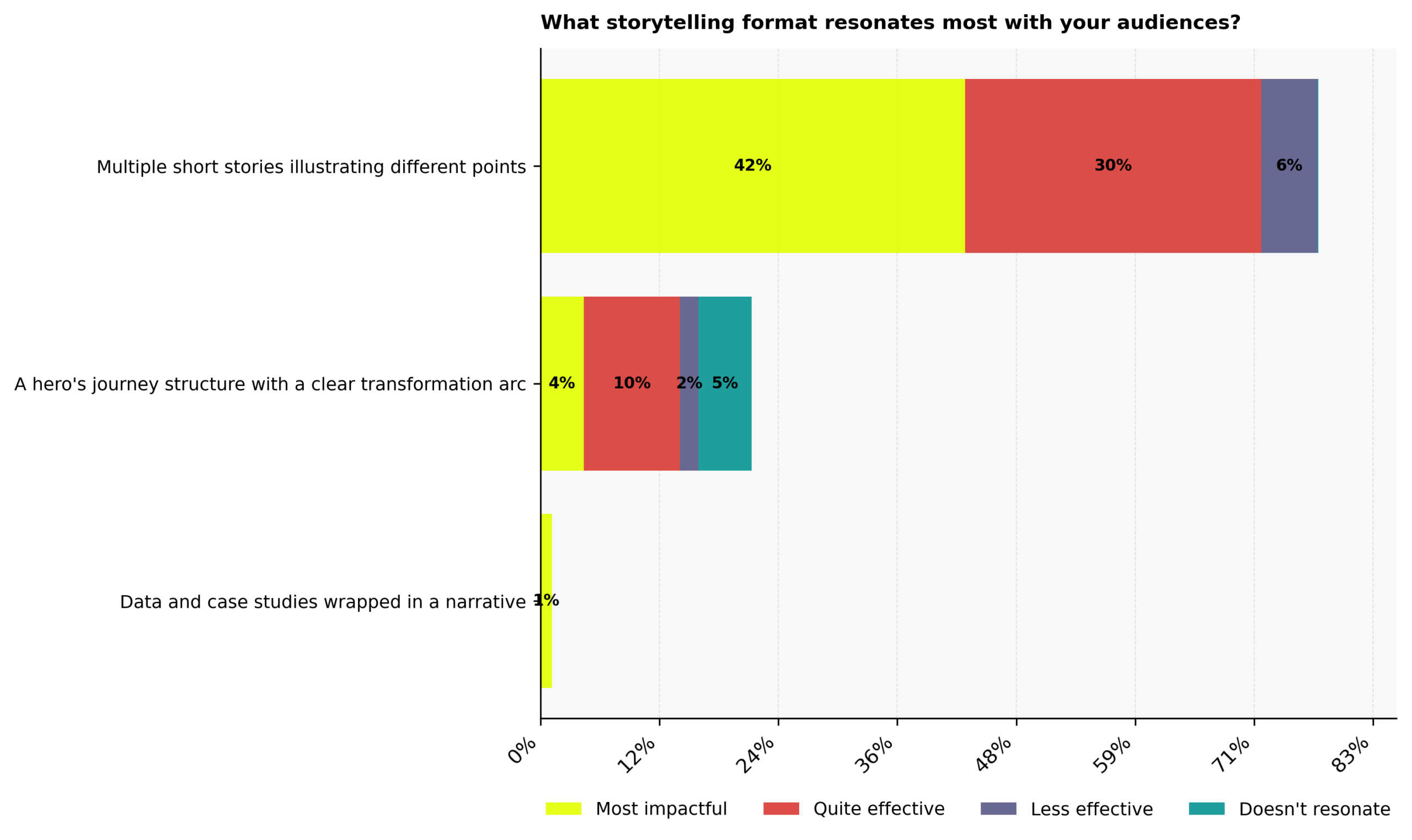
Our audience sees multiple short stories illustrating different points as the strongest storytelling format. 42% rate this format as most impactful, while another 30% see it as quite effective. A further 6% call it less effective, which shows the format isn’t universal, but it still has the strongest overall support by far.
In a keynote setting, shorter stories can reset attention, vary the emotional tone, and give the audience several ways to connect with the message. One story may land through leadership, another through failure, another through customer experience, and another through change.
Research into brand storytelling found that more authentic storytelling cues are linked with more positive audience attitudes. It also identified emotional activation and counterarguments as strong predictors of how people respond to stories. In a keynote, multiple short stories can help with exactly that balance. They give the speaker more chances to feel authentic, create an emotional connection, and reduce the risk of one long story losing credibility or relevance.
Audience buy-in ranks lower
A hero’s journey structure with a clear transformation arc gets some support, but it asks more from the audience. 4% rate it as most impactful, 10% as quite effective, 2% as less effective, and it doesn’t resonate with 5%. This format depends heavily on the audience staying invested in one arc from beginning to end. When it works, the payoff can feel powerful. When it doesn’t, there are fewer chances to recover.
Data and case studies wrapped in a narrative barely register, with 1% calling this the most impactful format. Evidence can support a keynote, but this finding suggests audiences respond more strongly when stories feel human first, rather than report-led.
John Livesay agrees. “When I give a storytelling keynote to a sales kick off meeting, the audience learns the different genres of storytelling and how to apply them to their company and product or service.”
How long is the ideal storytelling keynote speech for meeting planners’ events?
The ideal keynote speech length for 26% of meeting planners is over 90 minutes, for 26% it’s under 30 minutes, 23% say between 30 and 45 minutes is perfect, while 17% want a 60-90 minute speech, and 7% 45-60 minutes
Keynote length depends on the job the speech has to do.

The ideal keynote speech length is purpose-led rather than fixed. The split starts with two very different preferences. 26% choose over 90 minutes, which likely reflects events where the keynote is a major agenda anchor, such as a high-profile speaker session, deeper leadership experience, or story-driven program that needs room to build. Another 26% choose under 30 minutes, which points to a sharper role. These planners may want the keynote to energize the room, make one clear point, and keep the agenda moving.
The 23% who choose 30 to 45 minutes sit closer to a classic main-stage format. This gives the speaker enough room to build a story, add a few practical takeaways, and hold attention without slowing down the day.
The 17% who prefer 60 to 90 minutes may want more depth, especially when the keynote carries more of the event’s learning, leadership, or culture message.
Interestingly, only 7% choose 45 to 60 minutes as the ideal length, even though this lines up with industry advice that puts the maximum keynote length at 45 to 60 minutes and the minimum at least 20 minutes. Meeting planners in our audience seem less attached to the standard window and more focused on fit.
John Livesay disagrees. “In my 20 years of giving storytelling keynotes at sales kickoff meetings, over 95 percent want me to speak for an hour. The only exception is if I am the closing speaker and they are running long and need me to give a shorter keynote.”
How important is the opening of a storytelling keynote speech to meeting planners’ events?
For 27% of meeting planners, the opening story of a keynote speech is very important to the overall success of an event, as a weak topic is hard to recover from, it’s somewhat important for 27% as audiences warm up gradually’ however, 27% think the opening story is absolutely critical as it sets the tone, and 19% feel the opposite, as the quality of the speech matters more than the opening
The opening story carries weight, but it doesn’t carry the whole keynote:

Overall, meeting planners are split on how much the opening story affects the overall success of a keynote speech. It’s very important for 27% because a weak opening is hard to recover from. This group likely sees the opening story as the moment where the speaker earns attention, trust, and permission to go deeper.
The opening story is somewhat important for another 27% because audiences can warm up gradually. This is a more forgiving view of keynote delivery. A speaker may not win the room in the first few minutes, but they can still build connections through pacing, relevance, humor, and stronger stories later in the speech.
The opening story is absolutely critical for a further 27% because it sets everything that follows. Corporate event guidance supports this view, noting that keynote speakers can build engagement through energy, delivery style, audience connection, personal stories, and relevant experiences.
The opening story isn’t important for the remaining 19% because the quality of the whole speech counts more than the opening. This is a useful counterweight. A strong opening helps, but meeting planners still judge whether the full keynote delivers a message that feels clear, relevant, and worth remembering.
John Livesay agrees. “When I open my storytelling keynote talks to sales kick off meetings, my opening is unique and grabs the audience’s attention while also showing them the power of a great story.”
How important is humor as a device within a storytelling keynote speech?
60% of meeting planners agree that humor as a storytelling device within a keynote speech is somewhat important, and it depends on the audience, 36% think it is essential as it creates trust and opens the audience up, and 4% find humor very important as a speech without it loses the room
Humor has to fit the room:

A Stanford Graduate School of Business discussion on humor in workplace communication notes that humor can make content more engaging in the moment and more memorable afterward. Meeting planners in our audience recognize that value, but they don’t treat humor as something to force into every keynote.
Humor is somewhat important for 60% because it depends on the audience and the event tone. This is the clearest finding. Meeting planners seem to want speakers who can read the room and use humor with judgment, rather than relying on jokes as a default storytelling device. A leadership event, sales kickoff, or celebration may welcome more humor, while a sensitive change-management or resilience theme may need a lighter touch.
Creating trust through laughter
Humor is essential for 36% because laughter creates trust and opens the audience up. This group likely sees humor as a way to lower resistance, make the speaker feel more human, and help the room relax before the message goes deeper.
Humor is very important for 4% because a speech without humor loses the room. This points to a more performance-driven view of keynote delivery. Humor isn’t just a nice addition for these planners. It’s part of how a speaker keeps energy moving, prevents the room from feeling too heavy, and makes the story easier to stay with.
John Livesay agrees. “When I use self deprecating humor as part of my storytelling keynote at sales kick off meeting, the audience can relate and appreciate my vulnerability.”
How do meeting planners prefer the storytelling keynote speech to handle audience interaction?
97% of meeting planners prefer a keynote speech to keep audience interaction to a minimum as a solo polished performance is preferable, 1% prefer light interaction and a few well-placed minutes of engagement, for 1% it depends on the event type, and for another 1% the audience should be fully immersed and become part of the story
Audience engagement doesn’t mean audience participation:
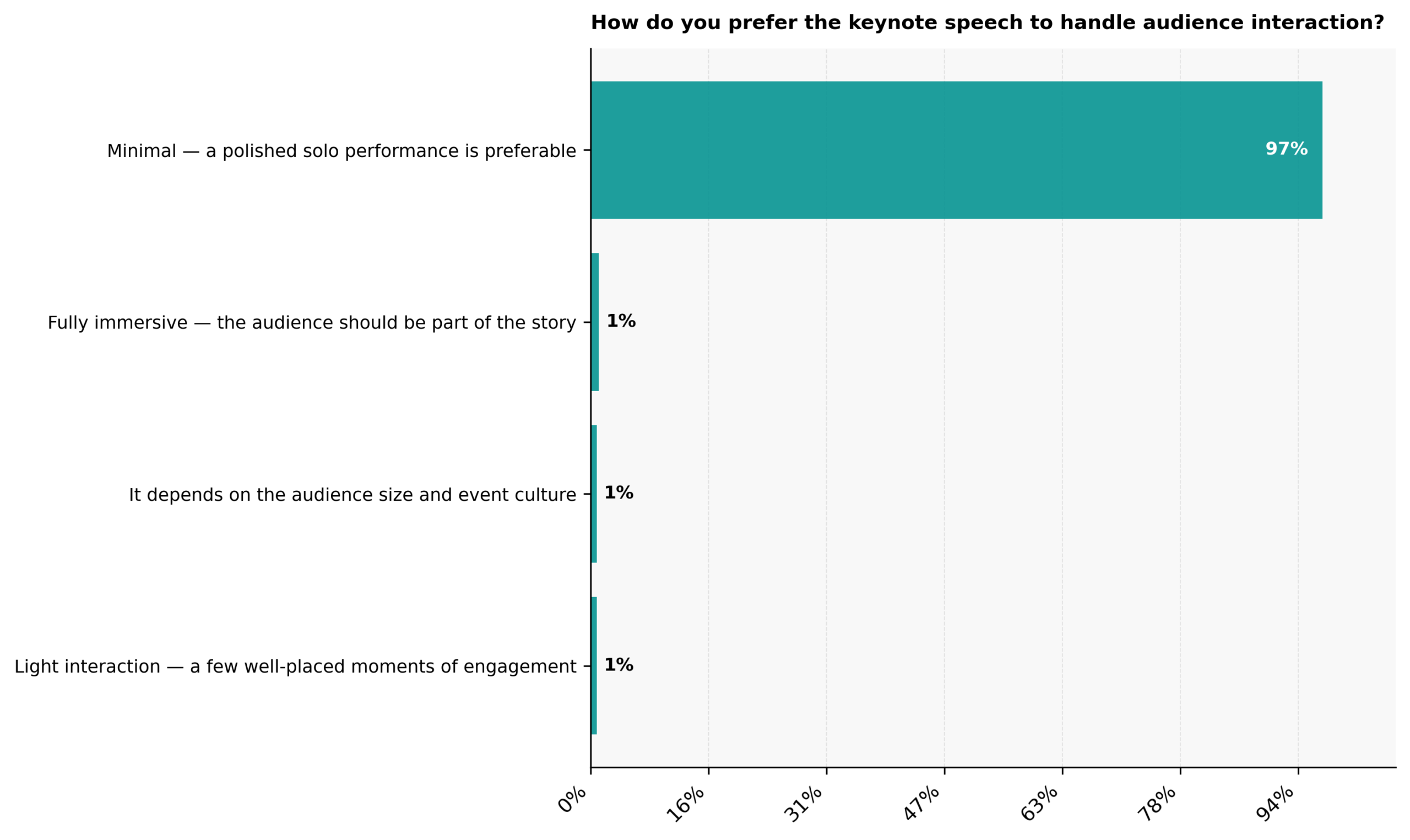
Meeting planners strongly prefer minimal audience interaction in a keynote speech, with 97% choosing a polished solo performance as the preferred format. This shows how they understand the role of a keynote. They want the speaker to hold the room through story, pacing, presence, and delivery, rather than turning the session into a participatory exercise.
A fully immersive format, where the audience becomes part of the story, is preferred by only 1%. This kind of interaction may work better in workshops, training sessions, or smaller team experiences. In a keynote setting, it can place too much responsibility on the audience and interrupt the speaker’s narrative control.
Another 1% base their preference on audience size and event culture. This suggests a small group sees interaction as situational. A smaller leadership retreat may tolerate more audience involvement, while a large conference may need a cleaner, more controlled main-stage format.
Light interaction, with a few well-placed moments of engagement, is also preferred for only 1%. Even low-pressure participation doesn’t seem to be a major priority here. Meeting planners appear to value a keynote that feels polished, focused, and easy for the whole room to follow.
John Livesay agrees. “My storytelling keynote talks at sales kick off meeting has audience engagement but not audience participation. A keynote is not a workshop.”
How do meeting planners feel about a storytelling keynote speech that intentionally creates an emotional moment?
51% of meeting planners are cautious about a keynote speech that intentionally creates an emotional moment that includes vulnerability or tears, as this can feel manipulative, 39% are neutral about this but prefer inspirational content, and 7% avoid booking speakers known for highly emotional content; however, 3% have positive feelings about booking emotional speakers as long as the emotion serves the message and is authentic
A keynote can go deep without getting heavy:

Meeting planners approach keynote speeches that intentionally create emotional moments, including vulnerability or tears, with restraint. While emotional skill has clear workplace value, with workers who have high emotional intelligence promoted 75% more often than colleagues with high IQ but low EQ, our audience still wants speakers to handle emotional moments with care.
Caution leads at 51% because emotional moments can feel manipulative if not handled well. The issue is control. A speaker may intend vulnerability to create a connection, but if the moment feels staged, prolonged, or disconnected from the event’s purpose, the audience can feel pushed into a reaction instead of invited into a story.
Neutrality is next, with 39% preferring inspiration to lean more uplifting than heavy. This points to a tone preference. Meeting planners may welcome emotion, but they still want the keynote to leave the room energized rather than drained.
Another 7% avoid booking speakers known for highly emotional content. This suggests some planners see intense emotion as a risk before the event starts, especially if they’re protecting a mixed audience, senior stakeholders, or a sensitive company context.
A positive view is held by 3%, as long as the emotional moment serves the message and feels authentic. Vulnerability works best here when it earns its place in the speech and helps clarify the point.
No opinions were expressed for being very positive because emotional resonance makes a keynote unforgettable. This doesn’t detract from its value, but in online conversations, emotional impact was less of a selling point than emotional judgment.
John Livesay disagrees. “When I give a storytelling keynote talk at a sales kickoff meeting, I want the audience to feel something. Stories that have high stakes are the ones we remember.”
What element of a storytelling keynote speech impresses meeting planners’ attendees?
Emotional moments that create a genuine human connection in a storytelling keynote speech always impress 52% of meeting planners’ attendees, and 32% are usually impressed by this, but 4% are less so, while practical storytelling frameworks that the audience can immediately apply usually impress 6% of attendees, 3% are sometimes impressed by this, and 3% are rarely impressed
The strongest moments are the ones that resonate because they feel true:

When meeting planners look at the element that most consistently impresses attendees, emotional moments that create a genuine human connection always impress 52%, usually impress 32%, sometimes impress 2%, and rarely impress 2%. This shows how powerful a well-earned emotional moment can be when it helps the audience see the speaker as human, not just polished.
The key is that the emotion has to feel genuine. Attendees may not remember every framework, phrase, or slide, but they often remember the moment when the room goes quiet, the story feels honest, or the speaker names something people recognize in themselves.
Practical takeaways less appealing
Practical storytelling frameworks that attendees can immediately apply play a much smaller role, usually impressing 6%, sometimes impressing 3%, and rarely impressing 3%. This is striking because practical takeaways sound like the safest way to prove value. The gap may come from how attendees experience a keynote in real time.
A framework asks them to process the message and think about how to use it later, while an emotional moment creates an immediate sense of recognition. A framework gives attendees a tool. A genuine emotional moment gives them a reason to keep thinking about the message after the keynote ends.
John Livesay agrees. “My storytelling keynote at a sales kickoff meeting is both inspiring and gives the audience actionable takeaways.”
How do meeting planners evaluate whether a storytelling keynote speech was effective?
62% of meeting planners evaluate whether a storytelling keynote speech was truly effective by the conversations and story-sharing amongst attendees after the speech, 15% by the applause and visible emotional response during the speech, 12% gauge impact via post-event survey scores from attendees, and 115 by the behavioral changes or skills application that become evident in the weeks after the speech
A great keynote does its best work after the applause:

Meeting planners evaluate whether a storytelling keynote speech was truly effective by looking for signs that attendees have picked up the message for themselves. At 62%, the strongest signal is conversations and story-sharing among attendees after the speech.
This is more than positive feedback. It means the keynote has given people a story worth repeating, which is exactly where storytelling creates its value. Attendees are turning the message into their own shared language after the session, not just reacting to the speaker in the room.
Audience applause and visible emotional response during the speech come next at 15%. These signals still count because they show the room is engaged in the moment. The limitation is that a strong reaction can fade quickly if attendees don’t keep talking about the message afterward.
Post-event survey scores from attendees account for 12%. This gives planners a more formal way to report success to stakeholders, but survey scores can miss the informal signs of impact, such as what people repeat, reference, or share with colleagues.
Behavioral changes or skill application observed weeks later sit at 11%. This is the most outcome-driven measure, but it’s also the hardest to connect directly to one keynote. A speech may influence behavior, but workplace change usually depends on follow-up, leadership reinforcement, and whether the event message keeps showing up after the room has cleared.
John Livesay agrees. “The most impactful way clients measure my storytelling keynotes at sale kickoff meeting is if the team starts telling stories in sales calls that result in more sales.”
How do meeting planners handle the gap between an inspiring storytelling keynote speech and behavioral change in the workplace?
64% of meeting planners rely entirely on a keynote speech to plant the seed for real behavioral changes in the workplace post-event, and 36% build internal accountability structures after the event to bridge the gap between an inspiring speech and a behavior change in the workplace
Inspiration is easier to create than to sustain:
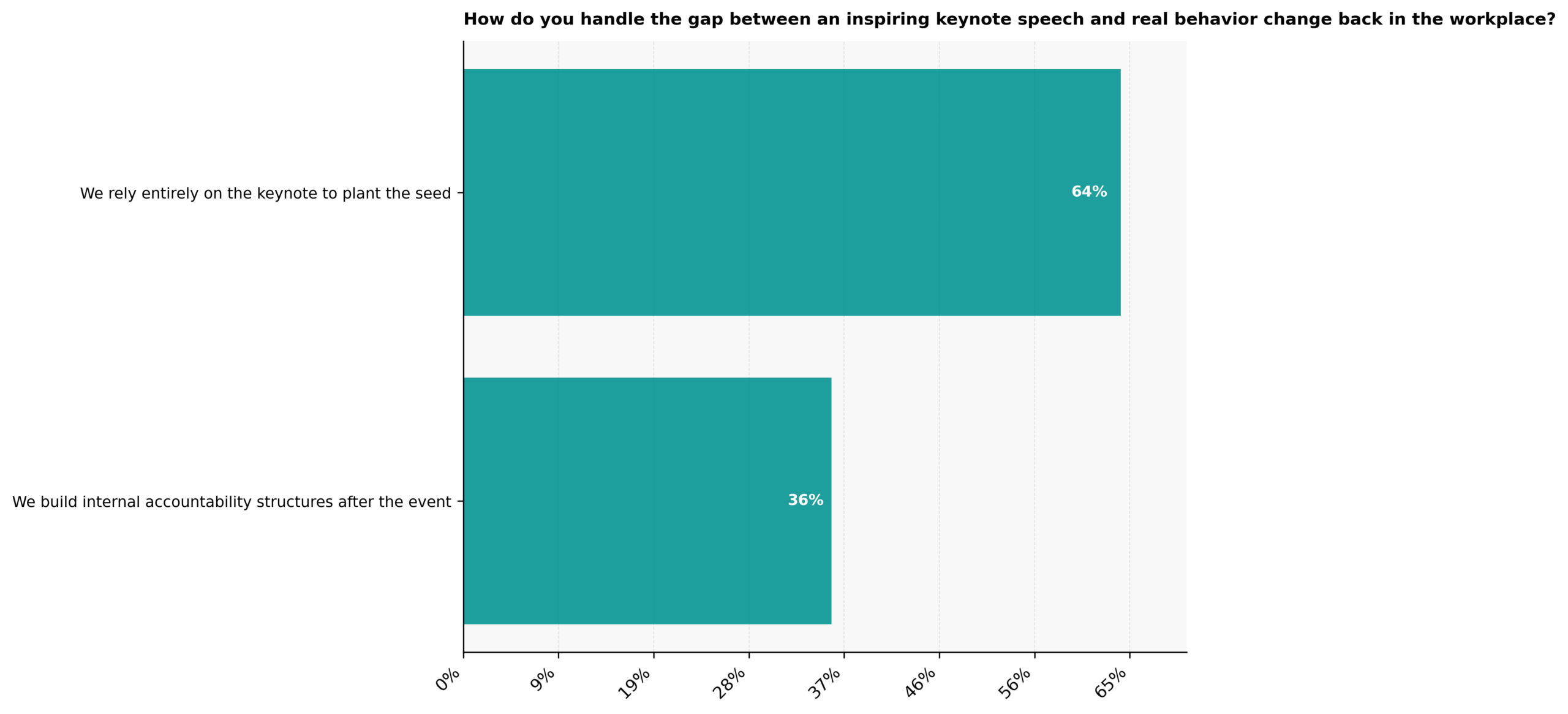
Meeting planners are more likely to rely on the keynote itself to bridge the gap between inspiration and real behavior change back in the workplace. 64% rely entirely on the keynote to plant the seed. This suggests many planners see the speech as the spark that introduces a new idea, gives people a shared story, and creates the first internal shift.
Research on the impact of motivational speech supports this logic, finding that motivational speeches can increase psychological need satisfaction and intrinsic motivation. In other words, a keynote can help people feel more capable, connected, and ready to act.
The remaining 36% build internal accountability structures after the event. This group seems to recognize the other side of the same issue. Inspiration can start change, but it does not always sustain it. Accountability structures help turn the message into something people revisit. Manager conversations, team commitments, follow-up sessions, internal goals, or practical check-ins can keep the keynote from becoming a one-off motivational moment.
John Livesay agrees. “Clients love that when I give my storytelling keynote at a sales kickoff meeting, their team learns a repeatable storytelling structure they can start using immediately.”
What makes a storytelling keynote speech an automatic rebooking for meeting planners?
58% of meeting planners will absolutely or strongly consider rebooking a storytelling keynote speaker for future events if they get a standing ovation and a visible emotional response in the room; however, this might not be enough for 12% and it’s not a rebooking factor for 8%, while senior leadership publicly crediting the keynote with driving cultural change would cause 9% to strongly consider rebooking, it’s not enough for 2%, and 8% would rebook if attendees reference the stories and frameworks post-event, yet this may not be enough for 2%
A room that responds is hard to ignore:

A standing ovation and visible emotional response in the room are the strongest rebooking signals for meeting planners in our audience. 29% see this as absolutely a rebook, while another 29% would strongly consider rebooking. This makes sense because live audience reaction is immediate, visible, and easy for stakeholders to understand. A room that rises, reacts, or shows emotion gives planners a clear sign that the speaker delivered the experience they were brought in to create.
Still, this reaction is not enough for everyone. 12% say a standing ovation and visible emotional response might not be enough, while 8% do not see it as a rebooking factor. This suggests some planners are cautious about judging a keynote only by the moment. A strong room response can prove impact, but it does not always prove lasting value.
Senior leadership publicly crediting the keynote with driving cultural change would make 9% strongly consider rebooking, while 2% say it might not be enough. This is a more strategic signal because it shows the keynote reached decision-makers and became part of the organization’s internal story.
Attendees referencing the stories and frameworks months after the event is absolutely a rebook for 5%, strongly supports rebooking for 3%, and might not be enough for 2%. This is the longest-tail proof of value. It shows the keynote stayed useful after the event, even though fewer planners treat it as an automatic rebooking trigger.
John Livesay agrees. “The clients that rebook me after a storytelling keynote at a sales kickoff meeting are often finding new ways for me to help their team be successful. One way is to use storytelling to recruit top talent.”
How do meeting planners use AI tools when planning or evaluating storytelling keynote speeches?
92% of meeting planners are currently using AI tools when planning or evaluating keynote speeches for their events by analyzing post-event survey data, 5% are using AI when researching speaker topics and audience relevance, 1% are using this technology for generating post-event content, and 2% are not currently using AI in this part of their planning process
AI is doing the sense-making work:

Meeting planners are using AI primarily to make sense of what attendees say after a keynote, with 92% analyzing post-event survey data. Industry reporting on AI in event data analysis makes this use case more specific. AI is helping planners work through open-ended attendee feedback, identify themes and micro-trends, and connect outcomes back to particular audiences or stakeholders.
This is important for keynote evaluation because the value of a speech is not always obvious in a score alone. Attendee comments may reveal which story landed, which idea felt relevant, which audience segment reacted most strongly, or which message should influence future programming. AI helps planners find those patterns without relying only on the loudest feedback or the easiest numbers to report.
Speaker selection still relies on experience over automation
Researching speaker topics and audience relevance sits much lower at 5%. This suggests planners are using AI less as a front-end decision-maker and more as a post-event interpreter. Speaker choice still likely depends on human judgment, stakeholder priorities, referrals, audience knowledge, and whether the speaker feels credible for the room.
The 2% not currently using AI in this part of the planning process may be holding onto the areas where human judgment still feels safest. Beyond sorting feedback, keynote evaluation involves reading tone, weighing stakeholder priorities, judging speaker fit, and deciding whether the room’s reaction matches the event’s goals.
Generating post-event content, such as recaps and social posts, accounts for just 1%. This low figure is telling. In this setting, planners are not mainly using AI to package the keynote afterward. They are using it to understand what the keynote actually did.
John Livesay agrees. “In an era of AI finding potential speakers, nothing beats a conversation with me to see if I am the right fit for my storytelling keynote for a sales kickoff meeting.”
How do meeting planners believe AI will impact the art of storytelling keynote speeches?
26% of meeting planners believe that AI will have a minimal effect on the art of storytelling keynote speeches in the next 3 years, as live storytelling is inherently human, and 25% think AI will have a moderate effect; however, 25% think it will have a significant effect as it will make authentic stories more valuable, and 24% are unsure of what impact AI will have as it’s too early to tell
AI raises the value of what feels unmistakably human:

There’s an almost even split on how AI will affect the art of storytelling keynote speeches over the next three years. The largest group is only slightly ahead, with 26% expecting minimal impact because live storytelling is inherently human and AI won’t change that. This group seems to see the keynote’s value in presence, timing, voice, vulnerability, and the speaker’s ability to read the room.
Another 25% expect a significant impact because AI-generated content will make authentic human stories even more valuable. A recent UN Chronicle article on responsible storytelling in the age of creative AI argues that people increasingly seek authenticity over messaging, lived experience over abstraction, and emotional truth over institutional tone. As AI makes polished content easier to produce, a real human story may become more valuable because it cannot be manufactured in quite the same way.
A further 25% expect a moderate impact, with speakers using AI as a research and preparation tool while delivery stays human. This is the practical middle ground. AI may help speakers understand audience priorities, organize ideas, explore examples, or prepare more efficiently, but the live keynote still depends on human judgment and delivery.
The remaining 24% are unsure because it’s too early to know how this will play out. Their uncertainty makes sense because AI storytelling is still an ethical and cultural question, not only a technology shift. The issue is whether dignity, authorship, and narrative integrity remain central as AI changes storytelling.
The best stories keep shaping conversations long after the storytelling keynote ends
Storytelling keynote speeches have the most value when the story travels beyond the session. Across our findings, the message is clear. The strongest experiences give audiences a shared language, a human point of connection, and a message that feels relevant to their work.
The real test is whether that message keeps showing up in what people discuss, decide, and do next.
John Livesay agrees. “Some of my signature stories are repeated long after my storytelling keynote at a sales kick off meeting is over.”
See how John puts that idea to work in his storytelling keynote for sales teams, and why planners choose him for lasting impact.
About the data
Sourced using Artios from an independent sample of 716,983 opinions of Meeting planners in the USA across X, Quora, Reddit, Bluesky, TikTok, and Threads. Responses are collected within a 95% confidence interval and 5% margin of error. Results are derived from what people describe online, from opinions expressed, and not actual questions answered by people in the sample.
Book John for your sales kickoff
Planning a sales kickoff? Bring John Livesay’s Revenue Rockstar keynote to your team. Ask about booking John.
Sales Kick Off (SKO) Meetings Statistics: USA 2026
Posted by John Livesay in Research | 0 comments
Sales kick-off meetings have moved beyond being annual pep talks to high-impact moments where strategy is set, teams are aligned, and sales performance is shaped for the year ahead. From leadership involvement and event structure to content priorities, keynote speakers, storytelling, and the growing role of AI, SKOs reveal how organizations are balancing motivation with execution.
To find out what 282,881 opinions of C-Suite leaders in the US were about sales kick off meetings, we utilized AI-driven audience profiling to synthesize insights from online discussions over 12 months, ending on June 10th, 2026, to a high statistical confidence level. These insights highlight how C-suite leaders are rethinking what it takes to engage teams, drive alignment, and turn big-picture strategy into real commercial momentum.
Index
- 36% of C-suite leaders hold formal sales kick off meetings annually, 26% do so quarterly, 21% hold SKOs twice a year, and 18% work on an ad hoc or as-needed basis
- 65% of C-suite leaders’ SKOs are rarely fully virtual, but 35% say that their format varies year to year, indicating a change in preferences depending on current circumstances
- For 91% of C-Suite leaders, over 500 people in their sales team attend their SKO, while for 9%, under 25 people attend, showing a huge variation in team sizes
- C-Suite leaders agree that CEOs are fully responsible for SKO outcomes, and 25% agree that there should be shared responsibility amongst the leadership team; however, 38% agree that individual sales managers should not be responsible for SKO outcomes
- 97% of C-Suite leaders’ involvement in SKO design varies each year, and only 3% delegate fully to sales enablement, pointing to clear trends in required input
- 76% of C-Suite leaders’ top priority for their SKO is to strengthen cross-functional collaboration but for 7% this isn’t a goal at all, 3% are prioritizing introducing new sales methodologies or tools, while 3% agree this is an important goal, and 4% disagree, saying it’s not a goal at all, a further 3%’s top priority for SKOs is to motivate and energize their sales force, while 2% aim to align the sales team on annual targets or strategies
- Keynote speakers or inspirational sessions are the content element that 91% of C-Suite leaders believe is absolutely essential at an SKO as it drives the most value, and 5% agree these add good value, while 3% feel that leadership Q & A and strategy sessions are absolutely essential, and conversations around sales skills training and workshops, product or roadmap updates, and peer-to-peer recognition and awards don’t feature
- For 57% of C-Suite leaders, storytelling is embedded throughout all their SKO sessions, 11% include internal sales leaders sharing customer success stories, 10% rely on an external keynote speaker focused on storytelling, and 5% use structured story frameworks in workshops; however, 18% don’t formally incorporate storytelling into their SKOs
- 35% of C-Suite leaders select external speakers for their SKOs based on industry reputation and speaker bureau referrals, and 22% rely on peer recommendations from other C-suite leaders, but 43% say they rarely use external speakers, giving no indication of how they select them when they do
- Emotional intelligence and buyer empathy are the SKO topics that 56% of C-Suite leaders wish got more attention, while 26% agree it could use more focus, 9% share the same sentiments about AI tools and sales technology, and 6% agree this topic needs much more attention, while 3% feel the same about competitor intelligence and market positioning
- 87% of C-Suite leaders’ organizations usually run their SKO over 3 days, and 12% run it over 2 days, indicating a preference for longer durations rather than shorter time spans
- Keeping attendees engaged throughout is a significant challenge for 94% of C-Suite leaders with their SKOs, while the remaining 6% battle with ensuring that the post-SKO momentum is maintained
- 21% of C-Suite leaders are currently using AI for personalized outreach and content, 1%for forecasting and pipeline management, and 1% for AI-powered prospecting and lead scoring, but 77% have not yet adopted AI in sales The story doesn’t end with the keynote
- For only 10% of C-Suite leaders AI adoption is a core agenda item and major focus of SKOs, and is somewhat included for 8%, compared to the 4% who say it’s not really included, 27% do not include AI adoption at all but agree they should, 2% briefly mentioned it, 21% plan to include this focus topic next year, and 27% say it’s not relevant to their team, so they don’t include it
- 37% of C-Suite leaders rate their last SKOs overall impact as poor, with minimal impact on teams or results, another 37% felt there was below expectations and had low engagement, while only 13% said that their SKOs overall impact was average and had some value, and 13% felt there was strong as their team was energized and focused
- More tailored, team-specific content would help 55% of C-Suite leaders invest more in their next SKO, and 9% say this is a top priority, while 21% list proven link to revenue growth as a top priority, and 15% as something that would help them to invest more
- An evolving SKO model
- About the data
How often do C-suite leaders’ organizations hold formal sales kick off (SKO) meetings?
36% of C-suite leaders hold formal sales kick off meetings annually, 26% do so quarterly, 21% hold SKOs twice a year, and 18% work on an ad hoc or as-needed basis.
The regularity of SKOs varies:

Gartner reported that, in 2023, 46% of organizations planned an in-person SKO, with the leading expected benefit being account-planning sessions that help drive closed won deals.
For our audience of C-suite leaders, the frequency of formal sales kick-off meetings varies, but everyone is holding them at some stage or another. 36% hold an SKO annually, making it the most common approach. A further 26% conduct these meetings quarterly, while 21% bring teams together twice a year.
Meanwhile, 18% take a more flexible route, holding SKOs on an ad hoc or as-needed basis. This could be as often as monthly or as seldom as once a year, and indicates a preference for tailoring sales alignment and training to changing business priorities, market conditions, or major product launches rather than following a fixed schedule.
John Livesay agrees: “In my 20 years of giving keynote talks, the firms that have SKOs twice a year are the ones that have the biggest impact because it keeps the momentum going.”
What format does C-suite leaders’ SKO meetings primarily take?
65% of C-suite leaders’ SKOs are rarely fully virtual, but 35% say that their format varies year to year, indicating a change in preferences depending on current circumstances.
SKOs don’t fit into a single type of format:
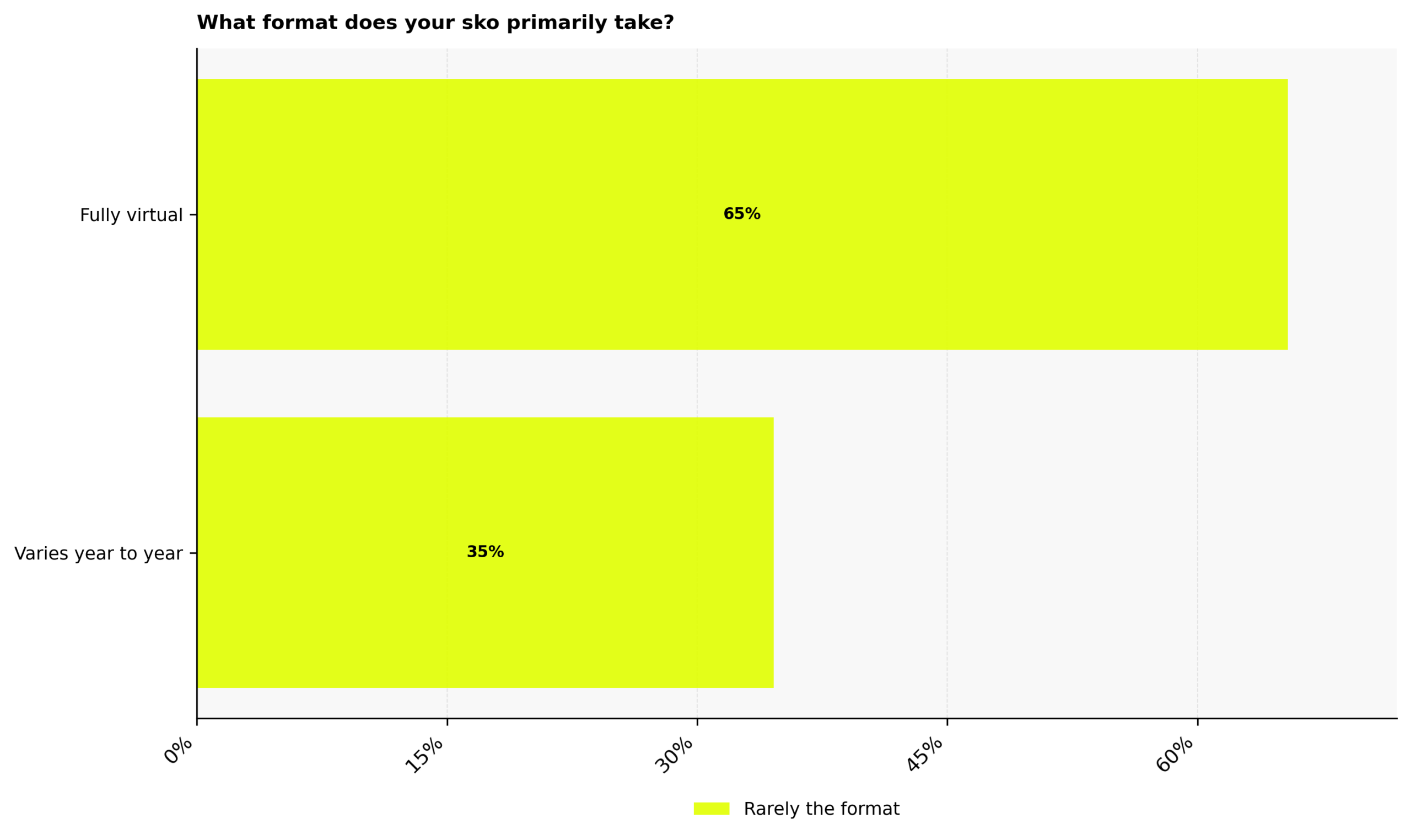
At C-suite-led organizations, SKO meetings are structured in two primary ways. Fully virtual formats account for 65%, though they are rarely used as the default approach. For 35%, the SKO format varies from year to year and is seldom the standard format.
This flexibility ties in with the way many organizations work today. With remote and hybrid working now firmly established, sales teams are increasingly spread across multiple locations. According to Statista’s 2025 report on remote and home-office work, around 1 in 5 US adults works from home regularly. As a result, many organizations are adapting their SKO programs, choosing virtual formats or changing them to best suit their teams, business goals, and working arrangements.
John Livesay disagrees: “Now that the COVID pandemic is over, 95% of the keynotes I give at SKO are live not virtual as corporate leaders value in person connection.”
What size sales team attends SKO meetings at C-suite leaders’ organizations?
For 91% of C-Suite leaders, over 500 people in their sales team attend their SKO, while for 9%, under 25 people attend, showing a huge variation in team sizes
Small and large teams are in attendance:
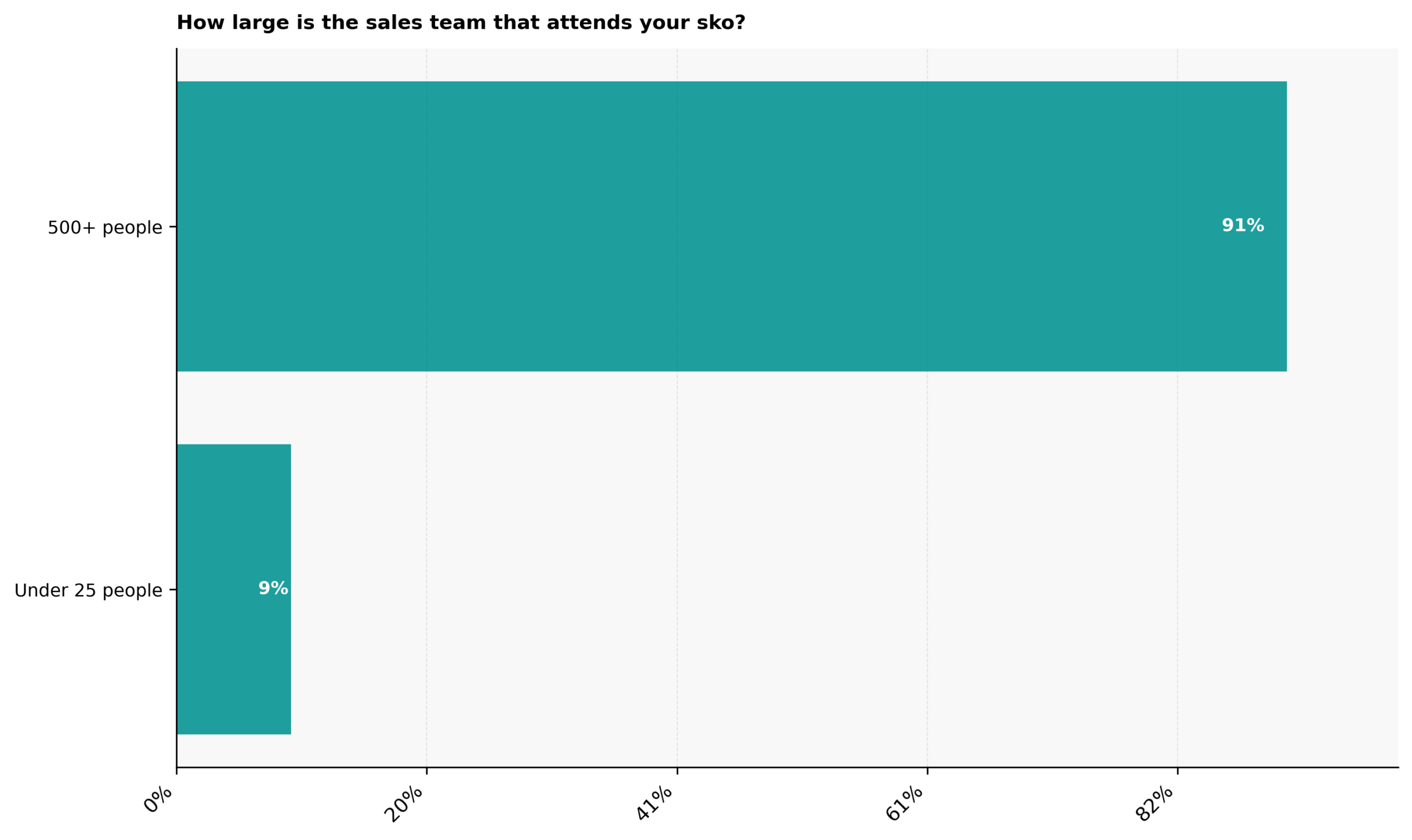
Sales kick-off meetings appear to be large-scale events for most of the organizations in our audience. An overwhelming 91% of C-suite leaders have more than 500 people attending their SKO, while just 9% report sales team attendance of fewer than 25.
While these figures are vastly different, the large attendance is not unexpected given the size of many US organizations. According to the US Census Bureau, the Health Care and Social Assistance sector alone employs more than seven million people across thousands of establishments with 500 or more employees.
Bringing hundreds of sales professionals together simultaneously allows organizations to share strategy, align teams, and reinforce company goals, showing the scale at which many sales organizations now operate.
John Livesay says, “I agree; in my experience, the average size of a keynote audience is 300 people.”
Who is accountable for SKO meetings outcomes in C-suite leaders’ organizations?
C-Suite leaders agree that CEOs are fully responsible for SKO outcomes, and 25% agree that there should be shared responsibility amongst the leadership team; however, 38% agree that individual sales managers should not be responsible for SKO outcomes
Ownership is clear-cut either way:
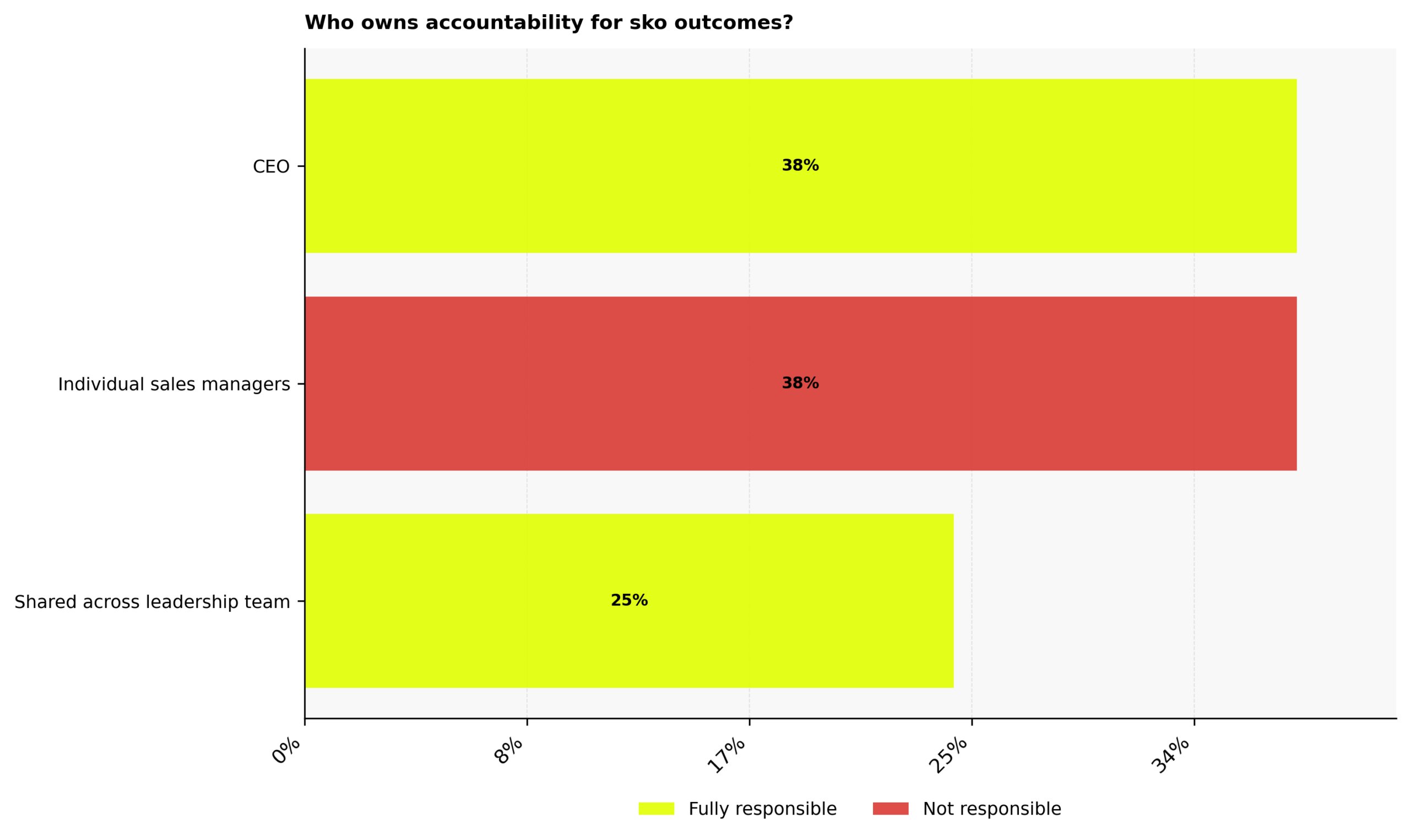
Accountability for SKO outcomes appears to sit primarily at the highest levels of leadership. Among our audience, 38% of CEOs are fully responsible for SKO results, revealing the strategic importance many organizations place on these events. A further 25% report that accountability is shared across the leadership team, suggesting a collaborative approach to planning, execution, and follow-through.
Yet, 38% of individual sales managers are not responsible for overall SKO outcomes. This distinction shows that while sales managers play a key role in implementing strategies and supporting their teams, ownership of event success is often tied to broader organizational goals set by senior leadership. It also indicates that organizations increasingly view SKOs as business-wide strategic initiatives rather than standalone sales department activities.
“When everyone takes ownership for the success of the SKO, including hiring the right speaker who customizes the talk, then the results are stellar!” agrees John Livesay.
How involved are C-suite leaders in SKO meetings design?
97% of C-Suite leaders’ involvement in SKO design varies each year, and only 3% delegate fully to sales enablement, pointing to clear trends in required input
One clear involvement pattern emerges:
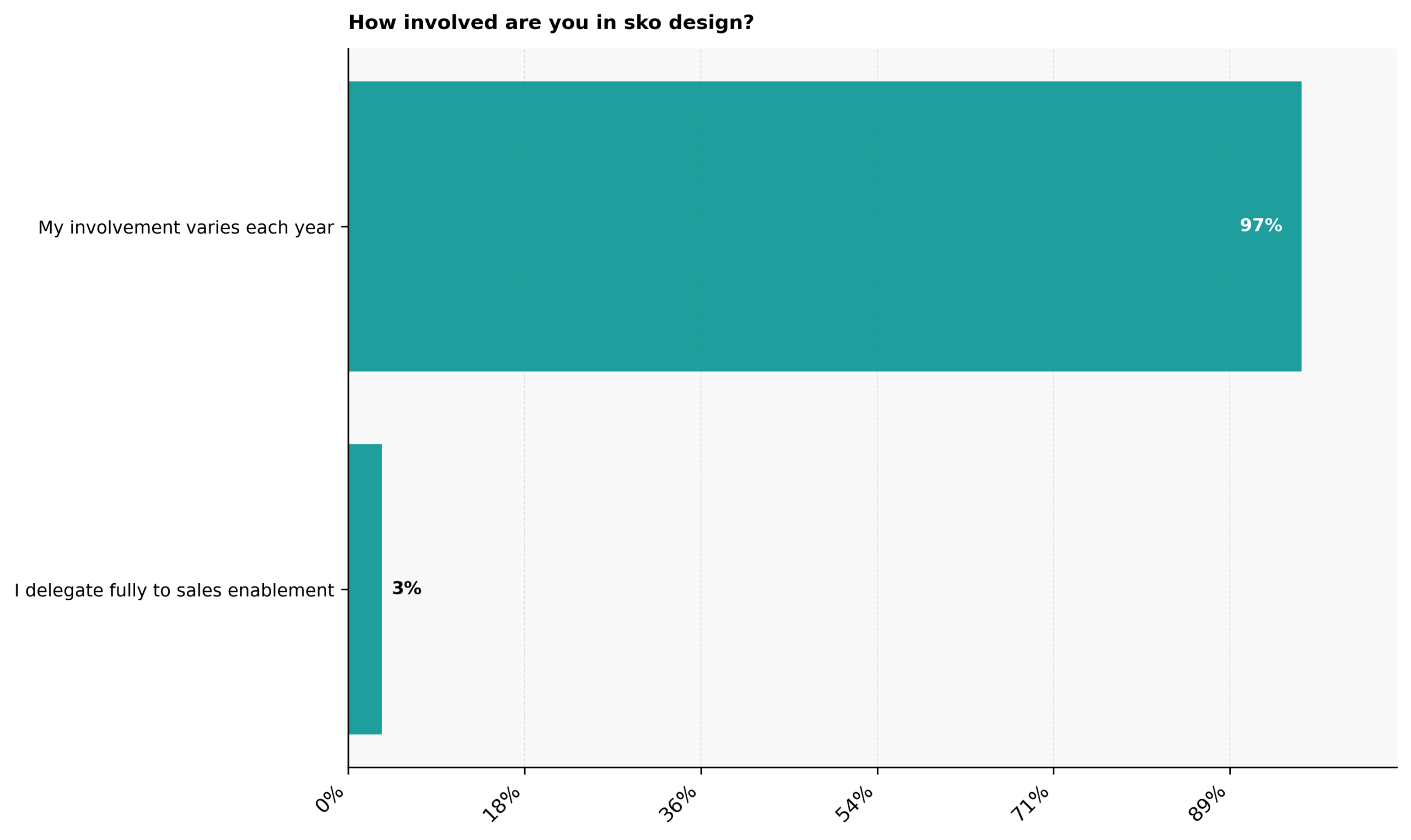
C-suite leaders appear to take a flexible, hands-on approach to sales kick-off design. 97% of our audience have varied levels of involvement from year to year, while just 3% fully delegate responsibility to sales enablement teams.
This is the nature of C-suite leadership, where executives set strategy but adjust their involvement based on business priorities. Rather than taking the same approach year after year or handing ownership to another team, many leaders tailor their participation to each SKO’s goals, helping ensure the event remains relevant and aligned with the organization’s current direction.
John Livesay agrees because the CEO usually introduces him as the keynote speaker. They are very involved in every detail.
What do C-suite leaders want SKO meetings to achieve?
76% of C-Suite leaders’ top priority for their SKO is to strengthen cross-functional collaboration but for 7% this isn’t a goal at all, 3% are prioritizing introducing new sales methodologies or tools, while 3% agree this is an important goal, and 4% disagree, saying it’s not a goal at all, a further 3%’s top priority for SKOs is to motivate and energize their sales force, while 2% aim to align the sales team on annual targets or strategies.
Goals tackle different directions:

One objective stands well above the rest when it comes to sales kick offs. Among our audience, 76% of C-suite leaders identify strengthening cross-functional collaboration as their top priority, while conversely, just 7% feel it is not a goal at all. Research has found that 84% of marketing leaders and employees experience significant “collaboration drag” when working across functions. Understandably, then, many organizations view SKOs as valuable opportunities to break down silos and strengthen teamwork across departments.
Other objectives rank much lower as leading priorities: 3% cite introducing new sales methodologies or tools as their top goal, and another 3% describe it as an important goal. However, new methodologies are not a main focus for approximately 1%, while 4% do not see it as a goal at all.
Also on the lower end of the scale are conversations about motivating and energizing the sales force, which is the top priority for 3%, while 2% place the greatest emphasis on aligning sales teams around annual targets and strategy. Launching new products or services ranks as the top goal for approximately 1%, pointing to the fact that the main focus of most SKOs extends beyond any single initiative.
Remark- Disagree John Livesay Today getting collaboration is not enough. Leaders expect the keynote speaker to not only inspire but give actionable takeaways that move the needle starting right away. That usually includes new mindsets and frameworks on how to tell compelling stories.
Which content element do C-suite leaders believe drives the most value at SKO meetings?
Keynote speakers or inspirational sessions are the content element that 91% of C-Suite leaders believe is absolutely essential at an SKO as it drives the most value, and 5% agree these add good value, while 3% feel that leadership Q & A and strategy sessions are absolutely essential, and conversations around sales skills training and workshops, product or roadmap updates, and peer-to-peer recognition and awards don’t feature.
One content element dominates at SKOs:

When assessing which content element delivers the most value at an SKO, C-suite leaders show a remarkably strong preference for keynote speakers and inspirational sessions. 91% of our audience considers this content absolutely essential, while a further 5% believe it adds good value. By comparison, leadership Q&A and training sessions are viewed as absolutely essential by 3% of leaders.
Other content types receive comparatively limited emphasis as primary value drivers. Less than 1% identify sales skills training and workshops as absolutely essential, and even fewer find they add good value. Less than 1% employ product or roadmap updates as the main driver of SKO value, while peer-to-peer recognition and awards are considered absolutely essential by less than 1%.
The focus of conversations shows how many organizations view SKOs as more than training or information-sharing events. C-suite leaders appear to place the greatest importance on SKO sessions that inspire, align, and energize teams, helping set the tone for the year ahead and reinforcing broader organizational goals.
John Livesay says, “The best keynote speakers make an impact that people reference for the rest of the event.”
How do C-suite leaders incorporate storytelling into their SKO meetings?
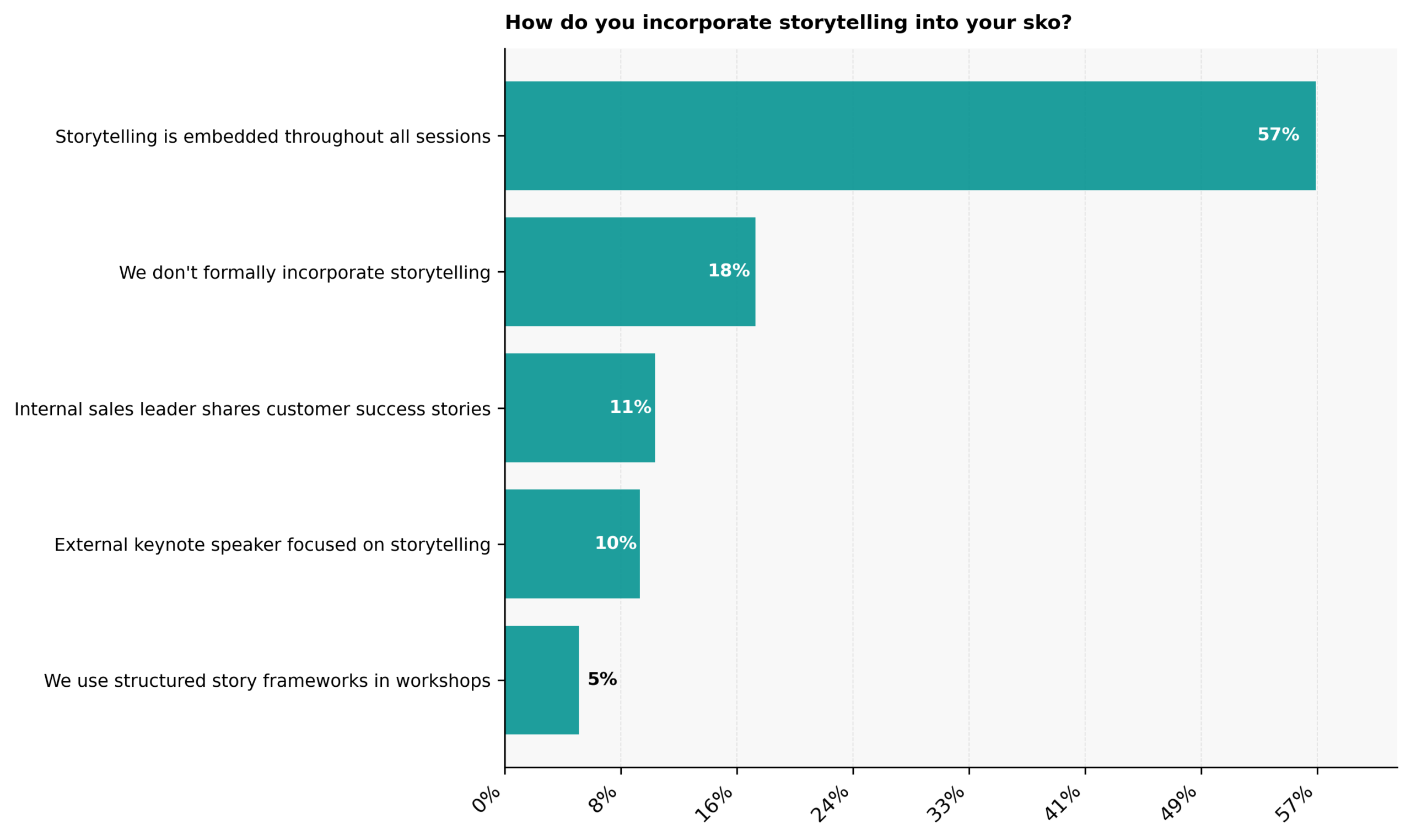
For 57% of C-Suite leaders, storytelling is embedded throughout all their SKO sessions, 11% include internal sales leaders sharing customer success stories, 10% rely on an external keynote speaker focused on storytelling, and 5% use structured story frameworks in workshops; however, 18% don’t formally incorporate storytelling into their SKOs.
For most, storytelling is a crucial part of SKOs:
Research has shown that storytelling can help professionals frame business challenges as meaningful journeys, making complex goals more relatable and inspiring. By using this approach, C-suite leaders can strengthen connections in their organization between strategy, customer success, and day-to-day sales activities.
With so many positive benefits, it’s good to see that storytelling plays a significant role in many sales kick-off events, although organizations take different approaches to incorporating it. 57% of our audience embed storytelling throughout all sessions, making it the most common strategy by a wide margin. Meanwhile, only 18% do not formally incorporate storytelling into their SKOs. But this does not mean they don’t include it at all; it just means that it is not included in a formalized format or even done so consciously.
Other approaches include having an internal sales leader share customer success stories (11%), bringing in an external keynote speaker focused on storytelling (10%), and using structured story frameworks in workshops (5%).
It’s evident from this split that many organizations see storytelling as a valuable tool for creating engagement and reinforcing key messages, though the data points to a preference for weaving narratives throughout the event rather than limiting them to a single session.
John Livesay agrees. “Once audiences learn how to tell their own story of origin, the company story and a case story, they become magnetic and memorable.”
How do C-suite leaders select external speakers for their SKO meetings?
35% of C-Suite leaders select external speakers for their SKOs based on industry reputation and speaker bureau referrals, and 22% rely on peer recommendations from other C-suite leaders, but 43% say they rarely use external speakers, giving no indication of how they select them when they do.
Selection is driven by referrals, reputation, and recommendations:
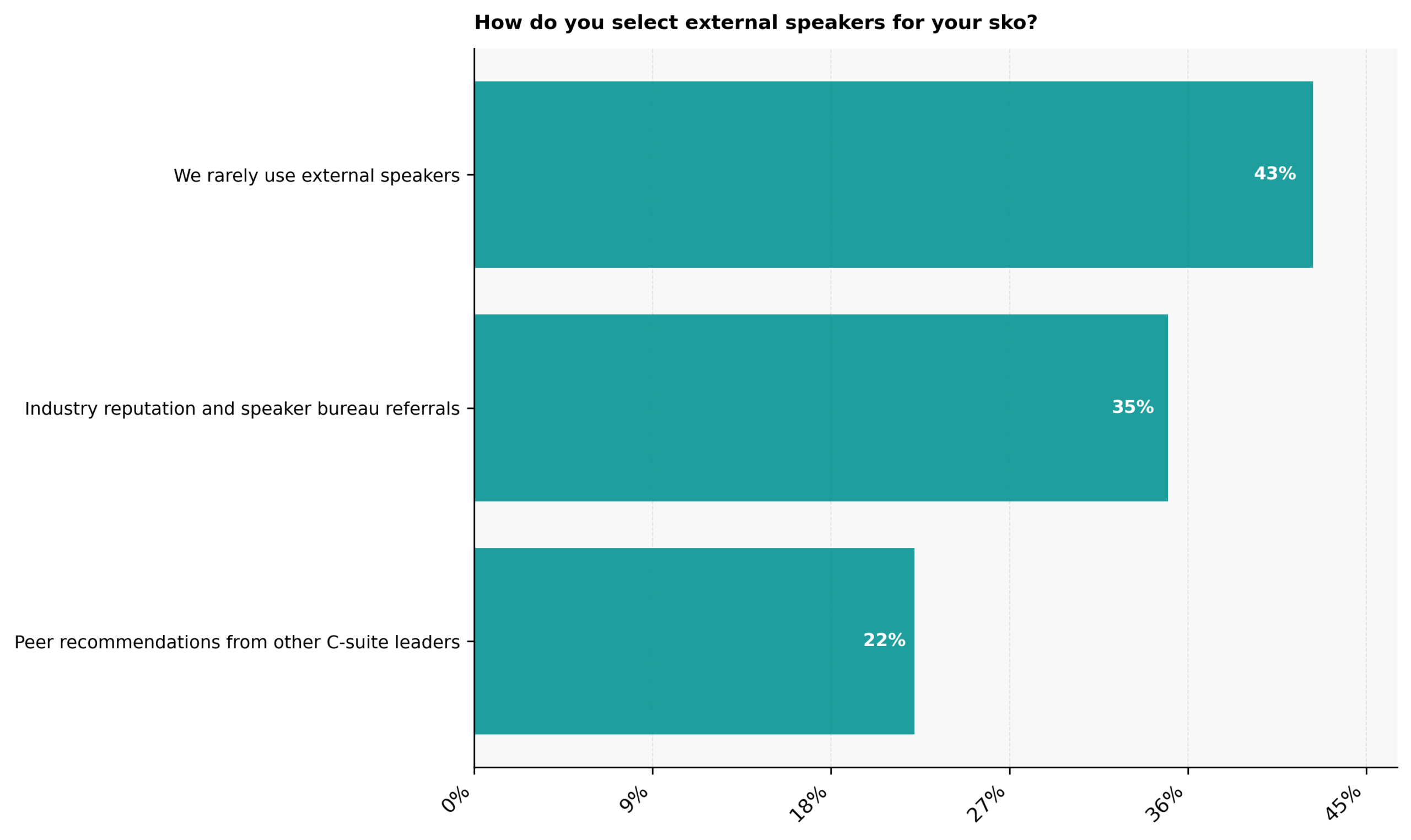
Approaches to selecting external speakers for SKO events vary across organizations, with many leaders choosing not to rely heavily on outside presenters. 43% of C-suite leaders say they rarely use external speakers, and they don’t provide information on where they’d source them from if they did.
However, those that do number over 50%. And for them, industry reputation and speaker bureau referrals are the most common speaker selection methods, cited by 35% of our audience. Another 22% turn to peer recommendations from fellow C-suite executives when identifying potential speakers.
These findings show the enduring strength of the referral, recommendation, and reputation trifecta. A strong industry reputation builds confidence, referrals from speaker bureaus provide a level of vetting, and recommendations from trusted peers offer real-world validation. These three signals reduce uncertainty and make it easier for executives to choose speakers they believe will deliver value and resonate with their teams.
John Livesay disagrees. “The majority of people realize they need an outside expert in the form of a keynote speaker to get their team to change their behavior. Interviewing speakers has become the norm, versus just relying on a referral.”
What SKO meeting topic do C-suite leaders wish got more attention?
Emotional intelligence and buyer empathy are the SKO topics that 56% of C-Suite leaders wish got more attention, while 26% agree it could use more focus, 9% share the same sentiments about AI tools and sales technology, and 6% agree this topic needs much more attention, while 3% feel the same about competitor intelligence and market positioning.
A few topics need to be talked about more:
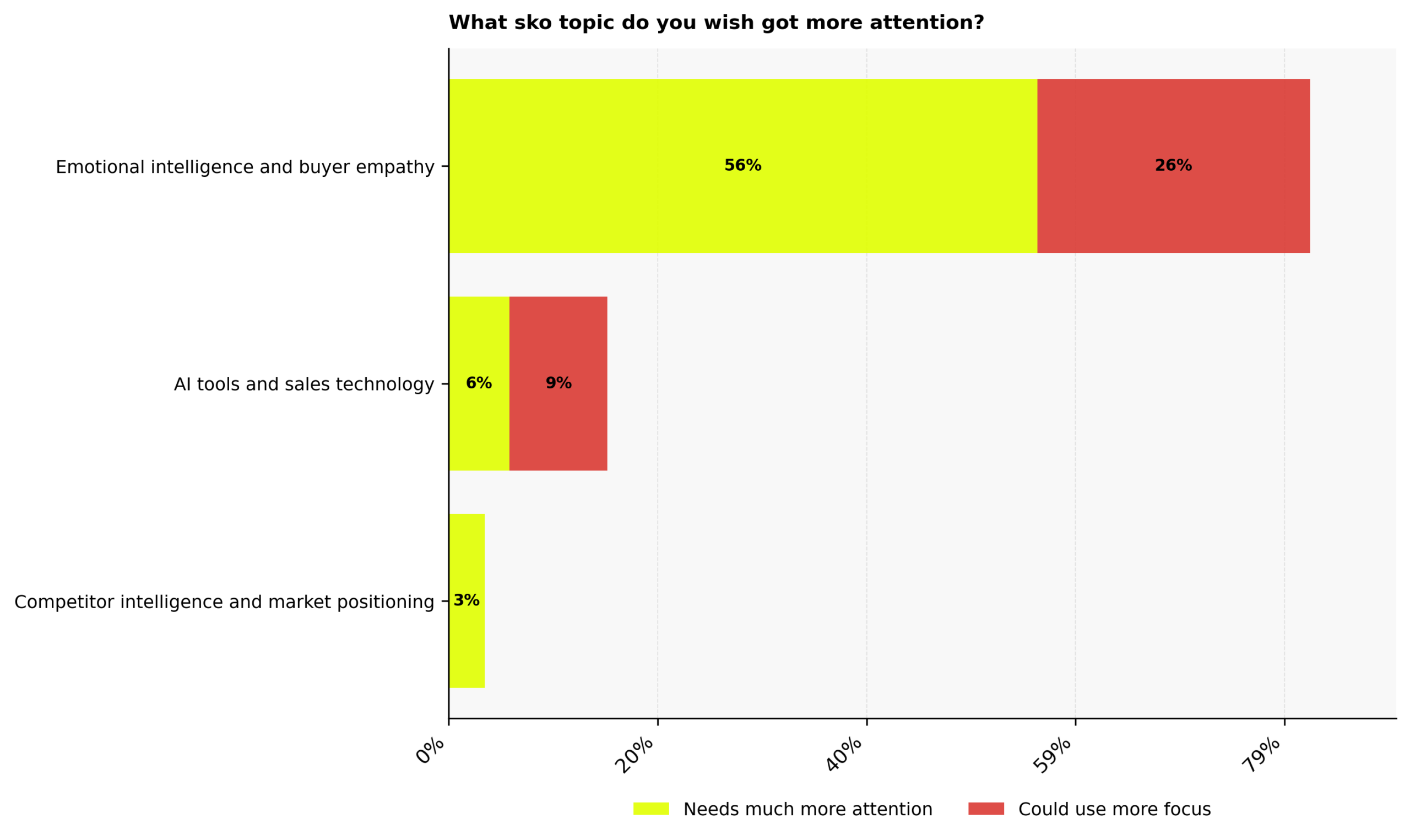
C-suite leaders see a clear opportunity to devote more attention to the human side of selling during sales kick-offs. A whopping 56% of our audience wants to see emotional intelligence and buyer empathy receive more attention at SKOs, while another 26% believe these tactics could use more focus.
By comparison, AI tools and technology are viewed as needing much more attention by 6% of leaders, with a further 9% believing they could benefit from additional emphasis. Competitor intelligence and market positioning rank lower still, with 3% identifying them as topics that need much more attention.
The strong interest in emotional intelligence and buyer empathy may reflect growing recognition of their role in sales success. Research has linked higher emotional intelligence with stronger sales performance, showing that understanding customer pain points, motivations, and concerns can have a meaningful impact on outcomes. This ties in with the findings, indicating that many C-suite leaders are looking beyond technology and products and placing greater value on soft skills that help sales professionals build trust, strengthen relationships, and better connect with buyers.
John Livesay agrees. “In the AI era, showing human empathy is more crucial than ever before.”
How long do SKO meetings typically run for C-suite leaders’ organizations?
87% of C-Suite leaders’ organizations usually run their SKO over 3 days, and 12% run it over 2 days, indicating a preference for longer durations rather than shorter time spans.
Preferences for SKO duration are very similar:
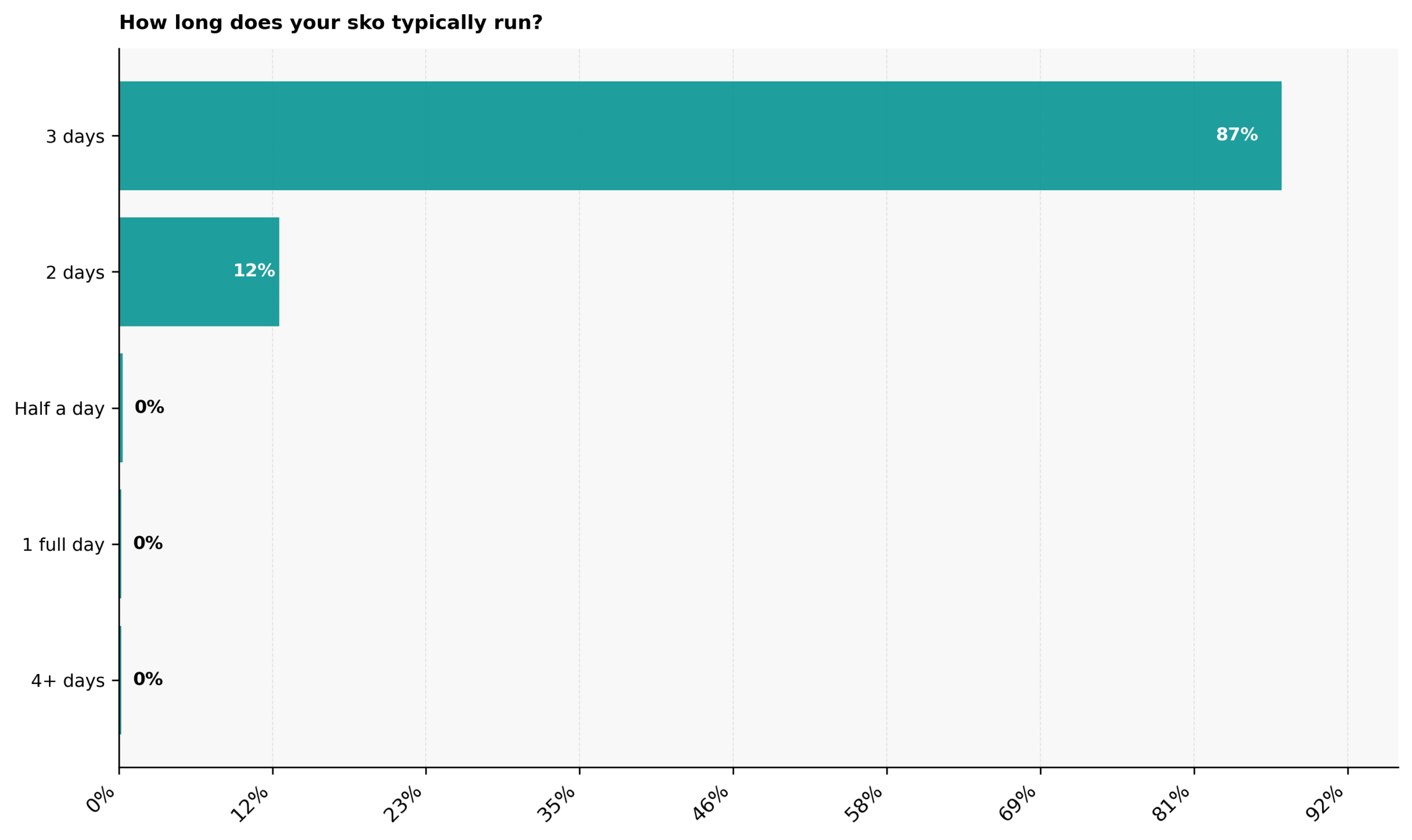
The vast majority of SKOs appear to follow a similar timeline. 87% of C-suite leaders run their SKOs for three days, making it by far the most common format. Another 12% report that their event lasts two days. In contrast, almost no organizations hold SKOs lasting only half a day (0%), one full day (0%), or four days or longer (0%).
The results indicate that many companies view two to three days as the ideal balance between depth and efficiency. A multi-day event provides time for strategy discussions, team-building activities, training sessions, and keynote presentations while still maintaining a practical schedule for sales teams.
John Livesay says, “Most events are between 2 to 3 days to give people enough time to bond and learn.”
What is the biggest challenge C-suite leaders face with SKO meetings?
Keeping attendees engaged throughout is a significant challenge for 94% of C-Suite leaders with their SKOs, while the remaining 6% battle with ensuring that the post-SKO momentum is maintained.
One challenge is the most common:

Keeping attendees engaged throughout the event is the single biggest challenge facing C-suite leaders at SKO meetings, with 94% identifying it as a significant concern. By comparison, only 6% view maintaining momentum after the SKO as their primary challenge. This implies that leaders are increasingly focused on creating meaningful, high-impact experiences during the event itself, recognizing that engagement is the foundation for long-term success.
The emphasis on engagement is understandable given broader workplace trends. American Society of Employers research shows that only 11% of meetings are considered productive, while 45% of workers feel overwhelmed by the number of meetings they attend.
In addition, 55% admit to checking email during virtual meetings, and 47% say meetings are their biggest time waster. Against this backdrop, SKO leaders appear determined to avoid the pitfalls of meeting fatigue by prioritizing participation, interaction, and attention.
John Livesay agrees and says it is crucial to get a keynote speaker who grabs and keeps an audience’s attention.
How is AI currently used in C-suite leaders’ sales processes?
21% of C-Suite leaders are currently using AI for personalized outreach and content, 1%for forecasting and pipeline management, and 1% for AI-powered prospecting and lead scoring, but 77% have not yet adopted AI in sales.
AI sales adoption is low:
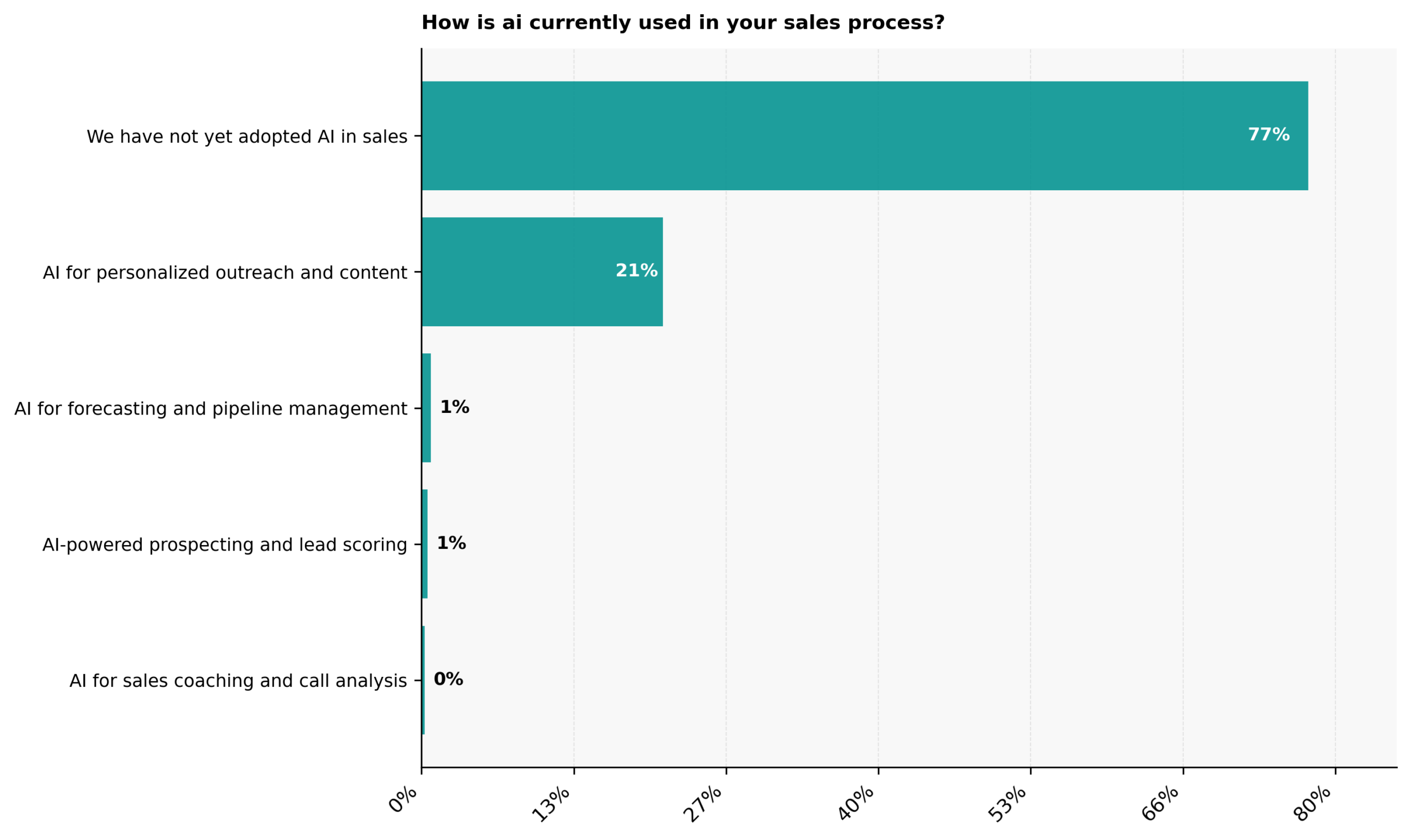
While 81% of sales teams report using AI in some capacity, AI adoption in sales remains limited among the C-suite leaders in our audience. More than three-quarters (77%) have not yet adopted AI in their sales processes.
Among those already using the technology, 21% rely on AI for personalized outreach and content, highlighting a growing interest in tailoring sales communications more effectively. Meanwhile, just 1% use AI for forecasting and pipeline management, and another 1% use AI-powered prospecting and lead scoring.
Notably, none of the leaders currently use AI for sales coaching and call analysis.
This huge contrast with broader industry trends, where AI is increasingly being embedded into core sales functions such as forecasting, enablement, and performance optimization, suggests that many C-suite-led organizations may still be in the early stages of experimentation rather than full-scale adoption.
Remark- John Livesay agrees and says AI can help analyze what went right so you can duplicate it as well as what went wrong so you can avoid repeating it.
Do SKO meetings include AI adoption as a topic at C-suite leaders’ organizations?
For only 10% of C-Suite leaders AI adoption is a core agenda item and major focus of SKOs, and is somewhat included for 8%, compared to the 4% who say it’s not really included, 27% do not include AI adoption at all but agree they should, 2% briefly mentioned it, 21% plan to include this focus topic next year, and 27% say it’s not relevant to their team, so they don’t include it.
AI adoption as a topic isn’t always prioritized:
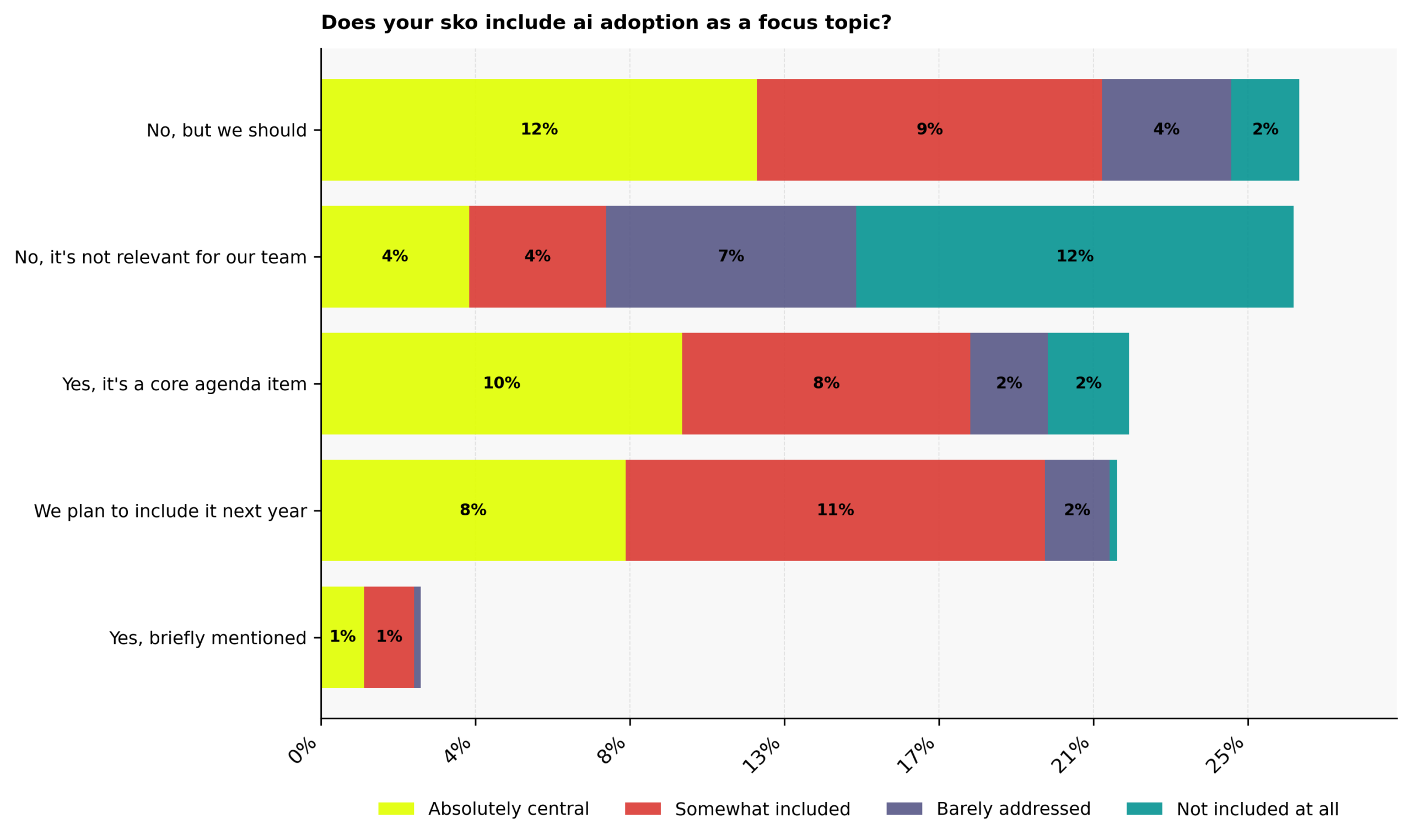
AI adoption takes on different levels of importance at SKO events. Among organizations where AI is not yet a focus topic but is seen as necessary, 12% believe AI is absolutely central to their discussions, 9% report it is somewhat included, 4% barely address it, and 2% do not include it at all.
Meanwhile, 10% have AI as a core agenda item, absolutely central to their SKO, while 8% include it to some extent. Smaller shares report it as barely addressed (2%) or not included at all (2%).
Other organizations are still evaluating AI’s role. Among those planning to include it in the next year, 8% consider it absolutely central, 11% say it is somewhat included, 2% barely address it, and less than 1% include it at all.
For teams that view AI as irrelevant to their team, 4% believe it is absolutely central, and 4% somewhat included, to 7% barely addressed, and 12% not included at all. Finally, 1% consider brief mentions of AI to be absolutely central, another 1% say it is somewhat included, and less than 1% barely address it.
Given that 88% of organizations now use AI in at least one business function, it’s positive to note that many leaders are actively determining how prominently AI should feature in their SKO agendas.
John Livesay agrees. “Human stories are more important than ever as people start to use AI more and more. It not enough to present data but turn that data into stories that people see themselves in.”
How do C-suite leaders rate the overall impact of their last SKO meeting?
37% of C-Suite leaders rate their last SKOs overall impact as poor, with minimal impact on teams or results, another 37% felt there was below expectations and had low engagement, while only 13% said that their SKOs overall impact was average and had some value, and 13% felt there was strong as their team was energized and focused.
Impact ratings of recent SKO events reveal significant opportunities for improvement. 37% of C-suite leaders rated their latest SKO as below expectations with low engagement. An equal 37% rated their events as poor, delivering minimal impact on either team performance or business results. At a whopping 74%, these figures prove that many organizations are still working to find the right balance of content, delivery, and follow-through to make SKOs more effective.
At the same time, there are small yet encouraging signs. 13% of leaders described their last SKO as average, noting that it provided some value while leaving room for improvement. Another 13% reported a strong outcome, noting their teams left energized and focused.
The low positive responses point to the growing importance of creating engaging, action-oriented events. Organizations that successfully align SKO content with team goals may be better positioned to turn inspiration into measurable results throughout the year.
John Livesay offers a virtual follow up to the keynote to maximize the impact.
What would make C-suite leaders invest more in their next SKO meeting?
More tailored, team-specific content would help 55% of C-Suite leaders invest more in their next SKO, and 9% say this is a top priority, while 21% list proven link to revenue growth as a top priority, and 15% as something that would help them to invest more.
Two core elements would drive future SKO investment:

C-suite leaders appear to be seeking a clear balance between relevance and measurable outcomes when deciding whether to invest more in SKO events. More tailored, team-specific content emerged as the most widely supported factor, with 9% of our audience identifying it as a top priority and a further 55% believing it would help justify greater investment. This suggests that leaders value SKOs that address the unique challenges, goals, and responsibilities of their teams rather than relying on a one-size-fits-all approach.
At the same time, demonstrating a proven link to revenue growth remains a powerful motivator. 21% of leaders consider this a top priority, while another 15% believe it would help them decide to invest more.
These findings indicate that both personalization and performance matter. Leaders want events that feel directly relevant to their teams while also delivering tangible business value, helping transform SKOs from annual gatherings to strategic drivers of growth and engagement.
An evolving SKO meeting model
These findings show how sales kick-off meetings continue to play a central role in how C-suite leaders set direction, align teams, and energize their sales organizations. Across formats, structures, and priorities, one theme is consistent. SKOs are evolving into highly strategic events rather than routine gatherings.
While approaches vary widely, leaders are increasingly focused on clarity, collaboration, and impact, ensuring that time spent together translates into meaningful action once teams return to their day-to-day roles. From leadership alignment to storytelling, and from content design to technology adoption, SKOs are becoming more purposeful.
At the same time, the findings highlight a clear opportunity for organizations to refine how they engage teams and measure success, particularly as expectations around effectiveness and outcomes continue to rise.
Clearly, SKOs remain a key moment in the sales calendar, but their value now depends on how well they connect strategy, people, and performance in rapidly changing business environments.
For a practical example, see how John’s Revenue Rockstar sales keynote turns storytelling into action, and why planners choose him to make the impact last beyond the sales kickoff.
About the data
Sourced using Artios from an independent sample of 282,881 opinions of C-suite leaders in the USA across X, Quora, Reddit, Bluesky, TikTok, and Threads. Responses are collected within a 95% confidence interval and 5% margin of error. Results are derived from what people describe online, from opinions expressed, and not actual questions answered by people in the sample.
Book John for your sales kickoff
Planning a sales kickoff? Bring John Livesay’s Revenue Rockstar keynote to your team. Ask about booking John.
Top Storytelling Keynote Speaker Statistics: USA 2026
Posted by John Livesay in Research | 0 comments
A powerful story can inspire, motivate, and change the way people think, but only if it’s told by the right person. As organizations continue to invest in keynote speakers to create memorable event experiences, the factors that influence speaker selection have become just as important as the stories themselves.
To find out what 234,185 opinions of meeting planners in the US were about the top storytelling keynote speakers, we utilized AI-driven audience profiling to synthesize insights from online discussions over 12 months, ending on June 10th, 2026, to a high statistical confidence level. The results reveal what builds trust, drives booking decisions, and separates a compelling speaker from a truly memorable one.
Index
- 48% of meeting planners always book a storytelling keynote speaker for an awards ceremony or gala dinner, 45% always book a speaker for an association or trade industry summit and 1% often book for these events, 3% always book these speakers for team training or professional development days, 2% do so for annual sales kickoffs or company conferences, and 1% always book for leadership or executive retreats
- A storytelling keynote speaker’s social media presence and following is the most important factor for 44% of meeting planners when shortlisting speaker options, it’s a strong influence for 43%, and some influence for 3%, while past event testimonials and reviews are the most important factor for 2%, 6% agree these have a strong influence, and 2% say they have some influence over their shortlist decisions
- While storytelling keynote speaker’s signature topic or framework first captures 20% of meeting planners attention when looking at their profiles and 6% find this relevant, 18% first look for media appearances and press features, and 12% find this somewhat relevant, 21% are first captivated by credentials and corporate experience they find somewhat relevant, and 15% say that audience engagement style is an important factor, followed by 6% who feel the same about high profile client logos catching their attention, and 2% who see this as having partial relevance
- 52% of meeting planners evaluate a speaker’s fit before booking by checking references from similar events, 38% review their published content and books, 7% request a live discovery or chemistry call to gauge the connection, 2% read audience survey feedback, and 2%watch full-length keynote recordings to weigh up their suitability
- 48% of meeting planners assess a storytelling keynote speaker’s quality by the originality of their storytelling framework, 39% rely on audience feedback scores from past events, and 13% on stage presence in demo videos
- The breadth of options available is absolutely essential to 54% of meeting planners in their current keynote speaker provider, and 24% find this very important, while transparent and straightforward pricing is crucial for 6%, 8% find it very important, 1% very important, and 2% not important at all, while 3% cite an ongoing relationship beyond the event as absolutely essential for a provider
- The ability to customize content to their audience is somewhat important for 47% of meeting planners when making a final selection of storytelling keynote speaker, while it’s a strong influence for 12%, and another 12% find chemistry during the discovery call somewhat important. 5% feel the same about strong referrals from trusted peers, but 6% say this has a strong influence on their final decisions, followed by 9% who are influenced by a speaker’s reputation in their industry, and 7% who are swayed by proven ROI from past keynotes
- A virtual keynote via Zoom or similar platform is the ideal format for 89% of meeting planners, and it’s a good option for 2%, but it’s not 7%’s preference, while just 2% prefer a keynote followed by a breakout workshop as their chosen format
- 65% of meeting planners prefer to engage a storytelling keynote speaker directly through the speaker’s own website, 19% prefer to do so via a full-service speaker bureau, 14% prefer engaging with a speaker at a live showcase or preview event, 2% want to work through a preferred vendor list or RFP, and1% via a recommendation from a planner peer
- Building resilience through personal narrative is the storytelling theme that is somewhat relevant to 52% of meeting planners’ audiences, and winning clients through persuasion and pitch is somewhat relevant for 22%, while 14% find leadership storytelling for culture change somewhat relevant, but 11% don’t find this theme very relevant
- 83% of meeting planners work in organizations that fall under financial services and insurance, 15% are in healthcare and life sciences, and 2% in real estate and construction; all of these industries are very people-and worker-centric
- 40% of meeting planners are based in Chicago, 28% in Austin, 24% in San Francisco, 7% in New York City, and 2% in Los Angeles, creating a spread across major business hubs
- The story doesn’t end with the keynote
- About the data
What events do meeting planners commonly book a storytelling keynote speaker for?
48% of meeting planners always book a storytelling keynote speaker for an awards ceremony or gala dinner, 45% always book a speaker for an association or trade industry summit and 1% often book for these events, 3% always book these speakers for team training or professional development days, 2% do so for annual sales kickoffs or company conferences, and 1% always book for leadership or executive retreats.
Two types of events dominate speaker bookings:

Meeting planners’ online discussions about storytelling keynote speakers are heavily focused on celebratory, high-profile business events.
Awards ceremonies and gala dinners generate the most conversation, with 48% of meeting planners indicating that they always book storytelling keynote speakers for these events. Association and trade industry summits follow closely behind, with 45% always booking a storytelling speaker for these events, while a further 1% often do so. These two event categories dominate the conversation due to the strong connection between storytelling and audience engagement at large gatherings.
Other event types attract considerably less attention. 3% of our audience always books storytelling keynote speakers for training or professional development days, while 2% book for annual sales kick-offs and company conferences. Leadership and executive retreats generate the smallest share of conversation, with 1% of meeting planners always booking storytelling keynote speakers.
This suggests that storytelling speakers are most closely associated with events designed to inspire, celebrate achievements, or bring large groups together, but that they also have a place in smaller, more intimate settings.
What influences meeting planners’ shortlisting decisions when finding a storytelling keynote speaker?
A storytelling keynote speaker’s social media presence and following is the most important factor for 44% of meeting planners when shortlisting speaker options, it’s a strong influence for 43%, and some influence for 3%, while past event testimonials and reviews are the most important factor for 2%, 6% agree these have a strong influence, and 2% say they have some influence over their shortlist decisions
Shortlisting depends on various factors:

Online visibility dominates the discussion around how meeting planners shortlist storytelling keynote speakers. Social media presence and following account for the overwhelming majority of conversation, with 44% of our audience viewing it as the most important factor, 43% describing it as a strong influence, and 3% associating it with some influence. Mentions of social media being unimportant are almost non-existent, at less than 1%. The scale of this conversation reinforces the value placed on a speaker’s digital profile, audience engagement, and ability to build recognition beyond the stage.
Other influences generate far less attention. Past testimonials and reviews account for 2% of discussions around the most important factor, while 6% focus on them as a strong influence, and 2% as having some influence. A speaker’s published book or broader thought leadership attracts only a negligible share of conversation, with less than 1% considering it the most important factor.
A strong focus on being visible online
A 2023 consumer poll highlights the growing importance of online brand recognition when evaluating speakers, indicating that 90% of people support brands they follow on social media platforms such as TikTok, Facebook, and Instagram. Additionally, more than half (53%) of the consumers surveyed indicated an increased likelihood of supporting a business accessible through social media platforms.
Active social media platforms provide a window into a speaker’s personality, communication style, and audience connection, making it easier for planners to assess relevance and credibility before adding a candidate to their shortlist.
What aspect of a storytelling keynote speaker’s profile captures meeting planners’ attention?
While storytelling keynote speaker’s signature topic or framework first captures 20% of meeting planners attention when looking at their profiles and 6% find this relevant, 18% first look for media appearances and press features, and 12% find this somewhat relevant, 21% are first captivated by credentials and corporate experience they find somewhat relevant, and 15% say that audience engagement style is an important factor, followed by 6% who feel the same about high profile client logos catching their attention, and 2% who see this as having partial relevance.
Meeting planners’ attention is captured by a mix of a storytelling keynote speaker’s expertise, relevance, and presentation. Conversation is strongest around a speaker’s signature topic or framework, with 20% identifying it as an important factor and a further 6% viewing it as somewhat relevant.
Media appearances and press features also attract significant attention, generating 18% of conversation around important factors and 12% around somewhat relevant considerations. Meanwhile, credentials and corporate experience account for 21% of the discussion in the somewhat relevant category, indicating that professional background remains firmly on planners’ radar during the evaluation process.
Audience engagement style is identified as an important factor by 15%, emphasizing the value placed on a speaker’s ability to connect with a room and deliver memorable experiences.
Research shows that the presence of recognized client brands on a website can help reinforce credibility and trust by up to 70%, making them a valuable inclusion. However, amongst our audience, the display of high-profile client logos on a speaker’s profile isn’t a major talking point: just 6% agree they are an important factor in catching their attention at first, and 2% say they are somewhat relevant.
While reputation markers matter, meeting planners are clearly most interested in what a speaker talks about, how they communicate it, and whether their expertise aligns with the event’s goals.
How do meeting planners evaluate a storytelling keynote speaker’s fit before booking?
52% of meeting planners evaluate a speaker’s fit before booking by checking references from similar events, 38% review their published content and books, 7% request a live discovery or chemistry call to gauge the connection, 2% read audience survey feedback, and 2%watch full-length keynote recordings to weigh up their suitability.
When evaluating whether a storytelling keynote speaker is the right fit, meeting planners are heavily focused on proven performance in comparable settings. Checking references from similar events accounts for 52% of the conversation, making it the most frequently mentioned approach by a considerable margin.
Reviewing published content and books follows at 38%, highlighting the importance of understanding a speaker’s ideas, expertise, and communication style before making a booking decision. These two methods dominate the discussion, suggesting that meeting planners place significant value on evidence of experience and thought leadership.
Other evaluation methods attract far less attention. 7% of our audience requests a live discovery or chemistry call before booking, indicating that direct interaction plays a role, though it is not discussed as often as reviewing existing materials. Only 2% read audience survey feedback, while watching full-length keynote recordings generates just 1% of mentions.
This points to a preference for assessment tools that are easy to access and compare across multiple candidates. References and published content provide a clear picture of a speaker’s track record and perspective, helping planners build confidence in their decision before moving forward with a booking.
How do meeting planners assess storytelling keynote speaker quality?
48% of meeting planners assess a storytelling keynote speaker’s quality by the originality of their storytelling framework, 39% rely on audience feedback scores from past events, and 13% on stage presence in demo videos.
Speaker quality assessment relies on three main points:
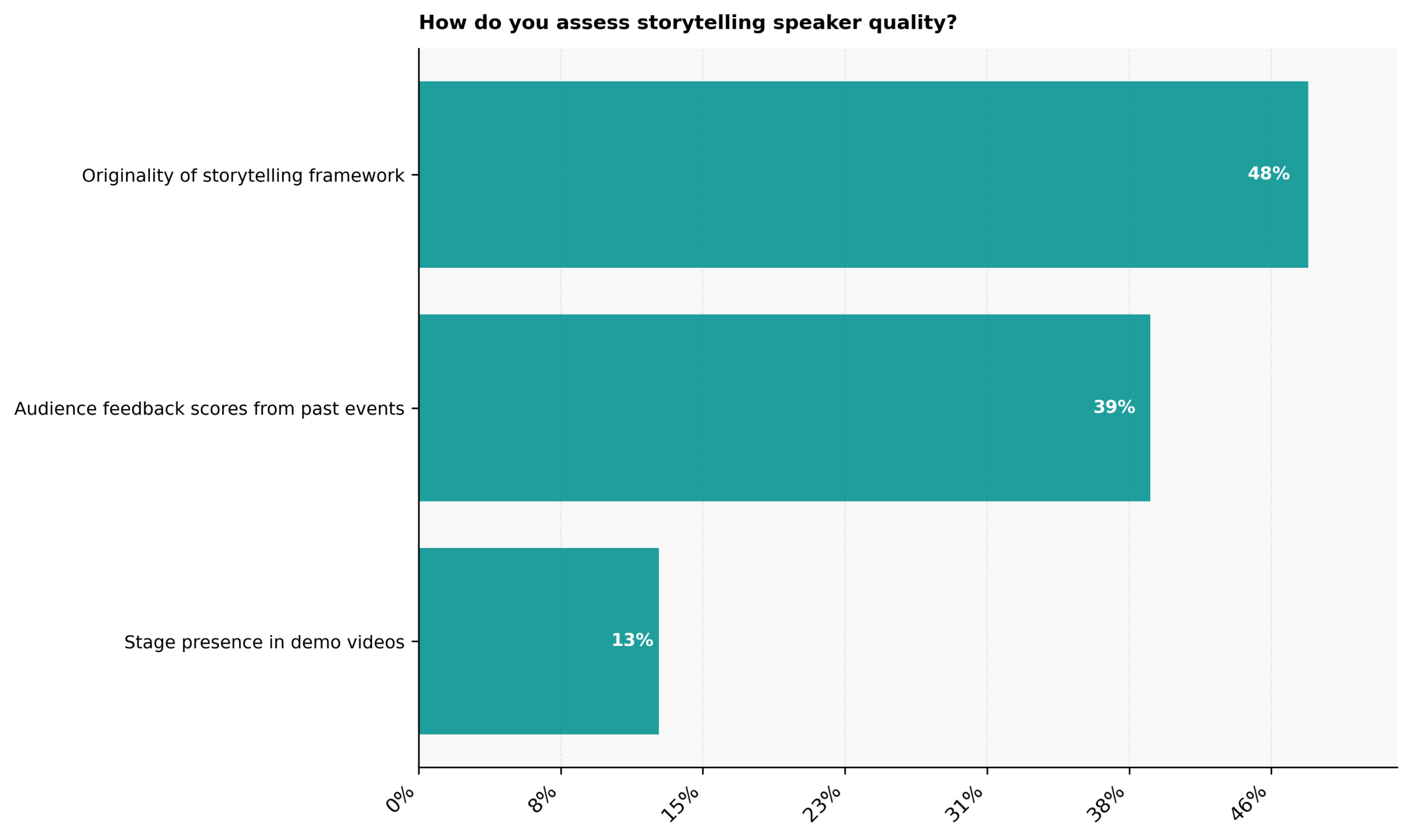
Storytelling speaker quality is largely measured by the strength and originality of a speaker’s storytelling framework. Nearly half of meeting planners (48%) cite this factor as the most frequently referenced indicator of quality. The volume of attention suggests that meeting planners place significant value on speakers who bring distinctive ideas, fresh perspectives, and memorable narrative structures to their presentations.
Audience feedback scores from past events are used by 39% to assess speaker quality, which shows the importance of demonstrated audience engagement and real-world reception. Stage presence in demo videos accounts for 13% of the conversation, proving that presentation style remains relevant but attracts less attention than content and proven impact.
The ability to tell compelling stories is often viewed as a powerful communication and leadership tool that can build credibility, inspire action, and make complex ideas more memorable, which may explain why framework quality and audience feedback stand out so much with our audience.
What do meeting planners value most in a storytelling keynote speaker provider?
The breadth of options available is absolutely essential to 54% of meeting planners in their current keynote speaker provider, and 24% find this very important, while transparent and straightforward pricing is crucial for 6%, 8% find it very important, 1% very important, and 2% not important at all, while 3% cite an ongoing relationship beyond the event as absolutely essential for a provider.
Current providers need to deliver in key areas:
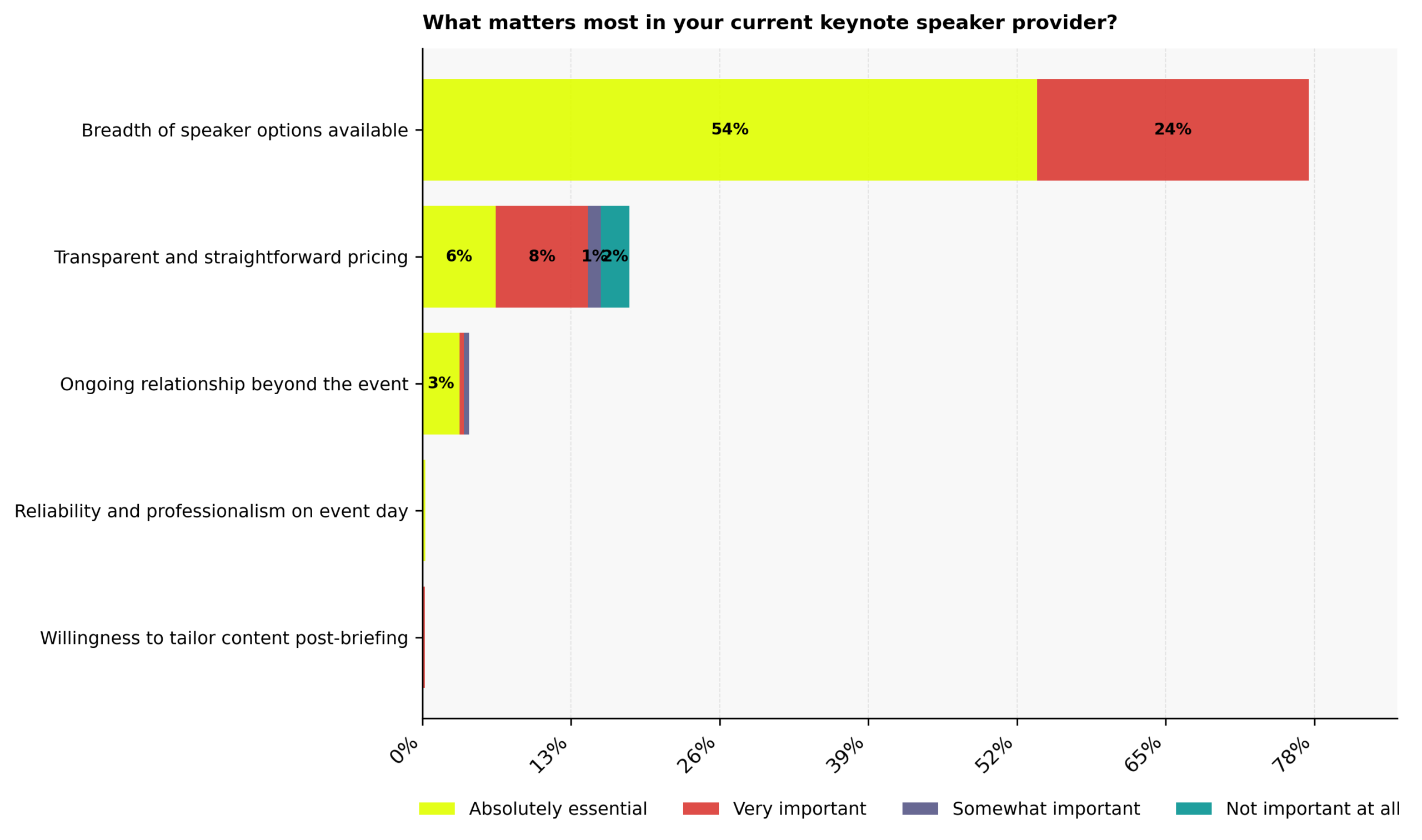
Conversations about keynote speaker providers are overwhelmingly focused on the breadth of speaker options. 54% of meeting planners rate this as an absolutely essential factor for their current provider, and 24% as very important, making it a dominant consideration by a wide margin. This concentration of discussion makes it clear that access to a diverse speaker roster is a priority, allowing planners to find the right fit for different audiences, themes, and event goals.
Other factors attract modest levels of attention. Transparent pricing is rated as absolutely essential for a keynote speaker provider by 6%, very important by 8%, somewhat important by 1%, and not important at all by 2%. Ongoing relationships beyond the event account for 3% who say it’s absolutely essential, with less than 1% agreeing it’s very important, and fewer than 1% who find it somewhat important.
Reliability and professionalism on event day, and the willingness to tailor content post-briefing, didn’t garner any opinions, as there’s a definite preference for choice and flexibility above all other provider attributes.
What drives meeting planners’ final selection of a storytelling keynote speaker?
The ability to customize content to their audience is somewhat important for 47% of meeting planners when making a final selection of storytelling keynote speaker, while it’s a strong influence for 12%, and another 12% find chemistry during the discovery call somewhat important. 5% feel the same about strong referrals from trusted peers, but 6% say this has a strong influence on their final decisions, followed by 9% who are influenced by a speaker’s reputation in their industry, and 7% who are swayed by proven ROI from past keynotes.
Drivers behind final decisions differ somewhat:

When choosing a storytelling keynote speaker, audience relevance takes center stage. 47% of meeting planners consider the ability to customize content somewhat important, 12% agree it strongly influences their final decision, and less than 1% cite it as a deciding factor. The prominence of personalization reflects the value many meeting planners place on presentations that feel directly relevant to their audiences, especially as personalized events can encourage emotional connections, helping audiences feel understood and valued.
Other considerations attracted lower but still notable levels of discussion. Chemistry during the discovery call is somewhat important for 12%, while fewer than 1% view it as not a factor in making a final selection. Strong referrals from trusted peers strongly influenced 6% and 5% rated this as somewhat important.
At the lower end, discussions about the speaker’s reputation in the industry drew attention from just 1% who said it was a strong influence and 8% who viewed it as somewhat important. Proven Return on Investment (ROI) from past keynotes attracted 7% of discussion as somewhat important, while fewer than 1% considered it not a factor. These insights point to a clear preference for tailored content, with referrals, reputation, chemistry, and demonstrated results playing supporting roles.
What format do meeting planners prefer for a storytelling keynote?
A virtual keynote via Zoom or similar platform is the ideal format for 89% of meeting planners, and it’s a good option for 2%, but it’s not 7%’s preference, while just 2% prefer a keynote followed by a breakout workshop as their chosen format.
Virtual keynotes are by far the most preferred:

Discussion around storytelling keynote delivery is heavily concentrated on virtual formats. For 89% of meeting planners, a virtual keynote delivered via Zoom or a similar platform is the ideal format. A further 2% views virtual delivery as a good option, while 7% indicate it is not their preference.
The prominence of this format reflects the widespread adoption of online event technology, with Zoom maintaining a leading position (55.91%) in the global conferencing market and serving over 300 million users worldwide.
Alternative formats attract far less attention. Just 2% of discussions identify a keynote followed by a breakout workshop as the ideal format. As online communication continues to play a central role in professional events, planners appear to value formats that make it easier to connect speakers and audiences regardless of location.
How do meeting planners prefer to engage a storytelling keynote speaker?
65% of meeting planners prefer to engage a storytelling keynote speaker directly through the speaker’s own website, 19% prefer to do so via a full-service speaker bureau, 14% prefer engaging with a speaker at a live showcase or preview event, 2% want to work through a preferred vendor list or RFP, and1% via a recommendation from a planner peer.
How meeting planners prefer to engage a storytelling keynote speaker is strongly concentrated on direct digital access. 65% of meeting planners want to engage with a storytelling keynote speaker directly through their own website. This indicates a preference for streamlined, first-hand discovery where planners can review content, positioning, and availability in one place.
Other engagement routes generate significantly lower discussion. Full-service speaker bureaus represent 19% of mentions, reflecting continued reliance on curated intermediaries. Live showcases or speaker preview events account for 14%, indicating the value placed on seeing speakers in action before making booking decisions.
Preferred vendor lists or Request for Proposal (RFP) processes account for just 2% of the conversation, while peer recommendations from other planners account for 1%. Overall, there’s an obvious leaning toward direct engagement channels, likely driven by efficiency, transparency, and the ease of comparing speaker profiles and content online when making shortlist decisions.
Which storytelling theme resonates most with meeting planners’ audiences?
Building resilience through personal narrative is the storytelling theme that is somewhat relevant to 52% of meeting planners’ audiences, and winning clients through persuasion and pitch is somewhat relevant for 22%, while 14% find leadership storytelling for culture change somewhat relevant, but 11% don’t find this theme very relevant.
Not all themes resonate the same: 
Conversations around storytelling themes reveal a clear preference for messages centered on resilience and personal growth. For 52% of meeting planners, the storytelling theme that resonates most with their typical audience and is always somewhat relevant is one that focuses on building resilience through personal narrative. The prominence of this theme reflects the continued interest in navigating change, uncertainty, and professional challenges. Leadership research from ResearchGate highlights resilience and adaptability as valuable qualities in modern organizations, which helps to explain why stories of overcoming obstacles continue to resonate so strongly.
Other storytelling themes attracted more moderate levels of attention. 22% of our audience agrees that winning clients through persuasion and pitch is a topic that’s always somewhat relevant, indicating ongoing interest in practical communication and business-development skills.
Leadership storytelling for culture change generated a more mixed response, with 14% viewing it as somewhat relevant and 11% considering it not very relevant. Based on these opinions, meeting planners are particularly drawn to storytelling topics that feel personally relatable, while leadership and sales-focused narratives remain relevant but appeal to more specific audience interests.
Which industry best describes meeting planners’ organizations?
83% of meeting planners work in organizations that fall under financial services and insurance, 15% are in healthcare and life sciences, and 2% in real estate and construction; all of these industries are very people-and worker-centric
Industries are split into three categories:
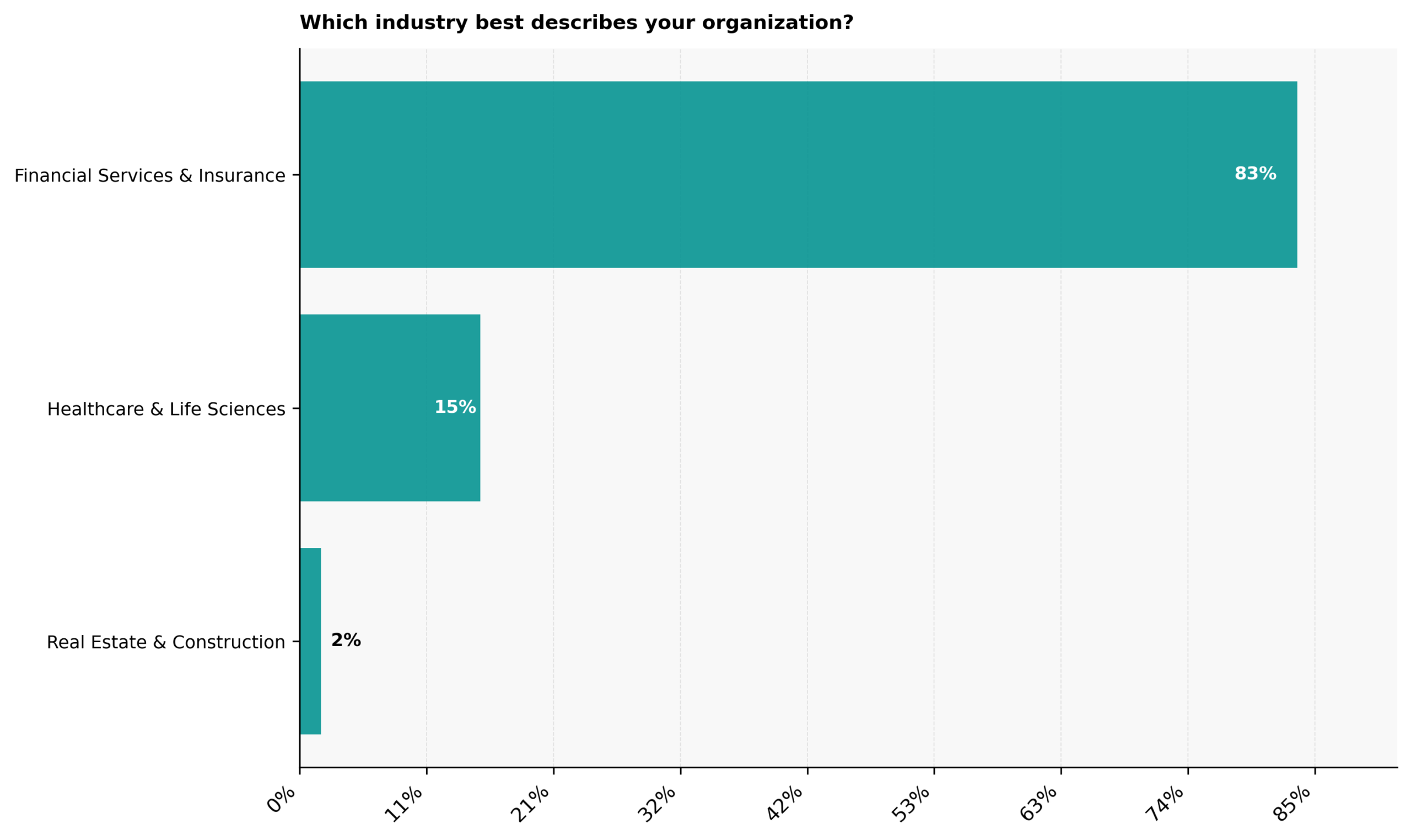
For 83% of meeting planners in our audience, the financial services and insurance industry best describes their organization. This strong presence of financial organizations is not unusual, given the consistent annual growth and current scale of the sector in the United States. Over 8.6 million people are employed in finance and insurance as of 2026, and this large ecosystem naturally creates substantial demand for conferences, meetings, and keynote presentations.
In contrast, 15% of meeting planners work in healthcare and life sciences organizations, establishing it as the second most visible industry group. Real estate and construction represented a smaller share at 2%. While the latter sectors attracted less attention, their presence reinforces the broad appeal of storytelling-focused keynote presentations across different professional environments.
Which city are meeting planners based in?
40% of meeting planners are based in Chicago, 28% in Austin, 24% in San Francisco, 7% in New York City, and 2% in Los Angeles, creating a spread across major business hubs.
Chicago takes the lead for meeting planners:
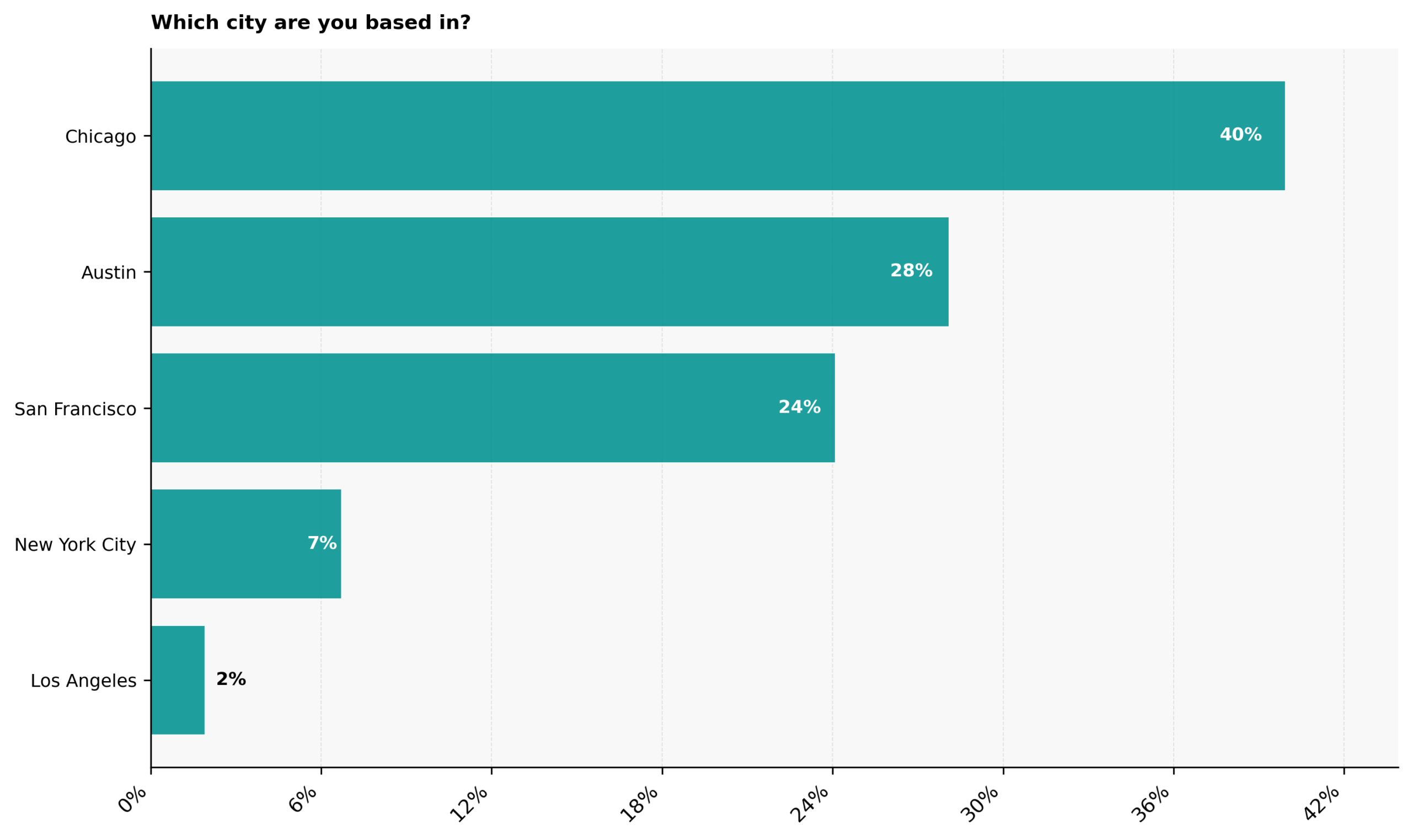
A small number of major business and events hubs emerged as the locations where our audience of meeting planners is based. Chicago accounted for the largest share at 40%, well ahead of other cities. Austin followed with 28%, while San Francisco accounted for 24%.
A further 7% of our audience is based in New York City, while 2% are in Los Angeles. Although these shares were smaller, they demonstrate that interest in storytelling-focused events extends across several influential metropolitan areas.
The story doesn’t end with the keynote
These opinions reveal that meeting planners are looking for substance as much as stage presence. They want speakers with a clear point of view, a credible track record, and stories that feel relevant to their audience rather than a one-size-fits-all performance.
A great storytelling keynote is designed to do more than hold an audience’s attention for an hour. The most successful speakers create ideas that spark conversations, reinforce event themes, and leave attendees with messages they can apply long after they leave the room.
Explore John’s storytelling keynote for sales teams and the reasons planners hire him for an event with lasting takeaways.
About the data
Sourced using Artios from an independent sample of 234,185 opinions of meeting planners in the USA across X, Quora, Reddit, Bluesky, TikTok, and Threads. Responses are collected within a 95% confidence interval and 5% margin of error. Results are derived from what people describe online, from opinions expressed, not actual questions answered by people in the sample.
Book John for your sales kickoff
Planning a sales kickoff? Bring John Livesay’s Revenue Rockstar keynote to your team. Ask about booking John.