

Restoring The Soul Of Business With Rishad Tobaccowala
Posted by John Livesay in podcast | 0 comments
The business world is changing, with AI and data-driven systems becoming more common. With these changes happening all around us, how do we keep the soul of business alive? John Livesay teams up with Rishad Tobaccowala, the author of Restoring the Soul of Business, to gain insight on how businesses can survive and thrive on these changes. Rishad discusses how to use storytelling to sell your services or products and why your vision can’t be captured using just numbers. Tune in for more on using your tools to capture the soul of your business.
—
Listen to the podcast here
Restoring The Soul Of Business With Rishad Tobaccowala
This episode’s guest is Rishad Tobaccowala, the author of Restoring the Soul of Business. He talks about when you combine the spreadsheet with the story, you have success and how your vision cannot be captured in a number. Enjoy the episode.
—
This episode’s guest is Rishad Tobaccowala, who is an author, speaker, teacher and advisor with decades of experience specializing in helping people, organizations and teams reinvent themselves to remain relevant in changing times. He specializes in unleashing talent and turbocharging productivity by delivering perspectives, points of view, provocations and plans of action, but no PowerPoints.
His bestselling book, Restoring the Soul of Business: Staying Human in the Age of Data was published globally by HarperCollins and focuses on helping people think, feel and see differently about how to grow their companies, their teams and themselves in these transformative times. The Economist Magazine calls it perhaps the best book on stakeholder capitalism and Strategy Magazine named it among the five best business books and Marketing Book of the Year. His weekly Thought Letter, The Future Does Not Fit into the Container of the Past, is read by over 25,000 leaders every week. I’m one of them. Welcome to the show.
Thank you very much. It’s great to be here.
You have such an impressive scope and understanding of data and generosity. I call it the toggling back and forth of soft and hard skills. I find it very rare that one person is an expert in both. That’s one of the reasons I was so excited to have you share these abilities to connect dots in a way that I haven’t heard anybody else do it before. Before we get into all the wisdom that you have and your wonderful book, let’s go back in time a little bit to your own story of origin. You can go back to childhood, school or wherever you want. How did you get into this concept that someday, you’re going to be a thought leader on the soul of business?
The good news or the bad news is I had no clue when I started this journey and where it would end up. If I had started saying, “I’m going to be a thought leader on the soul of business,” my sense is people would have put me in a crate and shipped me in an inhabited continent saying, “What a mad person.” I grew up in Bombay, India, which is now known as Mumbai, India. I got an undergraduate degree in Advanced Mathematics. I came to the University of Chicago to get an MBA in Finance and Marketing, which is a quad school. I joined Leo Burnett, which was an advertising agency.
I love that agency. I knew them well in Chicago. They would have apples in the lobby.
I joined them in 1982 and worked there under the Leo Burnett name until 1994, and then, for the first time in their history, I convinced them to take the name off the door to launch a new type of company which they own 75% of. I remained a Leo Burnett employee until it was called Giant Step. It was one of the first interactive agencies and then, based on that, I also helped spin-off their media company into a company called StarCom. We merged with a couple of other companies and then in 2002, we got bought by a publicist group.
For the next 15 or 17 years, I did a lot of different things inside various companies. We purchased big companies like Digitalis, Sapient and Razorfish. We merged different companies and ended up having at the end of this journey about 80,000 employees, the United States’ largest media buying and planning company.
Some of the most forward-looking digital assets include Epsilon, big creative brand names and in the last few years, I ran strategy globally or some combination of those two. I then started a second career where I had always wanted to be a writer when I was young, but my parents suggested that I needed to have something to say. They were not exactly sure a writer could make any money, so they said, “Go do something else.”
[bctt tweet=”Your vision can’t be captured in a number.” via=”no”]
I started a second career, which led to my book and I started this writing, speaking, educating and advising career. I’m fortunate that one of the companies I advise is my whole place of work, where I’m still very close to which is the Publicis Groupe. I work with a lot of other companies, a lot of startups, a lot of private equity, a lot of young entrepreneurs and now, a company of one. I’ve gone from a company of 80,000 to a company of one.
It’s exciting and interesting in its own way, but in many ways, what I’ve done is I’ve combined the two things. I’ve combined what I call the spreadsheet and the story. The spreadsheet is the digital, the data and the left brain. The story is, which you understand only too well, which is the sale is in the tale, is that you win people’s hearts and minds with stories and then you use the numbers to justify what they did.
Most people want to lead with the numbers and I think that’s a mistake. People buy emotionally and then back it up with logic.
It’s the only way to share your vision because your vision can never be captured in a number. If you think your vision is captured in the size of an addressable market, that’s not a vision. That’s numeric.
You’ve given us two great soundbite tweets already. Combine the spreadsheet and the story and your vision can’t be captured in a number. Every once in a while, I still have to convince people of the power of opening with a story. I would love your take on this. I was consulting with a group of architects who were pitching against three other firms to win this big renovation. They were only given 45 minutes and eight of them had to speak.
I recommended and worked with them on a 30 to 45-second story of origin like, “I was eleven years old. I played with Legos. That’s what got me into this.” One of the engineers who wasn’t even presenting in the room said, “We’re wasting time. We’re talking about ourselves.” I thought, “In order for us to get picked and to explain our vision, they have to know, trust and like us that we can all do the work or we wouldn’t be in the final four. Now, it’s about giving a little flavor of who we are. It’s not a waste of time at all.” The people who brought me in agreed. I stayed in, but I thought, “Wow.” I was so shocked that I still have to justify that sometimes.
The issue is this. Many of us are very proud of all the work we’ve done to create an answer and we often believe that the way we work is what is the differentiator. I believe it is not the way we work. It is who we are and what we do, but we are confused by thinking it is the way we work and what we have. It is the way we work and what we have.
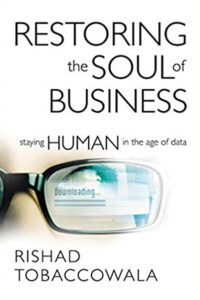
Restoring the Soul of Business: Staying Human in the Age of Data
Many companies talk about their history, not the individual’s history. They talk about the history of the company. They talk about their tools, methodologies and techniques. I remind people that it’s like trying to explain how your colon works. When people want to see cool stuff, don’t talk to them about how your colon works. Show them the cool stuff.
They always say, “You’ve got a few minutes to make a first impression.” I think it was Jerry Maguire in You Had Me at Hello. The reality of it is, in many cases, a pitch is won or lost in the first ten minutes. The first ten minutes have to set up an intrigue. Intrigue is also not something that mathematics can set up. You have to set up two things. You want to intrigue and you want a sense of inquiry. It’s a sense of like, “What is this?”
“Tell me more.” We have a Q&A session after that. I was doing the very same thing. I was using the concept of an open loop in a story. Plant the seed like, “Be sure to ask us about this in the Q&A for more details because you don’t have enough time to get into it all,” and they said that worked well. In the actual presentation and Q&A.
What you want to do is in the beginning, you want to set up with intrigue where they say, “Who are these people? What are they saying? Why are they saying what this is?” That’s intrigue about you and then inquiry from them. Those are what I call the two first Is. It’s intrigue and inquiry in the first ten minutes. They say, “That’s interesting.”
Then, you very quickly follow with three other Is, which are ideas, insights, and imagination. You provide them with insights about either their market or themselves. You provide them with the imagination of what is possible, and you provide them with specific ideas. That eventually ends you with the last two Is, which is they get inspired and you ask for an invitation.
Those are my seven I processes. You start with the two Is. The whole stuff is like, “These people are intriguing. Therefore, I would like to inquire more.” That’s getting you at hello. Very quickly, you’re starting to show your cool stuff, which is ideas, insights and imagination. You end with inspiring them so that you can get invited back.
Many times, especially when you’re pitching for funding, it’s about the second date or getting back. In this particular situation, they had already made all the final cuts, so this was the last chance. The invitation’s going to be, “We picked you.”
What happens is you simply say, “What exactly do we want to be invited to?” Sometimes it’s, “I want to be invited to the next meeting.” Sometimes it’s, “To win the pitch.” Once you do that, you notice this is all about storytelling, but along the way, you’re bringing in the math and the numbers to support the facts that you are stating. To me, the math is like the spinal cord of what you’re doing and nobody gets attracted to spinal cords unless you’re a dinosaur where a spinal cord is all that’s left of you.
How did you come up with the title of your book? I know as an author myself, that’s a lot of ideas and also what the image is going to be, especially from you coming from a media buying agency and working with so many big clients, Staying Human in the Age of Data is so strong.
What happened is I did not come up with the combination of a title. When I wrote my book, I wrote my book under the working title of The Story and the Spreadsheet, but when I wrote my book proposal and everything else, I was fortunate that I got myself an agent. My agent got HarperCollins as well as Penguin Random House interested. I talked to them. HarperCollins said, “We think this is a great idea. We are going to give you an advance, but we would like to tell you that we do not buy the title at the current time, so we are going to work with you to brainstorm titles.”
[bctt tweet=”Too much math creates too little meaning.” via=”no”]
What we did were brainstorm titles. They ended up with a title, which had Restoring the Soul of Business. I had something about human and data somewhere. They combined it and a few other titles, which included my own, which was The Story and the Spreadsheet. Because they’re a big company, they did research. They put out the titles with different people. What came back strong was this combination of Restoring the Soul of Business and Staying Human in the Age of Data.
There’s an unspoken fear for most people, and some people have spoken about the fear of AI taking over.
At that time, there was all that AI taking over, etc. For me, it was like, “It’s not anti-data. It’s not that the world isn’t becoming data-driven, but how do we include the human into looking at an extracted meaning from the math.”
A lot of people may have a great title, and then sometimes, the chapters are not intriguing. I can see why your book has gotten such rave reviews because, as someone who loves this topic of integrating soft skills and hard skills, Too Much Math, Too Little Meaning is one of the best sound bites I’ve ever heard. I have to give you so much kudos.
Thank you. In fact, there were two other things that we did which were very unusual. When someone reads my book and they start with the opening, they say, “It’s very interesting,” where I say why should you read this book. It’s because you are going to be spending the most amazingly valuable asset you have, which is time. I make the case, but then I say, “I’m going to make this easier for you. The book is not a book of essays because there’s a connecting spine as such, which is the story and the spreadsheet, the math and the meaning, but you can read any chapter in any order you want because they’re all freestanding.”
People love that.
You can go to what you want to read, and then, each chapter stands out with titles. Like Too Much Math, Too Little Meaning, there’s a chapter called Have More Meetings.
I was going to ask you about that because it’s so counterintuitive. The last thing people want is another meeting.
There’s also a chapter called How to Upgrade Your Mental Operating System or another chapter that is everyone’s favorite is The Turn on the Table.
It goes back to what you were saying about don’t talk about your colon. Let’s talk about the schedule more meetings. I’m so intrigued because again, this is such a great takeaway for everyone reading this. When you say something, write something and present something, your brain goes, “Wait a minute. I thought the opposite was true.” For example, as a sales keynote speaker, I often find myself saying, “Whoever tells the best story gets the sale and not who has the best product or the best price.” Most people go, “What are you talking about? That can’t be right.”

Soul Of Business: You win people’s hearts and minds with stories, and then you use the numbers to justify what they just did.
It’s the reverse. This book was written before COVID. My belief is I say the reason we don’t like meetings is that most of the meetings are not meetings. They’re stereothons. What we do is we go to a room and we look at a big screen with a PDF or an Excel spreadsheet while also then looking at a laptop or a tablet on our desk while we are surreptitiously looking at the other one, which is our phone on our knees. We have that as a meeting, which is I’m in a room staring at screens. My basic belief is a meeting is when you look at somebody and you have no technology involved. You have a sheet of paper if you need numbers and you talk to each other and interact. That’s a meeting.
You have four wonderful workshops. There’s more than that, but the four that grabbed me, I’m guessing those are also the subject of a keynote if someone wants to hire you just to talk and not a workshop.
You hear something about words and selling, which I think your audience will find particularly intriguing and why you’re right that the sale is in the tale. I first created four things where I could help people learn. My original four were simply called, The Future Doesn’t Fit in the Containers of the Past, which is how to think about the future, How to Manage Change, so it Sucks Less, How to Upgrade Your Mental Operating System and How to Lead with Soul. Those are things that came from my book. I call that learning and that was the tab on my website.
One fine day, I changed it. Instead of calling it learning, I call it workshops. I then ran counter to all these masterclasses and I said, “This is live, interactive, customized and not taped one way and completely non-customized.” This is much better than any masterclass, especially now when people do not want to watch. They need something live and interactive when they’re sitting at home or spread out wherever they are.
It took off like a rocket by changing that, the workshop and reframing it. The next four became much more about doing versus even thinking. One was simply called and as we’re talking about selling, it’s How to Sell Better. That’s about writing presentations in different ways. I also had one, which is how do you manage talent and how do you motivate talent in this particular area that we live in? Those became very popular.
I want to double click on the selling one and the other one about managing change, so it sucks less. Coming back from the talking workshop I gave, it was the first time these people have been in a room since COVID. Nobody has been in the office. There were people in a conference room, which used to be the norm, but now, everyone’s like, “My behavior of sitting this long in a conference room, brainstorming and practicing something is out of whack.”
Even the simplest things like, “Where’s the whiteboard and the easel? The markers have run out of ink. They’ve dried up over years.” There is also all this dusting stuff off. Regardless of where you are on the whole concept of vaccines, there’s still a lot of anxiety about coming back to the office. I would think that this managing change workshop would be so huge because it’s a big change to come back.
I’ll give you an idea and it’s very odd. I’m starting to travel again, which I was doing in October, November, December 2021. There were less of it and it’s back again, but I’m doing two presentations and they’re more or less on the same topic. I have 1,000 to 2,000 people in an organization on How To Manage Change So It Sucks Less and then across the continent of Africa to 3,000 people on How To Look Ahead and Not Look Behind.
I know you have four questions about how things change. Is there a little snippet you can give us or a little hint of one of the takeaways from this workshop for people who are reading and don’t have the privilege of hearing you talk about it in detail?
Absolutely. Here’s a very simple thing. The big thing coming out of How To Manage Change So It Sucks Less is to recognize that there are six things that everybody has to do in order for their company to succeed in changing, but most of us only do three of them and because we don’t do the other three, we have a problem. The three we do is put together a strategy for change. We then either go buy a company or hire additional talent to fill in things we don’t have. The third is we reorganize around either that company or the talent we purchased or got. That’s what I call the strategy reorganization in M&A/acqui-hire parts.
[bctt tweet=”Everybody’s got a plan until they get punched in the face.” via=”no”]
At that particular stage, we put out a press release, “Make balloons and have a party.” It doesn’t work because I remind people like Michael Tyson supposed to have said, “Everybody’s got a plan until they get punched in the face,” I believe that every leader and every board has a plan until people get in the way. I have 4, 5 and 6 are these questions. Number four is why it is good for the people. Don’t say, “Why it’s good for the company?” Number five is how will you change their incentive plan so they will change their behavior. The last one is how will you provide them with training so they can learn how to do the new things you’re claiming they need to do.
We forget. We don’t invest in training, changing incentive plans or communicating why it’s good for them and then we’re surprised when these things don’t happen. That’s fundamentally there. I then go deeper down into including solutions on how people can solve what is called the biggest disease of all, which is IDD. IDD is Inner Dinosaur Disease. Each of us has this inner dinosaur disease inside us and how to approach it. That is what that presentation is about.
You got so much good stuff here, but let me jump to the other one because this is my wheelhouse. I happen to be an amateur photographer and collect it as art. When I saw that you’re helping salespeople solve problems by leveraging photography, I thought, “I have hit the lottery,” because I’ve never seen anybody do that.
I love the concept of lenses, how you’re zooming out or jumping in and all that good stuff. What are we focusing on? The world that you’ve taken us into this concept of filtering things with quality control. I remember when I took Photo Journalism in college many years ago, the professor said, “Photography is painting with light.” “I can’t paint, but if I can paint with light with pictures, I’m in.” Give us a little snapshot of how the photography analogy can help salespeople.
The reason I use the photography analogy is that now, every one of us is a photographer because of our smartphones. Therefore, I’m using terminology that every one of us does. The reality of it is regardless of what equipment you use, I’m an amateur photographer but I’ve done a lot of it. Over time, what happens is there are three key things that matter and everything else doesn’t or matters very little.
The three things that matter is how do you frame and what do you look at. That’s the B to C in framing a picture. The way you frame makes a very big difference. The second, as your professor said, it’s about light, which is how do you illuminate and expose. You framed and you’ve taken the picture with the right light. The third one is about how you edit the solution, which is cropping, filtering and all of those kinds of things. In effect, I remind people that if you’re going to sell, what you’re selling is a solution. People don’t buy products and services. They buy solutions. If you are selling a solution, wouldn’t it be great if you could help someone frame the problem?
Framing is important. You frame the problem and that’s by focusing on what the problem is and making sure that the problem is discreet enough that your product or service can solve it. That becomes framing. The second is how do you illuminate and expose and that is everything from how do you bring in data because data is a form of light.
That becomes the second part of it. The final thing is how do you edit the solution. How do you make sure you don’t say too much in a meeting and say what’s necessary? You customize it. How do you filter it? How do you display it? One of the displays is how you do the seven Is to display what you did.
I remember one of the things when taking photography class was changing the angle whether you’re shooting down on something and standing on a table or you’re crouching down if you’re shooting animals like a dog running and you get down to their level.
In each of these, I mentioned three things that everybody can understand. You have to focus on the right problem. What you mentioned is my second one, which is points of view are incorporated. Points of view mean looking at things from a different point of view like you did from up and below as well as getting different people to look at the problem.

Soul Of Business: We often believe that the way we work is the differentiator. It is not. It is who we are and what we do.
My whole premise is, “Whoever describes the problem the best and shows empathy and can describe that, then people think, ‘You get us. You expressed our problems in a way that’s even clearer than we do internally, so you must have our solution if you understand our problems that well.’”
Most of the people who are reading this being successful as they are will recognize they have done this one particular thing, but they may not know that they did it, so I will tell them what they did. Often, all I do is reveal to people their own brilliance, and as a result, they think I’m smart, because, in effect, they say, “That’s what I did. You must be smart,” which is what they’re saying is, “I’m smarter. You figured it out, but because you told me, I think you’re smart too.”
It goes full circle to your expertise in advertising and marketing. When a marketer can put a headline or a commercial that says what people are thinking and they feel like, “You’re in my head, so this must be the right fit for me.”
Why that happens is even now, when I do some advisory work, a lot of people will call me and say, “Do you think you can help me with this problem?” I remind people, one, I’m limited in time and I’m not going to try to solve problems that I have no clue on how to solve. In some particular cases, they say, “Can you learn how to solve it? We would rather have you learn how to solve it and share how you’re learning how to solve it than get somebody who claims they have the answer.”
I’m not putting it as a pause on the future of the internet, so I know how to describe what’s going on with Web 3.0, metaverse and crypto better than most people because big companies asked me to study it for them and explain it to them how I was studying so they could understand what was going on versus me coming like a huckster and saying, “Buy an NFT. Do this. Do that.” As a result, they said, “Show us what you’re doing and how you’re doing it.” I was paid to learn to teach.
It’s like, “I can give you a fish, or I can teach you how to fish.” They were like, “We’re going to pay you to teach us how to fish.”
They’re also like, “We like the fact that you’re learning how to be a fisherman.” I told them, “I’m not even a fisherman and you’re asking me to teach you how to fish.” They’re like, “Go learn how to be a fisherman because nobody knows, and then teach us what you’re learning, including who else we should go and learn from.”
You’re curating everything for them. They trust you.
They trust me, so it allows me to say, “I don’t know.” It allows me to go to lots of world-class people and bring them in. I’m not competing with anybody, so I’m saying, “I’m trying to work on this project.” In effect, what many of your audience will find is often a client may ask and say, “Can you help me solve this problem?”
I sometimes say, “I’m going to turn your question around like this,” and often, I’ve been hired because I changed the question. I said, “I don’t think you’re asking the right question. I think this is what you’re really asking.” I have a piece that turned the opposite part, which is the problem of asking the wrong questions. I wrote a piece called The Problems of Asking the Wrong Question.
[bctt tweet=”People don’t buy products and services; they buy solutions.” via=”no”]
There’s so much good content. Thank you for sharing this incredible framework of the Is, the concept of photography and framing things from a sales perspective and combining the spreadsheet with the story is the way to get through all the noise that’s out there or, as I say, get out of drowning in a sea of sameness. If someone wants to find out more about you and hire you as a consultant, workshop or keynote speaker, the best place to send them is to your website, which is your name.
It’s RishadTobaccowala.com and there, you will find pretty much everything, including what my workshops are. If you click on where it says Thought Letter, you’ll find a lot of the stuff that I’ve talked about. As any good salesperson does, I give away the crack for free, so hopefully, people will buy the cocaine.
My Sunday Thought Letter, which is what you read and which is now read by 25,000 people, including entrepreneurs and CEOs, is completely free. That’s Rishad.SubStack.com. A lot of that content is on my website under Thought Letter, but instead of you having to go there every Sunday, it can come to you and it’s completely free. Not only is it free of no charge and no upcharge, but it’s also free of advertising, affiliate marketing and data harvesting. It’s a gift because, as I wrote, you build goodwill through generosity.
There are visuals that go with it, so you’re not just reading the text.
Also, each Sunday, I introduce a new artist, new sculptor or new photographer. There’s a new artist, sculptor, and photographer every Sunday. It’s a read that shouldn’t take more than five minutes of your time and the idea is that at the end of that five minutes, you will see, think and feel differently about the topic.
Especially generosity, that’s one of my favorites. The book again is called Restoring the Soul of Business. We certainly need that now more than ever. Thank you so much for writing the book and for putting out all of your knowledge and for inspiring all of us to be a little more human in our interactions with each other in the business world. Thanks again.
Thank you very much and thanks to everybody who read this.
Important Links
- Restoring the Soul of Business: Staying Human in the Age of Data
- RishadTobaccowala.com
- Thought Letter
- Rishad.SubStack.com
- Better Selling Through Storytelling Method Online Course
Wanna Host Your Own Podcast?
Click here to see how my friends at Podetize can help
Purchase John’s new book
John Livesay, The Pitch Whisperer
Share The Show
Did you enjoy the show? I’d love it if you subscribed today and left us a 5-star review!
- Click this link
- Click on the ‘Subscribe’ button below the artwork
- Go to the ‘Ratings and Reviews’ section
- Click on ‘Write a Review’
Love the show? Subscribe, rate, review, and share!
Join The Successful Pitch community today:
- JohnLivesay.com
- John Livesay Facebook
- John Livesay Twitter
- John Livesay LinkedIn
- John Livesay YouTube
How Business Can Build Resilience And Thrive In The Middle Of The Pandemic With Gail Davis
Posted by John Livesay in podcast | 0 comments

Anything can change in a blink of an eye. We cannot dictate what we want to happen in this uncertain world. Join your host John Livesay as he sits down for a conversation with Gail Davis on developing resilience during tough times. Gail has decades of experience in corporate marketing and event management. In this episode, she dives deep into how the pandemic brought changes globally, especially in her business which involves in-person events. She experienced letting go of employees to survive. It was definitely hard, but she believes that the pandemic opened up other opportunities for events in a virtual way. People had to adapt to using the current technologies to help them move forward with their businesses, which paved the way for innovation.
—
Listen to the podcast here
How Business Can Build Resilience And Thrive In The Middle Of The Pandemic With Gail Davis
Our guest is Gail Davis, you might remember, she was a guest back in January 2019. She is here to talk about how she navigated the challenging pandemic, especially to the speaking bureau world where live events were all cancelled. Some great takeaways for us about us for us about how, when you anticipate potential challenges, you are able to respond with an action plan as opposed to reacting from fear. Enjoy the episode.
—
Our guest Gail Davis was on the show in January 2019. Her decades of experience in corporate marketing and event management served as the launchpad for GDA Speakers. Before establishing the company in 1999, she spent years managing the events of the Dallas-based global technology conglomerate, EDS, Electronic Data Systems founded by the famous Ross Perot. While at EDS, she discovered Nando Parrado, a heroic survivor of the 1972 Andes plane crash. He presented an unforgettable speech at the EDS marquee event.
After his successful keynote, he signed an exclusive agreement with Gail. That was her first beginning. We were talking about how much life has changed for everyone in the speaking business and every business around the world since 2019. We had the pleasure of reconnecting in person at Josh Linkner’s event in Detroit. I said, “I would love to have you back on the show. You were such a great guest.” She said, “I would love to come back and talk about what the impact the pandemic has had on my business and how I have pivoted and maybe help some other readers and entrepreneurs do that. Gail, welcome back.
I am glad we made this happen. I feel like I have lived 1,000 lines since we did our first show, which was in early 2019.
It is that whole premise of, we think we have a sense of how the world operates and that we can always get a haircut when we want to. We can go see our friends and family when we have a meal, let alone live events going away. That wasn’t even on our radar of things to prepare for.
[bctt tweet=”Those who act quickly will survive.” username=”John_Livesay”]
That happened to be a leap year. On February 29th, I went to see the Eagles. That is a large concert in an arena, lots of people dancing, singing. The next day, I drove to Oklahoma and I stopped to see my mother. I said, “My business is going so great. 2019 is going to be the best year ever.” I have a fully trained team that has been with me for a long time. I am in a place where I can get away. Everything runs like clockwork.” That was Sunday afternoon, March 1st. On Wednesday, we had our first cancellation. By Friday, we had six and then the tsunami hit.
Let me ask you because so many have that experience of, “This is unraveling. It is no longer a thread in a sweater. This whole thing is coming apart.” At the time, none of us knew how long this was going to last. What was going on in your head? We were both former lifeguards. For me, as a former lifeguard, the training that I had to not panic and stay calm when someone was drowning does kick in sometimes. It can help us in those situations. What was your initial reaction? As a leader and running a big company and having people whose livelihood depends on you and your business, what went through your head? The second question is how did you keep other people from panicking?
I have a very vivid memory of that first weekend in March 2019. One of my colleagues from another bureau called to tell me that an event that was to have played in April of 2019 with Nando Parrado, he was supposed to be in person in Dallas, that client had decided they needed to reschedule. I said, “How are you feeling about all this?” He said, “I’m trying to save the company but I will talk to you tomorrow morning.” That Saturday we spoke. He had been on the phone with one of the sharks from Shark Tank. As he was hanging up, canceling an event, he said, “You have a lot of experience in running a business. What advice do you have?” The advice was those who act quickly will survive.
He told me, “You should run three scenarios with your existing payroll and expenses.” This is March 5th or 6th, 2019 that he is telling me. “Scenario number one, there are no live events between now and May 31st, 2019” I was like, “You have to be kidding. There is no way.” He said, “Scenario number two, no events between now and August 31st, 2019. Scenario number three, no events in 2019.” He was so confident in giving me that advice that I picked up the phone and I called the person that does my bookkeeping and accounting. I said, “I need you to run this for me. We should meet at 8:00 Monday morning to look at the results.” I don’t know prior to that in business, not life, I had seen anything so sober.
I am not willing to go in a hole that deep. What can I do? To answer your second question, I decided at that moment that full transparency and complete honesty was the only way I can handle any of this whether it was talking to a client or my team. I called the team in and I said, “In the last 3 business days, 5 days if you count the weekend, we had 7 events that have been impacted. We don’t know where this is going to go but I want to share with you these 3 scenarios.” That first Monday, I planted the idea. On that day, I let three people go. That is not my style. My style is to try everything under the sun. I almost felt like I was doing him a favor like, “Get down there and get in the unemployment line because the rest of the people are there.”
Resilience: At the start of the pandemic, full transparency and complete honesty was the only way you could handle your business, whether it was talking to a client or team.
I’m happy to say one of those people ended up coming back. PPP came along. We were able to stretch it a little bit longer but we are well into scenario number two. We had to let other people go. Scenario three came and went. To be completely honest with you, 2021 was a tough year. It was better but it was still tough because we are still talking about whether it’s variant D or Omicron. Lockdown or not, we are in a global pandemic and it is impacting this industry. That is what I hope we can dive into because when I sit back and I look back, I have a handle on what the good is that we can take away and some sage advice on how to move forward because the one thing that is cliché but true, we don’t know what we don’t know.
As a sales keynote speaker, I thought to myself, “I have to figure out a way.” I had a client say, “This live event, April 2020 is not happening. I’m going to push it back to August 2020.” When that came, “We are going to make it virtual.” How are you going to keep 300 people entertained on a Zoom call? That is what made me realize I have to do something. Zoom burnout became an issue. There are so many new challenges. The funny thing I thought was interesting is sometimes in these challenging situations, other opportunities come up.
In my case, the client said, “In addition to your keynote and workshop, can you teach my team how to look and sound good on Zoom? They are so uncomfortable being on camera and they don’t know how to frame themselves or like themselves.” I thought, “I’m one chapter ahead of you on that.” Trying to order equipment during the pandemic, there are a lot of people wanting professional lighting and mics. It was interesting that became a new need that never existed before. There is a technology that allows me to do some special effects.
The people whether you are a speaker or a bureau owner like you that say, “I’m not going to offer anything or invest in learning anything new unless I am dragged into it last minute.” I thought, “That is not the speaker I want to be.” If there is some new way to keep people engaged, I want to be at the cutting edge of that. It’s going to cost me some money when money is not coming in like it was to invest, learn and get the equipment. I’m going to do it as opposed to waiting until somebody asks me to do it. I wanted to hear if that resonates with you as a bureau owner.
One hundred percent. I remember a conversation with one former employee. I might qualify her as a slow adapter was, “I’m going to go with virtual. I’m going to wait and I’m going to say my specialty.” Which are in-person events. That would not work well for anyone. I love watching speakers. I feel like there are speakers that got on the front end of the technology. On March 10th, 2019, they were building their in-home studio and they were ready to roll. Others sat back and watched, “Who is doing this well? What can I learn from them?” They came into the game. There are some people I love and respect who still are sitting on the sidelines because they don’t think it works for them.
[bctt tweet=”Cross-train your team to build empathy.” username=”John_Livesay”]
For me, I knew that we had to change. I can think that to my first office in Colleyville, Texas, where we had a wall of VHS videotapes that were out the alphabetical by speakers’ last name. We used to buy blank tape and the box scrolls. We had two VCRs. If somebody wants John Livesay, we go grab your tape. We plug it in. We put a blank and we press record then we send the VHS tape in the mail to the client to watch. That is not how it works these days. Only knowing how to do in-person events is like only having VHS tapes. We had to learn it.
My first thing to my team was, “If you don’t already know Zoom, figure it out. Do you know what Teams is? Has somebody talked to you about StreamYard? I need you to get on there.” There were so many that came in at the beginning. “Everyone, I want you to learn.” The funny thing is you showed me your new toy, which is that Stream Deck. I have been doing this for months and I have never seen Stream Deck. The innovation in our industry is ongoing which is one of the gifts of the pandemic for our industry. You can look at it. People are like, “I want to go back to normal.”
I’m not sure normal is ever going to be the way it was in 2019 but there were so many gifts. Most of our sales calls are via Zoom. Prior to 2019, most of my team probably did not have a Zoom account. There are a lot of gifts. I wrote a blog. I used the line that I borrowed from a friend, Sean Hanks is the IASP President. He said, “Virtual events have become an and versus an instead of.” People who for many years had these three in-person events may now go back to those three in-person events but they may be augmenting with this August 2019 event that is going to be virtual because, in the pandemic, that was a home run.
It makes sense to keep that going. I love that. It’s not like, “We are going back to in-person. Virtual is going away.” Virtual is here to stay. There are instances where it makes sense. With international travel, it may be a long time before every person from every country can travel with this. There are a lot of gifts that have come out.
I did a keynote to a company based out of Israel and their entire sales team is global. One person is in Singapore and one person is here. Instead of having to fly everybody in, I was part of their annual kickoff meeting for the year. When I first came to Austin in March 2020, I was all excited. I had my tickets to South by Southwest. When they canceled that, I thought, “This is not something that is going to be fixed in a few weeks.” Here we are in March 2022 and it is still iffy if that is going to come back.

Resilience: The innovation in our industry is ongoing and which is one of the gifts of the pandemic bark industry. You can look at it.
Elton John was going to have two nights in Dallas. He tested positive. He canceled. There is an uncertainty in making plans that are becoming the reality of how we move forward with just about every personal or business decision.
A new skill is required because when I gave that talk down at the healthcare company in San Antonio, they said, “There are only going to be about 25 people in the room. However, we are streaming you live to 500 people so you have to speak to the room and the camera and not forget that there is an audience out there watching.” It was a fascinating hybrid experience. The fun part for me is when a client embraces the change. He said, “I have been talking about you and your book to my team about Better Selling Through Storytelling.
Instead of the normal way of introducing you by reading this introduction, we are going to put you in a private room next to the conference room. We will keep the door open and I am going to start talking and say I have been wrong about the power of storytelling and sales. We should not try and do this anymore. I want you to come in and interrupt me and say, ‘Cut, don’t listen to him. I’m here.’” I thought, “What a great way to break back into a live event.” Be that playful with your clients. It is the people that are willing to keep rolling with the disruption because that is what our brain craves.
Is this going to be the same old? When you have something new like that, it grabs the audience’s attention. You said that you feel like there have been some good takeaways. I gave an example of a client asking me to train their sales team on how to look and sound good on a Zoom call and not be intimidated if the other person keeps their camera off. It is fascinating what stresses people out. What would you say has been a good takeaway? Is the team closer than they ever have been getting through this?
Yes. I believe the team is incredibly cross-trained. When we did our last show, I had twelve people on my team. At one point in the summer of 2019, I went down to what I lovingly referred to as the core four. Those four can do anything other than run payroll. As we would add that in one person that summer, I remember when I was interviewing her she had prior bureau experience and I said, “I need you to do this. Sometimes I might need you to do this.” She said to me, “You need me to catch what needs to be caught.” I was like, “That is what I need.”
[bctt tweet=”Virtual is here to stay. It just makes sense to keep that going even after the pandemic is over.” username=”John_Livesay”]
She came on. She is super cross-trained. That is a very big gift in terms of the team’s closeness. When you are super solid and you haven’t sat in the seat of your fellow teammate, it is easy to get super irritated with them like, “Why are they aren’t meeting this deadline?” We have some new people that this is not the case but the majority of the people on my team are super cross-trained so there is a lot of empathy and understanding of the competing priorities. That is a positive for the team. In terms of the value that we add to clients, our skill or anticipating things we need to consider in the contract is at an all-time high.
Pre-2019, you want John, you want him in Austin and you want him on this day, contract done. Let’s move on. Now we are asking the question, if something prevents John from being there whether John can’t travel, you decide to go virtual, there is a government restriction implies. There is a new variant. I could go on and on. Let’s go ahead and discuss what that looks like. A lot of times they will say, “We are only going to do it in person.” We say, “Let’s talk about that. Do you want to kick the can down the road or do you want to have a contingency? What are we trying to accomplish?”
Sometimes if you are trying to train your team and keep the momentum on your team going, rescheduling the event to a later date is not necessarily the best. We get into a discussion of, “If he didn’t come in person, would he give us a reduction on the fee for virtual?” We have to navigate that. Anticipating and having the conversations that everybody is so tired of having but making sure we have them, we are better prepared. When I looked at how many events were impacted by the original Coronavirus, I still have 8 things we haven’t resolved out of 200.
You go to the Delta variant, we only had 23 and all the 3 are resolved. We know what we were doing, we are just waiting for a signature. So far, we have only had sixteen on Omicron. It is only two weeks old but about half were already resolved. That directly ties to anticipating, thinking, contingency, covering things in the contract. It is a little bit of a pain because you have to do a quick agenda but you have already thought through it. That is a time-saver to everybody because these variants coming up right before the event and we don’t need to be exploring options. We need to implement options.
That is a true sign of a good leader whether you are leading thousands of people, 10 or 4. Anticipating a need. I remember when I had the Banana Republic as a client and they said, “We want to redefine what luxury is. We are never going to be Neiman Marcus in terms of pricing but what if it was anticipating a need before you knew you needed it?” They put a place where you could get your phone charged in the flagship stores in San Francisco and Manhattan Rockefeller Center. They would say to these people, “Would you like us to charge your phone? We will guard it while you shop.” Unexpected luxury. The sales went up 10% because people kept shopping until the phone was fully charged.

Resilience: There’s an uncertainty to making plans that is sort of becoming the reality of how we move forward with just about every personal or business decision today.
There are all kinds of outcomes by anticipating a need before you know you need it. That separates the Banana Republic and you as a bureau. “I like working with Gail’s team because they think of every potential thing that could go wrong and a contingency plan to solve it.” Back in the day, your plane was late, you would miss a plane. You are great at getting another speaker there at the last minute. The microphone, battery or power bank goes out. Your remote doesn’t work. A hundred and one things can go wrong in a live event and you still have to be able to perform.
I had a situation where we had done little tech rehearsals on virtual in addition to the prep call. They were using a different platform besides Zoom or Microsoft. It had not been tested. They had not tested 300 people coming on at the same time, which caused the bandwidth to stop. They were freezing. Luckily, I had somebody on as my tech backup because as a sales keynote speaker, I’m used to people in the corner running the show. I’m not going to go solo on a tech call.
I have somebody on the call with me going, “Your volumes not all right. Something is off with the camera. Let me fix this. My Zoom call can handle 500 people. Let’s all move over to this Zoom link and we will redo the breakout rooms while you are giving the keynote talk so that the workshop will still work as planned.” The client was so grateful because their whole thing almost crashed because of technology. Is it worth it to pay somebody out of my pocket to be on those calls? You bet.
It is funny talking about the challenges and technology. We added to our team one of our logistics managers. She manages all the logistics. She started in the summer of 2019. One day, we realized, “She has never done an in-person event.” She mentioned that in the olden days, it was all about light planes, snowstorms and speakers’ travel delays. It was comical. It was like trying to show someone the old VHS tape and say, “Here is how you plug it in.” She had no frame of reference. She picked it up quickly. She is a rockstar but it was funny that they are talking about digital data. She was a virtual speaker.
All of us have to continually evolve. What I have learned personally is we can never get too comfortable. We all hear people talk about getting out of your comfort zone but you think, “I have invested in learning this skill. I have got a great brand.” You have been in business a long time. “I have a great reputation. My staff is trained,” and then a pandemic hits. You are like, “I get to see if I’m going to reinvent myself. Look at the three possible scenarios, worst-case scenario, scenario number three.” You are still here, not the case through all the bureaus. This transparency and adaptability. The thing I want to double click on that you said, I have not heard many people talk about this and it is so valuable for the listeners is cross-training your team building empathy. There is The Great Resignation happening.
[bctt tweet=”We don’t know what we don’t know.” username=”John_Livesay”]
A lot of our clients are saying, “How can I keep my team from leaving? I have some superstars. I don’t want to have them leave.” I have found that helping companies not only create case stories to help them win more business but getting individual people to tell their story of origin. What got you into healthcare? What got you into the speaking business? They start to find out things about each other that they never knew. It is fascinating to hear other people’s case stories.
For example, with a healthcare client, they said, “My mom was a nurse. That is what got me into it. I was a microbiologist. I didn’t want to spend my life behind a microscope.” “We worked with you for three years. We never knew that about you.” The management and sales teams are telling me, “We feel like we are losing the bond because we haven’t been able to see our sales team in person.” Now that you have had them put their story of origins together on this repository map with their case stories, they feel seen, heard and appreciated in a whole new way.
It has become an onboarding tool for HR that they say, “Get to know your co-workers, share their stories until you make your first sale but also get to know them as people.” What we live for in the speaking business is if a storytelling speaker can impact a culture that, “I’m hired to help you win more sales but if I can help you break down silos because all these stories live in one place and you can start sharing the stories and make introductions to other divisions, that is the joy of all of this.” What you have done here is a role model for all business owners. You have a culture and from day one you say, “It is not just this job description. If that is your mindset, that is not the culture fit here.” Brené Brown’s latest book talks about that. In her people, she was like, “If you walk by a piece of trash and go, ‘That is not my job. I’m not picking it up. That is not why I worked here.’”
A part of the way we developed empathy during the pandemic is each month we would have what we call the leadership meeting. We might have done it weekly at that point. We did Brené’s book, Dare to Lead. The team got super vulnerable. They do the exercises. They would share. It is your point of getting to know their entire story not just, “This is Susie Q over here doing an account.” It is super important.
We start to remember, “Everyone had some challenges in their life or this is something they have always dreamed of doing.” Like your wonderful story of origin. From EDS to hearing a speaker in that launching. Companies need a story. We all want to connect emotionally. That is what the stories do. You have such a great story. I am so excited and thrilled to hear how successful you are continuing to be. If you have survived this, you can survive anything. Any last thought or piece of advice you want to leave our readers on how to embrace the ongoing disruption and changes that we know are going to be part of life now?

Resilience: We need to watch our language when we hear ourselves. We all want this pandemic to be over. But we can’t control it so we have to reframe our mindset. And we have to look for the gifts. We have to look for the opportunity and we have to take that skill that we’ve developed of anticipating changes.
Once someone gave me a book. It was one of those little flipbooks that you go through but the cover said, “Normal Is Just a Setting on Your Dryer.” There is something to that. We need to watch our language when we hear ourselves. Sometimes I’m so tired, I want this to be over. I wanted to go back to the way it was. I want it to be normal. We have to reframe it. We have to look for gifts and opportunities. We have to take that skill that we have developed of anticipating and anticipate what else can change. How else could we modify this? How else can we take this forward? It’s a shift and muscle we have exercised ad nauseam. We will be well-served if we tend to lean into that.
Imagine if you never worked out and then suddenly you had an emergency where you had to swim, run or something. If you keep that muscle active, I’m adaptable and flexible we will go full circle in the lifeguard analogy again. We had to train. When someone was flailing their arms and you couldn’t throw them a buoy because they were too panicked, you knew, “I’m going to have to go in.” Let’s go and embrace the new world. Thank you so much for sharing your wonderful stories with us.
Thank you. It was great. You are always such a good person to visit with. I love it.
Likewise, Gail.
Important Links
- Gail Davis – Past episode
- GDA Speakers
- StreamYard
- Dare to Lead
- Better Selling Through Storytelling
- Normal Is Just a Setting on Your Dryer
- Better Selling Through Storytelling Method Online Course
Wanna Host Your Own Podcast?
Click here to see how my friends at Podetize can help
Purchase John’s new book
John Livesay, The Pitch Whisperer
Share The Show
Did you enjoy the show? I’d love it if you subscribed today and left us a 5-star review!
- Click this link
- Click on the ‘Subscribe’ button below the artwork
- Go to the ‘Ratings and Reviews’ section
- Click on ‘Write a Review’
Love the show? Subscribe, rate, review, and share!
Join The Successful Pitch community today:
- JohnLivesay.com
- John Livesay Facebook
- John Livesay Twitter
- John Livesay LinkedIn
- John Livesay YouTube
Brain+Trust With Tim Hayden
Posted by John Livesay in podcast | 0 comments

In today’s fast-paced world overrun by technology, understanding how the human brain behaves, works, and reacts is an important aspect of digital consumption. John Livesay delves more into this topic with Tim Hayden, the founder of Brain+Trust and chief business strategist at The Next Practice, by discussing how empathy and getting a full grasp of audience emotions can result in a compelling marketing strategy. Tim also explains how data science is being applied to COVID-19 trials as well as the concept of sonic gardens.
—
Listen to the podcast here
Brain+Trust With Tim Hayden
Our guest is Tim Hayden, who is the Founder of Brain+Trust, which is an agency that helps companies use empathy and technology to anticipate how to get inside their customer’s head. He’s also involved with a company called The Next Practice, which is about anticipating what’s coming around the corner. We go into things like how to tend to your sonic garden, a consent management platform, what’s happening in the world of AI, and consent and data privacy. All through a lens of how do we make the world better. Enjoy the episode.
—
Our guest is Tim Hayden, who has many years of marketing and business leadership experience. He’s been the founder of new ventures and a catalyst for transformational progress with some of the world’s largest brands. He is a strategic business executive, studies human behavior and how media and mobility are reshaping all of the business. From operations to marketing and customer service, he assembles technology and communications initiatives that lead to efficiency and revenue growth. He’s an investor and advisor to technology startups. He actively works with entrepreneurs and ventures to capitalize on opportunities and shifts across many different industries. Tim, welcome to the show.
John, thanks for having me. I appreciate that introduction.
Tell us your own story of origin and take us back a little bit. You can go back to childhood. You can go back to your days at Texas State. How did you get interested in being involved in startups in general? It seems to be a part of your path.
Growing up, my mom was a school teacher and later on, she became an executive with several nonprofits including The Hurst Euless Bedford Chamber of Commerce, right in the middle of the Dallas-Fort Worth. My dad on the other hand was in software. That’s probably what made me acutely aware of what was happening with technology and how it was iterating as time went along. Technology got faster. It got better. My dad, I wouldn’t say it was cumbersome, but he was absent for a lot of my formative years because he was working for somebody else. That’s the easiest way. I’ve always thought if I could wake up on Monday mornings knowing that the world is on my shoulders to win, to survive, or to do whatever else, that’s the path I’m going to take. That’s even been the case when I’ve gone to work for a large corporation or somebody else. I’ve always tried to be entrepreneurial in my approach.
Doing my research in preparation for this is, you have a fascination with human behavior and that’s why we’re looking forward to getting to talk with you because I share that passion from my advertising background. That’s what made me get into advertising was, what motivates people to change their behavior or buy one product over another. The same concept to persuade one person doesn’t necessarily work for another. You have certainly done a deep dive into that. Let’s start with what you’re doing at a company where you’re the Chief Business Strategy at The Next Practice? I find that concept fascinating “unlocking what’s next?” This premise that we all have to find what’s coming around the corner, we can’t stay in our comfort zone is what I get from what you’re doing there.
I’ve worked across a number of industries. You take municipalities and state local governments. This comes from even me sitting on the board of the Austin Chamber of Commerce at one time. The art of economic development is always being able to look 5 to 10 years in the future to understand what do you need to do to develop an infrastructure, the systems, the processes, and the environment for business to be conducive for a long period of time. That’s one part of it, but at The Next Practice, we’re all about doing that in terms of marketing customer experience and communications. We think that without calling it digital transformation, how can we help organizations with their endeavors be able to realize revenue growth, find new customers, and experience repeat behaviors from the customers that have already bought from them?
[bctt tweet=”Going on the next level by having empathy is what every entrepreneur should keep in mind.” username=”John_Livesay”]
How can we do that and always be ready for how behavior is going to change? That’s the important takeaway there is that, as the world becomes more automated as immediacy. During COVID, we can buy anything and have it delivered to our house in a matter of minutes, hours or days. That’s been a reality for some time, but we all know it way too well and we expect the rest of the world to be that way. At The Next Practice, we’re about being always on the next level if we can. It doesn’t mean that we’ll overshoot what needs to happen, but it means that we’ll have an understanding or maybe empathy with where things need to go from here.
You were very involved with the Austin Chamber of Commerce. Let’s give a shout-out to Austin and what an amazing community. I live here myself. I’ve been impressed by the friendliness, openness and collaboration that everyone finds here. A lot of people are moving from Silicon Valley here. The city has been voted the number one place to live for a couple of years in a row. There’s so much that it has to offer. From your perspective, both with your experience at the Chamber of Commerce and being an entrepreneur here, what is it that makes Austin special for you?
I went to school in San Marcos about 30 miles South of here. In the early and mid ‘90s, I was exposed to a lot that was happening with Austin. My wife went to UT. Neither one of us grew up here. She grew up in East Texas. I grew up in the DFW area. It’s the vibe that Austin has built on the edge of the Hill Country with a river running through it. It’s between the University of Texas and Ohio State, which has the largest public university in the country. Lots of young people live near the middle of town. You put a state government in the middle of it. The state government that leans a different way than the local government leans. It makes for an interesting mix of developments in terms of culture and business. That’s why Austin is the place for a creative class and for people whether they want to start new companies or they have fresh new ideas, this is a wonderful Petri dish to do that in.
You add in how green it is with an aquifer, the beauty of all the parks, amazing food, and live music. There are many special sauces to it that companies, even Tesla are coming here. It continues to attract and see what makes it unique. The thing you said that resonated with me, Tim, is as it relates to The Next Practice is this concept of empathy. Can you define for everyone reading what empathy is from a business standpoint? How is that a great tool to anticipate what’s coming next?
We look at it through the lens of design thinking about being human-centered, customer-centered in business is to understand exactly the preferences, needs and disposition of your audience. You said it first, “No two people have the same behavior traits, no two people have the same wants and needs, or have that same disposition.” When you talk about empathy, it’s about putting yourself in someone else’s shoes as best as you can. That’s a tall order. It’s an impossibility to do at scale, but thanks to the way we’re connected digitally these days and more so every day, we have the beauty of data turned into insights. That helps us understand how people behave, what their preferences are, what they imply and state, and maybe how they respond to questions we put in front of them.
It’s always about understanding and being customer-centric. That goes for internal communications, as well as understanding teams and business units, how can they better share information, how can they be on the same page having a true north of insight on that customer behavior. We believe at The Next Practice and Brain+Trust partners, that’s the remit for companies that want to not just survive, but want to succeed and grow over the next decade.

Brain+Trust: Being customer-centered in business is to understand exactly the preferences, needs, and disposition of your audience.
Let’s take some companies, maybe Kodak or Blockbuster. They had a little more empathy and been able to take a look at what’s coming. Maybe they would have seen that the business model that they had relied on for so long wasn’t going to stay either because the technology was changing and customer preferences were changing. The hassles of back in the day going to a store. Imagine young people today, they don’t know how to even operate a rotary phone. Let alone the concept of you had to wait for a movie to be returned before you could see it. All that is fascinating to me. You touched on Brain+Trust. As I said, you are busy in many projects. Tell us your role at Brain+Trust and what the story of origin was there?
In 2016, I was in the process of moving back from the Bay Area in California to Austin. I was out there in the Bay Area for two years. I had a couple of colleagues that I knew who had come from large global digital media roles with major companies. We all had a conversation and said, “There’s a wave of new technology coming into the market.” Artificial intelligence, machine learning, automation, not to mention what was happening with social media. Not to mention what’s happening in mobility in the automotive space with cars getting smarter. Some cars are able to drive themselves. All of this and the speed at which it’s happening is extremely confusing to decision-makers and leaders.
We built Brain+Trust, first and foremost, to be a sage counsel and at least a resourceful guide to be able to help business leaders roadmap where they need to make investments and decisions for investing in the future, whether that’s new process and operations or new technologies. Thanks to the pandemic in one way, it accelerated the need for companies in light of customer data privacy laws. In terms of the imminent threat that companies like Amazon and others pose to certain verticals, is to build a direct and personalized experience with your customers and to operate on their terms, which brings us back to empathy. Understanding your customers in their needs and serving those needs, that’s what businesses must focus on.
I spoke at the Coca-Cola CMO Summit and it was the CMOs of all of their quick-service restaurants that serve Coke. I was speaking to the CMO of Domino’s Pizza. He was explaining that their philosophy was creating the perfect pizza experience. Meaning you have a thought, “I’d like a pizza,” and it magically appears and fast. He and his team created that app that tracks the thing. I want to ask you about that whole thing of transparency and that people feeling part of the process is a new behavior. They’re using artificial intelligence.
That’s one of your areas of expertise. They said, “If you tend to order the same pizza at the same time every day, and you open the app or pick up the phone, the AI notices it and says we’re going to take a risk the odds or whatever. Put the pizza order in before you finish completing what you want on it to try and shave off a few seconds of the delivery time.” The bigger picture is the perfect pizza experience, and that’s where I’m fascinated to get your insights on because technology is great. Unless we’re connecting it’s feelings and emotions. What’s coming next and have this overall vision of in this case. I think about a pizza and it shows up and then using AI to make that happen without the customer even knowing it is something that you’re talking about.
We used to call that surprise and delight. KLM Airlines does this in several airports in Europe, where if you put up a signal, if you tweet or back in the days when everybody’s to check in on Foursquare. If you let the world know you’re at the airport and KLM has got their ducks in a row from a technology standpoint. They sense that you’re at the airport because you said you were. They already know what flights you’re on, what gates you’re on. They’re going to surprise you with a gift. They’re going to surprise you with something. We’re going to see more and more of that. What’s fascinating though is that because of the choices that consumers have, in terms of where they can get the goods and services they need. The way they can go about discovering new flavors, new products, and new brands. We got to be careful.
[bctt tweet=”Understanding your customers in their needs and serving those needs—that’s what businesses must focus on.” username=”John_Livesay”]
We need to know that it’s okay when I call my local pizza. I order from East Side Pies a lot here in Austin. If I call them up, I’ll ask, “What did I order last time?” They tell me what I did. I said, “Let’s do it again.” I don’t have to tell them my name. Because of caller ID, they knew who I was. That’s good but understanding that maybe shaving a few seconds off the delivery doesn’t mean that you have to preempt the consumer. Let’s allow our customers to be in control as much as we can. Let them opt-in. You’re required to do that because of data privacy laws that are popping up in 27 states. The bottom line is let’s make sure that they’ve consented, they’re opting in, and they’ve given you the green light to do that thing.
Which leads me to an article you wrote about, “If you can’t give a customer a cookie.” You talk about this premise of Consent Management Platform or CMP. Tell us what that means and how that can help businesses do better marketing.
Most people that are reading this are going to be aware of websites, especially news websites that they visit. That has a little banner that comes up and says, “Will you accept these cookies?” Most of those outlets will allow you to click on a different link and be able to see how your information is used. That’s how global data privacy regulations in Europe, which started a few years ago. That’s how that spelled out and how you’re supposed to do it. That’s how the California Consumer Privacy Act, which went into effect here in the United States. That’s what it says you need to do. What’s happening is Google is no longer going to support third-party cookies, which empowers brands to do so much from tracking a customer from a search result to the website. Maybe to the mobile app, to an eCommerce store, to a physical location and to do so on their terms, not Google’s.
Google is saying no longer will they support third-party cookies or use them in terms of how they do everything from rank searches and guide people to your doorsteps. You’re going to see probably more of investment directly with Google that will be required to leverage the behavior that’s there within Google. Apple at the same time has come out with a new operating system, iOS 14, which puts the customer in total control of who gets access to their data. Who gets to understand where they go with that device, whether an iPhone or an iPad or a Mac. What is consumed on that device, where has it been used, maybe what speed were you going, what direction you were going back to your place. Your point about predictive pizzas, “Does he drive by here every day?”
What we’re seeing is twofold. One, commitments to customer data privacy. That’s what we see there, but we’re also seeing that Apple, Google and others are doing all they can to be able to compete with Amazon. They understand that in Apple’s case with maybe Apple News before but with Apple TV plus, they’re getting more minutes of the day and more hours of the day with you in their ecosystem. You’re consuming media that flows from Apple. You already have the devices. You carry Apple with you all day that, how do we get more of your time while you’re in at home, your vehicle, and other environments. That’s what’s going to be fascinating over the next few years, as we see that shake out alongside more scrutiny to customer data and customer data privacy.
The other thing that I was interested in and impressed by was your Brain+Trust partners are a member of The Next Practice Group and you’re working with the Johns Hopkins University on their trials during the COVID. Can you explain how you’re helping all of that effort that everyone is concerned about?

Brain+Trust: The flip side of understanding consumer human behavior is how to get on the other side with behavior change.
I can’t tell you everything, but I can tell you that we’re employing data science to be able to identify audiences and opportunities to have people enroll in the trials. This is for convalescent plasma. This is a partnership between Johns Hopkins University, UCLA and several other universities. It’s about helping them as quick as possible as the trial needs to run, because with COVID, it’s a race for everybody to get the best possible treatments in place. The best possible vaccines through the approval process and trials. It’s a treatment with convalescent plasma and it’s not different than a company that’s trying to get to market as fast as they can before their competition does. In this case, their competition happens to be a virus.
It’s always a race and this case, the stakes are very high. How wonderful that you and your team have the technology that you used, crafted and honed to help companies have successful launches and anticipate what’s around the corner and play all scenarios out of imagining. What could go right, wrong and how can we mitigate those to help us all lead happier and healthier lives again without this fear hanging over us. There are some to going back to the empathy thing. There’s a toll that we all feel over time that we’re going to start to look at. What is the toll of isolation, depression, and all these other things that are separate from the fear of getting sick? I was talking to people at assisted living and how much longer it’s taking to get people to put their parents in an assisted living home because of those fears. Not being able to visit the parents and all those issues come up into play. You’re at the cutting edge of anticipating what’s going to be needed to help people get through what could be seen as a post-traumatic syndrome situation when this is finally over.
That’s the flip side of understanding consumer human behavior is how do you get on the other side of it with behavior change. How do you be able to temper expectations because there are many statements being made some by the government, some by brands companies that purport to have solutions, whether that’s vaccines, it’s more hospital beds, or it’s certain types of treatment or medicines. In terms of the fear that hangs over us, it’s intimidating or even worse than that it creates anxiety. There’s the associated things that happen there if going to the office was the only time you socialized with others. I think is the case for a lot of people.
There are some problems that can occur in terms of depression and isolation. How do we manage this in terms of a much calmer approach to educating people on how to stay safe. Educating people on when there may be changes to certain protocols, whether that’s businesses reopening, schools reopening, or new types of testing being available in the market. There’s much in the way that we can all learn from this experience on how we should go about education, which is a communications remit. Not only understanding behavior, but helping change results in better outcomes for certain populations or the population at large.
I have to ask you about your concept that we all need to tend our sonic garden. First of all, nobody loves words and can appreciate good writing as much as I do with my advertising background, speaking and helping people become storytellers. That’s what sticks is when our brain goes, “I know where the garden is. I know what sonic waves are. What is a sonic garden?” You have the skill of pulling people in with your words crafts. Tell us what you mean by tending a sonic garden.
People talk about elevator pitches. There are certain tones that when you’re on your couch, in your home, and a TV spot comes up of your favorite fast food restaurant or an automotive brand, you can tell within the first few seconds who that is. Even without looking at the screen, you usually can tell. The same thing with jingles, for shows tones like for Intel Inside, these are all pieces of us at Brain+Trust. I need to give all the credit in the world to my business partner, Tracy Arrington. She comes from years of advertising and has always looked in audio, especially with radio, satellite radio, and podcasting. The opportunity to build more trust with an audience and to do with certain sounds, audio cues, messaging, and the narrative you put forth.
[bctt tweet=”How to forge better relationships with your audience and catch their interest? Understand their needs and emotions first.” username=”John_Livesay”]
Back in the day, television shows used to have a theme song and then they got so frenetic about every second costing money. They’re like, “Can we cut that out and have a show without a theme song, friends, and all that stuff?” A song that people would hear that and they smile. Now because they want more time for ads, they have cut that out. If people want to know more about Brain+Trust or The Next Practice, any other way you want people to follow you? I see you’re big on Twitter.
I don’t know that I’m big on Twitter. I’m @TheTimHayden on Twitter. I always doing a podcast or anything like that would say, “If you had about anything we talked about or want to challenge me on it, please do it out in public. Bring it on Twitter.”
Any last thought or quote you want to leave us with, Tim?
We have a number of things that are going to greatly reshape how the country and our cities and our states are run because of all the different positions and different referendums that are up. The sun is going to come up tomorrow. Saddle up. Know that there’s always a new day.
Thanks so much, Tim.
You got it, John. Thank you for having me.
Important Links
- https://Braintrust.Partners/
- https://NextPracticeGroup.com/
- @TheTimHayden – Twitter
- Better Selling Through Storytelling Method Online Course
Wanna Host Your Own Podcast?
Click here to see how my friends at Podetize can help
Purchase John’s new book
John Livesay, The Pitch Whisperer
Share The Show
Did you enjoy the show? I’d love it if you subscribed today and left us a 5-star review!
- Click this link
- Click on the ‘Subscribe’ button below the artwork
- Go to the ‘Ratings and Reviews’ section
- Click on ‘Write a Review’
Love the show? Subscribe, rate, review, and share!
Join The Successful Pitch community today:
- JohnLivesay.com
- John Livesay Facebook
- John Livesay Twitter
- John Livesay LinkedIn
- John Livesay YouTube