

Marketing Mastery With Mostafa Hosseini
Posted by John Livesay in podcast | 0 comments

What are the secrets in formulating the best marketing strategies to scale your business up? Join your host John Livesay as he talks with Mostafa Hosseini about lead generation, qualifying leads, implementing marketing plans, and much more. Mostafa Hosseini is an entrepreneur and business coach that could help you create and implement a one-page marketing plan in three days or less. He shares his story on why he decided to drop the digital marketing services and keep coaching and consulting. He emphasizes the importance of identifying your target market. With his top three values of growth, family business, and learning, there are many takeaways in this episode of marketing mastery. You are sure to take the leap to make a profitable business for yourself and your loved ones.
—
Listen to the podcast here
Marketing Mastery With Mostafa Hosseini
Our guest on the show is Mostafa Hosseini, who’s an expert in marketing. We talk about how nothing works when someone’s trying too many things at once and how important client retention is. That is an untapped vault of cash that people aren’t using properly. Finally, he says 70% of entrepreneurs suffer from depression and overwhelm, and he helps them solve that with a laser focused plan. Enjoy the episode.
—
Our guest is Mostafa Hosseini, who helps coaches and consultants create and implement their one-page marketing plan in three days or less. He is a serial entrepreneur, a business coach, and the Founder of Persyo, which he’s also the host of the Daily Confidence for Entrepreneurs podcast, he’s the creator of Simple Marketing Formula, and much more. He’s been coaching and consulting for many years, helping businesses in various niches and industries grow and scale. Welcome to the show.
Thanks for having me. It’s great to be here.
I would love to hear your personal story of origin. You can go back as far as childhood or college. How did you get into becoming such an expert in marketing?
I was born in Tehran, Iran and moved to Canada back in 2000. I finished high school and I was eighteen when I got here. I went to school here. When I got first got here, I did not speak English. I went to English school for a couple of years to be able to speak. I went to school for engineering for two and a half years, didn’t liked it, dropped out, got into business school, loved it, which is what I wanted to do since I was a child. I got a diploma in Marketing Management. I got my Bachelor’s in Business Management with a minor in Marketing. I went to school for a long time and I started Persyo Marketing back in 2010.
Let’s stop the story there for a second. How did you come up with the name of your company, and what does it mean?
When I was trying to pick out names, the names that I wanted were all taken, the domains were taken. I had to come up with the name. What happened was one day back in 2010, I was sitting at a food court here in a mall in Calgary and I saw this restaurant. I’m like, “What about Persyo?” Persyo because I’m Persian-Canadian. I made the name, Persyo did not exist. When I searched Google, it didn’t bring up any results. I’m like, “Bingo.” The domain was available. I went for it. I asked a few people, “What do you think?” They’re like, “It sounds good. We like it.” I started Persyo Marketing. We did full-service digital marketing along with coaching and consulting our clients.

Marketing Mastery: By knowing what you want, you increase your odds of winning by 10 times compared to a person who doesn’t know what they want.
Back in 2017 or 2018, it got a little too competitive for me. I’m in a hyper-competitive environment and I decided to drop out and drop the digital marketing services and keep coaching and consulting. That’s my story. I’m married. I got two boys. My top three values are family business and growth and learning. I spend 99% of my time with family, business, growth, and learning. I love nature, mountains, skiing, hiking, barbecue. I love my Persian kebab. If you ever come up here, if I see you anywhere, I’ll do some barbecue and go from there.
Now that you’ve worked with so many different kinds of clients, do you see them having similar challenges or making the same mistakes in their marketing? Are they too complicated typically? Is that why you’ve honed it down a little bit to help people focus?
The number one challenge that I asked people over the years when it comes to their marketing is not knowing what to do. They want to grow their business, get more customers, and the rest of it, but they don’t know how to do it. The other challenge that they have is they start trying too many things. They are poking around twelve different things at any given time and nothing is working. That creates a feeling of frustration, overwhelm, anxiety, and people get depressed because they don’t get results. Back in 2017 or 2018, I read three books that changed the way I think and changed my business. The first one was Zero to One by Peter Thiel, who is one of the Cofounder of PayPal. In the book, Peter Thiel talked about how competition is for losers. He says, “You got to be in a place where there is no competition or you have very few competitors.”
I had too much competition that I felt like a loser. I’m like, “I got to change this.” I had competition all over the planet. In the digital marketing world, the barriers to entry are not very strong. People wake up one day and they’re like, “I’m a digital marketing advisor.” I decided to drop out of the digital marketing services and stick with coaching and specialization. The next book that I read that made a massive shift in my thinking was The 80/20 Principle by Richard Koch. If there’s one thing I wish I knew many years ago was this 80/20 principle. The next one was Essentialism by Greg McKeown on what is essential and not. I went through this phase and within 4 or 5 months. I’m like, “I need to simplify and focus.” I came up with a Simple Marketing Formula where we consolidate and simplify everything into one page.
Most business plans, especially coming out of MBA, it goes on and you don’t know where to start even with an executive summary it’s still so overwhelming and the shiny object of, “We should be on TikTok?” I’m like, “It depends on who your audience is. Not necessarily.” I like that. This 80/20 rule, for those people who may not know exactly what it is, I certainly found that useful in my sales career that 20% of your clients give you 80% of your revenue and 20% of the time you spend give you 80% of your results.
Are you spending time with clients that aren’t generating that much revenue? Sometimes, the lowest 20% of your clients are taking 80% of your time. That reframing of all of that is so crucial. Are there some myths that people have like, “If I spend so much money on my marketing, I should get this much percent growth automatically guaranteed?” or anything like that you see people thinking, “You’ve heard that, but that’s a myth.”
You mentioned one of them that, “If I spend so much money, I’m going to be successful.” It could happen, but it may not necessarily be true. One of the bigger problems that I see is if I worked hard, I’m going to see results. You talked about the 80/20, if you work on the 80% that doesn’t produce results, regardless of how hard you work, you’re not going to get there. I heard Tony Robbins said, “If you run East looking for a sunset, regardless of how hard you run and work, you’re not going to see it.”
[bctt tweet=”Nothing works when you try too many things at once. 70% of entrepreneurs suffer from overwhelm because of the lack of a plan.” username=”John_Livesay”]
I also think of the people at Kodak and Blockbuster, I’m sure they were working very hard up until the last minute.
The company doesn’t exist anymore. The strategy was outdated and what they were doing didn’t work and it got wiped up. Those are some of the biggest things.
You hinted at it, but let’s double click on what is this simple marketing formula that you’ve come up with?
The simple marketing formula was I need to apply to 80/20 principle to marketing and break it down to a few simple steps that cover 80% of the stuff that you need to do. I came up with six steps. Number one, you need to set your goals. You need to know exactly what you’re trying to build and achieve. As an example, when you’re trying to build a house, you design it, you do the dimensions. How many bedrooms, many garage doors, and the rest of it.
Come up with a plan, hand out the plan to the builders, bingo, they start building. You barely ever build a house in a city, at least, without a plan. If you do, you won’t get any insurance for it, and/or you would not put your family under that roof. You need to plan and know what you’re trying to build. If you don’t have a plan and a goal, you’re not going to achieve it. It’s pretty hard to achieve a goal that you don’t have.
It goes back to even time management. If it’s not scheduled, it doesn’t get done.
Step number one, know what you want. By knowing what you want, you increase your odds of winning by ten times compared to a person that doesn’t know what they want. It makes logical sense. Step number two, identify your target market, who do you serve and what do you do for them? Stop saying things like, “I serve everybody and anybody.” The fact is, if you try to serve everybody, you end up serving nobody. Who do you serve and what do you do for them? Step number three, your offer. What do you offer to these people? How do you connect your offer to what they want, need, and their challenges? There was a connection there. Step number four is your lead generation. How do I find leads? What’s one system that I need to master? Again, people are poking around at twelve different things.

Marketing Mastery: If you work on the 80% that doesn’t produce results, you’re not going to get there regardless of how hard you work.
If you pick LinkedIn, then don’t be spending time and money on TikTok or vice versa.
My strategy is to figure out LinkedIn and get it to a point where it’s driving leads to you while you’re sleeping, then move on to Facebook, then move on to something else. In that one platform, I’m pretty sure if, it’s the place for you, there’s so much business that you may not even need to go somewhere else. LinkedIn is massive. Lead generation. The next step is lead conversion, step number five. What is the step-by-step process to turn a lead into an actual paying customer?
That’s my sweet spot of helping people tell stories. Once they’re talking to a qualified lead that makes their offer seem irresistible.
We map it out step by step and we try to identify bottlenecks. Going back to the 80/20 principle, try to figure out what is these 1 or 2 steps that take 80% of the time. What do we need to do to speed things up and make things more efficient?
It’s anticipating a common objection so that you’re not a deer in a headlight when you get one.
There’s a bunch of things that could be happening. The fact that we map it out, people get these massive a-ha moments because 99% of people don’t have it mapped out. When they put it out there, they realize, one, “Because we visualize the process, we see what’s happening and more importantly, we see what is not happening.”
The myth is, “I’m losing my lead conversion at the end of the conversation. I’m not closing them properly.” I say, “You lost that sale at the beginning of the conversation.”
[bctt tweet=”You need to set your goals. You need to know exactly what you’re trying to build and achieve. ” username=”John_Livesay”]
Maybe before you started, that’s another problem. Step number five, conversion. Number six, client retention. What do I do to keep my customers do repeat business from them, with them, and get referrals from them?
Is that an unoverlooked goldmine? I tell people it’s just like any relationship. Friendships, spouses, anything. You can’t take relationships for granted.
By far, in years of marketing in my own business, client retention is the easiest most profitable sure-fire marketing process and action we have done. It’s like an untapped vault of cash that you have to open and there’s cash.
That’s a great image. We’ll use that as a tweet.
That’s it. Six steps.
The importance of this is trying to get a plane without a flight plan or build a house without an architecture plan. You’re just wandering all over the place if you don’t know where you are in the process and where you’re going. Is there a story you can share of how it’s helped a particular business owner?
I got probably 100 stories. I was looking around a whole bunch of video testimonials from people that we have helped. Identifying your goal, it calms your mind down. The sense of, “Here’s what I want to build.” Think about the frustration and anxiety of not knowing what you want. I call it being like a floating particle into air. I go right one second, I go left the next second, up and down, we don’t want to have consistency. It gives you that feeling of assurance and calmness.

Marketing Mastery: Identify your target market, who you serve and what you do for them. If you try to serve everybody, you end up serving nobody.
Once we’re calm, we can make better decisions as opposed to making them out of fear.
It’s like, “Here is what I’m trying to build. I need to find four customers this month.” How assuring is that? How many phone calls do I need to make to find four customers? Next, identifying the target market. Again, it gives you the certainty that here is who I serve. For example, I serve accountants between the ages of 40 to 45 in the State of California. How hard would it be to go on LinkedIn and find a county in the State of California? What do I do for them? For example, I help accountants in the State of California create and implement their one-page marketing plan in three days or less. All I have to say is, “I specialize in your service,” then finding customers becomes a lot easier.
Then the secret sauce to that is what is life like for those accountants after the three days? Peace of mind, revenues start going up, they start getting the referrals, and they know who their target audience is. They’re not just an accountant for everyone.
Another way that they become more profitable is when they drop all the extra lead generation activities that are not producing, they save on costs, become more profitable, either saved the money or refocused the money few things that are producing, become more profitable, bring in more leads, and everything becomes a lot easier. At the end of the day, you can sleep a lot better, your quality of sleep goes up.
If we can keep getting research in how important that is, your metabolism, your health, your mindset, what wakes you up in the middle of the night and keeps you up, that stress. I love your analogy of when our brain is not calm, then it never shuts off. It’s trying to solve the problem or figure out, “What should I be doing next?” To me, it’s interesting because sometimes, when I’ve worked with people who sell insurance and helping them craft a story, I say, “On some level, you’re selling peace of mind to people.” You don’t have to worry about if there’s a fire or whatever. On some level, what you’re doing is peace of mind for one of the most important aspects of running any business, which is we need customers and cash.
We need to figure out how to do it in a way that works as opposed to guessing because that’s anxiety. We don’t get behind the wheel of a car going, “I can figure this out. I don’t need to be trained.” Yet some people go, “I’ll figure out the marketing on my own. I don’t need anybody’s help, I’ll figure this out,” then you’re like, “That’s an expensive, time-consuming, lethal way to do it.”
You touched on it and we talked about it in the beginning, that is the number one challenge was not knowing what to do. There are so many options that not knowing what to do affects our mental health. Up in Canada, it might be pretty closed down in the States, the chances of people experiencing a mental issue is about 1 in 5, about 20% with average people. With entrepreneurs, it’s 70%. We have a 70% chance to experience mental issues. I’m willing to bet that not having a simple plan and not knowing what to do has a lot to do with this. If I wake up in the morning and I have twenty options and I’m just poking around, not knowing what to do and not knowing what to focus on, that messes my mind up.
[bctt tweet=”If you’re going to have a plan or if you don’t have a goal, you’re probably not going to achieve it. It’s pretty hard to achieve a goal that you don’t have. ” username=”John_Livesay”]
When you’re having conversations with these lead gens, you’re speaking to somebody who has the money to pay for it and they’re having a conversation with you to see if this is the time, if you’re the right person. If you’re in that 70% of entrepreneurs or accountants that are mentally stressed out, it’s like dating. People can smell desperation, fear, and pressure. You’re like, “I need four clients this month. I don’t even have one, and the month is half over. I’m going to talk fast when I’m talking to you and hope I get you to say yes.”
I’m getting stressed out as you’re describing.
That’s my skill, telling a story where you feel like you’re in it.
It’s important to know what you want.
You can’t fake being calm. Ultimately, people buy our energy. I was up for a speaking gig and it was between me and two other speakers and my agent emailed me, “Congrats. They picked you, they liked your energy.” I went, “I forget that’s what we’re all selling.” Our energy. Money is energy and action. You’re offering a plan that takes all the energy and all the ideas that somebody has of what they could do for somebody and gets it into a laser beam-focused energy. We all know what a laser can do, cut through metal and all kinds of stuff. They do laser surgery now. If I had to describe to people why they should explore getting this one-page marketing plan done in three days, it’s the power of the laser, which then gives you the peace of mind that you’re not going to be one of those 70% of entrepreneurs who are struggling with wondering what to do next and the stress that comes with that.
One of the things that we showed during those three days is how to differentiate yourself from the rest of the pack and how to almost eliminate your competition. Usually, when you ask people, how are you different? They say, “We do a good job.” That’s not different, everybody promises that. Having these pieces figured out gives you that calming assurance and the calming effect where you can be like, “Forget about everything else, just do this.”
I cannot come up with my power offer. I’m just buried in this picture so deep. People are like, “You’re a marketing guy.” I’m like, “I can’t see my stuff. Give me feedback.” What I’m trying to say is what other people look at you and talk with you, they can give you an outside perspective and it’s a lot easier.
Let’s also give out your website for people who want to find out more about what you offer.
Marketing Mastery: If one platform helps you drive leads, it’s the right place for you. There’s so much business that you may not even need to go somewhere else.
The website is Persyo.com. You can also find me on Facebook, LinkedIn, and all of our social media if you search for Mostafa Hosseini. Hopefully, I will be there.
Thanks so much for taking us through step-by-step the six ways that you help people get their laser focus. Any last thought or quote you want to leave us with?
Always encourage people to know what you want, have a plan to get there, implement the plan, and get support along the way. By doing that, you will increase your chances of success and odds of winning by 80 times compared to a person that doesn’t have a goal and a plan, doesn’t implement the plan, and gets no support along the way. Think about that.
Even climbing Mount Everest, those people have support, how to get Sherpas, and all kinds of stuff. Mostafa, thank you so much again for being on the show. I’m looking forward to hearing stories of how you’ve helped some of the readers.
Thanks for having me. I appreciate the opportunity to share my message with your audience.
Important Links
- Mostafa Hosseini
- Daily Confidence for Entrepreneurs
- Simple Marketing Formula
- Zero to One
- The 80/20 Principle
- Essentialism
- Facebook – Mostafa Hosseini
- LinkedIn – Mostafa Hosseini
- https://TD865.IsRefer.com/go/one/thepitchwhisperer/
- Better Selling Through Storytelling Method Online Course
Wanna Host Your Own Podcast?
Click here to see how my friends at Podetize can help
Purchase John’s new book
John Livesay, The Pitch Whisperer
Share The Show
Did you enjoy the show? I’d love it if you subscribed today and left us a 5-star review!
- Click this link
- Click on the ‘Subscribe’ button below the artwork
- Go to the ‘Ratings and Reviews’ section
- Click on ‘Write a Review’
Love the show? Subscribe, rate, review, and share!
Join The Successful Pitch community today:
- JohnLivesay.com
- John Livesay Facebook
- John Livesay Twitter
- John Livesay LinkedIn
- John Livesay YouTube
One Page Marketing Plan
Posted by John Livesay in podcast | 0 comments

 Episode Summary:
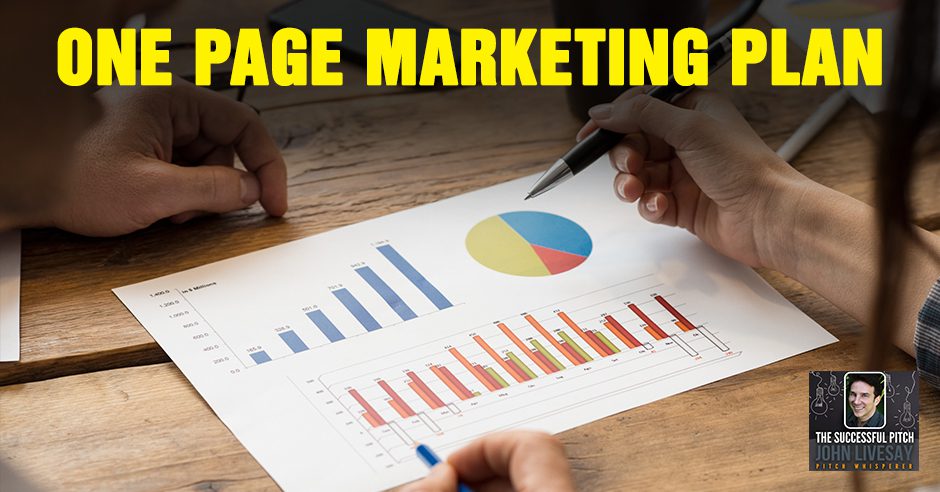
Small businesses need a small business strategy that works, and that really comes down to direct response marketing. Allan Dib needed to come up with a plan that was fast, effective, and followed direct response marketing principles very closely that would move the needle for his clients. From that need was born the 1-Page Marketing Plan which is a process that’s easy for clients to fill in and literally a single page divided that into nine sections. Allan is a serial entrepreneur, marketer and technology expert. He has started, grown and successfully exited multiple businesses in various industries. He walks us through how to have a marketing plan with just one page. He said, well, your path to profit isn’t getting referrals and that the marketing doesn’t stop once you get a customer.
—
Listen To The Episode Here
One Page Marketing Plan
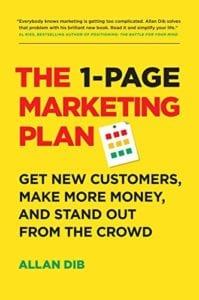
The 1-Page Marketing Plan: Get New Customers, Make More Money, and Stand Out from the Crowd
Our guest is Allan Dib, who was a serial entrepreneur, a rebellious marketer, technology expert and the bestselling author of a book called The 1‑Page Marketing Plan. He started and grown multiple businesses in all kinds of industries around telecommunications and IT. One of his previous business where he faced competition from a big billion-dollar company and he was still able to grow this startup. He was later named by Business Review Weekly as one of Australia’s fastest growing companies and got on their Top Fast 100 list. He’s passionate about helping new businesses find new ways to leverage technology and he is a business coach and consultant and speaker and he is here with us. Allan, welcome to the show.
John, a pleasure to be on the show.
I love hearing people’s story of origin. If you wouldn’t mind taking us back to whatever you want, as far back as childhood, high school, college, university where you said, “There’s got to be a better way to market things and what’s going on.” How did you get interested in what you’re doing?
John, I’m not at all from a marketing background. I’ve got no education in business or training in marketing, whatsoever. It came about by necessity, as many good things do. I was a dead broke IT geek. I was good at what I did. I was running an IT business. I would always try and learn the new technology. Our clients loved what I did, they loved my service. They loved my products, they love our team and everything like that. For the life of me, I could not grow this business. It was stuck and any business that came our way was business that either came by referral or by chance or by some other similar means. It grew out of absolute frustration. That put me on a path to trying to learn marketing for the better part of a decade. Long story short, I learned all I could. I discovered direct response marketing and my life was never the same. It sounds like an overnight success story, but it’s certainly not it. It was probably a decade from start to end.
Let’s figure out if we could have the big takeaways from using The 1‑Page Marketing Plan. Usually marketing plans are known for being thousands of pages if not hundreds. There are three takeaways. You’re going to get new customers, which then you make more money. The big one that I want to jump into is how to stand out from the crowd. One of the things you talked about Allan is why getting your name out there is a losing strategy. That’s such a common thing as like, “We’re starting a company and we’re going to get our name out there and get all kinds of brand awareness and spend money on Facebook and social media. Then when we’re ready to open the floodgates, people will know who we are.” Why does that not work?
“Build it and they will come,” is a great movie plot. It’s not such a good marketing strategy. It comes about because people think that, “I can see Pepsi or Coca-Cola, Apple doing this brand awareness stuff. They’re super successful companies. That sounds like a great strategy for me.” If you’re working on property investment, there are property investors who build skyscrapers and they invest hundreds of millions of dollars in their investment. Then there are investors who buy a single small property somewhere out in the suburbs and rent it out. If the guy who’s trying to do the small investment strategy, who’s working on a small scale, if he tries to do the skyscraper strategy where he’s only got enough money to build one level of the skyscraper that’s not going to work. He needs a strategy that’s going to work on a small scale, not a strategy that works on a large scale.

One Page Marketing Plan: Small businesses need a small business strategy that works.
It comes about because of some of the different motivations behind marketing at a large scale and marketing in a small scale. At a small scale, the only thing that matters is can we get a profit? Can we get a client? At a large scale, large companies, they have completely different motivations. Making a profit is somewhere within there, but I would put to you that above that is things like placing the board of directors, satisfying superiors, biases, winning creative awards, things like that. Things that are completely useless for small businesses. Small businesses need a small business strategy that works and that comes down to direct response marketing.
Let’s walk people through each of your nine grids on The 1‑Page Marketing Plan.
It’s a single page. Where this came about early in my business career, I thought, “I need to hire a consultant to help me put together a business plan.” I did. I paid him thousands of dollars that I couldn’t afford at the time, but I thought, “This is important. All good businesses have a business plan and a marketing plan.” He did what most consultants do. He put together a beautiful looking plan. It was hundreds of pages. It had beautiful graphs and charts and projections and things like that. I took that plan, flick through it, put it in the top drawer of my desk and the next time that I saw it was when I was moving out of our office and we were taking all the things out of the drawers. I looked at it and throw it in the trash and thought, “What a waste of time and money that was.”
I did recall that there was one part of that process, the creating that plan that was very valuable to me. That was the part inside it called The Marketing Plan. It wasn’t the plan itself that was super valuable to me, but it was the process that me and the consultant went through to do that. Part of what we did was look at, “What’s the target market that we’re going after? What’s the message that we’re going to go to that target market? How are we going to reach them? How are we going to position ourselves? How are we going to price ourselves?” That was a super valuable process because it crystallized to me the things that we needed to do as a business and how we needed to present ourselves and how we needed to pitch out our product and our service to differentiate ourselves from some of the competitors that were in the marketplace. That was a super valuable process to me. That stuck in my mind for many years.
Then when I became a coach, one of the things that I started to do with my clients, I started to say, “Let’s do you a marketing plan.” That’s when clients would freeze up and they would procrastinate on that. It feels like something so overwhelming, such a big thing to do. It takes a lot of time, a lot of money. That’s where I needed to come up with a plan that was fast, that was effective and that followed direct response marketing principles very closely because that’s the marketing that would move the needle for my clients. Out of that, they say necessity is the mother invention and I certainly found that to be the case.
From that was born The 1‑Page Marketing Plan. I wanted a process that would be easy for my clients to fill in and literally a single page. I divided that into nine sections. The first three sections are called the before phase, the next three sections are called the during phase, and the last three sections of the after phase. What do we do before we were acquired a client, what do we do during the time that we’re trying to acquire a client, and what do we do after we try and acquire a client? Then within those three major sections, we’ve got three subsections.
You don’t have any revenue coming in and you’re trying to figure out what your prospects are. Then after you’ve got that, those three things done. Your next level is, “How do I capture these leads with my sales funnel?” Then the final one is, “Now, I’ve got a customer, how do I keep them and get referrals and all that good stuff?” I always love to give examples with content and structure because it brings this incredible tool to life.
[bctt tweet=”Path to profit is in referrals.” username=”John_Livesay”]
I am a Co-Founder and CMO of a startup myself and we’re using your tool. I’m a testimonial for you on this podcast. We are helping homeowners who have equity built up in their home and want some cash out, but do not want to take out a second loan and besides selling the house the only way they get access to that cash. That’s our target market. We know that there’s a huge amount of people that want this and either can’t qualify or can’t afford to have a second mortgage payment by taking some cash out to remodel or send their kid to college or whatever they want to do with it.
The message to the target market is we’ll give you the cash in exchange for owning 10% of your house and you can stay in the house as long as you want, and then when you sell the house, that’s when we get our money back based on the percent of the house that we own. Then the third part of this strategy is you talked about what kind of media are we going to use? This is where I want your expertise to come to life is we’re using Facebook ads.
We’ve got an explainer video that explains how to do that. We’re going to be running ads to promote that, to build up an email list of people that are interested. We’re obviously doing PR as part of our marketing with the CEO being interviewed on podcasts and that type of things. That’s our strategy. Is there anything within those three buckets under your before section that you could amplify and say, “You’re good here,” not quite defined enough?
I like to get as niche as possible and it seems counter-intuitive to a lot of people, especially when you’re starting out. Maybe you’ve got a startup, you think, “I’ll cast the widest net possible because I don’t want to miss anyone.” What ends up happening is people say, “Yes, of course I can help you. I can help anyone. My product is for anyone and everyone.” That feels logical, but when you say it’s for anyone, you’re saying it’s for no one. It’s funny, you see so many ads that are a laundry list of products and services. “We do this, we do ABC. We do so on and so forth.” They’re trying to cast the widest net possible. The human brain it has so many stimuli coming at it every day, each day, every minute of the day that it has a filter.
The filter is, “Is this relevant for me?” It tries to actively filter out things that are not relevant for it. If you’re coming at people with a very general message, people’s brains are automatically going to filter that out because your brain wants to find things, “That’s relevant for me,” and then hone in on that. That’s exactly what we want to do. I’ll give the example, if you’ve got a knee problem, do you want to go see a general doctor or do you want to see a knee specialist? Let’s say I’m driving and I see a sign, knee specialist, that’s going to catch my attention. Whereas I might drive past ten signs that tell me about a general practitioner or a general doctor. We want to get hyper specific because we want our message to be so specific that when people read it they say, “That’s for me.” It commands attention.
I’ve had that experience myself where even sometimes in an email marketing. I’ll get an email and it’ll be like, “Are you in my head? This is exactly what my problem is.” I like to tell people that the riches are in the niches, which is a summary of what you said. That’s our challenge sometimes actually is we have found our ideal target market, avatar, whatever you want to call them as a middle-class family who has some teenage kids about to go to college and have been in their homes five plus years or more.
The house has gone up in value 30%, 40% where they could take out $50,000 $100,000 and still have quite a bit of equity left. They don’t want to pay interest rates or have a second mortgage on top of their current mortgage to get that money out. The other target market we could help are senior citizens who have paid their house off, but need some cash but don’t want to reverse mortgage. I said from a marketing standpoint, “Let’s pick one niche and focus on them and not try to have multiple messages going out.” Do you agree with that strategy?
I agree with that. The other thing that you can do is when you do have two obvious markets is have a one-page marketing plan for each. Treat them as completely different segments because the people who are retired who have paid off their house have different worries, they have different things keeping them up at 3:00 AM than the young family who have got a little bit of equity. We want to speak to them very differently.
The big takeaway everybody is have a one-page marketing plan for each of your niche markets. That is gold right there. Let’s go to the second stage, which is, “We’ve focused on people. We’ve got people clicking on our ad. They’re opting in for more information.” You’ve got these great things of what is your lead gen capture system, how do you nurture it, and then how do you convert that to sales? Do you have any examples of how you’ve done that either for your own business or one of your clients?
It comes down very much to who your target market is. In your example, for the older people, I would say things like Snapchat and Instagram may not be the best choice. You’ve got to be thinking about the target market, but when it comes to messaging, you want to hit some of the emotional triggers that people have. Some of the major ones that are universal, things like fear, love, greed, guilt, pride. We want to touch people emotionally in our marketing message. What a lot of people do is they list features and benefits, “This is going to be a low interest rate and this and that.” People think that they make decisions intellectually, but that’s absolutely untrue. People make decisions emotionally.

One Page Marketing Plan: The path to profit is in the after-phase, in the repeat and the referrals.
Those are five emotions that your marketing should encompass, fear, love, greed, guilt and pride. Let’s give our audience an example because that’s going to bring it to life. Sometimes, the fear is, “I won’t be able to send my kid to college or if I take out a second loan, I’m afraid that I might lose my house because that’s too much debt.” Then the love is, “I love my kids so much, I want them to get a good education. I’ve got to figure out a way to do this.”
The greed would be, “This is my money and I’m angry that the bank is so greedy and won’t give it to me without charging me a high interest rate. That’s greedy on their part.” The pride would be, “This is part of a movement that I’m proud to be part of that’s helping people get access to their money that they’ve earned without having to pay a fortune to get it.” Then the guilt is, “If I don’t share this information with my friends who I know are in the same situation, I’m going to feel guilty about it.” Is that helping bring those emotions to life within that scenario?
We want to hit on the things that are keeping your prospects up at 3 AM. What are they sitting there wide-eyed in the middle of the night concerned about, thinking about? What are the thoughts that are racing in their mind when they can’t sleep? We want to hit on some of those emotions because as one of the great copywriters said, “We want to enter the mind of the prospect.”
We’ve got these happy customers and you talked about delivering a world-class experience and how you increase their lifetime value and that was fascinating to me. Finally, how do we get referrals? Let’s take each one of those buckets separately, if we could. A world-class experience, even if you’re not selling something hugely expensive, the example I think of is Banana Republic. They wanted to give a world-class experience to people who come to their big flagship stores by offering them the ability to charge their phones while they shop or remembering their birthdays to their top 20% of their clients. Usually somebody like a Neiman Marcus would do that, but they said, “We could do that for not all of our clients, but the top 20%.” Is that what you’re talking about with world-class experiences, even if it’s not a world class price?
Price has very little to do with it. So many people finish their marketing when they’ve acquired the customer. It’s crazy because all of the money is made in the after phase, after you’ve acquired the customer. Very often, to acquire a customer, your cost of customer acquisition will often not even be covered by your first transaction. It depends on what business you’re in, of course. The path to profit is in the after phase, in the repeat, in the referrals, in all of that phase. What you want to be doing is building a tribe of raving fans.
You don’t want to be transactional. You don’t want to be, “Here’s your product and here’s my money and end of story.” That’s where a lot of businesses and their relationship with their clients. Delivering a world-class experience is all about creating a tribe of raving fans. You want people to become fans and people become fans when you’re easy and fun to deal with. When you create relationships for life, when you create a sense of theater in your products and services. If we think of some of the companies that do that like Apple, you walk into the Apple store, it’s an experience. It’s not just a store.
[bctt tweet=”Build a tribe of raving fans.” username=”John_Livesay”]
It’s interesting because Microsoft has tried to copy that and it feels so sterile and not hip and cool like Apple. It’s a fascinating. It’s like, “You’ve got computers along a wall, but where’s the architecture? Where’s the design of the space to match the design of the product? It’s not even close.” It’s fascinating how that sense of theatrical experience you were talking about is not always easy to even duplicate even if you have money.
It comes down to the DNA of the business and making sure that your marketing is something that’s part of your product. I see this a lot. People will say, “I’ve got XYZ product or this widget. How do I add marketing to it?” At that point it’s pretty much too late. You want to be a thinking about marketing and delivering the world-class experience during the product development phase. You want to say, “This is how we want to end up with a tribe of raving fans rather than clients. How do we do that?” If Apple had already put the store together and then at the end thought, “How are we going to market this thing?” That’s way too late. We want to be delivering a world-class experience and we wanted to have that baked into the DNA of our product and service.
Do you have any tips on how to stimulate referrals? Whether you’re a real estate agent or a company that you know is going to help people get cash out of their home without taking on more debt? How do you encourage those people to refer to their friends? Do you have incentives? What do you think?
A lot of people feel like asking for referrals is like asking for a favor. We feel weird about asking for a favor or we feel like we’re begging for more business or things like that. Certainly, if you’re positioning yourself like that, then that’s going to be a major problem for you. The reason I tackled the last chapter in my book orchestrating and stimulating referrals because it implies something active. It’s not sit and wait for referrals. It’s not beg for referrals or hope that they come to you. We want to plan out how a referral is going to happen in our business. There are a few ways.
First of all, when you’re delivering your product or service you might say, “John, I’m here to deliver you a fantastic experience and part of our business is making sure that referrals are coming our way. I’m going to deliver you a super experienced, but at the end, I’m expecting that you might refer to me to a few friends or relatives or, or whatever.” Making that expectation made upfront and with that expectation upfront, you’ll probably going to be working harder to deliver that world-class experience to the client.
That’s one thing, asking for it. The second thing is, if you think about the last time that you referred one of your friends or family to a movie or to a restaurant that you liked or something like that, were you doing that as a favor to the movie chain or were you doing that as a favor to the restaurant? I highly doubt that. You were doing that because you want to look good. You had a great experience at that movie or that restaurant and you wanted your friend or family to have that same great experience.
Understanding that people are doing referrals for selfish reasons. You want to feed that. You want them to look good and you want their ego to be puffed up or fed. You do that by helping them to understand that they’re going to look good by referring you. There are a few ways you can do that and you don’t have to put a lot of pressure on people. You don’t have to be pushy or anything like that, but giving something of value that they can pass on. An example of that might be a book, it might be a report.
In your case, it could be a free report that tells them how to get cash out of their house without taking out a mortgage. If suddenly hear of a friend who’s saying, “I’m needing cash but I’m struggling to get a home loan or I don’t want to get a home loan because I don’t want to be in more debt.” Then suddenly that’s going to pick up in my mind, ” Hang on. John’s got a report that says how to pull cash out of your home without taking a home loan out.” If I give that to my friend, I’m now helping my friend and I’m looking good.

One Page Marketing Plan: The person with the best pitch, the person who’s the best marketer are the ones who always win.
In case, we’ve created a two-minute video which sometimes people even prefer better than reading a report. It’s like, “Two minutes and it’s a video and it’s animated, I’m in. I can send that link.”
Understanding the psychology behind referrals goes a long way for you to being able to start stimulating and orchestrating those situations that will result in a referral.
Was there any one big mistake that you see people making when they’re doing this one-page? Do you see people getting stuck in either of these quadrants?
Probably the biggest place people get stuck is selecting their target market. A lot of people say, “I’ve got this target market and I’ve got that one and I’ve got that one,” and that’s totally fine. If you’ve got a business that’s got quite a bit of traction and you’re maybe mid-phase in business, that’s totally fine. In that case I would say, “That’s fine. Do a one-page marketing plan for each of those segments, and then deploy campaigns to each of those.” However, when you’re starting out, if you spread yourself too thin, it’s hard enough if you’ve got a single target market, but if you’ve got two or three or four, you’re going to spread yourself too thin. What I say is concentrate on the target market that’s going to give you the most bang for buck and dominate that ad then let’s add another segment and then let’s add the second one, let’s add the third one. First, dominate that target market.
The book again is called The 1‑Page Marketing Plan. We’ve got some great tweets here and takeaways. The path to profit is in the referrals. If you can build a tribe of raving fans by being easy and fun to deal with, some great insights. I can’t thank you enough, Allan, for being on the show. Is there one final thought you want to leave us with?
The last final thought I’d leave you with is become a good marketer. The reason I say that because the best marketer always wins. Many times people think, “I’ve got a great product or I’ve got a great service, so naturally I’m going to make all the sales.” It’s the person with the best pitch, the person who’s the best marketer, they’re the ones who always win. Resolve to be a great marketer in your niche, in your industry rather than being a great technician or delivering the technical thing that you do. The best marketer always wins, so become the best marketer in your industry.
[bctt tweet=”Riches are in the niches” username=”John_Livesay”]
You can even see that sometimes in the entertainment business, “Why is that particular singer more popular than somebody else who’s got a better voice?” They reinvent themselves or they are in the press more or whatever it is. They market themselves better, especially when it comes to technology, you can build the best thing in the world, if nobody knows about it or has an emotional connection to it, Beta versus VHS is always we go back to. How can people follow you on social media, Allan?
I’m on Facebook, @Successwise, and also at my website, Successwise.com. If they want to continue the conversation, just join my mailing list there. You can also get a copy of my book.
Where do you live? Are you in Australia still?
I’m in Melbourne, Australia.
Thanks again, Allan, for being on the show.
It’s a pleasure, John.
Links Mentioned:
- Allan Dib
- The 1‑Page Marketing Plan
- @Successwise – Facebook
- Successwise.com
- book on Successwise website
- www.Quantmre.com
- https://www.YouTube.com/watch?v=rUQezlWp-l0&t=2s
Wanna Host Your Own Podcast?
Click here to see how my friends at Brandcasting You can help
Get your FREE copy of John’s latest eBook Getting To Yes now!
John Livesay, The Pitch Whisperer
Share The Show
Did you enjoy the show? I’d love it if you subscribed today and left us a 5-star review!
-
- Click this link
- Click on the ‘Subscribe’ button below the artwork
- Go to the ‘Ratings and Reviews’ section
- Click on ‘Write a Review’