

Road To Revenue And Happiness With David Meltzer
Posted by John Livesay in podcast | 0 comments

Pain is a turn signal, not a stop sign in your life. This is one mantra David Meltzer has always believed in his whole life. David is the Cofounder of Sports 1 Marketing and formerly served as CEO of the renowned Leigh Steinberg Sports & Entertainment Agency, which was the inspiration for the movie Jerry Maguire. Today on The Successful Pitch, he joins John Livesay to talk about his life mission to empower over one billion people to be happy. He also shares how you can be happy and successful without being pushy. Don’t miss this episode and be on the road to revenue and happiness.
—
Listen to the podcast here
Road To Revenue And Happiness With David Meltzer
Our guest on the show is David Meltzer, who has many great takeaways for you about how to be happy and successful. He said, “Pain is a turn signal, not a stop sign in your life.” Also, he said that the secret to a great pitch is credibility. Read the wonderful stories he tells about how you can be happy and successful without being pushy. Enjoy the episode.
—
Our guest is David Meltzer. He’s the Cofounder of Sports 1 Marketing, and formerly served as CEO of the renowned Leigh Steinberg Sports & Entertainment Agency, which was the inspiration for the movie Jerry Maguire. I’m happy to have David on board. His life mission is to empower over one billion people to be happy. This simple yet powerful message has led him on an incredible journey to provide one thing, value. In all his content and communication, that’s exactly what you’ll receive. As part of that mission for the past many years, he’s been providing free weekly training to empower others to be happy. David, welcome to the show.
Thank you. I’m excited to be on a pitch show. I’ve done so much to help people share a vision and they neglect the pitch so much. I’ve executive produced Elevator Pitch with Entrepreneur the TV show. My TV show is called 2 Minute Drill, which is a two-minute pitch show on Bloomberg and Amazon. I do a Perfect Pitch on my free Friday training as well. It’s nice to have someone that understands the value of whether it’s a 1, 2 or 10-minute pitch.
That right off the get-go is a big value. You need to have variations of your pitch. Most people only have a ten-minute version. They don’t have a 2 or 1-minute version and they get completely overwhelmed. If your ten-minute version, it’s not the first minute of your pitch, it still has a beginning, middle, and end. Before we get into all your expertise around this, let’s go back to your own story of origin. I’m always fascinated to hear if you can go back to childhood, school, college, what was it that made you start your whole journey into business? I want to hear how you came up with your own personal mission statement because I think that’s important for people to realize the why of what you’re doing besides making money is crucial. Take us back as far as you want.
[bctt tweet=”‘Pain is the turn signal, not the stop sign in my life.'” username=”John_Livesay”]
My journey started with money. I wanted to be rich at five years old. My dad had left. Six kids and a single mom, a terrific mom. She worked two jobs as a second-grade teacher, packed her dinner in a paper bag, put us in the station wagon, and filled up the turnstiles at convenience stores with greeting cards. I said to myself, “Someday I’m going to be rich. I’m going to buy my mom a house and a car,” and that was going to make me successful. I wanted to be rich because the only time I wasn’t happy in my childhood was when there was financial stress. I’d catch my mom crying because we didn’t have enough money for food or a summer camp or the car broke down. There’s always something and it always revolved around money and so I believed that money bought happiness and love.
One advantage of that journey is that I was always looking at opportunities to make more money. Unlike a lot of kids, including my siblings whose parents tell them to be a doctor, lawyer, or failure, and they stay limited in their scope of what they’re supposed to do in life, I was completely open-minded because I wanted the highest paying gig. I used to tell people I’d shovel crap with my hands six days a week, twelve hours a day to buy my mom a house and a car. I didn’t care. I wanted to be rich. My journey led me through wanting to be a professional football player. I played football in college but got ran over by Christian Okoye, better known as the Nigerian Nightmare, AFC Player of the Year. That’s when I realized lying on my back, “Doctor, lawyer, failure.”
I thought I’d be rich being a doctor. That’s when my oldest brother who was a doctor gave me the best advice of my life. I told him I hated hospitals. He said, “Dave, you’re eighteen years old. What do you mean you hate hospitals? You’re pre-med. What are you talking about?” I said, “I want to be a sports doctor. They’re not in hospitals are they?” He goes, “David, you need to be more interested than interesting.” That became truly a perspective of mine. I no longer was going to be an interesting person. I was going to learn what I call, “Find the light, the love, the lessons, and everything.” Ask as many questions as I could, which ended up being a great tool not just in pitching, but in selling in general. You are an expert at selling and you know how important it is to be more interested than interesting.

Being Happy: The lens of gratitude will give you the ability to find enjoyment and the lesson in what you’re doing.
I went to law school instead, but while I was in law school, I kept my options open. I ended up with two job offers. One to be an oil and gas litigator, which is one of the highest paying jobs out of law school. I also had found a sales job in this new thing in 1992 called the internet. This new thing piqued my interest and I told my mom, “I’m thinking about taking the sales job. I’m not going to be a litigator.” My mom almost died. She is like, “You’re going to ruin your life. The internet is a fad. Don’t do it.” That’s the next lesson that I like to teach people. Just because somebody loves you doesn’t mean you get good advice. That helped me throughout my whole career. Voting for what you want, not seeking other people’s approval, knowing your own values, these are all tools not only in selling but in pitching in general. To understand what the objectives are, what your aligned values are in seeking advice from people who sit in a situation you want to be in. I took the sales job nine months out of law school, millionaire, bought my mom a house and a car, had a little bit left over to pay my loans.
Here’s the interesting thing. I graduated law school at 24, 25 in 1993. Everything I did reinforced that money bought love and happiness. I became the favorite child of my mom in my mind. 1995 came, we sold the company I worked for $3.4 billion to Thompson Oils. I then went to Silicon Valley and raised hundreds of millions of dollars in the wireless proxy service space, the middleware space. I then became CEO of the world’s first smartphone. I worked with Microsoft. It was a Windows CE device. I worked with Samsung manufactured by them. I was a multimillionaire by 30. I married my dream girl from the fourth grade. Every single thing that I did reaffirmed that money buys love and happiness. That’s when the journey shifted because I then became the CEO of Leigh Steinberg Sports & Entertainment. You’ve interviewed Leigh, the most notable sports agent in the world.
I surrounded myself with celebrities, athletes, entertainers, and I truly started to realize one thing, that I had moved from a world of not enough, where I was a victim. I was always looking at, “Why me? Why does John have that and not me? I’m as good.” I was a victim. I then became a millionaire and it was everything enough for me. If I wasn’t happy, I’d buy things I didn’t need. If I wasn’t happy, I’d buy more things I didn’t need. If I wasn’t happy, I’d buy different things I didn’t need. If I still wasn’t happy, I’d buy things to impress people that I didn’t like. This was not the best world to live in. It wasn’t a world of abundance. I was barely philanthropic. I gave to receive. Everything I did was to help other people, but I wanted something back. I wanted acknowledgment, recognition. I wanted some quid pro quo or trade. I wasn’t living in the world of more than enough.
[bctt tweet=”Be interested, not interesting.” username=”John_Livesay”]
That’s where my journey took me is I learned to shift the paradigm of value to understand, to receive so I can give. I talk about a world through me to others. I’m always looking from, what am I going to receive? How’s it going to come through me for others? I’m inspired, not motivated, to receive as much as I can. That value paradigm, that value shift, that transformation has helped me. I am a natural salesperson. One who oversold, backend sold, lied, manipulated, and cheated like a lot of salespeople in the name of commissions, territories, and quotas to somebody who provides more value than I receive. I guarantee more value in everything. I carry an energy of providing more value than I receive. That’s the context and basis for why I wanted to come on your show to share these ideas of how we can and truly make a lot of money, help a lot of people, have a lot of fun, create abundance for everyone, and to empower others to be happy.
There’s much to unpack there. Let’s start with the myth that it can be fun to make money. I think a lot of people think, “It’s going to be hard work, grit, pushing, and frustrating.” I think you are showing that is not the case when we come from a place of, “Am I having fun?” That is not mutually exclusive. The concept when we were growing up was you have fun on the weekends and at night, but not at work. Now that the whole wall has come down in a big way and the more fun you are to be with, the more people want to buy with you and hang with you.
I came up with this definition that aligns specifically with what you’re talking about. Instead of attaching my emotions to an outcome to the weekends, to the nights, I have shifted my emotions to enjoying the consistent every day, persistent without quitting, pursuit of my own potential, my own objectives, my own what tied to my own why. By doing so, I don’t believe in the word we’re working more, talk about a shift in the paradigm and perspective that people have. I believe there’s an activity you get paid for, an activity you don’t get paid for, and you should enjoy them equally. You should try to maximize the activity you get paid for that you enjoy more than the activity you don’t.

Being Happy: When we can be accountable as salespeople, we become empowered and in control of everything.
One of the things that you offer are these wonderful quotes on your Instagram account, which is @DavidMeltzer. The one that stands out for me, David, is “Be kind, not right.” Let me tell you why that resonates with me on two levels. One, from being in the traditional sales training, it was ABC, Always Be Closing. I shifted that to ABK, Always Be Kind to the way you talked to yourself so you can be that way to other people. That in a nutshell is a huge paradigm shift. You’ve taken not just be kind, you’ve added this premise of not right. I remember years ago someone saying to me, “The question for you is do you want to be right or do you want to be happy?” Since happiness is part of your branding as well, I’m completely thrilled to be able to ask you about this whole concept of happiness and choosing kindness over being right, and how that all connects for you.
It connects by the fifth daily practice. The most important daily practice that I have learned over all these years and that’s practicing ending fear. What I realize is we have primary and secondary fears. These are the interferences, the corrosion between us, that unbelievable source of light, love, lessons, and happiness that we’re connected to at all times. It’s the thing that creates resistance, voice, and shortages to the sales that we’re making in our pipeline and energy sucks that exist out there. What I realized was why don’t I have a practice to end the need to be right? I guarantee you, if you take the need to be right or the need to be offended which is closely attached to the need to be right, the need to be separate, inferior, superior, anxious, frustrated, worried, and angry, any of these, if you took the time, emotion, and money that you wasted trying to do these things, it wouldn’t matter how good of a salesperson you were.
You’d be a millionaire, a billionaire if you could get all that time back and harness it towards what you want. I decided what was the higher frequency over being right, over being separate, inferior, superior, offended, resentful, guilty, and all these feelings. It was happiness and kindness. It was a truth that was so much easier to have gratitude in my life. The pain would present itself as it always does when you live in an expansive world and you’re trying hard with what I call the Law of GOYA, Get Off Your Ass, like you and I, people who know how to be productive. We don’t sit around dreaming about what we want. We dream, but we go ahead and we take action to go get it.
[bctt tweet=”Find the light, the love, and the lessons in everything.” username=”John_Livesay”]
When you look at the number, one, gratitude. The lens of gratitude will give you the ability to find enjoyment in what you’re doing. To find the lesson in what you’re doing. What it does is it says, “Pain, mental, physical, spiritual, emotional, financial pain, and pipeline pain which is no closing. You’re an indicator. You’re not a stop sign.” I’m not going to quit. You’re an indicator pushing me to something better. You’re teaching me a lesson. That pain is there to indicate I have a lesson to learn. It’s not a stop sign. It’s a turn signal that there’s a better way to go. A better situation to be in. Using gratitude, it allows pain to be a turn signal in my life. Leading then to forgiveness because if I have forgiveness, I can forgive others.
Most importantly in sales and pitching is accountability. Asking myself two questions, one, “What did I do to attract this to myself?” Two, “What am I supposed to learn from it?” I find the biggest detriment in salespeople’s careers is they lack accountability. They live in a world of blame, shame and justification. When we can be accountable as salespeople, we become empowered and in control of everything. The lessons keep on coming until we learn them, but they start coming bigger, better and faster. We become statistically more successful and productive as well as accessible to others. This is an extraordinary thing. The number one piece of advice is ignored by most people. People think that they have all these different things about a pitch that you should have.
The number one thing you can have in a pitch is credibility. If I was 100% credible, if I could attain 100% credibility, which I’ve never been able to do, maybe in my mom’s eyes. That’s because she thinks I’m better than I am, but 100% credibility, all I would have to do for a pitch is say, “John, wire me $1 million tomorrow and I will wire you back $2 million on Friday.” If I was 100% credible, you’d say, “Okay.” The difference is most people don’t realize when they’re pitching that the minute they diminish their credibility, dissolve their credibility, create overselling, backend selling, manipulating, lying, shortages, avoids obstacles, some sort of insecurity, of credibility, people start harnessing and focusing on that. You create many more obstacles for yourself because you exaggerated something.

Being Happy: Time, emotion, and value are the three reasons people change their minds.
I told you, I had the two TV shows, Elevator Pitch and 2 Minute Drill. This guy gets on, he’s pitching and goes, “Our revenue is up 300% this year.” In my mind, I’m like, “He’s an over-seller.” If his revenue was at all decent, he would have said, “We did $1 million last year. We’re at $3 million already this year, which is a 300% gain.” I’m thinking he did $1 last year. He’s tried to BS me and sell me on an accumulated number. All of a sudden, I wasn’t listening to him anymore. I was trying to pick holes in everything that he said. He had a credible company when I ended up vetting it after the pitch, but he would have lost me if it wasn’t a TV show. People do this all the time. If you’re going to have one takeaway on pitching from me, someone who’s done six episodes of Elevator Pitch, created Bloomberg TV’s new series, 2 Minute Drill. Be credible. Make sure to fine-tooth comb. Eliminate the negatives. Be honest. Don’t oversell, backend sell, manipulate, lie and cheat. You’re going to ruin your pitch no matter how long it is.
We’re certainly going to make that one of the tweets from the show. Credibility is the number one secret to a great pitch. The other tweet I love that you said is, “Pain is the turn signal in my life.” Let’s double-click on that and then we’ll get back to credibility. A big fear that causes the blame shame justification you were referring to that salespeople can fall into is the fear of rejection. I tell people, “You’ve got to stop rejecting yourself.” If someone says no to you, you go, “I must be bad or my product must be bad.”
You take it on personally as opposed to you saying, “That’s a signal, it’s not a stop sign.” That would be helpful for people whether you’re pitching to get a new job, get your startup funded, or get new clients, rejection is part of the journey. You’ve said, “I look at it as a turn signal even if that’s not working. Let me try something else.” As opposed to, “I’m going to give up.” What else do you think about rejection and how we can build up our tolerance especially as it relates to your sports experience? There’s a lot of pain involved in sports.
[bctt tweet=”Don’t sit around dreaming about what we want. Dream but take action to go get it.” username=”John_Livesay”]
I have two rules when it comes to no. Number one is a perspective rule. I always tell myself, “I’m 25 noes from getting what I want.” What it does immediately in that framework is when you tell me no, I’m like, “Good.” When I’m at ten noes, I’m like, “All right.” I’m the only one that gets super excited after 24 noes because I know it’s coming. The idea of it is, I’m only many noes from getting what I want because I take the turn steering wheel strategy. I know that pain is indicating I have a lesson to learn. Every time someone tells me no, I have a lesson to learn. I love to learn because I’m more interested than interesting. That great line my brother told me at eighteen has changed my life because it allows me to find the light, love, and lessons, and know because I have an opportunity to grow, accelerate and expand because someone’s telling me no.
The second no rule that I have is interesting because people are made by the people that say no to you if you understand how no works. In the context of someone being interested in the follow-up context, when people waste time and they wonder, “I’ve called him eighteen times.” I say, “There’s a three-time closing rule.” You’ve got through the process. You’re calling for either a meeting or an order, something that has been agreed upon. The person says, “Sorry, I had a flat tire.” That’s one no to me. I’m accountable and honest to people. Even I who’s a student, my calendar, every once in a while I’d miss a call. Usually, it’s an important call that I missed. I don’t know how that happened, but if I miss it, I still count that as a no.
The third no is I love to shift the energy of it. I’ll always tell someone, “This is the right time, emotion or value I’ve been able to convey to you. I have a lot of other people who want to do business and meet with me or close. I’ll tell you what, please give me a call if you’re still interested in moving forward. If not, thank you for your time and consideration.” Fifty percent of the time the guy will call back and close, meet me, or do whatever. The other 50% of the time, I never hear back. Do you know what I say to myself? Think about how much time, emotion, energy, and money I saved. I especially as a younger salesperson who is an aggressive, hyper and persistent person, I would hit my head against the wall 50 times thinking I was doing myself a great service because I wasn’t quitting, instead I went from quitting to allowing the deal to happen.

Being Happy: Don’t hug people and make them feel good. Give them a profit and they will love you.
It’s a turn signal. I allow the deal to happen. I don’t make it or force it to happen. When you’re in that close, three times is enough to get a meeting. When someone’s already agreed on it and gave you a yes, there’s something there. If you allow it to happen, note time, emotion, and value are the three reasons people change their minds. Timing has changed. Their emotions on it have changed, or the value has changed. When someone tells you no, it means they have something more valuable to either spend their money, time or emotion on. That’s all it is. Be honest with yourself. You’re not the priority.
In addition to being an author, which we’ll talk about, you’re also a coveted speaker to major companies and talk about the value changing. It’s a great example to those of us who speak for a living or that’s a big part of our living. We’ve had to go from live events to virtual events. I’ve had the experience where a client will say, “You need to resell me on the value of your fee for it to be virtual versus in person.” Whether you’re a speaker or not, this whole exercise is valuable for everyone reading. How do we reframe value when something’s changed like this?
I take quantitative reasons you want me to speak, the quantitative impact you’d like me to have, and the quantitative capabilities that you’d like me to enhance in the readers. Whether I’m on a stage, in person, on Zoom, or whatever other platform you want to use, it’s all about quantifying the value. I’ll usually break it down to per person. I’ll say, “If I was here on stage, value-wise if I increase production 10% of 1,000 people, what’s the value of that? If I help your closing ratio, one extra sale per guy, if I’m able to have people show up on time. What is the value of people who are happier?” Happier people are proven to produce 41% more in a day if you’re happy than an unhappy worker.
[bctt tweet=”The number one thing you can have in a pitch is credibility.” username=”John_Livesay”]
I utilize open and closed-ended questions to say, “What are you doing today? Where are the quantitative reasons, impacts and capabilities? What do you like about it? What don’t you like about it?” Take out the fact that I’m not there in person. The fact that I’m not there in person, it’s only going to save you money. That’s the only difference between me being a person and me being here and also the capabilities of replay, rewinding, and a variety of other extra values I can bring virtually. What I have found is I am getting paid equal or greater to march of what I used to get in person. People are getting acclimated because I’ve been able to completely quantify. There’s a problem with selling called subjective value. The stage and the virtual stage is a perfect place to talk about it.
People love to feature and benefit dump. They love to be that purple dinosaur that’s a cartoon. We know him as Barney. Everybody knows the big purple dinosaur. I get frustrated when I see Barney sellers. I see it in speaking and authors. People who are overselling, backend selling, feature and benefit. They haven’t gotten to the nuts and bolts of, “Can you see any reason why you want to have me speak to you? I am guaranteeing to be a profit center for you. You may pay $50,000 for me, but I’m guaranteeing you’re going to make $100,000. Can you see any reason you will want to move forward?” A Barney seller, what they do when they speak, write books, consult, or do the things that you and I do is they hug you and they say, “I love you. You love me. Nobody makes any money.” Everybody feels good after you’re done speaking because you’re a Barney seller, like the meeting, you’re a Barney seller. Everybody is feeling great when you leave the pitch because you’re a Barney seller. You walk away and it doesn’t wear well. You’re not selling through the client where they’re going, “That’s life-changing.”
I do it in my executive coaching. I had a client right before the interview, all I did was give him the belief, the shift in the mindset and heart set that he’s charging too little. I have him ten times, he closed two people. Let’s say he was making $1,000 a client. I told him to ask for $10,000. I told him why and how to be a profit center at $10,000 to guarantee that the minimum they’ll make is $20,000 if they pay him $10,000 a month. Two closes where he would have made $2,000 a month for the year, which would equate to $24,000 each. He had a total gross of $48,000 that became $480,000. I said to him, “Can you see a reason you don’t want to pay me $20,000 a month? He has no reason. You can do that virtually on stage. People don’t do the work. They’re Barney sellers. Don’t hug people and make them feel good. Give them a profit. They will love you. You’ll sell through them. They’ll brag to everyone how much money they made from you.
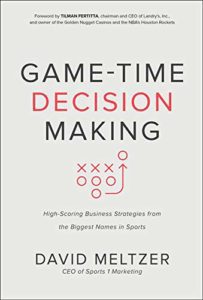
Game-Time Decision Making: High-Scoring Business Strategies from the Biggest Names in Sports
I want to support what you said because if someone’s reading and they’re like, “What does that mean that don’t just give motivation or good vibes?” You need to be tangible. In my situation, I tell people, “I’m going to show you how to tell a case story and whoever tells the best story gets the yes.” If you’re up against competitors, no one’s telling a story and you’re the only one telling a story, that’s going to mean more money, “What’s the average sale? Do you get that? Do you understand their business that well?” One more piece of jewelry. One more airport renovation. Whatever it is they’re doing, you help them win that, then the ROI is great on having you come to speak because it’s not, “Here’s something that would be nice to have.” It’s like, “We’re tired of coming in second place. If you can help us solve that problem, then that’s worth much more money.” That’s another example of what you said in action for people who are still thinking, “How does this relate to me?” I completely support what you’re doing.
You live by it, which is why I wanted to come on your show. What I enjoy about watching your stuff and reading your stuff is that you are the exact same type of salesperson that I am. You create productivity, accessibility and gratitude. You have quantitative value in what you do. You’re able to articulate it in the way that people want to communicate because it’s not what we say as salespeople. It’s what they hear. If you know your stuff well enough to articulate a story that comes to a logical conclusion of, “Can you see any reason you won’t want to do that?” You know how to pitch and you know how to sell like John does.
Thank you, David. You wrote this wonderful book called Game-Time Decision Making. That taps into not only why you, but the why now part of any decision. You talked about time, emotion and value. We’ve talked a little bit about creating value and storytelling creates the emotion. We’re going to end on the importance of timing, how that ties into your book and your upcoming workshops that you do every week on Fridays.
The manmade construct in this vibration is time. Everybody has 24 hours a day, but the productivity, the accessibility within that time of being able to number one, align your values. Your personal non-negotiable values, your experiential values. You’re giving and receiving values to the concept of time. Asking is related to time. If you understand time, you should understand the exponentiality of saying, “Do you know anyone that can help me? How can I be of service or value?” Understanding how time equates to that profit center and the exponentiality of growth, of growing exponentially by asking each person, “Do you know someone that can help me in person, on the phone, email, or media?” When we were young, most people had their card game, their golf group, and their church group. Nowadays on average, some guy you meet on the bus stop has 1,000 people in their network.
If you’re not asking, “Do you know what it can help me?” you’re cutting off your legs. Studying time is paying attention to and giving intention to the coincidence as you want with your time, the activity you get paid for the activity you don’t. Remember, that’s the mathematical equation of luck. Attention plus intention equals coincidence. Another thing about time is do it now. One hundred percent of the things you do now get done. The difference between successful people and others is successful people get stuff done. Ask yourself, “Could I do it now? If not, put it in your calendar to schedule for tomorrow and study that.” Finally, the practice of ending fear, utilizing your time, not to accelerate in the wrong direction, not to create resistance, avoid shortages and obstacles in your life, but to stop, drop and roll when you’re in an accelerated ego-based emotion, like the need to be right.
Kindness will take you back to the center and allow you to roll towards statistical success. More people in your pipeline. More people pitch correctly. More value is provided. More sales are made. More commissions are made to give to others so you can make more money, help more people and have more fun. Time is that manmade construct that you have to work within in order to effectuate that last world, to tie everything together. No more living in a world of, “To me, victimized and not enough.” No more living and buying things you don’t need to impress people you don’t like in the world of enough for me, but utilizing time, you can live as an instant between limitlessness and infinity in the world of more than enough. More than enough of everything for everyone.
When you’re selling and pitching from an abundant attitude that it’s not going to cost you anything, but we’re going to create value between the two of us that there’s more than enough of value for everyone. It’s because I take doesn’t mean you lose. It’s because you lose doesn’t mean I take. Everybody wins in the world of abundance. That’s where we need to pitch from with credibility and emotional judgment. Quantify the reasons, impacts, and capability from a world of more than enough. That’s what you do, John. We hit it off the first minute we ever spoke, we knew a lot of people in the same circles, but you started telling me what you do. I said, “This guy gets it. I’ve got to do more stuff with him.”
If you want more of David and let’s face it, why wouldn’t you want more? For the weekly training, you can go to his website at DMeltzer.com/training. Some of the episodes talk about creating a habit machine, learning to love what you do, and health, happiness and profitability. You walk your talk. The fact that you’re giving this training for free is such a gift to the whole community. I want to thank you on behalf of everyone reading for that. I want to encourage everyone to get this, because why would you not? David, any last thoughts or comments you want to leave us with?
Be kind to your future self and do good deeds. You can always email me at [email protected]. John, thank you for having me on.
Thanks for joining us.
Important Links
- David Meltzer
- Sports 1 Marketing
- Leigh Steinberg – Past episode
- @DavidMeltzer – Instagram
- Game-Time Decision Making
- https://DMeltzer.com/training/
- [email protected]
- Better Selling Through Storytelling Method Online Course
Wanna Host Your Own Podcast?
Click here to see how my friends at Podetize can help
Purchase John’s new book
John Livesay, The Pitch Whisperer
Share The Show
Did you enjoy the show? I’d love it if you subscribed today and left us a 5-star review!
- Click this link
- Click on the ‘Subscribe’ button below the artwork
- Go to the ‘Ratings and Reviews’ section
- Click on ‘Write a Review’
Love the show? Subscribe, rate, review, and share!
Join The Successful Pitch community today:
- JohnLivesay.com
- John Livesay Facebook
- John Livesay Twitter
- John Livesay LinkedIn
- John Livesay YouTube
FARGO-Exceeding Low Expectations with Greg Tehven
Posted by John Livesay in podcast | 0 comments
Episode Summary
Collaborating with people and exceeding low expectations is a bigger win any entrepreneur can ask for. Greg Tehven isn’t an exception to this notion.When all he saw in front of him was just metrics and checklists, he knew he had to make a shift and invest in time and experiences instead. Now a Co-Founder and Executive Officer of Emerging Prairie, Greg is dedicated to give value to the community and use his skills to serve others and make a difference.
My guest on The Successful Pitch is Greg Tehven, who has a fascinating story about growing up in Fargo, North Dakota, couldn’t wait to get out, travel the world and then decided to move back after all and make a difference in his own city. He said he’s all about hustle and not desperation. He has a great description of the difference and how that changed how he looked at the world. He said, “When you have limitations and you share them, you create compassion. If you start bragging about all your successes, you create competition.” His big focus is on creating moments and he wants to be time-rich so that he can spend his time with interesting and wacky new people and look at his life as an adventure as opposed to goal after goal to achieve. He has some great insights on how he discovered himself at a young age and now is living in the moment. Enjoy the episode.
Listen To The Episode Here
FARGO-Exceeding Low Expectations with Greg Tehven
Our guest is Greg Tehven who is living and from Fargo, North Dakota. I had the pleasure of meeting Greg when I was on the North Dakota Today Show and he has so much insights as to what it takes to become a successful entrepreneur and make an impact in the world. He is known as a thought leader, a storyteller, and that really resonates with me. He literally is an advocate for people who are creative. He loves to put out a message on how you can build a community that you want to live in. Greg believes that if you think creatively and act boldly, you can overcome any obstacle. He has literally done that. He’s proud to be from Fargo, North Dakota. I love his passion for that. He has literally traveled around the world and now he’s back in Fargo and he’s now taking action to make Fargo be known as its own special place with a good message out there. That pride takes on a lot of forms where he takes on big projects not only within his community, but inspiring other people to do it as well. He is the Executive Director of Emerging Prairie where he’s done so many things such as starting the TEDxFargo, 1 Million Cups Fargo, Startup Weekend and a lot of other great things. He’s really well-connected and generous with those contacts. I love his sense of humor and relaxed style. Greg, welcome to the podcast.
Thanks, John. It’s an honor to be here.
I always like to ask my guests to take us back to their own story of origin. You were growing up in Fargo. You can take us back as far as you want, whether it’s high school or earlier or college or earlier. What made you decide that you were going to leave Fargo? Did you always know you wanted to be an entrepreneur?
I don’t think I understood the word entrepreneur as a kid but I had a really, really healthy disrespect for the status quo at a very early age. I would challenge my coaches that there was a better way to do things. I would challenge my parents that there was a more efficient way to mow the lawn or shovel the snow. Believe it or not, John, as a young person, it’s not very appreciated. I don’t know if I was always appreciated for that perspective.
Will you call it precocious?
I would just describe to somebody that, “It was Greg’s world and everyone just lived in it.” I wasn’t always proud of that. I was this kid that lived on a farm and I would see things being done inefficiently. As a kid, when you live on the farm on a gravel road and you don’t get to go to town very often or if you forget something at home, you can’t just run home and get it. There was a resourcefulness that came from that. There was really, as a young person, awareness of waste: wasted time, wasted resources, wasted energy. I brought that through my entire journey.
One thing that’s interesting that I wanted to bring is in 1987, North Dakota was the only state in the union with a declining population. The politicians were talking about the brain drain. The best and brightest were leaving the state. The community conversation from when I was three years old until ten was that the best and brightest were leaving. They went to some researchers and they said, “What do we do in North Dakota?” They went to some Princeton PhDs and they came back with a proposal to return the prairies of North Dakota back to the buffalo and create buffalo commons. As a young person, the media was shaping my identity, that we weren’t smart. That if I was smart, then I had to leave. As a young person, I couldn’t wait to get out of Fargo.
I think a lot of us have that quest urge inside to go see the world and leave. The Midwest, coming from Chicago suburbs myself, those roots are usually pretty deep. You decided to go to Minneapolis and then you even dabbled in Stanford, I believe. Tell us a little bit about that journey.
I just knew that there was no school I was going to go to in North Dakota. I didn’t consider any of them. The University of Minnesota had a great business school at the time, and so I enrolled there. I had an incredible experience. I’ve got to live on a campus with 50,000 students, to experience an urban environment. I loved it. I started my first social enterprise when I was ten years into my freshman career with my college roommate and a couple of friends where over the course of the next seven years, we brought close to 30,000 students on Pay It Forward Tours where they would travel around the country and do service on their spring breaks; a fantastic learning experience of building a social enterprise, that transformative time of my life. I learned a lot about community and I learned that those things that my parents taught me when I was a kid about taking care of your neighbor, about serving others made a big impact, not just in Minneapolis but across the country. It really, really was helpful.
I also noticed you have a big philanthropic part of your personality. Can you talk to us about where that comes from?

Exceeding Low Expectations: Helping your neighbor makes a big impact. It’s small things and it’s big things. I gain a tremendous amount of joy from that.
I think that comes from growing up in a rural community in North Dakota. My parents role modeled for me taking care of your neighbors. When somebody’s house would burn down or somebody got cancer, all of a sudden my parents would be organizing folks around the coffee table on Sunday nights and they’d come over week after week, and I didn’t know what they were doing. Then I’d go to a big fundraiser that they were part of hosting or I would see them do that work. I think growing up in a rural community, that’s all we had, were our neighbors. That’s the spirit of generosity that for generations in my family has been instilled in me and that I believe resonates everywhere. Whether I’m doing work in India or in a small town in Pennsylvania, helping your neighbor makes a big impact. It’s small things and it’s big things. I gain a tremendous amount of joy from that.
How did you go from, “I can’t wait to get out of Fargo,” to being its biggest advocate and fan?
Part of that comes from when I burned out. I was 25 years old. Students Today Leaders Forever was hosting the Pay It Forward Tours. It was growing. I got a little self-absorbed. I looked in the mirror and realized I was more interested in the numbers, how much money we had raised or how many people were on our trips, versus the impact. I lost myself. I decided that I needed to take a break. I didn’t like who I was becoming. I didn’t have any hobbies. I didn’t have any friends outside of work. I decided to take a year and wander around the world. It was during those eleven months of walking across Spain on the Camino de Santiago or being in a village in West Africa with Peace Corps volunteers for six weeks that I saw the value of a small community. Because each place I went, I missed the small interactions. I missed knowing my barista. I missed knowing the person that I bumped into every Saturday morning at the market.
It was on that trip, I was in New Zealand on the last leg and I said, “I want to make a difference at home. I want to make a difference on my street.” I had been thinking I was going to be this big global world-changer and then I was like, “Maybe I’ll just try to add a little bit of value in my own backyard.” Unexpectedly, I started working in Fargo. It was the last place I ever, ever thought I would live again. The first project we did was TEDx. It was about sharing ideas. I had given a TEDx Talk in Minneapolis a few months before that and I was like, “I should look for ideas in my home community.” That’s when I fell in love with Fargo. I met a farmer that had brilliant ideas on nourishing the world, a doctor that thought about beauty differently, an artist that thought about their art as a tool to build a community, an entrepreneur that thought about curiosity as the success principle to change the world. These were all people that lived in my hometown.
It’s fascinating to me you took that year off. I did something similar after I graduated from college and traveled a year. I had a fascinating insight. I didn’t stay in any one place longer than six weeks and normally it was way less than that. I noticed, and I don’t know if you’ve experienced this, but you miss people knowing you. Every time you go to a new country and start a new conversation with somebody on a train or whatever, “My name is John, I’m from Chicago. I just graduated. I’m taking a year off.” You have to start your story over and over and over and there’s a lack of intimacy because you’re starting from scratch, as opposed to people who’ve known you your whole life and you can say, “I’m feeling frustrated. I’m feeling sad. I’m feeling overwhelmed.” You can’t really start those conversations with strangers. It wasn’t until I left the country and traveled that I started to really appreciate the relationships I had at home.
I think that’s so true, John. I’m guessing you’re similar to me and similar to folks like Steve Jobs or Sargent Shriver that their global experiences shaped their local actions. For me, I finally came to the conclusion that it wasn’t a year off, it was actually a year on. I discovered that I’m not a human doing, I’m a human being. Those were some discoveries that were really helpful for me. Some discoveries that weren’t helpful is I realized I wasn’t humble. Because back home, I would describe my work, “I’m part of this cool project.” When I was walking across Spain meeting strangers, they asked me what I did and I took all the credit for my co-founders. I was just disgusted by what was coming out of my mouth. It was a real shaping experience when I just had to show up as me. People are evaluating based on me, on who I am, not what I could do for them. I learned a lot about myself.
That lesson is so fantastic and important because I’ve interviewed a lot of investors and they’re looking for someone who’s confident and humble, confident but not arrogant. Also being a keynote speaker, one of the big lessons I’ve learned is that while the audience wants you to have confidence when you’re on stage, they’re still interested in you telling some vulnerabilities about yourself so that they can relate to you. I think that it takes a lot of self-esteem and work on yourself to be willing to not have to overcompensate and try to impress everybody all the time.
That really resonates with me, John. One of my teachers, if you will, on my year around the world was Steve Lacy, who was from a small town in Australia. This is a young guy, small town, had one of those fast track careers. He shared with me this idea that when we share our success, we create competition. When we share our limitations, we create compassion. It’s a fine line. For my work, I speak around the country, I work in big communities and small communities. It’s a fine line of helping people trust that we’re going to get some work done, but also let them know that we’re human. I’m lucky that I’m very human. In my keynotes, I’m often telling jokes of how pathetic I am.

Exceeding Low Expectations: When we share our success, we create competition. When we share our limitations, we create compassion.
Before I met my amazing wife, I was pretty pathetic at dating. I missed some cues from time to time. I was a guest of our US senator out at the State of the Union a couple of years ago. I thought the State of the Union was in Bismarck. Turns out it’s in Washington, DC. I thought that they brought a bunch of people to it. Turns out only one person can be a guest of each US senator. I forgot my suit on the way out there. I’m at the State of the Union wearing one of the staff members’ suits because I just miss some cues from time to time. I find that just being imperfect actually helps me. The fact that I can share that with folks, I just get to build better relationships and get to know people.
There are very few people your young age that get to do a TEDx talk in Minneapolis. I don’t think I’ve ever met anyone who’s taken that and then said, “I’m going to do one in my hometown,” especially in such so early in your career. How did TEDxFargo come about?
It was back in 2012. I was working for one of the great entrepreneurs of North Dakota’s history, Doug Burgum, who built Great Plains Software. He ended up selling it to Microsoft for $1 billion. He’s now our governor. I was working for Doug, working with him and trying to build out the energy, the creativity, the ideation in our community when he said, “Let’s do a TEDxFargo.” We threw an event. It cost us $5,000. We got four speakers. We did it at a beautiful art gallery in the heart of our city. We got 100 people there, and people loved it. It was February 2012. I got excited and I was like, “I’m probably going to go to grad school soon. Why don’t I just get another one in before I go to grad school?”
On summer solstice, we did another TEDx. I brought friends from across the Midwest to come speak. We did some adult fieldtrips that we called adventures beforehand, so folks were going to different businesses, doing some interactive work with chefs. We brought in Brian Murphy who wrote See Mix Drink, the world’s best cocktail book in 2011. People were learning how to mix cocktails before our event. It turns out that’s a really bad idea because then some people had to leave a few hours in and had to get a nap. We sold out three events in 2012. One of them we sold out in nine minutes. People were just excited. That was back in 2012. Since then, we’ve now done eight TEDxFargo events. We have one of the largest events in the country. We bring in speakers from all over the world. It’s made a really big impact in Fargo, North Dakota.
Let’s talk about the one that’s coming up in July of 2018. What’s the theme and what would make people want to come either hear this in person or certainly listen to those talks after they’ve aired?
[Tweet “Use your limitations as your strength. “]
Believe it or not, John, there are not a lot of people that are just stopping into Fargo on a regular basis for no particular reason. We use our limitation as our strength. How are we going to get people to come to Fargo on Thursday, July 26th? We look for world-class content. A couple of years ago, we had Richard Wiese, the producer and face of ABC’s Born to Explore. We had Steve Rohr, the publicist for The Oscars. We bring these folks back. What we’re trying to specialize in is the audience doesn’t just get to meet them on stage. We curate small events beforehand with the speakers. We have adventures. Our mainstay content is strong but we create experiences. We have 2,000 people that get to eat lunch together on the street in the heart of downtown Fargo. We hire musical performers, artists. We spend a lot of time thinking about moments, how do we create moments for our guests, for our sponsors. For our sponsors, we have a private backstage red room where the sponsors can interact with the speakers when they come off the stage. We have custom cocktails, fresh juices. We try to create these micro experiences.
For this upcoming event, the theme is ‘Forth’. It’s the activation of ideas. Some of the folks that we have coming, the President of Microsoft, Brad Smith, will be coming to give a talk on engaging technology in rural America. The University of Minnesota Women’s Volleyball coach, who has won a gold medal in both the Men’s Volleyball Olympics as the coach, and the Women’s Volleyball Olympics as the coach, is going to give a talk on his research that he’s doing with one of Malcolm Gladwell’s context. We look for world-class ideas but we’re trying to create an experience. We also do something which I believe is special in Fargo, where all of our past speakers get invited to dinner the night before. The current speakers and the past speakers get invited. In two years, we’re going to have our tenth event and we’re going to invite all 200 past TEDxFargo speakers for a big reunion weekend. Our past speakers are the governor, the artists and doctors and TV show folks. We’re going to bring them all together because we believe in creating community.
What’s fascinating to me, Greg, is that your lessons learned from the farm of not wasting time and wasting resources has propelled you to take that mindset into creating TEDxFargo by not wasting a moment and creating moments for not only your guests but for the speakers and using your limitations as your strength. I think that’s really a key to success in entrepreneurship and anything you do in your life. Because this is The Successful Pitch, let me ask you, how do you convince or pitch some of these big names to come to Fargo TEDx when they probably have other options of where they could go?
That’s my favorite part of it, John. What I need is I need to get them on the phone. I can’t sell them over email. I get them on the phone and I say, “Come to TEDxFargo. Here’s why you need to do it. No TEDx events can pay you, but what we can give you is world-class production. We give you a great video and great photography. Every single one of our speakers has fantastic images and videos from their talks.” They like that, but they can probably get that elsewhere. Then I say, “Come a day early. We’re going to have rehearsal, we’re going to have a speaker dinner and tell me who you want to meet. We want to activate your ideas in the community.” We had Todd Bol, the Founder of Little Free Library out of Wisconsin, come. Little Free Libraries have popped up all around the world. They’re just a little library on people’s yards or in the community where people can grab a book, take a book, leave a book, whatever they want to do. We had Todd come in a day early and we worked with our local community foundation in the city of Fargo and we had a community build. We built 30 Little Free Libraries the day before, he gives a talk, they go out the next week and all of a sudden, they pop up around the community.
We try to activate those ideas. We try to connect our speakers. Our community has become a laboratory to turn ideas into impact. It’s happened time and time again. We also have a concierge team where we book all their travel, we manage their schedules. We make the speakers feel like rock stars. Sometimes it’s famous people that people have heard of. Sometimes it’s high school students. We had two high school students speak and they both got standing ovations. It was so incredible. My wife and I had them over for dinner a couple of weeks later and I said, “Ladies, do we treat you like rock stars?” They both looked at me and they said, “No.” In my head, I’m pissed. I’m like, “What the heck? You’re in high school. How could you want us to treat you?” They shared with me and they go, “We felt better than rock stars. Our families felt like rock stars. Our community felt like rock stars.” We have these high school kids sneak all their friends in backstage. One of the women is from Somalia. She had all her friends there. The governor was taking photos with them, not the other way around. This young woman, Nastesho, she works at Target at the tail, she’s a cashier. She shared with me that the next day, she was back to work and people were stopping her and they wanted to talk to her about her talk. She just felt so good that she gave a powerful talk on radical inclusivity in communities and the community responded.
That’s making a big, big impact, clearly. Somewhere along the line, you decided to become the Executive Director of Emerging Prairie. Tell us about what that does to the community.
[Tweet “Fargo exceeding incredibly low expectations. “]
For you, John, who’s been to Fargo I believe one time and for others that maybe have been there zero times, growing up there, we go back to that idea of the brain drain. What’s going on in North Dakota? What’s going on in Fargo? When I do a lot of my talks around the country, I open up with the thought of Fargo exceeding incredibly low expectations. I’m with some buddies, all from North Dakota. One is an intellectual property attorney out of Harvard, one is a venture capitalist, one is an entrepreneur. We just said, “People locally are terrible at telling their own stories. We don’t want to be prideful. We don’t want to be boastful. We, as a group of friends, need to be better at telling the people in our community’s story.” We created Emerging Prairie with the idea that we should celebrate and connect our entrepreneurial ecosystem.
Now, here we are six years later. We’ve got a team of five, great folks. We’ve got a bunch of events in the drone industry, in emerging technology in agriculture and we’re building platforms to celebrate entrepreneurs. We’re connecting entrepreneurs to the ecosystem, so the corporations, the legal community, the finance community. Emerging Prairie is making a big impact. We had our third annual Drone Focus Conference and US Secretary of Transportation, Elaine Chao, came out and gave a talk. That talk has made a big impact on policy and partnerships across the country. It happened in little old Fargo.
I want to talk about that because I watched that as part of your talk about the impact that drones had and why Fargo was uniquely the right place for drones to be tested because there was a problem you were solving and you have all this open space. Can you double click on that a little bit on that for us?

Exceeding Low Expectations: Sometimes our limitations are our strength.
Let’s go back to sometimes our limitations are our strength. North Dakota is a state of 700,000 people. If our state was a city, we would be not in the top 50 of biggest cities in the country. We got scarce population. When you have scarce population, you have opportunity. Drones can be tested. We have one of the five test sites in Grand Forks, North Dakota. These folks are world-class. You look at the intersection of a technology community, of a university system that cares and then you add on that low unemployment. North Dakota has really low unemployment. One of our drivers for innovation is lack of talent. We got folks building world-class technologies with drones to monitor construction sites, to test out bridges to see how they’re doing, to fly the drones along electric lines during blizzards so we’re not sending humans out but we’re sending the drones out to make sure that our power is on in rural North Dakota. There is an ecosystem in the unmanned aircraft system that is growing. It’s collaboration. It’s the university. It’s the economic development folks. It’s the private sector. It really is a spirit of possibility. A lot of that has been championed by our elected officials from both sides of the aisle that see this technology as making an impact to improve the human condition.
Greg, do you have a vision for your life of where you want to be a year from now or three years from now?
I used to be really goal-oriented, John. I used to have metrics, goals, checklists. When I was on that year around the world, I shifted my perspective as I just want to be time-rich, meaning I get to choose to spend time with interesting, weird and wonderful people. Then I can use my skills and abilities to make a difference. I’ve thought about life more as a videogame such as Zelda, which is an adventure of multiple things you can do, versus the old school Mario where you passed levels and moved up. I don’t really see where I’m going to be in three years but I hope I’m loving my community, I hope I’m adding value, I hope there are twists and turns, and I hope it’s an adventure. I’m not focused on big numbers anymore. I’m not focused on certain accomplishments. I just want to have an interesting, wild and wonderful life that hopefully leads to other people benefiting from it.
[Tweet “Be TIME rich “]
When you have that clear of an intention, you are literally free from what I call the self-esteem rollercoaster, which is only feeling good about yourself if your numbers are up, and you feel bad about yourself if your numbers are down. That’s where you and I really align, Greg, is that’s one of my biggest goals is to get people off that self-esteem rollercoaster who are always looking outside of themselves for validation. There’s a whole new way to live your life. The irony is when you let go of that fear of not being good enough based on your results, the results typically come in because people want to help you. I’ve seen it time and again in my own life and I see it happening with you and what you’re doing not just for yourself but for all of Fargo.
Let me piggyback that one, John, for a second because what you said just resonated with me. There are a couple of thoughts I want to share. If this is helpful for everybody, great; if not, disregard it as fast as possible. Our organization, we need to raise money. I was on a pitch for $200,000 because in the nonprofit space, we still have to raise money too. I’ve thought of our work as a laboratory versus an outcome. I think the beauty that science gives us is the spirit of exploration. There’s an Einstein quote that said, “If we knew what was going to happen, we wouldn’t be able to call it research.” In my world, in my team’s world, we try to focus on having a great setup to our experiment versus predicting the outcomes. We think of our work as a lab and it takes the pressure away from certain outcomes and deliverables. That’s helped us.

Exceeding Low Expectations: If we knew what was going to happen, we wouldn’t be able to call it research.
The second thing is there’s a huge difference between hustle and desperation. Hustle is busting your tail. It’s achieving results, making an impact. Desperation is fear. Desperation has anxiety in it. We try to hustle and try to remove that desperation behavior. The last thing that we’ve learned is that we need to collaborate. In everything we do, we have to have collaboration. The projects that our team takes on, we can’t do alone. We fundamentally cannot do it alone. It forces us to collaborate. It turns out, when you collaborate and you have clear mission and intention and you bring people along for the journey, great things happen. In our organization, we struggle to put our name on our events. We struggle to put our name into the “branding world.” It turns out, when we shine through others and we collaborate and we let other people be the hero, or our mantra is “Give the wins away,” we just get way more wins. It’s a lot more fun. That’s been a principle that has percolated into the organization of, “Pass the microphone. Give other people the opportunity to be the hero,” and it’s working.
Greg, how can people follow you on social media both for TEDxFargo as well as Emerging Prairie?
Nothing that we do is all really unique. Our handles on social media for Emerging Prairie are just @EmergingPrairie, for TEDxFargo, @TEDxFargo. Personally, my Twitter handle is @GregFromFargo. My email is [email protected]. We’d love for folks to follow along. John, you asked, “What’s the why behind this?” For me, it’s to show off my community, to show off my neighbors, my friends, my family that I believe are doing world-class work. You came to visit Fargo and we went to Young Blood Coffee shop. That’s been around for a year and a half. I’ll put their toast up against anyone. They make great toasts. It’s $6 for a loaf and $5.50 for a slice, but it’s damn good toast. The biggest honor anyone here would do is come visit, come check us out, let us know. We’d love to buy you coffee. We’d love to show folks around. Fargo is a special place right now and we’d love for people to come explore it.
I personally can attest to the warmth and the hospitality of everyone I met there, including you. Thank you so much for being a guest on The Successful Pitch and sharing your passion and insights on how to make a difference in the world.
Thank you.
Links Mentioned
- Greg Tehven
- Emerging Prairie
- TEDxFargo
- 1 Million Cups Fargo
- Startup Weekend
- Pay It Forward Tours
- Students Today Leaders Forever
- TEDxFargo
- Doug Burgum
- See Mix Drink
- Richard Wiese
- Steve Rohr
- Little Free Library
- Drone Focus Conference
- Emerging Prairie Facebook
- TEDxFargo Facebook
- Greg’s Facebook
- [email protected]
Wanna Host Your Own Podcast?
Click here to see how my friends at Brandcasting You can help
The Successful Pitch – Book Trailer
Share The Show
Did you enjoy the show? I’d love it if you subscribed today and left us a 5-star review!
-
- Click this link
- Click on the ‘Subscribe’ button below the artwork
- Go to the ‘Ratings and Reviews’ section
- Click on ‘Write a Review’
Giftology: Make People Feel That They Matter with John Ruhlin
Posted by John Livesay in podcast | 0 comments
Episode Summary
Making people feel that you care and think about them through personalized gifts is the best way to make a connection. Not just because it is your obligation but because you feel it is the right thing to do to show your gratitude. Learn how to give great gives with Giftologoy author John Ruhlin. The gift-giving bar may have been set low by the advancements of technology, but this is the best time to go against the flow and make people feel one-in-a-million.
Today’s guest on The Successful Pitch is John Ruhlin who is the author of Giftology. Do you know what the ten worst gifts are to give? John does, and he has ideas on how to give great gifts that are thoughtful and consistent. One of the secrets is personalizing the gift and making it so memorable. He also has a secret about the best time to give a gift and the best time not to give a gift so they’re not lost in the clutter. He really is the master of storytelling, and he says give when it’s unexpected, and more importantly, make what you give something that people are going to talk about. It’s really worth the investment in coming up with a thoughtful gift. I can’t recommend his book and this episode enough. Enjoy it.
Listen To The Episode Here
Giftology: Make People Feel That They Matter with John Ruhlin
If I could show you how to cut through the noise, increase referrals and strengthen the retention of your clients, would you want to learn how to do that? I don’t know about you but I do, that’s why I’ve invited John Ruhlin who is the founder of the Ruhlin Group. He’s the author of the book called Giftology, which I have given out as gifts. His company is trusted by leaders of fast-growing companies to develop relationships, building strategies and VIP gifting programs that do all these important things about getting more referrals, getting the most important clients and employees, and even prospects to be personally engaged. He writes regularly for Entrepreneur, Forbes, Success. He’s literally spoken all over the world for big clients like Google and EO and countless others. John, welcome to the show.
John, thanks for having me.
I always love to ask my guests to tell their own story of origin, and you do that in Giftology, your great book. Would you give us an abbreviated version of how did you become such an expert in gifts and what you did with knives?
Giftology
That’s how most people would assume when they hear that we have the Cubs or Google as a client, they assume that I grew up either in Silicon Valley or New York or some place that’s hip and cool. The exact opposite would be true. I grew up on a farm in the middle of Ohio, one of six kids, doing the sexiest thing on the planet, milking goats every day. I learned very quickly what I did not want to do the rest of my life. I was splitting wood to heat our house. Literally our whole house or our whole farm house was heated with wood. I worked really hard, got great grades because I wanted to get out of dodge. I thought I’d go be a doctor because you’re poor and you’re trying to make a lot of money. You think, “I’m going to be a lawyer, a doctor.” I went to school to go make mom proud. She was in the health and wellness even back 30 to 40 years ago.
My life changed when I interned with a company that you referenced, the knives. I was desperate to make money and I knew enough to not graduate from school, I went to a private university with a bunch of debt. My goal was zero debt when I got out of school, which is very difficult to do because school’s expensive and how do you do that? I started interning with Cutco, the knife company, and they’ve worked with like 1.5 million college kids. They literally have some of the best sales training on the planet. I was just desperate to make money, and so I started the process. I was scared to death because I didn’t really know sales at all. My life changed because I was dating a girl at that time. Her dad was an attorney. Even though he’s an attorney, he seemed to be involved in every business deal in town. He never seemed rushed. He had more referrals than he could possibly handle. He was always giving things away, super generous, radically generous.
He’d find deals on silly stuff like noodles and he’d buy like a semi-loaded noodles and everybody at church the next Sunday, 200 people would end up with a year’s supply of noodles. I’m like, “Paul, that was $20,000, that’s crazy.” I worked up the courage to pitch him Cutco. They had pocket knives and I thought all of his clients are men, they’re CEOs of companies, maybe he’ll give away pocket knives to his clients at Christmas. I remember pitching the idea and I’m sweating because I’m nervous. He’s like, “What about the paring knives? Could we engrave those?” I’m like, “You’re going to give a kitchen item to a bunch of grown men that are running companies, like home builders and lumber yards? Paul, I’ll sell you as many paring knives as you want, but why?” He said, “In 35 years of doing business, the reason I have more deal flow that I could handle is I found that if you take care of the family, everything else in business seems to take care of itself.”
For me, it was like this lightning bolt moment. I had never heard of Robert Cialdini, Pre-Suasion and Influence and reciprocity or any of these things. I started to learn very quickly that it wasn’t really about the knife. All the knives are amazing and we still move millions of dollars of the knives. It was about the psychology of relationship building, how you invest in people, how you stand out, and how you engage with what we now call the inner circle. I started to apply these principles to the knife business and realized even brutally successful company leaders, big companies, billion-dollar companies, they suck when it comes to showing gratitude in a very thoughtful way and a consistent way. By the time I was a senior in college, I was Cutco’s largest international distributor. I have about 1.5 million people in their 70-year history by selling these knives because of these principles that I now write about seventeen years later. Like anybody else, seventeen-year overnight success, the book came out nine months ago and it’s opening doors with MIT and just insane places. A lot of what I write in the book are these timeless principles that I learned from this small country attorney back in Ohio.
[Tweet “Be thoughtful and consistent with your gifts”]
I love that story for so many reasons. It’s the ultimate rags to riches story, and there are so many life lessons in there. I’ve actually had Robert, the author of Pre-Suasion on the show. We can certainly connect what he’s talking about edifying people and planting seeds before you even ask them for anything and how that ties into gift-giving. The thing that you said now, John, that really resonates with me is you’re solving a big problem, which is even huge companies are really bad or AKA suck at giving gifts. Maybe they give gifts on a consistent basis or every holiday, but they’re not very thoughtful, or maybe in some blue moon they might have to come up with an idea that’s like, “It’s somebody’s anniversary, I’ll give them something,” or “They’re getting married and I’ll go to the registry and pick something.” It’s somewhat thoughtful to remember that, but it’s not consistent. It’s either one or the other but rarely both. Is that an accurate analysis of the problem?
Yeah. In the book we talked about the ten core things, what makes a good gift or not a great gift. The thing is, you don’t have to have all of them but if you do, it’s a home run. I think that the bar is so low right now because people just think it’s easier to send a text message versus a hand-written note, it’s easier just to order something on Amazon versus hand-selecting it or picking it and then making sure that it’s wrapped properly or that it’s personalized. There are a lot of people that are like, “I tried that gift thing, it doesn’t work.” I’m like, “You sent this piece of crap with your logo on it at Christmas.” They did everything wrong and they’re like, “Gifting doesn’t work. We cut it out of our budget.” I’m like, “Of course it didn’t work because you didn’t put any thought or strategy into it. You just randomly tossed your assistant a few dollars and said, “We made money this year, we probably should say thank you.'”
I see that from startups all the way up to $40 billion-companies. They put all the strategy in the marketing and operations and trade shows and all the same stuff that all of their competitors do, but when it comes to time to deepen relationships, and everybody says relationships are important, there’s an incongruence between what they say and what they do. They don’t realize internally when somebody gets something that’s crappy or is not personalized, it’s seared into their memory that that person doesn’t really care about me. They’re not really thoughtful, they’re not caring, that I don’t matter. People ask, “John, how did you get referred to the Cubs?” I’m like, “I planted a lot of good seeds for seven years straight and eventually timing and everything aligned together, and people went out of their way to stick their neck out and the deal came.” Most people aren’t willing to put in all the extra work to do it because they don’t think it matters. When you think something doesn’t matter, you don’t put in the effort and it becomes a self-fulfilling prophecy.
I was born in Chicago and grew up in the suburbs so I’m a big Cubs fan. It’s just a requirement if you live there. What did you do for your clients at the Cubs when they won the World Series? I’m sure that was an interesting thoughtful experience.

You have to pick your times of how you wow somebody.
What’s interesting is when you are the Cubs, you have to pick your times of how you wow somebody. A lot of what we did really led up to landing them as a client. We reached out to them and obviously sent over a nice note, congratulating them. There is so much fanfare around the team that hadn’t won in 108 years. What I love about what we do is we gift when it’s unexpected. Everybody was wanting to just flap their back and congratulate and do cool things for them after winning the World Series and then it became noise. It’s like giving gifts at the holidays. We waited a little bit and we started to put together this cool package. We’ve done a project with them where we took the Wrigley Field locker room where they’re ripping out and they didn’t know what to do with it. We built these amazing Bluetooth speakers made from the wood, 400 of them. We ended up making extras on purpose. We knew they would run out, and so we ended up sending an extra set of the speakers and we ended up making custom headphones for all the decision-makers and all the different people and even their teams. They were able to have a piece of history that was tied to our project but in a way that they weren’t expecting. Surprisingly enough, now that they’ve won, they’re like, “What can you do with these old batter circles? Can you do something with those?” I can’t say what we’re going to do with the batter circles, but it’s going to be for their top relationships.
Most people give gifts when they’re expected and it’s obligatory. That’s what ruins the gift. We don’t give gifts after referrals. “What do you mean you don’t give a gift after referral?” If somebody sends us a $500,000 referral and we send them a Starbucks gift card, it feels a little hollow. It feels like, ”I just gave you a $500,000 referral and you’re going to send me a restaurant gift certificate?“ That doesn’t feel very thoughtful.” We hand-write a note, I give gifts just because out of the blue and then that’s when they matter. People are like, “John was just thinking of me,” not “John wants something,” not “I just sent them something so now it’s a tit-for-tat transaction.” Everybody wants to be acknowledged just as being a human being, not because they did something.
In one of your chapters in your book, you talked about one of your favorite sayings, “How you do anything is how you do everything.” I personally also really like that quote. Can you bring that to life about how that relates to you and what you do with Giftology?
Yes. I think that it’s like going into an interview and your shoes aren’t shined. People notice the details, especially the higher up the food chain you go. I referenced the idea that for most people, it’s just easier to send a text message versus a hand-written note. Gifting is one of those things where the bar is really low and so it’s easier to send Harry and David Fruit of the Month Club and just put something on auto-pilot. I think that when you take the time to say even a gift matters, all of a sudden people are like, “If he put that much attention in detail into gifting, imagine what he does in his other parts of his business.” We see that halo effect over and over again. We spend $3 on our business cards and people are like, “That’s insane, why would you do that?” I’m like, “If we pay that much attention to a business card, imagine what we do when we outsource your gifts.” They’re like, “That’s true. I didn’t think about it that way.”
If you’re willing to take the minor details that most people think don’t matter and you go all in and go not 1% or 2% better but you go a 1000% better, all of a sudden people are like, “Wow.” It’s like going to a restaurant and have a nice steak dinner. You expect a good steak dinner and you expect great service and whatever else. All of a sudden the waiter knows your wife likes a certain kind of chocolate. A dessert comes out and it’s made with that chocolate. You just spent $300 on wine and dinner and steak and whatever else, and they spent $5 probably on that dessert. What do you go tell all of your friends? Do you talk about the steak was cooked perfectly and the ambiance and the mahogany wood? No, because those are all the normal stuff. You’re going to say, “They found out that my wife likes this kind of chocolate and they made a dessert that blew her mind.” You’d bragged about the $5 thing, not the $500 thing, because the $500 thing you’ve come to expect. Maybe they’re exceeding your expectations by 1% or 2%, but they took a detail and they went all in and they surprised you with it and made you look like $1 million to your significant other. All of a sudden, this $5 thing becomes the entire focus. That’s where I tell a hundred people about it.
I’ve seen people do that with mugs. I used to make fun of mugs on air. Every company on the planet gives out mugs. This gift maker, it’s what he calls himself, he makes things out of clay. He made this handmade mug for me that was a $250 mug that told my entire life story, and then he made one for my wife and he drove eight and a half hours to hand-deliver them to me. He’s a 23-year old kid. Guess who gets all of my business anytime I need to create this amazing gift experience for clients and financial advisors in startups? It didn’t matter the client. If I want to do something amazing, I call this guy up and he makes me a $250 mug. The way that he paid attention to detail and he took something mundane like a $3 mug and made it a $300 mug that became an artifact of my life, now I can’t stop talking about him. How you do anything is how you do everything. Most people are like, “It doesn’t matter,” and I’m like, “That’s exactly right, it doesn’t matter for you, but for the 1% that latched on to it, that becomes the game changer.”
[Tweet “Give When It Is Unexpected”]
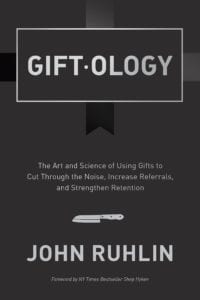
Let’s talk about the detail that you did on your book cover. It’s got shiny topography on it. It looks like it’s got a black ribbon on it. It’s got the knife. I’m sure some thought and effort went into that because I’ve seen a lot of books in my day and I’ve never seen a cover like that.
It costs three times as much to print that book as it does any other normal hardback. We actually have started to convert a lot of our books over to when somebody personally orders books from me. They don’t know this but for our first 50, for guys like Michael Hyde and Darren Hardy and Seth Godin, guys that read our friends, mentors or people I wanted to be, I made 50 of these books that look just like that but they were handmade. The book was handmade and then it went into a handmade leather bag. Then that went into a linen box that was padded and it was all color-coordinated with red. It was a $200 package and with a $9-metal letterhead, and hand-wrote notes to 50 of the top relationships. That’s a $10,000 expense. People are like, “That’s insane.” I’m like, “Let’s put it this way, Michael Hyde has one of the biggest audiences on the planet. He invited us to be on his podcast as a direct result.” He’s like, “I get thousands of books sent to me per year, yours is the only one I kept this year. It’s the nicest book I’ve ever seen.” He actually read it, as well as his twenty employees. People are like, “$200, that’s insane.” I’m like, “You’ll spend $200 on freaking flashlights and pass them out like they’re candy and not thinking anything of it. I’d rather spend $200 on one thing. Basically I call it shooting with a rifle versus most people shoot with shotguns. I’m going to go blow somebody’s mind with one thing versus sending out a thousand things that are just part of the noise and just vanilla and are nothing.”
We now have a VIP version of the book. That’s not $200 a piece but they’re very expensive; a leather bag, a linen box. When people get it they’re like, “Holy crap.” They only have to read the book and they understand what we do and what we teach and what we talk about and that we actually walk our talk. There are a lot of people that are big talking heads but are you willing to put your money where your mouth is and walk it out? For us, we’re this small little firm out of the Midwest, but we’re talking to the Washington Nationals right now about doing a big project with them. One of the reason is it’s because they’ve seen that we’re willing to walk our talk and they’ve heard about it from other people. It’s not that we don’t ever screw up. There are times that we drop the ball, we’re not perfect. Our intention is to fully play full on and do things that will level it, that most people are like, “That sounds great, but I could never do that.” They talk themselves out of it before they even engage.
That has so many layers; walking your talk, being authentic. It also reminds me of how the Italians wear clothes. They’d rather have one really wonderful handmade suit and wear that every day of the week than five so-so made suits. We go visit there and you think these people are really rich. They’re wearing these multi-thousand dollar suits and they’re like, “No, that’s all they wear. That’s their one suit.”
That’s their one suit. That’s their one leather bag. That’s their one watch. I’d rather have one really nice thing. My wife is the same way. She grew up in a farm and they took care of things. She’s like, “John, I don’t need a bunch of crap.” We don’t need more stuff, but everybody has room in their house for an artifact. I think that’s where people are like, “How do you send gifts? Doesn’t everybody just want experiences?” I’m like, “Experiences are awesome, I love experiences as gifts but I like to combine it with artifacts. Every time they see the item, they’re reminded of the amazing experience that they had with you or on their own or with their family or whatever else. I’m a big believer in do one really nice thing versus a hundred mediocre things.

I’m a big believer in do one really nice thing versus a hundred mediocre things.
Speaking of your wife, you talked about her throughout the book. You dedicate the book to her, you talk about how your favorite movie was The Notebook and that you weren’t around so much. Can you tell everybody what you did for your wife since that’s one of your favorite movies together?
Telling the whole story will probably take 30 minutes and usually that’s my wrap-up story when I give keynotes. The summation of it is I was broke as a joke when I started dating my wife. I had invested in a bunch of companies and real estate and I had an employee that was stealing from me, IRS audit. It was my lowest point. It was 2007, 2008. The world melted down financially on top of that. I went from sending saunas to people and Brooks Brothers and crazy over-the-top gifting experiences to living on $1,000 a month take home. The first two years of buying the company, didn’t take a salary, not one dollar.
I wanted to out-do myself of anything I’ve done for a client. I basically recreated The Notebook’s story. I was going to be on the plane with her in disguise, had arranged with Continental at the time. At 30,000 feet, she had read this notebook that I put together of 70 pages of our story. At the end it starts talking about, “Will you love me when I get older and when I’d gained 150 pounds?” There’s this old fat dude sitting next to her. She starts to realize, I’m the old fat dude, this is her boyfriend, I get down on one knee and pulled out the ring and proposed. Our 200 closest friends were waiting to celebrate in Cleveland where she was flying to, which is where I was living at the time. Her family had driven up. That was what was supposed to happen.
Unfortunately, I ended up collapsing in the airport, having to get on life support breathing machine. The FBI showed up because there was guy in disguise in an airplane in an airport. Everything that could go wrong with the story; they took me to the hospital, I was on breathing machine. It was like Romeo and Juliet. Fortunately, I didn’t die. I woke up the next morning and six days later got out of the hospital and was able to propose with no disguise. We read the notebook together with no disguise on the airplane and fortunately she still said yes after basically putting her through hell. It’s one of those stories that was told and written about. It wasn’t the version I thought it was going to be. It took a little bit of a U-turn, but it taught me some very valuable lessons along the way. It gave me an insane story involving FBI and TSA and hospitals and breathing machines. It’s probably the craziest thing in 37 years of living that I’ve lived through.
You’ve come up with this great term. Instead of an entrepreneur, you talk about being a giverpreneur. Can you define what that is for people in a way that they could start incorporating that into their business?
Yes. I came up with the term after reading Give and Take, Adam Grant’s book. I think that everybody is wired one of three ways. We all can be all three but we tend to have the tendency towards one of the three: a giver, a taker or a matcher. I think most people are matchers. If you do something for them, they’d do something for you. There are a handful of people that are givers in business, whether you’re a sales rep, an entrepreneur, an owner, that you give without expectation of anything coming back. Then the taker is obviously somebody that takes and is just looking out for themselves. What’s interesting about his book is the best performing entrepreneurs, lawyers, doctors, everybody, are givers. They’re also the worst performers. I think that it depends on how you give and there is a strategic way to give.
As an entrepreneur, we’re all looking for ways to grow our business and invest $1 and get $5 back. To me, a giverpreneur is somebody that has that giver mindset from Give and Take that gives with no strings attached. I think that a lot of the companies that scale the fastest are those that have the best relationships and have poured into them over and over and over again. Oftentimes, your first idea as an entrepreneur doesn’t hit. It’s the second, third, fifth, tenth, whatever idea, but if you’ve given along the way and poured into people, you start to stack up relationships and doors and opportunities and resources that by the third, fourth, fifth, tenth time, the idea is right, the timing is right, you have the right people on the team. I like to surround myself with other givers, whether it’s entrepreneurially or just in general, and have contests to see who can outgive each other. It’s amazing the things that start to happen and the doors that start to open and the people you start to meet.
To me, it sounds cool, giverpreneur. Really it’s just having a giving mindset and being strategic about surrounding yourself with other givers to grow whatever the business is, whether it’s the business you started or it’s operating as an entrepreneur or somebody that’s inside another company but acts like an entrepreneur. I want to surround myself with givers because those are the best performing people on the planet. Adam’s got the research to back that.
You’re also an investor so you hear a lot of people pitching you to possibly fund their startup. What do you look for in an entrepreneur, giverpreneur when you hear a pitch? Any tips on what a good pitch is?

Having some alignment from a core value perspective is really important to us.
We have pretty strict rights here. There are a lot of people that invest in tech and these different things. We do a little bit of tech investment but in general we’re looking for companies, one, where we trust the founder and that goes without saying. There are certain industries and arenas that, just based on core values, we’re just not going to get into. That’s just not the direction that we want to take even if it’s a massive opportunity. It’s just not who we are from a faith perspective and whatever else. Having some alignment from a core value perspective is really important to us. For us it’s not always, “Is the company going to grow to be the biggest?” but “Is there an opportunity to serve a niche and do something really unique and different and serve people?” At the end of the day, even if things don’t go perfect, we like companies where there’s not a huge amount of capital needs.
There are a lot of opportunities. Look at Amazon or Zappos. We’re not looking for companies to reach $1 billion in revenue before they’re profitable. We want the old school businesses where it’s like, “If this idea gets to $5 million, it’s going to throw off a lot of cash and help a lot of people.” If they can do those things and we feel like the niche is unique enough and we really trust the founder, then we’re open to invest in it. If not, it may be a $20 billion opportunity, at the end of the day that’s not necessarily why we’re investing. We’re not looking for unicorns. I know that hedge funds and all these other companies, they’re looking for the one unicorn. We’re looking for guys that can go out. I’d love home runs but base hits are just fine too. We invest in things that we understand as well. Like the one tech company we did invest in, it’s a gifting platform. I can add value to it and I understand it. Even though we don’t normally do tech, it was an area where we were like, “This could be really cool,” so we invested.
Movie studios have that same philosophy. They can’t all be blockbusters, some of them have to be base hits, as you described, back to the baseball analogy a little bit there.
Some of the movies that are consistently profitable are the ones that go directly to DVD or to Netflix or whatever else. They’re not the sexiest thing, they’re not going to do $100 million revenue, but they cost like $1 million to make and they produce $5 million in revenue. I’ll take a 5 to 1 ratio. It may not win an Oscar but I’m okay with that.
John, let me ask you about this situation. A lot of companies are invited to come and pitch, whether a magazine coming to pitch or brand to advertise or they’re an architect firm coming in with other architect firms to pitch to get the business to build the skyscraper or airport or whatever it is. They’re not quite sure if they should give a gift when they come to present or as a follow-up gift. They don’t want to have anybody accuse them of trying to “buy the business.” What are your thoughts on the best time to give a gift when you’ve been invited to come in and pitch, or should you give a gift at all at that time?
I think it’s a case by case basis. If it’s an RFP with Walmart or somebody like that where they can’t even accept a pencil or going out for coffee, then a gift isn’t appropriate. If you know those are the kind of people that you could take them to a ballgame or you can take them out to dinner, or there are more social experiences that are acceptable, then I would look to amplify. Let me take somebody out, if we were to take him out for a steak dinner, we might have personalized steak knives waiting for them when they got to the dinner that they could take home with them. It’s a cool thing that they can take home to their spouse and use. It was part of the experience, it elevated the experience, but nobody’s feeling like they’re being bought because there’s a $200 set of steak knives that they used at the dinner table. It was part of the experience. It was cool. It showed an attention to detail and personalization and class.
We do a lot of those things for clients when they’re in pitching stages or as a follow-up like we appreciate the time. We used the knives in that way like, “Thanks for carving up the time for us to be there and be a part of the things.” I think a lot of times, it’s sometimes those little things that show an attention to detail are huge. Sometimes, you’re pitching from afar. I know one of the guys that’s a client of ours, it’s an engineering firm, I was the only one that actually dropped everything, flew out and met with them to see what their real needs were, and that’s why I got the business. I wasn’t the cheapest but I was the only one that flew across the country to meet with them and really understand their needs. That’s why I won the RFP and the pitch.

If you don’t feel comfortable, like I can’t take them out for coffee, then don’t send a gift.
I think every industry and situation is different. If you don’t feel comfortable, like I can’t take them out for coffee, then don’t send a gift. The last thing you want to do is consistently spend money and have a negative consequence. What I will say is that most people play fearful when it comes to gifting. I would rather lose one of the ten pitches because they’ve misinterpreted the gift and stand out head and shoulders above on the other nine out of ten because I did. I think most people, all they remember is the one out of ten that got sent back to them or somebody was pissed off or upset or misinterpret it. I’m like, “Focus on the other eight or nine that loved it.” I love that people play scared because it means they won’t do what I’m teaching them to do. Five out of a hundred companies that we work with, they stand out head and shoulders above because even if their competitors know our playbook, they won’t do it because they play scared.
What’s interesting is my big takeaway, there are several, but the two that really stand out is the personalization combined with going the extra mile. There’s the young boy you described who drove so far, you getting on a plane, the personalization with the names on the steak knives, not just steak knives, that’s really key. My final question for you is, you talked about if you really get to know somebody, you can even really connect with them if you come up with a clever gift for their children. Have you ever done anything for someone who may not have children, but talks about their pets all the time?
I actually just sent one to Gary Vaynerchuk‘s former assistant who now runs Vayner Capital. We hosted Gary for the day. In Saint Louis, he toured our leather factory. He was like, “This is really cool stuff.” He’s like, “Phil, that’s this company.” I looked up and saw that he had a dog named Chloe, the dog loved peppers. I sent him a knife that was handcrafted exclusively for Chloe. It said something about Chloe’s pepper slicer or something like that. Sure enough, he responded. He was like, “That’s awesome,” because it was for his dog. We’ve done that with customized collars and leashes and beds and other things that are nice, classy, useful, high-end things for somebody’s pets absolutely. In many cases, people treat their pets better than they do their kids, it’s crazy. What lengths people go to. One of the few recession-proof industries is the pet industry. People eat Skippy peanut butter and be serving their dogs filet mignon. It’s amazing to me the level that people go to for their pets. Absolutely, that sets definitely a relevant angle to take.
Any last thoughts you have you want to leave us with on how we can be a giverpreneur?
[Tweet “Be A Giver-preneur”]
I would just say that a lot of times, people don’t think they can afford us or they get afraid on outsourcing and gifting to us. The reality is there are a lot of small companies that work with us. It’s like I’m going to take my three girls bowling. You just try to keep them out of the gutter and they have the bumpers that keep your balls over. We did create a PDF that has the ten worst gifts to avoid giving, just to give people a way to say, “At least it’s not one of these ten.” It eliminates. Most people are like, “Those are the ten I normally send, so I need to avoid those.” We confirm why they’re not great gifts. If you go to GiftologyBook.com/pitch, they can go download it for free and it summarizes some of what’s in the book. Obviously the book goes into detail on strategies, percentages, follow-up, case studies, and all that stuff. Sometimes people just want a little cheat sheet for them or their marketing team of like, “Keep these ten off of the list,” and it’s usually pretty helpful. I would say that that’s what I would wrap up with as far as a, “Go do this.” If you like the book, go download the book, and if you like the book and whatever else, you can reach out to us and I’m happy to help. That’s a good first step.
Thanks, John, so much. You’ve been a great guest and a giver.
Links Mentioned
- John Ruhlin
- Giftology
- Ruhlin Group
- Cutco
- Pre-Suasion
- Influence
- Michael Hyde
- Darren Hardy
- Seth Godin
- Give and Take
- Gary Vaynerchuk
Wanna Host Your Own Podcast?
Click here to see how my friends at Brandcasting You can help
The Successful Pitch – Book Trailer
Share The Show
Did you enjoy the show? I’d love it if you subscribed today and left us a 5-star review!
-
- Click this link
- Click on the ‘Subscribe’ button below the artwork
- Go to the ‘Ratings and Reviews’ section
- Click on ‘Write a Review’