

The Speakers’ Spotlight: Using Complementary Skill Sets As Leverage with Martin and Farah Perelmuter
Posted by John Livesay in podcast | 0 comments

Episode Summary:
When two skill sets match, it would definitely be an unstoppable joyride to success. It is the awesome secret sauce of entrepreneur couple Martin and Farah Perelmuter, Founders of Speakers’ Spotlight – a speakers’ bureau on a mission to change the world by helping clients put the right speaker in front of the right audience at the right time. Having taken the leap of faith to entrepreneurship, the power couple shares how they came up with their business, the value of complementary skill sets, and the concept of due diligence. Firm believers of building a business on trust, Martin and Farah tip us with the lessons they learned from the success of their first business and how they were able to apply it to the Spotlight Agency.
—
Listen To The Episode Here
The Speakers’ Spotlight: Using Complementary Skill Sets As Leverage with Martin and Farah Perelmuter
On this episode, I have not one but two guests, Martin and Farah Perelmuter. They took an entrepreneurial leap of faith back in 1995. They started Speakers’ Spotlight with a strong belief that the needs of conference organizers, meeting planners and speakers could be served in new and better ways and that speech can be a catalyst for positive change. They also believe that if they built this business on a foundation of trust, then the strength of relationships with clients and speakers would ultimately determine their success. They literally started in a spare bedroom in their apartment where they shared a desk, a phone and a computer. They had no clients, no experience, no staff and no money, but they had a clear vision and a strong belief that with a lot of hard work and a little luck, they can make it a reality. Since that time, Speakers’ Spotlight has grown into the world, one of the world’s largest and most respected speakers’ agencies. With the best team in the industry and an incredible roster of speakers, they are proud to have raised the bar of professionalism, service and integrity to a new level. Welcome to the show, Martin and Farah.
Thanks for having us, John.
I love to ask people their story of origin and I just hit the tip of the iceberg. Let’s start with what came first, the romance or the business idea?
I fell in love with Farah long before the business was even a seed of thought in my head.

Complementary Skill Sets: People who have complementary skill sets are the best cofounders.
How did you guys come up with it? You have your own separate careers, but you were together as a couple and then said, “We want to work together?” Tell us how that all came about.
Martin was practicing law and I was in advertising and marketing. One day my uncle came to me and he told me that he wanted to be a speaker. He asked me if I would work on his promotional materials. If I can help write them and design them. I said to him, “I would love to, but what’s a speaker?” I was in my early twenties. I had never seen a speaker. I didn’t realize that there was a whole world out there of professional speakers who spoke and got paid for it. I said to him, “Before I start working on your materials, I really need to go see a speaker.” I ended up seeing a whole bunch of them and I got involved in the speakers’ world. Martin and I ended up doing a year of research in our spare time. We recognized that there was a real opportunity out there to start our own business and that’s how it all started.
Was it easy or hard to convince Martin to leave his legal career and do this?
That’s the easiest decision I’ve ever made. I had already made the decision to leave the practice of law. I decided it wasn’t for me and I’ve been trying to figure out what to do next. We were experimenting, doing some research on the side while we were working and trying to understand the industry. Then it got to the point where we needed to get married first. Farah’s the oldest of three daughters and the first in her family to get married among her siblings. It was a big wedding in Farah’s hometown of Winnipeg, and there were about 300 people at the wedding, 293 on her side, seven on my side was the final count.
[bctt tweet=”Love what you do and who you are spending time with, and you will be happy.” username=”John_Livesay”]
She grew up with a very big family. I grew up with a tiny family and her parents, I think had probably told all of their friends and relatives that she was marrying a nice boy who had a good job as a lawyer. I had to stay in the practice of law until after the wedding so that at least we could keep that charade going through that. A few weeks after we got married and came back from our honeymoon is when we both quit our jobs and started full-time doing this business together. It was a bit of a scary moment because we went from two incomes to zero basically overnight, but we had put a lot of thought and planning into it and off we went.
It really is a leap of faith and faith in yourself.
In a very short amount of time, we got married, we moved into our apartment, we quit our jobs and we launched Speakers’ Spotlight.
If you ever look at one of those lists of most stressful things to do, a change of job is one, change of relationship status and moving is one of the most stressful things. We did them all basically at the same time.
If we can survive this, we will survive anything.
That was our mantra.
We were so happy. We hated our jobs so much and we were so excited to start our own and start the whole entrepreneurial journey.
What’s so fascinating is people who have complementary skill sets are the best cofounders in my observation and experience. The fact that you have this advertising and marketing is a big part of making sure your own website and how you present the speakers comes across. A big part of your business are contracts and making sure that’s all done properly and everyone is living up to what’s promised in the contract. If the client promises to have a projector there for the slides and there isn’t one, that can be a problem and vice versa. Your legal background comes into play on both sides there.
[bctt tweet=”Take the high road and be a good person.” username=”John_Livesay”]
Complementary skill sets are the key thing. It took us about six months of working together to figure out what our relative strengths were and create our roles so that they were quite distinct. I think for the first six months or so, probably 90% of what we did overlapped and then after that, it was probably less than 10% where we realized that we both had separate strengths and we started playing more to those strengths. That’s when we started to see things, I wouldn’t say take off at that point, but progress in the right direction.
Anyone who started their own business knows that one of the keys to success is getting clients and selling yourself. Especially in this industry that you’re in, there’s a lot of competition, which is fine, but you have to come up with some things that make you different and you’re able to articulate them so clearly on your website. I want to go over them because I think everyone is going to be able to say, “How can I apply this difference that’s working so well for Martin and Farah to my own business?” Ideally, people will understand your own branding better and what you’re bringing to the table. Let’s talk about the first one, which is this concept of due diligence and how do you decide who’s going to be fortunate enough to be in your roster because your reputation’s on the line as well.
I can say that when we first started, we found eighteen speakers who felt sorry enough for us to let us market them and represent them. It was tough going in the early days. Even those eighteen were all excellent speakers, we really tried to identify who some of the top speakers were in Canada at that point and try to work with them. Over time, we got to the point where in a typical year we would get over a thousand speakers a year approaching us, sending us either by email or phone or in the mail their packages or reaching out about representation. We realized early on that our reputation is everything. One of the most important things is making sure that the people that we’re representing and recommending to clients are going to be outstanding, not just in delivering a fantastic presentation, but all aspects of the engagement from the time that they secure it themselves right through and after the event. I can mention a couple of things that we’re looking for. Farah probably has things to add as well. Obviously, speakers need to be experts in their field and have some expertise, a point of view and have very good platform delivery skills.
Those are all a given, but I always think the ultimate test is if you are going to introduce that speaker to a room of say 500 of your biggest clients. It was an industry-type gathering or a client event, how would you feel about making that introduction? Would you be incredibly proud to introduce them and excited to unleash a speaker on that audience or would you be introducing them and may be heading for the exits because you aren’t exactly sure how it was all going to go down after that? If the answer is the latter, then they shouldn’t be on the website. They shouldn’t be on the roster at all. I really believe that we’ve got to be incredibly proud of people that we represent and feel passionately that they can make a difference with that audience. That they can move the needle and help an audience with whatever the objectives are, whether it’s professional growth, personal growth or whatever that may be.

Complementary Skill Sets: Integrity means walking your talk and doing what you say you’re going to do.
In terms of their topics, we need to make sure that it’s a topic that’s being requested by our client. It’s something that’s important now. It’s something important for attendees to hear about. It’s something that is perhaps newsworthy. We’ve worked with a lot of publishers so we know beforehand what will most likely be a big book in the marketplace. We know where the buzz is going to be. We often get to read those books first and we can sometimes get a heads up on those big authors and speakers. Also, many of our speakers are authors too, so we know what books they’re going to be working on. We can let our clients know this is going to be a topic that you’re going to be interested in and you may want to think about the speaker ahead of time. Also, if we know that a big book is coming out and we know the seats are going to go up, we’ll try to secure that speaker before that happens to our clients. It’s about relationships. It’s about knowing our speakers and our clients well. It’s a partnership.
You both have said so many great things here. Martin, the thing that jumps out for me is this nice alliteration about proud and passionate of what you’re offering. Farah, your insights are fascinating about the inside scoop of a new book that’s about to come out and then how you can capture that trend for your clients and possibly even get them at the current rate before all the buzz and demand comes when the book comes out. There are really fascinating strategies there. Then this other difference that you have, which I think is very interesting is no-commission sales agents. Your team is incentivized to do what’s right as opposed to the most expensive thing and that must pay-off a lot with going back to one of your cultural words of integrity. Do you have a story around that where you put your clients’ best interest in mind first and how that’s paid off for everybody?
I don’t know if we even have a specific story because it’s truly something that we do every day. The early days of the business, when it was just Farah and me for the first several years and then we hired our first employee. In terms of client-facing sales point of view, it was mostly Farah and me on the marketing side for the first few years. We knew we were going to do the right thing and we were really playing the long game. It was all about building trust and long-term relationships. When we started to hire salespeople, one of the things we wanted to ensure was that this culture that we had already been building around long-term relationships, trust and integrity was maintained.
It wasn’t really a brilliant brainstorm. It was, “How do we compensate people fairly but also ensure that they’re doing the right thing?” I’ve always had this belief that the most expensive speaker for an event is not necessarily the best speaker for the event. You want to listen to what the client is looking for, what their objectives are and make a recommendation based on who you think will have the biggest impact regardless of fee. We don’t even call them salespeople here because I don’t love the term, but when we started hiring people to work directly with clients and making recommendations, it’s one thing if we say, “Recommend the best speaker for the job, not the most expensive.” If they get compensated differently based on the fee, there’s a disconnect.
[bctt tweet=”Put the time in. There is no shortcut to success.” username=”John_Livesay”]
Even though I think the best sales professionals will still do the right thing and not be motivated by the size of the commission, it really disconnects. It can create a bit of a problem if we’re saying one thing but then compensating people on something else. Essentially we decided from the time we hired our first salesperson that what we’re going to do is incentivize them based on the number of engagements that they booked, but not tie it to the fee. Everybody has a target of the number of engagements that we hope and expect that they can book in the year, but it doesn’t matter what the fee is. A booking is a booking. That way, the incentive is to help the client find the right speaker because we know that if we do that, then the chances of that speaker working with us again in the future goes up significantly.
It wasn’t a brilliant brainstorm. It’s just the way we do things from the beginning. It made common sense to us, but the surprising thing is in speaking with a lot of people in the industry. I’m not aware of anyone else that does it that way. In fact, I’ve had people in the industry say, “How does this exactly work? I don’t understand how your salespeople are motivated if they don’t get a commission.” It is unusual, which is one of the advantages of starting a business when you have no idea what you’re doing. You don’t know the right way to do things, so you do things based on what makes sense, based on your values and so forth. That’s the way we’ve been doing things since day one.
Another thing is our team is very collaborative, so they work together quite a bit. If someone’s working on a client and they’re not quite sure what the right fit is, they’ll often ask other agents in the office and they’ll come together. They’ll talk about similar industries and other clients within that industry. There’s a lot of brainstorming and collaboration going on. It’s very much a team.
You really have defined what my definition of integrity is, which is walking your talk and doing what you say you’re going to do. The fact that you’ve set up your sales team not to be commissioned for the highest fees because you said that’s not your goal. Your goal is to get the best speaker regardless of the fee, then you’re walking your talk. That’s a big point of difference for people and then it leads right into your third big difference, which is this collective experience. When people are engaging with Speakers’ Spotlight, they’re not just getting one person. They’re getting the collective mindset of everyone there, that the team is collaborative. That comes from, “If I win, we all win,” and creating a culture of that, which I think is so important in whatever business you’re in.
Your fourth one, which I’m really fascinated with, is you manage the details and mitigate the risk. For everyone, many times when you were talking about what makes you different than everybody else, you’ll just state facts or features. What Martin and Farah have done here is they talk about the benefit to their potential client of mitigating the risk by managing the details. That is such a great example. Are there any stories of where a speaker’s flight got canceled or delayed and how you didn’t depend on the speaker to figure it out? Do you guys help the speaker?
I’ve got one that comes to mind. Unfortunately, it doesn’t happen very often. We’ll book on average in the last few years about 2,000 engagements a year. Unfortunately, we can probably count on one hand a number of times that something happens. It could be a serious illness. It could be unforeseen travel delays, but it doesn’t happen often. One of the things that we tell our clients is over 99% of the time, the speaker’s going to be there. Everything’s going to go smoothly and it’s all good. You don’t have to worry too much. However, one time out of every 300 or 400 engagements, something does happen. If that’s your one event, then it doesn’t matter. It’s a rare occurrence, it’s your event.
The one that comes to mind for me is the blackout that happened maybe ten or twelve years ago, where the entire Eastern Seaboard lost power and everything was shut down. We had a situation where there was no power in the office. There was no power anywhere and our computers were down, everything was down. We started flipping through files and tried to see if there was anything coming up that we needed to notify a client about. It was in August. Fortunately, it wasn’t a super busy time of the year in terms of conferences. It turned out that we did have a conference and we had a speaker booked for the next day at about 12:00 noon. When we looked in the file, we saw that at that moment when literally the lights went out, he was on a plane from the Western part of the country flying into Toronto.
We didn’t know where this plane was going to land, if it was going to land to Toronto or somewhere else. We immediately called the client on his cell phone and it was chaos. I could hear on the other end of the phone. They were in the hotel. The power had gone out at the hotel. We let them know that we were monitoring the speaker’s flight. However, we probably needed a backup plan just in case. I reached out to another speaker that I knew that was local and was available and I let the client know that the client was familiar with his work, so they were very happy with him as a backup plan. Long story short, the speaker’s flight was diverted and he landed in a place called Thunder Bay, which is about a twenty-hour drive from Toronto. He was hoping to get on a flight later that day or perhaps the next morning, but there was no guarantee he was going to make it.
[bctt tweet=”One of the keys to success is getting clients and selling yourself.” username=”John_Livesay”]
We had speaker number two, his name’s Mike Lipkin and Mike was on standby. He talked to the client, the client briefed him and he was ready to go and he said, “I’ll be at the event, ready to go. Even if the other speaker is able to show up, don’t worry. I’m happy to be there.” Mike showed up at the hotel the next morning. I went down there as well. I was on the phone with the other speaker who was still not sure if they were going to make it or not and they were still stuck in Thunder Bay. I lost touch with the speaker and I didn’t know where he was. We couldn’t reach him. We were counting down, there were maybe 30 minutes until the speaker was supposed to go on.
Fifteen minutes and they were getting ready to introduce him and the first speaker came running through the door. He basically had been able to practically parachute in and made it. We got the situation where we had two speakers ready to close this conference. Mike said, “I’m happy to back it, but why don’t we let the other speaker catch his breath and get ready? I’ll go out, I’ll do 20, 30 minutes if you want, just to get things going and then I’ll hand it off.” The client’s next question was, “Are we going to have to pay for the both of you?” Mike said, “No, I’m happy to do this. I’m here anyway. I’d love to do it.” He did the first twenty minutes or so, handed it off to the second speaker, his name is Alvin Law who has an incredible message. His message is, “There’s no such thing as can’t.”
If you ever meet Alvin and have a chance to see him speak, you’ll know why. He’s an incredible person. It was ironic if the person whose message is, “There’s no such thing as can’t,” can’t make it to the engagement but he did. He made it. He proceeded to get a standing ovation. It was just an incredible way to end the conference. The nice thing was on the spot the client hired Mike to keynote their conference because they were so impressed with the first twenty minutes. It all worked out. Things don’t always work out perfectly. That was an example where we thought afterwards if they hadn’t worked through an agency who was there partnering with them. Pulling on all of our resources and collaborating with our own team with our speakers and so forth, then it would have been a very different situation. That to me is my favorite story about mitigating risk, managing details, collaboration and so forth.
It says a lot about the team that you have, not just the team working for you, but the team of speakers and that willingness to do what it takes to make the client happy and that trust. That’s my big takeaway. Plus, I love any kind of story. I have a big emphasis on storytelling myself, on a little bit of drama and the way you described running in at the last minute and almost parachuting in. All that is what makes a good story and there are a lot of takeaways besides mitigating the risk and the details. If the quality of the speakers we have would go that extra mile even if they weren’t being paid and even if they had to back off at the last minute, that’s collaboration. Sometimes with two speakers sharing the stage, if they haven’t rehearsed or practiced together to have that be cohesive, it doesn’t always work. The big resolution of that was the other guy getting hired, but the irony of talking about there’s no such thing as can’t and, “I can’t make it to the event,” of course, he got a standing ovation.

Complementary Skill Sets: The great speakers are the ones who are really focused on the client and the audience and not just on themselves.
He made it. That was the amazing thing. In the back of my mind, I was thinking, “What if he doesn’t make it?” One of the things that you asked me in terms of what we’re looking for in speakers and the due diligence part is, we are looking for team players and people who are good people. Not just great speakers, but we’re fortunate that I think everybody that we work with, we feel we can count on. They’re good people that care about not just themselves looking good on stage because that’s not what they’re there for. It’s really about making the client look good, putting the client first, putting the audience first and being there to serve. That that’s what the great speakers do. There’s always a little bit of ego involved. You can’t get up in front of a large group of people without having a healthy dose of self-confidence, but the great speakers are the ones who are focused on the client and the audience and not just on themselves.
I also want to mention that one other thing that makes us a little different is we don’t have any contracts with our speakers. When we sign on a speaker, we fully talk about what the relationship entails, what the objectives are and what we both want to get out of it, but then it’s all on a handshake, integrity, honesty and transparency. There’s no contract.
That goes back to not paying salespeople commission for the highest paid. It’s all that mindset of trust. Before the show started, Farah, you’ve mentioned that you and Martin have started a second business, which is complementary to Speakers’ Spotlight. It’s called The Spotlight Agency. Tell us a little bit about how you decided. Did you see a problem that needed to be solved and you said, “Let’s start a separate business from that?”
We saw an opportunity that could be filled. What happened was we represent many high-profile personalities and celebrities. Over the years, aside from hosting and speaking, other opportunities came our way. In about 2006, we started a division at Speakers’ Spotlight called the Celebrity Division. Within that division, we started doing these extra types of projects. There were celebrity endorsement projects and spokesperson roles and some TV. What happened was that division started getting bigger and bigger and we realized that it was a slightly different target market. We felt that in order to grow that part of the business properly, we should really separate it. We started a new corporation called The Spotlight Agency. That is a separate entity from Speakers’ Spotlight. It’s growing quickly and we have part of our staff looking over that business and it’s exciting.
[bctt tweet=”You have to come up with some things that make you different.” username=”John_Livesay”]
It’s some of the same staff like Lucy, the Paw-sonal Assistant, your dog comes to the office. Lucy gets to work on both businesses, I’m guessing.
Lucy does whatever she’s asked. She’s very busy.
She’s very busy keeping everyone’s emotions on keel during any snow storms or delays.
Growing a business in the first place was not something we intended to do. When we started Speakers’ Spotlight, we did not have a huge aspiration. Much of it was a lifestyle change. We saw each other in our previous jobs and we wanted to do something together and take control of our careers and our lives. We thought the best case scenario is one day maybe we’d have three of four people working with us and we would get it out of the apartment. It organically grew. We’ve got about 34 employees now. It grew beyond what we had expected. With Spotlight Agency, it wasn’t something that was initially planned, but it fit really well. I’m sure you’re familiar with Simon Sinek’s work around Start with Why.
Our why with Speakers’ Spotlight is this idea that a speech can change the world. If we get the right speaker in front of the right audience at the right time, that’s when the magic can happen. I’m not so naive to think that people are going to walk out of a speech and their entire life is going to be changed, but I do believe that it can plant the seeds that are necessary to make some small differences, whether it’s at work, at home or in their community that can lead to positive change. That’s the goal behind Speakers’ Spotlight. With The Spotlight Agency, the businesses are similar in that they’re matching talent with organizations or brands.
One of the things we realized is that you can affect positive change in other ways too, not just through a keynote. It might be a marketing campaign. It might be a spokesperson campaign. Those kinds of things can have a profound impact as well. That was what made it an easy decision once we decided to move forward was it really fit well with our core beliefs around Speakers’ Spotlight. It’s similar businesses yet as Farah mentioned, very different in the sense of who the clients are, the whole process of putting deals together is quite different. The companies are quite distinct and yet share common values and beliefs.
I think it’s brilliant. It’s a nice use of skill sets and connections while expanding your brand that allows you to still stay to your core business and then have a brand extension that allows other skills to come into play and possibly different talent. Some people crossover and some don’t. It’s what I would see happening.
It’s interesting to have one business that’s 24 years old and another business that’s pretty new in some ways and it’s in rapid growth. It’s really interesting to watch.
[bctt tweet=”You owe it to yourself to find something that’s going to be meaningful and fulfilling.” username=”John_Livesay”]
That was going to be my next question. What lessons have you learned from the business that’s been around so long that you’re applying to this new business that people could say, “I need to be sure I’m doing this because I’m growing my business fast?”
One thing that I find that makes us really different from a lot of businesses out there is that we never borrowed any money and we never went into debt. Also, it’s the type of business we have, but it’s a service-based business and we had it out of our apartment. We didn’t hire people until we needed people and we grew it slowly. We bought what we can afford. We never borrowed from the bank or from our parents. We didn’t have that huge stress on us. We’re in some ways within the same with The Spotlight Agency. The Spotlight Agency are the same offices and we didn’t hire a ton of people out of the gate. We share some of the same staff and we’re doing it slowly and properly.
What a great takeaway. You’re not under stress with the decisions you make because you do not have to pay back a debt in the culture you created and not living beyond your means or spending beyond your means as a business. All these startups that get millions of dollars and then they blow through it because they have it as a very different mindset. That’s what allows you to work with top clients whether it’s Coca-Cola or McDonald’s or all kinds of people. Are there any last words of advice or thoughts that you want to share with the people?
I think this applies to anyone but particularly younger people. The two most important decisions that people make in their lives are the choice of career or job. One is what you choose to do for a living and the second is who you choose to spend your time with whether that’s your spouse or partner or someone who doesn’t have that close friends. I really believe that if you get those two decisions right, your life’s going to be pretty good. If you love what you do and you love the people that you spend the most time with, things will be great.

Complementary Skill Sets: It’s important to be not just happy but to be challenged, to be fulfilled, and to feel that we’re making a difference.
If you love your spouse and you hate your job, you’re probably not going to be happy all the time. If you love your job and hate your spouse, you’re probably not going to be happy. I believe that if you get those two decisions right, there are no guarantees or anything, but that puts you on a great course. I really think that those are two decisions that we have control over, in particular on work and in quitting. Having gone to law school, putting all that time in, getting hired at a prestigious firm and walking away from that, wasn’t an easy decision at the time, but it was the smartest decision I made because I knew that it wasn’t for me.
It’s for other people that might want that life and that’s great. I have a lot of respect for people who do that work. I think knowing yourself and knowing subjectively what is going to get you out of bed in the morning and want to go. We spend a lot of time at work and it’s important to be not just happy but to be challenged, to be fulfilled and to feel that we’re making a difference. That is critically important. If you’re doing something that you don’t love, I really think people, if they can, you owe it to yourself to try to find something that’s going to be more meaningful and more fulfilling.
The first one is that to achieve success, there aren’t shortcuts. You can’t beat the system in creative ways. You have to work hard work, you have to grind it out and you have to work and make it happen and then hopefully it will become easier. They have to put the time in.
Those are two wonderful tweets. Love what you do and love the people you’re spending time with if you want to be successful and happy. There are no shortcuts to achieve success, put the time in.
[bctt tweet=”The two most important decisions that people make in their lives are the choice of a career and who to spend their life with.” username=”John_Livesay”]
One last thing is to take the high road and be a nice person.
That is an amazing secret sauce. If you’re easy to work with and people like working with you on and off the stage, then they’re going to rehire you, refer you, all that stuff. People just assume that everyone takes the high road and as a good person, but if you are, it can be the difference between who they pick sometimes. I can’t thank you both enough. What a pleasure to get a sense of your relationship, your business, your family, your dog, the people working with you and the stories. It was all great. These are very useful information and I know that you’re going to be as successful with The Spotlight Agency as you are with your business, the Speakers’ Spotlight. Congratulations to you both and thanks for being on the show.
Thank you so much.
It was really a pleasure to chat with you.
Links Mentioned:
- Martin Perelmuter
- Farah Perelmuter
- Speakers’ Spotlight
- The Spotlight Agency
- Start with Why
- Speakers.ca/
- https://www.TheSpotlightAgency.com/
- Quantmre.com
Wanna Host Your Own Podcast?
Click here to see how my friends at Brandcasting You can help
Get your FREE Sneak Peek of John’s new book Better Selling Through Storytelling
John Livesay, The Pitch Whisperer
Share The Show
Did you enjoy the show? I’d love it if you subscribed today and left us a 5-star review!
-
- Click this link
- Click on the ‘Subscribe’ button below the artwork
- Go to the ‘Ratings and Reviews’ section
- Click on ‘Write a Review’
Premiere Speakers Bureau with Shawn Hanks
Posted by John Livesay in podcast | 0 comments

Episode Summary:
Growing up a la the von Trapp family singers, Shawn Hanks has lived with music and performing throughout his life. Now he imparts the knowledge of learning to create a feeling and communicate an idea to an audience among speakers and event partners as the CEO of Premiere Speakers Bureau. Shawn shows us the other way of selling which is to be able to communicate and connect at the same time. He shares some great advice on how you can keep your people loyal just as you do your clients. Shawn also talks about how his merger and acquisitions case became a success, giving tips on how to decide which accounts to target and what to say in your pitch to stand out as a brand.
—
Listen To The Episode Here
Premiere Speakers Bureau with Shawn Hanks
My guest is Shawn Hanks, the CEO of Premiere Speakers Bureau, who adds capabilities from several fields to the team. Over the course of his eighteen years in the event industry, he’s gained valuable experience advising corporate associations and non-profit partners. In addition, he provides direction to speakers on the Premiere roster. He’s an avid football/basketball fan and he and his wife survive CrossFit every day together. They are a couple that works together, stays together in Texas. They’re in mid-Tennessee. They have three children and an adorable golden doodle. Shawn, welcome to the show.
Thank you very much. It’s great to join you. Thank you.
Shawn, I love to ask my guest to tell their own story of origin. You can go back as far as you want, whether it’s childhood, high school or college days. Clearly, there’s some journey that you went on to become the CEO of this amazing speaking bureau, Premiere. I’d love to find out where that all came about, your love of communication and connection.
I grew up in a family that was a very musical family. We traveled and performed. Performing, communication, all of those things in my mind are one large path, which is to communicate an idea or create a feeling or an idea in the audience. That was instilled in me from a very young age and I performed most of my life. My wife and I are both from Texas. We’re high school sweethearts. We went to high school together, college together, married after we graduated and moved to Tennessee in 2000. That is the most interesting part as it relates to the Premiere Speakers Bureau. We were in Tennessee for a few months and a friend of mine interviewed for an agent role at Premiere Speakers Bureau. The interview did not go well. That’s a whole other funny story.
As this friend of ours walked out, she turned to Duane, the Founder of Premiere and said, “I think I know someone who might be interested in this in this career. He’s got a skill set that fits this.” I came and interviewed on Thursday, October 12th of 2000. I remember that date well because Duane offered me the job as I walked out the door. I was in a fundraising role. I was doing development for a large nonprofit. I went to my employer who was a great guy, very generous. I said, “This isn’t what I want to do with the rest of my life. I have a unique opportunity with a speaker’s bureau.” He asked the same question that I asked, the first question of my interview, which is “What is a speaker’s bureau?” That was 2000. Google existed, but we didn’t know how to use it yet.
Maybe it was AltaVista, I don’t know, wherever we were using to search at the time. I didn’t do a great job because I had to figure out what a speaker’s bureau was. He was very generous and said, “I’ll give my two weeks’.” He said, “If that’s what you want to do, go for it. We’ll wrap up all your relationships.” I called Duane on Friday morning and said, “I’d love to take a stab at this thing,” and literally started the next Monday. As they say, the rest is history. I’ve been here about nineteen years or will be nineteen years. That’s the genesis of what brought me to Premiere Speakers Bureau. If I’m honest, we’re still answering that question every day. What exactly is this speaker’s bureau? Hopefully, we’ve found some answers along the way.
I want to double click on this musical touring. I envisioned the von Trapp family from the Sound of Music vibe. Let’s hear a little bit of that because there’s a big connection between music and math and communication and music, and the importance of silence and things like that. You’re touring with your family, performing music. You’re playing instruments and singing, I’m guessing?
You got it right. The von Trapps with less lederhosen. I grew up in a pretty good size family of four kids. My mom and dad were both very gifted. My mom is still to this day, she’s 71 years old and still teaches piano every day. She loves it. Early on in life, I remember I would go to school during the week and on Friday afternoon, we would load up. We had a bus. I thought everyone did this as a kid. As I grew up, I realized it was very unusual and possibly weird even. The Partridge family was big in the ‘70s. That’s what everyone related us to, “You’re the Partridge Family.”
In fact, you plugged the instruments in.
It was required in the Hanks family that every child or kid at the time had to learn a musical instrument. You start with piano because that is a great way to learn theory and all those things. That was instilled in me early on in life. I performed all through high school musicals and all that stuff, church musicals. I have Music Ed degree of all things with a focus on performance and then theory as well. Music is like learning a foreign language. There’s a lot of math and algorithms essentially built into it. It’s a great way to challenge kids and adults’ minds. Keeping young and keep your brain working well. Music is a great tool in a lot of ways. It’s got a lot of corollaries and parallels to the industry I live in, which is communicating and people being able to own a room and control emotions and the journey that a group of people is on together for an hour. It’s a very similar process.
[bctt tweet=”Hire people with money, keep them with gratitude.” username=”John_Livesay”]
What were you doing before that fateful day on October 12th, 2000 after the music experience that allowed you to think that this may not be what you wanted to do, but you at least learn some business skills from?
I had worked at a university for several years in a recruitment role and then also a development role. That was at my wife and I’s Alma Mater, Mary Hart and Baylor, a small private school in Texas. When we moved to Nashville, I assumed a similar role with a large nonprofit based here in Nashville. It was a great opportunity for me. It put me in a room with high-net-worth individuals. I had about 30 to 45 seconds to tell them why I would need their considerable donations versus probably the line of people sometimes literally behind me. They would schedule five meetings in a row and come and pitch me on why your nonprofit has more value or specific value to where I want to invest my asset. That gave me an opportunity to hone those skills of being able to quickly define value and make it unique and essential to someone. I did that for probably about six months and that led to this opportunity. That wasn’t what I wanted to do with my wife if I was really honest. I couldn’t answer that question, what do you want to do with your life? I knew I wanted to do something interesting and unique. That’s where I ended up because I had to figure out what a speaker’s bureau was that made it interesting and unique.
That selling experience, why you should give your money here to this nonprofit versus this, must be somewhat similar except you’re more passionate probably about what you’re doing now of why a big company should work with Premiere Speakers Bureau versus another one. Is that accurate?
That’s perfectly well said. We have eleven agents on our sell side. Selling in our world is the wrong term. I’m a big believer in the term advocacy or consultancy because ultimately we are selling a speaker to a large event. They have a thousand attendees. A great salesperson can convince someone, “Bring in this speaker.” If it’s not the perfect speaker to communicate the right idea, the thrust of the event, it falls flat. Our role here is to talk to our event partners. We’re working with about 2,000 events this year.
Our role is as we chat with each one of those individually, most of those, we have existing relationships for years and we can reference, “This has worked in the past. This has not worked in the past,” or we can say, “In your industry, we’ve seen these things work. Here are two or three speakers we think would be great.”

Speaking: Music is about communicating and having people be able to own a room and control emotions.
They’re all professional speakers, John. You know a lot of these folks. They will all do a great job on stage. There’s that understanding what the client’s need is and how we can help fill that need. That’s real art. I feel like what our eleven agents do every day is not selling. It is understanding what their need is. Finding that point where they align with a speaker and the speaker goes, does an amazing job. That’s the real win for us. If that speaker communicates that important idea what that company is trying to get over to a thousand people in a room, the CEO can stand up there and say it all day. If someone unique comes in and does it differently, those thousand people will leave with that lodged in their head in a different and more memorable way.
You said that if someone from the outside comes and says something that’s in sync with the CEO’s messaging, it somehow resonates. It reminds me of parenting a little bit. When your parents would say something as a kid, you’d be like, “Yeah.” Suddenly a teacher says it or someone else’s parents say it. You’re like, “Oh.” How we process information is so key. This concept of selling as the wrong word, I am on a mission to help people stop pushing something, which is what people perceive when they think of selling. This mindset of how can we be storytellers, consult and tell a story of another client, for example, that had a similar situation. When we brought this speaker in versus another speaker, the outcomes were fantastic in terms of emotional involvement that day, the interactiveness, the actual takeaways and the revenue and painting that picture.
Whether you’re calling yourself a salesperson or an advocate or a consultant, that storytelling is the secret way to pull people in. If they can visualize themselves in the story, then it’s a whole different conversation. The mindset of, “I’m here to help serve you,” as opposed to pushing something out to you is keen. You’re in a fortunate position. This is Premiere Speakers Bureau’s 25th anniversary. Congratulations. You’re in a unique position in that you have a lot of existing clients for years. I’m going to ask you two questions. We’ll start with the first one about that. What advice do you have to people who are reading to keep those clients loyal?
Early on and I give credit to our Founder, his name is Duane Ward. Duane founded Premiere. Twenty years ago, I came in five or six years in. We have always had a very heavy focus on customer service. That’s the thing that everybody says. That’s an easy thing to say. We’ve invested significant amounts of revenue in not just service but the things above and beyond, sending multiple gifts throughout the year to our clients who may book one event with us each year, but they’ll get a number of handwritten notes. They’ll get different gifts from us throughout the year, different items. Small things we’ve discovered over the years resonate with people if it’s done from a genuine perspective.
If you send a gift and call the next day to say, “I want to make sure you’ve got the umbrella I sent you. Buy something from me.” No one wants that because that’s called manipulation. Some of these things sound cliché because it said so often, but I think it’s done rarely. If you see it as a partnership, many of our clients we’ve literally worked with for 20, 25 years, they often send us material from our competitors to say, “Look what I got from one of your competitors.” It lets you know when it’s time for us to get to work, which is probably the highest compliment we can receive that they’re receiving offers and invitations to work with others. We live in a friendly, competitive industry. “These are what your competitors are doing. We’re not going to work with anyone else.”
[bctt tweet=”Growth comes from customized targeted solutions.” username=”John_Livesay”]
To some degree when Premiere started, we were small and scrappy. Our industry, there are two big approaches, John. It’s getting a little bit into the weeds. Those that represent a number of visible names who were former world leaders. There’s a confidence that comes with that that my phone is going to ring from a former president of the United States and I’ll take the orders as they come. If I’m transparent, we didn’t have that opportunity early on. Our focus was we need to cultivate client relationships and then help solve their problems by providing great speaker options and speaker opportunities to them versus answering the phone and say yes or no, is the budget there, all those things.
It feels like we’re doing it well. We can always do it better. As we’ve grown and been blessed and seeing lots of opportunities and we’ve added those world leaders to our roster, we’ve always tried to keep that approach of, “Client, we want to serve you first.” There are security concerns and all these things for these world leaders that we represent. We never want the feeling to be, “Client, you now matter less because we have an important name or an important individual on our roster. Client, we’re still here to serve your needs also.” First is if we’re honest, that’s our approach. That sounds like a thin line, but it’s one I think has served us well. That service piece, we take it very seriously. We invest very heavily in real dollars to make sure our clients know that we appreciate the relationship.
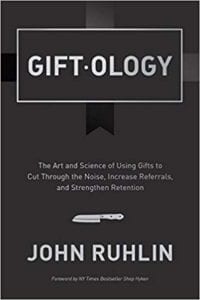
Giftology: The Art and Science of Using Gifts to Cut Through the Noise, Increase Referrals, and Strengthen Retention
I love this personal touch. The concept of a personal Thank You note, which used to be a standard thing years ago. When everyone else emails and you still take the time to write a personal note, it stands out and breaks through the clutter. Ironically, I’ve interviewed John Ruhlin, who did a whole book about Giftology and the importance of smart gift giving and how he works with companies to give thoughtful gifts at unexpected times. When I was in sales at Condé Nast, I put Google Alerts on all my clients. If they had a good stock report, if Guess Jeans’ stock is up X percent, I’d send a little note or a congratulatory gift. All the contact is not about selling, but knowing that I was in their corner cheering them on, congratulating them.
Clients, they understand that there’s a transaction to take place. I’m a client of many people in sales. It’s not a pejorative or negative thing when they sell me something. I think it’s Henry Ford. It’s been attributed to many people that nothing moves until someone sells something. The world is going around. It is the feeling of are you only selling me something or can we also have a relationship while you sell something? Again, it feels like finding the narrow path there. I, as a human being, when I am the consumer, I feel that difference. You do. We’d be naïve to think that our customers don’t feel that difference as well.
I always compare it to being a copilot with your buyer. When you’re on a plane and they say, “We’re now landing in Nashville,” nobody stands up and says, “What? We’re landing? I thought we’re running around forever.” It’s the same thing in a sales situation. Eventually, you’re going to ask them, “Would you like to hire somebody? There’s an event coming up.” You do have to pull the trigger eventually. I think that mindset helps. That’s a great insight as to how you keep your clients loyal. A lot of the people reading the blog would like to also possibly know how do you keep good talent because clearly the same authenticity and thoughtfulness and never taking people for granted that applies in relationships for clients, I’m imagining it applies for the team that you’ve built.
I’ve been at Premiere for nineteen years. I’d love to say that all nineteen of those have been doing it correctly. That would not be disingenuine to say that. Some of that was making mistakes along the way and saying, “I don’t want to recreate that mistake.” We’ve worked very hard to create what every company says family. That’s a bad analogy because you never get fired from your family or you never get laid off from your family. That’s the analogy that holds true in many ways. We worked very hard to make this feel familial in small ways. Everyone at Premiere is very blessed in life as they succeed. They see the results of that.
Every Friday we have a staff lunch in our large conference room, we’ll have 30, 35 people in there. That’s a good excuse for everyone to sit around and talk about what was funny on TV. There’s very rarely an agenda. I’m a big believer that you hire people with money, but ultimately you keep people with gratitude. When someone else approaches one of our team members, if I’m honest, it happens regularly. Often, I hear from that employee very quickly that, “A job offer was made.” If the money is ridiculously different I say, “I want you to have the next step and that’s great for you.” Most of the time it’s, “They offered me 10%. They’re going to have to do a lot better than that to get my attention.”
You acquired another speaking bureau. Can you tell us what generated that and what that experience was like?
John, we are in a competitive industry. I say often it’s a friendly competitive industry in the sense that I have many friends that work at the competing speaker’s bureaus. We have International Association of Speakers Bureaus, the association we’re all engaged with. We’re together many times throughout the year and have drinks and meals. There’s a camaraderie there. It also allows us to somewhat measure ourselves against one of the other and see how different people run their companies. I am a big believer in culture. There aren’t many other speakers bureaus that would be a culture fit. In the fall of ’17, Brian Palmer who was the Owner and Operator of National Speakers Bureau, his father had founded it in 1973, reached out to me and said, “Can I come to Nashville and take you to breakfast?” He did that very thing and it was for the purpose of saying, “I’m ready to start transitioning out of managing a team and managing a company day to day, running a company day-to-day. I want it to land in a place where I know it will fit well.”
We agreed that our cultures could mix and mingle and there wouldn’t be any shock either direction. There are always some surprises but relatively few, if I’m to be honest with you. Over the course of several months, we went through the acquisition process. We did everything. We removed ourselves from the process to a large degree, bring in an outside company to handle the transaction, an outside valuation company because I wanted him to feel like it was a win for him. Premiere is an AESOP. I have a duty to all of our employees here who were technically the owners of the company at this point to get a good value on a purchase. We were able to do that. John, I would say over the last months, the acquisition closed in June. They have not only thrived but significantly grown their production, the number of dates and the speaker relationship. It’s been a win.
[bctt tweet=”I am not the hero of your story, you are the hero.” username=”John_Livesay”]
Would you say that part of the reason this merger or acquisition in your case has been successful, is that you’re bringing some new technology and things that they didn’t have in place that allows them to be more productive?
Yes. National Speakers Bureau had existed much longer than Premiere. It has a very strong core base of clients who adore them. Clients that we not spoken to or worked with before, they had chosen our speakers because of those strong relationships like when we spoke about. We’ve invested very heavily on technology. Our competitors would say Premiere is almost a technology company as much as we are speakers bureau. We were able to integrate them into our systems, accounting, the backend services, logistics, air travel, all of those things within a week or two. I applaud our IT team. We have five people on that team. They integrated NSB very quickly allowing the NSB crew to truly go out and work with clients and continue those relationships and not have to worry or stress over all the heavy lifting that we can do because of our backend systems.
Do you imagine almost every company I have ever worked with, no matter how comfortable you are with these existing customers, there’s still an effort to go get new clients? We’ve already covered how we keep these existing clients loyal. We’ve covered how we keep the team loyal with gratitude and appreciation and acknowledgment. We’ve covered why this was a cultural fit for the acquisition. The last thing remaining would be how do you decide which accounts you’re going to target that might want to work with Premiere Speakers Bureau and what is it that you say in your pitch that allows you to stand out as a brand?
That like many industries is very specific to the sector of the business. You have association clients. They get calls from every bureau every day. That’s an exaggeration but probably not by much. Corporate clients, because they’re event planners, are more shielded. Those are a little bit more strategic where it’s attempting to connect through a third party or something along those lines. There are definitely are some commonalities across those sectors. It does get very splintered quickly. Our big approach is we are comfortable in spending to make an impact or to acquire a client or at least the attention of a client. The other side we have the benefit of we’re not solely focused on one, two, three or four products.
We have ultimately the ability if we see a business sector or an area of our industry that we think is underserved, we can go out and find two or three speakers that we feel are very strong on content that works in those areas. That essentially gives us a product to go to those buyers to say, “This product is perfectly designed for you.” That’s a huge benefit in the speaking industry because if you Google motivational speaker, I promise you’ll get tired before you get to the end of the result page. We have a great opportunity and we have to be strategic in what speakers we add because ultimately that that to some degree determines what type of clients are attracted to what we’re offering.

Speaking: To be the hero is truly to add value and to be a guide in some small way that resonates.
A great tweet based on what you said would be, “Growth comes from customized targeted solution.”
You should be a speaker, John.
I love doing it and I love interviewing people like you who got such a great passion and a message for what you’re doing. Is there any last thought you want to leave us with about either a book you want to recommend or a philosophy that has worked for you to become the CEO or be so successful in life that you would want to share?
John, you have a speaker that lives in your space, the story space, a guy named Donald Miller. If you don’t know each other, you should. You guys could blow a dinner parties minds with your thoughts on the story and conveying the story. I saw Don speak years ago. I knew him from some past relationships. His approach is, “Shawn, the sales process is not the hero of the story. I’m the guide in the story.” I felt like for the first time I’d heard someone describe exactly our approach. Premiere Speakers is not the hero in our event partner’s story. We want them to stand on stage and get the accolades and the applause. We have a product and we sell that product or we make it available.
Ultimately, we want them to be the hero. I felt like personal lives, professional lives as I’ve utilized that approach and been intentional about it that I’m not the hero in your story. If I’m here to add some value, I want to do that and I want to elevate this conversation and the thoughts and other people’s minds for the day. That’s not to be the hero. It’s to add value and to be a guide in some small way that resonates. I have literally written down on my desk, I read it 50 times a day. What I love is 20 or 30 years from now, someone says that about me, I’ll take that as a win.
[bctt tweet=”Small things resonate with people if it’s done from a genuine perspective.” username=”John_Livesay”]
What a great way to end this episode. I’m not the hero in your story. You are the hero. It’s such great insights. I tell people all the time, “I’m your Yoda or think of me as the Sherpa helping you get up the mountain, but you’re going to get there with me as your silver hero.” That’s wonderful stuff. Shawn, I can’t thank you enough. People can find you on the Premiere Speakers Bureau. Are there any social media that you want to promote the best way to reach your company?
Premiere Speakers Bureau. Congrats to everyone in this building and the people that have helped build it for the last 25 years. As we celebrate for the next year, I’m thankful for them. You’ll find us on Twitter, @PremiereSpeaker. If you go to PremiereSpeakers.com, you’ll be able to jump to all the different social media channels from there. We would love to help anyone. Please remind us that you connected with us through John. We’d love to know that.
Thanks again, Shawn.
Links Mentioned:
- Premiere Speakers Bureau
- Duane Ward
- John Ruhlin – previous episode
- Giftology
- International Association of Speakers Bureaus
- National Speakers Bureau
- Twitter – @PremiereSpeaker
- https://PremiereSpeakers.com/
- Quantmre.com
Wanna Host Your Own Podcast?
Click here to see how my friends at Brandcasting You can help
Get your FREE Sneak Peek of John’s new book Better Selling Through Storytelling
John Livesay, The Pitch Whisperer
Share The Show
Did you enjoy the show? I’d love it if you subscribed today and left us a 5-star review!
-
- Click this link
- Click on the ‘Subscribe’ button below the artwork
- Go to the ‘Ratings and Reviews’ section
- Click on ‘Write a Review’