

Marketing Mastery With Mostafa Hosseini
Posted by John Livesay in podcast | 0 comments

What are the secrets in formulating the best marketing strategies to scale your business up? Join your host John Livesay as he talks with Mostafa Hosseini about lead generation, qualifying leads, implementing marketing plans, and much more. Mostafa Hosseini is an entrepreneur and business coach that could help you create and implement a one-page marketing plan in three days or less. He shares his story on why he decided to drop the digital marketing services and keep coaching and consulting. He emphasizes the importance of identifying your target market. With his top three values of growth, family business, and learning, there are many takeaways in this episode of marketing mastery. You are sure to take the leap to make a profitable business for yourself and your loved ones.
—
Listen to the podcast here
Marketing Mastery With Mostafa Hosseini
Our guest on the show is Mostafa Hosseini, who’s an expert in marketing. We talk about how nothing works when someone’s trying too many things at once and how important client retention is. That is an untapped vault of cash that people aren’t using properly. Finally, he says 70% of entrepreneurs suffer from depression and overwhelm, and he helps them solve that with a laser focused plan. Enjoy the episode.
—
Our guest is Mostafa Hosseini, who helps coaches and consultants create and implement their one-page marketing plan in three days or less. He is a serial entrepreneur, a business coach, and the Founder of Persyo, which he’s also the host of the Daily Confidence for Entrepreneurs podcast, he’s the creator of Simple Marketing Formula, and much more. He’s been coaching and consulting for many years, helping businesses in various niches and industries grow and scale. Welcome to the show.
Thanks for having me. It’s great to be here.
I would love to hear your personal story of origin. You can go back as far as childhood or college. How did you get into becoming such an expert in marketing?
I was born in Tehran, Iran and moved to Canada back in 2000. I finished high school and I was eighteen when I got here. I went to school here. When I got first got here, I did not speak English. I went to English school for a couple of years to be able to speak. I went to school for engineering for two and a half years, didn’t liked it, dropped out, got into business school, loved it, which is what I wanted to do since I was a child. I got a diploma in Marketing Management. I got my Bachelor’s in Business Management with a minor in Marketing. I went to school for a long time and I started Persyo Marketing back in 2010.
Let’s stop the story there for a second. How did you come up with the name of your company, and what does it mean?
When I was trying to pick out names, the names that I wanted were all taken, the domains were taken. I had to come up with the name. What happened was one day back in 2010, I was sitting at a food court here in a mall in Calgary and I saw this restaurant. I’m like, “What about Persyo?” Persyo because I’m Persian-Canadian. I made the name, Persyo did not exist. When I searched Google, it didn’t bring up any results. I’m like, “Bingo.” The domain was available. I went for it. I asked a few people, “What do you think?” They’re like, “It sounds good. We like it.” I started Persyo Marketing. We did full-service digital marketing along with coaching and consulting our clients.

Marketing Mastery: By knowing what you want, you increase your odds of winning by 10 times compared to a person who doesn’t know what they want.
Back in 2017 or 2018, it got a little too competitive for me. I’m in a hyper-competitive environment and I decided to drop out and drop the digital marketing services and keep coaching and consulting. That’s my story. I’m married. I got two boys. My top three values are family business and growth and learning. I spend 99% of my time with family, business, growth, and learning. I love nature, mountains, skiing, hiking, barbecue. I love my Persian kebab. If you ever come up here, if I see you anywhere, I’ll do some barbecue and go from there.
Now that you’ve worked with so many different kinds of clients, do you see them having similar challenges or making the same mistakes in their marketing? Are they too complicated typically? Is that why you’ve honed it down a little bit to help people focus?
The number one challenge that I asked people over the years when it comes to their marketing is not knowing what to do. They want to grow their business, get more customers, and the rest of it, but they don’t know how to do it. The other challenge that they have is they start trying too many things. They are poking around twelve different things at any given time and nothing is working. That creates a feeling of frustration, overwhelm, anxiety, and people get depressed because they don’t get results. Back in 2017 or 2018, I read three books that changed the way I think and changed my business. The first one was Zero to One by Peter Thiel, who is one of the Cofounder of PayPal. In the book, Peter Thiel talked about how competition is for losers. He says, “You got to be in a place where there is no competition or you have very few competitors.”
I had too much competition that I felt like a loser. I’m like, “I got to change this.” I had competition all over the planet. In the digital marketing world, the barriers to entry are not very strong. People wake up one day and they’re like, “I’m a digital marketing advisor.” I decided to drop out of the digital marketing services and stick with coaching and specialization. The next book that I read that made a massive shift in my thinking was The 80/20 Principle by Richard Koch. If there’s one thing I wish I knew many years ago was this 80/20 principle. The next one was Essentialism by Greg McKeown on what is essential and not. I went through this phase and within 4 or 5 months. I’m like, “I need to simplify and focus.” I came up with a Simple Marketing Formula where we consolidate and simplify everything into one page.
Most business plans, especially coming out of MBA, it goes on and you don’t know where to start even with an executive summary it’s still so overwhelming and the shiny object of, “We should be on TikTok?” I’m like, “It depends on who your audience is. Not necessarily.” I like that. This 80/20 rule, for those people who may not know exactly what it is, I certainly found that useful in my sales career that 20% of your clients give you 80% of your revenue and 20% of the time you spend give you 80% of your results.
Are you spending time with clients that aren’t generating that much revenue? Sometimes, the lowest 20% of your clients are taking 80% of your time. That reframing of all of that is so crucial. Are there some myths that people have like, “If I spend so much money on my marketing, I should get this much percent growth automatically guaranteed?” or anything like that you see people thinking, “You’ve heard that, but that’s a myth.”
You mentioned one of them that, “If I spend so much money, I’m going to be successful.” It could happen, but it may not necessarily be true. One of the bigger problems that I see is if I worked hard, I’m going to see results. You talked about the 80/20, if you work on the 80% that doesn’t produce results, regardless of how hard you work, you’re not going to get there. I heard Tony Robbins said, “If you run East looking for a sunset, regardless of how hard you run and work, you’re not going to see it.”
[bctt tweet=”Nothing works when you try too many things at once. 70% of entrepreneurs suffer from overwhelm because of the lack of a plan.” username=”John_Livesay”]
I also think of the people at Kodak and Blockbuster, I’m sure they were working very hard up until the last minute.
The company doesn’t exist anymore. The strategy was outdated and what they were doing didn’t work and it got wiped up. Those are some of the biggest things.
You hinted at it, but let’s double click on what is this simple marketing formula that you’ve come up with?
The simple marketing formula was I need to apply to 80/20 principle to marketing and break it down to a few simple steps that cover 80% of the stuff that you need to do. I came up with six steps. Number one, you need to set your goals. You need to know exactly what you’re trying to build and achieve. As an example, when you’re trying to build a house, you design it, you do the dimensions. How many bedrooms, many garage doors, and the rest of it.
Come up with a plan, hand out the plan to the builders, bingo, they start building. You barely ever build a house in a city, at least, without a plan. If you do, you won’t get any insurance for it, and/or you would not put your family under that roof. You need to plan and know what you’re trying to build. If you don’t have a plan and a goal, you’re not going to achieve it. It’s pretty hard to achieve a goal that you don’t have.
It goes back to even time management. If it’s not scheduled, it doesn’t get done.
Step number one, know what you want. By knowing what you want, you increase your odds of winning by ten times compared to a person that doesn’t know what they want. It makes logical sense. Step number two, identify your target market, who do you serve and what do you do for them? Stop saying things like, “I serve everybody and anybody.” The fact is, if you try to serve everybody, you end up serving nobody. Who do you serve and what do you do for them? Step number three, your offer. What do you offer to these people? How do you connect your offer to what they want, need, and their challenges? There was a connection there. Step number four is your lead generation. How do I find leads? What’s one system that I need to master? Again, people are poking around at twelve different things.

Marketing Mastery: If you work on the 80% that doesn’t produce results, you’re not going to get there regardless of how hard you work.
If you pick LinkedIn, then don’t be spending time and money on TikTok or vice versa.
My strategy is to figure out LinkedIn and get it to a point where it’s driving leads to you while you’re sleeping, then move on to Facebook, then move on to something else. In that one platform, I’m pretty sure if, it’s the place for you, there’s so much business that you may not even need to go somewhere else. LinkedIn is massive. Lead generation. The next step is lead conversion, step number five. What is the step-by-step process to turn a lead into an actual paying customer?
That’s my sweet spot of helping people tell stories. Once they’re talking to a qualified lead that makes their offer seem irresistible.
We map it out step by step and we try to identify bottlenecks. Going back to the 80/20 principle, try to figure out what is these 1 or 2 steps that take 80% of the time. What do we need to do to speed things up and make things more efficient?
It’s anticipating a common objection so that you’re not a deer in a headlight when you get one.
There’s a bunch of things that could be happening. The fact that we map it out, people get these massive a-ha moments because 99% of people don’t have it mapped out. When they put it out there, they realize, one, “Because we visualize the process, we see what’s happening and more importantly, we see what is not happening.”
The myth is, “I’m losing my lead conversion at the end of the conversation. I’m not closing them properly.” I say, “You lost that sale at the beginning of the conversation.”
[bctt tweet=”You need to set your goals. You need to know exactly what you’re trying to build and achieve. ” username=”John_Livesay”]
Maybe before you started, that’s another problem. Step number five, conversion. Number six, client retention. What do I do to keep my customers do repeat business from them, with them, and get referrals from them?
Is that an unoverlooked goldmine? I tell people it’s just like any relationship. Friendships, spouses, anything. You can’t take relationships for granted.
By far, in years of marketing in my own business, client retention is the easiest most profitable sure-fire marketing process and action we have done. It’s like an untapped vault of cash that you have to open and there’s cash.
That’s a great image. We’ll use that as a tweet.
That’s it. Six steps.
The importance of this is trying to get a plane without a flight plan or build a house without an architecture plan. You’re just wandering all over the place if you don’t know where you are in the process and where you’re going. Is there a story you can share of how it’s helped a particular business owner?
I got probably 100 stories. I was looking around a whole bunch of video testimonials from people that we have helped. Identifying your goal, it calms your mind down. The sense of, “Here’s what I want to build.” Think about the frustration and anxiety of not knowing what you want. I call it being like a floating particle into air. I go right one second, I go left the next second, up and down, we don’t want to have consistency. It gives you that feeling of assurance and calmness.

Marketing Mastery: Identify your target market, who you serve and what you do for them. If you try to serve everybody, you end up serving nobody.
Once we’re calm, we can make better decisions as opposed to making them out of fear.
It’s like, “Here is what I’m trying to build. I need to find four customers this month.” How assuring is that? How many phone calls do I need to make to find four customers? Next, identifying the target market. Again, it gives you the certainty that here is who I serve. For example, I serve accountants between the ages of 40 to 45 in the State of California. How hard would it be to go on LinkedIn and find a county in the State of California? What do I do for them? For example, I help accountants in the State of California create and implement their one-page marketing plan in three days or less. All I have to say is, “I specialize in your service,” then finding customers becomes a lot easier.
Then the secret sauce to that is what is life like for those accountants after the three days? Peace of mind, revenues start going up, they start getting the referrals, and they know who their target audience is. They’re not just an accountant for everyone.
Another way that they become more profitable is when they drop all the extra lead generation activities that are not producing, they save on costs, become more profitable, either saved the money or refocused the money few things that are producing, become more profitable, bring in more leads, and everything becomes a lot easier. At the end of the day, you can sleep a lot better, your quality of sleep goes up.
If we can keep getting research in how important that is, your metabolism, your health, your mindset, what wakes you up in the middle of the night and keeps you up, that stress. I love your analogy of when our brain is not calm, then it never shuts off. It’s trying to solve the problem or figure out, “What should I be doing next?” To me, it’s interesting because sometimes, when I’ve worked with people who sell insurance and helping them craft a story, I say, “On some level, you’re selling peace of mind to people.” You don’t have to worry about if there’s a fire or whatever. On some level, what you’re doing is peace of mind for one of the most important aspects of running any business, which is we need customers and cash.
We need to figure out how to do it in a way that works as opposed to guessing because that’s anxiety. We don’t get behind the wheel of a car going, “I can figure this out. I don’t need to be trained.” Yet some people go, “I’ll figure out the marketing on my own. I don’t need anybody’s help, I’ll figure this out,” then you’re like, “That’s an expensive, time-consuming, lethal way to do it.”
You touched on it and we talked about it in the beginning, that is the number one challenge was not knowing what to do. There are so many options that not knowing what to do affects our mental health. Up in Canada, it might be pretty closed down in the States, the chances of people experiencing a mental issue is about 1 in 5, about 20% with average people. With entrepreneurs, it’s 70%. We have a 70% chance to experience mental issues. I’m willing to bet that not having a simple plan and not knowing what to do has a lot to do with this. If I wake up in the morning and I have twenty options and I’m just poking around, not knowing what to do and not knowing what to focus on, that messes my mind up.
[bctt tweet=”If you’re going to have a plan or if you don’t have a goal, you’re probably not going to achieve it. It’s pretty hard to achieve a goal that you don’t have. ” username=”John_Livesay”]
When you’re having conversations with these lead gens, you’re speaking to somebody who has the money to pay for it and they’re having a conversation with you to see if this is the time, if you’re the right person. If you’re in that 70% of entrepreneurs or accountants that are mentally stressed out, it’s like dating. People can smell desperation, fear, and pressure. You’re like, “I need four clients this month. I don’t even have one, and the month is half over. I’m going to talk fast when I’m talking to you and hope I get you to say yes.”
I’m getting stressed out as you’re describing.
That’s my skill, telling a story where you feel like you’re in it.
It’s important to know what you want.
You can’t fake being calm. Ultimately, people buy our energy. I was up for a speaking gig and it was between me and two other speakers and my agent emailed me, “Congrats. They picked you, they liked your energy.” I went, “I forget that’s what we’re all selling.” Our energy. Money is energy and action. You’re offering a plan that takes all the energy and all the ideas that somebody has of what they could do for somebody and gets it into a laser beam-focused energy. We all know what a laser can do, cut through metal and all kinds of stuff. They do laser surgery now. If I had to describe to people why they should explore getting this one-page marketing plan done in three days, it’s the power of the laser, which then gives you the peace of mind that you’re not going to be one of those 70% of entrepreneurs who are struggling with wondering what to do next and the stress that comes with that.
One of the things that we showed during those three days is how to differentiate yourself from the rest of the pack and how to almost eliminate your competition. Usually, when you ask people, how are you different? They say, “We do a good job.” That’s not different, everybody promises that. Having these pieces figured out gives you that calming assurance and the calming effect where you can be like, “Forget about everything else, just do this.”
I cannot come up with my power offer. I’m just buried in this picture so deep. People are like, “You’re a marketing guy.” I’m like, “I can’t see my stuff. Give me feedback.” What I’m trying to say is what other people look at you and talk with you, they can give you an outside perspective and it’s a lot easier.
Let’s also give out your website for people who want to find out more about what you offer.

Marketing Mastery: If one platform helps you drive leads, it’s the right place for you. There’s so much business that you may not even need to go somewhere else.
The website is Persyo.com. You can also find me on Facebook, LinkedIn, and all of our social media if you search for Mostafa Hosseini. Hopefully, I will be there.
Thanks so much for taking us through step-by-step the six ways that you help people get their laser focus. Any last thought or quote you want to leave us with?
Always encourage people to know what you want, have a plan to get there, implement the plan, and get support along the way. By doing that, you will increase your chances of success and odds of winning by 80 times compared to a person that doesn’t have a goal and a plan, doesn’t implement the plan, and gets no support along the way. Think about that.
Even climbing Mount Everest, those people have support, how to get Sherpas, and all kinds of stuff. Mostafa, thank you so much again for being on the show. I’m looking forward to hearing stories of how you’ve helped some of the readers.
Thanks for having me. I appreciate the opportunity to share my message with your audience.
Important Links
- Mostafa Hosseini
- Daily Confidence for Entrepreneurs
- Simple Marketing Formula
- Zero to One
- The 80/20 Principle
- Essentialism
- Facebook – Mostafa Hosseini
- LinkedIn – Mostafa Hosseini
- https://TD865.IsRefer.com/go/one/thepitchwhisperer/
- Better Selling Through Storytelling Method Online Course
Wanna Host Your Own Podcast?
Click here to see how my friends at Podetize can help
Purchase John’s new book
John Livesay, The Pitch Whisperer
Share The Show
Did you enjoy the show? I’d love it if you subscribed today and left us a 5-star review!
- Click this link
- Click on the ‘Subscribe’ button below the artwork
- Go to the ‘Ratings and Reviews’ section
- Click on ‘Write a Review’
Love the show? Subscribe, rate, review, and share!
Join The Successful Pitch community today:
- JohnLivesay.com
- John Livesay Facebook
- John Livesay Twitter
- John Livesay LinkedIn
- John Livesay YouTube
Never Fly Solo With Waldo Waldman
Posted by John Livesay in podcast | 0 comments


Every day of our lives, whether in our personal lives or in our careers, we work our way towards conquering fear. Conscious or not, conquering fear is an essential part of paving our path toward success because if we live our lives continually held back by fear, we never truly accomplish anything. Keynote speaker and leadership expert Waldo Waldman is the author of the New York Times and Wall Street Journal bestseller, Never Fly Solo. Waldo joins John Livesay to talk about the critical importance of conquering fear and choosing passion in our lives. Let Waldo and John help you choose to put passion before fear.
—
Listen to the podcast here
Never Fly Solo With Waldo Waldman
Our guest is Lieutenant Colonel Waldo Waldman, who is a decorated fighter pilot and expert on leading through crisis, a Hall of Fame keynote speaker, an executive coach, and a New York Times bestselling author. He has amazing stories of how he took his childhood dream and challenges of both being afraid of heights and claustrophobia that still allowed him to become a pilot in an F-16. He talks about the need for appreciation for being the fuel of performance and how we can all start using that to fuel our life. He talks all about what it takes to become a wingman and how we all need one. Finally, he said that passion trumps fear. Enjoy the episode.
—
Our guest is Lieutenant Colonel Waldo Waldman and he’s been inducted into the National Speakers Association, the Speaker Hall of Fame. He’s also known as the Council of Peers Award for Excellence. The award that honors those who have reached the top echelon of platform excellence. It’s been bestowed in less than 200 speakers worldwide since 1977, including Colin Powell, Zig Ziglar, and Ronald Reagan. Waldo is also a certified speaking professional, the highest earned designation recognized in the professional speaking industry. At least 7% of the professional speakers hold this exclusive designation. He’s a decorated fighter pilot where he’s led missions worldwide. He then went on to earn an MBA. His leadership and real-world business experience provided him the insights and skillset to consult with the largest and most diverse companies in the world. Waldo, welcome to the show.
It’s great to be here, John.
You and I met through some mutual friends, which we’ll get to in a bit but you’re known as The Wingman. Growing up in your family, who was the general? Who was the wingman between your mom and dad?
My dad was the Flight Lead and my mom was the General. She cracks the whip, was the enforcer, and sets the standard in the family. I grew up in an old-school, conservative New York household. My dad was a mechanic. My mom raised me and my identical twin brother, the ultimate wingman, and then my older brother and sister. We’re a tight family but blue-collar. My parents didn’t go to college, old school ethics, morals, conservative upbringing, hard work, integrity, get an education, and differentiate yourself. That’s what my parents always preached because they grew up poor. My grandparents were from Poland and Russia. They came over during World War II and experienced a lot of poverty. My parents worked their way up and were fortunate to have four crazy kids running around.
You have an amazing story of origin about this a-ha moment you had when your dad took you and your twin brother to the airport. Would you tell us that story?
My dad was a mentor in many ways to my brother and me and the family. He’s a workaholic. That’s why my mom tips the rain and doing a lot of the home disciplining and all that. My dad always spends time at work. One day, he took me and my twin brother, Dave, to Kennedy Airport on the first tour. We’d never been there. I’ve never been on a plane before around ten years old or so. I jumped onto that tarmac and heard the rumble of the jet engines. I watch those floating 747 in the sky. I smelled that JP-4 jet fuel and I was hooked. It was a defining moment. When it’s time to get on the flight line, he’d popped my twin brother and me into the jet 747. We sat in the cockpit. I remember it like it was yesterday, John. I’m sitting there and playing with the throttles, the switches, and making fake radio calls on the headset. I said, “Dad, what is this place for?” He said, “It’s the cockpit, Rob. It’s where the pilot flies the plane.” At that moment, I knew that I didn’t want to fix the planes like my dad, who was the mechanic on them. I wanted to fly them. There’s a lot more to that. He said, “Rob, you’re afraid of heights, it’s probably not the best career choice for you.”
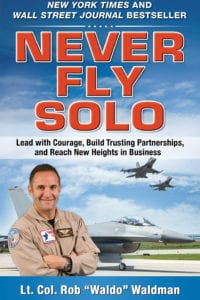
Never Fly Solo: Lead with Courage, Build Trusting Partnerships, and Reach New Heights in Business
You have this amazing story of one of the things that you have to do is jump off a high diving board with a 35-pound bag strapped to you. Tell us about that moment because you’re talking about overcoming your fears.
I always grew up afraid of heights as a kid but I had this maniacal passion for becoming a fighter pilot. I wanted to be in the air. What forced me to think about what I needed to do with regard to my education, my relationships, and working hard at school because we all know that being a pilot is not easy. I wanted to go to the Air Force Academy. To get into the Air Force Academy, you needed to have high grades, top of your class, well-rounded fitness, X, Y, and Z. It pushed me. That goal compelled me to stay focused and work hard. Unfortunately, the culture of my family was they embrace that environment.
It was relatively easy to have that guidance to stay on that path. I got accepted to the Academy, freshman year, I show up, everything is going great until we go to swim class. That swim class was this 33 feet high fiving board stare me down. I looked to the instructor and I said, “Excuse me, sir, do I have to jump off that thing.” He said, “As a matter of fact, Mr. Waldman, you do.” You don’t even graduate the Air Force Academy unless you complete the water survival training and jump off that diving board with a 35-pound pack on your back. I remember thinking as my mouth got parched dry and I freaked out that this was not in the marketing brochure.
That reminds me of Goldie Hawn when she’s in the movie about getting into the military and she’s like, “Where’s the glamour? Where’s the resort? Where’s the spa?” That little bait and switch sometimes when you think you’re getting into the one thing and it turns out to be something else. That happens a lot to people when they take a job, for example, or they get into a business relationship with somebody that wasn’t “in the brochure” or that’s not in my job description. Waldo, I want to double click on that because what you said there is worth so much for everybody reading. At that moment, you have a big decision. You can get mad, take your toys, and go home or you can reframe it and get back to your original purpose of how maniacally passionate you were to have your goal.
Passion trumps fear. When you look at what’s going on in your life, if we’re dealing with the economic downturn with COVID-19, the turbulence, challenge, stress, we’re facing 33 feet high diving boards, every single day. We’re facing missiles, headwinds, and turbulence. When I got into the F-16, I wasn’t jumping off diving boards, I was in the war in combat being shot at every single day. The fear was there but the key to peak performance, which is what I discussed, being that wingman and a trusted partner, realizing that you’re not flying solo and realizing that people depend on you. They’re not dependent on your philosophy as much as your performance, not your attitude as much as your actions. We, as leaders, emulators of excellence, partners, parents, friends, or whatever, we have to say, what is it that I need to do to jump? How am I going to step out of that comfort zone and realize that life is not in the brochure that on the opposite side of fear is growth? This was the key that I learned at an early age and it stayed with me. We could talk about my claustrophobia, combat, and all the turbulence.
Before we get into that, you mentioned that your dad said, “Rob, this is the cockpit, but you’re not good for this because you have a fear of heights.” How did you get to be called Waldo if you were born with the name Rob?
[bctt tweet=”The opposite side of fear is growth. ” username=”John_Livesay”]
My last name is Waldman. You could see the correlation there but every fighter pilot gets a call sign. You use it as a differentiator, as a brand builder. My brand was built in the Air Force when I finished pilot training. They said the great Waldo and I had a couple of nicknames as well but Waldo Waldman stuck. When you’ve been in combat and war, you normally get to choose your call sign. In the Air Force, there are a couple of other etiquette things you have to follow. It usually involves a lot of drinking and public embarrassment for you to earn that call sign. I’ve been called other things but I got the cool call sign or the one that I liked. It’s a cultural thing and you’ve got to earn that call sign. You’ve got to earn the respect of your peers, your wingman, your trusted partners, the men and women who you work with every single day. It happens in business and in life every day. We may not have a call sign, but our brand, name, reputation, how we show up, how we care, and prepare our critical assets and attributes to winning these days.
How we care and prepare because I am a big proponent of preparation, especially in the world of pitching and selling. In this story, we’ve got a picture of this determined young man who’s got a fear of heights overcoming that. From listening to one of your talks, it’s extremely competitive, not only to get in but to get that one slot. You said somebody else had slightly higher grades and that slot was taken. You have those key life-turning moments like the hero’s journey, you’re a hero. What’s going to happen next? Do you give up on your dream or do you say, “I’m going to go do something else and figure out a way to make still my dream happen.” In your journey, you did teach. Tell us what that was like.
For people that may not have context on it, when I graduated the Academy, I was fortunate enough to be ranked high enough to go to pilot training and there’s a wash-out-rate for all these training like at work but 33%, 1 out of 3 people normally wash-out or fail to make it through any of the higher-end aviation programs in particular and route to being a fighter pilot. Pilot training is competitive and stressful, as you can imagine. I graduated number two in my class. The number one pilot, Andy Toast, got the fighter slot and I wanted the fighter. He got the slot but I got my second choice, which was to be an instructor. That’s going to be teaching men and women how to fly in pilot training. I didn’t want to fly a big transport plane, the big cargo jets, tankers, and big Boeing. I wanted to be an aerobatic, high-G maneuverable aircraft. The next best thing was to be an instructor. I was high enough in my class to be an instructor.
What happens is we compete after the 3 or 4-year instructor toward duty for the next assignment. The higher you are ranked amongst your peers, the better your chances of choosing the jet that you want. For me, I wanted that F-16 and there were few slots. I made a commitment to work hard and be the best instructor I could. When it came time after 3 or 4 years to compete, I would maximize my chances. What happened was what happens in life en route to any journey that’s compelling and worthy of achieving is I almost died in a scuba diving accident. What does that have to do with flying? Long story short, I went scuba diving for the first time right towards the end of my last 6 or 8 months of my instructor tour and I almost died, 35 feet under the water, I had a panic attack, and the lungs filled with water. It was the first time I’d ever done.
I wasn’t well-trained and I freaked out. For those that are reading that ever had an anxiety or panic attack. I don’t know if you’ve ever been there, John. It’s an enlightening and fearful experience. I got out of the water and said, “I’m never doing that again.” A few days later, I’m back in Oklahoma, where I was an instructor, flying a training mission, the weather was terrible, and socked into the clouds. I couldn’t see the sun and the ground and I had that same panic attack that I had a few days prior. Instead of being 30 feet under the water, I’m now 30,000 feet in the air. I realized in a moment of terror that I had claustrophobia. That’s not the best thing for a pilot to have when they’re flying.
You had to overcome a fear of heights that you knew about, and then from a scuba diving experience, you realized you might have a little panic attack claustrophobia going on, which two big things that are heights and claustrophobia in that small cockpit. The thing that impresses me about your story and who you are as a man is a way you handle rejection. Number two, you have this choice. It’s no now but not no forever if you’re willing to put in the work for 3 to 4 years. A lot of people get to know in sales, particularly like, “I’m out.” It’s going to take you not to give up and keep going back. It might even take some time but you were committed. You’re like, “I’m going to be the best instructor ever so that I get another shot and had my dream coming true.” To me, that’s one of my favorite things about you and your story, because that is what inspires me to go, “If I’m committed like Waldo, then the no now doesn’t mean no forever.” You have a story to back it up.

Conquering Fears: Passion will always trump fear, no matter what’s going on in your life.
We all deal with rejection. We all have a dream. A jet we want to fly. A goal and something is going to bump into us. It’s going to be a headwind. It’s going to be a situation. It happens in our marriages, every day in sales, and it’s going to happen in your relationships, whatever it is. What I talk about is finding your why before you fly, the meaning to your mission. You’ve got to tap into what that passion is. What’s on the edge of that diving board? What’s at the end of that 3 or 4 years of training that’s going to compel you to keep stepping out of your comfort zone, to keep evolving and growing as a human being, as a parent, as a partner, and as a business person?
If we look at what’s going on with COVID-19 and the pandemic going on, the fears, and issues or maybe in your personal life. Also, some people reading have had cancer or went through a divorce, dealt with some intense rejection, going through some health issues, trying to lose weight, or whatever it is. You’ve got to have that compelling why and we’ve heard this before. It’s about taking action, investing, earning your wings, and saying, “I’m going to commit and grow.” It may not be now but I’m going to earn it. I’m not going to put my jet in the hanger and fall away in fear. I’m going to stay airborne. I’m going to keep getting in the cockpit of my life and eventually go for my dreams and hopefully have another shot, which I did at the end of that pilot training.
You talk about those moments of stress that sometimes we have to push up on the throttle when all of our instincts and our fears are saying, “This is a time to pull back.” Tell us an example of that in one of your combat situations. You’re good at taking your own story and then telling us how we can apply it in our own life. You’re trying to lose weight or you’re trying to whatever, and this situation that we’re all-in, how do we find that inner strength to push up on throttle when we want to carry our head in the cover sometimes?
It goes back to that passion, drive, and that innate goal that you have, a compelling goal that’s keeping you moving forward. If you’re an entrepreneur or if you’re in sales and want to get that big promotion, you’re vested in a relationship and want to take it to the next level, or you’re entering a bodybuilding competition and you say, “I want to overcome this insecurity.” Whatever it is, you need that to push you forward. I want to get back to the story about choosing my next aircraft because this was the first combat story for me. It was almost done and scuba diving, which was PTSD, Post-Traumatic Stress Disorder, and some of that Post-Traumatic Sales Disorder after dealing with rejection or whatever. When it came time for me to finish that assignment and we compete for that next slot. I’ll never forget what my commander said, “Waldo, you did great. Congratulations. You’re at the top of your class. You can choose anything that you want.”
A big heavy tanker, C-17 transporter, brand new plane, four engines, big roomy cockpit, be bored out of your mind flying eight-hour missions and cool spots but that’s not what I wanted. I wanted to be challenged. He also said, “By the way, you can choose your F-16, Mach 2, weapons and sensors, going fast and breaking the speed of sound, getting shot at in combat on nine-hour night combat missions.” I chose that F-16 but it was difficult for me because I had to look and say, “I’ve been dealing with these panic attacks.” Because for people that don’t realize, I would jump into a plane and have these panic attacks for a minute or two at first, that I’d breathe through it. I got focused and had to overcome this claustrophobia, this anxiety that held me back. I got used to that discomfort and chaos. I built resilience in that cockpit in the trainer, where it was one-hour missions over Oklahoma.
I knew I would be stretching by volunteering that next assignment to fly that jet, but I didn’t want to have to look back on my life and say, “To my future wife or my son, your dad played it safe. He quit on his dream when things were right in front of him.” I chose that F-16 knowing well that I was going to be going into the tiger’s mouth, face my fears in combat, fly eight-hour night combat missions, deal with my claustrophobia, crush it and defeat it. That’s what I did. There’s a long story behind that because I don’t think your fears and anxieties ever go away. The noise of fear must be drowned out by the music of your life. Your relationships, wingmen, partners, friends, fitness, what you read, what you ingest into your ears and eyes every day, especially when we’re dealing with those combat missions and now with COVID-19 and the uncertainty of the day.
[bctt tweet=”The music of your life drowns out fear.” username=”John_Livesay”]
Part of the message that I want to share with you people and guys like you because you and I have spoken, you have such amazing experience, top sales, travel, this and that, and now you’re getting into this amazing niche that you’re in. Doing these shows, creating Zoom webinars, becoming a coach, building revenue, and more significance in your life is what pandemics and fears force us to do. That’s the key. When you get up out of bed, choose the F-16 or hit the snooze button. When you got a donut or a green smoothie, choose the green smoothie. When you’ve got the opportunity to have a truthful, loving, heartfelt conversation or a board and say, “I’m going to hold off on another day.” Choose the road less traveled. Don’t take the easy way out, which is what my dad always used to say. You’ve got to go deep in your life to find out that meaning and not give up on your dreams because regret is a big poison in people’s motivation.
You talked about the choices we make and all kinds of things, flying the dream or not, the green smoothie or the donut. Everyone knows that to be a pilot, you have to be top fit because of the demands flying all night. You got to be ready to respond and defend yourself. You’ve kept this fitness. You could hop in that jet with your fitness level. Do you have tips that are transferable from the same discipline and focus that has allowed you to keep your fitness almost like an Olympic athlete that stays fit even after their Olympic career is over?
I’m a driven person. I’m a performance consultant and coach. It’s how you’re performing. That’s the true metric. Once again, it goes back to why. You need a reason to lose the way and reinvent yourself. You need a reason to have the conversation, jump out of bed early, sacrifice, hit the gym, and watch your fitness. For me, a huge component of it helps me deliver my best as a person. It helps me create. When I’m in the gym, I get creative. My heart’s pumping, I feel good, and when I’m done, I come out with ideas. I’m inspired. I want to serve other people. I’m more energized for the day. I can be an example to my son and wife. It’s not just about fitness, feeling good, and living a long life. I want to be in an environment where I can give and be my best. If you’re slacking off, not in shape, and losing that energy, other people, your clients, family members, or your friends may be impacted by that in a negative or positive way. A contagious example. The example that you said is contagious. We had ended energy or fitness or whatever.
This concept of appreciation being the fuel of performance which is such a great visual. How important is it for people to feel appreciated that keeps them going? How do you recommend people incorporate that concept of yours?
When I overcame my fears and became a peak performer, I realized a lot of the time that I was going up was that my fee was able to dissipate because I knew I wasn’t flying solo. When we went up in the to combat, I knew there were men and women on my wing supporting me, having my six, or checking my blind spots. I needed them, they needed me, and we were able to create this collaborative culture of mutual support like, “This is how we are able to win together.” Part of the key to being a peak performer, building resilience, and courage in life is to realize that others need you. You commit more for others than you likely do for yourselves. Any parent that’s reading or anybody who truly loves another human being, you know that you would jump off the 50-foot diving board for somebody that you love, whatever it takes because you’re not thinking of yourself. This was how I was able to be a great instructor pilot and a solid fighter pilot.
I wasn’t a great fighter pilot. I was good. I was a great instructor because it was always about focusing on my team, wingman, who needed me, who can I support and help? When I distracted myself from myself, I got out of my head. When we distract ourselves from our fears, anxieties, panics, and just say, “Who needs me? Who can I help? Who can I serve?” Now, we’re no longer selfishly thinking about ourselves and worried about our anxiety. We’re just in service mode, that’s how we can be fully present in life. That’s why you’re such a great communication pro and storyteller because it’s truly putting yourself in the hearts, minds, souls, that drives people. Back to the appreciation, it’s the fact that you can have your team and support them but what I learned is that what happens on the ground is just as important or even more important than what happened in the air.

Conquering Fears: It always goes back to whether or not you have a compelling goal that will keep you moving forward.
I wouldn’t say abusive but not kind and appreciative of all those other wingmen, the maintenance officers, the backend people who were in my squadron who I needed to get my jet airborne and be a part of the squadron. I learned a lesson about chewing out a young airman about appreciation. I’d be happy to share that story briefly but realizing that we have to appreciate our teammates and all those other men and women who fly with us. When we do that, we lift each other, we make them want to be around us more and make them feel good about who they are, and then they’re going to give more in return. I learned a hard lesson because I was a butthead as a fighter pilot, I was great with my fighter pilot buddies but I took for granted all those unsung heroes in my squadron.
After your military career, you went on to get an MBA and you went into sales management for big companies like UPS and Panasonic. You took some of that appreciation as well as this wonderful phrase here about, “Lose sight, lose the fight.” I’m sure that applies in selling because if salespeople don’t have a vision of who they want and what their goals are, they’re never going to make their quotas. What were you able to take from being a fighter pilot around this losing sight, losing fight into your career in business?
You always had to stay visual with your wingmen when you were flying. Part of mutual support is always having your eyes on your teammates, on the target, your eyes were everything. If you lost sight of each other, you would lose mutual support. The key to flying constantly was staying visual. In combat and a lot of scenarios, I would mess up or my flight leads will mess up. It was common because there are many moving parts literally and figuratively. It was difficult to stay visual, but when you had the visual, when you had the support, you were unbeatable. If you apply that concept in life, keeping visual of your teammates. If you’re a sales manager of those people who was working with you and for you. If you’re in a relationship, keeping visual, and keeping sight of your partner, your children, what do they need, listening, connecting, finding out what other people’s goals are. Also, staying visual about what you want, what your compelling goals are, what’s driving you forward is so important, especially when chaos happens, missiles come, and you’ve got headwinds.
My challenge for the people reading is to continuously keep your radar sweeping for those key elemental relationships that are not just important in business but in your personal life. We all know that our comrade of courage, our wingmen, the men and women in our life who lift us up rather than dragging us down who see the good that we have, the greatness in us, especially when we’re feeling deflated and out of fuel we’ll appreciate us for our gifts. That’s how we can come out of a tough situation by staying visible with them, communicating with them, checking in with them, and truly creating this context of support. Stay visual and I write down my goals every day. I’ve got items on paper. I want to stay visual with it. If you lose sight of your goals, key relationships, the people who need you, you’re going to lose the fight. It’s not easy to do. You got to be diligent and intentional with those key relationships and key drivers in your life and stay focused on them.
You’ve given us so much to think about in terms of accountability, what’s our personal commitment based on our why, executing and taking action, whether it’s getting fit or being a good wingman for the people in our lives. I wanted to recap it. You’re in great demand for companies wanting to have you come in and teach this whole concept of never flying solo. When we find the inner courage to be our best selves, we transform the way things get done. You’re also working with certain executives and one-on-one coaching. Who’s the ideal coach that you do your best client that you do your best work for?
We all know that when you’re strapped into a cockpit flying Mach 2 and pull 9 Gs, it’s difficult to see the big picture all the time. We all have blind spots, we have insecurities, things that were unfamiliar with, and we’re innocently ignorant with certain areas. A wingman builds our picture and improves that perspective. We call it checking six in the fighter world. Check six means if you can imagine, if you’re strapping into your jet, we’re sitting in our seat and 12:00 is out front, behind you is the 6:00 position. That’s the spot that’s vulnerable. It’s where the missiles come. It’s where the enemy sneaks up on you. In an F-16 strapped in, barely able to move, you can’t see that spot but if your wingman or wing ma’am is at your left 9:00 or right 3:00, if they’re a beam U, they can look over your shoulder, look behind your jet and see what you can see. Tell you to take action and hopefully, you’ll be approachable and coachable enough to take that action necessary to avoid getting shot down.
[bctt tweet=”Lose sight, lose fight.” username=”John_Livesay”]
That’s a metaphor with life and why people need a coach, mentor, or good friends who are brutally honest with them, not a yea-sayer who’s going to say yes to everything, but somebody who’s truly going to tell you what you need to hear and not what you want to hear. I coach sales leaders, transitioning managers, or going into executive positions, high potentials, and some CEOs who are looking to have somebody tell them what they need to hear and not what they want to hear. Create insights, give assets and tools on how they can be better than they were yesterday. That’s what drives me more than ever.
I love coaching people because I’ve invested in a lot of coaching myself because you can’t see the picture while you’re in the frame. You can’t see the missiles while you’re in the jet. It’s important to have that either formally or informally. You can hire a coach, you can invest in a coach and get training but there are also a lot of great coaches out there on the web. You can read shows like this. You’re their wingman or coach. They’re investing in this time by listening to us. We can finish on this note with regard to coaching is that I believe your coaches should be your friends in life and your mentors should be your friends. I have a saying, “Make your friends your mentors and your mentors your friends.”
You’ve got that mutual respect going on. If people want to reach out to you for either coaching or booking you as a speaker, what’s the best place for them to go to?
My website is YourWingMan.com or Google Waldo Waldman. You’ll find me there and I’m also all over social media, Waldo Walden. As far as coaching, if you want to email me at [email protected], even me or my assistant will get it. We can have a conversation. I want to give a gift to your audience. My book Never Fly Solo was in the New York Times and Wall Street Journal bestseller. It’s $20 on Audible, the audiobook, but I’m going to give it to you for free to your guests in particular during the pandemic. People need some good fuel, energy, and passion. If they go to YourWingMan.com/NFS, put your name in there, I’ll send you an audiobook, and you’ll also get six videos on building resilience in life. I’m creating trusting relationships and partnerships with people so that when you strap it to your jet and a missile comes, you won’t quit. You’ll stay resilient. You’ll keep pushing it up and serve those who need you and love you.
Thank you, Waldo. What a generous gift. I can’t wait to listen more and watch all those incredible videos. I want to thank you on behalf of the whole country for your service and for being such a great guy.

Conquering Fears: People need a coach, a mentor, or good friends who will be brutally honest with them instead of being “yaysayers.”
Thank you, John. It’s been a pleasure and I’m thrilled to be your wingman and develop a relationship with you as well.
Thanks.
Important Links
- Lieutenant Colonel Waldo Waldman
- Waldo Walden – Facebook
- [email protected]
- YourWingman.com/NFS
- Better Selling Through Storytelling Method Online Course
Wanna Host Your Own Podcast?
Click here to see how my friends at Podetize can help
Purchase John’s new book
John Livesay, The Pitch Whisperer
Share The Show
Did you enjoy the show? I’d love it if you subscribed today and left us a 5-star review!
- Click this link
- Click on the ‘Subscribe’ button below the artwork
- Go to the ‘Ratings and Reviews’ section
- Click on ‘Write a Review’
Love the show? Subscribe, rate, review, and share!
Join The Successful Pitch community today:
- JohnLivesay.com
- John Livesay Facebook
- John Livesay Twitter
- John Livesay LinkedIn
- John Livesay YouTube