

Sharing Our Stories: Tales Of Resilience And Renewal With Rick Gilbert
Posted by John Livesay in podcast | 0 comments

Sharing our stories is one way that people communicate. Stories bind people to one another, and stories are a way to understand others. In this episode, John Livesay talks to storyteller extraordinaire, Rick Gilbert, on the art of telling your story. Rick shares how his business was born of the need to help and how he started on the path of the storyteller. Full of insight and learning, this is one episode you shouldn’t miss.
—
Listen to the podcast here
Sharing Our Stories: Tales Of Resilience And Renewal With Rick Gilbert
Our guest is Rick Gilbert from Let ‘er Rip Productions. He is the Retired Founder of PowerSpeaking Inc., one of Silicon Valley’s most successful communication and training companies. Prior to founding that in 1985, he was a psychologist and held management positions at Hewlett-Packard and Amdahl. Rick is an author of several books such as Speaking Up, which is a how-to book on speaking to senior leaders. He performs one-man shows. His latest book is an audiobook, Sharing Our Stories, featuring interviews with 65 people, including people like Gloria Steinem and Daniel Ellsberg. Welcome to the show, Rick.
John, thanks for having me. It is a pleasure to be here.
We’ve got a little inkling of what an impressive background you have. Would you mind taking us back to your own story of origin, childhood, college, wherever you want to start? How did you get involved with teaching people how to be better communicators?
I started out always liking to be on stage. I was always in the school plays. In college, I majored in Psychology. As I got into my first jobs, I began to realize how much trouble people speaking are. It was terrible. I thought, “This is easy for me. Why don’t I go into business and help people learn how to do this?” I was active in Toastmasters for a long time and the National Speakers Association. I saw how many people were calling Toastmasters wanting help with this. I thought, “Why don’t I start a company?” That was many years ago.
The company has grown from me in the bedroom to 35 trainers worldwide and doing hundreds and hundreds of programs every year. The one that might be most interesting for your readers is something called Speaking Up: Surviving Executive Presentations. We found out that whenever people went up to the C-level in their organizations to make a presentation, whatever they did with their own team did not work. The audience was so different.
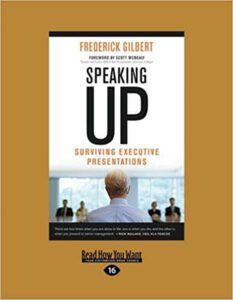
Speaking Up: Surviving Executive Presentations
What you said is so crucial. I have seen it time and again where somebody is a great salesperson and they get promoted to be a Sales Manager, Director, VP of Sales, not even at the C-level suite. They think, “Everyone has to sell the way I have sold.” Everyone has their own style. That alone is an example of just because you got a promotion does not mean the skills that got you there are not the skills that will keep you there.
Let’s take a composite person. A 45-year-old has 10 or 15 people on his team, making a lot of money and doing well at a certain level, whether VP or Executive Senior Manager. They get a chance to go to the C-level. Maybe they have to do it once a year to give a report. They use the exact same techniques they used with their own team. For some reason, they bomb and do not know why. It is because the audience is so different. It can be a tragedy for their career and team. Most of all, even for a product that needs to be funded, we had some people that we had been working with that did very poorly at the senior level.
I started interviewing CEOs to find out what was wrong with it. How come these guys are bombing? What we learned became that book, Speaking Up, and a program that we have been doing now for many years. It is very successful where thousands of people have taken this program. It shows middle managers, even though you are very successful, you are good, and you have an MBA, you’re great. The audience at the top level are different. We thought, “How are they different? What do they want?” We found out things that people can say that will make their career golden.
I will give you an example. The guy I was describing was 45 years old and a head of some big department. He goes into the CEO and the founders of the company. Here is what he or she can do to open up to be successful. The starting line is, “Good morning. I know how valuable your time is. We have 30 minutes on the agenda. I can get through it in 20 minutes.” You are giving me back some time. The second sentence out of that person’s mouth should be, “What I want from you today is a $10 million increase in our budget for marketing in Europe.” They know right up front what we call first line bottom line.
As a Sales Keynote Speaker myself, I know how important that first 90-second opening is. You’ve got to grab people’s attention. What I found works is a story that pulls people in right away, not this, “Thank you for the opportunity. I am excited to be here,” stuff. No one cares that you are excited. We go right into the story. It takes people a while, especially if they are not professional speakers, but just presenting.
[bctt tweet=”Stories energize all of us.” username=”John_Livesay”]
I worked with an architecture firm who was presenting against three other firms on who was going to get this billion-dollar project to renovate an airport. I said, “That opening line goes right into your story.” When I was 14 years old, I saw a drawing and I thought, “What is this?” That is what made me become an architecture buff. They are off and running as opposed to all the trite things, people, and the filler words.
This bottom line is a great soundbite. It is to let people know what you are asking for upfront. Otherwise, they are wondering, “What is to ask here? Where are we going?” I learned that when I gave my TEDx Talk, Be The Lifeguard of Your Own Life, the coach I had said, “What do you want the audience to feel, think and do?” Once we had the answers to that, the talk was built from the back end up in order to get those things. I am guessing you have found that similar type of strategy works.
I would make one suggestion to what you said. This is the thing about starting with a story. At the top level, you have the CEO, COO and CFO sitting around the table. They are making $13 million a year and their hourly rate is absolutely huge. This whole thing started when I was coaching this guy to start with a story and he did. They tore him to shreds and said, “Why are you taking up our time? What is your point? Get to the point.” We found that with the very top level, the stories are very difficult. The bottom line is they want data. If you are going to use a story, it should be extremely tightly focused on a customer experience. They are very numeric people.
A lot of the people I work with are in tech and healthcare. When I speak to that audience, they are convinced that people buy logically and back it up with emotion. I say, “Even the most sophisticated person is buying emotionally first and backing it up with logic.” Just pushing out facts and figures will not change anyone’s behavior. They are not going to remember it.
If I am speaking of an audience of CEOs, I always say, “XYZ CEO said to me or found that this was the number one thing that increased his bottom line. Here is the story to back it up.” Hence, if you have a story that can include a little ROI in it about someone that they relate to, they are a little more willing to go into the story.
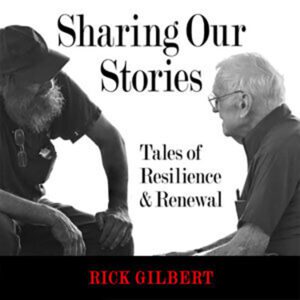
Sharing Our Stories: Tales of Resilience & Renewal
The guy that got criticized, our client, wandered the story, and took too long. They were so, “Let’s go. I have got another meeting.”
You can’t bore people. That is for sure. You have to be compelling. Stories need to tug at heartstrings to open purse strings. How did you come up with this audio book, Sharing Our Stories, about resilience and renewal?
I had retired years ago from the company that I founded, PowerSpeaking. I started a blog right away. Part of my blog was interviewing people. I love to do interviews, plus when I did the Speaking Up book, I had interviewed about 50 C-level executives in Silicon Valley. I had all of this choice of video and audio well-done and well-recorded. I thought, “Wouldn’t this be interesting to pull this together somehow?” A friend of mine said, “Why don’t you do an audiobook?” It popped for me.
I thought, “I love audiobooks. I have hundreds of them on my phone. It would be easy to do. I have all this stuff right here.” It was not easy. I worked on it for a year and a half. I am pulling it together and asking the data, “What does this mean? What is the data telling me?” Finally, it all came together and the title, Sharing Our Stories: Tales of Resilience and Renewal. I am a “spaghetti against the wall” guy. I said, “What is the pattern here?” That was the pattern that seemed to come out of all these interviews.
I ended up using 65 different people in this book. The purpose of it is to look over our lives from childhood, adulthood and elderhood. As a psychologist, there were 1 million different theories about development. I thought, “They are all too complicated. I like mine about childhood and elderhood. Elderhood is easy.” That was the format for it.
[bctt tweet=”At the very top level, stories are very difficult. Typically they want the bottom line. They want data, and if you’re going to use a story, it should be extremely tightly focused on a customer experience, or something like that.” username=”John_Livesay”]
The other thing that was critical about it was I wanted something to be entertaining. I wanted something that would be a page-turner, even though there were no pages. I would hope that people would sit in their cars and listen to this and be late for meetings because they want to find out how the story turned out. That is what I have produced here. It is an amazing contribution.
One of the things I learned from this that I did not know going into it was how powerful stories could be to change lives. It is not just telling our own story. We all like to tell our own stories, but how can I, as a person who cares about somebody else, encourage them to tell me their stories and give them the airtime and space to do it? Magic could happen. Magical things are incredible.
How did you get someone as famous as Gloria Steinem to agree to be interviewed?
I have a friend who runs a writers’ conference in San Miguel, Mexico. Gloria was coming down there to be the big keynote. It is a three-day conference. She was going to be the main event. My friend, Susan Page, told me about this and said, “You should come down and see if you can interview Gloria.” I wrote up a proposal that went to Gloria’s office. There were a lot of people in Mexico that wanted to interview her. I said, “I am interested, but I am not going to interview you about your career and the politics of what you have done. I want to know more about you as a person, what you have struggled with, and succeeded doing.”
They came back to Susan and said, “We want Gilbert to do this interview.” Nobody else got to talk to her. It was just me. You can see the entire interview on my webpage. Spending an hour with Gloria Steinem, she is like the Dalai Lama. I was in the same room with this woman. Here is the thing, John, you will love it if you watch the entire thing. I had watched some stuff of hers earlier that she had done. She had been a tap dancer in high school.

Sharing Our Stories: As a person who cares about somebody else, encourage them to tell their stories and give them the time and the space to do it.
At the end of our interview, I said, “We are wrapping up now. I am wondering whether you might be willing to do a little tap dance for us.” I put on my wide angle lens and pulled back. She said, “I do not know. I do not have any music.” I said, “I have music.” I sang, “You are my sunshine, my only sunshine.” She starts tap dancing in this hotel room. That was the end of my interview. It was more fun. She is a hoot.
There are a lot of takeaways there. One, you figured a unique angle that would appeal to her, so talk about knowing your audience. Two, that personal story of origin and the preparation, having a great closing is also equally important as a great opening and the playfulness of once a tap dancer, always a tap dancer.
I listened to that interview. One of the things that resonated with me was when she gets frustrated, aggravated, or a little down, she is able to remember a story of the impact she has had. She told this wonderful story of a woman who came to her book signing who had been in prison and changed her life. She became a lawyer. That arc of that person’s story energized her. I thought, “How great is that? Stories can energize all of us, even if they are not our story.”
When I asked her about moments that were extraordinary for her, she talked in general terms, like meeting people on the street. I said, “I want something more specific than that.” I burrowed in a little bit and said, “Can you give me a specific example of something that happened?” She told that story about the woman who went from prison to being an attorney and said to her, “I thought you would like to know.” Gloria says, “That keeps you going for months.”
There is a takeaway for the readers. Don’t take the first response someone gives you, whether you are interviewing them or if you are in sales and ask an open-ended question to try and find out what someone needs, and they give you the top line answer. You will understand this as a therapist. It is known when couples come to therapy and say, “Our sex life is in the toilet.”
[bctt tweet=”Active listening is the gold standard for interviewers.” username=”John_Livesay”]
That is the presenting problem. It is not the real issue. The same thing is true sometimes in sales. When you say to someone, “What is your biggest struggle? What is your biggest challenge?” They will give you a top line answer. You need to dig down a little bit like you did with Gloria. “What specifically does that look like or feel like?”
I learned that from Terry Gross on NPR. She is one of my favorite interviewers, and she always digs a little deeper. It has been very valuable for me as an interviewer when I am trying to get people to tell these stories.
Let’s face it. If you are in sales, and we all are selling ourselves all the time, you had to sell yourself to get Gloria to say yes. We need to ask deeper questions and build up some rapport that people are willing to answer those questions.
My background is in Psychology. Being a therapist, one of the takeaways from that part of my life was something called active listening. For an interviewer, that is the gold standard. Instead of trying to tell them your side of the story or direct them in some other way, you listen and say something like, “That must have been a real struggle for you at that point in your life,” and shut up.
I was fortunate enough to become friends with Elaine Gordon, who was married to Tom Gordon at the time, where they wrote Parent Effectiveness Training. That turned into Leader Effectiveness Training and that whole concept of not reacting to what someone says and reframing what you think you heard, so that you are listening to the right question.

Sharing Our Stories: One of the main things is going to be encouraging people to get the people in their lives to tell their stories.
I still use that technique when I coach people because sometimes, after they make a sales presentation, there is a Q&A. You can lose the sale in the Q&A if you are not listening to the question and you give them an answer that they did not ask because you are nervous or you did not hear it. They think they are talking to a politician and get frustrated.
It is like peeling an onion. You said it beautifully that people come for therapy. The sex issue is not the real problem. You start peeling away, but they will only tell you if you show empathy for what they are saying.
Tell us another favorite of the people that you interviewed on that book, another story from there of either how you got it or one of the things they said that surprised you.
One of the chapters is on risk-taking. I have interviewed some iron workers who talk about what it is like being 10 stories up on a 4-inch beam. One of the most interesting interviews I did was with a guy called Don Garlits. Don Garlits is the Founder of drag racing. He started racing after World War II on abandoned airstrips in Florida. I was doing a class at San Francisco State called the Psychology of Drag Racing. We went out to the drag races and interviewed these guys. Here was Don Garlits, the World Champion of this thing, and we got to interview him.
While I was interviewing, he said something had happened to him. Remember, this is danger and risk taking. He said, “I had a 2,000-horsepower dragster. I was coming off the line and two seconds into the thing, the car flew apart.” In those days, the driver sat behind the engine and transmission. When the car came apart, it also took off half of his right foot.
[bctt tweet=”Customize your presentation to your audience.” username=”John_Livesay”]
He ended up in the hospital for a long time recovering. In the hospital, he designed the rear engine dragster. At first, it was a real oddity and then it started winning races. Every time you see one of these dragsters that go 300 miles an hour in a quarter mile, the engine is behind the driver. I feel so proud of that fact that I got to hear that from the master, the guy that made that all happen, Don Garlits.
This concept of resilience and renewal, I have created something called the 555 Method. “Will this matter 5 minutes, 5 hours, or 5 days from now?” It is helping so many people to not stay in the loop where they keep replaying what somebody said that insulted them or hurt their feelings or in sales, you are getting a rejection. You have got to get back up fast.
Speaking of sales, there is a CEO I interviewed from Silicon Valley. His name is Steve Blank. He tells this story about what he learned and how he crashed and burned as a sales guy. He had a master sales guy come with him. When they went into this company, they were going to sell computers. Steve started out by telling them how stupid they were, how great his company was, and how wonderful their computers were. He said, “We were escorted out of the building.” This master sales guy said, “Let me do it this time.” In the next sales, the guy starts talking about the, “How are your kids? How about the high school football team? How are they doing?” Steve is sitting there, “When are we going to get to the sales part?”
Finally, the sales guy says, “I am embarrassed to be here because you guys are so smart. If your management had let you invest in the way that we have, you would have left us in the dust.” The customer says, “Now that you understand that, we are ready to hear what you have to offer.” It was a consultative sales masterpiece. Steve Blank tells this story so well of what he learned from a master sales guy who could understand from the client’s point of view.
I boil that down when I give my storytelling keynote speeches into, “The better you describe the problem, the better somebody thinks you have their solution.” We have time for one more, either story of someone you have interviewed or an overall reason why you would want someone to get the audio book.
[bctt tweet=”People will only tell you their issues if you show empathy for what they’re saying.” username=”John_Livesay”]
One of the main things is encouraging people to get the people in their lives to tell their stories. I am 82, so you can imagine a lot of my friends are getting up there in years. I have two friends who are going down very hard. One is in her early 90s. She is delusional. She has had a horrible life, round-the-clock care. Another guy is in his mid-80s. He can’t remember where he is. He gets lost in his own house, round-the-clock care.
The stories of these people are so sad. Both of them trust me though. I went with my iPhone recorder. It was very simple. I wanted an audio, and sat down with both of them separately. I got the woman who was delusional to talk about her career as a speech therapist in the school district. She spun out this wonderful story about a student that she helped. It was inspirational. Back in her mind is what she has done in life. It was so wonderful for me to be able to get her to tell that story.
It was the same with the guy who was so dimensional. He started talking about being on the swim team in high school. He starts telling these stories and it all comes back and is coherent. It makes them feel good about themselves. Their families love it because they are hearing it. “This is wonderful. This is the Jerry that I knew. This was the Tim that I knew growing up.” I want to encourage people to pull out that smartphone, sit down in a quiet place, use active listening, and listen. You will hear some magical things.
Rick, what is the best way for people to get to your audiobook?
Look for the audiobook, Sharing Our Stories: Tales of Resilience and Renewal. Thanks again, Rick, for sharing your story.
Thanks for having me. It has been fun.
Important Links
- PowerSpeaking Inc.
- Speaking Up
- Sharing Our Stories
- Toastmasters
- National Speakers Association
- Be The Lifeguard of Your Own Life – TEDx Talk
- Susan Page
- Gloria Steinem
- Terry Gross
- Parent Effectiveness Training
- Leader Effectiveness Training
- Don Garlits
- Steve Blank
- RickGilbert.net
- Better Selling Through Storytelling Method Online Course
Wanna Host Your Own Podcast?
Click here to see how my friends at Podetize can help
Purchase John’s new book
John Livesay, The Pitch Whisperer
Share The Show
Did you enjoy the show? I’d love it if you subscribed today and left us a 5-star review!
- Click this link
- Click on the ‘Subscribe’ button below the artwork
- Go to the ‘Ratings and Reviews’ section
- Click on ‘Write a Review’
Love the show? Subscribe, rate, review, and share!
Join The Successful Pitch community today:
- JohnLivesay.com
- John Livesay Facebook
- John Livesay Twitter
- John Livesay LinkedIn
- John Livesay YouTube
The People Whisperer With Ken Sterling
Posted by John Livesay in podcast | 0 comments

Public speaking isn’t easy. Sometimes, to maximize success, you need a people whisperer like today’s guest on your side. In this episode, John Livesay and Ken Sterling, Executive Vice President of BigSpeak dive deep into what you need to succeed in the public speaking space. Ken talks about being authentic, reacting to feedback, accountability, and choosing the right speaker for the job. Tune in for more great insights and learn from one of the best in the business.
—
Listen to the podcast here
The People Whisperer With Ken Sterling
Our guest is Ken Sterling, the Executive Vice President at BigSpeak Speakers Bureau. He talks about how they go from gurus to go-tos. Find out what he means in terms of speakers and the kinds of questions he asks to keep people coming back time and again and getting repeat referrals. He has an acronym called ACE for Anticipate, Communicate, and Execute. Enjoy the episode.
—
Our guest is Ken Sterling, who is based in Santa Barbara and the Executive Vice President at BigSpeak, the leading keynote, and business speaking bureau. He is a columnist for Inc. Magazine with a column called Talk Business to Me. He holds a PhD from UC Santa Barbara and an MBA from Babson College. He also teaches entrepreneurship, marketing, and strategy at USC Santa Barbara. In his spare time, believe it or not, he has some, Ken is a serial entrepreneur, a keynote speaker, and coaches executives for high-performance results. Ken, welcome to the show.
John, thank you for having me. It is an honor.
I am the one that is honored. You certainly are someone who does not dabble at life. You go all-in. You are able to be successful at so many things at the same time. Before we get into how you do that, I would love to know your story of origin. You can go back to childhood where you realized, “I gave a little talk and I’ve got a laugh. Maybe that is something I want to get into. I am interested in how organizations run.” Whenever you want to start the story from childhood or college because those stories are never linear, although I have done over 450 interviews now, no one has this, “I am going to get my PhD.” Few people have that in their heads when they first start their journey. Tell us how yours started.
I do not get asked this question often. I reflect on this a lot because I am so happy doing what I do in this blessed life and career that some people would call a job. It does not feel like a job. It feels like everything I did, including my origin, set me up to be successful doing what I do on what BigSpeak does. Going back over the waves of time back in the dinosaur days, I was born in a women’s college in Upstate New York. My mother was at a women’s college there. She is Sicilian.
Thanks to things like Roe v. Wade or whatever it is, I am a living being here. Thanks to my mom and the doctors at the little hospital there. I lived in a dorm for two years. My mom still has a picture of a drawer where they swaddled me in a blanket where I slept. We grew up very humble, not with a lot of money. My dad was not around. There was a lot of controversy around him and my mother. I grew up with a distant connection with my mother and no connection with my dad.
I have to make friends to survive and later to thrive. The first part of my origin story is about a kid that needs to connect and curate this tribe of a network. That is a lot of what we do in the agency world. We are networking, connecting, and being of service. We do good work. We have a reputation that we need to uphold. What I would do on my vacations is I would go live with my grandparents. My Nonno was an old-school Italian guy. He had a saying, motto, and value for everything. That rubbed off on me.
I was this poor street kid in New York then having these idyllic times with my Nonno. We came out to California when I was a teenager, which was interesting because back in those days, California was the big glitz and glamor of Hollywood. Elvis Presley was still the King. There was a lot going on. I was impacted a lot by Los Angeles, the energy, and the entertainment industry.
[bctt tweet=”Anticipate, Communicate and Execute.” username=”John_Livesay”]
I thought I wanted to be an actor. I auditioned. I was in a commercial with Sylvester Stallone for the Boys Club of America. I then tried out for a couple of being in movies. I’ve never got the parts. I did some theater arts and was in a couple of plays. I am still connected to performance, theater, and things like that. It is funny because I do have a PhD now. I am a high school dropout. I got kicked out and dropped out about two months before graduation.
Things did not go well. I had a run-in with a teacher and did not go back to school for many years. I’ve got my Bachelor’s, Master’s, and PhD much later in life. All the things that I did and the different businesses that I’ve got involved in were very much about building the community, connecting with people, feeding the family, and creating a family. Hopefully, good background of what makes me good at what I do is that I know how to keep people together and take care of people.
What a fascinating story from your crib being a drawer to dropping out of high school. With the predictions that you would go on to get a PhD and be at the level of success and contribution that you are making now, most people would not have bet on a story turning out like that. Was there a mentor involved that got you back into school? We are talking about your hero’s journey. Usually, there is some inciting incident or in a speaker’s career, there is a flashpoint, whether it is a book or a talk that changes things for that person’s career. Is there something you can point to now, looking back, that you said, “This is this person or this event got me on another path?”
Yes. It is interesting because there have been a few different mentors over the years. The mentor that helped me realize it was time to get back into education is the CEO and Founder of BigSpeak, Jonathan Wygant. We have known each other for years. Ever since I was a teenager, he has been a real mentor in my life and helped me a lot with getting me on good paths. What happened was interesting.
I was applying for a great job. Jonathan was one of my references. I ended up not getting the job because I did not have a college degree. I had some accomplishments and started some companies. I made some money, had some houses, and all the stuff. I was upset candidly that I did not get this job. I remember saying to the CEO of that company, “Mark Zuckerberg did not have a college degree.”
To her credit, she said, “With all due respect, you are not Mark Zuckerberg.” I said, “Thank you.” Jonathan invited me to go to lunch. We were having lunch and he shared with me at his company such as BigSpeak that he had a requirement for people to have a college degree and that to him and a lot of people, it demonstrates someone’s ability to follow through on a commitment and analytical thinking.
That was a barrier or a ticket of entry into a different world. I got out of that lunch meeting with him, drove up to the local community college, and went to the transfer center. I remember I waited in line, read a magazine, and got in front of this woman. Christine was her name and I said, “How fast can you get me to UC Santa Barbara” She put a plan together and I stuck to it, hustled, and made it happen.
Let’s talk a little bit about BigSpeak and the story of origin around BigSpeak. It is based in Santa Barbara where you live as well. What is it that BigSpeak does that makes clients want to keep working with you?

People Whisperer: I know how to keep people together and take care of people.
It is a great question to answer externally. It is a great question that we ask ourselves internally all the time, and because we ask ourselves that question, it sets us up for success. At BigSpeak, we are averaging about a 75% repeat referral rate, which is pretty phenomenal. We also run what’s called an NPS survey or a Net Promoter Score survey. To set the table for that, if anyone has ever gotten an email that says, “John, thank you for shopping at XYZ Widget Company. On a scale of 1 to 10, how likely would you be to recommend XYZ Widget Company’s services to a friend or colleague?”
There is a lot of science between why they asked the question the way they do and in the waiting for the answers. For example, on a scale of 1 to 10, most people think that a 7 or an 8 is pretty good when 7 and 8 are not good, so you want 10s, “How likely are you to promote us? How likely are you to tell a friend to do work with u?” We have for years sent the survey out to every client that we work with. We send it out on the company event planner side, to speakers, and to the speaker’s bureaus. The number is important. Our number is phenomenal.
Our NPS is 82, which shows a very high level of satisfaction. Back in the day, when Nordstrom had a great reputation, their NPS was in the 80s. Zappos back in the day was up in the 80s. Banks are notoriously down in the 30s and 40s. That is terrible. It is worse than an F’s. I will use the word obsessed because we are engaged with customer satisfaction and with Net Promoter Score, we always improve our systems. The number is one piece of it. The other thing is we ask the question, “If you did not give us a 10, what would it take to earn a 10?” We ask another question, “What’s something you think we do not want to hear?”
It is very vulnerable. With the stuff we have picked up on that over the years, we have revamped the way that we send out bills, collection notices, set up contracts, and do handoffs between our sales team, the events team, and other operations team. It has helped us understand those comments. We learn a lot more from them than the numbers, for example. We love the number and it is great for the ego. What we love are those comments where we learn from those.
Circling back to your original question here, “What is it that has made us successful?” 1) We are obsessed and concerned with customer satisfaction. 2) We work hard to do clean, effective, and good work. What that means is that we try to remove the turbulence and friction. We try to get everything cleaned ahead of time. Some folks in different roles, bureaus, and industries might half-communicate upfront. We like to get it all out on the table upfront. There are no surprises.
That tends to be important in terms of taking good care and setting good expectations. It is also great because when the speaker meets the buyer during the pre-call, onsite or virtually in the virtual green room, there are no surprises. You are in the speaking industry and we were talking about this before we came on. Sometimes, things happen. Anticipating those things and doing good, clean, thoughtful, and considerate work for all the parties helps.
I love a couple of things you have said that I want to double-click on. One, from your TEDx Talk, you talk about how leaders own turbulence. They do not try to avoid it. It is your process at BigSpeak of being transparent. I talk about, as a sales keynote speaker, the need to be a copilot with your buyers. Therefore, you are both agreeing, “This is where we are landing. It is not a surprise when we land the plane.” This concept of removing friction up front is so important because you have this wonderful acronym that I wanted to get into.
This is the perfect place for it because what BigSpeak is doing is putting the acronym into action. It is Anticipate something, Communicate it, and then Execute it. Let’s take the ACE. Let’s take each letter. Anticipating is what could go wrong and not shying away from it, both at the beginning and this is what is so smart about what you are doing but also at the end. What is it you think we do not want to hear? You are anticipating even the worst-case scenario. We still want to hear it so we can learn from it and this clear communication of, “This is what the speaker or the event requires.”
[bctt tweet=”From gurus, to go tos, leaders own turbulence.” username=”John_Livesay”]
Also, let me ask you this. How important is it that people are flexible enough like when a pilot hits unexpected turbulence? If something might go wrong at the event, that speaker has some flexibility in everything from how long they are going to speak to incorporating what happened so that it does not seem like a canned presentation. Do you have some examples of how you as a bureau have communicated some things that have allowed the clients to say, “We feel like you had our back”
Those moments happen when there is turbulence. We did about 1,600 events in 2021 and in 1,575, I will make that number up, we do not hear much. We get the smile sheet on the NPS and the 9 or the 10, “Amy was great to work with. Marc Randolph was an excellent speaker.” Those are great. In less than 1% of what we do, there is going to be some turbulence and the way that we show up, meaning BigSpeak, the leadership team, the operations team who might be interfacing. Also, the advisor on the sales team, when we get that feedback or know there is a problem, the first thing is to remain calm.
We talked about this as a group when we were all together. When a challenge comes up, embrace it as an opportunity to shine. A lot of folks, me included, would tend to sometimes feel a little triggered, anxious, and almost like we need to get defensive about something. What I mean by that is that even if let’s say it is not BigSpeak’s fault, we are still part of it. We still help create, promote or allow whatever the situation happens. Having ownership and accountability around that, realizing we are here to help, and this is why we exist. Otherwise, people could use Expedia for speakers.
We are here to solve challenges. That is a big part of the first step, “We are in a situation. I am here to help. I am a professional. I’ve got the expertise, knowledge, and experience. We have a team here to help.” That helps internally with the process. As we do hit those, let’s say 25 out of 1,600 events a year where there is a stumble and we hit the guard rails. Any number of situations may be created from those 25 challenges. What have we learned from those? That is where we can help with the A of the Anticipate.
We have been seeing more of this going on. It’s because of COVID, airlines have been canceling flights. We have got a speaker stuck in Dallas who was supposed to be in Orlando tomorrow. It is not going to work. Even if we could get a private plane, it is still not going to work, so we are going to have to scramble. Scrambling could mean lots of things. Scramble could be, “Who do we have in Orlando? Who do we have within three hours of driving to Orlando? Could we do a virtual? Could we get that speaker who is stranded in Dallas to a studio?” Those are the things that sometimes we are ahead of.
As we are putting that event together, speaking with the event planner and the speaker on that pre-call, what is our contingency plan? Gosh, forbid, everything is going to go great, and if it doesn’t, what is our backup plan? That is interesting because it hasn’t scared anybody away. It has helped the companies and the speakers feel, “BigSpeak knows what’s going on there. They are thinking of this stuff.” We have changed some of our discovery intake processes and agreements around what happened to COVID. It’s funny because A could be a lot of things. A is Anticipate, Accountability, and Adapting. As long as we are coming at it from those points of view, it is very helpful.
It reminds me of Captain Sully flying for years. When those birds flew into the engine, he needed to be able to land the plane in the Hudson. That is the kind of thing an event planner, management, and big clients want to know that BigSpeak has the skills. For everyone reading, when you start to collect worst-case scenarios, then you are not having to create them on the spot like, “This reminds me of another time somebody got stuck. Here are six choices we had.”
You offered them a virtual and a studio. Who lives there? You are not trying to come up with solutions under stress because you already have that template ready to go. I do the same thing with clients and stories. You have given so many great talks on what makes a good salesperson. We are in sync on the concept of having the ability to tell the right story to the right person at the right time so that you stand out against all the competitors.

People Whisperer: We learn a lot more from them than the numbers, for example. We love the number and it’s great for the ego. What we love are those comments where we learn from those.
It allows you to have this predictable revenue that you were focused on, giving people the sense of if you know your ideal client, in my case, it happens to be tech companies and healthcare companies, in that niche, when that offer or request comes up, then people go, “That is John’s niche.” They do not have to think about it. What if you could speak to them? I can speak to a lot of other kinds of sales organizations but that is my niche.
A lot of people are afraid to niche down but I feel and would love your opinion, that when you do have a niche, A) It makes you more memorable and, B) It makes you easier to refer and you get momentum. You are like, “You have got all these healthcare and tech companies under your belt.” You can speak to a real estate group, too, and they might even want to hear what’s going on in healthcare. That is what’s interesting but there is this ability to not try to be everything to everybody. Do you find that those are the speakers that are the most successful?
This comes up in conversations. This question comes up in my daily practice at least once a day, especially with newer speakers that we have been introduced to who are hungry for the work and may or may not be as passionate and do not have their niche, “What is popular? What are your top five topics? I can change my presentation and talk about something different.” That is a hard conversation because I am also empathetic to what their needs are and a few different things.
What I share with them and that I hope the impact is good with them is it is best to stay with your true north and your niche. Here’s why. First, you know it, you own it, and you are comfortable with it. To your point, when you get asked to shorten your presentation by ten minutes, the reason you can do that other than you being a wonderful speaker and you are very professional is that you know this content so well. You can take a couple of those Lego blocks out and it is not a problem.
If it is not you, if it is not authentic, and if it is this whole house of cards that you have built that isn’t true, then you are going to have a challenge with that. When things or a monkey wrench has happened, as you have seen on stage, sometimes, the confidence monitors go down or the lights go down. Who knows what’s going to happen? The more it is you and the more it is what you are an expert on, the better you are going to do, and the better the audience is going to feel.
They also can feel if it is not authentic and it is not what you are passionate about. I loathe sometimes to say, “Follow your passion,” because that is what a lot of parents say to their kids. I do believe in that as a speaker. Get up on stage and share your story that resonates and bangs so deeply in your heart that you have got to get it out there and share it.
I talk about it in terms of being an artist. An artist needs to create. There is this wonderful story of Picasso and other artists painting over their masterpieces in the ’40s because there was a shortage of canvases. If we were salespeople, speakers or whatever we are doing in the world, we would have that same urge, we will figure out how to compensate for a shortage of anything, whether it is a startup or not. The other thing is there are so many similarities between acting and speaking in terms of positioning and branding.
When they are casting a movie or sending out a request for a speaker, oftentimes, everybody wants Meryl Streep and a lot of people would love to have Simon Sinek because he is a wonderful speaker. They go, “We can’t afford either of them. Who else can we talk to?” I’ve got a gig that way because they knew they couldn’t afford Simon. They were looking for not a competitor but who can at least somehow connect the dots from why we like him to what we do when it fits our budget.
[bctt tweet=”If it’s not you, if it’s not authentic, and if it’s this whole house of cards that you’ve built that isn’t true, then you’re going to have a challenge with that.” username=”John_Livesay”]
I do not think a lot of people think of themselves like that. It helps bureaus like you and the salespeople go, “It is not the poor man’s whatever. It is just an alternative.” If you are looking for this kind of storytelling to explain your why, Simon is the man or the speaker. If that budget does not fit, there are also some other people that might be able to get you where you want to go within the budget that you have. You need to have that position for them to be able to think of you in those situations. That is the secret of it all.
I do not know if we can trademark this or not. We call it internally and when we are speaking with companies, the gurus, and the go-tos. I like that because it is not the plusser or the lesser situation. The gurus are Tony Robbins, Simon, Brené, and those kinds of folks. They are great. If that is not going to work out for a variety of reasons, then we have got the go-tos. These are amazing thought leaders who are professional speakers and knock it out of the park. They get 10 out of 10 reviews every time.
Sometimes, I will share candidly, and there is truth to this. I will say, “If you get a celebrity on your stage, it is great. Maybe you’ve got a photograph. I do not know if you or your audience is going to learn much from them. If you bring John in, he is going to get into how to help your sales team achieve their goals, be better storytellers, wrap storytelling into their pitch, and develop a better rapport with their clients. Isn’t that what is going to help move the needle at ABC Widget Company?” I believe that firmly. That is not a spin or a sales thing. I have written a couple of articles, “Do not Book a Headliner for Your Next Event,” and this is why.
It is that counterintuitive thing. I am sure you have got a lot of clicks on that.
I understand that a lot of big companies want that celebrity to sell the tickets, especially if it is an internal event and it is a sales team, you do not have to sell tickets. Their participation is mandatory. Why don’t you save yourself $100,000 and move the needle with someone like John and a thought leader in one of these go-tos who will get in, learn about your organization, and help make some change?
What’s fascinating is at one point, almost every guru was a go-to. They did not start with guru status, whether it is an actor or a speaker, everybody had their first break and went from there. What an enjoyable conversation wrapping around your expertise and BigSpeak’s expertise. Is there any last thought or a quote that you would like to leave us with?
A quote that I love applies to the speaking industry in general. We are in this area of information meets education meets entertainment. Sometimes I call it edutainment. At BigSpeak, our goal or mission is awakening greatness within. Where we go with that is that we believe that we want to help people learn, help them discover, and awaken things within them. I remember a quote by Ben Franklin. It had something to do with, “Teach me and I remember.”
I have got it here, “Tell me and I forget. Teach me and I remember. Involve me and I learn.”

People Whisperer: Get up on stage and share your story that resonates and bangs so deeply in your heart that you’ve got to get it out there and share it.
If you are a speaker, in the industry, and an event planner, as we build these experiences for audiences and have people up on stage or in a Zoom meeting, involve the audience, get them engaged, and make it inspirational, engaging, and interactive as much as you can because that is how you are going to get people and how they are going to remember in 30 days and 60 days. It is not that you had a blue shirt on or that there was a life preserver in the back. They are going to remember some content.
They are like, “There is a life preserver. We are drowning in a sea of sameness unless we tell a story. I’ve got it.” It is even a little visual cues. I have little life preserver chips that I can give people. It is a tangible thing for them to keep in their pocket or purse. They go, “I do not want to go back to my old habits.” There are all kinds of hooks. I love the involvement of using all of our senses. If people want to find out more about you, they can go to BigSpeak and follow you on Inc. The column is Talk Business To Me.
It is one of my favorites. It covers not only current topics but it makes us think in a way that brings your thought process, “I hadn’t thought about that,” or something like that. Here’s one of my favorite titles, “The Best Piece of Investment Advice I Got From a Billionaire Didn’t Involve Money.” That is how you hook an audience, whether it is a soundbite on a talk or a headline. That is part of what makes you and BigSpeak so successful as you cut through the clutter. Ken, thank you so much for being on the show.
Thank you, John. It is great to be here.
Important Links
- BigSpeak
- Talk Business to Me
- TEDx Talk – Managing Turbulence YouTube
- Do not Book a Headliner for Your Next Event – Article
- The Best Piece of Investment Advice I Got From a Billionaire Did not Involve Money – Article
- Better Selling Through Storytelling Method Online Course
Wanna Host Your Own Podcast?
Click here to see how my friends at Podetize can help
Purchase John’s new book
John Livesay, The Pitch Whisperer
Share The Show
Did you enjoy the show? I’d love it if you subscribed today and left us a 5-star review!
- Click this link
- Click on the ‘Subscribe’ button below the artwork
- Go to the ‘Ratings and Reviews’ section
- Click on ‘Write a Review’
Love the show? Subscribe, rate, review, and share!
Join The Successful Pitch community today:
- JohnLivesay.com
- John Livesay Facebook
- John Livesay Twitter
- John Livesay LinkedIn
- John Livesay YouTube
Storytelling With Impact: The Secrets To Giving A TEDx Talk With Mark Lovett
Posted by John Livesay in podcast | 0 comments

A former corporate executive who was saved by storytelling, Mark Lovett spent many years in the computer industry in Southern California. After getting out of that, he started consulting and got dragged by one of his clients to be a co-organizer of TEDx San Diego back in 2010, eventually producing twenty TEDx events over a six-year period. Today, Mark joins John Livesay to share his secrets to giving a TEDx talk and telling stories that can impact the lives of others. Shake off your fear of public speaking. Listen to this episode and start sharing your wisdom with the world.
—
Listen to the podcast here
Storytelling With Impact: The Secrets To Giving A TEDx Talk With Mark Lovett
Have you ever wondered what it takes to get to TEDx or a TED Talk? Do you think you have a story with an idea that’s worth sharing? Have you ever wondered what it’s like to organize a TED event? This episode is for you. Mark Lovett has given TEDx Talk and organized multiple ones. He shares with us all the secrets that go into creating a story with impact. Enjoy the episode.
—
I’m honored that we have Mark Lovett here from Lisbon. Mark and I knew each other when we lived in Southern California together. He was running the TEDx for San Diego for many years. He went on to do it down in between the border of Mexico and California. He even has done a TEDx in a prison. He is the expert not only on TEDx but how to tell a great story. Mark, thank you for joining us.
It’s a pleasure to be here, John.
Let’s have people know a little bit more about you. Would you mind expanding on your background?
I like to tell people that I was a former corporate executive who was saved by storytelling. I spent many years in the computer industry in Southern California. I got out of that and started consulting. It was one of my clients who started TEDx San Diego back in 2010, but that’s a program that only started in 2009. He was one of the first TEDx right out of the gate. He dragged me into the process to be a co-organizer. As the story goes, after one of the events, he puts something in my wine and I woke up the next day with a licensed to TEDx San Diego in my hand. Over a six-year period, we produced twenty TEDx events.
The big ones inside Symphony Hall were 1,800 people. You mentioned the one we did on the border where we built a stage in the United States and the stage in Mexico. There was the border fence right in the middle. We alternated our speakers back and forth from one country to the other. We did TEDx inside a state prison. One of our events was a youth event and that’s where the speakers, the performers, and the emcees were all high school students. My only rule was no adults allowed on stage.
I bet the kids love that.
[bctt tweet=”Tired of coming in second place? Stop playing defense.” username=”John_Livesay”]
They were thrilled. It’s like, “We don’t have any teachers or principals and we’re going to run this thing?” That whole process got me into speaker coaching, which has been a wide variety of things, from seminars to one-on-one. You and I met through a Speaker Adventure, which was a program I put on with another amazing speaker coach. We would bring six people together for a weekend and do intensive storytelling training. Storytelling’s become a lot of fun and it’s the passion of my life.
What I find interesting is many people will say to me, “I don’t have a story and I don’t have any interesting things to talk about.” You’ve shown that everyone from a high school student to someone in prison has a story. Can you speak to that a little bit of how can people who may not feel that they have a story, where should they start looking?
That is a common comment that I get from people also, “I don’t have a story to tell. I’m just an average person and I haven’t done anything great.” I said, “Interesting. No story to tell. You’ve never had any experiences in life? You’ve never made any mistakes? You’ve never had any successes? You’ve never learned a single lesson in your entire life?” They go, “No, let me tell you about,” and they’re rattling off. They were a football star in high school or they got in a car wreck and almost died but they recovered from it. When you dig into it, everyone does have a story. They have learned something. They have wisdom to share with other people. Once you can bring it out of them, then you get the ball rolling and then they get into the storytelling mode.
I once heard someone say that, “Your mess is your story.” That is a different way of looking at it because you’re saying, “You’ve never made a mistake. You never had any experience where you learned a life lesson.” Once we start to look at our lives, we think there is a story. The other issue is, “I’m not good at telling stories.” We’ve solved one problem. We’ve given people two places to look in their life, mistakes you’ve made and the lessons you’ve learned. Before anybody feels comfortable telling a story, even at a party, let alone in front of the people for business purposes, they think, “I stumble through it.” Let’s talk about that. How much practice is required when someone does give a TEDx Talk?
Let me back up a step to the overall point and then we’ll get into the TEDx. Unfortunately, there’s one of these urban legends that get out there that says, “People fear public speaking more than death.” I used to teach a class at the University of California, San Diego in storytelling and everyone would nod their head like, “I’ve heard that. I believe that. That’s the most frightening thing.” I said, “I’m going to give everyone in the class a choice. Option A, you come up in front of the class and speak for five minutes. Option B, I have a guillotine out in the parking lot. You can walk out to the parking lot and it’s off with your head. How many of you are going to choose to go out to the parking lot?” Nobody raises their hand.
In that class, the first night, there are a lot of nervous people. By the sixth class, everyone is up there delivering stories and they’re blown away by the other students. They’re all saying, “I had no idea you were such a great speaker.” It’s not that we’re afraid of public speaking. As humans, we are afraid of doing anything that we’re not good at and that we’re going to do in public because we don’t want to embarrass ourselves. Once you can start practicing to your point and get used to it, you realize, “I can do this. I tell stories all the time. I still tell stories to my family, friends, and at work all the time. Up on stage is a little different, but I can do it.”
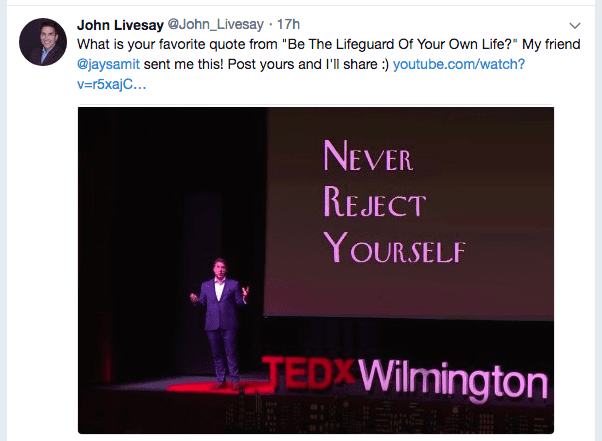
Giving A TEDx Talk: When you dig into it, everyone does have a story. They have learned something and they have wisdom to share with other people.
That reminds me of a book I read called Scared Speechless. My friend Steve Rohr wrote it. He said, “What’s going on in our brain is that from a tribal standpoint, stick with the herd. If you get hurt or you’re limping behind, that’s when you get picked off by a predator.” Our old brain is wired. If we’re standing in front of an audience, the herd is out there. You’re all by yourself. What are you doing? You’re going to get hurt. The other common thing I hear is that, “I get butterflies in my stomach. I get nervous and I hate that feeling.” I’m going to give everybody a solution to that, which is the goal.
It is not to get rid of those butterflies in your stomach, but to get those butterflies in your stomach to fly information. Get the nervous energy out of your stomach and into the room. If we make a gesture, then we’re putting energy into the room. It comes out of our stomach. The biggest thing is to get out of your head, worrying about how you’re doing. As you said, we’re afraid of embarrassing ourselves and of being judged, “Will they like me? Am I good enough?” The key to getting those butterflies in your stomach is don’t try to get rid of them. Get them to fly information. What are your thoughts on that?
It’s common. A lot of times, people think, “Only the amateurs get butterflies in their stomach.” I’ve talked to many professionals, they’ve been on stage 1,000 times and they still have that nervous energy. To your point, they turn it around to help them rather than to detract them from giving a speech. What I try to tell people is, “Think about this before you’re going on stage. The fact that you have this honor to connect with an audience and you’re going to give them a gift of your wisdom. This is a lesson you’ve learned, an idea that you have, an experience that you have and you’re going to share it. The audience is sitting there because they want to hear your story. They’re not passing judgment on you. Instead, they’re showing love to you.” When I tell that to people, they look at me strangely like, “What do you mean? These people don’t even know me. How can they love me?” They get out there, give a talk and then they come off stage. They go, “You were right. I could feel the love coming out of the audience. I could see the smiles. I heard the laughter. I got the applause.” They start feeding on that energy. Once you bring the energy of the audience and then the butterflies go away.
What I found when I gave a virtual keynote as opposed to doing it in front of an audience, we had that energy going back and forth. I wasn’t sure if the energy was going to come. I knew I could put the energy out, but I didn’t know because everyone’s on mute. I thought, “I’m wondering if this is going to still be the impact that I’m looking for.” Sure enough, it was. The element of connection and the joy of storytelling comes through virtually, which is fantastic to know. We can do a Zoom breakout rooms and we’ve got chats, we’ve got some questions here already.
Before we jump into that question, let’s just recap what we’ve covered so far. Everyone has a story. Look at your mistakes or lessons learned. Overcome your fear of giving the talk because you wouldn’t get those butterflies in your stomach to fly information. Get out of your head, worrying about embarrassing yourself. It’s one of the key elements, so we don’t feel like we’re going to stumble is practice. That would be the next logical thing of, “I know what I’m going to say. I’m not afraid of having to be perfect even.” The practice part also supports getting those nerves to go away.
The more comfortable you are, the more relaxed you’re going to be on stage. We used to always talk about when we did Speaker Adventure. There’s this process of moving the talk from your head down to your heart. It’s always in your head when you’re trying to remember, “What’s my next line? What’s the next thing I’m going to say?” Once you rehearse it enough times, it starts to become easier and easier to recite. It’s what’s often called the happy birthday effect. I’d walk up to anybody on the street and said, “Start singing happy birthday.” They wouldn’t stop and say, “What are the lyrics to that?” They would start singing happy birthday because they’ve done it so often. For me, there’s this circular process of writing, rehearsing, and editing. I try to get students involved in that as soon as possible.
[bctt tweet=”Go from pushy to persuasive.” username=”John_Livesay”]
I’m a big proponent for writing out your talk because the writing is where ideas start to flow and then stand up and rehearse this talk. All of a sudden, you’ll start hearing yourself going, “That sentence doesn’t sound right. I would never say that word. This sounds a bit disjointed.” One of the big reasons is that we read differently than we hear. When you’re reading a book, it’s not the same as somebody giving a speech. When you start writing your talk, you’re going to write it as though you’re reading it and it’s going to read well. When you start speaking it, you’ll notice all these things that don’t work quite right. You sit down and you start to edit it. Make your sentences shorter, more concise, use simpler words, and then get up and rehearse. When you do that, 30, 40, 50 times, some people roll their eyes and go, “I can’t believe I’m going to do it that many times.” You start to feel it. You start to get that happy birthday effect.
I love that happy birthday effect. That is clever. One of the mistakes that I see a lot of people are making is pushing out a bunch of information and I want to talk about that. What’s causing that? I’m going to tell his concept of, “We have to get people to know, like, and trust us.” People say, “What does that look like?” The problem with know, like, and trust is, you think, “If I have to get people to know me before they want to trust me, that’s going to cause me to push out a bunch of information.” You’ll get confused about it. You think, “I’ve got to explain to everybody why they would need to know me and why they need to like me.” When that happens, people get bored and they checked out because nobody remembers a bunch of information. That’s where storytelling comes in.
The old way of doing this is you got to know, like, and trust, therefore, “I got to give you a bunch of information, then maybe you’ll like me and trust me.” I tell people, “You’ve got the order wrong. You need to start with trust,” That’s a gut thing. In fact, the handshake came about to show you didn’t have a weapon in your hand. It goes from the gut to the heart. The more you show empathy for someone and can describe what their pain point is, especially as you were describing the mistake you might have made when you share that in a TEDx Talk or any situation. People feel like, “I have empathy for what that felt like. I’ve been in that situation.” It goes to our head where we want to have a story that gives people some actionable takeaway where they think to themselves, “This advice you’re giving me would work for me.” Tell me about some of the best TEDx Talks you’ve seen and coach people giving that use this formula.
I go all the way back to the ancient Greeks and the Romans, which is where rhetoric started. Aristotle had three principles that mirror what you talked about. Those are ethos, pathos and logos. Ethos is where we get the word ethics and it’s your credibility. Whether somebody believes in you, whether they trust you, whether they feel confident that you know what you’re talking about. Pathos is the emotional side, which is liking somebody. You want to touch somebody emotionally. I love the fact that you reverse the order on these because it’s the third one, the intellect. Logos is where we get logic from. Your argument needs to come off as being logical, but that logic comes after the emotional connection and after that credibility.
That gut, heart and head are important there. One of the ways that you do that is by being authentic on stage. Dumping out a bunch of information, then you sound like a college professor, “I’m reading from a textbook and here’s all the information that I’m trying to convince you that this information is true.” People need to be able to connect to you as a human first. One of the ways to do that is to put a human story within your story. Even if your story is technical, let’s bring in that human element. For example, we did a TEDx at the Salk Institute. I coached all the speakers. One of the scientists, his specialty was electron microscopy.
It’s a beautiful technology, but he would get down to the molecular level of what they’re seeing. They’re watching cells split and divided, all this stuff. I said, “I love all of that. Let’s take a step back and tell me who you are. How did you get into this?” I was certain he was going to tell me, “I knew I wanted to be a scientist when I was five years old. I had a microscope and I would look through a telescope.” He said, “When I was growing up, I wanted to be a tennis pro.” I said, “Unbelievable.” He goes, “I realized I wasn’t good enough, so I decided to go to college.” I said, “You wanted to be a scientist?” He said, “No, I was a Philosophy major.” It turned out his girlfriend had told him he needed to take an elective and she said, “Why don’t you take one of these organic chemistry classes?”

Giving A TEDx Talk: Your argument needs to come off as logical, but that logic comes after the emotional connection and, after that, credibility.
He stumbled into this class. He got into the lab and he says, “This is it. I’m hooked.” It completely changed his life. I said, “We need to put a piece of that in your talk so the people can understand you took a human journey to get to the point where you became a scientist. You weren’t born a scientist. You weren’t running around in your diapers with a little stethoscope.” He ended up giving a great talk connected with the audience because almost everybody’s had this issue of, “What’s my career? Am I going to change careers? What am I going to be when I grow up?” He tapped into that, “What am I going to be when I grow up?” It took him into the information piece.
When I work with people in the business world, salespeople, or helping people with their own story for an interview to get a job, I talk about the four parts of a story. You’d exhibited them brilliantly. I can refer back to what you said. The first part is the exposition, the who, what, where, when. You describe a problem, and then there’s a solution, and then there’s the resolution. Harry posted a question about, “How do we approach a complex story and reduce it to eighteen minutes for a TEDx Talk?” The same is true whether you’re given an hour in front of a client, if you’re a salesperson. Many times in my career they said, “I know we said you have an hour, you only have twenty minutes.”
You have to be agile and flexible. If we look at what you described for us, the Salk Institute. That’s Jonas Salk, who created the polio vaccine. You’re doing a whole TEDx. We know that’s going to be complicated and scientific. You then tell the story of all the problems this scientist was getting into the real nitty-gritty. There was no emotional connection to what he was saying. The solution you came up with was an unexpected story. It was not a linear story. Suddenly, we know about his life by chance of discovering how much he loves science and had a knack for it. That becomes a huge resolution to the story of whether you’re thinking if you might stumble upon something just like scientists do when they discover a cure, where they’re not even trying to cure something.
We know many examples of that, like penicillin or even Viagra. Many things were not originally discovered that way. Something that’s complex about molecules and scientists, we’ve taken them on that journey using exposition, a problem, a solution, and then I feel that the secret sauce to a great story is the resolution. I talk about The Wizard of Oz. Part of what hooks that movie is that little 3, 4-minute when Dorothy’s back home and saying, “You were there.” Suddenly she puts all the pieces together of what life is all about. If that movie ended with her in the hot air balloon going back home, then we’re like, “Okay.” We need those takeaways, don’t we?
In the story that I told about that speaker, once he connected with the audience and he got into the technology of electron microscopy, how they’re able to watch the AIDS virus, how it infiltrates a cell and how it replicates and all of this, he came out of that. He said, “What we’re learning now, we’ll be able to use to investigate many other diseases.” I’ve been thinking about him lately because of COVID-19. The fact that his research is exactly the research that looks at that molecular level to say, “How is the virus acting? Is it mutating? Is it changing? How is it affecting humans? Why is it killing one person and the other person doesn’t even know they have it?” He brought it back to that human level. He was saying to the audience, “Even though what I work on is very technical, the reason I do this is because it will change your life. The scientific discoveries that we’re going to make will change the world of disease prevention and control.” The people walk out of that talk feeling like, “My life is going to be different. Especially, my children’s lives are going to be different because of what he’s doing.” It came right back to that human aspect.
Let’s give everybody another example of storytelling. I was hired by Olympus Medical to be their keynote speaker for their 250 salespeople that call on doctors. They wanted to bring storytelling into their culture. Tapping into another TED speaker, Simon Sinek, who’s all about the why and not the how or the what. The thing is it was an a-ha moment for their executive marketing director. This started the journey where they said, “Everything we’re putting out in our marketing materials and what’s coming out of the salespeople’s mouth is about the what and the how, not why we’re doing this. Let’s find a speaker who can talk about storytelling and selling and help us get to our why.”
[bctt tweet=”The more comfortable you are, the more relaxed you’re going to be on stage.” username=”John_Livesay”]
They started their journey of looking and used Google search. My Better Selling Through Storytelling book came up. They saw I was a speaker and then I was up against another speaker. What’s ironic about all this is I help people use storytelling to sell their product or service better, and yet the audience forget that I had to sell myself using the same skills. I talked to them about, “What does it look like? What would this be?” I tell a story of how I helped an architecture firm win $1 billion airport renovation by telling a story that took people on a journey as opposed to showing a bunch of before and after pictures with statistics. When I started to work with the Olympus Medical people, I said to them, “What are you saying now?” “Our equipment makes surgeries 30% faster.”
I said, “That’s a nice feature. There’s no story there. There’s no emotional connection.” It’s very left brain analytical. They start doing the math for how many more surgeries? How much money could you make? I said, “What does that mean? How long is a typical surgery without your equipment?” “Two and a half hours,” “With it?” “Thirty percent faster is an hour and half.” I said, “How about if we tell this story to a doctor? Tell the story of another doctor.” Here’s the secret, everybody. When people see themselves in your story, they want to go on that journey with you. They said, “Dr. Higgins was using our equipment compared to what he had been using. You can imagine how happy he was that he was able to go out into the waiting room and tell the patient’s family who was waiting to know if their loved one was okay or not, as they look for cancer, made it and got good results an hour and a half earlier than normal. For that family in the waiting room, if you’ve ever been there, every minute feels like an hour.”
The doctor said, “This is why I became a doctor because I wanted to be able to deliver good news. The fact that I could deliver good news and heal people earlier than making someone out there waiting.” They said, “That gives us chills. We’ve never thought about the patient’s family benefiting from this.” Let’s talk about characters in a story that we bring in. How do we target people’s heart strings, so inevitably they want to open their purse strings and buy from us? What do you think about the importance of describing characters like that?
I think it’s key. I had a wonderful opportunity to work with an entrepreneur. He was starting a brand new company. They were still in stealth mode. Nobody knew they existed. Their product hadn’t been released yet. I came in and I said, “This is odd. I work with entrepreneurs and CEOs, but they have existing businesses.” He said, “I want all of my employees to become storytellers. I want them to start thinking about stories in what they do.” We brainstormed a couple of options. One was I gave a workshop to everyone on the general principles of storytelling.
We had a unique idea that we got everyone to buy into. That was we were going to make a commercial for a product that didn’t exist yet. We storyboarded the process and we said, “This is not you as an engineer or a marketing person telling the world how great your product is. We’re going to focus this little movie on two people, the one person who’s bringing out this product and the other person that is going to be one of the customers. Tell us a story of who this person is who’s developing this product. Once that product gets in the market and a customer gets a hold of that product, what are they going to do with it?” The focus was that the customer’s life was going to be better or to your point, they were going to be happier because every successful product ends up with a happy customer.
They have a smile on their face, they’re satisfied. Maybe it solved a pain point. Maybe it reduced the amount of time. Maybe it relieves stress. We did a storyboard. A couple of the employees in the company were pretty good with cameras and a couple of the engineers had daughters who would have been in theater. We wrote this out and they filmed a little movie about these two people. It humanized the whole process of why their product existed in the first place and the change that happened to their customer. When they showed this little video to the rest of the company, everyone’s eyes got big.

Giving A TEDx Talk: Once we are emotionally attached, there needs to be the logic underneath. Without the logic, it’s just a feel-good story, and there’s no takeaway from that.
They were watching someone’s life change in front of them. For most businesses, you don’t get to see that. You can make the sales call, you win the order, you ship the product, and then that company might sell that again to somebody else. You don’t get to be in that waiting room to touch on your story and you don’t get to see the look on the family’s face when they go, “Thank you so much. We were sitting here worrying minute by minute. It’s good to hear this news sooner rather than later.” By doing that, they were able to visually show that customer being happy. I would encourage other people to do something like that, to envision how the customer’s going to feel when your product has an effect on them.
Here’s a big myth like, “I’d rather die than get up and speak.” Another myth is people buy logically. There’s no emotion in any decisions. People buy emotionally and then back it up with logic. A lot of my tech engineer audiences and clients are shocked by that because they think everything they’re doing is logical. I said, “I promise if you go into an expensive sports car dealership, they’re not talking about how many miles per gallon it gets. They’re talking about how sexy you’re going to look and feel and how much fun it’s going to be.” That part of the joy of storytelling is it elicits emotion and then drives us going from there. This concept of storytelling. I want to go back to that with another story and then an example of that. This premise that, “Do we have a story or not?” Everybody has a story.
As we’ve talked about, you can tap into your stories from looking at the mistakes that you’ve made or lessons that you’ve learned. Businesses tend to talk about things through a case study, which has been around forever. It’s boring. They usually go, “We worked with this client.” You’re listening to someone recite a bunch of information. The magic is when you turn a boring case study into a compelling case story, almost like The Wizard of Oz that goes from black and white to color, people are suddenly pulled in saying, “I want to go on that journey.” When I was working with that architecture firm, we turned that fairly traditional boring case study.
I said, “What’s the exposition?” “Years ago, Jet Blue hired us at JFK to renovate the airport. One of the problems we had to deal with was wrapping up all the floors in the middle of the night. We had all our vendors on call from 9:00 at night until 9:00 in the morning in case something went wrong. At 2:00 in the morning, a fuse blew and we had the vendor there in twenty minutes fixed it. At 8:59, the last tile went down and then all the stores opened on time at 9:00 AM. A year later, sales are up 15% because we’ve designed a place that attracts and keeps people shopping longer.” That’s a case story as opposed to a lot of before and after pictures. Instead of getting up there and saying, “We use critical thinking to anticipate problems.” That was part of the story. We had all our vendors on call. Even the little visual of, “At 8:59, the last tile went down.” A little bit of drama in a story is important. Would you speak to that of how good TEDx Talk could use this?
I love that visual that you mentioned of putting down that last tile. We are geared these days to the Hollywood version of that storytelling. It’s right down to the last second and the hero has no chance of winning. He pulls it off in this miraculous fashion and we feel good because the hero was successful. There’s that emotional connection between the success of the hero and our desire to be successful also. Back to your point about the emotions versus the logic, it’s true. There are a lot of studies that have been done where people say, “I make my decisions logically. It’s based on the facts.” Studies have shown that emotion always leads. Once we are emotionally attached, there needs to be the logic underneath. Without the logic underneath, it’s just a feel good story and there’s no takeaway from that. That’s important for people to remember that they do need the data, but it needs to support the emotional piece of the story.
When we are working with TEDx speakers, that’s much the same process. They start off with, “Here’s all of the data that I want to put out there.” We come back and say, “How can they connect to you? How can your data connect to the audience?” In the case of the scientist, what he was doing was technical, but the result of what he was doing was going to touch people’s lives. We had a young woman on our stage talking about the integration of San Diego and Tijuana, Mexico and the fact that these two cities sit on the most heavily trafficked land border in the world. People think it’s far away and it’s a foreign country. When you bring people together, you see how cultures interact. Instead of this becoming a political issue or a physical issue or even some immigration issue, all of a sudden, she brought them down to culture.
[bctt tweet=”Every successful product ends up with a happy customer.” username=”John_Livesay”]
She’s like, “Think of the music that we share across this border or think of the art that we share.” She even told a funny story inside of her big story, which was, “When your friends come to town, they all want to know where can I get the $2 tacos?” The Taco Tuesday had become this religion in the United States. She brought this laughter into the audience where everyone in the audience could connect because they all knew what Taco Tuesday was. If you need to know about commerce across the board, maybe they didn’t understand all of the ramifications of two cultures, but it brought it down to this very common point. When you can do that, then you can layer the statistics on that. People now trust you because you’ve met them where they are. You’ve put yourself in the audience’s shoes.
Harry has another question for us. It taps into what you were saying about how Hollywood has influenced our perception of what a good story is and how we get pulled in and Robert McKee is known for being a big teacher of scriptwriting. There’s Joseph Campbell, who’s also known as creating the story structure of the Hero’s Journey. I’ve got some examples of how both of those things intersect to Hero’s Journey within movies. Did you pull from both when you’re working with people on their TEDx Talks and companies?
I like to pull from a variety of sources. I love to go back in history, so I can bring some of Aristotle and Cicero into the mix to say, “Look how old storytelling is. Before any of these electronics came out, the only way we could convey a message was through verbally speaking in front of a crowd.” Get into the Hollywood genre, which the Hero’s Journey is a part of that. Some people like to talk about the three-act play in the theater. There are some elements you can pull out of that. There’s a whole area of expertise called narrative nonfiction.
This is where you take a nonfiction, but instead of presenting it like a newspaper report, you present it as a story. If you’ve ever seen movies like The Right Stuff or Black Hawk Down, true stories, but they were wrapped in a narrative. You can pull techniques from each of these different genres to convince people that onstage, you can be telling a true story. Do it in a narrative fashion where you have characters, emotions, plot points and a resolution. These basic principles can all be pulled together.
Let’s share with people some of the genres of storytelling and then we’re going to talk about a movie that uses it and a brand that uses it. Rags to riches is a common example of storytelling. The movie that uses it is Cinderella when she gets completely transformed into something amazing. We hear rags to riches stories when we hear about Oprah. She was born poor. The fact that she’s a billionaire, brands use it. Johnnie Walker Scotch used to be this poor Scottish farmer and now he’s Johnnie Walker. When I was giving a talk at the Coca-Cola Summit for their CMOs, I met the Marketing Director at Auntie Anne’s Pretzels, which are sold in airports and shopping centers. I said, “How did this all start?” She started selling pretzel on a farmer’s market and clearly scaled up from there.
The next one is a quest, going on this journey. For me, nothing says that better than Lord of the Rings. Lord of the Rings is all about finding that ring, “I must get that back.” Their tagline is used to be, the pursuit of perfection. We’re on this journey together and how do we get there? The next one is a rebirth genre. This is It’s A Wonderful Life, when he’s trying to figure out, “How I can get a second chance at my life?” Prudential uses this in their brand marketing. They talk about in terms of storytelling structure. They say, “Your retirement is your third act. It’s not a continuation of middle age, it is a rebirth.” It’s very obvious. Back to our favorite, your decision of, “Do I stay home or travel?” It takes on all kinds of meaning during the COVID-19 situation but from a storytelling standpoint, that is The Wizard of Oz.

Giving A TEDx Talk: Every audience is going to be different. Every audience has a unique perspective on the experiences they’ve been in.
We talked about the importance of this resolution. This is all part of the storytelling. When people are going to go back to traveling again, Expedia uses this genre when they say, “Go book a trip on Expedia, had this amazing adventure and then come back and tell all your friends about it.” It’s important that people are taken on a journey so that they can relate to it. One of the biggest problems I help companies and salespeople do is become memorable. When I was talking to an executive search firm, he said, “It’s between us and two other people. We each get an hour to come in and present.” We always say, “Can we go last? We’ve done some research hoping that whoever goes last is more memorable.” I said, “If that’s what you’re depending on to be memorable, you’re in trouble.” Can you speak to the power of how stories make us more memorable?
I did a webinar with a bunch of hosts from Airbnb and these were their experiences. They’re used to people coming into town and having these great experiences. Right now, there are no travels. They’re looking at, “Once travel opens up, how am I going to retool myself? How am I going to improve my company?” I said, “People when they’re in storytelling mode, it happens in three phases.” This happens in a lot of industries, but travel is the top example. I said. “The first storytelling that they get into is when they see your product. They start telling themselves a story of, “When I have that experience, what is it going to be like? I’m going to be walking through a city. I’m going to be surfing. I’m going to be tasting wine.” They have to have a good enough story in their head for them to hit the buy button and to even purchase your product in the first place.
The second level of storytelling is when they do go on vacation. They’re in your city and you’re taking them on a hike out through the mountain ranges. They’re in a real-time story. It’s no longer imagination. Every step is a little piece of the story, the other people who are on the tour, and all of the things that they see. The third part of the story is once they go home and that’s when they’re telling all of her friends. That’s where that memory becomes solidified because they started out envisioning the process and then they experienced it. They’re telling their friends.
I think Apple did this well. To give one quick example, I remember these giant billboards when the iPod came out. It would have this girl dancing with headphones. She’s holding an iPod. They were like, “That’s it.” There’s no text. There are no specs, there’s nothing there. The whole story was people driving by that billboard, “I could be that person. If I was that person and I had that product, I could be listening to music everywhere.” They go out and they buy the product. They’re running on the beach and they’re listening to their favorite music. The third part of that story is they go tell all their friends, “You can’t believe how great this product is. It’s changed my life completely. I can listen to my favorite music everywhere that I’m at.”
Once you get someone to become your brand ambassador and sell your story, they have more impact than you telling your own story. When you’re trying to get a client to hire you as a speaker like I do, or to get a client to buy your product versus another product for a hospital or whatever it is you’re selling, you need to have somebody inside who can remember your story. They’re not going to remember 30% faster necessarily, but they’re going to remember that story. There are a lot of decision-makers these days. You need someone who can remember your story and tell it for you.
That’s why I’ve created an online course called Better Selling Through Storytelling to help people learn how to become better storytellers, so that they are able to start increasing the amount of sales that they’re closing. They just keep going up to bat and going, “I’m not getting anything.” They get burned out. I know I was there. I was on that roller coaster of pushing and pushing and hoping something stuck on the wall like spaghetti. With storytelling, you don’t have to push hard. You can pull people in. One of my clients said, “We are tired of coming in second place when we go up for these presentations.” They go, “We looked at three and sorry you came in second.” Unlike the Olympics, there’s no reward. There’s no medal for second place in business. You just don’t get the business.
[bctt tweet=”People will trust you when you’ve met them where they are, when you’ve put yourself in their shoes.” username=”John_Livesay”]
When I started working with them, they’d sent their team through this course to learn how to turn these boring case studies in the case stories, they won three new pieces of business back-to-back. They were statically happy. When I was working with Gensler, the architecture firm renovating the Pittsburgh Airport, the stakes are so important in a story. You have to have people to care. I’ve never worked on anything that had the stakes that high, $1 billion with its stake on who told the best story during that interview hour. This concept of nobody wants to be pushy. A lot of people hate even saying that they’re salespeople because of the image of an old used-car salesman pushing stuff.
Kurt Beecher, who was the CEO of Sugar Mountain Foods, they make this amazing cheese up in Seattle. He said, “Can you come teach my team how to become persuasive but not pushy? How would you do that?” I said, “Teaching them how to tell stories,” because when you teach people stories, they’re in the story. You’re not pushing. You’re pulling people in. We touched on the importance of people forget what you say right after you leave the room. That’s why going last was a hope strategy, which is not at all something you can control, but you can control telling the best story.
Even if you have to go first, you set the bar and people will remember you and then share that story. I love this phrase and I hear it a lot in the healthcare industry. People say, “I’m trying to talk to the doctors in between surgeries. I feel like I’m an annoying pest.” I said, “Stop pushing out a bunch of information and tell him a quick story. The story doesn’t have to be something about your product. ‘You look overwhelmed. You reminded me of another doctor who was so overwhelmed. He didn’t have time to go to the bathroom and get his lunch and I bought him his lunch. Would you like me to do that for you?’” It’s amazing. “I can’t wait to see you again. Do you have any more stories for me?”
There’s always time for a good story, not for being bored by a bunch of information. People talk about, “Is there anything storytelling can do to help me become better? I feel invisible. My calls didn’t get returned. People go, ‘Who are you? What’s the company again?’” I said, “You got to start with a story to get on somebody’s radar.” Have a catchy line in your subject line and your email. I help people do all of this. They go from invisible to feeling irresistible and then you get people wanting to work with you. You’re not pushing anymore. You’re pulling them in.
This online course goes through everything we talked about but in much greater detail. You can do it at your own pace. It’s only ten-minute modules. There’s a little quiz to make sure you understood things. You don’t even have to do it in order. I’ve made it so it’s not cumulative. Rob Angel, the creator of Pictionary said, “I skipped around on the things I wanted to learn first.” I said, “It’s designed for you to do that.” He was able to use what he learned in this to help him tell better stories for his talks as well as when he was getting interviewed for his new book. If I’ve put together a lot of bonuses and for everybody on this particular mastermind, not only do you get invited to a Facebook group where you can work with me once a week with everyone else in the course and have me help you with your pitch.
I’m giving people a one hour bonus to work with me one-on-one that normally goes for $500 an hour. You can see the value of signing up will give you an hour after you’ve gone through the course for me to help you do this. If you’re selling something for $50,000, like the Olympus Medical people do, and you’re closing five out of ten pitches and through becoming a better storyteller, you close six out of ten. That’s a great benefit to you. The course investment is only $497 and I come up with a 60-day guarantee. If your sales aren’t up by 10% after taking the course, I give your money back. Why? I don’t want people to feel like this is a risk. I’m passionate and my purpose is to help as many people as possible become storytellers because I know it can help change the way you feel about yourself and the impact you have on people.
If you go to this website, JohnLivesay.com/sales, you can sign up and you’ll get the bonus hour to work with me one-on-one. The Olympus Medical people put their entire team of people through it after my keynote. They kept reinforcing what they’ve heard. You’re in a similar situation where you’ve heard a mini version of my keynote and the course will reinforce this. You can imagine how much better your life is going to be where there’s storytelling in your toolbox instead of a hammer, as Maslow said, “Looking for something to hit a nail.” Mary Ann, thanks. She said she loved that there’s always time for a good story. You talk yourself out of it saying, “No one has time to listen to my story.” If you’re going to learn how to be clear, concise, and compelling with your stories, people always have time for that. Don’t you find, Mark?
The key thing to remember there, and you’ll hear about storytelling all the time, is to know your audience. Every audience is going to be different and every audience has a unique perspective on the experiences they’ve been in. Even if you sell one product to 100 different clients, all 100 of those clients are going to have their own story. You do need to do your homework. Put yourself in their shoes and understand what does success mean to them. Success to you means, “I made the sale,” there’s nothing wrong with that. If you’re focused on what is success for them, what does that story look like? Your story can be more tailored to take them on a journey in their mind, from where they are now to a place where they’re successful. We talked about customers being happy, that’s the same thing. They want to feel like, “This was a good choice. This was the wise move. This made my life, my company, and my customers better.”
I want to thank you, Mark, for giving us your wisdom and your insights and all that experience putting on many TEDx Talks and now you’re helping people around the world. If anybody’s interested in learning how to give a TEDx Talk, I’ve referred several of my friends to you and everyone. You coached me on mine. I will forever be grateful for that incredible experience. Storytelling is it, gang. That’s why I wanted to invite Mark on because we’re both in that same mindset of whoever tells the best story has the best TEDx Talk or the best chance at their career. Thank you all for joining us and I’m looking forward to getting to work with you, hopefully on telling your story. Someone’s asking how people can get a hold of you, Mark?
If you go to StorytellingWithImpact.com, that has all my information. You can connect to me through there. Like John, I also have an offer on my website for people who want to get on a Zoom call with me. My rates are similar normally, but in this time of COVID, I’ve been giving people a free hour session with me. It’s been amazing. I’ve heard a lot of great stories, not just about business, but mainly about what people are experiencing going through quarantine. You can book a time with me if you want, and we can chat too.
You get an hour bonus with me if you sign up for the course. Mark’s been generous enough to throw in an hour of his time. I can tell you will get a lot out of it than I have. Thanks again, everybody. Go out and tell great stories.
Take care.
Important Links
- Mark Lovett
- Speaker Adventure
- Scared Speechless
- Better Selling Through Storytelling
- Sugar Mountain Foods
- JohnLivesay.com/sales
- https://www.StoryTellingWithImpact.com/
Wanna Host Your Own Podcast?
Click here to see how my friends at Podetize can help
Purchase John’s new book
John Livesay, The Pitch Whisperer
Share The Show
Did you enjoy the show? I’d love it if you subscribed today and left us a 5-star review!
- Click this link
- Click on the ‘Subscribe’ button below the artwork
- Go to the ‘Ratings and Reviews’ section
- Click on ‘Write a Review’
Love the show? Subscribe, rate, review, and share!
Join The Successful Pitch community today:
- JohnLivesay.com
- John Livesay Facebook
- John Livesay Twitter
- John Livesay LinkedIn
- John Livesay YouTube