

Marketing With Webinars With Tom Poland
Posted by John Livesay in podcast | 0 comments

One of the difficulties many businesses face is finding the perfect timing to pop the question and ask potential clients to take the leap. How do you make people have the confidence and trust to work with you? In this episode, multiple best-selling marketing author, Tom Poland, joins John Livesay to reveal his unique answer: webinars. Tom shares with us his book, Marketing with Webinars, to guide us into the key benefits of using this method and what you can do to successfully get people to your lane. What is the Goldilocks marketing? How can you become more relatable? What role does storytelling play in the process? Why is reciprocity the most powerful force in marketing? Tom gives the answers and more in this discussion.
—
Listen to the podcast here
Marketing With Webinars With Tom Poland
Our guest is Tom Poland. He’s a multiple best-selling marketing author. Over the past 41 years, he started and sold five businesses, taking three of them international. He has led teams of over 100 people with annual revenues of more than $20 million. In his book, which is called Marketing with Webinars, he reveals the unique method that has helped thousands of organizations globally enjoy the fulfillment and prosperity that comes with a weekly flow of high-quality inbound client inquiries. Tom, welcome to the show.
John, thanks for having me.
Let everybody know besides your accent, where are you located in the world?
Just a correction first. I don’t have the accent, the Americans have. I am in the center of the universe, which is little Castaways Beach in Queensland, Australia.
It’s such a beautiful country. I’ve been up to the Barrier Reef. I know it well and lucky to be in all that beauty. Tom, I like to ask my guests to take us back to their own story of origin. You can go back to childhood, school, wherever you want to start the story, your interest in communications or marketing. It’s always fascinating to hear those stories are rarely linear.
[bctt tweet=”We’ve got to give people an opportunity to get to know us before we even pop the question of maybe talking about working together.” username=”John_Livesay”]
If I went and clocked back 41 years, I started out as a young management consultant. As a 24-year-old setting up shop as an independent management consultant. I was competing against the likes of the big fours that were then, the PricewaterhouseCoopers and Coopers & Lybrand. Way back then also, if you didn’t have a brick and mortar office with a receptionist behind a typewriter, you didn’t have a business. I had the overhead of a brick and mortar office and I had mortgages, three of them. I had children and I was broke. It doesn’t take too long to figure out that if you’re going to set yourself up as a 24-year-old management consultant marketing in competition against some big brands, you better get bloody good at marketing. You better get good fast. I bought every book, I went to every seminar and put everything in place. It didn’t work. I was going broke. Long story, I survived. I ended up thriving, but it was because I figured out there was one vital difference between almost all the marketing information and teaching that I was consuming and what would actually work. That one vital piece of information could be summed up by me saying, “When you’re marketing services advice or Software as a Service, it’s far more like you’re proposing marriage in your marketing than it is selling a washing machine.”
I was learning from people that were selling cars, real estate or dry-cleaning services. I was suggesting that a prospect enters into a long-term relationship with me so that I could give them advice. That meant the direct mail letters and whatever else we use back then, radio ads, “Come and get it, call this number and we’ll give you one.” None of that worked because I had to set up a scenario where people could have a first date with me. Before I propose, we talk about business. That first night became the event. It became the seminar, the workshop, the conference. I found that was a tremendously effective way to get new clients in the door. I reflected on that and I thought about the oldest, most successful marketing method in the world, which is speaking to groups of people.
If you have any doubts about that, ask yourself how many clients Buddha, Christ, Muhammad have. There are billions of them. All those three guys did was speak to groups of people and often quite small groups but it produced billions of followers. They didn’t even write anything. How I got to marketing webinars goes way back to that origin story. We’ve morphed from physical events into webinars mainly because I’m lazy. I got sick of running around the planet. I did have 500 physical events over those years. You’ll hire a conference center, send out direct mail letters, give everyone tickets, fill a room and struck your stuff on the stage for a couple of hours, hand out feedback forms and pick up the clients. It works well but it’s complicated. Long story short, when you’re marketing services advice or development software, you’ve got to give your prospect, your audience an opportunity to get to know you, much the same way as if I said, my now wife, I could have proposed to her at first sight, but I didn’t. I was only smart enough to know that that wouldn’t work. I asked her out for a date. One thing led to another. I think that’s analogous to the consultant, the coach, marketing services. We’ve got to give people an opportunity to get to know us before we even pop the question of maybe talking about working together.
For those first requests, I have found that the smaller they are, the easier it is. You don’t go from, “Fill out this form.” Maybe say, “If you want this free PDF, give me your email.” It’s like a little baby step. The risk is low and the reward is hopefully some good content as a sample.
It’s a bit like Goldilocks marketing. It could be too hot, it could be too cold. It can be just right. The right part depends on where the prospect is at because some of them want to know, where do I order? Almost literally they buy more of my books. I’ve got webinars. “Do we have to go through a consult? I want to work with you.” Those are the hot ones, and this is about 3%. Not a lot, but if you have enough volume, it can become significant. We find about 12% want to explore deeply. These are 12% of the people who comprised our audiences who want to explore deeply. They’ll read every word on a sales page. They’ll delve say for every second of a webinar or so on. That is what I call the explorers.
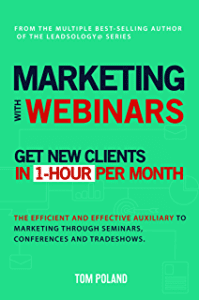
Marketing with Webinars
The 85% are the wanderers. They want to download the free PDF or the one-page blueprint. If you want to cater for the whole marketplace, you do need more than one marketing medium. The one I find that is the best, the Goldilocks. That’s about the right temperature is the webinar. If you align the title of the webinar with the benefit of working with you then you’re going to attract the right people. My webinars are about marketing with webinars. My book is about marketing with webinars, my program is about marketing with webinars and that’s an alignment. You think about this, we talked about how we’ve got to give people an opportunity to get to know us before we propose.
It’s like the first date. You can do speed dating. That’s not quite enough. That’s like social media. Six minutes and the clock goes, “Tell me all about yourself, I’ll do the same.” It’s not long enough to get to know someone. You could ask people to sign up for a six-week boot camp. It’s probably too much, but the webinars like the night out on the town. Let’s have dinner, let’s have a show, maybe have some coffee and we’ll go from there. They’ve got to register. It’s going to be an hour of their lives that they’re prepared to commit. If they’re prepared to put that much skin in the game, it’s about right for them at the end of that hour and 90 minutes, if everything’s clicked to reach out and book a time to talk with you about becoming a client. That’s why I call it Goldilocks marketing because we were hitting the sweet spot for the people that are ready to explore further.
I was doing one and somebody who’s a friend was listening, and he said, “Do you ever worry about giving away so much free good content that people might think?” I have my answer, but I would love to hear yours and I’ll share what I said to him. An open-loop we call that in storytelling. It’s creating a little suspense of, “I wonder what the answer is.”
My take on that is this. The simple answer is to give it all away, but there’s a caveat. I often start my webinars with a picture, a point of view photo of someone driving a beautiful car and you can see the dashboard and the screen, everything else. I said, “This webinar is going to be a bit like a test drive of the car.” Bringing them to the showroom. We can look under the hood and pop the trunk and fit you in the driver’s seat. We’re not going to build the car. We don’t have time to do that, but I can show you the car. If you want to build one together, we can talk about that later.
Don’t worry. You still going to get great value. You’re going to get lots of ideas and what to look like on a car. It’s going to be worthwhile. Please do understand that while some are paid to answer every single question, it’s not actually building the car. You will need help with that. If you want to work with someone else, work with me. I don’t mind. Please know that is a pivot to it. With that caveat, I’m happy to tell them everything.
[bctt tweet=”You don’t actually have to be smart to be successful. You only have to be smart enough to know how dumb you are.” username=”John_Livesay”]
The other thing to think about is what I say to my clients when they asked me this question, “Do you want to work with people who have the money to pay you and who are smart, or would you rather work with people that are broke or dumb?” It’s like, “It’s a no-brainer there, Tom.” If people are smart and they had the money having attended your webinar, they will want to work with you. If they don’t have the money, they can’t so give them lots of value because it’s good karma. I can help ignorant, but I can’t help stupid.
My response back to my friend who said that was, “I don’t worry about that because even if I show people step-by-step what to do, you still need help.” Everyone needs help. Crafting it, refining it, practicing it, honing it, whether you’re right. You’ve written a book, you need an editor. You don’t try to edit your own stuff. The same thing is true with everything. Reading a book on how to write a book, you don’t eliminate the need for the editor.
It’s like when we go out to the Australian Open watching Djokovic win it. I said to my wife, “I’m going to get his book because I’ve seen him play. I’ll go on the pro-tech.” I can see it how he’s done that. That doesn’t look too hard. I do always add that caveat, John, which is, this is not as easy as it might look.
I love that because you have to manage expectations. People either have one extreme or the other. They either think in the case of storytelling, “You’re either a born storyteller and I’m not so I can’t possibly learn it, or it’s easy for you because you are a born storyteller.” They don’t realize the skill, the training and the practice.
There are many subtleties and nuances to storytelling. To get to a level of professionalism, to get to a level of impact, you are going to need help from a specialist. It’s every other single specialization in the world, whether you’re a lawyer, an accountant or a software developer. It’s no good telling me how you do that. I’m not going to be able to do it. I would need your guidance. People that have money will want to reach out and work with you because they understand that.

Marketing With Webinars: If we can be humble enough to recognize that we only have to be smart enough to know how dumb we are, we can reach out and get help.
I took an Accounting class in school, but I certainly don’t want to do my own taxes. I watched somebody cut somebody’s hair, I’m not going to cut my own hair. It’s fascinating.
To finish this off, there’s a little-known secret of success. You don’t actually have to be smart to be successful. People think you’ve got to be like Bill Gates or Zuckerberg smart. You don’t. You only have to be smart enough to know how dumb you are. If you’re smart enough to know how dumb you are, then you get help. That’s what I’ve done for years. I’ve started trying to learn from the marketing masters because I knew I wasn’t good at it. I knew I was dumb at it. I needed to upskill on that. I think if we can be humble enough to recognize that we only have to be smart enough to know how dumb we are, we can reach out and get help.
That will be a great tweet. If you are smart enough to know how dumb you are, you get help. One of the things you talk about are these immutable elements. One is what you touched on about, you’re not Hugh Jackman. Most of us are not famous. Our brands aren’t famous and so forth. It’s a bit of hubris to act like we don’t need to flirt or date. That’s where we have these stages. You talk about these four Rs. Rapport, you get respect, relatability and reciprocity. Relatability, let’s double click on that word and we’ll go to the last one. What is something that someone could do to become more relatable, in your mind?
They should work with you and understand that the story is a great way for having an audience feel like you can relate to where they’re at, the before and after part.
Revealing some of your pain points and not coming across perfect is all a big part of that.
[bctt tweet=”Reciprocity is the least spoken about and yet the most powerful force in marketing full-stop.” username=”John_Livesay”]
You would know better than me.
This reciprocity factor, this concept of giving before you get is my definition of it. What does it mean for you?
It’s the before and after photo of the weight loss thing. You look at the photo before and think, “That’s me and I hate it.” You go to the after, “That’s what I want to be.” That’s a story I told you being a management consultant, having the overheads, going broke, reaching out for help, not working, and discovering, that’s part of my story. People go, “That’s where I’m at. I’m on a left-hand side of the Canyon.” I could see over the other side of the Canyon. It’s people who leads in and how do I get there? People can relate to that. The unpredictable nature of marketing, sometimes random acts of marketing, people can write to that. “I do that. I go run at a client, so I go to meetings and hope to get lucky.” Commercially wise. That’s the whole reliability thing. Somewhere early in the webinar, you want to be able to tell you the story in such a way that people can go, “He used to be where I’m at now and now he’s where I want to get to. I better listen up because he’s going to show me how to get there.” That’s a big part of relatability.
Reciprocity in my view is the least spoken about and yet the most powerful force in marketing full-stop. What is reciprocity? Let me tell you a story. A neighbor calls and I answer the phone, and they say, “Why don’t you come for dinner Friday nights?” “It sounds terrific. What time? What should we bring?” “Don’t bring anything,” she says. Me being a man goes, “She means what she said.” I said to my wife, “Are you up for dinner with Russell and Sally on Friday night?” She goes, “What are we bringing?” I said, “It’s okay. She said don’t bring anything.” My wife looks at me and she says, “Tom, are you so stupid? How old are you again? Eight.” It doesn’t mean don’t bring anything. We take wine. We take chocolates. We take flowers. Why? It’s because of reciprocity. Giving us a beautiful dinner, invite us into their home, but they’re going to clean the thing for half the day, if there is anything like my wife and so on.
She feels she needs to do something to even the score. The next morning, we wake up, on the front doorsteps there’s a pot plant because we went over the top and our neighbors have to even the score. This is like a perpetual giving machine. It never stops. That’s an example. Psychological reciprocity typically means it’s a fancy way of saying, “In our mind, we like to keep the score of giving even.” It is unconscious and it is powerful beyond belief. In the world of marketing, it means if I do something cool for someone else that’s genuinely helpful, they will feel unconsciously compelled to want to even that score up all other things being equal. If I have a Hitler youth party do something for me, I don’t want to even the score. When I say a lot of the things being equal. You’re interviewing me for your show, which is terrific. It’s a great example of reciprocity. At the end of the show, I would love to reach out and say, “How can I help you, John?” Reciprocity. It’s not going in with strings attached. It’s going in with extremely low expectations of a return on that giving, but a high expectation for the management of the giving.

Marketing With Webinars: Understand that the story is a great way for having an audience feel like you can relate to where they’re at, the before and after part.
The other thing you talk about is to be consistent in what you do. You alluded to that before. The book, your website, everything is about webinar marketing and consistency. I love it. Where I want to take you and the readers is when we get in a situation when someone asks us to do something for a famous company for a lot of money that’s not in our expertise, and you’re thinking to yourself, “Can I figure out how to do this? Can I suddenly become an expert in whatever it is that I am not an expert in so that I could shake and maneuver myself into this little box that they are describing, which I actually know somebody else who is good at that?” I was in that situation and I said to the event planner, “Here’s what I’m hearing you need. This, this and this. You want someone who’s comfortable entertaining people going out into the audience, 1,500 people and razzle, dazzling them, talking about customer service and getting into all of the nitty-gritty of operations and all these other things.”
I said, “My sweet spot is storytelling and an audience of salespeople, not people who run a quick-service restaurant.” I do know someone. That’s what they do, they perform, they’re an entertainer and they’re also a speaker. They’re getting everybody clapping. The irony was, they then started to change the parameters to fit my niche. “Maybe we could have you in a breakout room then.” I thought how funny. I’m like, “It’s not the number of people. It’s the audience and the topic that I was saying no to but, okay.” I’m curious if you’ve ever had people approach you going, “Can you also help us launch this product?” Whatever else they might ask you to do that you go, “I didn’t know how to do this well, but I’m not going to pretend I know how to do everything well.”
If I want the clock back 30 something years and you can have a look at my overdraft, and you asked me that time, “Can you do juggling on stage in front of 10,000 people for half an hour?” “Yes.” Realistically without wishing to seem too pure about it right now, I would say no to that request if someone asked me that exact same question. “Can you go through and make them laugh?” No, that’s not me. Call John. Way back when I was desperate for money, I probably would have said yes and figured out how to get paid and do the best job I can.
The yes-no response to that is dependent on how hungry I am. A beggar on the streets in Calcutta, if you ask them to do cartwheels for $10, they’d probably go, “Yeah.” I would say no right now because cashflow is pretty good. We’ve had a few years of successful business. I did have a friend of mine who did a lot of work on Twitter, LinkedIn and had millions of followers decided to focus on LinkedIn. She said she had a request to speak on Twitter a day after she made that decision to focus on LinkedIn. She turned down $25,000 gig. I would have said yes to that. She knew the subject. She had made a mental decision to make a break. That’s fine. Take the $25,000. You can deliver the value. It’s good money. It’s meat and drink for you. Go get them, girl. That’s what I would’ve done. People will draw the line in different places, but I have respected the decision all the same.
What I found fascinating with that, and I never tested it, was when you pull back and go, “I’m not sure this is for me.” Sometimes people pull in even, and they go, “I’m going to give you someone else.” “That’s the person we want is somebody who cares.” I phrased it in a way and I’m like, “I want you to be a success. If I’m not going to give you what you’re looking for, then I might not be the right person.” That takes a lot of awareness, confidence. You each decide, I heard Matthew McConaughey talking about his own career in these terms. That’s why I think it’s so relevant for everyone. Pick a niche, double down on it. He’d been known as the romantic comedy guy for years making all these movies with a shirt off making a lot of money. He decided he didn’t want to do that anymore. He’d made enough that he never had to work again if he didn’t want to. For six months he got more offers in that niche. He kept saying no and gets millions. He still said no. It was eleven more months for a total of twenty months before he finally started getting an offer for the serious roles that he’d always wanted to do. I thought, “We don’t all have that luxury,” but mentally it’s a great story in terms of consistency. If you’re in a box you don’t like to be in, it’s up to you to get out of it. It’s my takeaway from that story.
[bctt tweet=”You’ve got to make sure that the majority of your lead generation is in-house.” username=”John_Livesay”]
The big thing that helped him was the luxury of having millions of dollars in a bank account. That’s what I was referring to before. Years ago, my bank account was in overdraft. I was desperate. I probably would have said yes to about anything. These days you don’t have to. Where you draw the line might move. There’s a terrific book and I had a chance to have a preview of it. It’s the Greenlights, which is Matthew McConaughey’s book.
Your third element is, we must control our own oxygen supply. We’ve all heard that premise. If you are traveling with a child, put the oxygen mask on yourself first, not the child. It seems somewhat counterintuitive, but maybe even selfish if you think it through a bit. If you pass out, the kid doesn’t know what to do. In terms of business being leads, being a supply of oxygen, how do we help people make sure their lead supply doesn’t stop?
What I’m essentially saying there is that you’ve got to make sure that the majority of your lead generation is in-house. You can push the buttons and pull the levers. I’ve heard a lot, and it’s a tempting value proposition is, “Tom, if you could get me all the appointments, please. If you could set those up or if someone could do my marketing for me because I like to work with client,” which most of us do. The problem with that is if you outsource it to an agency, about 85% of the time, you will pay the money and they won’t get you the results. After 3 to 6 months you go, “I don’t want to keep doing that.” You write them the Dear John letter, “Dear John, I taught you, it’s me. I need to put this on pause for a while.”
Fifteen percent of the time would deliver results, you create a dependency. That dependency is dangerous. Someone once said the scariest number of businesses is the number one. One supplier, one client, etc. If you have one organization that you are totally financially dependent on for the supply of all your business and they go over or they sell, COVID hits, who knew? It’s like you’ve outsourced your oxygen supply. You wouldn’t outsource the oxygen supply to your body because if that third-party supplier fell over, you’re dead. The difference with the business is the death takes longer, but you’re still as vulnerable. By all means, if you have a great agency that can supply leads and they’re prepared to get started, especially if they’re prepared to give you a split of results that you pay them from a split of results, not money out upfront, do that. Make sure that they’re not supplying any more than 1/3 of your new business requirements. You’d have to have the rest of the house otherwise you’re vulnerable.
Any last thoughts or tips that you want to leave us with before we talk about how people can follow you? The book is called Marketing with Webinars.
The best thing people can do is buy the book, Marketing with Webinars because it’s the most prescriptive book I’ve ever written. It’s the sixth book I’ve written. It goes into the most detail. I go into all sorts of tech equipment to get and what not to get platforms. It will be going to things like titles and every single slide. When they get the book, they’ll have access to my 31 template slides, which is the same 31 slide template all my clients use. When I give it to my clients, I said, “When you bring it back, I don’t want to see 32 slides.” You can have any type of color font you would like, as long as it’s black, any background. It’s prescriptive. That’s what I’m saying.
They’re going to get a lot of value out of that, but other than that, I think the big thing is to make your strategic commitment to do your marketing and webinars. I do all of mine. It is the combination of the most efficient and effective marketing medium. It combines that oldest, most proven marketing message in the world, what I mentioned before, Buddha, Christ, Muhammad, billions of followers. I was speaking to groups of people with the world’s newest marketing medium, which is internet. It’s got the best blend of the old and the new in terms of marketing.
What’s the best website for people to find you?
Leadsology.guru, there are a lot of free resources there. There’s also LeadGenDemo.com because that’s where they can sign up for our monthly lead generation demo using marketing webinars. It’s completely free. People can come along. The website is a good place to start.
Tom, thank you for not only sharing wisdom but humor. What a fun way to have the medicine go down as they say. That’s why I’m sure you’re so successful. Thank you.
Thank you. All the best.
Important Links
- Marketing with Webinars
- Greenlights
- Leadsology.guru
- LeadGenDemo.com
- Better Selling Through Storytelling Method Online Course
Wanna Host Your Own Podcast?
Click here to see how my friends at Podetize can help
Purchase John’s new book
John Livesay, The Pitch Whisperer
Share The Show
Did you enjoy the show? I’d love it if you subscribed today and left us a 5-star review!
- Click this link
- Click on the ‘Subscribe’ button below the artwork
- Go to the ‘Ratings and Reviews’ section
- Click on ‘Write a Review’
Love the show? Subscribe, rate, review, and share!
Join The Successful Pitch community today:
- JohnLivesay.com
- John Livesay Facebook
- John Livesay Twitter
- John Livesay LinkedIn
- John Livesay YouTube
Branding Secrets: Creating A Good Story With Jenny Fernandez
Posted by John Livesay in podcast | 0 comments

Your brand is what makes or breaks your business. That is why it is crucial to create one that speaks not only to you but also to your audience. In this episode, John Livesay talks with the global branding expert, disruptor, and innovator, Jenny Fernandez, about some innovative marketing techniques that will see your business’ growth. Sharing more branding secrets behind her success, Jenny lets us in on the crucial role storytelling plays when crafting one of your own. She talks about how stories humanize a brand and drive breakthrough ideas to improve the consumer journey. When creating one, it is important to put it through the lens of the consumer and not just you. Join in on this great conversation to learn more about how to create a good story, one that allows you to reach more and create a bigger impact.
—
Listen to the podcast here
Branding Secrets: Creating A Good Story With Jenny Fernandez
Our guest is Jenny Fernandez, who’s a global branding expert. She’s worked with such brands as Ritz Crackers, Oreo cookies and Trident gum. She shares stories of how she used innovative marketing techniques for each one.
—
Jenny is a global brand marketer, a disruptor and innovator driving business teams and organizational transformation to accelerate growth through consumer insights, strategy, media, social and digital marketing, and team empowerment. She has been a leader across many different categories, including CPG and entertainment. She’s working literally around the world from all over North America and Asia. She is a consumer obsessed storyteller. I love storytelling, that’s why I couldn’t wait to have her on. She’s passionate about brands and humanizing data to drive breakthrough ideas to improve the consumer journey. She’s a coach and advisor to business and marketing professionals and startup teams. She’s been a graduate school adjunct professor and she’s got all kinds of expertise in branding, building brands and targeting. Jenny, welcome to the show.
Thank you, John. Thank you for having me here.
We have a lot of mutual friends including the wonderful, Judy Robinett. I want to give a shout out to people who make these great introductions. To reinforce to all the people reading how important it is to continue to build your network so that people clearly understand who you help and what problem you solve. Even if they don’t need you, they can keep you in mind for people who do. With that being said, Jenny, why don’t you take us back to your own story of origin? You can go back to childhood, you can go back to when you were getting your MBA at Northwestern, wherever you’d like. How did you get interested in branding and all that?
I will share that I moved to New York, to the United States when I was twelve. I am from the Dominican Republic. As a little kid, I came to New York and I was impressed by the number of people that I’ve met and the diversity. I have become what I call a global citizen, somebody who’s interested in understanding what moves people, what drives them and knowing that it is an exchange. If you’re able to understand what they want, what they are looking for, then you’re able to deliver on that need. They can pay it back when you do need that back. That’s like what Judy mentioned in terms of driving value and delivering value so that you can get value back later on.
You came here at twelve and then suddenly you decided, “I’m going to go get my MBA in marketing.” You ended up working for Kraft Heinz Company for seven years. Tell us a little bit about what that was like and what lessons you learned there?
I ended up joining Kraft Foods after my graduation from business school from Kellogg School of Management. It was an amazing experience. It was all about people. I had a lot of great alums who introduced me to the school who had attended Kellogg as well. It was a dream job. Imagine being able to talk and market the brands that you grew up with like Oreo cookies and Ritz Crackers, it was amazing in joining that environment and working with agency partners that knew and were champions of the brand and knew how to create a story. They introduced me to the whole idea of storytelling and in being able to, first of all, understand the audience that you’re working with. Understanding the message they want to hear and how they want to hear, it was compelling.
[bctt tweet=”Be obsessed with telling stories to consumers.” username=”John_Livesay”]
Let’s talk about a couple of those brands since it’s a big part of many people’s childhoods, mine included. The Oreo cookie, dunking it in milk, taking it apart and licking off the cream-centered filling. I spoke at the Coca Cola summit for all the CMOs who happen to carry Coca Cola at the quick service restaurants like Domino’s Pizza, etc. I was sharing the stage with another gentleman, Cal Fussman. He spoke for fifteen minutes, I spoke for 30 minutes, then he closed it. He literally described it as, “We’re like an Oreo cookie. I’m the opening and the end, John is the creamy filling.” I thought that’s a brand that’s big in people’s minds that it can now be used as an analogy. I thought you’d love that little story on the Oreo cookie brand. When a brand has been around so long, it becomes a challenge to come up with a fresh story while staying true to its origins. Tell us what you did on the Oreo cookie?
I helped manage the Oreo brand in the Asia Pacific. I moved to China back in 2012. I was managing thirteen countries including China, Southeast Asia, Japan, Korea and Australia. What was amazing is that every market was in a different life stage for the brand. The product had been in China for twenty years but it was only a four-year-old product in India. It was a different story that we needed to tell. One of the challenges that we have faced in the brand as we were looking to make it a global brand was, we needed to celebrate the 100 year anniversary for Oreo. Can you imagine how do you celebrate 100 years when the brand is just 20 or 4 years old? We went back to thinking, what is it that people love about the brand and what is it in people that drive them? We had this idea of celebration. Who doesn’t love a birthday? We said, “Join us in celebrating and join us in communicating your celebration of Oreo.” We got so much content and many beautiful videos. It was a great program put together with information from the consumer. That was amazing.
That’s the a-ha moment, everybody who’s reading. When you’re going to promote something, you need to put it through the lens of the consumer and not just you. I heard Geoff Cottrill, who had been the CMO of Converse, and they were having an anniversary and talking to their target market. He said, “What do you think of that?” I said, “It makes you seem old. Unless there’s something in it for us, why do we care, even around 100 years or whatever it was?” The fact that it becomes a birthday celebration and show us how you’re celebrating and having people submit social media content is great. That leads me right to the question, what do you think makes a good story? When you’re looking at all these contents and you’re deciding, “Of all these stories that we’re hearing, which ones are we going to promote on our social media?” What makes a good story, whether you’re creating it for the brand or you’re getting a story from your consumer?
It’s understanding what is the universal DNA that brings all consumers together. If you understand how they relate to the brand, then you can cut across cultures, across markets, across the social status. It’s about the humanity in us and what are they seeing in the brand.
Storytelling tags at the heartstrings. It transcends class and culture when we all relate to it. We know what it’s like to have a birthday, we know what it’s like to be happy, etc. Do you have a story you can share on what you did on Ritz Crackers, since that’s another big brand that you worked on and people know?
For Ritz, it was more about innovation. Ritz is a product that consumers use almost like a bread replacement. It’s a little sandwich. They create special recipes. They took the brand in a different place. We wanted Ritz to be a hand to mouth product and snack, but they decided to use it with cheese, with other more substantial ingredients. I was working in breakthrough innovation team and I wanted to leverage technology, the pop-up copying technology, to create a product that was going to be light, airy and hand-to-mouth eating, almost like a chip that we could attract younger consumers that were more on the go and wanted convenience products. They just wanted to put their hands in the bag and start eating. That was my main focus.
Branding Secrets: PR has become more and more a big powerful tool for startups to generate interest, not only from consumers but also from investors and retailers.
I used to eat Ritz Crackers with peanut butter. I don’t know if that’s just me or if other people did that too. Let’s talk about what your definition of innovation is and how that relates to brand marketing. If you’re trying to reach a younger market, how do you reach them in an innovative way? Let’s do Ritz as a story. Typically, marketing sits in scenarios where you give a brief for people who haven’t worked in this and say, “Here’s our target market. Here’s the problem we’re trying to solve. Either they’re not using us for snacking, they don’t know about us, we’re not on their radar or the marketing channel we’re using isn’t reaching them.” What did you do to be innovative to reach people?
If you don’t mind, I’ll talk about a different brand. I was working on Trident Gum. The gum business was interesting because we hadn’t spoken to an entire generation. We were trying to use product innovation in a way that wasn’t true to the brand. We were doing dessert flavors and trying to find replacements for sweet snacks and chocolates through our gum. That’s not why the consumer bought our brand. The consumers told us, “We want Trident because it is functional, because it’s going to clean my teeth.” Do you remember the commercial four out of five?
Yes, recommended. It’s not a substitute for a piece of cake or a cookie.
It’s about making you feel confident than when you need a clean mouthfeel. You are going to have one. We went back to basics and we communicated and partnered with the women’s soccer team for the World Cup. That was an amazing partnership because we were leveraging another brand, the soccer brand that talked to the same consumer we wanted to reach again. When you do a brand partnership like that, you’re basically borrowing equity.
People think fresh breath, you want to be having that for kissing. You went a completely different way around confidence and women who are playing a sport. It’s not the traditional, “This woman is concerned about her fresh breath for a kiss. These are women who are wanting to be healthy and confident. We’re tapping into that energy,” which is completely different. That’s a great example of innovation. Do you have any other stories of co-branding? That particular topic fascinates me where brands borrow the equity of another brand. It makes it a win-win for both. If you have any other stories of that, I’d love to hear them.
I’ll go back to Oreo. We did it an entire global partnership with Paramount, where we were working with Transformers 4, the movie. It was controversial internally because people thought, “Why do you want to do a brand that is about fighting and wars in space with a wholesome cookie?” Frankly, if you think back to the bigger picture, Transformers the movie came years ago. That was the origin of that movie. The kids that grew up watching transformers are the parents who are bringing their kids now. It’s a full circle. It was perfect because it’s about understanding who the consumer is. It catered to the entire family. The teenagers in the US that bought all the stuff were loving the movie, so did the moms who wanted to bring their young kids and have all their products that were more sensible within the Oreo brand. It allowed us to have an entire partnership globally that every market can get behind. Talk about the power of big and small, when you’re able to bring all of the markets within one brand and have a great program that returns on investments.
[bctt tweet=”If you understand how consumers relate to the brand, then you can cut across cultures, markets, and social status. ” username=”John_Livesay”]
You’re also involved in the startup world. Tell us a little bit about that and what advice you have for people who are starting a brand and looking for funding. What do they need to do to make sure that they get funding from investors in terms of branding?
I have a great interest in the startup world. You love coaching, I’m sure. Marshall Goldsmith has said, “What got you here will not get you there.” The skillset and the grit that somebody has to build their own business is different from the skillsets that they need in order to scale it up. When you need to level up yourself on your business, you need to be able to go to the biggest distributors, the big retailers like Target or Walmart and present a big pitch and present their case and be able to say, “Why am I going to invest in you and bring you in-house?” It all goes back to when you have a bigger decision to make on a bigger scale. You have to have a great understanding of who your consumer is. What is your true value proposition and how you differentiate versus your competition so that you can make a case for that?
The traditional way of getting into these stores was first, how many stores do I get tested in? Where on the shelf, am I? Am I at the bottom, the middle, or the top? Now with digital, it becomes a whole another way of branding. Can you speak to that? You need both channels, I’m assuming. You’re going to need to be sold in the grocery stores, in the Walmarts of the world. You also need to have some online presence or even beyond Amazon at least.
Direct to consumer is an amazing channel. You can have your own media. You have your own website. If you can partner with the likes of Amazon, you’re able to be where the eyeballs are. You don’t have to attract consumers to you. The consumers are already there. It’s great to have that kind of partnership. You can leverage social media and paid media to generate a lot of excitement about your brand. PR has become more and more a big powerful tool for startups to generate interest, not only from consumers but also from investors and retailers.
Let’s talk about PR because I think that’s an overlooked nugget. If you do it right, unlike the advertising which you have to pay for, it can be great on a pitch deck to give credibility and some social proof that you’ve been covered in Fortune or Inc. or whatever it is. What suggestions do you have for people? It’s pitching in a different way. What lessons have you experienced? I can certainly share mine but I’d love to hear yours of what it takes to get a journalist interested in you? Is it a sound bite? Is it thinking about it in terms of what’s interesting to their readers versus them trying to sell their product? What are your thoughts on how does a startup gets good PR?
There are two different ways or avenues that a startup can pursue. One is having a great founder story. That can be a way for you to position yourself as a founder, as somebody who is an expert in the field, somebody who’s innovative and creative, and somebody who has something valuable to say. I would definitely recommend founders to start building an amazingly compelling story. They can put it on their website. They can send as a PR kit to reporters. For themselves, to get themselves into conferences so that they can start talking about their business. They can start building personal brands. That’s a great way to have a PR angle.

Branding Secrets: You don’t have to be the best and have the best product, but you have to outlast your competition.
Another one would be about the actual product or service that they’re delivering. For that, it has to have a good anchor. They want to talk about innovation that’s coming up and how their value proposition is leading edge. They have the ability to speak to reporters or speak to magazines and tell them why their business is leading in that area. They can do that proactively either by hiring an agency, but if they want to go bootstrapping, anything from HARO, Help A Reporter Out. They have their own media kit and article to start creating free valuable media on Medium or Thrive to have the ability to create a sexy story that talks about why their product or service is differentiated.
Do you have an example or a story of someone you’ve consulted with that has done a good job of this?
Not somebody that I consulted, but a friend and a guest speaker to one of my classes at NYU, this is Ju Rhyu. She’s the CEO of Hero Cosmetics, which is a Korean patch that you use to heal acne. She has an amazing story. She was visiting Korea for vacation, and she had a bit of a breakout. She found these amazing products that she had never been exposed to in the US. She thought, “How can we not have this?” She decided to leave Corporate America and go on her own and bring that back. She started sending out these PR kits and working with a small bootstrap agency to create a message and to showcase why her product was differentiated. You can have the unveiling of those boxes where you see the product and you try it out. Getting influencers is a great way to do so. You can show the consumer how does it work and why is it effective. You can have a brand ambassador talk about your product.
One of the tips I’d love to leave everyone who’s reading this with is work on coming up with a sound bite because the media loves sound bites as a hook when you’re being interviewed either on camera or for an article. One that’s worked well for me is, “Are you stuck in the friend zone at work?” Both Fortune and Inc. interviewed me around that question because it grabs your brain. You’re like, “I know what the friend zone is in dating. What does it look like to be in the friend zone at work?” Three signs you’re in it and three signs to get out. It can be that basic but it pulls people into the article, then I quote me as the author that is selling through storytelling and a sales keynote speaker who’s helping people craft a story.
A lot of people in sales have been stuck in the friend zone at work with clients. It all ties together in that way. Having your founder’s story is important to take people on a journey that answers two big questions, which is why you and why now? When you have those things in a PR pitch, it also pulls in the reporters. Remember, the press is always concerned about, why now? It’s all about what’s going on now. You need to have that as part of your overall messaging. It’s the same thing when you’re doing a call to actions with consumers. Why now? Why do you need to get an Oreo cookie to celebrate our birthday or your own birthday, whatever it is? What’s next for you, Jenny?
What I’m looking to do is continue to partner with entrepreneurs that I can help them scale up their business, scale up their careers. Something that I tell a lot of them is you don’t have to be the best. You don’t have to have the best product but you have to outlast your competition.
[bctt tweet=”The skillset and the grit that somebody has to build their own business is different from the skillsets they need to scale it up. ” username=”John_Livesay”]
It’s like the TV show Survivor.
That’s right. At the end of the day, it’s not about being first to market. It’s about delivering great value and a great product that answers the consumer need. This is what gets to the crux of it. You have to have a great value proposition. You can communicate and that can be accessed by consumers. That’s why both direct to consumer marketing and getting distribution in big retailers is the way not only to provide that access but even to amp up your marketing.
Any last thought, quote or book you’d like to recommend?
There are a couple of books that I would love to recommend. One is Marshall Goldsmith’s What Got You Here Won’t Get You There. I do believe there is a sense of coaching and growth mindset that all of us need to have in order to scale up and level up our careers and businesses. That’s something I recommend to everyone. Judy Robinett with her networking book, because you have to have value to add to the networking mindset. One of the experiences and the questions that I ask my entrepreneurs and the people I work with is, “Do you feel a little dirty after going to networking events?” Most people do because it becomes a power struggle where you don’t have the upper hand. If you wait to network until you need something, you’re too late.
Judy’s books, it’s How To Be A Power Connector and her new one, Crack The Funding Code. I feel the same way about selling. Nobody wants to be pushy. The joy of becoming a storyteller is that you pull people in instead of pushing. How can people find you, Jenny?
Everybody can find me on social media, on LinkedIn and Twitter and on my website, JennyMFernandez.com. You can find me there as well.
Thank you so much for being such an insightful guest and sharing these stories of specific brands that we all know and love, and what you’ve been able to do around the world. I can’t wait to see what you do next.
Thank you so much, John. I appreciate it.
Important Links
- Jenny Fernandez
- Judy Robinett
- Hero Cosmetics
- What Got You Here Won’t Get You There
- How To Be A Power Connector
- Crack The Funding Code
- LinkedIn – Jenny M Fernandez
- Twitter – Jenny Fernandez
- Better Selling Through Storytelling Method Online Course
Wanna Host Your Own Podcast?
Click here to see how my friends at Podetize can help
Purchase John’s new book
John Livesay, The Pitch Whisperer
Share The Show
Did you enjoy the show? I’d love it if you subscribed today and left us a 5-star review!
- Click this link
- Click on the ‘Subscribe’ button below the artwork
- Go to the ‘Ratings and Reviews’ section
- Click on ‘Write a Review’
Love the show? Subscribe, rate, review, and share!
Join The Successful Pitch community today:
- JohnLivesay.com
- John Livesay Facebook
- John Livesay Twitter
- John Livesay LinkedIn
- John Livesay YouTube