

Marketing Mastery With Mostafa Hosseini
Posted by John Livesay in podcast | 0 comments

What are the secrets in formulating the best marketing strategies to scale your business up? Join your host John Livesay as he talks with Mostafa Hosseini about lead generation, qualifying leads, implementing marketing plans, and much more. Mostafa Hosseini is an entrepreneur and business coach that could help you create and implement a one-page marketing plan in three days or less. He shares his story on why he decided to drop the digital marketing services and keep coaching and consulting. He emphasizes the importance of identifying your target market. With his top three values of growth, family business, and learning, there are many takeaways in this episode of marketing mastery. You are sure to take the leap to make a profitable business for yourself and your loved ones.
—
Listen to the podcast here
Marketing Mastery With Mostafa Hosseini
Our guest on the show is Mostafa Hosseini, who’s an expert in marketing. We talk about how nothing works when someone’s trying too many things at once and how important client retention is. That is an untapped vault of cash that people aren’t using properly. Finally, he says 70% of entrepreneurs suffer from depression and overwhelm, and he helps them solve that with a laser focused plan. Enjoy the episode.
—
Our guest is Mostafa Hosseini, who helps coaches and consultants create and implement their one-page marketing plan in three days or less. He is a serial entrepreneur, a business coach, and the Founder of Persyo, which he’s also the host of the Daily Confidence for Entrepreneurs podcast, he’s the creator of Simple Marketing Formula, and much more. He’s been coaching and consulting for many years, helping businesses in various niches and industries grow and scale. Welcome to the show.
Thanks for having me. It’s great to be here.
I would love to hear your personal story of origin. You can go back as far as childhood or college. How did you get into becoming such an expert in marketing?
I was born in Tehran, Iran and moved to Canada back in 2000. I finished high school and I was eighteen when I got here. I went to school here. When I got first got here, I did not speak English. I went to English school for a couple of years to be able to speak. I went to school for engineering for two and a half years, didn’t liked it, dropped out, got into business school, loved it, which is what I wanted to do since I was a child. I got a diploma in Marketing Management. I got my Bachelor’s in Business Management with a minor in Marketing. I went to school for a long time and I started Persyo Marketing back in 2010.
Let’s stop the story there for a second. How did you come up with the name of your company, and what does it mean?
When I was trying to pick out names, the names that I wanted were all taken, the domains were taken. I had to come up with the name. What happened was one day back in 2010, I was sitting at a food court here in a mall in Calgary and I saw this restaurant. I’m like, “What about Persyo?” Persyo because I’m Persian-Canadian. I made the name, Persyo did not exist. When I searched Google, it didn’t bring up any results. I’m like, “Bingo.” The domain was available. I went for it. I asked a few people, “What do you think?” They’re like, “It sounds good. We like it.” I started Persyo Marketing. We did full-service digital marketing along with coaching and consulting our clients.

Marketing Mastery: By knowing what you want, you increase your odds of winning by 10 times compared to a person who doesn’t know what they want.
Back in 2017 or 2018, it got a little too competitive for me. I’m in a hyper-competitive environment and I decided to drop out and drop the digital marketing services and keep coaching and consulting. That’s my story. I’m married. I got two boys. My top three values are family business and growth and learning. I spend 99% of my time with family, business, growth, and learning. I love nature, mountains, skiing, hiking, barbecue. I love my Persian kebab. If you ever come up here, if I see you anywhere, I’ll do some barbecue and go from there.
Now that you’ve worked with so many different kinds of clients, do you see them having similar challenges or making the same mistakes in their marketing? Are they too complicated typically? Is that why you’ve honed it down a little bit to help people focus?
The number one challenge that I asked people over the years when it comes to their marketing is not knowing what to do. They want to grow their business, get more customers, and the rest of it, but they don’t know how to do it. The other challenge that they have is they start trying too many things. They are poking around twelve different things at any given time and nothing is working. That creates a feeling of frustration, overwhelm, anxiety, and people get depressed because they don’t get results. Back in 2017 or 2018, I read three books that changed the way I think and changed my business. The first one was Zero to One by Peter Thiel, who is one of the Cofounder of PayPal. In the book, Peter Thiel talked about how competition is for losers. He says, “You got to be in a place where there is no competition or you have very few competitors.”
I had too much competition that I felt like a loser. I’m like, “I got to change this.” I had competition all over the planet. In the digital marketing world, the barriers to entry are not very strong. People wake up one day and they’re like, “I’m a digital marketing advisor.” I decided to drop out of the digital marketing services and stick with coaching and specialization. The next book that I read that made a massive shift in my thinking was The 80/20 Principle by Richard Koch. If there’s one thing I wish I knew many years ago was this 80/20 principle. The next one was Essentialism by Greg McKeown on what is essential and not. I went through this phase and within 4 or 5 months. I’m like, “I need to simplify and focus.” I came up with a Simple Marketing Formula where we consolidate and simplify everything into one page.
Most business plans, especially coming out of MBA, it goes on and you don’t know where to start even with an executive summary it’s still so overwhelming and the shiny object of, “We should be on TikTok?” I’m like, “It depends on who your audience is. Not necessarily.” I like that. This 80/20 rule, for those people who may not know exactly what it is, I certainly found that useful in my sales career that 20% of your clients give you 80% of your revenue and 20% of the time you spend give you 80% of your results.
Are you spending time with clients that aren’t generating that much revenue? Sometimes, the lowest 20% of your clients are taking 80% of your time. That reframing of all of that is so crucial. Are there some myths that people have like, “If I spend so much money on my marketing, I should get this much percent growth automatically guaranteed?” or anything like that you see people thinking, “You’ve heard that, but that’s a myth.”
You mentioned one of them that, “If I spend so much money, I’m going to be successful.” It could happen, but it may not necessarily be true. One of the bigger problems that I see is if I worked hard, I’m going to see results. You talked about the 80/20, if you work on the 80% that doesn’t produce results, regardless of how hard you work, you’re not going to get there. I heard Tony Robbins said, “If you run East looking for a sunset, regardless of how hard you run and work, you’re not going to see it.”
[bctt tweet=”Nothing works when you try too many things at once. 70% of entrepreneurs suffer from overwhelm because of the lack of a plan.” username=”John_Livesay”]
I also think of the people at Kodak and Blockbuster, I’m sure they were working very hard up until the last minute.
The company doesn’t exist anymore. The strategy was outdated and what they were doing didn’t work and it got wiped up. Those are some of the biggest things.
You hinted at it, but let’s double click on what is this simple marketing formula that you’ve come up with?
The simple marketing formula was I need to apply to 80/20 principle to marketing and break it down to a few simple steps that cover 80% of the stuff that you need to do. I came up with six steps. Number one, you need to set your goals. You need to know exactly what you’re trying to build and achieve. As an example, when you’re trying to build a house, you design it, you do the dimensions. How many bedrooms, many garage doors, and the rest of it.
Come up with a plan, hand out the plan to the builders, bingo, they start building. You barely ever build a house in a city, at least, without a plan. If you do, you won’t get any insurance for it, and/or you would not put your family under that roof. You need to plan and know what you’re trying to build. If you don’t have a plan and a goal, you’re not going to achieve it. It’s pretty hard to achieve a goal that you don’t have.
It goes back to even time management. If it’s not scheduled, it doesn’t get done.
Step number one, know what you want. By knowing what you want, you increase your odds of winning by ten times compared to a person that doesn’t know what they want. It makes logical sense. Step number two, identify your target market, who do you serve and what do you do for them? Stop saying things like, “I serve everybody and anybody.” The fact is, if you try to serve everybody, you end up serving nobody. Who do you serve and what do you do for them? Step number three, your offer. What do you offer to these people? How do you connect your offer to what they want, need, and their challenges? There was a connection there. Step number four is your lead generation. How do I find leads? What’s one system that I need to master? Again, people are poking around at twelve different things.

Marketing Mastery: If you work on the 80% that doesn’t produce results, you’re not going to get there regardless of how hard you work.
If you pick LinkedIn, then don’t be spending time and money on TikTok or vice versa.
My strategy is to figure out LinkedIn and get it to a point where it’s driving leads to you while you’re sleeping, then move on to Facebook, then move on to something else. In that one platform, I’m pretty sure if, it’s the place for you, there’s so much business that you may not even need to go somewhere else. LinkedIn is massive. Lead generation. The next step is lead conversion, step number five. What is the step-by-step process to turn a lead into an actual paying customer?
That’s my sweet spot of helping people tell stories. Once they’re talking to a qualified lead that makes their offer seem irresistible.
We map it out step by step and we try to identify bottlenecks. Going back to the 80/20 principle, try to figure out what is these 1 or 2 steps that take 80% of the time. What do we need to do to speed things up and make things more efficient?
It’s anticipating a common objection so that you’re not a deer in a headlight when you get one.
There’s a bunch of things that could be happening. The fact that we map it out, people get these massive a-ha moments because 99% of people don’t have it mapped out. When they put it out there, they realize, one, “Because we visualize the process, we see what’s happening and more importantly, we see what is not happening.”
The myth is, “I’m losing my lead conversion at the end of the conversation. I’m not closing them properly.” I say, “You lost that sale at the beginning of the conversation.”
[bctt tweet=”You need to set your goals. You need to know exactly what you’re trying to build and achieve. ” username=”John_Livesay”]
Maybe before you started, that’s another problem. Step number five, conversion. Number six, client retention. What do I do to keep my customers do repeat business from them, with them, and get referrals from them?
Is that an unoverlooked goldmine? I tell people it’s just like any relationship. Friendships, spouses, anything. You can’t take relationships for granted.
By far, in years of marketing in my own business, client retention is the easiest most profitable sure-fire marketing process and action we have done. It’s like an untapped vault of cash that you have to open and there’s cash.
That’s a great image. We’ll use that as a tweet.
That’s it. Six steps.
The importance of this is trying to get a plane without a flight plan or build a house without an architecture plan. You’re just wandering all over the place if you don’t know where you are in the process and where you’re going. Is there a story you can share of how it’s helped a particular business owner?
I got probably 100 stories. I was looking around a whole bunch of video testimonials from people that we have helped. Identifying your goal, it calms your mind down. The sense of, “Here’s what I want to build.” Think about the frustration and anxiety of not knowing what you want. I call it being like a floating particle into air. I go right one second, I go left the next second, up and down, we don’t want to have consistency. It gives you that feeling of assurance and calmness.

Marketing Mastery: Identify your target market, who you serve and what you do for them. If you try to serve everybody, you end up serving nobody.
Once we’re calm, we can make better decisions as opposed to making them out of fear.
It’s like, “Here is what I’m trying to build. I need to find four customers this month.” How assuring is that? How many phone calls do I need to make to find four customers? Next, identifying the target market. Again, it gives you the certainty that here is who I serve. For example, I serve accountants between the ages of 40 to 45 in the State of California. How hard would it be to go on LinkedIn and find a county in the State of California? What do I do for them? For example, I help accountants in the State of California create and implement their one-page marketing plan in three days or less. All I have to say is, “I specialize in your service,” then finding customers becomes a lot easier.
Then the secret sauce to that is what is life like for those accountants after the three days? Peace of mind, revenues start going up, they start getting the referrals, and they know who their target audience is. They’re not just an accountant for everyone.
Another way that they become more profitable is when they drop all the extra lead generation activities that are not producing, they save on costs, become more profitable, either saved the money or refocused the money few things that are producing, become more profitable, bring in more leads, and everything becomes a lot easier. At the end of the day, you can sleep a lot better, your quality of sleep goes up.
If we can keep getting research in how important that is, your metabolism, your health, your mindset, what wakes you up in the middle of the night and keeps you up, that stress. I love your analogy of when our brain is not calm, then it never shuts off. It’s trying to solve the problem or figure out, “What should I be doing next?” To me, it’s interesting because sometimes, when I’ve worked with people who sell insurance and helping them craft a story, I say, “On some level, you’re selling peace of mind to people.” You don’t have to worry about if there’s a fire or whatever. On some level, what you’re doing is peace of mind for one of the most important aspects of running any business, which is we need customers and cash.
We need to figure out how to do it in a way that works as opposed to guessing because that’s anxiety. We don’t get behind the wheel of a car going, “I can figure this out. I don’t need to be trained.” Yet some people go, “I’ll figure out the marketing on my own. I don’t need anybody’s help, I’ll figure this out,” then you’re like, “That’s an expensive, time-consuming, lethal way to do it.”
You touched on it and we talked about it in the beginning, that is the number one challenge was not knowing what to do. There are so many options that not knowing what to do affects our mental health. Up in Canada, it might be pretty closed down in the States, the chances of people experiencing a mental issue is about 1 in 5, about 20% with average people. With entrepreneurs, it’s 70%. We have a 70% chance to experience mental issues. I’m willing to bet that not having a simple plan and not knowing what to do has a lot to do with this. If I wake up in the morning and I have twenty options and I’m just poking around, not knowing what to do and not knowing what to focus on, that messes my mind up.
[bctt tweet=”If you’re going to have a plan or if you don’t have a goal, you’re probably not going to achieve it. It’s pretty hard to achieve a goal that you don’t have. ” username=”John_Livesay”]
When you’re having conversations with these lead gens, you’re speaking to somebody who has the money to pay for it and they’re having a conversation with you to see if this is the time, if you’re the right person. If you’re in that 70% of entrepreneurs or accountants that are mentally stressed out, it’s like dating. People can smell desperation, fear, and pressure. You’re like, “I need four clients this month. I don’t even have one, and the month is half over. I’m going to talk fast when I’m talking to you and hope I get you to say yes.”
I’m getting stressed out as you’re describing.
That’s my skill, telling a story where you feel like you’re in it.
It’s important to know what you want.
You can’t fake being calm. Ultimately, people buy our energy. I was up for a speaking gig and it was between me and two other speakers and my agent emailed me, “Congrats. They picked you, they liked your energy.” I went, “I forget that’s what we’re all selling.” Our energy. Money is energy and action. You’re offering a plan that takes all the energy and all the ideas that somebody has of what they could do for somebody and gets it into a laser beam-focused energy. We all know what a laser can do, cut through metal and all kinds of stuff. They do laser surgery now. If I had to describe to people why they should explore getting this one-page marketing plan done in three days, it’s the power of the laser, which then gives you the peace of mind that you’re not going to be one of those 70% of entrepreneurs who are struggling with wondering what to do next and the stress that comes with that.
One of the things that we showed during those three days is how to differentiate yourself from the rest of the pack and how to almost eliminate your competition. Usually, when you ask people, how are you different? They say, “We do a good job.” That’s not different, everybody promises that. Having these pieces figured out gives you that calming assurance and the calming effect where you can be like, “Forget about everything else, just do this.”
I cannot come up with my power offer. I’m just buried in this picture so deep. People are like, “You’re a marketing guy.” I’m like, “I can’t see my stuff. Give me feedback.” What I’m trying to say is what other people look at you and talk with you, they can give you an outside perspective and it’s a lot easier.
Let’s also give out your website for people who want to find out more about what you offer.

Marketing Mastery: If one platform helps you drive leads, it’s the right place for you. There’s so much business that you may not even need to go somewhere else.
The website is Persyo.com. You can also find me on Facebook, LinkedIn, and all of our social media if you search for Mostafa Hosseini. Hopefully, I will be there.
Thanks so much for taking us through step-by-step the six ways that you help people get their laser focus. Any last thought or quote you want to leave us with?
Always encourage people to know what you want, have a plan to get there, implement the plan, and get support along the way. By doing that, you will increase your chances of success and odds of winning by 80 times compared to a person that doesn’t have a goal and a plan, doesn’t implement the plan, and gets no support along the way. Think about that.
Even climbing Mount Everest, those people have support, how to get Sherpas, and all kinds of stuff. Mostafa, thank you so much again for being on the show. I’m looking forward to hearing stories of how you’ve helped some of the readers.
Thanks for having me. I appreciate the opportunity to share my message with your audience.
Important Links
- Mostafa Hosseini
- Daily Confidence for Entrepreneurs
- Simple Marketing Formula
- Zero to One
- The 80/20 Principle
- Essentialism
- Facebook – Mostafa Hosseini
- LinkedIn – Mostafa Hosseini
- https://TD865.IsRefer.com/go/one/thepitchwhisperer/
- Better Selling Through Storytelling Method Online Course
Wanna Host Your Own Podcast?
Click here to see how my friends at Podetize can help
Purchase John’s new book
John Livesay, The Pitch Whisperer
Share The Show
Did you enjoy the show? I’d love it if you subscribed today and left us a 5-star review!
- Click this link
- Click on the ‘Subscribe’ button below the artwork
- Go to the ‘Ratings and Reviews’ section
- Click on ‘Write a Review’
Love the show? Subscribe, rate, review, and share!
Join The Successful Pitch community today:
- JohnLivesay.com
- John Livesay Facebook
- John Livesay Twitter
- John Livesay LinkedIn
- John Livesay YouTube
Dig Deep To Fly High With Karl Staib
Posted by John Livesay in podcast | 0 comments


The real key to success lies deep within ourselves, embedded in our goals, emotions, and desires. Aiming to help entrepreneurs achieve a boundless mindset and use their struggles as stepping stones is Karl Staib and his Dig To Fly technique. He shares how a simple concept born out of grief from his father’s death led to a life of gratitude, which Karl wants to impart to every business out there. To explore it even further, John Livesay turns the table and lets Karl interview him according to the Dig To Fly technique. They go deep into John’s desire to gain more momentum in his speaking stints, where he wants to grow, and how meditation can help achieve his goals.
—
Listen to the podcast here
Dig Deep To Fly High With Karl Staib
What I like to think of it is we have these diamonds inside of ourselves and they’re rough. They’re caked with dirt. You don’t realize that they have energy trapped inside of them. When we dig down and we start to uncover them, we start to see the energy come out because we bring them to light, and we see the shine and the sparkle.
—
My guest is Karl Staib, the Creator of the Dig to Fly Method. In this episode, he literally walks me through a particular challenge I’m having and uses his method to uncover new ways to look at it. When we change our mindset and come up with actionable ways to move the needle away from anxiety and into some sense of focus and comfort, it’s quite something. You’re going to enjoy this. You can start to see yourself in this episode where you can say, “I’d like to be a little more patient. I’d like to stop comparing myself to other people. I’d like to become a little more comfortable with the unknown.” If any of that resonates for you, this episode is for you.
—
My guest is Karl Staib, who is the Founder of the Dig to Fly Method. He trains people to use this method to find opportunities in their struggles. He’s been featured by Forbes and National Public Radio and has worked with great companies like Phillips Global and Southwest Research Institute. He has speaking chops. He’s spoken to Fortune 500 companies about using their struggles and turning them into stepping stones. He has a passion for improving the mindset that has no bounds. His real expertise is helping small business owners get a new mindset. When that happens, their business starts to take off. Welcome to the show, Karl.
Thank you. I’m excited to be here.
I always love to ask my guests to tell their own story of origin and you can certainly take us back to childhood or school or when you had your own struggles with health issues or your father passing, wherever you want to start the story.
There are many different spots because a lot of it stems from childhood. How we connected was because my father was passing and you connect with that story because your father passed a few years ago as well. It’s important when we go through a struggle, like a passing of a loved one, dying of a business that we dig into these thoughts and emotions. My son watched a little video that my older son created. It was these animated little characters. You do still frame. One came into the frame and made fun of the other, then the other’s shoulder slumped and he sulked out of the room.
My youngest started crying. A lot of empathy. I was like, “That’s great.” After crying, he’s like, “Can I watch something?” It was a way to soothe himself because he didn’t want to feel these feelings. I was like, “It’s okay to be sad. It’s all right.” When I was growing up in the late ‘70s, ‘80s, the boys were like, “No. Dust yourself off, get back out there. Don’t feel these things.” Our world is changing a lot. When we do feel these things and when my father was passing, we can either ignore it or we can soothe ourselves with alcohol, video games, TV, sex, whatever but we’re not paying attention, and not tuning in. When my father passed, it was this fork in the road of like, “What am I going to do here?” I knew a gratitude journal is one of the best ways to help process things. That’s what I did. That started me on the whole Dig to Fly journey. I went all in and now I have this method that I help small business owners with.
You have a book called Bring Gratitude: Feel Joyful Again With Bite-Sized Mindset Practices. I know we’ve heard the importance of gratitude, but I’ve never heard anybody use it as a way to deal with grief in particular. That fascinated me because I thought, “How wonderful to have another tool in our toolbox.” Gratitude does many things and your process certainly does that. Let’s talk about what your issues are about? How does someone find gratitude when they’re going through a crisis, whether it’s a business or a personal crisis?
When I first started on this journey back in 2016 when my father went into the hospital, I’ve done research in the work happiness space. Back in 2008, I started a website called Work Happy Now. I spoke and I trained people around work happiness. It was hard. People didn’t get the concept and in 2020, things are shifting. In 2021, we are becoming more empathetic and we are becoming a more compassionate culture. That’s amazing because back in 2008, I would reach out to companies and my employees are lucky to have a job. What are you talking about? Now years later, it’s a big shift. What’s amazing about this opportunity is we have these tools like gratitude but we then can say, how do we apply it?
[bctt tweet=”When you dig deep, you remove the dirt off the diamond that is you. Ask yourself the questions you don’t know the answers to and watch your business take off.” username=”John_Livesay”]
That’s when I came up with the Dig to Fly Method, because I realized it wasn’t just gratitude that I was using. I was digging in underneath these thoughts. I had testicular cancer and one of the things that you have to do with testicular cancer, or if you’ve ever had skin cancer or know somebody that has, you can’t take that piece of cancer. You have to go around it because it will metastasize. There are these little hairs that keep going. You have to go even further around it. That’s when I was like, “I need to not be just grateful for things. I got to understand where these feelings are coming from that I’ve been so afraid to think about and process.” I noticed when I started doing that, I reduced my procrastination. I was happier. I was taking on bigger challenges because I wasn’t as afraid. That’s when I was like, “This is something powerful.” Would you like to try the Dig to Fly Method?
I’d love to. Let’s jump in and show people what it is.
Do you have a current struggle that you’re dealing with right now?
I would think the big struggle I have sometimes is a lack of patience. I expect things to happen faster than they sometimes do. Whether it’s, “I thought I’d be booking more speaking engagements than I am now. Why is this taking so long? It seems like everybody else is able to speak more frequently than I am. What’s the missing ingredient?” That’s all tied together. The biggest struggle is getting comfortable with the unknown of when the next gig is coming.
I love it because a lot of people struggle with this. On a scale of 0 to 10, zero being, “This isn’t a struggle at all,” and ten being, “This is overwhelmingly the biggest struggle I’ve ever dealt with in my life.”
Seven.
Why is this a struggle?
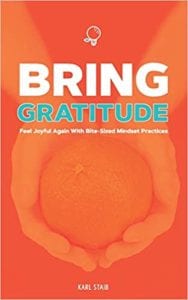
Bring Gratitude: Feel Joyful Again With Bite-Sized Mindset Practices
Because I love doing it. I have gotten such great feedback that I have a wonderful impact on helping people become storytellers, and how it enhances their career in their life. It feels like this is what I’m supposed to be doing. When it’s not happening as frequently as I would like it to, it is a struggle because I get frustrated thinking, “Am I not doing something right?” I’ve gotten past the not feeling good enough, which used to be part of the struggle. Now the struggle is, how do I create momentum?
Why do you want to create momentum?
I know there’s a great book about the tipping point. I remember somebody saying, “The more you speak, the more you speak.” I thought, “What does that mean?” Now I have had an experience of it where someone will be in the audience that will hear me speak. They’re like, “My wife works at XYZ Company. I’m going to tell her they should talk to you.” That is what I mean by momentum happening. Your confidence level continues to go up the more you speak. Your skills are finely tuned and you have stories ready to go about how you gave a great talk and how it gave everybody a great impact. That’s why momentum is powerful. It helps our energy and our confidence.
You said the word impact. Another reason why you want to make an impact on these people, could that be another reason too?
Yes, because the more momentum I have, the more people I’m reaching, the more impact I have. Ultimately, that’s what we’re trying to always do, create some legacy.
What are your expectations? Where do you expect to be at this point?
I stopped setting goals for myself around this because I was always under pressure for many decades in Corporate America with sales goals. You have to sell this month this X number, in this quarter, in this year to hit these goals. My intent is to align my intentions and allow the right people to find me without having to beat myself up if I’m not hitting certain numbers. As with any business, you have to invest quite a bit of time and money. As a speaker, you invest time in your website, your video, getting that edited, all that. In my case, I also have a course that goes with the talk. Your expectations are mine anyway of this is an investment in me. I know my work ethic and my skillset. I’m willing to put this money in.
[bctt tweet=”When we go through a struggle, like the passing of a loved one, we must dig into our thoughts and emotions.” username=”John_Livesay”]
As with anything, there’s no promise that it’s going to take off. At one point, you break even, and then when does it become profitable, and then when does it become something more than, “I love doing this. No, this is an actual career that you’re getting to do.” The big shift for me leaving Corporate America was realizing, “If I make $100,000 as an entrepreneur versus $100,000 as an employee, they’re very different.” I hadn’t realized that. First of all, it’s probably not going to come in a steady two-week paycheck, ups and downs. Also, there will be expenses that you have to pay, your insurance, websites and things like that. $100,000 as an entrepreneur is not necessarily the same lifestyle as an employee.
You want this to grow quicker because you’re like, “I have certain expectations money-wise, expectations of how I want to affect people and impact them,” and your legacy. This is where we need to start making some shifts here, some mental 180s. What are you grateful for about this situation?
I’m grateful that I have a wonderful speaking agent named Shawn Ellis. I don’t take that for granted ever. I’m grateful that I have had the opportunity to speak and get selected. I am grateful for the response. I gave a talk to Anthem Insurance and someone came up to me afterward and said, “How long have you worked in healthcare?” I’m like, “I haven’t. I took the time to customize my talk to your industry.” When you get a standing ovation and you see tears in people’s eyes, and you realize that you’ve touched their heart, and/or the feedback of, “That was beyond our expectations.” Those are all the things I’m grateful for.
The last part of this is, where are the opportunities that are within this struggle that you can dive into?
I’ve started the concept of focusing on healthcare and tech companies because I love that industry and I have several experiences with it. One of the things I’m looking at is I updated my LinkedIn profile, narrowing in on that particular industry. Sometimes people think, “That’s limiting yourself.” The irony is I’m still getting offers to speak at other industries because they want to hear about what’s going on in healthcare and tech, and how it could apply to them. It may seem like you’re cutting yourself off if you just niche. It has turned out to be the opposite experience.
What other opportunities have you noticed?
Sometimes speakers refer me when they can’t do a gig or other speaking bureaus, I’ve gotten on their radar enough to get referrals that way. Sometimes people find me by Googling storytelling and sales. I’ve spent some time and money on my search engine optimization. That’s always exciting when that works. That was unexpected. I had the belief that I was going to have to convince companies of the value of storytelling to grow their business. Many companies now have after the book Better Selling Through Storytelling came out.
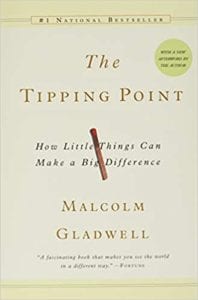
The Tipping Point: How Little Things Can Make a Big Difference
It wasn’t the book but I wrote the book without having that expectation. When it first came out, I was definitely having to convince people of how it makes you memorable and magnetic, people buy emotionally and not logically. Now the last few inquiries had been, “We want someone to teach our sales team how to be a storyteller.” It’s specific to what I do that’s an unexpected opportunity to have. Other people speak about storytelling and do it in different ways, which is fine. I don’t need to be the only expert on storytelling. That’s been fun to say, “Let’s keep making sure the SEO stuff works.”
Also, with external opportunities, there are also internal opportunities. What internally have you noticed going on that you could shed some light on?
I noticed that the more I speak, the more confident I am every time I have to go up and be interviewed for the next talk. I’m still on a high from the feedback from the recent one. Also internally, I remember I was up against 1 or 2 other speakers and the agent called and said, “They picked you. They liked your energy.” I thought, “How great?” The person said, “I felt inspired and motivated by your passion and energy, I assumed you’d make my team feel the same way.” Sometimes I can get stuck in my head internally going, “I need to explain to them all the details of how this is going to work.” At the end of the day, money and what you take away from a speaker is all energy. People are buying my energy as much as they are my expertise
What opportunities are out there that maybe you haven’t worked on to reach more people to make this bigger impact?
That I’m not sure I have an answer for because I’ve been digging as deep as I know how anyway. I’m exploring all the different channels, whether it’s how people can find me agents, referral, search engine, Google search. There is that tipping point that I’m doing press. You get some momentum that way of people started hearing about you. Posting on social media is another big way not to be attached to someone having to respond from one particular post. I did get somebody that reached out to me blindly on LinkedIn who goes, “I like your videos. I’m interested in talking to you about a talk that we have coming up in six months.” I thought, “Which videos? I need to know which ones are resonating.” I thought it doesn’t matter. It’s the consistency of it.
I’m going to read these back to you. I’m going to play it back to you in story form. I want you to listen, and then what we can do over the next 30 days to help you reduce this struggle and get more of these opportunities. The big struggle is a lack of patience. You want things to happen faster, more speaking opportunities. You see other people getting these opportunities and you wonder why you haven’t. The big part is the unknown. As you build this, you’re not sure what is going to happen next. I asked you to rate the struggle and you said it was a 7 out of 10. That’s manageable. If people say a ten, I’m like, “You’re not quite ready for this yet,” but it’s a seven, so you know there’s wiggle room there. There are things that you can improve. You have the motivation. If it’s a 1 or 2, there’s no motivation there to make any change.
Why is this a struggle? You love speaking. You love how it makes you feel but you’re not doing as much as you’d like, and you’re wondering, “Am I missing something?” You want to reach this tipping point and you want to make a big impact in the world. The expectations you have is you want to be able to reach more people. You expect more people to realize that you are good at this and that you can help them. One of the things you realize is you stopped setting goals. When you stopped setting goals, maybe there are some opportunities there of like, “Is there a hybrid model?” Maybe not the goals that Corporate America was setting but something that you can set that makes you feel more comfortable.
[bctt tweet=”Anxiousness is just a form of being stuck.” username=”John_Livesay”]
You realize too with your expectation of, “I’m going to start this business. When I earn $100,000, it’s not the same as earning $100,000 working for a corporate job.” We started that shift of gratitude. I could see it in your face. You started talking about the wonderful speaking events that you speak at healthcare. You have a wonderful agent, Shawn Ellis, which is amazing and you’re lucky to have him. The responses that you get, you’re blown away by how people feel, and how you can emotionally affect them through your words. You’re amazed that as you’ve been able to do more of this work, you don’t need to convince them that they need a storyteller. This didn’t happen ten years ago. This wasn’t a thing.
Opportunities, you want to focus on healthcare and tech. This is something that you realize like, “Yes, I’m niching myself, but I realized I’m also still getting jobs in other industries.” There are opportunities for more speaking referrals. Confidence, as you do this and people you’ve realized is they love your energy. Maybe how can we play off that? If there are these videos out there that they are attracted to, how can you showcase more of these? Where can you do this? I noticed social media seems like a good opportunity for you. I want to do internal and external goals. What actions can you do to reach out to others and then internally, help you process this. Let’s start with the external. What could you do over the next 30 days once a day or maybe Monday through Friday but every single day for 15, 20 minutes?
I could probably reach out to the people that I’ve spoken to in the past and check in on how they’re doing and the impact that it’s having. That might lead to a referral.
Can you do that every single day? Can you add some other people that might have been in the crowd that you’ve talked with? Maybe 1 or 2 people a day, when can you do that? What time of day? How can you add that to your routine?
I probably like to do it after lunch like 2:00.
Can you put that on your calendar?
Yes.
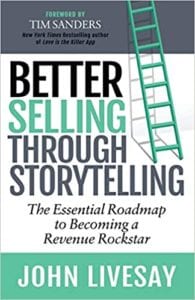
Better Selling Through Storytelling: The Essential Roadmap to Becoming a Revenue Rockstar
Keep it short, like 10 to 15-minute block you, and then once you have that email, you can copy and paste portions of it like your talk. It’s the core there. I love that. Now, internal.
I know that when I definitely booked time to meditate, I’m much happier.
Why is that? How does that help?
I’m not as reactive. I don’t get as stressed out and frustrated as easily.
When can you do that for once a day over the next 30 days? When’s best for you?
8:00 AM.
How long are you going to do it for?
I had this guided five-minute meditation.
[bctt tweet=”We need to be our own greatest advocate.” username=”John_Livesay”]
I love it short because whenever you’re like, “I’m going to do it for 30 minutes,” no. I know me. I do fifteen minutes max, and then I want to do something now. I heard what you’re going to do at 2:00 PM. You’re going to reach out to people, past clients, people you’ve spoken with. You’re going to get to understand a little bit deeper of how they liked it, get some feedback. Can you get maybe even quotes or testimonials while you’re doing It?
That’s a great idea.
You have a guided meditation that you can use and help you become less reactive. That’s why it is so important. The key thing and what I like about that is you’re already starting to think of how you’re going to be grateful for these things. You’re less reactive and you know you’re going to be calmer. How do you feel now on a scale of 0 to 10?
It’s like a three. It’s amazing putting a plan in action and not feeling overwhelmed. Part of it is this Dig to Fly Method is giving me a sense of control about something that’s felt out of control.
An important part of this is the sequence. You create some emotional space when you start putting a number on it, and then you’re already like, “That’s not terrible.” You start working your way through it. You dig down and then you start to do that 180. You can start getting out of that hole and start flying. I love it. Seven to three, that’s fantastic. Good job.
How great is that, you were able to show and not just tell what the method is. When you said, “Think of it like a story,” that’s the way I’m wired. Suddenly, I’m not listening to just my own stuff. I’m literally seeing a character in a story. Our protagonist is struggling with patience and comparing himself to other people and getting comfortable with the unknown. I’m like, “That’s a story I want to see how it turns out.” That part of it was interesting. Also, the willingness to ask questions that I’ve never asked myself. I could see how this would help small business owners in particular, but anybody, gets unstuck or get less anxious. Anxiousness is a form of being stuck. Maybe you’re still taking action but you’re anxious about it. That’s not the energy you want to put out into the world either.
What I like to think of it is we have these diamonds inside of ourselves. They’re rough and they’re caked with dirt. You don’t realize that they have energy trapped inside of them. When we dig down and we start to uncover them, we start to see the energy come out because we bring them to light, and we see the shine and the sparkle. We start to take away the dirt and the grime, and we start to chisel it away. We see how beautiful it is when we take the time to dig into this stuff and surface it because then it’s like, “Yes, I see what’s holding me back,” and then you can move forward. That’s the thing. It’s this murky darkness. You’re like, “I don’t know which way to go,” and then you slow down and go through the process.

Dig To Fly: Dig out of your hole, start to feel better and grateful, and then realize the opportunities that you have.
Everybody in the audience, after this is done, I have a one-sheet and they can print it out. They can do it themselves. That’s what I try to train people to do. Therapists are great counselors but we need to be our own greatest advocate. I want people to do this because I do this if my son’s acting like a little jerk or whatever and he’s in a cranky mood. I’ll be like, “How bad is his struggle?” I’m like, “Where did that question come from?” Subconsciously, now it starts popping out and I’ll do this method in 30 seconds. I’m like, “Where are the opportunities for?” Talking about my son crying, probably the older me from five years ago would have been like, “Come on. It’s just a little movie.” Now I’ll sit down and I’ll walk him through it because I want him to have this inner voice to be positive and talk him through things instead of being like, “Shove it aside, buddy. You’re fine.” It’s so interesting.
If people want to get your free steps and questions, they go to DigToFly.com.
Right there on that homepage is a little email sign up and they’ll get the Dig to Fly worksheet. I also have a recording of another Dig to Fly session so they can listen to somebody else. She was struggling with a friend. She has a reaction on there. She’s like, “Oh my God.” It’s funny. It hit her like a ton of bricks. It’s cool to hear.
I felt like you were running the interview instead of me hosting. I’m a big believer of show, not just tell something. We certainly showed how it can work in real-time and hopefully, people can imagine themselves going through it like I did. Any last thoughts you want to leave us with, Karl?
If people don’t even do this Dig to Fly Method, it’s important for them to pause, take a breath and say, “What is bothering me and why is it bothering me?” That why is so important because once you understand why, then you can start to come dig out of that hole. That’s when you can start to feel better and grateful, and realize the opportunities that you have.
Ask yourself, “Why am I so upset? Why is this bothering?” Nine times out of ten, we’re taking something personally. At least that’s my experience or we’re coming from a place of fear. One of those two whys can help us dig out and become the diamonds we were meant to be and be dirt free. It’s Dig to Fly Method. Thanks again, Karl, for sharing your expertise with us and inspiring us all to remember that we have the resilience inside if we ask these questions.
Thank you. I had a blast. Great job.
Important Links
- Karl Staib
- Bring Gratitude: Feel Joyful Again With Bite-Sized Mindset Practices
- LinkedIn – John Livesay
- Better Selling Through Storytelling
- https://www.Amazon.com/dp/B07DBT1L76/ref=rdr_kindle_ext_tmb
- Better Selling Through Storytelling Method Online Course
Wanna Host Your Own Podcast?
Click here to see how my friends at Podetize can help
Purchase John’s new book
John Livesay, The Pitch Whisperer
Share The Show
Did you enjoy the show? I’d love it if you subscribed today and left us a 5-star review!
- Click this link
- Click on the ‘Subscribe’ button below the artwork
- Go to the ‘Ratings and Reviews’ section
- Click on ‘Write a Review’
Love the show? Subscribe, rate, review, and share!
Join The Successful Pitch community today:
- JohnLivesay.com
- John Livesay Facebook
- John Livesay Twitter
- John Livesay LinkedIn
- John Livesay YouTube