

Hunting Discomfort With Sterling Hawkins
Posted by John Livesay in podcast | 0 comments

Getting results comes down to pushing past your comfort zone and limiting beliefs. That is what today’s guest, Sterling Hawkins, the CEO and Founder of the Sterling Hawkins Group, firmly believes. From a multi-billion-dollar startup to collapse and to come back to launch, invest in, and grow over 50 companies, Sterling takes that experience to work with C-level teams from some of the largest organizations on the planet and speaks on stages around the world. Sterling is out to break the status quo. He believes that we can all unlock the incredible potential within ourselves, and he’s on a mission to support people, businesses, and communities to realize that potential regardless of the circumstances. Today, he talks about how important it is to hunt discomfort and how, when you feel seen and heard, your loneliness goes down, and your productivity goes up.
—
Listen to the podcast here
Hunting Discomfort With Sterling Hawkins
Our guest is Sterling Hawkins, the author of Hunting Discomfort. We’ve talked about how important it is to hunt discomfort, not just tolerate it, and how when you feel seen and heard, your loneliness goes down, and your productivity goes up. Enjoy the episode.
—
In this episode, our guest is a repeat guest, which I don’t have many of those, but when someone says stand out and has such amazing new content as Sterling Hawkins does, it’s always a treat to have him back. In case you don’t remember, Sterling is out to break the status quo. He believes that we can all unlock the incredible potential within ourselves.
He’s on a mission to support people, businesses, and communities to realize that potential, regardless of the circumstances. He’s got this amazing story from a multimillion-dollar startup to collapse and coming back to launch, invest in, and grow over 50 companies. He’s got a new book out, which I am a big fan of, called Hunting Discomfort: How to Get Breakthrough Results in Life and Business No Matter What.
—
Sterling, welcome back to the show.
No matter what. Thanks, John. Great to be back with you. Thanks for having me on.
I want to ask you about three ways that we can start hunting discomfort and how that can help us change our lives for the better. Many of us avoid it. The concept of the comfort zone is what we all know, and I remember hearing years ago that if you’re not actively getting outside your comfort zone, your comfort zone shrinks. That was a shock to me. The majority of the time, I’m trying to be in my comfort zone, not hunt discomfort.
That’s probably the thing I hear most about this book. People tell me, “Sterling, look at my business, bank account, relationships, friends, and family. I don’t need to hunt discomfort. I’m surrounded by it.” My answer is always the same. That means you’re living with discomfort, not hunting it. When you’re hunting discomfort, you are forever free of it. Not circumstantially free. Not like, “I need enough money, then I will. I need to be in the right relationship, then I will.” It’s free based on yourself. It’s the only real freedom there is.
It’s an oxymoron, isn’t it? Our brain thinks, “How can I be free of discomfort if I’m hunting it?” Part of it is we’re in control a little bit. Would that be accurate? If you’re hunting something, you’re not afraid of it.
I found this research at the University of Michigan and they were studying my favorite topic, which is discomfort. They were looking at physical discomfort, maybe you broke something, emotional discomfort, you lost a job, broke up with a loved one, and mental discomfort, on and on. They were scanning people’s brains and their bodies. What they found blew me away.
[bctt tweet=”Loneliness can be cured when people feel seen and heard.” username=”John_Livesay”]
No matter what discomfort we were experiencing, physical, mental, emotional, or arguably spiritual, but that wasn’t in the study. Our bodies and brains process them identically. So much so, you can take a sip of methapine, and it will help you with emotional pain, believe it or not. That’s not a bio-hack from Sterling, by the way. I’m not suggesting that.
We have mentioned this hashtag that’s part of your brand, #NoMatterWhat. We’re going to get into why some of us back off from the discomfort the minute it starts to hurt but your whole premise is lean into it a little bit.
It will build the muscle for it because if we process it the same everywhere, we can grow our capacity to deal with it anywhere. You go to the gym to build your biceps. If you want to grow your resiliency and ability to breakout growth, will you hunt discomfort? There’s no other way.
You have all these great social media posts about how you yourself physically push past your own level of comfort, like riding a bike up a mountain or all these athletic things you do. How did you first start to embrace this as one of your favorite topics?
It was forced on me. I don’t wish discomfort on anybody, myself included. As you alluded to a little bit on my introduction, I was part of a massive startup. We raised hundreds of millions of dollars, a multibillion-dollar valuation. It was like the Apple Pay before Apple Pay. Hugely successful for a while then long story, very long story, very painful story, very short is when the company collapsed, so did I. My identity, how I saw success, how I saw my friends, and how I saw everything was so tied to it. The company crashed, and so did I.
It was like I was thrown into the unknown or ultimate discomfort. Having some of those dark nights of the soul kinds of moments, I’m asking myself, “Why am I here? What’s my life about? Where do I go from here?” As part of building myself back, I said, “I don’t know what I’m going to do or how I’m going to do it, but I’m going to take steps forward no matter what.” That was the origin of the whole thing.

Hunting Discomfort: Commit to one thing every day that you’ll do no matter what.
One of my favorite lines from your various successful and popular keynote is from the boardroom back to?
My parents’ house.
I think that’s such a fascinating, humble, vulnerable way to look at that. Let’s assume now that you have got us to start thinking, “I’m going to start hunting discomfort.” Is there one thing we can start to do that would be an easy first step? Is it take a cold shower, or is there something else you recommend?
You could. I’m a fan of that cold exposure therapy, for sure, but I suggest to people, especially those getting started, to commit to one thing every day that you’ll do no matter what. It doesn’t have to be the same thing. It might be, “I’m going to call my mom and I’m going to send this email. I’m going to make a cold call the next day.” It can be different. When you get up in the morning, you commit to one thing you’ll do no matter what. What that does is it builds your capacity to get things done regardless of the circumstances.
Many people give excuses for why they didn’t return the phone call. “I know I promised I was going to do this and I got distracted by this or that.” At the end of the day, it’s an integrity thing, isn’t it? Keeping your word to yourself is the first step.
It is, and when we are thrown into chaos that is not of our own choosing, pandemic, tech disruption, you lose your job, or whatever it is, we have built that muscle inside of us to get things done.
[bctt tweet=”You can hunt discomfort at any age.” username=”John_Livesay”]
A lot of people have goals and dreams, and they get stuck, or they give up on their dreams, but you’re saying that we start working this muscle of hunting discomfort. It gives us more tools in the toolbox to make those dreams come true. Do you have a story of that happening?
I would say it a little bit differently. I would say that you get the discomfort out of the way that’s in the way of reaching your full potential. I think there’s an innate love, joy, happiness, and gratitude inside each of us. That is I promise you greater than whatever is in front of us. When we get the discomfort out of the way at that, we become literally unstoppable.
One of our mutual friends, Emanuel, who’s part of the #NoMatterWhat community, is a great example of this. He lost his job as many did going into the pandemic. He was confronted with this question, “Where do I go from here? What are my next steps?” I think you know this story but he was walking by himself somewhere in the suburbs of New York. He stumbled into this tattoo parlor and said, “I want to get a tattoo of the business I want to start on my left bicep.” He did. It’s massive. It takes over his whole bicep. I don’t know how he explained that to his wife when he got home, but he committed in a way where there was no going back.
It’s a very important part of getting results. I would call it getting a tattoo. Proverbial, but he got literally a tattoo. Within weeks of that, he had moved to Texas. He had started his business. He started working with many clients, myself included. We started doing some work directly with him, and he’s built an eight-figure company.
He and his wife are traveling in Portugal.
They’re in Peru at the moment. They’re living the dream.

Hunting Discomfort: Feeling alone isn’t a function of having people around. It’s a function of being seen for who you are.
I’ve seen that tattoo, and I thought to myself, “That is a level of commitment.” I’ve only seen it when people were drinking the proverbial Kool-Aid at Nike, and they’d get the swoosh tattooed on them. What I love about what he did is he had the tattoo before the outcome. I think that’s what you’re talking about.
That’s critical. Otherwise, it’s a memory, which is fine. This is not a critique of tattoos, obviously, but when you commit and don’t know how you’re going to achieve it. You know it’s not impossible but you’re not exactly sure how. That’s a real commitment that is going to make a difference for you. It worked for him, me, and anybody that uses it.
Yes, and one of the things I admire about him is his willingness to give people a sample at no charge of his work because he believed in it so much and knew that he would pay for it.
I don’t think he’s doing that anymore.
No, he doesn’t need to, but that reminds me of Mrs. Fields’ cookies that used to stand outside. You’d smell it, but they go, “Do you want a free sample?” Everybody would come and eat multiple cookies. When you’re starting out with that commitment, it’s a total belief and has something of value. If I have to give it away or a sample of it, prove it. I will, and most people aren’t willing to do that. He came from a very humble place of that. Look how it’s paid off. It’s great.
You introduced me to him. I introduced him to people here in Austin who since have hired him. It’s very cumulative. That energy is very contagious, and you want to help someone like that. Do you think it’s ever too early or too late for someone to hunt discomfort? They’re like, “I’m 100 years old or I’m only 20 and whatever.”
[bctt tweet=”No matter what kind of discomfort we are experiencing – physical, mental, emotional, or spiritual – our bodies and brains process them identically.” username=”John_Livesay”]
Only the people that aren’t born yet or are already dead. For everybody else, it’s not only helpful but it’s critical and living a meaningful life. One of the reasons I wrote this book is because I want myself and the people I work with to be able to look at their life on their deathbeds and say, “I lived something that was true to myself.” The number one deathbed regret is, “I wish I had the courage to live true to myself.” If this movement can give even a couple of people that courage, that’s what it’s about.
You talk about self-doubt and how our brain is wired to look for patterns of failure if we let it. The awareness is that it’s a fight or flight response. It’s why of doing that but we need to override that. How do we do that?
It’s something that we can have worked to our advantage. There’s something in our brains called the Reticular Activation System, RAS for short. It works like the bouncer of our conscious mind. It looks at all the things in the world and says, “These are the important things for you to pay attention to.” The reason why I bought a new car and now I see that car everywhere. It’s the RAS kicking in, knows that it’s important, and now it looks for it. It’s not everybody bought the same car on the same day I did. It’s the fact that I started noticing.
When we succumb to self-doubt, what happens is that RAS is tuned, looking for reasons to give us an out, to make us fail, to have us crash and burn, especially if we failed in a similar way before. The good news is that RAS also works the other way. This was a perfect segue, John. When you make that big commitment, you’re behind it, and you are all in no matter what, your brain will start to look for openings for action, new opportunities, and new potentials like it did for Emmanuel. That RAS, when we’re a victim of it, it will kill you. When you use it to create breakthrough success, it’s the tool that will let you see things that are invisible from where you sit now. It’s hugely powerful.
It’s almost like we’re rewiring the fight or flight response to work since we’re not being chased by cyber tooth tigers anymore. We’re rewiring it to, “Don’t constantly focus on what could go wrong or what’s a danger here. I want you to start focusing on opportunities and any progress and reinforce that.” It’s helpful. This other part of the exposure, you have something here called The Loneliness Factor, which is rarely addressed in a business book.
I want to give you huge kudos for that. When I moved from being in the heart of everything in Austin near the airport by a house, I had some friends who live in the heart of everything come and visit. They said, “Aren’t you lonely out here?” I thought to myself, “I don’t think loneliness is a geographic thing.”
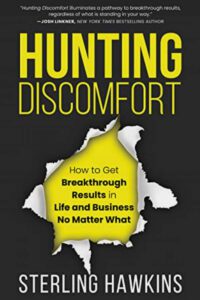
Hunting Discomfort: How to Get Breakthrough Results in Life and Business No Matter What
We’ve been at a party and feel very lonely sometimes or sometimes you feel you’re with one person and you don’t feel that. I don’t need to be crowded to not feel lonely. I thought that was such a fascinating thing. Everybody has different needs. I need to step outside my door in Manhattan and be in Times square in order not to feel lonely is not my MO. This concept of exposure and aloneness, can you address that a little bit? Tell us about the visual of trying to climb a smooth wall. It is so great.
I’d be happy too. Feeling alone isn’t a function of having people around. It’s a function of being seen for who you are. What happens for many of us, and I was certainly a victim of this myself, is we want to be accepted. We want to be successful and seen as successful with the people around us, family, friends, our coworkers, investors, and what have you. From an evolutionary standpoint, it makes a ton of sense because if you were kicked out of your tribe in the caveman days, it didn’t mean you didn’t have friends anymore. It meant death, like literal death.
We now have that same biological response where we’ve constructed these identities, views, ways of thinking, being, and acting that satisfy those around us but maybe aren’t true to who we are. When we let people into that view of who we are, we open ourselves to be a little bit vulnerable. It not only makes us not feel alone anymore. It makes us feel seen. It also helps other people connect with us. The wall analogy you used, I thought of that. I talked to my mom one day. We were out rock climbing and talking about love.
I always have these deep, profound conversations with my mom, and we were talking about perfection because we’re both recovering perfectionists. I said, “Perfectionism is like a smooth granite wall. There’s nothing to grab onto and climb. There’s nothing that makes it stand out. It’s perfect.” As there’s a wall that’s got some cracks in it, crevices, places for a foothold, or a handhold, that’s how you connect to it.
It’s the same with love. When we open ourselves, show those cracks, and show those imperfections, not only is it something that people can grab onto. We feel seen and somewhat paradoxically. We also get all the results, dreams, connections, and even money that we’ve always wanted. They are in the same place.
Talking about perfectionism as a goal and the smoothness of a wall with no cracks reminds me of what people talk about with plastic surgery that it’s called Plastic For A Reason. If you don’t have any character on your face, there’s not a laugh line or a wrinkle, then you can’t relate to that. That’s like a doll instead of a person. It doesn’t feel emotional. Actresses have gotten so much Botox that they lose their acting chops. I think there’s a lot to be explored there in terms of not being afraid to let the light in on those cracks and tell people, “I don’t have all the answers all the time.”
[bctt tweet=”There’s innate love, joy, happiness, and gratitude inside each of us that is greater than whatever is in front of us. When we get the discomfort out of the way, we become unstoppable.” username=”John_Livesay”]
It also leads to high-performing business cultures. It’s not just to feel good. The feel-good component is fantastic and arguably the most important thing. When you’re in a business, community, family, or any cultural dynamic that does that, you’re going to perform infinitely better because, as you said, you’re going to talk about your failures. You’re going to open yourself up and say, “I don’t know but let’s figure it out together.”
One of the other sections in Hunting Discomfort that jumped out at me was the concept of balancing discomfort with surrender. With those two words together, alone seemed like a lot to handle. Let alone coming up with a balance and then you talk about our comfort zone. What I love about this is the concept. There’s a difference, a distinction between mild discomfort and severe discomfort. On the far extreme is it’s paralysis of it, where we’re not even moving at all. Let’s give people a hint so that they want to get the book and read this themselves. On either side of growth is either mild discomfort or severe. I think of it as salsa. Do you want mild, medium, or hot?
One of the quotes that have always meant a lot to me is the Robert Frost quote, the way out is through. If the way out is through, the way through is to surrender. Not in terms of giving up, sitting on the couch, or ordering a pizza. Although there’s a time and a place for that surrender in terms of accepting what is, how it is, and how it isn’t, including yourself. When you do that, it frees you from the views, perspectives, ways of thinking, and enacting that have successfully gotten you to the way you are now, but they’re limiting you from taking that next step. How we surrender and how we move into discomfort is very important.
I saw a lot of these concentric circles on Instagram like you’re in your comfort zone, and the further you get away from that, the more dreamland of growth there is. That’s simply not the case. The sweet spot of discomfort is more like a bell curve. If you’re in your comfort zone all the time, that’s not good. There’s no growth. You’re not going to progress anything for yourself or your business. On the other side of that can be thoroughly paralyzed. Part of the reason I wrote the book is because there are steps for how to do this. You want people around you. You want the right environment to be able to move from that discomfort.
If you don’t have that in place, too much discomfort can be traumatic and make your discomfort even worse. There is this sweet spot that’s different for everybody. That splits the difference between comfort and extreme discomfort. That’s where growth is. When you’re in that spot, according to Yale’s research, you are able to learn four times faster. It’s like a bio-hack to getting better, faster, and smarter.
A lot of companies are bringing you in as the keynote speaker to talk about this very topic. You’re represented by Executive Speakers. They manage you. Who are some of the ideal audiences that you find craving this content?

Hunting Discomfort: When you make that big commitment and you are all in no matter what, your brain will start looking for openings for action, new opportunities, and new potentials.
It’s the audiences that are looking for growth. There are two flavors of them, you could say. One is companies and cultures that are facing extreme adversity. Maybe they’ve had some pandemic fallout, got labor shortages, supply chain issues, and people in Europe somehow involved in the war over there. They’ve got extreme adversity, and yet they still want to grow no matter what.
That is an audience where the #NoMatterWhat and Hunting Discomfort message has resonated. The other group are people that may be doing well already but want a breakthrough. They’re ready from an investment, a culture, and a company standpoint. They’re saying, “We’ve been successful thus far. We’ve been in business for maybe a while, and we’re ready to take it up a notch. Can you help us do that, Sterling?” The answer is certainly yes.
The keynote is just a start. From the keynote, we get into creating the ultimate intent of the company, leadership, and everybody that works there. It’s what matters to them at the end of the day or at the end of their lives. As that becomes a guiding beacon for each of them individually and their company culture, that’s what’s going to produce the breakout growth.
It sounds like you’re also helping companies attract great talent. If someone has that personal motto or I want to keep growing, I’m going to go work for a company that matches that vision versus another offer I have that maybe seems content to rest on their laurels. It’s the company that is growing, pushing, and hunting the discomfort that fits my needs. Those are the top producers in any field, whether it’s sales, tech, or what have you. The book again is called Hunting Discomfort on Amazon and anywhere you buy your book. If people want to get ahold of you as a speaker or a consultant, where should they go, Sterling?
SterlingHawkins.com. That’s got all our social media. You can join that #NoMatterWhat community there and check out all the details around the book and everything else. Thanks for that, John.
Thank you. What a great gift to the world at a time it’s certainly needed. When you’re describing all those people who are facing supply chain challenges and employee shortages or challenges with European at war, I’m like, “Your phone must be ringing off the hook.” It’s well deserved.
Thank you. We’ve been very busy, and I’m grateful for every moment of it.
Thanks again, Sterling.
Thank you, John.
Important Links
- Sterling Hawkins
- Hunting Discomfort
- #NoMatterWhat
- Amazon – Hunting Discomfort
- Better Selling Through Storytelling Method Online Course
- Mrs. Fields
Wanna Host Your Own Podcast?
Click here to see how my friends at Podetize can help
Purchase John’s new book
John Livesay, The Pitch Whisperer
Share The Show
Did you enjoy the show? I’d love it if you subscribed today and left us a 5-star review!
- Click this link
- Click on the ‘Subscribe’ button below the artwork
- Go to the ‘Ratings and Reviews’ section
- Click on ‘Write a Review’
Love the show? Subscribe, rate, review, and share!
Join The Successful Pitch community today:
- JohnLivesay.com
- John Livesay Facebook
- John Livesay Twitter
- John Livesay LinkedIn
- John Livesay YouTube
Bust Your Limiting Beliefs With Christopher Burns
Posted by John Livesay in podcast | 0 comments

Most people have been thought to believe in one thing their whole life without really understanding why. Some of these beliefs would be limiting beliefs. They would stop you from reaching your full potential. Find a new identity for yourself so that you can improve in whatever business you’re doing. This is how Christopher Burns became the person he is today. Christopher is the founder of Men Mastermind. He dedicated his life to coaching men to activate their purpose, power, and prosperity. John Livesay brings him in to the show to teach you how to remove your limiting beliefs and activate your purpose today.
—
Listen to the podcast here
Bust Your Limiting Beliefs With Christopher Burns
Our guest is Christopher Burns. He dedicated his life to coaching men to activate their purpose, power and prosperity. He teaches people how to go within to master themselves, which allows them to create their dreams. He’s been coaching men, entrepreneur and leaders for several years and works with these clients one-on-one, group coaching and home study courses. Welcome to the show, Christopher.
Thank you, John. It’s great to be here. I’m grateful to be on the journey together. Thanks for having me.
I love to ask my guests their own story of origin. You can go back to childhood or school, wherever you want to start your story. I have a friend that I’m a godfather to his son and I say, “What do you want to be when you grow up?” There are lots of obvious choices like a fireman or whatever. In his case, a security guard came out. I was like, “We might want to aim a little higher but okay. Is it the uniform you like? What’s going on?” Most people don’t have a childhood dream of doing what you’re doing. That’s why I’m fascinated to hear when did that start.
I dreamed of riding dirt bikes and motocross races when I was younger. That was something my dad and I did as a bonding time. We would go out to the desert and ride dirt bikes in Southern California. I was a curious kid. I saw opportunities and I was questioning, “How does the world work?” Here’s an example. When we were driving up to Northern California where our family has a cabin, I asked, “If someone throws a baseball in one car going one way and another person throws a baseball in another car going towards us, at what speed do the baseballs hit each other?”
[bctt tweet=”Accountability partner keeps your revenue consistent.” username=”John_Livesay”]
It was funny because that’s how my mind worked. At the same time, I was so curious that it started to aggravate my dad a little bit. He had a little shorter of a temper and he said, “Don’t you ever stop asking questions? Don’t you ever just enjoy?” That was that moment where I was like, “It’s not okay for me to self-express, to be curious and to be me.” That was one of the first memories of having that. Over the next decade or so I proceeded to close myself up and shut myself off from being self-expressed.
You might see me now communicating fairly effectively on podcasts, interviews and speaking. Throughout high school, I was so shy. I didn’t know how to communicate. I didn’t know how to self-express. I was introverted and afraid of what people thought about me and the world in general. I didn’t want to pick up the phone and schedule a dentist or a doctor appointment. I’ll say, “I don’t want to deal with that, mom, you deal with that. Dad, you deal with it.” It was a scary time for me in being a young man and then trying to figure out life. As children, I believe we get to figure out what is our journey in life and what are we meant to do.
I went to school for Electrical Engineering. I got my degree but I was also not seeing myself in that traditional route and hired a life coach. I was going to Toastmasters and things like that. Lee Adams owned a successful radio electronics store in Southern California. At the time, he was dying of cancer and he was attempting to overcome that. I was so inspired by him that he was giving his last breaths being of service, contributing to me and other people who we believed in to live their dream life that I was moved by, “This guy is living for something.” That stuck with me and planted a seed that I love to serve people. I love to help people make their dreams come true, especially men in this vehicle of the Men Mastermind, mastering men within. That’s a brief overview of a couple of those key points that made me so passionate about coaching.
I want to double click on “I’m too shy to even call a dentist” to now go where you’re running men’s groups and speaking. That’s quite the hero’s journey, as we say in the world of storytelling. It’s quite an arc. Most people don’t start quite that shy. It’s interesting when my mom was visiting me when I was living in LA and I said, “Let’s go into the Beverly Hills Hotel. They have lots of movies there and there are all kinds of history.” She’s like, “No, I’ve not dressed appropriately.” It never occurred to me to not feel okay enough to go into a hotel lobby. My mom is from a different generation. It’s not like she was wearing cutoffs or something, but she didn’t have the proper jewelry on or whatever her mindset was about that.

Limiting Beliefs: Look for your limiting beliefs and remove what you got programmed into believing. Identify the beliefs that are sabotaging you.
That was my first a-ha of on some level, my self-esteem is higher than hers. That’s always a little trivial even as a young adult. You’re like, “I got other issues but that’s not one of them.” Do you think it stems from a fear of what other people are going to think about you? You’ve insinuated that. I’m not a therapist here so we don’t need to even figure out where that came from. How does somebody might have a small dose of that? I teach people all the time when I talk to sales teams that the fear of rejection is the number one thing that keeps people from going into sales. It causes burnout and we all have to sell ourselves whether we have that as a title or not. How did you get to the place where you’re like, “What somebody thinks of me is not going to keep me up at night?” What did you do to get over that?
I’ll be the first person to say that I’m still a work in progress. I’m still a recovering people pleaser, but I would do whatever I could to put myself in the fire. How do I put myself in the fire? I did nine months of door-to-door sales for Verizon phone lines and business in Southern California heat. It wasn’t the most pleasant experience but I got a lot of experience there. Even before that, I was in a network marketing company trying that out for about one year and quickly learned how much I had to grow in my leadership, self-esteem and confidence. I said, “What’s something I can do to challenge myself to break through this lack of self-confidence or self-esteem several years ago? Let’s go to Southern California, Cal State Fullerton College and go up to 50 random women and ask them for their phone number.” It doesn’t matter if I get it or not. I don’t even stick around long enough to get it. I just ask the question because it’s the question that I’m afraid of asking or was afraid of asking. I did that and it was so exhilarating. It’s such an adrenaline rush and so activating for me that it changed me forever.
The takeaway here is when you confront your fears and repeatedly do the thing that scares you, you start to realize that after a while, it’s no longer triggering and you’re not attached to the outcome. That was the real secret. “I have to do it,” and then after you have your 10th or 20th no, a yes is almost a surprise, “Here’s my phone number,” or maybe you change the way you’re asking to play around with it. The key and what I’m getting is not being attached to the outcome allows us to let go of some of our fears. Would that be a good tweak for the episode?
Yes. It’s a commitment to the growth mindset versus a fixed mindset.
[bctt tweet=”Have a growth mindset instead of a fixed mindset.” username=”John_Livesay”]
That’s the old comfort zone again, isn’t it? Tim Sanders was kind enough to write the foreword to my book and he talked about it in terms of you either have an abundance mindset or a scarcity mindset. Einstein said, “The biggest decision you’ll ever make is, do I think the world is a friendly and safe place or not?” This growth mindset or fixed mindset is in that same genre of me growing, “Does that take away from someone else?” You do have a mindset that there’s a fixed amount of abundance and joy in the world or do you feel like it’s fixed? That leads to the next question which is you also help people become more prosperous whether they’re working with you one-on-one or in one of your masterminds. Let’s talk about your mindset and your beliefs around money and any growth you had to do on that.
I’m always a work in progress personally. I believe that we’ll keep working until we’re in the grave on becoming a better version of ourselves. For my upbringing, we were comfortable, upper-middle-class. In that next step up, the truly wealthy elite thing. My family had a negative view towards that like, “Power is bad. Power corrupts. Greed is bad.” All these things that I had to work through. I had the opportunity of excavating these limiting beliefs. That would be the very first thing if someone’s not where they want to be with prosperity with either the amount of money that they have or feeling and experiencing the prosperity that’s all around them because truly, we live in an infinitely abundant universe.
It’s all about our recognition and awareness of it. The first thing that I did was start writing down those limiting beliefs so I could get it out of my automatic monkey mind and the machine that keeps replaying the same tapes over and over again because that’s what I got programmed into believing. I got that down on paper and went through various reprogramming techniques but a simple one is crossing out the limiting belief and replacing it with a more positive statement. That’s something that anyone can do at any time.
The first commitment is I’m going to identify and inventory when these beliefs are sabotaging you when they come up. When I think about money, successful people or what it means to have a big business, does that mean I’m a slave to my business or does it mean freedom? It’s going through that process of re-choosing what is the reality that I want to create. I fully believe that we are the creators of our reality. Life is a game. It doesn’t mean it’s trivial but it is a game that I believe that we make up the rules. That’s a powerful place to stand in.

Limiting Beliefs: When you shift your identity, there’s an old identity that someone might have and you get to let go of that person. If you don’t have a new identity to step into, someone doesn’t have that new identity.
I tell people, “You’re the movie director of your own life. You can yell ‘cut’ at any time if you start playing out a horror movie of what the future might be.” That gives us the power. You can change locations as I did moving to Austin. That gives you a lot of freedom. It’s so important to write down because so many people in a digital age don’t write things down anymore. If you write it down, there’s that limiting belief again.” It’s so subtle and almost insidious. I remember growing up and I’d say something about, “Can we do this? Can we get that?” “Money doesn’t grow on trees.” That’s now implanted. I didn’t say it did but you’re implying that it’s not abundant. You’re not even aware that you’re implying that.
Excavating all that old stuff, writing it down and going, “Where did that come from? Does it really matter? Do I believe it true or false? Got it.” That’s a great starting point for getting people to go, “How do I replace it?” What I want to ask you about is and I want to see if you are doing something along these same lines. When I ask someone to stop thinking a certain way or let go of an old way of doing something, let’s say pushing out information to get people to buy. I say, “I want you to start telling stories and pull them in.” It’s crucial to give somebody something to replace something with. You can’t just say, “Don’t do this anymore,” and not give them what they should do as an alternative. Writing down the limiting beliefs and putting an X and throwing away doesn’t help unless you’ve got a whole new set to go in there. That’s what I’m getting at. I want to hear your thoughts on that.
Charles Duhigg’s The Power of Habit is a great start of that like nature abhors a vacuum if you don’t have a positive habit to replace the negative habit. You can do all the work that you want to replace the negative thing but chances are, you’re going to find the path of least resistance. Someone’s going to do that and it’s probably not going to be the best habit that could fill that space and slot. Another thing is the identity level, which is more in Atomic Habits with James Clear. It’s another habit formation stuff study. When you shift your identity, there’s an old identity that someone might have and you get to let go of that person. You get to kill off that person. If you don’t have a new identity to step into or if someone doesn’t have that new identity, then it will be very difficult for them to progress in a meaningful way. They will be leaving it up to chance. They will be a boat adrift at sea rather than a plane that is chartering a course to a specific destination.
Somebody’s got to take control of it. I talk about it in terms of being a copilot with your buyer and you’re both in the cockpit. You’re not flying the plane alone and they’re not flying the plane. It’s this concept of when you ask someone to buy or hire you or whatever it is, it’s not a shock. I said, “When we go on an airplane ride and they go without landing at LAX, no one ever stands up and goes, what?” I’m never going to fly around forever and yet, if you’re just adrift and your life is reacting to things and you’re like, “I have a flight plan and I have a destination in mind and a path to get there.” I might have to change the path like an airplane does with weather or what have you, but at least there’s a plan and we know where we’re going or where we plan to go as opposed to, “We’re going to get up and fly around and see what happens to the wind.” That’s a kite. That’s not an airplane ride.
[bctt tweet=”The fear of rejection is the number one thing that keeps people from going into sales.” username=”John_Livesay”]
This relates for me to the masculine energy and a healthy masculine because we might hear a lot about toxic masculinity these days. I believe that healthy masculine energy sets a container, sets a context, holds the frame and says, “This is what’s going to happen. I’m going to lead us to where we want to go. Together, we are going to go here. Does that work for you?” They check-in and they have this boldness, confidence and knowingness that, “Where I’m going matters. It’s meaningful and valuable. I wouldn’t be here unless I was planning on getting us to something that’s going to make a difference for someone’s life.” That’s key in the masculine aspect and especially with people not having a lot of great masculine role models growing up that we get to step back into that and trust that that masculine is valuable when it’s done in a healthy, not overly aggressive, overly controlling or overly manipulative way but rather purely, “Do you want to go on this journey? Here’s where we’re going.” It’s that open invitation which I believe is key in sales.
I tell people, “Once you tell a good story, the question is do you want to go on that journey with me?” It’s not about pushing them to do something. You’ve told a story that they see themselves in. One of the challenges I faced and I know that you helped a lot of men deal with is feast and famine. When I had a corporate job, you know what your paycheck is and you hit your bonus, you get some more money. It’s not so much a roller coaster. When you’re an entrepreneur, that stability is gone. Sometimes you have a great month and then sometimes a slow month. A pandemic or all kinds of things can happen. Especially as a speaker you’re like, “I need to learn how to do virtual talks now, not just in-person.” What tips do you give in your coaching and masterminds around breaking through these cycles? Does it keep going back to mindset or is some systems not in place?
I know you would have a great mindset around resilience and adaptability because of your TED Talk. For me, the thing that I focus on is if you can have someone outside of you like you said with that copilot, whether it’s a coach, an accountability partner, a business partner, a colleague, whatever it is, but someone who is able to be there to check you and check the person, check one of our readers on their growth, on their metrics, on the statistics that matter and are vital to them in their business, then I find that accountability is essential, especially for people who start up their own venture, their own vehicle.
For me, it was difficult to go from listening to teachers and bosses for most of my life and then transition into I get to generate myself. I get to generate my own activity, energy levels, intention, focus and activity. I find that having someone by to you who is able to be that copilot and consistently hold us accountable is key. For me, coaching is one of those things. Even masterminds is a great thing. If you could share about where you’re at, what your numbers are in the group. I think that’s super important but ultimately, what are those processes every week that we look at? We’ve probably all heard of KPIs, Key Performance Indicators. How do we know if we’re on track or off track? The real key is, do I know the vitals of my business? Do I track those on a daily, weekly and monthly business? Am I in tune with those? Do I know what those are so that I can course-correct them if need be?

Limiting Beliefs: You need to have someone outside of you, whether it be a coach or a colleague, who is able to be there and to check on you.
Am I in tune with those? That’s the magic source there because everything is energy, money is energy, relationships are energy. I remember when I was being interviewed for a speaking engagement and it was between me and two other speakers and then I get the email from the agent go, “Congrats, they picked you. They liked your energy.” Literally, that’s what they said. I thought, “Is it that obvious?” That’s what people are buying. It’s not the book, the content, the tours, the video or all the things that we think are going to get them to say yes. Later the event planner said, “I felt so good talking to you. I figured that if I feel this good, you’ll make the whole audience feel that great.”
This accountability partner keeps revenue consistent. That’s a nice little tweet for the episode as well because that sums up what you said in a way. This course-correct part is so crucial because if you’re flying solo and you don’t have anybody, you might not save yourself time to pull up on the airplane. If you’re thinking of it in terms of eating during the pandemic, “I gained some weight.” It’s like, “What are you going to do to fix it?” The next thing you know, “I haven’t done anything,” then you’re like, “Pull up already.” If there’s no one there going, “I see you’re eating more and exercising less, you know that’s not a recipe for what you want. How much longer you think that suits going to fit?” That’s probably the biggest challenge in why a mastermind that you offer is so valuable. It’s the isolation. In prison that’s the worst punishment, solitary confinement. We can’t go it alone in our lives or in our business. You have three pillars that you have in your curriculum. I’d love to hear what those are.
The three pillars of the mastered man curriculum are purpose, power and prosperity. Going back to what you were saying about isolation, I believe that when someone is alone, the confinement, they’re in prison by themselves, they get to sit with the shame and what they’ve done. There’s no human connection, openness, realness, transparency and vulnerability. Starting with that power pillar is out of order but the power pillar relates to this because if someone doesn’t feel powerful and able to express themselves like I know I didn’t when I was growing up and when I was super shy and introverted.
I know that when one of my clients launched his podcast, he didn’t feel powerful to be able to do that. He didn’t feel like he had the confidence to know-how. He was stuck in his head trying to figure things out. It was this block for him so when he reconnected with his self-esteem, self-worth and power, he was able to step into that and launch something that now is impacting a lot of people’s lives. That would be the power of prosperity and freeing ourselves of shame, limiting beliefs and things like that. The purpose pillar is where we start, typically. That’s because of identifying what is the vision for our life, the dream, the desire, where we want to get to, the destination so that we can course correct, so that we can start making different choices, putting in different habits, putting in different routines, activities and systems to be able to get there. We first got to know where do we want to get to and then also come to a humble acceptance of where we are now. That’s a big challenge for a lot of men especially. It’s the ego of, “I’m supposed to have it all together. I’m supposed to have it all figured out.” When we can be humble about that, we get so much freedom.
[bctt tweet=”In order to confront your fears, you need to do whatever you could to put yourself in the fire. ” username=”John_Livesay”]
I remember on a family vacation, we would drive and this is way before GPS and my dad would get lost. You could not get that man to pull over and ask for directions. I’m like, “Can we please pull up? Ask someone. We’ve gone too far.” “No.” “Why?” He’s like, “I’m a guy. I should be able to figure this out. I don’t want to bother.” Whatever the belief system is. It’s not just about money. It’s this concept of going it alone. Therefore, if I make a mistake, you don’t have any compassion for yourself and you’re judging yourself so harshly.
I remember hearing someone talk about the whole process of driving is error correct. On the freeway, you start to get a little too far to the lane. The movements are so subtle. I love that concept of driving is an ongoing series of error correct. It’s all unconscious competence, so why would we suddenly fear that we can’t make mistakes because we’re always making mistakes. They’re not huge. Luckily, we don’t crash the car but it’s always that. I love it. Christopher, do you have any last thought or a quote you want to leave us with?
I’d love to breathe, John. I believe breath has gone backseat in a lot of people’s lives and their personal presence and power in that aspect. For me, getting in touch with our breathing and activating our bodies, getting reconnected with our bodies, there’s so much wisdom within our bodies. If we want to be better salespeople, leaders, fathers, wives, whatever it is, if we are striving to be a better version of ourselves, then I believe we get to tap into the power within us. There are all kinds of different routines and things that you can do. A simple one is to reconnect with your breathing and that can start with 1, 2 or 3 minutes of being mindful and present. The mentor of mine, Jeremy, calls it having a mind break. If you take a three-minute mind break and you do this a couple of times throughout the day, it can drastically improve your performance because you’re able to be centered, grounded and ready to go versus all spun up and in reaction mode.
If people want to reach out to you to find out about your programs, your masterminds, where should they go?
Go to MenMastermind.com. You can also shoot me a DM on Facebook or Instagram. Facebook is @Th3Burns. Instagram is @IAmMillionaireChris. You can also email me, [email protected].
Thank you so much, Christopher. It’s been great hearing your insights. I’m going to be fascinated to watch you continue to grow. If you’re this far along in your life and your career at the ripe young age of 30, it’s going to be fun to cheer you on from the sidelines even if you don’t know I’m doing it.
I feel the support. Thank you so much, John. Thank you to everyone who tuned in. Stay connected to this show because when you pitched successfully, when you are an effective pitch master, learning from the Pitch Whisperer, all areas of life get better for you. John, thank you.
Thank you, Christopher.
Important Links
- Christopher Burns
- The Power of Habit
- Atomic Habits
- @Th3Burns – Facebook
- @IAmMillionaireChris – Instagram
- [email protected]
- Better Selling Through Storytelling Method Online Course
Wanna Host Your Own Podcast?
Click here to see how my friends at Podetize can help
Purchase John’s new book
John Livesay, The Pitch Whisperer
Share The Show
Did you enjoy the show? I’d love it if you subscribed today and left us a 5-star review!
- Click this link
- Click on the ‘Subscribe’ button below the artwork
- Go to the ‘Ratings and Reviews’ section
- Click on ‘Write a Review’
Love the show? Subscribe, rate, review, and share!
Join The Successful Pitch community today:
- JohnLivesay.com
- John Livesay Facebook
- John Livesay Twitter
- John Livesay LinkedIn
- John Livesay YouTube
The Bruce Lee Of Revenue Generation With Erik Luhrs
Posted by John Livesay in podcast | 0 comments


Erik Luhrs is known as the Bruce Lee of Revenue Generation and is the Creator of Revenue Kung Fu. He works with entrepreneurs, experts, leaders, and founders, helping them move beyond whatever holds them back so they can rapidly grow their business and achieve their desired outcomes. Erik joins John Livesay on today’s show in a discussion about the importance of being happy and the connection between our mind, body, spirit, and wallet. He also walks us through the four levels of going from living to lifestyle to legend to legacy.
—
Listen to the podcast here
The Bruce Lee Of Revenue Generation With Erik Luhrs
Our guest is Erik Luhrs who is the Kung Fu Revenue Generator. We talk about the importance of being happy because that’s what freedom is and that’s what people want. There’s mind, body, spirit and wallet connection. He walks us through the four levels of going from living to lifestyle to legend to legacy. Enjoy the episode.
—
Erik Luhrs is known as the Bruce Lee of Revenue Generation and is the Creator of Revenue Kung Fu. He works with entrepreneurs, experts, leaders and founders who are driven by a purpose, mission or vision that far exceeds their current level of success. He helps them to move beyond whatever holds them back so they can rapidly grow their business and achieve their desired outcomes. Erik, welcome to the show.
Thank you for having me.
Let’s start with some journey. You get to pick childhood or school. What made you decide that you wanted to brand yourself as Revenue Kung Fu and martial arts?
I’ve studied about eleven different martial arts. I have several different black belts. Martial arts has been a large part of my life. I got the nickname The Bruce Lee In Revenue Generation. It originated with a client years ago. He gave me the nickname The Bruce Lee of Sales, which I sat on for a year because I said, “I’ll try to have the confidence to back that one up.” After a year, I put it up on LinkedIn and doubled my connections in about 1.5 weeks because I had stuck to The Bruce Lee of Sales. It evolved as I evolved. First, I created The Guru Selling System and evolved into lead gen. I developed Subconscious Lead Generation. I’ve evolved to positioning. I developed Peerless Positioning and all these different systems.
[bctt tweet=”People buy happiness because it represents freedom.” username=”John_Livesay”]
My nickname evolved from the Bruce Lee of Sales to the Bruce Lee of Sales and Lead Generation to the Bruce Lee of Sales & Lead Generation & Positioning. I was like, “That’s far too many ampersands in this nickname.” I shortened it to Revenue Generation. I’m like, “I’m done. That’s it.” I’ll probably change it but for now, that’s what it is. Revenue Kung Fu came out of all that because Kung Fu means a skill acquired through perseverance. It doesn’t mean kicking butt. The people that I work with, their discipline is to increase the revenue for themselves and their company at least initially.
There’s something in martial arts that’s about being aware of your energy and your spirituality. You mentioned something when you’re talking about all your other creations and iterations that involve some subconscious things. To me, this is what makes you stand out from other people that say, “I have a system to help you generate leads.” Let’s go there because I love to go there. My first book years ago was all about how to take metaphysical principles and apply them to selling like not taking rejection personally, like The Four Agreements, don’t take anything personally, not being attached to results. Many of us and sales are attached to the results. Staying in the moment and out of your head, and all those things. Nobody was trying to connect those dots many years ago. It’s fun to meet a kindred spirit who is bringing that in proudly and not sneaking it in. My question to you is, how do you help people? Do you start with mindset stuff? Are you able to help people figure out what their blocks are even if they don’t consciously know what they are?”
I studied a lot of different things. I’ve studied Neuro-Linguistic Programming and was a master practitioner level and mind control. I’ve read up on Psychology and studied other behavioral systems, towards the metaphysical, multiple forms of meditation, self-hypnosis, self-discovery and all of that. When you initially meet people, their initial fallback is to put up a facade instantly.
We have our masks. We don’t feel safe.
It’s what I want you to see me as. Most of the time they’re failing miserably, they just don’t realize it.
“You look scared and petrified.” It’s those kinds of things.

Revenue Generation: When you let people go into themselves and open the space for them, they will verbally and energetically give you an idea of where they are.
A narcissist is perfect or somebody like a conman. Everybody else is like, “I’m like a god right now.” You’re like, “This guy sounds like a wet bag of kittens.” When you let people go into themselves and if you open the space for them, they will verbally and energetically give you an idea of where they are. Ultimately, what people want is to feel better. They want to be happy. As Abraham Hicks said, “Everything you want, you want because you’ll be happier.” Ultimately, everybody wants happiness.
When I’m speaking with somebody, I have the subconscious piece. You and I spoke before that I have the psychic piece going on too, so there’s that aspect that I’m picking up. I’m picking up their unconscious, subconscious and superconscious pieces. My entire desire is to simply say, “Here’s what I’m getting from you,” and putting that back to them. A lot of times when you hit people, they will be saying, “Here’s what I want. Here’s the mission I’m on.” I’ll say, “Okay.” The more you talk, all I keep seeing is this knot that’s tying itself tighter and tighter. I feel constricted as if all of these ribbons that are tying themselves are limiters.
That’s what I’m picking up and what that means to you. All of a sudden, when you give them that mirror they didn’t look in this morning. They look at the rose-colored mirror and, “Here’s the real mirror.” They go, “I do feel like this thing I’ve been selling for five years isn’t what I’m into anymore.” They will start talking. They will verbalize the ribbons. That’s when it’s like, “We’ve deconstructed what you’re putting out there. Where do you want to go with that?” I could say, “It’s been 30, 45 minutes. You have this epiphany of yourself.” Sometimes people are like, “I’ll go back and read some more Eckhart Tolle or something.” “Have fun.”
Other people are like, “I still have six years of therapy that I paid for so maybe I’ll double up on those sessions.” The people I work with are the people who have a much bigger vision of what they want to be, do, have and experience in the world, in life as far as beyond where they are. Those are the people that I’d like to help. They’re committed, motivated, action takers and implementers. They give into that. They’re like, “I see that there’s more to me than this physical stuff. I want to dive into that because I want to experience myself as opposed to trying to create a Facebook-worthy life.”
You’ve touched on a couple of things I want to go into. One is a Facebook life is another form of a mask. All the research has shown that you get more depressed the more time you spend on social media looking at people’s posts because your brain doesn’t constantly remind you, “This is a moment in time. This is the best of the best of their day. Their whole day is not this happy.” You look at all the things they’re doing that you’re not doing.
[bctt tweet=”Go from living to legacy.” username=”John_Livesay”]
Good marketing has the ability to make people feel you’re in their head. The way I talk about it is when you tell a story that other people see themselves in, they’re pulled in. Your ability to create a metaphor describing a feeling you’re getting from someone, in this case, the ribbons, people can then describe what that means to them. It’s a door that allows them to open up and say, “Now that I have a metaphor and visual to what I’m feeling, that helps me figure out those feelings and express them in a way that without them metaphor, I didn’t even know where to start.”
Whether it’s intuition or starting a revenue plan, because you’re also into systems, you toggle back and forth between the feeling and the analytical part, if you can help someone figure out what their mission and purpose are and figure out a way to express that in such a way that it resonates with potential people who need that, that makes perfect sense to me why you would earn the title of being The Kung Fu of Revenue. If we zoom out and think of money and revenue as energy, Abraham Hicks certainly talks about that. Most people don’t realize that.
I remember being interviewed to give a sales talk to a company. It was between me and two other speakers they were interviewing. A couple of days after, I got an email from the speaking agent and said, “Congrats. They picked you. They liked your energy.” Rarely do you see it that clear. That’s what we’re selling, our energy. We think it’s our book, the content, the structure or whatever else it is. At the end of the day, it’s always energy. The woman said later, “I felt good talking to you in the interview that I figured if you made me feel this good, you’d make all 300 people in the audience feel that good.
That’s what you’re also offering through a systematized lens from people who are like, “That’s too woo-woo for me.” You’re like, “It’s okay and here’s how to apply it to a system so there is some structure to it.” From an awareness standpoint, I thought that alone is how I describe what you do to people. That’s why you got many requests to connect because the subconscious is seeking it out whether we’re consciously seeking it out or not.
You opened up a rabbit hole. Because everybody wants to feel happy and we’re in physical form, we get pulled to search for a solution in physical form. Nobody ever goes on the internet and says, “I need a guy to help me get in touch with my beingness so I can become a billionaire.” If that was the case, my phone would never stop ringing. People go on online and they say, “I’m looking for a great Facebook or LinkedIn strategy or get more leads in my pipeline,” the generic things. The power of a story or a persona, because you’re talking about selling, the energy piece is that you weren’t even selling. What you were doing was compelling because for the person who is going to say, “I liked your energy,” you were an avatar.
They saw something in you that they lacked and truly desired. They couldn’t give voice to it because it’s not something that’s shown to them as, “Go look for this solution.” They simply sat there and some primordial beneath the surface part of them said, “I don’t know what the hell this guy is doing but I can’t look away. I can’t stop listening. I can’t take my eyes off him.” That person is aligned with their source. They’ve aligned their source with their beingness and their real-world and physical-world pursuits. That alignment makes you so much more powerful than any would-be competitor. You don’t have a competitor because everybody else is coming in there and they’re doing the five tactics for a great speech BS.

Revenue Generation: The people who have a much bigger vision of what they want to be, do, have, and experience far beyond where they are the ones who are committed, motivated, action takers, and implementers.
You come in there and you’re like, “I’m going to be me,” like a beacon. All of a sudden, it’s like the sun walked into this conference room. Even though I’m going to go blind, I can’t look away. What kind of money that person can make is unbound. Very quickly, it goes beyond money because money then becomes effortless. You make money by showing up. These people throw money at you and they don’t even know why. They’re like, “I will keep paying money to be around you.” It’s because you’re at a higher state of evolution. You’re in a state of freedom that they don’t possess yet. They hope that by buying your products, services and time, and being in your vicinity that they will become you. They want to be what you are.
The beauty in what you’re doing is true leadership because nowadays influencers are like, “I’m on YouTube and I’m on Instagram. I’ve got 1.2 million followers. Here’s Happy Dappy Energy Soda. I made $120,000 for showing this candy.” That’s not leadership. That’s pitching people. Anybody can be pitch people. You can pimp yourself enough, beef up and have followers. The people who make a difference in this world are true leaders. A true leader ultimately wants to free people from their limiting beliefs. When they see you living that higher energy, that freedom, their subconscious puts 2 and 2 together instantly, “I want freedom.” That’s what everybody wants. Happiness is freedom. They look at you and say, “He’s happy. He’s free. I want to be him. Whatever he’s selling, I’ll buy it.”
Sometimes freedom is the ability to be spontaneous at the moment and connect with whoever you’re talking to. One of the things I do is help fix people’s elevator pitches in five minutes. I have a process to do that. More than most people, you could relate to this. People have said to me, “How do you know what to say? How are you able to listen to someone and describe what they do, and then turn it into a two-minute or little story that taps into the pain points of the people they’re helping or what life is like after?” I don’t have an answer for them.
I get out of the way and all the training and whatever comes up, I’m able to say whatever it is or intuitively pick up on, “I’m guessing this is what your clients are feeling and thinking, and why they need what you do base on what you said to me.” If you say it that way, then people will be intrigued to ask you questions and want to know more. I’ve had an experience of that multiple times. The more it happens, the more we trust it. The same thing is true of coincidences as well. We can go, “That was a freak coincidence,” versus, “Maybe this is something I should look at and change in the way I’m living my life or how I’m approaching things.”
That’s serendipity.
[bctt tweet=”Ultimately, everybody wants happiness.” username=”John_Livesay”]
A lot of people don’t want to give any credence to that. You have this wonderful phrase about mind, body, spirit, wallet. I love it because it creates an unexpected little twist, which is what storytelling always has. What is it that you see people make the mistake when they’re trying to grow their business? Is it they don’t feel worthy enough or smart enough to charge a certain fee? Do they compare themselves to other people and feel less than or they don’t have a big enough reason besides making money to do it? I’ve seen all of that going on but I’m fascinated to hear your perspective on this because this is your niche. You’re dealing with all of it. Maybe everyone has a different challenge. Do you constantly see that the baseline is the mindset and then we fix other things from that?
In my construct, there are four levels of people from the past. Level one is living, which is getting from $0 to $100,000. The $100,000 to $1 million is what I call lifestyle. You’re changing and improving your lifestyle. $1 million to $10 million is a legend. You now want to experience more in the world and have more fun and impact. $10 million and up is what I call a legacy. You still got all three behind you but now it’s like, “What am I going to leave behind?”
Nobody loves alliteration more than I do. Let me just repeat it for everybody, living, lifestyle, legend, legacy.
That’s your evolution. It all depends. Most people reading this will fall somewhere between living and lifestyle. In living, those people need to focus on strategies and tactics. They need to get something going. A lot of times, they don’t even know what they’re trying to do. It’s clarity on what you’re trying to do, then going out there, taking some action, getting your bruises and making mistakes. Once you get past the living piece and say, “I’m in the lifestyle,” what I see as the biggest mistake is that lifestyle people will go back and they’ll go straight to the tactic level. They’ll still go online and look for, “Scale your business with better Facebook Ads. Grow your list with YouTube videos.” These are all viable and valuable tactics, strategies and applications. You will do them.
What’s happening is that those people have a hidden evolution point, which is effort. They get to that low return on investment and diminished returns. They’re saying, “The harder I try, the less stuff happens and I’m getting diminishing returns.” Once you achieve that level, the clarity that should come through at that point is no longer about effort. Look at the Math, “Every hour I busted my ass, I used to make $500. Now I bust my ass, I make $250. If I pull back, I can make $500 and I’m making more than if I try harder. I need more than 40 hours a week and I do 60. Something’s wrong here.” At that stage, it’s no longer about effort, it starts to move into existence. Who am I being? It’s this be, do, have.
The living people are all about, “What do I do?” If you keep trying to do more, the universe will happily give you more crap to do because you’re asking for it, “What do I do now?” “Here are YouTube stuff you can chase. Here are LinkedIn strategies you can chase. Here are networking strategies you can chase.” When you turn around, slow down and say, “Who am I trying to be? Who do I want to be? Am I evolving towards that vision of myself or am I trying to grow a smaller vision of myself that can’t fill the next stage of me?” I’ve reached the end of stage one, which is tennis ball size. Stage two is volleyball size. What got you to tennis ball size is not going to get you to volleyball size.

Revenue Generation: The person who is aligned with their source, beingness, real-world and physical world pursuits is so much more powerful than any would-be competitor.
Sometimes in Corporate America, people get promoted and they have no training on how to be a leader. They try to act like a salesperson still and it doesn’t work. That’s valuable to realize that you can’t keep pushing as hard as you were when you’re at another level and expecting the same outcomes. The awareness is the first step, “This isn’t going to work anymore and yet I haven’t a clue what to do that will work.” That’s where you come in.
Few people have gone and started doing the work necessary to evolve themselves. They need outside guidance of some sort. I’ve acquired it. To be honest, it wasn’t even that I went out looking to acquire it. I was trying to figure out what was wrong with me for years. I was successful but I’m not getting the results that I wanted. I fussed around and I studied all these different modalities. That’s why I went from sales to lead gen because I thought, “This will be the thing.” I mastered lead gen. I was like, “It’s still not moving the needle the way I want to. I better go learn positioning.” I’m mastering these things and creating these systems.
Finally, it wasn’t until I stopped. I was about to go do a brand position because that was the next step up. I said, “I’ve done sales. I’ve done lead gen. I’ve done positioning. I guess branding is next.” I was looking at my clients and the ones I had created miracles with but I was also looking at myself. I said, “When was I accelerating and the happiest?” It was when I was doing this deep work. “When was I making the most impact in life, income, joy and everything for my clients?” It was when I was working on the deep stuff. What’s the deep stuff? It’s beingness. The light bulb went on and as quickly it was like, “Oh, crap, how do you market beingness?”
It’s like, “I’m going to teach you how to breathe unless you’re in a yoga class.”
Ultimately, as you’ve discovered, you learn the tangible. People need a physical outlet for it. That’s where Revenue Kung Fu came from. I agonized because it was like, “How do I fit this into something that people can wrap their head around and be desirous of at the same time?” I was like, “They want the revenue.” In Kung Fu like in the Shaolin Temple, which is where Kung Fu which is Wushu came from, the monks studied martial arts not because it was an aspect of Buddhism. Before they studied martial arts, they were fat and out of shape and they fell asleep every time they tried to meditate for longer than 30 minutes.
[bctt tweet=”You make money by showing up.” username=”John_Livesay”]
When they started studying martial arts, they got healthier. All of a sudden they’re like, “I could meditate longer. I can have more enlightenment.” They put even more effort into the physical and they got these incredible results. They started doing these superhuman things like jumping 10 feet in the air, doing split kicks and knocking two people off horses. They were things that most human beings can’t do physically. Why? Conversely, it’s eight hours a day of martial arts, but then it’s eight hours a day of meditating. The deeply they went into themselves in the nonphysical, the more the physical expanded.
It’s the same thing for revenue. The deeper you go into yourself, the Kung Fu inside you, then the Kung Fu of your revenue expands as well. It’s that duality and that synopsis. That’s basically what it’s all about. You say, “How does something as vain as revenue mix with something as deep and meaningful as Kung Fu?” You have to do something in the physical world to embody what you’ve been doing in the metaphysical or your internal world.
If you want to have things clear, clear your mind through meditation or whatever and don’t live in a cluttered environment so it all matches. It’s another way of saying that. Do you sometimes see people that have some clarity and they’re well on their way to going from living to lifestyle, they’ve got some momentum, they’re having month after month of progress and all of a sudden, nothing seems to work and they haven’t changed anything? They’re getting a lot of noes all of a sudden or things that were going to happen fell out, and nothing new is coming in. It’s like, “What happened?”
Logically, it’s confusing because it’s not like lead gen. Things changed or something. It’s more of an energetic thing. First of all, I want to check in and go, does it happen often? A lot of people fear, “This can’t last forever.” You have a belief system and that scarcity can be part of it. Is it something that the person is subconsciously fearing that’s causing that to suddenly get a bunch of noes everywhere they look? Have you seen that happen? What do you think is 1 or 2 reasons usually?
The way that this works is if you can visualize. Coming from your highest level, you’re connected to the source. Let’s paint a picture. The source is at the top. That funnels down into you and your beingness, your mindset, your brand, your positioning, your go-to-market and your sales. You’re using all this energy. All this powerful energy is focused on creating all of these sales. We look at it as a funnel. It’s funneling all the energy down to this point of creating the sales and all of a sudden, “Now I have exploding sales.”
The fact of the matter is that it’s not like that because after the sales start expanding, the piece that a lot of people let go of or don’t even initially adapt is at the bottom or beneath this spiral or this funnel is another step, which is trust. That trust would circle you all the way around back to the beginning, to the source. What happens is when you start getting more money in the bank, your amygdala, that little thing at the top of your throat, right at the bottom of your brain, will get excited for a minute. It goes, “More money is coming in. What if it stops coming in?”

Revenue Generation: The deeper you go into yourself, the Kung Fu inside you, then the Kung Fu of your revenue also expands as well.
You had a few hours, a few days or a few months of happiness and you ignored it long enough, but it gets a moment. The amygdala’s only job is to terrify the crap out of you because it was designed to save you from saber-toothed tigers, bears and stuff when we were primordial humans. Now it’s bored. It can’t watch Netflix. It doesn’t have cable or internet. It doesn’t have anything else to entertain it and it’s only got one button in it and that button says, “Scare the crap out of you.” It keeps pushing that button because there’s no bear. There’s no car swerving in front of you to kill you. It’s got nothing else to do. We revert back and the amygdala takes over and it’s going, “You’ve got to put money away or you better close this deal. You were talking about buying that next house. You haven’t put it into your 401(k).” It will pull everything that it can to throw at you.
“Interest rates are going up.”
It’s anything. It’s like, “Your ex-girlfriend is doing better than if she would have married you. You suck.” It’s the stupidest crap. It will throw everything and it’ll say, “I’m just being logical.” You buy that BS. All of a sudden, your trust in your true self, in your source in this unbound energy gets hijacked. That’s why they call it an amygdala hijacking. You can look it up. This little, 1 x 0.5-inch piece of flesh in your skull takes over and makes you think that the sky is falling. It will cloud your entire concept of reality. When it does that, you begin to lose faith in your source, which means you begin to lose faith in yourself. The amygdala couldn’t be happier because the amygdala thinks it’s helping you. That’s the sick part of this. It’s like a fatal attraction that’s stuck in your skull. It thinks it’s trying to help you because it is. It was designed to save you, but because it doesn’t have Netflix, it’s like, “I’ve got to save you from whatever you perceive.”
I’ve never heard anybody say it quite like this. You’re talking about sales funnels, loops, and all the paths to keeping energy moving, whether it’s Abraham Hicks, focusing on what you want, not what you don’t want. Of all those things in a funnel or a loop, trust is the most important part of it to keep that energy circulating. That trust gets shaken, scared or unfocused. That makes total sense because you start to get a little confident, a little cocky, and the internal self-critic pipes up, “Who do you think you are?” You go, “Maybe I am the source of all this and that’s scary,” as opposed to trusting being part of the source. It all gets wobbly from there. It’s what I’m hearing. That’s so helpful.
Let’s sum up what it is you are offering the world. It’s a new way of thinking of success, figuring out where you are on that alliteration from living to legend to legacy, and how the skills for one need to go to another place. Your awareness of money being energy, and what’s holding you back that you’re not seeing for yourself. You’re able to hold up a mirror to people. You’re able to meet them where they are and get them where they want to be. Would that be a fair assessment?
[bctt tweet=”The people who make a difference in this world are true leaders.” username=”John_Livesay”]
Bruce Lee said, “It wasn’t the daily adding to. It was the daily stripping away or hacking away the nonessential.” Inside of you is the brilliant human being you desire to be. All I want to do is help you to hack away the limitations because when you were born, you were still connected to the source. Ultimately, if you can get back to that childlike nature, you can manifest anything you want in this world because you could. When you were a baby, you could manifest anything. You didn’t want anything because you were part of the uterus. Getting to that and stripping away so that you can have that in your business, life and energy. My job is to help you facilitate that.
If people want to reach out and find you, Erik, what’s the best way to connect?
You can go to my website, ErikLuhrs.com. If you want to find more testimonial, information, all my videos and such you can go to LinkedIn and type in my name or type Bruce Lee of Revenue Generation. I’m also on Instagram, YouTube, Facebook, the usual suspects. Last but not least, if you Google me, I come up all over the place.
Congratulations on having a brand that is memorable and that people want, that also allows them to equally understand what you do and who you help. I am excited to continue to watch you soar and watch you help others. Thanks for being on the show.
Thank you.
Important Links
- Erik Luhrs
- The 7 Most Powerful Selling Secrets: Soar Your Way to Success With Integrity, Passion and Joy
- LinkedIn – Erik Luhrs
- Instagram – Erik Luhrs
- YouTube – Erik Luhrs
- Facebook – Erik Luhrs
- The Four Agreements
- https://www.Amazon.com/Erik-Luhrs/e/B004SNT0X8%3Fref=dbs_a_mng_rwt_scns_share
- Better Selling Through Storytelling Method Online Course
Wanna Host Your Own Podcast?
Click here to see how my friends at Podetize can help
Purchase John’s new book
John Livesay, The Pitch Whisperer
Share The Show
Did you enjoy the show? I’d love it if you subscribed today and left us a 5-star review!
- Click this link
- Click on the ‘Subscribe’ button below the artwork
- Go to the ‘Ratings and Reviews’ section
- Click on ‘Write a Review’
Love the show? Subscribe, rate, review, and share!
Join The Successful Pitch community today:
- JohnLivesay.com
- John Livesay Facebook
- John Livesay Twitter
- John Livesay LinkedIn
- John Livesay YouTube