

Road To Revenue And Happiness With David Meltzer
Posted by John Livesay in podcast | 0 comments


Pain is a turn signal, not a stop sign in your life. This is one mantra David Meltzer has always believed in his whole life. David is the Cofounder of Sports 1 Marketing and formerly served as CEO of the renowned Leigh Steinberg Sports & Entertainment Agency, which was the inspiration for the movie Jerry Maguire. Today on The Successful Pitch, he joins John Livesay to talk about his life mission to empower over one billion people to be happy. He also shares how you can be happy and successful without being pushy. Don’t miss this episode and be on the road to revenue and happiness.
—
Listen to the podcast here
Road To Revenue And Happiness With David Meltzer
Our guest on the show is David Meltzer, who has many great takeaways for you about how to be happy and successful. He said, “Pain is a turn signal, not a stop sign in your life.” Also, he said that the secret to a great pitch is credibility. Read the wonderful stories he tells about how you can be happy and successful without being pushy. Enjoy the episode.
—
Our guest is David Meltzer. He’s the Cofounder of Sports 1 Marketing, and formerly served as CEO of the renowned Leigh Steinberg Sports & Entertainment Agency, which was the inspiration for the movie Jerry Maguire. I’m happy to have David on board. His life mission is to empower over one billion people to be happy. This simple yet powerful message has led him on an incredible journey to provide one thing, value. In all his content and communication, that’s exactly what you’ll receive. As part of that mission for the past many years, he’s been providing free weekly training to empower others to be happy. David, welcome to the show.
Thank you. I’m excited to be on a pitch show. I’ve done so much to help people share a vision and they neglect the pitch so much. I’ve executive produced Elevator Pitch with Entrepreneur the TV show. My TV show is called 2 Minute Drill, which is a two-minute pitch show on Bloomberg and Amazon. I do a Perfect Pitch on my free Friday training as well. It’s nice to have someone that understands the value of whether it’s a 1, 2 or 10-minute pitch.
That right off the get-go is a big value. You need to have variations of your pitch. Most people only have a ten-minute version. They don’t have a 2 or 1-minute version and they get completely overwhelmed. If your ten-minute version, it’s not the first minute of your pitch, it still has a beginning, middle, and end. Before we get into all your expertise around this, let’s go back to your own story of origin. I’m always fascinated to hear if you can go back to childhood, school, college, what was it that made you start your whole journey into business? I want to hear how you came up with your own personal mission statement because I think that’s important for people to realize the why of what you’re doing besides making money is crucial. Take us back as far as you want.
[bctt tweet=”‘Pain is the turn signal, not the stop sign in my life.'” username=”John_Livesay”]
My journey started with money. I wanted to be rich at five years old. My dad had left. Six kids and a single mom, a terrific mom. She worked two jobs as a second-grade teacher, packed her dinner in a paper bag, put us in the station wagon, and filled up the turnstiles at convenience stores with greeting cards. I said to myself, “Someday I’m going to be rich. I’m going to buy my mom a house and a car,” and that was going to make me successful. I wanted to be rich because the only time I wasn’t happy in my childhood was when there was financial stress. I’d catch my mom crying because we didn’t have enough money for food or a summer camp or the car broke down. There’s always something and it always revolved around money and so I believed that money bought happiness and love.
One advantage of that journey is that I was always looking at opportunities to make more money. Unlike a lot of kids, including my siblings whose parents tell them to be a doctor, lawyer, or failure, and they stay limited in their scope of what they’re supposed to do in life, I was completely open-minded because I wanted the highest paying gig. I used to tell people I’d shovel crap with my hands six days a week, twelve hours a day to buy my mom a house and a car. I didn’t care. I wanted to be rich. My journey led me through wanting to be a professional football player. I played football in college but got ran over by Christian Okoye, better known as the Nigerian Nightmare, AFC Player of the Year. That’s when I realized lying on my back, “Doctor, lawyer, failure.”
I thought I’d be rich being a doctor. That’s when my oldest brother who was a doctor gave me the best advice of my life. I told him I hated hospitals. He said, “Dave, you’re eighteen years old. What do you mean you hate hospitals? You’re pre-med. What are you talking about?” I said, “I want to be a sports doctor. They’re not in hospitals are they?” He goes, “David, you need to be more interested than interesting.” That became truly a perspective of mine. I no longer was going to be an interesting person. I was going to learn what I call, “Find the light, the love, the lessons, and everything.” Ask as many questions as I could, which ended up being a great tool not just in pitching, but in selling in general. You are an expert at selling and you know how important it is to be more interested than interesting.

Being Happy: The lens of gratitude will give you the ability to find enjoyment and the lesson in what you’re doing.
I went to law school instead, but while I was in law school, I kept my options open. I ended up with two job offers. One to be an oil and gas litigator, which is one of the highest paying jobs out of law school. I also had found a sales job in this new thing in 1992 called the internet. This new thing piqued my interest and I told my mom, “I’m thinking about taking the sales job. I’m not going to be a litigator.” My mom almost died. She is like, “You’re going to ruin your life. The internet is a fad. Don’t do it.” That’s the next lesson that I like to teach people. Just because somebody loves you doesn’t mean you get good advice. That helped me throughout my whole career. Voting for what you want, not seeking other people’s approval, knowing your own values, these are all tools not only in selling but in pitching in general. To understand what the objectives are, what your aligned values are in seeking advice from people who sit in a situation you want to be in. I took the sales job nine months out of law school, millionaire, bought my mom a house and a car, had a little bit left over to pay my loans.
Here’s the interesting thing. I graduated law school at 24, 25 in 1993. Everything I did reinforced that money bought love and happiness. I became the favorite child of my mom in my mind. 1995 came, we sold the company I worked for $3.4 billion to Thompson Oils. I then went to Silicon Valley and raised hundreds of millions of dollars in the wireless proxy service space, the middleware space. I then became CEO of the world’s first smartphone. I worked with Microsoft. It was a Windows CE device. I worked with Samsung manufactured by them. I was a multimillionaire by 30. I married my dream girl from the fourth grade. Every single thing that I did reaffirmed that money buys love and happiness. That’s when the journey shifted because I then became the CEO of Leigh Steinberg Sports & Entertainment. You’ve interviewed Leigh, the most notable sports agent in the world.
I surrounded myself with celebrities, athletes, entertainers, and I truly started to realize one thing, that I had moved from a world of not enough, where I was a victim. I was always looking at, “Why me? Why does John have that and not me? I’m as good.” I was a victim. I then became a millionaire and it was everything enough for me. If I wasn’t happy, I’d buy things I didn’t need. If I wasn’t happy, I’d buy more things I didn’t need. If I wasn’t happy, I’d buy different things I didn’t need. If I still wasn’t happy, I’d buy things to impress people that I didn’t like. This was not the best world to live in. It wasn’t a world of abundance. I was barely philanthropic. I gave to receive. Everything I did was to help other people, but I wanted something back. I wanted acknowledgment, recognition. I wanted some quid pro quo or trade. I wasn’t living in the world of more than enough.
[bctt tweet=”Be interested, not interesting.” username=”John_Livesay”]
That’s where my journey took me is I learned to shift the paradigm of value to understand, to receive so I can give. I talk about a world through me to others. I’m always looking from, what am I going to receive? How’s it going to come through me for others? I’m inspired, not motivated, to receive as much as I can. That value paradigm, that value shift, that transformation has helped me. I am a natural salesperson. One who oversold, backend sold, lied, manipulated, and cheated like a lot of salespeople in the name of commissions, territories, and quotas to somebody who provides more value than I receive. I guarantee more value in everything. I carry an energy of providing more value than I receive. That’s the context and basis for why I wanted to come on your show to share these ideas of how we can and truly make a lot of money, help a lot of people, have a lot of fun, create abundance for everyone, and to empower others to be happy.
There’s much to unpack there. Let’s start with the myth that it can be fun to make money. I think a lot of people think, “It’s going to be hard work, grit, pushing, and frustrating.” I think you are showing that is not the case when we come from a place of, “Am I having fun?” That is not mutually exclusive. The concept when we were growing up was you have fun on the weekends and at night, but not at work. Now that the whole wall has come down in a big way and the more fun you are to be with, the more people want to buy with you and hang with you.
I came up with this definition that aligns specifically with what you’re talking about. Instead of attaching my emotions to an outcome to the weekends, to the nights, I have shifted my emotions to enjoying the consistent every day, persistent without quitting, pursuit of my own potential, my own objectives, my own what tied to my own why. By doing so, I don’t believe in the word we’re working more, talk about a shift in the paradigm and perspective that people have. I believe there’s an activity you get paid for, an activity you don’t get paid for, and you should enjoy them equally. You should try to maximize the activity you get paid for that you enjoy more than the activity you don’t.

Being Happy: When we can be accountable as salespeople, we become empowered and in control of everything.
One of the things that you offer are these wonderful quotes on your Instagram account, which is @DavidMeltzer. The one that stands out for me, David, is “Be kind, not right.” Let me tell you why that resonates with me on two levels. One, from being in the traditional sales training, it was ABC, Always Be Closing. I shifted that to ABK, Always Be Kind to the way you talked to yourself so you can be that way to other people. That in a nutshell is a huge paradigm shift. You’ve taken not just be kind, you’ve added this premise of not right. I remember years ago someone saying to me, “The question for you is do you want to be right or do you want to be happy?” Since happiness is part of your branding as well, I’m completely thrilled to be able to ask you about this whole concept of happiness and choosing kindness over being right, and how that all connects for you.
It connects by the fifth daily practice. The most important daily practice that I have learned over all these years and that’s practicing ending fear. What I realize is we have primary and secondary fears. These are the interferences, the corrosion between us, that unbelievable source of light, love, lessons, and happiness that we’re connected to at all times. It’s the thing that creates resistance, voice, and shortages to the sales that we’re making in our pipeline and energy sucks that exist out there. What I realized was why don’t I have a practice to end the need to be right? I guarantee you, if you take the need to be right or the need to be offended which is closely attached to the need to be right, the need to be separate, inferior, superior, anxious, frustrated, worried, and angry, any of these, if you took the time, emotion, and money that you wasted trying to do these things, it wouldn’t matter how good of a salesperson you were.
You’d be a millionaire, a billionaire if you could get all that time back and harness it towards what you want. I decided what was the higher frequency over being right, over being separate, inferior, superior, offended, resentful, guilty, and all these feelings. It was happiness and kindness. It was a truth that was so much easier to have gratitude in my life. The pain would present itself as it always does when you live in an expansive world and you’re trying hard with what I call the Law of GOYA, Get Off Your Ass, like you and I, people who know how to be productive. We don’t sit around dreaming about what we want. We dream, but we go ahead and we take action to go get it.
[bctt tweet=”Find the light, the love, and the lessons in everything.” username=”John_Livesay”]
When you look at the number, one, gratitude. The lens of gratitude will give you the ability to find enjoyment in what you’re doing. To find the lesson in what you’re doing. What it does is it says, “Pain, mental, physical, spiritual, emotional, financial pain, and pipeline pain which is no closing. You’re an indicator. You’re not a stop sign.” I’m not going to quit. You’re an indicator pushing me to something better. You’re teaching me a lesson. That pain is there to indicate I have a lesson to learn. It’s not a stop sign. It’s a turn signal that there’s a better way to go. A better situation to be in. Using gratitude, it allows pain to be a turn signal in my life. Leading then to forgiveness because if I have forgiveness, I can forgive others.
Most importantly in sales and pitching is accountability. Asking myself two questions, one, “What did I do to attract this to myself?” Two, “What am I supposed to learn from it?” I find the biggest detriment in salespeople’s careers is they lack accountability. They live in a world of blame, shame and justification. When we can be accountable as salespeople, we become empowered and in control of everything. The lessons keep on coming until we learn them, but they start coming bigger, better and faster. We become statistically more successful and productive as well as accessible to others. This is an extraordinary thing. The number one piece of advice is ignored by most people. People think that they have all these different things about a pitch that you should have.
The number one thing you can have in a pitch is credibility. If I was 100% credible, if I could attain 100% credibility, which I’ve never been able to do, maybe in my mom’s eyes. That’s because she thinks I’m better than I am, but 100% credibility, all I would have to do for a pitch is say, “John, wire me $1 million tomorrow and I will wire you back $2 million on Friday.” If I was 100% credible, you’d say, “Okay.” The difference is most people don’t realize when they’re pitching that the minute they diminish their credibility, dissolve their credibility, create overselling, backend selling, manipulating, lying, shortages, avoids obstacles, some sort of insecurity, of credibility, people start harnessing and focusing on that. You create many more obstacles for yourself because you exaggerated something.

Being Happy: Time, emotion, and value are the three reasons people change their minds.
I told you, I had the two TV shows, Elevator Pitch and 2 Minute Drill. This guy gets on, he’s pitching and goes, “Our revenue is up 300% this year.” In my mind, I’m like, “He’s an over-seller.” If his revenue was at all decent, he would have said, “We did $1 million last year. We’re at $3 million already this year, which is a 300% gain.” I’m thinking he did $1 last year. He’s tried to BS me and sell me on an accumulated number. All of a sudden, I wasn’t listening to him anymore. I was trying to pick holes in everything that he said. He had a credible company when I ended up vetting it after the pitch, but he would have lost me if it wasn’t a TV show. People do this all the time. If you’re going to have one takeaway on pitching from me, someone who’s done six episodes of Elevator Pitch, created Bloomberg TV’s new series, 2 Minute Drill. Be credible. Make sure to fine-tooth comb. Eliminate the negatives. Be honest. Don’t oversell, backend sell, manipulate, lie and cheat. You’re going to ruin your pitch no matter how long it is.
We’re certainly going to make that one of the tweets from the show. Credibility is the number one secret to a great pitch. The other tweet I love that you said is, “Pain is the turn signal in my life.” Let’s double-click on that and then we’ll get back to credibility. A big fear that causes the blame shame justification you were referring to that salespeople can fall into is the fear of rejection. I tell people, “You’ve got to stop rejecting yourself.” If someone says no to you, you go, “I must be bad or my product must be bad.”
You take it on personally as opposed to you saying, “That’s a signal, it’s not a stop sign.” That would be helpful for people whether you’re pitching to get a new job, get your startup funded, or get new clients, rejection is part of the journey. You’ve said, “I look at it as a turn signal even if that’s not working. Let me try something else.” As opposed to, “I’m going to give up.” What else do you think about rejection and how we can build up our tolerance especially as it relates to your sports experience? There’s a lot of pain involved in sports.
[bctt tweet=”Don’t sit around dreaming about what we want. Dream but take action to go get it.” username=”John_Livesay”]
I have two rules when it comes to no. Number one is a perspective rule. I always tell myself, “I’m 25 noes from getting what I want.” What it does immediately in that framework is when you tell me no, I’m like, “Good.” When I’m at ten noes, I’m like, “All right.” I’m the only one that gets super excited after 24 noes because I know it’s coming. The idea of it is, I’m only many noes from getting what I want because I take the turn steering wheel strategy. I know that pain is indicating I have a lesson to learn. Every time someone tells me no, I have a lesson to learn. I love to learn because I’m more interested than interesting. That great line my brother told me at eighteen has changed my life because it allows me to find the light, love, and lessons, and know because I have an opportunity to grow, accelerate and expand because someone’s telling me no.
The second no rule that I have is interesting because people are made by the people that say no to you if you understand how no works. In the context of someone being interested in the follow-up context, when people waste time and they wonder, “I’ve called him eighteen times.” I say, “There’s a three-time closing rule.” You’ve got through the process. You’re calling for either a meeting or an order, something that has been agreed upon. The person says, “Sorry, I had a flat tire.” That’s one no to me. I’m accountable and honest to people. Even I who’s a student, my calendar, every once in a while I’d miss a call. Usually, it’s an important call that I missed. I don’t know how that happened, but if I miss it, I still count that as a no.
The third no is I love to shift the energy of it. I’ll always tell someone, “This is the right time, emotion or value I’ve been able to convey to you. I have a lot of other people who want to do business and meet with me or close. I’ll tell you what, please give me a call if you’re still interested in moving forward. If not, thank you for your time and consideration.” Fifty percent of the time the guy will call back and close, meet me, or do whatever. The other 50% of the time, I never hear back. Do you know what I say to myself? Think about how much time, emotion, energy, and money I saved. I especially as a younger salesperson who is an aggressive, hyper and persistent person, I would hit my head against the wall 50 times thinking I was doing myself a great service because I wasn’t quitting, instead I went from quitting to allowing the deal to happen.

Being Happy: Don’t hug people and make them feel good. Give them a profit and they will love you.
It’s a turn signal. I allow the deal to happen. I don’t make it or force it to happen. When you’re in that close, three times is enough to get a meeting. When someone’s already agreed on it and gave you a yes, there’s something there. If you allow it to happen, note time, emotion, and value are the three reasons people change their minds. Timing has changed. Their emotions on it have changed, or the value has changed. When someone tells you no, it means they have something more valuable to either spend their money, time or emotion on. That’s all it is. Be honest with yourself. You’re not the priority.
In addition to being an author, which we’ll talk about, you’re also a coveted speaker to major companies and talk about the value changing. It’s a great example to those of us who speak for a living or that’s a big part of our living. We’ve had to go from live events to virtual events. I’ve had the experience where a client will say, “You need to resell me on the value of your fee for it to be virtual versus in person.” Whether you’re a speaker or not, this whole exercise is valuable for everyone reading. How do we reframe value when something’s changed like this?
I take quantitative reasons you want me to speak, the quantitative impact you’d like me to have, and the quantitative capabilities that you’d like me to enhance in the readers. Whether I’m on a stage, in person, on Zoom, or whatever other platform you want to use, it’s all about quantifying the value. I’ll usually break it down to per person. I’ll say, “If I was here on stage, value-wise if I increase production 10% of 1,000 people, what’s the value of that? If I help your closing ratio, one extra sale per guy, if I’m able to have people show up on time. What is the value of people who are happier?” Happier people are proven to produce 41% more in a day if you’re happy than an unhappy worker.
[bctt tweet=”The number one thing you can have in a pitch is credibility.” username=”John_Livesay”]
I utilize open and closed-ended questions to say, “What are you doing today? Where are the quantitative reasons, impacts and capabilities? What do you like about it? What don’t you like about it?” Take out the fact that I’m not there in person. The fact that I’m not there in person, it’s only going to save you money. That’s the only difference between me being a person and me being here and also the capabilities of replay, rewinding, and a variety of other extra values I can bring virtually. What I have found is I am getting paid equal or greater to march of what I used to get in person. People are getting acclimated because I’ve been able to completely quantify. There’s a problem with selling called subjective value. The stage and the virtual stage is a perfect place to talk about it.
People love to feature and benefit dump. They love to be that purple dinosaur that’s a cartoon. We know him as Barney. Everybody knows the big purple dinosaur. I get frustrated when I see Barney sellers. I see it in speaking and authors. People who are overselling, backend selling, feature and benefit. They haven’t gotten to the nuts and bolts of, “Can you see any reason why you want to have me speak to you? I am guaranteeing to be a profit center for you. You may pay $50,000 for me, but I’m guaranteeing you’re going to make $100,000. Can you see any reason you will want to move forward?” A Barney seller, what they do when they speak, write books, consult, or do the things that you and I do is they hug you and they say, “I love you. You love me. Nobody makes any money.” Everybody feels good after you’re done speaking because you’re a Barney seller, like the meeting, you’re a Barney seller. Everybody is feeling great when you leave the pitch because you’re a Barney seller. You walk away and it doesn’t wear well. You’re not selling through the client where they’re going, “That’s life-changing.”
I do it in my executive coaching. I had a client right before the interview, all I did was give him the belief, the shift in the mindset and heart set that he’s charging too little. I have him ten times, he closed two people. Let’s say he was making $1,000 a client. I told him to ask for $10,000. I told him why and how to be a profit center at $10,000 to guarantee that the minimum they’ll make is $20,000 if they pay him $10,000 a month. Two closes where he would have made $2,000 a month for the year, which would equate to $24,000 each. He had a total gross of $48,000 that became $480,000. I said to him, “Can you see a reason you don’t want to pay me $20,000 a month? He has no reason. You can do that virtually on stage. People don’t do the work. They’re Barney sellers. Don’t hug people and make them feel good. Give them a profit. They will love you. You’ll sell through them. They’ll brag to everyone how much money they made from you.
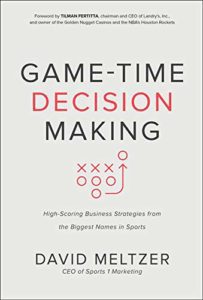
Game-Time Decision Making: High-Scoring Business Strategies from the Biggest Names in Sports
I want to support what you said because if someone’s reading and they’re like, “What does that mean that don’t just give motivation or good vibes?” You need to be tangible. In my situation, I tell people, “I’m going to show you how to tell a case story and whoever tells the best story gets the yes.” If you’re up against competitors, no one’s telling a story and you’re the only one telling a story, that’s going to mean more money, “What’s the average sale? Do you get that? Do you understand their business that well?” One more piece of jewelry. One more airport renovation. Whatever it is they’re doing, you help them win that, then the ROI is great on having you come to speak because it’s not, “Here’s something that would be nice to have.” It’s like, “We’re tired of coming in second place. If you can help us solve that problem, then that’s worth much more money.” That’s another example of what you said in action for people who are still thinking, “How does this relate to me?” I completely support what you’re doing.
You live by it, which is why I wanted to come on your show. What I enjoy about watching your stuff and reading your stuff is that you are the exact same type of salesperson that I am. You create productivity, accessibility and gratitude. You have quantitative value in what you do. You’re able to articulate it in the way that people want to communicate because it’s not what we say as salespeople. It’s what they hear. If you know your stuff well enough to articulate a story that comes to a logical conclusion of, “Can you see any reason you won’t want to do that?” You know how to pitch and you know how to sell like John does.
Thank you, David. You wrote this wonderful book called Game-Time Decision Making. That taps into not only why you, but the why now part of any decision. You talked about time, emotion and value. We’ve talked a little bit about creating value and storytelling creates the emotion. We’re going to end on the importance of timing, how that ties into your book and your upcoming workshops that you do every week on Fridays.
The manmade construct in this vibration is time. Everybody has 24 hours a day, but the productivity, the accessibility within that time of being able to number one, align your values. Your personal non-negotiable values, your experiential values. You’re giving and receiving values to the concept of time. Asking is related to time. If you understand time, you should understand the exponentiality of saying, “Do you know anyone that can help me? How can I be of service or value?” Understanding how time equates to that profit center and the exponentiality of growth, of growing exponentially by asking each person, “Do you know someone that can help me in person, on the phone, email, or media?” When we were young, most people had their card game, their golf group, and their church group. Nowadays on average, some guy you meet on the bus stop has 1,000 people in their network.
If you’re not asking, “Do you know what it can help me?” you’re cutting off your legs. Studying time is paying attention to and giving intention to the coincidence as you want with your time, the activity you get paid for the activity you don’t. Remember, that’s the mathematical equation of luck. Attention plus intention equals coincidence. Another thing about time is do it now. One hundred percent of the things you do now get done. The difference between successful people and others is successful people get stuff done. Ask yourself, “Could I do it now? If not, put it in your calendar to schedule for tomorrow and study that.” Finally, the practice of ending fear, utilizing your time, not to accelerate in the wrong direction, not to create resistance, avoid shortages and obstacles in your life, but to stop, drop and roll when you’re in an accelerated ego-based emotion, like the need to be right.
Kindness will take you back to the center and allow you to roll towards statistical success. More people in your pipeline. More people pitch correctly. More value is provided. More sales are made. More commissions are made to give to others so you can make more money, help more people and have more fun. Time is that manmade construct that you have to work within in order to effectuate that last world, to tie everything together. No more living in a world of, “To me, victimized and not enough.” No more living and buying things you don’t need to impress people you don’t like in the world of enough for me, but utilizing time, you can live as an instant between limitlessness and infinity in the world of more than enough. More than enough of everything for everyone.
When you’re selling and pitching from an abundant attitude that it’s not going to cost you anything, but we’re going to create value between the two of us that there’s more than enough of value for everyone. It’s because I take doesn’t mean you lose. It’s because you lose doesn’t mean I take. Everybody wins in the world of abundance. That’s where we need to pitch from with credibility and emotional judgment. Quantify the reasons, impacts, and capability from a world of more than enough. That’s what you do, John. We hit it off the first minute we ever spoke, we knew a lot of people in the same circles, but you started telling me what you do. I said, “This guy gets it. I’ve got to do more stuff with him.”
If you want more of David and let’s face it, why wouldn’t you want more? For the weekly training, you can go to his website at DMeltzer.com/training. Some of the episodes talk about creating a habit machine, learning to love what you do, and health, happiness and profitability. You walk your talk. The fact that you’re giving this training for free is such a gift to the whole community. I want to thank you on behalf of everyone reading for that. I want to encourage everyone to get this, because why would you not? David, any last thoughts or comments you want to leave us with?
Be kind to your future self and do good deeds. You can always email me at [email protected]. John, thank you for having me on.
Thanks for joining us.
Important Links
- David Meltzer
- Sports 1 Marketing
- Leigh Steinberg – Past episode
- @DavidMeltzer – Instagram
- Game-Time Decision Making
- https://DMeltzer.com/training/
- [email protected]
- Better Selling Through Storytelling Method Online Course
Wanna Host Your Own Podcast?
Click here to see how my friends at Podetize can help
Purchase John’s new book
John Livesay, The Pitch Whisperer
Share The Show
Did you enjoy the show? I’d love it if you subscribed today and left us a 5-star review!
- Click this link
- Click on the ‘Subscribe’ button below the artwork
- Go to the ‘Ratings and Reviews’ section
- Click on ‘Write a Review’
Love the show? Subscribe, rate, review, and share!
Join The Successful Pitch community today:
- JohnLivesay.com
- John Livesay Facebook
- John Livesay Twitter
- John Livesay LinkedIn
- John Livesay YouTube
Show Me The Money with Leigh Steinberg
Posted by John Livesay in podcast | 0 comments


Episode Summary
 Today’s guest on The Successful Pitch is Leigh Steinberg who was the inspiration for the character Jerry Maguire. He has a fascinating story of where that famous line, “Show me the money” came from, so you’re going to really want to listen to hear how that came about. Leigh is also very interested in making a difference in the world, not only with his own business but for the athletes and coaches and newscasters that he represents. He’s all about making sure that people know about anti-bullying as well as the issues of concussion with football players. He has all kinds of tips on how to take what you’ve learned as an athlete and apply it to the business world, whether it be courage under pressure or the self-discipline that you learn from sports and applying that to being a business leader. He said when you ask the right questions, you draw people out, and that’s really the secret to negotiating a great deal. Enjoy the episode.
Listen To The Episode Here
Show Me The Money with Leigh Steinberg
Today’s guest is Leigh Steinberg who is the CEO and Chairman of the Board at Steinberg Sports and Entertainment. He has two core values that I am really resonating with and excited to bring you, about treasuring relationships and making a positive impact in the world. Leigh represents professional athletes that are willing to serve as role models. He can retrace the roots to high school and collegiate programs and scholarships. He has represented eight players in the Pro Football Hall of Fame. He represents boxers like Oscar De La Hoya. He represents literally 40 television news anchors, sportscasters and coaches. As if that’s not enough, he was a creative consultant on Jerry Maguire, to name a few. Leigh, welcome to the show.
Thank you, John.
I’m always interested to ask my guest to tell me and our listeners the story of origin. In other words, I know you went to Berkeley and got your law degree there and actually taught legal things. How did you get from being so involved in the law into becoming this guru for sports and entertainment?

Show Me The Money: Leigh Steinberg was the inspiration for the character Jerry Maguire.
I went to Berkeley in the tumultuous time of the late 60s and early 70s, ended up Student Body President when the Governor of California was Ronald Reagan. I learned all I needed to know about negotiating from interacting with Governor Reagan as we were on the streets protesting the war in Vietnam and he was crushing those protests. I became a dorm counselor in an undergraduate dormitory. Working my way through law school, they moved the freshman football team into the dorm, and one of the students was Steve Bartkowski. In 1975, he became the very first player picked in the first round of the NFL draft. There really wasn’t sports agencies then. Players mostly represented themselves or have their parents represent them. He asked me to represent him and we got the largest rookie contract in NFL history. Berkeley was laid back when it came to sports, and so was Southern California where I’ve grown up.
We got back to Atlanta, their Klieg lights flashing in the sky like for a movie premier. A huge crowd was pressed up against the police line and the first thing we heard was, “We interrupt the Johnny Carson Show to bring you a special news bulletin, Steve Bartkowski and Leigh Steinberg have just arrived at the Atlanta Airport. We switch you live for the interview.” It was really then I saw the tremendous idol worship and veneration that athletes were held in communities across the country, how they were movie stars and celebrities. I thought if I could take those core values and have athletes go back to the high school community and retrace their roots by setting up a scholarship fund or working with the boys and girls club or church and then go to the collegiate community and endow some form of a scholarship, and then set up a charitable foundation at the professional level where the leading business figures, community leaders, and the political leaders with chairs and advisory board and set up a foundation that enhance the quality of life. They really could serve as role models, show the qualities of their character, and make a profound difference in the world.
It’s not enough to just be famous, I don’t think. You still want to make an impact in the world. In fact, one of the people I think that does that really well is Judith Light. I am fortunate enough to know her on a personal level. She’s won two Tony’s and an Emmy and all kinds of great stuff. She uses that fame to support causes that she believes in. It sounds like that’s what you’re doing for the athletes that you represent.
Running back to Tampa and Atlanta, just flipped 161st single mother and her family into the first home they’ll ever own by making the down payment and having the output. We have athletes who are working on causes from dyslexia to endangered species, from at-risk kids. Warren Moon has sent hundreds of kids with scholarships to college through his Crescent Moon Foundation. Troy Aikman has enriched children’s hospitals. The athletes pick something near and dear to them and then go ahead and make a difference. While they’re doing it, they’re learning skills other than athletic ones and they’re networking. It also can be messaging. I had the boxer, Lennox Lewis, cut the public service announcement that said, “Real men don’t hit women.” He was able to permeate the perceptual screen that especially rebellious adolescents put up against authority figures in messages and make more of a difference on an issue like domestic violence than a thousand authority figures ever could. Steve Young and Oscar de la Hoya, “Prejudice is foul play.”
[Tweet “Build Trust Through Listening”]
There’s so much to unpack there. First of all, the irony of having someone who’s a boxer talk about not bullying people and then realizing that a lot of people somehow don’t see color when they see a star athlete. Then that athlete as a person has still experienced some form of racism and can be the person to speak out and say, “This is not okay.”
We use the cultural symbols to try and deliver messaging in a way that triggers imitative behavior. It could be Bruce Smith, all-time sack leader in the NFL being part of The Impression Virtual Environmental Law March on Washington. It can be Warren Moon and I posing for an ad for one of the environmental organizations. You’re able to take an athlete like Rolf Benirschke, who did a program with the San Diego Zoo called Kicks for Critters, which raised millions of dollars and exposure for the concept that many species are endangered and they can be saved.
I think having athletes who have a shelf life much like a dancer, for example, ballet dancers or somebody like that, you know you’re only going to be able to do that for a certain amount of time. It sounds like you really help them have other focus besides just how much money you’re making and what team are you playing on, to start broadening their horizons while they’re in their peak so that that they can transition into possibly being a co-host of a talk show or whatever else they might want to do from being known for more than just being the athlete. Is that a fair statement?
We’re trying to stimulate both the most positive values and priorities with them, but also prepare them for a second career that will be just as fulfilling as what has come before. We have three players who are now minority owners of actual NFL teams, players who own parts of luxury hotels or head of construction companies, or run hedge funds or very involved in broadcast. No longer the greeters in front of Las Vegas hotels; these athletes have brand. Everything they learn in the athletic experience, whether it’s pushing off present gratification for future success, self-discipline, mastering complex information and applying it in real time, courage under pressure, team work. All these skill sets are completely applicable to business, media, coaching or anything else that they like to be involved in.
Self-discipline from sports can be transferred to business career and this concept of courage under pressure, which you will face whether you work for yourself or someone else, that there will be pressures and you have to dig deep. If you have that frame of reference, I think that brings a lot of credibility to what you’re doing. You wrote a book called The Agent: My 40-Year Career Making Deals and Changing the Game. Tell us about some of the stories from that.

The Agent: My 40-Year Career Making Deals and Changing the Game
What I try to emphasize there is that the real skill in life is listening. People think that it’s suasion, but allowing a space and trust to be built up so that you can peel away layers of the onion in another human being and be able to understand their deepest anxieties and fears and their greatest hopes and dreams, and bond with them at a deep level and see the world through their eyes. If you have that skill, you can gracefully navigate life. It’s not as important what your feelings are in the situation, whether it’s recruiting someone, negotiating with someone, trying to get to a solution. Being able to understand the other person’s priorities and goals so you can craft a win-win scenario is critically important. It’s listening and being able to draw out another human being and understand not what they’re telling you on the surface but what their real deeper agenda is, and seeing if you can figure out a way to accomplish your own goals while doing the same thing.
I negotiate contracts and the time frame of it is critical because there’s nothing that the athlete can do better with his life than to play for that team. Time works against us; time to be late to training camp or time to miss. The point is that what you fear is deadlock. When two people feel like somehow good faith has been offended, they can lock their positions in and self-destruct and just takes over. They’ll lock in and lock in. When you think things can’t get worse, in a deadlock they always can. The question is, how can you work out a paradigm of cooperation and not have that break down, and to be able to somehow identify points of commonality where resolution could be reached?
You’re the renowned expert at negotiation. I think people would be surprised to hear that your real tip on negotiating is not being typically aggressive but the listening and the empathy skills that you just iterated there. I think that’s a nice a-ha moment for everybody to say, “If I really want to be a good negotiator, I should become a good listener.” Am I on the right page there, Leigh?
Yes, and you also need to understand how to ask the right questions that could draw people out. The same skill is true in recruiting, in trying to make a sale, in every area of business. Making the assumption that you’re pre-set pitch is going to be effective assumes that every human being has the same priorities and the same personalities. What’s really important is to focus in critical situations that someone have the power to exclude all extraneous stimuli, to ignore the fact that the consequence of not making a sale or not negotiating this deal may be apocalyptic. To be able to tune that out, tune out extraneous noise, focus on the moment and elevate your level of performance to come through in those situations. So often in life, there will have been mistakes made or the situation may have grown dire. You may be facing pressures or temptation to quit or to see the situation as dire and unsolvable will be there at all times. It’s having the ability to tune all that out and focus on solution and be creative and perform in that moment that’s critical.
[Tweet “Ask The Right Questions When You Negotiate”]
You are the “real life Jerry Maguire,” super-agent, that’s what your book is really about. The director, Cameron Crow, of Jerry Maguire said you were the primary inspiration for that. Did you ever have a client ask you to do what they did in the movie about “Show me the money” and all that stuff?
No. It’s funny. Cameron called me up back in 1993 and asked if he could shadow me to pick up the atmosphere for a film that will involve a sports agent. He followed me to the 1993 NFL draft where I had the first pick. He came up to a press conference in New England with Bill Parcells, went to USC Pro Scouting Day, came for a week to league meetings, came into my office, Super Bowl parties, games, and I told him lots and lots of stories. The line, “Show me the money,” comes from a player named Tim McDonald who was out in Palm Springs. It was at the league meeting as I was showing him off to different teams to try to get them to sign him as a free agent. One night, Cameron went up to Tim’s hotel room and said, “What are you looking for in this experience?” Lou Dobbs in Moneyline was on in the background and Tim gestured towards the screen and said, “I’m looking for someone to show me some respect. I’m looking for a team to show me some winning. I’m looking for a team that shows me some money,” and Cameron wrote, “Show me the money.”
I love the story behind that. It’s such an iconic moment. Thank you for sharing that. You also have a story about how you decided to pass on representing Peyton Manning. Can you tell us about that?
That was one of my genius moves of the 20th century. There had been a situation where there were two quarterbacks coming out in ’93, Drew Bledsoe and Rick Mirer. Everyone thought Rick Mirer was more prolific in college, Drew was a better natural talent. I took Drew, we went on to Pro Bowls and to play in the Super Bowl, and Rick was not quite as successful. The same paradigm looked like it was going to happen in 1998, and that was Peyton Manning and Ryan Leaf. Ryan Leaf was really gifted athletically. Peyton Manning was really prolific in college. Ryan had to decide earlier, I took him. Peyton goes on to be one of the all-time great players and Ryan had a very fore-shortened career.
Do people pitch to you all the time to represent them? What do you look for when you hear a pitch like that?
I’ve represented in football 61 first round draft picks and the very first pick in the first round eight different years and in baseball practice, basketball practice. You’re looking for a talent level that’s going to enable our practice to stay on the cutting edge and give us role models who will really make an impact. In football, we have a quarterback-centered practice. This year, we have a quarterback Patrick Mahomes II who’s shooting up the first round with Texas Tech and last year. Paxton Lynch who hopefully will start this year for the Denver Broncos. You look for good values, first of all, and you’re looking for someone with a sense of self-respect, who understands the importance of nurturing family, who wants to be part of the community where people care for each other. Then you look for a work ethic and then that capacity, the ability to transcend the moment to perform in critical situations. All those things. Hopefully you have a strong family there but that’s sometimes not possible to have a nuclear, two-parent family. You look first for the character and personality qualities. There are many talented athletes. Every time you represent someone, it involves cutting up a little bit of your own life, which you have a finite amount of. You want to make sure you’re spending it on young men or women that truly you’ll be proud of.
What’s interesting to me is you not only represent the athletes but news anchors and sportscasters and sports coaches. I assume that same filter applies to them as well, yes?
It does. If you’re meeting people who have a heart, compassion, social conscience, a sense of a larger world, they’re going to use their craft and they’ll do more. They’ll find a way to use their profile to make a real difference. You get the same impact from people who are on television really in any capacity. Some of the coaches are as well-known as the players. They have longer careers, so do the news anchors, than athletes do. Again, every form of celebrity affords the opportunity to influence other people. A news person can do it through a well-crafted story or a story that’s got some passion or illumination to it. I think it’s all equally compelling.
The other thing that you’re doing that I’m really interested in is this creation of a virtual studio where you’re producing sports themed movies and TV and video games. Certainly, in the startup world, these internet apps and fan interactivity, the second-screen involvement, is really the hot button right now. Can you tell us about how that came about and what you’re doing with that?
We learned very early that the representation of athletes took us into the creation of content, and being involved with technologies. Back in the 90s, I have developed a company called Athletes Direct which was football, baseball, basketball players’ writing weekly diaries talking about their charitable foundation, e-commerce application. This was when you still have to go to AOL to get on the internet. We germinated it and sold it a couple of years later for a massive multiple. These projects where we can develop a sports themed reality show, a competition show, are dramatically scripted where we can consult on a sports themed motion picture. Then in technology, can we find the next new app, the new startup that brings fan experience closer, the next new website, the next new way to deliver content and be an adviser to that?

We have a group called Steinberg Ventures that looks at all forms of new technology development and looks for good startups.
I’m an adviser to a company called Desk Site where if you live in Los Angeles but you grew up in New York, you want to follow the New York Giants football team, you can get 30 hours of high-def over your computer, all the highlights, all the analysis and everything. It’s just like you were there. It’s got a demographic feature where you can tailor the advertising on a subscription basis to women or men or younger people or older people, as opposed to the scatter shot that happens when they’re advertising trucks on NFL games to an audience that’s 41% women. It’s a new concussion helmet that uses coil and compression to attenuate and dissipate the energy that comes into the head by as much as 50%. We have a group called Steinberg Ventures that looks at all forms of new technology development and looks for good startups.
Let’s talk about one of your other passion projects besides preventing bullying is working on concussion awareness and prevention and potential cures. You touched on that a little bit with Steinberg Ventures. Using technology to prevent some of these head injuries, obviously it’s a big topic right now. If the damage has occurred sometimes it doesn’t show up for a while. Anything else you want to tell us about what we can do as people who care? Is there a charity or something?
First, awareness. The reality of the situation is that, for example the sport of football, every time an offensive lineman hits a defense lineman with the inception of a play, it produces a low-level sub-concussive event. It turns out that an offensive lineman can walk out of the game with 10,000 sub-concussion events, none of which has been diagnosed, none of which has worked. It could happen as many as 10,000 times. The aggregate will almost certainly produce ALS, premature senility, Parkinson’s, chronic traumatic encephalopathy and depression. This danger exists not simply in pro-football or college and high school, in field hockey, in AYSO, in hockey; anything that involves collision. People need to be aware of that and understand that the collisions and concussions have especially devastating effects on younger people.
Looking at the age someone should start a collision sport, it takes longer for that adolescent brain to heal. Keeping track of the amount of concussions, finding ways to play collision sports more safely, protective helmetry and other devices. These are all things we need to focus on. We know that athletes who play collision sports may turn 40 and have problems bending over to pick up their child. It’s another thing not to be able to identify that child. We’re talking about the brain, which makes the concussion issue different than any other type of injury.
[Tweet “Show Courage Under Pressure”]
Any final thoughts, it’s just been a pleasure having you on, that you want to leave the audience with?
My dad used to tell me, when you’re looking for someone to fix a problem or deal with a situation in the world, and you keep waiting for the amorphous ‘they’ or them to fix it: the government, older people, someone else. He would say to me, you can wait forever. He would look at me and say, “The ‘they’ is you, son. You are the ‘they’.” It’s about individual responsibility and people believing that they have the power to affect the world around them and make a difference.
Don’t wait for somebody else to make a difference. You do it. I love it so much, Leigh. Thanks for sharing your insights and even the secrets of where, “Show me the money” came from. It’s been a fascinating interview. Thanks again.
Links Mentioned
- Leigh Steinberg
- Steinberg Sports and Entertainment
- Pro Football Hall of Fame
- Crescent Moon Foundation
- Kicks for Critters
- The Agent: My 40-Year Career Making Deals and Changing the Game
- Desk Site
- Steinberg Ventures
Wanna Host Your Own Podcast?
Click here to see how my friends at Brandcasting You can help
Fox 11 News Los Angeles John Livesay The Successful Pitch book
Share The Show
Did you enjoy the show? I’d love it if you subscribed today and left us a 5-star review!
-
- Click this link
- Click on the ‘Subscribe’ button below the artwork
- Go to the ‘Ratings and Reviews’ section
- Click on ‘Write a Review’