

CEO Secrets: The Strategies And Tips Of Being A CEO With Christy Budnick
Posted by John Livesay in podcast | 0 comments
Being a CEO of a company requires great responsibility. It demands excellent leadership skills and strategies to help the company grow. In this episode, the CEO of Berkshire Hathaway HomeServices, Christy Budnick, shares her secrets about being a CEO. She provides insights about her strategy in leading her agents and staying aligned with the company’s growth. Tune in to this episode as Christy shows how culture, diversity, and inclusion play a role in leading her company towards success.
—
Listen to the podcast here
CEO Secrets: The Strategies And Tips Of Being A CEO With Christy Budnick
Our guest is Christy Budnick, the CEO of Berkshire Hathaway HomeServices. We talk about how they are not only a forever agent and a forever brand, but for everyone and how important it is to paint a picture when describing something to someone. She believes that nose-to-nose and toes-to-toes is the best way to connect. Find out what her biggest surprise was becoming the CEO. Enjoy the episode.
—
Our guest is Christy Budnick, who serves as the CEO of Berkshire Hathaway HomeServices, a global residential real estate brokerage franchise network. In her role, Christy oversees the global real estate brokerage franchise network, which is made up of more than 50,000 real estate professionals and nearly 1,500 offices throughout the US, Canada, Mexico, Europe, the Middle East, India, and The Bahamas.
The network, among the few organizations entrusted to use the world-renowned Berkshire Hathaway name, brings us to the real estate market, a definitive mark of trust, integrity, stability, and longevity. Christy is listed among the Swanepoel Power 200, which ranks 1 of the 200 most powerful and influential executives and leaders in the residential real estate brokerage industry. I’ve had the privilege and honor of speaking at two of her events.
—
Christy, it is an honor. Thank you for sharing your wisdom and joining me on the show.
Thank you, John. It is so good to see you again, and I appreciate you inviting me.
It’s great. We’re going to have a lot of fun. I touched on the surface of your incredible background, but I would love you to take us back to your own story of origin of when you got interested in real estate and how that all happened.
First of all, I love your phrases “your story of origin.” It paints a picture in my head. Our family was a Navy family, and we lived overseas, among many other places. For the first 10 years of my life, we lived in 17 different places. When we moved back from Japan in 1979, my mother decided to divorce my father at that time. At the same time, she earned her real estate license. It was something she’d wanted to do, but because we moved around so much, she hadn’t been able to do it up until that point. As a single mother of two young girls, my career was born out of necessity.
She needed help with marketing, walking flyers around the neighborhood, the open houses, measuring houses, and all of the things that you do as a real estate agent. At the age of 11, I began my career in real estate. I have told the story a few times. I did not intend to stay in real estate. As a matter of fact, in 1988, my mother opened our family’s company, which was Prudential Network Realty at that time. That was the same year that I went to college.
I had decided that I was retired from real estate at that point, and I was going to do anything except real estate. It’s funny that it has a way of getting in your blood and staying there because, post-graduation, I did do some other things. What I found was every time I’d get together with my mom, which was real frequently, we were talking about real estate, like how things were going in the market, challenges she was having, successes, etc. I was getting drawn in more and more every time. I joined the company many years ago and have never looked back since. I love it almost every single day.
There’s a term when you’re a daughter of a real estate agent. What’s that term called? Isn’t it an acronym?

Being A CEO: The top agents look toward the future, and they plan for the future.
I’m trying to think of what it is.
It is DOR or DAM or something.
Something like that. We never use that, but I’ve heard others use it.
It’s more common than people realize.
It is interesting to see. As a matter of fact, when I would bring on new agents to our company, I’d always ask the question, “What made you decide to get into real estate?” If we brought on 10 to 15 people, both experienced and inexperienced, to the company each month, we found about 1/3 or more had family ties to real estate, like mother, father, grandparent, or something very close.
What that does for you when you’re evaluating if someone’s going to be a good fit for Berkshire Hathaway HomeServices is they know what they’re getting into. Firsthand, this is not like, “I might want to try this,” but, “I’ve lived with it, and I know what I’m getting into.” I love it because what I have seen with the friends that I have that are successful is, for them, it’s like a childhood birthday. They love seeing open houses, even if it’s not their listing. That passion is you’re in the right job.
The one thing I’ll say about real estate compared to my prior career is every day is completely different for every client and their needs, desires, and emotions. That, to me, is what I love. The other part of it is it doesn’t ever shut down. You’re running. I love the challenge, it’s fast-paced, and every day is so different. I never think to myself, “I wish I could shut this off because I love what I do.”
Take us to the moment in your career where you’re running this successful business and managing some people in the Florida region, and then you’ll get the phone call or the tap on the shoulder, “We’d like to promote you to be the CEO.” What did that feel like? What do you think made them pick you?
I was running our family’s company. I was President and CEO, and it’s a fairly sizable company. I will tell you, becoming the CEO of the franchise was never on my radar. I thoroughly enjoyed what I was doing. I loved being a part of the franchise. I believe in the Berkshire Hathaway HomeServices name and all that we stand for.
That day, I got the call from Gino Blefari, our chairman. He said, “Do you have a moment?” It was a Saturday morning. I said, “Sure.” It wasn’t that uncommon for him to call me on a Saturday morning, so that part didn’t surprise me. He said, “I’d like to talk with you about something confidential. We’re going to have an opening in the CEO role. I’d like you to consider putting your name in the hat.” My daughter was sitting right next to me. She didn’t know what was going on, but she could see me. She was looking at me, and she said, “Are you okay?”
[bctt tweet=”Raise your level of professionalism by going the extra mile. ” username=”John_Livesay”]
You could have blown me over. I truly wasn’t expecting it. The emotions I was feeling were I was proud that Gino would even consider me for the role because we have some talented people that make up the franchise network. It would be very easy to select several people from the network. Pride was the 1st thing and then the 2nd thing was, what in the world does the CEO of a network do? It was funny. That was the question I asked. I said, “I’m thrilled that you’ve made this call and I’m very honored, but I have to ask you, what does the position entail?”
His response, I will never forget this, “It’s pretty much everything that you do now except you’re over 500 agents, mortgage company, a title company, insurance company, relocation, builder, etc. Now, you’ll be over 50,000 agents globally.” I thought I’d never been one to back down from a challenge, so I said, “Let me talk with my family and I’ll get back to you.” I did, and I called him back the next day. I said, “I want to throw my name in.” He said, “You’re my first choice. I would love to have you take the position.” It was a complete whirlwind. I was static.
From 500 people to 50,000 is almost like you’re looking at a home. You’re like, “Add a bunch of zeros.”
I’ve been a part of the network for so long. The other franchise network members and all of the CEOs that make up, particularly the top companies, are like family to me. I’ve grown up with them. That part was special because they wanted to see me succeed and they took great pride that one of their own had taken the helm. It was the right move at the right time. I’m so grateful to Gino.
When I was your sales keynote speaker, I saw you meeting some of your team for the first time after the pandemic in person. One of the things that stood out to me consistently at both events was you’ve been in our shoes and understand our challenges, so respect is there. You then did something you and I are so in sync on, which is everyone has to figure out how they’re not going to drown and what I call a sea of sameness. You have a clever, unique way to do that. That reef solves a bit of a problem of drowning in a sea of sameness, but you do it in a way that elevates your team that other people aren’t doing. Would you share that strategy with us in terms of perception and becoming not a transaction but a forever agent?
At my former company, Berkshire Hathaway HomeServices Florida Network Realty, we were big on real estate portfolio reviews and serving our clients. We’ve never been a lead generation type of company or anything like that. We’ve always been about relationships. As a part of our service, one of the things that the agents do is a real estate portfolio review. What that consists of is, in the world of real estate, we scratch our heads and wonder why in the world we are looked at in the realm of ambulance chasing attorneys and used car salespeople. Good agents are some of the hardest-working people I’ve ever met. They provide an incredible service and deal in people’s largest asset. For us to be considered in that realm bothers me to my core.
Everything I do is to raise the level of professionalism, as my mother would say, in real estate. If we want to be seen as similar roles as financial planners, CPAs, and things like that who provide those financial services, we have to do similar activities. Anybody that works with a CPA or a financial planner sits down with their clients at least once a year and reviews their portfolio and financial situation. They consult with them to see how they’re doing. Are they on target to reach goals? I believe in portfolio reviews for that reason. Basically, the crux of it is an agent reaches out to their client. You do this for about 50 clients a year to start because it does take time and it is a commitment.
You reach out to your client and let them know that one of the services you’re going to be offering for your best clients is a realistic portfolio review. That takes into account the value of not only the home they live in your local area but also any other home they may own, whether it’s abroad outside of the United States or in another state. Because we have such a big network, we’re able to work with agents across the globe and this needs to be a sit-down, face-to-face meeting.
It is not intended for a sales pitch or anything like that. It is truly to review that person’s value of their properties so that the next time they meet with their CPA or their financial planner, they’re able to take them. I strongly suggest that the agent bring two extra copies of the review, one for the CPA and one for the financial planner. That person is then able to update their financial outlook with the true value of their real estate portfolio. Doing things like that is very client-centric and client-oriented. Again, it raises us in the eyes in terms of professionalism.
Two things you said there that stand out for me is you asked your team to start with 50. One a week and take two weeks off. It’s not overwhelming. It is a very bite-size action item workweek. It makes them think, “Who are my top 50 clients?” You’re then providing a level of service without trying to sell something. You’re showing empathy. What you and I love is the storytelling part, which is you then have a story of, “Here’s a story of somebody in Florida who started with 50, went to 100, went even higher of doing this multiple times, and the results are astounding.”

Being A CEO: 100% of top agents do an outstanding job of staying connected to their clients, and there’s something to be said about the human voice and that connection it creates.
It’s off the charts. If you do that alone and focus on your client’s needs, you won’t have to do anything else to succeed in real estate. That is my true belief of how powerful this one thing is.
When you were talking about a client that has a high net worth and owns homes literally around the world, of course, that’s very lucrative as a real estate agent to have that client, they need that VIP service. My favorite definition of luxury is anticipating a need before somebody knows they need it. That’s what this program is.
I love it because if I have multiple homes, the fact that Berkshire Hathaway HomeServices has multiple offices around the world is no longer a feature to me but a benefit to me because you’re going to give me multiple reports of what my current home is worth everywhere. I can make a decision with my financial planner about, “Is it time to sell one,” or whatever the issue is.
I’m no longer guessing of the Zillow estimate that is not that accurate, or I’m going to say what I think it’s worth if it’s gone up. I have a finger on the pulse and the consistency that you tell your team to do this. Whether they sell anything or buy anything from you or not, they know what’s going to happen. Those people are going to talk about you. They’re wealthy high net friends, and they’re going to be like, “My agent is not doing that. I don’t even remember the last time I talked to them.”
The CPAs and the financial planners, too, have people that want to buy and sell real estate. I guarantee they don’t see people that provide that service. It doesn’t need to be for high net worth. It’s for any client period that you consider your top clients. Frankly, if you can ultimately extend that to all of your clients, that’s even better.
What a great story of standing out in a sea of sameness when the competitors are not doing that. Do you have a big surprise now that you’ve been the CEO for a few years? Is there a happy surprise to being the CEO you hadn’t expected?
The thing that I’ve enjoyed about it is getting out, spending time with the network, getting to meet the agents, and hearing their stories. Every time I go out and spend time with any company, I love to be able to sit down with a group of agents and say, “What are you doing that’s working? What are you doing that’s not working? Where are your struggles?” The amount of information they share and share with one another, which I love, is so tremendous. That truly has been my favorite thing. Certainly, working with the CEOs as well. I have to say working with the one-on-one with the agents. I absolutely love that.
You’re traveling and you’re opening up offices. I believe Rome was a recent one, correct?
We did. We opened up in Rome and they have three offices there already. We’ve got some additional non-US locations opening up. We’re rocking and rolling and very excited about the future.
The other thing that impressed me was your marketing team. Let’s give a shout-out to them. They came out with this adorable, clever concept called Pawfect. It is a little video of the house and then it’s how many square feet. It seemed small to me and then no bathrooms. I’m like, “What in the world? Tell us what that is. It’s finished executing now and how it’s successful.
[bctt tweet=”Have a plan and execute it daily.” username=”John_Livesay”]
That was so much fun. John and BBDO are the marketing firm we worked with that helped bring that whole idea to life. They are incredible, but our marketing team did execute it beautifully. The inspiration for it was in 2021. When we were first talking about it, COVID was still weighing people down, and it felt like everything was heavy. We said, “We need to do something that’s fun and brings joy.” One of the things that we all realize is during the COVID time, so many people adopted pets.
Dogs, in particular, but there were cats, birds, reptiles, and all different sorts of pets, and home became more important than ever. We thought, “Why not do a sweepstake that is a lot of fun and silly, but it speaks to people’s hearts?” It is because that’s where their hearts are. It’s with their pets. We had an overwhelming response to it and we have already selected the sweepstakes. People have selected three of the winners so far. I believe we still have two more that were vetting the process. I’m really excited. Those folks are over the moon. They are so excited that they were selected.
What you do is if you win, Berkshire Hathaway HomeServices will create a replica of your actual house for your dog. That’s why there’s no bathroom in the house.
Not even just for the dog. Let’s say you have an iguana. We didn’t exclude it. It’s for everyone. Back to our forever agent, forever brand, for everyone. It could be a bird cage or for a fish. So far, I believe the winner does have dogs, but you’re exactly right. It’s a replica of their home. It’s pet size and pretty special.
Let’s double-click on that. Before the show started, we had a little pre-chat about you’re not a forever agent and forever brand. You are for everyone, which includes a real culture, brand of diversity, and inclusion for who you want to work with and who you want to talk with. That’s a very important criterion for so many people.
In addition to this amazing program you’ve discussed where you’re giving clients this analysis of all their homes, is there something that successful agents are doing? Maybe it has to do with a mindset or resilience that other people who aren’t in real estate that couldn’t say, “I could take that and use that to make my career more successful.” The people I met winning consistently year-after-year top awards. Is there something you see them doing that would be useful for everybody, whether they’re in real estate or not?
For the top people in the business, one of the things that they do is you typically find top agents working from some sort of a plan. It may not be a formalized business plan, but they know exactly what they’re going to do the next day before they go to bed the day before. They’ve got it planned out. Most of them will work from an office at some point because you do get energy and inspiration from others. There are also so many learning opportunities and even referrals that come out of being in the office. The top agents I’ve worked with over the years, the biggest thing I would say they do is look toward and plan for the future. That’s important. A lot of people get into this business.
One of the things that can be very difficult is you’re an independent contractor. There isn’t a set plan that you have to work from. As a matter of fact, the broker is not allowed to tell you that you must do this, clock in at this time, or anything that. For somebody who has been an employee and is used to a very rigid schedule, that can be a real difficult change.
Make sure you’re not shooting from the hip, working from a plan, and having a morning routine so that you’re hitting the ground with the right mindset every single day. Going back and evaluating yourself, how did you do on your day? What went well? What didn’t go well? What do you need to do differently next time? Those are some of the things that I see top agents doing very regularly.
It’s the old make your plan and work your plan. That’s as smart as driving all over the place if you’re going to start somewhere. Make sure that you’re driving, especially with the price of gas. When you think of professional athletes who practice or actors who rehearse before they get on set or on stage, yet a lot of us feel we don’t have to practice or rehearse what we’re going to say, what our stories are going to be, or what we’re going to share. I’ll just make it up. As you said, from the hip or wing it in the moment, yet nobody does that getting ready for the Olympics.

Being A CEO: There’s no such thing as a shortcut to doing the hard work to get the results.
Here we are dealing with people’s largest asset in most cases and people that wing it makes me wacko, actually.
One of my favorite quotes is from Arthur Ashe, the famous tennis pro. That is, “The key to confidence is preparation.” It seems to me that’s right on target with your philosophy here.
The other thing that I would say that top agents do is they do a good job of staying connected to their clients. Whether it’s through lunches, coffees, networking events, charitable activities, or whatever it is, they stay very connected, face-to-face, nose-to-nose, toes-to-toes with your clients. They’re not afraid of picking up the phone too. It seems that’s somewhat of a lost art. People are trying to use texting as a replacement. There’s something to be said about the human voice and the connection that it creates. Those are some simple things, but they’re very important.
I tell people your voice is a musical instrument. The volume, the pauses you take, and the intonation create an emotional feeling because we know everyone makes their decisions on what broker to use and what house to pick. Emotionally, they back it up with logic. If you’re the one that has those tones, as you said, nose-to-nose, toes-to-toes interactions and that emotional connection are there, that’s what’s going to separate you.
You touched on something that I know is near and dear to your heart, and it certainly is to mine, which is a charitable part. Let’s describe what Berkshire Hathaway HomeServices is doing around charity that makes people feel like, “That’s something I want to make some of my choice and support.” What is one charity that Berkshire Hathaway HomeServices is focusing on?
The Sunshine Kids is the charity that the network as a whole focuses on and that charity helps families who have children that are battling cancer. To listen to these children tell their stories and then the parents as well tugs at your heart and you want to do anything you can to help them. We give them all sorts of different experiences, whether it’s trips or help in terms of financial help. Many of our brokerages participate very heavily in that.
We have a number of different things, too, besides making donations. When we did the Pawfect campaign, we also had a day where you could take your dogs for a walk and make a donation to the Sunshine Kids, where you got a little bandana for the dog, a water bowl, and that sort of thing. It’s a great way to make it fun and make a difference, as well as closing gifts and things like that. The thing that tugs on my heart strings is to hear those children tell their stories and the strength they have at such a young age. What they’ve been through is chilling, but it makes a big difference in their lives and their families.
It also gives us a perspective of we’re having a tough daw, somebody went with a different agent, or whatever, and you’re like, “In the scheme of things, I don’t have any problems. I need to focus on what I do have and be grateful for that.” This thing you said about tugging at the heartstrings is what stories do. When we have the ability to share a story of a child or the client that we’ve helped, or we talk on those heartstrings, people open the purse strings because it’s an emotional connection that that’s where you want to put your investments, time, and money with someone.
You made me think of a story. In 2022, we have the Sunshine Kids front and center as we do every year. Our entertainment was Lenny Kravitz, who I am crazy over. One of the things that we did is we had the kids perform some of his songs because it so happened that the kids that are the spokespeople in 2022 are very musically and theatrically talented. The night of Lenny’s performance, the kids got to be right upfront at the base of the stage. and they were so excited. After the event, Lenny invited a couple of us, the Sunshine Kids, and their parents backstage for a meet and greet. To watch him talk to the children, listen to them, and draw stories out of them was so special.
It’s something I’ll never forget. One thing that was neat was one of the young ladies named Maya, when we were about to wrap up, Lenny was asking, “What do you all have going on coming up here soon?” She was going to star in an off-Broadway production, and she didn’t tell him that. Lenny’s daughter is an actress, so I knew that this was something that he’d be very interested in. I said, “Maya, you’ve got to tell Lenny about your off-Broadway performance that’s coming up.”
[bctt tweet=”So the top people in the business typically find top agents working from a plan that knows what they will do the next day.” username=”John_Livesay”]
Here it was, it was going to be at the end of May 2022 and Lenny was like, “What? You’re staring in an off-Broadway production. That is so cool.” She was like, “I’m so excited. I don’t even know Legally Blonde.” He said, “When is it?” She said, “it’s at the end of May. I don’t remember the dates offhand.” He said, “Isn’t it in New York City?” She said, “Yeah.” He goes, “I’m going to be in New York at the end of May. If it works out, I would love to come and see it.” Here’s the superstar who immediately made this connection with these kids. It was so special.
That’s why you’re such a great CEO. You connect the dots for people. Without you having heard and shared that story, that would never have happened. He then gave the gift of being completely and fully present with each and every child and you as well. That is a gift that we can all eat. We don’t have to be a superstar to give the gift of being completely present with people. You also do that.
I saw when someone’s speaking to you, or you’re meeting somebody for the first time, you are 100% present with them. That is a gift that makes them want to have their picture taken with you and makes you memorable. That is how we all stand out from the sea of sameness. Christy, what a joy it’s been to catch up with you again and hear all your words of wisdom. Is there any last thought or a quote that you’d want to leave us with?
One of my favorite quotes is from a former business partner and a dear friend of mine. He’s been a very successful career person. He’s always given me sage advice over the years. His name is Tom Petway. The thing that always resonates with me, whether it’s personally or professionally, he would tell me from a young age, “There’s no such thing as a shortcut. You have to do the hard work in order to get the results.” That is in business as well as personally. Anytime I’m thinking about, “I could do this, and we’ll get this result. What does Tom say?”
It’s sage advice for all of us. Christy, if somebody wants to follow you on social media or find out more about Berkshire Hathaway HomeServices, where should they go?
I’m on Facebook and Instagram. Of course, BerkshireHathawayHomeServices.com or BHHS.com is our web address.
Christy, thanks again. It’s been a pleasure to catch up. I am so excited to watch you as you continue to make a difference and help the company grow.
Thank you so much, John. It is such a joy talking with you. I appreciate you.
I sure appreciate you as well.
Take care.
Important Links
- Berkshire Hathaway Home Services
- Holding The Calm
- Pawfect
- Sunshine Kids
- Facebook – Christy Budnick
- Instagram – Christy Budnick
- Better Selling Through Storytelling Method Online Course
Wanna Host Your Own Podcast?
Click here to see how my friends at Podetize can help
Purchase John’s new book
John Livesay, The Pitch Whisperer
Share The Show
Did you enjoy the show? I’d love it if you subscribed today and left us a 5-star review!
- Click this link
- Click on the ‘Subscribe’ button below the artwork
- Go to the ‘Ratings and Reviews’ section
- Click on ‘Write a Review’
Love the show? Subscribe, rate, review, and share!
Join The Successful Pitch community today:
- JohnLivesay.com
- John Livesay Facebook
- John Livesay Twitter
- John Livesay LinkedIn
- John Livesay YouTube
Unbias With Stacey Gordon
Posted by John Livesay in podcast | 0 comments

Unconscious bias stops you from seeing someone qualified enough to do the job. John Livesay’s guest in this episode is Stacey Gordon, author of UNBIAS: Addressing Unconscious Bias at Work. Stacey discusses with John how experiencing exclusion as a black female herself inspired her to write this book. People often hire people who look like them. We have a misguided notion that whatever we have done is the best way to do it. We dislike difference and change. Listen to this episode to discover how we can work our way to diversity and inclusion. Tune in and be unbiased!
—
Listen to the podcast here
Unbias With Stacey Gordon
Our guest on the show is Stacey Gordon, the author of UNBIAS. She said people recruit for differences but hire for sameness. Find out what she means. She also said a coworker is not a relationship, it’s a label and that real leaders do, in fact, see color. Enjoy the episode.
—
Our guest is Stacey Gordon, who is leading the intersection of diversity, inclusion and workplace culture. In her role as an Executive Advisor and Diversity Strategist, Stacey coaches and counsels executive leaders on these strategies while offering a no-nonsense approach to education for the broader employee population. She’s the creator of the number one resume course at LinkedIn Learning and an Unconscious Bias course which has consistently been the second-highest viewed course on the platform. It is translated into at least four languages and featured by LinkedIn, Microsoft, and Virgin America, which is now Alaska Airlines. Stacey, welcome to the show.
Thank you, John.
I see that you also teach at Pepperdine, where you got your MBA. My friend, Claudio Ludovisi, has been in the Marketing Department attracting people like you to come to take their MBA. It’s certainly a beautiful campus and a beautiful place. You have a book out called UNBIAS: Addressing Unconscious Bias at Work.
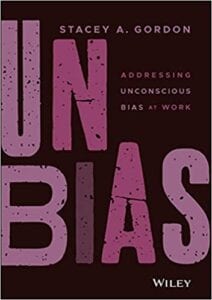
UNBIAS: Addressing Unconscious Bias at Work
It was released, and we are still promoting and talking about it and spending a lot of time focusing on the tenets of the book.
Before we dive into the book, let’s do a little background on your story of origin. You can take us back to childhood, school or wherever you want to start your story.
I always say, “Where do I start on this journey?” There are so many places I could go with it. I’d like to talk a little bit about the fact that the work that I do, I think my background, my childhood helped me prepare for this, which I did not know. Because I have always been the odd person out and it makes it very easy for me to relate to others, to be comfortable talking to different types of people and inserting myself in things even when I probably wasn’t invited or I wasn’t expected to show up. It’s like, “I’m here.”
Did you grow up in Southern California?
No. I grew up in London and then my family moved to Brooklyn, New York.
What was it about that place that made you feel like you didn’t fit in?
I did not fit in London because I was always one of the only black kids in my school. It was pretty tough for a little while there. I had friends that stopped talking to me because their parents told them that they couldn’t play with me anymore because I was black. I had kids that would hurl stuff at me and also, I remember being in that era too, where there’s a lot of very large Indian and Pakistani population. A lot of the cornerstones over there are owned by individuals who were Indian or Pakistani. There was a lot of hate crime, stores being burned down, swastikas being put up on the walls and a lot of riots and things going on. I was a kid and I don’t remember exactly what was happening, but I remember being scared.
One of the whole premises of childhood is to try and feel safe and I’m sure that was hard on your parents if they felt like you didn’t feel safe.
It was probably why we moved to Brooklyn. My mom’s family lives in Brooklyn and everyone there was black, so we’ll all get along. It’s like, “Not really,” because now I’m a black kid with a British accent in Brooklyn.
You still stand out. How did you decide you wanted to come to the West Coast, go to Pepperdine and focus on this particular niche? Obviously, you have lots of choices of what to do with your degree.
I spent a lot of time in New York City. It was expensive and again, being a person of color, it was like, “Do I want to stay in Brooklyn? At the time, we had a lot of crime and a lot of things going on. Is this where I want to grow up and raise a family eventually?” I lived in Manhattan for a couple of years. We couldn’t afford to continue to do that and realized that we had to leave in order to try to be able to make our dollars stretch, which is how we ended up on the West Coast and eventually in the LA area. We have been here longer than I’ve lived anywhere else.
That’s funny when you cross that mark. I grew up in the suburbs of Chicago for the first 21 years and then I remember passing 21 years in California before moving here to Austin and I was like, “I’ve been in California longer than I was in my childhood.” Let’s dive into the book and your website is Rework Work. That’s intriguing to me. Tell me how did you come up with that story.
[bctt tweet=”Coworker is not a relationship; it is a label. People recruit for difference but hire for sameness. ” username=”John_Livesay”]
I love the title and the name of our company. It came out of frustration as a lot of things sometimes do. I was working as a recruiter. I was running a recruiting company and at the time, I was operating under the Gordon Group. That was the name of my company. I was talking about that the usual, client work and the things that were going on. I was so frustrated. I said, “We need to rework recruiting, onboarding, training, advancement, and everything. We need to rework work.” I thought, “I like that. I wonder if anyone’s using that.” No one was using it. I did a trademark search and did the whole thing. It was like, “Wow.”
I’ve spoken to a lot of recruitment firms for their annual meetings, whether they’re Korn Ferry or another company, they all have to compete to sell themselves to get hired by a big company to find their next C-Suite level people. That was an interesting journey to look at their business model and how similar it is to other companies like architects. They have practice areas where people specialize in a special kind of thing.
A lot of recruitment firms are trying to get diversity within their own company, as well as offer diverse choices to companies that are hiring. The thing I keep hearing, and I want to get your opinion on this, is there’s not a lot of choices out there that fit that criteria. Has that always been the case? Do you see it changing if that is the case? For example, in the venture capital world, there are very few women, let alone women of color. If they want to fix it but don’t have people that have the skills to hire to fix it, how do you advise them?
They have the skills. There are very few women in the venture capital world because we won’t hire women in the venture capital world. They exist. I have to keep telling people like, “We’re not tooth fairies or the unicorns. We do exist.” The problem is that unconscious bias stops you from seeing me as somebody who was qualified enough to do the job when honestly, I’m probably twice as qualified as half the people there to do the job and I’m being real. There are people who are absolutely positively qualified to do it, but they are not seen as qualified as such. If we use the example of one of the women who is now going to be representing America in track, a black woman. She got blue hair. I’ve seen different pictures with different-colored hair. She’s got tattoos all over her. She is queer and got long nails. Here we are. We’re celebrating her. She’s going to represent the United States.

Unbias: Unconscious bias stops you from seeing someone qualified enough to do the job.
If that woman showed up at your job and said that she wanted to be hired, you would usher her out. She wouldn’t even get her foot in the front door. Here we are celebrating this person for being able to do the job she’s tasked to do regardless of how she looks. We have to realize that always we have been able to do the job, but because of how we look, we have not been seen as able to do the job. We have been turned away. We have been discriminated against, ignored and passed over. It is time for that to change.
One of the things you talk about is unconscious bias. It’s one thing if someone says, “I want to work with people that look and sound like me.” That’s obviously conscious bias.
Conscious bias is discrimination.
It’s one thing for people to know they’re doing it and maybe own up to it internally or whatever, but the problem from my perspective is there’s a lot of people who are unaware. That’s what your expertise is that it’s not biased, it’s unconscious bias. I’ve seen this when I was selling advertising at Condé Nast and I had worked at different magazines. I’m like, “All the women here are brunettes,” or at another place, “All the women here are blonde.” It was on some weird level, people are hiring people who looked like them and that’s within the same race. I can only imagine and I think that was an unconscious choice. The blondes wanted to hire blondes and vice versa.
We have a misguided notion that whatever we have done is the best way to do it. Others who do it the way that we do it, we like them. We don’t like difference and change. We recruit for difference, and then we onboard for sameness.
People hire for difference, is that what you’re saying?
We recruit for difference and we onboard for sameness or hire for sameness.
You’re saying, “I want to look at a lot of different kinds of people,” but at the end of the day, you hire someone who’s like everybody else in the company.
The thing is though, we go out there and we say, “We want diversity and difference,” but when you hire that person and you bring them in, you then say, “Do it the way it’s always been done.”
You need to fit into our culture. Don’t be yourself basically.
It’s like, “Why did you bother to go out and look for diversity in the first place?” When they don’t fit in the box that you want them to fit in, then you fire them or you say, “They weren’t a good fit. It didn’t work out.” The other thing is this notion that because there are fewer people that they’re not as qualified and that is so far from the truth. Every time I hear someone say, “I’d love to hire a woman in tech, but I don’t want to lower the bar.” I’m going to be honest. I want to punch them in the nose because that is so insulting. There are so many people who have not been given the opportunity and I get it all the time.
People say, “I treat everyone fairly. We hire people for skills.” That’s absolute BS because when you have your friend, Mark, who you’ve been hanging out with for months or years, that person gets the benefit of information and mentoring from you and learning the ropes informally. When it is time to promote, he’s ready because you’ve been grooming this person, but everyone else, you don’t talk to them. You don’t invite them to lunch, hang out with them on the weekends, golf with them and provide them with the same level of access.
One of the things you talk about is you help employee resource groups. Can you tell us a little bit about what that is and how that works?
[bctt tweet=”Conscious bias is discrimination.” username=”John_Livesay”]
Employee resource groups, you have an employee business group, business resource group, they used to be called affinity groups. A lot of companies now are creating them if they don’t already have them. There has been some controversy with that, too. It’s like, “Why are we separating? Why do we need to have a women’s group, black group, LGBTQ group, and Asian group?” The reason is that we have to focus on what are the systemic problems within the company that are affecting that so that we can all work towards fixing them. It’s not a group that is only for black people to join, it is a group that is focused on what is preventing black people from being promoted within your company. It’s not a group for only the gay people to join. It’s a group that everyone gets to participate in to look at what might be some of the barriers and some of the obstacles that we have created that would be problematic in this workplace.
It wasn’t that long ago. I would say even in the ’80s, they were looking for people who had families to promote because they’re like, “We like to have a guy who’s got a wife and maybe a kid or two, so they’ve got all this responsibility, mortgage, and child support to pay that they’re not going to take any risk and leave the company or start their own thing.” That’s our world. If you were single regardless of your gender preference or race, that alone used to ixnay you if you weren’t married. The list was so long of what was expected. Now that we’ve identified it clearly, I don’t think it’s a surprise to anyone reading, except maybe the depth of it might be a little eye-opening hopefully, but how do you help companies solve this problem?
The way that we do it is by exactly what you said. There’s a laundry list. There’s no point looking at the laundry list of things that we need to fix. It’s not about the individual laundry list of demographics and issues. If you’re single, you get discriminated against for this reason. If you have a baby, you’re discriminated against for that reason. You’re tall, short, blonde, fat, ugly, white, or whatever. As humans, we are always going to find reasons to exclude people. It is in our DNA.
The job is to know that and to counteract it. We have to be aware. That is the first step in the book. It’s awareness. We’ve got to be aware. We have to open ourselves up, be educated, and realize that this is a problem. We all do it and be open to realizing that this is what we all do, so then when we make decisions, we can remind ourselves that, “I need to make this decision and not make one that is going to be based on my gut feel, fit, or anything that I can’t quantify. Instead, I’m not only about to make a decision. I need to make sure that I’m going to make this decision based on facts and actual data that I have at my fingertips.”
So many people pride themselves on making gut decisions on the hiring and you’re saying, that’s probably going to tap into some unconscious bias. The other thing you talk about is leaders lead teams who trust and I’d love to hear how you help leaders build trust.
One of the ways that leaders build trust is by being open and being authentic, even getting to know people. We show up to work every day and we believe that we have a relationship with somebody because they’re a coworker. A coworker is not a relationship status, it is a label. We think that it’s okay. I’ll use this example because this used to drive me nuts. When I was pregnant, people would walk up to me and they would touch my belly without my permission. We’ve now come to realize that’s probably a little skeevy. We probably shouldn’t be touching people regardless of the fact that they’re pregnant. I used to complain about it and people would say, but they want to participate in the joy of you bringing a child into the world. “You, sir, are a stranger. I don’t care.”
It’s not about you. It’s not about what you want.
It’s the same thing. We want to get into these tough conversations. We want to have difficult conversations about race, sex, politics, etc., but I don’t know you. We haven’t created a relationship. Before you can dive in, we have to create a relationship. I need to get to know a little bit about you. I don’t need to know your intimate, deepest, darkest secrets, but I do need to know who you are as a person. I do need to know that you give a crap about me as a person. Once I know that, then we can start to develop some trust, then we can start to have some of these difficult conversations. Instead, we want to pull together a bunch of strangers, throw them in a room, and say, “Let’s have this conversation.” It’s like, “Whoa, Nelly! I’m not ready.”

Unbias: We have to focus on the systemic problems within the company affecting that group so we can fix them.
Until trust is built, then it’s someone’s sense of entitlement that allows them to touch a stranger’s belly without their permission. There are actual statistics taking females alone, let alone any other diversity, that female CEOs tend to outproduce men in the roles and yet, excuse predominantly male. There’s actual data, if I’m correct, that backs up that companies that have more diverse people working there have more diverse ideas and therefore, it can even be a competitive advantage than a company that does not. Is that accurate?
The statistics they are out there. If you look at Deloitte, McKinsey, and Catalyst, there are tons of statistics around the benefits of having a diverse workforce. The piece that’s missing though, is we also have to remember that we have to be inclusive because when you have a diverse workforce without inclusion, you have tokenism. We’re got putting people of color into positions strictly for window dressing.
We had a client and their job was to go out and do the sales pitch to get the work. They would make sure that they brought a woman and/or a person of color on that pitching team, but then those two people didn’t get to participate in the actual work. They didn’t get the opportunity to work on the project. Their face got to be on the project, on the documents and everything that went out. They got to be part of the pitching team, but they didn’t get to actually have the benefit of working on that project. That is tokenism. That is using somebody’s likeness to get ahead and that is not something that we want to be doing. That’s diversity with no inclusion.
You also talk about leaders’ need to not build trust, but listen. Obviously, if someone has, “I don’t like strangers touching my belly when I’m pregnant or anytime,” I’ve experienced this as an openly gay man where people say insensitive jokes and you feel like, “Should I say something? Who do I say it to?” If I say something, they’re like, “For God’s sake. Just get a sense of humor. Don’t be so sensitive.” Do you see that happening a lot around all kinds of things?
There are two things about that. One is, there is the sense that, “No one’s got a sense of humor anymore. We can’t joke anymore. Everyone’s so sensitive.” My response to that is we’ve always had to watch our mouths. We have parents. There are people in our lives who we respect and when we respect those people, we take into account their sensitivities and we pay attention to that. If my mother does not want me to curse, but I happen to curse like a sailor when I’m with my friends, when I get home, I find a way to somehow stop the F-bombs from coming out of my mouth. If I go to church and I talk to my pastor, I’m going to find a way to talk to that person and be respectful. Why is it that if you know that somebody doesn’t want to hear this specific joke or doesn’t think that’s funny that you want to be able to say, “No, it’s my right to be able to be an a-hole,” which is fully what it boils down to? You don’t respect that person enough to be sensitive to how they would like to be treated.
The final thing I want to talk to you about and you talk about it in your book, UNBIAS, is leaders see color. I think, again, an unconscious comment that white people can say to people of color is, “I don’t see color.” They think it’s a good thing to say and it sounds like you’re saying it’s not.
It’s absolutely not because it’s a lie. When we talk about building trust, how can I trust anything that comes out of your mouth when you start with something that is false on its face? You see color. You see that I’m black. This is not something that you do not see. You are not blind. It’s the first thing you see about me. You may even notice that before you notice that I’m female. When you say that, it puts everything else that you say into question because you start with something that is an absolute lie. What you should say is what you were trying to say instead, which is that I treat people the same regardless of color, ethnicity, or gender and then my question to that would be, “Do you? Let’s look into that.” The reason you won’t say that is because I can counter with that question and you would have to answer it, and that will be tough for you to have to do.
[bctt tweet=”When we respect people, we take into account their sensitivities, and we pay attention to that. ” username=”John_Livesay”]
Or even look at. It’s easier to gloss over it. I’ve never heard anyone frame it that way that it’s a lie and therefore, everything else is not based on truth. No relationship, work or personal without that foundation of truth is a house of cards. Any last thoughts or quotes you want to leave us with before we tell people how to reach you? Obviously, the book again, UNBIAS: Addressing Unconscious Bias at Work.
I want to say thank you. Our goal is to reach as many people as possible. However, we can do that, whether it’s purchasing the book, for your companies, for your company leaders, sending it to a friend, watching the Unconscious Bias course on LinkedIn Online Learning and all of those different things. What I’m seeing is that people are impacted positively and are realizing that they need to make a change. That honestly is the beginning and that’s what we need. We’ve got to start somewhere.
Let’s start with increasing our awareness. Stacey, thank you so much. Congratulations on all your success and I’m going to be cheering you on every step of the way as I watch you continue to grow.
Thank you.
Important Links
- Stacey Gordon
- UNBIAS: Addressing Unconscious Bias at Work
- Unconscious Bias – LinkedIn Learning
- Better Selling Through Storytelling Method Online Course
Wanna Host Your Own Podcast?
Click here to see how my friends at Podetize can help
Purchase John’s new book
John Livesay, The Pitch Whisperer
Share The Show
Did you enjoy the show? I’d love it if you subscribed today and left us a 5-star review!
- Click this link
- Click on the ‘Subscribe’ button below the artwork
- Go to the ‘Ratings and Reviews’ section
- Click on ‘Write a Review’
Love the show? Subscribe, rate, review, and share!
Join The Successful Pitch community today:
- JohnLivesay.com
- John Livesay Facebook
- John Livesay Twitter
- John Livesay LinkedIn
- John Livesay YouTube
Croissants Vs. Bagels: Building Meaningful Relationships with Robbie Samuels
Posted by John Livesay in podcast | 0 comments

Episode Summary
Interacting with others in different situations is not as easy as it seems because people vary. Robbie Samuels, a relationship-based business strategist, introduces us to the different ways people interact at events through his bestselling book called Croissants Vs. Bagels. Recognized as a “networking expert” by Inc., Harvard Business Review Ascend, and Lifehacker, Robbie redefines networking and encourages people to stop wasting their time networking and start building meaningful relationships instead. He discusses the three common complaints people have about networking, the downside of being a unicorn, and how to handle bagels versus croissants.
—
Listen To The Episode Here
Croissants Vs. Bagels: Building Meaningful Relationships with Robbie Samuels
Our guest is Robbie Samuels, who’s a keynote speaker and relationship-based business strategist. He’s been recognized as a networking expert by no less than Harvard Business Review and Lifehacker. He’s the author of the bestselling book, Croissants vs. Bagels: Strategic, Effective and Inclusive Networking at Conferences, and has been profiled in the Harvard Business Review, Forbes and Fast Company. His clients include associations in Corporate America like Marriott and General Assembly. He’s been featured in several books, one including Stand Out: How to Find Your Breakthrough Idea and Build a Following Around It by our mutual friend and former guest, Dorie Clark. He has guest lectured at many educational institutions including Harvard. He is the host of his own podcast called On the Schmooze, which features his network strategies. I’ve been lucky enough to be a guest on that. I couldn’t wait to have him on the show. Welcome, Robbie.
Thank you so much for having me, John.
I always like to ask my guest to take us back to their own story of origins and yours is going to be interesting. Were you an outgoing kid or were you shy? How did you get into being this expert in helping people connect and become networking?
I have never been accused of being a wallflower. I am very much an outgoing extrovert. I get energy from being around people. The way I got into this is that I was running a meetup group that grew to thousands of members and hosted hundreds of events. About a year in, I brought the regulars out for coffee and said, “What do you love about this space?” They told me how welcoming we were. They love coming back. They love the people they were meeting. I said, “I need you to be a clique that’s not cliquey.” They were like, “What does that mean?” I said, “Come fifteen minutes early. Greet people who arrive, help hand out name tags. We’ll do all those things. Wander the room and make sure people are comfortable.” That’s when I got a lot of deer in headlights because the people I was talking to, 70% to 80% of them were shy and/or introverted. It did not come naturally to them to do the thing that I was asking of them. Even though they loved the idea, it made them feel nervous. That’s where I did some one-on-one coaching. It led to me doing a workshop and that’s several years ago. That’s where this all grew out of, this idea of how do you create leadership qualities from folks that didn’t think they had it in them to have a host of mindset.
We want to be a clique but not be cliquey. I instantly thought of clicking on something. I bet you’re talking about cliques that used to form in high school, for example. You were either a jock or you were this or you’re that. What’s the inspiration for writing the book? Where did you get that great title?
[bctt tweet=”Think of yourself as being resource rich.” username=”John_Livesay”]
Croissants vs. Bagels is a concept of what I’ve been speaking on since almost the beginning. I had tested the idea through that group and Dorie Clark wrote about it in Stand Out. That was the piece that stood out for her. People started to ask her. When she would present on her books, she would have a slide about me, which she still does this. People would come up to her and say, “Does Robbie have a book?” I didn’t have a book. I’m also a speaker. It’s like a necessary requirement to have a book. I knew I had content, but I being an extrovert, didn’t find it easy to have the discipline to write down everything, sit quietly and do all of that.
Finally, I set a deadline. I had it done in July 2017. I was struggling with the title because that’s an important piece of this. I talked to Dorie and she said, “You have to call it Croissants vs. Bagels.” I was excited about the idea because it’s a concept that’s sticky. In case people reading are now curious, the bagels are those tight networking circles that are impossible to break into, those shoulder-to-shoulder huddle that we hate seeing at conferences and events. If you open up your body language, if you’re in that circle and you make space for others to join, you’re creating a croissant and it’s the croissants that we want to look for.
They’re a little softer, buttery, French, sophisticated and all that good stuff. A lot of people have a negative connotation around the word networking because they perceive it to be either a waste of time or a bunch of people pushing business cards on each other. How do you redefine it?
It’s interesting that you say that because there was a study by Northwestern and Harvard that determined that people do find it icky. It makes them feel dirty. The networking that study was testing was people who were thinking about it as a transactional piece like, “What can I get?” They were going in with a need. They were trying to get things. The people in that study who did not experience it in an icky factor where the senior executives because when they show up, they do not need things. They’re showing up to offer. They have all kinds of resources, referrals, connections, introductions, mentorship and budgets. They’re showing up resource-rich. I believe all of us can think of ourselves as resource-rich. We all have connections and opportunities to support each other. Even if you’re looking for a job, which is one of those moments when you do have a distinct need.
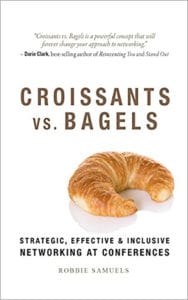
Croissants Vs. Bagels: Strategic, Effective, and Inclusive Networking at Conferences
It’s about finding the right job and the right fit. For the right hiring manager, you’re a dream. It’s about having that in you and thinking, “What’s my experience, passion and how do I present myself?” That is about having a solid pitch, like saying, “I need a job in nonprofit, rings no bells.” My database comes back to null. If you were clear with me about who you were, what your passions were, I could think of people to introduce you to. It’s a win-win for everyone. For me, it’s about relationship building. I want people to stop wasting their time networking and start building great relationships. Most of the time, people aren’t thinking about the real value of being present in a room with others.
Your book, Croissants vs. Bagels, you talk about three common complaints and nobody loves three problems and three solutions more than I do. Let’s attack that from that. The first complaint is meeting strangers is scary. Your solution to that is?
First, you should remember that your best friends started out as strangers. It’s a good reminder. If you think about it, you’ve already had some practice doing this. I’m also doing some research ahead of time so you know who to keep an eye out for what you might have in common with people, conversation starters, things that you can congratulate people on, compliment people on because you know a little bit what’s going on in their life. It makes them less scary, less of a stranger and more of someone that you haven’t met yet.
The second one, which is a big one for most people, is networking is exhausting. How do you help people not feel exhausted or even anticipate the exhaustion so that they avoid it?
This is definitely true for introverts. I could go for days meeting people. It doesn’t mean I’m effective. I might be hugging and air-kissing the whole room and not necessarily making the right connections. For introverts who need to think about how to manage their time and their energy in particular, it’s about knowing what you need to do in the time that you have. If I could tell an introvert, “If you dedicated an hour at the event, had all of your needs met, you did everything you need to do and you can go home after an hour, head held high, not feel like you’re slinking away, would you want to do that?” They’re like, “Yes.” I’m like, “There are a few hours with a prep that you’re going to do before you even get to the event. In that time that you do have the energy that you have, you’re super present. You know exactly who you want to talk to. You know what you’re going to talk about. That you’re not going to show up and hide in the corner. That hour is wasted and you could have stayed home and messaged the people on Facebook. If you don’t talk to people and you write them a message afterward, it’s not a follow-up message, it’s an email.
I love that you give people an exit strategy and that requires some preparation. People, especially if you’re introverted, would rather spend three hours preparing for who they want to talk to and meet and what they’re going to say. That one hour is limited and you can go, “I can survive anything for an hour.” The other big one is people think it’s a waste of time. You have a whole thing about let’s be strategic, which allows us to be effective. You also put in the word inclusive. How does that work so that we don’t waste time?
[bctt tweet=”There is a difference between collecting business cards vs. building relationships.” username=”John_Livesay”]
A lot of times when we head to a conference, which is one of the reasons I talked about that in the book is that we have the experience of going to conferences and organizing all the logistics to get there, travel, hotel, booking the ticket for the actual event. We’re not necessarily clear on the intentions we have around the event. In some way we’re going for the content, that’s what’s driving us to go. You can get content from the comfort and safety of your home. You don’t have to venture across the country to go meet people. If you’re going to do that, leave your house and go across the country, you should be there for connections, not content.
The wasting of our time is when we get to the end of a long weekend, if we’re a shy person, we may not have talked to many people and thought, “This was wasting my time. I’m exhausted.” If we’re outgoing, maybe we’d collect a stack of business cards, but we didn’t prioritize one over the other. They’re all like in a stack, which means they’re not going to be easy to follow-up with, which means we’re probably not going to follow-up, which means we’re thinking, “Whatever. This has wasted my time.” A lot of this is clear. Before you even get to the event, write your follow-up email draft. You’re not sending this to anyone. You are getting clear on why this event, in particular, out of all the events you could’ve gone to, who you’re trying to meet? What inspiration you’re looking for? What information you’re looking for? What can you offer this space?
What is the value that you’re bringing to the space? Write yourself a little draft now you’re going to personalize it when you get home. The other thing I suggest doing is on your calendar putting an hour after the event when you’re going to do the follow-up messages. If you have the draft and you’ve scheduled an hour, within two days of coming back from your event. During the event, you track the cards that were a higher priority conversation, maybe a little more in-depth, a little more engaged. Sometimes we’re standing in those tight bagels circles and someone starts handing out their card and everyone starts handing them out. It feels like you’re in a poker game.
Those shouldn’t have equal weight to the conversation you had for twenty minutes over lunch. I like to because we’re in Western culture, turn the corner of the cards that I want to keep track of. I always carry a pen. I like to jot a little note about the conversation. When I get home, I drop all the cards on the table, the ones that turn corners stand out to me. I have my draft. I have my time set aside. I’m likely to send the messages I need to. Everybody gets a LinkedIn invitation. Those small number of people will get a personalized email message as well. It won’t feel like a waste of time if we have some strategy, thoughtfulness and an intention before we even get there.
I love how you’re pre-loading and post-loading the whole concept. Creating a draft is so much easier to edit than starting from scratch that helps the momentum. If it doesn’t get scheduled, it doesn’t get done. The need to put that hour in a day or two after the event is crucial. One of your quotes in here that’s one of my favorites is “There’s a difference between collecting business cards and building relationships.” Can you give us a story of someone that you met at a convention that turned into a relationship and that paid off for both of you?

Building Meaningful Relationships: Being inclusive and being strategic are tied together.
I was at a big event in the Boston area where I live. It invited a lot of different sectors. It wasn’t nonprofit, business, government or education, it was all of them, which is one of the most difficult spaces to navigate. You’re trying to find your people. We were all there because we love the city. We were a part of this big campaign they were doing. I first told people, at the time I was working in nonprofit so people would turn and point, “No, you should meet so and so.” I’d say, “I do advocacy work.” They would point me to someone who does advocacy work. I’d say, “I do this kind of work.”
Someone said, “You should meet, she’s not here, let me tweet at her.” This guy tweets an introduction to this other woman, who I run into at an event months later, and me. That’s several years ago. We have done events together. She’s hired me. I’ve supported her work. She supported my work. What’s amazing is she wasn’t even in the room. All of that transpired because I was super clear on the people I was trying to meet and use part of that big picture, who I was looking for and assumed that everybody I was talking to was a connector. In some ways that’s true, some people are, but I knew that they knew at least one other person. I wanted an introduction to another person. I hope that I would leapfrog through the event to meet the people I truly needed to. That connection has absolutely paid off.
You talk about being effective once you already have your strategy in mind, but that strategy will only get us so far. What do you mean by that?
I also realized that I might not have talked about inclusion when you asked that question. I want to dovetail into that as well because being inclusive and being strategic are tied together. If you show up at the event and you do walk up to people, but the first thing out of your mouth is something off-putting, makes them feel like in other. Here’s an example that we’ve probably all heard at least if not said, “You’re tall. How tall are you?” If you’re over twelve years old, you should probably stop saying that. It could be about hair texture, skin color, heights, accents, names, things that people get commented on all day, every day. You’re not unique for having pointed out the obvious. That calling out differences is the thing that makes people feel like, “Do I belong here? I don’t feel like I fit. Am I welcome here?” It’s not doing you any good because they may have been a great connection, but you now have fallen into the trap of what everyone always says to them. They’re not going to think highly of you or want to stay engaged.
Inclusion is a strategy, which is why make the effort of going and talking to people and saying the thing that is off-putting? Calm that inner voice and as you get to know each other, I always think at some point maybe I’ll be like trading grandma recipes. I’ll talk to them about the thing that I had noticed or they’ll also be willing to ask me as well. We don’t want to lead with the obvious difference, but instead focusing on ways to engage people and welcome them into the space. That’s the part of the strategy and also the strategy of having your email draft ahead of time, talking to hosts and organizers, and asking for introductions. These are all things, getting there early so that you’re one of the people that everyone meets as they come.
[bctt tweet=”There is a difference between collecting business cards versus building relationships.” username=”John_Livesay”]
It can be a strategy taking on a host mindset so that as you greet people, I always think at a conference in the morning when they have coffee out. Everyone doesn’t know each other yet. They’re registered. There’s a cocktail table where you can lean with your coffee. I always stand at an empty table with my coffee. I look around and anybody who comes by, I wave them over. When I see someone trying to juggle their muffin and their coffee, I say, “Come here. You set it down right here.” Having that host’s mentality gives me an opportunity to talk to people that maybe I wouldn’t have otherwise. I do that at lunchtime. I’ll start a table and waving people over from the buffet. They don’t seem like they have a place to go. For me, it means that I’m going to have interesting conversations that I may not have had the opportunity to do so.
I love what you said about to generate the host table. I would have to say, even for myself, when I’m at those events, I tend to look for a seat that’s open at a table that already has people versus I’m going to sit by myself and try to get people to join me. If nobody does, I feel like a loser. You have a different mindset. You’re like, “No, start your own table, be a host and start inviting people over.”
If you are nervous and wondering where to be in, there are people who are even more nervous is my thought. To me, I also keep an eye out for the demographic outliers as well as the physical outliers. The physical outliers are the wallflowers. If it’s your first time attending the event, I don’t recommend going and talking to wallflowers because even though it may be a great conversation, it’s going to be a super awkward ending because they don’t know anyone and you don’t know anyone. You might be like, “John, it was nice talking to you. I’m going to go to the restroom.” You’re like, “Great talking to you too. That’s a good idea. I’ll join you.” You’re like, “I was trying to get out of this conversation.” If you’re new, go and find the openings in the large groups. For someone who’s been going a few times, it’s a nice thing to go over to the people on the sides of the room and bring them in. Similarly demographic outliers, someone who’s much older or much younger, people of color in mostly white space like going and engage the person who is visibly a little different and helping them feel engaged, not othered is a nice way to continue that host mindset.
Do you have any other graceful exit strategies besides, “Excuse me, I have to go get a drink or go to the bathroom?”
My favorite way to end a conversation is dependent on whether I’m new there or I know a lot of people. If I’m new I’ll say, “I don’t know that many people here. Is there anyone you think I should meet?” Usually, there’s a little bit of brainstorming because they know a little bit about me from the conversation we’ve had. I’ll be like, “That sounds great. Would you make an introduction? Would you introduce me?” Generally, that’s like, “I see them over there.” They walk me over and I get the introduction. I thank them. They can either stay with the conversation or they mostly wander off to do their own thing. Now I had been holding my hand over to that space. I am not left to stand by myself.

Building Meaningful Relationships: It’s exhausting to be a unicorn because you get all these pestering curious questions that make you feel like you’re under a magnifying glass.
The other thing I will tell you, John, is to make a note of how many people are in the circle with you. If there’s a three or four or more and you want to step away, you murmur something. You’re like, “I’m going to go,” you’re going to tap out. You’re like, “Let the person next to you know.” If there are three and one person leaves and it’s not you, now there’s two. When there’s two, you have to think are you inviting someone over? Are you coming up with some elaborate thing? Are you introducing them? Are they introducing you? Part of this is you leave before it’s time. You leave a conversation while it’s still got a lot of energy and makes them want to come and talk to you again. That’s another piece of this.
I have that philosophy with parties too, do not be the last person there when the host is saying, “We’re out of booze.” You talk about being inclusive and that there’s a downside to being a unicorn. Can you first define what a unicorn is? What is the downside?
You’ve heard probably the phrase “Always be yourself unless you can be a unicorn and always be a unicorn.” If you’re picturing what would a day as a unicorn be like? Is it rainbows and sunny skies? It’s probably more like, “A unicorn, I’ve never met a unicorn. Can I touch your?” All these intrusive, curious questions. A unicorn in this example are people who have that difference. It’s visible. They’re in a room that others are coming up to them and be like, “Can I touch your, can I ask you about this? I like your accent.” It can be exciting to be a unicorn, but sometimes it’s exhausting to be a unicorn because you get all these pestering curious questions that make you feel like you’re under a magnifying glass. In some ways, people are like, “I want to examine you.” That’s the downside. We’ve all experienced this to some degree or another. Some of us look like the people in the room more often than not. We also have had moments of being like, “I’m definitely the only blank here. How am I going to find people like me?”
We should call upon that to remind ourselves what it’s like to be in that space. That energy can be used to create a space where people can show up and bring more of their full selves. To clarify this for your audience, it’s not about the difference. A compliment is about something that they have chosen versus who they are. If someone has sunglasses on, a scarf, a piece of jewelry or an awesome jacket, those are compliments saying something nice. A guy has a tie that matches his shirt like a subtle connection. I love that. My dad taught me if you pick up a subtle color and a tie to match this color. I’m like, “You’ve got the style. Where do you shop?” That’s a compliment. If I said to the same guy, “You’re tall. How tall are you?” It’s not a compliment. It’s an observation and one they’ve heard before.
When you’re talking about fashion, I used to sell advertising for W Magazine, a fashion magazine. There was a phrase we had about the readers. It was, “Everyone puts on clothes, but not everyone gets dressed.” The people who read this magazine get dressed. That’s a fun way to compliment somebody who’s looking dapper, whether they’re male or female and say, “You got dressed, didn’t you?” I know you referenced that line and that’s a fun, unique way to connect with someone. Since you’re talking about your dad and you are a dad, do you have any tips for parents who might find that their child is a little introverted in school or in social situations?
[bctt tweet=”We don’t have to be extraordinarily outgoing or an extrovert to succeed.” username=”John_Livesay”]
It’s about finding those strength and working towards that. We put a lot of pressure on ourselves, our children and on each other to be something that we may not. Maybe they’re not the most outgoing kid, but what do they enjoy? If they enjoy it, they’ll put energy into it. They may find leadership doing that thing which they enjoy. Leadership is something that they will take the rest of their life. They don’t have to be extraordinarily outgoing or an extrovert to succeed. There are a ton of examples of people who are quite introverted that have been enormously huge impacts on our lives and our culture. Rather than trying to make them into something that they’re not, that they feel bad about, you can perform being more outgoing. A lot of people have adapted and learn how to do that, but it’s exhausting and not very fulfilling. Instead, guide them towards the things in which they feel good about, they can excel at and help them find leadership opportunities within that space, which will give them the confidence they need to make great decisions going on in life. That’s what I hope to do for my kids is hear them and listen to what they say as opposed to trying to make them the image in which I have for them. That’s difficult as a parent, but I think it’s a good idea to have that goal.
What I find interesting is when you try to force yourself or a child to be something you’re not is exhausting. If you do the old way of networking, that’s exhausting. If you are your authentic self, you’re energized, whether you’re in a networking situation or interacting with anybody. That’s a nice little barometer to see if you’re in the zone or not. You give these great keynotes about the art of the schmooze. Who’s your favorite audience to give this to?
My favorite audience is women at a Women’s Leadership Summit. I’ve gotten invited. I feel privileged to have been invited into that space a few times, maybe a half dozen times. It’s such a pleasure. The work that I do and how I speak about it resonates. My ideal coaching clients are entrepreneurial women in their 50s and 60s. It resonates with the corporate audience as well. Even using the word exhausted, that’s definitely a word women would use more than men for how the experience is. I’ll also make jokes and one of my earliest podcast episodes and blog posts was titled When Will Women Win the Right to Pockets?. You haven’t ever had to think about pockets then that’s a privilege in itself because women struggle with this all the time when they’re trying to get dressed in a nice way, they often have to sacrifice practical things like pockets.
The fact that I comment on that, have strategies for that, and I say things like, “It’s important to wear layers because the room is going to be freezing. The men are wearing suit coats.” The temperature is set for them. You’re in a sleeveless dress. You might want to bring something. They’re so appreciative that I’m naming that reality. I’m giving them tangible things that they can take action on. It’s not asking them to be anything other than who they are that I’m not asking them to reach outside of that. Now it’s outside their comfort zone to some degree to do some of this, but I’m not asking them to be someone else.
How do you develop such empathy for women in their 50s and 60s?

Building Meaningful Relationships: We need to be leveraging, reviewing, and rekindling connections with people that we’ve met.
I am 45 so I am closer to that than I look perhaps. I’m also an out trans guy so I would socialize as a girl and into being a woman. I have a better understanding of that space. It also comes with the empathy I have around introverts and shy people. I’ve never been those things and yet I can still put myself in that place and appreciate where they’re coming from. I learned a lot about being a leader is often about taking a step back. I learned that by having great people around me that I wanted to listen to. If I didn’t make space for them, they wouldn’t be heard. For me, it’s been a real practice.
The reason I love working with these women is that they’re motivated. They’re at a time in their life where they want more. They’re ready to take their business to the next level, but they also have a lot of trepidation about how to do it and feel like they’re starting over. They’re a novice when they’ve got 30 plus years of experience in the world. They forget about that. They, in particular, forget that they have a professional network that will support them in whatever the next level or transition of their business is. That’s my goal is relationship-based business strategies. They do not have to start from scratch. This is not scientific but 80% of who you need to know to be successful, I believe you’ve already met.
That’s such an a-ha moment for people. First of all, it keeps it from being so overwhelming. You think, “How is it that I’ve already met this person? I haven’t thought of asking him the right question or who else they might know?” All those things take it from this overwhelming, exhausting mindset into, “I have to think about who I’ve already met.” That’s a very different proposition.
It changes what networking is because we usually think of networking as having to meet new people. That’s only about 20% of what we needed to be doing. We need to be leveraging, reviewing and rekindling connections with people that we’ve met. It could be someone from five and ten years ago that you used to work with. If you would be happy to hear from them, you should be reaching out to them. If you’d be like, “It’d be so cool to hear from them again.” I do exercises where I have my clients brainstorm twenty names of those kinds of people without any connection to the work they’re doing or how it might benefit them.
Get in the habit of reconnecting because when you do make a great connection, you’ll already have the systems in place to schedule it. You’ll know how to do a Zoom call. You might have scheduling software to make it super easy. You’ll have the mindset to say, “Let’s follow up and make this happen.” When you go to a conference, it’s more likely you’ll follow up when you’re at a meeting when you meet someone at a restaurant. It doesn’t matter where you are. You have some of the habits around that set in place. It is habit forming. We have to get into the practice of our lives.
If you have one last tip you want to leave us with about how to handle bagels versus croissants, what would it be?
When you come into the room, look for the croissants. If you haven’t done the prep, if you haven’t prewritten your email follow up message and you haven’t thought about this space, take that as the moment to do it. If you remember to look for the croissants that will have a networking moment happen a little bit of strategy session with yourself, “Why am I here? Who do I want to meet?” Even that momentary pause before you go into the room can absolutely set some intentions that will create great outcomes. I look for the croissants.
What a great takeaway message. It’s visual, it’s sticky and it reminds you to be one yourself the next time you’re at an event and help other people. Robbie, thanks so much for being a guest on the show. The book is Croissants vs. Bagels. If you want to learn more about Robbie, go to his website, RobbieSamuels.com. Thanks again, Robbie.
Thank you.
Links Mentioned:
- Croissants vs. Bagels: Strategic, Effective and Inclusive Networking at Conferences
- Stand Out: How to Find Your Breakthrough Idea and Build a Following Around It
- Dorie Clark – Past episode
- On the Schmooze
- When Will Women Win the Right to Pockets? – Past episode of On the Schmooze
- RobbieSamuels.com
- www.RobbieSamuels.com/TSP
- https://www.Amazon.com/Croissants-vs-Bagels-Networking-Conferences-ebook/dp/B0746TDZRY/ref=sr_1_fkmrnull_1?keywords=croissants+vs+bagels&qid=1558121830&s=gateway&sr=8-1-fkmrnull
Wanna Host Your Own Podcast?
Click here to see how my friends at Brandcasting You can help
Get your FREE Sneak Peek of John’s new book Better Selling Through Storytelling
John Livesay, The Pitch Whisperer
Share The Show
Did you enjoy the show? I’d love it if you subscribed today and left us a 5-star review!
-
- Click this link
- Click on the ‘Subscribe’ button below the artwork
- Go to the ‘Ratings and Reviews’ section
- Click on ‘Write a Review’