

Think Unbroken With Michael Unbroken
Posted by John Livesay in podcast | 0 comments

Recovering from a traumatic childhood is extremely hard, especially when transitioning into adulthood. When you’re trying to deal with the trauma, it can be easy to think that the best solution is to forget and pretend it didn’t happen. Yet, it has already been enforced in your mind, and you continue to carry the weight in your life. In today’s episode, award-winning speaker, author, and advocate for adult survivors of childhood trauma, Michael Unbroken, shares his past experiences and how he overcame them. His book, Think Unbroken, has helped thousands of adults with childhood traumas become a better version of themselves. Tune in to this conversation to know more.
—
Listen to the podcast here
Think Unbroken With Michael Unbroken
Our guest on the show is Michael Unbroken, the author of Think Unbroken. He said, “Your brain is a liar.” He is a reality speaker, not a motivational speaker. Find out what he means when he says, “Hurt people, hurt people.” Enjoy the episode.
—
Our guest is Michael Unbroken, who is the Founder of Think Unbroken. He’s a best-selling author, award-winning speaker, podcast host, coach, and advocate for adult survivors of childhood trauma. From 8 to 12, he was often homeless and in deep poverty. He did what it took from stealing food and only bathing at school.
He got high for the first time at 12 and was drunk at 13. At fifteen, he was expelled from school for selling drugs. At eighteen, he found himself deep in the vortex and chasing money to solve the problems. By 25, he was 350 pounds, smoking, drinking, and even attempted suicide for the second time.
He had his mirror moment and decided to stop being a victim and be the hero of his own story. Since 2016, he’s empowered over 100,000 trauma survivors to get out of this vortex, learn to love themselves, and become the hero of their own stories. He’s the author of this best-selling book, Think Unbroken: Understanding and Overcoming Childhood Trauma.
—
Welcome to the show, Michael.
Thank you. It is a pleasure to be here with you.
One of the things I always love is how do we build trust with people. Our mutual friend and speaking manager, Blair, is the one that connected us at BBN Creative Management. Blair Nichols spoke highly of you. I feel like I already know you a little bit. The goal of the kinds of guests I like to have on the show is that the readers feel the warmth and the trust that you have with someone getting transferred.
You have many elements in your story of things that have happened to you. One is leading to the next and to the next. I’m going to let you decide how far back you want to go where you went, “I need to change this.” Usually, 25 years old still have challenges and issues. I myself have had challenges with food. I know what it’s like to feel like your weight is out of control, especially in emotional eating stuff for me. I’m interested to hear that part of your story, but you can take us back as far as you want as to how all these experiences led you to help other people.
It’s the human experience. We all have our thing. I always like to preface that it’s not a competition because people will hear what I’m about to say. They’ll be like, “My life is not that bad.” I’m like, “It’s relative. It doesn’t matter.” I grew up in Indiana. My mom is a drug addict and alcoholic. She cut off my right index finger when I was four years old. My stepfather was super abusive. He kicked out my brothers and me. It put me in the hospital multiple times. The thing I want people to hold on to here is hurt people, hurt people. The deeper I got into doing this work, the more I realized, “Their childhood was freaking bad that this is how they thought it meant to operate in the world.”
[bctt tweet=”I’m a reality speaker, not a motivational speaker.” username=”John_Livesay”]
From 8 to 12, we’re deeply impoverished and homeless. I lived with 30 different families in that four-year span and bounced around from place to place at the church. We’d sleep in vans and abandoned houses. It was crazy. When I was twelve, after living by myself for six weeks, my grandmother found out about this. She came and adopted me, which you think would be a godsend, but I’m biracial, Black and White. My grandma is an old racist, White lady from a town in Tennessee you had never heard of. We had a copy of Mein Kampf on our kitchen table. Imagine an identity crisis. When you introduced me, at twelve years old, I got high for the first time, popping pills, doing weed, whatever drugs, and crazy stuff sometimes. We’re like, “What’s in this?” “I don’t know. Let’s take it anyway.” I’m doing things like that.
By thirteen, I’m drinking all the time. At fifteen, I get expelled from school for selling drugs. I’m breaking into houses, stealing cars, running from the cops, and getting shot at. It’s crazy. I got a call from the school counselor one day, and she’s like, “The dean wants to talk to you. You need to come to school.” I’m like, “Talk to me about what? You already kicked me out. Why am I here?” My grandmother was like, “You need to go to school to figure out what they want.” I go, and I sit down. Two people I’ve never met in my life sit down next to me. We go, “You’ve been volunteered to a last chance program. You have two options here. You can either do this or good luck with the rest of your life.”
John, I was like, “Got it. I’m going to do this.” At that same time, I put a restraining order on my mother and my stepfather. This is on the internet. I’ve shown the report card. When I did this, I went from straight F’s to straight A’s. Captain of the wrestling team, dating the head cheerleader and playing varsity sports. Life is totally different.
A couple of years go by, and my mother gets sober for the first time ever. My grandmother let her move into our house. Within a month, she had completely drunk every single day and popped pills. You can watch my report card go from straight A’s to straight F’s. I ended up not graduating high school. Now, looking back on this, I know something important. My mother was put back into the home of her trauma. She was back in the vortex. She’s in the chaos of all of it. Now that makes sense to me, but at eighteen, it didn’t. I had to do something difficult.
I told my mom one night after she attacked me, “I’m never talking to you again. You’re out of my life.” Eventually, she died from Oxycontin and found herself legless in some random hotel room in the middle of nowhere in Indiana. I knew if she stayed in my life, you and I would not be having this conversation right now. That’s one of the hardest decisions I’ve ever had to make in my life. One of the things people have to understand is the idea about your family is your family. It’s nonsense. You can not get caught up in that because if you do, bad things can come from that. That’s childhood. That’s up to eighteen years old.
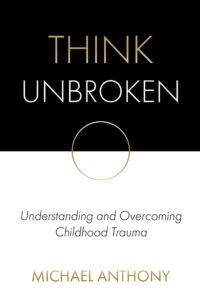
Think Unbroken: Understanding and Overcoming Childhood Trauma
From there, I realized, and as I’m in summer school, my business teacher, the irony of all ironies, tells me, “We’re done with you. Here’s your diploma. Get out. See you in six weeks at graduation.” I’m like, “You’re going to pass me after I didn’t pass. I got embarrassed and uninvited from all the parties. All my friends called me a loser. My girlfriend is embarrassed of me. You just got to give me this diploma.”
I’m working this job at a warehouse, putting microchips in motherboards every single day, twelve hours a day. It’s nonsense. I’m watching the desperation in people’s eyes because this is the place where people’s dreams go to die. I got fired, thank God, probably because I was stoned. I’m sitting in my car, and this was one of my first rock bottom moments. I’m like, “What is the solution for homelessness, poverty, abuse, and all the stuff I’ve been through my whole life? It’s got to be money.”
At that moment, I made a declaration to myself. I said, “By the time I’m 21, I want to make $100,000 a year legally.” That part was important. I’ve been in handcuffs more times than I can count. I have family in prison for life several years later. My three childhood best friends have been murdered. I knew where I was going.
I started taking all those skills I learned in that last chance program. I ended up getting a job with a Fortune 10 company as I’m heading into 21, no high school diploma and no college education. I start making $100,000 a year. I reached that goal, but I don’t have clarity in my life. I only know money. Fast forward five years, I’m riding high, and I’ve made almost $1 million, but I’m $42,000 in debt.
I’m 350 pounds. I’m smoking two packs a day and drinking myself to sleep every night. I’m high from the moment I wake up to the moment I go to bed. I’m cheating on my girlfriend. My brother never talked to me again. My best friends were embarrassed of me. My life is a freaking disaster. Why? Because I was still that hurt, lost little boy.
[bctt tweet=”Hurt people hurt people.” username=”John_Livesay”]
I thought money was going to be that thing. Many people who are business owners, entrepreneurs, and change-makers move towards money because we think that’s the thing. Everyone always says, “Money doesn’t change your life.” No one experiences it until it happens. You can read this all day long. I don’t care. Until you feel the impact of that, you don’t know what it means.
I hit this rock bottom. It’s Saturday morning. I’m laying in bed, eating chocolate cake, smoking a joint, and watching the CrossFit games. I’m sitting here at 350 pounds. You talk about rock bottom. For whatever reason, I got up and went to the bathroom. I looked at myself in the mirror. I remember being eight years old and the water company had come and turned our water off. This was normal. It was a blistering hot Indiana summer day. I go to the backyard. I take this little blue bucket. I walked across the street to our neighbor’s house, and for the first time, I stole water.
I remember being like, “When I’m a grownup, this won’t be my life.” It wasn’t in a lot of ways, but it was in all the ways. As I had that memory looking at myself in the mirror, I realized I was breaking a promise to myself. I asked myself the question that changed everything, “What are you willing to do to have the life that you want to have?” The answer became no excuses, just results. Several years later, here I am with you.
There are many things in that incredible story. The thing I want to double-click on is this concept of the vortex. How do you define that? How does someone know if they’re in one?
There are people saying things to themselves right now that if you said to me, I would punch you in the face. You’re expecting yourself to be successful. Think about this for a minute. That vortex is the negative limiting belief and self-sabotage. It is the place in which we play the victim. It is where we live up to the expectations of all the people who have always told us, “This is who we are.”

Overcoming Childhood Trauma: You have to recognize that we hold on to things like life is linear. But healing is peaks and valleys.
It’s natural that we would end up there, especially if you come from a traumatic background. Nobody escapes childhood unscathed. Don’t get it twisted. That’s the first thing that I always tell my clients. I’m like, “When you come into this, the first thing we got to do is we got to understand something that’s empirical that will change your life forever.” The way you speak to yourself matters more than anything else that you do. I promise you, going to the gym, meditating, journaling, yoga, and eating, that stuff does not work if you are an a****** to yourself.
It’s almost like thinking money is going to make me feel better and not addicted. The money doesn’t solve the problem either, much like affirmations and meditation, as you said. All that mean and negative self-talk is the core to getting out of the vortex and healing all addictions, not just one. In my case with food, I want to stuff down feelings I don’t want to feel, whether it is rejection, anger, anxiety, sadness, and boredom.
I had to identify what is the feeling that was triggering this need not to feel this. How do I get comfortable with people being angry at me, not liking me, or, in your case, having to be finding the courage to say, “I’m not going to have my mom in my life just because she’s my mom.” You found the self-esteem to do that. Was there a person along the way that did help you in any way since the grandmother wasn’t the supportive character in your story?
She was because I have the security of at least I know when I go home, I’m not going to get beat. When you look at resilience studies that have been done over the years, one person like that can create a different outcome. I would not argue that she was on, by any stretch of the imagination, somebody who catapulted to the next level because she wasn’t. Periodically I would have teachers or coaches who would eventually come to be mentors that I sought online, who became this foundational cornerstone for change in my life.
When you’re young, you don’t even realize, to an extent, you go, “This doesn’t feel right.” Until you start experiencing life through different views, do you understand that? My high school business teacher and my senior year, who failed me, were the greatest inspiration of my entire life. What happened was he was the only person who ever stood up to me. I’m 6’4”, and I’m towering. I’m a big dude. This is early 2000. People were like, “We want you out. It doesn’t matter.” This was several years ago. It’s different than it is now.
[bctt tweet=”The thing that people hold on to here is hurt.” username=”John_Livesay”]
One day I go up to his classroom, and I go, “I’m never coming to your class. It’s 7:30 in the morning. I’m out selling drugs all night. I’m working at a fake job at Hollywood video, trying to cover up because I thought that’s what you should do. My grandma is in a coma. Me and my younger brother are in this house by ourselves, trying to survive, and you think I’m coming to your class. You’re out of your freaking mind.” He’d been teaching for several years. He goes, “I get it. Check in with me once a week and do homework.” John, do you know how many times I did that? Zero.
I get a call from my girlfriend in my senior year. I’m at home playing video games, and she’s like, “You’re not graduating. You need to come to school and deal with this.” I went to school and I knew it was him because everybody else was like, “Whatever.” I go up to his classroom, and I go, “How dare you fail me?” He says, “I didn’t fail you. You failed yourself.” He told me the most important thing to this date anyone has ever said. He goes, “If you want something in life, you have to earn it. You can’t get by on your charms and your good looks.”
That singularly became the thing that catapulted me to the Fortune 10 company that now catapults me to being an award-winning speaker, having a best-selling book, having an award-winning podcast, and coaching thousands of people because it’s true. If you want it, go to work. What’s interesting is we don’t all get that person. What happens is I get to be that person for my clients.
One of my clients did something amazing in her career. She works for a company that we all know about. Everybody knows who they are, and I posted, “Way to go. You’re a badass. You did this.” Her response to my post was, “I love that I’m able to do this, but I couldn’t have done it without you.” That’s why I do this. I promise you. I can make money in a million other ways, but being able to be that person for people who didn’t have that person is what Mr. Bush was for me several years ago.
I’ve talked about us being the movie director of our own life and yelling cut when things aren’t going a certain way, and sometimes we have to change locations and people in our life. It sounds like you certainly did that. One of your chapters stood out to me, and I thought, “What a clever title.” This is your brain on trauma, as opposed to the commercial about this as your brain on drugs.

Overcoming Childhood Trauma: The coping mechanisms that we have are actually survival mechanisms.
That’s where it came from.
I have an advertising background. I know slogans and taglines. When people put a spin on something that’s already in our subconscious, it makes our brain pay attention because you’re like, “That’s an interesting new twist. I haven’t heard that. What does that mean?” The premise of what you’re saying here, Michael, is until we heal those traumas, nothing else is going to work. Part of the healing is what we’re saying to ourselves. On some level, how much does letting go of resentment and anger plug into that healing?
That’s the secret pill. I also have a background in advertising and marketing going on now for several years. I’m always thinking about that forward facing in the marketplace. It’s the same reason Michael Unbroken exists. You have to recognize that we hold on to things. Life is linear. Here’s your start date. Here’s your end date. Everything else between that was like, “I don’t know. That is the stuff.”
Healing is peaks and valleys. It’s like ping pong. What happens is, somewhere along this line, in this linear experience, you’re going to have to make a decision to let go. Here’s why that’s difficult. We, whether we like it or not, are the sum total of all of our experiences leading to this moment. That means everything that’s ever happened to you counts. Context, in twenty minutes, you know more about me than people who have known me for several years. Think about that for a second. Stuff it down, eat it away, smoke it away, drink it away, and have sex it away. The whole thing does not solve the problem.
The coping mechanisms that we have are survival mechanisms because the brain looks at this and goes, “This is uncomfortable. I must do anything else. If I can do anything else, I will be safe.” If you think about it, those coping mechanisms create chaos in your life. At least they did for me. You hear people who have been through traumatic experiences say this, and this is arguably one of the most dangerous things that you can say, “I thrive in chaos.”
[bctt tweet=”The way you speak to yourself matters.” username=”John_Livesay”]
Why would you want to thrive in chaos? Why would you not want to thrive in peace, companionship, love, empathy, grace, hope, and compassion? What happens is a part of this is going through the healing journey, whether it be therapy, coaching, personal devote, or whatever. At some point on this trajectory, you’re going to have to acknowledge one empirical reality.
You are not culpable for the things that happened to you in your past, but everything from this moment forward is on you. You have to decide whether or not you are going to anchor yourself into the depths of the water that drag you down every single day, or you are going to pull yourself up and go towards the shore of your decision-making. That’s hard because here’s why. Your whole life, you’ve been told you’re not good enough, not strong enough, and not capable enough. This is why you’re a loser, fat, dumb, your dad left you, your mom is a drug addict, your homeless, you’re weak, you’re on food stamps, you have to get school lunch.
In your brain, you go, “That must be who I am.” You then have to recognize reality. This is the matrix. Whether you like it or not, this crap is a red and blue pill. You can choose to stay exactly where you are. That’s easy. You’re already there, or you can take the red pill and see how deep that rabbit hole goes. When you do, you’ll be shocked to find out what you can do.
People will hear me, and there’ll be like, “This guy has all the accolades. He’s done all the things.” I have already been to rock bottom. I already know how dark it is down that street. All I do is simply hold up my hand and a flashlight to people. If you haven’t decided, you must make a decision. If you have not decided that you’re willing to heal and let go of the past so that you can move forward, nothing will help you.
It reminds me of Einstein’s quote, “The biggest decision we ever make is the world of a friendly, safe place or not.” From there, we look for data and experiences to back it up. In your particular case, you didn’t have a friendly, safe environment to grow up in. You’ve had to create that separately to make that your reality is what I’m hearing.

Overcoming Childhood Trauma: People are constantly bending themselves to the world, to everybody else.
That comes from looking at your brain on trauma, understanding that the brain’s response to the stimulus is to simply categorize it and go, “Is this safer or not?” If it’s safe, you continue to do it. If it is not safe, you put it away. Part of the problem with that is when you’re in your developmental years, especially as a child.
If you come from a traumatic background, being you can often be the most dangerous thing you can do. The fastest way for me to get my head slammed into a wall as a kid was simply to exist. The brain goes, “Being me is dangerous. I’m not going to be me anymore.” The worst part about that, John, is it serves you for a period of time when you’re 8, 12, 16, or 18 years old because it keeps you safe.
You’re 22, 37, and 54 years old. You don’t know how to be yourself. You don’t know how to say yes. You don’t know how to say no. The idea of ever asking for what you want, need, or are interested in is terrifying. The only way that you change is by changing. That’s the thing people get stuck on because they feel like they still have to be that other version of themselves. The brain has predetermined, based on empirical historical data, that being you is dangerous. Thus, you cannot be you because then you are not in a state of safety.
The only way you move through that is by slowly stepping your toes over the line of the reality that you live in and into what is next because that will build confidence and self-esteem. Eventually, I hope that on a long enough timeline for you, the thing that you come to realize is that the world is safe, but your brain is a liar because it simply only wants one thing. It wants to keep you safe.
I have Dr. Jud Brewer on Think Unbroken Podcasts. He has a TED Talk with 10 million people who viewed it. I said, “Jud, let me ask you a question. When I think out loud that the brain is a liar, is that true?” He’s like, “Absolutely.” The thing that people need to do if they want to create sustainable long-term change in their life. It’s not therapy, coaching, and personal development. That stuff is fine. Everybody knows to do that. It’s about paying attention to your gut.
[bctt tweet=”It is only until you start experiencing life through different views that you start to understand.” username=”John_Livesay”]
John, how many times in your life have you had a situation where you’re 2 weeks later, 1 month later, or 6 months later go, “I wish I would have followed my gut. I knew it.” You have never once said, “I wish I would have followed my brain.” Get in your body, pay attention to what’s happening here and understand that your brain is a liar.
You’ve taken this beyond the podcast and book to being a speaker. You spoke to over 10,000 people at our Grant Cardone conference. What did that feel like?
I fully and entirely believe in visualization. It’s weird because I’ve spoken at conferences where Blair has been there. I’ve spoken at conferences where 10,000 or 2,000 people are watching or whatever, but nobody was there several years ago when two people came. People always ask that question, but here’s the thing. I already decided a long time ago that I would speak in front of 10,000 people. The marker on my to-do list is to speak in front of 25,000 people. I’m not even close to what I’m trying to accomplish. It’s simply about this. I had already predetermined that it was going to happen.
Coming back to this idea that we live in the matrix. I know people are like, “We don’t live in the matrix.” I’m like, “How do you know?” That’s the whole point. I’m like, “Can you bend the world to you?” People are always bending themselves to the world, to everybody else, to your needs, their needs, and those guys’ needs. We grow up like that. Raise your hand to go to the bathroom, color the way we say to color, go to college, and all this stuff.
For me, what happened is, since you asked my feelings on it, I was sitting there thinking to myself, “I believe that I will accomplish everything that I want to accomplish in my life, but it’s simply about time. That means I have to keep going forward every single day and being in that energy.” I have a tattoo of a guitar pick from Dave Grohl from Foo Fighters on my wrist. When I was a child, I had two dreams. Don’t die and be a rock star. I don’t know how to play any damn instruments. I never put in the effort, so that ain’t going to happen.

Overcoming Childhood Trauma: Why would you want to thrive in chaos? Why would you not want to thrive in peace, companionship, love, empathy, grace, hope, and compassion?
What I can do is I can grab this mic, stand on stage and make tens of thousands of people feel emotional, alive, charged, loved, and feel like they can take on the world. Most importantly, I give them the tools because I’m not a motivational speaker. Motivation is nonsense. I’m a reality speaker. I’m going to tell you the truth you don’t want to hear. When I tell you some truth you don’t want to hear, you’re going to wake up or not. For me, I’m standing there getting ready to go speak in front of all these people. I’m like, “Some people are going to learn something now. It’s the thing that I needed.”
Do you have an ideal type of crowd that you’d like to speak up in front of?
People ask me all the time. I’ve lived a lot of lives. I’ve worked in Corporate America for a Fortune 10 company. I’m an entrepreneur that runs 3 different businesses with a team of over 82 people. I’ve been in leadership since I was eighteen. At eighteen years old, I worked for a fast food joint. I had 52 people under me. I’ve written books. I live my life. I can go and speak to any room. I fully and truly believe that. Here’s the reality. Nobody comes out of childhood unscathed. If you put me in front of a human being, we’re going to have a conversation.
That boils down to why you’re in demand as a speaker because the truths are universal, despite everyone’s different backgrounds and levels of trauma. What I loved most about what you said at the beginning was it’s not a competition. I learned that once in a therapy session. I feel guilty that I’m sad about this when all of these other people have these kinds of traumas. I’m like, “No, each person’s feelings are valid, and they get to have them.” You’re not comparing your feelings to someone else’s feelings of, “I don’t deserve to feel this way because I didn’t have as big a trauma as somebody else.” The fact that you preface that upfront lets people connect to you much stronger in a way that gives you a lot of credibilities but also authenticity.
John, I think this is important too. What I always remind myself of is, what does that have to do with me? We’ve never met until this moment. We have no intersection. There’s no way that the things that you have been through impact me directly. Indirectly on a long enough timeline when you connect the dots. Sure, of course, and ultimately, all of those things have led to this moment. It’d be stupid not to acknowledge that.
[bctt tweet=”The only way that you actually change is by changing.” username=”John_Livesay”]
The truth of the reality of life is everybody is on a different journey. If you get caught up in that mind game of, “They got it better. They got it worse.” you’re going to miss the boat because the only thing that you have is this present moment right now. The past is over. It’s gone. You don’t get it back. I can’t even get back anything I said in this whole conversation. I could have destroyed my whole career for all I know. I don’t know, but I can’t control the future either. I don’t have control over anything that happened, but the future doesn’t even technically exist because it’s either the present or it’s the past, and it’s gone.
The other chapter title I love is Keep Your Promises. I want to have you go into why that’s important. I think it starts with the promises we keep to ourselves and let alone others.
Think about this. If I cannot trust my commitment to myself, how can you? I apply this thoroughly. I measure people by this, and I know it’s not the best way to look at the human experience. If somebody tells me they’re going to do something and they don’t, and it’s for themselves, I can’t trust they’re going to show up for me. We have to show up for ourselves first.
Many of us are used to people breaking their promises. Many of us are used to, “Dad said he was going to come to the ballgame. The teacher said that they were going to help me with the assignment. My best friend said that they were going to be my prom date.” Whatever it is, I don’t know. All these things add up. We learn that it’s okay not to keep the promises.
I told one other person this since I’ve been doing it, a mandate 55 of 75 Hard. I’ve told nobody about it. Nobody even knows. On 75 Hard, you’re supposed to tell everybody and post it on the internet. I’m like, “This is for me. Can I show up and keep my promise to work out, drink water and all the stuff of that thing is?” It’s also like, “Can I keep my promise to write the book, speak on the stage, do the podcast, and not get in my own damn way?”
People are far more afraid of success than they are of failure. We’re used to failure. Failure is easy. I can fell now like that. Success requires work, commitment, a promise kept, and an understanding that on a long enough timeline, you can have anything you want in your life. You truly can. I believe that because I have seen billionaires fly off their helicopters on a beach while I’m sitting there like, “I don’t have that much money.” For me, it’s not the money. I don’t care about the money.
The thing is looking at that, and I go, “That guy wanted that so bad. He figured it out.” Elon Musk put a car in outer space. You have a cell phone in your hand. I have friends who make $100,000 a day with their cell phones. You can do anything, but are you willing to sacrifice? Are you willing to show up? Are you willing to keep your promise? It’s easy to quit on yourself. You’ve been doing it your whole life.
Michael, if people want to find out more about you, hire you as a speaker, get your book The Think Unbroken, where should they go?
I’m everywhere on social @MichaelUnbroken. You can listen to the Think Unbroken Podcast if you go to ThinkUnbrokenPodcast.com. It’s on iTunes, YouTube, Spotify, and all the places. If you want to listen to or download the first three chapters of my first book, you can go to Book.ThinkUnbroken.com.
Thanks for inspiring all of us. I love that you’re a reality speaker, not a motivational speaker. That’s a nice little branding position. Congratulations.
Thanks.
Important Links
- Think Unbroken: Understanding and Overcoming Childhood Trauma
- Think Unbroken
- BBN Creative Management
- Dr. Jud Brewer – Previous Episode of Think Unbroken Podcast
- Think Unbroken Podcasts
- @MichaelUnbroken – Instagram
- iTunes – Think Unbroken Podcast
- YouTube – Think Unbroken Podcast
- Spotify – Think Unbroken Podcast
- Book.ThinkUnbroken.com
- https://www.ThinkUnbroken.com/speak
- Better Selling Through Storytelling Method Online Course
Wanna Host Your Own Podcast?
Click here to see how my friends at Podetize can help
Purchase John’s new book
John Livesay, The Pitch Whisperer
Share The Show
Did you enjoy the show? I’d love it if you subscribed today and left us a 5-star review!
- Click this link
- Click on the ‘Subscribe’ button below the artwork
- Go to the ‘Ratings and Reviews’ section
- Click on ‘Write a Review’
Love the show? Subscribe, rate, review, and share!
Join The Successful Pitch community today:
- JohnLivesay.com
- John Livesay Facebook
- John Livesay Twitter
- John Livesay LinkedIn
- John Livesay YouTube
Be A Professional Human Being With Rajan Nazran
Posted by John Livesay in podcast | 0 comments

We’re all born with a brain and not a calculator. That is why it’s so important to tell stories and connect with people emotionally because that is what drives business. This is what journalist and entrepreneur Rajan Nazran believes in. Calling himself a professional human, he explains on today’s show with John Livesay how being one is all about taking a deeply human approach to deal with whatever situation is on hand. They also talk about the art of storytelling, what the human experience is all about, and so much more. Rajan has travelled to over 58 countries, taking on some of the biggest conversations and covering stories from around the globe the Global Indian Series, an immersive platform that provides original and exclusive content based around the lives of people of Indian origin.
—
Listen to the podcast here
Be A Professional Human Being With Rajan Nazran
Our guest on The Successful Pitch is Rajan Nazran, who talks about the fact that we’re all born with a brain and not a calculator, and why it’s so important to tell stories and connect with people emotionally. He said conflict resolution is a silent orchestra, that you have to interpret what the notes are. Enjoy reading how he’s done this around the world.
—
Our guest is Rajan Nazran, who is an award-winning explorer, content producer, entrepreneur and over the last couple of years, traveled to 58 countries, building networks and building Global Indian communities through his mediums. As a result, he is a highly established network and has brokered many deals independently. His network extends to heads of states, ministers, CEOs, entrepreneurs, and he’s the Senior Partner of NazranRoth and Chief Explorer for the Global Indian Series. He’s also an International Chairman for the Center for Leadership Development in Africa and an Executive Member of The Kenya Society. He’s the International Sports Director at the Corinthians Football Team of Malta, and he sits on the board for the Mental Health Change Working Group of England. Rajan, welcome to the show. That is quite the bio.
One does try. That was pretty good.
I always like to ask my guests to take us to their own story of origin and you decide how far back you go. It could be your childhood or school because you said to me earlier, you consider yourself a professional human, which I’ve never met anybody who’s put those two words together. A lot of us are focused on the awareness of being as opposed to doing. The concept that we can be professional at being human and make money typically is what the word professional means, you’re an expert at it. That alone is fascinating. I’m curious to see how that all came about, this urge to travel and this urge to make such an impact in so many ways?
First and foremost, John, it is a deep privilege to be on your show. I’m humbled for the fact that I’m here, especially amongst your guests that are far greater than I. It’s a nice place. How far back do you go? Being of Indian origin, we believe incarnations or reincarnation, going back too many lives. To give a brief background, my mother was born in the Philippine Islands in Cagayan. My father is born in Punjab, India and I’m from the UK. I am pretty much 50 shades of brown that automatically is the Indian community.
In fact, we’re the karaoke singers of that. Growing up was slightly different for me. I got to see the world in a different light because culturally, you don’t know where you belong to but you get this perception of identity that comes in. My mother was an entrepreneur. She set up a working group for Asian women in mental health. She became an artist and did incredible tapestries in museums now in the VNA. My father is incredibly hard-working from becoming a bus driver towards setting up the factory, then going to cars and they both work hand in hand.
I grew up around this series of passion, which is saying everything we do we do it because we believe that we’re making a difference. Whether it is to help and support Asian women or if it was to say, “What can we do to help support the country that we could have then,” which was the UK. From there, I went to university and this urge came in, which was saying, “I want to explore the world. I want to see where I fit into it all.” As every young person comes through, I did what you normally do, which is door-to-door sales, thinking, “That’s how I’m going to get my financing together.” I did that and went to university.
I was fortunate that I was at the right place at the right time. There was this whole Erasmus Scheme that took us to Italy where we could study abroad. I was there and I happened to be there when the Italian Olympic team was there. I did quick courses in NLP and hypnotherapy. I pitched my way into the Indian team and became their first youngest ever mental coach. That’s where I first started from.
I was there doing things with athletes in the interim. I got headhunted. It’s the right place at the right time. I got to go to Israel for P3 Consideration work. I went to the Middle East working with this great guy. He took me under his wing and told me about the weird and wonderful world of the media so I was getting aboard with him. My story has been one of either the constellations coming together or downright stupidity at times of saying, “What if,” and ending up in places. That’s how it all clicked off.
I want to double click on this background you have on what you called practical soft skills, the neuro-linguistic programming because I wrote a blog about soft skills that make you strong. A lot of people think, “I’m an architect. These are my hard skills.” Soft skills are not something that’s that important and of course, now we realize that soft skills are defined as empathy, listening, storytelling, EQ, emotional intelligence, not only your IQ.
So many entrepreneurs forget that as a key element of their success, whether it’s to get funded or to get the right people to join their team and eventually, you have to create a way to convince people to buy whatever it is you’re selling or download an app, etc. I want to hear and I know that you’ve incorporated this into the NazranRoth offerings of what kinds of things have you’ve done. What do you notice across countries? This ability to connect with an audience and everyone processes things differently is a starting point. Can you tell us a story about using soft skills to help companies in different countries?
[bctt tweet=”Conflict resolution is a silent orchestra you have to conduct.” username=”John_Livesay”]
I’ll continue an even better story than that and I’ll get to that. You probably know that I’ve been held hostage in Eastern Europe, so I have to use my words to get me out of tricky situations. I’ve been to 58 countries. Being held hostage. I was in Syria during the Ebola crisis, and at that moment, I came across a family who unfortunately lost somebody. The police were saying that they’re going to arrest me as a part of it. I was there. The power of soft skills is not left to the wells of business. This is who we are as humans, which is what I say a professional human. This is our faculties to be able to speak, understand and absorb.
Taking that to the wonderful world of internationalization, we work with a lot of clients to help them develop their own narrative, their own story, especially countries towards forging a way for them to get FDI, Foreign Direct Investment. It’s like what you say, everyone looks at this and your first notion is one has to be incredibly strong. You have to be academic and tell people the numbers. The numbers are what make things happen. There are only so many numbers you have for a country.
What we do is we reach out to that and say through the product offerings we have with the Global Indian Series, “Why don’t we showcase a softer form of public diplomacy. Let’s tell the stories that connect human beings together, not with each other but with a country.” We’ve done that with, for example, Portugal. We did this massive pitch in Portugal and we brought together some amazing individuals and we took a massive spin saying, “Rather than focusing on the economic support, let’s focus on the human interest of Portugal.” That feature that we created reached out to over 40 million people.
We did an event at the end of that and brought over $3 billion in private net worth to that event. We brought together people who are interested in the stories and human response to the businesses that showcase their humanity. Lo and behold, business takes place and that’s basically real-life practical soft skills. It’s not about getting people to vote for you. It’s about a country embracing who they are, that living organism of identity and culture. Allowing that to go through the narrative, the tonality of their words, the way that people view them to be. In that sense, we’ve helped.
In corporate, we’ve done the same thing. Some companies get some tricky situations that they need a bit of help and support with. Rather than going down the normal, typical legal route, we help them shape themselves and have those softer conversations with people that have a lot of empathy, emotional intelligence, and intercultural communications. To get them to connect powerfully with people that gets the end result on people saying, “I’m prepared to give you ten minutes of my time to listen to you. Let’s take it from there.” That’s the type of stuff that we get involved in again, comes back to the professional human element saying, “We’re all born with a brain, not a calculator.” If it is emotive beings, John, like you, you’re emotive. You wear your personality and your heart on your sleeve. That’s who we are as human beings. It’s common sense that’s what drives businesses.
I love that because it’s so visual. It brings it to life in a completely different way. The global business partner that you offer companies is what allows them to achieve real-world success because there are differences in culture. I know from my advertising background that certain campaigns don’t translate. I remember Body by Fisher for sportswear translated in Spanish to Corpse by Fisher. A car here in the States was called Nova and of course, in Spanish, that means no go. That’s not probably the best name and that’s the tip of the iceberg from an advertising standpoint of the need to translate what you’re doing from one culture to the other.
Is there anything that you see that’s consistent? For example, we’re all wired for stories, no matter what culture we come from and things like that? I would say, since you’ve been to so many countries, that you might say, “We have more things in common than you might expect. If you’re a global company already, and/or wanting to go global, here are a couple of things you might want to keep in mind.”
Coming into that tone there, the art of storytelling is like what you do. You’re an alchemist. You bring together these remarkable emotions, and you connect them together. If we were to put you in robes, we’ll call you guru, in that sense. The art of storytelling is this since time immemorial. Before TVs, what did we do? We stood around a fire and we told stories. We looked at the stars, and we conjured up images of how the gods or goddesses of our choices created the world. We forget about it. We try to make everything so robotic in nature. We forget that it’s the human element that makes us do things so some of the commonalities are down.
In the story alone, people know that the second thing for companies that do go global is that intercultural competence. One needs to know, as you said, that it goes beyond the notion of words and linguistics, but also the way that business is done in emerging markets. Who do you know? How do you know them? How well can you navigate through the policies and procedures to get the end results? Not everything is clear and the same.
One of the biggest obstacles a lot of international companies have is that they take the month of what they think the world is and they go to those countries and they don’t realize the world is different there. Therefore, we help them navigate those spots with that silent guardian that supports their journey because we can open up the doors where they need to be bearing in mind, I’ve got a footprint in over 58 countries that I’ve been to and I’ve got a lot of exposure there. Also, at the same token, we help them and practically assist them towards speaking to the relevant people because we know what those political landscapes are.

Professional Human Being: We do everything we do because we believe that we’re making a difference.
The other thing that I’ll say that’s a common tonality that I see is yes, “We’re all similar,” but the way we interpret our coaches is dissimilar in those markets. In the US, it is direct and straightforward. In Britain, we have the James Bond attitude of the globe, where if we take them to certain markets like Ethiopia, it doesn’t translate well. You need to be more aware of what takes place. What are their cultures? What are their stories? What defines them? How do they want to be treated?
I know that one of your expertise in NazranRoth is the national branding and PR, so it seems to me that what you’re offering is the ability to have the right message to the right person through your network at the time. When all those things align, then results start an act, people start taking action and wanting to partner with you. If one of those things is off and you don’t have the right person, you’re not in the right room, or you don’t have the right story it’s this recipe for success basically. You’ve got all of these pieces from all of these different experiences and countries, that a lot of people need you as the International Sherpa. That’s how I would phrase it.
The other thing that I’m fascinated about is what you’re doing under human excellence is conflict resolution. That is something that can destroy a start-up faster than anything, is a conflict between founders and it’s a big red flag for potential investors. It’s also a conflict within big companies. People say that they don’t leave their job, they leave their boss. The way conflicts are resolved from country to country is quite different. If you’re interacting with people from Japan, from what my study has been, they hate conflict. You never hear stories of people screaming at each other and they also don’t like to say no.
It’s almost like this silent orchestra that you have to read between the words to understand. It is a sign of orchestra. Conflict resolution, when you go and deeper, as you rightly say, it can be from person to person. Business to business. Communities to communities and nations to nations. It all starts off with understanding what are the core deliverables of human behavior. Why do people behave in a certain way? It goes even deeper into this whole notion of purpose and integrity. That’s how our viewpoints are formed. We’re fortunate, so when it comes to countries, we got four former heads of state on our advisory committee for NazranRoth. That helps because they’ve been through all that and they’ve been to some of the most challenging times you can ever imagine.
Donald Ramotar, the President of Guyana, was there at the most complex trading of Venezuela and Guyana of oil. He was there. He had to navigate the shores amongst the other guys across Africa. The way we normally deal with it is that we take a deeply human approach and that is the common core of the professional human. What is currently taking place, and how does it have a human-based impact? Regardless, if you’re head of state, get your person to the ground on the verge of being destitute, we all have emotions, that EQ that you named it to be.
Once we start taking that approach, and we realize as a species of human beings, we have this common denominator of behavior, it’s a lot easier for us to come in and deal with the situations on hand. It gets slightly difficult and murky is when you got large boards on the brink of almost killing each other along those lines. That’s when we have to deal with multiple personalities. Our secret there is, is there any magic to the toolbox to have a look at what is the human response to this? We need to understand what are the words behind the words. We’ve only got there like you creating incredible work that you’ve been doing over 300-plus podcasts. We’ve only got there because of the years of dedicated travel of experience and practically going to the countries and feeling it, blood, sweat, and tears. There’s no real genius behind it. It’s literally the experience I’ve been able to build up.
I see that some of your clients include Deloitte, which I find fascinating that you’re both well-respected advisors and consultants and yet even a company as big as Deloitte needs your expertise. Is there a story of what they engaged you for? Was it navigating some of that?
I can’t go into too much detail there but you’ve done your research. We worked with Deloitte, BP, SR, and Maersk, the big shipping lines. They sent me to Congo to the DRC to work with their people here and that was onboard a ship. That’s real conflict resolution. There are a lot of things happening. It’s because we know the markets, we know the people and we know how human behavior rates, we’re not in competition with anybody. We got the collaborative approach. If companies see that we can help and support them, we come in and we do that. We have large-scale clients to small start-ups. It makes no difference. We’re all humans on our own voyage of life. If we can be of help, we help out. It’s not an issue.
The takeaway is, no matter how big a company is, the smart ones still engage others to help them, especially in an area that they may not have all the expertise. If we can look at that and incorporate it into our own mindset of not trying to go it alone and think that, “That must mean I’m weak.” It’s flipping it on its head. Soft skills make you strong, collaboration and having other people partner with you makes you stronger. All of that has now led to one of your flagship services, which is the Global Indian Series, where you are everywhere and have some amazing stories there. Can you share with us the origin story of how that came about and what people might want to explore?
Absolutely. The story came from pure and utter frustration like everything else. When one travels, you go to all these countries, you meet with the people and you realize, forget about the flag of India. As people of similar type of origin, we’re everywhere but we don’t know about each other. That has a huge impact because politically and economically, it has an impact, victims of society and identity. Once you start to realize, with every country, everyone defined this notion of indigenous like this white elephant in the room. Some people held the tail, others the trunk, others the legs.
[bctt tweet=”An emotional connection breaks through the noise and clutter.” username=”John_Livesay”]
Everyone’s holding on to the same notion, but we’re different descriptions towards it and that has a huge impact for generations. Some people then take this historical route of, “Our traditions are set in stone. Women behave like this and men behave like that.” Others take it as a fluid part. I thought, “Let’s change this. There’s a lot of misconceptions. Let’s build an active living encyclopedia, a bridge that connects us all together and say, “We are brought up into an identity though, let’s face it, we’re all born into this planet out of luck, an agenda out of luck and in the country out of luck. Any form of wisdom out of luck.” It’s this identity thrust upon you that you have to live and die towards.”
You don’t understand what that identity is because if you don’t it controls you. That’s where we kicked it off. we did not create features. I was physically traveling to these places prior to COVID not in a hazmat suit. All of a sudden, COVID kicks in and you’re thinking, “What do I do next?” That’s when we kicked up from the digital side. We bring the podcast in and now what you hear is this living encyclopedia of the human experience of people.
We’ve had kings on that, heads of state, billionaires, people dealing with alcoholism, nations from around the globe, people there are coming together in a spirit of being a human being and saying, “We’re unmoored from what we thought was normal.” That’s been the beauty of it. It’s something I’m passionate about. It is part and parcel of one’s life mission to understand what is a brief fabric of humanity and is a common core there that we can learn from each other with.
One of the things that fascinated me was the fact that you talked about there are over 70,000 people of Indian origin that call Portugal home. That’s why that partnership made such sense, where you created this whole print feature that was viewed over 30 million times and you were able to get sponsors who wanted to target that audience. I thought it would be interesting for people who might be wondering, “How does a podcast go global and how does tapping into a specific country appeal to the sponsor?” In this case, it was the family hotel and resort. You might want to talk a little bit about that.
We had JLL that supported us. We had PLMJ, a massive law firm. We had Nova Business School in Montana. We’ve got loads of different companies that came together. The whole notion of what we do is a sentimental journey of the human spirit of us and bringing that up all together. What we turn around to our sponsors is, “In this world, there’s a lot of noise.” That’s the reality. You get 1,500 pieces of info thrown at you, bashing for attention and saying, “Listen to me.” What do we all want to know? What we want to know about people like us and the stories that mount our own hearts because that’s the person that gets our attention.
We created and part of what we design in integrity is, “We’re going to cover the story. If I don’t get any sponsors in, I may be bankrupt, homeless, and my wife may be annoyed at me but this is a commitment I have made to me and the high purpose of being, so I’m going to do it.” Lucky for me, the sponsors would rather you do not jump off a cliff, we will help you as well. They got involved with us and what they got out of it was a meaningful connection with not only India, not only with their global audience in Portugal, but they got to be part of the history books on what makes us a living encyclopedia.
They realize quickly at the end of that, that has a lot of collateral because not only now are their responses, the hearts, and minds of a community, the hearts and minds of a community that is across the globe. People that have both wealth and experienced know-how but also community is hard to reach. That’s why they jumped on board with us because there’s a bigger play here like us and like we did with Malta.
The government of Malta supported us and we had big organizations there. We did stuff across the Caribbean. All the large organizations said, “We get you. We understand you,” because now they realize that what we offer is an emotive outreach to the world’s biggest community. What our community realizes is we’re no fluff. We do this without fear or favor. We have no political sides and we say, “Let’s showcase a road as it is not as we are.” That’s a powerful medium for us.
I love what you said here that when you offer emotive outreach, it breaks through the clutter and that’s why sponsors are hungry for that. Every good marketing and advertising is all about good stories about emotional connection. If people don’t have an emotional connection to a story, they don’t remember it but when they do, they share it and tell others about it. That’s what everybody in marketing’s dream is. It’s having something that is so good that people want to tell others and become brand ambassadors for you and that is the magic of what you’re doing.
It doesn’t surprise me that you’re getting all kinds of high-level government officials and high net worth individuals together because it’s your passion that’s driving this. The big takeaway for the readers here is, people buy your energy. I remember once being interviewed for a speaking engagement and my agent wrote back and said, “They picked you. They liked your energy.” I thought, “They said that not, ‘They liked your book or they liked your topic, or whatever you proposed.’” It was, “They liked your energy.” The more we remember that, then the more we transcend all the differences we have with each other.

Professional Human Being: One of the biggest obstacles many international companies have is that they take the mindset off what they think the market is.
If you think of money as energy and action, it’s not such a leap of faith to go, “I am so committed to this.” My passion is so strong, that I know that will attract the right energy, aka money, to support this because it’s giving them real value, which is that laser focus. People are going to as I say, “When you tug at heartstrings, people open their purse strings.” You do that well. I’m excited to see the continued global impact you’re going to have. Is there any last thought you want to leave us with?
It does, doesn’t it? What you said there, we owe it to ourselves to understand who we are as human beings. Your business is your life. Everything you do goes towards a repertoire of your human experience on this planet. Therefore, for us to almost compartmentalize and say, “That is the business side of me now. That is the parental side of me. That’s the lover of me,” is crazy. In the bigger image, if you were to take that 50,000, 60,000, and 70,000 view from above the heavens, then you realize that we are all living in this fragility that is called the human experience.
Everything we do has to drive out who we are internally. Your readers, for example, if they’ve got a business and it’s successful, but they don’t feel happy, that’s a showcase to them saying, “This is your life. Do not waste it.” Likewise, if they’ve got this pursuit of something that they’re going for the finances for, there is a small, narrow-minded existence, because that doesn’t go with them. It’s only going to be who we are, that emerges to the greatest out of there. For me, that is my final thought there. It’s saying, “We owe it to ourselves to become professional humans.”
Whenever we speak, we never speak about money, we never speak about what’s in it for you and what’s in it for me, we speak from the integrity that holds in true of what it means to be human, the species that interacts with each other. That’s what makes me alive. That’s why I’m so drawn to the work that you do, John, because there’s none of this preconceived idea of saying, “This is what I know.” You’re that medium that executes a perfect unionship between people that says, “Let’s have a look at what is that inner yearning that we all have one-on-one together and where are we heading to together as a community of people, not only an individual?”
You’re transcending the concept of having transactional relationships with people, including ourselves. When that happens, everything lines up and your purpose, your meaning and you’re not so it’s a disjointed person going, “Is this all that there is. I thought if I got all these achievements and accolades, I’d be happy and I’m still not happy,” and vice versa, “Why can’t I do what makes me happy as a living and be a professional human being?” What a great way to end and if you want to know more, you can go to the Global Indian Series, the podcast is the same name and also NazranRoth. Thanks so much for sharing your passion and all these wonderful stories.
Thank you. This has been fun. It’s been cool.
I loved it too and I’m sure our readers will as well.
Important Links
- Rajan Nazran
- NazranRoth
- Center for Leadership Development in Africa
- The Kenya Society
- Soft Skills Make You Stronger
- Podcast – Global Indian Conversations
- Better Selling Through Storytelling Method Online Course
Wanna Host Your Own Podcast?
Click here to see how my friends at Podetize can help
Purchase John’s new book
John Livesay, The Pitch Whisperer
Share The Show
Did you enjoy the show? I’d love it if you subscribed today and left us a 5-star review!
- Click this link
- Click on the ‘Subscribe’ button below the artwork
- Go to the ‘Ratings and Reviews’ section
- Click on ‘Write a Review’
Love the show? Subscribe, rate, review, and share!
Join The Successful Pitch community today:
- JohnLivesay.com
- John Livesay Facebook
- John Livesay Twitter
- John Livesay LinkedIn
- John Livesay YouTube