

Closers Are Losers With Jeremy Miner
Posted by John Livesay in podcast | 0 comments


Failing to close a deal as a salesperson is one of the most upsetting things that can happen to you. But what if I told you that it was actually your fault that you didn’t get the sale. Selling is about change and most salespeople sell the product, not what the product can do for the customer. Join John Livesay as he talks to Jeremy Miner about integrating human behavior into the sales process. Jeremy has been in sales for 7 years! He is the founder of 7th Level. He is the co-author of The New Model of Selling and is the host of the Closers are Losers podcast. Learn how human behavior affects your customer’s sales objections. Find out how to get people into your products with some of Jeremy’s modes of communication. Start closing all your deals today!
—
Listen to the podcast here
Closers Are Losers With Jeremy Miner
Our guest on the show is Jeremy Miner, who has a book out on selling. He said, “Be a problem solver, not a product pusher.” He talks about how objections are preventable. Finally, the whole premise of selling is about change and that you need to learn how to disarm people so that they are less resistant to it. Enjoy the episode.
—
Welcome to the show. Our guest is Jeremy Miner, who is Chairman of 7th Level, a global sales training company that was ranked very highly by Inc. Magazine. He is also a contributor to Inc. and has been featured in The Wall Street Journal, Forbes, and many others. He says this great quote, “The single most effective way to sell anything to anybody is to be a problem solver, not a product pusher.” For Jeremy, the embodiment of this philosophy has made him one of the world’s wealthiest sales professionals. Not just America, the whole planet.
In his sales career, he was recognized by Direct Selling Association. His earnings as a commission-only salesperson were in the multiple seven figures every year. Clearly, he is doing something right. He is the host of the podcast, Closers Are Losers. His new book, The New Model of Selling: Selling to an Unsellable Generation, is out now. Welcome, Jeremy.
My co-author there is Mr. Jerry Acuff, a good friend of mine. He is the CEO of Delta Point Consulting, a large sales training company on the East Coast. We wrote that together. It will be fun and games for the kiddos to read on the bookshelf. We are excited about it.
You are a big reader, but before we get into your passion for reading, take us back to your own story of origin. How did you get into the world of sales?
I was not born out of my mother’s womb with advanced questioning skills or tonality training. That is something that you have to acquire if you want to be great at what you do. I got into sales many years ago as a broke, burned-out college kid. I got my first job selling home security systems door-to-door. I was one of those guys you feel sorry for coming around in your door. I did not know what I was doing.
Eventually, when I knew what I was doing, do not feel sorry for me at that point. I was making a lot of money as a college student. I felt like I was Jeff Bezos. I was this little punk college kid. I got in. The company recruits everybody. It was a straight commission. They see who makes it. Most don’t. Eighty-nine percent do not make it. They give you a script, give you a couple of books by the sales gurus, take you out in the van, and drop you off in a neighborhood. Usually, a not so safe neighborhood
Hence, the need for security systems.
“Go make some sales, tiger. We will pick you up after dark.” That is pretty much what it was. I thought selling was going to be easy because that is what everybody in the office told me. I remember my sales manager saying, “When they open the door, be excited. Talk about how great the product is. People are going to love it.” I am like, “I will do that.” I was excited. I was telling about the features, the benefits, and all this great stuff that it was going to do, but I noticed that I started getting a lot of objections at every single door, “We cannot afford it. We do not need it. We already have somebody for that. Your price is too high. I have already talked with somebody else last year. I need to talk to my spouse. I need to think it over. Can you call me back in a week, a month, a year later?”
[bctt tweet=”Be a problem solver, not a product pusher.” username=”John_Livesay”]
I am like, “This is going to be harder than what I was told.” I remember about 7 or 8 weeks into all that rejection, barely making any sales. When you are paid straight commission, if you do not make any sales, you might as well work for minimum wage. You are going to make more money minimum wage. I remember one night in particular. I was standing on the curb. The sales manager was about to pick me up. If you have ever done door-to-door, you are walking around 10 or 12 hours, so your legs get tired. In the summer, you are sweating all the way down. I remember sitting there. I had not made any sales for the day. I had worked for twelve hours. That whole week, I had worked 60-plus hours and I made zero sales.
This is the end of the week. I had $0. I was newly married and I had a kid on the way. I barely turned 22. I was still in college. At that point, I felt broken. How am I going to go home and tell my wife at the time that we do not have enough money to pay rent? “We are going to have to move in with your parents and live in the basement.” That was going to be one of those. I thought that maybe selling was not for me. I remember that night, especially. When the manager picked me up, he plugged in a Tony Robbins CD.
This was back in the old days. I love Tony. Tony said something like this, “Most people fail for the simple reason, they do not learn the right skills that are necessary to succeed.” He went on to say that everybody is taught skills for the most part. He said, “People who fail are the ones who do not learn the right ones.” I am like, “Maybe I am not learning the right skills.” This light bulb went off like, “Maybe the company was training me and what I was learning from the gurus at the time, maybe they were not the right skills. Maybe they did not work very well anymore.”
I had this major dilemma because the company would give us all these books. They were teaching us that the most persuasive way to sell was here, but at the same time, I was in school. My degree was in Behavioral Science and Human Psychology. My professors and all the works I was reading were saying that the best way to persuade and communicate was on the other end. It was completely opposite of each other. The gurus were saying it was here. Behavioral Science and Psychology was saying it was on the other.
I am like, “What am I supposed to do? The theory with Behavioral Science and a bunch of other things with Psychology, how do I bring that into the sales process?” Once I started to do that and learn how to work with human behavior, instead of pushing like most salespeople, I learned how to get prospects to pull me in. Once I started to discover that way of communicating, selling became very easy and profitable. That is my boring background.

Closers Are Losers: Bring the theory of behavioral science and merge it into the sales process. Once you learn how to work with human behavior, instead of pushing like most salespeople, you’ll get prospects that’ll pull you in.
Is that connected to your methodology, the NEPQ?
That is where it started, Neuro-Emotional Persuasion Questioning. That methodology developed from my background in Behavioral Science and Human Psychology.
For those who are not familiar with Neuro-Linguistic Programming, most people are aware of what EQ is, but you have got the letters in a unique way. Can you tell us what that is and how somebody could start to use it?
It is much different than NLP. I like NLP. There are some things that are good in NLP, but typically, if you are using some of it in a one-to-one selling environment. It is not quite as effective, in my mind than selling one to many. It is a little bit different there. When I was in college studying Behavioral Science, it was broken down into three main categories. I am not going to give everybody the scientific terms. I am going to give you something that everybody would know on here.
Sales and communications are broken down into three forms. All of you reading this right now, once you understand where you are in these three forms, where your current sales ability is compared to where it could be, it will completely change everything for you. I do not care if you are already making $10,000, $15,000 or $20,000 a month. There are ways you can make a lot more selling the exact product or service you are now. The first mode of communication, we would call this arrow one type of sales. Think boiler room selling. What is the first image that comes to your mind when I say boiler room selling?
[bctt tweet=”Most people fail for the simple reason that they don’t learn the right skills that are necessary to succeed. ” username=”John_Livesay”]
That movie and they are all, “Coffee is for closers.”
We are the least persuasive when we tell people things or we attempt to dominate them, posture them, manipulate them or push them into doing something we want to. As you said, Wolf of Wall Street. I am assuming Jordan Belfort. They portray him that way. I do not know if he was that way. That is how he is portrayed in Hollywood. Who knows? He is like, “I have got a great opportunity for you.” We talk about the features and benefits of what we do. We push them, tell them why they need to buy, and why we are the best. It is like telling your spouse that they need to do something for you and then you keep pushing them. What do they typically do back? They push back. It is human behavior 101.
If you push, people resist more. Most of the time, they push back. I will give you a few examples of the least persuasive way to sell because so many salespeople are still taught this way. Presenting. We are all taught that you have to have a great presentation. We have to show them how great our services and products are. We have to have an hour and a half pitch deck. We have got the best this. We have got the best that. Does not every single salesperson say that they have the best product and service? It is like watching The Bachelor. I do not know if you have watched The Bachelor, but they come out the host every year. They say, “This is the most dramatic Bachelor of all time.”
I am like, “You said that last year and the year before and the year before.” You stop believing it after a while. There is not going to be any salesperson who will say, “John, our service is fifth-best in the market.” Everybody says they are the best. When we hear things like that as a consumer, it goes in one ear out the other. We do not trust that. We trust people less when they say things like that or they talk down their competitors because we are used to everybody doing it.
According to the data, it is not very persuasive if your presentation is more than 10% of your entire sales process and/or conversation. The average salesperson is about 50%. That is a massive problem. “Telling is not selling.” We have all heard that saying. Telling your story is important like we talked about when I was on your show, but it has to be a structured story, not a winged story that does not have any relevance in a sales pitch. We have all been taught that we have got to give a great pitch.

Closers Are Losers: Sales and communications are broken down in three forms. And, once you understand where you currently are in these forms, everything will change for you.
According to the science, it is not a very persuasive way to do it. It is how you pitch. Do you ever watch Shark Tank on CNBC? When the entrepreneurs come out, they are excited. They are going to pitch the sharks. Watch the body language of Mark Cuban, Barbara, Mr. Wonderful, Kevin, and Daymond John. It is because of the way they are presenting that.
The big one is assuming the sale. According to the data, very low on the persuasion poll, especially if you are more of a complex selling environment that requires multiple calls and touches. I think me and you talked about that. That is the first form. The second form of communication, I will boil that down to this. I will call it consultative selling. Everybody knows what that is. We are more persuasive when we attempt to have a real discussion with the prospect.
Consultative selling, for the most part, would be known in books like SPIN Selling by Neil Rackham. The professor that came out in the mid-’80s taught that you need to ask logical based questions to find out the client’s needs. What is a potential downfall of the approach when you are only asking logical-based questions? We call those surface-level questions.
The prospect is going to give you logical-based answers in return. As you and I talked about, do people buy on emotion or logic? One hundred percent on emotion. Brain studies show that. We are more persuasive than boiler room selling, manipulating, and trying to pressure them, but you are still going to play the numbers game because you are not bringing up very much emotion by asking the same old questions. “John, what is keeping you awake at night?”
You cannot use those types of classic questions because your prospect hears them all the time or, “Who, besides you, would be involved in the decision?” It is boring surface level. Instead, re-language that. You can say this, “Sally, can you walk me through your company’s decision-making process to solve challenges like this? Walk me through.”
[bctt tweet=”It’s not very persuasive if your presentation is more than 10% of your entire sales process. Telling is not selling.” username=”John_Livesay”]
She is going to start thinking in her mind about what the decision-making process is. It causes their brain to go in a different range. The third mode of communication, everyone might know as dialogue. That is arrow three. We are the most persuasive when we allow others to persuade themselves. That is where we come in with Neuro-Emotional Persuasion Questioning. The key is where we ask certain questions and techniques that work with human behavior that get that prospect to want to open up, to want to engage and pull us in rather than us push them forward.
That is the question that everybody asks me, “How do I get somebody to persuade themselves? Can I show up and say, “Mr. Prospect, persuade yourself? By the way, here are the wiring details.” No. You have to learn the right questions to ask at the right time in a structured situation. We talked about storytelling as a structured process that gets the prospect to sell themselves and pull you in. Those are the three.
Do you think that the main reason there is such a delay and people’s sales cycles keep getting longer and longer is that everyone’s got a different reason for making a decision? What are some questions that people can ask to create some urgency?
I am always brutal in telling people what I think. When we go in and do audits with companies, it is all the same. Buying decisions only stall for the most part because sales teams are still being taught sales techniques that work against human behavior that trigger sales resistance and create uncertainty and doubt in your prospect’s mind. When your prospects have doubt and uncertainty, what are they going to do? They put on the brakes because they are uncertain. That is triggered by what we are saying and/or not asking.
I had somebody ask me at an event one time, “If you could describe selling in one word, what would that be?” It took me a few seconds and I am like, “It would be change.” That’s all that selling is. It is how good you are at getting your prospect to view, in their mind, that by changing their situation, that means purchasing your product, service, or whatever your solution is. By them doing that, that is far less risky for them than doing nothing at all. Staying in the status quo, the problem stays the same and nothing ever changes, which is more risky for them.

Closers Are Losers: You have to realize as a sales professional or as a business owner, you’re not selling the thing. Instead, you have to sell them the results of what that thing does for them.
Whether you want something better or the prospect is trying to get away from pain, it is about change. If selling is about change, here is your massive problem. Human beings do not like change. Selling is all about change, but human beings, the way we are wired, we do not like change even though we say we do. Why do we not like it? We feel unsettled. We feel a bit uncomfortable, especially when it is initiated by some pushy salesperson that is ready to pitch us in the first twenty seconds of a conversation.
Human behavior shows that we value something that is more known to us or something that is more consistent in our lives over something that is unknown. Think the battered spouse syndrome. The spouse keeps coming back and we are like, “Why do they keep coming back?” It’s because they fear the unknown over coming back to what they know even though they do not like it. Isn’t that crazy?
A lot of people are like, “Why does the wife or husband keep coming back for the verbal abuse?” You are like, “They fear the unknown, even over something that they hate.” We have to realize as a sales professional or as a business owner, you are not selling the thing. We have companies that come in and they are like, “I am in HVAC. I am competing on price because they can get the same HVAC XYZ system.” I am like, “Stop. All you are talking about is selling them the thing. You have to sell them the results of what that thing does for them. That is what you are selling.”
If you are a real estate agent, you are not selling them a home. You are selling them the results of that home and what that home will do for them. Maybe it is to get them out of a bad neighborhood into a safer neighborhood. If it is a multimillion-dollar home, you are selling them on the thing on that home that is going to give them the status in their brain to fulfill an emotional need. If you sell an insurance policy, you are not selling them a policy. You are selling them financial protection when the spouse passes away and the other spouse does not have to worry financially. That is what you are selling.
If you are selling cyber security to Wells Fargo, you are not selling the software. You are selling the results of what that does, which is going to protect their customers from fraud. We have to start thinking, “We are not selling the thing. We are selling the results of what that thing does.” You asked me a few good questions. One thing that we can do is, let’s say, we get through a first call of discovery call. Let’s say you sell B2B. You are talking to a company. Your next step would be to schedule a demo. Before you do that, let’s say you are three-fourths of the way in that conversation. You have helped them find out what their situation is. We call that their current state.
[bctt tweet=”Selling is change.” username=”John_Livesay”]
You have also found out where they want to be. We call that their objective state, like what their future looks like. What is the gap between all these problems your questions have allowed them to see and did not know they had? What I want to do is when they see what their future looks like, and they start to feel what it is going to feel like once all these problems are solved, we want to rip that feeling away from them where they emotionally have to defend themselves on why they have to change now, not later. When you start to become good at this, you hardly ever get, “We need to keep looking around. I want to think this through.” That is a trigger response.
I might ask them, “What are the possible ramifications if your company does not do anything about solving this and it keeps getting worse? What happens to you guys, then? Have you thought about what would happen if your company does not do anything about this?” Those are generic consequence questions. Whatever you sell, you would supply that in. Let’s say I sold lead generation. I am selling leads to like SMB companies that need a higher quality lead. Let’s say their problem is their salespeople are speaking to lower quality leads, they are overspending on leads, leads are stagnating, and they keep going down.
I might say something like this, “Hold on. What happens if you guys do not do anything about this? You keep getting these lower quality leads to your sales teams and your sales keep stagnating another 3, 6, even 12 months from now. What happens at that point?” That gets them to think of the consequences of what happens if they do not do anything about solving that problem now.
You started your story about talking about all the objections you got when you were doing door-to-door. You also say that there is a way to overcome objections and prevent them from ever happening.
I think people think I am crazy when I say that. They are like, “What? How do you prevent objections from happening in their mind?” It is easy. I would rather focus on preventing objections from happening and have way more laid out sales. I am assuming you are the same way, John. That is why you have structured stories because here is the thing. I am always like, “Where is the science behind where that came from? That guy is an ass.”

Closers Are Losers: Most sales objections are triggered by you, the salesperson in what you’re saying. You’re triggering uncertainty and doubt in their mind. So instead of saying “sign the contract”, say “authorize the agreement”.
When sales trainers say, “The more objections you get, the more interested they are.” What study shows that? The more objections you get, the less likely they are going to buy. If that was the case, you would not have any lay-down sales. What about the lay-down sales that had zero objections? Where does that come in? It does not make any sense.
I want to prevent the objections from happening. If they do, I know how to handle them. We call that objection prevention. Salespeople do not like it when I say this. Most objections are triggered by you, the salesperson and what you are saying. Not asking is triggering uncertainty and doubt in their mind. A lot of salespeople, and I still cannot believe they are still saying this, but they will be like, “John, I need you to go ahead and sign the contract.”
Sign and contract are two words that typically trigger sales resistance in a lot of people because no one wants to sign a contract that walks them into something they might not want down the road. If I make that languaging more neutral, I do not trigger that. If I say, “John, the next step is to authorize the agreement.” It means the same exact thing. Sign the contract, but if I say, “Authorize the agreement,” it is the same thing, but it is far more neutral.
With this concept of getting in our own way, as a sales keynote speaker, I find that audiences do not take responsibility for the reaction they get from someone. If you show some empathy and anticipate an objection, keeping in mind that most people are wondering, “Will this work for me?” If you say, “You might be wondering now if this is going to work for you,” and then you give them an answer, you have shot that objection down before they even say it.
It is exactly that. We train a lot of car dealerships too, and retail stores. What does every salesperson do when somebody walks into the store? “How can I help you?” What type of reaction did they get 95% of the time?
[bctt tweet=”Buying decisions only stall because sales teams are still being taught sales techniques that work against human behavior. ” username=”John_Livesay”]
“No, thanks. I am just looking.”
If you already know that you are going to get that, do not say, “How can I help you?” You are going to cut that objection off like you did on that stage. What you did is brilliant. You simply go into the objection and say, “Thanks for coming into the dealership today. Are you guys out looking around?” They are like, “Yes.” They say, “Do you know what you are looking for?” You are right into the conversation. It is their objection. They cannot say, “I am looking around now.” I just said, “Are you guys out looking around today?” “Yes. For sure.” “Do you know what you are looking for?” You are right into it. It is so simple. What you did there was brilliant on stage.
Let’s talk about closing. This concept of ABC, we joked about it a little bit with the boiler room mindset. I have replaced that with ABK, Always Be Kind, in the way you talk to yourself and other people because you cannot give that out. What is your alternative to the old way of Always Be Closing?
We use the ABDs. Always Be Disarming. What do I mean by disarming? Throughout all of that presentation, you do the same thing when you are on stage, John. You are disarming throughout the whole presentation. You know what objections the audience has. You know how to prevent them from the beginning of what you say on stage, all the way to the end. You are continually telling stories to disarm them to become open to what you are offering at the end. That is all you are doing.
If you are in a one-on-one sales situation, whether you sell business-to-business or business-to-consumer, your ultimate goal is to get that person to purchase what you are offering to solve their problems. You are doing them a favor by paying you to solve their problems. You have to look at yourself as that salesperson that does that.
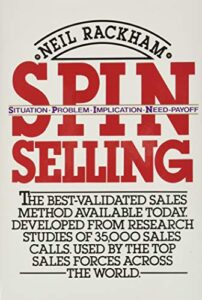
SPIN Selling
You are continually asking the right questions in that process that continually disarms the prospect where they want to keep engaging and opening up to you. One good way to do that is if you have somebody that is closed off, let’s say that you finally weed your way throughout the organization of the company. You are selling to a Fortune 1000 company. You are talking to the division head, the main person. That is your sixth appointment. You have finally figured out how to get through.
Let’s say that person is hard as nails. They do not want to open up to any of your questions. You are going to stop that conversation halfway through. Let’s say you are on Zoom or even in person, you can lean in and say, “Me and you here, off the record, what is holding you back from being able to X, Y, and Z?”
You cannot do that in the first ten seconds because there is no trust. You cannot force your way into that conversation. You know they are not opening up. They are staying surface level with you. You simply stop. You lean in and say, “Between me and you, off the record.” People open up. You do not use it every time. You’ve got to know when to use it. You cannot use it in the first two minutes because there is no trust throughout that conversation. That is a way to disarm a prospect to get them to open up.
We have gone full circle because you talk about selling is all about change. You are disarming people. You are mitigating the risk to do that change. That is a great summary of your skillset and the training you offer and your new book that is co-authored. It is going to be something that people are going to want to run and get The New Model of Selling: Selling to an Unsellable Generation. If people want to reach you, Jeremy, where should they go?
If they want to learn about what we do or even get some free resources from us, they can join one of our free Facebook groups. Send them to www.SalesRevolution.pro. We got about 18,000 C-level executives, salespeople, and entrepreneurs in there that want to get better and sell. Right when they join, check your Facebook Messenger because somebody on my team will message you over a free training called the NEPQ 101 Mini-Course. It is with my CEO, Matt.
Matt will break down different questions that you can use for different sales situations we know that you are going to be in on a day-to-day basis that will help you sell more. We go live in that Facebook group 3 or 4 times a week with different Q&As and different trainings for B2C and B2B. They are welcome to join that if they want to get some sources to sell more.
Thank you so much for telling us about your own story of origin and how you have learned to be prepared and even prevent objections and closing by making people feel safe to open up with, “This is off the record.” Thanks again, Jeremy.
Thanks, John, for having me on.
Important Links
- Jeremy Miner
- 7th Level
- Closers Are Losers
- SPIN Selling
- www.SalesRevolution.pro
- https://SalesTraining.ClickFunnels.com/optin164548828699
- Better Selling Through Storytelling Method Online Course
Wanna Host Your Own Podcast?
Click here to see how my friends at Podetize can help
Purchase John’s new book
John Livesay, The Pitch Whisperer
Share The Show
Did you enjoy the show? I’d love it if you subscribed today and left us a 5-star review!
- Click this link
- Click on the ‘Subscribe’ button below the artwork
- Go to the ‘Ratings and Reviews’ section
- Click on ‘Write a Review’
Love the show? Subscribe, rate, review, and share!
Join The Successful Pitch community today:
- JohnLivesay.com
- John Livesay Facebook
- John Livesay Twitter
- John Livesay LinkedIn
- John Livesay YouTube
Be A Professional Human Being With Rajan Nazran
Posted by John Livesay in podcast | 0 comments

We’re all born with a brain and not a calculator. That is why it’s so important to tell stories and connect with people emotionally because that is what drives business. This is what journalist and entrepreneur Rajan Nazran believes in. Calling himself a professional human, he explains on today’s show with John Livesay how being one is all about taking a deeply human approach to deal with whatever situation is on hand. They also talk about the art of storytelling, what the human experience is all about, and so much more. Rajan has travelled to over 58 countries, taking on some of the biggest conversations and covering stories from around the globe the Global Indian Series, an immersive platform that provides original and exclusive content based around the lives of people of Indian origin.
—
Listen to the podcast here
Be A Professional Human Being With Rajan Nazran
Our guest on The Successful Pitch is Rajan Nazran, who talks about the fact that we’re all born with a brain and not a calculator, and why it’s so important to tell stories and connect with people emotionally. He said conflict resolution is a silent orchestra, that you have to interpret what the notes are. Enjoy reading how he’s done this around the world.
—
Our guest is Rajan Nazran, who is an award-winning explorer, content producer, entrepreneur and over the last couple of years, traveled to 58 countries, building networks and building Global Indian communities through his mediums. As a result, he is a highly established network and has brokered many deals independently. His network extends to heads of states, ministers, CEOs, entrepreneurs, and he’s the Senior Partner of NazranRoth and Chief Explorer for the Global Indian Series. He’s also an International Chairman for the Center for Leadership Development in Africa and an Executive Member of The Kenya Society. He’s the International Sports Director at the Corinthians Football Team of Malta, and he sits on the board for the Mental Health Change Working Group of England. Rajan, welcome to the show. That is quite the bio.
One does try. That was pretty good.
I always like to ask my guests to take us to their own story of origin and you decide how far back you go. It could be your childhood or school because you said to me earlier, you consider yourself a professional human, which I’ve never met anybody who’s put those two words together. A lot of us are focused on the awareness of being as opposed to doing. The concept that we can be professional at being human and make money typically is what the word professional means, you’re an expert at it. That alone is fascinating. I’m curious to see how that all came about, this urge to travel and this urge to make such an impact in so many ways?
First and foremost, John, it is a deep privilege to be on your show. I’m humbled for the fact that I’m here, especially amongst your guests that are far greater than I. It’s a nice place. How far back do you go? Being of Indian origin, we believe incarnations or reincarnation, going back too many lives. To give a brief background, my mother was born in the Philippine Islands in Cagayan. My father is born in Punjab, India and I’m from the UK. I am pretty much 50 shades of brown that automatically is the Indian community.
In fact, we’re the karaoke singers of that. Growing up was slightly different for me. I got to see the world in a different light because culturally, you don’t know where you belong to but you get this perception of identity that comes in. My mother was an entrepreneur. She set up a working group for Asian women in mental health. She became an artist and did incredible tapestries in museums now in the VNA. My father is incredibly hard-working from becoming a bus driver towards setting up the factory, then going to cars and they both work hand in hand.
I grew up around this series of passion, which is saying everything we do we do it because we believe that we’re making a difference. Whether it is to help and support Asian women or if it was to say, “What can we do to help support the country that we could have then,” which was the UK. From there, I went to university and this urge came in, which was saying, “I want to explore the world. I want to see where I fit into it all.” As every young person comes through, I did what you normally do, which is door-to-door sales, thinking, “That’s how I’m going to get my financing together.” I did that and went to university.
I was fortunate that I was at the right place at the right time. There was this whole Erasmus Scheme that took us to Italy where we could study abroad. I was there and I happened to be there when the Italian Olympic team was there. I did quick courses in NLP and hypnotherapy. I pitched my way into the Indian team and became their first youngest ever mental coach. That’s where I first started from.
I was there doing things with athletes in the interim. I got headhunted. It’s the right place at the right time. I got to go to Israel for P3 Consideration work. I went to the Middle East working with this great guy. He took me under his wing and told me about the weird and wonderful world of the media so I was getting aboard with him. My story has been one of either the constellations coming together or downright stupidity at times of saying, “What if,” and ending up in places. That’s how it all clicked off.
I want to double click on this background you have on what you called practical soft skills, the neuro-linguistic programming because I wrote a blog about soft skills that make you strong. A lot of people think, “I’m an architect. These are my hard skills.” Soft skills are not something that’s that important and of course, now we realize that soft skills are defined as empathy, listening, storytelling, EQ, emotional intelligence, not only your IQ.
So many entrepreneurs forget that as a key element of their success, whether it’s to get funded or to get the right people to join their team and eventually, you have to create a way to convince people to buy whatever it is you’re selling or download an app, etc. I want to hear and I know that you’ve incorporated this into the NazranRoth offerings of what kinds of things have you’ve done. What do you notice across countries? This ability to connect with an audience and everyone processes things differently is a starting point. Can you tell us a story about using soft skills to help companies in different countries?
[bctt tweet=”Conflict resolution is a silent orchestra you have to conduct.” username=”John_Livesay”]
I’ll continue an even better story than that and I’ll get to that. You probably know that I’ve been held hostage in Eastern Europe, so I have to use my words to get me out of tricky situations. I’ve been to 58 countries. Being held hostage. I was in Syria during the Ebola crisis, and at that moment, I came across a family who unfortunately lost somebody. The police were saying that they’re going to arrest me as a part of it. I was there. The power of soft skills is not left to the wells of business. This is who we are as humans, which is what I say a professional human. This is our faculties to be able to speak, understand and absorb.
Taking that to the wonderful world of internationalization, we work with a lot of clients to help them develop their own narrative, their own story, especially countries towards forging a way for them to get FDI, Foreign Direct Investment. It’s like what you say, everyone looks at this and your first notion is one has to be incredibly strong. You have to be academic and tell people the numbers. The numbers are what make things happen. There are only so many numbers you have for a country.
What we do is we reach out to that and say through the product offerings we have with the Global Indian Series, “Why don’t we showcase a softer form of public diplomacy. Let’s tell the stories that connect human beings together, not with each other but with a country.” We’ve done that with, for example, Portugal. We did this massive pitch in Portugal and we brought together some amazing individuals and we took a massive spin saying, “Rather than focusing on the economic support, let’s focus on the human interest of Portugal.” That feature that we created reached out to over 40 million people.
We did an event at the end of that and brought over $3 billion in private net worth to that event. We brought together people who are interested in the stories and human response to the businesses that showcase their humanity. Lo and behold, business takes place and that’s basically real-life practical soft skills. It’s not about getting people to vote for you. It’s about a country embracing who they are, that living organism of identity and culture. Allowing that to go through the narrative, the tonality of their words, the way that people view them to be. In that sense, we’ve helped.
In corporate, we’ve done the same thing. Some companies get some tricky situations that they need a bit of help and support with. Rather than going down the normal, typical legal route, we help them shape themselves and have those softer conversations with people that have a lot of empathy, emotional intelligence, and intercultural communications. To get them to connect powerfully with people that gets the end result on people saying, “I’m prepared to give you ten minutes of my time to listen to you. Let’s take it from there.” That’s the type of stuff that we get involved in again, comes back to the professional human element saying, “We’re all born with a brain, not a calculator.” If it is emotive beings, John, like you, you’re emotive. You wear your personality and your heart on your sleeve. That’s who we are as human beings. It’s common sense that’s what drives businesses.
I love that because it’s so visual. It brings it to life in a completely different way. The global business partner that you offer companies is what allows them to achieve real-world success because there are differences in culture. I know from my advertising background that certain campaigns don’t translate. I remember Body by Fisher for sportswear translated in Spanish to Corpse by Fisher. A car here in the States was called Nova and of course, in Spanish, that means no go. That’s not probably the best name and that’s the tip of the iceberg from an advertising standpoint of the need to translate what you’re doing from one culture to the other.
Is there anything that you see that’s consistent? For example, we’re all wired for stories, no matter what culture we come from and things like that? I would say, since you’ve been to so many countries, that you might say, “We have more things in common than you might expect. If you’re a global company already, and/or wanting to go global, here are a couple of things you might want to keep in mind.”
Coming into that tone there, the art of storytelling is like what you do. You’re an alchemist. You bring together these remarkable emotions, and you connect them together. If we were to put you in robes, we’ll call you guru, in that sense. The art of storytelling is this since time immemorial. Before TVs, what did we do? We stood around a fire and we told stories. We looked at the stars, and we conjured up images of how the gods or goddesses of our choices created the world. We forget about it. We try to make everything so robotic in nature. We forget that it’s the human element that makes us do things so some of the commonalities are down.
In the story alone, people know that the second thing for companies that do go global is that intercultural competence. One needs to know, as you said, that it goes beyond the notion of words and linguistics, but also the way that business is done in emerging markets. Who do you know? How do you know them? How well can you navigate through the policies and procedures to get the end results? Not everything is clear and the same.
One of the biggest obstacles a lot of international companies have is that they take the month of what they think the world is and they go to those countries and they don’t realize the world is different there. Therefore, we help them navigate those spots with that silent guardian that supports their journey because we can open up the doors where they need to be bearing in mind, I’ve got a footprint in over 58 countries that I’ve been to and I’ve got a lot of exposure there. Also, at the same token, we help them and practically assist them towards speaking to the relevant people because we know what those political landscapes are.

Professional Human Being: We do everything we do because we believe that we’re making a difference.
The other thing that I’ll say that’s a common tonality that I see is yes, “We’re all similar,” but the way we interpret our coaches is dissimilar in those markets. In the US, it is direct and straightforward. In Britain, we have the James Bond attitude of the globe, where if we take them to certain markets like Ethiopia, it doesn’t translate well. You need to be more aware of what takes place. What are their cultures? What are their stories? What defines them? How do they want to be treated?
I know that one of your expertise in NazranRoth is the national branding and PR, so it seems to me that what you’re offering is the ability to have the right message to the right person through your network at the time. When all those things align, then results start an act, people start taking action and wanting to partner with you. If one of those things is off and you don’t have the right person, you’re not in the right room, or you don’t have the right story it’s this recipe for success basically. You’ve got all of these pieces from all of these different experiences and countries, that a lot of people need you as the International Sherpa. That’s how I would phrase it.
The other thing that I’m fascinated about is what you’re doing under human excellence is conflict resolution. That is something that can destroy a start-up faster than anything, is a conflict between founders and it’s a big red flag for potential investors. It’s also a conflict within big companies. People say that they don’t leave their job, they leave their boss. The way conflicts are resolved from country to country is quite different. If you’re interacting with people from Japan, from what my study has been, they hate conflict. You never hear stories of people screaming at each other and they also don’t like to say no.
It’s almost like this silent orchestra that you have to read between the words to understand. It is a sign of orchestra. Conflict resolution, when you go and deeper, as you rightly say, it can be from person to person. Business to business. Communities to communities and nations to nations. It all starts off with understanding what are the core deliverables of human behavior. Why do people behave in a certain way? It goes even deeper into this whole notion of purpose and integrity. That’s how our viewpoints are formed. We’re fortunate, so when it comes to countries, we got four former heads of state on our advisory committee for NazranRoth. That helps because they’ve been through all that and they’ve been to some of the most challenging times you can ever imagine.
Donald Ramotar, the President of Guyana, was there at the most complex trading of Venezuela and Guyana of oil. He was there. He had to navigate the shores amongst the other guys across Africa. The way we normally deal with it is that we take a deeply human approach and that is the common core of the professional human. What is currently taking place, and how does it have a human-based impact? Regardless, if you’re head of state, get your person to the ground on the verge of being destitute, we all have emotions, that EQ that you named it to be.
Once we start taking that approach, and we realize as a species of human beings, we have this common denominator of behavior, it’s a lot easier for us to come in and deal with the situations on hand. It gets slightly difficult and murky is when you got large boards on the brink of almost killing each other along those lines. That’s when we have to deal with multiple personalities. Our secret there is, is there any magic to the toolbox to have a look at what is the human response to this? We need to understand what are the words behind the words. We’ve only got there like you creating incredible work that you’ve been doing over 300-plus podcasts. We’ve only got there because of the years of dedicated travel of experience and practically going to the countries and feeling it, blood, sweat, and tears. There’s no real genius behind it. It’s literally the experience I’ve been able to build up.
I see that some of your clients include Deloitte, which I find fascinating that you’re both well-respected advisors and consultants and yet even a company as big as Deloitte needs your expertise. Is there a story of what they engaged you for? Was it navigating some of that?
I can’t go into too much detail there but you’ve done your research. We worked with Deloitte, BP, SR, and Maersk, the big shipping lines. They sent me to Congo to the DRC to work with their people here and that was onboard a ship. That’s real conflict resolution. There are a lot of things happening. It’s because we know the markets, we know the people and we know how human behavior rates, we’re not in competition with anybody. We got the collaborative approach. If companies see that we can help and support them, we come in and we do that. We have large-scale clients to small start-ups. It makes no difference. We’re all humans on our own voyage of life. If we can be of help, we help out. It’s not an issue.
The takeaway is, no matter how big a company is, the smart ones still engage others to help them, especially in an area that they may not have all the expertise. If we can look at that and incorporate it into our own mindset of not trying to go it alone and think that, “That must mean I’m weak.” It’s flipping it on its head. Soft skills make you strong, collaboration and having other people partner with you makes you stronger. All of that has now led to one of your flagship services, which is the Global Indian Series, where you are everywhere and have some amazing stories there. Can you share with us the origin story of how that came about and what people might want to explore?
Absolutely. The story came from pure and utter frustration like everything else. When one travels, you go to all these countries, you meet with the people and you realize, forget about the flag of India. As people of similar type of origin, we’re everywhere but we don’t know about each other. That has a huge impact because politically and economically, it has an impact, victims of society and identity. Once you start to realize, with every country, everyone defined this notion of indigenous like this white elephant in the room. Some people held the tail, others the trunk, others the legs.
[bctt tweet=”An emotional connection breaks through the noise and clutter.” username=”John_Livesay”]
Everyone’s holding on to the same notion, but we’re different descriptions towards it and that has a huge impact for generations. Some people then take this historical route of, “Our traditions are set in stone. Women behave like this and men behave like that.” Others take it as a fluid part. I thought, “Let’s change this. There’s a lot of misconceptions. Let’s build an active living encyclopedia, a bridge that connects us all together and say, “We are brought up into an identity though, let’s face it, we’re all born into this planet out of luck, an agenda out of luck and in the country out of luck. Any form of wisdom out of luck.” It’s this identity thrust upon you that you have to live and die towards.”
You don’t understand what that identity is because if you don’t it controls you. That’s where we kicked it off. we did not create features. I was physically traveling to these places prior to COVID not in a hazmat suit. All of a sudden, COVID kicks in and you’re thinking, “What do I do next?” That’s when we kicked up from the digital side. We bring the podcast in and now what you hear is this living encyclopedia of the human experience of people.
We’ve had kings on that, heads of state, billionaires, people dealing with alcoholism, nations from around the globe, people there are coming together in a spirit of being a human being and saying, “We’re unmoored from what we thought was normal.” That’s been the beauty of it. It’s something I’m passionate about. It is part and parcel of one’s life mission to understand what is a brief fabric of humanity and is a common core there that we can learn from each other with.
One of the things that fascinated me was the fact that you talked about there are over 70,000 people of Indian origin that call Portugal home. That’s why that partnership made such sense, where you created this whole print feature that was viewed over 30 million times and you were able to get sponsors who wanted to target that audience. I thought it would be interesting for people who might be wondering, “How does a podcast go global and how does tapping into a specific country appeal to the sponsor?” In this case, it was the family hotel and resort. You might want to talk a little bit about that.
We had JLL that supported us. We had PLMJ, a massive law firm. We had Nova Business School in Montana. We’ve got loads of different companies that came together. The whole notion of what we do is a sentimental journey of the human spirit of us and bringing that up all together. What we turn around to our sponsors is, “In this world, there’s a lot of noise.” That’s the reality. You get 1,500 pieces of info thrown at you, bashing for attention and saying, “Listen to me.” What do we all want to know? What we want to know about people like us and the stories that mount our own hearts because that’s the person that gets our attention.
We created and part of what we design in integrity is, “We’re going to cover the story. If I don’t get any sponsors in, I may be bankrupt, homeless, and my wife may be annoyed at me but this is a commitment I have made to me and the high purpose of being, so I’m going to do it.” Lucky for me, the sponsors would rather you do not jump off a cliff, we will help you as well. They got involved with us and what they got out of it was a meaningful connection with not only India, not only with their global audience in Portugal, but they got to be part of the history books on what makes us a living encyclopedia.
They realize quickly at the end of that, that has a lot of collateral because not only now are their responses, the hearts, and minds of a community, the hearts and minds of a community that is across the globe. People that have both wealth and experienced know-how but also community is hard to reach. That’s why they jumped on board with us because there’s a bigger play here like us and like we did with Malta.
The government of Malta supported us and we had big organizations there. We did stuff across the Caribbean. All the large organizations said, “We get you. We understand you,” because now they realize that what we offer is an emotive outreach to the world’s biggest community. What our community realizes is we’re no fluff. We do this without fear or favor. We have no political sides and we say, “Let’s showcase a road as it is not as we are.” That’s a powerful medium for us.
I love what you said here that when you offer emotive outreach, it breaks through the clutter and that’s why sponsors are hungry for that. Every good marketing and advertising is all about good stories about emotional connection. If people don’t have an emotional connection to a story, they don’t remember it but when they do, they share it and tell others about it. That’s what everybody in marketing’s dream is. It’s having something that is so good that people want to tell others and become brand ambassadors for you and that is the magic of what you’re doing.
It doesn’t surprise me that you’re getting all kinds of high-level government officials and high net worth individuals together because it’s your passion that’s driving this. The big takeaway for the readers here is, people buy your energy. I remember once being interviewed for a speaking engagement and my agent wrote back and said, “They picked you. They liked your energy.” I thought, “They said that not, ‘They liked your book or they liked your topic, or whatever you proposed.’” It was, “They liked your energy.” The more we remember that, then the more we transcend all the differences we have with each other.

Professional Human Being: One of the biggest obstacles many international companies have is that they take the mindset off what they think the market is.
If you think of money as energy and action, it’s not such a leap of faith to go, “I am so committed to this.” My passion is so strong, that I know that will attract the right energy, aka money, to support this because it’s giving them real value, which is that laser focus. People are going to as I say, “When you tug at heartstrings, people open their purse strings.” You do that well. I’m excited to see the continued global impact you’re going to have. Is there any last thought you want to leave us with?
It does, doesn’t it? What you said there, we owe it to ourselves to understand who we are as human beings. Your business is your life. Everything you do goes towards a repertoire of your human experience on this planet. Therefore, for us to almost compartmentalize and say, “That is the business side of me now. That is the parental side of me. That’s the lover of me,” is crazy. In the bigger image, if you were to take that 50,000, 60,000, and 70,000 view from above the heavens, then you realize that we are all living in this fragility that is called the human experience.
Everything we do has to drive out who we are internally. Your readers, for example, if they’ve got a business and it’s successful, but they don’t feel happy, that’s a showcase to them saying, “This is your life. Do not waste it.” Likewise, if they’ve got this pursuit of something that they’re going for the finances for, there is a small, narrow-minded existence, because that doesn’t go with them. It’s only going to be who we are, that emerges to the greatest out of there. For me, that is my final thought there. It’s saying, “We owe it to ourselves to become professional humans.”
Whenever we speak, we never speak about money, we never speak about what’s in it for you and what’s in it for me, we speak from the integrity that holds in true of what it means to be human, the species that interacts with each other. That’s what makes me alive. That’s why I’m so drawn to the work that you do, John, because there’s none of this preconceived idea of saying, “This is what I know.” You’re that medium that executes a perfect unionship between people that says, “Let’s have a look at what is that inner yearning that we all have one-on-one together and where are we heading to together as a community of people, not only an individual?”
You’re transcending the concept of having transactional relationships with people, including ourselves. When that happens, everything lines up and your purpose, your meaning and you’re not so it’s a disjointed person going, “Is this all that there is. I thought if I got all these achievements and accolades, I’d be happy and I’m still not happy,” and vice versa, “Why can’t I do what makes me happy as a living and be a professional human being?” What a great way to end and if you want to know more, you can go to the Global Indian Series, the podcast is the same name and also NazranRoth. Thanks so much for sharing your passion and all these wonderful stories.
Thank you. This has been fun. It’s been cool.
I loved it too and I’m sure our readers will as well.
Important Links
- Rajan Nazran
- NazranRoth
- Center for Leadership Development in Africa
- The Kenya Society
- Soft Skills Make You Stronger
- Podcast – Global Indian Conversations
- Better Selling Through Storytelling Method Online Course
Wanna Host Your Own Podcast?
Click here to see how my friends at Podetize can help
Purchase John’s new book
John Livesay, The Pitch Whisperer
Share The Show
Did you enjoy the show? I’d love it if you subscribed today and left us a 5-star review!
- Click this link
- Click on the ‘Subscribe’ button below the artwork
- Go to the ‘Ratings and Reviews’ section
- Click on ‘Write a Review’
Love the show? Subscribe, rate, review, and share!
Join The Successful Pitch community today:
- JohnLivesay.com
- John Livesay Facebook
- John Livesay Twitter
- John Livesay LinkedIn
- John Livesay YouTube