

Chasing Failure With Ryan Leak
Posted by John Livesay in podcast | 0 comments

While most people try to steer away from obstacles to avoid failure, there are those who go straight at them. And most of the time, these are the successful people. They have figured out that the path to success is to chase what others are afraid of: to fail. In this episode, Ryan Leak, the author of Chasing Failure, shares some lessons he has learned from failure and how it has helped him succeed. Looking at it from a psychological standpoint, he discusses how the fear lies in shame and embarrassment. Take a pause for a moment today and try to look at your biggest obstacles as the greatest opportunity to succeed. Tune in to this inspiring conversation as Ryan gives us a new perspective on what it takes to succeed.
—
Listen to the podcast here
Chasing Failure With Ryan Leak
Our guest on the show is Ryan Leak, the author of Chasing Failure. In this episode, he talks about how there is no version of your life that is not risky, so you might as well take some risks that follow your dreams and that you can’t get better if you don’t get started. Enjoy the episode.
—
Our guest is Ryan Leak, who is an executive coach, author, filmmaker, and motivational speaker that trains over 15,000 leaders and speaks to over 200,000 people each year. He teaches leaders how to solve problems that keep them from winning in life and business. He’s known as an ultimate risk-taker from his two documentaries, The Surprise Wedding and Chasing Failure. His most recent project is Chasing Failure, where he went on a journey to conquer his fear of failure by trying out for the Phoenix Suns. Through his books, films, and keynotes, Ryan gives organizations the tools they need to see their biggest obstacles as their greatest opportunities. Ryan, welcome to the show.
John, it is an absolute pleasure to be on your show. We got to connect a few months back, and I am super excited to chat with you.
One of the things that grabbed me when I first met you was your energy. I watched your speaking videos and thought, “Here’s an example of someone being completely authentic on and off the stage.” That is not always the case, whether you’re a speaker or an entertainer. I know a lot of people were sometimes surprised by certain talk show hosts not being the same person they were on the show as they were off stage. I want to talk about authenticity. Before we get into that, let’s talk about your story since this is all about the successful pitch and how to tell your story in a way that makes you memorable. You can go back to childhood or school. Where did you get the idea that this is the career you wanted?
My dad was a pastor, and he had a stroke when I was in fifth grade. I was super young, so I had to grow up pretty independent. I looked at my mom and said, “Keep dad alive. I’ll figure everything else out,” type of deal. I felt like I became an entrepreneur in sixth grade. I felt like I had to do that not to succeed but to survive. Throughout all of that, I noticed that whenever I was asked to speak or if I was asked for advice, it went well. It was one of those things where the way I view communication, speaking, and conversations are I’m always looking to serve the other person, and how can I add value to somebody else’s life.
What I learned is that whether it’s through consulting, coaching, or speaking, I learned that the way that I felt like I could add the most value to the world around me was through communication. That was a craft that even to this day, I would go, “I’m a good speaker.” Now, I would go, “I’m a dedicated and motivated speaker.” That so happens to be a book. For me, I don’t wake up going, “I got this.” I wake up every morning going, “How can I get better? How can I fine-tune some things in order to add value to people that are listening or watching?”
That’s a key thing for everyone, no matter where you are in your career. There’s this phrase that I used to have when I was in college, which was, “As soon as this happens, I’ll be happy. As soon as I graduate, as soon as I get out of the cold weather, as soon as I have this job, this car, house, or whatever.” It’s a very elusive way of not being in the present moment, but this thing you said, Ryan, is particularly interesting.
A lot of people think, “As soon as I get to this level, then I can take the foot off the accelerator and coast through the rest of my life and not have to learn anything new or make anything better. Good enough is good enough, and I’ll be fine.” The irony is it’s not a very satisfying way to live. Great athletes and actors are constantly working on their craft. For a lot of people who aren’t aware of speaking as a craft, you’re certainly someone who could speak to that. Do you look at footage of yourself like an athlete does?
I work with a few different NBA teams, and I very much relate to them more than any other industry in terms of the amount of travel, sleeping in different places in different cities and different time zones, what you put your body through, and all of those things. I’m not running on a court, but the travel does take a toll on you physically. Also, having to be on at a very high level.
I very much approach it how someone might approach it in an athletic competition. I’m watching the footage in real-time, taking notes on what didn’t work or what was working. I’m always trying a new story, illustration, or joke. Sometimes I’ll say something on accident that people think is hilarious, and I went, “That’s interesting.” There are some times when I tell a joke that I think is hilarious, that nobody thinks is funny.
It doesn’t land. This is an interesting topic. I had the same experience when I was talking with somebody, “I read this research that taking a cold shower burns fat, fights depression, and reduces inflammation.” I go, “You had me at burns fat,” and he started laughing. I thought, “I wasn’t trying to be funny. I was just being me.” I wonder if an audience would think that’s funny.
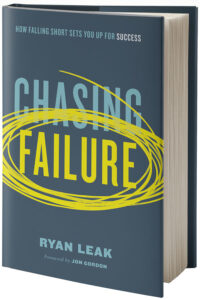
Chasing Failure – https://www.ryanleak.com/chasingfailure
I tested it, and they laughed. I’m like, “All right,” but sometimes the audience doesn’t laugh, and you’re like, “How bizarre is that?” Is it because of the time of day? Is it the delivery? What are your thoughts on that? If something’s funny 90% of the time, but not 10% of the time. Stand-up comics and Jerry Seinfeld is constantly refining what he does. What do you think is the reason? Should you throw it out then, or do you go, “No, this usually works?”
What I try to do is what I call my first base jokes. They’re jokes that I don’t you to be falling out of your seat laughing. I only need to know, “Do you smile?” Where are we at? Are we a target group? Are we a Walmart group? If you’re doing an event in Boston versus Atlanta, it’s two completely different mindsets about the world. There’s Southern hospitality in Georgia. There’s a natural emotional response to speakers that you’ll get in the South.
I went to Boston 4 or 5 times in 2022. Every time I landed there, the Uber driver was pissed off from the jump. If there’s a Southern hospitality, I call it sometimes a Northern pissivity. There’s a little bit of an edge already that you have to earn their respect a little bit more. I usually will kick off with things that don’t need to be funny, but let’s just see where their humor is and where everybody’s at. I’m always trying new things, trying to add, and trying to get better.
Your book Chasing Failure is a topic I want to talk about because so many of us feel like we focus on what doesn’t work the one time. If things work 9 times out of 10, but it didn’t work one time, then here’s where I see, myself included. I had to stop this behavior, which is all the way back to school. If I didn’t get an A and I got a C or something, I must be a failure. I’m a loser. Am I a great speaker if the audience didn’t laugh as much as they normally do?
I’m curious to see if you have this experience. Maybe you’re thinking, “I don’t know. This is going okay. It’s not going great. I’ve had to have the audience be a lot warmer.” You then get off stage, and people come up to go, “I loved what you said.” You’re like, “Somebody liked it out of the 500 people or whatever it was.” We can’t judge ourselves on what we’re experiencing at the moment. Is that what you’re saying?
Absolutely. Think of it like this. Somebody sends you a link to something funny. It’s a video. It’s an Instagram clip. It’s a meme. You might respond with a crying laughing emoji but you’re not. You’re like, “That’s funny,” in real life, but on text, you’re the furthest thing from crying or laughing. That’s what audiences are doing sometimes. We have to give ourselves some grace. Sometimes they’re going, “That was pretty funny,” but there’s no noise.
I did an event for a company where I spoke to 500 of their employees, and then they did two breakouts where they split the group in half and said, “Ryan, you’re going to speak to the whole group at 9:00, and then you’re going to speak to half of the group at 11:00. We’re going to break from lunch, and then you’ll speak to the second half at 1:00.” It’s pretty simple. I get my baseline by speaking to everybody in the morning. I go to that first half and a different talk, but that room was rocking. I’m like, “I know these people. I’ve spent the day with them.” I did the same talk at 11:00 that I did at 1:00. It flopped at 1:00, and it crushed at 11:00.
This is so valuable for everyone to read.
It’s the exact same slides, one room falling over laughing at some of the stories. There is some research out there that says after people have had lunch, they’re in that mode. A client will say, “What time do you want to speak?” I’m like, “I’ll speak whenever.” All time slots are not created equal. There are times when you’re the first thing in the morning at 7:30. I’m speaking. I’m doing a diversity, equity, and inclusion breakfast at 7:30 AM.
You have to prepare a little bit differently than your normal 10:00 AM keynote. One of the things that I have to tell myself before I speak is to make sure that I have fun, even if nobody else does. Enjoy the fact that you are one of the very few people on the planet that get an opportunity to talk for an hour and get paid for it. That’s amazing. I never let that leave me. I’ve never arrived. I’ve never like, “You all owe me this.” This is a privilege that I have, and I tell a lot of my professional athletes that too. I go, “Just in case you forget, you’re paid to play a game.”
[bctt tweet=”Make sure you have fun, even if nobody else does.” username=”John_Livesay”]
This is a dream very few people get to achieve.
Imagine somebody walking up to you and going, “Do you want to play Monopoly? We’re going to pay you to play Monopoly.” That’s your life. I feel the same way when it comes to speaking. I pinch myself every day to go, “I can’t believe I get to do this and get to add value to people’s lives.” Whether there’s a standing ovation or not, I say, “I want to make sure that at least I have a good time. I enjoy the fact that I get to be here and try to help people.” I am not trying to impress you. I am trying to help you go to the next level.
When I keep that at the forefront, then I’m not looking for affirmation from the audience anymore. I’m trying to help them. It positions you differently. Your countenance is different. One of the largest insurance companies in the world was having me speak. One of the questions I asked in pre-event calls is I say, “Who have you spoken to before that you love and why? Who have you had in the past? You don’t have to say their name, but I want you to tell me what they did that made you say we’re never going to have them again.”
I always like to make sure I don’t step on a landmine. This insurance company says, “The best figure we’ve ever had was Doc Rivers.” I was like, “Doc Rivers is a well-known NBA coach. That’s great.” It’s not a crazy surprise, but then I said, “Why was he the best figure you’ve ever had?” They said, “He was agendaless.” I thought, “Agendaless isn’t even a word.” However, it changed my approach to even how I work with clients going, “This next hour is not the Ryan show. It’s not about me. In fact, my only agenda is to help you.”
Here’s the interesting thing. Doc Rivers never used the word, “I’m agendaless.” It can be felt. There is something about a stage presence where people can feel when a speaker is trying to impress them versus going, “I’m here to talk about failure, and here’s what I realize about you. Sometimes it holds you back. Now, I’m going to help you reframe how you’ve seen this thing that has terrorized your career before.”
Right away, there is a difference, authority, and command of the room, “I don’t need you to like me. I want to help you overcome something in your life that’s holding you back. I’m going to tell you about some things that have happened in my life on how failure gave me a whole career. I keep trying to fail something every single day, and it has revolutionized my business.”
From there, you are more in command because you’re not trying to win them over. It’s like, “I’m trying to help you solve a problem.” When that’s the forefront of your brain, it’s amazing how relaxed and funnier you are because what you’re doing is you’re taking everyone’s guard down a little bit of going, “This guy’s a real guy. He’s an authentic guy. He’s not trying to sell me something right now.” I literally will watch people in the audience go from a folded arms position to a relaxed position.
The best I can ever get is when someone would come up to me after the talking, “I usually don’t pay attention to somebody talking that long. I’m on my phone or my mind wanders but those stories kept me engaged.” I’m like, “Great.” This concept of being agendaless is another version that is not being attached to whether someone likes us or what the outcome is. As you said, I’m not going to let my self-esteem go up and down based on whether I get a standing ovation or not.
No matter what your career is, do I need my boss to give me a rave review on my annual review, or do I know I did a great job or all those constant outside things that can make you feel less than others? This concept around chasing failure is interesting because most people, as you said, are terrorized by it, which is a great word. Why would I ever chase something that terrorizes me?
Can you tell us some of the lessons that are in the book that would get someone to go from, “If I ever meet a saber-toothed tiger, I’m running the other way, and I don’t care what you say?” This is not that kind of fear. This is fear of failure. Is it because we’re so in our heads, worried about what people think of us?

Chasing Failure: When you look at the fear of failure from a psychological standpoint, it’s really the fear of shame and embarrassment.
There’s a lot that goes on with that. When you look at the fear of failure from a psychological standpoint, it’s the fear of shame and embarrassment. What I’ve found is that there’s typically a particular person or group of people that we want to impress, somebody that we don’t want them to see us fail. It means that they were right. It means that our ex-girlfriend or ex-boyfriend will go, “Yes. I made a good decision.”
There is something underneath the hood of going, “If I fail, there’s somebody that’s watching, or at least, I think that they’re watching.” If they knew how this story ended, that’s what I’m afraid of. How I guide people through getting past this fear of putting themselves out there is a couple of things. One, every single person we look up to, admire, and read about has all failed.
We don’t realize that. We think, “This person’s always had success after success after success. Everything they touch turns to gold,” which is not true.
We have to dismantle the story we tell ourselves about other people that we watch their lives online. It’s not true. I’ll prove that it’s not true. I have a family photo. I’m on Zoom quite a bit. People are like, “What a beautiful family you have there. That’s great.” This is not indicative of how the day went at all. It was one of the worst days of our life. One of the kids was throwing up tons of stuff.
This was the only one picture of the thousands that we were taking that day because he was just trying to find one good photo and trying to get them in matching outfits and whatever, yet people will get my Christmas card and think, “What a beautiful family. This is how it always is.” It’s like, “No. That’s never how it is.” We can’t get them to sit on the couch for two seconds. If we’re honest, we don’t ever post our true story anyways. We post our very best and hide the rest. Everyone’s doing that. For you to be a failure, you have to deem somebody else successful. Why do you deem them successful?
It’s because of what they posted or because of what they showed you, but they won’t show you their pain. They won’t show you their scars, and oftentimes, they won’t show you their failures. What I started doing is I started showing people my behind-the-scenes. I started sharing about the different failures that I experience on a daily basis where I completely whipped it with a pre-event call or a sales call or completely lost a client. It’s like, “We won’t share that on LinkedIn, but it’s true. It happened all the time.” We’ve got to dismantle this belief that there’s somebody successful, that’s how I view success, and there’s me over here. It’s because usually, for us to be a failure, we have to be a failure compared to somebody else.
It’s a frame of reference.
We first have to navigate that. The second thing that is vitally important is whenever you’re thinking about trying something new or putting yourself out there, there’s no version of your life that is safe. There’s no version of your life that isn’t risky. Some people think, “I’m going to take my ball and play it safe in the corner. I’m going to do my 9:00 to 5:00.” Salesforce just laid off 8,000 people.
Companies are laying off thousands of people at the same time, and you’re going, “I thought you said it was safe.” Tell me, what is safe? I know so many people that have degrees from Stanford, Harvard, and Princeton that aren’t looking for jobs. Someone, please show me the safe route. I’ve yet to see it. The average CEO tenure is five years.
With CMOs, it’s eighteen months.
[bctt tweet=”If you learn from a failure, then you are not failing.” username=”John_Livesay”]
If you’re telling me, “My goal is to get here, and then I will feel secure,” that’s not a secure job. If you’re talking about doing it at a publicly-held company, good luck, buddy.
Look what happened at Disney. Bob Iger leaves, and then they promote somebody up. In less than two years, Bob’s back, and you’re out. Imagine that guy’s mindset.
I tell people, “There’s no version of your life that isn’t risky.” If there’s no version of your life or career that isn’t risky, you might as well do something that moves you toward your dreams. The other thing that is vitally important to understand about failure is you got to learn from it. If you are learning from your failures, you’re not failing. As long as you are taking notes on your failures, you are winning.
If you continue to fail the same way twice, you are just not taking notes. You’re not paying attention. You shouldn’t fail the same way twice. You should be tweaking something, a different angle, or something. The other thing that I write about in the book is as motivational speakers, we’re supposed to tell people to never give up. That’s terrible advice, especially if you’re talking to 1,000 people.
There are people that definitely should give up. We’ve seen them on American Idol. We’ve seen them on The Voice, and we went, “Somebody told you to never give up, but they should have told you instead to say, ‘Let’s see what some of these failures can teach us not to do.’” Again, you’re still learning. There are some things that I went, “Maybe I could. In my company, we tried doing Instagram 60-second documentaries.”
I thought it was going to be a hit. It flopped. It was terrible. It sounded like a great idea until it was fully flushed out. It was like, “No, it’s just an expensive 60-second video that people are just going to scroll by.” I learned that lesson. The platform isn’t designed for that. While I was trying to be innovative, sometimes you have to know when to give up.
One of the chapters in the book is to never gives up-ish. I’m like, “Go for it, but be smart.” Take some notes to go, “We’re going to try some things.” In the book, I laid out the top 100 companies in the world. I added up their research and development budgets. It’s billions. They’re failing on purpose every day in spending money to say, “We have to figure out a way to get this right.”
It’s because if we don’t, the competition will. If you look at Blockbuster, they used to be on every corner. The thought that that wouldn’t exist forever was like, “What else could ever place this? How did we live without this?” You also give a keynote talk on sales leadership. I love what you’ve said about putting your own spin on things. If you have heard of the concept leaders are readers, I like to say leaders or storytellers as well. You may not be somebody who likes to sit down and read a book. You found a way that works for you. Would you share what that is?
There are a couple of ways that I go about consuming content. One, I’m an Audible guy. I love listening to books. I can do that in a terminal. I can do that while I’m walking. I can do that while I’m exercising. Your brain can hear two times faster than it can talk. That’s why that scale is there on a lot of our audio devices to be able to do that.
Also, there’s another app called Blinkist, which gives you summaries of some of the top books in the world. There are some books that, for me, I love the person, but if I already know what you’re going to say, I am very familiar with a lot of your content, and I follow you, I only need the cliff notes. I need the one-liners. I need the overarching idea because that’s all I’m going to walk away with, anyway. I subscribed to Blinkist, and it’s amazing. You can get through a Blinkist in eleven minutes.

Chasing Failure: What people see is not always the true story of what it costs to be that person.
It’s another great tool. Your book is on Audible, Chasing Failure. Did you narrate it?
Yes.
I figured you did, as a speaker. That’s a whole process too. The concept that people think that you sit down and read your whole book in one take is not the case. Nobody usually has a session go more than two hours because you can’t keep the energy up. They listen to all the mistakes you made. You got to rerecord it and do pickups. If you’ve never thought about it or you go, “That Ryan is flawless in his reading.”
That is not the truth.
I mentioned Hoda in my book, and they’re like, “You’ve totally mispronounced her last name. We got to redo that.” I’m like, “Okay.” It is everything. Everything is a constant refinement of writing and recording your book. At the end of the day, people buy you. They buy your energy, vulnerability, transparency, and authenticity. That’s why you speak so frequently. I get it. You walk your talk. You don’t judge yourself, and therefore, people don’t feel judged when they’re in your presence. At least, that was my experience of being here.
One of the questions I often ask people is, “What does it cost to be you?” It’s a very important question because what people see is not always the true story of what it costs to be that person. They don’t see our flight schedule.
They only see the glamour.
They see the great photo, the arena, and the video highlights. They don’t see flight delays. They don’t see you jumping on one plane to catch another one. Whenever I see somebody that I admire most, I am like, “What does it cost to be you?” When people ask me for book advice, I say, “Don’t do it.” I don’t know that you have it. It’s not that I don’t think that you’re smart. It’s not that I don’t even that you can write a book, but writing a book is the easiest part about doing a book. Selling a book, marketing a book, and getting it into people’s hands are different. Do you have the schedule to sit in a studio and the patience and the cadence? You were like, “I want to tell my story.” It isn’t that easy. It’s not that simple. I’m like, “Unless you want this to be a thing, it’s going to cost you more than you think.” Know the cost. It’s not that I don’t believe in you. I’m only letting you know. It is harder than it looks.
When I had a corporate job and I would have to travel and there would be a delay, I’d be like, “As if this job isn’t hard enough. Now, I got to deal with that.” Now, when I have a travel delay and I’m speaking, I’m like, “I will put up with anything because I love what I do so much,” versus I like my job, but not enough to want to get up at 3:00 in the morning to catch a plane to be in New York in time for a cocktail party or whatever was required.
When you figure out what it is, then your home mindset of being instead of the angry Uber driver, you’re doing something you love, and you go, “That’s the cost.” The joke is we speak for free, and they pay us to travel. People go, “What do you mean?” You’re like, “The odds of a crying baby, a mechanical, and the weather is up there and/or a cab ride that has a flat tire.” It’s 101 things. I look at everything as, “This will make a great story.” That’s how I look at it, or, “I wouldn’t have met this person had I not missed that plane because the connection was delayed or whatever.”
[bctt tweet=”You can’t get better if you don’t get started.” username=”John_Livesay”]
Otherwise, you can’t show up and be fully present and alive. Also, whether you’re watching an athlete an actor, or a speaker, they shouldn’t have to know what you went through. They want to, “I’m here now. Wow me. Entertain me,” or whatever. Nobody cares about your drama unless they want to go into it. You have to be able to let all that go and not walk on the stage with a chip on your shoulder for God’s sake. As you said, it’s a privilege.
It is a privilege. Being in DFW, I’ve had mostly great travel experiences. Kudos to all of the different airlines that service our business, but DFW is a pretty good place to travel out of.
I often have to go there, “There’s no nonstop, so you’re going through Dallas.” “Okay.” It’s out of Austin. Any last thought or quote that you want to leave us? This question is great, “What does it cost to be you? There’s no version of your life that’s not risky.” You’ve given us so many incredible things to think about and reframe how we see failure and how we see ourselves, especially other people, and not compare ourselves so much and come up short.
The last line I would leave everyone with is you can’t get better if you don’t get started. You can’t make a book better if you don’t start writing. You can’t make a talk better unless you write one. Stop waiting for an audience. The greatest tool that a speaker or anybody that’s wanting to do something public-facing is social media. It’s the great equalizer. You might speak for Coca-Cola now, and I might speak for Facebook tomorrow, but guess what? Both of us have the opportunity to record something for Instagram right now.
It will show you if that resonated or not, “You got so many views on that,” versus this other thing I posted, “I got a lot of views. What’s the difference?” It’s instant data feedback. You’re like, “That works.”
There are things that I’m constantly trying on the internet every day. The biggest difference between myself and somebody that may be struggling to get some things off the ground is I’m willing to fail every day. I’m willing to fail more than most people. I’m willing to write a chapter that’s just okay, “I wrote a chapter, and you didn’t.” I’m willing to post a video that doesn’t get that much engagement.
In fact, the videos that will get the least engagement get the most. The videos that I think will get the most engagement get the least. It is one of those things where, as I said at the beginning, I don’t think you ever arrive. You consistently put yourself in the position of a student of, “Here’s what I’m learning. Here’s what I’m seeing. Here’s how I’m going to utilize that information to help the people around me.” You can’t improve something you never got started in the first place. If you don’t start the podcast, write the book, or start the business, you can never improve something that doesn’t exist. That’s what I want to leave people with.
Thank you. The book again is called Chasing Failure. If you want to find out more about Ryan or book him as a speaker, go to RyanLeak.com. Ryan, thanks again.
I appreciate it, John.
Important Links
- Chasing Failure
- Ryan Leak
- Blinkist
- RyanLeak.com
- Better Selling Through Storytelling Method Online Course
Wanna Host Your Own Podcast?
Click here to see how my friends at Podetize can help
Purchase John’s new book
John Livesay, The Pitch Whisperer
Share The Show
Did you enjoy the show? I’d love it if you subscribed today and left us a 5-star review!
- Click this link
- Click on the ‘Subscribe’ button below the artwork
- Go to the ‘Ratings and Reviews’ section
- Click on ‘Write a Review’
Love the show? Subscribe, rate, review, and share!
Join The Successful Pitch community today:
- JohnLivesay.com
- John Livesay Facebook
- John Livesay Twitter
- John Livesay LinkedIn
- John Livesay YouTube
Backable With Suneel Gupta
Posted by John Livesay in podcast | 0 comments

Whenever you’re faced with what looks like a massive failure, you can either be an ostrich and bury your head in the sand or be a peacock and say, “I’m owning this.” That is what Suneel Gupta, the founder of RISE and author of Backable, learned from his experience. Imagine spending your whole career trying to paint a picture of success, only to become a poster child for failure. That is exactly what happened to Suneel as he tried and failed to pitch his idea of a one-on-one nutrition coaching platform to one naysaying investor after another. Put that on top of halted startups, canceled projects, missed promotions, and missed opportunities and you’ve got the perfect person for The New York Times to label as “The Face of Failure.” How does one get back up from that? You’ll be surprised how deceptively simple the answer is. Join in as he shares some of it with John Livesay.
—
Listen to the podcast here
Backable With Suneel Gupta
Our guest on the show is Suneel Gupta, the author of Backable. He says that when we focus on seven qualities, anybody can learn to be backable. We go over some of them so you can learn how to be backable. The concept of embracing something negative is an interesting way to look at something and your power to reframe something. Most importantly he said, “It’s not charisma that convinces people, it’s conviction.” Enjoy the episode.
—
Our guest is Suneel Gupta, who is the Founder of RISE, and is on faculty at Harvard University. Using the seven steps inside this book, Suneel went from being the face of failure for The New York Times to being the “New Face of Innovation” for the New York Stock Exchange. His ideas have been backed by firms like Greylock and Google Ventures. He has invested in startups including Airbnb, Calm and SpaceX. He also serves as an emissary for Gross National Happiness between the United States and the Kingdom of Bhutan. Welcome to the show, Suneel.
It’s nice to be here, John. Thanks for having me.
I’d love to hear a little bit more about your own story of origin. You could go back to childhood or school. It’s always interesting to see what got you to where you are now.
Why don’t we pick a moment that always stands out to me? It is the basis for this book that came out called Backable. The moment was in 2004. I am working as a junior-level speechwriter for the Democratic National Committee. I’m at the 2004 convention, which was being held in Boston that year. I’m backstage. The convention draws the who’s who crowd to be there and give speeches. Backstage, there are the Clintons, the Gores, the Liebermans, the standard faces of the Democratic Party. There was one face that I did not recognize and that was Barack Obama. I didn’t know who he was. A lot of people didn’t know who he was. While he gave his speech that night, that changed his career and I would argue changed the world. I got to watch that speech from backstage.
It was interesting because while it seemed like the world was watching Barack Obama, I got to watch the world. What I saw was this tidal wave of energy just ripped through the stadium. I became one of the millions of young people that night who became interested in his story. I started to dig deep into, “What is this guy all about?” What I realized surprised me. Four years earlier, he had run for Congress, not for Senate, not for president. He had run for Congress and he had lost. He had lost by a big margin. What surprised me more, John, was the way that he was received during that campaign. People described him as boring, stilted and professorial. There was a guy named Ted McClellan, who was a journalist who covered the campaign. He said, “Barack Obama is so dry that he sucks all the air out of the room.” Four years later, in 2004, he is this bastion of hope, inspiration and charisma.
The reason that story stands out for me, not only for my career in the way that I view the world but also this book that I wrote is because it turned me on to the power and possibility of human transformation. We can always change and reinvent ourselves. I have become obsessed and fascinated by how people do that. What happened in those four years between 2000 and 2004 for Barack Obama? What happens when we take the stories of all of the people that we admire who we now are looking at the chapters 14, 15, 16 in their story? If we go back to chapter one, what does that look like? Where did that begin? How do they evolve over time? That’s what makes me tick.
[bctt tweet=”Being #backable is not just for celebrities and CEOs. It’s something that all of us can learn.” username=”John_Livesay”]
In your own story, you were called out by The New York Times, “The Face of Failure.” You weren’t the only one. You and Barack share that similar history of being called something that’s not exactly positive and something that most people would say, “You’re never going to recover from that label.” The face of failure, in this case or in Barack’s case, sucking the air out of the room or the opposite of charisma. What’s the story? What happened? What did you do that caused The New York times to say that?
I was an entrepreneur at the time. I was pitching every investor I could find on this idea called RISE, which was one-on-one nutrition coaching right over your mobile phone. I was passionate about the idea and felt like it should exist. I could not get any investors to say yes. I also had a checkered past in terms of success and failure. I’d been part of a couple of startups that didn’t go anywhere. I’d been on the other side of canceled projects, missed promotions and missed opportunities. One day, I got a phone call from the organizer of a conference called FailCon, which stands for Failure Conference. She said to me, “You have been nominated twice to be a speaker at this conference.”
John, it’s a humbling experience when somebody calls and says, “I’m running a conference on failure. We would love for you to be the keynote speaker.” The reason I accepted that is because I thought, “Maybe there might be some investors in the audience, people who I can get on board with this new idea.” It turned out there wasn’t but there was a reporter in the audience from The New York Times. Fast forward to sitting in my apartment one day in San Francisco, my wife turned to the newspaper. There was a full-length feature story on failure with my story as the photo up top. That article went viral. It went viral to the point where for months you could have Googled just the word failure and you would have seen my face as one of your top search results.
That’s some SEO challenge in there.
I bet it’s still there. It’s still probably on page 1 or 2. When something like that happens, you have a couple of choices. One is you can pretend that it doesn’t exist and move in any direction. The other is you can embrace it. I had spent my whole career trying to paint this picture of success. Now, I’m the poster child of failure. I decided, “What would it look like to embrace that a little bit?” The way that I thought about there were all these people that I was trying to get coffee with and get advice from. I was cold calling them. I was reaching out to them the same way that anybody else would. “I’m living here in San Francisco trying to break through into tech and entrepreneurship. Would you grab a coffee with me?” Most people would say no or disregard the email. Now, I changed my approach. I sent them the article and I would say, “As you can see from this New York Times article, I have no idea what I’m doing. Would you be willing to spend a few minutes grabbing advice?” People loved it.
One bullet breaks through the clutter. It’s self-deprecating and clever. It’s the fact that The New York Times covered it, not just you saying it. It works on so many levels. You could be an ostrich and bury your head in the sand or you could be the peacock and say, “I’m owning this.” This story continues to get better. After all those noes and getting labeled that, you did get some funding. It was eventually acquired by One Medical. The full circle to your opening story about Barack is, in 2016, Michelle Obama partnered with RISE to bring this coaching to low-income communities. Nobody could have predicted the outcome of the story. I love that story. When a story has a twist like this, it is fascinating to hear. We all have the hero’s journey of like, “He’s down or she’s never going to recover from this.” Recovering might have been, “We finally got some funding.” It probably went beyond your wildest dreams when you started it, to get the first lady involved with it.
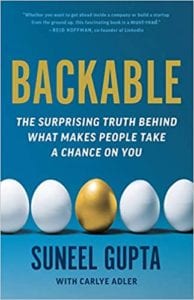
Backable: The Surprising Truth Behind What Makes People Take a Chance on You
John, you and I both love Joseph Campbell. We both love the hero’s journey. We know that one of the components of the hero’s journey is like, “Along the way, there’s an insight, learning, something that changes your worldview.” For me, through these conversations that I started to have, creativity and persuasion are two different things. Oftentimes, we think about them as one. We all know that you can have a great idea, be a great candidate for a job, have a beautiful product and still be dismissed. We see it happen all the time. That’s what I was feeling. Many of us have felt that way.
One of the stories that always pops for me especially is the story of Alexander Fleming, who came up with penicillin. Penicillin, to date, has saved nearly 200 million lives, yet it took him ten years to get people to buy into it. He got dismissed over and over again. Brilliant, game-changing ideas aren’t always met with a room of people who are going to support them. All of that got me interested in this idea of backable people. These are people who tend to be able to go into a room whether that be an interview, an audition or a pitch and they tend to shine. The trick of it is that, oftentimes, it’s when they aren’t the obvious choice. When they don’t have a fully baked product, we still feel like we want to take a chance on them. I wanted to understand like, “What is that quality? Can it be learned?”
Following up on this New York Times article, I started to have these conversations with people and said, “Let me have more and more.” Eventually, I found myself having hundreds of conversations with backable people from all walks of life including Oscar-winning filmmakers, Michelin Star chefs, military leaders, founders of iconic companies and fast-rising community initiatives. What I found was that being backable is not just for celebrities and CEOs, it’s for all of us. Being backable is not something that you’re born with but it very much is something that you can learn.
Let’s take a pause there. You’re being very humble. I’m going to shout-out. You have this book that has reviews from Reid Hoffman, the Cofounder of LinkedIn and Brian Grazer, one of my all-time favorite Oscar-winning producers of amazing movies. You’ve been able to not only have your own insights on what makes someone backable but figure out a way to grow your network and get out in front of people who are clearly backable and believe in what you’re doing. It’s a one-two punch there that gives it so much credibility much like The New York Times. One extreme to the other that social proof that gets transferred is what you’re demonstrating here in a big way that helps a lot of investors. You’ve invested in some successful companies yourself. I’m sure there are some things you look for in a founder that would be helpful to share that other people saw in you. The basic question is, as an investor, what makes a founder backable besides the idea?
The book outlines these seven qualities. We should talk about them. One of the things that I tried with this book, part of the reason that it’s doing well and a number-one new release is it talks about the stories and the substance but we get into the techniques. I personally love it when you can break it down for me and give me some specific techniques that I can use to bring it into my life immediately. Let’s start talking about some of these qualities. One of the first ones in the book came to me as a surprise. When I first started studying backable people, I thought that I was going to find a certain pattern of communication. I thought that backable people generally were going to end up being gifted speakers. They were going to make use of eye contact, hand gestures and pacing. I did not find that to be the case.
You certainly had backable people who are gifted speakers. It can be very Dale Carnegie-esque or Toastmasters-esque. There are plenty out there that are not. They’re shy, quiet and introverted. They’re not what we think of when we think of charisma. If you want an example of that, take a look at the most popular TED Talk of all time. What you’ll find is a brilliant talk being given by a guy named Sir Ken Robinson. It’s got over 65 million views. Amazing talk but not what you might expect. It’s a very un-TED-like talk. He’s got one hand in his pocket. He naturally walks with a bit of a slouch. He meanders on and off script, yet it was very well-received. What I found is that it’s not charisma that convinces people, it’s conviction.
[bctt tweet=”It’s not charisma that convinces people. It’s conviction.” username=”John_Livesay”]
There we go. There’s a tweet if I ever heard one. Plus, I love the fact that it’s got all those great alliterations. “It’s not charisma that convinces people, it’s conviction.” That’s a great line.
Backable people take the time to convince themselves first. They let that conviction shine through, whatever style it is that feels most natural to them.
Going back a little bit to your own story of origin, you have a relatively famous brother. I’m guessing that there’s a story there of what your parents taught you both. Why don’t you do the big reveal of who your brother is? It’s this concept of environment versus genetics. What causes certain families to produce such high achievers that are not just backable but impactful in the world? I wanted to ask, was there any sibling rivalry? Tell us a little bit about that experience with your brother and who he is.
It’s impossible for me to talk about my family without talking about my mom first. My mom was born and raised in a refugee camp on the border of Pakistan and India. She decided that somehow, she was going to become an engineer with Ford Motor Company. Her parents got behind the vision and dream. She got on a boat to the United States, ended up getting a scholarship at Oklahoma State University, drove to Detroit the day after graduation and went into the interview. When she got into the interview, the hiring manager said, “I’m sorry. We don’t have any female engineers here.” She, at that moment, was deflated. She picked up her resume and purse. She started to walk out of the room. In this last-ditch moment, she turned around and told this hiring manager her story of all the struggles that it had taken to get to this country, to get to Detroit, to get to this room. This guy was so moved by her story that he ended up taking a chance on her. She became Ford Motor Company’s first-ever female engineer. That was in 1967.
That’s the genesis story in a lot of ways for our family. I will talk about my brother here in a moment. We were raised with the refugee mentality even though we grew up in a very different environment than my mom. We had all the stuff that she didn’t have. We grew up in a safe, almost boring suburban Michigan. There’s still this refugee mindset of impermanence and possibility combined. It cuts both ways. With impermanence, you almost feel sometimes that things can be taken from you. You almost have an appreciation sometimes for what you have because you realize it could be gone. There’s the possibility. The possibility is there are no boundaries. Your past doesn’t necessarily determine your future. That’s what we learned simply from her story. She didn’t have to tell us that. It was who we were.
For my brother, he went to medical school and became a practicing surgeon in suburban Michigan. He realized he liked his job but he felt like there was more. He felt like he could be doing more of the type of work that he wanted to be doing. Naturally, he’s a gifted storyteller. He wanted to be telling the stories of patients. I remember I was in college at the time. I came home and he was home as well. We were with my parents. He was like, “I think I’d like to be on television. I’d like to start reporting on healthcare and patients’ stories.” I remember my mom was like, “Go do it. Figure out a way to make it happen. There’s no time like the present.”

Backable: When failure happens, you have two choices. The first one is to pretend that it doesn’t exist. The other one is to embrace it.
My brother, very similar to my mom’s improbable story, somehow gets himself in a room with the powers that be at CNN. This was in the year 2001. He has no Journalism and on-air experience but made himself backable in that moment. There are a lot of the techniques in the book that we talked about that he brought to that moment naturally. One of which is that he talked about his central character. He talked about the patient. Even though he didn’t have the on-air experience, his argument was, “I spend day in and day out with these patients. I understand them at a level that I may not be able to understand them if I wasn’t practicing day in and day out. These are the stories that I want to tell. These are the people I want to connect with.” It worked. They gave him a shot just like a hiring manager gave my mom a shot. That’s how Dr. Sanjay Gupta was at CNN.
One of the things that you talked about in the book, Backable, is this ability to put ourselves in a story that makes it memorable. You are singing from my song book. When people are pitching themselves to get a job, as your brother and mom did, pitching people to hire them, to buy their course and as speakers we have to pitch ourselves. If you can’t say something that makes you memorable during that interview and you’re just pushing out facts and figures or the details of your resume, “I’m a doctor. I went here,” and you don’t have a story to go, what I often do is I’ll tell a story of what happened at a recent speaking event and how that transformed the audience and made the people who hired me looked like heroes, all of those things and the feelings that get associated with it.
Stories are the emotional glue. We’re wired for stories. Few people understand that. You are supporting this so much that these personal anecdotes are what make us memorable. If you put yourself in the shoes of a hiring manager, an investor and the number of pitches that you hear in a year, there’s got to be somebody who says something to you that makes that memorable so that you can tell other people. That’s what people don’t realize. When someone like you, your brother or your mom tells a story or anybody who reads this book, Backable, learns is, “Once I have a story that makes me memorable, it’s not just that person who can remember it. They remember my story and tell other people.” That’s when it starts to grow viral or whatever else you might need it to do for those meetings when people are thinking, “Should we hire Suneel or someone else? Should we hire John or someone else? Did anybody tell us a story that we can tell other people of why we want to pick this person over another person?”
It’s such a good point, John. We’re not anymore pitching people. Hardly ever are we pitching the people who are going to be the only decision-makers. Typically, they’re going to have to sell their partners, other people, their boards, even their teams, on the decision they’re making. We’re not just looking for backers. We’re looking for advocates. Salman Rushdie has this great quote, “Most of what matters in our life takes place in our absence.” We don’t know what these conversations are like when we’re not there. We are trying to have people who are as passionate about what we’re trying to do with our own careers and ideas as we are. I do think stories are such a big part of that.
I remember pitching to Tim Ferriss on my company, RISE. I thought Tim was the perfect investor. When I was doing this one-on-one nutrition coaching right over your mobile phone, he had just written a book called The 4-Hour Body. He was starting to invest in companies. I thought it was the perfect fit. It turned out, he ended up passing on the idea. Along the way, he gave me some feedback that I will never forget. When I pitched to him, if you would have looked at that pitch, I spent the vast majority of my time talking about the market. I talked about the rising rates of diabetes, hypertension, obesity and how many people were out there spending money on trying to get into better physical health.
At the very end of the presentation, I told the story of my father. When he was in his 40s, he had an emergency triple bypass surgery. I still remember going to the hospital, I was about ten years old. I remember going to the hospital and felt like I had seen my father aged 25 years overnight. When we were leaving the hospital, they gave us a piece of paper. That piece of paper said things like, “Eat broccoli. Eat Brussels sprouts.” We were an Indian family. We didn’t eat broccoli and Brussels sprouts. There was nothing on that paper about chicken tikka masala. We struggled to make this diet that we were supposed to have now work. We struggled to make it fit for us. It wasn’t until insurance helped us pay for some time for a nutritionist that we were able to customize our lifestyle into something that worked. I believe that’s the reason that my father lived through that experience. He’s still alive now.
[bctt tweet=”The meaning of life is to find your gift. The purpose of life is to give it away.” username=”John_Livesay”]
I told Tim Ferriss that story. His feedback to me was like, “Why the hell are you leaving that story to the very end? Tell that story upfront.” My response to him was like, “It’s an Indian story. It’s an Indian thing.” He said, “No. It makes it even more important that you tell that story upfront even if the people who are sitting on the other side of the table from you look different than that. Even if they didn’t eat chicken tikka masala, it’s important. What you’re doing especially when you get into the details, is you’re helping them see themselves through the eyes of your central character, the one person that you’re trying to serve with this idea. If they can see themselves through the eyes of that central character, that’s when you hook them emotionally and then you talk about the numbers and the market. It’s the story that brings us in. It’s the substance that keeps us there.”
It brings us in and the substance keeps us paying attention but you can’t open with the substance. You did a beautiful job describing 5 of the 7 parts of what makes somebody backable. It’s drawing people into the story that makes them feel like insiders. I did this with Olympus Medical. I was saying to them, “What are you saying to doctors to get them to buy this equipment?” They said, “This equipment makes your surgeries go 30% faster. Do you want one?” I was like, “There’s no story there. That’s a left-brain analytical data like the market size.”
The story I helped them craft was, “Imagine how happy Dr. Higgins was six months ago using our equipment. He could go out to the patient’s family in the waiting room an hour earlier than expected. If you’ve ever waited for someone you love to come out of surgery, you know every minute feels like an hour. He came out, put them out of their waiting misery and said, ‘Good news. The scans showed they don’t have cancer. They’re going to be fine.’ He turned to the rep and says, ‘That’s why I became a doctor, for moments like this.’ That rep told that story to another doctor who sees themselves in the story and says, ‘That’s why I became a doctor too. I want your equipment.'”
That is your dad’s story with getting out of the hospital. By adding those little elements like, “If you’ve ever waited in the hospital for someone you love to come out of surgery, you know every minute,” that’s what pulls people in. Even if they haven’t had that experience, they probably know someone who has or they can certainly imagine how painful that would be. Those are the details that make me love your books so much. I have rarely seen anybody else talk about how to tell stories that are memorable. I say, “Tug at the heartstrings to get people to open the purse strings,” is what you’re showing us together.
I could talk to you forever. We’re only going to talk about a few things enough. Hopefully, it incentivizes people to run, not walk, to the nearest way to get a book. The last question I have for you is this beautiful cover, gold and blue, the gold egg. We all know there’s a story there about the goose that laid the golden eggs. I know, as an author, how much work goes into a book cover. What’s the story behind the book cover?
I’m glad you asked because I don’t get to talk about this enough. The book cover went through a few iterations. I worked with a great publisher. Little, Brown has been fantastic. I will say that when they sent me their first vision for the book cover, it was not something that I gravitated towards. It was the Facebook like thumbs. It was a cover full of thumbs where all of them were thumbs down but one of them was thumbs up. Same metaphor, it was like, “How do you get the thumbs up?” What I didn’t like about it was it felt overtly negative. It was almost littered with negativity.

Backable: Backable people take the time to convince themselves first. They let that conviction shine through, whatever style it is that feels most natural to them.
The other thing was it was very techy. I initially started writing this book because I felt like I was coming from the point of view of somebody who worked as an entrepreneur. I worked in tech. What I realized was like, “There’s not a single person out there who isn’t trying to make themselves backable in some way. You don’t have to be working as an entrepreneur. You don’t have to be working in tech.” It’s a human problem that we’re dealing with, which is unused creativity. We don’t sometimes know how to take these ideas that are inside us and get other people as excited about it as we are. That’s a human problem, not a tech problem. It’s not necessarily even an entrepreneurial problem.
I wanted to take this metaphor and do other iterations. It was interesting, John. I don’t know what your experience was like. With me, there was a push-pull that you have. We were very collaborative about it. I was super grateful to them for being that way. It reminded me a lot of one of the techniques that you talked about, which is flipping outsiders to insiders. One of my favorite stories from the book is it takes us back to the 1940s where Betty Crocker has introduced instant cake mix to the market. They were excited about this instant cake mix. All you have to do is pour water into a mix, pop it into an oven, and voila, you get this tasty treat. Who wouldn’t want that?
They were surprised when they find out that instant cake mix was not selling. Sales were terrible. They were trying to figure out why. They hired this psychologist named Ernest Dichter to go out into the field and start talking to homes across the country. What Dichter found when he came back with was fascinating. He said, “I think you’ve made the process of making a cake too easy and too simple. You removed the customer from the creative process so much so that when a cake comes out of the oven, they don’t feel any ownership of it.” His recommendation was, “Why don’t you remove one ingredient and see what happens?” They did. They removed the egg. Now, as a customer, you have to crack and mix in your own fresh egg. Sales skyrocketed. Now, when the cake comes out of the oven, customers felt like they were a part of it.
I think that comes back to this idea of we’ve been told that creativity and innovation is a two-step formula. You come up with a great idea and you execute on it well. I think there’s a hidden step in-between. That hidden step is where we flip outsiders into insiders so they feel like it’s their idea as well. In that way, when we show up to the execution, we show up together. These can be early employees, early investors, early colleagues who decided to take a leap of faith in your idea. You can trace every successful project, every successful organization, nonprofit company, political movement back to this hidden step.
There are many wonderful takeaways. Flipping outsiders into insiders. It’s not charisma that convinces, it’s conviction. This whole premise that the stories bring us in but it’s the substance that keeps us involved. The book is called Backable. The website to go read about the book and buy the book is Backable.com. Any last comments or ways that you want people to follow you and read about the book?
Go to Backable.com. I’ll leave you with one thought. I have two daughters, an 8-year-old and a 4-year-old. We do this little game every morning. I ask both of them, “What is the meaning of life?” They say, “To find your gift.” I said, “What is the purpose of life?” They say, “To give it away.” The meaning of life is to find your gift. The purpose of life is to give it away. I wrote this book, Backable, so that we can learn how to give our gift away. Thank you, John. I appreciate you having me on.
Thank you, Suneel. What a gift you are to the world. I’m sure you’re a great dad. I can’t wait for all kinds of people to benefit from learning these learnable insights on letting us all become a little bit more backable than we were before we got to read your wonderful book.
Thank you.
Important Links
- RISE
- Sir Ken Robinson
- The 4-Hour Body
- http://backable.com/
- Better Selling Through Storytelling Method Online Course
Wanna Host Your Own Podcast?
Click here to see how my friends at Podetize can help
Purchase John’s new book
John Livesay, The Pitch Whisperer
Share The Show
Did you enjoy the show? I’d love it if you subscribed today and left us a 5-star review!
- Click this link
- Click on the ‘Subscribe’ button below the artwork
- Go to the ‘Ratings and Reviews’ section
- Click on ‘Write a Review’
Love the show? Subscribe, rate, review, and share!
Join The Successful Pitch community today:
- JohnLivesay.com
- John Livesay Facebook
- John Livesay Twitter
- John Livesay LinkedIn
- John Livesay YouTube
Digital Leadership with Erik Qualman
Posted by John Livesay in podcast | 0 comments

Episode Summary:
Technology has greatly changed the dynamics of the world. Great leaders know how this impacts the business and therefore, learned to adapt with it. Taking the two together is best-selling author and keynote speaker, Erik Qualman, as he talks about the concept of digital leadership. Known as Equalman, the Digital Dale Carnegie, and The Tony Robbins of Tech, Erik shares how he has grown in his life by changing his mindset along the way and starting to look at how life happens for you and not to you. He believes that even failure has to be done right. Erik gets down into his work with Digital Leader, the superhero concept he has created a brand around, and why you should set a laughable goal. He reveals his secrets on what it means to give digital hugs especially in a world where it is easy to become impersonal.
—
Listen To The Episode Here
Digital Leadership with Erik Qualman
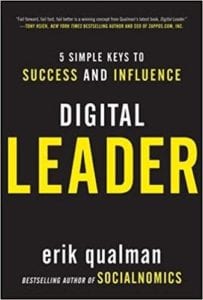
Digital Leader: 5 Simple Keys to Success and Influence
Our guest is Erik Qualman, who’s often called a Digital Dale Carnegie and the Tony Robbins of Tech. He is a number one bestselling author and a motivational keynote speaker who’s spoken in over 50 countries and reached 30 million people. His Socialnomics work has been featured on 60 Minutes to the Wall Street Journal and has been used by the National Guard to NASA. His book, Digital Leader, propelled him to be voted the Second Most Likable Author in the World behind Harry Potter‘s JK Rowling. Qualman was formerly a sitting professor at Harvard and MIT labs and he’s also the owner of an animation studio. Erik, welcome to the show.
Thanks for having me. It’s an honor to be here.
I always love to ask my guests to take us back to some point with their own little story of origin. Did you know that you wanted to get into tech at a young age? Was there a moment in time you went, “This is for me?”
I fell into it backward like a lot of people. I’ve been in the tech space for many years. I grew up in Detroit. Like a lot of kids in Detroit, you go and work for the automotive industry. As an intern, I was working with Cadillac. Part of my job as an intern was to write the meeting notes. I go to the meeting, write out the notes, print them, put them on people’s desks and they had a thing called interoffice mail which had a little red string on it. We’d send that out. Each meeting took me about two hours to produce this. Crazy enough for a lot of your audience out there, email was brand new at the time. I said, “I wonder if I can send an attachment instead of printing these. Can I attach this to this thing called email?” There wasn’t Google. It took me a while to figure it out, but I did. Instead of taking two hours, it took me five minutes. I sent out the note and then the next thing I know, the CEO of Cadillac is standing right next to me. I’m going, “This guy is super pumped. I’m going to be in the executive suite here soon.” I quickly realized it was my time to explain why I should keep my internship. I went, “To save two hours of my time,” but I could tell by the look on his face he didn’t care how I spent two hours of my time. The second thing I said was, “This saves the environment. We don’t have to print the paper.” Remember this was the ‘90s. No one cared about the environment. Last but not least I said, “I can track this if someone saw it.” He goes away. I saved my internship.
A couple months later, they come out with these things called websites and the CMO is talking to the CEO going, “We need this thing called the website.” Try to explain that before they exist. It’s a mission impossible so the CEO goes, “I have no idea what you’re talking about, but go talk to the kid on the first floor.” Keep in mind that your email address is normally your first initial and last name. As Erik Qualman, that becomes EQualman. He goes, “Go talk to the kid on the first floor that thinks he’s a superhero. Maybe he can get us this Cadillac.com thing you’re talking about up front.” It’s been a long ride. I love it. That’s how we fell in it backward, a kid born and raised in South Detroit. We went from there.
[bctt tweet=”Things happen for you, not to you. ” username=”John_Livesay”]
That superhero concept is something that I want to explore because you’ve created a whole brand around it. Tell our audience what the significance is about being Equalman and the colored glasses that you wear and how that makes you memorable and unique.
For those not familiar with me, I wear these bright green glasses. They’re Clark Kent-like glasses. For the beginning of my career, the first many years I hated being called Equalman. Imagine if you’re an intern or a junior associate walking into a meeting and they go, “Don’t worry, Equalman’s here. He can save everything.” I fought it, which a lot of us do. We fight what’s at our core, who we are a lot of times. For some reason, we fight who our true self is. I fell into this a little bit backward. Things happen for you, not to you. I was doing an article with a magazine when the book started to take off. Digital Leader started taking off. They did a magazine article. They wanted to have me on the cover and they go, “Your website’s Equalman since your email address is Equalman, do you mind wearing Clark Kent-like glasses?” I go, “That sounds fun. Let’s have fun.” They go, “Do you mind if they’re green because it’s going to be the Saint Patrick’s Day? It’s coming out in March.” I go, “Whatever helps.” They bring them out and I go, “Those are bright green glasses.”
We do this shoot. I don’t think much of it. A couple of weeks later, I go to Kenya to speak. The night before I’m going to adopt a baby cheetah at a rescue shelter, not to take home but to support the local community. Ironically enough, the day before, Usain Bolt the Olympian, the sprinter had adopted from the same litter. As we drive over to the rescue shelter, the lady that’s with me says, “If you don’t mind, we’re going to film a lot of this because it’ll help promote the shelter. We had Usain Bolt here yesterday and we filmed him. We’re going to splice all this together. For the video, we’d like you to have your green glasses on.” I looked at her and I said, “I don’t wear those green glasses every day. I look like an idiot walking around wearing green glasses like that everyday day.” The look on her face was that of disappointment. She said, “Everyone in Kenya, that’s what they think that you look like.” I never wanted to see that look of disappointment again. Over time, we’ve started to wear them more. Almost all the time I’m wearing them because it’s turned out to be good for business. We lose some business. We don’t want that, “That guy looks a little quirky,” but then we gain a lot more.
Crazy enough we’re in the business of producing these green glasses because I’ll go and perform. There are 2,000 people in the audience and they go, “We want to have some fun. We want to have a big photo opportunity. Can we get some of those green glasses?” Originally, we pushed them to Amazon. Over time, Amazon can’t handle these large orders. Now we’ve become producers of these bright green glasses. It all works out for you in the end. We completely have stepped into being my true self and it’s been learning and a journey for me that help my audiences to say, “You got to step into that discomfort.” Every day I now walk in discomfort wearing bright green glasses. Sometimes I forget I’m wearing it and then people are looking at me strangely. I go, “That’s right. I’m wearing these bright green glasses.” It’s a very long story to say that my cheetah is much faster than Usain Bolt’s cheetah.
The entrepreneurship of making the glasses for your audience is a fantastic full circle there. You said, “Things happen for you, not to you.” Did I hear you correctly?
A lot of us wake up and there’s going to be this challenge every day. With time, it might be a couple minutes, it might be a couple of minutes, a couple of days, sometimes it might take fifteen years, but you can look back and go, “It’s happening for me. It’s not just so I could be made fun of. This thing happened for me, not to me.” Once you change that lens and mindset, your day-to-day is going to be much better.
[bctt tweet=”Evaluated practice leads to progress.” username=”John_Livesay”]
Another example was the disappointment on that woman’s face when you said you didn’t want to wear the glasses. You thought, “That’s not happening to me. It’s happening for me if I embrace this.” Now you’re selling glasses. You don’t need glasses to see. They’re not prescription? Are they plain glass?
Here’s a tip for everyone that’s out there that’s a speaker. Everyone’s a speaker, whether it’s the size of one or size of 10,000. I do wear corrective lenses. I normally have contacts in. I do also wear glasses. The bright greens, we’re trying to figure out how we get bright green glasses and high-end glasses, but that color is hard to come by. It’s only replicable in plastic. On stage, I wear my contact lenses for a couple of reasons and a lot of this is to learn the process. I didn’t know this until we started doing it. Number one, you don’t want to reflect the light back on the audience because it’s going to refract off your lenses when you’re wearing glasses. Secondarily, if they’re taking photos or video of you, it’s a lot crisper when people can see your actual eyes. They can relate more not only the audience there but also the audience that’s abroad when you’re being filmed. Last but not least, as you exit the stage and you’re doing a book signing, there’s going to be in this day and age a lot of selfies being taken or photos being taken with the people that are getting their books signed. The picture is much better when you don’t have the lens in your glasses.
I want to ask you a few questions about your book, Digital Leader. You have something in here that I love, an acronym. Fail forward, fail fast and fail better. Can you give us a little sneak peek on what that means?
Fail fast, another synonym for that is to fail cheap. If you’re going to fail, you might as well do it in an hour. That’s much better to do it than six months and it’s going to be cheaper. If you’re going to fail, which we all should, it’s all part of a learning process. The misnomer, because everyone’s like, “Fail, fail, fail.” You’ve got to do it the right way. That’s why I always say, “Fail fast, fail forward, fail better.” The second one is to fail forward is to evaluate that failure. For those that are into music or have grown up doing sports, there’s the old adage that practice makes perfect which is completely false. Evaluated practice leads to progress. If you don’t evaluate that practice, then practice leads to permanence and probably permanence in the wrong way. It’s about evaluated failure. Fail fast, which makes sense. Fail better is you got to evaluate the failure, which for most of us that goes against their DNA. You want to sweep it under the rug.
With teams at work, they’re not your best buddies. They’re friends. It’s uncomfortable to be like, “John did this or Jim, Kelly, this totally didn’t work,” and what you do is you don’t evaluate it because it’s uncomfortable. If you evaluate it then you can fail better, meaning you’re not going to repeat the same mistake twice. The key though is the first two tenets then they lead to the third. That’s what it’s all about. It’s being fail fast, fail forward and fail better. Failure does lead to learning. Failure’s a part of the process but you’ve got to do it the right way.
That is the secret there because I know there’s a lot of fear of failure and I tell people to look at it as feedback. Your concept here of evaluated practice leads to progress. When there’s death in hospitals, the medical community has a process where they will have a meeting to see what went wrong without pointing fingers. To see if they did something in the surgery that caused that patient to die. A lot of sales organizations could benefit from this concept of failing forward. If they could create a safe enough environment where people were not pointing fingers at what caused a sale not to happen. They can learn from it so they don’t keep making the same mistakes when they pitch. You mentioned the willingness to have fun and with the glasses. One of the chapters in your book is to set a laughable goal. Can you tell us an example or two of what a laughable goal is and how we might be able to do that?
I will tell you my laughable goal because the more I repeat it, the more likely it will become an outcome or it’s reminding me too that, “This is what we’re trying to do.” My laughable goal is to create the next Disney World. It’s to have an actual park, a physical location. Families come in there. It’s more educational-based. There’s still entertainment, but when they leave they’ve been educated. It’s taking that Disney 2.0. I love Disney. I love Disney Parks. If Walt Disney were to arrive, come back and walk around Disney he’d go, “This is all you’ve changed? This hasn’t changed much.” It’s a wonderful place. It’s the happiest place on earth. It’s about taking the amazing stuff that they do and doing it 2.0. Whether in the marathon we may get to Mile 11, Mile 14, it’s about getting to hopefully that 26.2. As it relates to that, the other laughable goal is that we want to entertain, educate and empower seven billion people this decade. In our minds, that is setting the bar low because there are more than seven billion people and there’ll be more than seven billion people when we look out many years from now. It’s about setting it out there. That goal has to be laughable that most people you’d tell, the first reaction is that they laugh. Those that don’t continue to laugh are the ones who are going to help you get there.

Digital Leadership: Those that don’t continue to laugh at your laughable goal are the ones who are going to help you get there.
Sometimes when we have a goal, we’re afraid to share it because people will think we’re crazy or who do you think you are to have that goal. I remember the first time I said out loud to somebody that I wanted to give a TEDx Talk I did a little bit of a gulp. Instead of saying, “That’s never going to happen or you’re crazy,” the person I happened to mention it to said, “I know someone who organizes the ones in San Diego. Let me put you in touch with him and he can give you some tips.” It’s that willingness to be laughed at when you state a goal, however big or small it is that is important in your career. Whether you’re running your own business or working for someone else. It allows people to align with you and that’s how it becomes a reality. The other thing that intrigued me about your book, Digital Leader, is a digital hug. What is that? I’m guessing it’s more than an XO at the end of your email.
More and more now with everyone adopting the emojis, but it’s about understanding that these digital tools are not designed to replace face to face. There, one time and distance is an issue. The beautiful thing about these digital tools is they allow you to scale more than ever before. As much as you are able to are you can give out digital hugs? How do you promote someone else digitally? How do you shine the light on some cool stuff that people are doing in the community? It’s about giving that love out there as much as possible. One thing, for example, is let’s say you’re going to write a thank you note. You write a handwritten thank you note. The digital hug version of that is you take a picture of that thank you note and also send an email in case it gets lost in the post office. That person gets it real-time and they’re more active to respond as well. If they get a note in the mail, it’s great. It makes them feel good, but they’re probably not going to hand write a letter back to you. It’s about understanding that you can’t replace a physical hug, but as much as you can get to scale with the digital hugs.
[bctt tweet=”Give digital hugs.” username=”John_Livesay”]
Certain words and the way you frame things in your emails convey warmth. You certainly do that. I noticed that the people on your team do that. Do you have any tips on how people can not make email cold and impersonal?
We’re not perfect at this and I wrestle with it all day. Keep in mind that sometimes I have to pause and go, “Am I being a jerk here on certain things?” You get wrapped up and you’re like, “Why isn’t this moving as fast as we’d like?” What helps me is I constantly try to take pauses and ask myself, “If I were to receive this, how would I like to receive it? What is interesting?” A lot of the readers out there in sales, what’s intriguing is can I make this person feel a kid again? Can I ask them a question that will provoke thought within and it makes it more fun? At the same time, can I give them some personality? It could be the holidays are coming up. What was the favorite toy you ever received from Santa Claus? I’d sit back and there’s probably one that pops in their mind and they immediately come back. Even if they don’t respond, it’s caused them to think. They’re going to think about that question and then you tell them what you enjoyed it. It’s like, “I’ve got the Millennium Falcon,” whatever it is or, “I’ve got this Playmobil set.” Whatever it is you received, then you’re sharing a little bit of personality. They can relate to you.
I remember mine vividly. Waking up Christmas morning and seeing a shiny red Schwinn bike all assembled in the living room somehow magically, an outdoor thing inside the house in the suburbs of Chicago in winter. Your mind was like, “How did that happen?” I can’t even ride it yet because there’s snow everywhere. Those memories come flooding back. What a great question and an example of pulling that together. Since one of your goals is to become the next Disney World, you’re well on your way with this animation studio. Can you tell us a little bit about how that came about and the kinds of clients you’re helping? I know you’re working with Disney ironically as well as Cartier.
It’s been such a blessing. How it occurred is that for my first book, Socialnomics, I go, “I’ve been talking to a lot of these CEOs for an hour.” This was when social media was first big is when Myspace was big and then it was overtaken by Facebook, fortunately and got that right. In the book, Socialnomics, we said, “Facebook is going to be the killer here.” I’d sit there and the CEO goes, “I got it,” but they weren’t taking action. I go, “I need to do something different,” and the book’s coming out. I need to hit them over the head with a three-minute video about here’s why it matters and to scare them a little bit. We put this together. I was in Cambridge at the time. I grabbed some of the folks from MIT Media Lab. We put together this, this animated video. It also goes massively viral. Most importantly, it started getting people’s attention. People started using it to any meeting they went to go, “This is why this stuff matters or why it’s going to change the world with the way we communicate. Why it’s going to affect elections. Why it’s going to change the way we do business.” That’s how we got started.
I started getting phone calls from these big companies and they’d go, “We love that video you produced or the videos that you’re producing for your books. We’d love if you could do one for us. Can you do that for us?” I go, “No, I do it for myself.” I didn’t think anything of it. By the third knock on the door, the proverbial knock on the door. For all the readers out there, don’t do what I did. You’re not going to get three knocks sometimes. I was fortunate to get that third knock. Finally, I said, “We have a whole studio. We’ll rock it out.” Even though it scared me to death, I go, “Can I deliver on something like this for a client?” and then away we went. It’s been great. Ironically enough, here’s the story with the green glasses. I was about to give a talk in the afternoon. I was in Nashville having breakfast. There’s a guy sitting across from me and kept looking at me. They finally came over and goes, “I saw you speak a couple of months ago.” I got, “Sit down.” We started talking about the Cubs. I’m a big Chicago Cubs fan.
Long story longer is he’s connected to Disney. All of a sudden we got a call from Disney and they go, “We love your videos. We’d love for you to do a video for us.” I even said, “Why don’t you have the Pixar guys do it?” They go, “We like your story writing capability and it’ll be a little faster for you to do it. It’s a little different look. We want you to do it. You get from an outside perspective what we’re trying to do. We’re trying to showcase that Disney is a digital company.” I go, “Fantastic.” That’s how that transpired and it relates back to those green glasses. It’s been a wonderful ride. We take on clients like Disney, Cartier and smaller businesses sometimes. Even speakers, we’ve started to help some people with their speaking reels.
[bctt tweet=”Digital leaders are made, not born.” username=”John_Livesay”]
Let’s hear about what that looks like. You animate speaking reels. You’re bringing 2D or 3D animation into a speaker’s sizzle reel?
For the speaker’s sizzle reels, what we found is that, “There are a lot of speakers out there that need this and we can help them out.” We take a lot of the footage that they have. Sometimes we have to go shoot real footage. We’ll layer in the 3D and 4D animation as well as if they need a voiceover, if they need music, and then that storytelling capability to help them from an outsider perspective, “This stuff, I know you love it. No one’s going to care about it. Let’s hype it up.”
Are you creating any of these kinds of videos for authors?
They’re almost one and the same when you think about it. Almost every speaker is now an author. Usually along those lines when it makes sense. We’re fairly expensive. We still primarily work with the Fortune 500, but we do small business as well. We’ve found it fun to work with a lot of these speakers as well since we’re in the business.
You’ve given many wonderful keynotes around the world. You’ve met Barack Obama. Can you tell us one of your favorite talks and what made it one of your favorites?
What Happens in Vegas Stays on YouTube
One of my favorites and one of the most interesting are one and the same. I was invited to present on digital leadership in front of 3,300 counterterrorism FBI agents. Not only was the background check interesting and I’m glad I cleared. It is intense. At the time it was Director Comey and it was during the middle of the election, during the middle of all this Hillary Clinton. A couple of things. One, we’re blessed to have all these agents. They’re amazing. To be on the ground and talk with them on a human level, because I’m scared to death like, “What are they looking up? What do they know about me?” I wrote a book, What Happens in Vegas Stays on YouTube. I go, “These guys are probably digging.” Comey spoke on leadership and then I spoke on digital leadership.
Can you give us the distinction between leadership and digital leadership for people who may be wondering? What’s the content different in a talk like that?
The genesis of digital leadership, I’ve been doing this and I’ve been speaking over a decade. I’ve been paid to do it for over a decade. I’ve been fortunate to meet Malcolm Gladwell in the green room and Jim Collins. I started to see a pattern that the top three business books that everyone uses are The 7 Habits of Highly Effective People, Jim Collins’ Good to Great and Malcolm Gladwell’s The Tipping Point. I started to ask myself, “All these books are fantastic and these authors are amazing, great people. They’ve all been written before the iPhone existed, before Facebook, before YouTube, before Snapchat, before Instagram.” The world has changed. We live in exponential times. I’m sure leadership has changed, but the core is still probably there. We wanted to figure out what’s core? What’s still in is by 80% is still the same? Digital leadership is that slight twist knowing we live in a hyper-connected world and that the communication is much different. That’s digital leadership.
We profile a Howard Schultz. The good thing is digital leaders are made, not born. Howard Schultz came back as the CEO of Starbucks when their stock dropped to 2% during the great recession. He comes back from Chairman to be the CEO to run it day to day. He quickly realized that the world has shifted while he was away and he’s back in a day to day. He had to figure out how to become a digital leader. He takes that step and then by the time at the end of his tenure, all of a sudden Starbucks has taken the most mobile transactions of any company in the world. They are a digital company that happens to sell coffee. He was able to transform himself and that’s what digital leadership’s all about. He’s a good example of what it looks like.
I remember the first time I went to Starbucks and I saw somebody buying their coffee with their phone and I thought, “Are they getting a discount? They want to do that for the convenience or the cool factor or the up?” It took that whole vibe of, “I’m part of the club and loyalty and all the things that make how people interact less friction.” The time flies by with someone like you who’s involved in many wonderful things. The insights have been tremendous from giving digital hugs to realizing that things happen for us, not to us and that we can learn to fail forward, fast and better. Any last thoughts you want to close with?
[bctt tweet=”Listen first, sell last.” username=”John_Livesay”]
A lot of the readers out there, they’re trying to figure out probably how to sell better. Everyone’s in sales no matter what you’re trying to do. Whether you’re trying to ask your boss if you can work from home on a Friday, whether you’re a kid trying to get a snow cone from your parents is that all of us are in sales. When we look at it in the digital world, people when they jump in need to understand it’s not about you first. It’s not about the selfie first. It’s about the unsolved. It’s about listening first, digitally. All of us in our DNA, I included, you jump on. Here’s why you need to get me. Here’s why you need to get my product. Here’s why you need to get our service. We’re the best. That doesn’t work. It doesn’t work offline and it doesn’t work digitally. When you think about the offline metaphor is if you went up to four people at a cocktail party, they didn’t know when they’re laughing. They’re having a good time. Maybe it’s a networking conference and they’re laughing, having a good time. You wouldn’t go up to them and tap on their shoulder and go, “Do you mind if I interrupt you and tell you why I’m great for the next five minutes?” We would never do that in the offline world, but when there’s no barrier digitally, almost all of us make that mistake. It’s about listening, interacting, reacting and then selling. It’s to sell last, listen first digitally.
That’s a great reminder of all of us. Listen first, sell last. The analogy I always use is if you met somebody on a first date, you’re probably not going to ask them to marry you. A lot of us make that mistake in selling. We don’t do it in our personal life. Somehow we think, “You just met me. Would you like to hire me or buy my product or whatever it is?” without building a relationship first. The website is Equalman.com. We all know where that comes from. There’s even a logo that goes with it with the equal sign inside of a shield. There are the green glasses and great stuff. I’m sure people are going to be intrigued to look at your animation studio, hiring you for more keynotes and buying your wonderful book. Thanks again for being on the show.
Thank you, John. It’s been an honor.
Links Mentioned:
- Erik Qualman
- Socialnomics
- Digital Leader
- Cadillac.com
- What Happens in Vegas Stays on YouTube
- The 7 Habits of Highly Effective People
- Good to Great
- The Tipping Point
- https://EQualman.com/
- Quantmre.com
Wanna Host Your Own Podcast?
Click here to see how my friends at Brandcasting You can help
Get your FREE Sneak Peek of John’s new book Better Selling Through Storytelling
John Livesay, The Pitch Whisperer
Share The Show
Did you enjoy the show? I’d love it if you subscribed today and left us a 5-star review!
-
- Click this link
- Click on the ‘Subscribe’ button below the artwork
- Go to the ‘Ratings and Reviews’ section
- Click on ‘Write a Review’