

Get Your Dreams Funded with Manny Fernandez
Posted by John Livesay in podcast | 0 comments

 Episode Summary
 Today’s guest on The Successful Pitch podcast is Manny Fernandez, who you might have seen on television CNBC’s Make Me a Millionaire Inventor. He was named the 2014 San Francisco Angel Investor of the Year. He shares with us how he had a successful exit, and the three things he’s looking for when he hears you pitch. Number one is of course, the team, and why you’re able to execute your idea. Number two, is how large is this market, because without a large market, there’s no return on investment for the investor. Finally, are you early in the market, in other words, it’s too late to be the next Uber. Enjoy the episode.
Listen To The Episode Here
Get Your Dreams Funded with Manny Fernandez
Hi and welcome to The Successful Pitch. Today’s guest is Manny Fernandez. Manny, you might know as an investor on CNBC’s Make Me a Millionaire Inventor. I’ve watched him be on that show and he’s amazing. He’s also amazing on CNBC’s Squawk Box. He’s quite successful in so many ways, and we’re just thrilled to have him here. He’s had a successful exit. He’s an active Angel Investor, and he was awarded the 2014 San Francisco Angel Investor of the Year and Equity Crowdfunding Leadership Award.
He’s not only the founder of the San Francisco Angel Groups, but he is also the founder of DreamFunded as the CEO. What that company does is crowdfund startups with an online market place. He’s got quite an interesting background. I’m going to let him tell us all about it. Manny, welcome to the show.
Thanks for having me, John. I’m honored to be here.

How to Make Money Investing in Pre-IPO Stocks
It’s great to have you. You have touched every possible touch point on how to be successful from writing a book, How to Make Money Investing in Pre-IPO Stocks, to being on television, to launching not one but two different things. I know that you have been involved with Stanford and Wells Fargo, but take us back, if you will, before you got to be on television as the investor, how did you get involved in this whole world of startups? Because so many people say, “Wow, I would like to be an investor someday, but I don’t have a clue.” What was your journey?
It all started with this thing called real estate, where not as an agent, but I just bought a piece of investment property and learned that I was pretty talented at it and then later, I wanted more. I was stuck with the question, “How do you raise money to be able to buy a hundred homes?” I networked aggressively to figure out the answer. Later at the age of 23, I created a real estate fund, then we bought a portfolio of single family homes and sold at the peak of the market. What many people didn’t know is during the down times, I was studying Computer Science out of our office. I created the online brokerage that was later acquired by the largest Century 21 franchise in Northern California. Later on, I created another real estate fund.
One thing I learned about it was how to work with other people, to invest their money appropriately and get a return. When I was attending Stanford, one of the things I learned professionally was about venture capital, Angel investing. Those are the courses that really stood out at me because it reminded me what happened so many years ago. A lot of the dynamics are the same, that one of the big differences, obviously, the asset class is different. That was the start. As I started to Angel invest and joined a group called TiE Angels and later created our own group called SF Angels. Asked for help like always, and was fortunate to network with someone do an introduction, I’d invested early in Google and Paypal. Was a former partner of this legend, Ron Conway. I learned a lot from him and I did a scary thing, John.
I had to go out, which every entrepreneur has to do. I have to go out and talk to customers about the business. It was the hardest thing that I had to learn, I had to be really high profile in Silicon Valley and that was hard to do. Look at my skin. I had to learn how to public speak and talking to entrepreneurs, those were the customers. I had to let them know that we have money for them, but I had to do it in a different way, John, where I gave them advice and education on the subject to allow them to raise money Which was unheard of because everyone want to keep the secrets, like, “Don’t tell entrepreneurs how to raise money because if you do that, then everyone will have the money.” That’s not the case. A lot of people are still stuck in fear.

Get Your Dreams Funded: I learned how to work with other people, to invest their money appropriately and get a return.
Indeed. Let’s talk about San Francisco Angel Group. I’m really interested in how that works compared to other Angel groups, for example. I know you have 30 plus accredited investors. Do you only typically fund people who are in Silicon Valley? Let’s start with that.
Yes, that was the purpose. The purpose was even more specifically in San Francisco early stage. It did go a little bit more into later stage companies, when they were doing the Series A or Series B round, some of our members had access to it. It was primarily Silicon Valley. Throughout that experience of only funding companies here, I realized there are a lot of great companies outside of Silicon Valley, in Austin, in Seattle, L.A., even Florida. At the same time, just being out there in the community, I was forced then to be a keynote speaker in many parts of the world. Many entrepreneurs wanted funding, but what was the most amazing thing, John, is many investors wanted to co-invest. I said, “Our meetings are every Thursday of every month, come on down.” Obviously, I didn’t invite people if they lived in Shanghai or Singapore or Texas and L.A. or New York. I just held their business cards. I remember that many of the entrepreneurs pulling at my heart strings, they want to get introduction to investors, and there was really no way of doing that. I just started thinking about it.
Interesting. If someone lives in San Francisco, Silicon Valley area, and wants to come pitch to the San Francisco Angels, what’s the process and what does it look like when they get in front of your group?
Primarily, you go on a website and you can apply. Some of the members, actually, they’re the best method to get an introduction, usually they’re interested, they’re investing, they’re “sponsoring” you to be presented to the group. If you’re qualified, the entrepreneurs will say their story and the entrepreneur will be asked to leave the group, then the group will ask a few questions among the group if there’s enough interest to do what you call due diligence. If there’s enough, then we will move it forward to do a little research to see if this is an investment we want to do. That’s it in a nutshell.
That’s great. Because this is The Successful Pitch, I’m always interested to hear, do they get ten minutes for a pitch and then there’s a ten minute Q and A? Is that the format you use or is it something different?
No, you’re absolutely correct. It’s approximately anywhere from seven to ten minutes, and then we ask questions among the members of the group.
Those warm introductions are so important, to get even invited to come in and pitch. I know you specialize in equity crowdfunding, the internet real estate software. Does the group itself look for high tech solutions, or is there a type of startup that you like to see come in?
Yes. Everyone in that group is very specifically focused on tech, software, internet-related startups.
Are you funding people who are pre-revenue, giving them their seed round?
Absolutely.
Those typically range anywhere from … The definition is so broad now. It could be anything as 250, all the way up to a million, typically. Is that in the ballpark of what your group does?
The interesting thing about the group, some people make a group decision and some people do it individually. Sometimes you don’t have everyone’s approval. I provided checks as low as $25,000. This will be the first check in to a company, and give them a little boost and try to connect them to other investors to fill their round. It’s not one individual cutting a check for a million, it’s multiple people coming together.
Can you tell us about a good pitch that you’ve heard, Manny, that you’re thinking, “They had me in the first three minutes, and they’ve been a big success story”, either at San Francisco Angel Group or DreamFunded.
I think that one of the things that I hear a lot is entrepreneurs, they’re not telling a story. A lot of people talk in logical terms and things that we don’t care about. One entrepreneur that worked out quite well, they talked about the market, they talked about the team, they talked about the potential for the investors to make money, and that sometimes gets our attention. I don’t know why.
The best way for the investors to feel like they’re going to make their money is to have a successful exit. It’s what I typically hear. Do you have other suggestions?
Absolutely, that’s the case. If the entrepreneur says they’re going to hold it for twenty years and give it to their step-kids, then that’s probably not the right business for us. If they think they’re going to become the next Facebook and make it go public, maybe that will work. But if they look at they’re going to potentially have an acquired, and these are the natural acquisitioners, then we can understand the thought process behind the entrepreneur. I think the best I’ve seen, they tell a story, the beginning, middle and the end. The beginning is why they created it, their personal problem, what team they have established, the great market, and they have some traction, it doesn’t mean it’s sales. At the end, where they’re going with it if they did have the money? What would it look like at the end? If you can imagine a movie, all the dynamics of it, I think the entrepreneur should probably cover that.
[Tweet “Get Your Dreams Funded: Pitch like you’re telling a story in a movie.”]
Nice, I love that. Pitch like you’re telling a story in a movie, like you’re pitching a movie and have us visualize it. Paint a picture, if you will. I like this, why you created it, how big the market is, what the team is. People are always interested in what you look for, besides sales, in terms of traction. I have some ideas, but I’d love to hear what you think is important, or what you think is valid traction if it’s not sales.
I think there’s one thing I was taught, it was three little things. I think you can screen out 90% of the startups that are presenting, or if you’re a startup, look for these dynamics. Because these are the dynamics that some investors look for for really large returns. Number one, it’s a large market. Without a large market, it’s going to be challenging to make any real money and to make it a big business. Second, early in that market. Not chase after something that’s really too late because there’s many relationships, and most of the market is already taken. Last but not least, it is the most important thing, is the team. The team who’s executing behind it, who did I piece together to make this story into a reality.
Nice. Those are great three things. We’re going to tweet that out, a large market, early in that market, and a great team. Speaking of tweeting, you have quite the award there, Manny, with being number fourteen in the top 100 Angel Investor’s to follow in Twitter. Of course I’m following you. One of 150,000 people. Congratulations on that. I couldn’t resist giving you a little shout-out on that.
Thank you. One day, it will have extra number behind, 1.5 million, because the more information we can provide to the public about how to invest or how startups can use the equity crowdfunding to raise money, the numbers will greatly grow. The motivational tweets that I provide, it really goes viral a lot.
Let’s talk about DreamFunded.com. This is different than the San Francisco Angel Groups. It’s an online capital platform, where people can invest in startups for as low as $3,000. Yet, you guys have done some major investments alongside major VC firms, like Tim Draper and Greylock, etc. Tell us, how did you get inspired to start DreamFunded? For people who are listening, maybe you could contrast and compare? Like, if this is you, then you should go to San Francisco Angels, if you have a warm intro, or if that’s not you, DreamFunded is more in line with what you need to do.
When I started Angel investing, I had a certain vision of it. When I got involved, then I had a certain reality of it. I said, “Maybe, I’ll create a group and get a few of my friends and network together so we could fund more entrepreneurs,” and more entrepreneurs were being funded. However, 99% plus unfortunately weren’t getting funded. Maybe because for whatever reason, they weren’t in our network, kind of unfair. They’re not in our network, they can’t get an intro, they can’t present in a meeting, and I had a problem with that.

Get Your Dreams Funded: Money should be more distributed to anyone that has a desire of creating a business.
In addition to that, it was other entrepreneurs that probably had a small business or a business that maybe couldn’t really scale but could do well for the entrepreneur and their community. I started thinking about that. I always had a problem with that. Money should be more distributed to anyone that has a desire of creating a business. They should be able to be backed because that’s a rare desire, an entrepreneur who wants to do something different than have a job.
One day in the fall, it was a slow period in December. This was in 2013. I had some time to go through my emails, and there are thousands of them, unfortunately, I haven’t read yet. I was going through them and I said, “It’s a good time to go back and see companies that applied and see what happened to them. I could do a self-study.” I saw two companies that presented but unfortunately were a little bit slow. It took an average of 60 days to get funding, and fortunately they had another way they got funded. They went on some big name platform and actually received the funding. I said, “Wow.” I played with the numbers of what the exit was. I’m keeping the name quiet. What was exit and what were they asking for and what our return was, and boy, when I saw seven figures, I got really frustrated. I got upset because I started thinking about all the investors who are out there that wanted to get access to it, and yet if we’re faster, then maybe we could have got in.
I started thinking about the entrepreneurs that were trying to get funded as well as the investors that want to invest. I thought back, “What am I going to do about this?” I got a stack of business cards of many investors that wanted to invest. I have endless entrepreneurs who are looking for funding. I thought back, my early 20’s, my first dream was to create a startup or create a business. My second dream after that was I need to get funded. That was almost impossible. I said, “Okay, I know that, but then now, I’m a successful investor and entrepreneur. My dream is to fund the next big thing.” It just came to me, DreamFunded. I bought the name and used our network at SF Angels.
It was an interesting time because there was this new thing called equity crowdfunding happening, t allowing accredited investors to invest. We were the fourth platform approved by Angel Capital Association, a trade organization. Almost in a short period of time, 90 days, we had 3,000 plus accredited investors signed up for many of the Angel groups nationwide. I was looking at it, I could not believe we had so much interest. Maybe many people were just checking out what was going on, but then we had some pretty well-named companies that we funded through DreamFunded and it just kept growing.
I love it. How do someone decide if they should pitch the San Francisco Angel Group or another Angel group or go to DreamFunded? What’s the criteria for getting funded via DreamFunded?
Now we’re trying to have everyone go to DreamFunded and apply there, because there’s, we call it deal flow, where we have to start there and sometimes it’s right for a group, sometimes it’s right for our platform, sometimes it’s right for our fund. We don’t know until they apply. Going to DreamFunded.com and signing up and applying, we as a team can quickly review what they’re doing. Unfortunately, not everyone is going to get accepted but some people are better to tap in this thing called equity crowdfunding, Title III of the JOBS Act. What that really means, it allows everyday people to invest. Just to say what you said earlier, at one time the minimum was $3,000, but now the minimum is $100.
DreamFunded is solving two problems. One, allowing people who are not “accredited” investors with a million in assets to invest in startups. Secondly, giving a platform without needing to have a lot of connections to investors directly to get in front of an Angel group, to possibly get seen and not only be part of equity crowdfunding, but if it’s a big enough idea, get the attention of someone like you who says, “You know what, this is equity crowdfunding and then some.” Correct?
Absolutely.
It’s really exciting. I think what you’re doing is solving so many problems for so many people that I don’t know how you have time to sleep.
[Tweet “Get Your Dreams Funded: Leverage – have a great team.”]
Leverage, my friend. I got a great team. I may be a good marketer but I have a great team, like my co-founder, Avery Haskell. He just graduated from Stanford. He has been secretly building DreamFunded with me throughout the time while he was in his dorm room. He didn’t want to get his focus off of his study. Now he is really improving the site to great ability, because we really have over a 160,000 members all around the world now signed up. We have about 20 companies that are going to be approved shortly, that’s going to be able to raise a million dollars from everyone. People are really spreading the word about DreamFunded because they see it on CNBC Make Me a Millionaire Inventor, or they may have seen it on Wall Street Journal in December or in Bloomberg in December.
The word is being spread, but the message is, entrepreneurs now, they have an interest in raising money and you’re not born in that special network where you can get access to that special club, this is for you. If you are one of the investors that are out there saying, “I don’t know how to get into that special network,” or, “I don’t want to wait for Facebook to go public. Plus, I don’t have much money, I’m not one of the accredited investors. I cannot invest $25,000 or $50,000. I just want to spend $100 or $500.” Maybe back the entrepreneur that I know, that’s going to be creating something. That’s what DreamFunded is about.
Typically, a lot of people will say, “If you’re going to use crowdfunding, equity crowdfunding or any other kind of crowdfunding, you need to “bring your own crowd.” Is that the case with the DreamFunded?
It’s partly the case. But how I started building it is that I started with the foundation of SF Angels and then many of the Angel members nationwide that are members and many of the talks that I’ve done throughout the world brought a stronger base of investors. CNBC’s Squawk Box in the studio, they tremendously increase the visibility as well as the amount of investor sign-ups. It is helpful for the entrepreneur to have a small handful of people that believe in them, to back them. Many of those people can be just found on LinkedIn, so it’s nothing too complex, it’s a combination of both. In a Shark Tank mindset, we have the hungry sharks, the smaller sharks that are ready to bite on the new startups that are going to be applying.
I’m going to shift gears a little bit. In your LinkedIn profile, it describes your successful exit, and that’s always an interesting topic for everybody to hear. Can you tell us that story?
Some things start off one way and they change and they become something different. I think that’s an important thing to know. Every entrepreneur may start off one way and end up changing their direction based on feedback. I just really wanted to create a site where I thought people want to sell their house when the market would change and they wanted a quicker way of selling it. Then the market changed, and unfortunately they didn’t have much equity in their home.
We had people all across the country who were signing up and ended up devolving into an online real estate brokerage where we receive the commission upon the sale of their house. At that time, it was so early, no one knew what this thing called short sales were. We went from zero to an excess of $5 million in sales in a very short period of time. Sometimes you get lucky. It was acquired by the Select Group Real Estate, the largest Century 21 Coldwell Banker, ERA owner in Northern California, with 60 plus offices, thousands of agents.
Congratulations. What you’ve gone through that experience, like going through due diligence. Now you know what to look for and help people that you’re funding get through that process in a way that gives the investors a great return on their investment. Is there any book, besides yours, which we have mentioned, that you would recommend to people to read either about life or about getting funded?

Think and Grow Rich by Napoleon Hill
I do have a new book that’s coming out, that’s going to help people to raise money. It will be on Kickstarter shortly to allow people to buy the book in advance. For those that want to raise up to a million or raise up to 50 million, the secrets will be in there. One book that I really love is Think and Grow Rich by Napoleon Hill. If any of your listeners are looking for a book that’s probably a free version of our book, just email [email protected]. When that book comes out, I’ll send you a copy of it, just put a headline that you heard about it on the show. There’s no cost, you can save the $20. If you feel bad that you saved the $20, just find an unfortunate person and give it to him.
That’s such a great gift. I really appreciate you doing that. Are there any final thoughts you have on giving a good pitch or just perseverance required to be a successful entrepreneur?
Yes. There’s this guy, and this gentleman came up to me late 2013.I was at this event I was judging, he came and grabbed my arm, he said, “Hey, how are you doing? Nice to meet you. Can you help me show me how to fund my hair product?” I really didn’t understand what this guy said. All I heard was, “fund my hair product.” I’m like, “Sorry, we fund software internet companies.” I turned because my attention was pulled somewhere else. He grabbed my arm and I said, “What is going on?” I turned around and looked at him, and I made a mistake because I looked at his eyes, and his eyes are really sincere. It reminded me of myself a few years ago when I was in my 20’s. “How do you raise money? What is the secret about raising private money? Hey, can you show me?”

Get Your Dreams Funded: How do you raise money? What is the secret about raising private money?
I didn’t have an answer, but instantly when he said that, I thought about it and I said, “There has been a PowerPoint that’s been used by our Angel group,” and I’ve seen it circulated throughout the Valley. For some reasons it’s helping a lot of people get funded. I said, “Tell you what, I’m going to give you my business card, you put PowerPoint on the headline, send me an email, I’ll send you a copy of the PowerPoint”, because in my mind I was going to take out the ingredients and just keep it general so people can have a framework. I gave it to him and later on, about 45 days later, he sent me an email that he raised over $600,000.
What’s interesting about that is because I’ve never seen it work outside of Silicon Valley. I’ve never seen it work outside of tech companies. For a guy who I didn’t even understand what he was saying to be able to raise that, it was like, wow. One of the things I do now is, for those that really want a framework to be able to raise money, I can’t say it’s perfect, but it allows you to think what an investor is looking for. I give this away, if you want a copy of that free PowerPoint that will help many people, just email, [email protected]. It’s no cost. It’s my community gift.
There’s a video on YouTube. Type in the word “equity crowdfunding” and it pops up, the number one most viewed video of all time for equity crowdfunding. It was a talk I did at keynote talk in Finland. I gave out that PowerPoint, and I think many people loved that gift, so they started spreading the video everywhere. Fortunately, it has over 200,000 views now. For the entrepreneurs that are looking for a template, take a look at that, GetFunded@DreamFunded. It also shows you ways to follow-up in terms of how to pitch us.
Fantastic. So much value added, so many great insights. You’re so generous with your time, your insights and your knowledge. Anybody who gets to work with you is indeed lucky, so follow you at @MannyFernandez on Twitter. Manny, I can’t thank you enough for being on The Successful Pitch today.
One last thing, there’s an upcoming TV show we’re doing. It’s a new type of show that allows the public to invest in these companies that are approved. More information will follow for those. Follow me on Twitter, Manny Fernandez on Twitter. You will find out the moment I can release it to everyone.
Good. Exciting little tidbits. That’s a great open loop. That’s how you get people intrigued, everybody. Give them a little teaser. Give them a reason to stay listening to your next tweet. Thanks again, Manny.
Links Mentioned
- J Robinett Enterprises
- John Livesay Funding Strategist
- DreamFunded
- How to Make Money Investing in Pre-IPO Stocks – Book
- Equity Crowdfunding video
- TiE Angels
- San Francisco Angel Groups
- Think and Grow Rich by Napoleon Hill
- [email protected] – get new book for free
- [email protected] – get the PowerPoint framework/template for free
- @MannyFernandez – Twitter
Crack The Funding Code!
Register now for the free webinar
Fox 11 News Los Angeles John Livesay The Successful Pitch book
Share The Show
Did you enjoy the show? I’d love it if you subscribed today and left us a 5-star review!
-
- Click this link
- Click on the ‘Subscribe’ button below the artwork
- Go to the ‘Ratings and Reviews’ section
- Click on ‘Write a Review’
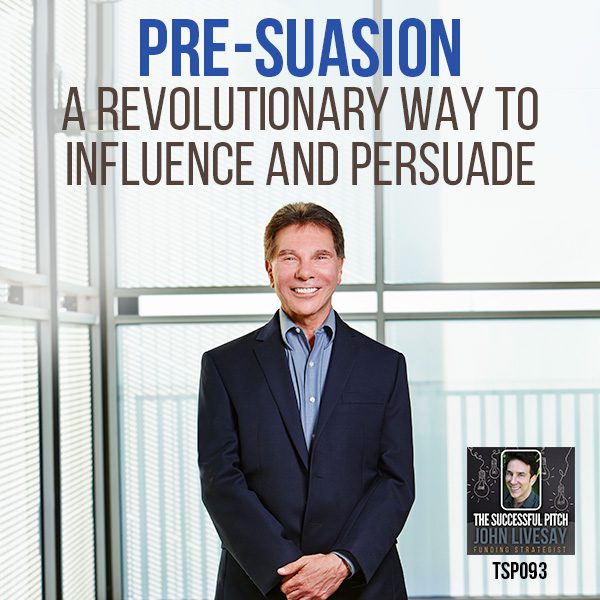
Pre-Suasion: A Revolutionary Way to Influence and Persuade – Dr. Robert Cialdini
Posted by John Livesay in podcast | 0 comments
 Episode Summary
 Dr. Robert Cialdini has spent his entire career researching the science of influencing and earning him an international reputation as an expert in the fields of persuasion, compliance and negotiation. His new book Pre-Suasion: A Revolutionary Way to Influence and Persuade is now becoming a Wall Street Journal and New York Time’s Bestseller as well . He’s frequently regarded as “the godfather of influence”.
Listen To The Episode Here
Pre-Suasion: A Revolutionary Way to Influence and Persuade – Dr. Robert Cialdini
Welcome to The Successful Pitch. Today’s guest is Dr. Robert Cialdini who has spent his entire career researching the science of influencing and earning him an international reputation as an expert in the fields of persuasion, compliance and negotiation. His books including Influence, Science and Practice are the result of decades of peer reviewed research on why people comply with request. Influence has sold an impressive three million plus copies. It’s a New York Time’s Bestseller and it’s been published in over, get this, 30 languages. His new book Pre-Suasion: A Revolutionary Way to Influence and Persuade is now becoming a Wall Street Journal and New York Time’s Bestseller as well because of this worldwide recognition, his cutting edge scientific research and his ethical business and policy applications. He’s frequently regarded as “the godfather of influence”. Welcome to the show.
Thank you, John. I’m pleased to be with you and your followers.
It’s so fascinating to see your interesting and worldwide global influence, obviously, on people. One of the questions I always like to ask my guests is, you’ve been on Larry King, you have clients like Google and Microsoft and a wide variety of insurance companies and obviously, Harvard University, when you were first starting your career, did you ever imagine you would have this kind of influence in the world?
I never did, John. That expectation was confirmed for the first three or four years of my book, Influence, which pretty much did nothing when it first came out. Then all of a sudden, it started to sell, reaching bestseller levels where it stayed ever since. The best I can interpret that is in terms of something that happened in the society that we live in. Right around that time when it started to sell, the idea of evidence based decision making began to take over the major institutions of our society. Business, government, education, fundraising, even sports. People needed to make their decisions based on data, based on evidence. The book Influence at the time had provided a compendium of research based evidence on how to get people to say yes to a request or a proposal or a recommendation. It was all right there in this one place. I think that’s what accounts for the popularity of the book ever since.
Fascinating. It didn’t just start off as a bestseller. I think when someone sees your kind of influence and success, they just assume, “He’s never had to overcome any challenges or obstacles in your life,” but it sounds like it wasn’t a hit from the get go from what you just said.
That fits with the thesis of the new book, Pre-Suasion, is that it doesn’t matter how good a seed you have, if the ground hasn’t been prepared ahead of time, it’s not going to bear fruit until that cultivation is done. Something else has to happen first for the thing really to get leverage and traction.
[bctt tweet=”Pre-Suasion: Plant seeds in fertile soil to get a yes.” username=”John_Livesay”]
You talk about that in your book Pre-Suasion where it says, “There’s a privileged moment for change that you need to have to get people to be receptive to your message.” Can you expound upon that? I love the analogy of the fruit of soil.
Privileged moments are those moments that occur just before a message is delivered so as to create a state of mind in recipients that’s consistent with the forthcoming message. It’s the moment in which we can arrange for others to be attuned to our message before they encounter it. That step is crucial for maximizing desired change. For example, in one study, when researchers approached individuals and asked for help with the marketing survey, only 29% agreed to participate. If the researchers approached a second sample and preceded that request with a simple presuasive question, “Do you consider yourself a helpful person?” Now, 77.3% volunteered to help with the survey. Why? When asked before the request if they were helpful, nearly everyone answered yes. Then when the request occurred, most agreed to participate in order to be consistent with the recently activated idea of themselves as helpful people.
I was listening to one of your talks that you gave on your website, the clip about how important it is to have somebody else edify or talk you up, introduce you before you get up and plant that seed. I think that’s so important. When people are pitching an investor, there’s a big need for a warm introduction. What I define as a warm introduction, I’d love your opinion on this, is not just meet so and so, but you need to really talk up why you like that person, why you think they’d be a good person to invest in so that that person doesn’t have to “start from ground zero”, that the soil is already fertile, to use your analogy.

Pre-Suasion: A Revolutionary Way to Influence and Persuade
Exactly. This goes all the way through your organization. We have an office in the UK. My colleague, Steven J. Martin there, did a little experiment with a realty firm that was having trouble converting callers into customers. They’re located in London. He took a look at what a receptionist said when she received a call. Typically, she would say, “Are you interested in commercial real estate or residential real estate? In what part of London, is it Knightsbridge, is it Bloomsbury?” Then she would say after getting that information, “Let me connect you to one of our realtors.” What Steve had her change was to say, “Let me connect you to Clive who’s our expert in commercial real estate in Knightsbridge. Or let me connect you to Sarah who’s had fifteen years of experience with residential real estate in Bloomsbury.” That produced a 16% increase in conversion from calls to customers. Here’s what I love about this. That receptionist was doing it anyway. She was sending the caller to the expert in that arena. She just didn’t say so.
I love it. This really goes to what you talked about in Pre-Suasion, which is, “It’s not just what to say, but when to say it.” We’re going to tweet that out. That’s such a great line. Because when you’re pitching an investor, you need to decide, “When do I say this really impressive thing about myself? Do I say it at the beginning or do I wait until the team slide comes up?” All that strategy, just trying to figure out what to say or when to say it is really the key.
[bctt tweet=”Pre-Suasion: To be influential, it’s not just what to say, but when to say it.” username=”John_Livesay”]
Let me give you something as an example that Warren Buffett does every year in his annual reports to shareholders. I happen to be a shareholder. I’ve been getting the letters to shareholders for fifteen years now. Here’s what he does on the first page, first or second page. He mentions a weakness, he mentions something that went wrong the previous year. That establishes him as honest about everything he says, and then he describes the strengths.
I love what you just said there because so many investors tell me time and again, we have to trust this person before we can even like them. You have to be completely candid and transparent because if you’re not in the pitch, it’ll come out in due diligence and the deal will fall through. Being a little vulnerable and being upfront that you may not have all the answers or may you have had a problem or you had to pivot or whatever the issue is is so important to build trust that you don’t come across as a know it all or arrogant.
Buffett’s brilliance in this is that he puts it first so that it colors everything he says next. Typically, the weakness is the things that went wrong or buried in a footnote at the end of the report. No, Buffett says, “Look, I’m honest. I need people to recognize that before they go through the material, all of the material that I have to present.” Because now, they’re experiencing that information as coming from a credible source, a trustworthy source.
You also write about, in Pre-Suasion, the importance of channeling people’s attention. I love the story of you being a palm reader at a party. What you get people to focus on really influences what they think is important.
That’s right. I learned that if I said to somebody after bending back their thumb, “I can see you’re a stubborn person,” they will go through a memory exercise and they will find a time when they were stubborn. They’ll say, “That’s right.” But if I said instead, “I can tell you’re a flexible person.” They’ll go through a different direction. It’ll be another memory exercise but an opposite one, to find times when they were flexible. They’d hit one. We’re all flexible and we’re all stubborn. They’d say, “You’re right.” I’ve put them in a place where they believe what I’m about to say now about their flexibility. If I were to say something that required them to be flexible, because I’ve got a brand new idea or initiative where they’ve got to get out of their old habit and into this new way of thinking, what I have to do is ask them about their flexibleness first.
It goes full circle to what you just said at the beginning of the podcast episode, which is, do you consider yourself a helpful before asking someone to fill out a survey. It’s such a great example.
There was another example of where they simply walked up to people and gave them a flyer that allowed them to get a brand new product, a new soft drink. If at the top of the flyer it said, “Do you consider yourself an adventurous person?” Now, people were almost two and a half times more likely to go ahead and provide the information that would allow them to access this new product. You put people in mind of a particular concept, it becomes focal in consciousness. It’s top of mind. What’s top of mind drives behavior.
You talk about that there’s all kinds of ways to command attention. Boy, if you’re given just ten minutes to pitch, you have to grab that attention in the first 90 seconds. There’s different types of attention grabber techniques. One you said is the attractor and then there’s something you wrote about called, am I pronouncing this right, the magnetizers?

Pre-Suasion: People need to know the answers to mysteries. We all have a need for closure.
Yes, those that hold attention. The one that I like these days, besides something like credibility, which of course, you want to listen to people who are knowledgeable and trustworthy, but I like the idea of beginning your pitch with a mystery story. “How could it be that our idea …” Let’s say you’ve got to write a project or a company and you want people to invest in it. How could it be that something that’s only five months old has gotten a better market share than various companies that have been around for a long time? What would it be? You know what, your listener needs to know the answer to that because people need to know the answers to mysteries. We all have a need for closure.
That open loop. Can’t stay open, it causes us anxiety, doesn’t it?
Now, that you set this up as a mystery, they’re going to process the details of what you tell them because to sell the mystery, you have to understand the details. You’ve arranged for them to pay special attention to the complexities of your case because they need the details to solve the mystery for themselves.
It’s so good. Another thing that’s so important in influencing people, and you talk about this in Pre-Suasion, is we relationships. Not just being together but acting together. Can you tell us a little more about that?
People who act in cooperative togetherness kinds of ways on some task and can see that they have a common goal that they are moving towards as a unit then become much more cooperative with one another on other topics. One thing for example, here’s something that’s very hot right now in marketing. It’s called co-creation. I think it applies to investors who are making a pitch. Very often, if you’ve got a product or a service or an idea and you want to get support from someone else, you’ll give that person a blueprint or a draft of the plan that you have for it and you will ask for that person’s feedback. Instead of giving me your opinion of what you think of this, that’s typically what we say, “Can you give me your opinion?” That’s a mistake.
It turns out that when you ask for an opinion, people take a half step back psychologically and go inside themselves for the answer. They look inside themselves. They separate from you. Now, if instead you use one different presuasive word, instead of asking of their opinion first, ask for their advice on the plan. They take a half step towards you psychologically. They see themselves as part, in partnership with this idea. The research shows, now they will be more supportive of the idea because you’ve put this togetherness, partnership, unity state of mind installed in them. They will now be more supportive of the idea that you then present to them. I’ll just give you one more example of this togetherness idea, getting this unity thing in mind first.
[Tweet “Pre-Suasion: Don’t ask for someone’s opinion, ask for their advice.”]
There was a study done. This is the study of all of the research in the book Pre-Suasion. Rocked me back in my chair when I read it. It was a study done in Belgium. Researchers brought subjects into an experiment and they showed them photographs, for 1/3 of the subjects, of a single individual standing alone. For a 2/3 of the group, another third of the group, they saw photographs of two individuals standing apart, separate. Third group saw pictures of two individuals standing together, shoulder to shoulder, in a cooperative, unified kind of pose.

Those in whom this togetherness idea had been installed first were three times as likely to help.
Then in all cases, the researcher got up from the table and pretended to drop an array of items onto the floor. The question was, who becomes helpful? Who now cooperates with the researcher by getting down off the chair, onto the floor, hands and knees and helps the researcher pick up these items? There wasn’t any question about it. Those in whom this togetherness idea had been installed first were three times as likely, tripled. Now, that’s not what made me rock back in my chair. It was when I read that the subjects in this experiment, all of them were eighteen months old.
What? That is shocking. Babies. Wow.
They were babies, John.
That’s so young to have that instinct to help.
Only when they were first exposed to the idea of unity. That’s how primitive … I don’t mean that in the negative sense.
No, it’s instinctual.
The elemental sense. That’s how primitive this process is in human functioning. We’d be fools if we didn’t employ it because everybody responds to it. I’ll give you an example that happened to me. A while ago I was working on a project, it had a deadline of the next morning. I got to the last section of the report I was supposed to write and I didn’t have the data I needed but I knew that a colleague of mine had done some research and he did have the data. I sent him an email and I said, “Tom, I need some data. I don’t have the data in my files, I know you do. I’m going to give you a call in a few minutes and ask you to get to your archives and give me that data.” I did call him.
This is a guy who is known for being kind of a disagreeable guy. He works in the psychology department where I am housed for a long time. We’ve known each other. He said, “Bob, I can’t help you on this. I know you need it tomorrow but I’m a busy man too. I can’t be responsible for your poor time management skills. Sorry, can’t help.” John, if I hadn’t read this research, here’s what I would’ve said to him. “Come on, I need this. I’ve got this deadline tomorrow.” Instead I said, “Tom, we’ve been in the same psychology department now for twelve years. I need this. I need it tomorrow.” I had it that afternoon.
There’s an example. There it is, everybody. When to say it. You planted that seed, you showed him that you’re in this together and, “We’ve been doing this for so long so you can’t isolate yourself from your needs versus my needs because we’re part of the same team.”
We’re part of the same, yes, the same membership.
Culture.
The same identity. We share an identity here. He knew that at some level.
But it wasn’t focused.
That’s the bull’s eye insight, John.
Love it. That’s so valuable because now everybody, you can take these lessons and apply it to when you’re pitching your team, that you tell a story about how your team has worked together and why you’ve worked together so well and invite the investor to join that team and get them visualizing themselves, helping you make this disruptive new technology that’s going to change and improve everybody’s lives.
Be sure to ask them for their advice in the process. Now, you’ve got all kinds of stuff going.
Collaboration. One of your talks about reciprocity, you said this great line that I want to tweet out, which is, “You need to invest in people that you want to invest in you.” That is just one of my favorite lines ever.
[Tweet “Pre-Suasion: You need to invest in people that you want to invest in you.”]
We have to figure out, if we want people to benefit us, we have to figure out how can we benefit them first?
Doing some research on them too. You really talk about the importance of that, figure out something that you have in common with them because that really gets your rapport building skills up fast.
Exactly right. Another thing that you do first, establish a sense of some parallel or some commonality. As a result, you establish rapport. People are more likely to say yes to those who are like them because we like people who are like us.
You have to figure out a way to do that. Another one of your talks about this sleuth of influence, you talk about find a reason to smile when you give a talk. I love that because it’s so valuable to people who are nervous pitching for money, you need to smile when you get up there, and not a fake smile but find some reason to smile that’s authentic.
Exactly. I once was advised by a consultant who advises speakers how I could sharpen my platform presentation. We spent about three hours together. I don’t remember anything except one thing he said and that is what you just said. He said, “Before you go on, find a reason to smile at your audience.” He didn’t say, “Before you go on, be sure you remember to smile at your audience in some sort of counterfeit way.” No, find a genuine reason. They will see the authenticity of a genuine smile and now you’ve got a rapport that you wouldn’t have had before.
One of the reasons I love that so much is the investors tell me a lot, “We really want people to be human when they’re pitching. We don’t want to hear a performance, we want to have a conversation, a collaborative conversation.” That little tip you just gave is a huge tip of just starting off with a smile and figuring out a reason to smile that makes you a human and connects them to go like, “She or he likes me and I like him. Now, I trust them and now I’m willing to listen.” I think the importance of liking and trusting people before you’re open to hearing what they have to say can never be overemphasize. You’re the master of that.
What I love about this particular example is we now make it ethical. It’s not something we fabricate, it’s something we locate. What is it in this situation or these people that would make me smile? Because I know somebody out there or because I feel confident at my material, whatever it is. Locate that thing that causes a genuine smile. Now, the newest research shows, people can detect the difference between a genuine smile and a fake smile.
I’m sure. We can feel it too. You can not only see it, but I think you can literally feel it. This whole concept of ethical is so important when people are deciding who they’re going to fund. They’re all deciding between this deal and that deal, they both seem to have the same amount of traction. I’m interested in both. They both seem qualified to execute this idea. It’s going to come down to who do I trust and like, but more importantly, who do I feel is the most ethical use of my money that I’m going to give them. I’d love to have you just talk a little bit about that.
I think we come back again to the Buffett strategy of every case has strengths and weaknesses. What Buffett recognized is you make lemonade out of the lemons by mentioning them in a way that they establish your honesty for the strengths of your case that go next. You wind up being ethical and effective at the same time.
[Tweet “Pre-Suasion: Be ethical and effective at the same time.”]
I love that. Be ethical and effective at the same time. There’s another tweet. This has just been an incredible amount of huge takeaways. I can’t thank you enough. The book again is Pre-Suasion: Revolutionary Way to Influence and Persuade. We’re going to put it in the show notes. It’s available wherever books are sold and online of course. Is there any last bit of tips that you want to give our listeners on what they can find in Pre-Suasion that will persuade them to not only buy the book but make a difference when they’re pitching for funding?
I guess the summing up that I would say is that we’ve always thought that the way to move people optimally in our direction is to operate on the message itself, to go inside the boundaries of the message, make sure that we’ve got it logical, we’ve got it clear, we’ve got it favorable to the best things that we have to offer. That’s true. But there’s new research that says, “If you really want to optimize, if you want to maximize your success, you also have to go to the moment before you deliver your message.” Operate on that and it will give your message special traction.
Love it. What’s the best way for people to follow you on social media? What’s your Twitter handle, all that good stuff?
I think the best way is just to go to our website, which is www.InfluenceAtWork.com. All that information is there.
Fantastic. I can’t thank you enough for all this. Thanks for writing another great book. I know that I’m going to be one of the millions of people who get a great deal out of implementing all the things I’ve read.
Thank you, John. You asked great questions, I have to say.
I appreciate that. That’s a wrap. Thanks again.
Links Mentioned
J Robinett Enterprises
John Livesay Funding Strategist
Pre-Suasion: A Revolutionary Way to Influence and Persuade
Crack The Funding Code!
Register now for the free webinar
The Successful Pitch – Book Trailer
Share The Show
Did you enjoy the show? I’d love it if you subscribed today and left us a 5-star review!
-
- Click this link
- Click on the ‘Subscribe’ button below the artwork
- Go to the ‘Ratings and Reviews’ section
- Click on ‘Write a Review’
How To Sell Your Company for Maximum Value – The Robin Hood for Small Businesses – John Warrillow
Posted by John Livesay in podcast | 0 comments

Episode Summary
 Today’s guest is John Warrillow. He has a value builders system that creates a score on whether your company can sell and for how much. The key factors that he look for when he funds a startup is that the founder has humility, resilience and discipline. He looks to hear a story of showing those attributes. Be sure to find out how he decides what valuation things he looks for when he’s looking to decide whether he’s going to fund a startup or not. There’s wealth of information on how you need to know your numbers. Enjoy the episode.
Listen To The Episode Here
How To Sell Your Company for Maximum Value – Interview with John Warrillow
Hello. Welcome to The Successful Pitch. Today’s guest is John Warrillow, who is the author of not one, but two amazing books. It is called The Automatic Customer: Creating A Subscription Business In Any Industry. Also, Built To Sell: Creating a Business That Can Thrive Without You. He’s an Angel investor and the founder of the Value Builder System, which helps startups and anybody figure out how much their company is worth and how to increase it when they want to sell. John, welcome to the show.
Thanks for having me.
John, I always am fascinated to find out what is it that causes people to get started. Before you became an author, before you became an Angel investor, take us back to your own strategy of this is what I want to do and how did you get there.

Built To Sell: Creating a Business That Can Thrive Without You
I wrote Built To Sell after having been involved in a few startups myself and literally made most of the mistakes you can make in creating a startup. Writing the book helped me codify some of those mistakes and get them out on paper. I didn’t really have a business idea to … A lot of people have a business and they write a book to support the business. In this case, it was the opposite. I wrote a book and a business plopped out at the bottom of it where we put together a questionnaire that would allow business owners, readers to figure out how their business stacked up using the same lens we talk about in Built To Sell. In other words, how an acquirer would value and look at your business from the outside. The questionnaire was super popular. We built a business around it, we licensed it to advisors and now we’ve got something like 600 advisors around the world who use the platform. That’s a circuitous way to getting started.
Wow. Tell us about the first book that was Built To Sell, that was the first one and then out of that was the second one?
Actually, I wrote a book years ago, 2001, called Drilling for Gold, which is about how big companies can market to small companies. At the time, I was running a market research business where we had a unique niche. We worked with very large companies. American Express and Citibank, Intuit were all customers of ours. We help them reach the small business markets. I wrote a book about that topic. In that case, it was really to credentialize the company. That was a book that I wrote back in 2001. Built To Sell was written in 2011.
Got it. What is the big message in Built To Sell that you want readers to take away and why would somebody … Obviously the big lesson there?

Sell Your Company for Maximum Value: Just chasing profits is not the same thing as building a valuable company.
One big lesson is that so companies are not built to sell because they’re too deeply dependent on the owner. I think in a lot of cases, entrepreneurs build … I think we confuse profits with value. We assume what will make us more profitable will also make us more valuable. If you just look at a company like Uber as an example, a company worth tens of billions of dollars, $80 billion last time I checked, something like that, it doesn’t have any profit. Clearly, just chasing profits is not the same thing as building a valuable company. I think one of the things we tried to communicate in that book was that for your business to have value, an acquirer really has to see how it’s going to operate without you. Of course, to buy you, they’re going to get rid of you. The next question is, how things are going to run without you? That’s if you were to distill 200 pages into one thought. It’s how you’d get it structured to work without you.
[Tweet “Sell Your Company for Maximum Value: Don’t confuse profits with value.”]
It’s a great tweet right there, “Don’t confuse profits with value.” I love it. What have you found, is 90% of people who buy a company and the founder doesn’t stay? Is that right or is it even more than that? Sometimes founders do want to stay, yes?
Most buyers want the founder to stay for a period of time. Most founders hate that experience. If you talk to an entrepreneur, it was one of the worst, lowest days of life. It was grinding your way through a two year earn out where you go from being in charge of your destiny, the founder making all the decisions, getting all the accolades, to reporting to the regional director of such and such who reports to the senior director, reports to the vice president. Brutal. You go from really being the king of a small castle to being a cog in a very large wheel. It’s horrible. Nobody likes it.
Let’s talk about the next book after that. What motivated you to write it? The whole concept of automatic customer. How do you create a subscription business in any industry? That’s what’s fascinating to me because usually it’s, “I understand it for this but would I do it for XYZ?”

The Automatic Customer: Creating a Subscription Business in Any Industry
When we looked at the kind of big drivers of company value, there are eight of them we discovered. One of them is recurring revenue. It is the one where a lot of entrepreneurs fall down. Some of the other ones are things like growth potential and how customer concentration and specific forth. We were seeing a lot of businesses, in particular non tech businesses, really struggle with recurring revenue. Because everybody thinks about SaaS companies and they say, “Sure, if I had a SaaS company, a software as a service business or a cloud based application, sure I can understand how it create recurring revenue. What if I own a distribution business or retail company or a manufacturing company? How on earth am I supposed to create recurring revenue?”
That’s really what the book’s about. It’s about we discovered nine different subscription models. The premise of the book is no matter what industry you’re in, you can create some recurring revenue, applying one of these subscription models to your business. The postscript is, that’s going to make your business more valuable. It’s also going to make it a lot more predictable. That’s really the reason we wrote the book.
Let’s have you put your Angel investor hat on for a second. What do you look for when you hear a pitch in terms of do they have a plan for recurring revenue?
I look for the LTV to CAC ratio, which is a very technical term. It stands for lifetime value to customer acquisition cost. What I’m looking for as a potential investor is at least a three to one LTV to CAC ratio. Meaning, for simplistic terms, imagine you have a subscription where over the life of the subscriber, she’s going to pay you $100 a month over twelve months. Your lifetime value of a subscriber, if that would be the average, would be $1200 or $100 times twelve. Your allowable cost to acquire her as a subscriber could not exceed $400 all up, including all your sales and marketing expenses, including your salaries, your software, your marketing if you’re buying lists and so forth. What I’m trying to look for are subscription models where the LTV to CAC ratio is better than three to one. Lots of companies fail to reach that threshold but the ones who are at least three to one have the potential to scale.
[Tweet “Sell Your Company for Maximum Value: What’s the lifetime value of your customer?”]
Two incredible takeaways right there. Number one, you have to understand the concept. If you get asked that question, you’re not deer in headlights. Some people think, “Oh, if I just know the cost to acquire a customer, I’m good.” It seems like it’s a little more sophisticated than that. Number two, I love how you broke it down to the three to one ratio. The cost to acquire is $400 and the lifetime value is $1200, there’s a three to one ratio. Did I get that right?
That’s right. Yet, if your cost to acquire is $700 and your lifetime value is $1200, clearly you’re underwater and you can’t scale.
Exactly. What I really love about what you said John is don’t just count how much money you spent on Facebook for example, to get that customer. You have to also account for all the other things that you suggested, overhead, salaries, etc. that I don’t think a lot of people realize goes into that cost to acquire a customer.
Just to be clear, the cost to acquire a customer would include all of your sales and marketing expenses. Not all of your overhead, not your office space, etc. but it would be all of your overhead associated directly with sales and marketing. If you had a VP sales for example, his or her salary would be part of your cost to acquire customers. If you have a subscription to HubSpot, it would be part of your cost. Your office manager would not be included in that calculation.
Got it. Thank you for that distinction. Do you see that that’s a mistake that a lot of people make, that they don’t include those sales, salaries and they just include the cost of the marketing?
Probably the classic mistake would be to not include the time of the owner. Most owners are the best pitch people for their company. If you’re paying yourself, whatever, $100,000 a year and 90% of your time is dedicated to sales and marketing, then 90 grand should be incorporated into the annual cost associated with marketing attributed directly to your salary. That’s probably the most common thing that’s left out of the calculation.
[Tweet “Sell Your Company for Maximum Value: Owners are the best pitch people for their company”]
Thank you for that deep dive on both of those amazing books. Let’s talk about what made you start the Value Builder System and what problem are you solving and for who?
Three out of four small companies in the United States, and the number is the same in virtually every western economy, are planned exit their business in the next ten years. When they go to the negotiation table to do that, on the other side of the negotiation table, they will be faced with a mercenary business buyer, a killer, a shark. Somebody who’s trained to buy that business for as little cash upfront as possible. There are schools that teaches, there are techniques and sleazy, disgusting ways that they go out and buy businesses for less than they’re worth. For a lot of business owners, they get completely hosed in that situation because for most of us, we don’t have the opportunity to think about selling all day long. We’re making widgets, we’re hiring employees, we’re doing all the things that entrepreneurs do. It really only is one or two times where we actually get the opportunity to go through the sale of a business process.

Sell Your Company for Maximum Value: We want to defend the rights of the entrepreneur from the predators of which there are many.
What we’re trying to do at the Value Builder System is really tilt the world back in favor of the entrepreneur, is give entrepreneurs the tools, the resources, the content to really get them armed to go into that negotiation from a position of strength so that they’re not taken advantage of when some corporate development person had a big company or when some private equity partner offers you some massively under-weighted earn out or some huge vendor take back with horrible terms or when some venture capitalist frankly, comes in and says, “We wanted a 2x preference on our investment.” These kinds of things happen every day. We were trying to defend internally, we don’t usually talk about it too much publicly. We think of ourselves a little bit like the Robin Hood of a business. We want to defend the rights of the entrepreneur from the predators of which there are many.
I’m going to tweet that out. “Meet the Robin hood of small business.” The Value Builder, how soon should a small startup start using this? Before they even pitch to get funding so that there’s some strategy in place for an exit strategy? What do you recommend?
[Tweet “Sell Your Company for Maximum Value: Meet the Robin hood of small business.”]
Anybody’s welcome to do it. You can just go to ValueBuilder.com and complete the questionnaire. Ideally, you’ve got some revenue. Ideally, you might have an employee or two before you do it. I can tell you that the majority of our users are business owners that have revenue between a million and $20 million and annual top line revenue between $1 and $20 million. You don’t have to have that but I can just tell you, that seems to be the sweet spot. Beyond that, you’ve typically got some sophisticated money people around the table, be it a CFO or outside investors. Below that, it’s usually the owner who again knows everything there is to know about making whatever widget they make but often doesn’t spend a lot of time thinking about what are my exit options, how do I value this, what are the ways that I can monetize this. That’s where we really play a role.
Let’s talk about cash flow, because that’s one of the things in your Value Builder System, is this valuation teeter totter. How does that work and help people improve their cash flow?
When you buy a business, if you can wear the hat of the acquirer for a moment, you’ve actually got to write two checks. Most of us, as entrepreneurs, we focus on the first check, which is the one that is written to us. The actual acquirer has to write a second check, and that is to the business that they are buying to fund its working capital. Working capital is MBA speak for, how much money does the business need in the bank the day that the new buyer takes over? To me, that’s immediate obligations.
If you have a model where you’re just sucking up a lot of cash, constant contact, had to dilute themselves a lot because they just sucked up a lot of cash, then that’s going to depress the value of your business in the eyes of a buyer because the buyer, although they write two separate checks, they’re both drawn on the same checkbook, the same account essentially. The more cash your company sucks up, you need a lot of inventory to run your business. You’ve got a really weird subscription model where you capture the lifetime value of the customer over years and get no money upfront. Those are situations where you’re underwater and then it takes a lot of time to recover the cost to acquire the customer. In those situations, your business is going to be discounted because somebody’s got to fund that working capital. In that case, the acquirer would.
Now, putting your Angel investor hat back on for a minute, what are some of the best pitches you’ve heard actually with somebody referring to the Value Builder System, ideally? I’m guessing there’s a story that somebody smart enough to have used that when they’re pitching you, yes?
Interestingly, no. Because we run the platform. Meaning, the platform is the software application, a set of tools and a set of lessons. We actually got to go to market through a network of advisors. We’re actually not directly serving the business owners that use the system, we license the platform to advisors who in turn will use the system with their clients. I can’t give you a pitch example from Value Builder. We’ve got lots of examples of companies that have used the system successfully. One comes to mind is a woman who ran a home cleaning service. She was in the business of basically holding yourself out as a home cleaning service. She had a few cleaning people who went out and clean people’s homes, very very low tech, analog business. She was doing it on a break-fix business model or a transaction business model, which is running advertising, waiting for the phone to ring, somebody had a party, they need a home cleaning service and she would dispatch a team to go clean the home. Of course, it’s a very difficult business model.
Through the Value Builder System, she learned that recurring revenue is going to A, make her business more predictable, also make it a lot more valuable. She changed the business model. It’s a very simplistic example but she just basically created subscriptions for home cleaning. Now, in her staff, she will sign up on a subscription, they then clean the home in the same week, in the same time every week. She’s built a recurring model that comes scales beyond her initial team, much more predictable, she knows how many cleaner she needs.

Sell Your Company for Maximum Value: They went from having a transactional business model, which was very expensive to stimulate demand to one where the lifetime value of the customer is measured over a year.
Another example, is a guy who runs a corporate cleaning business. I don’t know why I’ve got cleaning on my mind today. Maybe I’m feeling kind of dirty. Anyways, this cleaning company based in New Jersey, they would sit around waiting for the phone to ring, buy lots of advertising to try to get you to click on their ad when you needed your rugs cleaned. What they did is instead built a VIP Gold program where twice a year, without fail, they would come in a clean the carpets. The pitch was, “Look, the health of your employees is at risk if you don’t clean your carpets at least every six months. We’re going to take care of that for you, make it very predictable. They went from having a transactional business model, which was very expensive to stimulate demand, to one where the lifetime value of the customer is measured over a year. A couple little examples.
What type of startups do you like to invest in? What are you looking for when you hear a pitch?
I’ve spent a lot of time focused on SMB, small-medium businesses. For me, that’s just the space I get and know. I’m curious when I see businesses that have that as a target market, SMB, small-medium business. It’s usually an area that’s horribly misunderstood because we think of, the United States for example, the SBA boasts that there are 30 million small businesses in the United States. Reality, 22 million of those have no employees. They are home based, often times shell companies setup by lawyers to avoid taxes. The real market is something closer to eight million. Whenever I see a pitch that shows the SMB market as 30 million and we’re going to sell XYZ widget for $5000 to 28% of the 30 million, I know we’ve got a problem because it’s just a misunderstanding of the SMB market. For me, I look for B2B companies, business to business companies that have a specialization and focusing on the SMB market. Mostly just because my former company, we did a lot of market research in that area so we kind of have a bit of a sense of what it takes to get a company like that off the ground.
Interesting. It doesn’t have to necessarily be tech related or does it?

Sell Your Company for Maximum Value: That’s okay, if you’re not a bleeding edge technology company to be targeting SMB.
No, it doesn’t have to be by all means, no. SMBs buy in large are usually not as tech savvy as their large enterprise customer. One of the beauties of targeting SMB is you don’t have to be on the bleeding edge of technology. You don’t have to have the latest, coolest wiz bang technology. Intuit is a good example of that. Intuit, $28 billion market capitalization. They make QuickBooks and you could make a very good argument that QuickBooks is perhaps, on a feature to feature basis, less easy to use than Zero. You might make the argument that that’s okay because their customers are somewhat technology laggards. They’re not going to be adopting technology the same way as a larger enterprise company. That’s okay, if you’re not a bleeding edge technology company to be targeting SMB.
John, what do you look for in a team when you’re hearing a pitch to invest in?
I’m probably not really the right guy to ask that question in the sense that I think the founder is probably 90% of the equation. I think teams come and go. I think the one person that is going to make or break the business is the founder, or founders if there are multiple founders, then by all means, I’m evaluating them.
Let’s talk about what you evaluate in a founder or founders. What’s important for you in those people?
Competitive drive. What did they do in school for sports and how competitive were they. That usually says a lot about their resilience, their desire, their ability to overcome, their ability to be disciplined. A lot of humility. I like it when people say, “I don’t know the answer to this question but here’s the three ways that we’re planning to find that out.”
[Tweet “Founders need competitive drive, discipline and resilience.”]
Nice.
It’s pretty quick. I don’t I’m alone in this. I think it’s pretty easy to sniff out vapor ware and a superficial pitch. You wouldn’t need the money if you had all the answers. I like the pitch where there’s a hypothesis but there’s still a lot of questions on the table and a lot of humility among the founders, their desire to find out the answers.
I’m fascinated. I’ve never heard anybody describe the resilience story that you could tell about being in sports and school as a way to show how you have discipline and resilience. What a clever way to bring that to life during your pitch. Are you geographically agnostic?
For the most part. Obviously, I’m based in Toronto. Toronto base is a lot easier practically. Toronto is certainly not the only town that’s got great company. No, I don’t do deals in Asia or South America. First of all, I don’t speak the language. Second of all, there’s plenty of stuff to do here in North America.
You do speak French I noticed on your profile. Let’s talk a little bit about your podcast before I let you go. What would people learn listening to Built To Sell podcast? I got the name right?

Sell Your Company for Maximum Value: Listen to Built To Sell Radio.
It’s just called Built To Sell Radio where we interview once a week an entrepreneur who has sold their company. I ask them the nitty gritty plumbing of what was the deal structure like. How did you sell it? Who did you sell it to? Who made the first move? How did you figure out what it was worth? How did you negotiate a better price? How did you play one offer over the other? All the mechanics of selling a company. We don’t talk about how do you build a company, how do you start a company, how do you grow. Lots of good resources for that. We’re really focused on how do you exit successful. I just interview a different entrepreneur every day. The current one that I just did this week, we talk to a guy who had a $5 million software company. These aren’t massive companies, these are real businesses ran by real people. It’s not Mark Zuckerberg and Elon Musk, it’s real entrepreneurs who have, in many cases, this is their lifework, this is their retirement, this is the wealth they will create in their lives. We ask them how they did it and what mistakes they’d avoid.
I love it.
They’d recommend others avoid.
Really, The Successful Pitch podcast and your podcast are the perfect bookends, the beginning, how to get your pitch going to get funded, and then you’re the great one to go to figure out how to sell what you’ve created.
I think they’re even more aligned. I don’t know if I’d characterize them as bookends as much as peas in a pod in the sense that I think for a startup, to know what your exit strategy is is important. Because as we talked offline John, for anyone investing, whether it’s an Angel investor, venture capitalist, corporate buyer, they want to know what the exit strategy is. They want to know how they’re going to get out. That’s the only reason they’re going to invest. It’s not because they have some passion for your business or because they think you’re going to change world. It’s because like, “I want to make a dollar I invest in your company worth $10 in five years’ time.” Explaining in very clear terms how you’re going to make it worth $10 and how you’re going to exit, I think it’s very important. I’ll give you a quick example.
[Tweet “Sell Your Company for Maximum Value: Buyers want to know the exit strategy.”]
Please.
I interviewed a guy who had an ice cream company. He came up with a cool new ice cream concept, low fat ice cream. He wasn’t sure how to sell it. He started to create some retail stores. He also started to forge distribution relationships with big grocery stores. He went out and over 15 or 20 year period, he built 60 different ice cream stores, retail stores. Had to dilute himself, give up equity to finance it, had to hire all these people. A complete spaghetti ball mess of nonsense to create all these retail stores. He went to sell the business after 15 or 20 year run and he found that the only thing anybody who would be a likely buyer for his business cared about was his wholesale distribution network.

Sell Your Company for Maximum Value: Know what you’re acquirer is going to value from the earliest stages of your business.
Anybody buying the business would immediately shut down the stores and focus exclusively on his relationships with Kroger and Safeway and all the big distribution companies, the big box retailers. That’s exactly what happened. He sold his business for a very low multiple because he wanted to be valued for all of his business, not only the retail distribution but also the wholesale distribution. But a buyer wasn’t willing to pay for the 60 stores because they’re going to shut them down. It’s one example. I think knowing what you’re acquirer is going to value and really being clear about that really from the earliest stages of your business I think gives you a really good place to start with your pitch.
We’ve come full circle, haven’t we? You started with don’t confuse profits with value and now you’ve closed with a fantastic example of someone doing just that.
That’s exactly right.bui
How fantastic. John, what is your Twitter handle? How can people follow you on Twitter and other social media?
It’s @JohnWarrillow, or Facebook it’s just Facebook.com/BuiltToSell.
Nice. It’s been fantastic having you. Thank you for sharing all your insights and wisdom on not just how important it is to have an exit strategy, but the details that need to be understood before you even enter into getting your first round of funding. Certainly, everybody should get your books and check out the Value Builder System.
Thanks, John.
Thank you.
Links Mentioned
J Robinett Enterprises
John Livesay Funding Strategist
Crack The Funding Code!
Register now for the free webinar
The Successful Pitch – Book Trailer
Share The Show
Did you enjoy the show? I’d love it if you subscribed today and left us a 5-star review!
-
- Click this link
- Click on the ‘Subscribe’ button below the artwork
- Go to the ‘Ratings and Reviews’ section
- Click on ‘Write a Review’