

How Hard Can It Be? With Arnaud Henneville-Wedholm
Posted by John Livesay in podcast | 0 comments

How hard can it be to monetize your startup business? John Livesay sits with Arnaud Henneville-Wedholm, an entrepreneur, optimist, and author of How Hard Can It Be? The journey is full of peaks and valleys. It’s never just a straight line towards success. The key is to start small. Validate your assumptions by throwing your ideas into the market. Don’t forget to get honest feedback. The most important thing? Believe that you can. Need more tips on how to make your startup business a success? Tune in!
—
Listen to the podcast here
How Hard Can It Be? With Arnaud Henneville-Wedholm
Our guest is Arnaud Henneville-Wedholm, who is an optimist, entrepreneur, and author of How Hard Can It Be. He leads sales and business development at GLOBHE, which is a health platform for drone data on demand. He mentors startups at the Nordic Startup School and Leaders on TaskHuman.com. He is the Founder of multiple startups, including internalDesk, a SaaS platform for enterprise collaboration, where he served as the Chief Operating Officer. It was recognized as one of the Top 10 Tech Rising Stars in the Nordics in 2014 and was acquired in 2019. His interests include entrepreneurship, neuroscience, and everything related to mindset and wellbeing. He lives in Stockholm. He’s also a fan of storytelling. Welcome to the show.
Thank you so much, John.
It’s great to be with you. We have some mutual friends. I would love you to take us back to your own story of origin. You can go back to school or even childhood of how you get interested in being in the world of entrepreneurs. A lot of people are not even exposed to the concept. You either go to school and become a doctor or lawyer, or you have your own business as an electrician or something. How did you get into this world of entrepreneurship?
The quick answer is I feel that I’ve always been an entrepreneur. It’s a weird one. I’ve never fitted in. I’ve done the classic curriculum in a way, although it wasn’t a straight line. I went to school, dropped out, started to work, and went back again. I didn’t follow the classic schooling in France initially. I worked a bit and eventually realized that I felt behind academically. I needed to have this bigger degree. I went on and pursued an MBA.
After that, I work in management consulting. I didn’t align with my expectation of what it meant to be in business. I did try a couple of things along the way, naturally. That’s why I’m saying I’ve always felt like being an entrepreneur throughout. After years in management consultancy, I went all in and dedicated my life to entrepreneurship. It’s been joyful and exciting.
Your book, How Hard Can It Be, is a chronological watch of your startup journey. At the beginning of our entrepreneurial journey, most of us are seeing big winners like Jeff Bezos. You said it’s like comparing a late-stage Picasso to someone who’s starting. It’s not fair to yourself to do that.
We were exposed to the big successes, the Kardashians and the Elons. When you start with that picture in mind, you can quickly, rapidly, or totally be sent off guard and end up being depressed, perhaps even.
[bctt tweet=”The journey is full of peaks and valleys; it’s never just a straight line towards success. ” username=”John_Livesay”]
The worst thing we can do in any career is to compare ourselves to other people because that is the gateway to Imposter syndrome and self-doubt. It never benefits us.
I did my journey, and my startup lasted for a few years. We did the classic entrepreneurial startup journey. We had the idea, blended some angel money, driving a tech startup, and we’re incubated. We got VC funding and did the whole trip. We landed very nice customers, Fortune 50 companies, and did some nice rollouts. It was a nice and enriching experience.
When you look at the data points, at that time, we were all looking beautiful. It’s all aligned. The journey itself is filled with peaks and valleys. It’s never a straight line towards success. We go up and down. Eventually, after a few years, we never got to scale the way we wanted to. We had to hang up the gloves and let them go.
The reflection of that post-journey, even though it didn’t necessarily end up in a failure, but at least a personal failure, not meeting my own expectations. I realized that most of us, 9 out of 10, will end up like that. As you look around and from where we started, it all looks everyone is an Elon, but that’s not the case.
There are a lot of takeaways there. A lot of people think it’s all or nothing. Either you’re this huge success, or you’re this huge failure. What I’m hearing is while you didn’t scale the business, you were still able to sell it. I’m wondering if the investors got some, if not all, of their money back, or maybe even a little profit. Tell us how that turned out.
It didn’t turn out the way they had expected. We did sell the technical platform, but it’s not that we ended up on the beach with piña coladas, nothing like that.
The fact you’re able to sell something is a huge accomplishment. A lot of people have to realize things are not all or nothing in life. Your book takes us on this journey, much like my fable, The Sale is in the Tale, where you pull people in with this story with great exposition about. We know it’s Stockholm, know what year it is, your laptop’s open, waiting to go live, yet there’s some conflict because there’s a big delay. That creates some tension. It’s important for people to realize that any good story, whether a movie or a book, sets something up and then instantly creates some conflict because there is no story without conflict.
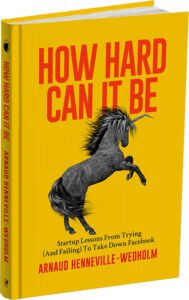
How Hard Can It Be: Startup Lessons From Trying (And Failing) To Take Down Facebook
I did an MBA. I was a management consultant. I read most of the books that are concerned with strategy and entrepreneurship. Most of them are either highly academic, which serve their purpose but are not so inspiring as a story would be. Otherwise, they are a list of the hacks to make it work. Someone has figured it out.
If you buy the book, you’ll manage yourself. It’s not black or white. It’s a very gray zone in here. My intent was to put the wannabe entrepreneur or the entrepreneur who is running his or her startup into what it’s like to drive a startup from everything, the actual emotional rollercoaster because there’s a lot to it. It’s not success after success. There are a lot of valleys and difficult situations to rise from and decisions to make.
We’ve heard about the hero’s journey and the trough of despair. What you’re saying is that your emotional skills are as important as your tech skills.
It’s all about what’s in between your ears. That’s where everything happens. There is this thing that either you believe you can, or you believe you can’t. In both cases, you are right. That’s true.
The subtitle of your book is Startup Lessons From Trying (And Failing) To Take Down Facebook. That’s a huge goal. Ironically, we are doing this interview close to the plummet in Facebook’s stock. A lot of it has been blamed on somebody taking it down, whether it’s Apple changing the ruling about tracking things, TikTok getting a little more popular, or Google doing some things. It seems like a multifaceted series of challenges that they’re facing. Give us some perspective on that. You spent a lot of time trying to figure out how to take them down back in 2013 and 2014. Years later, it looks like it might be happening. Timing is a big factor in everything.
Sadly, it wasn’t me this time. At that time, Facebook was the social platform of choice. What we were frustrated with as management consultants was the focus on behaviors. My thing was helping large organizations to cascade strategic initiatives. That implies typically either upscaling the employees themselves to help them roll out the strategy of the moment inside the company or upscaling of behavior like mindset change.
What does it take to roll out a sales initiative or whatever important strategic initiative that needs to be rolled out in large corporates? As we were looking at Facebook, all of our friends and the whole world were wondering what’s in it for people to press that button from there so fast and call that engagement? Why should you do that? Why should you like the content of the plate of your neighbors and be satisfied with that?
We thought there was more to life than being content with that action. We would challenge them with a social network that would be more engaging, and the mechanism we had found to do that was to create challenges. Anyone could challenge anyone. You could challenge your friends or yourself to something that you want to achieve in the real world.
It could be anything like becoming a storyteller, learning Chinese, or starting running in preparation for a marathon. Whatever you would set yourself to, you would have to do on the platform and provide evidence of your accomplishment. We thought that as we would do that, we would help people become better versions of themselves.
[bctt tweet=”Help people become better versions of themselves. ” username=”John_Livesay”]
It was all back to self-development in a way, self-actualization, and helping people to move from their current state to their better self. When you look at it from all theories you have out there, from Maslow to anything you can come across, it’s all agreed upon. We all want more, but there’s a gap when it comes to doing it.
You had mentioned that one of your challenges was scaling your business. What advice would you have from going through this experience for people of either a mistake to avoid or something they need to make sure they are doing to scale a business?
I’ve got plenty of advice, having gone through years of it. One of them would be to start small and not think about this one thing we believe is the best thing since sliced bread. We are going to scale it, all is going to be nice, and we’re going to end up as an Elon. No. Start small, validate your assumptions by throwing your ideas into the market, getting real feedback, and not overdeveloping things. That’s the beginning.
For example, when you launch a product, the MVP thing, you don’t want to be overdeveloping only to realize that you’ve developed out of your own imagination. It doesn’t resonate with the market whatsoever. I’ve learned to get out there, get real feedback from the market, and follow the lead of your target audience.
One of the things you say in the book is scalability is a scale in itself. You give an example of a telemedicine application on the phone being more likely to scale because you can increase the number of virtual consultants exponentially with only a small increase in the actual costs of IT. What you’re talking about is figuring out something that can scale fast without a lot of expense.
Yes. Also, your product can be scalable. Ours was. We had developed a platform that could host a lot of videos and content. The platform was scalable, but the business model was not. There was a conflict here. I have to take you a few steps back. As we tried to get people to become other versions of themselves, we failed at that because that’s a mindset element. That’s the thing we can talk about.
Everyone has their own comfort zone of how you only let yourself get so fit or whatever the issues before self-sabotage kicks in.

Startup Business: Business strategy books are highly academic but not as inspiring as a story.
It’s very hard to naturally do things that you have not done before and throw yourself into new things. People get comfortable and function 95% out of a routine they’ve established or have not established for themselves based on the mental models they’ve been given or downloaded throughout their younger age and believe what they perceive as being the world is what it is but it’s not. You can shuffle it all up and come up with anything you want. You just have to decide what it is you want.
As a storytelling keynote speaker, I’m always explaining to audiences the importance of showing something and not telling them. You did a great job of that with the story of how you met your wife, Claire, and all of the obstacles. I thought Romeo and Juliet had a tough go. You guys were in different countries and time zones. It would be so easy to have given up on that relationship.
You think, “I got this job opportunity to be close to her.” The next thing was she has moved and got her own thing even further away. That little love story within the business story shows your tenacity and flexibility. That’s what investors are looking for, being able to tell me a story either in your personal life or career where you show those things as opposed to saying you are someone like that.
When you have a story like that to back it up, then it’s memorable. People feel it’s so wonderful because you’re married, have children, and happy. Children love to hear how their parents meet. It’s such a great legacy as well. The same thing is true when you’re telling not only your personal story but your company stories.
Let’s jump ahead a little bit to what you see happening now. For Facebook to double down and even change their name to Meta, you’re asking people to make big changes and no longer “live in the real world” as much they may currently be doing and want to be immersed in this world with avatars and things. It’s a big escape beyond video games.
What is your take since you’ve been so immersed in this world and seen some resistance? Is it going to be an age thing? Young people are going to go, “This is for me. I am a digital native,” and people over a certain age will be like, “Maybe I’ll spend an hour in there, but not my whole life. I still want to talk to people in person.” What do you see happening in the future?
That’s a very multifaceted discussion, the metaverse, blockchain, NFTs, and all of that.
Let’s keep it to the metaverse because it ties so well to what your book is about, which is, “Just because the platform exists doesn’t mean the business is scalable.” Do you think it’s going to be age-specific, or is everyone going to want this new metaverse world?
[bctt tweet=”Your online digital brand image is crucial. ” via=”no”]
To some extent, we are already doing it. Interestingly, we spend a lot of time online. We all do it first for work. Every document is in the Cloud. You are already spending a large portion of your time online. You’re already in the metaverse. Another thing that struck me is that we’re not conscious of it, but we tend to create our own branding.
Our branding online has become more important than our branding offline. You can go and buy milk in your not-so-classy trousers. In your neighborhood, you may know just a few people. However, when you go online, you have potential access to millions of people, and you want to show right. That means that your actual avatar or your real or personal branding has a higher value for you online than it has offline. To some extent, we are already there.
There are all kinds of people who will spend money buying costumes and jackets for their avatars. The movie that was done several years ago about everybody going into this machine and becoming a 3D avatar is certainly an interesting thing. Do you think it’s going to appeal to a wide range of people and not just young people?
Yes. There’s the next level with the whole brain that is connected to the net, and we live mostly in the metaverse. First, we’ll go there as digital avatars, and then eventually, perhaps with Elon again, we might end up being thrown into the digital world itself.
I went to New York and saw my friends and their son, Max. During the pandemic, I wasn’t able to see him. From 6:00 to 8:00, I only have a relationship with someone via FaceTime and Zoom. In real life lunch, he said to his mom, “Uncle John is more fun in person than he is even on Zoom or FaceTime videos.” I thought, “Thank goodness.” He seems surprised that he would have more fun in person than he would on a call. What a fascinating perspective for someone who has been so isolated at that age range because that was not my childhood to have that comparison. What’s next for you?
Two things, I’m working with the book. I want to help as many entrepreneurs as possible to get a feel of what the journey is. If they are not yet in it but are considering the move, they’ll get a head start if they read the book. That’s one. Another thing I’m doing connected to the book is Keynote and things like that. With organizations, we talk a lot about failing as a capability that needs to be built into the organization for resilience.
Naturally, as a leader, you should understand what that means and how you get feedback from your people and build a culture where failure is not the thing that you don’t accept. It’s even going beyond embracing failure. It’s about seeking failure so as to dare new things and extend the box in which you are, and hopefully, find next-generation products and services.

Startup Business: Start small and validate your assumptions by throwing your ideas into the market.
In the startup world, there’s all this culture of fail fast and learn from it, and reiterate. In the world of Corporate America, people are afraid to fail. They think they’re going to get fired. To become more agile and nimble, they need to embrace failure as something that people are not afraid of doing or, worse, hiding it, and because we don’t take risks, we’re so afraid of failing that we can’t experiment. We keep doing the same thing.
I talk about Blockbuster with all the video stores that kept doing the same thing. By the time they tried something new, it was too late. Netflix did not go down that path. There are many examples of companies failing to the point where they go out of business, like Kodak, because they are not willing to try something to fail. If people want to reach you, you’ve got this wonderful website, which is the title of the book, HowHardCanItBeTheBook.com. Any last thought or quote you want to leave us with?
Dare and seek failure as opposed to being afraid of it because it’s an illusion. It doesn’t exist. You’re making it up. The moment you try something that you have not tried before, you realize that finally, it wasn’t that hard. It’s a mental block. The more you dare try things, the more you rewire your view of the world, and the easier it becomes to try different things.
[bctt tweet=”Failure builds resiliency.” username=”John_Livesay”]
I tend to look at this as when you run. If you stay stagnant on one thing you’ve always done, like running around the block while you’re not going to run 10K or further, the moment you start pushing it a bit, you realize that, “I can do that. Maybe next time I run a little further and a little further.” Eventually, you end up doing a marathon, and it wasn’t that scary after all.
It’s about expanding yourself by putting yourself into situations that at first may seem difficult, but the reason they are difficult, or at least in your head, is because you haven’t done them before. They are in your reach. Anyone can do anything. It’s a matter of mindset and daring to get out there and do the thing that you want to do.
Your children are lucky to have you as a parent that’s inspiring them with those messages. We’re all lucky to have your book inspiring all of us. Thank you so much for being on the show.
Thank you, John.
Important Links
- How Hard Can It Be
- GLOBHE
- TaskHuman.com
- The Sale is in the Tale
- HowHardCanItBeTheBook.com
- Better Selling Through Storytelling Method Online Course
Wanna Host Your Own Podcast?
Click here to see how my friends at Podetize can help
Purchase John’s new book
John Livesay, The Pitch Whisperer
Share The Show
Did you enjoy the show? I’d love it if you subscribed today and left us a 5-star review!
- Click this link
- Click on the ‘Subscribe’ button below the artwork
- Go to the ‘Ratings and Reviews’ section
- Click on ‘Write a Review’
Love the show? Subscribe, rate, review, and share!
Join The Successful Pitch community today:
- JohnLivesay.com
- John Livesay Facebook
- John Livesay Twitter
- John Livesay LinkedIn
- John Livesay YouTube
How Business Can Build Resilience And Thrive In The Middle Of The Pandemic With Gail Davis
Posted by John Livesay in podcast | 0 comments

Anything can change in a blink of an eye. We cannot dictate what we want to happen in this uncertain world. Join your host John Livesay as he sits down for a conversation with Gail Davis on developing resilience during tough times. Gail has decades of experience in corporate marketing and event management. In this episode, she dives deep into how the pandemic brought changes globally, especially in her business which involves in-person events. She experienced letting go of employees to survive. It was definitely hard, but she believes that the pandemic opened up other opportunities for events in a virtual way. People had to adapt to using the current technologies to help them move forward with their businesses, which paved the way for innovation.
—
Listen to the podcast here
How Business Can Build Resilience And Thrive In The Middle Of The Pandemic With Gail Davis
Our guest is Gail Davis, you might remember, she was a guest back in January 2019. She is here to talk about how she navigated the challenging pandemic, especially to the speaking bureau world where live events were all cancelled. Some great takeaways for us about us for us about how, when you anticipate potential challenges, you are able to respond with an action plan as opposed to reacting from fear. Enjoy the episode.
—
Our guest Gail Davis was on the show in January 2019. Her decades of experience in corporate marketing and event management served as the launchpad for GDA Speakers. Before establishing the company in 1999, she spent years managing the events of the Dallas-based global technology conglomerate, EDS, Electronic Data Systems founded by the famous Ross Perot. While at EDS, she discovered Nando Parrado, a heroic survivor of the 1972 Andes plane crash. He presented an unforgettable speech at the EDS marquee event.
After his successful keynote, he signed an exclusive agreement with Gail. That was her first beginning. We were talking about how much life has changed for everyone in the speaking business and every business around the world since 2019. We had the pleasure of reconnecting in person at Josh Linkner’s event in Detroit. I said, “I would love to have you back on the show. You were such a great guest.” She said, “I would love to come back and talk about what the impact the pandemic has had on my business and how I have pivoted and maybe help some other readers and entrepreneurs do that. Gail, welcome back.
I am glad we made this happen. I feel like I have lived 1,000 lines since we did our first show, which was in early 2019.
It is that whole premise of, we think we have a sense of how the world operates and that we can always get a haircut when we want to. We can go see our friends and family when we have a meal, let alone live events going away. That wasn’t even on our radar of things to prepare for.
[bctt tweet=”Those who act quickly will survive.” username=”John_Livesay”]
That happened to be a leap year. On February 29th, I went to see the Eagles. That is a large concert in an arena, lots of people dancing, singing. The next day, I drove to Oklahoma and I stopped to see my mother. I said, “My business is going so great. 2019 is going to be the best year ever.” I have a fully trained team that has been with me for a long time. I am in a place where I can get away. Everything runs like clockwork.” That was Sunday afternoon, March 1st. On Wednesday, we had our first cancellation. By Friday, we had six and then the tsunami hit.
Let me ask you because so many have that experience of, “This is unraveling. It is no longer a thread in a sweater. This whole thing is coming apart.” At the time, none of us knew how long this was going to last. What was going on in your head? We were both former lifeguards. For me, as a former lifeguard, the training that I had to not panic and stay calm when someone was drowning does kick in sometimes. It can help us in those situations. What was your initial reaction? As a leader and running a big company and having people whose livelihood depends on you and your business, what went through your head? The second question is how did you keep other people from panicking?
I have a very vivid memory of that first weekend in March 2019. One of my colleagues from another bureau called to tell me that an event that was to have played in April of 2019 with Nando Parrado, he was supposed to be in person in Dallas, that client had decided they needed to reschedule. I said, “How are you feeling about all this?” He said, “I’m trying to save the company but I will talk to you tomorrow morning.” That Saturday we spoke. He had been on the phone with one of the sharks from Shark Tank. As he was hanging up, canceling an event, he said, “You have a lot of experience in running a business. What advice do you have?” The advice was those who act quickly will survive.
He told me, “You should run three scenarios with your existing payroll and expenses.” This is March 5th or 6th, 2019 that he is telling me. “Scenario number one, there are no live events between now and May 31st, 2019” I was like, “You have to be kidding. There is no way.” He said, “Scenario number two, no events between now and August 31st, 2019. Scenario number three, no events in 2019.” He was so confident in giving me that advice that I picked up the phone and I called the person that does my bookkeeping and accounting. I said, “I need you to run this for me. We should meet at 8:00 Monday morning to look at the results.” I don’t know prior to that in business, not life, I had seen anything so sober.
I am not willing to go in a hole that deep. What can I do? To answer your second question, I decided at that moment that full transparency and complete honesty was the only way I can handle any of this whether it was talking to a client or my team. I called the team in and I said, “In the last 3 business days, 5 days if you count the weekend, we had 7 events that have been impacted. We don’t know where this is going to go but I want to share with you these 3 scenarios.” That first Monday, I planted the idea. On that day, I let three people go. That is not my style. My style is to try everything under the sun. I almost felt like I was doing him a favor like, “Get down there and get in the unemployment line because the rest of the people are there.”

Resilience: At the start of the pandemic, full transparency and complete honesty was the only way you could handle your business, whether it was talking to a client or team.
I’m happy to say one of those people ended up coming back. PPP came along. We were able to stretch it a little bit longer but we are well into scenario number two. We had to let other people go. Scenario three came and went. To be completely honest with you, 2021 was a tough year. It was better but it was still tough because we are still talking about whether it’s variant D or Omicron. Lockdown or not, we are in a global pandemic and it is impacting this industry. That is what I hope we can dive into because when I sit back and I look back, I have a handle on what the good is that we can take away and some sage advice on how to move forward because the one thing that is cliché but true, we don’t know what we don’t know.
As a sales keynote speaker, I thought to myself, “I have to figure out a way.” I had a client say, “This live event, April 2020 is not happening. I’m going to push it back to August 2020.” When that came, “We are going to make it virtual.” How are you going to keep 300 people entertained on a Zoom call? That is what made me realize I have to do something. Zoom burnout became an issue. There are so many new challenges. The funny thing I thought was interesting is sometimes in these challenging situations, other opportunities come up.
In my case, the client said, “In addition to your keynote and workshop, can you teach my team how to look and sound good on Zoom? They are so uncomfortable being on camera and they don’t know how to frame themselves or like themselves.” I thought, “I’m one chapter ahead of you on that.” Trying to order equipment during the pandemic, there are a lot of people wanting professional lighting and mics. It was interesting that became a new need that never existed before. There is a technology that allows me to do some special effects.
The people whether you are a speaker or a bureau owner like you that say, “I’m not going to offer anything or invest in learning anything new unless I am dragged into it last minute.” I thought, “That is not the speaker I want to be.” If there is some new way to keep people engaged, I want to be at the cutting edge of that. It’s going to cost me some money when money is not coming in like it was to invest, learn and get the equipment. I’m going to do it as opposed to waiting until somebody asks me to do it. I wanted to hear if that resonates with you as a bureau owner.
One hundred percent. I remember a conversation with one former employee. I might qualify her as a slow adapter was, “I’m going to go with virtual. I’m going to wait and I’m going to say my specialty.” Which are in-person events. That would not work well for anyone. I love watching speakers. I feel like there are speakers that got on the front end of the technology. On March 10th, 2019, they were building their in-home studio and they were ready to roll. Others sat back and watched, “Who is doing this well? What can I learn from them?” They came into the game. There are some people I love and respect who still are sitting on the sidelines because they don’t think it works for them.
[bctt tweet=”Cross-train your team to build empathy.” username=”John_Livesay”]
For me, I knew that we had to change. I can think that to my first office in Colleyville, Texas, where we had a wall of VHS videotapes that were out the alphabetical by speakers’ last name. We used to buy blank tape and the box scrolls. We had two VCRs. If somebody wants John Livesay, we go grab your tape. We plug it in. We put a blank and we press record then we send the VHS tape in the mail to the client to watch. That is not how it works these days. Only knowing how to do in-person events is like only having VHS tapes. We had to learn it.
My first thing to my team was, “If you don’t already know Zoom, figure it out. Do you know what Teams is? Has somebody talked to you about StreamYard? I need you to get on there.” There were so many that came in at the beginning. “Everyone, I want you to learn.” The funny thing is you showed me your new toy, which is that Stream Deck. I have been doing this for months and I have never seen Stream Deck. The innovation in our industry is ongoing which is one of the gifts of the pandemic for our industry. You can look at it. People are like, “I want to go back to normal.”
I’m not sure normal is ever going to be the way it was in 2019 but there were so many gifts. Most of our sales calls are via Zoom. Prior to 2019, most of my team probably did not have a Zoom account. There are a lot of gifts. I wrote a blog. I used the line that I borrowed from a friend, Sean Hanks is the IASP President. He said, “Virtual events have become an and versus an instead of.” People who for many years had these three in-person events may now go back to those three in-person events but they may be augmenting with this August 2019 event that is going to be virtual because, in the pandemic, that was a home run.
It makes sense to keep that going. I love that. It’s not like, “We are going back to in-person. Virtual is going away.” Virtual is here to stay. There are instances where it makes sense. With international travel, it may be a long time before every person from every country can travel with this. There are a lot of gifts that have come out.
I did a keynote to a company based out of Israel and their entire sales team is global. One person is in Singapore and one person is here. Instead of having to fly everybody in, I was part of their annual kickoff meeting for the year. When I first came to Austin in March 2020, I was all excited. I had my tickets to South by Southwest. When they canceled that, I thought, “This is not something that is going to be fixed in a few weeks.” Here we are in March 2022 and it is still iffy if that is going to come back.

Resilience: The innovation in our industry is ongoing and which is one of the gifts of the pandemic bark industry. You can look at it.
Elton John was going to have two nights in Dallas. He tested positive. He canceled. There is an uncertainty in making plans that are becoming the reality of how we move forward with just about every personal or business decision.
A new skill is required because when I gave that talk down at the healthcare company in San Antonio, they said, “There are only going to be about 25 people in the room. However, we are streaming you live to 500 people so you have to speak to the room and the camera and not forget that there is an audience out there watching.” It was a fascinating hybrid experience. The fun part for me is when a client embraces the change. He said, “I have been talking about you and your book to my team about Better Selling Through Storytelling.
Instead of the normal way of introducing you by reading this introduction, we are going to put you in a private room next to the conference room. We will keep the door open and I am going to start talking and say I have been wrong about the power of storytelling and sales. We should not try and do this anymore. I want you to come in and interrupt me and say, ‘Cut, don’t listen to him. I’m here.’” I thought, “What a great way to break back into a live event.” Be that playful with your clients. It is the people that are willing to keep rolling with the disruption because that is what our brain craves.
Is this going to be the same old? When you have something new like that, it grabs the audience’s attention. You said that you feel like there have been some good takeaways. I gave an example of a client asking me to train their sales team on how to look and sound good on a Zoom call and not be intimidated if the other person keeps their camera off. It is fascinating what stresses people out. What would you say has been a good takeaway? Is the team closer than they ever have been getting through this?
Yes. I believe the team is incredibly cross-trained. When we did our last show, I had twelve people on my team. At one point in the summer of 2019, I went down to what I lovingly referred to as the core four. Those four can do anything other than run payroll. As we would add that in one person that summer, I remember when I was interviewing her she had prior bureau experience and I said, “I need you to do this. Sometimes I might need you to do this.” She said to me, “You need me to catch what needs to be caught.” I was like, “That is what I need.”
[bctt tweet=”Virtual is here to stay. It just makes sense to keep that going even after the pandemic is over.” username=”John_Livesay”]
She came on. She is super cross-trained. That is a very big gift in terms of the team’s closeness. When you are super solid and you haven’t sat in the seat of your fellow teammate, it is easy to get super irritated with them like, “Why are they aren’t meeting this deadline?” We have some new people that this is not the case but the majority of the people on my team are super cross-trained so there is a lot of empathy and understanding of the competing priorities. That is a positive for the team. In terms of the value that we add to clients, our skill or anticipating things we need to consider in the contract is at an all-time high.
Pre-2019, you want John, you want him in Austin and you want him on this day, contract done. Let’s move on. Now we are asking the question, if something prevents John from being there whether John can’t travel, you decide to go virtual, there is a government restriction implies. There is a new variant. I could go on and on. Let’s go ahead and discuss what that looks like. A lot of times they will say, “We are only going to do it in person.” We say, “Let’s talk about that. Do you want to kick the can down the road or do you want to have a contingency? What are we trying to accomplish?”
Sometimes if you are trying to train your team and keep the momentum on your team going, rescheduling the event to a later date is not necessarily the best. We get into a discussion of, “If he didn’t come in person, would he give us a reduction on the fee for virtual?” We have to navigate that. Anticipating and having the conversations that everybody is so tired of having but making sure we have them, we are better prepared. When I looked at how many events were impacted by the original Coronavirus, I still have 8 things we haven’t resolved out of 200.
You go to the Delta variant, we only had 23 and all the 3 are resolved. We know what we were doing, we are just waiting for a signature. So far, we have only had sixteen on Omicron. It is only two weeks old but about half were already resolved. That directly ties to anticipating, thinking, contingency, covering things in the contract. It is a little bit of a pain because you have to do a quick agenda but you have already thought through it. That is a time-saver to everybody because these variants coming up right before the event and we don’t need to be exploring options. We need to implement options.
That is a true sign of a good leader whether you are leading thousands of people, 10 or 4. Anticipating a need. I remember when I had the Banana Republic as a client and they said, “We want to redefine what luxury is. We are never going to be Neiman Marcus in terms of pricing but what if it was anticipating a need before you knew you needed it?” They put a place where you could get your phone charged in the flagship stores in San Francisco and Manhattan Rockefeller Center. They would say to these people, “Would you like us to charge your phone? We will guard it while you shop.” Unexpected luxury. The sales went up 10% because people kept shopping until the phone was fully charged.

Resilience: There’s an uncertainty to making plans that is sort of becoming the reality of how we move forward with just about every personal or business decision today.
There are all kinds of outcomes by anticipating a need before you know you need it. That separates the Banana Republic and you as a bureau. “I like working with Gail’s team because they think of every potential thing that could go wrong and a contingency plan to solve it.” Back in the day, your plane was late, you would miss a plane. You are great at getting another speaker there at the last minute. The microphone, battery or power bank goes out. Your remote doesn’t work. A hundred and one things can go wrong in a live event and you still have to be able to perform.
I had a situation where we had done little tech rehearsals on virtual in addition to the prep call. They were using a different platform besides Zoom or Microsoft. It had not been tested. They had not tested 300 people coming on at the same time, which caused the bandwidth to stop. They were freezing. Luckily, I had somebody on as my tech backup because as a sales keynote speaker, I’m used to people in the corner running the show. I’m not going to go solo on a tech call.
I have somebody on the call with me going, “Your volumes not all right. Something is off with the camera. Let me fix this. My Zoom call can handle 500 people. Let’s all move over to this Zoom link and we will redo the breakout rooms while you are giving the keynote talk so that the workshop will still work as planned.” The client was so grateful because their whole thing almost crashed because of technology. Is it worth it to pay somebody out of my pocket to be on those calls? You bet.
It is funny talking about the challenges and technology. We added to our team one of our logistics managers. She manages all the logistics. She started in the summer of 2019. One day, we realized, “She has never done an in-person event.” She mentioned that in the olden days, it was all about light planes, snowstorms and speakers’ travel delays. It was comical. It was like trying to show someone the old VHS tape and say, “Here is how you plug it in.” She had no frame of reference. She picked it up quickly. She is a rockstar but it was funny that they are talking about digital data. She was a virtual speaker.
All of us have to continually evolve. What I have learned personally is we can never get too comfortable. We all hear people talk about getting out of your comfort zone but you think, “I have invested in learning this skill. I have got a great brand.” You have been in business a long time. “I have a great reputation. My staff is trained,” and then a pandemic hits. You are like, “I get to see if I’m going to reinvent myself. Look at the three possible scenarios, worst-case scenario, scenario number three.” You are still here, not the case through all the bureaus. This transparency and adaptability. The thing I want to double click on that you said, I have not heard many people talk about this and it is so valuable for the listeners is cross-training your team building empathy. There is The Great Resignation happening.
[bctt tweet=”We don’t know what we don’t know.” username=”John_Livesay”]
A lot of our clients are saying, “How can I keep my team from leaving? I have some superstars. I don’t want to have them leave.” I have found that helping companies not only create case stories to help them win more business but getting individual people to tell their story of origin. What got you into healthcare? What got you into the speaking business? They start to find out things about each other that they never knew. It is fascinating to hear other people’s case stories.
For example, with a healthcare client, they said, “My mom was a nurse. That is what got me into it. I was a microbiologist. I didn’t want to spend my life behind a microscope.” “We worked with you for three years. We never knew that about you.” The management and sales teams are telling me, “We feel like we are losing the bond because we haven’t been able to see our sales team in person.” Now that you have had them put their story of origins together on this repository map with their case stories, they feel seen, heard and appreciated in a whole new way.
It has become an onboarding tool for HR that they say, “Get to know your co-workers, share their stories until you make your first sale but also get to know them as people.” What we live for in the speaking business is if a storytelling speaker can impact a culture that, “I’m hired to help you win more sales but if I can help you break down silos because all these stories live in one place and you can start sharing the stories and make introductions to other divisions, that is the joy of all of this.” What you have done here is a role model for all business owners. You have a culture and from day one you say, “It is not just this job description. If that is your mindset, that is not the culture fit here.” Brené Brown’s latest book talks about that. In her people, she was like, “If you walk by a piece of trash and go, ‘That is not my job. I’m not picking it up. That is not why I worked here.’”
A part of the way we developed empathy during the pandemic is each month we would have what we call the leadership meeting. We might have done it weekly at that point. We did Brené’s book, Dare to Lead. The team got super vulnerable. They do the exercises. They would share. It is your point of getting to know their entire story not just, “This is Susie Q over here doing an account.” It is super important.
We start to remember, “Everyone had some challenges in their life or this is something they have always dreamed of doing.” Like your wonderful story of origin. From EDS to hearing a speaker in that launching. Companies need a story. We all want to connect emotionally. That is what the stories do. You have such a great story. I am so excited and thrilled to hear how successful you are continuing to be. If you have survived this, you can survive anything. Any last thought or piece of advice you want to leave our readers on how to embrace the ongoing disruption and changes that we know are going to be part of life now?

Resilience: We need to watch our language when we hear ourselves. We all want this pandemic to be over. But we can’t control it so we have to reframe our mindset. And we have to look for the gifts. We have to look for the opportunity and we have to take that skill that we’ve developed of anticipating changes.
Once someone gave me a book. It was one of those little flipbooks that you go through but the cover said, “Normal Is Just a Setting on Your Dryer.” There is something to that. We need to watch our language when we hear ourselves. Sometimes I’m so tired, I want this to be over. I wanted to go back to the way it was. I want it to be normal. We have to reframe it. We have to look for gifts and opportunities. We have to take that skill that we have developed of anticipating and anticipate what else can change. How else could we modify this? How else can we take this forward? It’s a shift and muscle we have exercised ad nauseam. We will be well-served if we tend to lean into that.
Imagine if you never worked out and then suddenly you had an emergency where you had to swim, run or something. If you keep that muscle active, I’m adaptable and flexible we will go full circle in the lifeguard analogy again. We had to train. When someone was flailing their arms and you couldn’t throw them a buoy because they were too panicked, you knew, “I’m going to have to go in.” Let’s go and embrace the new world. Thank you so much for sharing your wonderful stories with us.
Thank you. It was great. You are always such a good person to visit with. I love it.
Likewise, Gail.
Important Links
- Gail Davis – Past episode
- GDA Speakers
- StreamYard
- Dare to Lead
- Better Selling Through Storytelling
- Normal Is Just a Setting on Your Dryer
- Better Selling Through Storytelling Method Online Course
Wanna Host Your Own Podcast?
Click here to see how my friends at Podetize can help
Purchase John’s new book
John Livesay, The Pitch Whisperer
Share The Show
Did you enjoy the show? I’d love it if you subscribed today and left us a 5-star review!
- Click this link
- Click on the ‘Subscribe’ button below the artwork
- Go to the ‘Ratings and Reviews’ section
- Click on ‘Write a Review’
Love the show? Subscribe, rate, review, and share!
Join The Successful Pitch community today:
- JohnLivesay.com
- John Livesay Facebook
- John Livesay Twitter
- John Livesay LinkedIn
- John Livesay YouTube
Global Investing: An Entrepreneur’s Global Perspective With Sleem Hasan
Posted by John Livesay in podcast | 0 comments

As the years go by, it seems like the world has become significantly smaller. It has become easier by the day to reach other people and even set up your own business. In this episode, John Livesay interviews Sleem Hasan, the founder and CEO of Privity FZ LLE, to talk about global investing. He takes us through a global lens of his own journey that spans different countries and shares the different lessons and experiences he got. How can being globally competitive help you? What are the benefits of a global eye? Sleem answers these questions and more with John.
—
Listen to the podcast here
Global Investing: An Entrepreneur’s Global Perspective With Sleem Hasan
Our guest is Sleem Hasan who is an experienced owner with a demonstrated history of working in venture capital and the Japanese capital markets. He is skilled in investor relations, securities, asset management, investment advisory, and working with technology entrepreneurs. His strong entrepreneur professionalism is with a Part III Mathematical Tripos from Cambridge and a Mathematical degree from Oxford. He’s also the CEO and Founder of Privity, which is an independent Dubai-based advisory firm founded back in 2004. Sleem, welcome to the show.
Thank you, John, for having me.
I always like to ask my guests to take us on their own little journey, their own story of origin. You can go back to your days at Oxford or childhood when you first realized, “I’m interested in math,” or I’m guessing back when you were a child, the concept of entrepreneurship was not as well-known as it is now.
I usually share my background using six different flags. The first flag is that of Fiji island because that’s where I was born. The second flag is from Pakistan because that’s where my late parents hail from. The third flag is from Nigeria in West Africa because that’s where I grew up. The fourth flag is the United Kingdom because that’s where I went to study at university. The fifth flag is Japan because I spent 37 years of my life dealing with the Japanese markets, first at Nikko and then with Hasan Financial Corporation, my first startup. The last but not the least flag is the United Arab Emirates, which is where I reside in Dubai. That’s zero to date with six flags.
You would be the definition of a global citizen based on those six flags.
You could say that every part of it was not by choice where you’re born, where you grew up.
[bctt tweet=”You don’t need to get other people to believe in yourself when you believe in yourself.” username=”John_Livesay”]
After that, it becomes your journey. I’m sure a lot of people are as intrigued as I am to ask this next question, which is how many languages do you speak besides English?
Badly, probably about six. Fluently, probably 2 or 3 but I love languages. I speak my own language which is Urdu. Although, I grew up in the northern part of Nigeria. I’m comfortable in Hausa. I learned French at school, a bit of Arabic because of my religious background and a bit of Japanese I picked up working with Japanese. Having said that, I’ve picked up a bit of Italian along the way, a bit of Spanish.
There’s a real connection between music, math and languages, don’t you think? There’s a structure to all of it. There’s a rhythm to it. It’s a tuning your ear and formulas even about, “This is what pass perfectly is,” or those things. The Japanese language is extremely different than the Spanish, Italian, or even English and they write, I believe, with their hands as part of symbols.
It’s funny you say that because I go one step further and I draw parallels between actually Mathematics, which is what I studied at university and Entrepreneurship. What do mathematicians do for a living? They solve problems. What do entrepreneurs do? They solve problems too. In my humble mind, there must be some homeomorphic map in the mind of a mathematician and the mind of an entrepreneur.
I’ve never heard anybody else frame it like that and it’s brilliant because if you’ve ever had any kind of math and I did some calculus a little bit and things like that, or even basic geometry is all about solving for X or Y or whatever the answer is. If you think of yourself as a problem solver, when you create your company and I get into this is where our lives and our passions crisscross is my passion is helping founders be able to craft a story and show empathy for the people whose problems they’re solving. The better they can describe the problem to a potential investor. I think investors like you think, “This entrepreneur probably has the solution because they understand the problem well or they’ve experienced it.”
Whenever any two people meet, whether it’s entrepreneurial and investor, two friends meeting at university on open day or even a boy meeting a girl, what is the most important thing? You’ve got to catch them at hello. The minute you catch somebody at hello, the person gets engaged. That’s exactly what I tell entrepreneurs today. You’ve got to catch the investor at hello because it’s that first initial impression that we’re the chemistry exchange is pointed and very pertinent. If you can capture that and then they get engaged, they want to know more. If you’ve got a ten-minute pitch and you spend the first 5 or 6 minutes taking them down a cul-de-sac, the chances that they’re going to lose, you’re going to get lost in translation and they lose interest. That’s my two cents for whatever it’s worth.

Global Investing: It’s that first initial impression where the chemistry exchange is very pointed and very pertinent.
It’s worth way more than two cents. I tell a lot of investors when I’m working with them on their pitch, “You may have ten minutes in front of an Angel group or even more if you’re a venture level, but you only have 90 seconds.” Grab them at hello. I tell people, “The biggest mistake I see,” and I’d love to hear what yours are, “Is they waste those valuable opening seconds with cliché things like, ‘Thanks for this opportunity. I’m excited to be here.’ No one cares that you’re excited. It’s not about you. It’s about the investor.” I’m all about jumping right into a story that pulls people in.
It’s very important to outline the problem with the story. I think starting your pitch with a compelling story is important. I even say that on my website when I talk about Privity. I say, “I’m agnostic to geography as I am to industry vertical. I only care about the underlying compelling value proposition of the idea.” Straight up on my website for anybody interested. Literally, you go to the first landing page. That’s the first paragraph you’re going to meet. I want to capture you at hello. If you go to Privity, you’ll see I’m practicing what I’m preaching.
First of all, that’s unusual because a lot of investors are not geographically agnostic nor are they open to multiple industries. I always love going to the portfolio page when I prepare to meet an investor whether it’s interviewing them for my show or if I worked with a founder who’s going to pitch an investor. That to me is a sign of respect that you’ve taken the time to do it. The one company that’s on your portfolio page that I would love to hear about is Kiwi Wearable Tech because I have a fashion background. That one intrigued me to know more about that one.
I’ll tell you how it came about. For better or for worse, since I built the portfolio, three companies I’ve exited and three companies crashed. Kiwi is one of the latter, which did not do well, but I had an interesting journey learning about the wearable technology. A brilliant founder I met in my early days in Dubai, got to know him and then we relocated to Canada. He came up with this idea of what he was doing, building up this wearable technology business and the IoT. This was early days IoT. It’s morphed since I got involved with Kiwi, but there was a lot of learning there. They did get an offer early. It was from Intel or Google, I forget which one, but it was a serious offer on the table, but it was a low offer like a $10 million or $12 million exit.
As the shareholder, I told the guy, “It’s a result. You’ve done well,” but like a lot of founders or entrepreneurs, they’ve all got the big unicorn on their minds and they all have the dream. The founder had majority stake in it and whilst we all advised him as shareholders to take the money and start again. He chose to go a different path and then he ran out of money. The classic story. There was a lot of learning one can get out of the Kiwi story and I’m glad you picked that one. Not everything that one gets involved in turns out smelling of roses. It’s being in the trenches, working with these companies day in, day out, and then learning from the mistakes. I always tell people it’s not success or failure, you either succeed or you learn. You learn from the mistakes you make and that should then reinforce when you encounter the next one, you’ve now got that data point you did not have the day before and that is worth its weight in gold.
I would imagine part of your magnetism as an investor too because if someone’s got a great idea, maybe some traction and revenue, they’re looking at multiple investors, like you look at multiple founders. I’m always advising founders, “You don’t want any money, you want smart money,” and someone with your experience and having those data points and references because without a frame of reference whether it’s connections to help the company grow or knowing the right time to exit or not is crucial in who you decide to go with.
[bctt tweet=”No meeting in life is ever a waste of time.” username=”John_Livesay”]
Whilst I don’t make any claims to be a Sand Hill road type VC nor do I even have a fund. I have built up a business in my own way, but I work with entrepreneurs. I cut deals with entrepreneurs because I’m an entrepreneur myself and it’s a different model that I’ve built out here and I have mobilized a significant capital for early stage investing through a network that’s kind enough to share the good, bad and ugly with what I do. There’s one particular investor who’s comw in four times as recent as July 2020 and as early as 2012.
He’s followed me into stuff I do. He’s benefited from the pluses and at the same time, he’s experienced some of the negatives, but he’s backed me because he believes that there’s a method in my madness, which he appreciates. I’m grateful for that. We’re all looking for the ball you want to bat out of the park, but I’m happy to crawl before I walk, before I run and keep working hard and building up that value. Hopefully, your LPs, your investors, people who would like to be part of your journey will see that down the road.
What is the kind of business you’re in, if you don’t mind me asking, that allows you to create an enough income to invest in startups?
I had a separate business which sold in February this year. It was my first startup called Hasan Financial Corporation. That was my first taste of entrepreneurship when I made multiple returns of my capital in the first three years, which was reported at UK Companies House with the UK Regulators. It was a buy and sell side advisory firm focusing on the Japanese markets. I ran that business for 24 years and I sold it in February 2020 before COVID broke. That was one of the funding vehicles I used to finance my experiment I would call it here in Dubai when I started Privity. In fact, the first five years of Privity, it was a nonevent. I got involved in a couple of branches, which were not tech because I was too early here.
Dubai was in build mode back then. I don’t know if you know Dubai, but there were cranes, construction work, real estate. That was the order of the day. I call it Dubai 1.0 because that’s what I found. Nobody was interested in tech. Nobody’s interested in venture. The ecosystem was not what it is. It’s quite robust. There’s a lot of activity in this space, in the region as a whole. A lot of FinTech companies are coming out of the region. There have been interesting exits out of the region. Amazon bought a startup in this region at a huge valuation. It’s on the radar and like anything else in the world. That’s why I talked about the six flags, right at the get-go of our conversation, because that is ultimately who I am.
I don’t have a parochial view to life. I look at the view of the world in a 360 manner. It’s very important. Maybe a data point in China can actually affect what you’re doing here or a data point up in Russia could be moving the needle down here. The whole interplay between all these different data points builds a very interesting fabric around your portfolio. And so I’m open to opportunities wherever they come from and thanks to the six flags I keep referring to, it’s been the biggest blessing in disguise. Perhaps, one of my strengths, it’s like moving a mouse seamlessly through from Japan to Nigeria, to London, to Pakistan, and back to the United States in 0.6 seconds, I can do that because I know where the bodies rlies and who the people are in those different geographies.

Global Investing: No meeting in life is ever a waste. If somebody is kind enough to knock on your door wherever they are, never say no.
You’re the global Sherpa.
If you can move from Asia, Africa, Europe, US seamlessly, that’s a huge swathe of land. It’s a huge content you’re covering. The beautiful thing about sitting in Dubai is that it’s probably one of the few geographies I’ve ever lived in that you can cover the entire world on the same business day, without compromising on your sleep. You could be a one-man shop or a huge multinational sitting in Dubai, but you’ll have that advantage because of its geographic location.
The fact that you have such a success record in FinTech, that must give you a lot of expertise. For looking at FinTech companies, I read one of your articles, you posted on LinkedIn around FinTech. That’s why I was curious to see what your expertise was while you’re not locked into FinTech, you certainly have an ability to analyze it not just from one country in the world.
You flatter me John, I’m not the clever one. In fact, however much somebody on this side of the guy who was writing a check or who’s helping get the checks for the people who wanted, the clever ones are the entrepreneurs. Let’s be clear about that. To me, I bow my head to the guy who’s generating the idea, not the guy who’s writing the check. To me, those are my teachers. In fact, I jokingly refer to Privity as the cheapest MBA program in the world because I’m learning from very very smart minds about different businesses.
That leads me to the question about LF Technologies. That one fascinated me as well. I’m sure there’s a story there. The first time you heard their pitch, the LF is all about rapid creation of marketplaces through how they’ve reinvented two things, online commerce and search. A lot of people I think would say, “I think we’ve got that handled with Google and Amazon. How do you reinvent that?” That’s what fascinates me to hear that story about LF.
You must be either clairvoyant John or something because the two companies in the portfolio have very interesting stories that’s still there. In fact, while it’s a UK holding company base, the operations are out of your backyard sir in Austin.
[bctt tweet=”You’ve got to catch the entrepreneur or the investor at hello.” username=”John_Livesay”]
That is a little same energy. I’m a big believer in quantum physics, energy and trusting your gut a little bit.
And in fact I met the founder through another portfolio company of mine called Boloro whose chairman is a YPO. I helped Boloro in 1st, 2nd and 3rd run. In fact, that was my third small exit out of my portfolio in 2019. This is a company based out of New York. The chairman reached out to me, what I was doing and he said, “I want to introduce you to somebody.” It was word of mouth. When I found out what LF is doing and what they’re doing specifically in artificial intelligence, I rolled my sleeves up and told the founder, “I want to be part of your journey.” Now, he’s a dear friend and we’ve been on that journey.
One of the things that stands out on your portfolio page about LF is they have a paradigm shift called an intelligent marketplace and that alone, as someone who loves stories and good soundbites, is something that intrigues our brain to want to go, “Wow.” I know what intelligence of things are and I know what an intelligent shopper might be, but an intelligent marketplace, that to me is intriguing. Can you shortly give a little hint of what they mean by that phrase?
Nowadays, cars are going to drive themselves. Your fridge will be able to talk to the supermarket and tell it’s running out of milk. Things are going to be talking to one another, but the one thing that still is in the dark ages ever since Google and Amazon came along is searching the marketplaces. What is Amazon? If you think about it. You’ve got a search box, you’ve got some kind of engine at the back that generates searching for let’s say a 40-inch Sony TV. It’ll come up with suggestions and maybe what is it that John Livesay wants doesn’t come up on the first page so you spend more time, 2nd, 3rd, 4th, 5th, 6th, 7th, and maybe 9th page right at the bottom, you may find what you’re looking for.
What if that platform learns a bit more about John Livesay and says, “I’m not going to show you 40-inch TVs. Maybe there’s a 60-inch TV that is within your budget. It’s a good brand?” You would respond to it, “If I knew a bit more, I could find a way.” Instead of you searching, it’ll fetch it for you. Like in the old days, when you used to ring up a broken the marketplace and tell the broker, “Buy IBM for me at $40 if the price hits. I’m not going to spend all my time watching the screen and stuff and if it hits that price, either buy for me or come back and tell me the markets where I can can trade.” Think of it that way. That’s the automation that one can bring into the world of search and market place. I don’t know if that answered your question.
It does, because I went through an experience moving here to Austin. You’ve been here, it’s beautiful. There’s a 300-acre park and there are all kinds of bike trails along the lake. I thought, “I want to buy a bike.” Not realizing that bikes are in the same category as paper towels and toilet paper during a pandemic. There’s a shortage of bikes, but the fact that I was trying to figure out where to go to get the bike, asking friends and started looking at things, suddenly I’m finding things in my feed about, “Here’s a helmet you might like and here are all these other things.” I’m like, “I’m looking for a bike.”
[bctt tweet=”It’s not success or failure. You either succeed or you learn from the mistakes you make.” username=”John_Livesay”]
This particular intelligent agent, intelligent platform can be applied to just about every single vertical you can think of. It could be a real estate, hospitality, travel. It doesn’t matter what the vertical is because the principle, you’ve got two sides of the equation. You’ve got a buyer and a seller. It affects you’re creating intelligent stock exchanges where everybody in the world, anybody can be a buy and sell at the same time. That’s the ultimate vision of it.
It’s because you’re giving people information when they need it at the right time. Otherwise, you’re wasting your time and money at marketing to somebody who’s not in the mode of buying whatever it is.
Inadvertently, you’ve picked on something else which was always my dream at Privity sitting here in Dubai, and that is I want to be agnostic to geography industry, but at the same time, I want to be global. You picked up two portfolio companies. One that’s in the portfolio, one that didn’t work, the first one you picked on was out of Toronto in Canada. The second you picked on is in your backyard in Austin, what you’re hearing about for the first time and where am I sitting? In Dubai. That is my vision. I don’t care where. If I have the good fortune of meeting the founder, whether it’s offline, online, and because of COVID, a lot of us couldn’t meet face-to-face. Zoom and Microsoft Teams are the order of the day. That was my vision to do that. There are examples that you’ve picked and I can talk about sitting thousands of miles away in my little garage in Dubai.
Do you have any last tips or thoughts you want to leave with us? Either a quote or a book you like, or philosophy about resilience or grit?
One of my favorite quotes is that of the late Stephen Keshi who was the coach of the Nigerian Eagles, the Nigerian football team. He said, “I don’t need you to believe in me to succeed. I will work hard and when I succeed, you will believe.” I’ll leave you at that.
What a great way to end the show. I love it. Think of yourself almost like a stock is my takeaway from that. When you know what your work ethic is and your skillset, then you’re not trying to prove anything to other people and you find the courage to stay focused on making your own stock, your own brand if you work stronger.
I also have two simple sayings in life. No meeting in life is ever a waste. If somebody is kind enough to knock on my door wherever he is, I will never say no. That is a conversation for another day because one of my portfolio partners, which has got nothing to do with tech was one of the biggest lessons in my life. If you’re interested, you can learn about an artist who’s in my portfolio by the name of Ralph Heimans. You’ll see it in my portfolio. It’s not a technology, it’s an artist. The question you should be asking is, “What is an artist doing in a tech portfolio?” That’s a conversation for another day and I hope that creates some intrigue.
That’s a fantastic way to get people to go to Privity.com. You’re on LinkedIn. Is there any other way you want people?
PrivityLLE.com is the URL. I’m on LinkedIn under my name. Privity is also on Facebook. I’m on Twitter as well under my own name and I’m socially on Instagram, the usual suspects. Thank you very much for your time.
It was a joy getting to interview you and know you a little bit.
Important Links
- Privity LLE
- Privity.com
- LinkedIn – Sleem Hasan
- Facebook – Privity LLE
- Twitter – Sleem Hasan
- Instagram – Sleem Hasan
- Better Selling Through Storytelling Method Online Course
Wanna Host Your Own Podcast?
Click here to see how my friends at Podetize can help
Purchase John’s new book
John Livesay, The Pitch Whisperer
Share The Show
Did you enjoy the show? I’d love it if you subscribed today and left us a 5-star review!
- Click this link
- Click on the ‘Subscribe’ button below the artwork
- Go to the ‘Ratings and Reviews’ section
- Click on ‘Write a Review’
Love the show? Subscribe, rate, review, and share!
Join The Successful Pitch community today:
- JohnLivesay.com
- John Livesay Facebook
- John Livesay Twitter
- John Livesay LinkedIn
- John Livesay YouTube