

Deep Kindness With Houston Kraft
Posted by John Livesay in podcast | 0 comments

Everyone can agree that kindness is a vital character everyone must possess, but in today’s world soaked in ambition, achievements, and ego, its meaning sadly wanes day after day. Houston Kraft, the author of Deep Kindness, believes that this can still be remedied by integrating the idea of kindness in the education system. Together with John Livesay, he discusses how providing training and curriculums centered on compassion can help change the perspective of kids in showing kindness rather than merely chasing success. Houston also explains how to bridge the empathy gap by sharing his touching story of one rainy night in Haiti.
—
Listen to the podcast here
Deep Kindness With Houston Kraft
Our guest is Houston Kraft, a professional speaker, author, curriculum designer, and kindness advocate who speaks at schools, conferences, and events internationally. He spoken to over a half a million people at 600 engagements and counting. He’s the Cofounder of CharacterStrong, which is training and curriculums that create more compassionate cultures in schools and communities. They work with 2,500 schools serving over a million students with their content. In 2019, he was featured by Lay’s on BBQ and Jalapeño chip bags for their spreading smiles campaign. His first book, Deep Kindness, is being published. Welcome to the show, Houston.
Thanks, John. It’s always nice to have kind things that you helped write read back to you. I don’t know what to do.
It’s quite a journey. What I love about your website is these pictures of you as a young boy. I’m imagining, there’s a story there of what got you into wanting to be involved with schools and students, as well as this a-ha moment of when you realize that kindness was going to help you through something.
My roommate, who’s a comedian and amazing storyteller says, “I was in middle school and I hugged someone and said, ‘I can monetize that.’” His joke for how I’ve ended up where I’m at. It’s not how it happened. My world has revolved around the practice of kindness for a long time. In my senior year of high school, I came together with a group of friends and we started a club at our school that was about weekly kindness practice. That was the premise. It’s protected time to put into action. What we believed was we knew we wanted our school to be a more compassionate place.
[bctt tweet=”The more anxious people are, the less empathetic they become.” username=”John_Livesay”]
We wanted people to feel accepted, belonging and safe in our schools, organizations and for our world. We thought, “What is the most practical way to make sure that we did that on a weekly basis?” That was a turning point for me was the experience of running that club with friends and watching it grow, feeling the joy that I got from participating and practicing kindness. My world and life ever since have been like, “How do we do this for more people in more places?”
What did you decide you’re going to major when you were in school? Did you think you might be a teacher? How did you get to this level where you are now writing books and speaking about it?
Mostly on accident. My two big passions in high school were theater and student leadership. When I got to college, I’m at student leadership, I said, “What does that look like in the real world and politics. I’ll be a politician.” I took one political science class and I was like, “No, I’m not going to be politician.” Acting was my other passion. I went to Los Angeles, the summer after my freshman year. I worked on a movie with Lindsay Lohan. I was like, “I’m not going to be an actor either.” I realized that the fusion of the two was speaking in schools. I got to be a storyteller, performance aspect, but I also got to talk about how to lead in a way that had integrity, that was focused on service and compassion in the world. That’s what I started doing. As I was finishing college, I was beginning to speak on stages and here we are.
Do you find that people are asking for you more than they were even many years ago because of bullying issues, school shootings and things like that? If that’s on the opposite end of what you’re teaching and no matter where you stand on gun control, the whole point is how do we prevent people from feeling isolated and angry that they need to act out is most likely not a lot of kindness coming to them in their childhood.
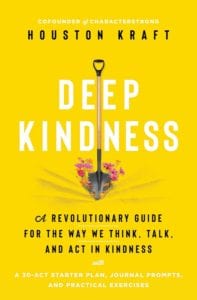
Deep Kindness: A Revolutionary Guide for the Way We Think, Talk, and Act in Kindness
My ultimate aim is to work myself out of job, and yet, I feel busier than ever, which is tough. It is the context of the world. We’ve always had challenges and access to information distribution that allows us to be more conscious or aware of some of the challenges that we already had. As we communicate information more quickly and widely, the way that we speak about things to me is what I’ve grown to be passionate about. In some ways, it’s why I wrote the book. The language we have around kindness doesn’t do kindness a service.
Tell me more about that.
With every word in our world, we have the dictionary definition, cultural definition and our own personal lived experience definition. The cultural definition of kindness for most people brings to life the things that the news talks about what kindness is, which is like the pay it forward coffee lines or the high five hallways or the Post-it note that were positive. In the book, I talk about that as confetti kindness, which is not inherently bad. We’re about to celebrate World Kindness Day and there are all kinds of organizations that promote random acts of kindness. I suppose my argument is that the kindness the world needs, in my opinion, presently is not random at all. It’s incredibly specific, intentional, thoughtful. It is the by-product of listening and empathy.
As we look into the reality of how most people interpret kindness, a lot of people think about that it’s free. My argument is that kindness is not free, but it requires time, energy and comfort from us in order to in many ways be humbled and do good for people who look different, act different, talk in front of us. In a time where we have divisiveness, kindness is going to require a tremendous amount of listening and perspective taking. That’s what I’m advocating for is a new way to speak about kindness so that we can navigate those issues that even you’re alluding to more honestly. How do we tackle things like gun control or the political divide or bullying? It starts with an honest assessment of what kindness looks like in my life and how to practice it in ways that move the needle, not just the surface level of goodness that the media pays attention to.
[bctt tweet=”The language people have around kindness doesn’t do kindness a service.” username=”John_Livesay”]
I know your opening chapter is titled Something Somewhat Provocative. I love that it grabs the attention with my storytelling and advertising background, which is the kindnesses. I thought, “I guess it isn’t.” What can a parent or teacher do to change that, so that it wouldn’t be normal for a child to do the kind thing first as opposed to it not being the norm?
To me it’s a little bit gentle attack on how we perceive ourselves versus what we do in the world. One of the studies that I think about often comes out of Harvard’s Making Caring Common project. Dr. Richard Weissbourd asked families, “Rank for me what you would prioritize most for your kid. Would you rather they be high-performing or happy or kind?” Eighty something percent of parents said, “They’d rather their kids be happy and kind over high-performing.” It seems like encouraging data. They asked the kids of the same parents say, “What do you think your parents want you to be, high-performing, happy or kind?” The data is the exact opposite. In fact, one of the clever distillations of the study, they said, “The vast majority of kids said that their parents would rather they get good grades, than be a good people.” Which to me runs counter to the argument of most parents or teachers or whoever would say, “We want our kids to be kind.”
The question becomes, “Do we allocate our time, energy, resources, education in order to make that real? What questions do we ask?” The family, when the student gets home is like, “How was your day? What did you learn? How was the test? How was practice?” It’s all about them versus my friend Keith Hawkins have a beautiful paradigm shifting question which is, “What did you do for others today? Who did you serve today? Would did you help?” Those are the questions that rarely get asked. As a result, for the younger generation, they pay attention to more so the indirect communication than they do the direct communication. Most of our indirect communication would say that achievement is more important than generosity.
I love this because I was interviewed by NBC on how to help parents get more than a one-word answer out of their child when they come home from school. With school and you get fine. What I suggested was ask your child, “Tell me a story about the best part of your day,” and then the child can decide beginning, middle, or end. Ideally, the parent tells a story and then you start teaching your child storytelling skills, but this takes it to another level, which would be, “Tell me a story about what you did to help somebody else today.” It would be even more aligned with what you as a parent value. Therefore, the child would then say, “That’s the story they want to hear. Not the best part of my day was I got an A or my team won or whatever the performance measures would be.” Let’s talk about what you described here as the empathy gap. What’s your definition of empathy? Where is the gap occurring?
Deep Kindness: Most indirect communication would say that achievement is more important than generosity.
The definition of empathy is going to require a couple of episodes for me to delve into it a bit more because in the context of kindness, my friend Barbara Gruner has a lovely phrase. She says, “Empathy gives kindness its why.” Which is to say, kindness without empathy, which we can reinterpret for the context of at least as listening and understanding perspective taking. Usually, that kindness is going to serve me more than it does you. To bring an example to it, after the Sandy Hook shooting, this national global tragedy, where there was moment of collective need, people wanted to give kindness to this community who was hurting.
People from all over the world sent stuffed animals or teddy bears, but Newtown, Connecticut had to rent a 20,000 square foot warehouse to house all the inbound gifts. One of the people that helped plan the candle light vigil in a profound quote he said, “There were more stuffed animals present than there were people. A teddy bear is great, but a teddy bear doesn’t pay for counseling and a teddy bear doesn’t pay for a funeral.” I reinterpret to mean, you gave me something that made you feel good, but it wasn’t what we needed. Empathy to me plays a huge role then in our ability to practice kindness effectively, because if I don’t listen to what you need, then I’m giving what I’m projecting you need, as opposed to potentially what you are in need of at the moment.
That might require asking a question of what you need versus thinking, “I’ll send him teddy bear, because that’s what I would like.” That’s easy than taking that extra step. Empathy, as you are saying is not just, “I feel sorry this happened to you,” but literally listening into what it feels like now and what would be the best way or thing I could do. That’s the gap. We think we’re being helpful and showing some, “I’m sorry.” There’s a big difference in my opinion between sympathy and empathy. I think you’re narrowing it down. Sympathy is you send a teddy bear and empathy is you take the time what I’m hearing you say to find out, “You need counseling? Let’s figure out a way to get that right.”
Not empathetic kindness lets me feel like the hero without ever even acknowledging whether or not I’ve made a difference. The gap itself is not in between intention and reality. The gap is between our ability to do it for others and how we’re feeling in the moment. The empathy gap, the term itself comes from Dr. Michele Borba, who spent 30 years researching empathy. She says that the biggest barriers in her research between why we wouldn’t be empathetic to another person or a group of people are anxiety, fear, and narcissism.
[bctt tweet=”Personal relationships will fall short when we prioritize things that do not lead to success.” username=”John_Livesay”]
She goes, “When any of those increase, empathy decreases.” If you think about the reality of the world, where we’re seeing at the huge increase in anxiety and fear, the by-product of that is decreased empathy. She says, “The empathy gap widens as anxiety increases.” The more anxious we are, the less empathetic we are as a culture. If you look at students, the data would tell us the average student now has as much anxiety than the average psychiatric patient from the 1950s. Empathy has dropped 40% in the average college aged students since the year 2000. She correlates that data. She’s like, “It makes sense. The more worried I am about what’s going on in my world, the harder time I’m thinking about what’s going on in yours.” Collectively, the more anxious we get, the more disconnected we get and the more disconnected we get, the harder it is to practice empathy in our life. It’s a little bit of a vicious cycle that creates that loneliness that we’re sensing in our world.
That’s what you talk about here that we created a lonely generation, not just a few people who don’t have friends that even people who have all that are still feeling lonely. It’s not how many people are in your life. You can still feel lonely if you’re not connected to people beyond your own fears and anxieties is what you’re saying.
If our own personal metrics of success are about winning or achieving, which mine for many years were unconsciously around that. I found myself successful and lonely. I was busy. I was traveling to the new school or event every single day, but personal relationships, my friendships, all the things that also mattered in my life had fallen short because I was prioritizing the thing that I thought was success.
You have a section here on incompetence and talk about empathy is standing in the rain. Can you expand on that a little bit?

Deep Kindness: The empathy gap is between the ability to serve others and how you are feeling at the moment.
We get to go down the storytelling route if you want. Many years ago, I had a chance to work in Haiti, alongside my friend, John. He lived in Haiti for over twenty years in American living there because he wanted to make an impact in a community where he saw tremendous need. I was lucky because back in the early 2010s, John was building a school in a poor area of Haiti called Bourjois about an hour outside of Port-au-Prince. I landed, I’ve never been to Haiti before I get off the plane with my camera and my Fedora. I’m working perfectly out of place. We get picked up and we’re driving through Port-au-Prince. As I look around, it’s the first time I’ve come face to face viscerally with that poverty. The beauty of Haiti is the contrast. Poverty sits alongside joy eloquently. As you look around, you see evidence. Although, it had been years since the earthquake had happened, you still saw staircases on top of buildings. You saw potholes that went 8 feet into the sidewalks.
You saw shanty towns with 700 people on top of each other. We drive up to John’s house in the mountains. We pull in and a part of the school is a choir. The name of the choir is Wozo, which is Haitian Creole for bamboo. Their motto is, “We bend, but we do not break.” An attitude of resilience is a natural resource in Haiti. We pull in and we get out of the car and Wozo is singing. I don’t speak the language. I don’t have no idea what they’re saying, but it doesn’t matter. I felt like that love and that welcome is always translatable. As soon as I got out of the car, it was clear that people were gearing up for a big event.
They kept calling it the big event and it was this celebration down in Port-au-Prince by the brand Life is Good, was putting on this concert series. Wozo, the choir was going to perform there and they were pumped. Finally, the big day rolls around, the big event and Wozo, the choir shows up and the bus is three hours late to pick them up. We’re standing outside, it’s over 100 degrees. We’re all sweating. The bus pulls in and it’s not a bus.
It’s a twelve-passenger van to fit these eighteen kids to travel an hour without air conditioning, down into Port-au-Prince. We get there right when it’s about to be their set time. The person who is organizing the event has to explain that they’re running behind and they have to cut Wozo set in half. You can tell that they’re disappointed, but they go backstage. They change their robes and formal gear and they get up and sing their brains out. I have no idea what they’re saying, but exuberance and joy are translatable.
[bctt tweet=”Your primary job is to listen well to love better and suffer alongside people to understand them better.” username=”John_Livesay”]
They get off stage and it’s time to head back home. In the distance, you see this rain cloud coming in and rain in Haiti is not a gentle experience. It is aggressive. You hear the thunderclaps. You see the rain coming in and people are scurrying to get in the cars. We realized that we have another car that can fit some of the kids in the back. We take about six girls from the choir, put them in our car and we begin driving up the mountain. At one point, the thunder is loud that it feels like it’s inside the car. There’s a five-year-old in the back who’s rightfully terrified. I am too, but she starts crying. I want to say something to this girl, but I don’t speak the language. I have no idea what to say. All of a sudden, the girls grabbed her hand and they all start sing.
We drive an hour with the girls in the back, singing and comforting this little girl. Finally, we pull up to the first stop. John who created the organization, hops out of the car, opens up the back and he grabs one of the girls out of the back and it’s pouring rain. This girl’s brother is standing there waiting for him because as I learned, the roads don’t get to these people’s homes. Many of them are going to have to walk another 1 or 2 miles to get back to their homes in the middle of this rain. We do this on repeat for the next hour. Every time we stop, John gets out of the car, gets out with the girl, walks him over and talks to the family and leaves them to go. Finally, he gets back in the car after the last interaction with the girl.
This is me, his brother Jesse and John. I remember feeling so bad because they’d been gearing up for this for long. I’m like, “I’m sorry. This day has not been anything that has been planned.” Jesse in the front was like, “In the US, there would be lawsuits at these girls to walk home in the rain.” I’ll never forget John looks back and he goes, “You don’t understand the big event had nothing to do with the celebration in the park. For many of these young people, this was the best day of their life that they had this opportunity to celebrate, be seen and sing. For me, the big event was standing in the rain with those girls. If I could’ve, I would’ve stood there all night with them.”
For me, it was a paradigm shifting moment in empathy, because I thought for a long time, that empathy was this thing that you had to live it to give it. You had to live through someone’s story in order to feel bad for them or with them in what they’re suffering. The reality is for people in Haiti, my life experience, I’ve never lost someone to a treatable disease. I’ve never had to walk my house for basic necessities, like water or medicine. I do know what it feels like to feel let down, to have disappointment, to be excited to share something and to stand in the rain.
Deep Kindness: You have to live through someone’s story to feel bad for them or with them.
There’s a distinction in my mind between the levels of thy. Which is you got apathy, which means, “I don’t care if you’re in the rain as long as I don’t get wet.” You got sympathy, which is, “I’m sorry, you’re getting wet. Here’s an umbrella.” You have empathy, which is, “I’ll stand in the rain with you.” It’s to suffer alongside someone and recognize that the human experience, whether or not it’s the same story to put myself into your experience and say, “Where do we overlap?” Empathy is an exercise in intentional imagination. Whenever I think about wanting to have empathy with someone, I think about standing in the rain.
It doesn’t get better than that. That’s an amazing story. I love the alliteration of intentional imagination. I love the contrast between, “I don’t care,” to, “Here’s an umbrella,” to, “I’ll stand in the rain with you whether we have an umbrella or not,” as our new definition of empathy so that we can start to work on reducing that empathy gap with a new awareness of what empathy is. Any last thought or quote you want to leave us with Houston?
To me, the whole premise of empathy, the whole purpose of standing in the rain would be, our primary job is to listen well in order to love better and to suffer alongside people means to truly tune in to contextualize who they are through all the pieces of their identity that’s different than mine. Where you grew up, your race, your gender, your orientation, your family, your traumas, everything that you’ve lived that’s different than me makes the way that you experience a situation wildly different than how I might. To stand in the rain with someone means to give our attention to someone well enough to truly understand how their needs are different than mine because that’s what kindness is. It’s my willingness to listen well enough to truly meet your needs in a given moment.
The book again is called Deep Kindness. If people want to follow you on social media, what’s the best way to find you?
I can’t thank you enough for putting this needed message out into the world with a new framework that we can all learn how to be better at it. Kindness. Thanks, Houston.
Thanks, John.
Important Links
- CharacterStrong
- Deep Kindness
- @HoustonKraft – Instagram
- https://www.HoustonKraft.com/
- Better Selling Through Storytelling Method Online Course
Wanna Host Your Own Podcast?
Click here to see how my friends at Podetize can help
Purchase John’s new book
John Livesay, The Pitch Whisperer
Share The Show
Did you enjoy the show? I’d love it if you subscribed today and left us a 5-star review!
- Click this link
- Click on the ‘Subscribe’ button below the artwork
- Go to the ‘Ratings and Reviews’ section
- Click on ‘Write a Review’
Love the show? Subscribe, rate, review, and share!
Join The Successful Pitch community today:
- JohnLivesay.com
- John Livesay Facebook
- John Livesay Twitter
- John Livesay LinkedIn
- John Livesay YouTube
The Blind Spots Between Us With Dr. Gleb Tsipursky
Posted by John Livesay in podcast | 0 comments

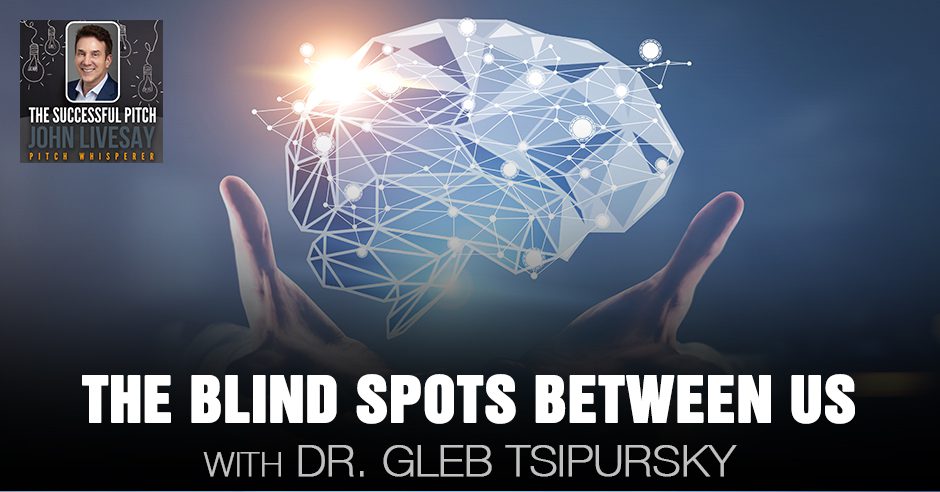
We like to think of ourselves as intelligent beings. After all, are we not the most evolved organisms on the planet? Sophisticated as our brains may be, they are specifically wired to be prone to a large number of cognitive biases that affect how we communicate and build relationships with other people. Whether you’re talking about business or personal relationships, falling prey to our cognitive bias leads to bad decisions and, ultimately, disaster. We have over 100 cognitive biases. Cognitive neuroscientist and Disaster Avoidance Experts CEO, Dr. Gleb Tsipursky, takes the 30 most dangerous ones for relationship building and effective communication and discusses them in his new book, The Blindspots Between Us. In this interview with John Livesay, he goes in-depth into the two most common and insidious forms of cognitive biases that we are constantly subscribing to, to the detriment of our business and relationships.
—
Listen to the podcast here
The Blind Spots Between Us With Dr. Gleb Tsipursky
Our guest is Dr. Gleb Tsipursky, who is the author of The Blindspots Between Us. He talks about the importance of emotions being like underwear, and that you don’t want to go commando into your next sales call. I love that. That was very playful and clever. He’s quite intelligent and talks about cognitive bias, which is when we think something is true, when in fact it’s false. For example, people buy illogically and then you throw out a bunch of information. He and I are definitely on the same page that people buy emotionally and that they need stories to pull them in. Find out what the other cognitive biases are that you might be doing and making mistakes that you can learn to avoid. Enjoy the episode.
—
Our guest is Dr. Gleb Tsipursky, who defends people from relationship disasters caused by dangerous judgment errors, known as a cognitive bias. He does this with consulting, speaking and training as the CEO of Disaster Avoidance Experts. He’s a Cognitive Neuroscientist and Behavioral Economist. He has over 550 articles, everything ranging from Fast Company to being in Psychology Today. He is a bestselling author known for Never Go With Your Gut. He is writing a book about resilience, which we all need about adapting to COVID. We’re going to be talking about his latest book, which is The Blindspots Between Us: How to Overcome Unconscious Cognitive Bias and Build Better Relationships. Gleb, welcome to the show.
Thank you so much for inviting me, John. It’s a pleasure.
Our mutual friend, Dr. Mark Goulston, lots of doctors, you’re a doctor, he’s a doctor, referred me and he always has amazing relationships and contacts. You and I had a chat previous to the show, and you have a very unique set of insights to share with us. Before we get to that, Gleb, I like to ask my guests to take our readers on their own little story of origin. How did you become you? Were you a little boy saying, “Someday, I’m going to become a doctor and figure out how to help people avoid disasters?” You can take us back to childhood, college, wherever you want.
I will take it back to childhood and it wasn’t quite about disasters. It was about decisions. That’s what my fundamental area of expertise. How do we make decisions go well? How do we make decisions badly? How do we avoid the bad decisions? When you look at disasters, disasters come from bad decisions. That’s where disasters come from. There are two types of decisions that lead to disasters. Either we actively make a bad decision, so our initiative causes a bad decision or a series of bad decisions that lead to a disaster, or we fail to foresee a disaster. We fail to foresee and take action, make the decision that would result in avoiding disaster. Those are the kinds of things that result in disasters. My interest in decision-making stems from my childhood, when I saw my parents making some pretty bad decisions in their personal lives. For example, my mom, she liked to buy nice clothing. She’d go out, she’d buy a $100 sweater. My dad was a cheapskate, so she’d come home and he’d yell at her, “No sweater should be worth over $20.” She’d bring up how he always leaves the toilet seat up.
Where did you grow up? Where is this happening?
This was happening already in the former Soviet territory of a country called Moldova, which was liberated from Soviet domination, Russian domination in 1991. That’s when my parents immigrated to the United States and that happened in the United States. I was ten when they immigrated. It happened definitely before that and afterwards.
It’s important to get that context. It’s fascinating for them to realize why your dad might be perceived as a cheapskate based on his background there, and now they’re in the States and still bringing some of those choices, beliefs and decisions. Even though you changed locations, your mindset sometimes comes with you.
[bctt tweet=”Disasters come from bad decisions.” username=”John_Livesay”]
That does not change. That basic dynamic between them did not change. I kept doing that and the thing is all throughout my childhood, both back in Moldova and in the United States, nothing changed. They kept doing the same things and they kept not changing their behavior. My mom kept buying nice clothing and my dad kept yelling at her. I grew up frustrated. It impacted me as a kid to see my parents fight over something so stupid. As a kid, I was seeing this stupid thing to fight over. Even more stupidly, there was no change. They kept hurting each other, dealing with each other to these emotional blows all the time, but their behavior didn’t change. My mom kept buying the clothing. My dad kept yelling at her and they kept having these conflicts.
I kept hoping that somebody would sit me down and say, “Here’s how I make good research decisions about communicating about your relationships with others,” but nobody did. In other life areas, there was nobody who taught me how to make good decisions. That didn’t happen in school. Not in elementary school, not in middle school, not in high school. Nobody taught me to make good decisions in college and that’s not taught in business school either. I became interested in how do you make good decisions? How do you avoid the bad relationship patterns and communication patterns that my parents fell into? I didn’t want that for my relationships. I didn’t want that for my professional life. I am the CEO of Disaster Avoidance Experts. As the CEO of a consulting, coaching and training company, I’m obviously in sales.
Dr. Gleb, can you define for us what a disaster is in business?
A disaster in business is anything that significantly impacts your bottom line in a negative way. Anything like that is a disaster and that’s what I wanted to help people avoid. Right now, as the CEO of Disaster Avoidance Experts, I’m obviously in sales. I know that there are many things, many of these dangerous judgment errors that harm the fundamental relationships that you have to build in sales and the effective communication that you have to have in sales. That’s something I learned as I went into the job of consulting, coaching, and training. Initially, I didn’t know anything about sales. I was fascinated with decisions and decision-making. As I learned about this topic, people started asking me about it and that’s how I began to be consulting, coaching and training on this topic. I’ve been doing that for over twenty years. I learned that there’s very little quality information available out there in the popular literature and the popular media on making good decisions. It boils down to go with your gut, trust your intuitions, follow your heart. The Tony Robbins, be primal, be savage, that’s unfortunately incredibly damaging and causes people to lose sales all the time and make very bad decisions about everything from selling to storytelling to all other areas of business.
What’s the biggest mistake people are making when they’re trying to sell someone?
The biggest mistake people are making when they’re trying to sell someone is going for their mind as opposed to going for their hearts. There’s a cognitive bias, a specific, dangerous judgment error that we make as human beings because of how our brain is wired. That’s called the empathy gap. The empathy gap is when they underestimate the extent to which emotions move other people or influence other people. When you look at the research, I mentioned there was very little quality literature out there making good decisions. It’s popular literature. I had to go into academia and become a cognitive neuroscientist, which is the study of how our brain works and how it impacts the way that we function, and the behavioral economist, which is how human beings behave in economic situations. I’ve been doing that for many years.
In order to get somebody to take an action and buy something, or even hire you or enroll in graduate school, you have to look at their thought process as well as their pocketbook. People look at something and they go, “I want that or I need that,” like in your mom buying the dresses. There’s some behavior bias on why she needed to buy a certain price point to feel good about herself or proud about what she was wearing. If we define cognitive biases, so a bias is when we tend to have a prejudice one way or the other based on our thoughts. Is that what cognitive bias is?

Cognitive Bias: There are so many dangerous judgment errors that harm the fundamental relationships that you have to build in sales.
Cognitive bias is a mistake we make in our thinking when we think one thing is true, but it’s actually not true.
Do we have an example of that?
I mentioned the empathy gap. When people think that other people are moved by reason by logic.
It’s a cognitive bias mistake to think that people buy logically when they in fact buy emotionally. That’s an example of a cognitive bias.
That is one out of over 100 cognitive biases. That is a fundamental mistake because what the research in cognitive neuroscience shows us is that our motivation, about 80% to 90% of what motivates us comes from our emotions. It comes from what we feel, not what we think.
I had a conversation with the dean at a prestigious university who’s in charge of marketing. He was saying, “You’re always telling, ‘People tug on the heartstrings and people open their purse strings.’ I’m not sure that I agree with that for all products.” His premise was that telling something that’s tugging at heartstrings, it’s emotional might be good to get people intrigued to get into the sales funnel. Maybe you want to close your request to get students to enroll in a graduate program with an emotional play. He says, “Everything in between there is a logical decision. It’s not impulsive. They want a return on investment.” I get at the end the emotional tug would be your life will be better or this will be a new chapter you’re investing in yourself.
That’s his thought process. My whole premise, which I would love your expert opinion on, is that you need the emotional storytelling throughout the entire funnel. It’s not that the opening and closing. I actually work with people in turning these boring case studies, whether it’s a technical situation, or in this case, trying to get someone to enroll in an expensive graduate program. You still should be using case stories to emotionally pull people in so that they see themselves in that person’s life that went through the program and want to go on that journey versus only using emotions at the beginning. My first question to you is, do you think that’s true that we should have emotional storytelling throughout the entire funnel, or only as he’s suggesting at the beginning of the end?
[bctt tweet=”People absolutely buy emotionally for everything. They just don’t realize it.” username=”John_Livesay”]
We must have emotional storytelling throughout the entire funnel. His perspective is silly. He’s not realizing what’s happening. This is fundamentally a mistake where he is thinking people are logical. I was a professor for over fifteen years. I understand how professors relate to each other and they relate to each other mainly through logic and reason. They perceive that other people are logical and reasonable. What’s important fundamentally underneath that is a combination of fear, anxiety, status-seeking, respect seeking, intellectual one-upmanship, competition. Those are all things that are fundamentally emotional. That dean does not realize that.
What we do is complicated. I hear a lot of people tell me, “In technology, people don’t make an emotional decision to do that. We need to show how smart we are and that this is an engineering choice.” My second question based on his comment was do you think that people buy emotionally for everything, not just certain products?
They absolutely buy emotionally for everything, but they don’t realize it. When there’s an engineer, let’s say a software engineer describing a product, there’s a demonstration of status of smartness. That makes people feel more confident, more trusting in what’s going on. Confidence and trust are the emotions that are appealing to. Of course, if the engineer doesn’t realize that what’s going on is that she or he is appealing to confidence and to trust, they’re not going to be doing that in the most effective manner. Emotions are like underwear. You don’t show that you know what’s going on. They’re the framework, but you need to not go commando to a sales pitch because that will not be good for you. That will not be good for your sale. You want to understand the emotions that the other person is experiencing. If you haven’t taken the time to create an emotional profile of the person that you are going to sell on and you haven’t taken the time to think of the stories, you want an emotional profile, and that is fundamental. You want to see what the person will resonate with. You want to think about how stories will impact the emotional profile at various elements. The stories are going to be the tools, the tactics that you use to appeal to the person. Those are the tools that you should work with when you’re pitching people.
Gleb, what made you write The Blindspots Between Us? How did you come up with that title and what made you want to write this book?
What made me want to write this book is seeing all the problems in communication. I’ve been doing consulting, coaching and training for over twenty years. I’ve been in academia for over fifteen years and there’s no book out there on the cognitive biases in communication and in relationships. This was sad to me to see that people are making so many mistakes. My fundamental value set is as utilitarian. I want the most good for the most number. Seeing people suffer unnecessarily, make terrible mistakes, everything from losing sales to going for divorces because of bad communication and not realizing what the basis for the relationships is. The basis for relationships is fundamentally emotional. There are so many mistakes that we make when we try to approach other people on the logical basis. What the research on this topic shows us is that we as human beings, we are fundamentally pattern-making and storytelling machines.
When you look at the evolutionary basis of what our gut reactions are, what our emotions are, we look for patterns, and that is a fundamental aspect of who we are. Those patterns are most effectively conveyed through patterns and stories. Those are all very effectively appealing to emotions. You want to understand the patterns that people will see. How will you tie your pitch to their needs? There needs to be a pattern that they resonate with. The story is a way of creating that pattern, that effective pattern, that narrative that appeals to their underlying emotions.
Let’s pivot a little bit on a personal level because this book appeals to both personal relationships and business relationships. Let’s say I have a friend and he keeps tending to date the same person. He tends to find himself not purposely or consciously going out. “I met this woman and it turns out she’s a nurse and I like nurses. They’re compassionate, they’re caring, they’re this or that. I dated her and then it was a horrible breakup.” Two years later, he dates some other people and now, “I’m getting married to a nurse.” That lasted for a number of years and then they got divorced. Now he’s saying, “John, do you think I should stop dating nurses?” Is that a pattern? I’m fascinated to hear what your thoughts are on that? Is that something that’s a coincidence? You’ve heard it many times like, “I married my parents or I keep attracting people that don’t treat me well,” or whatever the issue is. Let’s go as basic as this, “I’ve had two bad experiences with nurses in my dating life. Therefore, I should make her an absolute rule for myself going forward I’m never going to date another nurse.” What do you think about that?
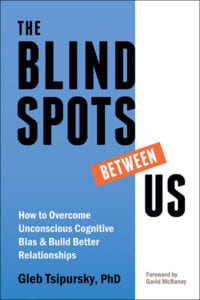
The Blindspots Between Us: How to Overcome Unconscious Cognitive Bias and Build Better Relationships
What you want to look at is what’s under the quality of the nurse. If you’re looking for people who are compassionate, let’s say. If that’s the reason you’re looking for nurses, there are lots of caretaker people who will be compassionate. They don’t have to be nurses. If you have breakups with nurses and in general, with compassionate people, that might indicate that you’re looking too much for compassion, those people are already giving of themselves in the world. You might be looking for love in the wrong place in that sense.
You mentioned that there are over 100 cognitive biases besides making the mistake that what you think is true is not true. You could make a joke about the majority of people believe that the world is in fact round and not flat, but some people maybe have that cognitive bias that they think it’s flat. They don’t trust science. Is there another big cognitive bias where people think something is true and they behave accordingly that you say, “That’s such a problem in business?”
One of the other biggest ones I want to highlight is called the illusion of transparency. The illusion of transparency is the idea that when you say or convey something, the other person understands 100% of what you mean perfectly well. That is the biggest cause of miscommunication that I see. The empathy gap is the biggest cause of problems and challenges through relationships, but in the direct communication, the illusion of transparency is the biggest one.
For example, if I say dog, I assume I mean my adorable King Charles, and you might be thinking Great Dane, right?
Exactly. It’s semantics and so much more, and the dog is one thing. When you say dog and to somebody who is from a culture where people eat dogs, you’re thinking pet and that person might be thinking food. That is another fundamental misunderstanding because when you say something, we don’t realize the mental associations we have with certain terms and certain concepts. We assume the other person has the same mental associations with these concepts or the same stories. We’re talking about stories, we understand our life, our surroundings through stories. When we say dog, you have a certain story of a dog in your head. The other person has a very different story. Most likely they have a dog in their head unless you know very well that they have the same story.
If you and your wife have the same dog and have the same pet, you probably have a similar story, but otherwise, you most likely don’t. When you’re doing a sales pitch, let’s say when you’re conveying certain information, you have a lot of knowledge about the product or the service that you’re trying to sell. That’s why salespeople often try to sell the grass seed instead of the lawn. They talk about the product. They don’t talk about the other person’s needs. They don’t talk about what the other person needs. They focus on conveying information. They assume. They feel. That gut reaction is to feel like the other person would automatically understand the outcome because they describe the qualities. That is fundamentally flawed. That is not how the other person thinks. They don’t have the same stories. They don’t have the same associations that you do with what you’re describing. With the content, with the idea, or with the message that you’re trying to convey. What you need to do is discover their stories. What they are thinking about the topic that you’re going to be talking about? Not what you’re thinking, but what they are thinking. Target your messaging toward their thought patterns. That’s the first step. You want to check for understanding. You want to ask people to convey to you that they’re getting what you’re trying to get them to get.
Constantly be checking in. It’s like, “Does this make sense? Are you following this?” I always say the confused mind says no. Most people won’t tell you they’re confused. It’s an ego thing.
[bctt tweet=”Know the other person’s story first. Don’t assume they think about things in the same way that you do.” username=”John_Livesay”]
It feels bad and that’s emotions. It feels bad to say you’re confused. Even framing it, “Have I conveyed this clearly? Would you like me to rephrase something?” Putting it on yourself.
Would you say, “I’m not clear, I’m holding responsibility for this not coming across clearly. Let me restate it?” Would you say it’s fair then to say close the empathy gap through storytelling?
Absolutely, yes.
That will be one of the tweets we’ll have for this episode for a sound bite for people to remember what you’re saying because I’d like to try to sum it up. That’s why I’m known as The Pitch Whisperer and a short little sound bite that makes it easy for people to reference this. My big belief is that one of people’s cognitive biases, I’ve never called it that before, but for years we’ve heard the term, “You’ve got to get people to know, like and trust you,” in that order. You’ve heard that, yes?
I did.
My premise is if people think that’s the order in order to get someone to buy from you, that’s what triggers the mistake of saying, “You’ve got to get to know me. Let me vomit a bunch of information about my product.” I think the order is all wrong. I tell people, “You need to get people to trust you first,” and then it goes to the heart, which is, “Do I like you?” Finally, it’s a knowledge thing. It’s not even still do I understand the product perfectly, but the question is completely different, which is, “Will this work for me or not?” Therefore, do I see myself in the story? I think that’s why Dr. Mark wanted us to meet because we have similar philosophies of looking at things going, “This isn’t true. You’re behaving your assumption that this is true. People have to know you first before they like and trust you causes you to do the wrong behavior. When you flip it and start building trust and likability first, then you can get into people knowing you and your product. It’s not about knowing it. The head question is, will it work for me?”
What they need to do is trust you first, not trust the product. That’s the fundamental mistake.

Cognitive Bias: The empathy gap is the biggest cause of problems in relationships, but in direct communication, the illusion of transparency is the biggest one.
You sell yourself first.
That’s the fundamental mistake so many people make. They logically sell the product whereas what they should be doing is building a personal relationship and cultivating that first. How will the person trust you and trust that the product will work for you? They have no idea what the product is compared to you, but they have to buy it and then figure it out. They have to trust you first. They need to trust you. They need to trust that you have their best interests at heart before they go forward to with the product.
Any last thoughts or a phrase or something that’s in the book, The Blindspots Between Us, that you want to leave us with to incentivize us to take the leap and get the book?
I want to remind you about the illusion of transparency. Know the other person’s story first. That can be another tweet to share about this. These are only two of the cognitive biases. If you want to know what are the others, there are over 100, I talk about the 30 most dangerous ones for successful relationship building and effective communication in The Blindspots Between Us: How to Overcome Unconscious Cognitive Bias and Build Better Relationships. If you want to know the other 28 and make sure that you don’t fall into those problems, get the book.
The book again is called The Blindspots Between Us. Dr. Gleb, thank you so much for sharing your story, your wisdom and the results from all your research so that we can avoid making these mistakes over and over again and have better relationships in our career and in our personal life.
Thank you so much, John. It’s been a pleasure.
Important Links
- Never Go With Your Gut
- Disaster Avoidance Experts
- The Blindspots Between Us: How to Overcome Unconscious Cognitive Bias and Build Better Relationships
- Amazon – The Blindspots Between Us: How to Overcome Unconscious Cognitive Bias and Build Better Relationships
- Better Selling Through Storytelling Method Online Course
Wanna Host Your Own Podcast?
Click here to see how my friends at Podetize can help
Purchase John’s new book
John Livesay, The Pitch Whisperer
Share The Show
Did you enjoy the show? I’d love it if you subscribed today and left us a 5-star review!
- Click this link
- Click on the ‘Subscribe’ button below the artwork
- Go to the ‘Ratings and Reviews’ section
- Click on ‘Write a Review’
Love the show? Subscribe, rate, review, and share!
Join The Successful Pitch community today:
- JohnLivesay.com
- John Livesay Facebook
- John Livesay Twitter
- John Livesay LinkedIn
- John Livesay YouTube