

Every Conversation Counts With Riaz Meghji
Posted by John Livesay in podcast | 0 comments


Every conversation counts. They may seem so trivial most of the time, but they are actually key to making significant connections that lead to extraordinary relationships. But sometimes, we get so caught up in our own lives that we forget to ask the right questions, or we simply don’t know what to say. That’s why in this episode, we have human connection expert Riaz Meghji to talk about how conversations spark connections and shape our lives! He shares valuable insights from his book, Every Conversation Counts: The 5 Habits of Human Connection That Build Extraordinary Relationships. Riaz also touches on what to say and how to help someone dealing with grief. You don’t have to be a genius at conversation – just try out new things and keep listening. Tune in now!
—
Listen to the podcast here
Every Conversation Counts With Riaz Meghji
Our guest is Riaz Meghji, who is a Human Connection Keynote Speaker. He talks about how to build connection, which leads to trust and all-important emotional engagement. He has two amazing questions that you can ask someone when they’re grieving the loss of a parent. You don’t want to miss this. Enjoy the episode.
—
Our guest is Riaz Meghji, who is a Human Connection Expert and the author of the book, Every Conversation Counts: The 5 Habits of Human Connection that Build Extraordinary Relationships. His insights have been featured in Fast Company, Harvard Business Review, and Financial Post. After one conversation led him to take a dramatically different career path that changed his life for the better, he became dedicated to exploring the ways that authentic human connection can change lives and organizations. In addition to being a respected thought leader and author on the topic of human connection, Riaz is also an accomplished broadcaster with many years of television hosting experience. He’s interviewed experts on current affairs, sports, entertainment, politics, and business. Riaz, welcome to the show.
John, I feel like this was meant to be, the two of us talking about conversations and stories. It’s great to be here. Thank you.
You are a natural storyteller, and you know how to teach people how to ask questions in difficult situations. We’re going to get to that in a minute. Your bio teases out that little conversation that took a dramatically different career path. I know the answer to it, but I’d love you to share it if you don’t mind, your own story of origin. You can go back to childhood or wherever you want, “Here’s what interested me, and then I thought I was going to do this, and then I did that instead.”
Thanks for opening with this one. It’s so interesting because it’s such a relatable question, “What is your origin story?” For the work that I do and hopefully, invite the audience to think about defining conversations and defining moments, what is one of the most important conversations that changed the trajectory of your path? For me, it goes back a few decades. I was finishing my Finance degree at Simon Fraser University, living my parents’ dream. Not my own South Asian family if you’re not a dentist or financial expert.
An investment banker, yes.
[bctt tweet=”Assertive empathy is the key to connection. Ask questions that show empathy.” username=”John_Livesay”]
You’ve got a few options. In my final semester at Simon Fraser University, I was enjoying the art of presentation. I was presenting at a conference in Quebec City in my final semester. I was fortunate enough to have the co-chair of that conference. He’s still a friend to this day. He sat in on some of my sessions, and they were HR sessions for a student-run group, an international student exchange group.
He pulled me aside at the end of the conference and said, “I know you think you’ve got your life figured out at the age of 22, but I don’t think you should go into Finance.” I remember looking at him and thinking, “Okay.” He said, “From what I saw on stage and your age, you should take a year of your life and explore what’s out there in the presentation space, maybe something on TV.” This was the first time I truly thought about this as a profession. I thought, “That is a compliment, but you recognize my parents are South Asian, so there are expectations here that we need to uphold.” He did not hesitate when he leaned in. He challenged me and said, “When are you going to stop playing safe and start living your life?”
That question is at any age, not just when we’re young in our twenties. Now, as we get older, we get responsibilities, mortgages, and whatever, but this concept of, “We no longer take risks in our life,” you stop taking risks after a certain age is a myth that I would like to bust because we should always be asking ourselves that question, “Am I playing it safe?” What you mentioned that somebody saw on you is what I saw in another guest, Tucker Bryant.
With that kind of talent at such a young age who had a similar trajectory from England, Stanford education, and worked at Google, he was on that path. He was like, “I’m going to be a keynote speaker about poetry and leadership.” Talk about explaining that to mom and dad. What somebody did to you was pointing out that talent. Once you and I have the opportunity to spot that in somebody else at that age, or they’ve already made the decision to do the riskier choice, but it’s their passion, we can double down and say, “That was a good choice. We see why you did it.” That’s the joy of paying it forward or paying it back however you want to look at it.
To build on that, I think back to the gift that the co-chair was able to give me at that moment. It also is a great reminder that he was making a statement, but he was also allowing me to reflect and ask myself the question, “Am I living the life that I truly want to live? Am I playing this game of life safe?” The big opportunity for all of us is to ask first and talk second to have breakthroughs in our conversations because we could feel we’ve got the greatest advice to give to somebody.
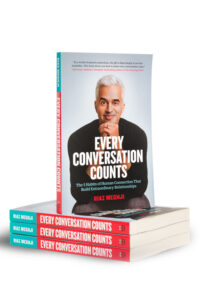
Every Conversation Counts: The 5 Habits of Human Connection That Build Extraordinary Relationships by Riaz Meghi
The conversations you have on this show about persuasion and influence, we cannot motivate, persuade, or influence anybody unless or until we connect with them first. The power of connection starts with the power and quality of the questions we ask. When you have somebody that has seen something that is leaning in with that type of precision, it’s not only a compliment. It’s his opportunity to call me up at that moment and not call me out. That is what true leadership is with storytelling on the questions that we ask ourselves, “How can we call each other up in important moments?”
As a keynote speaker, you’re going into organizations, helping them have better connections with their team and with their clients. You also have this wonderful video talking about you and your brother suddenly losing both of your parents and how to deal with that grief. It’s going to happen to all of us. We’re going to have a situation where we have to grieve, or someone we care about is experiencing loss in their life. Most of us are stuck with the platitudes we see on TV of, “I’m sorry for your loss.” You came up with some incredible questions to ask people while they’re in that state of grief.
I’m going to repeat the questions for you because I want you to then give us some of the experiences and some of the answers you’ve gotten to these questions. That could be a loss of a job or a pet. Grief is grief. It’s different degrees. Let’s say it’s the loss of a parent. The question that hit me was, “What do you want me to know about them?” That person gets to decide. It’s a legacy. The other part is, “What is giving you comfort now?” I thought those were brilliant.
I’ve never heard anyone ask those questions in that situation, and that’s why you’re a thought leader, successful, and in demand. My first thought of, “What gives you comfort now,” makes us look for something. When you’re in that grief, having experienced it with the loss of my dad, nothing’s giving me comfort at the moment, but I have to try and find some answer. Nobody wants to say nothing because you’re still here remembering them, talking about it or whatever it might be. As a former journalist and now keynote speaker on this human connection, how did you come up with those amazing questions?
I’m glad that you introduced this in the conversation. These are probably some of the most powerful moments that come out of the keynote, especially when we talk about one of the habits in the book of assertive empathy. If you’re reading this, and you’ve gone through loss, or you know someone that is going through loss, and you want to be there for them, and you’re not sure what to do or what to say, “What do you want me to know about them,” has been a game-changer question.
[bctt tweet=”Use the power of your curiosity to feel that challenge in front of you to avoid fixing the wrong problem.” username=”John_Livesay”]
I realized before I experienced loss, my brother, my wife, and myself going through this, I had failed everybody that had experienced loss before I experienced it myself. In my mind, I thought, “I don’t want to trigger them, so I’m not going to bring it up. They probably don’t want to talk about it.” I’m making assumptions in my own mind to soothe myself from that discomfort, forgetting about the person in front of me. What do we all do at the moment? You articulated that when something goes wrong, and if there’s loss or some element of grief, it’s autopilot mode, “I’m so sorry for your loss, thoughts and prayers. Let me know if you need anything,” and then what do we do? We step back, and that person is left all alone.
In this message of human connection, I talk a lot about how we combat loneliness. Grief is a huge part of loneliness because you feel like no one can relate, no one can understand, and you feel like you’re drowning. In the early part of 2020, I volunteered with Canuck Place Children’s Hospice every year for their Gift of Love Gala. I found myself in conversation with the Lead Counselor of Canuck Place, Deb Davison. I credit her with this question because she does incredible work to lift parents who have faced the unimaginable circumstance of having lost a child.
She not only is there to support them, but to elevate them, so their parents can take the stage and motivate a community to support the hospice. It’s incredible. I remember saying to Deb at that moment. I was four months removed from the sudden loss of my father and never had truly dealt with grief. I looked at her and said, “Deb, how do you do this? I am profoundly struggling with this notion of grief. How do you do this work? What is the best thing you can say to somebody?”
She reframed my perspective and approach to this question. She said, “It isn’t about what you can say. It is about what you can ask.” When I asked her, “What’s the best question you can ask somebody?” she introduced the question, “What do you want me to know about them?” What that person on the other side needs the most at that moment is to share a piece of that person, their legacy, their story, and ultimately their connection to that person and why it mattered so much. When she said that to me, I remember looking at her and said, “I will never forget this gift you gave me. Thank you.”
Every single person that I knew had lost someone from that point on, one, I recognized my failure in being able to support them wasn’t because of malicious or selfish intent. I just didn’t know. Now, I encourage others to lean with curiosity. What do we all do when the conversations hit a roadblock? Sometimes we fall into the trap of trying to fix it too fast. I encourage others to use the power of their curiosity to feel that challenge in front of them before they fix it, so they’re not fixing the wrong problem and that person is truly feeling seen, heard, and valued in their darkest hour. That person on the other side, as you know, John, will not forget it when you were there to lift them up.

Conversation Counts: Grief is a huge part of loneliness. You just feel like no one can relate or understand you, and you feel like drowning.
That’s what good leaders do. They make their team feel seen, heard, and appreciated as people and not cogs in a wheel. You mentioned in your book, Every Conversation Counts, there are five habits to build these connections, and one of them is assertive empathy. My question is, what determines whether something’s assertive empathy versus regular old empathy?
I love the distinction here. I believe the idea of assertive empathy is leaning in with that empathetic curiosity, even when the conversation is difficult. It’s easy when the emotions aren’t heightened to be empathetic. When it’s difficult or you potentially disagree with someone, there is such an opportunity to understand how you get to that conclusion and the power of our questions and these types of scenarios. I’ll give you some examples.
Think about the idea when someone or I could come to you and say, “John, I presented on stage. Can you give me some feedback?” Before you jump in with that feedback, there’s an opportunity with your assertive empathy to say, “How do you feel that went?” and that’s the opportunity for me to start articulating first and doing that work of reflection. Maybe I’m at a roadblock, and you could simply say to me, “What do you feel is impossible in your life now, Riaz?”
I could express all of this pain, and then you could simply reframe and say to me, “What do you think would make this possible? What’s the first step in making that possible?” You’re not giving me any of the answers, but you are that assertively empathetic guide to unlock the answers that I already have within. I’m just asking for a soundboard that will help me through it and a strategic partner that will ask the questions, that notion we talked about, that will call me up in these moments and not necessarily call me out. It’s an empathetic form of accountability.
Before the show, we had a little bit of a conversation about you being on camera, hosting television, producing segments, and how part of that job and the producers get pitched all the time to have people come on the show and either pitch their book or be an expert on a topic. When people were pitching you to come on your shows, the CityTV Breakfast TV or MTV Canada, what made you say, “I can see that as a great segment,” and what would make you go, “There’s no way I’m having that person on?”
[bctt tweet=”One of the ways to establish trust is putting aside our perfect persona and going first with vulnerability.” username=”John_Livesay”]
The one clear factor that I’d always look at in every single pitch, whether this would be a winner in a 5 to 7-minute live television segment or a complete self-indulgence was looking at this pitch, and is this pitch saying how great this subject is, or is this pitch saying how great the audience can be after this 5 to 7 minutes on TV?
That’s what we do as keynote speakers. We’re all about, “What kind of impact can I have on making this audience’s life better?” Not, “Is the audience impressed with me?” It’s the opposite, but, “How can I serve them?”
I liken it to philosophy, and the whole philosophy behind the book was, “Look at you is greater than look at me.” I believe the interviews that truly resonated, whether we had subject-matter experts or even higher-profile celebrities that came on the show, weren’t about anything that I said. It was the questions that gave them the space to share where they’d say, “I like that guy. He’s on my side,” and giving them space. It’s not only the power of the pitch. If you truly want to impact that audience and move that audience to action, one of the things that I found was the ability for all of us as communicators to embrace the power of productive silence.
What does productive silence look like? More importantly, what does it sound like?
It’s giving the audience space. You, as a keynote speaker, have such great wisdom in the stories you tell. You could give that audience a nugget. Instead of moving to that next point after you drop your knowledge bomb, give them a moment.

Conversation Counts: A strategic partner that will ask questions again is an empathetic form of accountability.
It’s like what I did with you earlier. You said some amazing things like, “Let’s pause here for a second. Let me repeat that for people to digest that.” Is that an example?
Yes, letting it breathe. I feel like there’s this sense of urgency, and maybe because modern culture emphasizes convenience and efficiency. Things move so fast. I’m a firm believer that sometimes efficiency can be the enemy of human connection. How can we slow down these conversations and truly hear each other? You throw something out like, “That resonates with me. I want to reflect on this. Let’s dive into that.”
It’s almost suspending your judgment, your assumptions, and your script. You had beforehand of, “Here’s where I was planning on going with the interview, but you gave me something that I didn’t think was coming. Let’s lean in here.” That’s how you can have a conversation that will be memorable for both sides, where if they can say, “I’ve never shared that before,” that is a gift that you gave them the safe space to do that.
One of the things that really stands out for me watching your keynote speaker video is you have this amazing journey you take the audience on. It’s the awareness that many people are experiencing loneliness personally and at work. Just because you’re in an office doesn’t mean you’re not lonely. Once you show people how to have better connections, that builds the all-important trust, which then builds the engagement for the team to be productive. The same thing is true in sales. You need to connect with that person.
Sometimes that means being a little vulnerable, and that builds trust. You then can have an engagement with that potential buyer or person who’s going to decide whether they’re going to have you on their show or hire you as a speaker. People forget that we, as speakers, have to often pitch ourselves as to what the experience would be like if we’re the speaker that gets hired. That is true in almost every industry, whether you’re a doctor, lawyer, or architect. We’re all having to have some emotional connection. As you said, this efficiency being the enemy of connection, it’s not about how many facts and figures we spiel out, is it?
[bctt tweet=”If you are playing safe, how could you take a small risk every single day and put yourself out there?” username=”John_Livesay”]
No. The facts and figures are going to be vital for the analytical mind, but to make that message sticky with storytelling, you’re going to use powerful metaphors. How do we amplify the emotion at that moment for them, so they truly feel the message? Vulnerability is a big part of this. There’s the notion of, “I think about sales. With your audience, I think about persuasion.” Trust is a huge component of this equation. How do we truly establish trust?
One of the habits I champion is putting aside our perfect persona and going first with vulnerability. Some leaders say to me, “When is it oversharing? When is it too much?” You’re like, “This isn’t the right space and time to do that.” There is a powerful concept in psychology known as the Pratfall Effect, where if you’ve done the work to convey your competence and show that you are that point of authority, are reliable, and establish credibility, your vulnerability will then become a powerful tool to draw people closer and embrace connection.
If they’re questioning your credibility, and then you floor the gas pedal with the vulnerability, that share could fall flat and create distance instead of connections. It’s important that we also convey credibility before vulnerability, but both sides are an important part of the equation to amplify emotion and ultimate impact and motivation for the audience to move.
There is an art to it like there is in selling or storytelling. Everything has a delicate balance. If you’re making a meal, and you over-season something, it ruins the meal. The same thing is true when there’s an order to a recipe for a reason. That makes sense in my head that this has to come first for a reason, and then you add that as opposed to willy-nilly and throw it in any order or any amount. That’s not how you make anything connect as it were.
The science and psychology of the formula are very important, but the formula itself should not be more important than authenticity. Some people would say, “Aren’t you manipulating the person in front of you or the audience or the person you’re trying to sell to?” It’s being who you are. If that fits with who you are, and it’s an authentic display, people will be pulled towards that. If they say, “You’re following a script or a formula. I’m going to back away from that,” nothing trumps authenticity. Authenticity and vulnerability, if we talk about the ingredients of the entire equation, are vital in any message and platform that we’re going to convey.

Conversation Counts: Every audience reacts and responds differently to a particular content. One of the best audiences is the new one who is willing to be open and embrace the message of human connection.
Who’s your favorite audience to speak to?
It’s a real interesting question that makes me think because a lot of strategists will say, “Who is the target audience?” With the message of human connection, there are moments when I’m talking to groups in the HR space with leadership, culture, and collaboration. There are times that I’m talking about how to win customer loyalty. There are times I’m talking about how to grow sales through authentic connections. I feel like there are always two teachers in the room, and every audience is a profound teacher.
To be honest, and this is an indirect way to answer your question, every audience has been this profound teacher where I wait for the moment. In a lot of the keynote, what I do is create a space for interaction. I try to reframe the Q&A into a Q&I that instead of questions and answers and telling them the answers, I try to prompt them to generate their own ideas, so we have a conversation. This isn’t just a sage from the stage. I find every audience is different in how they react and respond to the content. My favorite audience is a new audience that is willing to be open and embrace this message of human connection.
If people want to reach out to you, your book, Every Conversation Counts, is on Amazon. If they’re interested in engaging you for coaching or speaking, it’s your website, your name, RiazMeghji.com. Any last thought or quote you’d like to leave us with?
The final thought about the opportunity we have in any conversation is asking ourselves, “Am I in autopilot mode here? Am I in autopilot mode, showing up with the people I already know?” Sometimes when they’re familiar to you, maybe it’s a lifelong friend, we’re in autopilot mode thinking, “I don’t need to be curious.” What is one thing you can discover about someone you already know?
One of the most profound conversations I had in my career interviewing people for a living for decades was with the late great Wayne Dyer. The reason I introduced this idea of, “Am I in autopilot mode? How do I get intentional with my communication?” whether that’s reaching out, asking more questions, or embracing the power of productive silence, comes down to how we can all create new experiences for ourselves.
I remember I asked Wayne Dyer in the week of his 74th birthday, “What is one of the most important conversations you have when you celebrate the milestone that is your birthday? If I’m lucky enough to make it to that point, I’m curious. How do you celebrate?” He did not hesitate. He looked at me, laughed, and said, “That’s easy. I asked myself a question.” I said, “What’s the question you ask on your birthday?” He said, “Did I live 74 years, or did I live the same year 74 times?” I remember looking at Wayne and saying, “Happy birthday to us. That is a gift.” That always stuck with me. I encourage your audience.
If you’re reading this, ask yourself day in and day out, “Am I in autopilot mode in my conversations?” If you are playing safe, how could you take a small risk every single day and put yourself out there, whether that’s leaning in when the conversations are difficult, having the courage to ask for help when you’re struggling, or maybe intentionally celebrating one another? After reading this, reaching out to somebody right now and saying, “I’m thinking about you. I miss you. Can we get together?” Watching the difference and the small actions in our conversations build profound relationships in our lives.
Thank you so much for helping us all connect better, feel a little less lonely, and have some new wonderful questions to ask so that we can practice assertive empathy.
John, you’re a gift. Thanks for creating these conversations, and thanks for having me on. This was meant to be.
It’s my pleasure.
Important Links
- Riaz Meghji
- Every Conversation Counts: The 5 Habits of Human Connection that Build Extraordinary Relationships
- Tucker Bryant – Past Episode
- Video – Losing Your Parents
- Canuck Place Children’s Hospice
- Gift of Love Gala
- Better Selling Through Storytelling Method Online Course
Wanna Host Your Own Podcast?
Click here to see how my friends at Podetize can help
Purchase John’s new book
John Livesay, The Pitch Whisperer
Share The Show
Did you enjoy the show? I’d love it if you subscribed today and left us a 5-star review!
- Click this link
- Click on the ‘Subscribe’ button below the artwork
- Go to the ‘Ratings and Reviews’ section
- Click on ‘Write a Review’
Love the show? Subscribe, rate, review, and share!
Join The Successful Pitch community today:
- JohnLivesay.com
- John Livesay Facebook
- John Livesay Twitter
- John Livesay LinkedIn
- John Livesay YouTube
Dig Deep To Fly High With Karl Staib
Posted by John Livesay in podcast | 0 comments


The real key to success lies deep within ourselves, embedded in our goals, emotions, and desires. Aiming to help entrepreneurs achieve a boundless mindset and use their struggles as stepping stones is Karl Staib and his Dig To Fly technique. He shares how a simple concept born out of grief from his father’s death led to a life of gratitude, which Karl wants to impart to every business out there. To explore it even further, John Livesay turns the table and lets Karl interview him according to the Dig To Fly technique. They go deep into John’s desire to gain more momentum in his speaking stints, where he wants to grow, and how meditation can help achieve his goals.
—
Listen to the podcast here
Dig Deep To Fly High With Karl Staib
What I like to think of it is we have these diamonds inside of ourselves and they’re rough. They’re caked with dirt. You don’t realize that they have energy trapped inside of them. When we dig down and we start to uncover them, we start to see the energy come out because we bring them to light, and we see the shine and the sparkle.
—
My guest is Karl Staib, the Creator of the Dig to Fly Method. In this episode, he literally walks me through a particular challenge I’m having and uses his method to uncover new ways to look at it. When we change our mindset and come up with actionable ways to move the needle away from anxiety and into some sense of focus and comfort, it’s quite something. You’re going to enjoy this. You can start to see yourself in this episode where you can say, “I’d like to be a little more patient. I’d like to stop comparing myself to other people. I’d like to become a little more comfortable with the unknown.” If any of that resonates for you, this episode is for you.
—
My guest is Karl Staib, who is the Founder of the Dig to Fly Method. He trains people to use this method to find opportunities in their struggles. He’s been featured by Forbes and National Public Radio and has worked with great companies like Phillips Global and Southwest Research Institute. He has speaking chops. He’s spoken to Fortune 500 companies about using their struggles and turning them into stepping stones. He has a passion for improving the mindset that has no bounds. His real expertise is helping small business owners get a new mindset. When that happens, their business starts to take off. Welcome to the show, Karl.
Thank you. I’m excited to be here.
I always love to ask my guests to tell their own story of origin and you can certainly take us back to childhood or school or when you had your own struggles with health issues or your father passing, wherever you want to start the story.
There are many different spots because a lot of it stems from childhood. How we connected was because my father was passing and you connect with that story because your father passed a few years ago as well. It’s important when we go through a struggle, like a passing of a loved one, dying of a business that we dig into these thoughts and emotions. My son watched a little video that my older son created. It was these animated little characters. You do still frame. One came into the frame and made fun of the other, then the other’s shoulder slumped and he sulked out of the room.
My youngest started crying. A lot of empathy. I was like, “That’s great.” After crying, he’s like, “Can I watch something?” It was a way to soothe himself because he didn’t want to feel these feelings. I was like, “It’s okay to be sad. It’s all right.” When I was growing up in the late ‘70s, ‘80s, the boys were like, “No. Dust yourself off, get back out there. Don’t feel these things.” Our world is changing a lot. When we do feel these things and when my father was passing, we can either ignore it or we can soothe ourselves with alcohol, video games, TV, sex, whatever but we’re not paying attention, and not tuning in. When my father passed, it was this fork in the road of like, “What am I going to do here?” I knew a gratitude journal is one of the best ways to help process things. That’s what I did. That started me on the whole Dig to Fly journey. I went all in and now I have this method that I help small business owners with.
You have a book called Bring Gratitude: Feel Joyful Again With Bite-Sized Mindset Practices. I know we’ve heard the importance of gratitude, but I’ve never heard anybody use it as a way to deal with grief in particular. That fascinated me because I thought, “How wonderful to have another tool in our toolbox.” Gratitude does many things and your process certainly does that. Let’s talk about what your issues are about? How does someone find gratitude when they’re going through a crisis, whether it’s a business or a personal crisis?
When I first started on this journey back in 2016 when my father went into the hospital, I’ve done research in the work happiness space. Back in 2008, I started a website called Work Happy Now. I spoke and I trained people around work happiness. It was hard. People didn’t get the concept and in 2020, things are shifting. In 2021, we are becoming more empathetic and we are becoming a more compassionate culture. That’s amazing because back in 2008, I would reach out to companies and my employees are lucky to have a job. What are you talking about? Now years later, it’s a big shift. What’s amazing about this opportunity is we have these tools like gratitude but we then can say, how do we apply it?
[bctt tweet=”When you dig deep, you remove the dirt off the diamond that is you. Ask yourself the questions you don’t know the answers to and watch your business take off.” username=”John_Livesay”]
That’s when I came up with the Dig to Fly Method, because I realized it wasn’t just gratitude that I was using. I was digging in underneath these thoughts. I had testicular cancer and one of the things that you have to do with testicular cancer, or if you’ve ever had skin cancer or know somebody that has, you can’t take that piece of cancer. You have to go around it because it will metastasize. There are these little hairs that keep going. You have to go even further around it. That’s when I was like, “I need to not be just grateful for things. I got to understand where these feelings are coming from that I’ve been so afraid to think about and process.” I noticed when I started doing that, I reduced my procrastination. I was happier. I was taking on bigger challenges because I wasn’t as afraid. That’s when I was like, “This is something powerful.” Would you like to try the Dig to Fly Method?
I’d love to. Let’s jump in and show people what it is.
Do you have a current struggle that you’re dealing with right now?
I would think the big struggle I have sometimes is a lack of patience. I expect things to happen faster than they sometimes do. Whether it’s, “I thought I’d be booking more speaking engagements than I am now. Why is this taking so long? It seems like everybody else is able to speak more frequently than I am. What’s the missing ingredient?” That’s all tied together. The biggest struggle is getting comfortable with the unknown of when the next gig is coming.
I love it because a lot of people struggle with this. On a scale of 0 to 10, zero being, “This isn’t a struggle at all,” and ten being, “This is overwhelmingly the biggest struggle I’ve ever dealt with in my life.”
Seven.
Why is this a struggle?
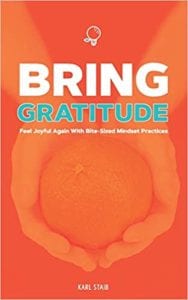
Bring Gratitude: Feel Joyful Again With Bite-Sized Mindset Practices
Because I love doing it. I have gotten such great feedback that I have a wonderful impact on helping people become storytellers, and how it enhances their career in their life. It feels like this is what I’m supposed to be doing. When it’s not happening as frequently as I would like it to, it is a struggle because I get frustrated thinking, “Am I not doing something right?” I’ve gotten past the not feeling good enough, which used to be part of the struggle. Now the struggle is, how do I create momentum?
Why do you want to create momentum?
I know there’s a great book about the tipping point. I remember somebody saying, “The more you speak, the more you speak.” I thought, “What does that mean?” Now I have had an experience of it where someone will be in the audience that will hear me speak. They’re like, “My wife works at XYZ Company. I’m going to tell her they should talk to you.” That is what I mean by momentum happening. Your confidence level continues to go up the more you speak. Your skills are finely tuned and you have stories ready to go about how you gave a great talk and how it gave everybody a great impact. That’s why momentum is powerful. It helps our energy and our confidence.
You said the word impact. Another reason why you want to make an impact on these people, could that be another reason too?
Yes, because the more momentum I have, the more people I’m reaching, the more impact I have. Ultimately, that’s what we’re trying to always do, create some legacy.
What are your expectations? Where do you expect to be at this point?
I stopped setting goals for myself around this because I was always under pressure for many decades in Corporate America with sales goals. You have to sell this month this X number, in this quarter, in this year to hit these goals. My intent is to align my intentions and allow the right people to find me without having to beat myself up if I’m not hitting certain numbers. As with any business, you have to invest quite a bit of time and money. As a speaker, you invest time in your website, your video, getting that edited, all that. In my case, I also have a course that goes with the talk. Your expectations are mine anyway of this is an investment in me. I know my work ethic and my skillset. I’m willing to put this money in.
[bctt tweet=”When we go through a struggle, like the passing of a loved one, we must dig into our thoughts and emotions.” username=”John_Livesay”]
As with anything, there’s no promise that it’s going to take off. At one point, you break even, and then when does it become profitable, and then when does it become something more than, “I love doing this. No, this is an actual career that you’re getting to do.” The big shift for me leaving Corporate America was realizing, “If I make $100,000 as an entrepreneur versus $100,000 as an employee, they’re very different.” I hadn’t realized that. First of all, it’s probably not going to come in a steady two-week paycheck, ups and downs. Also, there will be expenses that you have to pay, your insurance, websites and things like that. $100,000 as an entrepreneur is not necessarily the same lifestyle as an employee.
You want this to grow quicker because you’re like, “I have certain expectations money-wise, expectations of how I want to affect people and impact them,” and your legacy. This is where we need to start making some shifts here, some mental 180s. What are you grateful for about this situation?
I’m grateful that I have a wonderful speaking agent named Shawn Ellis. I don’t take that for granted ever. I’m grateful that I have had the opportunity to speak and get selected. I am grateful for the response. I gave a talk to Anthem Insurance and someone came up to me afterward and said, “How long have you worked in healthcare?” I’m like, “I haven’t. I took the time to customize my talk to your industry.” When you get a standing ovation and you see tears in people’s eyes, and you realize that you’ve touched their heart, and/or the feedback of, “That was beyond our expectations.” Those are all the things I’m grateful for.
The last part of this is, where are the opportunities that are within this struggle that you can dive into?
I’ve started the concept of focusing on healthcare and tech companies because I love that industry and I have several experiences with it. One of the things I’m looking at is I updated my LinkedIn profile, narrowing in on that particular industry. Sometimes people think, “That’s limiting yourself.” The irony is I’m still getting offers to speak at other industries because they want to hear about what’s going on in healthcare and tech, and how it could apply to them. It may seem like you’re cutting yourself off if you just niche. It has turned out to be the opposite experience.
What other opportunities have you noticed?
Sometimes speakers refer me when they can’t do a gig or other speaking bureaus, I’ve gotten on their radar enough to get referrals that way. Sometimes people find me by Googling storytelling and sales. I’ve spent some time and money on my search engine optimization. That’s always exciting when that works. That was unexpected. I had the belief that I was going to have to convince companies of the value of storytelling to grow their business. Many companies now have after the book Better Selling Through Storytelling came out.
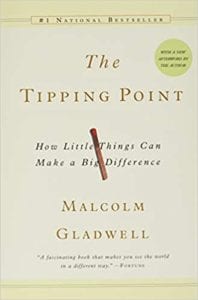
The Tipping Point: How Little Things Can Make a Big Difference
It wasn’t the book but I wrote the book without having that expectation. When it first came out, I was definitely having to convince people of how it makes you memorable and magnetic, people buy emotionally and not logically. Now the last few inquiries had been, “We want someone to teach our sales team how to be a storyteller.” It’s specific to what I do that’s an unexpected opportunity to have. Other people speak about storytelling and do it in different ways, which is fine. I don’t need to be the only expert on storytelling. That’s been fun to say, “Let’s keep making sure the SEO stuff works.”
Also, with external opportunities, there are also internal opportunities. What internally have you noticed going on that you could shed some light on?
I noticed that the more I speak, the more confident I am every time I have to go up and be interviewed for the next talk. I’m still on a high from the feedback from the recent one. Also internally, I remember I was up against 1 or 2 other speakers and the agent called and said, “They picked you. They liked your energy.” I thought, “How great?” The person said, “I felt inspired and motivated by your passion and energy, I assumed you’d make my team feel the same way.” Sometimes I can get stuck in my head internally going, “I need to explain to them all the details of how this is going to work.” At the end of the day, money and what you take away from a speaker is all energy. People are buying my energy as much as they are my expertise
What opportunities are out there that maybe you haven’t worked on to reach more people to make this bigger impact?
That I’m not sure I have an answer for because I’ve been digging as deep as I know how anyway. I’m exploring all the different channels, whether it’s how people can find me agents, referral, search engine, Google search. There is that tipping point that I’m doing press. You get some momentum that way of people started hearing about you. Posting on social media is another big way not to be attached to someone having to respond from one particular post. I did get somebody that reached out to me blindly on LinkedIn who goes, “I like your videos. I’m interested in talking to you about a talk that we have coming up in six months.” I thought, “Which videos? I need to know which ones are resonating.” I thought it doesn’t matter. It’s the consistency of it.
I’m going to read these back to you. I’m going to play it back to you in story form. I want you to listen, and then what we can do over the next 30 days to help you reduce this struggle and get more of these opportunities. The big struggle is a lack of patience. You want things to happen faster, more speaking opportunities. You see other people getting these opportunities and you wonder why you haven’t. The big part is the unknown. As you build this, you’re not sure what is going to happen next. I asked you to rate the struggle and you said it was a 7 out of 10. That’s manageable. If people say a ten, I’m like, “You’re not quite ready for this yet,” but it’s a seven, so you know there’s wiggle room there. There are things that you can improve. You have the motivation. If it’s a 1 or 2, there’s no motivation there to make any change.
Why is this a struggle? You love speaking. You love how it makes you feel but you’re not doing as much as you’d like, and you’re wondering, “Am I missing something?” You want to reach this tipping point and you want to make a big impact in the world. The expectations you have is you want to be able to reach more people. You expect more people to realize that you are good at this and that you can help them. One of the things you realize is you stopped setting goals. When you stopped setting goals, maybe there are some opportunities there of like, “Is there a hybrid model?” Maybe not the goals that Corporate America was setting but something that you can set that makes you feel more comfortable.
[bctt tweet=”Anxiousness is just a form of being stuck.” username=”John_Livesay”]
You realize too with your expectation of, “I’m going to start this business. When I earn $100,000, it’s not the same as earning $100,000 working for a corporate job.” We started that shift of gratitude. I could see it in your face. You started talking about the wonderful speaking events that you speak at healthcare. You have a wonderful agent, Shawn Ellis, which is amazing and you’re lucky to have him. The responses that you get, you’re blown away by how people feel, and how you can emotionally affect them through your words. You’re amazed that as you’ve been able to do more of this work, you don’t need to convince them that they need a storyteller. This didn’t happen ten years ago. This wasn’t a thing.
Opportunities, you want to focus on healthcare and tech. This is something that you realize like, “Yes, I’m niching myself, but I realized I’m also still getting jobs in other industries.” There are opportunities for more speaking referrals. Confidence, as you do this and people you’ve realized is they love your energy. Maybe how can we play off that? If there are these videos out there that they are attracted to, how can you showcase more of these? Where can you do this? I noticed social media seems like a good opportunity for you. I want to do internal and external goals. What actions can you do to reach out to others and then internally, help you process this. Let’s start with the external. What could you do over the next 30 days once a day or maybe Monday through Friday but every single day for 15, 20 minutes?
I could probably reach out to the people that I’ve spoken to in the past and check in on how they’re doing and the impact that it’s having. That might lead to a referral.
Can you do that every single day? Can you add some other people that might have been in the crowd that you’ve talked with? Maybe 1 or 2 people a day, when can you do that? What time of day? How can you add that to your routine?
I probably like to do it after lunch like 2:00.
Can you put that on your calendar?
Yes.
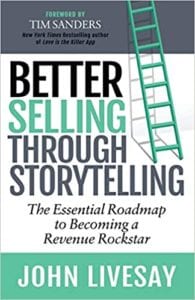
Better Selling Through Storytelling: The Essential Roadmap to Becoming a Revenue Rockstar
Keep it short, like 10 to 15-minute block you, and then once you have that email, you can copy and paste portions of it like your talk. It’s the core there. I love that. Now, internal.
I know that when I definitely booked time to meditate, I’m much happier.
Why is that? How does that help?
I’m not as reactive. I don’t get as stressed out and frustrated as easily.
When can you do that for once a day over the next 30 days? When’s best for you?
8:00 AM.
How long are you going to do it for?
I had this guided five-minute meditation.
[bctt tweet=”We need to be our own greatest advocate.” username=”John_Livesay”]
I love it short because whenever you’re like, “I’m going to do it for 30 minutes,” no. I know me. I do fifteen minutes max, and then I want to do something now. I heard what you’re going to do at 2:00 PM. You’re going to reach out to people, past clients, people you’ve spoken with. You’re going to get to understand a little bit deeper of how they liked it, get some feedback. Can you get maybe even quotes or testimonials while you’re doing It?
That’s a great idea.
You have a guided meditation that you can use and help you become less reactive. That’s why it is so important. The key thing and what I like about that is you’re already starting to think of how you’re going to be grateful for these things. You’re less reactive and you know you’re going to be calmer. How do you feel now on a scale of 0 to 10?
It’s like a three. It’s amazing putting a plan in action and not feeling overwhelmed. Part of it is this Dig to Fly Method is giving me a sense of control about something that’s felt out of control.
An important part of this is the sequence. You create some emotional space when you start putting a number on it, and then you’re already like, “That’s not terrible.” You start working your way through it. You dig down and then you start to do that 180. You can start getting out of that hole and start flying. I love it. Seven to three, that’s fantastic. Good job.
How great is that, you were able to show and not just tell what the method is. When you said, “Think of it like a story,” that’s the way I’m wired. Suddenly, I’m not listening to just my own stuff. I’m literally seeing a character in a story. Our protagonist is struggling with patience and comparing himself to other people and getting comfortable with the unknown. I’m like, “That’s a story I want to see how it turns out.” That part of it was interesting. Also, the willingness to ask questions that I’ve never asked myself. I could see how this would help small business owners in particular, but anybody, gets unstuck or get less anxious. Anxiousness is a form of being stuck. Maybe you’re still taking action but you’re anxious about it. That’s not the energy you want to put out into the world either.
What I like to think of it is we have these diamonds inside of ourselves. They’re rough and they’re caked with dirt. You don’t realize that they have energy trapped inside of them. When we dig down and we start to uncover them, we start to see the energy come out because we bring them to light, and we see the shine and the sparkle. We start to take away the dirt and the grime, and we start to chisel it away. We see how beautiful it is when we take the time to dig into this stuff and surface it because then it’s like, “Yes, I see what’s holding me back,” and then you can move forward. That’s the thing. It’s this murky darkness. You’re like, “I don’t know which way to go,” and then you slow down and go through the process.

Dig To Fly: Dig out of your hole, start to feel better and grateful, and then realize the opportunities that you have.
Everybody in the audience, after this is done, I have a one-sheet and they can print it out. They can do it themselves. That’s what I try to train people to do. Therapists are great counselors but we need to be our own greatest advocate. I want people to do this because I do this if my son’s acting like a little jerk or whatever and he’s in a cranky mood. I’ll be like, “How bad is his struggle?” I’m like, “Where did that question come from?” Subconsciously, now it starts popping out and I’ll do this method in 30 seconds. I’m like, “Where are the opportunities for?” Talking about my son crying, probably the older me from five years ago would have been like, “Come on. It’s just a little movie.” Now I’ll sit down and I’ll walk him through it because I want him to have this inner voice to be positive and talk him through things instead of being like, “Shove it aside, buddy. You’re fine.” It’s so interesting.
If people want to get your free steps and questions, they go to DigToFly.com.
Right there on that homepage is a little email sign up and they’ll get the Dig to Fly worksheet. I also have a recording of another Dig to Fly session so they can listen to somebody else. She was struggling with a friend. She has a reaction on there. She’s like, “Oh my God.” It’s funny. It hit her like a ton of bricks. It’s cool to hear.
I felt like you were running the interview instead of me hosting. I’m a big believer of show, not just tell something. We certainly showed how it can work in real-time and hopefully, people can imagine themselves going through it like I did. Any last thoughts you want to leave us with, Karl?
If people don’t even do this Dig to Fly Method, it’s important for them to pause, take a breath and say, “What is bothering me and why is it bothering me?” That why is so important because once you understand why, then you can start to come dig out of that hole. That’s when you can start to feel better and grateful, and realize the opportunities that you have.
Ask yourself, “Why am I so upset? Why is this bothering?” Nine times out of ten, we’re taking something personally. At least that’s my experience or we’re coming from a place of fear. One of those two whys can help us dig out and become the diamonds we were meant to be and be dirt free. It’s Dig to Fly Method. Thanks again, Karl, for sharing your expertise with us and inspiring us all to remember that we have the resilience inside if we ask these questions.
Thank you. I had a blast. Great job.
Important Links
- Karl Staib
- Bring Gratitude: Feel Joyful Again With Bite-Sized Mindset Practices
- LinkedIn – John Livesay
- Better Selling Through Storytelling
- https://www.Amazon.com/dp/B07DBT1L76/ref=rdr_kindle_ext_tmb
- Better Selling Through Storytelling Method Online Course
Wanna Host Your Own Podcast?
Click here to see how my friends at Podetize can help
Purchase John’s new book
John Livesay, The Pitch Whisperer
Share The Show
Did you enjoy the show? I’d love it if you subscribed today and left us a 5-star review!
- Click this link
- Click on the ‘Subscribe’ button below the artwork
- Go to the ‘Ratings and Reviews’ section
- Click on ‘Write a Review’
Love the show? Subscribe, rate, review, and share!
Join The Successful Pitch community today:
- JohnLivesay.com
- John Livesay Facebook
- John Livesay Twitter
- John Livesay LinkedIn
- John Livesay YouTube