

I’ll Be Back With Shep Hyken
Posted by John Livesay in podcast | 0 comments

How do you get your clients to say, “I’ll be back”? Renowned customer service and experience expert Shep Hyken believes that delivering an amazing experience is what keeps customers coming back for more. With this in mind, Shep has managed to work with companies and organizations that want to build loyal relationships with their customers and employees. He sits down with John Livesay in today’s episode to share how his upbringing instilled in him the values that are essential in the service industry. Listen in and learn more as Shep discloses his secrets on how to turn repeat customers into loyal customers.
—
Listen to the podcast here
I’ll Be Back With Shep Hyken
This episode’s guest is Shep Hyken, an expert in customer service and the author of I’ll Be Back. He said that repeat customers are different than loyal customers. Find out what he means. Enjoy the episode.
—
Our guest is Shep Hyken, a customer service experience expert and keynote speaker. Shep works with companies that want to build loyal relationships with their customers and employees. His focus is on delivering amazing customer service, engagement, managing the customer experience, and creating loyalty. He is a Hall of Fame Speaker and a New York Times and Wall Street Journal Bestselling Author. His new book is I’ll Be Back.
—
Shep, welcome to the show.
It is great to be here. One day, I will get to say I am back. Will you have me back? We will find out at the end of this show, won’t we?
That is what is known and storytelling is an open loop. We are already creating them, so take us back if you will to your own experience of getting involved with this. Were you a child that had bad customer service and went, “I am going to fix this,” or did you start thinking you were going to be something else? How did this customer service business come about?
There are two pieces of the story. The first one was when I was a child. At twelve years old, I started my first business. I was a birthday party magician. I would do magic tricks at birthday parties. The first show was on a Wednesday after school. My mom picks me up and takes me over to these people’s homes. I am there in front of 25 screaming little six-year-old kids. I do my show for about 30 to 45 minutes and collect a whopping $16. It was $15 plus a $1 tip. When I came home, my mom said, “What are you going to do after dinner?” It was a school night. The typical answer is my homework. She goes, “Not until you write a thank you note.” I go, “That is a good idea.”
That was a great customer service lesson. I did not realize it. My parents raised me to always say please and thank you and be polite, but she wanted to emphasize that. Even though I had said thank you on the way out the door, maybe a follow-up would be nice. My dad said, “That is a great idea. After they have received the thank you note, by next week, why don’t you give them a call and thank them again? Ask them, ‘How did you like the show?’”
Get some feedback. Find out if you did a good job, and get specific. Ask them what tricks they liked the best. If you do this enough times, people start to say the same tricks and won’t mention some of the tricks. You will notice a pattern. Those are the tricks you get rid of and replace with tricks they will talk about. I was like, “That is a good idea.” That is exactly how my whole entry to customer service got started. I had no idea that is what it was called, but later on, I found out.
It was ingrained in me from even much earlier than that. As I said, I was told to be polite and say please and thank you. I am a people pleaser and that helps if you are in the customer service world because some personalities are meant to take care of customers. Some people are meant to work on that frontline or call center. They live for taking what I call moments of misery, those complaints, and turning them into moments of magic. I might be one of those people.

I’ll Be Back: How to Get Customers to Come Back Again & Again
When I was about 19 or 20 years old, I was working at a gas station while I was in college. This was many years ago. Even though we were a self-serve station, we did not have the computer where you paid outside, come in, and get your receipt. We had to stand on the lot, reset the pumps manually, and make the change right out there. Even though the customer pumped their own gas, we walked around with a wad of cash, and I had a little metal changer on my belt, and I made the exact change.
One very cold day, I asked a woman who was elderly who I had seen in the station before. She was probably about 85 or 90 years old. She was pretty old but still driving. I said, “Let me pump the gas for you. It is a little cold.” I thought that was the right thing to do. I go inside and my manager goes, “What did you do?” I go, “I am not sure. What did I do?” He was like, “I saw you pumping that lady’s gas.”
I was like, “Yeah. I did that.” He was like, “Why did you do that?” I was like, “She is 90 years old. It is six below zero outside. It is pretty cold. I had to be out there. Why not let her stay in the car?” He was like, “Now, she is going to want it the next time.” I go, “Maybe she will come back here instead of the gas station across the street or the one on the opposite corner.” He gets mad at me, walks out, and slams the door. All I knew at that moment was that I was right and he was wrong. I have been living my life ever since.
I get out of college and I am looking for something to do. I see a couple of motivational speakers. I think, “I can do that. I am going to talk about customer service.” Within one year out of college, that is exactly what I was doing. I was doing speeches and talking to the companies that I was working for about how to deliver a moment of magic. I have been talking about creating that magic and avoiding misery for years.
I love that your twelve-year-old magician has created a career where you help companies turn unhappy customers into satisfied customers through a moment of magic, what a wonderful through-line of a hero’s journey there. Let’s talk about some of the clients that have hired you to come to speak to them. Let’s start with American Airlines.
I love American Airlines. I realize the airlines have a tough goal, but I have been with that airline and I have worked for the airline for years. Before that, I worked with TWA, Delta Airlines, and Southwest Airlines. I have had the privilege of working with these companies. The airline business is tough because it is very hard to make a customer happy when there is a delay that the airline or the customer has no control.
It could be bad weather or more traffic than usual. There are all kinds of things that could go wrong that can make your trip not perfect. The fact that if you get the right person, it does not matter whether or not they show up on time but eventually get there. If you get the right person, they take great care of you. If you get the right person on the phone when you have a problem, it is amazing how well you feel about that airline. I know you are looking at my list. There are American Airlines and American Express.
That is the other one I wanted to ask a question about, but before we jump off the airlines because I worked for TWA as a ticket agent when I was in college at O’Hare, the training I went through to be a part-time ticket agent was incredible. They always asked, “Did you shine your shoes?” They always made the appearance important. They also had the ability to answer people’s concerns and anger. They stand on the wrong line because they did not read the sign.
Create experiences that people will talk about. Click To Tweet
This is not a place where they sell tickets, check bags or whatever the issue is, or wonder how much sleep the pilot got. Those are the kinds of questions you got. People’s anxiety about flying would manifest in different ways. It could be being tapped on the shoulder while you are standing at the urinal in your uniform asking, “What gate is this?” If the employees feel like they are not being treated right, it will trickle off into the passenger experience.
Which airport were you at?
I was at O’Hare.
I was in LaGuardia, New York, one day, and this was back in TWA. There is this flight that I was on that was canceled. Everybody is getting put on to the next flight. The guy in front of me says, “Are you going to feed us? I was going to get a meal on my other flight.” The lady says, “We will have a meal, but you are going to have to feed yourself.” She smiled and laughed. His exact words were then like, “I am being a jerk, aren’t I?” They were close to the exact words. She goes, “I am not going to judge, but I am happy to put you on your next flight and I will make sure that there is a meal for you to eat if you would like to.”
You have to roll with it and have a sense of humor.
She was so funny and then I walked up to her, and I went, “Can I have a meal too?” She was so nice. That is the thing. You get people that are very difficult to deal with. I remember I was at O’Hare and this was many years ago. When you are a high-ranked flyer on their frequent flyer program, you get privileges. One of the privileges is you get to fly standby, and when you fly standby, they put you on the standby list. Based on the seniority of your frequent flyer status, they put you at the top. The guy said to me, “I am not going to put you on here. We already have too many people on standby. You are not going to make it.” I said, “I am the highest level flyer.” He goes, “Do you want to jump in front of everybody?” I go, “That is exactly what I want to do.” That is the privilege of spending all your money on one airline.
That is what I wanted to talk about. Your book is perfect. When I have maybe more convenient routes or a cheaper fare, but I want to build my points with one particular airline, then that is what keeps me loyal for the potential upgrades with miles or whatever it is.
I write articles about this all the time. There is a difference between a repeat customer and a loyal customer. This is right out of the book I’ll Be Back: How to Get Your Customers to Come Back Again & Again. One of the things I talk about is there is nothing wrong with repeat business. We need to go for it. It is really important. However, to create true loyalty would be for the airline to say, “We are getting rid of the frequent flyer program and we hope that you stay with us.” If you get rid of the free upgrades or the free trips, would that passenger says, “You are good enough to keep me?” That is loyalty.

Loyal Customers: Some personalities are meant to take care of customers, and they live for taking moments of misery and turning them into moments of magic.
A lot of times, even though we call this a loyalty program, it is really a marketing program. It is a way to get perks and points or perks and miles. If you think about those perks, the more points you get, you get a free ticket. What that really is is a discount program. To put it in a more simplistic term, if I go to a restaurant and they give me a little card that says, “Come back here five times and the fifth sandwich is free,” that is like a 20% discount card.
There is nothing wrong with repeat business and giving out the perks to give you discounts or free whatever, but recognize it for what it is. The goal would be you want to create both loyalty, which is an emotional connection, as well as the desire to do business because maybe they do take care of you in such a way. The combination of the two is unbeatable, but the moment you focus just on points, the company that has a better point program is going to win.
I do love American Airlines. They are my airline of choice. They do take care of me and there are times that I hate all airlines. There is no doubt about it. Things happen, but I realized that most of the time, the things that happen are not the person at the front desk control. I have had bad flight attendants. I had one flight attendant many years ago when they were cutting the salaries of people. It was sometime after 9/11.
She was not being very friendly. The person next to me was another flight attendant sitting there. She was deadheading, meaning they were going to another city. They are not in uniform. They are dressed in street clothes. I said to the woman that was working, “Are you having a bad day?” She goes, “They’ve cut my salary, so I am not going to try as hard.” I looked at the person next to me who worked for the airline and she goes, “I can’t believe she said that to you.”
What is interesting about these points or loyalty programs is there are different levels, but you have to qualify. If you flew an X number of miles, then you get up to platinum, executive platinum, etc. I find that mindset fascinating. That ties me into American Express, another one of your big clients. Now, American Express has a premium associated with it. They do the same thing where there is the green, the gold, and the platinum level.
There is also the black card.
The levels of the prestige of everything are fascinating for people trying to impress people at a restaurant.
Here is what is cool about the AmEx card. They did a change that I don’t like, and I have let them know I am unhappy. I am one of those people that never publicly say what is on my mind because I realized I represent a lot of these brands. They changed something, and I wanted to understand why they did it. I understand why they did it, but it is not in sync with the highest level. The highest level is black, but the typical high level most people have is that platinum card.
Your last customer impression should not be a survey. Click To Tweet
It costs $600 a year to buy that card. I use it for FedEx now. I get 10% off FedEx. That almost pays for my card at the end of the year. In addition to that, they give you $200 in airline credit for miscellaneous fees, which could be everything from baggage to flight change fees to an American Airlines wireless. They reimburse you for your TSA approval for your global entry.
I get $200 back when I buy a Dell computer. At the end of the day, not only did all the points accumulate, but I also made money on this card. The American Airlines card that I have, which is a MasterCard, is a point card. The reason I like to use that for certain things is the points go toward miles. It used to be that every mile I have on American Airlines was because I flew it. Now, they said, “We don’t care how many miles you fly as long as you spend money on our airline or our card.”
To get an executive platinum card, you have to spend more than $200,000. They don’t even give you miles. It does not matter if the flight from St. Louis to Chicago is 250 miles, but if it costs you $1,000, they give you 1,000 points times a premium for your status. It is a little higher if you are executive platinum and a little lower if you are gold, but you earn the points.
Anyway, it is a different program. I am not sure I like it or don’t like it, but it is interesting the way credit card companies, airlines, and different companies are working toward creating what they term loyalty, but it is really the repeat business. Even Amazon and Walmart are going head to head trying to create loyalty, and the way they are doing it is by charging you to be part of their program. This is brilliant thinking. I am a member of Amazon Prime. The direct competitor of that is Walmart+.
Walmart+ gives you free grocery delivery and whatever other perks they have. Amazon Prime gives you a number of other perks as well. The question is, which do I like? No matter what, I am paying either $99 for Walmart or $129 for Amazon. I want to get my money’s worth, so what am I going to do? Once I pay, I am going to try to use the card. I love that that is a membership program that has a premium attached to it that you have to pay for.
You have got a company like Nike. Nike has no charge to be a part of their program, and from the standpoint of discounts and perks, they give you nothing, but what they do give you that makes it interesting to be part of that program is content that is served up exactly the way you would want it. What I mean by that is if I buy running shoes and that is all they see that I am buying through their program, they will never send me anything about basketball shoes. They know what I want. They also notice like, “You might be interested in the new version of your shoe. We put new technology in there.” They will give me a preview as to what is going on in my shoes.
People love that insider look.
It is giving me an inside feel.

Loyal Customers: The sense of airline customer service is if the employees feel like they’re not being treated well, it trickles off into the passenger experience.
Before we get off the airline and credit card thing, there is this new phenomenon of the flight attendants trying to get everyone on the plane to subscribe to a credit card that is separate from theirs where you get a free trip or you get so many more miles than a regular credit card. I think the flight attendants get a little commission. Also, it is all premised on that. You are not paying off that debt every month. They get a lot of money by charging a lot of interest. Otherwise, the whole thing is a house of cards.
That is standard credit card marketing. The airlines are brilliant to do that. To me, a guy that flies every single week, especially if I had to take two flights in the day to get where I am going, I got to hear that darn message twice a day. I could do the message for them. Act now and you get 60,000 bonus points. That is enough for two round trip domestic tickets or one to Europe.
With this new insider information that you mentioned that Nike is doing, I experienced that when I was speaking for the Wizards Play Network, which has Dungeons and Dragons. They have salespeople who call on retailers that sell the games and they want them to upgrade and spend around $20,000 to make the stores a special premium level. I said, “What is in it for the store?” They said, “They get to give their regular customers insights into what is going to be on the game before the game comes out.”
People who are avid game players love that bragging right. The throwing the blackboard down at a restaurant is the bragging rights that I know something that is coming before you do because I stopped at this store and this store happens to be one of these levels of premiums. I thought that is a valued commodity. Within the world that these are all of our customers, there is a certain niche that will pay or be loyal out of you giving them some bragging rights, for lack of a better word, yes?
That is right. That is the point. You make them feel like they have insider information, and it is very personalized because it is based on just the game or the shoe. There are other companies that will give you that inside scoop of information. I received an email from a guy that sells this little piece of equipment. Not many people would buy that, but what he said was, “I have 100 of them. The last time, they were gone within a day, so I remade some more for anybody that is interested.” That is like, “I am the insider. I got on his list,” because all my friends, when I said, “You need to go and get this,” they could not get it. It was gone and sold out.
That used to be something that the luxury market would be involved in. That is my background.
It is a scarcity mindset or mentality.
For example, the Hermes Birkin bag. Before, you are on a waiting list with all of that anticipation. Now, it has become much more mass where people wait in line for iPhones and other things like that.
A lot of times, loyalty programs are really just marketing programs. Click To Tweet
Do you know who has done a great job of this? It is Rolex. My son got me fired up about the watch market. I don’t know why he is into that, but interesting. Rolex has done a great job. There are only two watch companies that have done a fine job of making sure their watches on a regular basis will appreciate. They have some duds that they come out with that nobody wants, but Patek Philippe and Rolex are the two companies that have done it.
I watched how Rolex does it. They can release ten times more watches than they are releasing, but they don’t because it keeps the market solid. They would rather keep the demand for what they have so strong that the prices on the secondary market are often 2 and 3 times higher than what you might buy in a jewelry store, but the wait at a jewelry store is sometimes 2, 3, or 4 years to get the watch that you want. They could make a lot more money if they wanted to, but they have done two things. They have created a great experience for the person that owns the watch and think about how they are handling the middle person, the jeweler. They are saying, “We are taking care of you too because we are going to create the demand, and that means you are going to sell every watch that you have.”
What a dream for a retailer. That is loyal. You have this amazing ability to have your pulse on the zeitgeist, and that is what makes you such a great author and speaker. You are verbalizing people’s inner voices and frustrations and figuring out solutions to them. The one that you have done that I went, “There he is again getting ahead of the curve,” are the endless emails asking you to fill out a survey form. Everyone seems to do it and they won’t leave you alone. Shouldn’t there be a limit to how many times you ask?
The same customer gets the same survey. My car dealership is bad about that. I get the same 15 to 20-minute survey every single time I go in there. Whether it be for an oil change or a transmission overhaul, I am going to get the same survey.
These people’s livelihoods are dependent on it. I bought a new home and the people said, “You are going to get a survey of how every department did. Unless you give us all tens, none of us get a raise.” They are begging you to lie on the customer service report. The loan people were horrible, but they were great.
Somebody referred to it as they know that the Uber driver gets dinged if you give them a low rating. If I have bad service, I choose not to give a rating because I don’t want to hurt the guy’s reputation, but I am not going to help it by giving a false rating.
I remember the reverse was the surprise when Uber rates you.
Uber rates you as well. We do a survey every year, and we survey over 1,000 consumers. It is a GenPop survey, so it looks like the cross-section of the US-based on age, ethnicity, geography, gender, and everything else. Forty percent of customers have said they have stopped doing business with a company because the survey was too long.

Loyal Customers: There’s nothing wrong with repeat business and giving out perks or discounts, but you need to recognize it for what it is.
That does not mean they do it to every company, but they have done it. They said, “I am not going back there anymore.” The last impression should not be the survey. Think about this. I have a great meal. If the next day I get a survey that said, “Would you answer two quick questions,” and it took me less than 30 seconds, I probably don’t remember doing that, but if you asked me to spend five minutes on a survey, I am going to remember that.
Your whole brand positioning for what you do is that customer service gives you a competitive advantage and not the product or price. I have to say the reason I love Apple so much is that Genius Bar. Dell does not offer that. I need someone that peace of mind that if I need to go have some buddy help me, I can get that help. I am loyal because of that. That is customer service in my mind.
That is why people love Apple. That is not my favorite way to do business. I don’t want to have to make an appointment to go get customer service. I want to pick up the phone and get it. Apple does a great job. If they can’t fix it on the phone, then I have to go to the Genius Bar. I wrote an article. It reminded me of something that happened a few years back, and I don’t mention the name of the company, but it was Apple.
I bought a new Apple phone and it was so different from the phone I had before that I was ready to smash it on the ground, put the parts in an envelope, send it back, and say, “Give me my money back.” I was that mad, so I called them up. I am talking to the guy and he knows I am not happy. There were things that we had to do to fix something that did not work as it should have, but this is what he said to me. He says, “I understand how upset you are. This is my job now. My job is to make you so happy with your phone that you would jump in front of a moving bus.” I go, “That was the perfect thing to say, wasn’t it?”
That is a passionate level.
What it did is it set a goal. It set a goal that I said, “If this is what this guy wants to do, I am going to give him a chance to do it.” In the end, I said, “I will jump in front of that bus as long as it is moving backward.”
Before I let you go, how do you, as a sales keynote speaker, provide amazing customer service when someone hires you as a speaker?
The first thing is I inform them that I will be the only thing they do not have to worry about at this point. Number two is constant communication. We tell them, “You don’t need to worry about anything. We are going to call you. 6 to 8 weeks before the event, I am going to call you to start working on the content. We are going to have as many content calls as necessary, and I will interview others. If you don’t have the time for it, you tell me who you want me to talk to and I will do that.”
You need to make your customers feel like they have insider information. Click To Tweet
The product is the product. I am going to deliver the speech. I am going to meet the expectation if not exceeded. By the way, I have a really good demo video, but I am better than that video. There are plenty of speakers out there that are not as good as their video. I was very clear. Chris West from Video Narrative did a magnificent job. I said to him, “You cannot make me look better than I am. What I want you to do is make me look good enough to justify what I charge and make good enough to be comfortable that the client is comfortable booking me.” That was our goal because I have seen sizzle reels that are really sizzling, and when you see the speaker on stage, it is a dud.
We have all had that experience. I am not going to name the brand. I saw a car commercial and I thought, “I am going to go experience that.” I went to the dealership and was like, “This is a bait and switch. This is nothing like the commercial of what this experience is supposed to be like.” You hurt yourself by overpromising in a sizzle reel TV commercial.
That is what we are worried about, but the moment I hit the ground, I text the client, “I am maybe not in the building, but I am on my way to the building. Let me know if you need anything before I meet you for my soundcheck.” The soundcheck is often the next morning before everybody gets up, and that is fine, but if they need me the night before, I always fly in. That is the other thing I tell them. I say, “I will never take the last flight.” I tell them a couple of things. Number one is that I have only missed one speaking engagement due to weather-related issues in my entire career, and that is because both airports, mine and theirs, were closed down. I felt bad, but those were acts of God. There is nothing you can do about that type of thing. I said, “I am going to figure out a way for that never to happen again,” and the way you do that is I tell them I am going to keep an eye on my flights.
If I see there is a weather pattern coming in and my speech is in Los Angeles, I might be there two days ahead of time. I showed up to a speech once. I will never forget it. I was out somewhere in the LA area and it was such a bad snowstorm on the East Coast and the Midwest. She was like, “How did you get here?” Only she and I were the only ones that showed up for this meeting. I said, “I told you I would be here.” I had to fly and drive to get to those planes, trains, and automobiles. I got there and she was so impressed. She goes, “The meeting was canceled. Other than the weather, we are going to redo this again. We are going to take care of you.” She was so amazed that I cared that much to get there. You have to do that.
What a great story. Those are the stories that people remember instead of you telling people, “Don’t worry, I will be there,” then you have a story to back it up, and that is everything. If people want to track you down, your website is your last name, correct?
Yeah. It is Hyken.com. It is pretty easy.
If you want to be entertained and learn how you can be better at customer service between the book or if you don’t get to hear Shep speak, then he has got a blog.
Go to the YouTube channel. It is called Shep TV. There are 900 videos. Everything that is in my head eventually ends up on YouTube.
That is impressive. Thanks again for being such a great guest and sharing with us how we can all be a little bit better at giving people an experience that makes them loyal.
Thanks for having me. I will be back.
Important Links
- Shep Hyken
- I’ll Be Back
- Shep TV – YouTube
- Hyken.com
- Better Selling Through Storytelling Method Online Course
Wanna Host Your Own Podcast?
Click here to see how my friends at Podetize can help
Purchase John’s new book
John Livesay, The Pitch Whisperer
Share The Show
Did you enjoy the show? I’d love it if you subscribed today and left us a 5-star review!
- Click this link
- Click on the ‘Subscribe’ button below the artwork
- Go to the ‘Ratings and Reviews’ section
- Click on ‘Write a Review’
Love the show? Subscribe, rate, review, and share!
Join The Successful Pitch community today:
- JohnLivesay.com
- John Livesay Facebook
- John Livesay Twitter
- John Livesay LinkedIn
- John Livesay YouTube
Providing Value To Your Clients: How Francisco Rodriguez Built The Largest Speaking Bureau In Latin America
Posted by John Livesay in podcast | 0 comments

Providing the best value for your business clients starts with knowing what they need. If you are like Francisco Rodriguez, who made it his mission to build the largest speaking bureau in Latin America, then it means being ready to communicate with your customer and fill their specific need. In this episode, John Livesay interviews Francisco on how he built one of the most successful businesses in South America. Learn how Francisco pivoted his old company to form Smart Speakers, and what he’s learned that helped him grow and scale his company. Tune in for more great business stories as John Livesay hears more success stories.
—
Listen to the podcast here
Providing Value To Your Clients: How Francisco Rodriguez Built The Largest Speaking Bureau In Latin America
My guest is Francisco Rodriguez Aguirre who is the President of the largest speaking bureau in all of Latin America. He shares with us his secrets to his success starting the bureau Smart Speakers and says that when you provide expertise, you give your clients the best outcome. His whole focus is on being the best partner that he can be to his clients and finding innovative ways to bring in new content to events to make them a huge success. He said it’s not enough to have the right expertise as a speaker, you must also have the right attitude and be easy to work with. Enjoy the episode.
—
I’m honored to have Francisco Rodriguez Aguirre who is the Founder of Smart Speakers, the largest and biggest speaking bureau in all of Latin America. They’re in countries like Chile, Colombia, Costa Rica, the US and Mexico. We had the pleasure of meeting at an event that our mutual friend, Josh Linkner, produced. We instantly clicked. He is someone who leads from the heart and speaks like a poet. Francisco, welcome to the show.
Thank you very much, John. I’m honored to be here with you.
The honor is all ours. There are so many impressive things about your background from you winning an award at MPI to going to school at UCLA and getting your MBA. I’m going to let you take us back to your own story of origin. You can go back to childhood. You could start at UCLA, wherever you want to start your story on how you started to discover your passion for communication and how you got into the speaking bureau business.
I first started in a family business that was radio. We were such a big family so it was difficult over there to cover an important part. I took my MBA and when I finished the MBA, I love all training, knowledge and after reading such big names, I’m getting so much knowledge. I said, “I love this.” I started a company that used to make events for selling them. We used to do the Sales Summit or Marketing Summit, events where we used to bring great speakers from Mexico and Latin America with great minds from all over the world. Over there, we have Philip Kotler, who was the great Father of Marketing. We have Seth Godin and Al Ries. We have these big names.
When we’re doing these events, we used to produce everything. We used to hire the place where it was going to be. We used to do the marketing to know which best subjects that the business people would like to have and who are the biggest names that would be in these events. We were very successful but a lot of competition started to come when we did this in Mexico. The business started to be not as good and it started to be more risky. Some of our clients that come to our events because there were corporate events for business people started to tell us, “Are you able to make an event for my company like this? This speaker is great. Can you book this speaker for us?”
[bctt tweet=”Always try to get the most value for your clients. If the client is happy and sees that their objective was accomplished, you’re going to have a happy client.” username=”John_Livesay”]
In the beginning, we said, “No because we are doing this,” but afterward, when we started to see that the business was not going that good, we said, “Let’s try it.” We started two lines of business. One line as a speaker’s bureau but we weren’t speakers bureau yet. We started hiring speakers. Another is as a meeting planner. Being a meeting planner specializing in conferences doing like these kinds of events. We were growing but my passion was not in producing the whole event. I was always with my team.
We were great at getting good content and researching who has the newest option and curating that great content. With my team, I was like, “Let’s do this speaker’s bureau.” We saw it in other countries. We set our webpage and we started to create the speaker’s bureau a 100% professional one. We did this in 2010. We did our first event in 1999. We started selling speakers in 2006 and making private events as a meeting planner in 2006. We stopped in 2007 doing our events.
What I love about that story is you have incredible insight and empathy for the stresses and needs that an event planner has. You aren’t just trying to figure out what they need or what pressure they’re under. You were in their shoes, which allows you a competitive advantage for someone who doesn’t understand it from the inside out.
That ability to say, “I know what you need. If that speaker’s plane is delayed and they don’t notify you when they land, you’re worried about that. We make sure that we have our speakers tell you when they get into the country so you don’t have to worry about it.” You’re anticipating problems that other people wouldn’t even think would be a problem but you’ve done it so that makes you a great partner for the event planners.
I was in the shoes of the meeting planner but before, as an end client.
You know both sides.

Speaking Bureau: Big differences are not that big and something that is great is that we can bring the best speakers from one place to another place.
In the beginning, we used to be a client of speaker’s bureaus and buy it for us. We used to be meeting planners but my passion was with the speakers. I used to study so much about speakers and looking for new content. I started looking more for that so that our business grew so much bigger from speakers and as a meeting planner. What started to happen was something that I didn’t like. We used to go to events and we met some meeting planners that used to be our clients or speaker’s bureau. I said, “I don’t like this. I have to choose one of both. I’m not able to play in both.”
We stopped being a meeting planner. We have everything. Our speaker’s bureau business and the meeting planner. The two things are focus and being a partner because in their part when I was a meeting planner, we have that competitive advantage and understanding because we were one of them. Sometimes, I could compete with them. That’s why we stopped being meeting planner. When we did that is because we have a good business from being a meeting planner. That’s when we said, “Let’s go international.” We started in Mexico City, Columbia, Chile, the US and Costa Rica.
Are there differences between the audiences in those different countries? Do you find that maybe Costa Rica prefers a different audience than people in Chile?
There are some differences but something great is the same language and culture because many of these countries are Latin America. Those big differences are not that big and something that is great is that we can bring the best speakers from one place to the other place.
If one of your clients has multiple offices in these countries, they might hire you to find one great speaker to speak multiple times to their different countries.
We can bring the best of Chile to Mexico and Mexico to Virginia or the US to Mexico. Many clients tell you, “What new do you have? What innovations in the speakers do you have?”
[bctt tweet=”Focus on being the best partner to your clients and they are loyal to you.” username=”John_Livesay”]
When someone comes from the US to speak at Mexico or any of these other countries that you’re in and the speaker is not fluent in Spanish, people might be curious about how does that work? Do you use a translator there? Do they have to pause? Are people listening to something like at the United Nations? What is the typical setup for language translation?
We use simultaneous translation. We have some good translators. They almost do it at the same time. If you’re a speaker, you shouldn’t speak very fast.
You got to pause a little bit. You can still keep your pace going. If you’re telling a joke, you can still keep all of that going. The audience is listening to something while it’s being translated. They provided a device.
They have their headphones. In many events, half of the people have headphones and of all the people speaking.
The speaking business was heavily impacted by the pandemic shutting down live events. I’m imagining that many of your clients said, “We’re going to have a virtual event. We still need to meet. Can your speakers give us virtual presentations?” Tell me about that transition. Were you able to keep some live events and convert them to virtual? People are doing hybrid events. What are you seeing?
Most people have something awful. I guess that it happened the same to you because we were going great with a lot of bookings and suddenly, everything came down when it was declared that this was a pandemic. I remember they stopped the flights to Europe and the US. Everybody canceled everything. In the beginning, we were trying to negotiate some of them, we used to say, “For May or June.”

Speaking Bureau: We were blessed that our industry was able to transform this way.
It was very difficult because of lots of agreements and things. It was awful. We started doing a webinar once a week. We bring speakers to these webinars and we made alliances with MPI and the Human Resources Association of Mexico. We did four alliances so that we had our own clients as well as the clients or the members of the other associations. We were reaching that it was able to do it in a virtual way in the speaking business. We did with some meeting planners and some events inviting their clients and our clients to show a way to do it.
We even had a webinar where we discovered a speaker that was training in how to do a virtual event. We even teach the meeting planners with this speaker how you could make your live event and how you can convert it into a webinar. We did this event. We spread the word. The clients started coming to us and the meeting planners telling us, “Let’s have a webinar. What options do we have? I still have to connect with my clients, with my people.” We were blessed that our industry was able to transform this way. We were with the speakers and say, “You should watch our video on how you can make it entertaining.”
You can’t just speak. You need some special effects, some music and all kinds of other things to keep people engaged in breakout rooms and polls to take so that the audience is entertained and not just watching a Zoom call. If you have a lot of major clients on your website, what is your strategy on how you keep these big clients happy? Do you have something as a part of your culture when you train people and hire new people around customer service to let them know we have to do not the minimum but go beyond what’s expected?
In Latin America, in general, we are very customer-oriented. We always try to get the most value for our clients and speakers because we like long-term relationships. If the client gets happy and he sees that his objective was accomplished, we’re going to have a good client both the speaker and us. We are always trying to get more value in the pre-event. The first thing is how we are going to meet the goals of the client in the best way.
We always have these pre-event calls but sometimes, it could be 1 or 2 pre-events calls. In the event, depending on what is the objective of the client, we are going to get this value and after the event. That is not just something that good speech that was great but everyone can forget afterwards. We are looking for ways to engage more with the client.
Having some ongoing follow-up, I know when I get engaged for a speaking event many times, I’ll say, “Let’s package in a 30-day and 90-day follow-up.” A lot of clients love that because it reinforces what they heard. It’s a check-in to see if they are, in my case, starting to tell better stories, are winning more business so that the objectives are measurable of what it was like before the talk and workshop and what’s happening afterward. I’ve had a lot of clients say to me, “We picked you because of that ongoing connection beyond the talk. We know it’s going to be reinforced.”
[bctt tweet=”Having the right attitude is just as important as your expertise.” username=”John_Livesay”]
That’s the real result that they looking for that they are going to make difference.
Do you have a favorite story of a speaker that you like to use and it has gotten great results that made you and the client happy?
Following calls with videos that reinforce the main idea or topic is something that is not that difficult. It could be videos of 1 or 2 minutes. The best customer service is not but you want to reinforce. If you do it that once a month, you keep the idea coming in.
Short little videos that recap the message make the client feel like it’s customized to them.
Before, we were not used to seeing that many videos live. We were not used to Zoom and all of these things. This is a new era and these things are great.
What is one thing that you’re excited about coming up in 2022 in the speaking business?
Something great is the Harvard events and how we are having new tools and more benefits from the speaking industry. In the beginning, as we were talking about it was awful but at the end, it’s a barrier. For example, we hired twice Pep Guardiola who is the soccer trainer of Manchester City. He was in the champions in number two but he was the trainer of Barcelona. With Barcelona, they won so many titles. He is the best soccer trainer of all time.

Speaking Bureau: The first thing is how we are going to meet the goals of the client in the best way. So we always have these pre-event calls.
He is a trainer and the champion of England and being the second in Europe. With this virtual thing, we are able to get personalities like him while he is playing with other teams. Usually, if we wanted to bring him to the US, Chile or Mexico, he would have to spend at least three days coming from Europe. Now you have a mixture of virtual and personal. This is something great that you can take the best of both worlds.
Is there a favorite quote that you would like to leave us with, Francisco?
Always deal with the experts. That’s the best thing that you can do. We’re looking for the best speakers that our clients need according to their objectives. We are the experts in hiring speakers and matching the needs of the client with the right speaker. That’s why we are able to get the right speaker but all this great content and the speakers that are easy to work with. There are some great speakers. You have great lawyers and some doctors. It’s everywhere. We have some other speakers that sometimes could be a little bit difficult to work with. Some others that they like to get value to the client. We can get the right speaker with the right content and with the right attitude to get their objective.
It’s not just the right speaker at the time and content, the magic secret ingredient is your expertise in making sure that that speaker has the right attitude. I can’t thank you enough. If people want to find out more about your bureau, they can go to SmartSpeakersWeb.com. Thank you so much for giving us such a global perspective and congratulations on all of your success.
Thank you very much, John. It’s a pleasure to be with you.
Important Links
Wanna Host Your Own Podcast?
Click here to see how my friends at Podetize can help
Purchase John’s new book
John Livesay, The Pitch Whisperer
Share The Show
Did you enjoy the show? I’d love it if you subscribed today and left us a 5-star review!
- Click this link
- Click on the ‘Subscribe’ button below the artwork
- Go to the ‘Ratings and Reviews’ section
- Click on ‘Write a Review’
Love the show? Subscribe, rate, review, and share!
Join The Successful Pitch community today:
- JohnLivesay.com
- John Livesay Facebook
- John Livesay Twitter
- John Livesay LinkedIn
- John Livesay YouTube
How To Delight Customers And Retain Top Employees With Jason Bradshaw
Posted by John Livesay in podcast | 0 comments

When it comes to business, the customer is always right. Sounds obvious but putting this into practice is a lot harder than it seems, especially when we direct it to employees, also known as the company’s first customer. Joining John Livesay in this episode is Jason Bradshaw, a global guru on customer service and author of It’s All About CEX! The Essential Guide to Customer & Employee Experience. Jason shares how putting customers and employees first ultimately leads to greater returns and better employee retention. Doing business is not just about selling a product; it’s about the experience.
—
Listen to the podcast here
How To Delight Customers And Retain Top Employees With Jason Bradshaw
Our guest on the show is Jason Bradshaw, the expert on customer and employee engagement. He said, “If you get your customers’ and employees’ metrics, everything else follows. When you have a team of people, the way to get them to be engaged is to ask them to share their dreams. When you ask your employees for feedback, it’s not enough to just get the feedback. You must take action from it.” Enjoy the episode.
—
Our guest is Jason Bradshaw, all the way from Australia. He created his first business at the young age of fourteen, where he was selling telecommunications and computer equipment in the Australian Regional City of Toowoomba. The lead-up to this was he was inspired by books like, The Pursuit of Wow by Tom Peters, which opened his eyes to the power of customer and employee experience. Jason tested and implemented strategies for improving the experience in a variety of sectors, including telecommunications, retail, media, finance and many more. He’s worked with companies like Target Australia and Volkswagen. A cornerstone of his career has been this unwavering commitment to improving the lives of customers and employees. Jason, welcome to the show.
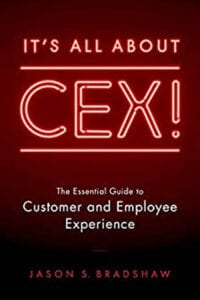
It’s All About CEX! The Essential Guide to Customer & Employee Experience
It’s great to be on the show. Thanks for having me.
It’s my pleasure. I always say, “Let’s start your story of origin and figure out where to start.” In your case, it makes me want to say, let’s please know the story of how in the world did you decide at fourteen that you wanted to start a business, and pick telecommunications and computers?
I know it sounds like I was on some great plan to conquer the world when it came to computers or telecommunications. It was simple. I like gadgets. I’m not fourteen anymore and I like more expensive gadgets. I needed to find a way to fund them. I decided instead of buying stuff at retail, I would buy it at wholesale, but I needed to be able to prove to suppliers that it wasn’t just for my bedroom. If you read a copy of my book, you’ll know that even before the age of fourteen, I was dabbling in different things. My parents and grandparents were all entrepreneurs. One of the many suits my father had was a gunsmith. I was sitting in the lounge room in our family home many times, bottling oil for people to clean their firearms and stuff with trade shows that would give me a small part of his display. I would sit there talking to anyone that came by, trying to pitch my oil to them.
You were encouraged at a very young age, which is not always the case. For myself, growing up, I didn’t even know what the word entrepreneur meant. They’re the ones who either worked for a company or owned a dry-cleaning or a plumbing business, but we still didn’t put an entrepreneur tag on that. Certainly, I didn’t know anybody inventing or starting anything from scratch. It’s fascinating that more young people are saying, “Hmm?” In your case, you saw it being modeled for you. Especially at fourteen, what’s there to lose? You might as well give it a shot. That’s a big part of why a lot of people are afraid to leave the security of a corporate job. The income is not steady and they’re not sure if their idea works. There are 100 reasons not to do it. If you get that out of your system at a young age and have some traction, I would imagine it encourages you to go, “I can do this.” How did you get from that into becoming this expert on helping people give their customers better experiences?
Life’s a wonderful journey, isn’t it? By the time I was 21, I had started three successful businesses. I went from telecommunications and computers into domestic and commercial cleaning. If you think about carpet cleaners and shop cleaners, I had the vans on the road. I had the telemarketers annoying you at dinner. I had an even crazier idea. I had what was perhaps a great learning lesson but I wouldn’t say that’s how I put the successful spin on it, but my third business was a video rental store. I’m dating myself now.
Like Blockbuster here.
[bctt tweet=”Make your customers and employees feel seen and heard. ” username=”John_Livesay”]
They say location is everything in real estate. Location is even more when it comes to video rental. I learned some lessons there. From there, I jumped into the corporate world. My entire career, whether it was a business that I was running or an organization I was working for, I was always the guy in the room saying, “What about the customer? What about the employee? Why do we need 300 steps in our process? It makes no sense to me. How do you think I’m going to delight the customer when I’m trying to follow steps 1 to 300?” Perhaps because of my readings as a young child, going to mom and dad’s place of work or their various ventures, I was always advocating for customers and employees. Naturally with that, as my corporate career took off, I continued to go up the corporate ladder, always with that customer and employee focus.
I haven’t always been the head of the customer and the chief customer officer. In fact, I worked for Australia’s largest government organization, the New South Wales Government Office of Procurement. I was the Director of Procurement Transformation. What’s the customer guy doing in an organization that’s designed to buy hospital beds, diesel, all things like that. Apart from changing processes, my job as a Senior Executive in the New South Wales government was to put the people of New South Wales back into the procurement process. As a government organization, we started thinking about our ultimate customer, as opposed to the agency down the road that needed to buy the hospital beds or diesel for the trains or whatever the case might be. I’ve always found a way in whatever job that I’m doing to bring that customer and employee lens into the fore. My experience is that if you take care of your employees and customers, all the other metrics follow. You sell more, make more money and have loyal customers.
It reminds me of the importance of storytelling, who’s in the story and what the focus is. If you’re in this government job, it’s easy to get caught up in the paperwork, not see the big picture and forget that you are serving the people who live in that country as the end-user, make them the hero of the story, and all of your actions from there as opposed to trying to get something done. This concept of, “If we take care of the customers and the employees, all the other metrics follow,” instead of being so focused myopically on, “What are the sales this quarter and this month?” If we go, “How can we delight the customer better?” That’s such an interesting insight. I want to know a little bit about your days as the Chief Customer and Marketing Officer. That would be a CCMO title instead of a CMO. It’s certainly a C-Suite level that you worked your way up to of doing Volkswagen in Australia. Obviously, it’s not from and in Germany. I worked with Lexus based in Southern California. There are Japanese companies in America like the luxury brands like Mercedes and BMW.
Everyone’s competing in an out-of-country environment. The thing that jumped out on your LinkedIn profile for me is that you have a loyalty program for cars. Most people think, “There are loyalty programs for airlines,” but I don’t think most people realize how important it is to get that repeat buyer or the person who’s leasing the car for two years to stay within the brand. Can you speak to what you did with customer loyalty as it relates to Volkswagen? I’m sure people can extrapolate for whatever industry they’re in and some ideas?
My role is Chief Customer Experience and Marketing Officer at Volkswagen Group Australia while focused on the Australian market. I did have the great privilege of working with my colleagues in North America. In Mexico, we republished the book that we wrote for the Mexican audience. It was great to work across both running a market but also to assist some colleagues in North America to understand the similarities more than what you might expect. One of those, as you alluded to, is the importance of the customer coming back during the lifetime of the ownership.

Retain Employees: Employees feel much more engaged with an organization if there is a continuous investment in them.
There’s this misconception out there. I certainly know I had it before I worked in the automotive industry that you go, buy your car, and the dealership has a 50% profit margin in the vehicle. I don’t know if that day ever existed but it certainly doesn’t exist now. The margins in an automotive dealership from the front end, the new vehicle out there are really small. Where dealers and automotive manufacturers make most of their money is in the service and accessories side of the business. It is extremely important for consumers to come back into the dealership to get the vehicle service.
If I put up my automotive hat, I’m going to tell you there’s a whole range of reasons why you should do that. The pure commercial reason is that’s where they make their money. From a customer lens, you should have a better product experience. I always think that when you buy a car, every single day when you hop in it, that product experience is what’s reminding you that you made the right or wrong decision. That service experience, getting the software updated, getting the oil changed and all the various other things that you do in the service, making sure customers get that completed by a trained professional should lead to a better daily product experience which should lead to loyalty. We launched in Australia a product called Service Packs or Volkswagen Care.
It was essentially a prepaid service package for your vehicle. You could pay for it upfront, package it in with your lease if you’d like, and every twelve months or whenever your vehicle was ready for a service, you’d come in and there’d be no more to pay. Interestingly enough, when we first package that product up, it didn’t sell and people weren’t interested. The sales teams in dealerships begrudgingly spoke about it. Why? There wasn’t value in it. We didn’t take a customer-centric view to create the product.
My team led a piece of research. We went out and asked her a range of people what they were looking for and what it would represent value for them in that post-buy purchase experience. We relaunched the product, renamed it and changed the inclusions. Interestingly enough, the price point didn’t change substantially. We had done some studies that showed that if we bring a prize to a particular point with these inclusions, it would maximize sales and retention. We made those changes all with the customer in mind. We had a 284% increase in sales instantly. Two and a half years on, that sales increased and that new sales run rate has maintained. I believe it’s simply because we created value from a customer lens.
If you don’t understand something, you’re not going to buy it. The confused mind always says no. If you make it hard for the salespeople to explain it or the customer to understand it, they’re like, “Do I want to increase my monthly lease?” No. Unless you frame it through their lens of convenience and not having to come up with the money. Do you have examples of brands that you as a consumer have experienced, not any place that you worked that did a poor job? You don’t have to name them. You can say it’s a hotel or a restaurant. We learn from both extremes. You described a great thing you did at Volkswagen, upping the consumer experience and customer experience of car owners or at least, people. What’s an example of somebody doing it wrong?
[bctt tweet=”Be sure you follow up with feedback your team gives you.” username=”John_Livesay”]
If I might, I’ll start with a B2B example. I’ve had senior roles in customer employee experience over many organizations. As a result, you tend to pitch multiple times for various solutions that you tried to create. As a result, sometimes you get to see the same people you hang with from company to company. I had this one company pitched to me four times in four different companies the exact same solution. They never once changed their pitch despite the fact that it was the same team pitching to me. The requirements were funny enough very similar, so I was leading it each time. After each pitch, I had given them feedback about why they didn’t win. Yet, the fourth time, they still hadn’t changed. I sat in the meeting going, “You’re here trying to tell me that you can help me with customer experience, yet you’re not listening to a potential customer.” It blows my mind away when people say, “This customer experience stuff is full B2C.” No, it’s B2Everyone.
Your book is It’s All About CEX!: The Essential Guide to Customer and Employee Experience. The fact that you’ve married the two, in other words, you can’t treat your employees badly and expect them to give customers a good experience. An example of a good company would be Starbucks, when Howard Schultz was giving his part-time employees health insurance here in the states way before other companies were. Those people felt seen, heard, valued and they would remember your drink order if you came in every morning at the same time. You can’t pay people to do that. Their job is to ask you what you want and give it to you but if they feel valued, “I’m getting healthcare and I’m only part-time, then I’m going to go the extra mile.” Those are the little details that a lot of people don’t see the ROI right away.
“Why would we do that for part-time? If we don’t have to, why would we ever give something to an employee?” That to me is an example of why you would do that. Let’s put on the hat of a manager, how important it is to keep top talent? We all know there are always the top performers, whether they’re in sales or whatever the department is. The line is that people don’t leave their job, they leave their boss. When you give keynotes to companies and you’re talking about not just how to delight the customer, what tips do you give them to keep their top talent?
There’s some research that’s come out that shows that 67% of employees feel that their company or manager asked them for feedback on their experience. That’s a pretty decent number. It could be higher but 67% is not a bad starting point. The alarming thing is that only 29% of employees feel that the company does anything with that feedback. The first thing that I say to managers in the board room is, “If you’re going to ask a question, be prepared to do something with the answer.”
Otherwise, you’re just blowing smoke and letting people talk. That’s more frustrating. You pretend to care and not care.
Quite often, when I say that people came back to me and said, “What if they ask for something that we can’t afford to do?” I’m not saying you have to do everything they asked for. I’m saying that you have to address their concerns. That might be saying no to something but explaining why it’s a no. It might be trying to find the middle ground in some instances. It’s not about doing everything at once. A focus on being a little bit better every single day is much better than spending six years trying to launch a new program for your employees to keep them only to have six years of people walking out while you say you’re working on something. People like to see progress. When it comes to experience, I don’t think there is a finish line.
Think about the number one selling motor vehicle in 1970 in America, it didn’t have airbags and seatbelts but the expectation of customers now is that there’s more than seatbelts and airbags. It’s the same with employees. That journey is a never-ending one that’s why it’s important to crystallize what is it that I promise to you as an employee. What am I going to deliver every time? In Starbucks, that’s things like healthcare and tuition assistance. For other organizations, that could be something smaller or bigger. That doesn’t matter what it is, but if you say you’re going to do it, you need to do it.
You need to ask for that feedback, be open and honest and say, “We’re not going to fix everything or we’re not going to agree with everything, but here are the three things that you told us that make you want to jump onto LinkedIn or Indeed job site. We’re going to focus on those over the next 90 days or over the next year. Every month, we’re going to communicate with you around what we’re doing on that journey.” That way, people don’t go, “I left some feedback but their companies not listening.” Often, their company has listened and done stuff but hasn’t told anyone.

Retain Employees: There’s a lot more learning that happens in the commission of getting it wrong than in the celebration of getting it right.
You’re not letting them in behind the scenes. I’ve heard from a lot of clients when they bring me to train their team on how to become better storytellers. Not only does it help them close more sales but they also feel like the company cares about their career. They’re learning a skill, in this case, storytelling, that is going to help them, whether they stay at 1 or 10 years or leave tomorrow. They’re getting something from that company that’s empowering them to be better at their job but also maybe better people. Have you seen this happening? Is there research that backs any of that up that you’ve seen?
There’s no doubt to suggest that employees feel much more engaged with an organization if there is a continuous investment in them. I want to make sure that we differentiate creating a website that people can go and do a whole pile of self-case studies. Some organizations have that these days. It’s nice to have but that only works for the employee that is a go-getter that’s a self-motivated learner. Certainly, across the board, there is research that shows, “If my boss understands that our biggest challenge is not being able to sell storytelling. He or she goes and sets up some training for us around storytelling, that shows that they care and importantly, they’re investing in my success.”
The worst thing you can do as a manager is to say, “The target this month is $1 million. I’ll see you on the 31st.” If it was that simple, sales leaders wouldn’t exist. As people leaders, our job is not to solve their problems but guide our people so that when we see that there’s a collective problem, we can bring in some help to fix that. At the end of the day, as a leader, our job is to help our teams be successful. Through this success, we become successful.
The other thing that you talk about in some of your keynotes is crisis leadership. You’re once accused of castrating the men of Australia when you were head of the customer experience with a major retail group? That begs me to know that story.
It’s not something that I ever expected to read. When I was working for Target, we decided to take off sale the game GTA 5, the Gran Turismo 5. It’s a PlayStation and Xbox game. For various reasons, we decided to stop selling it. There was a petition for us to stop selling it, and there was a petition for us to start selling it. In between, while letters were coming to me saying things like I was castrating the men of Australia because that was prohibiting the sale of GTA 5. The reality is in almost every location, you could have walked across the whole of the mall and bought it at another store. It wasn’t our store. I don’t have that power. It was certainly interesting to see how emotional people came about the perception that they couldn’t buy a product.
You could have bought it from us, but you could buy it anywhere else. We weren’t making a judgment about you or your product. Certainly, people felt that they were. While I was at Target, I also got called all things like killing babies. Discount department stores’ big box retail is full of stories. You could speak to any leader in a big box retailer and you’ll get everything. I remember a colleague of mine in the US. She said, “I used to hate getting the 2:00 AM phone calls about a fire in the store. Now, I got a 2:00 AM call because some cashier accidentally left off her rifle or a pistol.” Castrating the men of Australia was certainly one for the storybooks. Ultimately, we didn’t change our position. We took it off sale and left it off sale to this day. Target doesn’t have it on sale.
It’s fair for organizations to make a decision but it comes down to communication. In the GTA example, there were 40,000 social media comments about our decision to take GTA 5 off sale. Some organizations would have just told their teams to ignore those comments, don’t comment on them. I insisted that our social media team follow up on every single comment. There were some canned pre-scripted responses, but whether you were for or against it, you were engaging with the brand. I wanted you, the customer, to feel heard. The customer that wrote to me about being castrated, my response was dry compared to his letter. It’s important that during a crisis that you communicate, you help your employees and your customers when you’re next going to have some use for them so that you take away some of that unknown. A crisis is all about the unknown.
[bctt tweet=”If you take care of your employees and customers, all the other metrics will follow. ” username=”John_Livesay”]
I remember, at Target, we took off sale or recalled a range of denim products because the production process of denim included the use of a dye called an azo dye. There was some research that suggested that it could cause cancer in extremely rare situations. Their company wasn’t breaking any rules. The Australian guidelines were all being met. We weren’t the only ones doing it, that’s everyone’s excuse, but it was fairly commonplace to use this azo dye in denim products. The company made a decision boldly to take it off the shelves and to recall the product.
The advice that we were getting was changing and being updated by the hour. We bunkered down with the teams and said, “Every hour we’re going to give you an update.” To our consumers, we were saying, “Every day at 9:00 AM, we’re going to publish an update.” You still had people asking questions in between but you had a large number of people that said, “The company said at 9:00 AM. As long as they meet that commitment at 9:00 AM, that’s fine. I won’t engage.” Whether it’s being accused of castrating people, giving children cancer, the list goes on. In any crisis, the very first job as a leader is to create some milestones where people can start to get some certainty of comfort.
That’s been seen time and again if your plane is delayed. If they communicate how long it’s going to be, what the update is, versus leaving people sitting there hours on end with no information, how agitated they get. Let’s leave on a happier note. You also help people discover employees’ untapped potential. What is a tip you can give someone to either discover their own potential or someone on their team’s potential?
I’m a big believer in creating space for team members to share their dreams with me. If someone came into my office and said, “One day, I want to stand on a stage and deliver a keynote,” I might say they’re crazy but I would get them to tell me the story about why that’s important for them. I would find ways to incorporate experiential elements into their job so that they can learn that skill. I had a colleague of mine who moved to a new job and she was speaking to me. She’s like, “I am drawing on everything I’ve learned over the six years of working for you.” I said, “That’s fantastic. I’m glad that the job is going well for you. I knew you could do it.” She’s like, “Sometimes you gave me a task and said, ‘Get it done.’”
The tip would be this. Show your team members that you trust them to do the unexpected and what they haven’t done before. You know in your teams the people that no matter what, they are going to find a way to make things happen. You also know people in your team that are the shrinking violets, the solid achievers. It’s our job as leaders to give them permission to try. Importantly, if they don’t succeed, that might be okay as well. As long as they haven’t gone against your wishes, there’s a lot more learning that happens in that commission of getting it wrong than in the celebration of getting it right. I always encourage, “Give your people the chance to try new things. If they get it wrong, turn that into a teachable moment, not a, ‘You’re on my naughty list and I’m never going to let you do anything else again.’”
If someone wants to find out how to work with you as a speaker or consultant, what should they do and where should they go?
The easiest way to reach out to me is at JasonSBradshaw.com and on all the social channels, @JasonSBradshaw. It is important that you don’t forget the S in the middle. Otherwise, you’ll be buying yourself some real estate in California.
Thank you for coming on and inspiring us to have our team members share their dreams and remembering the importance of following up with feedback once we get it whether it’s from a customer or an employee.
Thanks very much, John. I appreciate it.
Important Links
- Jason Bradshaw
- The Pursuit of Wow
- LinkedIn – Jason Bradshaw
- It’s All About CEX!: The Essential Guide to Customer and Employee Experience
- Better Selling Through Storytelling Method Online Course
Wanna Host Your Own Podcast?
Click here to see how my friends at Podetize can help
Purchase John’s new book
John Livesay, The Pitch Whisperer
Share The Show
Did you enjoy the show? I’d love it if you subscribed today and left us a 5-star review!
- Click this link
- Click on the ‘Subscribe’ button below the artwork
- Go to the ‘Ratings and Reviews’ section
- Click on ‘Write a Review’
Love the show? Subscribe, rate, review, and share!
Join The Successful Pitch community today:
- JohnLivesay.com
- John Livesay Facebook
- John Livesay Twitter
- John Livesay LinkedIn
- John Livesay YouTube