

The Right Hustle With Rajesh Setty
Posted by John Livesay in podcast | 0 comments


Many people say you won’t get far without hustle. In truth, it’s not just hustle that will take you far; it has to be the right hustle. John Livesay is joined by author and entrepreneur, Rajesh Setty as they discuss what the right hustle means and how you can achieve it. Rajesh talks about his early forays into writing and the rejections, and ultimately, the first book he sold. He also discusses connecting with people, generosity, and the art of learning.
—
Listen to the podcast here
The Right Hustle With Rajesh Setty
Our guest is Rajesh Setty who talks about his course, The Right Hustle. The big question is, do I care about what you care about? It is the genesis of every relationship he has. Finally, he says, “What is your GQ?” Find out what GQ stands for. Enjoy the episode.
—
Our guest is Rajesh Setty who is Silicon Valley’s secret spark plug from startups to scaleups. He loves to bring meaningful ideas to life via startups like Audvisor.com and MentorCloud.com. His books include Six Foot World and Smart, but Stuck. He also has a course called The Right Hustle. Welcome to the show.
I’m super excited. Thank you for having me.
You’re one of those people that pulls people in. Your magnetism, kindness and creativity are all so inspiring, and people want to be around your energy. I’m curious to know a little bit about your own story of origin. You can take us back to childhood or when you were in school. How did you discover this passion for bringing ideas to life, not just generically but doing it with love?
It was not by design, for sure. By the time I was four, I had started reading all sorts of books. Anything that went past me, I would read it in multiple languages. In India, many people grew up with many languages. I love reading. By the time I was about nine, I had read about 700 books. Most of them were useless books, according to my mom, because they were thrillers, fantasy, adventure, spy thrillers and murder mysteries. You name it, I would read it.

The Right Hustle: Everybody talks about hustle and get things done. Whenever the word is used, the connotation is you have to network to get something. That’s the wrong hustle.
When I read that many books, most of them were fiction, I used to think, “I know what happens in this book.” I know this is what will happen, but most of the time, something else would happen, and I would get frustrated with myself, not with the author, saying, “How can I not guess what it is?” After some time, I thought, “My forecasting powers were good. Authors were making a mistake, and they should have done it this way.” I then got frustrated with them. I said, “The only solution is I should write my book because I can make the characters do whatever I want and the story to develop however I want it to develop.”
I went on a journey for over eight months. I never wrote a poem. I never wrote a short story. I wrote a novel, which was more than 200 pages. My parents thought something was wrong with me. My parents thought I copied it from somewhere else. For me, I thought, “How many people would write a book when somebody is nine years old? I’ll send it to a publisher. I’ll get a red carpet welcome and my books will be in the bookstores, and I will be a celebrity.” That was what I was thinking. Nothing remotely close happened.
The moment I picked up the phone and called the publisher in my baby voice, the first thing is they click the phone back thinking somebody is doing a prank or somebody is playing games. I would call them back again. At that time, there was no internet and in our home, there was no phone. I had to go to a grocery store nearby where there’s a public payphone booth that I had to put money in, and then I had to dial. I keep dialing again and I said, “Please don’t hang up. I’m an author.” Until I say, “Never call me again or I’ll call the police,” or something, I’d keep trying. Long story short, I was rejected 160 times over 3.5 years.
That’s a lot of rejection. Why did you not take it personally?
[bctt tweet=”What is your GQ – Generosity Quotient?” username=”John_Livesay”]
Earlier, I would think they’re making a mistake. They’re wrong. I would think that I’m not getting the right person. I was experimenting with myself. After some time, I realized something is not right. I reframed it thinking, “Everybody gets rejected maybe 200 to 300 times. I’m still not there. Let me finish my rejection quota so that I will get to the right one quickly.” I used to keep on reframing to my convenience. That’s what I used to do.
Whatever story we tell ourselves that keeps us going is the key. Whether it’s overcoming a physical challenge in sports or an illness, our dream is going to happen sooner than later.
I still remember the time when I got a book deal. I was physically meeting a publisher and I gave them the manuscript. By that time, I had built a network of my own because when I get rejected, I reach out to other people, “How do you do it?” You build relationships and I got a referral to this publisher. I went and they said, “This is interesting. Let me take a look.” He turned on the side and then he started reading it. I was a thirteen-year-old kid so I don’t know whether to stay or to leave because he didn’t ask me to leave. I was standing there for about two hours. He forgot that I was there. He finished reading the book, he turned around and said, “You’re still here.” I said, “Yes, I’m here because you didn’t tell me to leave.” He said, “I’m sorry. I’m going to take this. It’s a good book. How much do you want?” That is one question I was not prepared for. I had no idea what to say. With great thought and a lot of stupidity, I said, “I need ₹100.” ₹100 is $1.50, so you can imagine what I asked for. He said, “Are you sure?” I said, “Yes. That is what I want for this book.” He picked up the money, gave it to me and said, “We have a deal.” That was a game-changing moment for me.
That’s a great story and an example of hustle. That leads to my next question, which is you have a course called The Right Hustle, which is this fine art of moving the needle and that it is an art form. It’s not just push, push, push. I love that you talk about choreographing actions, which to me implies that there’s some preparation and thought that goes in before you jump in.

The Right Hustle: We have more tools than ever before on this planet that will make you get closer in the spirit and in the mind.
My thinking is that everybody talks about hustle and get things done. Whenever the word is used, the connotation is you have to network to get something. I think that’s the wrong hustle. The right hustle is to network to give something. You don’t have to get all the time because there’s a universal accounting system that will take care of the checks and balances and all the accounting system. Your goal is to give something meaningful. When you reach out to someone, and you connect with someone, make sure that you give a gift rather than trying to get something from them. How do you do it? That’s the whole thing about the right hustle. What will give you the platform, power, strength, skills and abilities so that you are always giving?
One of your many books is called Six Foot World. How did you come up with the title?
This is probably the first book that got published about the pandemic. As soon as the pandemic was onset, within three months, I wrote and published the book about what might happen. I’m usually often wrong but never in doubt kind of person. I said, “I might be wrong but there is something wrong that is happening here.” People will be caught off guard. I had a friend who is a publisher who took a chance on me. The reason I wrote Six Foot World is when the pandemic was onset, people say, “You need to maintain a 6-foot distance.” I said, “This thing will continue for a very long time.” Several of my friends said, “This is nonsense because it will end in three months, and then this book will be irrelevant quickly.” I said, “I don’t think so.” They said, “Why do you think this is?” I said, “I’m not a doctor and I’m not a futurist, but I studied linguistic philosophy for 7.5 years. When the phenomenon experience is described wrong, everything about it will be wrong or the assessments will be wrong.”
Why do I say it? If you think about it, every big disaster that we have had, the society came back as if nothing happened after a few years post the disaster. That happens on 9/11. Post 9/11, things didn’t come back to normalcy. They underwent a permanent change. The security systems got bolstered, pilots would lock themselves up in the cabin. There is red, blue and all of those kinds of signals. Everything changed. Why? It’s because there is a switch in the internal world that said, “Who knows? One among us may be a terrorist.” Once that switch is internal, the change externally will be semi-permanent.
[bctt tweet=”Be timeless, relevant, actionable, curated and knowledgeable.” username=”John_Livesay”]
Even the concept of social distancing as opposed to physical distancing, I thought once you start flipping that switch that people should be afraid to be connected or be near each other socially as opposed to just stay 6 feet apart. If we’re socially distancing, then it becomes a whole other level of psychological distress. My favorite analogy is one of the worst things they can do to prisoners is put them in solitary confinement.
The post-traumatic stress that people have been experiencing by social distancing, in other words, feeling so isolated from friends and family and meeting new people, once that is switched, it’s going to take a while to heal and recover from that. In this 6-foot world that we’re living in, even after everything might go back to some fewer restrictions in terms of distancing, mask and big events, what do you think is one of the biggest things that people can do? I love the image you have of the kitten is unprepared and the lion is prepared.
If you think about it, we have never met. We both are talking but we never felt that we’ve never met, isn’t it?
Right.

The Right Hustle: The easiest thing to do, whether you’re connected physically or not, is to ask only one question. Do I genuinely care about what they care about?
I’m sure we have many friends like that that you never met, but you always feel connected to them. I always think like this. We have to learn to live in a world however physically disconnected we are, but in the spirit and the mind, we should be fully connected. I’ve worked with several people in my life. One of them is my illustrator, Ming, in Malaysia. I’ve been working with him for around twenty years, but I met him only after sixteen years of working with him. I never felt that I was disconnected because it has to be in the spirit. The easiest thing to do, whether you’re connected physically or not, is to ask only one question. Do I genuinely care about what they care about?
Are the values aligned?
Once you do that, then the physical distance is distilled because we have tools like Zoom and all those things. We have more tools than ever before on this planet that will make you get closer in the spirit and in the mind.
Since you’re all about promoting new ideas, it creates new needs for new projects. For example, when I was speaking to the Olympus Medical sales team, I went from a live event to a virtual event, they said, “Can you also add in some training on how to look and sound good on Zoom calls?” That was never a need before. How do we sell on-camera versus being in person? All those little tips suddenly create another need. If one goes away, another one comes up.
[bctt tweet=”When you reach out to someone, make sure that you give a gift rather than trying to get something from them.” username=”John_Livesay”]
If we think about it, there are only two things. People have concerns or when they are taking care of their concerns, they have breakdowns along the way. That’s what my philosophy teacher taught me. The concerns and the breakdowns while they’re taking care of those concerns are never going to go away as a concept. As soon as you make a change, then the concerns are not going to go away. New concerns will get formed.
Speaking of new concepts, let’s talk about Audvisor, brilliant in three minutes. How did you come to get involved with this startup?
Let’s look at the trend. The trend is people are going to think that they have less and less time. They don’t have less time. I can guarantee you that. They will think they have less and less time. Why? It’s because they’re always connected with people who will want to sell them advertisement or sell them stuff and all those things, but they don’t know that. They always think they’re always connected and it’s a privilege, but it’s a privilege for people who will sell them something. In the process, their time is getting lost and then it becomes this, “I don’t have much time to study. I don’t have much time to grow. I’m always doing something.”
Globalization is not helping, which is you can follow the sun. This means when you sleep, somebody else is working. When they are asleep, you are working and you can do the handoff. In reality, both of them are awake all the time, saying they’re in coordination and all those things. My thinking is with these many changes, the need to learn and grow has never been less. It has to be more and more, but if they have less time, how do they get to learn from some of the world-class experts or top experts? If the only method is to digest your entire book, it’s not possible because you don’t have the time. What if I get the world’s best experts, more than 100 of them, and give their best advice in three minutes or less with zero fluff?

Six Foot World: How to Reimagine the Future in Disruptive Times
It’s laser-focused. Let’s give an example. I recognize so many of these experts who have been guests on my show, everyone from Sam Horn, Dorie Clark to David Meerman Scott, a lot of many smart speakers, thought leaders and authors that people can say, “I don’t have time to read their whole book but I would love to get the essence of it.” It is so powerful. This concept of TRACK is a wonderful acronym. Can you walk us through what that stands for?
It stands for Timely, Relevant, Actionable, Curated Knowledge. It has to be timely and relevant, which means if it has to be relevant for a long time, then the experts or authors that we work with should give timeless advice. That means it should stand the test of time. It has to be actionable and it has to be curated knowledge. Our goal is to deliver the highest wisdom per minute. People say that we want you to spend a lot of time with our app. I said, “No. Don’t spend a lot of time with our app. You can spend 15 minutes per week or even a month. It’s good enough for you.” Why? It’s because we have abstracted the best wisdom in the least possible time, deliver it on the audio, which means that you’ll be eyes-free and hands-free. Just press the button and you can listen to it. There is no excuse for not doing it. What will you say? “I don’t have fifteen minutes a week?” No. You just start to have the discipline.
One of the things I love about Audvisor is that you say, “We perfectly curated a playlist just for you.” I talk to people all the time about the need to think of their brains as a playlist with stories. You don’t have 1 or 2 stories that you tell over and over again. You have multiple stories like a playlist, but in this case, instead of a song, it’s a story that’s relevant to the person you’re speaking to. That requires a lot of practice, curation and being able to have access at a very fast amount of time, “I need to tell this person this story at this moment for them to see themselves in it.” The same thing is true if you start training your brain to absorb a short amount of information, then you can give a quote from someone or something you learned that’s keeping your own knowledge relevant, timely and actionable. People think, “How do you have time to read all these books?” It’s almost the old premise that leaders are readers or readers are leaders, however you like to say that. Now, this is a way to stay cutting edge without exhausting your energy and time.
If you think about it, what is the biggest blind spot that everybody knows but it’s very difficult to do anything about it? It is what you don’t know that you don’t know? You don’t know what to do about it because you don’t know that you don’t know.
[bctt tweet=”Everything that’s there is red, blue, and all of the signals. Everything changed.” username=”John_Livesay”]
You’re in the dark. It’s like when I needed to learn how to make special effects on my virtual presentations. Before that, I didn’t even know that Ecamm existed so I didn’t know what I didn’t know. How am I going to make a Zoom call to 300 or more people engaging, and I didn’t know what I didn’t know? Once I became aware that that was a potential tool, then I had to make the decision, “Am I willing to invest the time and money in it because of my own passion for doing something cutting edge and giving my audiences the best possible experience to keep them engaged?” There’s a whole premise of getting people up from unconscious and competent to “I’m aware that this exists,” to “When do I take action on this? Do I wait until everyone’s using it? Is this a requirement? Do I want to be the kind of person that gives something to people while it’s still new because the wow factor is incredible, and then that’s what makes people remember you and refer you?”
It was one more step deeper. If you think about it, if somebody watches you in action, unless they talk to you in person or in a coaching conversation or sometimes read your book. Let’s say they’re brought you in to help with a big sale. They say to you, “Whatever you want to take inside. We have a $2 million deal. Can you come and help us?” You took that assignment, and then you deliver the best possible pitch. If they don’t know that the underlying theme was how to construct a story with exposition, conflict resolution route. If they don’t know this, they will just conclude, “John is so awesome and he tells amazing stories.” If they say, “Now that you saw him in action, can you please repeat it?” They can’t because they don’t know the ingredients that pertain to what made you awesome. Unless they work with you, read your book or something, it’s not automatically by watching. Nothing happens because that’s only the tip of the iceberg.
I’ve helped an architecture firm, Gensler, win a billion-dollar airport renovation in Pittsburgh. The criteria there was, “We’re going to hire the firm we like the most because you’re all qualified to do the work.” They were like a deer in headlights because they’re used to pitching their designs and hoping that’s enough to win the business, “Likability? Where do we even start?” In addition to helping them tell case stories instead of just presenting before and after pictures of other airports, I worked with them on the team slide to craft a story of origin from each person that made them likable, memorable and gave a sense of their own. It’s one thing to say, “I’m somebody who doesn’t give up.” It’s another to show it a story.
All of those little techniques are something that people can learn and work on. If we start at, “We don’t even know we need to tell stories,” to “Now we know the basics of a story but we still need to be at the blackbelt level of it.” If we’re the only ones telling a story and our competition isn’t, odds are we’re going to win. In this case, they did. If other people start telling stories, then you’re like, “That’s the table stakes. That’s the minimum. Now I have to be a master storyteller to tug at heartstrings.” It’s an ongoing process and your solution Audvisor is certainly another way for people to stay one step ahead of what other people are thinking and doing.

Smart, But Stuck
This is the art of learning as well as a discovery platform. A discovery of what you think you should know, but you didn’t know that you should. For example, if you talk to somebody, let’s say the person on the Wolf of Wallstreet, Jordan Belfort. He will talk about straight-line selling. Maybe that’s useful but if you didn’t even know that such a thing existed that you could use that tool somewhere, you’d have no idea. Maybe it’s about frame control. How do you control the frame? If you didn’t know there was a concept of something called a frame, how will you do it? I created a term called hunger engineering, which means way before you sell something, you have to create the hunger for them to want it. If you never think of it, then you have no clue. They are not tools. First of all, you should know the concept exists, which means somebody has to describe it and put words to it.
I want to talk about your talk, Know Your GQ. I was like, “IQ, EQ and GQ is a fashion magazine.” You have a new definition here of what GQ is. Give us a little hint of what that means so we incentivize to go watch your talk on that.
I gave this talk years ago called Practical Generosity Quotient. I always talk about generosity because that’s a complete advantage that anybody can have with simple changes to their mindset, skillset and the way they do their relationship building. The practical generosity quotient is very simple. It’s the ratio of the capacity you added to the capacity that was needed by someone to make a meaningful thing gets done. For example, somebody wants to write a book. We know the capacity that is needed was 100. Somebody comes to return sixteen books and said, “Can you help me here?” I said, “No problem.” When you want to write a book, you pick a topic, go to Amazon and search on the topic. See the books that come out and look at the top three ones. Read them and you’ll get inspired.”
Be as advised. The capacity you added was 1 out of the 100 that was needed. I can do this very same thing differently. Somebody comes to me. I know what is required for a publisher. It’s like a proposal. I have the best proposal template that anybody can have. I select it and do the proposal. I’ve given talks about writing a book. I’ve written a book about how to write a book fast. I have a video course material and a book called Writing Zero. I give them all of those and say, “Why don’t you take a month or something, read it and then we’ll have a discussion over breakfast or Zoom. I’ll help you come through the content. I’ll create a mind map for you.” Now the capacity I added was way more than 50 out of 100. Imagine if everybody did this to the other person by the PGQ. How much capacity are they’re adding to the capacity that was needed to get a meaningful project or meaningful action done? It will be a different way we look at the world.
It is indeed a wonderful new way to look at the world. Your startup or many that you’re involved with Audvisor, one of your many books, the Six Foot World, one of your many courses, The Right Hustle, and now the generosity quotient. Thank you so much for sharing all of this wisdom with us. If people want to follow you on social media or find out more about the book and the course, where should we go?
My website, RajeshSetty.com.
Thank you so much. It’s been a thrill and an honor to get to spend time with you.
Thank you so much, John.
Important Links
- Rajesh Setty
- The Right Hustle
- Audvisor.com
- MentorCloud.com
- Six Foot World
- Smart, but Stuck
- Sam Horn – Previous Episode
- Dorie Clark – Previous Episode
- David Meerman Scott – Previous Episode
- Know Your GQ
- Practical Generosity Quotient
- Writing Zero
- Better Selling Through Storytelling Method Online Course
Wanna Host Your Own Podcast?
Click here to see how my friends at Podetize can help
Purchase John’s new book
John Livesay, The Pitch Whisperer
Share The Show
Did you enjoy the show? I’d love it if you subscribed today and left us a 5-star review!
- Click this link
- Click on the ‘Subscribe’ button below the artwork
- Go to the ‘Ratings and Reviews’ section
- Click on ‘Write a Review’
Love the show? Subscribe, rate, review, and share!
Join The Successful Pitch community today:
- JohnLivesay.com
- John Livesay Facebook
- John Livesay Twitter
- John Livesay LinkedIn
- John Livesay YouTube
Think. Do. Say. With Ron Tite
Posted by John Livesay in podcast | 0 comments

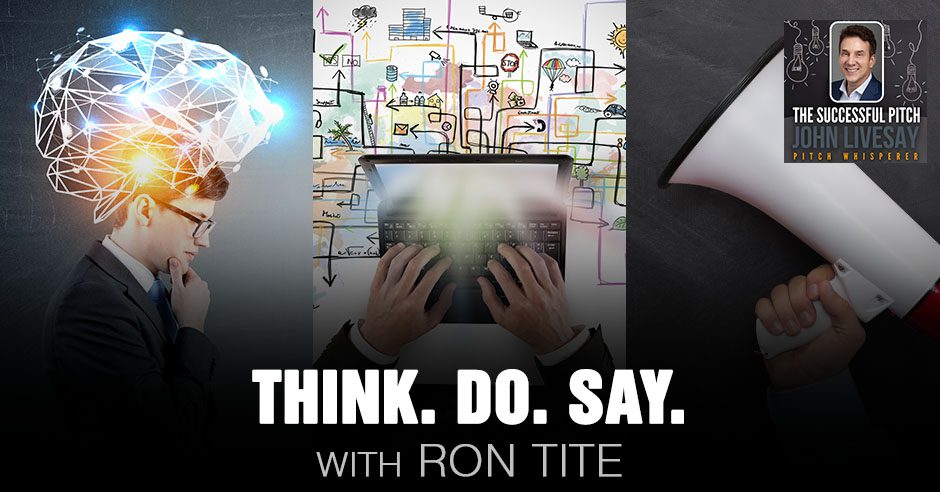
Our guest is Ron Tite who is hailed as one of the Top Ten Creative Canadians by marketing Magzine. He’s the author of Think. Do. Say. In this episode, Ron shares how to build trust, as well as how do we win the battle for time when everyone is so inundated with things that you have to figure out a way to create content and advertising that wins that battle. Today, he shows us exactly how to do it from lessons learned in his book. Don’t miss this episode to discover a whole process of building trust – from figuring out how to connect with your beliefs and values, how to deliver on those beliefs and values, and how authenticity is the secret sauce to all of that.
—
Listen to the podcast here
Think. Do. Say. With Ron Tite
Our guest is Ron Tite who has been named one of the Top Ten Creative Canadians by Marketing Magazine. He has been an award-winning advertising writer and Creative Director for some of the world’s most respected brands including Air France, Evian, Fidelity, Hershey, Johnson & Johnson, Kraft, Intel, Microsoft and many more. His work has been recognized by The London International Advertising Awards and many more. He’s the Founder and CEO of Church+State, a Toronto-based marketing agency and he’s the publisher of This is That: Travel Guide to Canada. He also has a book coming out called Think Do Say. He and I are going to be speaking at the Coca-Cola CMO Summit on storytelling. Welcome to the show, Ron.
Thank you so much, John. Thank you for having me.
I always like to ask guests to tell us their story of origin. You can go back as far as childhood high school, college or whatever it was you thought, “I want to be a creative person.”
When you look at the broader life story, we can break it down in terms of the peaks and the valleys, and the origin story is such a great way to put it. I grew up the youngest child of four in a predominantly single-parent home for the most part and not quite poor. I think that it’s observing being the youngest while everything else was going on around me. I began to be able to observe things right and start to look at that life. I try and pull humor and see the humor in it. Even from being a very young child, not being a class clown, I wasn’t that but I could certainly appreciate the humor in situations and always.
My family is Italian and Québécois background so it’s very loud, it’s animated, the people who themselves were amazing storytellers. As a kid sitting around the kitchen table hearing my aunts and uncles tell stories and how they could just capture a room whether they were emotional stories or funny stories. I think that’s where I really got the ability to tell a story and which would serve me well. I started doing stand-up comedy so I would do that. I went off to university, I was the first of my family to go to university. I did a phys ed degree like most people in comedy and advertising.
You started off in phys ed, athleticism, which doesn’t normally lead to being an expert in creativity and humor. How did that connect for you?
Getting into it, it wasn’t a conscious choice but I don’t know that it was something I was destined to do. Nobody of my family had gone to university. I liked the job that my wrestling coach and gym teacher have and I said, “How do I do that?” I do that and then once you go and you land in the middle of the sea of people who come from this variety of different backgrounds, I quickly realized, “I don’t have to do that. I can do whatever I want. I think I’m smart enough. My head is screwed on tight enough.” I don’t know why and I read a book that changed my life.
It really sought away, but it is not a book that everybody knows. John Irving wrote a book called The Imaginary Girlfriend that was not a biography. It was how he was this very successful wrestler who wrestled in college and discovered his love of writing. He would tell his wrestling coach that he couldn’t attend to meet because he had to go see his girlfriend, but his girlfriend was his writing. When I read that, I realized, “I don’t have to live into this predefined. I don’t have to be a wrestler. I don’t have to be a gym dude.” I realized I could pursue the things that I find interesting, that I’m curious about and that’s when I started. After I read that book, I got a job in the business school at Queen’s University. It was the beginning of the internet and I started doing some tech stuff there. I made my way into advertising and then the second biggest contributor to the story was that I wanted to be a stand-up comedian. I don’t know what that guy was thinking many years ago because it is like, “You do it for money.”
[bctt tweet=”We trust imperfection.” username=”John_Livesay”]
Were you scared? It is one thing if we give a talk to an audience and they have all these expectations that it’s going to be hilarious so they’re not at a nightclub drinking like you’re giving a keynote. You’re usually in front of a business audience, the stakes are still high, but I think getting in front of a crowd that’s like, “You are the next Seinfeld or Ellen DeGeneres, and if not, some people get booed off the stage if they’re not funny.” Was there any trepidation doing comedy for the first time?
No weirdly and when I tell you the extended part of this, you’ll be more freaked out maybe. I’ve always liked to look at something like, “How do I pursue that and explore it?” I don’t want to apply for a job. I want to create a job. Someone told me that the way to get under stand-up comedy was you had to go and do five minutes at an open mic. I went to see that to check it out and I walked away going, “That’s the most demoralizing, horrible experience for anybody I could ever imagine.” I am already better than everybody on that stage. I was cocky about it. I went to a friend and I said, “I’m not doing that. That’s inhumane. What else can I do?” He said, “Why? I guess the only thing you can do is find a producer who’s producing a live show and you can convince them to give you five minutes even though you’ve never done it before.” I said, “Why don’t I just make myself the producer? I’ll make myself the headliner. My very first night of ever performing stand-up comedy on my own, I headlined with a 45-minute set and that’s ballsy.
It also shows that you’re taking something, disrupting it and making it your own.
I started writing and starting the rules to favor my own situation. Once you do 45 minutes, they put a stamp on your face and say, “You’re a professional stand-up comedian now,” and then you used to get gigs. I guess the other pivot out of that, the third most important one, I started to do stand-up comedy. I was touring and doing a lot of club shows and then because I worked in advertising, I started doing corporate shows. I started to see speakers and I was like, “This exists, a career that is interesting.” When I found out that they were making three times that I was making and repurposing the same speech over and over, I thought I had to pivot out of that and so I started bringing in some weird strategy bits into my corporate comedy set and it was weird. I realized the third most important pivot was there’s no market for a comedian who knows about business, but there is a massive market for a funny business guy. I walked away from comedy, struck it from my record, took it from the bio and everything, and said, “I’m a speaker. I’m not a comedian at all. Let them be delightedly surprised by the funny.”

Building Trust: There’s no market for a comedian who knows about business, but there is a massive market for a funny business guy.
When did you decide to launch your own agency? How did you come up with the name Church+State? I love that concept because having worked in advertising myself, they used to say, “The editorial and advertising, church and state don’t even talk to the editors, don’t ask them any questions about a story. We don’t want anything in the edit to be touched by an advertiser’s request.” In other words, if W Magazine is doing a photo shoot, they don’t necessarily want to have Lexus cars in that photoshoot. I’m guessing that’s where that came from.
I was an Executive Creative Director at Euro RSCG and I was at a point where I literally remember the moment I was shooting a TV commercial for Kraft and it was in Montevideo, Uruguay. I am with someone, would step back to take a photo of the crew and all of us from the agency, clients, stuff and I turn to my producer and said, “How are we still doing this crap?” Like, “Really?” We’re flying halfway around the world for 30 seconds and confirmed that no one’s watching anymore. I just quit. I realized I want to do stuff on my own. I thought that the traditional process of getting consumers’ attention was broken. I thought the agency model was a little bit broken and I wanted the freedom to pursue what I was curious about and not have to report that into the head office in New York or Paris. I quit and committed to starting my own thing.
One of the first things I did before I started the agency is I started consulting and I was consulting with a media company that had radio stations. I realized that as the large marketers from big CPGS, telcos and tech, that they didn’t get where the world was going. I also thought the big established media players didn’t see where it was going either. The idea was somebody has to know where media is going to know where advertising is going. We started as the Tite Group and then once we formalized and realized what it was, we pronounced it Church and State but it was this realization that as to your point, that you were banging on with that. It was theirs that we used to claim, the separation of church and state. I firmly believe that when you’re now at a time where we see the unification of church and state and everything, that every ad can be an actual piece of content. If it’s good enough and compelling enough then every piece of content can be an ad. If it’s responsible and authentic enough and it’s really about how do we help people win the battle for time so we do it for big brands? We do it for big media companies and then we do it for individuals too.
How do you win the battle for time and that is obviously having content and advertising be a good story? Am I guessing that pulls people in?
100%, when you go to YouTube and you get the pre-roll video, the pre-roll ads.
[bctt tweet=”How do you win the battle for time?” username=”John_Livesay”]
Everybody goes, “How many more seconds until this stops?”
“How can I skip it? Can I skip it? There, I’m going to skip it.” I think we place that on advertising in a pre-roll one. The skip ad button exists in every conversation we have. It’s like you go to a party and someone’s like, “I’m in data mining.” You’re like, “Can I skip this ad? Can I get out of it?” We used to believe that the content players, that people all wanted to tune in to that and they didn’t want to see the ads and they would skip the ad. If you’re a newspaper right now, every article, every tweet, everything you do, there is a skip button that says, “Do you want to roll pass this because you’re distracted by other things?” Everything has a skip ad button and what it is that makes people go, “I don’t want to skip this. I want to listen to this.” The old like, “People have a short attention span.” “That’s why they’re sitting down and watching twenty-minute TED Talks.” That’s why they’re great big shows on that list. People want great stuff and there’s so much great stuff that they’re willing to seek it out and find it. I don’t care if you’re an ad, a newspaper or a person. Your stuff better be good enough to win the battle for time or you’re done.
Your book, Think Do Say, reminds me automatically of monkey-see, monkey-do and all that good stuff. I love that you talk about that everybody succeeds in the world by figuring out what they think, what they do and what they say is a criterion. Those are some great takeaways from this episode for everyone to think about. When I gave my TEDx Talk, the TEDx coach said, “What do you want the audience to think? What do you want them to feel? What do you want them to do?” It’s very much in line with what you’re doing in this great book. My first question is, how did you come up with the title?
Nobody asked that because they often assumed it was like, “You pick three random words.” This came about because I was doing a TV appearance on a daytime talk show and they wanted me to talk about personal brands. I was bringing in all this marketing language and I was talking to the producer and she’s like, “You’ve got to dumb it down a little bit.” You’ve got to simplify it because these people aren’t marketers. I was out of frustration and I said, “Here’s the simplest way to do it, it’s based on what you think, what you do, and what you say,” in that order and then I did that in the appearance. I was working with Michael Port and Amy Port. I went to them and I was speaking probably 55 times a year. If you ever got to that point, we were like, “This is all great, I’m getting great reviews and the gigs are coming back.”
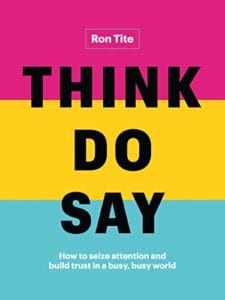
Think. Do. Say.: How to seize attention and build trust in a busy, busy world
There’s something personally I feel it’s not quite there yet. They came to a speech that I gave and they’re not all ten out of ten. This was a ten out of ten, it was brought and they started the conversation with, “We have some notes.” They said, “We don’t know what the foundation is. What is this about?” It’s a bunch of random stuff. You didn’t stand because you broke it down like a stand-up way and a bunch of it. We explored that, Think Do Say, and then I built the framework before I even thought of the book. Once I decided I want to do the book Think Do Say, for me it was the only title. It was not negotiable.
People don’t realize how important a headline is. In an email, what your subject line is, to get people even to want to open it, a book title to get people to be intrigued enough to pick it up or at least click to read what that means. I also have learned that there’s a craft of speaking and there’s a craft of telling jokes or figuring out what’s funny and that the order of things is critically important. For people to think maybe, “I should think about something and do something before I say something. I normally just say something.” Can you speak to that a little bit, the importance of the order?
It is hard why I was frustrated enough to write the book because you’ve got to be really frustrated to go, “I’m going to take a few months out of my life and sit down and write this.” I thought that far too many people, far too many thought leaders, far too many speakers, far too many businesses, marketing people. We’re all trying to game the system by jumping to the say and that we were getting in the zone where we’re looking at data and saying, “This is the headline that most people respond to and you’ve got to talk about yourself in this way.” We started cliparting communication and saying, “You’ve got to put this word here and that word there, you’ve got to start this way.” One, the creative person in me. My soul dies a little bit every time I heard that but also I was so frustrated to step back and go, “You can’t just say what you think everybody wants to hear without having the actions and behaviors that give you the permission to say it in the first place. You’re gaming the system, it’s a big crock of crap. It’s clickbait and I thought, “We’re losing this ability or this desire to play the long game.” If you were to zero-base at business like, “How do you build it or zero base a person, an entrepreneur and your business is the one person?” It’s the same thing.
The first thing you need to do is believe in something greater. There has to be something that you believe in that allows you or inspires you to do the things that you do. What is that foundation? What do you believe in? The second thing is you have something that you can seek actions and behaviors to tie back to and to reinforce because this was the other thing I saw. My friend Warren Tomlin says random acts of digital where they’re doing stuff and it’s not strategically tied to anything. You need a guide for your actions and behaviors and those are your beliefs. What do you believe? What do you do to reinforce that belief through your actions? If you believe in something greater and you behave in a way and empower your team to behave in a way that reinforces that point, that is worth talking about. If you’re going to talk about it then shouldn’t you talk about it in a really interesting and compelling way? Shouldn’t you use stories to tell what you believe in how you reinforce it to get as many people onside? If you do that and you talk about that stuff, enough of those people will convert to buying whatever it is you’re selling.
[bctt tweet=”It’s our imperfections that people buy because that’s what makes us human.” username=”John_Livesay”]
Let’s talk about how you bring this to life in your book because it’s like, “Let me digest this.” I have to figure out what I believe then I have to take actions based on that belief and not have it be some core belief that I have on a wall and never take actions on. How do consumers get involved with this? Most people are thinking to themselves, “I don’t even know how to connect beliefs to actions, let alone get my customers,” but you have a wonderful story in Think Do Say about how REI implemented this. Would you walk us through the implementation of that so that those steps come to life for people?
REI believed and this kicked off in 2015. The program still exists now and it’s growing. REI, for those readers who may not know, for international audiences, it’s an outdoor equipment retailer co-op. They sell tents and hiking boots and stuff like that. Most people, if they have that business, they would say, “What do we believe? We believe we should be the best outdoor retailer in the world.” That’s not a belief. The other people do that and other people have that aspiration and don’t make you that special. What they did is they believed in something more important. They believed and they state this, “We believe a life lived outside is a life well-lived.” They didn’t say we believe we should knock twenty points off hiking boots. They elevated it to something that people actually care about like, “I get this.” The second thing is they then took action. One of the first things they did was a very symbolic but important gesture, they close all their stores and stopped eCommerce payments and delivery on Black Friday, the busiest retail day of the year. Their line was, “We’d rather be in the mountains than in the aisles.”
Let’s talk about how great that is. It’s visual, it hits you in the gut, it’s so counterintuitive. Normal people who are worried about stock prices or even a privately-held company, worrying about profits because I know retail makes a majority of their money in the fourth quarter. That is what most people would say is an insane decision and it ties to the belief and has a surprising outcome. Continue with the story. I wanted to underline that as such a great concept if you’re going to take a bold step like that. Have an emotional look that is from the mountains instead of the aisles of a store. I’m in a story which is my whole thing, get people in your story.
They delivered this message so that was their do and then the say was that you want to say it in a way that is compelling and interesting for people so they pay attention. They come on your side so they chose a couple of things in these say. One, they didn’t talk about this being an anti-consumerism thing. They didn’t make it about social issues. They’re not anti-corporate. They don’t think the private sector is evil. They didn’t go down that road. They said, “We believe a life lived outside is a life well-lived. We’re going to close our stores on Black Friday and rather be in the mountains than the aisles.” Those are the first things I decide. The second thing was they decided to have this in a slightly whimsical launch spot. The CEO at the time is no longer CEO because the CEO was sitting at a desk out on the top of a mountain. These two hikers come up and go, “What are you doing here?” and he’s like, “Why? I work here.” It’s not knee-slapping funny but it gives a smile and is consistent with the brand. It is a very authentic piece of communication.

Building Trust: Don’t ask for the sale. Communicate your values so you’re connecting right away without your sales bias getting in the way.
This has grown and they’ve got more partners on. What I love and I think what is a point that gets missed in this story is that what are the adjoining pieces of this story? You can say, “They lived happily ever after.” There are some other stories here because by believing in something more important that goes beyond the product and then by saying, “How can we act in a way that reinforces that belief?” They had the one act of closing the stores but that’s not all they did. The actions they took to say, “If we really believed in, what can we do to support that belief that goes beyond the stuff we sell?” They created REI Adventures which is a touring company and they started to diversify their portfolio. They now start REI classes where they teach people how to kayak, canoe, rock climbing and things like that. Not only are they doing more to support their beliefs, they’re diversifying the revenue portfolio by doing it. It’s a great business story and the hook for all the doubters who are reading and going, “That’s easy to close your store on Black Friday.” Two things, one, as Nike said with the Colin Kaepernick ad, “If you believe in something, even if it means sacrificing everything,” but REI grew the business, they gained nine points year-over-year by closing business retail day of the year.
I also imagine that it creates brand ambassadors who say, “That’s what I believe in, more family time, less fanatic shopping to save some money where you’re pushing and shoving people.” This concept of if a brand decision and a marketing message can start attracting the kind of talent you want that’s not normally an advertising job. I would think that top talent would look at that decision and say, “That’s the culture I want to work in,” which is to me is another extension of that story.
You are banging on there, as a recruitment piece, it’s incredible, it’s amazing.
You have such great insight in Think Do Say about people don’t know how to trust people. People say that all the time, “How do I get someone to trust me right away whether I’m an ad or I’m pitching to get hired or pitching for anything to sell my product?” Speak to us about how Think Do Say can help us with our trust?
[bctt tweet=”It’s nice when we get to meet somebody face to face. It amplifies the connection more.” username=”John_Livesay”]
We have to look at why people don’t trust others and we have to acknowledge that. We have to acknowledge that there are macro cultural forces at play that have gone into that person’s day and over the past decade. We’ve seen Lance Armstrong lie to our faith. We saw Bill Cosby when going from America’s dad to America’s predator. We’ve seen Panama papers do nothing. We’ve seen CEO compensation go through the roof. We’ve seen Volkswagen with the emission scandals. A long list of all aspects of our lives and internally within organizations like, “Please.” Employees are like, “Great another reorg. I’m sure you have my best interests at heart.” We know that coming into it, people are already completely skeptical and then there are two points to the distrust, I think. If we look at Times Square as this metaphor, that up top you’ve got the big brands who can afford to do the promotion and they put it into glitzy ads with high prices, photography, perfect scripts and everything else. They get so big and they get so perfect that they lose all the semblance of personality. They can’t connect with the common person because they’re saying stuff to be really perfect and nobody is perfect.
We trust imperfection. Like in advertising, we used to fire the director of photography if there was a lens flare on the film and we consciously put them in because people see that as a slight imperfection and they trust it. I got these big brands who don’t want to be imperfect and so we don’t trust them because they’re too scripted. On the other hand, we have these people on the street who are nothing but imperfect and they got someone telling you the end of the world is coming and someone is selling a fake Gucci. They may be authentic and imperfect but we don’t trust them because they don’t have the credibility that the guys have at the top has. That’s why we’re stuck in this zone. That the big established players who have screwed us for years and we’ve got these startups. We’re not exactly sure whether they’re going to be around tomorrow and that’s this paralysis that is in the minds of the consumer.
To build that trust, if you start with a belief and you connect with people on beliefs and values. You’re not asking for the sale. You’re communicating your values and so you’re connecting right away without your sales bias getting in the way and people go like, “I trust this person. I like this person.” If they’re skeptical like, “They only said that they believe,” and then they fall and you deliver on what you told only you’re going to deliver on. Now, I can trust you and then if you talk in an authentic way. I’ll tell you this very quick story.
I was at a gig in Sarasota, Florida and I was talking with a chairman of a global software company that I can’t name. This person was from the Deep South and he was previously the CEO of that software company. He spent some time at a CPG and rose to the ranks of vice president. Once he hit vice president, they sent him on a leadership development course and he realized that the sole idea and purpose of the course was to get him to lose his Southern accent because they didn’t feel he would have credibility on the global stage sounding like a country boy. He looked to me and said, “I quit because I realized my voice is not a bug, it’s a feature.” It’s our imperfections that people buy because that’s what makes us human. If we hide those imperfections through incredibly polished photography, communications and incredibly scripted things that have no sense of personality, if we’re hiding who we really are, what else are we hiding?
I saw the value. It’s almost the concept where you see people spending so much time photoshopping a Facebook post so that there are no wrinkles and their teeth are extra white and all this stuff online. At what point do we not even let a casual photo go up to where we go, “That’s not perfect, I can’t show it.” “We trust imperfection.” I love that line and this concept you’ve given us, a step-by-step. It builds trust by letting people connect with our beliefs and values then deliver it. That builds trust through authentic vulnerable communication and connection. Ron, that is brilliant. I have never heard anybody put it so clearly, that’s why the book Think Do Say is so valuable and a must-read for everyone. How can people follow you if they want to engage you, to come and speak? What’s the best way to do that?
They can go to RonTite.com, ThinkDoSay.com, ChurchState.co or all the social channels, just add Ron Tite.
Any last thoughts or one quote you want to leave us with?
The one thought I would leave you with is I absolutely love our conversation and we’ve never met in person but we get to do so in Chicago. I think that as much as we can connect the people through digital means and it makes it nice when we get to meet somebody face-to-face. It takes those connections and amplifies them even more. I’m really looking forward to that.
Likewise, and remember that if you have a choice between texting somebody, talking to them, Zoom call or seeing them in person, always go for the in-person energy.
Important Links
- Think Do Say
- Ron Tite
- Church+State
- This is That: Travel Guide to Canada
- The Imaginary Girlfriend
- Better Selling Through Storytelling Method Online Course
Wanna Host Your Own Podcast?
Click here to see how my friends at Podetize can help
Purchase John’s new book
John Livesay, The Pitch Whisperer
Share The Show
Did you enjoy the show? I’d love it if you subscribed today and left us a 5-star review!
- Click this link
- Click on the ‘Subscribe’ button below the artwork
- Go to the ‘Ratings and Reviews’ section
- Click on ‘Write a Review’
Love the show? Subscribe, rate, review, and share!
Join The Successful Pitch community today:
- JohnLivesay.com
- John Livesay Facebook
- John Livesay Twitter
- John Livesay LinkedIn
- John Livesay YouTube