

Millionaire Secrets With Jeff Lerner
Posted by John Livesay in podcast | 0 comments

Getting to the top is not worth it if you are not doing what you love, or you still feel empty despite having everything. True professional success is all about indulging in your passion, keeping a healthy body, and having a deep connection with others. John Livesay is joined by the Cofounder and CEO of ENTRE Institute, Jeff Lerner, in discussing the secrets of attaining worthwhile business success, from taking care of your body to knowing the right way to eliminate money-related problems. Jeff looks back on his life that led him to become the entrepreneur he is today, starting from his piano performing days, getting divorced twice, and being a father figure of an integrated family.
—
Listen to the podcast here
Millionaire Secrets With Jeff Lerner
Our guest is Jeff Lerner who shares the 3P’s to success, physical excellence, personal excellence, and professional excellence. He does a deep dive on what the word professional means to him as well as what the word desire means. You’re going to want to listen to how he’s completely turned his life around and figured out how to be successful. More importantly, how you can too. Enjoy the episode.
—
Welcome to the show. Our guest is Jeff Lerner, who is the Cofounder and CEO of ENTRE Institute. He is a serial entrepreneur, speaker, author, and musician. He’s a native of Houston, Texas where he spent most of his twenties attending university by day while working nights at one of the top piano players, a gig, which found him playing in the homes of billionaires and business owners. This is what triggered his interest in entrepreneurship. In 2008, when he was only 29, after multiple failures, during a restaurant franchise that left him with over $400,000 in debt, he found his calling as a digital marketer and paid that debt off in eighteen months. Jeff, welcome to the show.
Grateful to be here, John. I appreciate you having me.
Let’s start with your own little story of origin. You can start by playing the piano. I love that story of seeing how successful people who are entrepreneurs got to live and being in the entertainment and saying to yourself, “What’s the secret sauce here?”
That was a powerful transformative experience for me. I’ll set it up by backing up a little bit. I’ve had one job in my life and it’s when I was sixteen years old. I worked for three weeks in the office supply room at a major law firm. That meant that I worked for legal secretaries. I don’t know what big five legal firm culture is now but I can tell you that in the mid-‘90s, legal secretaries were not the happiest bunch of people. As they say, they got what rolls downhill.

Professional Success: When you start screwing stuff up, and it involves kids, it’s a whole other level of carnage and negligence.
It rolled downhill from the attorneys to their secretaries. They paid it forward down to me in the lowly supply room and like, “I need a print cartridge. My boss has a deposition due at 2:00 and if he doesn’t have it, it’s going to be your ass.” I’m like, “I’ll bring you a print cartridge. Take a chill pill.” Three weeks was all the abuse I can handle. I managed to get myself fired. Apparently, I was disrespectful to a secretary. I’m sure she was being very respectful to me though. I was like, “I’m never doing that again. I better figure out something that I can do so I can make a living and make a life in this world without having to ever take that again.”
I became a musician. It was a very strategic decision. It wasn’t like I had some deep longing to express myself through the creative arts. It was more of like, “What do I know already that I’m good at it and I can develop into a tangible, monetized skill?” I went hardcore into piano. I didn’t start seriously playing piano until I was seventeen years old but I had played guitar previously. I knew I was a good musician, but the problem with guitar is if it’s acoustic, it’s not loud enough to play by yourself. If it’s electric, nobody’s going to hire you without a band for the most part.
Generally, you don’t get to keep all the money. A lot of times you get booked to show up, there’s already an instrument there and you get to keep all the money. Especially if you learn to sing, you can make decent money. Again, it was very pragmatic. I was like, “I’m going to learn the piano. I’m going to start learning to sing. I’m going to learn the Great American Songbook. I’m going to learn contemporary, radio hits, and I’m going to go get jobs.” It was a little harder than that. It took me three years to get good enough to play professionally.
I dropped out of high school at seventeen. I was like, “High school holds nothing for me. That’s going to graduate me to learn how to go get a job. I don’t want to do that so there’s no point. How to navigate that with my parents?” It was interesting. They knew me. They’re like, “If he decides he’s going to do something, there’s no stopping him. We can either make our home life miserable because he’s going to be pissed off all the time because we’re fighting him or crazy as it sounds, we can support him in becoming a professional piano player.”They bought me a piano. They said, “You better practice your ass off, son.” I did. It took three years. I practice 8 to 10 hours a day as much as I could. The only days I took off were because my hand was so stiff, I couldn’t move my fingers. In three years, I became good enough to get a scholarship at the collegiate level and start getting hired for gigs. It ended up taking me almost ten years to finish college but I did graduate with a degree in Jazz, Piano Performance, and Music Composition and a minor in Finance which is most notable because I had dropped out of high school.
[bctt tweet=”Physical, personal, and professional excellence are all needed for success. Stop trying to take shortcuts.” username=”John_Livesay”]
I still managed to get into college on a music scholarship. That was the musical part of the plotline but what was transformational for me were few things. One was, I did get to experience what it’s like to make a living doing something that you love. Once you’ve experienced that, it’s hard to ever imagine going away from it. I was hooked at that point that I had made the right decision even though life was hard and I did not make very much money. I tried to get married twice in my twenties and blew it both times. I was twice divorced by the end of my twenties. There are two classes of people that are hard to be married to.
One is startup entrepreneurs. The other is aspiring musicians. I was both. God bless my ex-wives. I don’t necessarily fault them for their second choice. The first choice to marry me, I questioned that but the one to divorce me, that makes some sense. The biggest thing in my twenties was as a gigging piano player, it’s not hard to get the elite gigs that pay the best. You have to get a suit that fits and not smoking. If you do smoke, do it in such a way that it doesn’t make you stink like cigarettes. You have to be on time and respectfully carry on a polite conversation but not over-talk because the clients don’t want you chatting up the guests. You have to know a lot of songs, and be a decent piano player. Since I was one such person, I got in with this good agency. They started booking me.
I played in the homes of Tilman Fertitta who owns the Houston Rockets, Jim Crane who owns the Houston Astros, Bob McNair who owned the Houston Texans. He passed away in 2017 but I played in his home, and Andy Fastow, the CFO of Enron. I played in some big billionaire mansions and I got a real taste of how much money there is out there. I was in a unique position because I would always get to the gigs early so I could warm-up, set up, play the piano, and feel the keys. Whenever I could, I would try to corner these guys for at least a minute or two of conversation.
Usually, I would frame it as like, “Do you have any favorite songs? How loud do you want me to play? What mood do you want me to set? By the way, you’re successful. Do you have any tips? You got a lot of zeros in your bank account. Anything you could share with a broke musician?” I started hacking my way into billionaire mentorship from some of these guys and got a real strong vision of what my life could look like. They frankly alienated me from my musician peers because they’re all about struggle and the art, and I was a jazz musician.

Professional Success: You can change who you are through cognitive restructuring, even though it can be brutally painful and exhausting.
There’s a real lore in jazz around the struggle. I was like, “Screw this. I want to be rich. I want to take care of people. I want to bless the world. Honestly, I want to be able to make music someday on my terms.” I heard a story about how Prince built this whole recording studio in his house. He started his own record label. He could release his albums and do all his recording. He answered to no one. I was like, “If I’m going to be a musician, I want to be a musician like that.” I realized I was never going to get there for me through playing piano so I tried to start businesses.
All through my twenties, I rattled off on the last interview I did, it was nine businesses that I failed at. Fast forward to 2008, the Great Recession destroyed the economy. In 2006, I had gone through the funding and application process for two franchise restaurants. I own these two sandwich shops. I thought I was going to be a traditional American franchise millionaire dude, instead it all went out of business with the Great Recession. In 2008, I was $495,000 in debt. I couldn’t afford my apartment. I ended up moving in with my estranged and soon to be ex-wife’s parents, living in their spare bedroom, dodging creditors who were calling their house so you can imagine how popular I was.
The hard thing about owing that much money on those types of loans is of the $495,000 in debt, $330,000 of it was to the US Treasury because these were SBA bank loans that are backed by the US government. It’s no different than owing $300,000 worth of taxes. You don’t disappear from that unless you die. I was hiding from the US government in my ex-wife’s parents’ house trying to figure out how the hell I was going to get my life back on track. That’s when I discovered in 2008, I remember it clear as day, it was Monday of Thanksgiving week, November 2008. Three days before Thanksgiving, for $395, I bought a course on affiliate marketing. It turned out that I was good at a keyboard whether it was a piano keyboard or a computer keyboard as it turned out. Mostly, I had the ethic to practice. I knew how to sit there and grind for 8, 10, 12 hours a day leaning in, deciphering complex musical passages.
You do the work and you give it time. As a musician, I know how long it takes to develop competence. It’s something that is sophisticated. Years, thousands of hours, and that’s how I approached internet marketing. Thankfully, I was a quick study. I had a great training course, a good mentor. In eighteen months, I paid off $495,000 in debt. I’ve been doing some form of new economy entrepreneurship ever since. I’ve done real estate, Shopify stores, affiliate marketing. I had a digital agency, I create my own courses online. You name it, I’ve done it.
[bctt tweet=”Always solve the money problem first to prove to yourself that money wasn’t the problem.” username=”John_Livesay”]
The thing that stands out for me, besides the wonderful metaphor of the keyboard from a piano to the keyboard of the computer, is the lessons you took from learning and becoming a professional musician, not from an artistic standpoint but driven money-making, “I don’t want to work for anybody else,” mission of discipline to practice, being on time. I can’t emphasize that enough to anyone. Since you make a virtual appointment, it doesn’t mean you get to be late, especially if you’re pitching to a client or an investor. How you do one thing is how you do everything. I’m wanting to tap into that, Jeff, because that’s one of the things that made me want to have you on the show. Finally, not talking too much. We both are comfortable in selling things and selling ourselves.
The biggest mistake I see a lot of people making is they talk too much about the features. They bore people. They’re not telling stories, and the worst mistake ever is after someone says bye, but they keep talking. When you brought that up, I thought, “I don’t hear a lot of guests talking about that being one of the keys to their success.” In this case, as a piano player. When you transfer that to an entrepreneur, a salesperson, and having a successful pitch, the exact same three things, discipline, be on time, don’t talk too much, that’s like table stakes. If you’re doing it and most people are only doing 2 of the 3 or only 1 of the 3, you’re already ahead of the game. In my mind, if you can tell better stories, which clearly you’re great at, because music is a story. Each piece of each song tells a story so you have the ability to transfer so many of those skills to that.
You’re doing at the ENTRE Institute these ways of excellence and you have three of them. There’s a personal one, a professional one, and a physical one. Many times, people sacrifice 1 of the 3. We see all these wealthy people that are one beat away from a heart attack. You’re like, “You’re walking commercial of what that looks like.” It’s because the physical is not a priority or the sleep deprivation is a badge of honor and all these crazy behaviors or the multiple divorces and miserable life. You had said you have some insights for people. I bet a lot of people are going to lean in now of you can show us how to be excellent in all three. Please start with the personal. What tips do you have for people on having an excellent personal life while being an entrepreneur?
What’s funny is this is the one that I thought I had figured out because I’ve always been a reasonably fast, smooth talker. I thought that meant I was good with people. I was a train wreck of a listener like, “I got to stop talking and let other people talk.” I was an only child. I thought I was the sun and everyone else was a planet. I thought that my personal skills were well-developed. It wasn’t until my mid-30s, I realized how truly terrible they were. I’m jumping ahead in the story but in my early 30s, I started making money but I’m still not happy even though I’m out of debt. I came off of another interview, but this was what we ended up talking. It’s important to solve the money problem so that you can prove to yourself that money wasn’t the problem. As long as you have a money problem, it’s easy to make that your problem.

Professional Success: Professionalism is an intentional profession of faith, belief, testimonial, and value.
I solved it in my early 30s and I was still miserable. I was a divorced bachelor living in New York City, trying to live a cool Manhattan bachelor life which was such a façade and a distraction. I met this wonderful woman who lived in St. George, Utah, a little town I’d never heard of. She was a widow. I met her at an event that her dad was hosting, and I was the guest because I’d been an affiliate for his company. We hit it off. She had three kids and her youngest was two at the time. I went and visited. It didn’t click with the concept of a dad. It wasn’t like, “You’re not my dad,” because she’d never had a dad. It was like, “Who’s this guy?” I came out a few more times. I was head over heels in love with this woman.
I was like, “This is the woman I want to like to hang out with. There’s no one like this in New York.” I’m flying out to Utah every weekend from New York. It’s 4, 5, 6 weeks into that process, then all of a sudden, she’s like, “Daddy.” Suddenly, my girlfriend and I are like, “What happened?” We didn’t plant or suggest that. In fact, we’ve been very careful. Here’s the thing, I pretended to be mortified. I was so happy. Something came over me and I was like, “This is it. This is what I want for the rest of my life.” Within a month after that, I had exited everything else I was doing in New York City. I had loaded up a U-Haul, I was driving out to Utah, and I’ve been here ever since. The reason I’m telling you this in terms of the personal excellence, personal relationships, communication, connection, all that good stuff.
Now I was the father figure in an integrated family. She had two boys and a girl and the stakes are high here. I’ve been through a divorce. It sucks when adults screw things up. When you start screwing stuff up and involves kids, it’s a whole other level of carnage and negligence. It was like, “Let’s go get therapy. Let’s go get help. Let’s do this right.” She’d been divorced. I’d been divorce. That’s what changed my life. Early mid-30s, I go get in with a good family counselor. I thought I was going for a couple months to follow instructions, put the Legos together, and it was all going to be grand. I spent 2,000 hours in therapeutic environments over the next five years.
It doesn’t surprise me because you’re focused on the number of hours you put into learning how to play the piano, you’ve taken that ability to focus and commit to making your personal life as good as it can be.
[bctt tweet=”Excellence must always center on how you connect with people and how you manage energy in conversations.” username=”John_Livesay”]
Here’s the thing, I love it. You talk about listening. It’s stop talking, responsive listening. I say those two words together or people are like, “I should listen and be more responsive.” There’s an art to responsive listening like empathy. I got tested in the early days of therapy. My empathy on a scale of 0 to 100 was a 4. I’m an only child. I don’t need to hear about other people’s problems. I don’t walk out on anybody’s shoes. Years later, I figured out what if I retook the test. It was up to an 80. You can change. Not what you think and what you do. You can change who you are.
It’s a process called cognitive restructuring. It is brutally painful and exhausting. To this day, my therapist says, “You two are some of the only people I’ve had that were willing to do the work.” In ENTRE, when I talk about personal excellence, I’m talking about how you relate, how you connect with people, how you manage and control the energy in conversations. I’m talking about power dynamics. We teach something called nonviolent communication. One of the most important skills in life is making it so that every time somebody finishes a conversation with you, they feel good.
Wouldn’t it stand to reason that would be a useful skill? There’s a way to do it. Study transactional analysis, non-violent communications, Adlerian psychology. There are actual ways that you can become excellent in relationships that not only make your personal life better, not only make your relationship with yourself better. Honestly, they’ll make you a crap load of money. We’re here to talk about pitching and selling. Let’s say I’ve made millions. These skills added a zero.
Let’s dive into that. Be professional excellence, especially around the world of affiliate partnerships. For those who may not know 100% what that is, it can be everything from someone selling a course or a training program and people promote it for you and they get a percentage of what your revenue is. What’s happening in my perspective, of course I want to hear yours, is transferring of trust. The skills that you learned, empathy and listening, are what allows people to want to partner with you and then have those people who are following them say, “If Jeff trusts John, then I can trust John.” That’s the foundation for then seeing of whatever John is offering wouldn’t even be something but at least the ears are open. “If Jeff has vetted him in this, then this is a safe email to open,” or whatever it is.

Professional Success: Money is the last indicator of health. It must always start in the body.
Affiliate marketing is technology applied to referrals. We’ve had referrals as old as time, “John, you’re in Austin. You got to check out that pizza place on MLK.” Imagine if I said, “Make sure when you go in there to give them my name so they know I sent you. They might even give you a discount but also they’re going to know I sent you so they’re going to send me $1 for the referral.” Affiliate marketing is that, only it’s all tracked through digital links. That is what I started with in 2008. I was a full-time dedicated affiliate marketer from 2008 to 2012. I did well with that and I paid off my debt.
At the end of the day, it’s all about communication. I have a very specific definition of the word professional. It’s the 3P’s, Physical, Personal, and Professional excellence. Admittedly, I like it because it starts with P. It fits the pattern. I could say financial excellence, business excellence, or value excellence. Professional is a very specific word, very intentional to profess something. A profession of faith, belief, testimonial, value, or whatever.
There’s so much more to change the way we view business as how we make money or change our career. The way we view our career is how we make money. What are you professing every day through the work that you do? It’s important to change the way we view the business that we do or the career that we have. It’s not how we make money. It’s what we stand for in the world. It’s the profession of our faith, our belief and our identity.
I love that because the basics of being a professional, one of the things is showing up on time which we talked about at the beginning. What’s more than that because it’s energy of your passion that you profess your company in such a way that is not something you’re doing. It’s something bigger and there’s a bigger purpose behind it. Therefore, you’re able to profess your belief in it and that’s what is attractive to people.
[bctt tweet=”Say yes to success by saying no to everything that isn’t success.” username=”John_Livesay”]
You could rate somebody’s career satisfaction by saying, “Is their profession consistent with their profession?”
Finally, the physical element of it. For those who aren’t able to see you in person, you obviously keep in great shape. Whether you’re an entrepreneur, a musician, or an athlete, there is something to be said that your health is your biggest asset. Without it, you’re tying one hand behind your back. Any thoughts you have about the importance of sleep and exercise and all that to be successful?
When I draw the physical, personal, and professional excellence model on a piece of paper or a whiteboard, I draw it as concentric circles and physical is at the center. By the way, I always say them in that order, physical, personal professional from first to last. Money is the last indicator of healthy, sustainable, non-destructive growth. I personally believe it starts with the body. The body is the fuel cell. You cannot power a life, an engine, or a machine if you do not have a charged fuel cell. The way I look at it is, your physical is your fuel cell. It’s the energy source.
When energy projects from your life, what’s the first thing it hits? It hits the people right around you. Your points of impact, those are your personal relationships. I would argue, if you’ve got an energy that positively suffuses the people around you, do you even deserve to have a lot of professional success? If you’re saying, “No, I want my energy to skip my family. I want it to land in the market so I can make a lot of money. I don’t even want to have to have good, healthy energy. I’m going to neglect my body and my family. Hopefully, there’s this peripheral ring of professional, whatever that sends me a bunch of money.” That’s irresponsible. That contravenes the universal law of effort and value.

Millionaire Secrets
We need to stop taking shortcuts or trying. The shortcuts don’t exist, but they’ll work for a while and then they’ll call our bluff. We need to stop trying. Take care of your body and the people around you. Again, use the word deserve. The place that you serve from. If you’re serving from the right place, you’re professing something that’s aligned with who you are, you believe in, and it gives value to the world then you deserve professional rewards. That’s how I look at the world. I’m a simple person from the standpoint of when the going gets tough. I can only remember one thing. It’s easy to sit here, you and I can have this coffee shop talk, be intellectual, cerebral, and have all these great ideas.
I’ve got a bookshelf right here. I can pull a book off and read. If I’m in a firefight or if I’m $495,000 in debt, my ex-wife is leaving me, I’m stuck living in her parents’ house, and I have a month to try to figure out how I’m going to generate $40,000 or $50,000 a month or else, I’m going to lose everything. I’m going to have to end up in debtor’s prison or whatever. In those circumstances, when the stress has ratcheted it up, I’m not smart enough to remember all the fancy stuff. I got to have so simple heuristics that I can glom to. The three PS is at the center of my mental universe because it’s always there for me, physical, personal professional. Jeff, where are you faltering? You don’t have the money you want.
Are you taking care of the people you love you? Are you taking care of your health? There’s the problem. It always proceeds in that sequence for me. As far as an execution, there’s only 24 hours in the day. How do I get to have it all? By the way, this is a podcast so people can’t see this, but I’ll show you and you can speak to it. This is my schedule. People will say, how do I do it? I get up at 3:30. I do my morning routine. I practice piano for an hour. I go to the gym for 90 minutes. I have an hour of family morning and breakfast and take my daughter to the bus. It’s 8:00 and I start work. There’s no way around it. Get your butt up, do the work, and be balanced. Here’s the key, you say yes to success by saying no to everything that isn’t success. I got time to do that because I make no time for anything else.
I believe that you might have a free gift for the readers.
I absolutely do. I have an eBook that I wrote. It’s called The Millionaire Shortcut. I am privy to all the studies on human attention spans and how much they like to read long books so I didn’t write one. I wrote a very short book, very big print. It’s even got some pictures, and it’s twenty pages long. You can read it in fifteen minutes. It’ll teach you the fastest way to become successful in the new digital economy. You can get that at MillionaireSecrets.com/JohnL. It’s a special landing page we set up for this episode. I invite you to read it. On that page, you can also subscribe to my YouTube and listen to my show if you’d like.
Jeff, thank you so much for sharing your passion about how we need to show up for ourselves so we can show up for the family and then make the impact in the world that we want with our finances. It’s been great. Thank you for sharing that great eBook. I’m sure lots of people are going to take you up on learning that. I love your story from the discipline of the piano keyboard to the keyboard of your life at this point.
Thanks, John, for having me.
Important Links
- ENTRE Institute
- MillionaireSecrets.com/JohnL
- YouTube – Jeff Lerner
- Better Selling Through Storytelling Method Online Course
Wanna Host Your Own Podcast?
Click here to see how my friends at Podetize can help
Purchase John’s new book
John Livesay, The Pitch Whisperer
Share The Show
Did you enjoy the show? I’d love it if you subscribed today and left us a 5-star review!
- Click this link
- Click on the ‘Subscribe’ button below the artwork
- Go to the ‘Ratings and Reviews’ section
- Click on ‘Write a Review’
Love the show? Subscribe, rate, review, and share!
Join The Successful Pitch community today:
- JohnLivesay.com
- John Livesay Facebook
- John Livesay Twitter
- John Livesay LinkedIn
- John Livesay YouTube
Pivot, Disrupt And Transform with Marcia Daszko
Posted by John Livesay in podcast | 0 comments


Episode Summary:
How leaders behave directly impact the course of the business. They are the ones that lead the people in the team to work towards a common goal and succeed. As we know it, everyone has the capacity to become a leader. The only thing therefore is to be good at it and not the judging critique that blames others. One of the world’s leading business strategists and catalyst for leadership and organizational transformation, Marcia Daszko, talks about how leaders beat the odds and survive with her book, Pivot, Disrupt, and Transform. Marcia gives the three-step process that tells people to stop focusing on the bottom line and performance appraisals, and shares how leaders should ask the right questions. On top of that, she talks about the foundational business strategies that will soon work towards improving and innovating to ultimately serve the customers.
—
Listen To The Episode Here
Pivot, Disrupt And Transform with Marcia Daszko
Our guest is Marcia Daszko and she’s one of the world’s leading business strategists and catalyst for leadership and organizational transformation. She’s got over 25 years of proven success running her own consulting firm and workshops for executives. She’s also a researcher, a graduate level teacher, a keynote speaker, and an award-winning writer. She’s been an adviser to Fortune 500 companies, government agencies including the Pentagon. Marcia, welcome to the show.
Thank you for having me.
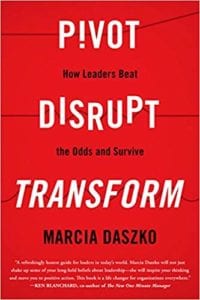
Pivot, Disrupt, Transform: How Leaders Beat the Odds and Survive
Your book is fantastic it’s called Pivot, Disrupt, Transform: How Leaders Beat the Odds and Survive. You’ve got some great testimonials from authors like Ken Blanchard who wrote The One Minute Manager, which is one of my all-time favorite books. Before we double click and do a deep dive into this great book of yours, can you take us back to your story of origin? You can go back as far as you want. Your childhood, high school or college. Where did you start getting interested in leadership?
I never thought of myself as a leader because I was so excruciatingly shy. Although my friends when they hear me say that they laugh and roll their eyes and wonder. They see something maybe I don’t see. I grew up in the Midwest in Iowa. My family moved to California when I was in college. I transferred out here. I attended Santa Clara University and San Jose State University and ended up getting my master’s in mass communication. I worked for various companies in corporate communications and marketing. Then one of the organizations that I worked with was owned by Dr. Perry Gluckman a statistician who had a group of colleagues’ consultants who worked with organizations to help them learn and apply Dr. Deming’s philosophy of leadership and management. For those who don’t know, Dr. Deming was a man who went to Japan at the invitation of General MacArthur after World War II to help turn around Japan and help them become a global competitor. In the 1980s, he came back to the US and worked with the CEOs of General Motors and Ford to help save our auto industry.
That’s an impressive background that’s certainly a huge impact and now that changing with Korea and China. I was looking at how China’s overtaken Japan lately in gross national product and all that good stuff. What made you want to write this book?
Once I had begun working with Dr. Perry and Dr. Deming they became my mentors. I learned from them that everyone within them has natural leadership. How I learned that is because my two mentors pulled it out of me. Over time, they taught me how to consult and that’s how I got into consulting years ago. We worked from small organizations to companies like the Fortune 500. I wrote the book because in my 25 years plus of consulting, I had seen the fork in the road for leaders. Some leaders struggle and fail and others succeed wildly. It’s like, “Why does this happen and why are some struggling so much? Why is it that we have 6,000 startup companies in the Silicon Valley Bay Area and probably 90% of them won’t go out of business? Why is it that there was a list of Fortune 500 companies that came out in the in 1955 and more than 60% of those Fortune 500 corporations do not exist anymore?” Some were merged in, but many went out of business. When we think about Montgomery Ward, Pan Am, Circuit City, and Blockbuster, they disappeared pretty fast. Does that mean that companies like IBM, Walmart or Shell Oil like we’ve seen with Sears or Target, will they go out of business? I wrote the book because I wanted to help leaders who have so many challenges see that there’s a better way. There’s a different way. There’s a bold way. There’s a courageous way to lead and it’s not that hard.
What would you say would be the one takeaway? Let’s give some great insights right off the bat. If someone is saying to themselves, “If everyone has natural leadership within them, how do I find that? What is it that I can do to discover that if I don’t have a mentor?”
I would ask people to follow their own strategic compass. If they’re thinking about their own leadership and/or they’re thinking about leading their team or their organization, even at home. That they think about what are we trying to accomplish. What am I trying to accomplish and getting people together. Knowing nobody works alone. How do we learn, work, and improve together? That is key. If you don’t have that question answered well, then everything else following it, you’ll struggle and eventually fail.
[bctt tweet=”Everyone has natural leadership within them. ” username=”John_Livesay”]
You’ve got a three-step process here where you tell people to stop focusing on the bottom line and performance appraisals. They need to start doing something new, which is asking some questions and seeing what they can do to encourage an environment of change. Finally, the transformation part of being more resilient. What do you mean stop giving performance appraisals? What do you mean stop looking at the bottom line? How else would we run a company? What do you say to that question?
We need to go back to the aim. What are you trying to accomplish? If you say, “We’ve started this company and now we have 200 employees. We need to start implementing performance appraisals,” I would ask again, “What are you trying to accomplish?” “We want to we want to coach people. We want to give people feedback. We want to help and so on.” That is usually the answer that I get around performance appraisals. What has happened is performance appraisals end up being in practice what people use to judge, rate, rank, criticize, and blame people for. The problem is the people worked in the system. They didn’t create the system. They can’t change the system. Yet, people want to hold them accountable for the system’s results. If they don’t like the results they blame and judging criticize the people, but it wasn’t the people. People come to work to do a good job. They want to be proud of their work. They want to contribute. They want to serve customers. They want to work together. Yet we saw the performance appraisals that we rank and rate the people which creates internal competition. Then we tie it to a compensation system that again is more limiting. Then we say, “Our corporate values are teamwork, collaboration, and integrity.” Yet they don’t see that there’s a huge gap between the two in the practice of even using performance appraisals which is a total waste of time. They are in direct conflict with what they say their values are.
Having been in the corporate world myself and selling advertising for Condé Nast for a number of years and selling my multi-million-dollar mainframe computers, nobody likes them. I have managers who used to dread doing that. It was a huge amount of time and they were under a lot of pressure from top management to not give anybody perfect scores. You must find something to ding somebody on so that there’s something for them to improve on. Otherwise, if you tell them they’re doing a great job, they will stop working so hard. Like, “Next year, hopefully, my three will go up to four on creative ideas or some weird category that they create.” There’s a great quote in your book from Dr. Myron Tribus, “Looking at results is like driving the car by looking in the rear-view mirror.”
That summarizes what you’re saying here. That you can’t motivate or even come up with an inspiring vision of what the future could be if all you’re doing is evaluating someone’s past performance. This concept of teamwork, I always found so amusing, especially in a sales department. They do rank you and yet they want you to all work together. Oftentimes, you would split accounts. Like if Lexus is based here and there are agency is based here, but that wasn’t always the case. Sometimes I’d have a client that the agency was in LA and the client was in New York. The rep in New York and I had to work together and split the commissions if we got the business or we grew the business, but it was still a competition of who’s the top sales person this week and this month, this year. It’s a very bizarre compete, work together, and you’re going to get paid on how you perform, not so much how the magazine performs.
That’s why another thing that I suggest is that not only does a company get rid of the performance appraisals, but they also get rid of incentives, arbitrary, numerical goals, and commissions. That’s a unique, bold, radical revolutionary thinking for most organizations because it’s not best practices. That’s what part of the book is saying too is stop best practices and management fads. If you step back and think, what are you trying to accomplish those don’t help you?

Leadership: Salespeople are successful if they ask the best questions.
You also talked about helping people understand why they lose customers to the competition. That’s a fascinating topic for me particularly because I had to win back a client at one point. Then I’ve helped other companies put a strategy together on how to win back a client. A lot of people don’t have a clue that winning back a client is very different than getting them in the first place. Can you expand on your insights on what companies can do to prevent losing clients and what they might do to get them back?
I have beautiful examples of that. Personal examples that’s what brings everybody to heart. If leaders think about what they are passionate about and get their whole organization focused on supporting each other to serve customers. Doing what they love to do to serve customers, they tap in on being close to their customer. It’s not by surveys and focus groups. It’s by talking to their customer. What do you like? What do you want? What do you need? It is beyond that because it’s not the customer’s job to tell you that they want the fax machine or that they want the iPhone. It’s the companies, the leader’s job to create the future. To create new products and services that are innovative and will serve and satisfy new customers and new markets. For example, for me, I was a very loyal customer of American Airlines years ago. I had more than three million miles on American Airlines. Whenever I would fly with colleagues I would say, “Come on my flight.” Even though there are tickets generally on average worth $50 more than the competition, I would stay loyal. Then their service over time drastically changed. It was a change of CEOs that was part of it. There were mergers after that and then they pulled out the San Jose market as a hub. That drastically impacted our ability to have as many routes and so forth.
The point being, their customer service drastically went down. One time, I got on 40 flights with American Airlines. On those flights, 39 out of 40 I didn’t get a hello, a thank you or a goodbye. As a premier flyer, I wrote them a letter. Months later, I got a wrinkled form letter back justifying their behavior. That’s when I said, “That’s it. I’m done.” I fly American Airlines only if I absolutely have to. I would say they’re a little bit better, but they still have so far to go. I have no interest in flying them. Plus, their seats are the tightest together. You could starve on their flights. I love JetBlue, I love Southwest Airlines. The point being that it didn’t cost them anything to say hello, thank you, and goodbye. It cost nothing for that customer service. I knew that leadership had changed because when leadership doesn’t have the mindset to serve customers, it’s for them maybe all about the bottom line or they’re competing with their peers or whatever it is, it shows up in the people who are touching the customers.
Let’s dive into the second part of the book, which is if we’re going to stop focusing on the bottom line and giving people these performance evaluations, we should be doing something new. That’s the first thing you start talking about, which is also fascinating to me. I also believe that salespeople are successful if they ask the best questions. You were talking about leaders asking questions. Can you expand on that?
What we need to help leaders do then is yes let go of the old because otherwise, if you are trying to start something new but you don’t get rid of the old, I always say it’s like trying to put strawberry jam on moldy green bread. Let’s get rid of the old is essential. Leaders need to start thinking and asking different questions. These are not questions like, “Why did you do this and why did you do that?” Instead, the questions of, “What are we trying to accomplish?” It’s a strategic compass, which I have in the book. “What are we trying to accomplish together? By what method will we achieve it together? What are the values that we’re going to stand for with our customers, with our markets in our community and with our colleagues? Who are our customers? What do they need and how do we know?”
[bctt tweet=”Looking at results is like driving by looking at your rearview mirror.” username=”John_Livesay”]
That’s significant because that means we’re going to collect data and look at that data over time and not react to it. Based on what we see about that data over time, what are the trends? Is it stable? Are we serving customers or not? Then we ask the final questions which are, how do we measure progress? How do we measure success? Most management teams and executive teams, when they have management team meetings, most of them are focusing on and that might be a day or two at a time. You’ve been in the sales team meetings where you spent a day or two or three talking about the numbers and the quotas and goals. You kept manipulating the numbers. I’ve seen those meetings and they’re a sad use of time. I share with my clients that we focus on discussions about the aim, about quality, and about the customer. About serving customers, about the systems, the processes that we need to create and improve, and enable to flow so that we can then get the results that we want.
The last thing in a management team meeting that we need to talk about if we have time are the results or the goals or the numbers. Everything that you do before that are the things that create the numbers. If you don’t like the results, if you don’t like the bottom line, if you don’t like the profit margin or the profits you need to go back. Leaders need to go back and spend 90% plus of their time thinking about, “How do I create an organization where everyone understands what the aim is and how we create the systems and processes so that we have these strategies?” Quality is a business strategy. Improvement is a business strategy and innovation is a business strategy. We need to have those three as foundational business strategies. Then we can go through the organization, work together and see how we improve and innovate to serve our customers.
It sounds like a very different use of time than what I used to have to do, which was once a week all sales reps from around the world will be on this long conference call. We have to say, “For this upcoming issue, I’m going to bring in ten ads. I have five of them who verbally said yes. Another ten that are 50/50 and maybe another seven or so that are less than 50%. Then they say, “We take 90% of the verbals, 50% of the 50/50 and then 10% of all the others. You still are short a couple of pages. Where are you going to get them from?” Then you’d have to listen to everybody else’s story. Then they go, “If we add up all the numbers that everyone says they’re promising and committing to bring in, here’s the number for the month. That’s not high enough for what our goal is.” We will do that for three months out. Tedious, painful, and unproductive. Everywhere I work, that’s what it was. That was the given way of doing it.
It’s the best practice, it’s the management bat. It’s the way we always do things even though the way we always do things isn’t helpful, isn’t innovative, isn’t serving customers, isn’t fun and isn’t motivating. That process you described is demotivating. It doesn’t make me feel good. I’m not happy when it’s over, it’s like, “I’m so relieved.” It’s all about the numbers. It’s not about things that you can get passionate about like serving customers and being creative. It sucks the life out of people.
Then they would add a layer on to it where it’s like, “You promised that you bring in as many ads.” Something fell out. You promised to the whole room as if getting people to commit to something makes them do it. If they don’t feel bad enough that something fell out.

Leadership: Once you make the decision to pivot and start trusting your people, you cannot go back and start trying to manage from fear again.
One of my friends had 1,200 sales people in his corporation. He had sales of $500 million. He was constantly competing for his share of the pie. He was frustrated with it and looked for a better way. That’s when he decided to transform his organization. He spent a year transforming his own thinking about leadership. Then he decided to change his system. He made the plan to do it. He communicated both to his key executives, his key salespeople, his employees, and his customers what he was going to do before he did it, then took all of his 1,200 salespeople off of commission and off of incentives. No more performance appraisals. He did many things to transform his organization and then he took it from $500 million to $2 billion in six years.
People think that salespeople aren’t motivated unless they’re tied to a performance and that’s not the case. I love this concept where you have here on how we transform as leaders, the old way and a better way. The biggest level is the high level of fear, anxiety, and stress or in the old way of, “If you don’t make your numbers, after three months you’re going to be fired.” There’s a constant fear-based culture. This is multiple companies, this is not unique to one. The better way you propose is to reduce the fear and build trust that if you have a bad month or two, we’re going to look at you your attitude and your work ethic. All other things besides just the numbers deciding whether or not you keep your job. Is that a fair summary of what you’re saying on the better way?
[bctt tweet=”You can’t motivate or even come up with an inspiring vision of what the future could be if all you’re doing is evaluating the past.” username=”John_Livesay”]
The better way is that the leader is finally going to lead instead of being judge and critique and blame the king or queen. Their job as a leader is to create an environment where everyone understands and contributes to the aim of the organization, and people support each other. That means that it’s up to the leader to communicate effectively, to build trust and they do that through communication. I’m not saying to put out a memo or an email or anything saying, “Here are our mission, vision, and objectives.” That old static document has to go away anyway. Instead, the leaders are the people that are communicating a hundred times a day but they’re asking questions. They see that their job is to develop all of the people’s natural leadership in the organization. Not just the top ten people or the management team, it’s everyone. Their job is to reduce fear and build trust. Over and over again, they have to be asking questions, listening and then responding to find out what are the barriers for you in doing your job. For you personally, for your team, for this department for this division, what are the barriers getting in the way of them supporting each other? In them learning, in them developing as a team, and in them serving customers. We have to ask more questions.
One of my clients, I was sitting down with him one day. It was one of the first meetings and I had a feeling that he would get value out of seeing that list of the old way and the better way. I went over it with him and he looked at it and he said, “I’ve been doing the old way. Can I change and start doing the better way?” I said, “Yes.” Overnight he transformed. He scared the wits out of his management team. His executive assistant asked me, “What did you do to him?” I said, “What are you talking about?” She said, “He’s changed so much. It’s great, but will he change back?” I said, “When he’s under stress, he might change back but that’s why I’m here. Until he’s not wobbling on that bicycle, but he’s riding that bicycle and that’s then who he is. He’ll transform. He transformed his thinking overnight and said to me, “Marcia, over the 30 years that I’ve been managing this organization, I wish I would have known that I had a different option than the one that I was never taught in school. That I’ve never learned from anyone else before.” He felt a huge sigh of relief being able to lead, coach and develop his people and create an amazing organization versus being the critic he used to be.
That’s one of my favorite takeaways from a book. Once you make the decision to pivot and start trusting your people, you cannot go back and start trying to manage from fear again. Your final words in the book are, “Think different, act different, and be different.” Thank you so much for being on the show. The name of the book is Pivot, Disrupt, Transform: How Leaders Beat the Odds and Survive. How can people find you? If people want to hire you as a consultant, what’s the best way to find you?
They can go to my website via MDaszko.com. Through the book, my contact information is in there. They can call, email or reach out. I look forward to helping leaders however I can.
Links Mentioned:
- Marcia Daszko
- Pivot, Disrupt, Transform: How Leaders Beat the Odds and Survive
- The One Minute Manager
- MDaszko.com
- Quantmre.com
Wanna Host Your Own Podcast?
Click here to see how my friends at Brandcasting You can help
Get your FREE copy of John’s latest eBook Getting To Yes now!
John Livesay, The Pitch Whisperer
Share The Show
Did you enjoy the show? I’d love it if you subscribed today and left us a 5-star review!
-
- Click this link
- Click on the ‘Subscribe’ button below the artwork
- Go to the ‘Ratings and Reviews’ section
- Click on ‘Write a Review’