

Every Conversation Counts With Riaz Meghji
Posted by John Livesay in podcast | 0 comments

Every conversation counts. They may seem so trivial most of the time, but they are actually key to making significant connections that lead to extraordinary relationships. But sometimes, we get so caught up in our own lives that we forget to ask the right questions, or we simply don’t know what to say. That’s why in this episode, we have human connection expert Riaz Meghji to talk about how conversations spark connections and shape our lives! He shares valuable insights from his book, Every Conversation Counts: The 5 Habits of Human Connection That Build Extraordinary Relationships. Riaz also touches on what to say and how to help someone dealing with grief. You don’t have to be a genius at conversation – just try out new things and keep listening. Tune in now!
—
Listen to the podcast here
Every Conversation Counts With Riaz Meghji
Our guest is Riaz Meghji, who is a Human Connection Keynote Speaker. He talks about how to build connection, which leads to trust and all-important emotional engagement. He has two amazing questions that you can ask someone when they’re grieving the loss of a parent. You don’t want to miss this. Enjoy the episode.
—
Our guest is Riaz Meghji, who is a Human Connection Expert and the author of the book, Every Conversation Counts: The 5 Habits of Human Connection that Build Extraordinary Relationships. His insights have been featured in Fast Company, Harvard Business Review, and Financial Post. After one conversation led him to take a dramatically different career path that changed his life for the better, he became dedicated to exploring the ways that authentic human connection can change lives and organizations. In addition to being a respected thought leader and author on the topic of human connection, Riaz is also an accomplished broadcaster with many years of television hosting experience. He’s interviewed experts on current affairs, sports, entertainment, politics, and business. Riaz, welcome to the show.
John, I feel like this was meant to be, the two of us talking about conversations and stories. It’s great to be here. Thank you.
You are a natural storyteller, and you know how to teach people how to ask questions in difficult situations. We’re going to get to that in a minute. Your bio teases out that little conversation that took a dramatically different career path. I know the answer to it, but I’d love you to share it if you don’t mind, your own story of origin. You can go back to childhood or wherever you want, “Here’s what interested me, and then I thought I was going to do this, and then I did that instead.”
Thanks for opening with this one. It’s so interesting because it’s such a relatable question, “What is your origin story?” For the work that I do and hopefully, invite the audience to think about defining conversations and defining moments, what is one of the most important conversations that changed the trajectory of your path? For me, it goes back a few decades. I was finishing my Finance degree at Simon Fraser University, living my parents’ dream. Not my own South Asian family if you’re not a dentist or financial expert.
An investment banker, yes.
[bctt tweet=”Assertive empathy is the key to connection. Ask questions that show empathy.” username=”John_Livesay”]
You’ve got a few options. In my final semester at Simon Fraser University, I was enjoying the art of presentation. I was presenting at a conference in Quebec City in my final semester. I was fortunate enough to have the co-chair of that conference. He’s still a friend to this day. He sat in on some of my sessions, and they were HR sessions for a student-run group, an international student exchange group.
He pulled me aside at the end of the conference and said, “I know you think you’ve got your life figured out at the age of 22, but I don’t think you should go into Finance.” I remember looking at him and thinking, “Okay.” He said, “From what I saw on stage and your age, you should take a year of your life and explore what’s out there in the presentation space, maybe something on TV.” This was the first time I truly thought about this as a profession. I thought, “That is a compliment, but you recognize my parents are South Asian, so there are expectations here that we need to uphold.” He did not hesitate when he leaned in. He challenged me and said, “When are you going to stop playing safe and start living your life?”
That question is at any age, not just when we’re young in our twenties. Now, as we get older, we get responsibilities, mortgages, and whatever, but this concept of, “We no longer take risks in our life,” you stop taking risks after a certain age is a myth that I would like to bust because we should always be asking ourselves that question, “Am I playing it safe?” What you mentioned that somebody saw on you is what I saw in another guest, Tucker Bryant.
With that kind of talent at such a young age who had a similar trajectory from England, Stanford education, and worked at Google, he was on that path. He was like, “I’m going to be a keynote speaker about poetry and leadership.” Talk about explaining that to mom and dad. What somebody did to you was pointing out that talent. Once you and I have the opportunity to spot that in somebody else at that age, or they’ve already made the decision to do the riskier choice, but it’s their passion, we can double down and say, “That was a good choice. We see why you did it.” That’s the joy of paying it forward or paying it back however you want to look at it.
To build on that, I think back to the gift that the co-chair was able to give me at that moment. It also is a great reminder that he was making a statement, but he was also allowing me to reflect and ask myself the question, “Am I living the life that I truly want to live? Am I playing this game of life safe?” The big opportunity for all of us is to ask first and talk second to have breakthroughs in our conversations because we could feel we’ve got the greatest advice to give to somebody.
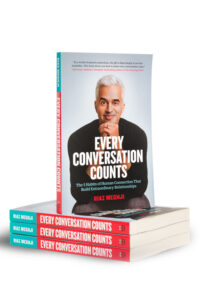
Every Conversation Counts: The 5 Habits of Human Connection That Build Extraordinary Relationships by Riaz Meghi
The conversations you have on this show about persuasion and influence, we cannot motivate, persuade, or influence anybody unless or until we connect with them first. The power of connection starts with the power and quality of the questions we ask. When you have somebody that has seen something that is leaning in with that type of precision, it’s not only a compliment. It’s his opportunity to call me up at that moment and not call me out. That is what true leadership is with storytelling on the questions that we ask ourselves, “How can we call each other up in important moments?”
As a keynote speaker, you’re going into organizations, helping them have better connections with their team and with their clients. You also have this wonderful video talking about you and your brother suddenly losing both of your parents and how to deal with that grief. It’s going to happen to all of us. We’re going to have a situation where we have to grieve, or someone we care about is experiencing loss in their life. Most of us are stuck with the platitudes we see on TV of, “I’m sorry for your loss.” You came up with some incredible questions to ask people while they’re in that state of grief.
I’m going to repeat the questions for you because I want you to then give us some of the experiences and some of the answers you’ve gotten to these questions. That could be a loss of a job or a pet. Grief is grief. It’s different degrees. Let’s say it’s the loss of a parent. The question that hit me was, “What do you want me to know about them?” That person gets to decide. It’s a legacy. The other part is, “What is giving you comfort now?” I thought those were brilliant.
I’ve never heard anyone ask those questions in that situation, and that’s why you’re a thought leader, successful, and in demand. My first thought of, “What gives you comfort now,” makes us look for something. When you’re in that grief, having experienced it with the loss of my dad, nothing’s giving me comfort at the moment, but I have to try and find some answer. Nobody wants to say nothing because you’re still here remembering them, talking about it or whatever it might be. As a former journalist and now keynote speaker on this human connection, how did you come up with those amazing questions?
I’m glad that you introduced this in the conversation. These are probably some of the most powerful moments that come out of the keynote, especially when we talk about one of the habits in the book of assertive empathy. If you’re reading this, and you’ve gone through loss, or you know someone that is going through loss, and you want to be there for them, and you’re not sure what to do or what to say, “What do you want me to know about them,” has been a game-changer question.
[bctt tweet=”Use the power of your curiosity to feel that challenge in front of you to avoid fixing the wrong problem.” username=”John_Livesay”]
I realized before I experienced loss, my brother, my wife, and myself going through this, I had failed everybody that had experienced loss before I experienced it myself. In my mind, I thought, “I don’t want to trigger them, so I’m not going to bring it up. They probably don’t want to talk about it.” I’m making assumptions in my own mind to soothe myself from that discomfort, forgetting about the person in front of me. What do we all do at the moment? You articulated that when something goes wrong, and if there’s loss or some element of grief, it’s autopilot mode, “I’m so sorry for your loss, thoughts and prayers. Let me know if you need anything,” and then what do we do? We step back, and that person is left all alone.
In this message of human connection, I talk a lot about how we combat loneliness. Grief is a huge part of loneliness because you feel like no one can relate, no one can understand, and you feel like you’re drowning. In the early part of 2020, I volunteered with Canuck Place Children’s Hospice every year for their Gift of Love Gala. I found myself in conversation with the Lead Counselor of Canuck Place, Deb Davison. I credit her with this question because she does incredible work to lift parents who have faced the unimaginable circumstance of having lost a child.
She not only is there to support them, but to elevate them, so their parents can take the stage and motivate a community to support the hospice. It’s incredible. I remember saying to Deb at that moment. I was four months removed from the sudden loss of my father and never had truly dealt with grief. I looked at her and said, “Deb, how do you do this? I am profoundly struggling with this notion of grief. How do you do this work? What is the best thing you can say to somebody?”
She reframed my perspective and approach to this question. She said, “It isn’t about what you can say. It is about what you can ask.” When I asked her, “What’s the best question you can ask somebody?” she introduced the question, “What do you want me to know about them?” What that person on the other side needs the most at that moment is to share a piece of that person, their legacy, their story, and ultimately their connection to that person and why it mattered so much. When she said that to me, I remember looking at her and said, “I will never forget this gift you gave me. Thank you.”
Every single person that I knew had lost someone from that point on, one, I recognized my failure in being able to support them wasn’t because of malicious or selfish intent. I just didn’t know. Now, I encourage others to lean with curiosity. What do we all do when the conversations hit a roadblock? Sometimes we fall into the trap of trying to fix it too fast. I encourage others to use the power of their curiosity to feel that challenge in front of them before they fix it, so they’re not fixing the wrong problem and that person is truly feeling seen, heard, and valued in their darkest hour. That person on the other side, as you know, John, will not forget it when you were there to lift them up.

Conversation Counts: Grief is a huge part of loneliness. You just feel like no one can relate or understand you, and you feel like drowning.
That’s what good leaders do. They make their team feel seen, heard, and appreciated as people and not cogs in a wheel. You mentioned in your book, Every Conversation Counts, there are five habits to build these connections, and one of them is assertive empathy. My question is, what determines whether something’s assertive empathy versus regular old empathy?
I love the distinction here. I believe the idea of assertive empathy is leaning in with that empathetic curiosity, even when the conversation is difficult. It’s easy when the emotions aren’t heightened to be empathetic. When it’s difficult or you potentially disagree with someone, there is such an opportunity to understand how you get to that conclusion and the power of our questions and these types of scenarios. I’ll give you some examples.
Think about the idea when someone or I could come to you and say, “John, I presented on stage. Can you give me some feedback?” Before you jump in with that feedback, there’s an opportunity with your assertive empathy to say, “How do you feel that went?” and that’s the opportunity for me to start articulating first and doing that work of reflection. Maybe I’m at a roadblock, and you could simply say to me, “What do you feel is impossible in your life now, Riaz?”
I could express all of this pain, and then you could simply reframe and say to me, “What do you think would make this possible? What’s the first step in making that possible?” You’re not giving me any of the answers, but you are that assertively empathetic guide to unlock the answers that I already have within. I’m just asking for a soundboard that will help me through it and a strategic partner that will ask the questions, that notion we talked about, that will call me up in these moments and not necessarily call me out. It’s an empathetic form of accountability.
Before the show, we had a little bit of a conversation about you being on camera, hosting television, producing segments, and how part of that job and the producers get pitched all the time to have people come on the show and either pitch their book or be an expert on a topic. When people were pitching you to come on your shows, the CityTV Breakfast TV or MTV Canada, what made you say, “I can see that as a great segment,” and what would make you go, “There’s no way I’m having that person on?”
[bctt tweet=”One of the ways to establish trust is putting aside our perfect persona and going first with vulnerability.” username=”John_Livesay”]
The one clear factor that I’d always look at in every single pitch, whether this would be a winner in a 5 to 7-minute live television segment or a complete self-indulgence was looking at this pitch, and is this pitch saying how great this subject is, or is this pitch saying how great the audience can be after this 5 to 7 minutes on TV?
That’s what we do as keynote speakers. We’re all about, “What kind of impact can I have on making this audience’s life better?” Not, “Is the audience impressed with me?” It’s the opposite, but, “How can I serve them?”
I liken it to philosophy, and the whole philosophy behind the book was, “Look at you is greater than look at me.” I believe the interviews that truly resonated, whether we had subject-matter experts or even higher-profile celebrities that came on the show, weren’t about anything that I said. It was the questions that gave them the space to share where they’d say, “I like that guy. He’s on my side,” and giving them space. It’s not only the power of the pitch. If you truly want to impact that audience and move that audience to action, one of the things that I found was the ability for all of us as communicators to embrace the power of productive silence.
What does productive silence look like? More importantly, what does it sound like?
It’s giving the audience space. You, as a keynote speaker, have such great wisdom in the stories you tell. You could give that audience a nugget. Instead of moving to that next point after you drop your knowledge bomb, give them a moment.

Conversation Counts: A strategic partner that will ask questions again is an empathetic form of accountability.
It’s like what I did with you earlier. You said some amazing things like, “Let’s pause here for a second. Let me repeat that for people to digest that.” Is that an example?
Yes, letting it breathe. I feel like there’s this sense of urgency, and maybe because modern culture emphasizes convenience and efficiency. Things move so fast. I’m a firm believer that sometimes efficiency can be the enemy of human connection. How can we slow down these conversations and truly hear each other? You throw something out like, “That resonates with me. I want to reflect on this. Let’s dive into that.”
It’s almost suspending your judgment, your assumptions, and your script. You had beforehand of, “Here’s where I was planning on going with the interview, but you gave me something that I didn’t think was coming. Let’s lean in here.” That’s how you can have a conversation that will be memorable for both sides, where if they can say, “I’ve never shared that before,” that is a gift that you gave them the safe space to do that.
One of the things that really stands out for me watching your keynote speaker video is you have this amazing journey you take the audience on. It’s the awareness that many people are experiencing loneliness personally and at work. Just because you’re in an office doesn’t mean you’re not lonely. Once you show people how to have better connections, that builds the all-important trust, which then builds the engagement for the team to be productive. The same thing is true in sales. You need to connect with that person.
Sometimes that means being a little vulnerable, and that builds trust. You then can have an engagement with that potential buyer or person who’s going to decide whether they’re going to have you on their show or hire you as a speaker. People forget that we, as speakers, have to often pitch ourselves as to what the experience would be like if we’re the speaker that gets hired. That is true in almost every industry, whether you’re a doctor, lawyer, or architect. We’re all having to have some emotional connection. As you said, this efficiency being the enemy of connection, it’s not about how many facts and figures we spiel out, is it?
[bctt tweet=”If you are playing safe, how could you take a small risk every single day and put yourself out there?” username=”John_Livesay”]
No. The facts and figures are going to be vital for the analytical mind, but to make that message sticky with storytelling, you’re going to use powerful metaphors. How do we amplify the emotion at that moment for them, so they truly feel the message? Vulnerability is a big part of this. There’s the notion of, “I think about sales. With your audience, I think about persuasion.” Trust is a huge component of this equation. How do we truly establish trust?
One of the habits I champion is putting aside our perfect persona and going first with vulnerability. Some leaders say to me, “When is it oversharing? When is it too much?” You’re like, “This isn’t the right space and time to do that.” There is a powerful concept in psychology known as the Pratfall Effect, where if you’ve done the work to convey your competence and show that you are that point of authority, are reliable, and establish credibility, your vulnerability will then become a powerful tool to draw people closer and embrace connection.
If they’re questioning your credibility, and then you floor the gas pedal with the vulnerability, that share could fall flat and create distance instead of connections. It’s important that we also convey credibility before vulnerability, but both sides are an important part of the equation to amplify emotion and ultimate impact and motivation for the audience to move.
There is an art to it like there is in selling or storytelling. Everything has a delicate balance. If you’re making a meal, and you over-season something, it ruins the meal. The same thing is true when there’s an order to a recipe for a reason. That makes sense in my head that this has to come first for a reason, and then you add that as opposed to willy-nilly and throw it in any order or any amount. That’s not how you make anything connect as it were.
The science and psychology of the formula are very important, but the formula itself should not be more important than authenticity. Some people would say, “Aren’t you manipulating the person in front of you or the audience or the person you’re trying to sell to?” It’s being who you are. If that fits with who you are, and it’s an authentic display, people will be pulled towards that. If they say, “You’re following a script or a formula. I’m going to back away from that,” nothing trumps authenticity. Authenticity and vulnerability, if we talk about the ingredients of the entire equation, are vital in any message and platform that we’re going to convey.

Conversation Counts: Every audience reacts and responds differently to a particular content. One of the best audiences is the new one who is willing to be open and embrace the message of human connection.
Who’s your favorite audience to speak to?
It’s a real interesting question that makes me think because a lot of strategists will say, “Who is the target audience?” With the message of human connection, there are moments when I’m talking to groups in the HR space with leadership, culture, and collaboration. There are times that I’m talking about how to win customer loyalty. There are times I’m talking about how to grow sales through authentic connections. I feel like there are always two teachers in the room, and every audience is a profound teacher.
To be honest, and this is an indirect way to answer your question, every audience has been this profound teacher where I wait for the moment. In a lot of the keynote, what I do is create a space for interaction. I try to reframe the Q&A into a Q&I that instead of questions and answers and telling them the answers, I try to prompt them to generate their own ideas, so we have a conversation. This isn’t just a sage from the stage. I find every audience is different in how they react and respond to the content. My favorite audience is a new audience that is willing to be open and embrace this message of human connection.
If people want to reach out to you, your book, Every Conversation Counts, is on Amazon. If they’re interested in engaging you for coaching or speaking, it’s your website, your name, RiazMeghji.com. Any last thought or quote you’d like to leave us with?
The final thought about the opportunity we have in any conversation is asking ourselves, “Am I in autopilot mode here? Am I in autopilot mode, showing up with the people I already know?” Sometimes when they’re familiar to you, maybe it’s a lifelong friend, we’re in autopilot mode thinking, “I don’t need to be curious.” What is one thing you can discover about someone you already know?
One of the most profound conversations I had in my career interviewing people for a living for decades was with the late great Wayne Dyer. The reason I introduced this idea of, “Am I in autopilot mode? How do I get intentional with my communication?” whether that’s reaching out, asking more questions, or embracing the power of productive silence, comes down to how we can all create new experiences for ourselves.
I remember I asked Wayne Dyer in the week of his 74th birthday, “What is one of the most important conversations you have when you celebrate the milestone that is your birthday? If I’m lucky enough to make it to that point, I’m curious. How do you celebrate?” He did not hesitate. He looked at me, laughed, and said, “That’s easy. I asked myself a question.” I said, “What’s the question you ask on your birthday?” He said, “Did I live 74 years, or did I live the same year 74 times?” I remember looking at Wayne and saying, “Happy birthday to us. That is a gift.” That always stuck with me. I encourage your audience.
If you’re reading this, ask yourself day in and day out, “Am I in autopilot mode in my conversations?” If you are playing safe, how could you take a small risk every single day and put yourself out there, whether that’s leaning in when the conversations are difficult, having the courage to ask for help when you’re struggling, or maybe intentionally celebrating one another? After reading this, reaching out to somebody right now and saying, “I’m thinking about you. I miss you. Can we get together?” Watching the difference and the small actions in our conversations build profound relationships in our lives.
Thank you so much for helping us all connect better, feel a little less lonely, and have some new wonderful questions to ask so that we can practice assertive empathy.
John, you’re a gift. Thanks for creating these conversations, and thanks for having me on. This was meant to be.
It’s my pleasure.
Important Links
- Riaz Meghji
- Every Conversation Counts: The 5 Habits of Human Connection that Build Extraordinary Relationships
- Tucker Bryant – Past Episode
- Video – Losing Your Parents
- Canuck Place Children’s Hospice
- Gift of Love Gala
- Better Selling Through Storytelling Method Online Course
Wanna Host Your Own Podcast?
Click here to see how my friends at Podetize can help
Purchase John’s new book
John Livesay, The Pitch Whisperer
Share The Show
Did you enjoy the show? I’d love it if you subscribed today and left us a 5-star review!
- Click this link
- Click on the ‘Subscribe’ button below the artwork
- Go to the ‘Ratings and Reviews’ section
- Click on ‘Write a Review’
Love the show? Subscribe, rate, review, and share!
Join The Successful Pitch community today:
- JohnLivesay.com
- John Livesay Facebook
- John Livesay Twitter
- John Livesay LinkedIn
- John Livesay YouTube
Don’t Be Afraid To Be Replaceable: Preparing Yourself For The Next Growth Level With Michael Van De Ven
Posted by John Livesay in podcast | 0 comments

Are you afraid to be replaceable? Don’t be. John Livesay sits down with Michael Van de Ven, the National Sales Director for Vision Care at Bausch + Lomb Canada. Michael shares that being replaceable means, you’re a good leader and manager. Why? Because you succeeded in honing top talent that can take your role. When that happens, you’re ready for a promotion! Join in the conversation to discover valuable wisdom on passionate leadership.
—
Listen to the podcast here
Don’t Be Afraid To Be Replaceable: Preparing Yourself For The Next Growth Level With Michael Van De Ven
Our guest is Michael Van De Ven, the National Sales Director at Bausch + Lomb Canada. He talks about how important it is to make fewer promises so you can make sure you keep those promises and without a story, you are just a commodity. Find out what he means. Enjoy the episode.
—
Our guest is Michael Van De Ven, who was originally from London, Ontario. Michael graduated from Western University in 2011 and quickly developed his experience in the different fields of marketing and sales with the hospitality and consumer packaged goods industries. In 2016, he joined Bausch + Lomb as a Territory Manager, working closely with optometrists and opticians across the channels to build strong relationships and educate on new technology contact lenses.
In late 2017, he transferred to the position of regional sales manager for English-speaking Canada and developed the Bausch + Lomb Vision Care Canadian Program, which has played an instrumental role in developing the knowledge of the field sales team across the country. Throughout his time as a regional sales manager, he has continuously led and supported various projects within marketing, national accounts, development, and the education of student eyecare practitioners. Now he is the National Sales Director. Michael, welcome to the show.
Thank you for having me. It is a great honor to be on here.
You and I met because you honored me by selecting me as your sales keynote speaker for your annual sales meeting. From there, we realized that we share a passion for helping people tell better stories and how that led to us wanting to have you on the show to share your unique vision on what it takes to be successful in sales and sales and management. Why don’t you tell us about your own story of origin? You have a unique family background and then we will lead into how that led to you getting into the healthcare space.
It starts back with my parents. Growing up, I had a father. He worked 7 days a week, 12 hours a day. He made it a point with my mom to pay for the education of myself, my brother and sister, so we graduated from university. He said, “You will not have to work in the same environment that I did. I want you to be successful.” That is something that we all keep top of mind as we have continued to push ourselves and develop in our own careers.
When I think about where my career started, I graduated from university. I started in the hospitality industry as the marketing manager for a bar and restaurant in London, Ontario. Looking back at it, I have had different people say, “It was not that a waste of the first couple of years of your career.” It was interesting because the bar was owned by two very business-savvy gentlemen who had MBAs and owned different restaurants in London. They forced me to work at forecasting, come up with a marketing plan and learn all the different social media platforms, which was great. They were skills that I carried over into different businesses.
What was cool was I dealt with a lot of different people. I dealt with business school students, the average bar patron, corporate events, you name it. It allowed me to diversify my social skills, which has played a key role in sales moving forward for myself. After I took those skills, I left the bar and hospitality industry. I went into consumer packaged goods with PepsiCo. I sold on the beverage side and there was where I started taking some of those skills and integrating them more into a corporate environment. PepsiCo is a fantastic company for training, learning, culture, and everything like that. There are so many great relationships that I still have there. I was able to elevate myself into three different positions in a short period of time.
[bctt tweet=”Be curious and prepared.” username=”John_Livesay”]
Within that time, I was looking to break into the medical industry. My brother, at the time, had worked for Bausch + Lomb on the pharmaceutical side of our business. My sister is an optometrist. It was lots of eyecare already in my family. I have been trying for a while and I had interviewed a couple of different times, but I was unsuccessful mostly because I did not have medical experience. Finally, a role opened up with Bausch + Lomb in London for a new product that they were launching.
At first, there was some hesitation because I did not have experience, but I was able to make my way through the interview based on some of the values I brought to the table. In my very first year, I was able to win top performer in Canada. It was a pivotal point in my career where not only had I gone through the process and picked up other skills, but I have proven to myself that I could be successful in this medical environment, but also show the company that you can take chances on people if they have the right skillsets and develop them to success.
After about a year and a half as a territory manager, I was promoted to a regional sales manager for English-speaking Canada. I was 28 at the time. It was my first time being a manager. I had only been in medical device for a year and a half. I took the leap of faith. I wanted to build my foundation for success off of three things. The three things were always making sure that I am willing to lead my team into the fire with anything. I wanted to make sure that I could do everything well. I have done it myself so that I could teach them properly as I trained them.
The second thing was to make a few promises and keep them all. I only make a promise if I could make sure that I could follow through on it. The third thing was I always tried to fill the gaps that I faced for previous managers, which included investing more in development and coaching and everybody more than employee number but making sure that they had the opportunity to grow within our team. That is how I was able to develop and attract so much talent within our organization.
As I went to that position over various years, we had multiple product launches, revamped the sales team, and developed a lot of talent. Eventually, I moved into the role I am in, which is National Sales Director. As a National Sales Director, as someone that owns the strategy, it is important for me to maintain the culture that we have been able to build over the years, but further back from the front lines.

Be Replaceable: Learning all the different social media platforms is a great skill.
This has been a learning experience, but also it is cool to see that if I had been in this position earlier, the company would be feeling it a bit more from a personnel standpoint. I truly believe that we have developed top talent to a point where I am more replaceable. Some people say, “Never tell someone you are replaceable, so you can protect your job.” For me, if I am replaceable, that means that I am a good leader and I am a good manager. That is fantastic.
That is a good tweet. Do not be afraid to be replaceable as a leader. That shows that you are ready for the next level of promotion. Let’s take a dive into each of these three key things. The first one is about leading your team into the fire and not asking them to do anything you are not willing to do or have not done yourself. That builds a lot of trust with people, as well as you know it is possible because you have done it.
If I am asking someone to make X number of calls, for example, or start using storytelling in their presentations, you have seen it, done it, and seen it work. If someone is coachable, you say, “I know this is a new skill. It is like anything else. It is awkward at first, like riding a bike for the first time or driving a stick shift, but you will master this and the outcome will be worth it.”
This other thing is so valuable because whether you are a sales manager or a politician or anybody who has got to lead people, keep the promises you make. Therefore, to keep the promises you make, keep the number of promises to a manageable number. In other words, do not promise the world. I always tell people, “If you think you can be everything to everybody, you are nothing to anybody.” In your line of work, you are calling on optometrists. If you promise the optometrists 10 things and you deliver on 8, they are still going to be frustrated.
If you only say, “Working with us, we are going to promise you three things. We are going to help you find staff if you need it or we are going to help you be more profitable.” Those are some things that I learned of why the optometrists are using you from my interviews before I gave the keynote talk. The promises have value to them as opposed to, “The product will show up on time.” That is the minimum table stakes. I wanted to ask you more about that. If you agree with how important it is to keep the promises to a short, small number, but also that those promises have value to the people you are making them to. What do you think about that?
[bctt tweet=”Make promises that you can keep.” username=”John_Livesay”]
It works both ways, internally and externally. As a leader, everybody is always watching. Your margin for error is very small. With customers, especially a new prospects, your margin for error is extremely small as well. You want to make sure that if you are going to commit to something, you can follow through, and that is how you build the foundation for trust with your customers and your team.
When you have that foundation for trust, the business does not always go perfect in any world. When things are not going perfect, if you can show your team that there is a way forward and a light at the end of the tunnel and they have that trust that is already developed, that is how you are going to keep your horses riding versus seeing people deter to leaving the company or exploring other options.
Your third point about as a manager, a director, filling in these gaps, not everybody arrives with the same training, whether it is sales training or product knowledge training and how important it is to keep learning. Many people think, “Now I am out of university, I do not have to read another book. Maybe I have to learn a few new things about a product, but as far as my presentation skills, storytelling skills, or listening skills, I am done.” You are like, “No.” We talked about how you pride yourself and walking your talk on continuing to learn. Can you speak about that? You said before the show that you keep challenging yourself to bring some new, innovative ways of doing things that are resulting in people being successful.
I have a good story that can help us. When I first became a regional sales manager, I had six vacancies to fill. We already talked about how I was a 28-year-old first-time manager. Typically, we relied on our US counterparts for training and they did not have a training session scheduled anytime soon. I had to step up as a new manager and collect content and put together a training session in a short time. I always reflect back to that first session and it was perceived as great, but I knew it was not great compared to where we are because it was put together so quickly. Over time, it has quickly developed and we have changed the process. We have seen how different reps have learned. We have engaged with online learning versus virtual versus role plays. We diversified things to make it less didactic and more engaging.
We are going through a training process with a couple of new hires. What they are going through, I see some of the other leaders on the team be like, “I remember my training process and thinking it was great, but it has evolved so much now.” You can see that everyone is getting more comfortable and they appreciate that when you join a new company.

Be Replaceable: Commit to something you can follow through to build the foundation of trust with your customers.
When someone joins a new company, that is your first chance to create that feeling of culture and wantedness within the company and put yourself in a good spot. It is going to make them want to be with the company for a long period of time. That evolution of the training program is a great example of innovation within our team and for myself personally.
I have some marketing background, but I have never worked marketing in terms of medical device. I reached out to our company. I said, “I want to take some brand management courses with Cornell University.” I decided to do that. I would wake up at 5:00 AM, go for a run, and work on my certification for a couple of hours three times a week. That was me trying to fill some of the gaps I had because I knew as I grew further and further in terms of my leadership positions. It is great for me to understand the different functions of the business. I can lead in a way where I understand all the different aspects of the business and make decisions that are going to best support every single function.
This concept of your own personal story, how other people see themselves in that story, and this ability to break into a new industry, whether it is healthcare or anything. The skills you develop as a salesperson, storytelling, listening, empathy, and problem-solving are in fact, transferable so that you won top performer your first year out.
It sets a precedent of, “The ideal candidate does not necessarily have to check off ten of these boxes if they have these characteristics in place.” When you are now in the place of giving someone a chance or a break, what characteristics are you looking for? That you say, “I can teach them the product knowledge, but I cannot teach them this,” and because they already bring that to it, the odds are they will be successful.
I look for the talent. I always hire the most talented person. There is a difference between talent and skills. Skills can be bought. Talent is something that you have inherently. Personable skills, from a personality standpoint, are you going to be able to succeed in the social environment in a very heavy relationship-driven industry? How is your curiosity? What kind of questions are you asking me? How much preparation did you do for the interview?
[bctt tweet=”Use your most positive face and bring the right energy because there are people out there who are living their best life. ” username=”John_Livesay”]
Your capacity to learn and develop, where do you want to go with your career? Are you asking me what the training program looks like and the expectations? For me, that is great. I want someone that is coming in and has all those different things. Having additional experience is always a plus, but it is never something that I particularly hone in on unless it is a rockstar candidate.
I have three quick examples. Sometimes I tear up talking about this because they are such great stories. One gentleman interviewed with one of our competitors and they told him that he did not have sales experience and did not give them a chance. I hired him as a maternity leave cover near Toronto. He did extremely well. He took a full-time job with us in Edmonton all the way across the country. He picked up and moved during the pandemic.
He proceeded to be a top performer in our business and then has been elevated to a team lead position with Ontario. I love that because that is somebody that had no experience. He had a degree, was curious, asked the questions, had the work ethic, and was so personable. I knew within five minutes that I was going to hire him. It is awesome to see how he has developed.
Another great example is that there was a rep that I took a chance on. She also had no experience, but she told me in her interview that she had sent twenty messages on LinkedIn to people in the medical device industry to make a connection every single day. She told me that story and I was like, “This person is hungry. She wants to win.” She showed that same curiosity. She has been extremely successful with us as well.
The last story is one of my favorites. This story was told at our national sales meeting. Different people on our team were in tears. The first person I mentioned who got promoted and moved to Edmonton, we still had to cover the remainder of that maternity leave. We hired somebody without an experience. She came in and was very curious, and then she finished her maternity leave cover.

Be Replaceable: Even if you think you’ll not hire the candidate, always give them the full 45 minutes of your time.
We ended up finding her a job virtually covering another maternity leave, even though she lived in a different area of the country. After that finished, we hired her for another maternity leave cover virtually. She continued to cover. She loves our company so much and was so passionate about what she did. Eventually, a position opened up where she lived, which was in Vancouver. She got a full-time job with us. She told us her story about how she wanted to break into sales so badly and she wanted to learn and how we have taken a chance on her.
Sometimes in business, not everything goes your way and you can get caught in a rut. Her name is Krista. I think about how passionate she is to be here and have the opportunity. Sometimes it helps you reset yourself and be like, “Today, I need to put on my most positive face and make sure that I am bringing the right energy because there are people out there that are living their best life, working this job.” It is something that they want to develop further with their careers.
We have to hit our own reset button sometimes. We can focus on the problems or the challenges or the frustrations. We can focus on, “Look how many things I have to be grateful for, including being in this industry, working for this company, and the team I have surrounded myself with.” Once you start to have that, and then you get into interacting with a potential client or touching base with someone who is a client, they pick up on your energy.
My whole premise that we talked about when I was the sales keynote speaker for your team is that people buy your energy. It is up to us to keep that energy and our mindset at the right level of coming from a place of, “You are not another doctor to me. I care about you and I am looking for ways to make you successful and make your patient experience successful. I realize you got your own set of challenges that we might be able to help you with.” I love this.
One of the things I talk about is once you have your own personal story that people can resonate with and helps you attract top talent, it also helps clients feel like this is not something you happened to fall into. This is something you care about and the company’s story. The point is that Bausch + Lomb has a fascinating history of innovation that people may or may not know about and the culture it creates. Can you speak about how you use the Bausch + Lomb story to get the right talent and get the optometrists and doctors you are calling on to see the value of co-branding with you?
[bctt tweet=”Without a good story, you’re just a commodity. ” username=”John_Livesay”]
We are fortunate enough to work for a company that has been around for over 160 years. We have provided a lot of innovation across various different channels over the years. Most of our candidates who interview with our company have already heard of us in some way, shape or form. It brings that value.
When you talk about that history, it gives you that recognition right away where someone can feel proud that they are even interviewing for the company. Within the interview, I got great advice from a previous mentor. Even if you think you are not going to hire the candidate, you always give them the full 45 minutes of your time.
That interview, they might have stayed up all night excited or that this might have been their big break. To me, that is a human respect aspect that I took seriously. They are going to interview for Bausch + Lomb. They probably know the company and had done the research like, “This could be my big opportunity.” The brand does help create that environment. When we think about the progression where we are moving with our company, we are moving in a way where the company has growing pains at times. We are almost on this comeback. Everybody loves a comeback.
It is such a well-known brand. When you are putting a fantastic talent into your team and your system, and then you are launching new products, you have this great brand, it creates an amazing vibe. It allows the reps to passionately tell their story about why they work for Bausch + Lomb and talk about our products passionately or be proud in general. They work for a great company with such great people.
That culture is integrity, flexibility, and going above and beyond the minimum. Even if it is not your job, you still do it. Those kinds of characteristics create a culture of, “This is a fit for me or this is not a fit for me.” The final part of all this is when you are in those sales presentations, instead of talking about numbers and case studies, turning them into case stories that tug at heartstrings to get people to want to open the purse strings of, “This is something I want to buy. You are the rep I want to work with versus a competitor.” Since the talk I gave, have you seen people starting to use stories more? Do you have any stories to share on how it is making a difference?

Be Replaceable: Be understanding of different people’s personal and professional goals, and do your best to support them as a leader. If you do that, that is the difference between people turning around at 4:30 to go home or doing that last call before 5:00.
The reason I originally had engaged you to be our keynote speaker at our national sales meeting was because storytelling has always been a foundational piece of how I have sold myself. I have taught the reps in our business to sell. When you came in and gave your presentation, it gives a structured approach to how you can integrate it and show it a lot of value.
Telling our story is a pivotal part to our business when we think about our strategy overall. When we think contact lenses, they are very commoditized and typically, an optometrist or an eye care professional is doing the contact lens fit. The patient is potentially purchasing from a different channel, and mail-in rebates are used to help keep patients into practice with optometrists doing the fits.
At Bausch + Lomb, we do not do mail-in rebates. Our story is we know there is low redemption and a hassle for the patient. We created a unique strategy. We are the only contact lens company to go this route to give patients instant value and differentiate. That independent eyecare professional who is spending the time to do the contact lens can see the fruits of their labor. As we tell that story to support independent optometry, so many great things get layered in. If you do not tell the story correctly, one of our customers might look at us and say, “You guys do not have rebates.”
If I see the reps expand the story and have seen it expand even further after the presentation you gave, they tell that story to the why. Why do we do this? We do this to support you because we want your patients to buy from you. We know that they take your brand recommendation. This is how we are going to support independent optometry to make sure they are also purchasing from your practice. It allows us to show our agility as a smaller company with a team that is passionate about what they do and everybody is behind the strategy. The storytelling part is key because without a good story, then you are a commodity.
That is true in every business. What I love about you embracing the storytelling concepts and structure for your team is it now can become an onboarding tool for the new site. That can not only start learning other people’s case stories to share, but the story of origin of each individual person is a great way for people to start to feel part of the culture of, “Your brother works here. Your sister is an optometrist, and your father taught you this.” They start telling their personal stories of what their childhood was like or their first experience wearing contacts. Whatever it is that makes them so passionate about this. Stories bond the team when people feel seen and heard and acknowledged.
[bctt tweet=”Stay open to learning and make sure that you stay passionate. If you’re not, you might have to check what you’re doing.” username=”John_Livesay”]
You do a stellar job of making your team feel that way. I see how well you work with the marketing department when you were putting on this sales meeting together in our preparation call. Marketing and sales, when they work in sync and everyone is singing from the same song and books, telling the same stories, expressing the vision in a similar way that, “This is what our brand is,” and what that means to you as an optometrist, it is no surprise you have got the success you have.
It does not come accidentally. It is you going, “Let me fill a gap and take a course in what this marketing stuff’s objectives are, and how that can make me and my sales team better, and that everything is working in conjunction,” that is part of the secret to your success. Do you have any last thoughts or a quote you want to leave us with?
One great thing with everything I have talked about is I talked about developing people and this training program. You mentioned how I worked so well with our marketing team. One thing that we are very proud of is we do a lot of promoting internally. Our marketing team is a team of two. Both of them were people that I took a chance on as reps. They have been promoted through the system.
Our managers and team leads have also been reps in national accounts. It shows the culture of developing from within and building up, which is a key reason why people also are enticed to work for our company. It is fantastic from a cultural standpoint, but also we get amazing support from our HR department.
My last quote is, “Stay open to learning.” Even with my experience, with everything that happens, I was at a training and I overheard it. Someone had been at the company for one week and said the line. I liked the way it sounded. I am going to integrate it into my presentation. I am the National Sales Director.
Make sure that you stay passionate, and if you are not passionate, then you might have to check what you are doing because you should always be passionate about what you are doing. People can tell when you are not. Stay passionate and stay focused. The last thing is always be understanding of different people’s personal and professional goals, and do your best to support it as a leader. If you do that, that is the difference of people turning around at 4:30 PM to go home or doing that last call before 5:00 PM.
That passion and openness are what drive the behavior to go the extra mile for your career and the clients. Thank you so much for sharing your wisdom. I cannot wait to see where the future takes you and your team. You can be sure that I am going to be watching and cheering you all on.
Thanks so much. I appreciate you having me on the show.
Important Links
- Bausch + Lomb
- https://www.LinkedIn.com/in/michael-van-de-ven-45788545/
- Better Selling Through Storytelling Method Online Course
Wanna Host Your Own Podcast?
Click here to see how my friends at Podetize can help
Purchase John’s new book
John Livesay, The Pitch Whisperer
Share The Show
Did you enjoy the show? I’d love it if you subscribed today and left us a 5-star review!
- Click this link
- Click on the ‘Subscribe’ button below the artwork
- Go to the ‘Ratings and Reviews’ section
- Click on ‘Write a Review’
Love the show? Subscribe, rate, review, and share!
Join The Successful Pitch community today:
- JohnLivesay.com
- John Livesay Facebook
- John Livesay Twitter
- John Livesay LinkedIn
- John Livesay YouTube
Raise Your Resiliency With Kris Coleman
Posted by John Livesay in podcast | 0 comments

No matter what field or industry you’re in, it’s always a good thing to raise your resiliency in order to achieve your goals. In this episode, the founder, President, and CEO of Red Five Security, Kris Coleman, shares some of the skillsets he’s gained in his time with the CIA that will improve your understanding of what it means to be resilient. Learn how he defines critical thinking and how to translate it into your business through communication. Know the importance of building trust, not only with those people you work with but your clients as well. He also talks about the ripple effect that you can originate from you towards the people around you when you decide to be a resilient and self-sufficient individual. In addition, learn how you can train yourself to be resilient if you believe you’re not quite there yet.
—
Listen to the podcast here
Raise Your Resiliency With Kris Coleman
Our guest is Kris Coleman, who’s worked for both the FBI and the CIA and has a wonderful book out called Raise Your Resiliency. He talks about how important it is for us each to be responsible for our own resilience and about getting off the X. More importantly, how critical thinking includes empathy. Enjoy the episode.
—
Our guest is Kris Coleman, who founded Red Five Security back in 2004 to provide world-class state-of-the-art security and protective intelligence services. He continues to use his knowledge, experience and integrity to grow Red Five into a multifaceted company that focused on bespoke security solutions for unique clientele. He’s also the author of Raise Your Resiliency. Kris has worked in both the private and the public sectors throughout his many-year career and served with the Central Intelligence Agency, the FBI, and is a former principal with Good Harbor Consulting. His depth and range of experiences allow the Red Five team to specialize in high-quality, proactive and discreet security services. Kris, welcome to the show.
Thank you, John. It’s a pleasure to be here.
You’ve worked with both the FBI and the CIA. What a fascinating background that is because after 9/11, a lot of people think those two agencies aren’t known for communicating well-enough, let alone sharing staff or having one career lead to the other. That’s something I want to explore. Before we get into that, let’s let you decide where to tell your own story of origin, where you as a child, growing up and you saw an FBI TV show or a movie or a CIA thing and said, “That’s for me.” How did you get into this world?
I had many different majors in my college career. I was undecided, but I was a great fan of different works by Tom Clancy and other writers that were that whole international entry. I’m looking for a job. I’m trying to figure out what I am doing with my life in college. I went to a career fair. There was a CIA that day. They were like, “We’re looking for people that can be trained, that can think critically, and apply their skills to National Security.” I’m like, “What could go wrong? Let’s go.” I signed up, and they were happy to train me and give me some amazing experiences from the training perspective. That was how we got started. I was trained to do a whole lot of things, as you can imagine. I did a lot of time overseas with that particular organization.
Is there a myth that a lot of people have about what happens at the CIA and/or the FBI that you would like to bust?
It’s not everything that you see on TV and in the movies. I got paid to travel the world and see some amazing things, work with amazing cultures, very diverse experience, and then carry out some of the best work in my career in trying to protect this country in a proactive way. I can’t say enough about my coworkers and my colleagues at both those organizations, CIA and FBI. The dedication, sacrifice, and evidence is in the memorials and it’s in the successes that they’ve had. Both those that are publicized and those that are not. That’s my shout-out to those organizations.
I know you were a member of the FBI Enhanced SWAT team, as well as when you were at the CIA, you were a senior instructor and a team leader. My question is that experience has got to help you with what you’re doing at Red Five. Both in terms of figuring out who’s a good fit for your company and the training that’s required because you touched on that in your story of origin there about, “We’re looking for people who have critical thinking.” That leads to the obvious question for me, which is how do you define what critical thinking is? Everyone has their own version of it. I would love to know yours with your incredible background, being trained in it as well as now using it for your clients.
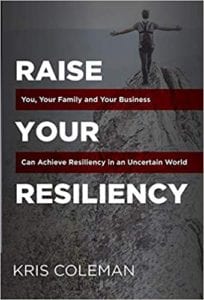
Raise Your Resiliency: You, Your Family and Your Business Can Achieve Resiliency in an Uncertain World
Both organizations spend hundreds of thousands of dollars to train new employees that are new special agents or new intelligence officers. A lot of that, as we said, is about critical thinking. It understands the psychology of who you’re talking to. It’s being able to empathize with who you’re talking to. When you are an active listener, whether you’re interviewing a potential criminal or you’re investigating a crime or talking to a victim, or perhaps trying to understand someone in an overseas country that may want to work for the US government and for the US government’s interest, you need to understand who they are, where they come from, what their motivations are. When you hear them talk, pick apart what they’re saying to you. Get every little bit and piece of the meaning and the nuance out of the conversation.
Whether you’re reading a piece or doing an interview or talking to someone, critically taking it apart and understanding its totality of what’s being said to you, what’s being communicated is important. We do that when we do our deliverables to our clients. We make sure that those things are very clearly articulated. We mean what we say, and we say what we mean and what we write. We can back it up. It’s not just, “When we went to this place, we saw these things, and we wrote these things down.” It’s like, “This is what this means, and this is why it matters.” That’s important. A lot of our products are like that, “This is what it means. This is why you need to listen to us.”
You’re connecting the dots, you’re not just reporting on facts. You’re putting it through the lens of, “Here’s why we recommend doing this or not doing that because of our in-depth understanding and ability to put ourselves in somebody else’s shoes.” This concept that critical thinking includes empathy is fascinating to me. I don’t hear a lot of people saying that. Empathy, storytelling, listening have been labeled sometimes as soft skills. Soft skills can make you strong. It sounds like that’s the direction that you’re also leading that when you have empathy, and you’re this example, that allows you to make those hard skills choices of taking action or not. Whether you can trust someone or not. Can you speak a little bit about how someone can build trust? What’s your red flag when you don’t decide not to trust somebody?
We were trained to look at a whole variety of things when we were talking to people, whether it was interviewing or eliciting information from a foreign source or whatever it might be. There’s a whole element of reading body language, eye contact. Are they leaning forward? Are they speaking in an active voice? Are they hanging back? Are they defensive by turning away? There’s a whole variety of things, eye movement. You’re taking all that in but depending on what your objective is, as the listener, are you trying to help them? Are you trying to recruit them to work for us? Are you trying to get them to confess? Whatever your objectives are of the conversation matter. You need to go into the conversation, knowing what you’re trying to achieve.
In normal daily life, you may not have an objective just to sit down and talk to a friend or to grab a coffee, but in a professional environment, knowing what your objective is and then using empathy to communicate non-verbally as well as verbally with the other person is important. If you want them to work for you, give you information, and collaborate, then that empathy has got to be there. “I understand your current situation.” “No. You need money or you need medical help or whatever it is you need.” In showing that verbally or non-verbally, they’re going to be more likely to collaborate with you, whether they’re a victim, an interview on a witness, or whatever it might be.
One of the services that you offer at Red Five is Private Family and Family Office Security. That’s certainly been in the news with William and Meghan talking about their own security. One of the things that resonated with me was it’s about trust, not about wealth, and that it’s about the mindset. However, you have a whole thing called Measured Risk Management. Can you explain what that is and why it’s important?
We’ve done a lot of work with private families. Since the inception of Red Five many years ago, we’ve been working with high net worth and families that consider themselves more private than others. Discretion is a huge piece of that. We trade and trust. That’s our currency. Our discretion, where we came from in those two organizations. How we know how to keep things quiet and be discreet is important. When you talk about trust, it’s not selling them things they don’t need. There was a big piece of that. There’s a lot of families that have this, “Are you going to give me the Smith family special price?” Which means they’re going to gouge me because I’m wealthy. The reality is we never do that.
[bctt tweet=”Critical thinking includes empathy.” username=”John_Livesay”]
We come in and say, “I know you approached us with an emotionally charged problem. This was happening in the family, or this happened to the state that we were in or while we were traveling, but it’s not my place to take advantage of that. It’s my place to solve the problem.” I will approach it in a way that says, “I hear you. I understand this is a problem. Let me provide you some solutions. What you’re telling me I should do as your vendor, as your partner may not be what you need,” that emotional, “I need a protective detail. I need ten people to protect my family.” You may not need that. It was my job to come in level-headed, take a look holistically at the situation, and give you a measured risk management response. You’re not paying for stuff you don’t need. I’m not taking advantage of the situation. I would never do that.
The approach may be that you’re wildly off in the emotional state of the solution you think you needed. You need me and my team to come in and go, “Here’s a measured risk management approach. We’re going to do A, B and C.” It’s not about men and women, earpieces, sunglasses, and suits standing around a black Suburban or a black Escalade. It is about us changing the process of how your domestic staff walks into the house or how you set up your travel arrangements so that people don’t know that you’re traveling. There are many things we can do that are below the radar in a relatively inexpensive that could raise the security of a private family. That Measured Risk Management approach is a big part of us, building that trust, then I’ll be displaying competence and delivering excellence.
It totally leads right into your expertise on resiliency, which can include safe rooms. I see that sometimes on shows and movies, but that part is real from what I can see on your website that certain families and situations do require a safe room. In a way, I never thought of it as a resilient thing, but it’s a backup. Ithas other options. For example, being here in Austin, when the power and the water went out, the airport closed, the roads were icy, didn’t have stuff going on, and the grocery stores were closed, you had a firsthand experience of, “There’s not a lot of resiliency. I can’t zig or zag here. The heat is up, there’s no water, there’s nowhere to go. I can’t fix this with money.” There are many situations of the need for resiliency over and above the pandemic that everyone is taking a look at a whole new way of looking at it. That’s your expertise, isn’t it? It’s analyzing what could go wrong so that there is something that you never find yourself in this situation that so many of us were in Texas when all that happened.
To talk about safe rooms, you’ve seen them in Hollywood movies. It’s this seven-figure, very expensive, extremely elaborate high-tech room that people run to when things go bad and it doesn’t have to be that. We operated in environments overseas where it’s going to be a closet that we throw a bunch of sandbags in on the lower level floor of a building in Bosnia during the war. We’re going to set up defensive positions, and that’s going to be the safe room. In Africa, we used to set up a whole floor of a house. It would be on the upper-level floor. We would have multiple layers of protection, a strong front door, in the hallway, at the top of the stairs, and at the bedroom.
We’re building into that detection element. Is there a problem than a delay element to slowing down, trying to get in the house? You have to get into this concept of neutralization of the threat. Ideally, by the time they’re getting to that 2nd and 3rd layer of the cavalry, it is coming over the hill and they’re going to save the day. Same thing with wealthy families. Not even the wealthy families and private homes in the US. We’re seeing questions and people are coming to us and saying, “We need a safe room because of the riots or because of some of the uncertainty in our neighborhoods.” That doesn’t have to be a million-dollar room. We can talk about simple upgrades to make that a safe room.
People don’t want to sell you that because it’s not expensive and not a big price tag, but it goes back to measured risk management. We’re going to build you what you need. To speak to Austin in the winter polar vortex for easy guys went through. I had a number of examples come in from my colleagues. They were like, “I am making sure my well though that it doesn’t freeze. I am boiling snow. I am working through two different generators to power the house to keep the well warm, keep the TV on, lights on, the refrigerator.” People were taking food out of the freezer and putting it in the front yard because it’s colder outside than it is in the freezer. There are smart things about that. It’s food, water, shelter and self-defense. We start there and make sure that all those things are taken care of by the family.
What that experience taught Texas and should have taught the rest of the country is that our electrical grid is very fragile, also our infrastructure and supply chain. We built all these things so they are efficient. You only get what you need right when you need it. You hit the button and it shows up at the front door. The reality is those networks and those supply chains are extremely fragile because they are at the last minute. They are built that way on purpose. What we need people to do when we talk about this in the book is if each individual family and each individual thought of themselves as resilient self-sufficient, the whole nation becomes more self-sufficient and more resilient. It’s a National Security thing if you ask me. The more families are resilient, then the more resilient we are going to be as a country. We’re looking at hurricanes, tornadoes, wildfires in the West, all those things drive resiliency. We need to be more aware and become more resilient.

Raise Your Resiliency: The individual is the cornerstone of resilience. As an individual, you have to decide to be resilient and learn to be if you’re not.
You talk about it’s time to get real in the book, Raise Your Resiliency. A lot of people is like an ostrich that we bury our head in the sand, “Let me know when this pandemic is over. Let me know when this crisis is over. I don’t want to ever pretend that there’s never going to be an earthquake in California again.” What I like about what you wrote here is it’s not just the business. It’s you and your family. Everything is connected. This virtual experience we’ve all been through, we used to be one person at work and another person at home.
Now, all that’s completely changed. We’re like, “This is who I am. This is me at home. This is me working.” Those lines have blurred, which increases the need for a book like this. We talked before the show that this cover is fantastic about somebody on the edge of a mountain and holding their hands out. It reminds me a little bit of our mutual friend, Alison Levine, who climbed Mount Everest, talk about resiliency and a mindset. How did you and your publisher decide on that image in that cover?
The premise of the book is that the individual is the cornerstone of resilience. If you, as an individual, decide you’re going to be resilient, and you can learn to be, if you’re not. That’s a key part of the book, but then if you’ve made the decision to be that, that means that those around you will have a chance to benefit from that. If you have a family, then you will then be that cornerstone for the family and the family is going to be resilient. If you’re an entrepreneur or a founder, or you work in an organization that is open to that, you can then be a key element of resiliency in that company or your own company, or perhaps, in a corporation. It could be a nonprofit as well. There’s an element there of the individual achieving resilience.
Getting to the top of that mountain and knowing that we’re going to get knocked back down. We’re not always going to be at the top. There will be people in adversaries and things that we refer to as the jackal that always tries to knock us down. It might be an illness, a divorce, a natural disaster, or a career setback, but regardless of the jackal coming at you, you’re going to make it back to the top. That is the whole core of adversity. The real deal of resiliency and is that you’re bouncing back from adversity. Whatever knocks you down, you get right back to the top of the mountain.
The speed at which you get back up is crucial. From other people I’ve interviewed about salespeople getting a rejection, for example, some people shake it off and move on. Some people keep holding onto that. The ability to get back up fast is like any other skill that we can practice. How important that is to model that for people in our world, whether it’s our family or our coworkers, is to not let something that’s knocked us down keep us down. Is that a good definition of resilience?
Yes. What we talked about is the mindset in the book. It’s one of the five pillars. The mindset is that there are no doomsday thinking. There is no catastrophic thinking like, “I didn’t get picked for the job because I’m this or that. I wasn’t as good as this person. I wish I had done these things.” The reality is it’s all about a positive growth mindset. When you have a setback, it’s like, “I’m going to learn from that. I’m going to turn right around, pick myself up, and get back up there.” That is an important piece. That was drilled into the US at the CIA and FBI. You’re going to have a bad day. You’re going to be confronted on the street.
You’re going to be attacked perhaps by terrorists, whatever’s going to happen to you. You’ve got to mentally be prepared to fight through the gunfight, to fight through the attack that you’re going to experience. We always talked about, “Get off the X. Something bad is going to happen.” Don’t sit still and let it happen. It’s much like a career setback. “Don’t just sit there and let it happen. Change direction, get off the X. If you’re moving forward, stop. If you’re sitting still, move forward, turn left, turn right.” The point is get away from that adversarial environment and move forward through the problem. That is the important key to resiliency.
[bctt tweet=”Get off the X. Get away from the adversarial environment and move forward through the problem. That’s an important piece of resiliency.” username=”John_Livesay”]
I literally experienced when the power went out here. I had a friend’s son visiting me. Suddenly, my responsibility for what I do is not just on what I’m going to do for myself and my choices that I would make for myself. I said, “Your mom will be mad at me if something happens to you while you’re here.” A friend of mine had called and said, “We have electricity. We’re about 12 miles away. If you can get here on these icy bridges, you can stay here. You can bring your dog and your friend. The house is big enough.” Thank goodness for all of that. It reminded me of that moment in the movie where you see people leaving their car in a storm. You’re like, “Should they leave the car?” I’m like, “Technically, we’re safe here in this place, but it’s getting down to 40 degrees inside.”
We decided to get off the X. We’re going to take the risk and drive without snow or icy roads. We saw some cars in the ditches. A truck went by and threw a bunch of snow on our windshield. It was not an easy, fun, 12-mile drive by any stretch of the meat. We are 20% of the way there. I’m like, “That’s all? It seemed like forever.” It was the right choice to make. You would rethink that if you were in the ditch and how long it would take somebody to come get you was a whole other choice. Do you have water in the car? That fight or flight response that you’ve been trained to not have, which is we are deer in headlights, and you freeze. This is a calculated risk, but the reward is worth it. That’s what I think you say about this get off the X.
That’s one of the things we talked about in the book is you shelter in place. What would you have done? Had you stayed, or did you evacuate to a place that appears to be, and by all reports, is safer? You’re making that judgment decision, “I’m safer here. I have a shelter. I have a defense. I have food. I don’t know how long the power will last or how long it will stay warm.” At some point, you may make the decision that it’s safer to take the risk, to travel to point B instead of point A. We talk about what you should have in your vehicle and what you should have at home, then what should be at the other location. If the other locations are predetermined safe place or location, we call like a bug-out location.
You’ve got a bug-out from where you are to get to where you want to be. What supplies are there? What have you already pre-positioned in that other location? Ideally, if they’re saying, “Come to our location.” They’ve got enough water, beds, power, food, and they are in a safe location. Now you’re making a judgment call that a travel element where you are now exposed to other things that you weren’t exposed that when you were at home is a smart choice. Those conditions will be different. Whether it’s a winter storm, a terrorist attack, an earthquake, a wildfire, the conditions will change.
That’s another one of the pillars is awareness. You have to be aware of what’s going on around you. It may not be that Facebook Feed that’s giving you the best information. You may need to turn to an actual news source that’s trusted and then use that or call someone, which we like is get information on the ground in that other location so that someone is telling you firsthand, “I saw this. This is the situation here where we are.” That awareness piece is another key pillar that we talk about in the book to resiliency.
There are five pillars that are in this wonderful book, Raise Your Resiliency: real awareness, real mindset, real fitness, real skills and real relationships. The one that we haven’t touched on that I think might surprise some people is fitness is an attribute of resiliency. I’m not probably ever going to have to fight somebody. We’re talking about stress. Fitness can include a meditation practice, anything to help you not “freak out,” stay calm, and not panic. That’s what your training has done. That’s what this book can help us become a roadmap so that we can not only raise our own resiliency but those around us.
Fitness, emotional, mental, physical. It’s not how much weight you can lift or how many miles you can run. It’s about your flexibility, endurance, whether or not you’re emotionally mature. Are you professionally mature enough to deal with what’s going on around you? That’s a big piece of this fitness. We talk about it when we get into the biophysical elements of stress. If you have poor physical fitness and/or emotional fitness and more poor mental fitness when that stressor hits, your body performance drops, and it usually drops below what we call the hard deck. That’s when you talk about deer in headlights. When you drop below that hard deck, your body dumps a lot of adrenaline in the system, and you typically lockdown. You are now the deer in headlights, and you can’t move.

Raise Your Resiliency: If you’re not resilient, then seek out scenario-based training experiences. Create muscle memory to do good things regularly and have it be an innate part of who you are.
You’re going to go to some level of paralysis. It’s more of an adrenaline lockdown. That’s when people, unfortunately, bad things happen to them. They died in place when things happened because they just froze. If you’ve got that fitness level tool to a higher plateau, where when that stressor does, you don’t drop below. You might go below but you come back quick or you drop down, you’re close, and you may be stressed, but you’re not freezing up. That’s where we were lucky to be fitness-wise. Mentally, emotionally, and physically, don’t drop a low hard deck. Keep your wits about you, and then move to the problem. Get off the X.
Your book and your company, Red Five Security, have never been more needed than they are now. I’m grateful that you and your team are out there helping us all. I highly recommend the book Raise Your Resiliency. Any last thoughts or tips that you want to leave us with?
What we talked about with people is that it can be a learned experience. If you’re not resilient now, if you’re not self-sufficient, you don’t see yourself as ready or prepared in your business, then seek out scenario-based training, experiences like we offer because you can read it in a book. You can do it a single time at a shooting range, but those aren’t training. Those aren’t experiences. Those are one-time things that you did that don’t embed and create muscle memory to do good things regularly and have it be an innate part of who you are. We want resilience to be learned, people to get experiences, then they’re immersed in the environment. They can learn from them and repeat the solutions, so the next time when it hits, they’re ready to go. That’s the ideal path or someone looking to be resilient.
My TEDx Talk is called Be The Lifeguard of Your Own Life. That’s what you’re preaching. Thanks so much, Kris. Thanks for being who you are in the world and for this wonderful book.
Thank you very much for having me.
Important Links
- Kris Coleman
- Raise Your Resiliency
- Red Five Security
- Be The Lifeguard of Your Own Life
- Private Family and Family Office Security
- Measured Risk Management
- Better Selling Through Storytelling Method Online Course
Wanna Host Your Own Podcast?
Click here to see how my friends at Podetize can help
Purchase John’s new book
John Livesay, The Pitch Whisperer
Share The Show
Did you enjoy the show? I’d love it if you subscribed today and left us a 5-star review!
- Click this link
- Click on the ‘Subscribe’ button below the artwork
- Go to the ‘Ratings and Reviews’ section
- Click on ‘Write a Review’
Love the show? Subscribe, rate, review, and share!
Join The Successful Pitch community today:
- JohnLivesay.com
- John Livesay Facebook
- John Livesay Twitter
- John Livesay LinkedIn
- John Livesay YouTube