

Pitch Investors Live With Jonathan Foltz
Posted by John Livesay in podcast | 0 comments

Finding the right people to invest in your company, particularly start-up ones, is a pretty tedious and time-consuming endeavor to accomplish. But thanks to Pitch Investors Live, every business can take advantage of this online platform that’s very much like Shark Tank combined with Tinder. John Livesay interviews Pitch Investors Live Co-founder, Jonathan Foltz, to share how he and his friends started this groundbreaking project. He also looks back on his childhood and how his falling short of being a basketball player pushed him to pursue a career in entrepreneurship.
—
Listen to the podcast here
Pitch Investors Live With Jonathan Foltz
Jonathan Foltz is a Co-Founder of Pitch Investors Live. What they do is they help match up investors with founders looking for money, much like dating app meets Shark Tank. He talks about his career as an entrepreneur and how he had to overcome the fear of not being good enough after his dream of being a basketball star did not happen. That was his first pivot in life. He’s now gone on to do many other successful businesses and has life lessons of having a passion for what you do.
—
Our guest is Jonathan Foltz, who is the Co-Founder and visionary of Pitch Investors Live. He is a futurist, a philosopher and an avid knowledge seeker. He started multiple companies in technology, education, eCommerce and the digital space. He’s built $4 million brands in completely four different industries. He’s also the Owner of an international marketing agency, Digital Age Business, which has worked with some of the biggest brands in the world. He also owns multiple eCommerce brands. He was able to take a business to seven figures a month within its first year. Welcome to the show, Jonathan.
I’m happy to be here.
Before we dive into everything you’re doing and this whole concept of your own story of origin around the PitchInvestorsLive.com, I want to invite you to tell us your own story of origin. You can go back to childhood school. Where did you get this urge to be an entrepreneur? Did you always have a passion for multiple things? Start the story wherever you want.
Like many entrepreneurs, a lot of my entrepreneurial skills came from a necessity as a young kid growing up with my father and everything like that. He was in the oil industry and we traveled a lot. I was born in Canada, then we moved to New York, to Miami, to Argentina, to Columbia and then back to Miami. In between was Venezuela, Peru and the UK. I went to a few different schools when I was in Columbia as a kid. I got used to having to make new friends. That started to build a little of my social skills. As a kid, you want to be liked. I had to go and find brand new friends because I was moving from place to place. It was rough as a kid and you have to figure out the skillsets to make new kids, new teachers and new people in your realm like you. You’re like, “Now I’m in a brand-new environment.” It made me a little bit more confident having to go through so much of that. As time went on, my parents got divorced when I was 12, 13 years old.

Pitch Investors Live: A lot of our entrepreneurial skills came from a necessity.
I was obsessed with basketball. Basketball was my life. I thought I was going to be in the NBA. I had that belief system. I was obsessed. I watch ESPN and played all day. As time went on, I remember when my parents got divorced, I know that my mom had gone through a rough time during the divorce. She started hustling. She started working and doing some stuff with flea markets and stuff like that. The interesting thing about this is that my mom was a hustler. She was good, social, likable and had such a good personality that everyone loves her. She’s a social butterfly. That’s one of the skills that I got from her. That’s where I learned that type of skillset around that time.
Little by little, I started learning. I was able to get a computer. One of the things that I learned quickly when having a computer and a CD burner, which not a lot of my friends had them at the time, I was making CDs for friends. This was in the beginning stages. I was a little kid and people didn’t know about Napster. Every kid in the school was burning CDs. I happened to burn CDs for music stuff that they’d never heard of. I’ll put a cover on it and sell it. I’d made a little $5 here and there. One day, there was a CD coming out. It was called The Marshall Mathers LP, it’s an Eminem CD. Before it was coming out, I got access somehow to the internet as a little kid. This is when the internet was new. I was probably 14, 13 years old or something around the time. This was the early stages of when all this was coming out.
No one knew about Napster and how Napster would take down the entire entertainment business. It was crazy what was happening. We didn’t know what was going to happen from it. I knew that I’m like, “This is a popular CD.” I have early access to it. As a little kid, I have no idea what I’m doing here. I brought that CD to school and this was my first glimpse. I don’t know if they were giving fines for people at the time that were burning CDs and such. I don’t even think that time had come yet. Later down the road, people start getting fines. Their parents were getting $5,000 fines from the entertainment business. I don’t know if you remember that. They were sending out checks like lawsuits against a bunch of people, but little kids didn’t know. None of them knew what was going on. They’re little kids with power of the internet.
That’s what was exciting to me. Nowadays, people call me the Digital Frontiersman. I got my first sample of the power of the internet when you could do these things that were never possible before. When I got my hands on the internet as a little kid, my whole world had unfolded into something that I could never imagine. My first case study of great success. I tried all kinds of stuff. I try some baseball cards. I would open up all the cards and I would never be able to sell them all. That was a failed venture. I sold a little CDs here and there for $5. I was entrepreneurial because of my mom. When I did this The Marshall Mathers LP CD, I knew it was going to be a hit for some intuitive reason. I empty my book bag. I filled the entire book bag with these CDs. I went to school and sold them for $10 apiece. I sold every single one and my mind was blown. I was like, “What just happened?” The next day, every kid in school was selling them too. I saw what happened. It was like I was the first mover in that direction. Every kid in school went and copied the same model that I did and it blew up through the entire school, even so much so that the principals and everyone said, “You guys got to stop selling CDs in the hallways.”
[bctt tweet=”Our values and purpose are built out of voids.” username=”John_Livesay”]
That’s how big it became in our school, Palmetto High School, which is the same high school that Jeff Bezos went to. That was one of the things, but what put me into the entrepreneurial realm was in the 9th grade. I tried out for the basketball team and I got cut in the first round. For me, basketball was life. When I got cut from the basketball team and I knew that there were people on the team that made the cut that I was way better in, what it meant for me as a kid was I’m not good enough. I went home that night, went to my bed and I’m thinking to myself like, “If I’m not good at basketball, what am I good at?” Honestly, I have no clue what I’m good at. That was deteriorating to me. I had to go through a shift.
This is another reason I got into philosophy. Aristotle had something that he called upon Axiology. It’s a study that he developed and he called something the Telos, which was the purpose. All being the medium in mind and where you’re going in life. One of the biggest things that he talks about is that our values and purpose are built out of voids. Voids are things missing. What was missing to me was I’m not good enough. That started to build a mentality out of me that I wanted to be good enough. When I started to find out a little bit about the entrepreneurial realm, I started making money with these little side hustles selling whether it was sneakers, selling baseball cards or selling the CDs. Early out of high school, I had a pet shop. I started figuring out all these ways. I was like, “I’m good at something.” To me, it was inspiring because that wasn’t my mentality. I thought I wasn’t good at anything at that point when I got cut from the team. That was where the spark and the power came from. It was from me being cut from that team. It became one of my greatest driving forces.
What an inspirational story. That concept of not feeling good enough is something that people struggle with most of their life on a subconscious level sometimes. That’s why people fear rejection. That’s why we get into the imposter syndrome. We’re comparing ourselves to other people and coming up short, “I didn’t go to that Ivy League school. My book didn’t sell as much as theirs.” It’s an insane route. The fact that you were able to pivot at a young age like entrepreneurs learn to do and go, “Basketball is not it. I’ll figure something else out.” Even that earlier story you were telling about the people started copying you. That’s another big takeaway for everyone reading, which is investors are always going to ask you, “What’s your secret sauce?” “What’s your barrier to entry from a big competitor.” You had all that in that story. The awareness of, “Other people are going to think of this too, so I need to get something here that’s going to prevent other people from doing that.” Let’s talk about what void you saw in the marketplace that made you and your team start Pitch Investors Live?
I’ve started many companies. I’m going on maybe 25, 26 companies. I am one of those crazy serial entrepreneurs. I know well how hard it is first and foremost. Secondly, I started learning more about the investment space. I wanted to learn more. I remember reading many magazines and books. I’m like, “One day, I want to have my own venture capital fund. I want to be a venture capitalist. I want to work on multiple projects.” I’m much on the go. I’m a visionary, but I like to go and do it. I love the building process and that’s why I’ve done many different things.

Pitch Investors Live: You can have the greatest idea in the world, but if you don’t position it correctly, shift it, and adapt it, it’s not going to get anywhere.
My business partner was the founding founder, if you want to call him that, from the 2UP app itself. 2UP app was a debate app when it first started. That’s how Pitch Investors Live came in and that’s the time that I came in. 2UP itself was an app before Facebook Live existed. It was even before Periscope existed. Before all that stuff came out, 2UP came out. I had met Matt at a startup conference. He was launching 2UP. I was going to help him with marketing. We threw some ideas back and forth together. I was going to join him, but I was doing so many other things. I never joined 2UP. It got traction but it was missing some key components. Later down the road, when I and Matt came together to build Pitch Investors Live, we realized he’s the technical backend innovator and I’m the business dev marketing visionary. I know what can go to market the right way and how to position it. You can have the greatest idea in the world, but if you don’t position it correctly, shift it and adapt it, it’s not going to get anywhere.
Knowing all these different things and being a huge fan of Shark Tank, when Matt was developing Pitch Investors Live and it was like an older UI, I honestly did not like it at all. I was like, “This needs some major work.” He was trying to hire us to launch Pitch Investors Live. When we started talking about this, I invited them to a house that we were staying at called the Marketer’s Mansion. We rented a huge mansion on the top of a mountain in Arizona. It was five of us internet marketers, e-commerce experts. What we did is we created an accelerator. We had probably over 1,000 people come through those doors. We had a mastermind where there were two giant mansions and there was a jet involved where we went to Las Vegas. It was one of those fun things to do.
As time went on, we had different people come through the door. I remember Matt, he had a significant exit in the tech space. I’m like, “We need to get some high-end people here. We want to have some people that we can learn from and they can learn from us.” I called Matt, “We’re looking for another person. We have an open spot. One of our roommates has gone. What we do here is we collaborate. I’m looking to create some new apps. I know you know how to develop them. I know what’s going to make a whole bunch of money in the marketplace. That’s one of my expertise. Let’s get together and let’s build something.” When he came over, he started telling us about Pitch Investors Live and how he turned 2UP into pitch. He wants to take it to the next level. He wants branding.
There was also cryptocurrency and blockchain involved. To me, that was a massive space that is going to be monumental in the future. Every single big company now in the world is implementing some type of blockchain technology, especially in the financial space. Even the federal reserve and the Chinese are implementing full blockchain into their finance, but that’s a whole different story. That was exciting to me. I was getting the hang of it. I was like, “Let me see what he has available. I am busy but let me see what he wants.” I’m not trying to take clients on. We used to take clients because I had an agency. I stopped doing it and I listened. I was excited with what he had envisioned, but I knew there was more of what it could be and I knew what it took. I went back to him and I said, “I’m not going to take on this project. I’m not going to help you with the marketing. The only thing that I’ll do is I’ll come on as a co-founder to help you build this because this is bad-ass and I know what needs to get done.”
[bctt tweet=”It’s lovely to see people get success from a new technology that has come out that has changed how things used to be.” username=”John_Livesay”]
It needs some complete revamp on the branding side. The app needs to have all kinds of stuff. I was like, “I will come in. I’ll bring my entire team because this is an amazing idea.” It is amazing that I was like, “This has to come to market.” When I saw it, what I thought of and I gave it this interpretation, it was like you make Shark Tank together with Kickstarter, together with Tinder or Bumble, or one of the swipe dating apps together with live streaming technology. That right there is monumental. No one’s ever done that in the startup space or the funding landscape. No one’s done anything like that. We’re going to be the first people to be able to pull this off.
I was like, “That’s what I want to do. I want to come as a co-founder. I will not come in as anything else. You can’t hire me. He was happy. He was like, “Someone wants to join on board. All right, let’s do this.” We were friends also. That was one of the beneficial parts of the whole thing. As soon as I came on, I enrolled my business partner, Umer, into it. I enrolled my other roommates from the Marketer’s Mansion, Damien Coughlan, Lawrence Aponte, and there was this other guy, Odie, an amazing camera guy. We started enrolling all these people and everyone wants to join because it was a cool project. This is going to be monumental with what we could do not just with the blockchain components but also simultaneously, with the faction that what we want it to do is allowing people to invest in companies live. Imagine if you’re able to invest into companies as there’s a live pitch happening. This is a game-changer for me.
You also have Kevin Harrington on your advisory board. He’s also been a guest on this show. What I love about this story is that your dream and part of your pitch is to imagine Shark Tank meeting Kickstarter, meeting a dating app and live streaming. That is no longer like, “Wouldn’t it be nice to have that as an analogy?” One of the original Shark is part of this. The credibility factor goes soaring up. The first of many takeaways for people who are reading is who’s on your advisory board is as important as who’s on your team, especially if they’re active. When investors are looking at what kind of credibility and experience like, who you’re going to when you have questions and get stuck? Imagine all the years and all the deals that Kevin has heard so that he can say, “If I put myself in the shoes of an investor, this is what I’d want to hear and what’s missing from this pitch.”
You and I have discussed why I’m excited about joining with you and promoting this to people is investors I’ve interviewed on this show have told me, “We hear about 2,500 pitches in a year and funded about 25, 1%.” What you’re doing is allowing people to get in that 1% club. The old way of doing this is you had to get an introduction, you physically get in the room, you have ten minutes, and you hope you did a good enough job that you get invited back. I’ve seen that happen successfully multiple times in multiple levels from seed to series A, and all the other stuff that you’re talking about. Investors need to hear pitches. If you streamline this even before the pandemic and people weren’t traveling, think how much more productive it is. I’m only hearing pitches from people who are in Silicon Valley, for the most part. There’s got to be some other ideas out there. You’re allowing people to get heard without them having to move to Silicon Valley to build their network. It’s not that a network isn’t important, but I think this premise is so important. You have no shortage of investors that want to be part of this.

Pitch Investors Live: Every single big company now in the world is implementing some type of blockchain technology, especially in the financial space.
We have a good decent amount of all kinds of investors from VCs, Angels, regular credit investors and institutional.
One of the things I say when I’ve worked with people is don’t talk to an investor who only invests in AI if you’re not AI. You need to do a little homework on the investor’s portfolio and see if they have a competitor or they don’t fund the thing you’re pitching. You’re in the wrong room. You need to get in the right room with the right pitch, which is why this combination of what you’re doing is so smart. I’m guessing there’s some kind of vetting that’s going on so that an investor can see what’s coming up to see if he wants to watch those live pitches.
For anyone that wants to download Pitch Investors Live on both iOS, Android and PWA. We had a lot of people and some older investors that are like, “I want to be on my computer.” We’re like, “Let’s do PWA,” so we created that.
For those people who don’t know, what is PWA?
It’s a Progressive Web App, which means it’s like a website, except it loads much faster. You could use it on a website and you could get on it live like what you do on Zoom. That will be on a web browser. We added some very light artificial intelligence. It’s more like machine learning to allow people to connect. It’s already rolled out, but we’re going to roll it out and implement it in a cool manner. When the investor comes in, we’re going to find out all their information. What kind of projects they like? What’s the funding? What’s their sweet spot? How much money they’re looking to invest?
[bctt tweet=”If there’s something that’s truly inspiring to you, no matter what it is, go after that.” username=”John_Livesay”]
We’ve had some investors that are like, “Our sweet spot has been in the few hundred thousand dollars.” We have a lot of investors that are in the $2 million to $5 million range. They will put the ranges inside there. What kind of companies they’re looking for, if it’s pre-revenue or post-revenue? Some are willing to go into those companies that are early stage. Some are like, “No, I need to make sure that they’re making money.” We vet them in all that type of information. We then have the entrepreneurs answer similar questions. How the AI comes into place is it has a matchmaking service that pulls them like, “You guys are a good link because you’re looking for $2 million, he likes companies from $2 to $5 million. You’re an eCommerce, he likes to get eCommerce entrepreneurs.”
That was exactly the answer I was looking for on how we take the concept of a dating app and apply it to Shark Tank that it screened. The other thing that you are doing brilliantly is your pitch is saved in a library. Any potential investors can see it at any time. That alone is worth so much because if you’re a founder pitching and you figured, “This is my one shot.” If the right person is not there or they’re sick, I don’t get to come back because we’ve already passed on that. We’re looking at new pitches. This fear of, what if somebody doesn’t see it live? It completely goes away. For everyone reading who is trying to figure out how to get people to join their team, having good people, you got to be attractive to them. Once you’ve got that good team, you need to pitch the investors. You also need to pitch to get business clients, the marketing is part of that. There are three different buckets that the storytelling aspect that I teach helps solve that whole thing from start to finish.
The problem is a lot of people think, “If the right person doesn’t hear my pitch, then it’s lost forever.” Now you’ve solved that problem. The big takeaway here is think like Jonathan and his team. Anticipate an objection, whether it’s from an investor or a potential customer, which in this case it would be like, “If I’m going to pay money to put my pitch on live streaming, what if the perfect investor isn’t listening to me at that moment?” You’ve anticipated that problem and you have an answer and a solution for them that creates value. What I’m trying to do is use your model for people to not only say, “I need to get on Pitch Investors Live to get my startup funded,” but also for those people who are reading that aren’t necessarily looking for funding, they can still learn so much from you. They can learn from anticipating objections and answering them in advance, as opposed to being a deer in headlights when you get them from a customer or an investor.
One of the things that we’ve been very excited about is when you do come on to Pitch, you’re not pitching that one investor. It goes live in the app, on Facebook and YouTube. In the future, we plan on pushing that into other genres, stuff and potentially podcasts too. We have a story of a guy named Efren who had a company called Gemini Cyber Securities, it was something similar. He pitched Kevin. Kevin didn’t like the deal but he was like, “This is a good project. I might talk to Robert about it.” I don’t know the backstory on that, but what I do know is that it was saved on YouTube. Efren put on his own LinkedIn. Someone hit him up on LinkedIn because of the video that was online. They didn’t watch it live. They’ve watched a rerun of it. They contacted him. He got fully invested, found two new partners from that live that was prerecorded on the internet. Several months later, we come to find that Efren got acquired. He got the Pitch helped him find his investor, gets two partners and then get acquired several months later. None of that would have been possible or at least in that timeline if he had it on his homepage and then had it on there. It’s lovely to see people get success from a new technology that has come out that has changed things how they used to be.

Pitch Investors Live: Imagine if you’re able to invest in companies as there’s a live pitch happening. It’s a game-changer.
It’s a philosophical perspective on life. It goes back to a metaphysical way we’re talking about in your childhood, which is either you feel like you’re good enough or you don’t. You have to compare yourself to other people or you don’t. Einstein said, “One of the biggest decisions we ever make is if we feel that the world is a safe and friendly place or it’s not.” From that one decision, we then go looking for evidence to support that decision. The same thing is true in the startup world or entrepreneurship. You either believe that you’re going to get good people. It doesn’t mean you don’t do your due diligence, but it’s your mindset. If you have the belief that, “I never know who’s going to be listening to this live pitch on what platform, that could change my life.” If I believe and I’m open to those possibilities as opposed to, “I must know how it’s going to happen, when it’s going to happen, and who’s listening.”
The structure is great but you might want to be an accountant versus an entrepreneur if that’s the way you’d like to think and work. That’s why I love that story you share because the goal is we want other people to see themselves in that story of someone who used your platform and say, “If that happened for that founder, it could happen for me.” That’s what you are creating. You’re walking your talk on many levels. I don’t even know if you realized it. You’re inspiring people with your own passion and your own unlimited thinking of possibilities while also helping other people and making money. That’s the dream.
The social impact aspect of it is the factor that is going to continue to get more and more important. People feel that energetically when they talk to you, when they tuned-in to this show, and when they go to your website. All of that is what I want to leave everybody with. Your brand and your messaging need to be consistent. It is constantly sending out some kind of vibration and energy. It’s up to you to define what your culture is, and define who fits and who doesn’t. When that happens, then you trust and allow the rest to fall into place. You have a good story. You’re in the right room. You’re embracing new technologies and new ways of doing things so you’re not dependent on who your network is at any given time. That’s what I see is your big impact on the world.
I do this because I love it. That’s why even starting Pitch was something that I believed in and I knew how much entrepreneurs needed the support. In the funding landscape, you hit it on the nail how we explained it to people in the beginning stages. We don’t want the entrepreneurs to have to go to Silicon Valley or have to go to New York. The best thing for them is why can’t they be at home and be able to pitch an investor instantaneously from anywhere that they’re at.

Pitch Investors Live: Entrepreneurs don’t have to go to Silicon Valley or New York. They can be at home and be able to pitch to an investor instantaneously from anywhere they’re at.
With the pandemic, your timing is perfect. You’ve been doing this for years. We’ve got it all the kinks ironed up. You’ve got proof of concept. The timing in the synergy of now more than ever, no one’s going and pitching people in person. Any last thoughts or inspirational quotes that you want to leave us with?
One of my beliefs in life is that you have to do something that is truly inspiring to you. If you’re doing things for the money, you’re doing things because of the judgment that you had, what your parents thought or whatever it is, the biggest thing that has been proven even scientifically, to give you more energy and longer life span is being inspired about something. If there’s something that’s truly inspiring to you no matter what it is, if you go after that, it changes the dynamic. You go to sleep with energy. You wake up with energy. Your true genius and potential come out in forms that you can’t even imagine. Any time that you can tap into that flow, that is where your true potential comes from and where you’ll make a great impact in the world. Usually, it’s of service like what you’re doing right here on this show.
I can support what you said because I was hired as a speaker once. My agent said to me, “It was between you and another speaker, they loved your energy and they want to hire you.” We can never underestimate how much passion and our energy is what people are buying. We’ve heard this line a hundred times, “Investors invest in the jockey, not the horse.” The person is the jockey. Jonathan, thanks for your passion, energy, insights, and for creating Pitch Investors Live as a place for both investors and founders to find each other like a dating app while still having a little technology to make sure those matches are good. We all need innovation now more than ever to solve all these big problems we have. You’re the catalyst in making that happen.
I appreciate that. It was great coming on here and being able to speak to you and everyone.
Important Links
- Digital Age Business
- https://PitchInvestorsLive.com/
- Kevin Harrington – Past episode
- Better Selling Through Storytelling Method Online Course
Wanna Host Your Own Podcast?
Click here to see how my friends at Podetize can help
Purchase John’s new book
John Livesay, The Pitch Whisperer
Share The Show
Did you enjoy the show? I’d love it if you subscribed today and left us a 5-star review!
- Click this link
- Click on the ‘Subscribe’ button below the artwork
- Go to the ‘Ratings and Reviews’ section
- Click on ‘Write a Review’
Love the show? Subscribe, rate, review, and share!
Join The Successful Pitch community today:
- JohnLivesay.com
- John Livesay Facebook
- John Livesay Twitter
- John Livesay LinkedIn
- John Livesay YouTube
Invisible Solutions With Stephen Shapiro
Posted by John Livesay in podcast | 0 comments

Many people advise us to think about our destination, our end-goal, that sometimes, we miss out on the many opportunities that come our way. The author of Invisible Solutions, Stephen Shapiro, joins John Livesay in this episode to share with us the different lenses he’s created to allow us to see the solutions that are right in front of our face but are in fact invisible. One to emphasize how we should focus on the direction we’re going, he tells us some great insights, tips, and tricks towards becoming a lot more successful—from the importance of branding to learning how to ask the right questions. He also shares what a performance paradox is about and how we can use it to our best advantage.
—
Listen to the podcast here
Invisible Solutions With Stephen Shapiro
Our guest on the show is Stephen Shapiro, the author of Invisible Solutions. He shares with us all the different lenses he’s created to allow us to see those solutions that are right in front of our face but are in fact invisible. He said that if you focus on your direction you’re going and not necessarily just the destination, you’re going to be a lot more successful. He talks about what a performance paradox is and how we can use it to our best advantages. Sometimes having the answer is not the answer. Enjoy the episode.
—
Our guest is Stephen Shapiro. For many years, he’s presented his provocative strategies on innovation, culture and collaboration to audiences in 50 countries. During his fifteen-year tenure with the consulting firm, Accenture, he created and led a 20,000-person innovation practice. He’s the author of five books, including Invisible Solutions. His clients include Marriott, 3M, P&G, Microsoft, Nike, NASA and GE. In 2015, Stephen was inducted into the Speaker Hall of Fame. He’s also been a regular judge and mentor on the TV show, Girl Starter. We’re going to be talking about stories, how to become more inventive and what the heck is an invisible solution. Stephen, welcome to the show.
John, it’s great to be here. Thanks for having me.
I love to ask people like you to take us back to childhood or school when you started this curiosity factor that you seem to have in spades about, how does the world work and how can things be better? Start anywhere with whatever the story jumps out in your head.
I would say I’ve always been a bit of a tinkerer. I liked seeing how things work so I would take things apart and hopefully, try to put them back together. I did that sometimes successfully and sometimes not so successfully but that was something I always love to do as a kid. I also love magic because to me, magic is like, how do things happen? How do you do things that are impossible? I’ve always been fascinated with taking things that appear complex and trying to deconstruct them and understand them, then reconstruct them in a way that they’re not so complex.
Take us at the beginning of your college. How did you decide what to major in when you have that interest?
I had two paths that I was going to go down. One was going to music because I was a jazz sax player and good at it, and then the other one was an engineer. I got a lot of advice. In fact, one piece of advice I got from someone which goes counter to what a lot of people might say is they said, “If your passion is music, don’t major in it because once you start having to make a living off of it, it might crush your passion. Choose something that is going to make money and then do music as your true passion on the side.” I became an engineer because I’m a bit of a nerd.
[bctt tweet=”An ineffective question is one that doesn’t give you the results you want.” username=”John_Livesay”]
There’s a lot of similarities between music and math and all that, so that’s not a huge shock. I’ve heard Elizabeth Gilbert talk about creativity and in her case, it’s writing books like you. She’s like, “If you put too much pressure on your creative outlets to make you a living, it does take the joy away from it.” There’s something to be said there, where we don’t have any pressure on anything we love doing, and then if the money happens to come great. To make that jump in is I advise that a lot of young people are not getting because Robert’s “follow your bliss” situation is a big thing. Let’s jump into those fifteen years at Accenture. You’re based in London some of the time and you’re managing all these people. What kinds of problems were you solving?
The biggest problems that we were focused on were how do we take the mindset of 20,000 people who are much technology-led? A lot of Accenture was much on technology implementation. The group that I was working with was about, whether it’s SAP or some other enterprise management system or some other new technology, how do we get them to focus on value first? How do we get them to think innovatively and then look at the technology as solution? That was the problem we were trying to solve. We did that through a series of programs, books, materials and other things trying to create a greater awareness of how you can, without taking a lot of time, rethink the entire thought process for delivering a project.
You started your speaking career after that. Is that correct?
I had the first copies of my book on September 10th, 2001. It’s a bittersweet day because the next day, things were a little different. I plan to leave the company at that point and left Accenture when my first book came out. It’s been many years that I’ve been doing my own thing. I’ve been focusing on helping companies innovate, solve problems, collaborate and things of that nature.
In your book, Invisible Solutions, you’re wearing a purple shirt and the burqa is purple. There’s a lot of purple on your website as well. Let’s talk about the importance of branding, being known for colors, and certain things. What are your thoughts on that? How did you come up with purple?
I always loved purple. I have these big geodes that are deep purple and I always love those. Even as a kid, I have those. I’ve always loved purple for whatever reason. I hired branding companies that said, “You can’t do purple. Purple’s a bad color for a brand.” I moved away from purple. When the book came out, we decided to go with the purple cover. I went back to what I love. I love purple. To me, it’s a good royal color. I remember one of the first speeches that I gave after I left Accenture, I was in Singapore. I was told that purple is a color for innovation. I was like, “There you go. That worked out perfectly.”
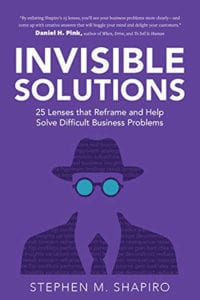
Invisible Solutions: 25 Lenses that Reframe and Help Solve Difficult Business Problems
That’s all meant to be. The cover of your book is fascinating. There’s a guy in a suit and these glow in the dark glasses. What’s the story there?
It’s the variation of the invisible man. The whole book is on 25 lenses, which are 25 different ways to reframe the problem. The fedora, glasses, tie, and jacket, if you look carefully, you’ll see subtly are all 25 lenses written. The whole outfit is made up of the words of the lenses.
It reminds me of Dolce & Gabbana, how they have words and their logos on dresses, purses and things and it becomes immersive like that. My first question is, how’d you come up with the title? Usually, people think, “If a solution is invisible, is that a solution?” We get down in the Alice in Wonderland rabbit hole a little bit.
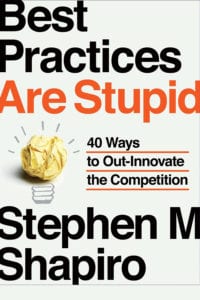
I’ve been fortunate to have a buddy of mine, Adam Lefort, who’s brilliant at technology but he’s also great at coming up with big concepts. One of my books was called Best Practices are Stupid. Adam came up with that title. He came up with Invisible Solutions. The whole idea of the book is the best solutions are right in front of your nose. You just can’t see them because we’re not asking the right questions or we’re looking at the problem the wrong way. He said, “The solutions are there. They’re just invisible. They’re hidden.” That’s how we came up with the title which led to the invisible man, and then the cover was designed by my buddy, John Brunswick, who was at Salesforce. He came up with this concept one day and said, “How about the invisible man as a concept for the book cover?” I’m like, “Cool. Let’s go with it.”
Both in your keynote and in your book, you talk about how we are hardwired to ask ineffective questions. People would say, “We’re hardwired that way?” Let’s start with your definition of what is an ineffective question. I can guess but I’m sure you put a lot of thought into what an ineffective question is.
An ineffective question is one that doesn’t give you the results you want. The reason why we ask ineffective questions is because we probably don’t even ask questions. What we’re doing is we tend to make snap judgments or snap decisions, and then we start moving forward quickly. Part of this is because the brain’s primary function is survival. We need to innovate to survive and we need to adapt to survive, but we tend to innovate and adapt as a means of survival. The primary message of the brain says, “Whatever we did before we were together today, John, didn’t kill us so it’s probably safest for us to continue whatever we’ve done in the past.”
[bctt tweet=”Often, when we’re trying to solve a problem, we think of it too abstractly. We don’t take the time to frame it properly.” username=”John_Livesay”]
Anything new, different, and ambiguous might be risky, and therefore, we don’t want to do it. The brain doesn’t spend a lot of time processing the question. It is more reactionary in many respects. We need to put that conscious mechanism of putting the pause button on and say, “What is the real problem that I’m trying to solve? Where am I trying to go?” Sometimes, in organizations, business, and life, we’re under time pressures, so we think we need to go fast. The problem is if you go fast in the wrong direction, you’re just going further away from the ultimate result that you want to achieve. A little bit of time upfront can go a long way in repositioning you need to go in the right direction.
I’m fascinated by this whole fight or flight response concept. It’s something safe or not and yet, how do we build trust with clients, especially in the sales world? It’s little tricks and tips that we do as speakers, even though we’ve been on many stages. I’d be curious to see if you do this as well. If you have the opportunity the night before you give a talk in the morning, you go into the room, check it out, and maybe even walk up on the stage. You’re telling your body, “This is the safe space. This is not my first time on the stage. I know where the stairs are.” All those things that you don’t want to have to be thinking about survival like, “I don’t want to trip and look like a fool” is an example of that?
Absolutely. I will always go through a rigorous amount of practice the night before, whether it’s in the shower, thinking through certainly the first 3 to 5 minutes of the speech because I want to nail the beginning, and it’s always different. I know some speakers say, “I’ve got my first five-minute story.” I’ve tried that many times to have a starting story and it never seems to land. I don’t think it connects with the audience. I want to talk about, what’s the pain of the audience? What are they going through? I give a lot of thought to that so that when I’m ready to deliver the speech, even if it’s totally different, at least I feel comfortable that I’ve spent the time to think about it.
Yes, I love to practice. We’re on virtual stages so I’m in my office delivering speeches. I don’t know, John, if this is the same for you, but I still get nervous every speech. I don’t care what speech it is and I don’t care who it is. I sometimes do a little biofeedback. I’ll check my pulse in a live event. If I’m in the audience, I’ll be sitting there and I’ll put my fingers on my pulse. I’ll feel my pulse and I’ll control my breathing because I know that nervousness is going to help me explode on stage, but I don’t want to blow up and have my brains all over the place. I like to at least calm myself down a little bit.
I talk about this because a lot of salespeople struggle with nerves when they get up in front of big clients. I call it your Super Bowl of meetings or your Olympic moment. Everybody gets those butterflies in their stomach. My whole advice that I use myself is my whole goal is to get those butterflies in my stomach to fly in formation. I do that by saying, “It’s game time.” It’s my adrenaline kicking in and that fine line between being nervous and excited feels a lot the same, so we get to reframe it. I know what you mean. You’re sitting maybe off stage or standing off stage and they’re writing down the introduction to you and your heart starts beating a little bit faster because you know it’s showtime in a few seconds. You need to ground yourself and realize, “I’m excited. I’m not scared. I prepared for this.”
Let’s come to sales for a moment because one of the reasons why we might get nervous on a stage or in a sales pitch is because we are attached to the outcome. In many cases, we’re attached to the wrong outcome. If I’m trying to do a sales pitch, I might be attached to making the sale. That’s the outcome I want to get from it. If you can shift that outcome to, “I want to connect with the audience. I want to give them as much value as I possibly can, regardless of the sale,” now all of a sudden, that shifts your mindset and probably has. You’d be a better salesperson. When it comes to speaking, if I’m worried about, “Are they going to like me? Are they going to laugh? Am I going to get a standing ovation?” I’m going to fail. I try to remind myself, “I’m there to serve them the best I can. I’m going to give it my best shot. That’s all I can do.” If it’s all about me giving value, not me getting accolades, now I’ve shifted things and I find it helps a lot.

Invisible Solutions: The best solutions are right in front of your nose. You just can’t see them because we’re not asking the right questions or we’re looking at the problem the wrong way.
I went through this the first time I did a virtual talk and of course, everyone was on mute. When I know I get a giggle or a little bit of laugh, I can’t hear it. It took me off my game a tad. I was like, “Okay.” We depend so much on that feedback, energy, and facial reactions you can see people’s faces. I’m curious to know your experience of this, Stephen. Once the talk was over and people could post stuff in chat and take themselves off mute, the people are holier now than they were before the pandemic for connection, inspiration, and new tips. We’re saying how much they liked it. They got more feedback than the applause in a ballroom. I’m fascinated to know your thoughts on that.
People want connection. They don’t want to be in these endless Zoom calls, but they want to connect around something of meaning, purpose, and value. I know some of my speaker friends are 180 degrees from where I am but I love virtual. Partly because what you said that set you back a little bit was you didn’t get the audience reaction. My problem is in a live event, in-person event, I’m watching the audience and I’m thinking, “What are they thinking?” All these things start going through my head.
With the virtual audience, what’s awesome is I can be there. I do a lot of engagement with chat and other things but when I’m delivering the content, I’m just delivering the content. I’m looking at the camera. I’m giving it the best shot I possibly can. I find that the level of engagement and value and my energy goes up. I’m having a blast delivering virtual because it’s a different experience that can create a heck of a lot more value for the audience and for our clients.
I hear a lot of sales teams struggling with getting in what I call the virtual door. A lot of them, especially in healthcare, didn’t have to do it. They could stop by the doctor’s office and bring in some Starbucks or maybe catch the doctor at a hospital between surgeries. All those ways to connect and meet are gone. If they don’t have practice or training on what to say to even get the meeting before you tell a story, it’s a whole new world. I’m guessing you’ve got some ideas around that since you’re always about making sure you’re asking well-defined questions. Any thoughts and suggestions about what people who’ve never had to request meetings virtually before could be asking to show value at the meeting?
The keyword is value. A lot of times, we want a meeting because we have a hidden agenda. We need to move away from these hidden agendas to an explicit statement of value like, “Why would somebody even care to have a conversation with us? Why would somebody want to pay us to give a speech?” Whatever it is. A lot of times, it’s our get out and sell, but people don’t want to be sold. They want to be helped.
That’s what I try to do. I try to reach out to my best clients, my favorite clients, past clients, and people I’ve never done business with before and find something that I can connect to their pain. Unfortunately, I have a tool and a process and everything else that solves most people’s pains but putting that aside, everybody has a way of creating value. It’s not a Starbucks gift card. It’s not, “Let’s have a random conversation.” It has to be something that’s meaningful, timely and relevant for that individual.
[bctt tweet=”If you want to sell more, don’t focus on selling. Focus on serving.” username=”John_Livesay”]
That right now aspect of it. I first learned about this from a publicity standpoint. If you’ve got a book coming out and you’re a publicist and you are looking for what’s in the news and the headlines that are relevant to what I’m saying that pulls it in. When I’ve worked with people on their pitch to get a startup funded, it’s why now? If we think back in 2008, if the economy wasn’t in trouble, Airbnb might not have worked and people would have been open to new ways of having an income. That “why now?” question is valuable for all salespeople or anybody in marketing to put their filter through when they’re looking for the right questions to ask that bring this all up. I know you have 25 lenses that help us reframe things. We talked about reframing nervousness to excitement. What is one of your most popular tools of all these 25 lenses that somebody could possibly dabble with?
They’re all equally valuable. They’re all my children. I love them all equally. There are some that are more applicable. It depends on the type of problem. I’ll give a couple of them. A lot of times when we’re trying to solve a problem, we think of it too abstractly. We don’t take the time to frame it properly. Let’s say it’s a company that’s losing revenues. They might ask the question how do I grow revenues? How do I prevent eroding revenues? Whatever it might be.
The problem is when we ask these big, broad, abstract questions, it’s like trying to solve world hunger. We can get tens of thousands of ideas of which probably none of them have value. We need to, in those situations, break them down into something smaller. We need to reduce abstraction. There are five lenses for that. One which I always use is the leverage lens. It’s lens number one. It’s the most basic of lenses, but it says, “If you could only solve one aspect of this problem, what would it be? What’s going to give you the greatest return, the greatest bang for your buck?”
If you’re trying to increase revenues, you might ask, “First of all, is it revenues you want or is it profitability?” You could grow revenues but erode profitability. That’s a different lens. That’s a substitute lens. Is it revenues or profits? If it’s profits, then we can ask ourselves, “Who are the most profitable customers?” That’s a great start. What we might do is use the reduce lens, which is another lens to say, “Maybe instead of having more highly profitable customers, maybe we want to target fewer highly profitable customers.” Now you can see how we’ve gone from revenues to fewer highly profitable customers.
The last one I want to throw out is the variation lens. If we’re going to say we’re going to put most of our energy into our most highly profitable customers, we need to find a way of serving everyone else. The variation lens says, “We don’t necessarily want to. We probably do not want to use a one size fits all strategy.” How do we serve our most profitable customers one way, yet still offer something of value that might be completely different from our other customers?
For example, if you’re in financial services, maybe for your most highly profitable customers, you have a hands-on service where you provide them financial planning or whatever it might be. Whereas everyone else that’s purely digital, you can’t even walk into a bank. You can’t even do it with a teller or whatever it might be. Now you’ve got a highly efficient margin on one side where it can handle large volumes, and then the other one is high touch but high value. In the variation lens, think about how you would handle different segments, customers and people differently.
Best Practices Are Stupid: 40 Ways to Out-Innovate the Competition
I have an example of this from when I was selling advertising and one of my clients was Banana Republic. They had said, “We’re never going to be Neiman Marcus in terms of service and price points.” The question was, what could we do to target 20% of the clients that we have that are giving us 80% of the revenue? You triggered my memory when you’re talking about, “Let’s look at our most profitable customers.” They tended to be in San Francisco in the Union Square store and in New York City’s Rockefeller Center. They said, “Let’s try and anticipate, what is luxury?” That was the next question. That’s using your process without even knowing they’re using it. Now that I understand your process, it’s fascinating to see this in action. What is luxury besides price point? That’s the big shift. That’s the ineffective question. It’s the norm. Luxury is expensive. What else is luxury?
They came up with a definition that luxury is anticipating a need before you know you need it. From that lens, they said, “Why don’t we test putting in phone charge places in those two locations where the majority of our clients are giving us the majority of the revenue? We’re targeting this 20% of all the people that shop at Banana Republic or we’re going to get a good chunk of them in those two locations, those two big stores. It’ll be a nice way of upping the luxury experience without having to raise our prices or spend a ton of money, but giving them some other little perk.” The results blew them away because sales went up 20%. Not only did the people use it, but they also shopped longer waiting for their phone to fully charge, which they had not even thought of as an outcome. If I understand the takeaway from the book, which I love, Invisible Solutions, that would be it in action?
That’s absolutely it in action. That was a combination of the leverage lens, insights and observation lenses, which are all about, how do we understand what latent needs are? Needs that haven’t been explicitly expressed. That’s a whole bunch of different lenses there. I love that and then you can play with it like, “How do we get them to stay even longer?” Some stores have put in services in retail stores, whether it’s a desk where you could stay and work.
The theory is if you’re staying in the store, even if you’re not shopping, you’re still in the store, then you’d be like, “I see that over there. That’s cool. I want to go get that.” It could be even exclusively for certain clientele. “We got these red stanchions with velvet ropes for special people.” There are lots of different things you could do. The key is to test it out. You can sit around and come up with a lot of cool solutions, but we don’t know if any of them are going to work to do these small experiments.
What are the other things you have in your chapter about, switching elements is a performance paradox? Nobody loves an alliteration more than I do, Stephen. It sticks in my brain. Can you define what a performance paradox is?
The performance paradox is if you want to achieve a goal paradoxically, sometimes the best way to achieve it is to not focus on the goal. If you want to sell more, don’t focus on selling. Focus on serving. I had great pleasure when I was living in London working for a Formula One race car team. I asked them, “How do you get pit crews to go fast?” They said, “We tell them to go fast but what we found is that if we tell them not to focus on their speed, but focus on their style and their movements, they went faster and they thought they were going slower.”
[bctt tweet=”One of the big mistakes we make is we get myopically focused on the future that we forget that the future is not predictable.” username=”John_Livesay”]
There’s a lot of examples of this, whereby shifting from the outcome or the goal to a present moment activity can fundamentally shift your performance because you reduce stress. I’m not a great golfer, but I think about golfing as a great metaphor because when you’re golfing, which one does is look at the pin. You want to look at where you’re going but once you line up, if you lift your head up and look at the pin as you’re swinging, you’re going to slice the ball. You need to focus on the ball. Your eye has to stay on the ball 100% of the time knowing you’ve lined up and it’s going to go to the pin. That’s the way things work.
Don’t you find a lot of us struggle with worrying about the future too much? We’re not in the present moment, which is what a game like golf requires to be completely present. You can’t be thinking about anything, including what’s happening a few seconds after you swing. How does that help us in business when we do have to do projections and we have a big meeting, and yet we need to be completely present?
We cannot be thinking about, “I need this sale to make my quota.” “If I have to show this person another house. I’m going to lose my mind.” I work with people on replacing that negative self-talk or those future fear-based things with some simple mantras of peaceful and calm as you’re listening to someone give you an objection or interrupting them, worst case. “I have your answer. I’ve heard this objection 100 times. Let me cut to the chase. Talk about a way to kill a sale.” That’s one way to do it, right?
Yeah. We did a study once in a retail store many years back and we had two teams. One team, we told them, “We’re going to see who can sell the most.” We measured how much they sold. Another team, we told them they’re there to serve the customer. We’re going to see how well they serve the customer. That means if the customer should go somewhere else, they go somewhere else. Of course, the sales were measured for both teams and the team that was focused on serving the customer sold more than the team that was focused on making the sales. We can make these shifts.
You need to know where you’re going, at least directionally. I say you don’t want a specific destination. You want a sense of direction and then meander with purpose. That’s one of my favorite lines, which means, I don’t know. If you come up with a five-year plan, you’re smoking something because nobody has a clue of a one-year plan, so you need a sense of direction to make sure you’re moving forward with something but then you go each and every day and make these minor corrections in your course. What you’re going to find is you might move in a different direction, but it’s a better direction based on new information. That’s one of the big mistakes we make. We get myopically focused on the future that we forget that the future is not predictable.
I once heard someone describing this concept in terms of driving that when we’re driving on a freeway, we’re making these subtle corrections with a steering wheel to stay in our lane and not go over to the other oncoming traffic. It’s subconscious, we’re not even aware of it, error, correct. What you’re talking about is focusing on the direction we want to go. When I was a kid in family vacations, I’d be in the backseat torturing my parents. “Are we there yet?”

Invisible Solutions: The performance paradox is if you want to achieve a goal paradoxically, sometimes the best way to achieve it is to not focus on the goal.
That’s what salespeople management can do to each other. “Did you hit that number yet? Did you get that sale?” As opposed to, “Let’s keep focusing on customer service. What do they need? How can we solve that problem?” The other thing that you said I’m fascinated with is on both of those examples where there’s the car team changing the tires quickly or the other example of the contest is people perception. “Am I going slower or faster? Is this working or not?” It’s not always accurate. It’s almost like you’re trying to trust your eyesight and you know that sometimes what you see is not the reality.
When you’re working hard, you think you’re making progress. That’s not necessarily true. Some of the things that I’m talking about here go back many years to research that was done by two scientists, Yerkes-Dodson. If you look at the relationship in between, they use the word arousal, but I think of it as motivation. How do we motivate somebody? Their performance looks like an upside-down U for the most part. No motivation and no performance, then there’s that sweet spot where you hit that peak performance, but then if you over motivate somebody, their performance starts to drop.
Let’s say we were lucky enough to get our name picked out of a hat for a basketball game. If you shoot from the half court, you win money or better yet, let’s choose the county fair. Those little basketball games and you win a stuffed doll. A stuffed doll is not a big motivation but now all of a sudden, I give you $100, you’re going to try a little harder. $300, you’re going to try a little harder. There’s a point that will be different for each person but there’s a point where I’m going to give you so much money, you’re going to get a lot worse. If I said it’s going to be $10 million, I promise you, you will not sink the ball because your nerves are going to go out of control. That’s what we see happening is that upside-down U model.
That’s beginner’s luck because they’re unattached to the performance. “If I don’t do well, I’m not going to beat myself up. I’m not going to suddenly think I’m a bad person or not talented. I’m just trying this.” Once we started trying to beat our own records, when I used to swim competitively, that was always the thing. “Here’s your best time for the last three months. See if you can beat it this race.” Ironically, I find myself in a sales career, which is the same thing with quotas. “You hit this number last year, now we’ve raised it X percentage. I’ll try to beat that.”
It is interesting how we find ourselves. That’s why I always love hearing your own personal story of origins. You’re deconstructing things as a child and now you’re deconstructing myths like, “Working harder doesn’t necessarily mean progress,” or getting people to let go of the premise that, “I have to focus on my outcome and not the process.” All of those things that make us more innovative. There are solutions that are in front of us that we just have to get the right lens so that we can see them. Is that a fairly good, accurate summary of you and your book?
That’s spot on. I’m glad you pulled out the performance paradox because I also say there’s the solution paradox, which is the corollary to it. If you want a better solution, stop focusing on solutions. Having the answers is not the answer. We have to have better questions and we need to reframe the questions. The key to high performance is better questions that lead to faster implementation of more valuable solutions.
[bctt tweet=”The key to high performance is better questions that lead to faster implementation of more valuable solutions.” username=”John_Livesay”]
You need to have a certain emotional EQ to be comfortable that you don’t have all the answers, especially if you’re in a management or leadership position. The old way was if you got that job, you better have every answer or fake it. People can see through that as opposed to more collaborative conversations that I see happening. One last question for you because I see this as a big problem in a lot of different industries. I’m guessing you have a tool through your lenses. All the silos that exist in companies.
They’re constantly telling the silos of whether it’s a practice area and an architecture firm or law firms that have different practice areas or healthcare companies that have separate sales teams for each division of whatever the product is. Yet, they’re trying to get the end-user who’s using one division to use all of them and there’s no way for them to even start so they’re all focused on, “We need more new clients,” as opposed to, “Maybe if we weren’t siloed, we could grow some existing clients to use other divisions.” That to me seems like a huge problem that someone like you has to put a lot of thought into. Any thoughts around that before we say goodbye?
We could do a whole podcast on this one topic. It’s a fascinating one. I remember a company that we’re doing some work with, where their on-time product launch was 15% on-time product launch. The reason was because they thought product development, the R&D group was the product but it wasn’t because they would create a product, and then it would go to marketing. They say, “This is not the right product,” and then we go to sales, “It’s not the right product,” or manufacturing, “We can’t make this product.” They would go around in circles. They redefined product development as being six months after a successful product launch. Everyone, legal, sales, marketing, manufacturing, and R&D were all part of that and measured and incentivized on that. What they went for is from 15% to 70% on-time product launch in one year, simply by shifting people’s definition of what the launch of a product was.
Everybody has a vested interest in that.
Exactly.
The book, Invisible Solutions, you can get it on Amazon, and then Stephen’s website is StephenShapiro.com. Thanks for coming on and sharing your solutions whether they be visible or invisible.
It’s great to be here, John. Thanks.
Important Links
- Invisible Solutions
- Elizabeth Gilbert
- Best Practices are Stupid
- StephenShapiro.com
- Invisible Solutions – Amazon
- Better Selling Through Storytelling Method Online Course
Wanna Host Your Own Podcast?
Click here to see how my friends at Podetize can help
Purchase John’s new book
John Livesay, The Pitch Whisperer
Share The Show
Did you enjoy the show? I’d love it if you subscribed today and left us a 5-star review!
- Click this link
- Click on the ‘Subscribe’ button below the artwork
- Go to the ‘Ratings and Reviews’ section
- Click on ‘Write a Review’
Love the show? Subscribe, rate, review, and share!
Join The Successful Pitch community today:
- JohnLivesay.com
- John Livesay Facebook
- John Livesay Twitter
- John Livesay LinkedIn
- John Livesay YouTube
Lingo – Discover Your Ideal Customer’s Secret Language With Jeffrey Shaw
Posted by John Livesay in podcast | 0 comments

Understanding your audience is at the core of creating a successful business in today’s fast-paced world. It’s become easier and easier for audiences to move on if they feel that a brand doesn’t really try to understand what they need. Jeffrey Shaw, the author of LINGO: Discover Your Ideal Customer’s Secret Language and Make Your Business Irresistible, joins John Livesay about this essential element of catering to your audience. Businesses can’t grow if they don’t find ways to keep up with their audience. Let Jeffrey take you through how you can best work towards creating a full-fledged understanding of what your audience wants from you.
—
Listen to the podcast here
Lingo – Discover Your Ideal Customer’s Secret Language With Jeffrey Shaw
Our guest is Jeffrey Shaw. One of the reasons I’m excited to have Jeffrey on the show is he’s going to help us figure out how to stop wasting time on customers that will never appreciate us. For more than three decades, Jeffrey’s been one of the most sought-after portrait photographers in the US. His portraits have appeared on The Oprah Show, People Magazine, and have been even seen at Harvard University. Jeffrey’s going to share with us about how to make your customers feel seen, heard and understood like a photographer sees their subject. When that happens, you’ll attract and retain your ideal customers by learning to speak their LINGO, which happens to be the name of his book. When he’s not hosting waffle Sundays at his home in Miami, then he is a Brand Consultant, the host of the Creative Warriors podcast and a TEDx speaker. His book is called LINGO: Discover Your Ideal Customer’s Secret Language and Make Your Business Irresistible. Welcome, Jeffrey.
John, I’m thrilled to be here with you.
You are a keynote speaker, photographer and author. There are many great things about you that the readers are going to love knowing about. Let’s start with your own story of origin. I’d like to know the story of how you became interested in becoming a photographer.
My original interest was it seemed like the ideal thing to do as a young kid that I’m afraid of the world. I was a shy child until my twenties. In my teen years, that seemed like the ideal hobby because there’s a thing. There’s this box between you and the world. Of course, back in the day, a lot of the activity involved a darkroom, which I loved because you could isolate yourself in the dark. The darkroom was my survival technique through high school. I was fortunate that my father enjoyed photography as a hobby. We had a darkroom in the house, so that introduced me initially to the chemistry. Up to this day, I’d love to bake and I love to landscape. A common denominator with all these things that I am passionate about is the chemical interaction between art and science. That’s the root of the passion. That’s something I picked up as a teen and have been doing ever since.

Understanding Your Audience: You have to believe there’s an audience of people out there who will value what you do. It’s your job to find them.
An interesting hook that I wasn’t anticipating as part of your answer is the chemistry, this whole combination of a catalyst that triggers the reaction. I vividly remember that in school and being fascinated by something being a catalyst. Of course, in the business world, whether you have chemistry or not with your team or with your customers, it’s that vibe of, “Does something click or not?” In the dating world, I remember reading that when you kiss somebody, you’re smelling them. The chemistry between two people in a romantic situation has to do with pheromones and there is actual science to it. Let’s talk about chemistry as far as what you’ve learned being a portrait photographer and how important it is to have chemistry with the people you’re photographing.
It’s such an intimate experience photographing. On my job, I did all portraits on location. I was going to their homes, beach or second homes. Most of my clients have multiple homes. It’s such an intimate experience, not just being photographed, but also gaining the trust of our customers in a way of having them open up their lives and their homes to prepare for a portrait session. It’s almost more intimate than the actual act of being photographed because people are going to ask you, “What do you think I look best in? How do you think I should dress?” People are opening themselves up in a vulnerable way asking for your input into what’s going to bring out the best in them. I always appreciated that. I loved being a photographer.
There were things that I loved about it, but at the end of the day, the camera was my vehicle to have amazing relationships with people. I have found that to be a common denominator for one amongst successful photographers, we used to call it the dirty little secret in the industry, which is those of us that were the most successful in the industry tended to see what we did as a vehicle for something bigger. It wasn’t that we were photography nuts. We weren’t the people that were going to conferences with cameras on our neck. We were the ones that were there to allow the people we are interacting with to help us grow and be bigger at what we were doing. At the end of the day, the camera was just a vehicle. I find that to be true of some of our most purpose-driven entrepreneurs.
[bctt tweet=”You need to speak the same lingo as your customers in order to be successful.” username=”John_Livesay”]
How did you go from having a special place in your home to develop photography, to becoming known for getting relatively successful, even sometimes famous people to agree to hire you? There are some lessons here in a landscape full of photographers and especially now, everyone thinks they’re a photographer because of the iPhones. What did you do to get yourself to stand out as a place where people can trust your taste level and take the best picture of them?
I grew up in a small country town. It’s a couple of hours in North of New York City in New York State. I grew up lower to the middle class. That’s the reality of it. I had no expectations. I would ultimately be a family photographer for the most affluent families in my country. What changed everything for me was going back to my hometown after I went to a photography school. Quite honestly, I went to photography school because I had no guidance from my parents. Some people have helicopter parents. I had parents that forgot that I lived at home from the age of fourteen and on. I was the youngest, which is okay. I was the youngest of three boys and I was easy. I was the kid that nobody ever had to worry about. I never got in trouble. I was quiet.
I was left on my own and I didn’t have any guidance. University College wasn’t something I thought about. I went off to photography school. It was during that one year, I gained the confidence that this is potentially a career, although I couldn’t imagine what it could be. I returned to my hometown and that was the pivotal moment. I went back to this hometown with big aspirations, not that I was going to be super successful, but big aspirations that I felt being a photographer was important. Therefore, I commanded what I felt was a high price, certainly for that area.
The problem was three years in, it was a complete failure. I go through all the things like, “Am I not good enough?” My biggest fear was this is all I knew. I’ve been into this business for years and the only education I have is being a photographer. The real reason it wasn’t working is why I wrote my book LINGO. The turning point moment when I realized that the reason my business wasn’t working is I was not speaking the same lingo of the people that I was trying to serve. It was such a big division. The reason photography is valuable and important is because it’s something we hand down from generation to generation.
Being the youngest of three boys to this day, I have found one photograph of my childhood. I know that it emotionally drove me to feel it was important to have the moments of our lives preserved. These are the ideas I was promoting to these potential clients in my hometown that they should invest in photographs to hand down from generation to generation. They should invest in preserving their children’s memories. The problem was this is a community that’s struggling to get by a month every month, so investing isn’t part of their lingo. Responsibility for their children’s future is not part of their lingo. That was when I realized why I was failing.
It sounds like you were a little too high up on the Maslow hierarchy about self-actualization and legacy for someone who was still at the bottom rung of getting basic needs met.
I don’t know if you feel this way, but sometimes I wonder, “How does that happen?” This is where I was born into the world in that place to this family. To your point, I came into the world at a higher level of that pyramid. I had a completely different value system than my family because they said it was a lower-middle-class economic scale. Why did I have such value? I don’t know and I find that compelling and interesting, but I find that to be true because I work with creatives. I’ve taken surveys and I’ve asked people, “How many amongst us feel like we were the black sheep of our family?” Every hand goes up.
Surely, these cannot be my parents. It must have been some mistake at the hospital.
We prayed to find out that we were adopted, but to me that is a universal truth. The world needs that because we need people born into those situations to take everyone to the next level.
In LINGO, you talked about that your understanding of the affluent market came from watching Bing Crosby’s Christmas specials, so you weren’t in-sync. Did you change your language to the people in your town? Did you move to a town that cared about legacy and investing?
At the moment that my business was failing, I realized that it was the big question. Do I change everything about who I am, what I value and believe in to adapt to the market or do I fundamentally believe? I almost had no reason to believe this except in my absolute soul of soul and my gut. There’s an audience of people out there that will value what I do. They’re already out there and it’s my job to find them. The most tweeted moment on any of my keynotes is when I put up a slide that says, “It is not your job to prove your value to anyone. It is your job to find the people who already value what you do.” That shifts everything from a world of selling and convincing to taking on the higher-level responsibility of marketing and branding so that we put ourselves out in the world.
Also, the way that the people that we’re meant to serve to see us. That’s what I chose to do. I chose to say, “Instead of changing who I was, there must be people whose values were aligned with mine.” Ultimately, I realized that in order for their values to be aligned with mine, they had to have discretionary income. That’s how I led my way into the affluent market. Believe me, I had no experience or knowledge of what it meant to be affluent at that point in my life, but their value system was more closely related to mine. If you have the money, you can plan for the future. You invest. It’s part of your lingo.
Let’s talk about one of the stories that you shared with me about one of your clients, Stephanie Seymour, and why she wanted to have you photograph her family.
She’s definitely one of my most treasured clients and experience. Stephanie Seymour was one of the original supermodels with Christie Brinkley and Cindy Crawford. There’s even a portrait of them altogether. They were the models that even coined the term supermodel when models became a household name. She was Victoria’s Secret’s first breakout model. Everybody back in the ‘80s knew who she was. She was a recognizable and absolutely beautiful woman and inside as well. What most people don’t realize, she went on to have four kids in her life. She would hire me annually for many years to photograph her family.

Understanding Your Audience: Businesses that take the time to get the audience they want to reach will achieve their goals.
She’s been photographed by the world’s most famous photographers in the world. To have someone like you instead of Bruce Weber, Richard Avedon or whoever she’d been photographed by, is a huge deal. It completely ties into, “You spoke her lingo.”
I would walk into her bedroom helping her choose what to wear and there’s a nude portrait of herself by Richard Avedon in the bedroom and she’s hiring me. I asked her once, “Why me?” She said, “You have a way of seeing my family.” I had a way of seeing herself as a mom that these other photographers didn’t. Think about your experience as a well-known model. You must’ve come to wonder if anybody sees you for who you are because everybody’s just seeing the exterior. That was the difference. She was used to having been a model from her teen years. She was used to being seen for what the world saw on the outside. I saw something more. I saw a mom of four kids. I saw the relationship between her and her kids. I saw the relationship between the siblings and her husband. I saw all the relationships and I captured them. That’s why she felt that I saw her in a way that no other photographer had. That’s what she wanted to be portrayed in her family, photographs that she would share with her family and friends.
[bctt tweet=”You need to stand out to the right people.” username=”John_Livesay”]
What makes you special? What makes you picked to be the portrait photographer when people at her level have a lot of other relationships and choices? The takeaway here is that you have a way of seeing her that others don’t. As an entrepreneur, people hire you to come in to help them be better at attracting their ideal customers or clients. How are those lessons from a portrait photographer of helping people feel seen transferable to the entrepreneurial world? How does that lead to people hiring you as a speaker?
I love this part of the conversation because honestly, I’ve been spending years trying to unpack that. Sometimes, we don’t see the through-line where we come from and how it serves us today. For me, there are many layers to it. One is as a photographer, I’m used to not only seeing people and making them feel seen, but I’m also helping them see something in themselves. When you see someone gained confidence, it’s usually that they’re finding something in themselves that they didn’t see before. If I could be the facilitator of that, that’s an amazing thing. That applies as a photographer, brand consultant and speaker. As a speaker, there’s hardly anything more satisfying than seeing attendees of an audience in front of you get something you’re saying. You can see the visceral change in their expression and it’s more than just a nod of the head. You know when you’ve helped them see something in themselves that they didn’t see before.
Tell us about one of your ideal audiences where they had that a-ha moment that you’re referring to.
My ideal audience is a combination. My heart will always be with entrepreneurs because I love the entrepreneurial journey and how much heart entrepreneurs put into their businesses. At this stage of my career in business development and branding, I’m excited about working with companies and leaders because I like to see them have that same reaction. I’m beginning to see these walls being broken down between the whole B2B and the B2C world. I don’t even get it anymore. I’m embedded as an entrepreneur and has been a B2C type of business. What I’m seeing is the B2B world opening up to learning the entrepreneurial spirit and mind. Somehow, B2B has thought they are different. With the leaders that I speak in front of and I do workshops with, I’m seeing their eyes opening up to realizing that they’re B2B customers are just like B2C because, at the end of the day, we’re all humans.
Instead of thinking it’s all artificial intelligence talking to artificial intelligence. Jeffery, you have this wonderful coffee creamer story as part of your keynotes. It ties into making someone feel seen. Can you share a little bit about that story with us?
I love that you relate so much of your work to dating because I’ve always found that to be a useful tool as well. I was on a date and I observed that he took cream in his coffee and I drink my coffee black. At a later date, we had a casual diner. The waitress brought over the metal creamer and set it down in the middle, but almost a little bit more towards me. I immediately slid the creamer across the table and it was much an expression of, “This is for you,” because I had already observed that he took the cream and I did not. It was such an interesting reaction as his eyes were watching the motion of the creamer, but then he looked up with this look in his eyes like, “You get me.” It was the smallest gesture, but those are the ones that are always the most meaningful.
That’s what happens. We take that behavior into the business world where if you are having trouble standing out against a sea of competitors, the one that people are going to use and more importantly, stay loyal to are people who feel like, “You get us. That brand gets me. Therefore, I’m staying loyal to that brand,” whether it’s a hotel, a particular department store or whatever product or service you might be using. You have so many choices of stories to go to, whether it’s the Venice water taxi or Bergdorf Goodman. Tell us one of those, if you would.
Making your customers feel like you get them is the differentiator today. It’s only going to become more so because, with today’s technology-driven way of doing business, we’re often going to feel more distant. With my own concerns about businesses and how they use technology, which can be an incredibly useful tool, but the question I like to pose businesses is, “Using technology, will you make your customers feel like one in a million or one of a million?” The choice is yours and it’s going to make a difference as to whether you succeed or not.
Hopefully, it’ll only be the businesses that make their customers feel like one in a million that succeed. To understand the lingo of your ideal customers is to understand not just their values, behavior, and lifestyle, but these intimate ways in which they function. At the end of the day, if I looked at all my affluent clients, my photography clients, there are certain traits. We don’t want to judge people, stereotype people or put people in big buckets. However, there are certain behaviors that one can attribute to certain places of how they see themselves in the world.
Most affluent people are particular and detailed. They’re surrounded by a lot of staff and supportive people that can help them live their lives in a certain way. What I realized is that at the end of the day, the thing that was most important to them was being responsible because if you have money, money’s not an excuse. They can’t put two of their kids to Ivy League schools and the third one to community college. They can’t answer that. They can’t address that. I realized that their main lingo was the lingo of responsibility. Everything I did in my business spoke to the lingo of responsibility.
For example, one thing we did is we would produce these beautiful high-end holiday greeting cards. We’re talking about cards that were $10 apiece, and these are clients that are sending out 600, 700 or 1,000 of these cards. Big investment in holiday cards and my photographs would be on the front. Back in the old days, there were photographs mounted on the front and then when digital printing came along, the photographs were printed on the outside and maybe multiple photographs on the inside, all custom done. The smallest detail like the creamer of coffee would include in the box of cards and a pen that was a soft calligraphy nib, which the ink of the pen was as close as we could get to the recolor of the return address ink on the back of the envelope.
What I know of their lingo is that perfection is a big part of it and there’s no way they’re going to address or have someone else address the envelopes in black ink if the return addresses red, blue or green, which doesn’t match. We would give them that pen, it was a $2.50 pen and their faces, especially the first time they experienced it, would light up because of the amount of attention to detail. What I knew I was doing is helpful. I was saving them time from having to run around town to find that pen that I know that would be important to them. More than anything, it was the saving of time that I gave them. It was way more valuable than the pen. It saved them time and that meant the world to them.
Let’s share the story about the Venice water taxi because when you speak to someone’s lingo, that causes you to stand out.
At the time, it was funny how it stood out to me as an event in my life, but I wasn’t doing what I do in branding. It didn’t have the correlation, but it was one of those life moments that stood out. I was in Venice with my three kids and my kids were young at the time. It was our first European trip as a single dad and it was a big undertaking. I’m alone with three kids going to Europe and I don’t speak Italian, but this was the country you wanted to go to. We’re in Venice and we’re cruising down the Grand Canal in a crowded water taxi. If you’ve ever been in that experience, they’re packed and not all Europeans believe in deodorant.
[bctt tweet=”It’s your job to find the people who already value what you do.” username=”John_Livesay”]
It’s an intense environment and everyone around us is speaking Italian, which to my American ears sounds like white noise, a buzz. All of a sudden, someone on the taxi spoke English and my head whipped around. We made eye contact with that person with a smile. John, to this day, I would swear that the person’s voice was louder than everyone else. It was crystal clear to my English-speaking ears and I realized this is often how I even demonstrate what it means to speak someone’s lingo in the world. Because that person spoke my lingo, my native language, they stood out crystal clear. In today’s business world, standing out is not enough. We’ve been hearing that as an objective because we can stand out as being louder.
We can stand out by being dramatically different, but what’s the point of standing out if you haven’t taken the time to make sure it’s standing out to the right people and your ideal customers? That person could have stood out by speaking Italian louder, but they spoke out to me because they spoke my lingo. That is what makes lingo the most important strategy today because it’s a big world full of a lot of noise and a lot of messaging. Businesses will experience exponential growth in their businesses if they know who their ideal customers are. Who they’re meant to serve, who will love what they have to offer and learn to speak their lingo. That’s what cuts through the noise and raises a louder volume.
You have a lot of different keynote topics and I want to touch on a little bit on two. One is Life is an Everything Bagel: How to stop choosing between things and choose to have everything. What does this concept of having it all versus failure mean? Give us a little snapshot of who would want to hear that and one of the takeaways.
It’s a fun keynote for me. I was originally hired to give that keynote by an organization that wanted me to do to be the closing keynote. What they were looking for was how to inspire an audience to take action on what they had learned. I’d love it as both an opening and closing keynote because it’s one of the humorous because life is an everything bagel. The reason I use everything bagel as the metaphor is I envisioned what it must have been like when someone was in a kitchen and decided they didn’t want to choose between poppy seed, sesame seeds, raisins, garlic, and onion instead of saying, “I’m going to put everything in me in the batter.”
The creation of this talk came from when I was moving from New York to Miami because I was going through such trauma about not being a New Yorker and I realized, “Why do I feel like I’m being forced to choose? Why can’t I have everything? Why can’t I still be in New York or living in Miami? Why can’t I consider New York home and visit it often?” I don’t love how I tested this theory. I went to a burger joint once, a casual burger place like a lot of burger places, they had an endless number of different kinds of fries.
The waitress came over and I ordered my cheeseburger and she said, “What fries would you like with that?” I said, “What kinds do you have?” She said, “We have waffle fries, steak fries, curly fries, spicy fries, regular fries and sweet potato fries.” I said to her, “I’d like a little bit of all of them.” She goes, “You can’t do that.” I said, “I’m not asking for more fries. I just want a sampling of each of them.” She nervously responds like, “No, you can’t do that.” I was like, “Ask the chef. Maybe it’s possible. I bet you can do it.”
I wanted to pump her up a little bit. I wanted her to get this philosophy in life like, “Why am I being forced to choose? Why can’t I have everything?” Sure enough, a little while later, she came back and she was grinning from ear to ear giving me this burger with a little bit of a sample of all the fries. Let’s face it. They’re all premade. That is what this talk is about. It’s about learning to realize that in this black and white world, constantly forcing us to make a choice between things, when we stopped choosing between things is when we choose everything.
That’s important in business because many entrepreneurs have this experience as a roller coaster that we’re on. Often, the root of that roller coaster is because they’re unknowingly deciding, “Right now, I’m choosing to put all my attention and money towards my business. I’m neglecting my personal life and then I’m going to put all my attention towards my personal life, but my business is taking a slide. I’m putting all my attention towards the volume and not the price of services. I’m going to put all my attention to the price of services.” This is the route of why we experience this roller coaster and my philosophy is, “Why not choose to have everything instead of limiting your own thoughts?”
We understand now that speaking the right lingo is going to attract the right people and to help us stand out, but you have another keynote about how to attract and retain dream employees, not just customers and clients. That’s such a challenge for a lot of companies, especially the Millennials and younger. What is it that someone can do to speak the lingo of a Millennial versus someone else?
One of the key lessons in businesses today is about pivoting, but there’s a deeper level to pivoting. It’s paying attention to what needs you. When I wrote LINGO as a branding strategy, I joke about it in my HR keynotes that I have never had a job and I’ve never received a paycheck. Here I am speaking to HR, but I’m bringing this branding perspective into HR, which they desperately need. Every generation has had its differences and has misunderstood the generation following them. Honestly, I don’t know that there’s ever been such a dissonance between the generation that is typically doing the hiring and the generation of today’s workforce, which are the Millennials.
There are such huge misperceptions of Millennials and I have to have three of them as well. I’m a little more sensitive to this. It’s a key problem in HR because they’re not speaking of lingo. I’ll give you one example and it’s the recruiting process. Many companies recruit in such an old-fashioned way. It’s a lack of communication and this formal interview process. Even if a candidate gets in front of HR, there’s a lack of communication. There’s this old style of doing it. I go into companies and I refer to it as creating a frictionless recruiting process because the generation you’re speaking to, their lingo is frictionless.
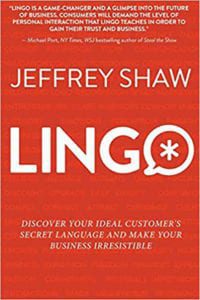
LINGO: Discover Your Ideal Customer’s Secret Language and Make Your Business Irresistible
We turn to Uber and Lyft, and the whole business model of technology is to create a frictionless experience. HR is like the fax machines of business practices and it’s a big problem in HR. If they want to get their dream employees, they need to develop the process itself to be more frictionless or more technology-driven. If they want the dream employees of today’s workforce, they need to think like them. They need to speak their lingo.
The takeaway I have is if you’re trying to target a tech Millennial and your application process, your whole interaction with them is a pleasant user experience as they call it in the tech world. It’s seamless and there’s not a lot of bumps. It’s easy to use and it’s intuitive. They think, “They’re speaking my language. They want me to do this, but they already arrived. I’m going to come here. These people already understand the importance of what is important and therefore, I’m intrigued to possibly pick them versus another company trying to woo me.”
You will stand out competitively. If you were that candidate or potential employee, wouldn’t that also mean to you what the experience of working for that company was likely to be like?
I was speaking at a Coca-Cola Summit for CMOs who carry Coke instead of the other brand. One of them was the CMO of Domino’s Pizza and I said to him, “What’s your biggest marketing challenge?” He said, “Attracting tech people.” I said, “Really?” He said, “Yes. We’re competing against a lot of other tech companies because we’re promoting this app that tracks your pizza from the time you ordered it online, how fast it’s getting there and who’s doing it. We used to say we’re a pizza company that uses tech to try to attract this top tech talent. Now we say we’re an eCommerce company that happens to sell pizza.” I thought, “You’re speaking their language because eCommerce company happens to sell insert books. It sounds a lot like Amazon, but you’re just inserting pizza.” That’s another example of what you’re talking about speaking the right lingo to recruit the right people.
I’m working with a company that layout offices. They get the furniture and they design it. It’s an integrated system that they offer and they’re big on what they refer to as resimercial design, which is this blend between residential and commercial design. In redoing their branding where you’re leveraging that as one of the key distinguishable properties that they want to promote to potential customers as to how they can attract their ideal employees. Many companies are having a problem attracting a good workforce. Designing their offices in resimercial styles are attractive to today’s workforce because it’s a cooler atmosphere. I even dig deeper and I was like, “There’s also an added psychological benefit here. In all our lives, the lines are blurred between work and in our personal lives. There are almost no lines.” Therefore, in the workplace when you soften those lines, it’ll feel like that. You increased productivity because it’s not like you’re going to take the hour and go down to the cafeteria. You’re going to sit in a café and keep working while you’re having your sandwich.
At least have a casual conversation with people you work with and collaborate on brainstorming ideas in a new space. I’m a big believer in that as well. Any last thoughts or a quote you want to leave us with?
Philosophically, I believe that businesses, whether they’re businesses seeking their ideal customers or their dream employees, those that take the time to get the audience, get them. They get the audience they want to reach and achieve their goals. Companies that are willing to get their customers will get better customers and companies that are willing to get today’s workforce will get their dream employees. It starts with having a willingness to understand the lingo of the people that you want to attract. I look at lingo as the evolution beyond buyer personas and avatars, which at best scratches the surface. It’s an attempt. Buyer personas and avatars is an attempt to understand that you have to go further than that today because all the companies that are producing buyer personas and avatars are all going to compete with one another. If you want to stand out, go beyond the buyer persona and avatar and find out what emotionally moves the audience that you’re trying to attract.
People can find you if they want to hire you and have a conversation about having you as a speaker at JeffreyShaw.com. Jeffrey, thanks for being such a great guest and sharing your secrets on lingo.
John, thank you for having me. I appreciate it.
Important Links
- LINGO: Discover Your Ideal Customer’s Secret Language and Make Your Business Irresistible
- Creative Warriors
- JeffreyShaw.com
- Better Selling Through Storytelling Method Online Course
Wanna Host Your Own Podcast?
Click here to see how my friends at Podetize can help
Purchase John’s new book
John Livesay, The Pitch Whisperer
Share The Show
Did you enjoy the show? I’d love it if you subscribed today and left us a 5-star review!
- Click this link
- Click on the ‘Subscribe’ button below the artwork
- Go to the ‘Ratings and Reviews’ section
- Click on ‘Write a Review’
Love the show? Subscribe, rate, review, and share!
Join The Successful Pitch community today:
- JohnLivesay.com
- John Livesay Facebook
- John Livesay Twitter
- John Livesay LinkedIn
- John Livesay YouTube