

How Diverse Voices Are Changing The Narrative With Blair Bryant Nichols
Posted by John Livesay in podcast | 0 comments


For years, the dominant voices in the business world were white, male, and straight. But that is no longer the case. Diverse voices are starting to change the narrative. Increasingly, businesses are recognizing the value of diversity in all forms and actively seeking out diverse voices to help them tell their story. When companies embrace diversity, they send a powerful message that everyone is welcome and that all voices matter. We talk about all this with Blair Bryant Nichols, owner of BBN Creative Management. Blair is an expert on developing speakers for corporate events, conferences, and other thought leadership opportunities, including internal and external communications. Join in as he talks about unconscious bias, diversity, and how the right mission and purpose drive success.
—
Listen to the podcast here
How Diverse Voices Are Changing The Narrative With Blair Bryant Nichols
Our guest is Blair Bryant Nichols who manages speakers, authors, and other people who are all about diversity. He is a champion for getting diverse voices heard. We also talk about unconscious bias and how, when you have a mission, that’s what drives success. Enjoy the episode.
—
Our guest is Blair Bryant Nichols. After beginning his career representing hundreds of authors from top six publishers, he moved into the management of founders, entrepreneurs, executives, authors, and celebrities with various work streams, projects, and personal interests acting as a chief-of-staff, manager, or agent. He has deep expertise in developing speakers for corporate events, conferences, and other thought leadership opportunities, including internal and external communications.
As a manager, coach, and consultant, he helps diverse individuals and/or socially-driven companies foster new strategies for operations, communications, business development, and partnerships across all appropriate areas to further develop and enhance their bottom line and brand. Blair is the author of Before You Fall In Love, a series of personal essays on Medium.
He is a former Co-Host of Inside The Greenroom podcast, which is a behind-the-scenes look at the ever-changing landscape of live events and the speaking business. He got his MBA from UCLA Anderson with a specialization in Entertainment Management. He is my particular speaker manager, I’m happy to say. Welcome to the show, Blair.
Thank you, John. I’m constantly reminded I need to shorten my bio but thank you for sharing.
It’s quite a list of accomplishments. I always like to ask my guests to take us to their own story of origin because we love storytelling here on the show. You can go back to childhood, high school, college, or wherever you first felt like, “I like communications. I like connecting with people.” A show you were on in high school that you were like, “I’m going to be in the entertainment business in some way, shape, or form.”
I was a Literature major as an undergrad because I loved books. I thought I wanted to work in government. I realized that law and government didn’t excite me as much. With Literature, I felt like I could explore something that I was passionate about, all while having no idea even that the publishing world existed. Even though I was reading my entire life, I never thought about the business behind it. I set my sights on that and landed at the HarperCollins Speakers Bureau.
My journey, as I’ve started to reflect on it more and more in my career, certainly began much earlier. I went to a Catholic high school in South Carolina. The day before I graduated high school, we were at the church that we were using for our baccalaureate mass, the traditional mass the day before our graduation. It was going to be the time when they were announcing all of the honors for the senior graduating class. There were only 33 of us. It was a pretty small newish school in the area so it was a pretty intimate setting.
The big awards of the night were salutatorian and valedictorian and officially announced those to the community there. I grew up gay. I was in the theater. I was a nerd. I was not an athlete. For me, the imagination, the culmination of my adolescence was going to be this graduation, and being the valedictorian and giving that speech felt like my Oscar moment. You’re giving that speech. You fantasize about finally feeling some validation and reward for a lifetime of anxiety and sometimes bullying. Especially in a Catholic school, questions about your identity, and everything else that’s going on.
[bctt tweet=”The right mission and purpose drive success. ” username=”John_Livesay”]
I like the combination thereof valedictorian and feeling validated. That’s a clever play on words there.
Maybe there’s a connection there. As they got closer to announcing these top two positions, they got ready and they announced, “Salutatorian Blair Bryant Nichols.” I was a salutatorian and everyone clapped. It was a nice moment and then they announced who would be valedictorian and my entire class stood up. I can’t tell you what it felt like at that moment to feel ultimately defeated. It wasn’t just that this classmate had beat me in my GPA, had outperformed me on tests, and we went head-to-head.
What had happened a few months earlier as we were gearing up for the end of the year and there were about four of us with very similar GPAs all taking multiple APs and finishing up with finals. They said that they needed a little bit more time to determine who ultimately would be the valedictorian. What was going on behind the scenes in my conservative Catholic high school was that my headmaster went to the drama teacher, someone I was very close with, and asked if I was going to come out during my graduation speech because that was the rumor.
I wasn’t publicly out. I had told a couple of my friends. I was out to my family who was supportive. My mom was a teacher at the school. She had heard what was going on behind the scenes. Ultimately, what they decided to do was not reward it to the person who had slightly the highest GPA. They decided to let the faculty vote. Now, imagine being my mother and watching her son who should have been rewarded with this top honor, see her peers, colleagues, and boss decide to hold an arbitrary vote. They selected the person who is much more aligned with their faith, who had demonstrably done more in the church, is more involved, and in their eyes, is a better example.
The funny thing is they still let me give a speech. I’m not sure why this was big prevention, but it prevented me from receiving something that I felt like I had earned. As privileged as my life has been and was to that point, it gave me that first taste of discrimination that didn’t sit well. It planted a seed in me that made me want to rebel against society, organizations, and systems that held people back for racist, bigoted reasons and be a champion for diverse voices.
I landed in this industry because I love publishing. It was a great opportunity to get into this world. It took me from HarperCollins to Hachette, Simon & Schuster, GTN, and bigger agencies. It took me from New York to LA and where I still live. Ultimately, it took me to where I’m at now, starting my own business that’s devoted to diverse voices and championing people who are not White straight men.
There are a lot of speakers that I first worked with in this industry that fit that description. In fact, most of the highest-paid speakers ever heard of in that description aren’t celebrities. They’re former CEOs and presidents. They’re the people who you would expect to be receiving these types of paychecks. The people who were getting booked for diversity talks were always the low man on the totem pole. We’re always getting the least amount of fees and we’re considered not as important or valuable as these other speakers.
I’ve come to see and research shows, again and again, the value of diversity, innovation, creativity, and all these different things. I don’t offer speakers of the world who just speak about diversity. You’re not an expert in diversity. You’re an expert in storytelling and sales. You’re a master at it. You just happen to be diverse. That’s what the marketplace wants. They want new perspectives. They want people that represent all sides of the industry, all silos, or whatever it may be, but they want them to also represent different parts of their population of their employees.

Diverse Voices: Nobody wants to be the recipient of stereotypes or prejudices, and yet we all are programmed with it.
Hopefully, by working with people that don’t always look exactly like them, they’re getting what they’re investing in, new perspectives, and ideas. They’re getting something more from that talk, workshop, or whatever it may be because if they just brought in someone that looked and thought like them that reinforced what they already knew, there’s not going to be a lot of change. I’m sure you’ve experienced that in organizations and seen when it goes well and when it doesn’t go as well.
You’re 100% correct because the assumption that everyone is a White, straight male just because you happen to be White and male is consistently surprising to me. You always have a choice on how you come out and let someone know you’re gay. It could be, “My husband and I,” or, “My ex-husband,” in my case, whatever you say that lets people know without having to say I am gay.
It lets people know that the assumption of this is not accurate. Everyone I know who has gone through that process of coming out has faced some level of pushback. “We’re not so comfortable with you.” Especially the hiring process often is, “I want to be able to go have a beer with this person,” and stereotypes that go around that if someone’s gay, they’re not into sports, this, or that.
They can’t possibly relate to my life. There’s way more that we have in common than we have not. If you’re not able to find the connection points with people because of your sexuality, then that’s on you. The perception is a lot of people are like, “I don’t even want to try. I don’t want to take the risk of having it be awkward for me.” You don’t make anybody feel awkward, but they need to understand. What you said is that the different perspectives of diversity, whether it’s gay, a different race, gender, or whatever the issue is, diverse ideas create diverse concepts and creativity.
If you keep listening to your own bubble to get your news, then you never have other perspectives. That’s not where any growth comes from. Your management company is BBN Creative Management. You only manage people who are diverse in some way. I thought that was a fascinating niche. I love the story of where you got your own sense of, “This isn’t fair. This isn’t right. I can’t be the only person experiencing this so I’m going to figure that out.”
Just because someone is diverse, again, the stereotype was, “That must be your topic.” There are so many assumptions that everybody makes about things that they don’t know about. Ironically, it’s the same problem in business that I see a lot. They go, “This is a big company, therefore,” and then they put all the stereotypes about them, “They’re not flexible. They’re not nimble. They treat people like numbers.” That’s not the case in every big company. Nobody wants to be the recipient of stereotypes or prejudices, yet we all are programmed with it. Can you speak a little bit about what people can do besides bringing in people, whether it’s a speaker or employees to make people feel welcome?
I want to comment on some of the things that you said because that idea of having someone that’s like us, that fits our culture, and is going to be a good cultural fit, you hear that a lot. That’s code language for, “They’re like us. They look like us. They think like us. They’re going to fit in. They’re not going to rub anyone the wrong way.”
You want people with diverse ideas. You want people that differ in size, age, and everything. The most successful teams are ones that are diverse and it’s a flat egalitarian-type model rather than hierarchical. You want people that can work together from all different perspectives, but not with one person, the appointed leader in some structure that makes anyone feel less than. That’s just a little bit about teams.
[bctt tweet=”Diversity creates innovation.” username=”John_Livesay”]
One of the things that I love most about working in this industry with people like yourself and getting to meet so many amazing, smart people in their areas of focus is now I’m working with a woman named Vivienne Ming who’s a transwoman married to another woman. It is pretty diverse. She has talked about the neuroscience of trust. She’s been one of those speakers talking about diversity for many years.
Businesses keep inviting her back to make the case for diversity and the case has been made. There’s data and research in reams to support what I mentioned around creativity, innovation, engagement, and pay equity. All of those things that especially my generation and others care so much about now in our workplace. She got interested in why it is so difficult for people to put these changes in place.
Pragmatically, they know what the benefits of diversity are, yet a lot of these trends continue. A lot of these things happened in corporations or small companies or whatever the case may be. She did further research and found that it’s back to our biology. You and I have a sense that we’re similar. We have similar backgrounds. We both grew up in a similar part of the country. We’re White, we’re gay, we’re male, but it’s even down to if your intestinal flora is the same as someone because you live in the same thing. You have a similar diet. It comes down to so many factors that are completely innate that it makes meeting someone else risky.
It’s a risk. It’s effortful. When you go out, you meet someone, and you click, that’s how we all judge whether or not they’re a good match. We’re like, “We’re going to get along well. I didn’t vibe with that person if you’re in LA because that’s your first impression. Oftentimes, that’s the person that’s going to help you grow and change the most, expose you to new perspectives, and make you uncomfortable.
It’s the same thing in hiring, but you’ve resisted that. It seems like, “This is going to be unproductive. This is not going to make things efficient. This is going to make things harder and it’s true. It will. It is effortful to integrate someone different, but the results speak for themselves. This resistance to it is not something that comes down to policy and practice. It comes back to even our own biology.
To answer your question finally, “What can people do?” you have to make that effort. You have to understand and know that psychology, the neuroscience are going to tell you to resist. Think that this person isn’t the right one, but maybe you need to dig a little deeper. Check your own assumptions and biases. Understand, if maybe this is going to be the value add that you need because there’s going to be some friction. There’s going to be something different.
That’s fascinating to think about, “We can take it from a business angle. I can talk to you all day long about the bottom line impact,” but it hasn’t made a bunch of changes. We have to be aware of what’s going on in our minds and our bodies to then be able to overcome that and create the change which will create the organizations that you and I would love to see.
You touched on so many great things there. Let’s unpack that a little bit for the listeners. The first step is the awareness that we all have some bias. The concept is during hiring, in particular, it’s an unconscious bias. I have a little story about that shocker. When I started working at Condé Nast, I worked for a woman publisher who was a brunette.

Diverse Voices: Speaking is not a vocation. It’s an advocation.
I didn’t notice it until after I’d been there a few months that all the women in the New York office that reported to her were also brunettes. I’m like, “That’s interesting.” It wasn’t until she left and then they hired another woman to be the Publisher of W Magazine and she was blonde. Little by little, everyone that was replaced or left was also blonde.
I was the only one that had been there consistently to notice that and I was like, “This is fascinating. Your unconscious bias, even on hair color, let alone anything else, sexuality or race, is influencing who you hire.” Once we realize that it is unconscious, we have to fight because that’s staying in our comfort zone. I like to work with people who in some way look like me literally, in the hair color case. They may be not even aware of it. If I want to have some diverse opinions and override that, I might have to get out of my comfort zone.
As we know in business, if you stay in your comfort zone, that’s the beginning of the end of your business. You’ve got to constantly be stretching, learning, and trying new things. Certainly, this is one area that a lot of people are not instantly thinking of. “This is a way to bring in a new idea from someone who has a completely different perspective than I may have, but certainly some of our employees have it. We want to make this a friendly place for everyone so let’s mix it up a little bit.” That awareness is so valuable.
Let’s talk about some of the other people you represent because there’s a wide variety. I tell people about Bethany Hamilton who is famous for losing her left arm to a shark. People have seen the movie and the book. They say that it is a fascinating level of awareness that someone like that has. You’re not quite as well-known as Oprah, but she has an evergreen message that could have gone the opposite way.
She’s this beautiful woman. She doesn’t have her arm. A lot of people would say, “I’m just going to be a hermit.” She did the opposite. I would imagine that we all have flaws, whether they’re visible or not, disabilities, whatever you want to call that, something that we’re embarrassed about, or that’s not the norm. Someone like Bethany is showing us, “Why don’t I make the most of this?” It makes you grateful you have all your limbs. That is a starting place. I speak to what people love about her.
She’s so unique because a lot of times when you have someone like her who’s an athlete, often they’re well known. They have won the Superbowl or been very popular. I wouldn’t say surfing is the most popular sport by a stretch in the US or anywhere around the world. Her story of perseverance is so unique, at thirteen years old, getting back in the water, and wanting to continue to do the thing that she loved. This traumatic experience could have easily set her back for the rest of her life, and maybe would have heard the story of her survival and that would have been it.
It would have been a news story, but what’s so interesting is that her story has permeated society so much that almost every elementary school includes her story in one of their books by 3rd or 4th grade. My niece in Indiana brought home a book and my sisters called me, “You’re not going to believe this, but Megan is reading a book about Bethany Hamilton right now. I told her that you work with her and she was so impressed.”
I get so many requests from people from big companies and organizations. The reason they’re interested in her is that the kids love her. Whether they’ve talked about it or watched the movie. She’s got her documentary, Unstoppable, on Netflix, too. That’s something so unique. You don’t hear about that often with speakers. That’s not a groundswell coming from the children of the potential meeting planners and organizers. She has that personality, message, and that lightness about her. She’s apolitical. She doesn’t want to choose sides. She is all about health and living a wonderful unstoppable life. She’s been successful for so long at this because she’s not the best speaker.
[bctt tweet=”The most successful teams are very diverse, a very flat egalitarian type model rather than hierarchical.” username=”John_Livesay”]
She’s not in it to be out there like Tony Robbins. She just enjoys sharing her story, helping others, and inspiring, especially young people. That’s something interesting to me. I haven’t worked with a lot of speakers where I felt like so much of what’s continued to carry their story and their everything forward has come from such a young audience. I’ve started to think about how to diversify some of my client’s offerings with children’s books or YA books and start to plant those seeds early because I’ve seen what effect it has on someone like her even her speaking to big companies.
My book, The Sale is in the Tale, is a business fable about someone who’s 30-something. When I was speaking to a client, the guy said, “I saw my son in your story.” That was never my intention, but it made me happy that when you have a story that’s so strong, people younger and older than whatever that person is going through at that moment can relate to it. Speaking of story, let’s talk about Michael Anthony, AKA Michael Unbroken. I am like, “ I’m the Pitch Whisperer. He’s Michael Unbroken.” I loved that. He is all about being the hero of his own story. Tell us a little bit about what Michael Unbroken is doing.
It’s another great case study of how this crazy-speaking world can work. He was at a speaking competition. He won a pitch contest. Someone was there that I used to work with and unrelated. His team reached out to me to be on the podcast that I was previously recording. One of my other clients was at that competition. We started talking. We had a great conversation on the podcast.
He ended up becoming a client and working together more fully. He just has an incredible story about the trauma he endured as a child, how he escaped and rebuilt his life from addiction being massively obese and on his own after, horrific things happen to him. He has made it his mission to end childhood abuse and trauma in the future.
A lot of speakers, especially ones that I align with, have a massive purpose and vision. One of my old bosses used to say, “Speaking’s not a vocation. It’s an advocation.” It’s best when it’s not just there for people who want to sell, who want to make money, who figured out they’ve got a thing that they can offer. There are budgets and we’re just going to keep pitching.
It’s people who are driven about getting out there and sharing a message who have a deeper purpose. It doesn’t matter if they’re speaking to corporate audiences. At the end of the day, they are driven by something higher and bigger and that is him. He’s been driving up the charts on his own podcast and self-publishing books, getting the word out, and completely hustling his way into very influential places with influential people. Hopefully, you’ll be hearing a lot more about him in the future because he hasn’t quite broken through to the general masses, but that’s where he’s headed.
You said something I want to double-click on for everyone reading, which is the importance of having a mission bigger than making money. It’s something that we’ve heard before, but a lot of us forget, we don’t think it’s important, or a company might have it written somewhere on a wall, but nobody visits it and lives it every day.
I know from my own journey when I came up with the mission of helping as many people as possible get off the self-esteem rollercoaster, where you only feel good if things are going well or your numbers are up and bad if they’re not, I, myself, was on that roller coaster many times, up and down. We don’t celebrate the good. You’re already back to worrying about, “How am I going to hit my next goal? What if something bad happens to me if I’m not making my quota, getting laid off, or whatever else?”

Diverse Voices: Generosity leads to intimacy, which leads to candor, which leads to accountability.
I got from a client that you are on this rote which is exhausting. If I can show people through the stories they’re telling themselves in their head, how to step out of that so that any one event doesn’t devastate or elevate your self-esteem. That it stays fairly consistent regardless of outcomes so you’re not seeking. That is a huge takeaway for a lot of people.
They usually engage me to help them win more sales, but then when the message and the mission are coming out, that’s one of the biggest things that people say to me. It becomes awareness that I’m on it. I didn’t ever label it before and you’ve shown me a way to get off of it. That’s when you feel you’re making an impact. That’s what all of us want to do in whatever job we’re doing.
When you think of having that mission and purpose, when you’re sharing that, whether it’s in a sales context or in meeting someone, it gives them more of an emotional connection to you as a person. Even if you tell a great story and make it emotional, if they also know what you’re now, what your purpose is and everything, it sticks with them. I get so many people who find me because they’re excited about my mission or they liked the copy on my website. If you put it out there, people are going to remember you.
People are going to find you. They are going to refer people to you because they’re going to remember, “You need to go talk to Blair. He’s similar. You guys have similar ideas. You guys would align.” The magic is when you’re not just making a nice connection, closing the sale, and keeping it warm and friendly. They’re actively referring people to you. John, how did you turn people into evangelists for you? You’ve done such an amazing job with sales. That has to come through some referrals and word of mouth as well.
The number one thing I do is figure out what the expectations are and challenge myself every time to what can I do to exceed those expectations and go above and beyond. That’s what people remember. “We got some nice feedback or what have you.” I remember giving a talk and the client came up to me. He said, “We never have the same speaker back next year. Do you have any recommendations?”
I said yes and I gave the recommendation. I looped it back to the speaking bureau that had booked me for the job. I said, “I know they also happened to represent the speaker.” That bureau raved about me because I was going above and beyond by giving a great talk and making the client happy but I was pre-setting up for the next one a year out without him having to start from scratch all over again. That’s one thing I do.
It’s challenging ourselves, “What can we do to be irresistible to someone that they remember us and want to do something that makes it special?” I love making introductions. We met through our mutual friend, Sterling Hawkins. If you want to build relationships with people, do that. Think about somebody else and help them. That builds so much goodwill that it energetically comes back to you.
I agree with that. I love making connections. I’m not a matchmaker. I wouldn’t even know where to begin on that. Professionally, I’m the guy who knows a guy, generally, or in most cases, a gal who can help you out. Generosity is exactly the key. I worked for Keith Ferrazzi for three years as his Chief of Staff and his book, Never Eat Alone, is pretty much a guidebook to building relationships.
[bctt tweet=”You want people that can work together from all different perspectives, not with one person, the appointed leader, and some structure that makes anyone feel less than that’s just a little about teams.” username=”John_Livesay”]
There were four points in a circle that is the general framework. Generosity leads to intimacy, which leads to candor, which leads to accountability. It works across the board. If you lead with generosity and actual generosity, not, “I know exactly what I want to ask for once I give them this thing.” You know so often when people are being generous with an ultimatum or an ulterior motive is the appropriate thing.
When you’re truly generous, follow up, make that connection, and help someone with what they’re doing, that’s going to lead to a relationship. You’re going to get real candor and hopefully, the accountability whether it’s an employee or whatever also comes through with these types of relationships. That bureau is going to feel some responsibility to continue to promote you. They want you. You’ve done a great job. You bring the business back.
That’s the accountability on your part. You’re bringing business back to them that you easily could have spun off for yourself and have taken and run with it, which is what a lot of speakers do. They think in the short term and those are the types of people, whether they’re in Hollywood or all over the world, as speakers. They don’t have as long of careers because these people, the ones that you’ve worked with, the ones that I’ve worked with, have been around for a long time. These are long-standing agencies and bureaus. Maybe some of the people will change and go but a lot of the major players are still the major players in this business. It hasn’t completely exploded and consolidated either.
It’s a smart way that you navigate these relationships and how generous you’ve already been with me, how I’ve seen your relationships that you’ve built with the other agencies, and things like that. That’s what excites me about working with you and with others who understand the value of partnership and that this is a long-term strategy.
This is not a get-rich-quick thing that you can maximize in one year and walk away from if you want to get the most value out of it. It’s thinking in the long-term, creating that plan, and being intentional about that. It’s okay to be generous to people that you want to have a relationship with because you want to do business with them. You just have to provide value if you think they’re going to want to have any exchange with you.
Before I say goodbye to you on this episode, I wanted to ask you. AJ is the Founder of the concept of Get Your Shine, which is a personality quiz. Everybody loves a quiz so good for him for creating a quiz. Tell us a little bit about what that is.
AJ, similar to you, he and his partner moved from LA to Dallas during the pandemic. They’ve been living that Texas life out on a ranch there in Granbury. It is not the same as Austin. He’s an incredibly energetic speaker. He used to be the Head of Mojo when Verizon and AOL merged and Yahoo was mixed in there, too. He was traveling the world, speaking to different teams, and getting them excited.
He’s done a lot of coaching with executives on communication and a lot around internal culture and things like that. He created the Shine Scale as a way to talk about the different attributes that help bring you to life. In the same sense of building your confidence, putting your best foot forward, and understanding the areas where you could use some improvement, the scale helps break down some of the things where you’re maybe more heart-focused and where you’re more head-focused. It splits between the two. We need both.
[bctt tweet=”Having your sense of purpose and meaning and why you do what you do can create much more excitement, engagement, and purpose in your life.” username=”John_Livesay”]
Oftentimes in sales, sometimes people are head-focused. They focus on the numbers, the data, and the pragmatic side. They ignore the heart. They don’t make that emotional connection. They don’t tell a great story. They don’t bring out the qualities that make people like and trust you, which is how they buy and make decisions. There are those times and there are times when people are too heart-focused and don’t ever get around to the salient details and the other things. They think the relationship will carry them into that conversation.
You need both. He talks about both sides of that. We’ve done some really interesting workshops for Univision and Verizon, even virtual during the pandemic, and getting their teams to think about their own personal mission statement. Even when you work for a major company, having your own sense of purpose, meaning, and why you do the thing you do can create so much more excitement, engagement, and purpose in your own life.
We’re helping people do that, who were not usually in an environment to participate in those conversations, and who hasn’t been asked to share their origin story ever before. By the end of the session, we’re getting them all to do that. You can tell the shift that comes over them as a team and as an individual, getting to start to look at themselves, and define their work as a part of their identity, rather than just, “This is my function. This is my story over here.”
You’re singing my song because I love working with clients and helping them figure out their stories of origin. Why did you get into healthcare? Why did you become an architect? I’ve had people who’ve worked with people for years, not knowing that story of origin, and suddenly feel closer to them. It’s because stories make us feel connected and bonded. More importantly, they make us memorable. That’s the a-ha factor when you’re meeting so many people. If you have a little story that has a twist to it that does it. If people want to reach out to you, they can go to BBNCreativeManagement.com. Before we say goodbye, do you have a final quote or a book you want to recommend?
I wanted to conclude a little bit more about my story and then I’ll share some recommendations there, too. I thought back to high school graduation when I’ve been examining my origin story as I launched my company and have been speaking to clients and potential clients. It got me thinking even further back and I realized that the salutatorian speech wasn’t the first time I had the opportunity to get up and speak in front of an audience.
I lived in Pennsylvania when I was in middle school. We had moved there when I was starting sixth grade and we moved back to the same town where I’d left in eighth grade. Middle school is not the best time in anyone’s life. It wasn’t the best time in my life. I didn’t make a ton of friends. I didn’t have overall the best experience. I was getting ready to leave at the beginning of eighth grade. We had written essays and submitted them. That was the only assignment, but my teacher decided that she thought I should read my essay aloud.
The irony or the coincidence was I was Bethany Hamilton’s age. The essay was about sink or swim. I went on to describe as a thirteen-year-old male in front of an entire class of other eighth graders that I felt like I had sunk there. I had given a moral about when people are struggling, help them swim instead of sink. Hopefully, I’ve gotten stronger. I do remember the feeling of being recognized, supported, and told that your story is important. Your peers need to hear it.
Rather than my story being about getting back at the people who discriminated against me and there’s been many more than that one high school principal, it’s about the people who lift other people’s voices. Being one of those people, being the support, the love, and the care, not to knock anyone else down or displace anyone, but to help give more room for those types of voices. That is what I’d like to think about more than some of the other more traumatic parts of the origin story. There are a lot of great, amazing books out there. I’d recommend yours. It depends on what you’re looking for.
You guys can reach out to me on LinkedIn, as well as BBN Creative Management. I’m always happy to have a chat wherever you’re at in your business, speaking, or whatever it may be. I’m always happy to meet new people and give my two cents. Feel free to define me online. We can chat more about book recs, too. You can follow me on Instagram. For the first year, I’m finally posting books that I’m reading. I’m trying to be more intentional about that so you can see what I’ve been up to and what else I’m reading the rest of the year.
Thanks so much, Blair, for coming on the show, for becoming my speaking manager, and for sharing your wisdom on how important it is that all of us realize that we can join this mission to be champions for diverse voices, whether it’s ours or anyone else’s. When someone’s down, reach out a hand, and help. If we all start doing that a little bit more, things will change.
Important Links
- Blair Bryant Nichols
- Before You Fall In Love
- The Sale is in the Tale
- Never Eat Alone
- Get Your Shine
- LinkedIn – Blair Bryant Nichols
- Instagram – Blair Bryant Nichols
Wanna Host Your Own Podcast?
Click here to see how my friends at Podetize can help
Purchase John’s new book
John Livesay, The Pitch Whisperer
Share The Show
Did you enjoy the show? I’d love it if you subscribed today and left us a 5-star review!
- Click this link
- Click on the ‘Subscribe’ button below the artwork
- Go to the ‘Ratings and Reviews’ section
- Click on ‘Write a Review’
Love the show? Subscribe, rate, review, and share!
Join The Successful Pitch community today:
- JohnLivesay.com
- John Livesay Facebook
- John Livesay Twitter
- John Livesay LinkedIn
- John Livesay YouTube
The Attention Switch With Itzik Amiel
Posted by John Livesay in podcast | 0 comments

Did you know that networking is all about listening? John Livesay’s guest in this episode is Itzik Amiel, the founder of EyeRon™ Group and author of The Attention Switch. Itzik shares his deeply personal story about the hug of life. It’s when the bus he was supposed to ride in exploded. Do you know what made him miss the bus and narrowly escape death? It’s hugging his girlfriend, who’s now his wife. From then on, he never passed by any opportunity to establish true connections with fellow human beings.
The only way to make real connections is by giving attention. If you want to succeed in networking, you need to learn how to pay close attention to the people you’re interacting with. Are you ready to get the success you always wanted? Then this episode’s for you. Tune in!
—
Listen to the podcast here
The Attention Switch With Itzik Amiel
Our guest on the show is Itzik Amiel, who is the author of The Attention Switch. We go into great detail about the different kinds of attention, how to get attention and how to keep it. He said, “Where energy flows, that’s where the attention is going. Attentional networking is the art of being you.” Enjoy the episode.
—
Our guest is Itzik Amiel, who has extensive experience for decades, gained as an international tax and M&A lawyer where he’s worked with companies around the world in the trust and financial situations. He founded a company called EyeRon. It’s the leading global expansion company where he listens to client’s needs and helps them grow their business internationally. There are lots of things you can imagine that you need to know and each country has a different situation.
He and his team operate in over 27 countries with a special focus on BRIC countries and emerging markets. He also founded the Power Networking Academy, which is the number one provider of business networking and relation capital. He is traveling all the time, has been featured on all kinds of international business TV channels, and has a great book out called The Attention Switch. He is working on a new mastermind for those people who qualify. We’ll find out more about that. Welcome to the show.
Thank you very much, John. I’m so excited to be here. I was listening to how other people introduced me because I’m learning about myself. The older you get, you start forgetting what you’re doing in your life and not appreciating it enough. When somebody else is talking about it, what goes in your mind is, “Is that me? Is that everything about me?”
I love the quote about your book being considered the Dale Carnegie super upgrade for the cyber age, which is fascinating. I want to ask you your own story of origin. You can go back to childhood or school, call it law school, wherever it was. When did you start having an interest in law and international? Did that lead to networking or did it start with networking?
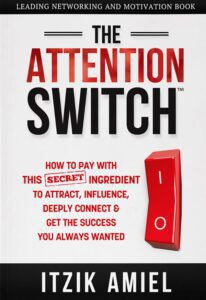
The Attention Switch: How to Pay with This Secret Ingredient to Attract, Influence, Deeply Connect & Get the Success You Always Wanted
You touched a very interesting one that nobody ever asked me in any show. You told about the book and about the fact that it was compared to Dale Carnegie. Here’s a secret I never share to nobody. The first book I ever read in my life was from Dale Carnegie, How to Win Friends & Influence People. I’m an Israeli originally. I read it in the Hebrew language. I remember finding it on the shelf in my room. It was owned by my father. He declined that he ever read that book. He doesn’t know about this book. I know it looks like, but I could not find this book anymore.
Since that day, it has influenced my life. I used to give it to a birth or for friends, but I never used to talk about it. It’s almost taboo in the legal world to talk about how to influence people and win friends while you are miserable. You have to do it. Nobody will understand. It’s almost like Napoleon Hill’s Think and Grow Rich. If people go, “I don’t want to be rich,” it’s not about that. It’s about thinking, mindset, ability and skills. We’re celebrating them but many years ago, nobody did.
I was embarrassed to say that I love people. Can you imagine? That’s a true story. This is my real story that my bestselling book, The Attention Switch, starts with. I hid this story for all my life as a lawyer. It’s from February 25, 1996. At the time, I used to live in Israel and work for a law firm in Tel Aviv. I’m originally from Jerusalem. My girlfriend then, which is my wife now, was working as an au pair in Jerusalem.
You know with boyfriend-girlfriend, I’ll sneak few times a week to Jerusalem and stay with my girlfriend. Early in the morning, I go to the bus station and from there to the center station to go to the Tel Aviv office. In that morning on 25th of February, ‘96, I woke up. If you work with me, I’ll have coffee. I was about to go to get the bus. At the station, my girlfriend hugged me. I ran and I missed the bus. It’s always the same routine. People stay in the same place. You’re going to know it because if you miss this bus, you miss the next connection and you’ll be late.
I remember being annoyed to wait there. Twenty minutes later came another bus. I was on the way to the center station in Jerusalem. There were police who stopped the bus. In the ‘90s, there was a lot of incidents in Israel, terrorists attack, all kind of stuff. We were curious about what was going on because we had to go from a different way to the central station. We asked the bus driver if he could open the radio so that we could hear what happened exactly. At that moment I heard that the first bus I was going to take exploded and everybody died.
You wouldn’t be with us if you got on that bus.
[bctt tweet=”Give attention when you love somebody.” username=”John_Livesay”]
I never shared that story. If you go over to Jerusalem, that’s a big place, though. It was the biggest terrorist attack we had. They had the same bus, same number and same hour the week after again, which was a very crazy incident. I will never think once I was miserable. I had power within myself. I was very successful. If you’re asking me, John, what was the time that I endorsed life and people? That was the moment.
My girlfriend is my wife now. This hug that I talked about is the act that I based all my life, the act of giving attention. It is the period of Corona. I guarantee you, John, if you go to an event, people meet and start hugging each other, count on me. Feel the feeling that people can transfer to each other but just warm hug. Without talking, pitching or anything, you can transfer it to another human being so much more warmth, love, care and empathy. “I’m here for you.” It’s everything you want with just a hug. That can be an act of giving attention.
That brings me to one of the things in your book, where you call it The Hug of Your Life. Can you tell us that story?
That’s exactly the hug of my life. When my girlfriend hugged me, because of that, I have my life. I will talk about this metaphorically, but also strangely enough, when I speak on stages around the world, it’s not in my culture. We don’t hug in Israel for business. People are thinking we hug, maybe in the Middle East but not in Israel. When I spoke on stage, people came around and hugged me. It’s unbelievable. I even caused people to hug each other. For me, more than the symbol, it’s a way of people understanding human-to-human. “I don’t care who you are or where you are from.” Nobody can ever convince me.
I don’t necessarily look like an Israeli or a Jewish. I could look like an Indian, Brazilian, Spanish or Arabic. I look like everything. I use that all my life to show people how miserable we are when we judge people. You’re missing so many opportunities. John, when I was speaking on the big stages and you know yourself, there are many very known figures. I’m the unknown guy doing the big stages. Everybody that’s there was Les Brown, Dalia Lama and Richard Branson. I’m the unknown guy.
I will not sit in the green room, John. There is so much bullcrap there. We don’t like that. I’ll sit between the audience somewhere in the back. I’ll talk to people. I look at the brochure. In the brochure, whose picture is there? It’s the speaker. They’ll say, “Who’s this guy? Who’s the speaker” It’s me, but I say, “Let’s see what they’re going to tell us.”

Attention Switch: Scientists prove that attention is a muscle of the brain. You need to practice the muscle of attention.
Suddenly from the big stage, they announced, “Ladies and gentlemen, our next speaker is Mr. Itzik Amiel.” “That’s my turn. I have to go.” People will look at me and say, “I’m sorry.” I’m going to use that because in the middle of my presentation, I’ll ask this person to stand up. “How did you feel you didn’t know who I am? I was not important, but you connect me out of authenticity.”
When people stand in line and they want to hug you and take a picture of you, I’m not sure what they want. I always believe you build a relationship for a reason, season or lifetime. I’m begging each one that’s reading to stop building a relationship for a reason or season because you’ll be miserable. Every relationship we build, build it for a lifetime. When I look at a person, I said, “Will I be a friend of this person the rest of my life?” If the answer is no, don’t walk away from them because it’s embarrassing. Run away from them. You don’t want these people in your life.
There are so many things you’ve said here that I want to recap for the readers. One is when you don’t have something go exactly the way you think it is. I was flying back from surprising my sister for her birthday party in Chicago to Austin. The plane was delayed. I’m like, “I’m not going to get home until after midnight.” You can get frustrated and annoyed or you can zoom out again and go, “There must be a reason I’m not supposed to be on that plane.”
The other thing I love about who you are as a person is I can feel your energy come through. That is a reminder to everyone that what you’re offering people is your energy. I remember once I was interviewed for a speaking gig and the agent emailed me, “Congrats, they picked you. They liked your energy.” I thought, “There it is in writing.” It’s not our credentials or the outcomes we’re going to give people. The client said, “I felt so good after talking to you. I figured you could make all of the people in the audience feel the same way. We want to learn about ROI and all that other good stuff.”
Whatever it is you’re selling, whether it’s to get funded, get people to join your team, start using your app or buy your product, if you can remember that you’re selling energy and money is energy in action, it totally shifts how you interact with people. You’re a walking talking example of that, which is why we become friends. I love it.
The other thing I want to ask about is this beautiful visual you’ve created called The Rainbow of Attention. You’ve got some great distinctions. Let’s go through all of them because they merit a chat. We all know what a rainbow is, but we don’t realize that there are some differences between giving attention versus getting attention. How did you come up with this wonderful concept of a rainbow?
[bctt tweet=”Build relationships for a lifetime, not a season. ” username=”John_Livesay”]
The first is out of frustration, for example, in our days in social media. If you look at it, every marketing on social media online is based on the act of getting and grabbing the attention of the audience. People measure your success by how many likes you get and how many people give you attention. I don’t care about that. I care about those people watching it. They say, “Why don’t I get likes? Why did I get only two? I’m miserable. I’m nobody.” You see all this stuff. I hate it because I feel bad for those people. It’s not true. I wanted to show it, so I’m helping more than 25,000 professionals that don’t go to some LinkedIn or somewhere else.
I’m doing everything behind the scenes, like in the messaging. I’d build the relationship. By showing them, they’re getting huge deals. If you look at the profiles, it’s like, “I’m a miserable person. I get only two likes and then a few posts,” but behind the scenes, the opportunities, the relationship building is unbelievable. We have the biggest scars in our world of getting and giving attention. How many people, when you talk to them, shut up their mouths and listen to your story? In networking, what I teach is you don’t need to speak. The introvert among us knows that. It’s not about talking. There are other network jerks many times. Listen from the bottom of your heart.
Stephen Covey talks about seven ways of listening, synthetic, inactive and disactive, whatever it is. Listen with all your heart and soul. Not dreaming what you’ll eat at dinner while speaking to another human being. Not floating around with a face while talking to somebody. Being there in the moment, you’re going to magnetize the soul of the other people. They don’t even know what happened, but they felt in their gut, “I want more from that.” You don’t even have to give them your business card or tell them the name. I promise you, they are going to find you who you are because they want more of that. They will find an only excuse to find again where you are to go there to invite you. They’ll pitch you on themselves.
John, don’t get me wrong. It’s frightening to a lot of people. Some people talk to me where they met me as a stranger and within minutes, they’re telling me the deepest secrets of their life. There comes a moment where they look at me and say, “I don’t know why I told you the story.” I said, “Relax. Enjoy it.” Attention is not an artificial thing. Attention, as proven by scientists, is a muscle of the brain like you have muscle on the body. It’s like if you go to the gym to practice your muscles, you also need to practice the muscle of attention.
Let’s give our readers a little exercise. Let us ask each one of you there, what do you hear in the room where you are? Maybe it’s the birds, a car driving, some screaming children, the pot or TV. What is out there? It was a tricky question, John. All those things are there all the time, but their brain is choosing to give attention to us. Do you see what the power of it is? From all the noises in the world, from all the sounds over there, they shut them all off and give full attention to one human being. That’s why in English, you say, “You pay attention.” It’s a financial term. Which other thing could you pay with? If you could pay with attention, they’d be a billionaire without money.
One of the biggest compliments I can ever give someone or that I can ever receive is that someone would say to me, “I feel safe to be myself with you.” That goes back to what you were talking about, the magnetizing of the soul that causes someone to open up because they feel like you’re not going to judge them. That sends any kind of basic rapport 101 because you’re getting an emotional connection, which is how we all want to connect.

Attention Switch: Speak slowly and articulate the word.
That’s why people are missing an opportunity in networking. A lot of interesting people in networking don’t stand in the middle of the floor. They’re somewhere on the side. Think about it. If you’re a CEO of a big company, you don’t want to see people to bother you if you want to come and listen to whatever lecture. You’ll sneak in the back and stand.
You’re a speaker. I’m a speaker. When we go and sneak in to watch another speaker on stage before we’re done, where are we going to go? We’re going to go in the back of the room. If you want to connect with people, find them in the side of the room. You will be surprised by what amazing people they are. Everybody will miss it because everybody looks at these people in the middle. They’re talking to everybody there. Talk to the one in the side. The one in the room, don’t worry. You’ll meet them one at a time. The one on the side, they are many times crazier than great people. I promise you. You’ll be surprised how amazing people you meet. Only give them attention. That’s all that you need to do.
You also have a distinction between positive attention and negative attention. My first thought is, “If I do something stupid like trip or drop food on myself, that gets me negative attention.” I’m guessing you have a different meaning here.
When I wrote this chapter, I was in a hotel in whatever conference. I was sitting with friends and talking about it. We start discussing philosophically. I don’t remember exactly the detail, but there was an incident that happened with the lady there. I could see the look on her. She didn’t have to say much, but it looked like, “I’m going to kill you,” with the eyes. You know that’s not positive attention, but she gave you the entire message by her two eyes looking at you.
I remember even when I was a child, my mother used to open her eyes and we know exactly that we didn’t behave nicely. These are the ability to transfer. You could use it. It’s positive-negative but not in the sense of discouraging you but more of warning you and stuff like that. Some of them is awareness alerts. “I’ll wait from here. You’ll be in danger. Don’t put yourself in danger.”
Attention is a muscle. You need to learn how to play with it. I’m playing with it a lot in airports, John. It’s also connected to body language. I used to think that attention is about eyes. I thought people give attention with their eyes. When I did the book, I found the research. It’s bullcrap. Do you remember the time you called somebody? You’re on the phone and suddenly they’re silent. “Are you still there?” We need the sign of attention. People do it in different languages, cultures or ways. They will do something or symbolize it. You know they’re giving you the attention. It has nothing to do with the eyes. A lot of it is based on the brain, how the brain works or the brain need symbols.
[bctt tweet=”Don’t put yourself in danger. Pay attention. ” username=”John_Livesay”]
Here’s another tip for people. If you want to get people to listen to you to know that you’re given attention and even you are the best expert in the world on this subject, you know so well everything about it, if somebody asks you a question, count 1, 2, 3, and now go out and answer the question. Why? It’s because the brain of the other person has to perceive you’re listening and giving attention. If you don’t give this time of silence and you answer right away because you’re the expert and you know the answer, the other brain said, “You didn’t give attention to me,” and then you lost them.
I’m big on teaching people about the concept that confident people are comfortable with silence and pauses. That completely supports what you said. You might be the expert. If you’re the expert, you don’t have to prove anything to someone else. You can be comfortable with that silence of three seconds or whatever it is before you answer, not without worrying about, “People think I don’t know the answer.” No, you own the room.
It’s the same thing when you get up to speak. You don’t necessarily have to start talking fast right away. You look at the room and the audience. You take it in and then you begin, but that takes a lot of confidence to be comfortable with not rushing through what you want to say. It’s a very unconscious thing sometimes when people talk too fast. It’s nerves plus the fear that, “I’m losing the audience. What I’m saying isn’t interesting enough, so I have to talk fast.” If you’re comfortable, you can take a pause between your thoughts.
That’s a very good one because I had to learn that myself. I tend to speak fast because I think fast, but with an audience, if I don’t think fast and I start speaking slowly, they’ll think I’m thinking they’re idiots, but it’s not true. What you said is exactly right. If the idiot will speak slowly, articulate the word and give poses, they let it sink and go even deeper in them. They get you more and they’re with you.
This is why I talk about speakers or people speaking. For example, if you go to the audience, you come in the morning and you know those speakers come in the morning, they say, “Good morning, everybody.” There are two people who answer, “Good morning.” Some of us goes, “I said good morning, everybody.” Everybody shouted. That moment, you lost the trust of the people because they gave you what they want and now you manipulate them. It takes fifteen minutes to get the attention back.
That’s why the pauses are so important because what you get is the biggest gift people give you and that’s the biggest commodity of their times, the thing that does not come back. It’s something that Microsoft did in 2005. Probably every entrepreneur know this, they do not know that Microsoft did it, but they searched the attention span of a human being. They found that in 2000 it used to be twelve seconds. 2013 was eight seconds. In 2021, who knows where it is? Do you remember what has one second more attention span from the human being? Do you know which one was that?

Attention Switch: When you let your brain relax, it will show you where the opportunities are.
Is it a goldfish?
Exactly. Don’t ask me how. I tried to see a goldfish in the aquarium. I couldn’t get its attention, but that’s what the research shows. That’s how sad it is. When it comes from that point of view that is declining, you need to know what people pay attention to because they’re going to be more and more things coming our way to steal this attention. More instruments, TV, iPad, telephone, people, all these things. How do you select what to give attention to? That’s the skill. If you know, you’ll succeed. If you give it to the wrong thing, you lose. The time’s gone.
It’s the same to network. You go to an event. You need to know who the people you want to meet are. You enter the room with 5,000 people. How will you know who to talk to? You have a two-day event. You know you’re not going to meet everybody. How will you meet the right people? Here’s a secret, John. It’s shown by research. When you go to the room, do you agree with me, John, that you are probably going to see maybe 10, 15 faces? You pick them up. The person with these glasses or the lady with the red scarf. What happened? Here’s what the research shows.
With all the 5,000 faces, your brain scans the room. The brain compares them to the library you have in your head because you have the library all the time. You cross the street. You see strangers. Your brain said, “Like, don’t like.” The brain is doing it all the time. It’s updating the library. When you’re in a room, the brain compares all these 5,000 people and shows you on the silver tray that you have 10 or 15 people you must go and speak to because something awesome comes out of it.
What most people do is push the delete button and start talking to everybody. Let the brain relax and it will show you. If you don’t have a good memory, take a pen and paper. Write it down, “The person with the red glasses. The lady with the blue scarf.” Now talk to these people. I promise you. You’re going to be so shocked. You’re going to find commonalities and opportunities in seconds. Within an hour of networking with ten people, you get opportunities. You have two days to enjoy. You have no stress. You don’t need to meet anybody else. Everything else is a bonus. This is a new thing.
The artificial intelligence inside of our brain is scanning. We just have to trust our gut. Is that what you mean when you talk about spontaneous attention versus planned attention?
[bctt tweet=”You have to be careful when you introduce the wrong people because you build relationships for years. ” username=”John_Livesay”]
That’s more out of frustration. In most of the professions I know, when they build relationships, they build it on most serendipitous attention. They go there and meet some nice people. They maybe follow up something to get you a referral. “Networking works.” To those people reading who want to build everything on serendipitous networking, do yourself a favor.
Don’t go to a networking event. When the world comes back to normal, sit at the airport in your country and meet awesome people. Each one of them could be a client. You’re not going to go wrong every day. If that’s what you want, but that’s not how you build a business because it’s not predictable. When you build a business, you need both, the planned and serendipitous.
Serendipitous is a cherry on the pie. It sounds nice, but if you have planned, then you know who you give attention to, why you give attention and when do you give attention, you’re going to get results and everything above it is an extra. This is the fun thing. Unfortunately, a lot of professionals build their business only on the serendipitous without any predictability on the model. In networking, most people don’t have predictability. They don’t know what they do. They just want somebody who told them to go to events.
All those are important things, we forget them. It doesn’t take the authenticity of it. It’s not manipulation. A lot of it is preparation. You prepare and you know who you meet. Nowadays, people are doing things online. Before you meet people physically, start building a relationship online. When you meet them physically, you feel like you met them years ago, but you just met them the first time. That’s the power of it.
I teased it out in the introduction that you have a mastermind. Can you tell us who that’s for and how you decide who you let in?
That’s a way to bring yourself back. As you know, I own Switch, which is a big training company, as well as Done For You Services for a lot of professionals around the world, but there’s one thing I was missing. My career was as a lawyer and accountant. I was helping companies expand internationally. This is my expertise in tax, legal and M&A but also in other subjects of the matter.

Attention Switch: Start building relationships online.
That’s where I started my career as an entrepreneur. I wanted to do that because I felt like the big companies know how to do it that maybe medium and a small entrepreneur doesn’t know. Some people have an amazing product, but they’re not okay. “I need to sell it somewhere else, but how do I do it? I don’t have the money to travel.”
I used to travel every two months to Brazil, India, China and Ukraine. I was traveling the world. No one paid me. The boss paid the bills. Each travel like that is $5,000, $10,000. That’s a lot of money for a small entrepreneur. The idea was, how do you find them the right opportunities faster? They don’t need to build twenty years of relationship, but they have the product. That’s all I did. It’s shaping and hopefully, we’ll go out with it for the first group. It’s very limited. It’s about 8 to 10 people because we wanted to get the business. It’s not theoretical teaching or something. All I did behind it was tap into what I call network intelligence or the power of the crowd.
There’s a lot of knowledge in there that people do not know and can solve the solution, thing that looks like, “How do I do it?” People solved it before. If you get your people to solve it and give you the answer, then you don’t need to look for consultants to do it. That’s always cheaper but also more valid and specific. They were in the franchise, so it’s not a book to read or something. We build it around global expansion. It’s mainly for entrepreneurs that are successful, maybe selling the product locally and want to expand to a new market but also those who have a good product that didn’t sell it locally. If you have lifeguard services, but you live in this area, you don’t sell it inside. You need to look.
Don’t get upset. Don’t bankrupt yourself. Maybe you’re in the wrong market. Maybe the other market is dying to have your product. I have a lot of companies that I helped in the past that I was shocked to see that they didn’t sell a single product in the local market. Let me tell you this. Many people who specialize are using that. They’ll buy it for pennies because they know they can take it to another market and sell it for a lot more money.
For example, the Canadian Goose, the coats. Once it starts declining, the German guy, after many years trying, has to sell it. The next person who bought it, within five months, sold it in a new market and made 100 times more money. People are doing things in the wrong market. There are lots of opportunities, but for me, it’s more selecting the right people that cannot be mass destruction with hundreds of people. It’s dedicated work and relationship-driven. They seem to know CEOs of company or top levels of relationship as well. You have to be careful when you introduce the wrong people because it’s something you have built for years.
When it’s up, I’ll let you know. We call it The Global Expansion Incubator. It’s not a mastermind. You know what a mastermind is. A lot of people, unfortunately, misuse the word mastermind to not make a mistake. It’s a place where you take people and expand the business internationally. That’s what I did behind it.
[bctt tweet=”Where attention goes, energy flows. ” username=”John_Livesay”]
You’re uniquely qualified for that. That’s for sure. The book is called The Attention Switch. If people want to reach out to you or follow you, what’s the best place to send them?
LinkedIn is the best place to find me. I’m always answering and active over there as well. Unfortunately, I don’t do much on Facebook. I have there a lot of followers but don’t look for me there. If you want to have the book, The Attention Switch, go to AttentionSwitch.com. The reason for it first is the limited edition. I have two versions of my book. The limited edition is four chapters more. I signed the book. It’s a free gift as training but also the most important thing, the money goes to charity to support the kidney foundation in the Netherlands because my mother died from kidney disease. It’s the same price like Amazon, I promise you, but it’s a different version of the book I made as a lawyer.
She’s 1 of the 4 women that you dedicated the book to, I saw as well.
My mother is the reason I’m speaking as a lawyer. People ask me, “How did you shift from being a successful lawyer? This is strange.” A lot of people don’t even know I was a lawyer because every brand is so good that I’ve hidden there. If you look at my profile, you won’t find it. I’m no lawyer than a speaker.
A short story is there were thousands of people at my mother’s funeral. I didn’t get it. I was like, “My mother is not a celebrity.” I asked one lady at my mother’s funeral, “How did you know my mother?” She said, “I don’t know your mother.” I said, “What are you doing at her funeral?” She said, “Your mother was a very special person. If somebody was sad in the corridor in the office, she would encourage them, speak to them, tell them good things and then she’d go back to her room. We didn’t know your mother, but we knew that’s the lady sits in that room.” When the lady in that room died, they all came to her funeral.
I remember sitting with my father and my four sisters on Memorial Day, which is the seventh day when we do it in Israel. I knew my mother never knew it. I said, “I hope she could see that because she never knew it in a lifetime that she touched so many people.” I promised myself that was the time for me. During my lifetime, I want to feel that I helped a lot of people. I don’t want to wait until I die. That’s the shift that I made of what I’m doing and the rest is history.
Thank you so much for bringing your energy, your wonderful stories and teaching us how to pay more attention and how to get it without being pushy.
Thank you very much, John, for the opportunity. Remember, where attention goes, energy flows.
Important Links
- The Attention Switch
- How to Win Friends & Influence People
- Think and Grow Rich
- LinkedIn – Itzik Amiel
- Better Selling Through Storytelling Method Online Course
Wanna Host Your Own Podcast?
Click here to see how my friends at Podetize can help
Purchase John’s new book
John Livesay, The Pitch Whisperer
Share The Show
Did you enjoy the show? I’d love it if you subscribed today and left us a 5-star review!
- Click this link
- Click on the ‘Subscribe’ button below the artwork
- Go to the ‘Ratings and Reviews’ section
- Click on ‘Write a Review’
Love the show? Subscribe, rate, review, and share!
Join The Successful Pitch community today:
- JohnLivesay.com
- John Livesay Facebook
- John Livesay Twitter
- John Livesay LinkedIn
- John Livesay YouTube