

Chasing Failure With Ryan Leak
Posted by John Livesay in podcast | 0 comments

While most people try to steer away from obstacles to avoid failure, there are those who go straight at them. And most of the time, these are the successful people. They have figured out that the path to success is to chase what others are afraid of: to fail. In this episode, Ryan Leak, the author of Chasing Failure, shares some lessons he has learned from failure and how it has helped him succeed. Looking at it from a psychological standpoint, he discusses how the fear lies in shame and embarrassment. Take a pause for a moment today and try to look at your biggest obstacles as the greatest opportunity to succeed. Tune in to this inspiring conversation as Ryan gives us a new perspective on what it takes to succeed.
—
Listen to the podcast here
Chasing Failure With Ryan Leak
Our guest on the show is Ryan Leak, the author of Chasing Failure. In this episode, he talks about how there is no version of your life that is not risky, so you might as well take some risks that follow your dreams and that you can’t get better if you don’t get started. Enjoy the episode.
—
Our guest is Ryan Leak, who is an executive coach, author, filmmaker, and motivational speaker that trains over 15,000 leaders and speaks to over 200,000 people each year. He teaches leaders how to solve problems that keep them from winning in life and business. He’s known as an ultimate risk-taker from his two documentaries, The Surprise Wedding and Chasing Failure. His most recent project is Chasing Failure, where he went on a journey to conquer his fear of failure by trying out for the Phoenix Suns. Through his books, films, and keynotes, Ryan gives organizations the tools they need to see their biggest obstacles as their greatest opportunities. Ryan, welcome to the show.
John, it is an absolute pleasure to be on your show. We got to connect a few months back, and I am super excited to chat with you.
One of the things that grabbed me when I first met you was your energy. I watched your speaking videos and thought, “Here’s an example of someone being completely authentic on and off the stage.” That is not always the case, whether you’re a speaker or an entertainer. I know a lot of people were sometimes surprised by certain talk show hosts not being the same person they were on the show as they were off stage. I want to talk about authenticity. Before we get into that, let’s talk about your story since this is all about the successful pitch and how to tell your story in a way that makes you memorable. You can go back to childhood or school. Where did you get the idea that this is the career you wanted?
My dad was a pastor, and he had a stroke when I was in fifth grade. I was super young, so I had to grow up pretty independent. I looked at my mom and said, “Keep dad alive. I’ll figure everything else out,” type of deal. I felt like I became an entrepreneur in sixth grade. I felt like I had to do that not to succeed but to survive. Throughout all of that, I noticed that whenever I was asked to speak or if I was asked for advice, it went well. It was one of those things where the way I view communication, speaking, and conversations are I’m always looking to serve the other person, and how can I add value to somebody else’s life.
What I learned is that whether it’s through consulting, coaching, or speaking, I learned that the way that I felt like I could add the most value to the world around me was through communication. That was a craft that even to this day, I would go, “I’m a good speaker.” Now, I would go, “I’m a dedicated and motivated speaker.” That so happens to be a book. For me, I don’t wake up going, “I got this.” I wake up every morning going, “How can I get better? How can I fine-tune some things in order to add value to people that are listening or watching?”
That’s a key thing for everyone, no matter where you are in your career. There’s this phrase that I used to have when I was in college, which was, “As soon as this happens, I’ll be happy. As soon as I graduate, as soon as I get out of the cold weather, as soon as I have this job, this car, house, or whatever.” It’s a very elusive way of not being in the present moment, but this thing you said, Ryan, is particularly interesting.
A lot of people think, “As soon as I get to this level, then I can take the foot off the accelerator and coast through the rest of my life and not have to learn anything new or make anything better. Good enough is good enough, and I’ll be fine.” The irony is it’s not a very satisfying way to live. Great athletes and actors are constantly working on their craft. For a lot of people who aren’t aware of speaking as a craft, you’re certainly someone who could speak to that. Do you look at footage of yourself like an athlete does?
I work with a few different NBA teams, and I very much relate to them more than any other industry in terms of the amount of travel, sleeping in different places in different cities and different time zones, what you put your body through, and all of those things. I’m not running on a court, but the travel does take a toll on you physically. Also, having to be on at a very high level.
I very much approach it how someone might approach it in an athletic competition. I’m watching the footage in real-time, taking notes on what didn’t work or what was working. I’m always trying a new story, illustration, or joke. Sometimes I’ll say something on accident that people think is hilarious, and I went, “That’s interesting.” There are some times when I tell a joke that I think is hilarious, that nobody thinks is funny.
It doesn’t land. This is an interesting topic. I had the same experience when I was talking with somebody, “I read this research that taking a cold shower burns fat, fights depression, and reduces inflammation.” I go, “You had me at burns fat,” and he started laughing. I thought, “I wasn’t trying to be funny. I was just being me.” I wonder if an audience would think that’s funny.
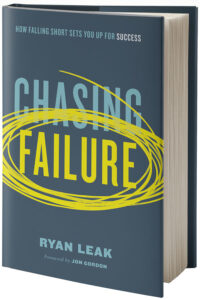
Chasing Failure – https://www.ryanleak.com/chasingfailure
I tested it, and they laughed. I’m like, “All right,” but sometimes the audience doesn’t laugh, and you’re like, “How bizarre is that?” Is it because of the time of day? Is it the delivery? What are your thoughts on that? If something’s funny 90% of the time, but not 10% of the time. Stand-up comics and Jerry Seinfeld is constantly refining what he does. What do you think is the reason? Should you throw it out then, or do you go, “No, this usually works?”
What I try to do is what I call my first base jokes. They’re jokes that I don’t you to be falling out of your seat laughing. I only need to know, “Do you smile?” Where are we at? Are we a target group? Are we a Walmart group? If you’re doing an event in Boston versus Atlanta, it’s two completely different mindsets about the world. There’s Southern hospitality in Georgia. There’s a natural emotional response to speakers that you’ll get in the South.
I went to Boston 4 or 5 times in 2022. Every time I landed there, the Uber driver was pissed off from the jump. If there’s a Southern hospitality, I call it sometimes a Northern pissivity. There’s a little bit of an edge already that you have to earn their respect a little bit more. I usually will kick off with things that don’t need to be funny, but let’s just see where their humor is and where everybody’s at. I’m always trying new things, trying to add, and trying to get better.
Your book Chasing Failure is a topic I want to talk about because so many of us feel like we focus on what doesn’t work the one time. If things work 9 times out of 10, but it didn’t work one time, then here’s where I see, myself included. I had to stop this behavior, which is all the way back to school. If I didn’t get an A and I got a C or something, I must be a failure. I’m a loser. Am I a great speaker if the audience didn’t laugh as much as they normally do?
I’m curious to see if you have this experience. Maybe you’re thinking, “I don’t know. This is going okay. It’s not going great. I’ve had to have the audience be a lot warmer.” You then get off stage, and people come up to go, “I loved what you said.” You’re like, “Somebody liked it out of the 500 people or whatever it was.” We can’t judge ourselves on what we’re experiencing at the moment. Is that what you’re saying?
Absolutely. Think of it like this. Somebody sends you a link to something funny. It’s a video. It’s an Instagram clip. It’s a meme. You might respond with a crying laughing emoji but you’re not. You’re like, “That’s funny,” in real life, but on text, you’re the furthest thing from crying or laughing. That’s what audiences are doing sometimes. We have to give ourselves some grace. Sometimes they’re going, “That was pretty funny,” but there’s no noise.
I did an event for a company where I spoke to 500 of their employees, and then they did two breakouts where they split the group in half and said, “Ryan, you’re going to speak to the whole group at 9:00, and then you’re going to speak to half of the group at 11:00. We’re going to break from lunch, and then you’ll speak to the second half at 1:00.” It’s pretty simple. I get my baseline by speaking to everybody in the morning. I go to that first half and a different talk, but that room was rocking. I’m like, “I know these people. I’ve spent the day with them.” I did the same talk at 11:00 that I did at 1:00. It flopped at 1:00, and it crushed at 11:00.
This is so valuable for everyone to read.
It’s the exact same slides, one room falling over laughing at some of the stories. There is some research out there that says after people have had lunch, they’re in that mode. A client will say, “What time do you want to speak?” I’m like, “I’ll speak whenever.” All time slots are not created equal. There are times when you’re the first thing in the morning at 7:30. I’m speaking. I’m doing a diversity, equity, and inclusion breakfast at 7:30 AM.
You have to prepare a little bit differently than your normal 10:00 AM keynote. One of the things that I have to tell myself before I speak is to make sure that I have fun, even if nobody else does. Enjoy the fact that you are one of the very few people on the planet that get an opportunity to talk for an hour and get paid for it. That’s amazing. I never let that leave me. I’ve never arrived. I’ve never like, “You all owe me this.” This is a privilege that I have, and I tell a lot of my professional athletes that too. I go, “Just in case you forget, you’re paid to play a game.”
[bctt tweet=”Make sure you have fun, even if nobody else does.” username=”John_Livesay”]
This is a dream very few people get to achieve.
Imagine somebody walking up to you and going, “Do you want to play Monopoly? We’re going to pay you to play Monopoly.” That’s your life. I feel the same way when it comes to speaking. I pinch myself every day to go, “I can’t believe I get to do this and get to add value to people’s lives.” Whether there’s a standing ovation or not, I say, “I want to make sure that at least I have a good time. I enjoy the fact that I get to be here and try to help people.” I am not trying to impress you. I am trying to help you go to the next level.
When I keep that at the forefront, then I’m not looking for affirmation from the audience anymore. I’m trying to help them. It positions you differently. Your countenance is different. One of the largest insurance companies in the world was having me speak. One of the questions I asked in pre-event calls is I say, “Who have you spoken to before that you love and why? Who have you had in the past? You don’t have to say their name, but I want you to tell me what they did that made you say we’re never going to have them again.”
I always like to make sure I don’t step on a landmine. This insurance company says, “The best figure we’ve ever had was Doc Rivers.” I was like, “Doc Rivers is a well-known NBA coach. That’s great.” It’s not a crazy surprise, but then I said, “Why was he the best figure you’ve ever had?” They said, “He was agendaless.” I thought, “Agendaless isn’t even a word.” However, it changed my approach to even how I work with clients going, “This next hour is not the Ryan show. It’s not about me. In fact, my only agenda is to help you.”
Here’s the interesting thing. Doc Rivers never used the word, “I’m agendaless.” It can be felt. There is something about a stage presence where people can feel when a speaker is trying to impress them versus going, “I’m here to talk about failure, and here’s what I realize about you. Sometimes it holds you back. Now, I’m going to help you reframe how you’ve seen this thing that has terrorized your career before.”
Right away, there is a difference, authority, and command of the room, “I don’t need you to like me. I want to help you overcome something in your life that’s holding you back. I’m going to tell you about some things that have happened in my life on how failure gave me a whole career. I keep trying to fail something every single day, and it has revolutionized my business.”
From there, you are more in command because you’re not trying to win them over. It’s like, “I’m trying to help you solve a problem.” When that’s the forefront of your brain, it’s amazing how relaxed and funnier you are because what you’re doing is you’re taking everyone’s guard down a little bit of going, “This guy’s a real guy. He’s an authentic guy. He’s not trying to sell me something right now.” I literally will watch people in the audience go from a folded arms position to a relaxed position.
The best I can ever get is when someone would come up to me after the talking, “I usually don’t pay attention to somebody talking that long. I’m on my phone or my mind wanders but those stories kept me engaged.” I’m like, “Great.” This concept of being agendaless is another version that is not being attached to whether someone likes us or what the outcome is. As you said, I’m not going to let my self-esteem go up and down based on whether I get a standing ovation or not.
No matter what your career is, do I need my boss to give me a rave review on my annual review, or do I know I did a great job or all those constant outside things that can make you feel less than others? This concept around chasing failure is interesting because most people, as you said, are terrorized by it, which is a great word. Why would I ever chase something that terrorizes me?
Can you tell us some of the lessons that are in the book that would get someone to go from, “If I ever meet a saber-toothed tiger, I’m running the other way, and I don’t care what you say?” This is not that kind of fear. This is fear of failure. Is it because we’re so in our heads, worried about what people think of us?

Chasing Failure: When you look at the fear of failure from a psychological standpoint, it’s really the fear of shame and embarrassment.
There’s a lot that goes on with that. When you look at the fear of failure from a psychological standpoint, it’s the fear of shame and embarrassment. What I’ve found is that there’s typically a particular person or group of people that we want to impress, somebody that we don’t want them to see us fail. It means that they were right. It means that our ex-girlfriend or ex-boyfriend will go, “Yes. I made a good decision.”
There is something underneath the hood of going, “If I fail, there’s somebody that’s watching, or at least, I think that they’re watching.” If they knew how this story ended, that’s what I’m afraid of. How I guide people through getting past this fear of putting themselves out there is a couple of things. One, every single person we look up to, admire, and read about has all failed.
We don’t realize that. We think, “This person’s always had success after success after success. Everything they touch turns to gold,” which is not true.
We have to dismantle the story we tell ourselves about other people that we watch their lives online. It’s not true. I’ll prove that it’s not true. I have a family photo. I’m on Zoom quite a bit. People are like, “What a beautiful family you have there. That’s great.” This is not indicative of how the day went at all. It was one of the worst days of our life. One of the kids was throwing up tons of stuff.
This was the only one picture of the thousands that we were taking that day because he was just trying to find one good photo and trying to get them in matching outfits and whatever, yet people will get my Christmas card and think, “What a beautiful family. This is how it always is.” It’s like, “No. That’s never how it is.” We can’t get them to sit on the couch for two seconds. If we’re honest, we don’t ever post our true story anyways. We post our very best and hide the rest. Everyone’s doing that. For you to be a failure, you have to deem somebody else successful. Why do you deem them successful?
It’s because of what they posted or because of what they showed you, but they won’t show you their pain. They won’t show you their scars, and oftentimes, they won’t show you their failures. What I started doing is I started showing people my behind-the-scenes. I started sharing about the different failures that I experience on a daily basis where I completely whipped it with a pre-event call or a sales call or completely lost a client. It’s like, “We won’t share that on LinkedIn, but it’s true. It happened all the time.” We’ve got to dismantle this belief that there’s somebody successful, that’s how I view success, and there’s me over here. It’s because usually, for us to be a failure, we have to be a failure compared to somebody else.
It’s a frame of reference.
We first have to navigate that. The second thing that is vitally important is whenever you’re thinking about trying something new or putting yourself out there, there’s no version of your life that is safe. There’s no version of your life that isn’t risky. Some people think, “I’m going to take my ball and play it safe in the corner. I’m going to do my 9:00 to 5:00.” Salesforce just laid off 8,000 people.
Companies are laying off thousands of people at the same time, and you’re going, “I thought you said it was safe.” Tell me, what is safe? I know so many people that have degrees from Stanford, Harvard, and Princeton that aren’t looking for jobs. Someone, please show me the safe route. I’ve yet to see it. The average CEO tenure is five years.
With CMOs, it’s eighteen months.
[bctt tweet=”If you learn from a failure, then you are not failing.” username=”John_Livesay”]
If you’re telling me, “My goal is to get here, and then I will feel secure,” that’s not a secure job. If you’re talking about doing it at a publicly-held company, good luck, buddy.
Look what happened at Disney. Bob Iger leaves, and then they promote somebody up. In less than two years, Bob’s back, and you’re out. Imagine that guy’s mindset.
I tell people, “There’s no version of your life that isn’t risky.” If there’s no version of your life or career that isn’t risky, you might as well do something that moves you toward your dreams. The other thing that is vitally important to understand about failure is you got to learn from it. If you are learning from your failures, you’re not failing. As long as you are taking notes on your failures, you are winning.
If you continue to fail the same way twice, you are just not taking notes. You’re not paying attention. You shouldn’t fail the same way twice. You should be tweaking something, a different angle, or something. The other thing that I write about in the book is as motivational speakers, we’re supposed to tell people to never give up. That’s terrible advice, especially if you’re talking to 1,000 people.
There are people that definitely should give up. We’ve seen them on American Idol. We’ve seen them on The Voice, and we went, “Somebody told you to never give up, but they should have told you instead to say, ‘Let’s see what some of these failures can teach us not to do.’” Again, you’re still learning. There are some things that I went, “Maybe I could. In my company, we tried doing Instagram 60-second documentaries.”
I thought it was going to be a hit. It flopped. It was terrible. It sounded like a great idea until it was fully flushed out. It was like, “No, it’s just an expensive 60-second video that people are just going to scroll by.” I learned that lesson. The platform isn’t designed for that. While I was trying to be innovative, sometimes you have to know when to give up.
One of the chapters in the book is to never gives up-ish. I’m like, “Go for it, but be smart.” Take some notes to go, “We’re going to try some things.” In the book, I laid out the top 100 companies in the world. I added up their research and development budgets. It’s billions. They’re failing on purpose every day in spending money to say, “We have to figure out a way to get this right.”
It’s because if we don’t, the competition will. If you look at Blockbuster, they used to be on every corner. The thought that that wouldn’t exist forever was like, “What else could ever place this? How did we live without this?” You also give a keynote talk on sales leadership. I love what you’ve said about putting your own spin on things. If you have heard of the concept leaders are readers, I like to say leaders or storytellers as well. You may not be somebody who likes to sit down and read a book. You found a way that works for you. Would you share what that is?
There are a couple of ways that I go about consuming content. One, I’m an Audible guy. I love listening to books. I can do that in a terminal. I can do that while I’m walking. I can do that while I’m exercising. Your brain can hear two times faster than it can talk. That’s why that scale is there on a lot of our audio devices to be able to do that.
Also, there’s another app called Blinkist, which gives you summaries of some of the top books in the world. There are some books that, for me, I love the person, but if I already know what you’re going to say, I am very familiar with a lot of your content, and I follow you, I only need the cliff notes. I need the one-liners. I need the overarching idea because that’s all I’m going to walk away with, anyway. I subscribed to Blinkist, and it’s amazing. You can get through a Blinkist in eleven minutes.

Chasing Failure: What people see is not always the true story of what it costs to be that person.
It’s another great tool. Your book is on Audible, Chasing Failure. Did you narrate it?
Yes.
I figured you did, as a speaker. That’s a whole process too. The concept that people think that you sit down and read your whole book in one take is not the case. Nobody usually has a session go more than two hours because you can’t keep the energy up. They listen to all the mistakes you made. You got to rerecord it and do pickups. If you’ve never thought about it or you go, “That Ryan is flawless in his reading.”
That is not the truth.
I mentioned Hoda in my book, and they’re like, “You’ve totally mispronounced her last name. We got to redo that.” I’m like, “Okay.” It is everything. Everything is a constant refinement of writing and recording your book. At the end of the day, people buy you. They buy your energy, vulnerability, transparency, and authenticity. That’s why you speak so frequently. I get it. You walk your talk. You don’t judge yourself, and therefore, people don’t feel judged when they’re in your presence. At least, that was my experience of being here.
One of the questions I often ask people is, “What does it cost to be you?” It’s a very important question because what people see is not always the true story of what it costs to be that person. They don’t see our flight schedule.
They only see the glamour.
They see the great photo, the arena, and the video highlights. They don’t see flight delays. They don’t see you jumping on one plane to catch another one. Whenever I see somebody that I admire most, I am like, “What does it cost to be you?” When people ask me for book advice, I say, “Don’t do it.” I don’t know that you have it. It’s not that I don’t think that you’re smart. It’s not that I don’t even that you can write a book, but writing a book is the easiest part about doing a book. Selling a book, marketing a book, and getting it into people’s hands are different. Do you have the schedule to sit in a studio and the patience and the cadence? You were like, “I want to tell my story.” It isn’t that easy. It’s not that simple. I’m like, “Unless you want this to be a thing, it’s going to cost you more than you think.” Know the cost. It’s not that I don’t believe in you. I’m only letting you know. It is harder than it looks.
When I had a corporate job and I would have to travel and there would be a delay, I’d be like, “As if this job isn’t hard enough. Now, I got to deal with that.” Now, when I have a travel delay and I’m speaking, I’m like, “I will put up with anything because I love what I do so much,” versus I like my job, but not enough to want to get up at 3:00 in the morning to catch a plane to be in New York in time for a cocktail party or whatever was required.
When you figure out what it is, then your home mindset of being instead of the angry Uber driver, you’re doing something you love, and you go, “That’s the cost.” The joke is we speak for free, and they pay us to travel. People go, “What do you mean?” You’re like, “The odds of a crying baby, a mechanical, and the weather is up there and/or a cab ride that has a flat tire.” It’s 101 things. I look at everything as, “This will make a great story.” That’s how I look at it, or, “I wouldn’t have met this person had I not missed that plane because the connection was delayed or whatever.”
[bctt tweet=”You can’t get better if you don’t get started.” username=”John_Livesay”]
Otherwise, you can’t show up and be fully present and alive. Also, whether you’re watching an athlete an actor, or a speaker, they shouldn’t have to know what you went through. They want to, “I’m here now. Wow me. Entertain me,” or whatever. Nobody cares about your drama unless they want to go into it. You have to be able to let all that go and not walk on the stage with a chip on your shoulder for God’s sake. As you said, it’s a privilege.
It is a privilege. Being in DFW, I’ve had mostly great travel experiences. Kudos to all of the different airlines that service our business, but DFW is a pretty good place to travel out of.
I often have to go there, “There’s no nonstop, so you’re going through Dallas.” “Okay.” It’s out of Austin. Any last thought or quote that you want to leave us? This question is great, “What does it cost to be you? There’s no version of your life that’s not risky.” You’ve given us so many incredible things to think about and reframe how we see failure and how we see ourselves, especially other people, and not compare ourselves so much and come up short.
The last line I would leave everyone with is you can’t get better if you don’t get started. You can’t make a book better if you don’t start writing. You can’t make a talk better unless you write one. Stop waiting for an audience. The greatest tool that a speaker or anybody that’s wanting to do something public-facing is social media. It’s the great equalizer. You might speak for Coca-Cola now, and I might speak for Facebook tomorrow, but guess what? Both of us have the opportunity to record something for Instagram right now.
It will show you if that resonated or not, “You got so many views on that,” versus this other thing I posted, “I got a lot of views. What’s the difference?” It’s instant data feedback. You’re like, “That works.”
There are things that I’m constantly trying on the internet every day. The biggest difference between myself and somebody that may be struggling to get some things off the ground is I’m willing to fail every day. I’m willing to fail more than most people. I’m willing to write a chapter that’s just okay, “I wrote a chapter, and you didn’t.” I’m willing to post a video that doesn’t get that much engagement.
In fact, the videos that will get the least engagement get the most. The videos that I think will get the most engagement get the least. It is one of those things where, as I said at the beginning, I don’t think you ever arrive. You consistently put yourself in the position of a student of, “Here’s what I’m learning. Here’s what I’m seeing. Here’s how I’m going to utilize that information to help the people around me.” You can’t improve something you never got started in the first place. If you don’t start the podcast, write the book, or start the business, you can never improve something that doesn’t exist. That’s what I want to leave people with.
Thank you. The book again is called Chasing Failure. If you want to find out more about Ryan or book him as a speaker, go to RyanLeak.com. Ryan, thanks again.
I appreciate it, John.
Important Links
- Chasing Failure
- Ryan Leak
- Blinkist
- RyanLeak.com
- Better Selling Through Storytelling Method Online Course
Wanna Host Your Own Podcast?
Click here to see how my friends at Podetize can help
Purchase John’s new book
John Livesay, The Pitch Whisperer
Share The Show
Did you enjoy the show? I’d love it if you subscribed today and left us a 5-star review!
- Click this link
- Click on the ‘Subscribe’ button below the artwork
- Go to the ‘Ratings and Reviews’ section
- Click on ‘Write a Review’
Love the show? Subscribe, rate, review, and share!
Join The Successful Pitch community today:
- JohnLivesay.com
- John Livesay Facebook
- John Livesay Twitter
- John Livesay LinkedIn
- John Livesay YouTube
The Future Of Work Is Now With Seth Mattison
Posted by John Livesay in podcast | 0 comments


Our marketplaces are shifting faster than ever, simultaneously with talent, expectations, wants, needs, and values. Today’s guest is Seth Mattison, the founder of FutureSight Labs, who shares how successful leaders become the beacon to top talent to navigate these shifts. To have an internal shift in 60 minutes can be challenging because it’s deep work to create a long-lasting transformation. Seth dives deeper into the conversation with his 90-day-rule. Find out what the 90-day-rule is as you discover how to face the changing faces of the future of work! Enjoy this episode.
—
Listen to the podcast here
The Future Of Work Is Now With Seth Mattison
Our guest is Seth Mattison, who is an expert on the future of work. He said, “Culture is not in the building but it is in the heart of the people who work there. You can’t be a successful leader unless you love people. Find out what he means. Enjoy the episode.
—
Our guest is Seth Mattison, who is an internationally recognized thought leader, author, advisor, and top-rated keynote speaker on change and transformation, leadership, and the future of work. His ideas have been featured in such publications as The Wall Street Journal, Forbes, and Entrepreneur. His diverse client portfolio spans industries ranging from Lockheed Martin and NASA to Microsoft and IBM.
In addition to leading his own research organization and future site labs, Seth is the Cofounder of ImpactEleven, a speaking training development and accelerator community that I am a member of, which supports both emerging and established thought leaders and bringing their message to the world. Seth, welcome to the show.
It’s great to be here. It’s great to get to spend a little bit of time with you. Thanks for the opportunity.
You have such a compelling story and a message. You are traveling around the world. It’s very fortuitous for all the readers to be able to get to know your story. Before we get into that, would you mind sharing your own story of origin? You can take us back to childhood, school or wherever you want to start. When you started thinking, “This whole concept of speaking and being in touch with what’s going on in the world is something that lights me up?”
[bctt tweet=”Culture is not in the building, but in the heart of the people who work there and that you can’t be a successful leader today unless you love people.” username=”John_Livesay”]
I think of my story as almost like a three-part saga. Part one is I grew up on a fourth-generation farm in Minnesota, father, grandfather, great grandfather, mother, grandmother, great grandmother but on my father’s side, I’m watching four generations of men approach work and life. The farm was a business. It was a remarkable way to get to grow up.
I was watching at a very young age this idea of how each generation has its own unique story and history. I was fascinated with that and had close exposure to it early, having lived through the Great Depression, the characteristics and behaviors that manifested out of that having come through the 1960s and ‘70s in Vietnam.
Without understanding or even knowing that generational theory was a thing, I was exposed to it naturally and learned how to connect across those generational divides. Coming out of University Act 2, I go into Management Consulting. I worked for a boutique firm in Minnesota, and the firm specialized in executive alignment and culture change work like the people part of the transformation. I came in as a very junior account executive. The role was more of sales and relationship development, calling in at a C-Suite level to $100 million to $1 billion businesses, mid-size or mid-cap.
At the time, I’m 24 or 25 years old. I’m calling on CEOs that if I could get through or I was chatting with people, these 25 or 30 years younger than they are. They are looking at me like, “What are you going to tell us about transformation and alignment?” They weren’t wrong. I tried to communicate. I’m not there to bring the solutions. I’m there to bring the right resources and play matchmaker with this incredible bench that we had.
To build a better connection, I started asking him a different set of questions. As an aspect of a lot of what you talk about like the power of asking great questions and what that opens up, I started asking them more specific questions about the younger workforce. It was unbelievable. This is in the mid-2000s. The conversation around Millennials and Gen Y at the time were new. We weren’t inundated with it like we are now with social media, articles, and all the coverage.
As I’m asking this question, I could see all of this pain and frustration come pouring out of these leaders who are like, “Tell me what it is that you all want?” To these kids, “What do you want? I don’t what to do. You are driving me nuts.” It is a little light bulb that went off in my head of like, “For the first time in this world, my age is a benefit. Instead of holding me back and being perceived as negative, this could be positive. I could be their inside guy to this world.”
I started studying and researching the topic, having my own point of view and perspective as a member of the generation but wanting to understand the theory. I naturally gravitated towards it because of my upbringing. I got lucky. I found the serendipity of life. I found that there were two best-selling authors who were also based in Minneapolis, Minnesota, where I was as well. It’s a niche. In all of the places in Minneapolis, there are these two HarperCollins-published best-selling authors. I knew that I wanted to speak to teach. I didn’t exactly know what or how but I felt that calling.
All of a sudden, I was like maybe this is a path. I used my network and my relationship building to find someone who knew someone who got me to David Stillman and Lynne Lancaster. I was able to convince David’s executive assistant to be on his calendar, which was not easy. I will never forget sitting down and having coffee with him. All that youthful enthusiasm and vibrance of like, “I’m the next generation. Lynne is a Baby Boomer. You are a Gen X-er. I’m a Millennial. We can do this together. Here’s what I think.” God bless him.
He let me talk and smiled. He’s like, “I love the enthusiasm. We are not looking to hire anyone now. If you want to speak, I will help you. I will give you some insight and show you the landscape.” He was the first one to encourage me to what I needed to put together to start reaching out. I’m talking about Chambers of Commerce, local rotaries, and the entry-level where you got to go because the barriers to entry are very low. They are always looking for people. There’s not a big budget. I started speaking for free wherever I could. I started introducing myself as a generation’s expert.
I read a couple of books. I met one actual expert and just claimed it. Sometimes, on our entrepreneurial journeys, even in the journey as a speaker, there comes a point when you have to claim that identity. Before anyone else is going to give it to you, you have to do it that become claim the identity before you feel you are it or before you feel ready. I started to do a study to get the reps. We stayed in touch, and it took about a year.
A year later, David reaches back out and he’s like, “We got the green light to write a book about your generation, the Millennials. We think it’s a perfect time for you to come onboard.” I did. I got to help them in the writing of their second book, which was called The M-Factor: How the Millennial Generation Is Rocking the Workplace in 2010. We had an unbelievable ride together, and it’s where I got my speaking chops. I started to speak with them. They were working with all the bureaus. It gave me an entry point. I was speaking on their IP and learned their content.
It taught me stagecraft, communication skills, and influence skills. They sell the platform and the brand. When they did, it gave me a beautiful opportunity to launch on my own. In 2013, I launched on my own and pivoted my research and focus from thinking exclusively about generations to thinking, researching, and talking about the future of work, which is Act 3 in this story.

The M-Factor: How the Millennial Generation Is Rocking the Workplace
I lunched on my own. I had just enough momentum and credibility in the marketplace with clients and more specifically, with speaking bureaus as I worked my way up that fee structure that when I launched on my own, they were like, “We’ll see what you got.” They were willing to take a shot at me. We were celebrating a decade in April of 2023, which is wild to think about.
We can talk about that journey and where the research landed. That’s a little bit of the background of the fourth-generation farm in Minnesota. I played college football, came up through the ranks and management consulting, stumbled into this cottage industry, this interesting profession, and got paid to speak for a living, and we are having a blast.
You co-authored another book, The Future of Leadership. I’m curious about that one because one of your key takeaways in that book is navigating disruption. Everyone’s experienced disruption. You wrote about navigating disruption before the pandemic. You have always had your zeitgeist.
We wrote it with my co-author in 2017, and then it came out in 2018. We took this fundamental shift happening in the world of work, this big trend, and we brought it to life through a parable. I had never written a business book like that before. It was a little bit of a leap of faith. I had so much fun. It was much joy to give myself permission to create characters and write fiction to bring these lessons through the feedback we’ve gotten from that has been remarkable over the years of a surprising way to bring these insights to life. That has been fun.
I can certainly relate to that journey with my book, Being A Parable Business Fable, a story about storytelling. You get into the descriptions of someone’s life. You want to paint that picture of that character in a situation. You’ve nailed it when someone says, “I thought so and so would get together at the end of the story.”
Their imagination is taking those characters and bringing out their storylines 1,000%.
What is the other thing that distinguishes you, in my opinion, is the research that you have. The thing that jumps out at me is going beyond this agreement of, “I’m going to be your leader. That’s the table stakes.” How do you work with C-level executives? This is applicable to whether you are Fortune 500 or running a small company of 50 people that they need regardless of their age from their leaders.
It’s an interesting and exciting yet challenging time for leaders. They’re more confronting, and external change and transformation on marketplaces are shifting faster than ever. At the same time, the people talent that we need to help us deliver value and create exceptional experiences for clients, and their expectations, wants, needs, and values are shifting at a speed we’ve never seen before. COVID fundamentally changed us. We all collectively went through a collective existential experience.
[bctt tweet=”Claim your identity before you are ready.” username=”John_Livesay”]
When we say collective existential experience, it means at some point over the last now almost three years, in a moment of pause, joy, and frustration in the silence when everything was closed and locked down, we all paused and asked ourselves the big questions, “Who am I? What do I want? How do I want to design my life? What are the experiences? Who do I want to be doing life with?” We all reevaluated.
When you talk about the research, whether we are conducting primary research or working hard to identify great secondary research, this theme of an existential experience showed up in the data. Oracle released interesting global data pointing to the fact that 88% of people said that they had evaluated their values over the past years. We are all looking at the 93% of people who said they had a new definition of what success was for them in their life. That is an unheard-of shift. For leaders, it’s like, “How do we work with them? What are we trying to do?”
It’s a good example. One of the things we are trying to do is to tease out the non-obvious counterintuitive data points of how the world and people are changing to create a-ha moments for them of like, “I hadn’t thought about that before. What are the implications if, across an organization of 10, 100 or 10,000 people, their values are shifting, and their definitions of success, all of our rewards, incentives, and things that we use as levers to get their juice, are being called into question? ‘Maybe they’re not going to work, and if those don’t work, what will work?’”
We saw that the traditional methodologies of trying to activate, engage, and drive performance no longer worked. We watched close to 50 million people voluntarily quit their jobs. It’s a mass exodus. Another thing I thought was interesting when we looked at the data of over 50 million people voluntarily leaving, 65% of those people left the industry with their field completely. The whole industries getting hollowed out. The other big ones like hospitality, you can’t go to a hotel and don’t have the staff, retail, healthcare, huge shortages, and nurses and nurse practitioners are exhausted from this.
A big part of the work that we are doing with leaders is helping them spot, “We got through all of that.” Whether it’s a recession or the next big internal, people are exhausted, and you have more open positions than ever before. You are trying to figure out how to create a compelling offer to bring people in to get them to want to join you.
How do you unlock high performance in and amongst the teams in your organization to create great experiences for clients? For me personally, number one, it’s an exciting and interesting time because there’s so much transformation that’s occurring in us as human beings, and then it’s ripe for reflection and perspective shifting with leaders as they try to get their arms around what’s happening.
What I’ve seen when I’m talking to architects or even law firms is this shortage of qualified top talent, a real estate also trying to get the top producers from one brokerage to come to their firm. It’s all the same. You bring your own business, “Why should I bring you versus somebody else?” Leaders have always needed to attract and keep top talent.
With this big shift in people’s values, you describe it as the need to be a beacon. I love that because that’s the lighthouse image of, “Here’s a safe place to land that’s going to see you as a human and not a cog in a wheel.” I can’t have you on my show without talking about your production skills, where you have a whole thing about stories changing the world.

The Future of Leadership: Elevate your influence. Navigate disruption. Bring out their best.
Speaking your language.
Tell us a little bit about how you’ve worked with some of these big companies on helping these leaders become authentic so that they can, in fact, become a beacon to top talent.
One of the challenges that we confront with speaking business is usually 30 or 90 minutes. Otto Scharmer from MIT quoted this saying, and this quote stuck with me. We also intuitively know this, “We cannot create an external shift in our organizations until an internal transformation happens within.” You can’t create an external shift until an internal transformation occurs within leadership.
Trying to help people drop into a deep self-reflective place and answering some of those big questions like, “Who am I? What are the beliefs and values that I hold? How am I showing up to get someone to be self-reflective?” To have an internal shift in 60 minutes is challenging because it’s deep work. To create real, lasting long-term transformation, that’s where your coaching comes, and you are working with someone.
What I’m hoping to do is to cut through the noise so that maybe they can hear it for the first time or more specifically, maybe it reminds them of who they are and that idea of being a beacon because a lot of times, the leaders we are working with are trying to lead a transformation journey internally. At the 2 or 3-day event that they are at, the leadership team has gathered. They are talking about strategy for the next year and how they are going to communicate that. Usually, they have to go back to their people and convince them to change their behavior and go in this new direction to get them to buy into the new strategy and the new vision.
I will have leaders say to me a lot of the times and stuff like, “How do you get them to believe in this thing?” I asked a mentor of mine once. The feedback I got, which has stuck with me ever since, is, “You can’t make anyone believe anything.” I can’t make you believe anything. The same goes for our audiences. I can’t make them believe it. All we can do is communicate what we believe with enough clarity and conviction that it creates space for someone to stand up and say, “I believe what you believe. I’m coming with you.” It’s like, “What does that mean?” Number one, you have to know what you believe.
It has to be very clear. It can’t be vague at all. It’s a Jerry Maguire thing as well. People know that reference of, “It’s coming with me.”
It seems simple but sometimes it shocked leaders and ended up like, “What do you believe?” Not just what you think. Especially for non-senior executive leaders, who are tasked with going back and communicating the vision and the strategies that their teams like, “If you don’t believe it and you are not bought in, no one is going to buy.”
[bctt tweet=”There is no external shift until there is an internal shift.” username=”John_Livesay”]
Certainly, not buyers if you are a seller. I see this across industries. That’s why I know you are in such demand as a speaker. Everything from real estate dramatically changes with interest rates going. It was very easy if you got a listing to get multiple offers at a low-interest rate, and now you have to change. The same thing. I’m working with a company that makes electric motors. They have been selling because there has been such a shortage of inventory. They happen to have it. They didn’t have to sell that hard. There’s only one place to get it. That’s not going to last forever, either.
The supply chain will eventually open up again. Everything keeps shifting. The future is different. You have to change and get the leaders to convince people that, “We can’t keep doing what we have been doing. It’s not going to keep working.” I saw it when print sales went away and it became digital. There are many examples of that.
You’ve got this incredible career and friendships with the cofounders of ImpactEleven. One of the things that you do so well is your authenticity comes through in your videos, in person or when you are on stage. You look at the world from a place of abundance and the people that you could be perceiving as your competitors. You make them your allies. You have this wonderful 90-Day Rule that I want you to share because I love it so much that you’ve got your core people. Tell us what you guys have agreed to do with each other and how ImpactEleven came about.
You are spot on about trying to operate in this state of abundance. It’s easy to talk about that and talk about when things are good and flowing. It’s another to be able to stay in that when you might be momentarily in a state of scarcity. My three Cofounders of ImpactEleven are Peter Sheahan, Josh Linkner, and Ryan Estis, did you have them all on the show? At least you had Josh.
I’ve had Josh, you are up, Ryan is following, and I still have yet to get Peter.
If you are only going to get Pete to be in the same state because he’s traveling all over the world. We will get him locked in. Technically from the outside, you could say that the four of us have been competitors for the better part of a decade. We have been in the same proposals up for the same opportunities forever. Ryan will go for one year. I will go next year. I beat Pete. Pete would beat me out but we were always very collegial.
Ryan and I were very dear friends. We live right next door to each other in Minneapolis. He was at my wedding. We had a strong anchor point. We had leaned on each other as we were building our businesses but you need somebody to run ideas through like, “How are you breaking in with this bureau?” We started to develop deeper relationships with Peter and Josh.
When we went through COVID, remember what I said when we’ve all gone through this collective existential experience. We did as well. Part of what came out of that was this idea of, “I don’t want to do this by myself anymore.” As entrepreneurs, depending upon the business that you are building, it can be a lonely road. Speaking in particular, you get to be in front of big audiences but you spend an enormous amount of time alone.

Future Of Work: It’s right for reflection and perspective shifting with leaders if they try to get their arms around what’s happening.
You are more often alone in hotels, airports, and traveling. You are sitting in front of your computer, cranking out content. That’s like, “I don’t want to do this by myself anymore.”It feels like there’s an opportunity to number 1) Do something together. Number 2) We all had people in our life that were there to help us break into this business each in our own way, I, David, and Lynne.
You’ve got all the raw materials and all the makings to be able to break in but it’s understanding of the formula. Maybe it was understanding how the bureau channel works. It’s getting a couple of your assets squared away so that it helps buyers as they are thinking through the buying decision. We could help the next “generation” of speakers, this whole tribe of speakers that are ascending in their own careers that you can see there add a great deal, a great volume but they a little tweak that takes them to the next level.
The idea was that there was more than enough for all of us to go around. There’s so much speaking opportunity out there, and then expanding that partner group out to a larger partner group. We can help other people do this well, and it’s not going to take anything away from us. I’m not trying to do 200 or 100 events a year. I want to do 60 to 65 events in my niche of future work.
I want to be focusing on building out this community. There are hundreds of thousands of speaking slots around the world for the opportunity. We came together and were like, “Let’s build this thing out.” You nailed it at the top of the show. Its development, training, live events, it is anybody who has a message on their heart that they want to bring to the world. Certainly, we have a number of phenomenal professionals like you that are in this community.
We also have people who have just sold their businesses they are writing a book. They’ve got to make the shift from, “I’m an executive,” into, “I’m going to take this to the street now.” It turned into this beautiful community that is expanding way beyond the four of us. We are seeing it happen in real time. Relationships are being developed, communications, and meet-ups which is what the hope always was. The community would be able to support one another in a way that the four of us long wouldn’t.
You have this 90-day agreement.
The 90-day agreement sparks specifically with Ryan. I moved to chase my wife out to California in 2011, from Minnesota. Ryan and I haven’t lived in the same city for over ten years. A part of what kept us close and committed because we get turned into adults, we have families, and we get busy. It’s about time. Time creeps in, and you lose touch. We’ve created this 90-day rule. Every 90 days, 1 of us gets on a plane or we are coordinating our travel schedules. We travel a lot and say, “Maybe it’s a layover. Maybe it’s a meeting at the airport. I will come up to Minnesota.”
We don’t go more than 90 days without seeing each other. It has sustained a beautiful friendship. There is some of that ethos that is carrying over into the ImpactEleven community. Now we have at least quarterly in-person experiences, and part of it is selfishly because we want to be together. Part of it is the learning magic and the deep bonds that are getting formed across the community by being able to spend time together in learning and leveling ourselves up and then doing a lot of fun stuff.
It has been one of the best experiences I have ever been a part of. A friend of mine who’s a mentor for me, Tim Sanders is one that told me about it years ago. He’s friends with Josh. It’s grown into all of this incredible skillset of understanding that it’s a business. It needs a structure, and your talk needs a structure. All of the different things of, “If you are not giving a talk that generates additional interest. There’s something wrong with your talk,” that a-ha moment for many people of, “I need to be constantly working on this craft like an actor or singer.”
You have all the nuances to do all that and see it in person. Also, this huge commitment to diversity of the kinds of people and mentors in the community. It’s a very special place. If anyone is interested in taking their speaking business to the next level and/or getting into the speaking business, I’m constantly telling people that this is the best investment you could ever make.
It was not lost on us. Four of us are sitting around a dinner table and it’s like, “We are four straight, cisgender White men. This is not reflective of the industry and our clients. At the same time, we can’t change who we are. What we can do is be intentional, bake it into our values, our behaviors, and who we encircle ourselves with to expand this reach.” It was important to us right away to build out what we called our extended partner group and bringing on people like Cassandra Worthy or Erica Dhawan.
[bctt tweet=”We can’t change who we are, but we can be very intentional and bake it into our values and behaviors and who we encircle ourselves with to expand this reach.” username=”John_Livesay”]
Alison Levine is one of my favorites.
Alison is a phenomenal veteran. She’s a great example of something that you said of, “Thinking about this like a business but this idea.” It’s applicable no matter what your profession is. If you are reading this and you are not a professional speaker, it still applies. In our business, this idea of going out and delivering with such excellence at such a high level that it transcends more than just a, “Thank you. That was a great job,” email.
That is nice, and it feels great but that has to be table stakes. What we are after is we need people coming out of our time with them, and they’ve got to tell people about what they experienced or are a part of an association they see John speak, and they were like, “I have to get John into my company.” They leave needing and feeling compelled to get you back or to tell someone about that experience. That is a very high bar for all of us that I’m constantly in pursuit of. It’s challenging because you can feel like, “That was pretty good.” People seemed happy they were nice afterward.
“Did I wow them?”
It’s true in every entrepreneur’s business, especially as you are growing it off like the satisfied customer versus a raving fan, that their business and life have been deeply moved by interacting with you. That’s what we are after.

Future Of Work: It’s easy to talk about abundance when things are good and flowing. It’s another to be able to stay in a state of scarcity when you might be momentarily in.
If they can quote something from your talk years later, I heard Alison speak in Los Angeles several years ago. I got her to be a guest on the show. We became friends from that. She has this wonderful line about, “Backing up is not backing down,” as she’s talking about climbing Mount Everest. I will always remember that. When you have that soundbite hook that people go, “That made me rethink things even if I’m not climbing Mount Everest,” then you see why she’s successful. Speaking of success, how can people reach out to you for speaking and find out more about ImpactEleven? Give us the websites if you would.
I’m easy to find. My website is SethMattison.com. There’s a big contact page there. When you reach out there, you will connect with our Head of Sales and Relationship Development, Jenny DeRosse, and across social channels. I’m probably most active on Instagram and LinkedIn. That’s @SethMattison. I’m pretty easy to find there too. Although I have friends who have told me that there’s a number of fake accounts, unfortunately, that using my name, so you have to give it double-check.
Any last thought or a quote you want to leave us with?
I will leave you with two. You teach us well by helping leaders try to navigate this environment that we are in now. Two big things that we have been trying to anchor into leaders’ minds as we have been doing this work, especially as organizations are trying to find their footing with, like, “What do we do with our physical real estate? Do we make this shift to remote? How do we do hybrid?” The number one reason why leaders tell me that they want their people back in the office is culture. It always comes back to this conversation, “I’m worried about a culture.” Culture is hugely important, and the physical environment can certainly facilitate that and holding that together.
What I try to remind them is that culture doesn’t live in the walls of your building. Culture lives in the heart of your people, and getting them to make this shift, doesn’t live in the building. It’s in your people. The walls can support it but that means in this new environment, your culture has to manifest and come to life across all digital channels. Your culture comes to life in the work itself in every text message, Slack, channel, and email. All become reflective. It’s not just the building. The building can help and support. That’s one.
Number two, you can’t be a leader in this coming decade unless you love people. Sometimes I have audiences that roll their eyes a little bit and are like, “I barely love my family. You are asking me to love my staff or my people?” The answer is yes. Love means wanting goodness for them in their life and calling them up to their place of high service. I always love to ask people to reflect and like, “If you have ever been lucky enough to work for a leader that you knew loved people, you were around them, almost every hand will go up in a room because someone can remember.
Think about how they showed up. They cared about you as a human being. They wanted good things. They had your back. They would tell you the truth. Loving might mean the leader that loved me let me go. He fired me, and it was an act of love. It doesn’t mean we lower our standards or don’t have high expectations, but you have to care deeply about people in this world and in this environment. Love your people.
What a great way to end. Thank you, Seth. You’ve inspired me every time. It’s great, and I’m sure you will have done the same for the readers.
Thanks, john. Take care.
Important Links
- ImpactEleven
- The M-Factor: How the Millennial Generation Is Rocking the Workplace
- The Future of Leadership
- MIT
- Josh Linkner – Past Episode
- Alison Levine– Past Episode
- SethMattison.com
- @SethMattison – LinkedIn
- Instagram – Seth Mattison
- Better Selling Through Storytelling Method Online Course
About Seth Mattison
 Seth Mattison is an internationally recognized thought leader, author, advisor, and top-rated keynote speaker on change and transformation, leadership, and the future of work.
Wanna Host Your Own Podcast?
Click here to see how my friends at Podetize can help
Purchase John’s new book
John Livesay, The Pitch Whisperer
Share The Show
Did you enjoy the show? I’d love it if you subscribed today and left us a 5-star review!
- Click this link
- Click on the ‘Subscribe’ button below the artwork
- Go to the ‘Ratings and Reviews’ section
- Click on ‘Write a Review’
Love the show? Subscribe, rate, review, and share!
Join The Successful Pitch community today:
- JohnLivesay.com
- John Livesay Facebook
- John Livesay Twitter
- John Livesay LinkedIn
- John Livesay YouTube
Selling From The Heart With Larry Levine
Posted by John Livesay in podcast | 0 comments

Salespeople usually focus just on the product or service that they’re selling. But really they should try selling from the heart. As a salesperson, people skills is a very important trait to learn. You need to know how to sell your memories and experiences with your customer. Join John Livesay as he talks to Larry Levine on how to sell properly through relationships. Larry is the bestselling author of Selling From The Heart: How Your Authentic Self Sells You! He is also the co-host of the Selling from the Heart Podcast. Join in the conversation to learn how to grow your business by knowing more about your client.
—
Listen to the podcast here
Selling From The Heart With Larry Levine
If you’re looking for new ways to be authentic when you sell something and make authenticity a lifestyle and not a light switch you turn on or off, then this episode Selling From The Heart is for you.
—
Our episode’s guest is Larry Levine, who is the best-selling author of Selling From The Heart and the cohost of the Selling From The Heart Podcast. With decades of in-the-field sales experience within the B2B technology space, he knows what it takes to be a successful sales professional. In a post-trust sales world, Larry Levine helps sales teams leverage the power of authenticity to grow revenue, grow themselves and enhance the lives of their clients. He’s coached sales professionals across the world from tenured reps to new Millennials entering the salesforce. They all appreciate the practical, real, raw, relevant, relatable, and street-savvy nature of his coaching. He is not shy when it comes to delivering his message. Welcome to the show, Larry.
John, what’s going on? I can already tell we’re going to have a blast.
Tell me about your story of origin. You can go back to childhood or college, wherever you want to start where you got your first inkling of either being an entrepreneur or the concept of being a heart-centered person.
I hated everything about school. To me, high school was a blur. I didn’t like anything about school. I went to college to appease my parents and I double majored in college. My cumulative GPA by the time I graduated was 2.1 out of a 4.0 scale. The school wasn’t the gig for me but I went because I wanted to make my parents happy.
That’s the thing, growing up with a father who was a rocket scientist. That’s what I did. I’m a big believer in this. You don’t wake up one day and say, “I think I’m going to be a salesperson.” You fall into sales somehow. Here I am with a degree in Marketing and Health Science going, “Now what?” I was getting married. No pressure and no job. I had this little voice inside my head saying, “You got to pull your head out of you-know-what pretty quick because life has been thrust upon you.”
It’s going back to the late ‘80s. I opened up the yellow pages and saw the largest ad in the office technology space because my father had said, “If you could last one-year selling copiers, you’re worth your weight in gold in the sales world.” I took it for what it’s worth. I picked up the yellow pages, the largest ad, called up, asked for the owner of the company and got a job.

Selling From The Heart: You don’t wake up one day and say, I think I’m going to be a sales person. Sales doesn’t work like that, you fall into it. You fall into sales somehow.
A week later, I find myself in a room watching a bunch of videotapes and getting trained and so forth. I’m sharing all this with you because the backstory behind all of this translates into my entire career selling copiers. My first year was 1988. It was the worst year and the best year of my life. I made $18,000 selling copiers in my 1st year.
Was that commission only, I’m guessing?
It was a draw against the salary and it was tough. I had to do 50 cold calls a day. I couldn’t come back until I had 50 cards. Once I came back, I had to start knocking down phone calls. I share all this with everybody because I believed what I learned in my first year carried me my entire career in the office technology space. I’m a big believer in this. We all have five senses and we all know what those are but I have no scientific proof behind the sixth sense, though we all have a sixth sense. My sixth sense when I was 24 years old was I have a keen awareness of bull crap.
It’s the BS meter if somebody’s wasting your time or not when you’re prospecting them.
[bctt tweet=”If you can last one year selling copiers, you’re worth your weight in gold in the sales world.” username=”John_Livesay”]
It’s not only that. I say this for a reason. I had this sixth sense of being keenly aware of what was going on in my surroundings, how salespeople are treating customers and what they were doing. I was going on sales ride-outs and so forth. I saw that the customer and commission were the centers of everything. It took me a while to figure this out because I was mirroring and mimicking everybody in my surroundings. It started to mess with me and I knew that wasn’t me. I remember I made my very first sale. I asked him, “Why did you buy from me? Besides, you felt sorry for me because it was my first sale.”
They said something to me that got me to start thinking, “You did something that completely was the polar opposite of what everybody else did. You made it about me, my company and how you can help. You didn’t make it about your products, your company and yourself.” I still remember that. I went on a very inquisitive rampage throughout my entire career. That curiosity led me to always ask questions. The more questions I asked about what was going on inside their heads, their perception of salespeople and experience, I took all of that and that’s how I marketed myself. For many years, I spent my entire career in one sales channel that was selling copiers.

Selling From The Heart: The best way to define authenticity in the sales world is congruency. Does your walk match your talk?
You talk about in your book, Selling From The Heart, the importance of authenticity and getting trust when trust is low. A lot of people are aware that they have to be curious and ask some questions as opposed to just talking. What I want to have the readers learn from you is how do you earn the right to even ask the questions? The fact that you’re curious, if someone doesn’t trust you or think you have their best interests at heart, they’re like, “Tell me what you’re here for and I’ll make a decision. I don’t need to talk to you or for you to quiz me.”
Doctors can ask patients questions because assumed expertise and trust are going on there. Let’s dig a little deeper because you have so much experience. That’s the table stakes. Don’t be somebody who just talks. Ask questions. Let’s assume that more than half the people reading know that but are looking for another way to earn that trust, to be authentic so that potential buyers are even willing to answer the questions.
I’m going to dance on authenticity for a moment and the equal business stature. There are a couple of key things there. I believe we’re all authentic human beings. First and foremost, John, I’m going to get that out on the table. To me, authenticity is a lifestyle. It’s not a light switch. We’re all authentic human beings. I have no PhD or Doctoral in any of this, neither Master’s in Psychology and so forth. This is street smarts through decades of getting the you-know-what beat out of me, what works and what doesn’t work.
I bring up authenticity for a reason. The best way to define authenticity in the sales world is congruency. Does the walk match the talk? We can say the BS meters are at an all-time high with people. How you build trust and credibility happens in the first five minutes of a conversation with somebody. This is what I know is going on in their head. John is saying to himself, “Does Larry have the goods? Is this somebody that I can trust, open up and share my business secrets with the things that are going on in my office? Can I trust him? Is he credible? Can I believe what he says?”
I bring this up for a reason because that’s what I was keenly aware of. There are two words that I held myself accountable for my entire career. It’s how can I connect and relate to somebody? The faster you can do this and the faster you can make somebody feel comfortable with you, the faster they will become comfortable enough to share uncomfortable things going on in their office. It’s those uncomfortable things that are gold. Those are the things that you will need to help them solve their issues, challenges, goals, initiatives, dreams and aspirations.
[bctt tweet=”Sell memories and experiences.” username=”John_Livesay”]
I play so much emphasis on how I opened up meetings because I knew if I opened these up correctly and I shared a bit of me, John would share a bit of him. The missing link is we don’t spend enough time on the first five minutes. The first 5 to 10 minutes in most sales situations are product-centric dumps, company-centric dumps, the buyer knows it and the insert name of decision-maker knows it. They know what’s happening and they‘re prepared for it.
I was talking to an optometrist. Salespeople are calling him all day long and he said, “It’s gone from they could bring lunch into we could have a conversation. With the pandemic, you can only talk to me for ten minutes between patients.” What are people doing? He said, “They all say the same thing. ‘Our product is the best. Let us give you all the data and scientific facts to back it up.’” Something he could read on his own.
They’re not saying one thing about themselves or anything that they might have as an idea to help his practice. It’s like, “I only have ten minutes then I got to talk about all this stuff.” There’s no “time” to build rapport or ask a question. He said, “The opposite is true. When you have less time, relationships are even more important to build. Not less.”

Selling From The Heart: Know how you can connect with somebody? And how you can relate to somebody? The faster that you can do this, the faster they will be more comfortable to share things with you.
I’m a big believer that we all can achieve equal business stature. Let’s say I’m talking to a chief financial officer, chief information officer or human resources. It doesn’t matter. I don’t have to be as highly educated as them but I need to understand the language they speak and bring it to the table in a very quick amount of time that I understand their world.
In other words, in the very beginning, if you want somebody to feel comfortable with you, start speaking their language and sharing like, “John, these past days, I’ve worked with four chief financial officers just like you. These are the three issues that we’ve been working on deeply to help them solve, issues 1, 2 and 3. I’m curious, do any of these hit home with you?” You can roll that out but what it shows somebody is you’re working with people and using verbiage like them. You’re living in their world. Talk about making somebody feel comfortable, they’re going to go, “What just happened?”
Back to the optometrist because I love stories and I’m always trying to take your words of wisdom and make them relevant through a story, the optometrist said he likes this company that he works with because of their innovation. The problems people have with their eyes in that are not what they’re having. With the pandemic, everyone’s coming in complaining about their eyes being dry, wearing contacts more than six hours because they’re looking at Zoom calls and phones way more than they used to.
Enter a product that makes your contacts less dry after 6 hours and can go for 8 or 10 hours. That ability to stay current and make the doctor look like the hero by having the product that solves the problem is what a lot of companies didn’t use to do. I remember computer companies. They’re like, “We’re going to make something and then it’s up to marketing and sales to get people to want it as opposed to asking, ‘What are your problems? Let’s make a product to solve it.’”
Here’s my challenge to the sales world. We think we sell products. Ask any salesperson, company, sales leader or most people on what they sell. They go right to their products, solutions, service, all company-centric stuff. When I learned this decades ago, it was a monumental shift in everything. I learned to sell memories and experiences. You use storytelling. This is where all of this ties together.
[bctt tweet=”Authenticity is a lifestyle, not a light switch.” username=”John_Livesay”]
In sales, we all live in a commoditized world. I’m here to throw this out there. I came out of the copier channel. There wasn’t much difference between one copier and another. Highly commoditized sales channel. The difference was my ability to articulate how I was able to help them do better business and the experience they would get with me, not my company. The big key is the competitive differences in the company. The competitive difference is you. When I learned how to capture stories and how to repurpose stories, I’m the biggest believer that the best storytellers are story collectors.
I’ve worked with companies who realize that if the rep’s repertoire or tools are only the sales they’ve made and they don’t know anybody else’s success stories to share, they’re walking around with one hand tied behind their back. If somebody else has multiple stories like a playlist or a jukebox ready to go, even if they’re not their personnel, they can say, “So-and-so in another office had somebody in a similar situation to you.”
They tell that story. If that’s the one that resonates the most, then that’s what’s important, even if it’s not necessarily your story. As long as it’s a true story that somebody else in the company did, that’s how you start breaking down silos and growing existing clients. The secret there is not just telling stories but figuring out a way to share the stories across the department.

Selling From The Heart: Ask any salesperson what they sell. They’ll go right to their products, services, and other company-centric things. Instead of doing that, learn how to sell memories and experiences.
This is game changer stuff for those that are in sales. Let’s think about this collectively for a moment. Salespeople have golden opportunities to capture all of this. You’re having conversations with your customers daily. You’re in sales situations daily. You have opportune and monumental times to capture these stories. This is why amusement parks such as Disneyland, Magic Mountain or the sports entertainment world do a massively good job at capturing memories and experiences. There are no price negotiations.
It keeps going up every year. You don’t go to Disneyland and say, “I’ll have four tickets,” and the person at the window says, “That will be $1,500.” The next word out of your mouth goes, “I’ll tell you what. I’ll give you $1,250 for it.” It doesn’t happen so why do we allow this to happen for those that are in sales? The reason why I believe it happens is that people have lack confidence.
They may not believe in themselves or their messaging. They have low self-worth. When all of this happens, it’s hard to capture these memories and experiences. To be able to have a heartfelt human conversation with somebody with clarity, they get somebody to go, “I get it.” The faster you can tug on somebody’s heartstrings, the faster they will open up.
They open up the purse strings, not just their needs because we buy emotionally and back it up with logic. In your book, Selling From The Heart, you’ve got a whole wonderful visual of someone who is authentic and that there are three parts to around the heart. There’s selling, client management and prospecting, all done through the lens of authenticity. Let’s start with how does somebody prospects authentically? What does it look like when someone isn’t being authentic in their prospecting?
I have a different viewpoint on this because you started with prospecting. It triggers them. Most companies start their training with prospecting and building the pipeline. I’m all for it. I write about it in Selling From The Heart. If you want to have an ever-flowing sales funnel, you must build an ever-flowing relationship funnel. Here’s where I believe companies missed the mark. They start with prospecting first. I start with client management first.
I see monumental growth with this and it ties into authentic prospecting. When sales leaders and sales professionals understand what it’s like and they can comprehend how to build authentic relationships and bring meaningful value to their current client base, this fuels them and will propel them to authentically prospect for new opportunities. I’m all for new business growth and prospecting. It’s 100% non-negotiable.
[bctt tweet=”If you want to have an ever flowing sales funnel, you must build an ever flowing relationship funnel.” username=”John_Livesay”]
It’s a fascinating way of looking at it because I’ve come at it from a different perspective but the outcome is the same. When I was training speaking to a sales team of luxury car salespeople, Jaguars and Range Rover, I said, “You’re going to get noes.” People think, “If you’re selling a luxury car, you don’t get rejected.” Yes, you do. There’s a competitive set for every price point. I said, “What you need to do after the no calls someone you recently sold a car to. Not to try and sell them anything else but to remember what a happy client sounds like.”
When the next person walks into the dealership or rings on the phone, you have that in your head and not the no. It’s like a sorbet in between courses. I hear you saying before you start prospecting, get in the mindset of the current clients and why they’re happy so that you’re authentically sharing that message.
I fought with sales managers inside the world that I grew up in, which is the copier channel. We were always benchmarked on outdated KPIs, Key Performance Indicators. “How many calls you made now? How many appointments did you go on?” Things that are still alive and well drive me bonkers. I would get into severe arguments then they would say something like this, “Larry, you’re spending way too much time with the current customers. You got to go out and grab some new business.” However, I drove more new business sales in a company year over year than any other salesperson but yet spent the most amount of time with my current customers.

Selling From The Heart: If you want to grow your business, know that the more you know about your clients, the more you’ll grow with your clients. And, the more you learn about your clients, the more you’ll earn from your clients.
Were you getting referrals?
It was referrals but here’s where I learned this. I self-taught myself to power the networks. I knew that when I went high, wide, deep and built authentic relationships inside my customer base, I was one degree of separation from all of their peers, friends and people like them in other businesses with the same titles. I will be the first one to throw up both hands high in the air and say, “I hated cold calling.” I would rather find any other excuse out there than to cold call.
What I did enjoy was prospecting through my current customers. If leaders and salespeople can latch onto this, they will monumentally grow their business. It was simple as this. It’s a silly rhyme but I’ve made this up a long time ago. I stuck to it forever. “The more you know about your clients, the more you’ll grow with your clients. The more you learn about your clients, the more you’ll earn from your clients.” I held myself to these non-negotiable standards that every single day, I was going to generate new conversations, new connections and build new relationships inside my customer base.
I was going to intentionally pour myself into my customers. In turn, they would pour themselves into me. In doing so, I would ask for people like them that I can go out and talk to. Pretty soon they were repurposing stories and sharing experiences. I was driving more new business inside my company than anybody else. That’s why I’m a big believer that we have to flip prospecting on its head. I’m all for a new business but not at sacrificing the relationships with your current customers.
You have taken all this expertise and turned it into a book and a podcast. You also are available for personalized coaching for teams or individuals. You have some sales training available.
This is where this forced entrepreneurship came in because at 50 years old, I was fired. That was my exit out of the copier channel. I had to decide real quickly what to do. I can go back to what I knew or I could try something different. I doubled down on myself. I put 100-pound weights on my ankles into the entrepreneurship world. What I’m bringing is what I believe is sorely lacking. There are great sales skills training and product training out there.
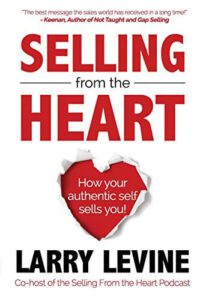
Selling From The Heart: How Your Authentic Self Sells You! By Larry Levine
What’s not enough of is people skills and relational skill-building. To me, that’s the missing link in sales. Some might call it soft skills. I say soft skills, yield hard dollars. People skills are human nature. It’s how we connect, relate and create these personal relationships. Everything that we do on our side of life, I believe transfers to the professional side of life. That’s what I coach sales leaders and sales teams to do. They might be going, “Where’s my ROI on this?”
Do you have a particular niche that you’d like to talk to? Is it people who are selling equipment?
What’s been interesting is to see where Selling From The Heart has taken me. It’s taken me into tons of vertical markets and industries. Industries are where relationships matter. You might be saying, “Larry, that’s about every place.” The whole message in the book and the movement around Selling From the Heart attracts like-minded and like-hearted leaders.
It eliminates the dirtbags that are out there that are transactional-oriented salespeople and sales leaders. Nothing wrong with that, you can grow your business that way. If you want to continue year over year to grow your people, you have to transform yourself, your sales team, the conversations and the relationships you have with your customers.
It all comes from developing people skills and relationship skills with your team. I’m a big believer in this and this is why we’re seeing such growth with this. Leaders who lead with their heart and lean into their sales team will soon develop a team that goes out there and leans into their customers and sells from the heart. That’s what we’re all about.
There’s a great way to end the episode. If people want to find out more about you, the book or the podcast, they can go to SellingFromTheHeart.net. Any last thought or quote you want to leave us with, Larry?
Your clients and your future clients would rather do business and connect with a sales professional who sells from the heart as opposed to a sales rep who is an empty suit.
Thanks for being someone who sells from the heart and shows us all how to do it in that wonderful way as well. Thanks, Larry.
Important Links
- Selling From The Heart
- Selling From The Heart
- Selling From The Heart Podcast
- Better Selling Through Storytelling Method Online Course
Wanna Host Your Own Podcast?
Click here to see how my friends at Podetize can help
Purchase John’s new book
John Livesay, The Pitch Whisperer
Share The Show
Did you enjoy the show? I’d love it if you subscribed today and left us a 5-star review!
- Click this link
- Click on the ‘Subscribe’ button below the artwork
- Go to the ‘Ratings and Reviews’ section
- Click on ‘Write a Review’
Love the show? Subscribe, rate, review, and share!
Join The Successful Pitch community today:
- JohnLivesay.com
- John Livesay Facebook
- John Livesay Twitter
- John Livesay LinkedIn
- John Livesay YouTube