

The Influencer: Secrets To Success And Happiness With Brian Ahearn
Posted by John Livesay in podcast | 0 comments

Developing your ability to influence people is crucial to success and happiness. Your business needs to have a solid foundation, and you also have to know how to widen your network. Join John Livesay as he talks with Brian Ahearn on the science behind the influence process. Brian is a dynamic international keynote speaker, author, coach, and consultant. He specializes in applying the science of influence in everyday situations. Tune in to discover how to recognize powerful opportunities and influence people!
—
Listen to the podcast here
The Influencer: Secrets To Success And Happiness With Brian Ahearn
Our guest is Brian Ahearn, a return guest from October of 2020. When he reached out to me and said that he has a new book called The Influencer: Secrets to Success and Happiness, that is a business parable and follows the life of John Andrews, who’s an ordinary person who becomes an extraordinary influencer as he learns from coaches, mentors, and clients. I thought to myself, “I need to have Brian back on.” I, myself, have written a fable. What he is doing is using the storytelling format to reach a new set of readers. It is about applying what is in The Influencer book on the impact that influence can have both professionally and personally.
—
Brian, welcome back to the show.
John, I appreciate you having me on. It’s good to talk to you again.
I know that one of the things that excited you about this book is that nearly every character is based on a real person that you have learned something from. What a great combination of your life’s work? I know what that feels like. You think I couldn’t have written this book several years ago, and I couldn’t have done it.
Absolutely. I didn’t start out writing the book with that in mind, but I started to quickly realize, “This character is based on Loring, Ben or Dwayne.” I started utilizing those first names so I could clearly visualize them, but it was an honor to share with the world the things that these people taught me that were so helpful on a professional and a personal level.
For those who haven’t read your episode from October 2020, give us a little snippet of your own story of origin. You can parallel that with the book as well. You do an amazing analysis and research to give some exposition on who this lead character is. I wonder if any of those things mirror your own story of origin.
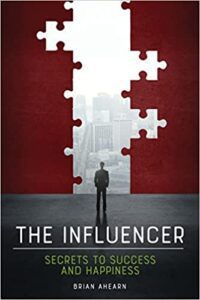
The Influencer: Secrets to Success and Happiness
They do mirror my story. I had people ask me, “Is this your story?” Its bits and pieces are. For example, when John goes off to college, he takes a Psychology class as a freshman, which has a big impact on him. That happened to me. I didn’t come across influence, but I do clearly remember that class. It obviously had a big impact, but John is a lot smarter than I was. The things that he learns, he lays hold of and puts into practice so that he starts reaping the benefits.
It took me a lot longer to figure that part of the game. Certain things do parallel. Many of the things that he learns throughout the book are things that I learned from significant people, coaches, clients and mentors throughout the course of my life. To go back to that episode in 2020 and let people know my area of expertise is the science of influence. I look at the decades of research from Social Psychology and Behavioral Economics. I look at ways to put that into practice to help clients get to yes more often. That usually means, on a personal level, a lot more success when you are in the office and usually a lot more happiness at home when people are more willingly saying yes to you.
As a storytelling keynote speaker, what I have found is that when people learn how to tell better stories, it not only helps them in their sales career, it helps them in their personal life. You do such a great job in this book of showing how the two things work in this character’s life. Can you give us a little snippet of when you fix, learn, or improve one area of your life? It is not in a siloed, “This only helps me in my career.”
I think it takes creativity to figure out how to take some of the silos and combine them. As a personal example, I’m a disciplined individual. It came from sports at a young age, football, weightlifting, running marathons, and things like that. It took me a while to figure out how do I take that silo and put it into my career to have more success. Once I figured it out, all of a sudden, especially as I stepped out on my own a few years ago, it has never been hard for me to get up early, put my head down, and put in 8 or 10 hours a day towards the business where a lot of people might say, “I would not have that self-motivation.”
That is a personal thing for me. In the book, I tried to help the character as he learns these bits and pieces. He has got this vision of what he is trying to put together in this puzzle. He doesn’t know what the picture is going to be ultimately, but he knows that these snippets of ideas that are helping him somehow have to come together to form a philosophy of life. At the end of the book, he completes the puzzle and knows what that picture is.
One of the intersections of what your work and my work is people inevitably get this objection, which is, “I don’t feel like I’m ready to make a decision right now. I need to think it over.” You have helped people come up with some things to either avoid that from happening or what to say when it does happen. Can you give us some insight on that?
I think a great way of avoiding that is very early in the sales process. John, the lead character, is a medical supply sales rep. When you understand the principle of consistency, it tells us that we feel an internal psychological pressure and external social pressure to be consistent in what we say and what we do. The bottom line, we feel better about ourselves when our words and deeds line up.
[bctt tweet=”Don’t say ‘no problem’ after someone thanks you. Give people everything they need upfront to make saying yes easier.” username=”John_Livesay”]
If a salesperson learns to ask the right questions early on, when you get to the point where you are trying to close the sale, it becomes much easier because you can reference back to. For example, “John, when we initially talked, you told me that you needed this particular price, timing, and these terms in the contract. It looks like we have done all of that and a little bit more. Go ahead and start working on the paperwork and consummate this deal.”
It becomes much harder for you to say, “Let me think about it.” It is not that you want to remove yourself from the situation. There is always a little bit of fear when you are making a change and a purchase. Learning how to ask those questions to trigger this principle of consistency allows somebody to feel good about themselves by saying yes because they are only responding that you have done everything you said you would.
The other thing that almost all of us have happened to us at one time or another, especially if there is some emotion involved in it, like if someone is breaking up with you, for example. They said, “It was never my intention to hurt you.” I know this happened to me exactly. At that time, I found that so unsatisfying of an answer and I thought, “Why is that not landing as a sincere apology or making me feel any better?”
Someone said later, “Wouldn’t it have been great if you could have said back? I’m sure it wasn’t your intention to make me feel loved by that behavior either.” I didn’t have that in my repertoire to say when it happened to me. You talk about almost all of us having that situation where we go, “I should have said this instead of that or not saying anything.” What do you show in the book that helps us with these situations?
This guy, John, is a smart and good person, down to the poor, which most people are. We want to do the right thing. He does run into situations where he ends up hurting his wife because he is making some decisions without consulting her. She was looking at this like, “This is a partnership, and you may not think this is important, but I’m not even in on the decision-making.”
He does feel bad about it, but he continues to make this mistake at times. It is never to hurt. He sometimes feels boxed into a decision, and all of a sudden, he is responding. I will say that he begins to learn his lesson, and that makes things better, having to sit down with somebody in a situation like that and not try to defend why you did what you did because we all have reasons to be able to say, “I am so sorry. It was never my intention. Here is what went on with me. I hope you can forgive me.”
That is an integral part of having relationships being able to say you are sorry and asking for forgiveness. I think asking for forgiveness is important. We could think that everything is okay because we apologize and have not gotten confirmation from the other person that they are okay. I think it is important to admit the mistake and then say, “Can you forgive me?” If that person says yes, you are in harmony. If they say, “This is going to take some time,” then you have got to be patient.

Influencing People: It takes creativity to figure out how to take some of the silos and combine them as a personal example.
I think what the frustration was, at least, for me, and I see it in other situations where it is not that big of a dramatic moment, but it is when someone doesn’t want to own responsibility for what they did or the outcome. The fact that it wasn’t my intention to hurt you means I’m off the hook. There is nothing to even ask for forgiveness for because it wasn’t my intention. I think in a business situation, it is the same thing because I have worked with clients that have lost clients and tried to win them back. We have to do the same thing as we do in our personal relationships and own that we made a mistake, explain what we are going to do, that it doesn’t happen again and have some empathy for what that other person is feeling.
The other part of what you do so well is when someone is looking for a sales keynote speaker. They typically do a Google search. Oftentimes, I have come up against a couple of other speakers. They had a meeting and interviewed the final three candidates and looked at our videos and our books. Sometimes, as many as 8 or 10 people have to agree on who is going to be the speaker. You hoped you had created somebody in there that is going to be your internal champion to rally for you. No matter what the decision is, getting a consensus can be challenging with a team. What kinds of tips are we going to learn from your Influencer book?
When you are going into a situation like that, try to discern, first of all, is this person the decision-maker, or there going to be other individuals who are part of it? Can you get some of those other individuals on the call? For example, I had the second call with a client. The first there was the lead-in, but we had a call with that lead-in’s boss and a peer of the boss. There are still other people that are going to make the decision. I know that now having a positive influence on three different decision-makers and being able to speak their language in the middle of that sales conversation gives them confidence that this guy knows what he is talking about and he can relate to us.
Three people will be a lot better for ultimately making that decision than if I had that single individual. Discerning who the decision-maker is and doing what you can to bring in other people also asking, if you and I were having the conversation and I might say, “John, it is a great conversation. I’m excited about the potential opportunity to work. Who else will you be talking with? What can I give you beyond the conversation to support your recommendation for me as a speaker?”
If it is that bio, the customer list, the videos, and all of that stuff are usually out there for any speaker. My goal is to make your life a little easier and directly give you that information so that you are ready at that moment to say, “I talked to the person, look at the list. Let’s watch this five-minute video and get that traction.”
I think that is so valuable. Sometimes you get hired because you are easy to work with, given everything else is the same. The simplest things of, “You are connecting the dots for me. I don’t have to go searching for something, or you have some empathy and are trying to put yourself in my shoes going, “You might need this. I’m happy to send it to you. You don’t have to spend five minutes looking for it,” or whatever it might be. Those little things do add up.
I had a client in 2021. I’m very diligent about staying on top of the email. When I would email that person, they are like, “Thank you so much for getting back to me quickly.” I said, “Part of my job is to make your job easy.” She was like, “You would not believe how many people don’t do that or hard to get ahold of. They don’t get me information.”
[bctt tweet=”An integral part of having relationships is being able to say you’re sorry and ask for forgiveness.” username=”John_Livesay”]
I also know this when I get something. If she had said, “Give me the bio, the customer lists, and a link to a video,” I almost always would put in the beginning, “Name as promised to make what you need.” It is only highlighting that, “Brian is a guy who does what he says he will do.” Those little bits continually work on somebody. That is when they look for a speaker again, and they say, “This person was great on stage. They were so easy to work with.” They want you back.
It is that whole thing of pre-suasion that you are such an expert at. You are reinforcing, as promised, is a subtle subconscious thing of almost edifying yourself that you keep your promises.
If you go into a store, you may have a wonderful experience, but it can be reinforced when that person says something about, “We hope you had a great experience shopping here now,” or the server who comes up. The server, like in a restaurant, should never, ever, come up and say, “Is the food okay?” Nobody goes to a restaurant for okayed food.
That is all we are aiming for.
Is the food delicious? If you come back and say, “Delicious,” you have convinced yourself that this is pretty good. I should probably come back. If it is not, they have an opportunity to say, “I am so sorry. What can I do to change this? Can you bring it back and have it warmed up or something like that?” That act becomes viewed as reciprocity, “That server was nice.” He or she went out of their way to make sure this was warmed up. I’m going to tip them a little more and come back here. Those little interactions back to that customer mean a lot.
I had an experience of this personally. I was in New York to go see some Broadway shows. You now have to stand in line to show your ID and vaccination and then another line to show your tickets. You are standing outside. It is cold and winter. They have those people saying, “Welcome back to Broadway.” Suddenly, everyone is happy in the line. You don’t mind the cold. You are excited to see a show that you have seen for many months. That one phrase said by the people who are running the line made a whole energy shift for everyone to remember why they are there. You have a great story in here about a major insurance company that was able to recover from a $700,000 mistake with post-it notes. Please share what that is.
The first book that I wrote, Influence PEOPLE: The Powerful Everyday Opportunities to Persuade that are Lasting and Ethical, looks at a lot of business case studies. There was a piece of research that intrigued me. It was around a company trying to increase the response rate for a survey they sent out. When they sent the survey out with a cover letter, I think 36% of the people responded. When they put a little handwritten note on the cover letter, it bumped it up to 48%. Taking a little extra time to sign that personally and put a little note on there increased the response rate, but in a third variation, they put a yellow sticky note. They had the same handwritten note that had been on the cover letter before.

Influencing People: There’s always a little bit of fear when you’re making a change and you’re making a purchase.
The response rate was 75%. They more than doubled it. When people hear that, they are fascinated, but they don’t always know how to put it into practice. At the company that I used to work for several years, I would come back from an extended Christmas break, and almost immediately, I was called into a room with half a dozen people. “Here is the situation we face, John. We had overpaid insurance agents in one of our operating states, $700,000 in total, 150 agents had their commission for the month of December doubled. We needed to get the money back because, at the end of January, we were going to be paying year-end bonuses to those agents. It would be nice to have an extra $700,000.”
As we strategized about it, we didn’t have the ability to go in electronically and take the money out. We were going to have to inform them that there had been a mistake and ask them to write a check. That is no easy task. If you get a letter that says, “John, I’m so sorry, but we overpaid you $5,000 last month, would you sit down and write us a check right away?”
That is where cold calling becomes more appealing than writing the $5,000. The head of accounting had been through some of my training, and I turned to him and said, “Steve, remember what I taught you guys about the sticky notes?” He said, “Yeah.” I said, “When you send out that letter that talks about the mistake and asks for the money back, make sure you put a sticky note on every one of those, personally sign it or put a little note.” He said, “I will do it.”
It was a couple of weeks later, I called them up, and I asked, “How was the collection going?” His exact words were, “John, I’m floored.” I said, “Why?” He goes, “We have already gotten money back from 130 of the 150.” The optimist in me said, “You mean we didn’t get it all back?” He laughed at me and went, “We are talking about money because I get them to say, ‘Take it out of next month’s commission, put me on a payment plan’ or anything, but ‘Sit down and write the check.’”
When we had lunch a few months later, we had collected in full from 147 of the 150. This is a hardcore accounting, black and white numbers guy, and your sales staff is BS. I don’t believe in that. He believed in the use of yellow sticky notes. He was a believer after that because he knew that was a radical change in behavior from these people to pay us that money back.
When you go, the extra effort to other people is a great way to end the episode. The book itself again is Influence PEOPLE: The Powerful Everyday Opportunities to Persuade that are Lasting and Ethical. It is on Amazon, but this concept of the unrecognized power of saying thanks and responding properly to thanks, there are two questions in that. One is, saying thanks, how is that unrecognized as a good thing to do? The second part of it is, when someone thanks you, there is a proper way to respond as opposed to maybe, “You’re welcome,” not saying anything or a smile. Let’s take the first part of that question. Are most people not aware that there is power in saying thanks, and that is why they don’t do it?
[bctt tweet=”Having positive influence on different decision makers and being able to speak their language in the middle of that sales conversation is important.” username=”John_Livesay”]
I think what you or I might have called good manners as we were growing up had gone by the wayside. I have always found that, for example, if somebody asks me something and I say, “Yes, please or no, thank you,” I have a lot of people go, “It is so nice to interact with somebody who has manners.” I will say, “My mom raised me right.” The story that I put in the book was about a man named Lieutenant Murphy who was a Navy SEAL and was killed in action.
He had to make a call back to base and expose himself on a rock. He knew he was going to die and be shot. In the middle of that, he called for airstrikes and said, “Thank you,” at the end of the call. The individual who relayed the story, a commanding officer, said, “That is the man that he was,” in the middle of a firefight and he did lose his life. My point with sharing the story is if he can find the time, life and death situation, to say, “Thank you,” then we all should.
It acknowledges that other person like, “I appreciate what you have done.” On the flip side, the other story and that you asked about how we respond to that, we never wanted to dismiss somebody’s thanks to you. When somebody says, “No problem. No big deal. No worries,” you are de-valuing what somebody felt like was valuable. The proper way when somebody says “thank you” is to say something like, “John, that is what partners do for each other. You helped me. I will help you. I’m happy to do this.”
If you want to be funny, sometimes I have said this, “It would have killed an ordinary man, but you were worth it.” Something that acknowledges you heard them. You had put forth an effort and I appreciate what they did. It is the grease of the wheels that make our relationships better. Little things like that make customers want to come back because they feel good about the transaction.
I want to thank you publicly, but most people won’t be able to see what I see, which is you did something very personalized and customized as you have a monitor with my show’s image logo. It says, “Hello, John,” on it. I have done over 350 episodes. It also shows pictures of your wonderful books. I have never had a guest do that ever.
I appreciate you saying that. I joke with people, I say, “Everybody should have their name in lights once a day,” but I’m a fast learner like John was in the book, The Influencer. Once I see that something means something to people, I make it a point to go out and make sure that I recognize and prepare for the time that we are going to spend together. It is a wonderful selling tool, too, because then people ask questions. I can stand up and talk about the virtual studio that I put in because of the pandemic. It creates a win for everybody.
Any last thought? Obviously, if people want to reach out to you, they can go where?

Influencing People: Learning how to ask questions to trigger the principle of consistency allows somebody to feel good about themselves by saying yes.
The best place to go to start is LinkedIn because I post a lot of content. If you reach out to me and don’t tell me how you found me, guaranteed, I will come back and say, “How did you find me?” I like to know why people reach out. It allows us to have a little bit of interaction. It makes social media social. If you let me know how you found me, I will still say “thank you,” and we will have a little interaction. You are going to get some one-on-one.
The other place would be my website, which is InfluencePeople.biz. There you find links to the books. You can see previews of my LinkedIn learning courses and all kinds of other information. I have been blogging weekly for several years. There are a ton of free resources available if you are a reader, and I have been on well over 100 podcasts. If you want to listen to podcasts, there are lots that are listed there.
Thanks for sharing your wonderful wisdom and fable. It is a fun way to improve our skills in becoming better influencers and having better connections with people.
Thank you, John. I appreciate you having me on the show. It was great to chat with you, and hopefully, as we get out of the pandemic, we might find each other at the same venues speaking to some audiences.
That would be terrific. I look forward to that day. Thanks again, Brian.
Important Links
- Brian Ahearn – Previous Episode
- The Influencer: Secrets to Success and Happiness
- Influence PEOPLE: The Powerful Everyday Opportunities to Persuade that are Lasting and Ethical
- LinkedIn – Brian Ahearn
- InfluencePeople.biz
- Better Selling Through Storytelling Method Online Course
Wanna Host Your Own Podcast?
Click here to see how my friends at Podetize can help
Purchase John’s new book
John Livesay, The Pitch Whisperer
Share The Show
Did you enjoy the show? I’d love it if you subscribed today and left us a 5-star review!
- Click this link
- Click on the ‘Subscribe’ button below the artwork
- Go to the ‘Ratings and Reviews’ section
- Click on ‘Write a Review’
Love the show? Subscribe, rate, review, and share!
Join The Successful Pitch community today:
- JohnLivesay.com
- John Livesay Facebook
- John Livesay Twitter
- John Livesay LinkedIn
- John Livesay YouTube
Invisible Solutions With Stephen Shapiro
Posted by John Livesay in podcast | 0 comments


Many people advise us to think about our destination, our end-goal, that sometimes, we miss out on the many opportunities that come our way. The author of Invisible Solutions, Stephen Shapiro, joins John Livesay in this episode to share with us the different lenses he’s created to allow us to see the solutions that are right in front of our face but are in fact invisible. One to emphasize how we should focus on the direction we’re going, he tells us some great insights, tips, and tricks towards becoming a lot more successful—from the importance of branding to learning how to ask the right questions. He also shares what a performance paradox is about and how we can use it to our best advantage.
—
Listen to the podcast here
Invisible Solutions With Stephen Shapiro
Our guest on the show is Stephen Shapiro, the author of Invisible Solutions. He shares with us all the different lenses he’s created to allow us to see those solutions that are right in front of our face but are in fact invisible. He said that if you focus on your direction you’re going and not necessarily just the destination, you’re going to be a lot more successful. He talks about what a performance paradox is and how we can use it to our best advantages. Sometimes having the answer is not the answer. Enjoy the episode.
—
Our guest is Stephen Shapiro. For many years, he’s presented his provocative strategies on innovation, culture and collaboration to audiences in 50 countries. During his fifteen-year tenure with the consulting firm, Accenture, he created and led a 20,000-person innovation practice. He’s the author of five books, including Invisible Solutions. His clients include Marriott, 3M, P&G, Microsoft, Nike, NASA and GE. In 2015, Stephen was inducted into the Speaker Hall of Fame. He’s also been a regular judge and mentor on the TV show, Girl Starter. We’re going to be talking about stories, how to become more inventive and what the heck is an invisible solution. Stephen, welcome to the show.
John, it’s great to be here. Thanks for having me.
I love to ask people like you to take us back to childhood or school when you started this curiosity factor that you seem to have in spades about, how does the world work and how can things be better? Start anywhere with whatever the story jumps out in your head.
I would say I’ve always been a bit of a tinkerer. I liked seeing how things work so I would take things apart and hopefully, try to put them back together. I did that sometimes successfully and sometimes not so successfully but that was something I always love to do as a kid. I also love magic because to me, magic is like, how do things happen? How do you do things that are impossible? I’ve always been fascinated with taking things that appear complex and trying to deconstruct them and understand them, then reconstruct them in a way that they’re not so complex.
Take us at the beginning of your college. How did you decide what to major in when you have that interest?
I had two paths that I was going to go down. One was going to music because I was a jazz sax player and good at it, and then the other one was an engineer. I got a lot of advice. In fact, one piece of advice I got from someone which goes counter to what a lot of people might say is they said, “If your passion is music, don’t major in it because once you start having to make a living off of it, it might crush your passion. Choose something that is going to make money and then do music as your true passion on the side.” I became an engineer because I’m a bit of a nerd.
[bctt tweet=”An ineffective question is one that doesn’t give you the results you want.” username=”John_Livesay”]
There’s a lot of similarities between music and math and all that, so that’s not a huge shock. I’ve heard Elizabeth Gilbert talk about creativity and in her case, it’s writing books like you. She’s like, “If you put too much pressure on your creative outlets to make you a living, it does take the joy away from it.” There’s something to be said there, where we don’t have any pressure on anything we love doing, and then if the money happens to come great. To make that jump in is I advise that a lot of young people are not getting because Robert’s “follow your bliss” situation is a big thing. Let’s jump into those fifteen years at Accenture. You’re based in London some of the time and you’re managing all these people. What kinds of problems were you solving?
The biggest problems that we were focused on were how do we take the mindset of 20,000 people who are much technology-led? A lot of Accenture was much on technology implementation. The group that I was working with was about, whether it’s SAP or some other enterprise management system or some other new technology, how do we get them to focus on value first? How do we get them to think innovatively and then look at the technology as solution? That was the problem we were trying to solve. We did that through a series of programs, books, materials and other things trying to create a greater awareness of how you can, without taking a lot of time, rethink the entire thought process for delivering a project.
You started your speaking career after that. Is that correct?
I had the first copies of my book on September 10th, 2001. It’s a bittersweet day because the next day, things were a little different. I plan to leave the company at that point and left Accenture when my first book came out. It’s been many years that I’ve been doing my own thing. I’ve been focusing on helping companies innovate, solve problems, collaborate and things of that nature.
In your book, Invisible Solutions, you’re wearing a purple shirt and the burqa is purple. There’s a lot of purple on your website as well. Let’s talk about the importance of branding, being known for colors, and certain things. What are your thoughts on that? How did you come up with purple?
I always loved purple. I have these big geodes that are deep purple and I always love those. Even as a kid, I have those. I’ve always loved purple for whatever reason. I hired branding companies that said, “You can’t do purple. Purple’s a bad color for a brand.” I moved away from purple. When the book came out, we decided to go with the purple cover. I went back to what I love. I love purple. To me, it’s a good royal color. I remember one of the first speeches that I gave after I left Accenture, I was in Singapore. I was told that purple is a color for innovation. I was like, “There you go. That worked out perfectly.”
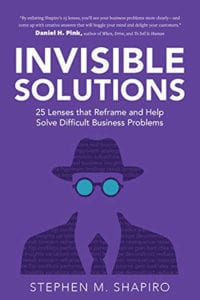
Invisible Solutions: 25 Lenses that Reframe and Help Solve Difficult Business Problems
That’s all meant to be. The cover of your book is fascinating. There’s a guy in a suit and these glow in the dark glasses. What’s the story there?
It’s the variation of the invisible man. The whole book is on 25 lenses, which are 25 different ways to reframe the problem. The fedora, glasses, tie, and jacket, if you look carefully, you’ll see subtly are all 25 lenses written. The whole outfit is made up of the words of the lenses.
It reminds me of Dolce & Gabbana, how they have words and their logos on dresses, purses and things and it becomes immersive like that. My first question is, how’d you come up with the title? Usually, people think, “If a solution is invisible, is that a solution?” We get down in the Alice in Wonderland rabbit hole a little bit.
I’ve been fortunate to have a buddy of mine, Adam Lefort, who’s brilliant at technology but he’s also great at coming up with big concepts. One of my books was called Best Practices are Stupid. Adam came up with that title. He came up with Invisible Solutions. The whole idea of the book is the best solutions are right in front of your nose. You just can’t see them because we’re not asking the right questions or we’re looking at the problem the wrong way. He said, “The solutions are there. They’re just invisible. They’re hidden.” That’s how we came up with the title which led to the invisible man, and then the cover was designed by my buddy, John Brunswick, who was at Salesforce. He came up with this concept one day and said, “How about the invisible man as a concept for the book cover?” I’m like, “Cool. Let’s go with it.”
Both in your keynote and in your book, you talk about how we are hardwired to ask ineffective questions. People would say, “We’re hardwired that way?” Let’s start with your definition of what is an ineffective question. I can guess but I’m sure you put a lot of thought into what an ineffective question is.
An ineffective question is one that doesn’t give you the results you want. The reason why we ask ineffective questions is because we probably don’t even ask questions. What we’re doing is we tend to make snap judgments or snap decisions, and then we start moving forward quickly. Part of this is because the brain’s primary function is survival. We need to innovate to survive and we need to adapt to survive, but we tend to innovate and adapt as a means of survival. The primary message of the brain says, “Whatever we did before we were together today, John, didn’t kill us so it’s probably safest for us to continue whatever we’ve done in the past.”
[bctt tweet=”Often, when we’re trying to solve a problem, we think of it too abstractly. We don’t take the time to frame it properly.” username=”John_Livesay”]
Anything new, different, and ambiguous might be risky, and therefore, we don’t want to do it. The brain doesn’t spend a lot of time processing the question. It is more reactionary in many respects. We need to put that conscious mechanism of putting the pause button on and say, “What is the real problem that I’m trying to solve? Where am I trying to go?” Sometimes, in organizations, business, and life, we’re under time pressures, so we think we need to go fast. The problem is if you go fast in the wrong direction, you’re just going further away from the ultimate result that you want to achieve. A little bit of time upfront can go a long way in repositioning you need to go in the right direction.
I’m fascinated by this whole fight or flight response concept. It’s something safe or not and yet, how do we build trust with clients, especially in the sales world? It’s little tricks and tips that we do as speakers, even though we’ve been on many stages. I’d be curious to see if you do this as well. If you have the opportunity the night before you give a talk in the morning, you go into the room, check it out, and maybe even walk up on the stage. You’re telling your body, “This is the safe space. This is not my first time on the stage. I know where the stairs are.” All those things that you don’t want to have to be thinking about survival like, “I don’t want to trip and look like a fool” is an example of that?
Absolutely. I will always go through a rigorous amount of practice the night before, whether it’s in the shower, thinking through certainly the first 3 to 5 minutes of the speech because I want to nail the beginning, and it’s always different. I know some speakers say, “I’ve got my first five-minute story.” I’ve tried that many times to have a starting story and it never seems to land. I don’t think it connects with the audience. I want to talk about, what’s the pain of the audience? What are they going through? I give a lot of thought to that so that when I’m ready to deliver the speech, even if it’s totally different, at least I feel comfortable that I’ve spent the time to think about it.
Yes, I love to practice. We’re on virtual stages so I’m in my office delivering speeches. I don’t know, John, if this is the same for you, but I still get nervous every speech. I don’t care what speech it is and I don’t care who it is. I sometimes do a little biofeedback. I’ll check my pulse in a live event. If I’m in the audience, I’ll be sitting there and I’ll put my fingers on my pulse. I’ll feel my pulse and I’ll control my breathing because I know that nervousness is going to help me explode on stage, but I don’t want to blow up and have my brains all over the place. I like to at least calm myself down a little bit.
I talk about this because a lot of salespeople struggle with nerves when they get up in front of big clients. I call it your Super Bowl of meetings or your Olympic moment. Everybody gets those butterflies in their stomach. My whole advice that I use myself is my whole goal is to get those butterflies in my stomach to fly in formation. I do that by saying, “It’s game time.” It’s my adrenaline kicking in and that fine line between being nervous and excited feels a lot the same, so we get to reframe it. I know what you mean. You’re sitting maybe off stage or standing off stage and they’re writing down the introduction to you and your heart starts beating a little bit faster because you know it’s showtime in a few seconds. You need to ground yourself and realize, “I’m excited. I’m not scared. I prepared for this.”
Let’s come to sales for a moment because one of the reasons why we might get nervous on a stage or in a sales pitch is because we are attached to the outcome. In many cases, we’re attached to the wrong outcome. If I’m trying to do a sales pitch, I might be attached to making the sale. That’s the outcome I want to get from it. If you can shift that outcome to, “I want to connect with the audience. I want to give them as much value as I possibly can, regardless of the sale,” now all of a sudden, that shifts your mindset and probably has. You’d be a better salesperson. When it comes to speaking, if I’m worried about, “Are they going to like me? Are they going to laugh? Am I going to get a standing ovation?” I’m going to fail. I try to remind myself, “I’m there to serve them the best I can. I’m going to give it my best shot. That’s all I can do.” If it’s all about me giving value, not me getting accolades, now I’ve shifted things and I find it helps a lot.

Invisible Solutions: The best solutions are right in front of your nose. You just can’t see them because we’re not asking the right questions or we’re looking at the problem the wrong way.
I went through this the first time I did a virtual talk and of course, everyone was on mute. When I know I get a giggle or a little bit of laugh, I can’t hear it. It took me off my game a tad. I was like, “Okay.” We depend so much on that feedback, energy, and facial reactions you can see people’s faces. I’m curious to know your experience of this, Stephen. Once the talk was over and people could post stuff in chat and take themselves off mute, the people are holier now than they were before the pandemic for connection, inspiration, and new tips. We’re saying how much they liked it. They got more feedback than the applause in a ballroom. I’m fascinated to know your thoughts on that.
People want connection. They don’t want to be in these endless Zoom calls, but they want to connect around something of meaning, purpose, and value. I know some of my speaker friends are 180 degrees from where I am but I love virtual. Partly because what you said that set you back a little bit was you didn’t get the audience reaction. My problem is in a live event, in-person event, I’m watching the audience and I’m thinking, “What are they thinking?” All these things start going through my head.
With the virtual audience, what’s awesome is I can be there. I do a lot of engagement with chat and other things but when I’m delivering the content, I’m just delivering the content. I’m looking at the camera. I’m giving it the best shot I possibly can. I find that the level of engagement and value and my energy goes up. I’m having a blast delivering virtual because it’s a different experience that can create a heck of a lot more value for the audience and for our clients.
I hear a lot of sales teams struggling with getting in what I call the virtual door. A lot of them, especially in healthcare, didn’t have to do it. They could stop by the doctor’s office and bring in some Starbucks or maybe catch the doctor at a hospital between surgeries. All those ways to connect and meet are gone. If they don’t have practice or training on what to say to even get the meeting before you tell a story, it’s a whole new world. I’m guessing you’ve got some ideas around that since you’re always about making sure you’re asking well-defined questions. Any thoughts and suggestions about what people who’ve never had to request meetings virtually before could be asking to show value at the meeting?
The keyword is value. A lot of times, we want a meeting because we have a hidden agenda. We need to move away from these hidden agendas to an explicit statement of value like, “Why would somebody even care to have a conversation with us? Why would somebody want to pay us to give a speech?” Whatever it is. A lot of times, it’s our get out and sell, but people don’t want to be sold. They want to be helped.
That’s what I try to do. I try to reach out to my best clients, my favorite clients, past clients, and people I’ve never done business with before and find something that I can connect to their pain. Unfortunately, I have a tool and a process and everything else that solves most people’s pains but putting that aside, everybody has a way of creating value. It’s not a Starbucks gift card. It’s not, “Let’s have a random conversation.” It has to be something that’s meaningful, timely and relevant for that individual.
[bctt tweet=”If you want to sell more, don’t focus on selling. Focus on serving.” username=”John_Livesay”]
That right now aspect of it. I first learned about this from a publicity standpoint. If you’ve got a book coming out and you’re a publicist and you are looking for what’s in the news and the headlines that are relevant to what I’m saying that pulls it in. When I’ve worked with people on their pitch to get a startup funded, it’s why now? If we think back in 2008, if the economy wasn’t in trouble, Airbnb might not have worked and people would have been open to new ways of having an income. That “why now?” question is valuable for all salespeople or anybody in marketing to put their filter through when they’re looking for the right questions to ask that bring this all up. I know you have 25 lenses that help us reframe things. We talked about reframing nervousness to excitement. What is one of your most popular tools of all these 25 lenses that somebody could possibly dabble with?
They’re all equally valuable. They’re all my children. I love them all equally. There are some that are more applicable. It depends on the type of problem. I’ll give a couple of them. A lot of times when we’re trying to solve a problem, we think of it too abstractly. We don’t take the time to frame it properly. Let’s say it’s a company that’s losing revenues. They might ask the question how do I grow revenues? How do I prevent eroding revenues? Whatever it might be.
The problem is when we ask these big, broad, abstract questions, it’s like trying to solve world hunger. We can get tens of thousands of ideas of which probably none of them have value. We need to, in those situations, break them down into something smaller. We need to reduce abstraction. There are five lenses for that. One which I always use is the leverage lens. It’s lens number one. It’s the most basic of lenses, but it says, “If you could only solve one aspect of this problem, what would it be? What’s going to give you the greatest return, the greatest bang for your buck?”
If you’re trying to increase revenues, you might ask, “First of all, is it revenues you want or is it profitability?” You could grow revenues but erode profitability. That’s a different lens. That’s a substitute lens. Is it revenues or profits? If it’s profits, then we can ask ourselves, “Who are the most profitable customers?” That’s a great start. What we might do is use the reduce lens, which is another lens to say, “Maybe instead of having more highly profitable customers, maybe we want to target fewer highly profitable customers.” Now you can see how we’ve gone from revenues to fewer highly profitable customers.
The last one I want to throw out is the variation lens. If we’re going to say we’re going to put most of our energy into our most highly profitable customers, we need to find a way of serving everyone else. The variation lens says, “We don’t necessarily want to. We probably do not want to use a one size fits all strategy.” How do we serve our most profitable customers one way, yet still offer something of value that might be completely different from our other customers?
For example, if you’re in financial services, maybe for your most highly profitable customers, you have a hands-on service where you provide them financial planning or whatever it might be. Whereas everyone else that’s purely digital, you can’t even walk into a bank. You can’t even do it with a teller or whatever it might be. Now you’ve got a highly efficient margin on one side where it can handle large volumes, and then the other one is high touch but high value. In the variation lens, think about how you would handle different segments, customers and people differently.
Best Practices Are Stupid: 40 Ways to Out-Innovate the Competition
I have an example of this from when I was selling advertising and one of my clients was Banana Republic. They had said, “We’re never going to be Neiman Marcus in terms of service and price points.” The question was, what could we do to target 20% of the clients that we have that are giving us 80% of the revenue? You triggered my memory when you’re talking about, “Let’s look at our most profitable customers.” They tended to be in San Francisco in the Union Square store and in New York City’s Rockefeller Center. They said, “Let’s try and anticipate, what is luxury?” That was the next question. That’s using your process without even knowing they’re using it. Now that I understand your process, it’s fascinating to see this in action. What is luxury besides price point? That’s the big shift. That’s the ineffective question. It’s the norm. Luxury is expensive. What else is luxury?
They came up with a definition that luxury is anticipating a need before you know you need it. From that lens, they said, “Why don’t we test putting in phone charge places in those two locations where the majority of our clients are giving us the majority of the revenue? We’re targeting this 20% of all the people that shop at Banana Republic or we’re going to get a good chunk of them in those two locations, those two big stores. It’ll be a nice way of upping the luxury experience without having to raise our prices or spend a ton of money, but giving them some other little perk.” The results blew them away because sales went up 20%. Not only did the people use it, but they also shopped longer waiting for their phone to fully charge, which they had not even thought of as an outcome. If I understand the takeaway from the book, which I love, Invisible Solutions, that would be it in action?
That’s absolutely it in action. That was a combination of the leverage lens, insights and observation lenses, which are all about, how do we understand what latent needs are? Needs that haven’t been explicitly expressed. That’s a whole bunch of different lenses there. I love that and then you can play with it like, “How do we get them to stay even longer?” Some stores have put in services in retail stores, whether it’s a desk where you could stay and work.
The theory is if you’re staying in the store, even if you’re not shopping, you’re still in the store, then you’d be like, “I see that over there. That’s cool. I want to go get that.” It could be even exclusively for certain clientele. “We got these red stanchions with velvet ropes for special people.” There are lots of different things you could do. The key is to test it out. You can sit around and come up with a lot of cool solutions, but we don’t know if any of them are going to work to do these small experiments.
What are the other things you have in your chapter about, switching elements is a performance paradox? Nobody loves an alliteration more than I do, Stephen. It sticks in my brain. Can you define what a performance paradox is?
The performance paradox is if you want to achieve a goal paradoxically, sometimes the best way to achieve it is to not focus on the goal. If you want to sell more, don’t focus on selling. Focus on serving. I had great pleasure when I was living in London working for a Formula One race car team. I asked them, “How do you get pit crews to go fast?” They said, “We tell them to go fast but what we found is that if we tell them not to focus on their speed, but focus on their style and their movements, they went faster and they thought they were going slower.”
[bctt tweet=”One of the big mistakes we make is we get myopically focused on the future that we forget that the future is not predictable.” username=”John_Livesay”]
There’s a lot of examples of this, whereby shifting from the outcome or the goal to a present moment activity can fundamentally shift your performance because you reduce stress. I’m not a great golfer, but I think about golfing as a great metaphor because when you’re golfing, which one does is look at the pin. You want to look at where you’re going but once you line up, if you lift your head up and look at the pin as you’re swinging, you’re going to slice the ball. You need to focus on the ball. Your eye has to stay on the ball 100% of the time knowing you’ve lined up and it’s going to go to the pin. That’s the way things work.
Don’t you find a lot of us struggle with worrying about the future too much? We’re not in the present moment, which is what a game like golf requires to be completely present. You can’t be thinking about anything, including what’s happening a few seconds after you swing. How does that help us in business when we do have to do projections and we have a big meeting, and yet we need to be completely present?
We cannot be thinking about, “I need this sale to make my quota.” “If I have to show this person another house. I’m going to lose my mind.” I work with people on replacing that negative self-talk or those future fear-based things with some simple mantras of peaceful and calm as you’re listening to someone give you an objection or interrupting them, worst case. “I have your answer. I’ve heard this objection 100 times. Let me cut to the chase. Talk about a way to kill a sale.” That’s one way to do it, right?
Yeah. We did a study once in a retail store many years back and we had two teams. One team, we told them, “We’re going to see who can sell the most.” We measured how much they sold. Another team, we told them they’re there to serve the customer. We’re going to see how well they serve the customer. That means if the customer should go somewhere else, they go somewhere else. Of course, the sales were measured for both teams and the team that was focused on serving the customer sold more than the team that was focused on making the sales. We can make these shifts.
You need to know where you’re going, at least directionally. I say you don’t want a specific destination. You want a sense of direction and then meander with purpose. That’s one of my favorite lines, which means, I don’t know. If you come up with a five-year plan, you’re smoking something because nobody has a clue of a one-year plan, so you need a sense of direction to make sure you’re moving forward with something but then you go each and every day and make these minor corrections in your course. What you’re going to find is you might move in a different direction, but it’s a better direction based on new information. That’s one of the big mistakes we make. We get myopically focused on the future that we forget that the future is not predictable.
I once heard someone describing this concept in terms of driving that when we’re driving on a freeway, we’re making these subtle corrections with a steering wheel to stay in our lane and not go over to the other oncoming traffic. It’s subconscious, we’re not even aware of it, error, correct. What you’re talking about is focusing on the direction we want to go. When I was a kid in family vacations, I’d be in the backseat torturing my parents. “Are we there yet?”

Invisible Solutions: The performance paradox is if you want to achieve a goal paradoxically, sometimes the best way to achieve it is to not focus on the goal.
That’s what salespeople management can do to each other. “Did you hit that number yet? Did you get that sale?” As opposed to, “Let’s keep focusing on customer service. What do they need? How can we solve that problem?” The other thing that you said I’m fascinated with is on both of those examples where there’s the car team changing the tires quickly or the other example of the contest is people perception. “Am I going slower or faster? Is this working or not?” It’s not always accurate. It’s almost like you’re trying to trust your eyesight and you know that sometimes what you see is not the reality.
When you’re working hard, you think you’re making progress. That’s not necessarily true. Some of the things that I’m talking about here go back many years to research that was done by two scientists, Yerkes-Dodson. If you look at the relationship in between, they use the word arousal, but I think of it as motivation. How do we motivate somebody? Their performance looks like an upside-down U for the most part. No motivation and no performance, then there’s that sweet spot where you hit that peak performance, but then if you over motivate somebody, their performance starts to drop.
Let’s say we were lucky enough to get our name picked out of a hat for a basketball game. If you shoot from the half court, you win money or better yet, let’s choose the county fair. Those little basketball games and you win a stuffed doll. A stuffed doll is not a big motivation but now all of a sudden, I give you $100, you’re going to try a little harder. $300, you’re going to try a little harder. There’s a point that will be different for each person but there’s a point where I’m going to give you so much money, you’re going to get a lot worse. If I said it’s going to be $10 million, I promise you, you will not sink the ball because your nerves are going to go out of control. That’s what we see happening is that upside-down U model.
That’s beginner’s luck because they’re unattached to the performance. “If I don’t do well, I’m not going to beat myself up. I’m not going to suddenly think I’m a bad person or not talented. I’m just trying this.” Once we started trying to beat our own records, when I used to swim competitively, that was always the thing. “Here’s your best time for the last three months. See if you can beat it this race.” Ironically, I find myself in a sales career, which is the same thing with quotas. “You hit this number last year, now we’ve raised it X percentage. I’ll try to beat that.”
It is interesting how we find ourselves. That’s why I always love hearing your own personal story of origins. You’re deconstructing things as a child and now you’re deconstructing myths like, “Working harder doesn’t necessarily mean progress,” or getting people to let go of the premise that, “I have to focus on my outcome and not the process.” All of those things that make us more innovative. There are solutions that are in front of us that we just have to get the right lens so that we can see them. Is that a fairly good, accurate summary of you and your book?
That’s spot on. I’m glad you pulled out the performance paradox because I also say there’s the solution paradox, which is the corollary to it. If you want a better solution, stop focusing on solutions. Having the answers is not the answer. We have to have better questions and we need to reframe the questions. The key to high performance is better questions that lead to faster implementation of more valuable solutions.
[bctt tweet=”The key to high performance is better questions that lead to faster implementation of more valuable solutions.” username=”John_Livesay”]
You need to have a certain emotional EQ to be comfortable that you don’t have all the answers, especially if you’re in a management or leadership position. The old way was if you got that job, you better have every answer or fake it. People can see through that as opposed to more collaborative conversations that I see happening. One last question for you because I see this as a big problem in a lot of different industries. I’m guessing you have a tool through your lenses. All the silos that exist in companies.
They’re constantly telling the silos of whether it’s a practice area and an architecture firm or law firms that have different practice areas or healthcare companies that have separate sales teams for each division of whatever the product is. Yet, they’re trying to get the end-user who’s using one division to use all of them and there’s no way for them to even start so they’re all focused on, “We need more new clients,” as opposed to, “Maybe if we weren’t siloed, we could grow some existing clients to use other divisions.” That to me seems like a huge problem that someone like you has to put a lot of thought into. Any thoughts around that before we say goodbye?
We could do a whole podcast on this one topic. It’s a fascinating one. I remember a company that we’re doing some work with, where their on-time product launch was 15% on-time product launch. The reason was because they thought product development, the R&D group was the product but it wasn’t because they would create a product, and then it would go to marketing. They say, “This is not the right product,” and then we go to sales, “It’s not the right product,” or manufacturing, “We can’t make this product.” They would go around in circles. They redefined product development as being six months after a successful product launch. Everyone, legal, sales, marketing, manufacturing, and R&D were all part of that and measured and incentivized on that. What they went for is from 15% to 70% on-time product launch in one year, simply by shifting people’s definition of what the launch of a product was.
Everybody has a vested interest in that.
Exactly.
The book, Invisible Solutions, you can get it on Amazon, and then Stephen’s website is StephenShapiro.com. Thanks for coming on and sharing your solutions whether they be visible or invisible.
It’s great to be here, John. Thanks.
Important Links
- Invisible Solutions
- Elizabeth Gilbert
- Best Practices are Stupid
- StephenShapiro.com
- Invisible Solutions – Amazon
- Better Selling Through Storytelling Method Online Course
Wanna Host Your Own Podcast?
Click here to see how my friends at Podetize can help
Purchase John’s new book
John Livesay, The Pitch Whisperer
Share The Show
Did you enjoy the show? I’d love it if you subscribed today and left us a 5-star review!
- Click this link
- Click on the ‘Subscribe’ button below the artwork
- Go to the ‘Ratings and Reviews’ section
- Click on ‘Write a Review’
Love the show? Subscribe, rate, review, and share!
Join The Successful Pitch community today:
- JohnLivesay.com
- John Livesay Facebook
- John Livesay Twitter
- John Livesay LinkedIn
- John Livesay YouTube