

Business Mastery With Bill Prater
Posted by John Livesay in podcast | 0 comments


If you want to excel in business, don’t think like the players in your niche. Instead, figure out what the elite players do and emulate them. Joining John Livesay in today’s episode is Bill Prater, a business owner, entrepreneur, publisher, author, speaker, consultant, and coach. Bill is best known for his long-term success in enabling business owners and leaders to quickly eliminate personal barriers, rapidly reach their current dreams, and embark on a journey of business mastery. Today, Bill shares some insights on how you can think like an elite performer and dominate your market. Enjoy the episode.
—
Listen to the podcast here
Business Mastery With Bill Prater
Our guest on the show is Bill Prater, who’s an expert at Business Mastery. He tells people not to use the same approach for all problems. He’s got some insights on how to dominate your market and how to think like an elite performer. Finally, he says, “Always be ignorant. Don’t be afraid to ask questions and stay curious.” Enjoy the episode.
—
Welcome to the show. Our guest is Bill Prater, who’s a business owner, an entrepreneur, a publisher, author, speaker, consultant, and coach. He’s best known for his long-term success in enabling business owners and leaders to quickly eliminate personal barriers so they can rapidly reach their dreams and embark on this journey of Business Mastery. His own story was that he was excelling in sales, sales training, and sales management at IBM in the computer division as a national sales manager and a partner in the country’s largest oil and gas securities firm. He raised more than $750 million of equity capital in eight years. He recruited, trained, and led more than 100 sales professionals and achieving average revenue growth of 100% annually. I know how hard that is. Bill, welcome to the show.
It’s great to be here, John. Let’s make this happen.
One of the things I want to ask about having sold multimillion-dollar mainframe computers myself earlier in my career is your own story about that. We can start the story before IBM. If you’d like, you can start with school, college, or wherever you got this passion for connecting and sales.
The connecting and sales lineage started back with me being a full-ride football guy at a university. I got a scholarship. I got hurt before the season started. After the first year was over, I had to figure out how to go to school on my own. I ended up working in the land surveying civil engineering field and made pretty good money that I thought, “Why bother going to school?” That’s my first relationship with the value of money. I ended up flunking out of school. I went back and saw the Dean of Men at the University of Washington. I said, “I like to come back into school because I’m a good guy,” and I went through my whole spiel. He said, “No. Why would I let a flunk out in the school when I have these eager young freshmen that want to come into school?”

Business Mastery: If you think you know the answer to something, go ahead and ask anyway. You never really know what you don’t know until you ask.
That was an excellent point. He vented. What he said is, “I’ll let you into night school if you get straight A’s, then I’ll let you go into the day school.” I said, “How do I get straight A’s?” He says, “I don’t know. Ask the professors.” He needs to know I’m dead serious. “Think this through. What kind of students asked the professor how to get an A?” I said, “Probably A-students.” He said, “You got it.” That was my first major learning about effectively, the art of asking questions or, better yet, asking for help. You and I have a sales background, sales management background. You’re stuck with it. I’m still in it, even though I don’t claim I’m a sales guy.
A big major lesson that I got early on is always to be ignorant. By that, I mean, even if you think you might know the answer to something, then go ahead and ask anyway. You’ll never know what you don’t know until you ask. Fast forward, I did ask the professors how to get A’s. I ended up getting straight A’s for the rest of my college career and graduating on the Dean’s List. It’s all because of that simple question, which I asked over and over again. It was amazing the kinds of things these people would do to help me get an A.
They know you’re that committed. What I love about what you said, “Always be ignorant. Ask anyway,” as opposed to assuming you know what the answers are going to be. I’ve helped some people when they’re interviewing for a job ask a question. At the end of every interview, people say, “Do you have any questions for us?” Unfortunately, a lot of the younger people might say, “When’s my vacation start?” I tell them to ask this question, “What would it look like if I were to exceed your expectations in this job?” It is another way of saying, “What do I need to do to get straight A’s?” Most people never ask a future employer that question, nor do they ask a professor that question.
When people are reading this, they can start to think, “What question am I not asking that I could ask that my competition is probably not asking? What set me apart?” Once you have that momentum going in any conversation, whether it’s a sales conversation or trying to get your team motivated to grow and scale, which is your expertise, it completely shifts in the box traditional way of solving things. Also, what I love about that story is your resilience. A lot of people would have given up. “You got a good point. Why should you give it to me when you got all these hungry freshmen? That’s too high a bar. Straight A’s? Forget it.”
[bctt tweet=”Allow yourself to be ignorant and ask questions anyway.” via=”no”]
There are lots of things that come out of that story that starts to give me a little more color and texture, almost like a painting coming to life. I know how hard it was to get a job at IBM. They would test everybody. If you think getting into college was tough, getting a job at IBM was tough. It was the best of the best. You just didn’t get a job. You thrive there. I’m sure there’s a little more context. I specifically want to know when you were at IBM, this premise of scaling 100% out of 100%, there are two things that come up all the time when I’m talking to people who are entrepreneurs, salespeople, or both. One is fear of rejection. The other one is, “I had my best year ever. How am I going to top myself?” That’s where the superstars like you shine, is the consistent growth, not just, “I have a great year. Don’t ask me about next year.” How do you start to help people with that mindset and strategy?
That’s exactly what it is. It’s the mindset. What it is that all of us were programmed as young people to act in a certain way. A lot of that becomes part of our subconscious. Since it’s in our subconscious, we’re able to deal with a bunch of stuff. We don’t have to think, “What color is that light? What color is red?” You know red means stop the car. You don’t process that through. A couple of points about mindset is that it had happened at IBM that I realized what my programming was.
When I was young, I remember vividly that when something would happen in the house where my grandmother lived with us, she’d say, “Billy, do something about that.” I didn’t have any idea what it was all about. I jumped up and took action. I didn’t think. I just responded. That’s lesson number one. I realized that in a company like IBM, there’s a lot of telling you what to do going on all the time. I decided, “No. I’m going to think this through, not be reactive and figure out how can I reduce the amount of time it takes to get something done?” If you remember IBM, they used to be greedy good at giving you performance appraisals.
I was a systems engineer to start with. I get in performance appraisal. My boss, his name is Dave, said to me, “Your score is outstanding.” I said, “That’s great. I’m outstanding. Now what?” He said, “What do you mean now what?” I said, “If I’m already at the top, what’s next to your point?” He flounders around a little bit, frankly. I got him in a box because I was outstanding. I said to him, “If I’m your number one systems engineer, am I the highest-paid systems engineer?” They don’t like to answer that question, but he did, unfortunately, and said, “No.” I said, “I don’t understand how I could be rated number one and not being the number one paid?”

Business Mastery: Most of us were programmed as young people to act in a certain way. A lot of that becomes part of our subconscious.
He went through. He got the old chart out. You’ve seen the charts of how many years and what your score is. The maximum raise you can get. It’s all a Mathematical model. He said, “The only way to get paid what you’re worth in IBM is to be a sales guy.” I said, “Okay, sold.” He said, “No, not so fast. You’re my number one systems engineer. I don’t want to let you go.” I said, “Dave, that is not a good answer. You’ve got it.” He says, “I’ll let you go to sales school if you finish in the top three.” I go, “Okay.”
I got the challenge of finishing the top three. I ended up finishing at the top one. I was number one in sales school. I came back, and I walked into his office. The school ends on a Friday, and I’m back at work on Monday. He doesn’t know anything about what happened. He said, “How did it go?” I said, “It went pretty well. When’s my sales job?” He said, “What do you mean?” I pull out my gold cross pen that has IBM on it and I hand it to Dave, and he uttered a nasty word. I said, “It’s time for sales.” He said, “You don’t want to go now. This is September. You’d have to have a whole half year’s quota.” I said, “Fine.” He says, “You don’t know what you’re saying. You got three months to do a full half-year.” I said, “I want to go now. You’re barking was if I did this, I get there.”
I ended up doing pretty well. I bought myself a Porsche in the whole deal because I completely shut it out. I shut the lights out. You and I talked before we got into our interview about cold calling. I figured I might as well go cold calling people. I don’t know anything else about what to do. I go. One of the very first people I banged on the door of, I walked in, and the receptionist said, “You’re with who?” I said, “IBM.” She said, “I’m sure that David wants to see you. We’re looking for a computer.” That was it.
Once you got into sales management, how did you keep the momentum going when your team would have a good year and the quotas would go up accordingly? This is why I was excited to have you on the show is we can go into this subconscious mindset. I feel from my observations that a lot of salespeople think when they’ve had a great year, it’s a fluke. Therefore, when you were asked to repeat it or exceed it, it’s the same thing for the business leaders you deal with, a new council. They don’t have a plan or a roadmap in place.
[bctt tweet=”Be curious to get insights.” via=”no”]
They say, “Everything started lined up as a perfect storm.” They had a big knee. They had a budget that they’ll never have again. “I can’t possibly find another client like that. With these numbers, I’ll never make it.” You take the mindset and the strategy. It’s not just one or alone. I wanted to get a sense from you when you work with companies. Companies hire you to pick this expertise and give them the scalability issue that you’re great at. Not just growth but dynamic growth. What is it that you do that helps people overcome their initial negative self-talk that they can’t possibly exceed the best year they’ve ever had in terms of mindset? What are they missing strategy-wise?
I’m going to finish up with mindset and then we’ll jump into strategy or positioning. A lot of what you asked me and a lot of the answers I deal with is the notion that we’re originally programmed or taught that we need to deal with the environment we’re put in or the hand that you’re dealt. You’re given a certain quota, a crappy sales territory, a sales team, but half of them are rookies. We can continue to list all of that. All of that, in general for all of us, you and I and the people that are reading, if you think about a bell curve, most salespeople, sales managers, business owners think of themselves as in the middle. In the middle is what’s called the standards or the averages. That’s the way you measure the middle of any industry.
The people that end up looking at the environment through the prism of being in the middle of the bell curve are going to stay in the middle of the bell curve. What you need to do mindset-wise, I found is you’ve got to figure out what the elite players in your niche. If you’re 1 of 140 salespeople, they’re not all performing equally. You don’t think the revenue of the company, divide by 140, and everybody does that Math thing. Instead, there are some super laggards. There’s the mass unwashed middle, and then there are the superstars. What are the superstars doing? One, they’re not waiting until they get their quota in the middle of January. They’re starting day one, minute one. Second, you remember this with IBM, every year, they had a different sales plan. The sales plan was designed to benefit the company called IBM.
They wanted you to sell certain things. They wanted you to add certain kinds of software and a variety of it. They put all that stuff in the sales plan. Step one, minute one, don’t deal with all that stuff, go figure out what the fastest path to the cash is, and go do that. It’s usually a machine they want you to sell etc. Number one is don’t think like the rest of the players in your niche, instead figure out what the elite players do and emulate them. Their mindset is one of mastery, dominance, excellence or extraordinary. Emulate that. Strategy is an entirely different thing than tactics, but a lot of people get that stuff mixed up. For example, a tactical thing to do is to make cold calls on the phone or send out cold emails.

Business Mastery: Once you’ve got the goal and assembled your resources, the next step is to execute.
The question is, why are you doing that? What’s the strategy? What’s the higher-order bid? What’s the reason that you have to go down the road you’re going down? Once you’ve figured out your reason or your strategy, then you can start doing tactics. Maybe cold calling is a perfect fit, but maybe it isn’t. Maybe, instead, what you want to do is go and interview your last year’s customers and have them tell you, for example, here’s the question, “Sir, I enjoyed working with you last year. How could I have served you better?” That’s the question I taught my people to ask. We went and interviewed all of our customers the previous year, ask them how we could do better, how we could serve them better. We got this huge list. We got our whole tactical plan from asking people, “How do I get an A?”
Were there many surprises? Were those things you knew you could do better and didn’t have the resources to do, or was it, “I had no idea that was something people wanted, so we weren’t doing it?”
Mostly surprises. Companies like IBM or Transamerica are large organizations. The senior executives don’t have a clue what’s happening on the street. The people that know what’s happening on the streets are the people that are on the street. Just because the sales plan or the missive from on high says, “X, Y, Z,” that doesn’t mean that something like, “P, R, Q,” is what you should be doing. The only way you can find that out is to ask people that are your customers. Prospects are going to give you the answers too, but they don’t have much context because they haven’t seen what you’ve done in the past.
This Business Mastery system that you’ve been doing for many years, helping companies, small and large, figure out a killer strategy, makes a lot of sense in that context. One of the things you have on here is this wonderful blog about What’s Stopping You From Getting Better Results Every Single Time?, as opposed to, “I’m going to try, be like a baseball player, and hit a certain percentage.” You’ve got four beautiful colored circles, things. Would you walk us through what those are? We’ve touched on them. I want to intrigue them to read this blog. If you described what the four things are and how they all keep going round and round to keep growing, it might be a light bulb moment for some people saying, “No wonder I’m missing this key part while I’m doing 3 of the 4.”
[bctt tweet=”Don’t think like the rest of the players in your niche. Instead, figure out what the elite players do and emulate them.” via=”no”]
Even using baseball or softball, either one analogy is a good place to start. Nobody told you that you had to have a good batting average. Your coach didn’t say that. Nobody said that. That’s not baseball. That’s not what it is. If you’re up for batting, what is the first thing you’re supposed to do? It’s not hit the ball. The first thing to do is get on base. How can you get on base? The ball can hit you then you go on base. You can hit the ball and have nobody catch it or throw you out at first. You’re then good on base, or you can walk. There are at least three different ways.
The point of it is to figure out how to get on base. That’s back to that comment about a tactic versus the strategy. The individual player, the job of the batter, is to get on first. They do have a term in baseball and softball called on-base percentage. That’s much more important than a batting average. It’s the same thing as though in business. What I discovered of a variety of things and I won’t go in order because frankly, John’s describing, it is a cycle, number one, and it fits for any size company in any niche privately held and republic he held but even more magically if it’s in every department in every company. Even more magically, it fits in every team in every department, in every company. It makes my life easier.
Those of us that are in sales is a practical matter. We’re a business owner. We have a geographical territory, some product niche, or specialty. All of that is an entrepreneur’s or business owner’s jive. We already talked about this concept of the environment. The environment is where all your resources are. That’s where you have your tools and potentially some team members. Most people operate their business, territory, job from the standpoint of whatever they have from a resource standpoint. For example, if you’re physically in San Francisco and an opportunity comes for you to service somebody in, let’s say, Baltimore, and you say in your mind, “I’m in San Francisco.” That would be resource restrictive that you’ve allowed yourself to be contained by your environment.
Instead, what you wanted to say in your mind is, “How can I service somebody in Baltimore at a high-quality level?” That’s one of these four phases, which is effective alignment, but most people put that a front of planning. It should be behind plan. Your plan should be the pick of the year. “I’m going to be 300% of quota this year. I’m going to grow my business by 300%. I get 300% more new customers.” That would be effectively an annual goal. Once you’ve got that, it’s time to look at what resources you do need. Not the other way around, make your decision about what you want to do first, then find the resources. For example, we could cold call. We could figure out a way to get a bunch of referrals. We could survey all of our existing customers and all of those.

Business Mastery: Dominate Your Market: How to Quadruple Revenue in Four Steps (Business Mastery Series Book 1)
The temptation a lot of people might have is they’ll hear an idea like that, and they’ll put it in action. It may or may not be a good idea. The way to do it is to do it after you’ve figured out what your goal, objective, or strategy is for the year. Once you’ve got the goal, and you’ve assembled your resources, next is to execute or go get into action and do stuff. Instead of being like, “I did with my grandma jumping up immediately when she told me to.” Think, gather your resources, then execute. The fourth phase is to figure out what in the world happened.
The answers are either red and you fell on your face. Green, you exceeded whatever heck you’re after doing. The third is some Amber or a yellow, meaning you’re just about okay. The cycle is to analyze your situation, figure out a new plan, gather the resources you need, execute. After you execute, analyze the result, adjust your plan, find new resources if you need to, then execute. It’s a cycle. All businesses, departments, projects, individuals with a sales territory, all people with some project that they’re managing, you should run them through that four-phase cycle I gave you.
When we clarify something, we’re not limiting ourselves to one answer, and you zero in on what do we want to focus on first. The thing that I love about this Business Mastery system you’ve created is the alignment. Not just executing without other people’s agreement, understanding. That’s crucial to what you’re doing that makes this fly so much. I did also want to touch on this wonderful quote of yours, which is, “Don’t use the same approach for all problems.” If you go to sales training like, “You get this objection, here’s the answer regardless of who’s saying it or what the situation is.” I don’t think that’s the case anymore. I tell people, “You’ve got to think of your brain like a jukebox with multiple stories ready to go depending on what the problem or the challenge is.” The fact that you talked about this is another wonderful blog about how you bring results to people. Give us a little taste of what this means in terms of some things that require more finesse etc.
Objections are problems. However, most of them are disguised. What I mean by that is most people that you’re having a sales conversation with are not very skilled at giving you quality objections. They may say something, but they’re hoping you’re going to go away. They’ll make a comment to see what you’re going to do. If you say, “I’d give up,” then mission accomplished. What teed up in my mind is whatever you hear from anybody is likely not a well-thought-out response. Sometimes it could be, but you simply need to practice this art of ignorance and say, “Could you elaborate more on what you mean by that? Would you flash that out more?”
[bctt tweet=”What’s stopping us from getting better results is almost always not asking questions or for help. ” via=”no”]
I don’t believe in a Rolodex type of thing where you get a certain question. You need to find that answer and deliver it. That’s what you get when you have a chatbot or something like that running on a robot. All you have to do is be genuinely curious. “I’m surprised you said that. Where did that come from? What’s the backstory of that?” That’s the key. The key is to be ignorant, don’t act like you’ve heard that before because maybe it isn’t quite the same and ask, “Tell me more. May I ask for more? Can you help me out here? I don’t quite get it,” things like that.
Are there any last thoughts? You have this wonderful book that people can get. It’s called Dynamic Growth.
In GetBillsNewBook.com, and you’ll get a chance to get the pre-publication version. It will give you a book form. It will encapsulate a lot of what we’ve been talking about here.
It’s called Dynamic Growth: How to position your business as a 24/7 cash-producing ATM. Who doesn’t want that? Bill, thank you so much for sharing your gifts, including this wonderful book, and more importantly, this awareness that when we’re curious and when we’re not pretending we know something, no matter how much experience we have, get our mindset and our strategy in place, there’s nothing that we can’t do together. Thanks again for being on the show. I’m looking forward to having all kinds of feedback on how many people are going to be giving me insight going, “That was a great episode. Thanks so much for having Bill on.” Nothing makes me happier than to have guests like you that have so much wisdom and a heartfelt passion for what you do.
Thanks, John. I appreciate it very much.
Important Links
- Bill Prater
- What’s Stopping You From Getting Better Results Every Single Time?
- GetBillsNewBook.com
- Better Selling Through Storytelling Method Online Course
Wanna Host Your Own Podcast?
Click here to see how my friends at Podetize can help
Purchase John’s new book
John Livesay, The Pitch Whisperer
Share The Show
Did you enjoy the show? I’d love it if you subscribed today and left us a 5-star review!
- Click this link
- Click on the ‘Subscribe’ button below the artwork
- Go to the ‘Ratings and Reviews’ section
- Click on ‘Write a Review’
Love the show? Subscribe, rate, review, and share!
Join The Successful Pitch community today:
- JohnLivesay.com
- John Livesay Facebook
- John Livesay Twitter
- John Livesay LinkedIn
- John Livesay YouTube
Ask! : The Bridge from Your Dreams to Your Destiny With Mark Victor Hansen and Crystal Dwyer Hansen
Posted by John Livesay in podcast | 0 comments


There is only an answer when there is a question. In life, there are times where we are held back from the things we want because we are just so scared of asking. In this great episode, John Livesay talks to not one but two amazing guests. He is with Mark Victor Hansen—the co-author of Chicken Soup for the Soul—and his wife, Crystal Dwyer Hansen—entrepreneur, certified life coach, and wellness nutrition expert. Together, they share about the power that is in asking through their new book called Ask!: The Bridge from Your Dreams to Your Destiny. Mark and Crystal tell us the seven roadblocks we have to overcome before we can start asking ourselves and other people and even God for help. We are literally made to be each other’s resources, and that whoever asks the most questions becomes more likable. They share the essential questions that will make you masters of asking and lead you out of just dreaming into your destiny. Tune in to today’s show!
—
Listen to the podcast here
Ask! : The Bridge from Your Dreams to Your Destiny With Mark Victor Hansen and Crystal Dwyer Hansen
I have not one, but two amazing guests: Mark Victor Hansen and his wife, Crystal Dwyer Hansen. They are the co-authors of a new book called Ask!: The Bridge from Your Dreams to Your Destiny. Mark, you might know as that Chicken Soup for the Soul guy, which started back in the 1990s. He and his business partner, Jack Canfield, created what Time Magazine called the Publishing Phenomena of the Decade with over 110 million Chicken Soup for the Soul books sold worldwide. Crystal is an entrepreneur and certified life coach and a wellness nutrition expert whose personal coaching, speaking, CD and video programs have helped people all around the world. Her expertise is in the field of human potential. People who have worked with her have a profound and lasting transformation in all areas, relationships, careers, health and wellness. Her book, Skinny Life: The Real Secret to Being Physically, Emotionally, and Spiritually Fit is also available. Mark and Crystal, what an honor. Thank you both for coming. Welcome to the show.
It’s our delight. We’re excited because we know the secret that will make everybody infinitely better off if we go through this talk with you.
Let’s know what the secret is and then we’ll get into your own backgrounds a little bit more. You’ve teased us so much. What is the secret? Everyone’s on the edge of their seats.
[bctt tweet=”The most important questions we ask are the ones we ask ourselves. ” username=”John_Livesay”]
What happens is we travel so much that we meet people that are wonderful, fabulous, successful, professional, intelligent, but they don’t quite fulfill their potential. We said, “What would it be that they need to do to fulfill their potential?” What they’ve got to do in our impression is to become masters of asking. You say masters of irresistible storytelling and pitching.
I’m sure the audience is very interested to know a little bit about your own personal stories of origin and then how you two met. Crystal, tell us a little bit about how you became such an expert in all of these areas of nutrition and relationships. Go back as far as you want like childhood, school or whatever.
I was raised in an unusual situation where my mother was way ahead of her time, organic gardening, naturopathic medicine and those types of things. I was raised that way. Later on in life, I was in the business world. I was in real estate and loving what I was doing, but I’ve always found that whatever I was doing, whether it was modeling or selling real estate, I would connect with people very easily and people would open up to me. I seem to find an easy way to help them with their issues. My sister came to visit me. She has been a smoker since she was fifteen years old. My cabinet-maker was there that day. He was redoing one of the cabinets in a house that I was doing and he lost weight. I said, “Tony, you were great. Why do you look so good?” He goes, “I stopped smoking, I lost weight. I got hypnotized. I went to a hypnotherapist in 30 days. I’m back. I’m better than ever.” I was so intrigued. I said, “Stephanie, we need to get this. I’m going to take you over to this hypnotherapist and let’s do this.” I was astounded that she could break this impossible addiction, lifetime habit in that much time.
I became obsessed. I enrolled in the largest holistic college in the country. I became certified in American Board of Hypnotherapy. I became certified in life coaching and I started helping people. I opened a practice in Scottsdale, Arizona. I was almost astounded at the results people were getting. People were coming to me who had been depressed their entire lives. I got a note from a woman one time. She said, “I am so thankful I heard you that day on the radio. You were my last hope. I’ve been depressed my entire life. After five appointments with you, I can honestly say I am entirely free of the crushing depression I’ve experienced my entire life. I can wake up and have a bad day. It’s not the end of my world.” I became addicted to helping people. I love it. I connect with people and that’s the work I was doing.
When Mark and I had met, I had written my first book, Pure Thoughts for Pure Results, and I went to an event he’s speaking at called Author 101. He saw me, I saw him. We ended up in the VIP room together at the reception. A woman spilled a glass of red wine on my white pants and Mark came over to my rescue and said, “I know where the club soda is.” It was that kind of moment because I was talking to a speaking coach and he was surrounded by an entourage. I wasn’t bothering him. He must’ve been looking because he saw this happen. He came scooting over to me, held my hand, pulled me out of the room and said, “I’m sorry this happened. Let me help you find some club soda.” We started talking and we haven’t stopped talking.

Dreams to Your Destiny: There are two kinds of people in the world, those of us that ask and those who don’t.
Mark, I know that Chicken Soup for the Soul has been a huge success. You have a lot of other books, The One Minute Millionaire, Cracking the Millionaire Code, How to Make the Rest of Your Life the Best of Your Life. You have had so much success in so many areas. What is it that caused you and Crystal to say, “There’s still something out there that the two of us combined can put out into the world,” which is the secret of ask?
She tells me that I’m the master asker of all time. I’m the ninja of asking, maybe even a triple ninja. My parents were Danish immigrants and didn’t have any money. I started buying my clothes at nine years old and learning how to do stuff. I was a Boy Scout and I read the Boy Scout Life Magazine. You could sell greeting cards on consignment. I looked up in my little dictionary what consignment meant. It means I didn’t have to put up any money so I could afford that. I started learning to ask. I asked more neighbors than anyone else. I sold more greeting cards than anyone else. I became the number one ingredient card salesman in America at nine years old. Forty years later, I’m back with the same company, Gibson greeting cards. We sold 897,000 boxes of Christmas cards a year through grocery stores. It’s an amazing full cycle thing. There are two kinds of people in the world, those of us that ask and those who don’t. Most people are afraid and they get stifled and stop toward asking.
It’s an energetic thing that you talk about, that there are three different channels. Let’s talk about the three channels and then let’s talk about those roadblocks to asking. Because if people can walk away from those three tools that the two of you have given, everyone’s going to be making a mad dash to buy the book because it’s just the tip of the iceberg. Would one of you share with us the three channels through which we can ask?
Each one of these is important in and of itself. The three channels are: ask yourself, ask others and ask God. Some of the most important questions you’ll ever ask are the ones you’ll ask herself. When you’re sitting there depressed or have anxiety that’s shutting you down every day or you’ve through a divorce or you’ve lost your job. All of these places, times where we need to start over and often, we don’t see the way to do it. You start with the question and it’s that question you ask yourself that causes an answer. We did a lot of research for this book. There is research done that it ignites the critical thinking part of your brain. When you ask a question of yourself, your brain has to engage in a different way. All of a sudden, you have a new illumination, you have a new solution, you have a new insight, you have a new breakthrough, a different understanding of something. Those self-questions, asking yourself, that is one of the most important parts of the asking journey.
[bctt tweet=”Ask more questions if you want people to like you. ” username=”John_Livesay”]
One of the things I work with people on is if you’re in sales selling yourself or a product, you have to feel that you’re worthy and believe what you’re doing. I tell people, “Start a question off with, “What if?” I believe it taps into our imagination. Do you have an example or a story of someone of a good question we should all be asking ourselves?
We have a friend who we think the world of, Jim Stovall. He was slated to be an NFL player. He had the size and speed. They’d recruited him, he was ready to go. They send them to the medical and they say, “You’re going to go blind.” He’s going blind and can’t do it what his heart’s desire was, and he is in a little 9×12 room with three things. A radio, a television and a telephone and he’s going stir crazy. He goes to the first blind meeting recommended by his parents and he sits next to a woman and he said, “I watched TV in the old days. I love action movies, thrillers but I can’t see something, and now I can’t see the action. I wish somebody would do something about it.” That’s the pivotal question because the lady next to him, also blind, leaned over and said, “Jim, you and I are somebody. Why don’t we do something about it?” They created a business that you and I wouldn’t know as sighted people, but they have fourteen million people watching narrative TV that shows a guy throw a right hook or whatever it is, tire squealing away.
He’s becoming an enormous business guy and very successful because of one question she asked. “We’re somebody, why don’t we do something about it?” He says, “I now write books,” and he wrote a great book that I did the foreword to. He says, “I know write books that I can’t read and I make movies that I can’t watch because Mark told me to make that book a movie.” He wrote three books entitled The Ultimate Gift, The Ultimate Journey and The Ultimate Life. He’s amazing, but he’s a big football player size, blind. He says, “I write books that I can’t read and I make movies that I can’t see.”
We get the power of asking ourselves these potential questions of what could be possible, and then we have to somehow find the courage to ask others to help us, to brainstorm with us to see the best in us. What do you think, Crystal, would be an example or a story of asking other people and overcoming some fears we have of coming across maybe as too pushy or something?
The research shows that people are more than willing to step up and help you, but they don’t help unless you ask. People are wired to connect. We’re wired to help each other. We’re wired to jump in, but people often feel they’re nosy or they don’t want to intrude unless you ask them.

Dreams to Your Destiny: Couples that stay together pray out loud at night and in the morning before they go and do whatever they can do together.
Do you have a story of a time that somebody asked others for either help or insight or support that they had to overcome their own fears of being rejected or feeling pushy?
One of the stories that we tell is, and it’s one of those amazing lessons, one of our friends, Rita Davenport, she’s a journalist. She was a superstar in the network marketing industry. She had created this amazing concept where it was a cooking show. She had this idea to scale it up and she knew what she needed to do. She had the answer. She knew it was successful at a small level. She went to ask the person who would make the decision ultimately and he said no. She lost out on a $3 billion enterprise by not stepping up because somebody else went forward and did the business.
It’s one of those lessons where she found out later, all she had to do was keep going through the channels and keep asking to get her dream. It was heartbreaking for her because there was no way around it. She went to the gentleman later who ended up taking her idea and running with it. She said, “The very least you could have done was shared this with me.” He admitted that it was her dream and her idea, but she was too polite. She was too worried. She thought she had to take no for an answer. The thing about asking is you have to be a fearless asker and keep asking.
What I’m getting is not take rejection personally or be so afraid of rejection that you can’t even ask.
[bctt tweet=”People are more than willing to step up and help you, but they don’t help unless you ask. ” username=”John_Livesay”]
One of the greatest examples of that is our friend, Bob Proctor. We use him as an example of completely transforming from being a very unworthy person. He was raised in poverty and had nothing. Mark probably knows the story better than I do.
He’s told that he’s not good enough. He comes out of the Navy, goes in and becomes a fireman. As a fireman, he was making $4,000 a month. He was married and had three kids. He owed $6,000 a month. Every night after going to the fire department, they went in sat and drink. He looks around the bar and says, “These guys aren’t going anywhere. I need to ask some new questions.” He goes to the richest guy he knows and asked him, “How do you do that?” He says, “If you wanted to be rich, healthy, and successful, you’ve got to ask yourself better questions because better questions are going to get better results.” Fast forward, Bob Proctor, his wife asked him a question because he is in the self-improvement business and one of the giants. I’ve owned two companies with him and I love this guy. I have no idea how wise Socrates and Plato looked, but Bob looks wise when I look at him and listen to him. His wife said, “Bob, what would you do to make $1 billion?” He said, “I never thought of it. I will start sketching on a yellow pad.” He came up with it and he said, “I think we’re going to do it.” He’s 85 years old young.
We ask ourselves, ask others and then we ask God. Whatever that means to people, I think this concept of asking God, people go, “That’s what a prayer is maybe.” I bet the two of you have an opinion and a belief system that we need to ask God, the universe, whatever you want to call it for assistance, guidance or insights, not just at times of crisis or emergencies. I would love either one of you to give me your insights.
When Crystal and I are commencing our dating, we lived in Newport Beach, California. We’d go to a restaurant called Mother’s Market at Costa Mesa. We’re having this great meal and deep, wonderful conversation because we start everything by asking. We inundate each other with questions. The guy sitting at the next table was a white-haired gentleman of some renown, which we didn’t know at the time. He leans over and says, “You guys look like such a delightful a couple. Can I tell you, if you’re going to get married, which I hear you talking about, how to make sure your marriage works forever?” I said, “Yes. Let me ask you, how do you make a marriage work perfectly?” He says, “My whole life I’ve spent with the Billy Graham Organization and we did all the research. Here’s what we discovered. One thing and one thing only. Couples that stay together pray out loud at night and in the morning before they go and do whatever they can do together. They pray for each other. They pray for their family, they pray for their city, their county, their business and then the world.”
I was like, “I don’t know if I can do that.” It seems crazy because I prayed for my whole life. I prayed alone and I prayed in groups at church, but I thought, “I’ve never prayed with my significant other.” I thought, “Can I do this? It seemed awkward,” but it was amazing when we started doing it because it allowed us to come to the same place and put it on all on the line spiritually together. One of the most beautiful things about our relationship is that we do have a deep spiritual belief and practice that we share. We meditate and pray every day. It’s our morning meeting. We start off the day that way. We asked each other what are the most important things that we think we’re going to do with our day will be. We ask each other if there’s anything that’s bothering either of us, things that we need to work on together and work on with our business. We decide together what’s important to us spiritually. We ask for guidance because you can have all the tools and techniques in the world and they’re all wonderful, but sometimes you get to that place where you feel small and alone.
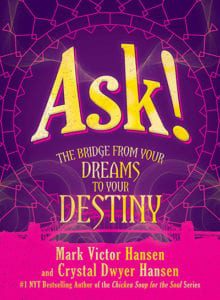
Ask! The Bridge from Your Dreams to Your Destiny
Everyone feels this way. I don’t care how successful you are. You’re stuck, you don’t have another place to go. Doesn’t it make sense to go to the Creator of the universe? Whatever your spiritual belief is, there is a Creator of everything beautiful. The same being the creative eyelids, eyelashes, flowers and every color, trees, plants and all the planets in the universe. There’s so much intelligence and wisdom. When you start tapping into that and asking, you feel things changing in your life. Part of that is believing in your question and believing that you deserve an answer, and that’s the faith part. They talk about faith, but you have to have that belief that I am a part of creation and I deserve to ask this question. I deserve the answer and it’s out there for me. Be open to it.
What I know you say, Mark, was it’s not just praying together with your significant other about what you two need and what’s going on in your life, but then the community and the world. It keeps zooming out bigger and bigger. Anyone I’ve ever met who’s had any level of success, every time, it’s consistent. They care about more than what’s going on within their world. You certainly do that. You’re both very involved in a lot of charitable organizations, trying to solve world problems with pollution and all kinds of other things. Thank you, Crystal, for sharing your own hesitation to do that because you’re being true and vulnerable. You let other people think, “I’m not alone in my internal thoughts. This is something I do privately. This is a whole other level of intimacy that I hadn’t even realized.” We’ve touched on some of the roadblocks to asking questions and one of them is the fear of rejection is one. You want to quickly go through what some of those roadblocks are that we might not have talked about yet?
One of the most interesting ones that we found is naiveté. Sometimes we don’t ask because we don’t conceive of what is available to us. We don’t know what’s out there for us. That’s why we encourage everybody to be very curious about the environment around them and about everyone you meet. We all make judgments about everything. We do it because of the efficiency of our brain, we’re trying to get through our day sometimes. Sometimes if we stopped doing that and be intentional about being curious, about things we’re not aware of, other things, other people. The real magic happens and opportunities open up for you that otherwise wouldn’t. I tell a little story about mangoes. It seems like a silly thing, but when my children were young, I hired this lovely Filipino woman to help me. She loved cooking these delightful meals for our family and it was so much fun to have her there with us. One day she’d show up with these fun little groceries and she cut it up and it was this juicy fruit and orangey colored. I was like, “What is this?” She said, “It’s a mango.” I tasted it. I thought it was worldly, but I had never tasted a mango.
I was like, “This is amazing.” I probably wouldn’t have tasted that if she hadn’t brought it to our family. That’s such a little thing, but it’s a small example of a greater principle. That is when we get stuck in our own track and we stop looking, being curious about others, what they do, some of their traditions, what’s out there for us? We cut ourselves off from the resources because we are one another’s resources. That’s why asking is important. It’s funny because there are several studies that show that asking makes you more likable. It seems counterintuitive because we think you don’t ask or be nosy.
[bctt tweet=”Whatever your spiritual belief is, there is a creator of everything beautiful. ” username=”John_Livesay”]
Some people are afraid to ask because they think they’ll be perceived as stupid, uninformed or that they don’t know enough. That’s the opposite. It shows that you have humility, being able to ask a question. Being willing to ask a question shows that you’re humble enough to do so. The other part of that is people feel like they’re honored. They’re honored sometimes that you’ll ask them. They’re honored you’re even asking them to do a favor. People feel honored that you would want their opinion. Another study showed that by asking, you’re more likely to get asked out on another date in a dating scenario.
I asked her to marry me a lot of times before she did. At our wedding, one of our dear friends, Matt Ferry, wrote a great song for us.
It was called Say Yes Again. It was the funniest thing because when he interviewed us because he wanted to write this song about our wedding and he said, “How did you ask her?” Mark said, “I’ve asked her a whole bunch of times.” He’s like, “Why do you keep asking her if she already said yes?” He said, “I want to hear her say yes again.”
He’s not a famous singer because he does another business. He spontaneously offered it and it was wonderful. When Crystal and I met, she gets done with the wine on her white pants. I said, “Have you eaten yet?” She said, “No.” I said, “Me either.” It’s 9:00, I said, “I can’t stay here because there are 1,000 people that all want two minutes with me at least. That’s not going to work. We’re at a dysfunctional get-together. Can I drive you off the property?” We go to the top restaurant in Hollywood, which you would know, and the line was still long and I thought, “$100 wouldn’t get us in.” We walk up and Crystal is ravishingly beautiful. The guy says, “I give up. Who is she?” Being a good butt-crusher, “You don’t recognize her?” He says, “No. Who is she?” I said, “She’s the queen of Denmark.” He said, “She’s the queen of Denmark? She is. Who are you?” I said, “Who travels with the queen.” That fast, we had the best table in the house.
The book is called Ask!: The Bridge from Your Dreams to Your Destiny, written by two powerful loving people that have put their energy into this book to make an impact in the world. I want to encourage everyone to get it. Thank you both for being a guest.
[bctt tweet=”Sometimes, we don’t ask because we don’t conceive of what is available to us. ” username=”John_Livesay”]
Thank you. If they want, we’d like to give them a free gift of an audiotape I did, which is the most listened audiotape in the world. Originally by Earl Nightingale, updated 50 years by me called The Strangest Secret. If they go to MarkVictorHansen.com, it just says, “Click here,” and you’ll have it. We’d like everyone to have it.
What a great generous gift. You keep giving. That’s in MarkVictorHansen.com. Get your free gift right there. Go to Amazon and order, Ask! by Mark and Crystal Hansen.
John, we thank you for asking us to be here.
We appreciate it.
It was a big ask and you said yes. Thank you both.
Important Links
- Ask!: The Bridge from Your Dreams to Your Destiny
- Mark Victor Hansen
- Crystal Dwyer Hansen
- Skinny Life: The Real Secret to Being Physically, Emotionally, and Spiritually Fit
- Pure Thoughts for Pure Results
- The One Minute Millionaire
- Cracking the Millionaire Code
- How to Make the Rest of Your Life the Best of Your Life
- The Ultimate Gift
- The Ultimate Journey
- The Ultimate Life
- Rita Davenport
- Bob Proctor
- Better Selling Through Storytelling Method Online Course
Wanna Host Your Own Podcast?
Click here to see how my friends at Podetize can help
Purchase John’s new book
John Livesay, The Pitch Whisperer
Share The Show
Did you enjoy the show? I’d love it if you subscribed today and left us a 5-star review!
- Click this link
- Click on the ‘Subscribe’ button below the artwork
- Go to the ‘Ratings and Reviews’ section
- Click on ‘Write a Review’
Love the show? Subscribe, rate, review, and share!
Join The Successful Pitch community today:
- JohnLivesay.com
- John Livesay Facebook
- John Livesay Twitter
- John Livesay LinkedIn
- John Livesay YouTube