

How To Be A Story Leader With Ben Zoldan
Posted by John Livesay in podcast | 0 comments

Listening to others and what they have to say fosters a sense of community, kinship, and empathy, and these are things we all could afford to get better at. In a time of divisiveness, listening to others might just get us to a place of, at the very least, mutual understanding, in order to foster peace. Ben Zoldan is the co-founder of Storyleaders. He sits down with John Livesay to talk about why listening to others is such an important skill that we need to hone. Listening is the gift that makes others feel seen, so let’s get to a place where we’re all giving each other that precious gift.
—
Listen to the podcast here
How To Be A Story Leader With Ben Zoldan
This episode’s guest is Ben Zoldan who is the co-author of What Great Salespeople Do. He is the Cofounder of Storyleaders. He said if he had to retitle the book, it would be What Great People Do, not just storytellers or salespeople. He also said, “When you listen into people’s eyes, you transcend basic empathy, and that listening is the gift you give others and you make them feel seen, and that totally transforms the relationship.”
—
This episode’s guest is my friend Ben Zoldan who is the Cofounder of Storyleaders and author of What Great Salespeople Do. I read it myself and loved it. It turns out that he started Storyleaders back in 2008 as an accidental research project. Before that, he was always into efficiencies and things related to results. That turned into him now talking about stories as a way to measure things in a whole new way. Welcome to the show, Ben.
John, thanks for inviting me into your world. That bio, I wasn’t expecting it. That was my narrative coming from efficiencies, compliance, and process. That gave way for some other things in my life and things that you’re into.
This concept of someone’s story of origin is something near and dear to both of our hearts. I would love it if you can take us back to Ben as a little boy growing up, wherever that would be, or college days. Wherever you want to start your story as to how you got to where you are now.
Let me start with something controversial that happened to me. I started my day off at around 6:30 going through my feed and trying to pick a video or something to watch and I found this company. I went to the bios of their leadership team. There were twenty leaders, and it was middle-aged white dudes. It looked like the United States Senate. Something appalled me. I was like, “Why is it so homogenized?” I’ve always had a disdain for the system, the way things work.
My journey started off with teenage parents who are at UC Santa Cruz and had two kids by the time they were twenty. They were hippies before it was cool to be hippies. Vegan before it’s cool to be vegans. What I did get was a lot of these alternative influences and all this cool stuff that was on the sidelines and I was always in trouble. My parents were so young that they didn’t monitor us so we would just run wild. I was always getting in trouble by the combination of having parents that gave me these cool influences, things that were on the sideline like counterculture before there was such a thing, and then having a lot of autonomy when I was younger, so I was always getting in trouble.
Now when I look at things in the world that are injustices, and I’ve had my own. Being on my own, abuse was part of my upbringing. Stuff that I always had a hard time talking about. I speak of it as a 49-year-old guy, but even as a 35-year-old, I probably couldn’t talk about and share my true authentic experiences. I was guarded. What I always do was when I saw injustice or something wrong, I fought it. I didn’t know how to fight it before. It was yelling by yelling, and I would rather yell without yelling now.
What I hear going on is, there was a secret, and we’re only as sick as our secrets is the phrase that takes on a whole new meaning because as long as we’re holding on to a secret, whether it’s, “I got abused,” or “I’m gay.” Whatever the issue is that someone can then possibly blackmail you with, make you feel bad, or expose it because you haven’t owned it, and you have all this charge on it, then we get triggered if anything reminds us of our secret. Even if it’s not happening to us, because it’s like a walking wound almost. That would make sense to me that if there’s not a lot of structure in the youth, and some bad things happen along the way, then we would be following, in your case, the hero’s journey into this thing of, “How can I get control of my life?” “I know. I will get good at measuring results, numbers, structure, looking at logic, and putting some process into things so things do seem like they’re a little bit more in control.” Is any of that resonating?
It was my drug. It was my dopamine hits at every turn and it was a safer place to be. I can run away from this stuff and look for external things to govern the world and put controls in the world and safety of process and measurement. For me, it showed up more in this incredible search for belonging and feeling so isolated. When you talked about wounds, running away from the wounds, and thinking that there was a way to belong in the world, that was to sign up for all the things that we’re supposed to sign up for, a career, scoreboard, stack rankings, and so-called success. Making a certain amount of money and then you make this much money and then a little bit more, then a nicer house and a nicer car. It’s all this endless, hollow, shallow race. For me, it was signing up for all these playbooks. The playbooks are always the same thing. These playbooks were built around, “How do we get more, do more, and sign up for this endless vicious cycle?” For me, it collapsed.
[bctt tweet=”Listen into people’s eyes.” username=”John_Livesay”]
Eventually, it does. Even for people who reach the pinnacle of whatever they’re doing. Like when Michael Phelps had to stop swimming, it collapsed for him. It’s like, “Who am I if I’m not this Olympic swimmer? I’ve done it so many times. I’ve hit that bell, got those medals, but I still have to figure out who I am.” As a swimmer competitively myself in junior high and high school, my parents used to put a big chart on the wall of all my times for all the different events. I was constantly trying to beat my own time. Fast forward to my career in sales, I’ve basically recreated that whole experience with a quota of, can you beat last month or last year’s number? Over and over again. It was so familiar to me from competitive swimming that you do tend to burn out from all of that.
You and your co-author did so much research for your book with salespeople who sometimes feel like they’re so pushy, and that’s what causes them to be universally disliked. Can you speak to some of that? If you don’t like yourself and then you take on a career that is not liked and salespeople aren’t alone. Lawyers or dentists sometimes fit into that category. If you have a job that most people dread going to or dealing with you on top of you not liking yourself, how do we deal with that? How do we change that story?
First of all, I hate the title of my book. I can’t believe you picked it up and read it. It was never about that. I’ll tell you the story behind that. It was past the deadline a few months with McGraw Hill, our publisher, and Danya, who happened to be my personal publisher, was like, “Get the manuscript in.” We finally did and we didn’t have a title. We were going back and forth one day, and nothing was coming up for us. I barked at her. I said, “Danya, stop it. This is a book about what great salespeople do.” She goes, “Hold on. Let me get back to you.” I guess she went and checked if it was available.
She comes back ten minutes later. She calls me up and says, “Ben, I think we have a title.” I’m like, “What is it?” She was like, “What Great Salespeople Do.” It checks off all the boxes. It has the word sales in it, so we put it on the sales shelf. I didn’t think much of it. I’m not this marketer. It stuck, but here’s the thing. It wasn’t real. When I was doing the project, which was a personal research project, it was fundamentally about people that I had admired. People that I had emulated. If you close your eyes right now and I know some of the people in your circle, and you think of somebody who makes a difference in your life. Can you think of a person that comes to mind who has that knack or that gift? Did someone come up for you?
Sure, our mutual friend that introduced us, Mark Goulston.
Dr. Mark Goulston, a beautiful man. Would you describe him as any of the attributes of a salesperson?
No. Just the opposite. In fact, his whole thing is about helping people get out of this mindset of transactional relationships and then to transformational ones.
Now here’s a guy who is incredibly wholehearted, combined with incredibly sciencey. This lethal combination of knowledge and a whole heart that comes at you with such empathy and compassion and yet, he’s probably the antithesis of any of the behaviors of a salesperson. He’s not this hard-charging agenda, interrogator, or ROI negotiator, but he gets there in such a beautiful way. He’s helped me open up doors in my life. When I thought about people that I emulated a dozen years ago, I was like, “I want to deconstruct those people.” People like Mark. It was people that had this grace and benevolence. The way they could just sprinkle fairy dust.
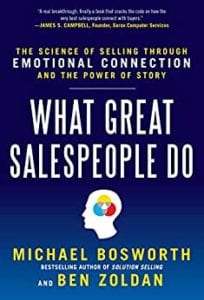
What Great Salespeople Do: The Science of Selling Through Emotional Connection and the Power of Story
I had that interaction with you when we first met. We went from not knowing each other to an hour later, I was like, “I know this guy. I would take the shirt off my back for you.” Sometimes we can’t label why we feel that way around people. For me, this was a research project. The book was about people that were affecting the world in such a way that was not figured out. We never figured it out. What a lot of things came up for me was how people can open up and share their stories. How they could be so in tune, self-reflective, and fiercely passionate about something but not in this dogmatic way.
I bring that back now to why I brought that up. To me, it was a book and I’m not a moral authority. I don’t know if I’m qualified to say it, but it’s what I fantasize about. I have to go back to my publisher and change the title of the book to What Great People Do. If we all think about our careers that way, it will change our behaviors. For example, lawyers. If lawyers stop lawyering, salespeople stop selling, or teachers stop teaching and start being more human. I have two teenage daughters and now with the storm that’s going on in the world, they’re doing remote learning. These teachers are just giving information, trying to teach and hammer information. What if we could create a culture of humans out of any of the things we do?
Let’s do a little bit of an insight into the magic that you’re doing for big corporations like Salesforce. A lot of big companies that people would think, “They’re going to be resistant to this.” Yet, the testimonials say the opposite. You’ve got these workshops that are not just another training where people are learning how to be not storytellers but authentic storytellers. You’ve got some listening involved there and I love that part. I tell people all the time, especially if they’re salespeople, “Until people feel like you’ve listened to them, they’re not willing to listen to you even if you’re telling a story instead of a bunch of facts.” Also, this other piece of the pie or third leg on the stool, if you will, is neuroscience. I want to make sure that we touch on at least one little nugget from each of those three circles because that’s why you’re sought out as a speaker. That’s why companies bring you in to help make all of this come together. Let’s start with authentic storytelling. First of all, what makes something authentic versus just a story?
Early on for me, it was scary because as I was looking at people that I admired, the theme was these people are just storytellers. I had this mentor of mine, his name was John Scanlon, and it didn’t matter if we were with a customer, if it was a team meeting. I rode with him once from downtown Chicago to O’Hare and in that one-hour ride to the airport, I got out of the car and I’m like, “Here’s the CEO of this thriving company, and I know everything about his life.” I didn’t know it at the time, but he was just letting me in. No veneer, no pretense, no points he was trying to make but if something came up, he would share like he had no guard. I was like, “What if I want to be like that?” That means I’d have to share.
You wouldn’t have those secrets walking around.
I’m pretty good at the walls, the secrets, the mask, and the veneer of superficiality. We could talk about the Lakers and we could talk about the weather. If you want to know about me and show you who I am, I always thought, and this took me a while so I love your take. I don’t think I came from storytelling. I don’t think it’s a framework as much as it is, this self-discovery work and I resist. In sales, we always talk about a story about a customer but that’s the price of admission. No good stuff is the good stuff. It was a battle I resisted. I could talk about everything but myself.
Part of it has to do with the mistake that people make in thinking, “I’m one person at home and I’m another person at work.” Now that many of us are having to work from home during the quarantine, people see where you live. All those masks are coming down in a whole new way. When your dog, kid, or whatever else is interacting with your life, it’s not so siloed. “I’m one person in my life in Connecticut,” if you’re that person, “and then I go into the city and I’m the business person. That business person doesn’t let people in.” The irony is that the more you show your imperfections and vulnerability or that you don’t have all the answers all the time, the more people respect you and trust you.
I grew up in the suburbs of Chicago so I know that ride so well from downtown to O’Hare. The Midwest, in particular, at least my experience in the suburbs was, that’s what everybody talks about all the time. It’s the weather or sports. I go, “Is there anything else to talk about?” That was the opening line for small talk all the time. I thought to myself, that’s how people relate to each other. “We have this in common,” or “How about those Cubs? Are they ever going to win?” and all these kinds of conversations left me empty as a kid and I didn’t know why. I didn’t have any other skills to bring up but I was like, “This is not interesting to me, constantly talking about those two topics.” Maybe we get into cars a little bit, “How’s your car running?” I don’t care but it was another topic that didn’t deal with any authenticity or vulnerability about how you are feeling.
[bctt tweet=”Listening is the gift to make others feel seen.” username=”John_Livesay”]
I remember being with my dad. One of his dreams was to go up in a helicopter but he’d never done it. I was able to do that with him and his sister and my sister. I had a picture of it. I said, “Dad, look how happy you are in this picture.” My dad was not somebody who was comfortable with expressing feelings. He never learned. His response was, “Who wouldn’t be?” I thought, “I asked you to express a feeling that’s not in your toolbox. I get it. Of course, it’s logical that you would be happy at that moment.”
Once I let go of being so frustrated that he couldn’t express his feelings, someone said, “Do you know how to fly a helicopter?” I said no. They said, “What if it’s an emergency, you still can’t do it. It’s the same thing with feelings. It’s another skillset.” Storytelling, it’s not something you’re brought up with. You might think, “Everyone else is a natural storyteller. I go on and on. My stories don’t have any point.” The good news is that people who go through Storyleaders learn how to become storytellers, correct?
Yes. It’s like with your story. It almost sounded like if I’m getting you that there was a level of fatigue with this and the way the interactions were. Was it, for you, like, “I’ve had enough of this. Let’s get real?” In my old days, I would have thought, “Here’s a guy, John, who can get on stage in front of hundreds of people and inspire them.” The myth is that this guy is a natural-born storyteller, leader, or whatever. That’s not the case for you.
Not at all. I had lots of training, lots of focus on it, getting inspired by other people and thinking, “I want to feel something.” I want to make other people feel something, as well as teach them something when I speak. It was a journey to make a difference. I didn’t know how I was going to do it. There’s no such thing as professional swimming so I knew I couldn’t stay in that sport to make a difference. That’s what led me on that path. I thought of little moments where people will say something and you’re like, “Huh.” I remember at the end of Oprah’s talk show after all those years. She said, “Everyone should think of their life as a talk show.” I love that framework. Whether I’m talking to one person or hundreds of people when I’m on stage, it doesn’t matter. I’m still having some impact. That’s where that goes. Let’s go into the real listening part, not just listening. What is a nugget that you can share with us about how we can be better listeners?
We have mentioned that Mark Goulston has been a mentor in both of our lives. He’s the Professor of Psychiatry at UCLA and a former hostage negotiation trainer. He takes everything we do and distills it down to what it would be like to listen. He and I were having a conversation once. He was talking about what it would be like to listen into people’s eyes. At that moment, I was shaken because I was thinking about all the times I don’t listen into people’s eyes. That would require such a level of commitment, being all in, and vulnerability. I was thinking about this experience I had talking to a friend the day before I was talking to Mark. We were talking about something going on with how we’re taking in information around this pandemic. Should the government do this or the government not do that? The minute I heard her position, which was 180 degrees from mine, I went, “Stop. Timeout.” I made some stupid remark like, “Don’t ever say that around my family.” She goes, “See? You always do this.” I’m like, “I always do this,” and I start defending myself. She lets me spin out because she knows. Here I am, a guy who preaches about listening and I cut her off myself. After my tornado winds down, she goes, “You never listen.” That hits me.
For someone who thinks of themselves as a listener, that’s the ultimate insult.
I’m a fraud. I don’t practice what I preach. I remember those words that Mark has shared with us about what it’s like to listen into someone’s eyes. I feel like what that requires for me is such vulnerability because I have to commit to somebody else’s place, feelings, and position. It’s so hard to do. What I found easier for me to do is to look away. If I look away, I could be like, “No, I’m right. You’re wrong. You’re Republican, I’m a Democrat. We’re Israel, Palestine and we’re divisive like the news channels.” There isn’t any antidote to that division. It’s like the vaccine we’re looking for. If we actually listened into people’s eyes, we would feel what they feel. It would be the purest form of empathy.
This may be controversial. Everybody talks about empathy. It’s become so over, you don’t even know what the word means anymore. Empathy sucks. It sucks because empathy is hard. We have to say, “I’m going to feel what you feel.” I have one tattoo of my daughters’ names on one arm. On the other arm, I want to put “listening to their eyes.” If we look into others’ eyes, we cannot help but feel. I’m looking at your sincerity. My heart rate slows down. My defensiveness and my own walls go down. I go, “That person’s another human being.”

Listening To Others: Leadership teams in many organizations tend to look very homogenized.
They always say that the eyes are the windows to the soul. If you look at someone and don’t look away, it requires incredible tolerance of anxiety to stay completely present. That’s why the phones are such a challenge. It defeats listening because I’m going to look down at my phone if it dings or I’m bored with what you’re saying or whatever. To hold someone’s interest and to be riveting to someone goes back to the emotion. Take me on a story. You told me a story that’s got some emotional ups and downs. Now, I’m listening with my eyes because all my emotions are engaged. I know how much you pride yourself on being a good dad. Make that eye contact with your daughter and teach her how to do that to other people. You’re modeling for her, “If people aren’t doing this to you, that is not okay, no matter what their gender is.”
The same thing is true in a sales situation. If you’re not paying attention and listening to somebody tell their story, what their challenges are, why they’re tired, or whatever the issue is, it doesn’t resonate when you tell your story. We were talking about table stakes, the basics are telling a story of another client you helped. What I love doing that makes me so excited is to get to know you and bring you into the people that love storytelling as much as I do for our clients.
Once we get someone to be comfortable with their own story and then we get them to the place where they’re telling a story of a client they helped, when you put it together and say, “We’re going to tell a story within a story,” that’s a whole other skillset. I was working with this guy, Adam. Before we started talking, he said, “I’ve got three daughters,” and this and that. He told me their ages and I filed it away. I said, “Okay.” He’s telling the story of a client. I said, “What’s her name?” “Sandy.” “What was Sandy’s situation?” “She had to be in charge of going to the hospital from two operating rooms to four.” “What was Sandy feeling?” You’ve got to pull that out of people.
If you’re not in touch with your own feelings, you’re certainly not listening to what other people are feeling. “Sandy was overwhelmed by having to go from 2 to 4.” I said, “Let’s go back to you having three daughters. I imagine that when your third daughter was born, your wife turned to you and said, ‘Honey, we’re outnumbered. I feel overwhelmed.’” He was like, “We did say that.” Put that into this story so that you’re showing empathy for Sandy but through your lens of what it feels like to be overwhelmed, not in the same situation. That’s what I think you’re saying here. It’s not just empathy, it’s my experience of that emotion. You were talking about secrets and I share that I know what it’s like to have a secret. We all have something. That’s where I think real connection comes from.
As you’re sharing about that, speaking about daughters, and talking about listening reminds me of a profound experience I had with my youngest daughter. One evening, we took a walk in the neighborhood. We walked to the little center where there are restaurants and stores. It’s late in the afternoon and the sun is going down. It was a nice time she and I were having together. We walked by this man who’s asking for money. He’s having a difficult time. By appearance, he looked homeless. Since we were just going on a walk, I didn’t bring my wallet. My daughter was probably in her early teens at the time. I said, “Abby, have you got any cash on you?” She said, “No, dad.” I was stuck. I couldn’t walk by this man who needed help. I go, “Abby, stay here. I’m going to bolt home. I’ll be right back.” We both wanted to help this guy out. I ran and got back in two minutes. I have a $20 bill and I hand it to this man. Abby was hanging out over here for a few minutes until I got back.
My youngest daughter goes, “Are you from here?” The man takes a $20 bill and puts it on the side next to him. I’ll never forget this, John. I want you to visualize it for a second. He’s sitting on this bench, takes a $20 bill, and almost sets it on the bench next to him. It could have flown away. The minute Abby asked him, he first introduced himself. He says, “My name is Albert. I’m not from here. I’m from Mississippi.” I’m like, “How long have you been here?” He said, “Twenty years.” He tells us the most incredible story of coming here from Mississippi. His parents moved out here and they had passed away. He had brothers, they’re not here. They’re back in the South. We were engaged with Albert for 15 or 20 minutes. I don’t know if it was five minutes. He let us into everything about who he is. His story was beautiful. It had traumas in it. It was unfiltered and it was raw. My daughter was there with her jaw open, listening to this man.
It’s different from her life or her friend’s life.
Fifteen minutes went by and that $20 bill was still on the side of him. He never went to the $20 bill. We wrapped up, “It’s great to meet you. I’ll see you around.” We walked away and it was beautiful. It was magical, if I can say that. He leaned over and nonchalantly grabbed the $20 bill. The $20 bill was incidental. Abby said the most profound thing to me as we’re walking away. She said, “Dad, the $20 wasn’t nearly as important to Albert as him sharing his story with us.”
[bctt tweet=”If empathy’s the thing that’s going to get us out of this mess, we have to get better at it.” username=”John_Livesay”]
That was his priority.
It was as if him being able to share his story was the magical gift. I feel like it was more important than the $20. There’s so much wisdom in what Abby taught me. When you talk about listening, maybe as we listen, we’re giving people this platform to show up, be heard, be seen, and to not be invisible. Listening can be a more powerful thing than sharing our stories. When we talk about connection, it’s a swapping of stories. When we share stories, that’s part of it. When we give other people the ability to share theirs, that’s a gift.
That’s a great tweet. Listening is the gift to make others feel seen. People want two things in life. They want to be seen and they want to be acknowledged, and ultimately loved. When you’re accepted for who you are, then everything else comes. The money starts flowing in from that. The final thing is the neuroscience that you have combined to storytelling and listening. What is it about neuroscience is a trigger or a different part of our brain where stories seep in a way that information doesn’t?
When I started the research, I don’t think I could tell a story for the life of me. Someone said, “Tell me a story,” I couldn’t. Somebody said something to me once. He said something like, “Go around and ask people, ‘Can I tell you a quick story?’ They’ll never say no.” Why don’t people say no to that? It has to be because of how we’re hardwired? Our evolution is wired into our DNA of who we are as a species, what separates us from every other species.
It might be entertaining too.
Why do our heart rates slow down when we hear the words once upon a time? A relevant thing that I learned and I’m no scientist but I admire people who do real research. In our generation, the neuroscience, how we’re wired, how we make decisions, how we respond to stimuli is understood in a way in the last 15 to 20 years that has undermined everything before. It’s like our good friend that shared with us who is a neuroscientist, we’re at the age of anxiety. Everybody’s scared, we’re fearful. We’re constricted, we’re sheltering.
Stress is at an all-time high and the stress hormone is cortisol. That makes it hard for us to think straight. When we have high cortisol levels, the stress hormone, the blood that goes from the top of our brain goes to our fight or flight. People aren’t thinking straight. The question becomes what’s the antidote to cortisol, to stress? I’m a stress case. I’m neurotic, I have to get the plugin. I’m a Jew from LA so I’m neurotic and paranoid. I have a lot of anxiety. The hormone that will reduce the cortisol levels is the oxytocin, which is the bonding agent, the love drug. That’s the neurochemical that is disproportionate in levels where we have bonding, love, lovemaking. Our loved ones holding, hugging, and touching.
Even pets, anything counts. The impact that you have with clients who hire you. Some of these results of if you get someone to go to where they learn how to tell authentic stories, become good listeners, and figure out how to reduce their own anxiety by making real connections with people. You then bridge this huge gap between low and high performers that aren’t making their goals. It has nothing to do with their knowledge or their commitment to their job, and yet they’re not making their numbers. After working with you through Storyleaders, they suddenly no longer have the stress of being fired because they’re not making their numbers. What a gift to the world you have here, Ben.

Listening To Others: Everybody talks about “empathy” so much that they don’t even know what that word means anymore.
You’ve given me this and I think about this in a nerdy way sometimes because I have to oversimplify. If we’re all at anxiety levels, cortisol levels, as we go through the world, drive down the street, meet with salespeople, meet with prospects, meet with bosses, we’re at high cortisol levels and the antidote is oxytocin. You then got to say, “What triggers oxytocin?” We know this. What triggers that is empathy. The ability to feel what other people feel. What I’m trying to understand is we don’t tell stories, we don’t listen, we don’t do these things to sell stuff. Maybe we have it backward. Maybe we sell, we do the things we do in order. It’s like listening to each other’s stories. If we start there, if someone doesn’t get how that has everything to do with leadership, selling, parenting, friending, spousing, or sonning. It’s my mom’s birthday, I want to be a good son tonight. If empathy is the thing that’s going to get us out of this mess, yes. We need to get better at that.
What a great note to end on. How can people find you? I know there’s Storyleaders.com to read more about all the different ways you impact the world through storytelling. Any other way that you want people to track what you’re doing?
I appreciate you. By the way, let me say this first. You are one of the most gracious people I know. You support others, give other people a platform, but you do it through your community building and put other people first. You shine a light on others which is such a great form of leadership into itself. You allow others to lead and you shine a light on others. If you’re a musician, you allow others to have their solos. It’s Storyleaders.com. My email is [email protected] and I respond to everybody. I appreciate everything you do, John.
Likewise, Ben. I’m excited to see how we can continue to collaborate and get as many other people to learn how to listen into other people’s eyes. That alone could make a huge shift in how we all deal with the stresses that we’re under. Thanks again for being on the show.
You got it. Thank you.
Important Links
- What Great Salespeople Do
- Salesforce
- Storyleaders.com
- [email protected]
- Better Selling Through Storytelling Method Online Course
Wanna Host Your Own Podcast?
Click here to see how my friends at Podetize can help
Purchase John’s new book
John Livesay, The Pitch Whisperer
Share The Show
Did you enjoy the show? I’d love it if you subscribed today and left us a 5-star review!
- Click this link
- Click on the ‘Subscribe’ button below the artwork
- Go to the ‘Ratings and Reviews’ section
- Click on ‘Write a Review’
Love the show? Subscribe, rate, review, and share!
Join The Successful Pitch community today:
- JohnLivesay.com
- John Livesay Facebook
- John Livesay Twitter
- John Livesay LinkedIn
- John Livesay YouTube
Strategic Leadership: Nurturing New Leaders And The Leadership Tree With John O’Grady
Posted by John Livesay in podcast | 0 comments

Strategic leadership uses the concept of the leadership tree, where you nurture the people under your leadership until they develop to become leaders on their own. Former Division I athlete, West Point graduate, Army Colonel, and leadership coach John O’Grady joins host John Livesay in this episode to share his experience in strategic leadership in challenging situations. He is a distinguished combat leader whose unit was awarded the Presidential Unit Citation for “extraordinary heroism in the face of an armed enemy” in recognition of their exemplary work in Afghanistan. John attributed this success to their values-based culture and used what he learned from this experience to drive his leadership coaching career. His empowering message now benefits coaches, athletes, and corporate organizations through his coaching firm, O’Grady Leadership and Consulting Services, LLC.
—
Listen to the podcast here
Strategic Leadership: Nurturing New Leaders And The Leadership Tree With John O’Grady
Our guest is John O’Grady. He has an incredible background in both athletics and in the military. His company is Strategic Leadership Academy where he takes his lessons learned from the battlefield into the world of Corporate America. He said, “You need to be willing to seek collaboration from wherever it may come.” The kinds of people he likes to work with are those that have both humility and curiosity about how they can learn to grow and raise better leaders. He said, “The key thing about athletics and the military is you have a sense of purpose greater than yourself.” Enjoy the episode.
—
Our guest is John O’Grady and what John does is helps athletes, coaches and executives bring out the best in their players and teams. He’s a former Division I athlete, a West Point graduate, Army Colonel, and a distinguished Combat Leader. John inspires leaders to become the best version of themselves in the most demanding complex, austere and challenging environments. He utilizes the principles he’s developed and practiced for over 30 years in athletics and the army. He works with a diverse group of organizations and he provides leadership, culture, and strategy principles that are fundamental to getting the outcomes of excellence. John has a decorated military career where he led organizations from 30 to 3,500 people in active war zones. One of the things he’s most proud of that we’re going to ask him about is his leadership tree. John, welcome to the show.
Thanks for having me, John, and it’s a pleasure to spend time with your audience as well.
The readers are much in for a treat learning from you. I started to tease out what your leadership tree is. Can you take us back a little bit to your childhood and college? How did you become you? How did you decide you wanted to get into the military?
It’s a little bit by accident and a little bit due to athletics, quite frankly. The accidental part is in some way, I socialize and I would always watch the old war movies with my dad on Saturday afternoons. I look forward to that. The athletic part was being a lacrosse player that provided me an opportunity to get recruited and then ultimately go and attend the United States Military Academy.
You are an athlete and, in the military, concurrently, is that correct?
Yes, technically. While at the Military Academy, you’re playing Division I Lacrosse, but you’re also a cadet, which has clearly the military components of the academy.
What similarities are there between being a great athlete and being a great cadet?
Some of the key similarities are a sense of purpose greater than oneself, certainly, and understanding that being part of a team is purposeful, it’s purpose-driven. The little bit that you give of yourself exponentially returns by the larger community that you’re a part of.
There’s so much to dig into there. A sense of purpose being greater than yourself. A lot of people, unfortunately, go through life not having a sense of purpose. If they do have a sense of purpose, it’s all self-focused. “I want to be better at this. My purpose is to do that.” You’ve got big scale purposes of making the country that you’re serving a safer place, then you’ve got your own purpose of the team doing well. For those of you who don’t know, Division I is the top of the top. It’s the Olympic level performance going on there. You’ve taken all these amazing things.

Strategic Leadership: No matter what position you think you’re in, always be willing to seek collaboration from wherever it may come.
I love this image of you and your dad watching war movies and becoming athletic, and now you’re a cadet. We’re going to take the readers on this next start of your journey. You’re in a war zone, and I don’t have many people ever encounter that I get to talk to about what that is like. There’s little I know about military training. You’re the expert. Is it true and do you have a story that when you’re in those crisis situations, you don’t have time to think about what to do and you just rely on your training?
That is accurate in many respects, for sure. There have been a number of situations I’ve been in that I can share that will lead to that.
Take us back to a specific incident however long ago. Tell us what year it is, but give us a little bit of the who, what, where, so we’re in that story with you and then it will take us on that journey.
It was 2011. I was deployed to Afghanistan, leading a 500-person organization. We are in a battlespace, roughly 8,000 square miles. To put that in perspective, Rhode Island’s about 4,400 square miles. We had to break out the team of 500 into approximately five 100-person clusters across this battlespace. We deal with a myriad of challenges and complexities, 5 major ethnic groups, 15 districts that this was broken down into, 1,000 villages, and 30 major languages with a whole host of other dialects spin-off from that. Also, a whole host of players inside this space from non-government organization people to government organization people to other military forces to tribal warlords as well. It is one of the unique stories I have.
We’re in Afghanistan with all these different tribes and languages and things. What’s at stake? Everybody could die, but what is the biggest problem you’re having to solve besides all of the logistics? What is your mission?
Our mission essentially is to help the Afghans themselves provide a safe and secure environment for themselves so that they can begin to thrive in a healthy way.
You’re protecting them from attack, correct?
In many regards, yes. We’re partnering with a whole host of people to do that.
Is it an active war zone?
[bctt tweet=”Being part of a team is driven by a purpose greater than yourself.” username=”John_Livesay”]
Yes.
Tell us a time when they were being attacked and what you had to do to keep them safe.
We are one of those outposts. Those separated forces of about 100 people that I put out in one of the spots in the battlespace, they’re under attack. It’s starting to get dusk and we can’t get air in because of the weather. I deployed with a ground element to go into this village to help provide additional support. You’re hearing things over the radio and different things are coming in. Reports from different places if things aren’t going particularly well. Dusk is starting to fall. There’s an act of firefighting going on for a couple of hours here. Thankfully, we have no serious casualties. In a distance, we see what looks like these torch-like lanterns, almost like the old medieval movies that got that stick with the large flame on top. We’re trying to make that out like, “What the heck is that?”
What it turned out to be is that we were in a valley called the Sanglakh Valley and that valley had been taken over by the Taliban. What these lights ended up being were about fifteen people from the Sanglakh tribe coming to attack the flank of the Taliban, who was starting to gain on us. At the end of this, we link up with them and I’m on the ground now standing there. The tribal leaders, who I ended up becoming good friends with during my time there, had led fifteen of his tribesmen into this attack. Finally, there was an organization there that they viewed could help them get back to their valley that was part of their tribal lands going back as long as time.
You’ve got this huge contrast with American Forces there with state-of-the-art technology and basic tribal weapons and people with just a torch trying to help you help them.
What I learned from that was no matter what position you think you’re in, being willing and able to seek collaboration from wherever it may come is always important. Keep that mental aperture, if you will, organizational aperture open for those opportunities because that partnership became one that fundamentally changed the dynamic. That’s the second thing. Bad situations seize the opportunity and create and collaborate on new opportunities, which was powerful for me.
While they may not have the state-of-the-art weapons, they’ve got a passion and a heritage that is a reason and purpose bigger than anybody else to figure out how to help you. In this particular battle, were you successful?
Yes. It’s successful as any good battle is.
That’s the best you can hope for. You help keep them safe, so mission accomplished. This resolution part that you’re talking about is these life lessons of being willing to see collaboration for wherever it may come. Also, another resolution was that they felt empowered and the morale went out that we won this battle and together, we can continue to win. That would be some great things.

Strategic Leadership: The principles of leadership are very transferable. How they’re applied is very contextual.
It falls back a little bit to some of my athletic training as well where the team being larger than any one individual. You have your team that you normally think of, but then what are the other teams outside your team that you can create that larger pie if you will. It doesn’t have to be about scarcity, competition, and me grabbing my own. It could be about collaboration, growth, and we eat the bigger pie.
That leads right into what we teased, which is your concept of a leadership tree where you continue the success of people that reported to you and they become leaders. Were there some people in that situation that saw how you handle that and then went on in future situations to become their own leaders?
I would like to think so in terms of either directly or indirectly observing my leadership and the culture that I tried to create that then helped them in their own authentic way, go ahead, and have their own success. There’s one that comes straight to mind. A guy named Jim Collins, who’s a brigade-level commander is in charge of about 3,500 people. He’s at Fort Bliss and he’s been made the COVID response commander for the Fort Bliss community, which is a large military community down in Texas. At the time, he was a major in my organization. He was a direct report to me, but now he’s the guy who’s commanding 3,500 people and taken on this additional challenge for not only the soldiers but all the family members. Also, all the other people who work to support Fort Bliss installation as well as the surrounding community.
Your command was awarded the Presidential Unit Citation, which is the highest award given to you and it’s for extraordinary heroism in the face of an armed enemy. You attribute this to the culture that you created.
I’m incredibly blessed with unbelievable people inside that organization and layers of leadership inside that organization. I won’t take that credit on my own at all because that’s deserved by not only the entire organization but here’s something for your readers. The American people can be as proud of that as I am because it’s their sons and daughters that they give to us, and it’s a sacred responsibility and trust that I know I never wanted to break. I know many of my peers as well feel the same way.
You’ve taken all this experience with your crisis situations and managing all these people and managing huge amounts of money including operational portfolios in excess of $14 billion. You have your own consulting firm, O’Grady Leadership and Consulting. Who do you do your best work with, John? Who is your ideal client?
My ideal client is a person who’s in a leadership position, who has both the humility and the curiosity to want to grow. That’s who I work best with. What sectors do I find that in? I find that ideally in athletic coaches because of my tie and how strongly I believe about not only sports but what lessons sports can provide these young people who are going to be the future leaders in our society. Also, corporate executives and executive teams.
Do you have an example of a case story where you worked with someone that came to you and they said, “We want to grow, we’re humble and curious?” It could be athletic or it could be a corporate story.
I’ll give an athletic one, but I’ve had it in corporate as well. The parallels are there. Principles of leadership are essentially immutable and transferable. How they are applied is contextual and that needs to be first understood. That’s one of the first failures I find that people have when they’re going through leadership. They take one thing from one and try to plug it into the other. It doesn’t quite work that way. It centers around not understanding, not knowing, or worrying about where my next generation of leaders is coming from. In this case, it was an athletic coach who wanted to make sure that he never found himself in that position. He knew and looked back over the course of a successful career that some years, he was more concerned about leadership inside his organization and others, and he didn’t want to have that much variance anymore.
[bctt tweet=”If you have an ad hoc approach, expect to have ad hoc results.” username=”John_Livesay”]
How long ago was this? What sport is it? When you say leaders within the sport, do you mean where is the next quarterback coming if it’s a football situation?
It was lacrosse at Georgetown University, the women’s lacrosse program. It started initially with just being focused on the captains. These are phenomenal kids, so it’s no indictment or judgment value statement on one year of captains versus another. It’s about getting the maximum potential out of those individuals and being intentional.
In the corporate world where you have to develop new talent all the time to keep them happy, promote them, how do we find them, and how do we recruit them? The number one problem I hear all the time in Corporate America is, “How do we recruit and how do we retain top talent?” The same thing is true in this lacrosse example you’re saying.
Also, develop that talent. In corporate, lots of times, it’s middle management. Usually, the CEOs and those higher-level executives are clear in their own minds of what they want, how they want things to be, and what they want the culture to be like. Somehow, by the time it gets down to the lowest levels of the organization, that message gets dissipated or even flat out stopped. It’s not unlike that with a coach with his assistance, captains, and then leadership group.
As you’re working with this lacrosse coach, you’re helping them figure out where the future leaders are going to come. What is the one mistake you see people making all the time? Is it worrying about it or not knowing what to do next? What do you see happening?
The biggest thing I see is an ad hoc approach and then they’re a little bit surprised when they get ad hoc results.
You have a step by step proven system I’m guessing so that you take the guesswork out of it and say, “You need to be doing this and then you need to be doing that.”
Let’s use captains as an example on a sports team, but the same could apply for mid-level managers. “Coach, how do you pick your captain?” “This and the third.” “Might you and your senior staff get together and list ten attributes or characteristics that you’d like your captains to have. Go ahead and institute a program where you ask it in a survey form to the entire team.” “List the top three athletes on your team who will best advocate for you to the head coaches. List the top three who you trust the most, etc,” whatever those attributes were. That alone is incredibly powerful because one, you give anybody who’s listening, a word roadmap of how to behave and you’re reinforcing the things that you say are important. Two, you learn about how different people list all those people and you juxtapose that to what you thought would be on that list. You see what they value and who they value. You see people who maybe you thought were good who aren’t on that list. That alone is incredible.
It’s a way to curate that with some value and everyone’s agreeing on what the values are. This leads me to one of my last questions for you, which is your distinction that is important between capability and capacity. If we’re looking at criteria to define the next captains or leaders, how can people put that into action? Should they emphasize one over the other?

Strategic Leadership: Capacity in the leader development sense is about the attributes that are going to best allow you to deal with the unknown.
I don’t think it’s binary and I generally tend to drift away from those types of things. Unfortunately, not a lot of people feel that way. I know you get that totally. I’m sure many of your readers do. The way I think about the two is to me, capacity is based on ensuring your human capital inside your organization can do the things that are necessary, based on all the stuff that has happened in the past. It’s informed by the past. What’s interesting is about the future, none of us, your readers, you or I, have any idea truly what the future will bring. If there’s a reader out there who does, please contact John and myself with the next lotto winning number. Generally speaking, we have no idea. Capacity, in the human capital sense and the leader development sense, is about the attributes that are going to best allow you to deal with the unknown, the future. That causes you to have to go down a whole other leadership development task.
Let’s give an example. You and I are both public speakers. We get hired to come and speak at corporate events and live events. With a lot of situations, people are saying, “Can you do it virtually?” We know we have the capacity and the skills to be a speaker, we then had to test ourselves to see if we were capable of learning how to do it in a new platform. John, any last thought, quote, or book you want to recommend?
A book would be Viktor Frankl’s Man’s Search for Meaning. I have read it probably 3 or 4 times and it’s incredibly timely too. Given the fact that at least as we’re having this discussion, we’re in the throes of the pandemic. It’s a powerful book about finding purpose and understanding where your agency truly lies and the power that comes with that.
If anybody wants to follow you on social media or get ahold of you to find out about hiring you for consulting, how can they find you?
I’m on LinkedIn, John O’Grady. I’m on Twitter, @OG_Leadership, and then email, [email protected].
John, thank you for your service, for inspiring all of us to be better leaders and for giving us a roadmap on how to do it.
Thank you as well, John, for you having this vision and also providing a platform for people to go ahead and share some goodness in the world.
Important Links
- Strategic Leadership Academy
- Man’s Search for Meaning
- John O’Grady – LinkedIn
- @OG_Leadership – Twitter
- [email protected]
- Better Selling Through Storytelling Method Online Course
Wanna Host Your Own Podcast?
Click here to see how my friends at Podetize can help
Purchase John’s new book
John Livesay, The Pitch Whisperer
Share The Show
Did you enjoy the show? I’d love it if you subscribed today and left us a 5-star review!
- Click this link
- Click on the ‘Subscribe’ button below the artwork
- Go to the ‘Ratings and Reviews’ section
- Click on ‘Write a Review’
Love the show? Subscribe, rate, review, and share!
Join The Successful Pitch community today:
- JohnLivesay.com
- John Livesay Facebook
- John Livesay Twitter
- John Livesay LinkedIn
- John Livesay YouTube
Success Academy With Brandon T. Adams
Posted by John Livesay in podcast | 0 comments

There’s no singular way to becoming successful. Each person has their own journey to success, but there are certain building blocks that make it much easier to become as successful as you desire, your own way. Brandon T. Adams is an Emmy® Award-Winning Producer and Host of the TV series, Success in Your City. Joining John Livesay, Brandon explains some of the most important building blocks for becoming successful. Let this lively conversation between Brandon and John serve as a call to empower you to become successful on your own terms.
—
Listen to the podcast here
Success Academy With Brandon T. Adams
Our guest is Brandon T. Adams, who’s a successful entrepreneur at a young age. He tells a story about how he wasn’t even confident and couldn’t speak that well when he was a child. Now, to see him as confident and speaking all around the world around the skills that he’s acquired as an entrepreneur and how to be successful is quite inspiring. He said, “If you want to build your network, the quickest way to get someone’s attention is to make them money, and that when you work with the best, you are seen as being the best.” Brandon shares his passion and enthusiasm in a way that you have never known before. Enjoy the episode.
—
Our guest is Brandon T. Adams who is an Emmy Award-winning producer and host of the TV series Success in Your City. He’s a podcaster, speaker, inventor, adviser, crowdfunding expert as well as a media expert. He’s a serial entrepreneur and he owns a stake in a number of businesses including the Accelerant Media Group, Live to Grind, Young Entrepreneur Convention, Success in Your City, and more. He and his team have worked with high profile clients like Kevin Harrington from Shark Tank and John Lee Dumas, XPRIZE, and many more. They’ve raised over $35 million to date and he’s the Associate Producer and the youngest feature entrepreneur in the movie Think and Grow Rich: The Legacy, which is based on the classic book Think and Grow Rich. Brandon has been featured on the cover of Inventors Digest, USA Today, NBC News, and was listed among Seven Millennial Influencers to follow in 2008 by BuzzFeed. Brandon, welcome to the show.
Thank you. It’s always weird hearing your intro, it puts you down memory lane, but I’m excited to be here with you and provide massive value to your audience.
Are you still a Millennial? Everybody’s dying to know you’re in the top seven in 2018, now it’s 2020. Did you cross over?
I’m still a Millennial. I’m 30 years old. It’s crazy. I can’t believe I’m 30, but time flies. I’m still young.
Take us as far back as you want. You could go to childhood, high school, your college days at Iowa State. When did you decide you wanted to have this career being an entrepreneur and doing adventurous things?
I was born an entrepreneur. When I was born on December 31st, 1989, my dad was happy because I was a tax cut and my mom was mad because I wasn’t the New Year’s baby. Instantly, I came out and I was an entrepreneur. My dad was already trying to figure out ways to make money off me and for me to make money. I’ve always been an entrepreneur. I grew up in an ice business. I sold packaged ice and I can sell ice to an Eskimo. My dad was a wholesale distributor. We delivered bag ice. Envision cubes of ice in your drink. Every time you have a drink of water with ice or a drink of whiskey, you’re going to think of me. We sold packaged ice for a living and growing up I was in that business. It was ingrained in me about working with customers, buying and selling things, and this whole entrepreneurship thing. I saw my dad running the business. I saw the ups and downs when he was about to lost it all, and then when he had the ups in the business. That was ingrained in me at a young age.
One disadvantage I had at a young age that became a part of who I am is I was born with a speech impediment. As a kid, I had a lisp and I couldn’t communicate like other people who bothered me. I made it my burning desire to become a great speaker and overcome my speech impediment. At nine years old, picture this kid looking in front of a mirror and doing, “I am a great salesman, I am a great speaker, I am a success.” I was driven to overcome that. I’m never getting bullied. I would cry. I would tell my parents, “I don’t want to go to speech class and all these things.” Eventually, my disadvantage became my advantage. I started putting myself out of my comfort zone. I always volunteered to speak in front of the class even though I wasn’t a good speaker. I would go and do things that scared me. Eventually, I started to become a better speaker. By high school, I lost my speech impediment. By college, I got better at speaking and I went to be a paid speaker. It’s crazy where things go. I’m going to college. I was at university. Some people go there and they get great grades. That wasn’t me. I got a 1.68 GPA in my freshman year. I stay a little bit of sex, drugs, and alcohol a lot. I got kicked out of my dorms five days before we were done at school for fighting. I was down this path of I didn’t know where I was going to go.
[bctt tweet=”When you work with the best, you are seen as the best.” username=”John_Livesay”]
Where I had this change pivot part of my life is when I was introduced to the book, Think and Grow Rich by Napoleon Hill. If you haven’t read the book, everybody should read it. It’s a game-changer. Here’s what I took away from the book. People like Henry Ford, Thomas Edison, and Andrew Carnegie, all these people that pioneer the things that we have now, I saw what they achieved. They weren’t 4.0 students. They weren’t the smartest people out there but this is what they had. They had a burning desire. They had a vision for themselves. They surrounded themselves with the right people and they didn’t quit until they got something. When I was reading that book in my college apartment, wondering what I was good at next, I realized that anything was possible for me if I kept going. That ultimately became what changed my life. I went forward in anything I took on. I had this mindset of I can achieve it and I had this confidence about myself that no matter what it is, I’m going to take it on because if I keep going and keep pushing, I’m going to be a success. That formed me into who I am now as an entrepreneur. The things that I do from producing TV shows, speaking, being able to speak with people like you and impacting people’s lives in a positive way.
Let’s take this story of origin, which is certainly fascinating. Getting in trouble right at the end of school. I had a similar situation where I was never somebody who got in fights and then somebody was constantly picking on me. Several days before graduating from junior high, we were on some field trip and he started on me again. We got into a fight and he had gotten his braces off and I happened to pop him in the mouth and the front tooth came out. You can imagine the drama of that. Luckily, they find the tooth and put it back in his mouth. That’s something you can do now but it is an unexpected behavior outcome. Everyone has a breaking point and you can also not judge yourself or anybody else based on one particular incident.
Getting in a fight or hitting somebody in the mouth is not life-changing where you get kicked out of school permanently. There was some talk about, “Should we let him graduate?” I haven’t thought about that in years. It does feed into the concept that everyone’s got a story and because you see a person at a certain level of success or confidence doesn’t mean they were always there. In your case, with the stuttering and the fact that you transformed that into being a speaker. Let’s fast forward to your relationship with Kevin Harrington from one of the original sharks on Shark Tank. You don’t just have a casual relationship with him. How did you at such a young age relatively speaking, because Kevin’s not in your generation and neither am I. I’m always impressed when somebody young breaks through the noise and the clutter and finds enough of things in common that that person says, “I’m going to spend some time with you.”
A lot of my friends and mentors are 20, 30, and 40 years older than me and I clicked with that. I believe I’m an old soul and I relate with people that are doing big things, people like Kevin Harrington or other people I’ve connected with and work with. It started with me first doing a lot of research. The one thing I learned about life and then thinking the rich and businesses would, for one, you understand a person, you understand what they’re trying to achieve and you can find ways to help them achieve that and become a person of value to them. Eventually, you’re going to get to work with them. You look at history and you’ll get Edwin C. Barnes who put himself into business with Thomas Edison. He went to him and he said, “I’m here to go in business with you.” He knew he already made up his mind before he got on a train and went to see him. It took two years before he got past sweeping floors. He went into business with him and became wealthy because of it. I look at somebody like Kevin Harrington. When I came to him in 2015, back when I wore a suit and tie and all that. I created a personal video in front of my computer and I sent it to him. It got to his assistant and I said, “I wanted to work with him in some way and that I wanted to help him.”
That video led to five more months of negotiation and conversation with his assistant to even get to talk to Kevin. I want him to come to speak at my event. I ended up committing a large sum of money to get him to come to speak at my event. At that time I didn’t have the money, but I committed and figured it out later. I ended up meeting with him. He had seen what I had done back in 2016. I helped a guy named John Lee Dumas do about a $500,000 in a month for the book, The Freedom Journal. He wanted me to do that for him. I had created this value proposition. I had created this expertise in an area and I use the expertise to add value to people like Kevin Harrington. Ultimately, what I did is I made them money. The quickest way to get somebody’s attention is either you pay them or you make them money.
There are a lot of people that talk and they say, “I’m going to help you. I can do this for you.” Talk is talk. Can you walk the walk? What I did is I walked the walk for a lot of people and it was a lot harder than I thought it was. I would say I’m going to do something, but I realized it was a lot harder than I thought, but I always did it. When you have that track record, that street cred, what happens is other people get attracted to you. That’s how I built a relationship with Kevin. He spoke at my first event in 2016. I wound up going on to coauthor a book together. We then went on to do multiple multimillion-dollar deals and we advise companies together. He’s become a good friend. I have a father that I love dearly and he’s like another father in the space that I have. That relates to anything. No matter who you want to connect with and being in business with, it’s simple when you think about it. How can you help them? How can you help them make money and how can you help them get towards their goals? If you do that for them, they will reciprocate and they will help you in return.
We’re going to make that a tweet, “The quickest way to get someone’s attention is to make them money.” You also mentioned John Lee Dumas. For those people who may not know who he is. He hosted a wonderful successful podcast called Entrepreneurs on Fire, which I’ve had the privilege of being on and I got one of his Freedom Journals. It’s a big tool to help people write down what their daily goals are and stay focused. What I love about the Kevin Harrington story that I wasn’t expecting to hear was, you told a case story as opposed to a case study, which is what traditional people do. They would say, “Here’s my case study. On this date, I did this, and then I did that.” It’s dry and you told the story.

Becoming Successful: Whatever it is, you can take it on if you have the confidence. You can be a success, so keep going and keep pushing.
A good story has a little bit of struggle. It took me five months talking to the assistant to get in front of Kevin and then the little surprise in that story is, “I’d done something for somebody well-known in the podcast business.” John Lee Dumas publishes his revenue of how much money he’s making on his podcast for people. It’s inspirational and transparent. That course begs another story, which is what great storytelling does. People are intrigued enough to want to know more. Let’s back up. John Lee Dumas is a successful guy like Kevin Harrington. You’re this twenty-something-year-old guy going, “I have some expertise already that you don’t have to help you sell this Freedom Journal.” Can you tell us a little bit about what that expertise was and how you got it?
I want to add quickly to Kevin Harrington’s story that I realized as we were talking about this. When I initially got the first meeting with him in person, somebody said, “I can get you a twenty-minute conversation with Kevin in person in a car ride. You’ve got to be in Florida tomorrow, fly here.” I flew to Florida and I went there. I took the opportunity to get that and that’s where we made the deal to work together, just so you know.
Here’s the lesson. What are you willing to do that most people are not willing to do? How bad do you want it? How much are we willing to invest in it? When I was interviewing for a job, I flew myself to New York. I said I was going to be there anyway seeing friends and I wasn’t. I remember meeting Michael Phelps and asking him what his secret was. He told me that when he was young, his coach said, “Michael, are you willing to work out on Sundays?” “Yes, coach.” “Great. We got 52 more workouts in a year than your competition.” That is, “What’s the takeaway?” What are we willing to do to become an Olympic athlete level in our business life that other people aren’t willing to do or haven’t thought to do? A lot of people will be like, “I don’t have the money. Flying all that way just for twenty minutes, is it worth it?” All of that shows your character and your tenacity as opposed to you telling us you have it. That’s why I want to circle, underline, highlight with a couple of other stories to amplify your story. Now, people have three examples.
It’s taking action. You have to burn the bridges like you’ve done to go to the interview. You burn the bridges behind you. You assume the sale, the opportunity, and you just go. You can’t have any defeat in your mind. You have to have the sole focus of, “This is going to happen. I’m going to do this.” That’s how I’ve lived my life. In the last few years, I’ve lived that way. It’s allowed me to get a lot of amazing opportunities. Going back to the expertise of how I got to work with John Lee Dumas, and this is a great lesson and this is the beginning of where I got into podcasting. In 2015, I started a podcast show called the University of Young Entrepreneurs, which is now the Live to Grind Podcast. We have over 400 episodes. What I did is I wanted to learn from other people around the country. I wanted to pick their brain. I didn’t say, “Can I come to pick your brain?” I said, “Can I bring you on my show and share it with my audience?” I didn’t have any audience at the time, but I’m going to share it with my audience.
John Lee Dumas was one of the people that came to my show. While in this process of doing podcasting, I was starting to build my brand as a crowdfunding expert. I had not that much experience in crowdfunding. I wrote a book on crowdfunding to build my brand. I started going on TV shows and morning shows around the country because when you’re on a morning show, when you’re on video and people see you as this expert, whether you are the expert or not. I was doing all these things to build up the street credit and credibility as a crowdfunding expert. When we got done doing that interview for him going to my podcast show, at the end of every show, I always said, “I’m a crowdfunding expert. If I can help you in any way, please let me know.” Always let people know how you can help them. He said, “I’m thinking about doing this campaign for a book called The Freedom Journal. Maybe I’ll call you up on your services.” That was it. As soon as the show got done, I rescheduled the call. We jumped on a call. I gave him all the advice I had and I took the initiative and spent a whole day creating a campaign page for him. He did log in and say, “Let’s do this.”
I took on the campaign at no fee because I saw an influential person in podcasting. I knew that if I could prove to him how good I was, he would share with his audience and I was right. It was five months of me working with him at no cost. When we launched a campaign, we made it the fifth-largest crowdfunding campaign in history for a book. This is what’s happened from that. He brought me on his show four times. Every time I’ve been on the show, I’ve made money. Once I made $50,000 from going on one of the episodes. That experience led me to work with Kevin Harrington, XPRIZE and Think and Grow Rich: The Legacy and being part of the movie Think and Grow Rich. That one thing that I did to take the initiative to add value. First, I built up this area of expertise, crowdfunding, and then I offered value. I gave massive value and then that was the catapult domino effect for my career. That’s why I get the opportunities I do now.
A lot of people have also heard about XPRIZE. We know you’ve made a splash from investing in yourself and believing in yourself and getting proof of concept, which got to Kevin and say, “I want that too.” What did you do with XPRIZE?
[bctt tweet=”You never know where a conversation will lead.” username=”John_Livesay”]
This is a funny story. I turned XPRIZE down first.
Do you know why I love this so much? I’m constantly teaching people about storytelling genres. In a classic romantic comedy movie, 9 times out of 10, the couple that ends up together doesn’t like each other at first. The people that you’ll hear about, I read that the guy who played Captain America turned down the part because he wasn’t confident enough, Chris Pratt. You can’t imagine anyone else in that role and then you hear the backstory of, “I turned it down. They haven’t talked me into it because I was too insecure about my ability to do it. Not that I think it was a good part or that I was too good for it, but it was the opposite.” You’ll start looking for them and going, “There’s that classic scene where they hate each other and then they end up liking each other.” First of all, most people would be like saying, “Would you like to go on Oprah, when she was on?” “No, I turned it down.” I can’t wait to hear how this goes. I did want to take a beat and under. Already, you’re leaning in because who in the world would turn down XPRIZE?
It’s funny because it’s this whole demand when somebody they can’t get something, they want even more. When this happened, they hit me in a time of my career where I was focused on one thing. It was when I went on this endeavor to create the TV series Success in Your City. I had stopped everything else. I had a company I was doing well in and we stopped that. I went all-in on the show and right when I was going all-in on this show, they wanted me to help them fundraise and be a part of a project. The project was called the Ironman. They want to do a $10 million crowdfund for people with ALS. It was this exoskeleton suit. At the time, I didn’t know that’s what it was going to be, but they wanted my crowdfunding services. I did a call with them initially. I added a mass of value to them and showed what I did. They kept following up and I was busy. I didn’t respond, then I did respond. I said, “I’m busy right now.” It got to the point where the CEO called me on my cell phone. Marcus was his name. They have a different CEO now. He left me a voicemail, “Brandon, what’s it going to take for me to get you to come to XPRIZE?”
I said, “Let’s do this. This is my ask, by the way.” I initially said, “I will fly out and I will pick two people that I know are the best, and we’ll come in and we’ll give you everything we know. These I believe are the best people in the country for crowdfunding.” My ask is, “You have to sponsor my event in Iowa and I want Peter Diamandis to come to speak at my event.” That was my ask. They said, “You’re going to ask big. You never know what you’re going to get.” They said, “Peter doesn’t even come and speak at our events. Let alone in Iowa, but we’ll give you our CEO and he’ll come to speak.” That was where that happened. They flew us out. They sponsored our event. They paid us a good sum of money and he was committed to speak. The sad part of that story is before the event, he had left XPRIZE and then he couldn’t speak anymore. He apologized. He was like, “I got scheduled to meet with Tony Robbins and Richard Branson and these people. I can’t miss this meeting.” I was like, “I get it.” That’s how that happened. How I got the opportunity is because I worked with influential people.
If you want to become the best in your space for one, you may not be the best at what you do, but if you can show that you’re the best at what you do, if you can work with the best, you are seen as the best. I worked with celebrities. I worked with the original shark from Shark Tank. I worked with John Lee Dumas, the top podcaster. I worked with Think and Grow Rich and The Napoleon Hill Foundation forward working on the Think and Grow Rich movie. I worked on all these sexy projects. I might have not been the best in the whole industry, but I was seen as the best. Because of that, that led me to get to work with XPRIZE. For me personally, one of the greatest accomplishments to say I got to work with them because I had read the book Bold. I had studied XPRIZE. I love what they’re doing with advancing our abilities in life. It all came back to building up my expertise in one area, showing a few select people that I was worthy, and then the rest brought itself to me.
There’s our second tweet of the episode, “When you work with the best, you are seen as the best.” I love it. This concept of Social Proof. That’s why having footage of yourself or being quoted in magazines and press all of that gives you the social proof. From an advertising standpoint, we used to call it co-branding with people and brands co-brand with each other. Back in the day, United Airlines cobranded with Starbucks and they served Starbucks on United exclusively to get people to sample it before it opened up in their city and to have a competitive advantage against another airline.
Think of yourself as a brand. It’s the first step to co-branding like you’ve done and given many great examples. It would be interesting to hear about your experience being on live TV and being in a movie because a lot of people think about that. In my experience in live TV, the adrenaline is going so much. It’s almost like the three minutes flies by and being on the soundstage. I remember the first time robotic cameras came at me and then I had to talk about tips on being confident and my heart was racing. I was like, “Where are the people pushing the cameras?” That’s what I had at the other studio. There are lots to being comfortable on camera. What have you learned on your journey?

Becoming Successful: When you communicate back to people, it gives you a way to converse with them by speaking to their pain points, and giving them what they want.
I’ve learned a lot. I’ll tell you, it’s addicting. It feels amazing. It’s like an addiction. You go on TV, there’s no other feeling like it that says, “It’s a lot.” I’ve been on 50 morning shows across the country. In 2015, I was going to a lot of morning shows. It was like I’m this eagle thing. I want to see how many shows I could get on because there’s a whole process to it. There’s a lot of work but I know how to do it. I learned that for one TV storytelling, all of it is entertainment. Can you be entertaining? Can you keep people’s attention? Can you tell a story? It’s elevating your voice, going loud or going low, using your hands, smiling, all these different things, and using words that people can think of. Names of people or stories that people can relate to because if they can relate to that, they’ll be able to relate to your message and you’ll get your point across.
Morning shows and live TV is becoming the ultimate storytelling. Sadly, you look at morning shows across the country or news channels, there are a lot of dark and sad stories. Anytime I went on a show, I was in positive energy. I wanted to bring the fire. What I’ve learned from going on morning shows is learn to master your communication. Be exciting and entertaining. When you can be exciting, entertaining, and communicate your words into descriptive graphic in terms of people can visualize that, you will be a hit. You’ll get your point across and you’ll get what you want out of a situation. It helped me become a better storyteller and communicator. I’m doing it at a point because as you said, it’s like 90 seconds clip to 6-minute. Usually, the 2.5 to 3 minutes you have, it goes quickly. You have to know going into the interview what you’re going to say. Also, you have to be good at controlling the conversation because if you let the host do it, you will get what he wants you to say. I’ve been on morning shows where I feel like I was better than the host and I helped them with communicating the interview.
Were you talking about crowdfunding?
Crowdfunding. The first thing I did was I found a niche everybody wanted to hear about. Everybody wanted to know what it was like to raise money through crowdfunding. I found that was a sexy topic people want to hear and I utilized that to get on morning shows. The thing I did, I call it unique like a local hook, is I pick the campaign at every city that had a crowdfunding campaign live and I promoted them and said, “I want to promote this local campaign in Reno or California.” I loved it because these people didn’t even know. I got a guy in Albuquerque, New Mexico. I called him up and I said, “I want to get you on the morning show. This guy doesn’t even know me and he couldn’t believe it. I’m like, “No, seriously, they’re expecting you.” I got him a TV segment. We went on together and then he got another segment. I’ll never forget, he came up to me like, “Brandon, I don’t even know you. Why would you do this for me? Thank you so much.” I’ll never forget the emotion I had. I’m like, “I get something for someone I don’t even know.” The feeling I got was more than anything I could have ever got from this situation. That’s my TV show experiences.
To give people some tips so that they can try to figure out how they could get this experience that you and I have had. Not everyone has had it. You need to think of a sound bite that’s going to grab that producer’s eye. A lot of authors like to try to get on TV and very few do. My book Better Selling Through Storytelling does not sound like a book that you’d have on a morning talk show. It sounds like something for MSNBC, which is fine. The pitch that publicist and I came up with was, “How to go from invisible to irresistible in your dating life and in your career?” They were like, “That’s it.” They show the little ladder and then of going from each step and then you go back and forth between the dating and this and that. Typically, you give the people questions and you’ve got to stay connected to the hosts, whether you’re on a podcast or a TV show, they are the ones that have the audience.
The more you use the host’s name and stay focused on them, don’t look at the camera. All these things you can do if you’re a rookie that makes you not come across confident. I remember one of the guys said, “You’re also a speaker. I give talks, but I get nervous still. Do you still get nervous?” I thought to myself, “I’m not going to make it about me so much.” I said, “Would you say you get butterflies in your stomach?” He said, “Yes. Exactly. That’s what happens to me even though I’m on camera every day.” I said, “The goal is not to get rid of those butterflies, but to get them to fly information.” That’s a soundbite that works every time for my talks and on TV. He didn’t know it. He thought I made it up at the moment. You talk about talking and controlling the conversation, he was trying to go off the script about, “Do you get nervous when you speak?” I made it about him and then pulled out that moment where I asked him a question that goes, “Are you feeling this?” then do that so everybody at home can watch it.
What I like about what you did there is you coached him on a live TV and you have that clip.
[bctt tweet=”Learn to master your communication.” username=”John_Livesay”]
The producer said, “Monday morning is hard to get them to laugh because they’re up so early after the weekend of being off and you did.” You can see in the last few seconds when we were off the script and they were riffing. I make them laugh by that comment. You have to be comfortable with silence when you’re a confident person. I wondered if you had any thoughts around that topic, being comfortable with silence.
Silence is a powerful thing. It’s awkward for some people because people want to talk, they don’t want to silence. Sometimes the silence at the right time like your public speaking or let’s say you’re doing something that’s impactful, it lets your communication and point settled to the audience. It gets it across. Silence, they say the person that talks the least is the one that wins and sells. If you listen, this goes in the storytelling. I used this all time and I know you do too. When you talk with a potential lead, you talk with a potential client or a business. When you can let them talk and share everything about them and that you learn about their pain points. You learn everything about them, their avatar. When you communicate back to them, it gives you a way to communicate to them speaking to their pain points, what they want, and doing it through storytelling.
You can say, “Here’s a passive experience of somebody I’ve worked with.” You can pull it. I have all these stories. I call these files in my mind. Depending on who I’m talking to, what show I’m going on, or who I’m potentially going to work with, I look and I think, “What file am I going to pick from here and apply to this conversation?” The more you listen, the more ammunition you get to be able to take on their conversation to win, and then you take on the conversation with a story. That is ultimately why people are successful in sales. They utilize storytelling, but they also utilize power listening and then communicating to that person’s need.
You also have a Success Academy where you help people become number one and figure out their potential and get seen, which is your expertise. Tell us a little bit about who this is for.
I’ve worked with people all over the country in terms of building their brand influence online, doing it through communication, and the power of video. It’s storytelling but mainly through utilizing their story and their expertise on video. I’ve worked with a lot of real estate agents. I’ve worked with the top 1% of real estate agents all over the country. I’ve worked with actors, speakers, authors, you name it. I created that because personally, as we talked about building my brand as a crowdfunding expert, I built my brand as a crowdfunding expert, as TV producer and host, and I’ve helped other people build their brands. I wanted to create something where I could share with them how to build their brand influence. There’s a system, it’s utilizing things like TV, books, telling your story, podcasts, and all these different things that I did. I didn’t know it as brand building at the time. I thought, “This is how I’m going to get myself out there because I don’t have any money to promote myself.” I applied these and then I realized, “This is how you build a brand.” I’ve been working with hundreds of entrepreneurs over the country and helping them build their brand influence online specifically through video content with the Success Academy.
You also have something cool and I signed up for it, which is people can get a text that’s going to motivate them every day. Tell us about that and what do we do? What’s the number and how do we get those text messages?
We had it going daily and what I do is I send out texts here and there to people. If you text my name, Brandon, to the number 64600, what’s going to happen is you’re going to get a text from me and I send out free texts and I give people motivation. I love it. People reach out to me and they’ll say, “Brandon, I needed to hear this.” That reminded them of me. If you want to text my name, Brandon, to the number 64600. Get hooked up to my text list. I don’t send spam, I send motivation. It’s my way to get back. I’m always trying to find ways to add value to a more standpoint. It’s top of mind. People would text me instantly, “It’s Brandon.”

Becoming Successful: People all over the country are using communication, especially the power of video, to build their brand influence online.
If people want to learn more about the Success Academy, either launching a podcast, writing a book, getting on TV, becoming a speaker, and figuring out the proven step-by-step system you have, how do they do that?
If reading and you want to find out everything about how you can work with me and stuff, go to BrandonTAdams.com, everything’s there. Honestly, if you want to connect with me and have a conversation, I am good at direct messages on Instagram, @BrandonTAdams, and it’s me. It’s nobody else. I love having a conversation because you never know where a conversation can lead to. Send me a direct message on social media. I’m @BrandonTAdams everywhere.
That will be the last tweet and the last great way to end the show. You never know where a conversation will lead. It could be a twenty-minute conversation with a former Shark that changes your career. We were in a group and it was in a breakout room and there were 5 or 6 of us. We were only there for six minutes. There was something about you that made me say, “I want to get to know this guy more.” Since then, there you are on my show. It turns out we know a lot of the same people and that’s the energy you talk about. Brandon, any last thought, any last quote you want to leave us with?
First, I thank you, John, for everything you’re doing. You understand the power of storytelling. This book Better Selling Through Storytelling is something that all people need and I mean that. My life, everything I’ve done through podcasts, speaking, and video, it’s storytelling through different mediums and the most powerful, influential people that have impact people’s lives I talk about this when I speak. You look at Gandhi, Martin Luther King, and Steve Jobs, a lot of their success came through storytelling because they learned how to tell a great story of their products. A great story to build a following and influence people. If you can master storytelling, you’ll have success in whatever it is you do. For one, hire you or understand the power of storytelling because it will change your life.
My quote is, I always say, “Create something great and become unforgettable because life is too short not to.” Life is short. It’s fragile. You don’t know. No day is grand for us. This could be our last day and I always say, “Figure out how to be the best person you can be on that day because you don’t have regret.” I personally do not want to wake up one day and wonder, “What if I were to do this? What if I had done that?” That’s how I live my life. Always going after things that I believe in. Taking so-called people see as risks, but for me, it’s going after my dreams. If you do that, you’re going to live a happy life seriously. From all the hundreds of entrepreneurs I’ve ever interviewed, they said they went after what they wanted and they had no regrets. For you, go after the things you want and you’re going to live a fulfilled life.
Thanks so much, Brandon, for sharing your passion for life, your wisdom, and your incredible enthusiasm. You have been a great guest. I’m looking forward to having a lot of people read this.
Thank you.
Important Links
- Think and Grow Rich
- Kevin Harrington
- The Freedom Journal
- Entrepreneurs on Fire – Podcast
- Live to Grind Podcast
- XPRIZE
- Bold
- Better Selling Through Storytelling
- @BrandonTAdams – Instagram
- @BrandonTAdams – Facebook
- http://BrandonTAdams.com/
- Better Selling Through Storytelling Method Online Course
Wanna Host Your Own Podcast?
Click here to see how my friends at Podetize can help
Purchase John’s new book
John Livesay, The Pitch Whisperer
Share The Show
Did you enjoy the show? I’d love it if you subscribed today and left us a 5-star review!
- Click this link
- Click on the ‘Subscribe’ button below the artwork
- Go to the ‘Ratings and Reviews’ section
- Click on ‘Write a Review’
Love the show? Subscribe, rate, review, and share!
Join The Successful Pitch community today:
- JohnLivesay.com
- John Livesay Facebook
- John Livesay Twitter
- John Livesay LinkedIn
- John Livesay YouTube