Social Selling And Making Creative Presentations With Mike Montague
Posted by John Livesay in podcast | 0 comments

Age old principles of sales hold true even in the era of social selling. Just with traditional selling, it is all about being creative with your presentation – a feat that can only be achieved by knowing what your client needs and building a relationship of trust with them. Joining John Livesay to talk about this is, Mike Montague, Global Head of Content and a Certified Trainer at Sandler Training. Mike is author of LinkedIn the Sandler Way, a groundbreaking book that documents some of the best practices of social selling from Sandler graduates. He also hosts the How to Succeed Podcast. In an in-depth conversation, Mike delves into the world of social selling, dispels the myths and misconceptions surrounding it and gets clear about the principles that really matter.
—
Listen to the podcast here
Social Selling And Making Creative Presentations With Mike Montague
Our guest is Mike Montague. He shares with us his expertise on what it takes to use LinkedIn for social selling. He talks about how to have opportunities, people, and build relationships around that. He also talks about how to avoid sales malpractice and the way to do that is to ask the right questions. He said that the best presentation is the one that your prospect will never see because they don’t need to because you’ve done a good job of connecting with them. Finally, he says negotiate terms, not dollars. Enjoy the episode.
—
My guest is Mike Montague, the Global Head of Content and a Certified Trainer at Sandler Training. He’s also the author of LinkedIn The Sandler Way, which talks about social selling, as well as the host of How to Succeed Podcast. He’s got a lot of creative ideas he’s going to share with us from his days as a DJ. I can’t wait to hear his own personal story. Mike, welcome to the show.
Thanks for having me.
I teased out a little bit about you. You’re an expert in helping people ask better questions. You’ve got a book out about social selling, but I want to start with your creativity background. You and I before the show talked about your days as a DJ and how you’ve come up with all creative ways to grab people’s attention. If you don’t mind, take us back to your childhood. Were you a magician as a little boy? Where did you learn all this creativity?
I did do a little bit of that. My family has a term called Creative Nerdery and I own it. If you want, you can to go to CreativeNerdery.com. What that meant for us was being our authentic natural child self of nerding out and geeking out on something or entertaining the family. We would do fake radio shows, we swim across the pool and then interview how it feels to be the winner and do those weird creative projects. I have a cousin that’s a podcaster, interesting designer, rock musicians. My brother did stand-up comedy and we all nurtured our creative artistic side.

Social Selling: The best presentations are ones that don’t look like a presentation. The best salesperson doesn’t like one either.
I loved music and I found deejaying in college. As soon as I turned 21, it was a cool way to make money and meet girls instead of paying money and sitting in the back, not talking to anybody. I did that for twelve years, made it all the way up to the top 40 radio station here in Kansas City. I was on Mix 93.3 as Romeo because of my last name there. I think entertaining and getting people’s attention and having fun brings interest to whatever you’re doing, but even sales pitches.
This concept of creativity and even a little bit of magic, you hinted that you did something with time travel to entertain people. Tell us that story.
That was the presentation that I did in Orlando right before everything shut down. We set it up as a video pitch for the launch of a new Alexa app that we have. We have a My Sandler skill on Alexa. We did this Alexa Powered Time Travel thing where I did the evolution of dance type of video, but I did it live. We went back to the 1960s. I was a salesperson in the 1960s, and then I was a salesperson in the 1980s and a salesperson in the early 2000s. I changed wigs and changed clothes during the presentation and had to run from stage-to-stage. It was a whole lot of fun. I also thought an interesting way to tell the story and get people’s attention rather than say, “Sandler has been around for 50 years. While you might think we’re old, we have a new voice-activated Alexa app.” That’s great, but that’s boring. Instead, we got some good laughs and had some fun.
Tell us a little bit about what the Sandler Training is. I know that you had mentioned to me the importance of asking the right question because you and I talked about you’re going to have a great presentation, but if it’s in the wrong room with non-decision makers or people who don’t see a need, it’s throwing your pearls before swine. What is this premise of the training that you specialize in at Sandler?
[bctt tweet=”When selling don’t try to get married on the first date.” username=”John_Livesay”]
David Sandler himself started many years ago and he passed away in the 1990s, but he had a rule that the best presentation you’ll ever give, the prospect will never see. What that means is if you do a good enough job of asking the right questions, understanding their needs, talking about how they’re going to make decisions and how your solutions might fit, there might be a chance that you don’t even need to give a presentation that they go, “That sounds great. I’ll buy it.” You don’t do this formal dog and pony show and break out the PowerPoint because they trust you to continue to do what you say, work with them on crafting the solution and you move forward.
The other part of that is there is this old stereotype of the salespeople need to be pushy, that they need to be convincing and they need to jump up on tables and make a lot of noise to get people’s attention. You and I both know that’s not true. That sometimes the best presentations that you give are ones that they don’t even recognize as a presentation. Like in your book, a great story doesn’t feel or look like a presentation. That person doesn’t feel or look like a salesperson. They never even see it coming when you do it that way.
I wanted to ask your opinion around this because my belief is that the premise of people has to get to know you and then they might like you and eventually trust you is all wrong. We’ve heard that phrase, you got people to know like, and trust you. I remember in my days of competing against IBM, we were trained. You have to earn the right even to ask a question. My premise is that people have to trust you first before they will even let you ask them questions. What are your thoughts on that?
I think trust is the keyword in that know, like, and trust. Sometimes people will buy from people they don’t like if they trust them more. All things being equal, people still do like to buy from people that they like. They have to know that you exist. All of those things are relevant, but sometimes they do give the wrong stereotypes or they slow down your sales process because you think, “First they have to know everything about me.” No, that’s not true. They need to know that you exist. They don’t need to know your company history and your background. What they need to know is that you can solve their problem and that they can trust you to do what you say you do. You’re right on there. That’s also a lot of what we do at Sandler is talking about, “Before you give this pitch, how can you thoroughly understand their needs so that you’re solving the right problem?” A lot of times, the problem the buyer brings you is not the real problem. They’re bringing you a symptom of something else. If you pitched that symptom, you’re not solving the real issue and they’ll give you a, “Yeah, but,” answer.

Social Selling: Sometimes, what a buyer brings you is not the problem, but a symptom of something else.
It is much like a doctor who has to ask the right questions to figure out what’s causing the symptom and not just deal with the symptom of things are slow here or there’s no engagement.
We use that doctor analogy a lot because it’s a great one for a good professional salesperson that you can trust. They’re going to ask you, “How long has it been hurting? Does it hurt when you do this? What have you tried to do to fix it?” “Are you taking any other medications?” Those are all great questions as salespeople too. We need to know the whole scope. Otherwise, it is the sales malpractice. You’re guessing at the solution and you’re prescribing an answer before you know what the problem is.
I’ve never heard that combo before. I like that a lot. I want also to ask you about your book. This concept of social selling and that LinkedIn is a platform where that probably works, people run ads on Facebook. I see it now, a lot of sponsored things on Instagram. This concept of social selling, tell us where the concept came from. What’s a big mistake people make when they’re trying to sell on social media platforms?
There are two things. The first one is that we wrote this book with LinkedIn and I teamed up with a guy named Koka Sexton at LinkedIn. It’s authored by Sandler and LinkedIn and you can get it for free at Sandler.com/linkedinsecrets. We wrote it because there’s so much stuff out there about social media marketing. When people hear social selling, they think the wrong thing, they think making sales pitches or blasting out a tweet or update posts that people click on and they buy from you. That’s not what we’re talking about here. I’m talking about salespeople in the sales profession and people that need to build relationships and they want to add more information about a current relationship. I know you did a lot of enterprise selling. If you’re selling to Coke or Pepsi, you’re not going to send out a tweet and have them send you a $1 million advertising contract.
[bctt tweet=”Avoid sales malpractice.” username=”John_Livesay”]
You’re going to need to build that relationship, but you can find out so much more information about the organizational structure of a Coca-Cola by going on LinkedIn. The other thing people don’t do is they don’t listen. If you go on social media to look for opportunities and you see what the other people, your clients and buyers are posting about, that’s where you can find a lot of gold, not worrying about what you’re going to post. That was my way of flipping the script on traditional social marketing and talking about how salespeople can use it as a tool to make headway and get more deals in their pipeline because that’s what we’re all trying to do.
I was up for a speaking engagement for a high-tech medical company. It was between another speaker and me. People don’t realize the irony sometimes of being someone who gets hired to train salespeople or be a speaker at an annual sales meeting is you have to sell yourself to get the job in order to train salespeople. You’ve literally been in their shoes. During that process, one of their regional vice presidents reached out on LinkedIn. I accepted the connection. I took it a step further and started looking at some of the articles he had written or posted, and not only liked them, but commented on them. He said, “That’s what I’m trying to get my sales team to do with the doctor’s posts.” The fact that you organically did it means you’re the right fit for us because you’re doing it. I’m not asking you to teach them something to do that you’re not doing. I wanted your thoughts on that of building the relationship through something. When I say make a comment, I mean not a good job or interesting. Make a thoughtful comment, show you’ve actually read it.
I think even likes and shares do count there. You went above and beyond by making a thoughtful comment. The way I explained it is there are millions and millions of people on social media begging for someone to pay attention to them. If you’re the one that’s paying attention, you’re the one that’s valuable on social media, not the people trying to get attention. What you did is by commenting on their stuff or replying and making messages is you get to start a conversation about sales things and about stuff that’s important to them versus trying to be the one broadcasting messages and hoping that somebody sees it and it starts a conversation with you. It’s a lot more proactive. It’s what people want. They’re dying for people to listen and pay attention to them.
I also have experienced this and I see other people complaining about it. As the expert around this, do you see it? What are your thoughts? Someone that you don’t know invites you to connect with no real reason. Supposedly, if you put a note with your request to connect from your desktop versus a mobile where you can’t make a big difference. When you say yes and then the next thing you get from them is, “Do you want to buy X, Y, Z?” No relationship building at all.

Social Selling: People are dying to get others to pay attention to them. Comment on their stuff on social media and start talking sales from there.
It’s the trust factor. They’ve immediately destroyed the trust because they’re pitching right away. Would you like the other tweetable comment? The other thing we call it is, “Premature presentation syndrome.” Prematurely trying to sell something before you understand if that person has a need, if they have a budget for the year solution and if they have decision-making authority over it, all of that is trying to get married on the first date. What we want to do on social media is that’s the bar scene. We want enough interest to get a phone number, enough interest in a phone conversation to get a face-to-face appointment or a Zoom call, and then enough interest there to get a second one. Eventually, somewhere down the line, we’ll get married. I know that sounds like a lot of work and it sounds like it will take a while, but that’s the only way successful relationships are built. Everything else is transactional.
It’s also interesting that I’ve noticed, Mike, is that a lot of people don’t spend a lot of effort on their LinkedIn profile. They’re like, “I’m not looking for a job. What do I care?” I tell you as a speaker and an entrepreneur myself, I have found that the time I’ve spent making sure that the visuals on my LinkedIn profile are strong, that you instantly know what I do. Seeing me speak in front of a crowd, detailing that I had a sales career, where it was, what accomplishments I had there, that helped me get this speaking engagement. This was between another speaker and me.
The guy said, “You have been in sales. I wanted a speaker that’s been in salespeople’s shoes.” The other speaker just looked like they wrote a book on it. I thought to myself, “That’s not the case in the other candidate, but the other candidate didn’t make it clear. It was buried in a paragraph that they’d done sales. It wasn’t detailed, ‘Here’s the company,’ or anything like that.” What are your thoughts on the importance of a LinkedIn profile and making it clear where you got your credibility from?
A lot of tips here and you can check out a bunch of these in the book. The first thing is to have it filled out and make it look like you know what you’re doing and showing up. The way I relate this is to in-person events. You don’t show up in a T-shirt and shorts if you’re trying to get booked as a professional speaker or somebody in financial services that are always wearing a suit. The old dress for success. Dress for the job you want, not the job you have. I think the LinkedIn profile is the same in what you said there, but also a lot of times people fill that out backwards in retroactive looking and we encourage people to make a forward-looking profile about your customers.
[bctt tweet=”Negotiate terms not dollars.” username=”John_Livesay”]
When you fill in your job description and your summary, talk about who you help and the problems you solve for those people versus your background, your track record, your history of success. Those things are all great, but nobody cares. What they’re looking for is, “What can you do for me?” If you put that front and center on your profile, I think you’ll have a lot more success. That’s talking about the job you want, not the job you have, even if that job is working as a speaker or as a salesperson for that buyer.
It’s like a good elevator pitch in your LinkedIn profile. I don’t have to work that hard to understand who you help and what problem you solve to decide whether that’s something I might want.
That’s exactly what you should put in your summary is your 30-second commercial. The other one to note is that the headline area, a lot of people get way too cute with that. They start using resume speak and it’s like, “I help companies increase their revenues and decrease their costs.” I still have to click on your profile to find out what you do. I don’t even know what you’re selling there. I like to position company, industry, major keywords that you’re looking for there, make it simple to know that people found the right person and that you’re a salesperson. There’s one stat that it’s people that have sales on their business card and on their LinkedIn profile sell more than those that don’t. They’re confusing the issue like, “I’m a territory executive representative.” People don’t know if you’re looking to buy, would you contact the territory manager or would you contact a salesperson?
All of these buzz words like I literally have virtual sales keynote speaker, not hiding it, not trying, my title, Better Selling Through Storytelling. I embrace the word, selling, and many people in sales, I’m biz dev, I’m this, I’m that. I’m everything, but a salesperson, because of all the negative connotations around it. My whole premise is, if you embrace it through storytelling, it’s not such a negative stereotype. How about the concept of recommendations on LinkedIn? Another, I believe overlooked key element, what I love about these recommendations are that person has to write it. It’s not something that you can say, “Here’s what so-and-so said about me.” This is something right from their LinkedIn that they have to take the time and it’s a little bit of effort. To me, that makes it even more meaningful.

Social Selling: Get really good at disqualifying. Do not try to negotiate on bad terms and bad footing.
It does for everybody else too. We’re seeing social proof becoming more and more important in the sales process. Whether that’s Google reviews, if you have a retail establishment, LinkedIn reviews and testimonials and enterprise sales that use G2. I think all of those are great when they’re written. Just a thumbs up or five-star on Amazon, “That’s great. We’ll take it.” When you get that personal testimonial and you can see that they will recommend and speak on your behalf to people, I think that’s when it gets powerful and it means something. You don’t have to go out and get hundreds, but I encourage people to get at least five and at least overwhelming support. Whatever that is, you want, ten times more good ones than you have bad ones on whatever reason for review side.
Is there a tip you have for someone who wants to say, “I don’t know that I could be as creative as Mike with the time travel and change the costumes and wigs, but I would like to do something creative maybe. I don’t even know where to start to think creatively.” What recommendations do you have for people?
I think the easiest way to do something novel is to combine other stuff. When we combined the idea of the evolution of dance video with the history of Sandler, it became something that nobody’s ever done before. An example I have given speeches a lot to is if you think about stormtroopers, stormtroopers are a dime a dozen in Star Wars movies. If you think of the idea of a circus that’s been around for a couple of hundred years and not popular anymore. Either wouldn’t even be particularly creative, but a stormtrooper circus would be something that nobody’s ever seen before. If you take 2 or 3 ideas and combine them together, you’ll have a lot of fun. What I did, we did a masked trainer contest in the middle of our virtual sales kickoff.
I put the COVID mask over our presenters from our last meeting and had people guess who was in the picture and we did a trivia game there. It’s easy to combine a trivia game with relevant content to them, anything like that, or you can do a fill-in-the-blank or a word search or other things like that to have people pay attention and listen to your presentation and actively participate. It makes it much more powerful than, “Let’s hear what you got. I’m going to sit back and sleep for the next 30 minutes.”
[bctt tweet=”Sales malpractice is guessing the solution and prescribing an answer before even knowing what the problem is.” username=”John_Livesay”]
Our mutual friend that introduced us, Mark Olsen, talks about in terms of mental real estate and that the premise of, “You’re The Pitch Whisper.” “I know what a horse whisper and a dog whisper is. What’s a pitch whisper?” I moved to Austin and I asked somebody, “Is there a place around here to get your shoe repaired?” He goes, “There’s the shoe hospital.” I’m going just for the name.
You remember those things and it’s proven by human memory that the more connections you make, the more memorable things are. If you tell somebody something they hardly ever remembered, if you tie it to one of their favorite childhood memories of eating a cold popsicle on a hot day, they know what their favorite Popsicle from the ice cream man is when that song starts playing. You run it by and you go, “I’m going to bon bon or I’m going ice cream sandwich.” You know what your favorite is and when you can tie those memories together, those make permanent long-lasting impressions.
My advertising background and jingles and music and emotional connections, that music evokes an emotional connection. You and I had a conversation around the a-ha moment for many people that people buy emotionally, and then back it up with logic. Let me hear your thoughts on that.
It doesn’t have to go long. If you’ve ever had an argument with your spouse or child about what they want. You can tell that they want it because they want it. The rest of it becomes a reason why that’s a good idea. There’s also been a lot of psychological and physical studies about how the brain works and the chemicals in the body. Basically, we make a lot of our decisions on gut instinct and on our buyer feelings. Our brain works to make that true. That can happen in a lot of different ways when we’re talking about goal-setting and what you want for your future is to decide first and then work out the details later.
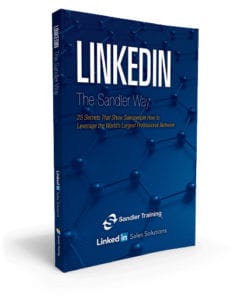
LinkedIn the Sandler Way
Even when we’re buying in a short impulse purchase is when you’re walking through the checkout in the grocery store and you see the Snickers bar over there, your body is already decided it wants the Snickers bar. From there, you’re going, “Did I work out today? How can I logically justify the Snickers bar?” I don’t know about you but for me, it’s like, “I had a rough day, I have the extra money in my pocket, I worked out hard or I’m going to be working out this weekend.” You can stretch those reasons far.
It’s true that the voice of justification one way or the other, whether it’s getting us off our goals or keeping us on our goals. It’s important to be aware of how loud we are letting it become. I know a big part of your focus is helping people become better salespeople through The Sandler methods. One of the things you also talk about besides asking great questions so you don’t waste your time, anybody’s time is also you have a lot of focus on how to be better negotiators. I briefly want to get a little snippet to entice people enough to want to know more about your tips on negotiation.
You’re trying to talk somebody into something or talk them out of something, the same rules apply. What we were talking about is when you want something, you will intellectually justify it. If somebody doesn’t want to buy your stuff, there’s no negotiating or talking them into it. We have a gumball analogy. If you think back the old big gumball machines when you were a kid. If you want a green gumball, you put your quarter in and you crank it. If you get an orange one, you can’t get mad at the gumball.
You can’t get mad at yourself. There wasn’t anything you did. There’s nothing you can do to talk that orange gumball into being a green ball. I would say the first step would be you got to get really good at disqualifying and not try to negotiate on bad terms and bad footing. You have to have a willing partner and you have to have somebody that has a problem that you can solve and that wants that problem solved and has the budget and everything. Even when that comes down to it, the other subtle stuff that we were talking about does play a huge difference that you probably again happen with a spouse, a business partner, a child where if they say, “Do we have $100 to go to dinner?” If you say yes too fast, that ask becomes $200. They go, “I should ask for more,” all of a sudden.” There is a little bit of gamesmanship and psychology in this that we work with in Sandler.
We don’t think about it manipulatively or taking advantage of anybody, but sometimes people are going to try and take advantage of you. We think about judo and karate. How do you have defensive moves when people are trying to cut down your price so that you can have equal business stature and maintain the profit level that you set, not take advantage of people, but get your price and make that non-negotiable and negotiate terms instead of dollars?
How can people find out about your book, about Sandler and about following your creativity?
If you want to learn more about Sandler, our sales management and customer success programs, go to Sandler.com/sell. There’s a ton of free resources. You get a year’s worth of access to thousands of podcasts, videos, webinars and stuff that we’ve done from people like Bob Burg, who wrote The Go-Giver, Olympic athletes, the drummer for Pink and cool stuff in there. If you want to get the free copy of my book specifically, go to Sandler.com/linkedinsecrets. My side project, the personal passion thing, is CreativeNerdery.com. It’s a private social media site for people who are trying to be more creative, be more authentic and their real selves and not hide that nerdery passion topic, whatever it is for you, if you like to geek out on stuff, it might be for you.
Any last thought or quote you want to leave us with?
My favorite quote is, “Whatever you are, be a good one.” That’s Abraham Lincoln. To follow that up would be Steve Martin, “Be so good they can’t ignore you.” I think those go hand-in-hand that if you’re trying to give a presentation or you’re trying to be a salesperson and you’re upset and frustrated that people aren’t paying attention to you, the question is not what’s wrong with them. It’s what you can do to make yourself more interesting and worthy of being paid attention to.
What a great note to leave it on. Who could have ignored that time travel opening that you gave? Thanks for showing us and not just telling us.
Thank you.
Important Links
- Mike Montague
- Sandler Training
- LinkedIn The Sandler Way
- How to Succeed Podcast
- CreativeNerdery.com
- Better Selling Through Storytelling
- The Go-Giver
- My Sandler
- https://www.Sandler.com/linkedinsecrets
- www.Sandler.com/sell
- Better Selling Through Storytelling Method Online Course
Wanna Host Your Own Podcast?
Click here to see how my friends at Podetize can help
Purchase John’s new book
John Livesay, The Pitch Whisperer
Share The Show
Did you enjoy the show? I’d love it if you subscribed today and left us a 5-star review!
- Click this link
- Click on the ‘Subscribe’ button below the artwork
- Go to the ‘Ratings and Reviews’ section
- Click on ‘Write a Review’
Love the show? Subscribe, rate, review, and share!
Join The Successful Pitch community today:
- JohnLivesay.com
- John Livesay Facebook
- John Livesay Twitter
- John Livesay LinkedIn
- John Livesay YouTube
Selling With Flair! With Jeroen Corthout
Posted by John Livesay in podcast | 0 comments


Rarely does it happen when a CRM becomes a salesperson’s friend as opposed to another project they have to do. This is how revolutionary Salesflare has become, a CRM system that automatically fills itself out so salespeople don’t have to waste time manually putting information in. On today’s show, Jeroen Corthout, the Cofounder of Salesflare, joins John Livesay to talk about how you can sell with flair and the importance of building stories that take your clients on the complete journey. Don’t miss this episode to hear firsthand how you can start applying these same principles of storytelling to win new clients for your business.
—
Listen to the podcast here
Selling With Flair! With Jeroen Corthout
Our guest is Jeroen Corthout, who is the Cofounder and CEO of Salesflare, which is an intelligent CRM that’s built for businesses selling to businesses. It’s popular with agencies and SaaS companies. Salesflare itself was started when his Cofounder wanted to manage the leads for their software company in an easier way. They didn’t like keeping track of them manually and they built Salesflare which pulls customer data together automatically. One of their awards is the Most Popular CRM on Product Hunt for its ease of use. Welcome to the show.
Thank you. Glad to be here.
I always want to ask people their own story of origin before we get into your company’s story of origin. Take us back to childhood days or college days, wherever you want, to start your own story of how did you get interested in software in general?
From childhood, I always like to build stuff. I would do anything, like camps in the woods or build a catapult or all kinds of stuff. I keep build something to see it there and you’re happy with what you’ve created. At some point, I discovered the joy of building websites. That was when I was 14 or 15. That started with the simple GeoCities websites. I don’t know whether you know that. There are websites where you didn’t have to do much. You put some elements there and you built this silly website. It started evolving into building full websites back then with HTML and Flash, there was a lot of Flash going on back then.
I liked that because you could build anything you wanted. Flash disappeared in the meantime. From there, I figured I was going to start my own a web design agency. When I went to the university, I first had a look at Computer Engineering. I did not like what I saw, it looks nerdy and far from reality. I went a different way and went through Electrotechnical Engineering and from there to get it with Business Management. I went into Biomedical Engineering, which was then a totally different thing. It felt more impactful and it felt also like I was learning more but I wanted to start an engineering job. I felt like I want to do something more with customers. I missed that aspect much. I didn’t want to be purely building things.
I wanted to build things for people not being disassociated with the customers. I went to business school. From there, I figured that the best way forward to get some experience is become a product manager in a pharma company. I did that. That was not the right idea. I quickly learned this is a limited role and not at all building your own company or something. When I thought about starting a web agency again, but then for pharma companies, I talked to this guy and he said, “You can join us. We do multichannel for pharma companies.” Everything from websites over CRM, sales, marketing and all that. I did that for four years, did a whole lot of work with Salesforce, for pharma companies internally at the company That’s why I started learning about CRMs and the joy of working with Salesforce. From there, I still figured I want to start my own company. I had a bunch of projects, of which now Salesflare is the first viable one that became a company, all the other ones stopped somewhere.

Salesflare: If you’re a leader in a business, even a smaller one, you might be surprised that many people in your business don’t know all the things you sell.
It’s interesting that you missed the connection and interaction with people as opposed to building things. That’s a part of your personality that’s both engineering-oriented and right brain people-oriented, allows you to have a lot of skills to in fact, run and launch a company. It takes not the tech skill or not just people marketing skills to be successful, you need to have people on your team who complements you where you may not be strong, but also to have that big picture overview which it sounds like you’ve been able to create.
Let’s dig into what made you decide to start Salesflare because I think it’s interesting to hear that typically, you’re first working with pharma companies, helping them with all those different things to make their sales more effective. Yet, Salesforce is something that almost everyone who’s ever had a sales job has used at one point or another. You’re discovering that there’s something not being met because Salesforce couldn’t be customized to pharma or was there something you needed for your own needs that made you want to start this?
It didn’t start from the pharma background. It was more us using Salesforce internally at the consultancy/agency I was working at. That’s also why we have many agencies on the software. A big part of my experience comes from there. We would use it internally. It was my first real CRM. I never understood well how I was supposed to use it as a practical tool. I tried, but I failed. A lot of the things seems like they weren’t built for end users. Certainly, they were built for customization. They were built for organizations to be able to build whatever they like. Let’s say you’re a big enterprise and you want software to adapt to your company completely, then an enterprise CRM like Salesforce is a great choice. When you’re a small company and the company itself is also more interested in something practical, something that’s going to help you sell more, Salesforce is not a great choice. It’s inward-oriented and not so much outward-oriented. It’s organization and not so much end user. I hit a lot of these limits.
What do you mean by agencies? Are we talking ad agencies or PR agencies or consulting agencies?
All of those. We are mostly of marketing agencies, which is partly ad agencies, partly all the types of marketing agencies on the software. On the other hand, also quite some software development agencies.
I used to work in advertising, called on a lot of ad agencies to get them to run their clients’ campaign with the media I was selling. Ad agencies are constantly pitching to win new business. They need something to keep track of their leads, when proposals come in, and all of that kind of thing. Let’s make this concrete for the readers and you graciously offered to do this with me so people can get a real-life example of what you’re doing and how you’re pitching, as an example. You go into an agency. How are you keeping track of your leads? Are you using Salesforce or nothing? What’s your biggest pain point? How do you open up a sales call to get an agency even to consider taking a meeting with you?
[bctt tweet=”Imagine a CRM that fills itself out! Are leads falling between the cracks?” username=”John_Livesay”]
I generally asked what they’re using. I ask how that’s going like if it’s all going to expectations. Are people filling it out to the extent that they are expecting them to fill it out and using this ram to the extent that they’re expecting them to use it? Almost invariably, you will hit a pain point there because nobody fills out a CRM to the extent that they’re supposed to and nobody uses it to the extent that they’re supposed to. That gives me the opportunity to show them that we built a system that fills out itself largely so it’s based on existing data. It’s based on your emails, calendar, phone, social media company database, and it offers the information to you so you can curate it rather than you having to manually input things into a CRM, which then has two big benefits.
One, salespeople are going to use the CRM and make more sales in it because that’s what the CRM can help them with that it’s not dependent on their manual input. Second, for sales managers, that’s often where the story starts, makes it easy for them to create transparency and accountability with their first sales hires or with their existing sales team. Many of our sales conversations start when people hired their first salesperson or first few sales people or when their sales team has outgrown the sheets that they made or something or outgrown the system that they were using. The sales team or the sales manager mostly wants to get a better grasp on what’s happening and it’s not appearing in the CRM. That’s usually where the story starts.
If we’re going to make this applicable to everyone reading, the first thing you need to do is ask questions to find the pain point. Oftentimes, people will ask you, “What’s your secret sauce?” You need to have an answer ready to go whether you’re pitching an investor or pitching a potential new client. What you did well I thought was turned it into a benefit right away. I like that you said the story starts there because what I do with clients is turn these case studies into case stories. If we were to talk about getting someone’s attention even to take a meeting, sometimes it’s frustrating.
A good pitch is clear, concise and compelling. If we were to take what you said and make it slightly more concise so that people instantly get it as opposed to having to wait for the payoffs, they might be a little more intrigued sooner than later. What you could say would be something along the lines of, “I’ve been in your shoes. I worked for an agency, we have a lot of clients like you and then what they’re struggling with.” If you introduce the word struggling, that automatically is typically followed by a pain point so that people lean in and because their whole goal is to get people to see themselves in your story.
“Another agency like you were struggling, because their sales team was not filling out the information. They resented having to do it. They felt like it was a waste of time and we ourselves experienced that. We created Salesflare which instead of having to input something manually, it gives you information and saves you time. Imagine instead of resenting doing something, it was almost as if you had another assistant giving you tips and suggestions so that leads didn’t get lost and things were more organized, which made you more productive so you could make more sales call. Instead of wasting time filling out a CRM so the management can try to understand what you’re doing and what the problems are, you had a CRM that didn’t waste any of your time, but in fact, saved you time.”
I like how you started with it, “I’ve been in your shoes.” You say that I would come to the lean-in.

Salesflare: People can spot a script right away. Your best people will be the first ones to resist a script because it is disrespectful to them.
The fact that I asked you your story of origin gives you credibility. Let’s take an example of turning a case study into a case story. Let’s say that opening new concept there pulls people in because the whole goal of a pitch, even an elevator pitch or the opening pitch, is to intrigue people enough to say, “That’s interesting you’re on. Tell me more.” When you told me that this thing fills itself out, my next question is, is it using artificial intelligence to do that?
Not really. It’s more algorithms.
It doesn’t matter how it’s doing it, but it’s intrigued me enough to ask a question which continues the conversation. It’s not your pitching. Let’s take a client that’s used you. There are four parts to a great story. The first part is the exposition. Do you have a client in mind that hired you a year ago or so? When did they hire you?
Many years ago.
Can you say the name of the client?
I’d rather not share because what I’m going to share afterwards is a lot more personal.
[bctt tweet=”Perfection is not the goal, but being consistently good is the goal.” username=”John_Livesay”]
A marketing company or an ad agency type? Describe what they do. What kind of company?
It’s rather complex to explain what they do.
Are they an agency?
It’s a software development company.
That’s all we need to know because we want to be describing theoretically, you’re calling on another software development company. The case story that’s exactly like this, what I was saying is business. Many years ago, a software development company based in where? Give us a country.
Southeast Asia, I’ll say. Otherwise, it’s too easy to identify.

Salesflare: If you find yourself having a lot more confidence in the value you offer than how to talk about it, you’re in good company.
That’s the opening of your story. That’s the exposition like a journalist, who, what, where, when. What they were struggling with was? Now, fill-in what their pain points are.
They were having a lot of leads dropping through the cracks. They were not organizing this well enough. They didn’t have it visually in front of them, first of all. Secondly, they didn’t know well what was last discussed with each customer. They didn’t know exactly when to fall, but whom, which meant that they were losing quite some money.
Is there anything that you do that Salesforce doesn’t do around those pain points?
Automatically keep track of what’s been discussed. Our software also nudges you to follow-up the right times based on when you were last in contact and emails that go unanswered and stuff like that.
They’ve started using it. What was the solution? Ideally the solutions are the opposite of the problem. After they used Salesflare for 2 or 3 months, they went from leads falling between the cracks to not one lead being lost. Instead of missing follow-ups, they were nudged a day before and because they were following up more accurately, then describe what happens to their business. Their sales go up as a percentage.
They shared with me that their sales went up by $1 million US a year.
[bctt tweet=”Your everyday business conversations are, in fact, a manageable business issue.” username=”John_Livesay”]
How’s morale?
Our morale is good I think. I don’t know what the morale look like.
Remember, good stories have an emotional hook. It’s not all wonders. People are more competent, they’re sleeping, the management’s happier. Morale is up because the sales reps feel like the management’s not mad at them for losing leads. That’s the secret sauce to storytelling. Any potential new client hearing this case story, instead of a case study that’s boring with stats only, is going, “That’s what we want. Not only do we want more sales, but we want our team to instead of fighting with management and getting yelled at for losing leads and not following up to feel happy working here.” They stay.
The whole thing from start to finish would sound like this, “Many years ago, a marketing software company in Southeast Asia was struggling because their leads were falling between the cracks.” They couldn’t visually get a quick snapshot of what was happening. They forgot when they were supposed to follow-up with people. All of that was causing a lot of tension in the company. Sales managers were constantly hounding the reps, “What about this? What about that? Why haven’t you followed up?” Once they started using Salesflare, all of those problems short time. Leads were no longer falling between the cracks. They weren’t having to waste a lot of time to enter the leads because we automatically did that for them and that’s our secret sauce. A year later, sales are up a million dollars. More importantly, everyone’s happier. There’s no more blame game going on because everyone’s feeling more productive, efficient and the team is running smoothly. “Does that sound like the journey you’d like to go on with us?”
For the readers, if you need some help turning these case studies and stories. Certainly, if you need a CRM that’s going to automatically do it, then the two of us could be a resource for you to not only have better pitches, but also to use a tool that being something you resent to something that you are happy, that’s helping you. When that happens, you’re more productive, and more importantly, you’re feeling proud of the work you’re producing because nobody purposely lets leads fall between the cracks, they’re overwhelmed, they need help. It’s not their fault.
Sales where instead of being a burden becomes like a Sherpa helping somebody climb Mount Everest. That’s what we wanted to talk about was how to use story telling a real-life example so that you’re on can now use this for his sales team who’s going out to pitch because, like myself, I have to sell myself to get companies to hire me as a sales speaker. We all have to sell ourselves all the time. the better we describe stories of why we got hired and what is life like after they hired me to speak or hired him to use Salesflare, and they see themselves in the story, then you’re no longer pushing. That’s the magic of storytelling is that you and your team now can describe a story like that and say, “Does that sound like the journey you’d like to go on with Salesflare?” Instead of like, “Do you want to buy?” It’s a different way to sell.

Salesflare: We need to win hearts and minds inside the organization, just as we try to win hearts and minds outside.
It sounds compelling when you said it like that.
Any last thoughts you want to share with us about your own journey growing Salesflare or your goals for the future or any tips you have?
The advice I’d like to give to the readers is to be able to build these stories and journeys that you want to take people on. It’s important to talk to your own customers that you already have to understand their stories and journeys and to do some customer interviews with them. You can select the best customers you’re having. Invite them to have a call and then to understand the full journey, “This is thing I like to follow,” the jobs to be done methodology, but then the version by Bob Moesta from The ReWired Group. They have an interview about the four forces and that’s a play on any buying decision and it helps to uncover those. It goes from there’s inertia, like what kept people on the old solution. There’s the push of the old solution towards the new one, because there’s something wrong with your solution.
There’s the pool of the new solution, like the brighter world and there’s also an anxiety to go to the new solution. When you’re with your questions uncovering these four things, it’s come to interesting conclusions. Plus, it’s good to take this story as long as possible. When I do these interviews, I don’t ask what they were using before Salesflare, but I also asked what they were using before that and understand what the company was like, who was in charge of these decisions, why they were using these systems, how that worked, things like that. You can clearly visualize the whole journey instead of taking this small snapshot out of it they would normally be taking. That informed a lot of our thinking about why people choose Salesflare over other systems, what they compare with which is invaluable information when you’re building these stories, building up your marketing anything towards customers.
If you want to create a story, make sure you’re creating a story that takes your customers on the full journey, not just part of the journey. Thanks for being on the show. We can find you on LinkedIn and your company Salesflare.com.
Important Links
- Salesflare
- LinkedIn – Jeroen Corthout
- Better Selling Through Storytelling Method Online Course
Wanna Host Your Own Podcast?
Click here to see how my friends at Podetize can help
Purchase John’s new book
John Livesay, The Pitch Whisperer
Share The Show
Did you enjoy the show? I’d love it if you subscribed today and left us a 5-star review!
- Click this link
- Click on the ‘Subscribe’ button below the artwork
- Go to the ‘Ratings and Reviews’ section
- Click on ‘Write a Review’
Love the show? Subscribe, rate, review, and share!
Join The Successful Pitch community today:
- JohnLivesay.com
- John Livesay Facebook
- John Livesay Twitter
- John Livesay LinkedIn
- John Livesay YouTube