
Social Purpose Investing with Joel Solomon
Posted by John Livesay in podcast | 0 comments
Episode Summary
One good life purpose is to do as much good as you can and leave the world better. Joel Solomon, the author of The Clean Money Revolution, shares that deciding that finance business and capitalism could be a powerful force for good was an awakening for him. Joel is the Chairman of Renewal Funds, a $98-million mission venture capital firm. He’s invested in over a hundred early growth stage companies delivering above-market returns while catalyzing positive social and environmental change. In this episode, he shares a wealth of knowledge about social purpose investing. When we take responsibility for where we are investing, it reveals who we are as a human and what our belief systems, philosophy, morals, and ethics are.
—
Listen To The Episode Here
Social Purpose Investing with Joel Solomon
Our guest is Joel Solomon, who is the Chairman of Renewal Funds, which is a $98 million mission venture capital firm. He’s invested in over a hundred early growth stage companies delivering above-market returns while catalyzing positive social and environmental change. He also published a book, The Clean Money Revolution: Reinventing Power, Purpose and Capitalism. Joel, welcome to the show.
Thanks so much for having me.
I want to ask you to tell us your own story of origin. You can go back to childhood, college or wherever you want. Where did you start to figure out what you wanted to do with your life?
I think I’ll go back to the pre-Joel roots a little bit and say that I come from two lineages, one of which was a German-Jewish lineage and the other was Russian-Poland-Lithuanian. The one left earlier than the big troubles but came to the United States for the opportunity. The other was shipped away as a ten-year-old to escape conscription and bad conditions in Russia at the time. My grandfather ended up in Atlanta and they had an experience shortly afterward of a Ku Klux Klan march around their neighborhood and moved up to Chattanooga where it was quieter. My father and mother met at the Democratic Party convention in 1952 on a blind date. I grew up in Tennessee.
At eighteen, I went away to university in the northeast and then over the years, my father became a very successful entrepreneur. I spent some time thinking about life. I worked in politics. I started making seed capital investments. I was diagnosed with genetic kidney disease and told I could die soon or live a long time, but there was nothing I could do about it. That led me to think about, “What does the kidney do?” When I realized it had to clean the toxins out of my blood, I started looking at the ingredient labels. That led me into a career in organic food investing along with climate issues that we invest in. A friend gave me her kidney several years ago. I ended up moving to Canada to take some great opportunities here and got to enjoy the Canadian healthcare system, which I never heard the words insurance or money. I get fabulous care and I’m healthy now and all that went well. It did put me into a career of thinking that life’s purpose was to do as much good as you can and leave the world better.
What I love about that story is the awareness of a personal challenge and that’s what I see a lot of great entrepreneurs having is they’ve had some personal problem. They want to solve for themselves and then realize other people have similar problems that they can solve and scale that solution. It generates a lot of ideas. The concept of having a kidney issue and figuring out what it does and then leading into healthcare and into a social impact is quite fascinating.
[bctt tweet=”Vision, Grit and Passion are keys to success” username=”John_Livesay”]
The journey with deciding that finance business and capitalism could be a powerful force for good was an awakening because I’d started in the ’60s with lots of questions and all kinds of things were going on then. I was a bit confused about what’s the best pathway. As I found the movement of entrepreneurs who thought that they could do good with a business, I found that very attractive. It was able to combine multiple sources of myself. My mother became an artistic photographer who shows the underbelly of psychology and emotions of humans on the planet. Combined with the optimistic entrepreneur dad and a serious look at the other side mom, I had a nice combination of critical thinking and enthusiasm for making things happen.
I love anything to do with critical thinking and I’ve heard it used in a lot of different arenas including the healthcare industry where for example, nurses need to have critical thinking skills to not just follow things exactly by the book. If they see something going wrong, they need to be able to respond to that. How do you define critical thinking in terms of entrepreneurship?
First of all, it’s a constant, daily critical thinking in terms of where are the opportunities, where are the challenges, what are we doing wrong and what can we do better? What are the hurdles to there? How do we assemble the right resources in terms of people support, boards of directors, other investors and expertise of all kinds? As an entrepreneur of building, we like to call it mission venture capital, we have to first assess what it is we’re interested in and we think we’ll be successful. Secondly, we want to understand the entrepreneurs and particularly their senior team, but as much about the culture as possible. “These people that are adaptive, can they assess what the circumstances are and make good choices?” You do as much due diligence as you can. You never know for sure well, but you’re making a bet on people and on a fairly long-term relationship. That’s how that pathway led to being an investor.
Let’s talk about what you look for besides having a great team when you hear a pitch.
The basics that you would think of are the core of it. Does the premise make sense? Does it look like there’s a marketplace opportunity? Do the entrepreneurs know what they’re doing or seem to know what they’re doing? What is competition? What’s the landscape? What are the resources? All those kinds of common sense things. What is really important to me is to understand the character and personality of the people I’m getting involved with. Everyone sells well or many people sell. What are they like under pressure? What kind of choices will they make when it’s not so easy?
What about when the plan that was enthusiastically presented doesn’t work? It’s more in the challenge points where you find out someone’s character. We do our best, I don’t have any special tricks for it other than experience with humans. I’m going through a lot of different entrepreneur situations and things like that and all kinds of situations, but I think it’s a lot about the inner skills, the psychological and the emotional. How do you handle conflict? How do you handle the pressure? Do you know what the truth really is and how to be very straightforward with people while still maintaining optimism and strategy?

Investing In Social Purpose: The art of understanding our emotional and psychological being is quite under-trained and under-utilized.
I think that’s fascinating information and choice of that. Wayne Dyer once said that if you squeeze an orange, you always get orange juice. It doesn’t matter what time of day, if you squeeze it in the corner, you still get orange juice. The thing about how consistent are we. If we get squeezed into a corner, does a different side of our personality come out or are we consistently calm and rational or what kind of choices are we making when we’re under pressure? That reminded me of that little analogy there. What is your favorite way to handle conflict that you could give as advice for people who are struggling with that? Many people say, “Let’s avoid it. Let’s bury it. Maybe it will go away. I don’t want to have that difficult conversation.” What advice can you give of how to handle conflict for people who are afraid of it or just try to avoid it?
It begins with my own journey through that myself. I went and sought help. I tried to be open to the professions that are there to help people. You can talk about the psychological and the mental stuff and the study of human nature, that kind of thing, but there’s a whole other level of knowing how to understand what one is even going through. Am I feeling something? What are the emotions I’m feeling and being able to identify them? If you become practiced at understanding yourself, when are you afraid? When are you angry? When are you sad? When you notice that and you learn that you do have the power to just simply by seeing it and acknowledging it, it’s a huge doorway, but then you can gain tools over time. It might be, “I’m going to take ten seconds and take a breath.”
That gap between stimulus and response is something that isn’t talked about very much.
“I’m going to go for a walk. I need a break.” I need to call somebody I trust and say, “I’m having a hard time now. I’m not sure what it is. Maybe it was whatever my wife said to me last night or my kid or who knows what.” I think that the art of understanding our emotional and psychological being is quite under-trained and underutilized. There are no courses in the university. I don’t know if incubators and accelerators have taken this up these days, but an entrepreneur is typically supposed to be an invulnerable hero of super person magnitude and be able to do everything. That is a mistake to try to be that person.
What I want to be is the most aware and conscious person who’s capable of seeing what’s going on in myself and understanding what the choice options are and then making a clear choice. I’ll say one more thing about this. Often if it’s a business situation, I will go so far as to say, “I’m having a bad day and I’m a little grumpy. I’m sad about something that happened or I’m worried about this or something.” It dispels so much to be vulnerable and honest that way. I don’t consider it a weakness. I consider it a strength.
Brené Brown certainly agrees with you. She was giving TED Talks on it and wrote books about the need to be vulnerable but that’s how people connect and relate. This concept of being aware of your feelings. “Am I afraid? Am I angry? Am I sad? What is triggering the anger in particular?” Do you have any experience or tips for people who struggle? We all have our hot buttons and we try to deactivate them to the best of our ability. If someone you find is constantly critical or a little condescending and you’re focusing on the 1% or 2% things you’re doing wrong as opposed to the 80% and 90% you’re doing right, do you have any suggestions on how you would personally handle that? What do you suggest to other people on how to not get so triggered?
[bctt tweet=”How do you use critical thinking?” username=”John_Livesay”]
To be a little more explicit about the professions out there that can help us get better at this, we bring in all kinds of expertise to our companies. One of the last things we’re typically going to bring is HR or organizational development or executive coaching. A good executive coach or those other professions, they have these skills, they’re good observers, they know how to give us feedback about it and they can help us both craft our own behaviors and then a corporate culture. Marketing, sales, finance, there are all kinds of tangible skills that are needed. This gets left off the list.
The EQ, the emotional intelligence, not just the IQ.
We’re in a world that demands more of this than ever before. We are looking at people less mechanistically like we’re machines and robots who are supposed to figure everything out exactly the same way. The modern marketplace and the modern backdrop to that marketplace like social-environmental trends and human trends, labor trends, younger people and how they are going to be in workplaces and what do they want? What is expected of us with a company and our values, morals and ethics? What kind of citizens are we in the world? It’s getting more complex, but at the same time, there’s something very simple in here which is opening to the idea that I can intentionally grow as a human being and as an entrepreneur.
Let’s talk about what inspired you to write your book. I’m always interested in that journey because that is not something that people undertake on a whim because it’s a huge amount of work and commitment. The Clean Money Revolution, what does that mean for people who don’t know?
What Clean Money is about is that I need to take responsibility for what my money is doing, whether it’s in my pocket, whether it’s in a bank, whether it’s invested somewhere. That is my responsibility. It reveals who I am as a human, what my belief systems, philosophy, morals, ethics are. I don’t want to end up invested in things that are damaging people or damaging places. That’s not a sacrifice I want to make. Everything’s imperfect, so I’m not talking about perfect. I’m talking about moving on that scale and taking responsibility. How much plastic do I buy? How do I treat other people through my money?
I got very fascinated with this idea and I had a fairly unique career. You can read about it in the book, but I had a fairly interesting career and I feel like I had a lot of privilege. Some of it had to do with just being in new areas early, which allowed me to be at the beginning of certain concepts or early stages, different business ideas and things. I realized that I’d been exposed to an awful lot and there’s not enough information out there about the moral and ethical sides. We talk about business ethics, but we don’t talk about the ethics around money itself very well. I think that future generations are counting on me to make good choices about my purchases, my buying and things like that.

Investing In Social Purpose: You end up with deep social unrest and serious problems if you don’t think about everyone at some kind of some level.
I wanted to share ideas about that and I also wanted to share that there’s a movement underway. It’s called impact investing in the sector I’m in. We’re looking at everything in society and we’re considering the long-term impacts, the manufacturing impacts, where stuff comes from and who’s affected. I wanted to share about that. The first part is the personal journeys. How did I think this all through and get this way? Second, there’s a movement underway. Here’s a personal taxonomy that I may have seen early stages of a couple of subsectors and here’s how they’ve grown. The third part is to talk about the moral and ethical aspect of this state of the world, the crisis we’re facing on all fronts and how do we be the best that we can be.
When you decide what you’re investing in, do you invest in companies only in Canada or the US and Canada?
We are US and Canada-focused. We can’t do international because it’s too much for us to take on. Our investors are from around the world, but mostly US, Canada. We have one advantage, which is depending on what are fairly big swings and exchanged rates, it might be better to be shopping for investments in one country or the other. That gives us an interesting little bit of diversity that isn’t it as common.
When you talk about social impact, is it only companies that are helping the environment or if you see that someone is creating a product or a service that has a positive social impact on people’s life or their ability to buy a home or something, does that fall under something you invest in? Is it only environment?
One thing I wanted to say, by the way, is that we’re raising money and I haven’t updated my bio, so we’re going to push near $200 million under management, maybe over that. It’s succeeding over time. We’d look at all the factors, but we are primarily focused on soil, agriculture and food and everything to do with the environment technologically, which there’s really a vast world of that now. However, we are looking at social factors, we’re looking at the human beings, we’re looking at what kind of a workplace it is. We don’t ignore that but our first doorway has to do with the environment and climate.
When you talk about reinventing power and purpose, let’s take a dive on how do we reinvent power and is it by the way we spend our money or what companies we invest in? Is that what you’re talking about? Are we giving those people more power by attracting that kind of money?
[bctt tweet=”How Do You Handle Pressure?” username=”John_Livesay”]
What I meant by saying that is that power is distributed in a quite imbalanced way currently on the planet. We have created the benefits to flow to those who needed the least. Tax benefits, access to education, all kinds of things. We are steadily reducing that access for people who have the least. Legislation and all kinds of things keep changing that is going what I consider the wrong direction. You end up with deep social unrest and serious problems if you don’t think about everyone at some level. By power, I’m talking about who gets to have and who gets accessed and who gets to decide. A very few of us relatively speaking, have that power and there are choices to make.
You can be a consultative leader, you can be a dictatorial leader. You can cultivate a safe workplace for ideas and innovation or you can not want to hear anybody ever question you. That’s where power is. I’m using it very loosely there, but it’s deep. If we don’t pay attention to this, I think we’d get in trouble. I was born with less than three billion people on the planet and I could live to see eight billion. How are we going to split up everything and how are we going to take care of each other? What’s going to happen? Who gets to decide who gets what? That’s what I mean by the power in that one.
We often talk about the Ford Foundation committing over a billion dollars in the next ten years to helping people get affordable housing and financial services accessibility. That is where I am really fascinated and the social impact that that has. If you look at Maslow’s hierarchy, until we have some basic needs met and give people access to qualifying or getting some cash without going into debt so much, if everybody’s living paycheck to paycheck then they never get up the hierarchy to start self-actualizing and caring about the planet. If you’re still wondering where your next meal is coming from or if you’re going to pay your rent. I love what you’re doing here. Is there anything from the book that you want to say to somebody, “If you’re struggling with this, you’ll find the answer in The Clean Money Revolution?“
I might offer you more questions than answers, but I’ll tell you a lot of stories in that book. I like the parable and the storytelling. The living example to make the points rather than to overly act like I know exactly how things should be done or people should be done. One of the greatest things in my life is the stories that I’ve been able to be exposed to or be part of. Early on, one of those was Jimmy Carter. I went to work for him in my teenage years when he decided to run for president. I worked through that. Another was after I was diagnosed with kidney disease. I went out on seek and search and I ended up caretaking an island that was an Orca Research Laboratory that was founded by the guy who started Greenpeace’s Save the Whales campaign. I saw two examples between age 18 to 25 or 27 where one individual decided to take on some huge complex task and both of them actually succeeded at it through vision, grit, learning and going for it. Those were very helpful to me and then in the entrepreneur world, I get to see other stories and it goes on from there. It got me in the pattern of stories as the best teaching methods.
You’re singing my song. My whole book is Better Selling Through Storytelling because Plato said storytellers rule society and it’s as true now as it was 2,600 years ago. The more we can become storytellers to get people engaged in caring about a particular issue, I think that’s where it hooks the emotions is storytelling.
I’m so glad we’re aligned on that and it’s the ballgame. You can learn it in a lot of different places, but doing it takes practice. You’ve got to remember.
What’s something you’re working on now that you’re very excited about?
We have 300 investors at this point and influencing those investors, their families, friends and advisers that there is a different way to invest. There’s a different way to make money and here’s a whole bunch of stories that you’re going to get exposed to. That’s one part. The second is proving to the citizenry and to industry sectors and everyone else, that there are better ways to do things and that you need to pay attention to that continual improvement. If there are practices that you’re waking up to and you’re going, “I don’t know if I want to tell my grandchildren about what I did to build this industry or the sector or this product.”
There are increasing ways to make better choices because human ingenuity both do well on greed. Human ingenuity does a great job on accumulation and domination and that kind of thing. My friend gave me her kidney. That’s unfathomable really. We’ve gotten used to this kind of thing and in every different part we look and we don’t like something in the world. We’re in an era. If we can maintain it then don’t blow it. We’re in an era where the possibilities of human vision, passion and caring could make a fantastic future or we could blow it.
Let’s stay optimistic that the vision, the grit and the passion will allow us to not blow it and in fact continue to have great social impact. I can’t thank you enough, for coming on and sharing your wisdom and the insights from your wonderful book. If people want to follow you, where should they go?
Joel Solomon, I’m in the major social medias. That’s one way to find me under my name. The book is available, The Clean Money Revolution out in the world, you can get your bookstore to order it. You could go to your favorite online bookstore and etc. The two websites, RenewalFunds.com is about the businesses we invest in and how we do what we do. The JoelSolomon.org, this podcast will be there and lots of other interviews, ideas, blogs, connections and things like that.
Thanks again, Joel.
Thank you so much.
Links Mentioned:
- Renewal Funds
- The Clean Money Revolution: Reinventing Power, Purpose and Capitalism
- Ford Foundation
- Save the Whales
- Better Selling Through Storytelling
- RenewalFunds.com
- www.JoelSolomon.org
Wanna Host Your Own Podcast?
Click here to see how my friends at Brandcasting You can help
Get your FREE Sneak Peek of John’s new book Better Selling Through Storytelling
John Livesay, The Pitch Whisperer
Share The Show
Did you enjoy the show? I’d love it if you subscribed today and left us a 5-star review!
-
- Click this link
- Click on the ‘Subscribe’ button below the artwork
- Go to the ‘Ratings and Reviews’ section
- Click on ‘Write a Review’
Think. Do. Say. With Ron Tite
Posted by John Livesay in podcast | 0 comments

Our guest is Ron Tite who is hailed as one of the Top Ten Creative Canadians by marketing Magzine. He’s the author of Think. Do. Say. In this episode, Ron shares how to build trust, as well as how do we win the battle for time when everyone is so inundated with things that you have to figure out a way to create content and advertising that wins that battle. Today, he shows us exactly how to do it from lessons learned in his book. Don’t miss this episode to discover a whole process of building trust – from figuring out how to connect with your beliefs and values, how to deliver on those beliefs and values, and how authenticity is the secret sauce to all of that.
—
Listen to the podcast here
Think. Do. Say. With Ron Tite
Our guest is Ron Tite who has been named one of the Top Ten Creative Canadians by Marketing Magazine. He has been an award-winning advertising writer and Creative Director for some of the world’s most respected brands including Air France, Evian, Fidelity, Hershey, Johnson & Johnson, Kraft, Intel, Microsoft and many more. His work has been recognized by The London International Advertising Awards and many more. He’s the Founder and CEO of Church+State, a Toronto-based marketing agency and he’s the publisher of This is That: Travel Guide to Canada. He also has a book coming out called Think Do Say. He and I are going to be speaking at the Coca-Cola CMO Summit on storytelling. Welcome to the show, Ron.
Thank you so much, John. Thank you for having me.
I always like to ask guests to tell us their story of origin. You can go back as far as childhood high school, college or whatever it was you thought, “I want to be a creative person.”
When you look at the broader life story, we can break it down in terms of the peaks and the valleys, and the origin story is such a great way to put it. I grew up the youngest child of four in a predominantly single-parent home for the most part and not quite poor. I think that it’s observing being the youngest while everything else was going on around me. I began to be able to observe things right and start to look at that life. I try and pull humor and see the humor in it. Even from being a very young child, not being a class clown, I wasn’t that but I could certainly appreciate the humor in situations and always.
My family is Italian and Québécois background so it’s very loud, it’s animated, the people who themselves were amazing storytellers. As a kid sitting around the kitchen table hearing my aunts and uncles tell stories and how they could just capture a room whether they were emotional stories or funny stories. I think that’s where I really got the ability to tell a story and which would serve me well. I started doing stand-up comedy so I would do that. I went off to university, I was the first of my family to go to university. I did a phys ed degree like most people in comedy and advertising.
You started off in phys ed, athleticism, which doesn’t normally lead to being an expert in creativity and humor. How did that connect for you?
Getting into it, it wasn’t a conscious choice but I don’t know that it was something I was destined to do. Nobody of my family had gone to university. I liked the job that my wrestling coach and gym teacher have and I said, “How do I do that?” I do that and then once you go and you land in the middle of the sea of people who come from this variety of different backgrounds, I quickly realized, “I don’t have to do that. I can do whatever I want. I think I’m smart enough. My head is screwed on tight enough.” I don’t know why and I read a book that changed my life.
It really sought away, but it is not a book that everybody knows. John Irving wrote a book called The Imaginary Girlfriend that was not a biography. It was how he was this very successful wrestler who wrestled in college and discovered his love of writing. He would tell his wrestling coach that he couldn’t attend to meet because he had to go see his girlfriend, but his girlfriend was his writing. When I read that, I realized, “I don’t have to live into this predefined. I don’t have to be a wrestler. I don’t have to be a gym dude.” I realized I could pursue the things that I find interesting, that I’m curious about and that’s when I started. After I read that book, I got a job in the business school at Queen’s University. It was the beginning of the internet and I started doing some tech stuff there. I made my way into advertising and then the second biggest contributor to the story was that I wanted to be a stand-up comedian. I don’t know what that guy was thinking many years ago because it is like, “You do it for money.”
[bctt tweet=”We trust imperfection.” username=”John_Livesay”]
Were you scared? It is one thing if we give a talk to an audience and they have all these expectations that it’s going to be hilarious so they’re not at a nightclub drinking like you’re giving a keynote. You’re usually in front of a business audience, the stakes are still high, but I think getting in front of a crowd that’s like, “You are the next Seinfeld or Ellen DeGeneres, and if not, some people get booed off the stage if they’re not funny.” Was there any trepidation doing comedy for the first time?
No weirdly and when I tell you the extended part of this, you’ll be more freaked out maybe. I’ve always liked to look at something like, “How do I pursue that and explore it?” I don’t want to apply for a job. I want to create a job. Someone told me that the way to get under stand-up comedy was you had to go and do five minutes at an open mic. I went to see that to check it out and I walked away going, “That’s the most demoralizing, horrible experience for anybody I could ever imagine.” I am already better than everybody on that stage. I was cocky about it. I went to a friend and I said, “I’m not doing that. That’s inhumane. What else can I do?” He said, “Why? I guess the only thing you can do is find a producer who’s producing a live show and you can convince them to give you five minutes even though you’ve never done it before.” I said, “Why don’t I just make myself the producer? I’ll make myself the headliner. My very first night of ever performing stand-up comedy on my own, I headlined with a 45-minute set and that’s ballsy.
It also shows that you’re taking something, disrupting it and making it your own.
I started writing and starting the rules to favor my own situation. Once you do 45 minutes, they put a stamp on your face and say, “You’re a professional stand-up comedian now,” and then you used to get gigs. I guess the other pivot out of that, the third most important one, I started to do stand-up comedy. I was touring and doing a lot of club shows and then because I worked in advertising, I started doing corporate shows. I started to see speakers and I was like, “This exists, a career that is interesting.” When I found out that they were making three times that I was making and repurposing the same speech over and over, I thought I had to pivot out of that and so I started bringing in some weird strategy bits into my corporate comedy set and it was weird. I realized the third most important pivot was there’s no market for a comedian who knows about business, but there is a massive market for a funny business guy. I walked away from comedy, struck it from my record, took it from the bio and everything, and said, “I’m a speaker. I’m not a comedian at all. Let them be delightedly surprised by the funny.”

Building Trust: There’s no market for a comedian who knows about business, but there is a massive market for a funny business guy.
When did you decide to launch your own agency? How did you come up with the name Church+State? I love that concept because having worked in advertising myself, they used to say, “The editorial and advertising, church and state don’t even talk to the editors, don’t ask them any questions about a story. We don’t want anything in the edit to be touched by an advertiser’s request.” In other words, if W Magazine is doing a photo shoot, they don’t necessarily want to have Lexus cars in that photoshoot. I’m guessing that’s where that came from.
I was an Executive Creative Director at Euro RSCG and I was at a point where I literally remember the moment I was shooting a TV commercial for Kraft and it was in Montevideo, Uruguay. I am with someone, would step back to take a photo of the crew and all of us from the agency, clients, stuff and I turn to my producer and said, “How are we still doing this crap?” Like, “Really?” We’re flying halfway around the world for 30 seconds and confirmed that no one’s watching anymore. I just quit. I realized I want to do stuff on my own. I thought that the traditional process of getting consumers’ attention was broken. I thought the agency model was a little bit broken and I wanted the freedom to pursue what I was curious about and not have to report that into the head office in New York or Paris. I quit and committed to starting my own thing.
One of the first things I did before I started the agency is I started consulting and I was consulting with a media company that had radio stations. I realized that as the large marketers from big CPGS, telcos and tech, that they didn’t get where the world was going. I also thought the big established media players didn’t see where it was going either. The idea was somebody has to know where media is going to know where advertising is going. We started as the Tite Group and then once we formalized and realized what it was, we pronounced it Church and State but it was this realization that as to your point, that you were banging on with that. It was theirs that we used to claim, the separation of church and state. I firmly believe that when you’re now at a time where we see the unification of church and state and everything, that every ad can be an actual piece of content. If it’s good enough and compelling enough then every piece of content can be an ad. If it’s responsible and authentic enough and it’s really about how do we help people win the battle for time so we do it for big brands? We do it for big media companies and then we do it for individuals too.
How do you win the battle for time and that is obviously having content and advertising be a good story? Am I guessing that pulls people in?
100%, when you go to YouTube and you get the pre-roll video, the pre-roll ads.
[bctt tweet=”How do you win the battle for time?” username=”John_Livesay”]
Everybody goes, “How many more seconds until this stops?”
“How can I skip it? Can I skip it? There, I’m going to skip it.” I think we place that on advertising in a pre-roll one. The skip ad button exists in every conversation we have. It’s like you go to a party and someone’s like, “I’m in data mining.” You’re like, “Can I skip this ad? Can I get out of it?” We used to believe that the content players, that people all wanted to tune in to that and they didn’t want to see the ads and they would skip the ad. If you’re a newspaper right now, every article, every tweet, everything you do, there is a skip button that says, “Do you want to roll pass this because you’re distracted by other things?” Everything has a skip ad button and what it is that makes people go, “I don’t want to skip this. I want to listen to this.” The old like, “People have a short attention span.” “That’s why they’re sitting down and watching twenty-minute TED Talks.” That’s why they’re great big shows on that list. People want great stuff and there’s so much great stuff that they’re willing to seek it out and find it. I don’t care if you’re an ad, a newspaper or a person. Your stuff better be good enough to win the battle for time or you’re done.
Your book, Think Do Say, reminds me automatically of monkey-see, monkey-do and all that good stuff. I love that you talk about that everybody succeeds in the world by figuring out what they think, what they do and what they say is a criterion. Those are some great takeaways from this episode for everyone to think about. When I gave my TEDx Talk, the TEDx coach said, “What do you want the audience to think? What do you want them to feel? What do you want them to do?” It’s very much in line with what you’re doing in this great book. My first question is, how did you come up with the title?
Nobody asked that because they often assumed it was like, “You pick three random words.” This came about because I was doing a TV appearance on a daytime talk show and they wanted me to talk about personal brands. I was bringing in all this marketing language and I was talking to the producer and she’s like, “You’ve got to dumb it down a little bit.” You’ve got to simplify it because these people aren’t marketers. I was out of frustration and I said, “Here’s the simplest way to do it, it’s based on what you think, what you do, and what you say,” in that order and then I did that in the appearance. I was working with Michael Port and Amy Port. I went to them and I was speaking probably 55 times a year. If you ever got to that point, we were like, “This is all great, I’m getting great reviews and the gigs are coming back.”
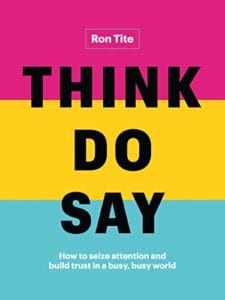
Think. Do. Say.: How to seize attention and build trust in a busy, busy world
There’s something personally I feel it’s not quite there yet. They came to a speech that I gave and they’re not all ten out of ten. This was a ten out of ten, it was brought and they started the conversation with, “We have some notes.” They said, “We don’t know what the foundation is. What is this about?” It’s a bunch of random stuff. You didn’t stand because you broke it down like a stand-up way and a bunch of it. We explored that, Think Do Say, and then I built the framework before I even thought of the book. Once I decided I want to do the book Think Do Say, for me it was the only title. It was not negotiable.
People don’t realize how important a headline is. In an email, what your subject line is, to get people even to want to open it, a book title to get people to be intrigued enough to pick it up or at least click to read what that means. I also have learned that there’s a craft of speaking and there’s a craft of telling jokes or figuring out what’s funny and that the order of things is critically important. For people to think maybe, “I should think about something and do something before I say something. I normally just say something.” Can you speak to that a little bit, the importance of the order?
It is hard why I was frustrated enough to write the book because you’ve got to be really frustrated to go, “I’m going to take a few months out of my life and sit down and write this.” I thought that far too many people, far too many thought leaders, far too many speakers, far too many businesses, marketing people. We’re all trying to game the system by jumping to the say and that we were getting in the zone where we’re looking at data and saying, “This is the headline that most people respond to and you’ve got to talk about yourself in this way.” We started cliparting communication and saying, “You’ve got to put this word here and that word there, you’ve got to start this way.” One, the creative person in me. My soul dies a little bit every time I heard that but also I was so frustrated to step back and go, “You can’t just say what you think everybody wants to hear without having the actions and behaviors that give you the permission to say it in the first place. You’re gaming the system, it’s a big crock of crap. It’s clickbait and I thought, “We’re losing this ability or this desire to play the long game.” If you were to zero-base at business like, “How do you build it or zero base a person, an entrepreneur and your business is the one person?” It’s the same thing.
The first thing you need to do is believe in something greater. There has to be something that you believe in that allows you or inspires you to do the things that you do. What is that foundation? What do you believe in? The second thing is you have something that you can seek actions and behaviors to tie back to and to reinforce because this was the other thing I saw. My friend Warren Tomlin says random acts of digital where they’re doing stuff and it’s not strategically tied to anything. You need a guide for your actions and behaviors and those are your beliefs. What do you believe? What do you do to reinforce that belief through your actions? If you believe in something greater and you behave in a way and empower your team to behave in a way that reinforces that point, that is worth talking about. If you’re going to talk about it then shouldn’t you talk about it in a really interesting and compelling way? Shouldn’t you use stories to tell what you believe in how you reinforce it to get as many people onside? If you do that and you talk about that stuff, enough of those people will convert to buying whatever it is you’re selling.
[bctt tweet=”It’s our imperfections that people buy because that’s what makes us human.” username=”John_Livesay”]
Let’s talk about how you bring this to life in your book because it’s like, “Let me digest this.” I have to figure out what I believe then I have to take actions based on that belief and not have it be some core belief that I have on a wall and never take actions on. How do consumers get involved with this? Most people are thinking to themselves, “I don’t even know how to connect beliefs to actions, let alone get my customers,” but you have a wonderful story in Think Do Say about how REI implemented this. Would you walk us through the implementation of that so that those steps come to life for people?
REI believed and this kicked off in 2015. The program still exists now and it’s growing. REI, for those readers who may not know, for international audiences, it’s an outdoor equipment retailer co-op. They sell tents and hiking boots and stuff like that. Most people, if they have that business, they would say, “What do we believe? We believe we should be the best outdoor retailer in the world.” That’s not a belief. The other people do that and other people have that aspiration and don’t make you that special. What they did is they believed in something more important. They believed and they state this, “We believe a life lived outside is a life well-lived.” They didn’t say we believe we should knock twenty points off hiking boots. They elevated it to something that people actually care about like, “I get this.” The second thing is they then took action. One of the first things they did was a very symbolic but important gesture, they close all their stores and stopped eCommerce payments and delivery on Black Friday, the busiest retail day of the year. Their line was, “We’d rather be in the mountains than in the aisles.”
Let’s talk about how great that is. It’s visual, it hits you in the gut, it’s so counterintuitive. Normal people who are worried about stock prices or even a privately-held company, worrying about profits because I know retail makes a majority of their money in the fourth quarter. That is what most people would say is an insane decision and it ties to the belief and has a surprising outcome. Continue with the story. I wanted to underline that as such a great concept if you’re going to take a bold step like that. Have an emotional look that is from the mountains instead of the aisles of a store. I’m in a story which is my whole thing, get people in your story.
They delivered this message so that was their do and then the say was that you want to say it in a way that is compelling and interesting for people so they pay attention. They come on your side so they chose a couple of things in these say. One, they didn’t talk about this being an anti-consumerism thing. They didn’t make it about social issues. They’re not anti-corporate. They don’t think the private sector is evil. They didn’t go down that road. They said, “We believe a life lived outside is a life well-lived. We’re going to close our stores on Black Friday and rather be in the mountains than the aisles.” Those are the first things I decide. The second thing was they decided to have this in a slightly whimsical launch spot. The CEO at the time is no longer CEO because the CEO was sitting at a desk out on the top of a mountain. These two hikers come up and go, “What are you doing here?” and he’s like, “Why? I work here.” It’s not knee-slapping funny but it gives a smile and is consistent with the brand. It is a very authentic piece of communication.

Building Trust: Don’t ask for the sale. Communicate your values so you’re connecting right away without your sales bias getting in the way.
This has grown and they’ve got more partners on. What I love and I think what is a point that gets missed in this story is that what are the adjoining pieces of this story? You can say, “They lived happily ever after.” There are some other stories here because by believing in something more important that goes beyond the product and then by saying, “How can we act in a way that reinforces that belief?” They had the one act of closing the stores but that’s not all they did. The actions they took to say, “If we really believed in, what can we do to support that belief that goes beyond the stuff we sell?” They created REI Adventures which is a touring company and they started to diversify their portfolio. They now start REI classes where they teach people how to kayak, canoe, rock climbing and things like that. Not only are they doing more to support their beliefs, they’re diversifying the revenue portfolio by doing it. It’s a great business story and the hook for all the doubters who are reading and going, “That’s easy to close your store on Black Friday.” Two things, one, as Nike said with the Colin Kaepernick ad, “If you believe in something, even if it means sacrificing everything,” but REI grew the business, they gained nine points year-over-year by closing business retail day of the year.
I also imagine that it creates brand ambassadors who say, “That’s what I believe in, more family time, less fanatic shopping to save some money where you’re pushing and shoving people.” This concept of if a brand decision and a marketing message can start attracting the kind of talent you want that’s not normally an advertising job. I would think that top talent would look at that decision and say, “That’s the culture I want to work in,” which is to me is another extension of that story.
You are banging on there, as a recruitment piece, it’s incredible, it’s amazing.
You have such great insight in Think Do Say about people don’t know how to trust people. People say that all the time, “How do I get someone to trust me right away whether I’m an ad or I’m pitching to get hired or pitching for anything to sell my product?” Speak to us about how Think Do Say can help us with our trust?
[bctt tweet=”It’s nice when we get to meet somebody face to face. It amplifies the connection more.” username=”John_Livesay”]
We have to look at why people don’t trust others and we have to acknowledge that. We have to acknowledge that there are macro cultural forces at play that have gone into that person’s day and over the past decade. We’ve seen Lance Armstrong lie to our faith. We saw Bill Cosby when going from America’s dad to America’s predator. We’ve seen Panama papers do nothing. We’ve seen CEO compensation go through the roof. We’ve seen Volkswagen with the emission scandals. A long list of all aspects of our lives and internally within organizations like, “Please.” Employees are like, “Great another reorg. I’m sure you have my best interests at heart.” We know that coming into it, people are already completely skeptical and then there are two points to the distrust, I think. If we look at Times Square as this metaphor, that up top you’ve got the big brands who can afford to do the promotion and they put it into glitzy ads with high prices, photography, perfect scripts and everything else. They get so big and they get so perfect that they lose all the semblance of personality. They can’t connect with the common person because they’re saying stuff to be really perfect and nobody is perfect.
We trust imperfection. Like in advertising, we used to fire the director of photography if there was a lens flare on the film and we consciously put them in because people see that as a slight imperfection and they trust it. I got these big brands who don’t want to be imperfect and so we don’t trust them because they’re too scripted. On the other hand, we have these people on the street who are nothing but imperfect and they got someone telling you the end of the world is coming and someone is selling a fake Gucci. They may be authentic and imperfect but we don’t trust them because they don’t have the credibility that the guys have at the top has. That’s why we’re stuck in this zone. That the big established players who have screwed us for years and we’ve got these startups. We’re not exactly sure whether they’re going to be around tomorrow and that’s this paralysis that is in the minds of the consumer.
To build that trust, if you start with a belief and you connect with people on beliefs and values. You’re not asking for the sale. You’re communicating your values and so you’re connecting right away without your sales bias getting in the way and people go like, “I trust this person. I like this person.” If they’re skeptical like, “They only said that they believe,” and then they fall and you deliver on what you told only you’re going to deliver on. Now, I can trust you and then if you talk in an authentic way. I’ll tell you this very quick story.
I was at a gig in Sarasota, Florida and I was talking with a chairman of a global software company that I can’t name. This person was from the Deep South and he was previously the CEO of that software company. He spent some time at a CPG and rose to the ranks of vice president. Once he hit vice president, they sent him on a leadership development course and he realized that the sole idea and purpose of the course was to get him to lose his Southern accent because they didn’t feel he would have credibility on the global stage sounding like a country boy. He looked to me and said, “I quit because I realized my voice is not a bug, it’s a feature.” It’s our imperfections that people buy because that’s what makes us human. If we hide those imperfections through incredibly polished photography, communications and incredibly scripted things that have no sense of personality, if we’re hiding who we really are, what else are we hiding?
I saw the value. It’s almost the concept where you see people spending so much time photoshopping a Facebook post so that there are no wrinkles and their teeth are extra white and all this stuff online. At what point do we not even let a casual photo go up to where we go, “That’s not perfect, I can’t show it.” “We trust imperfection.” I love that line and this concept you’ve given us, a step-by-step. It builds trust by letting people connect with our beliefs and values then deliver it. That builds trust through authentic vulnerable communication and connection. Ron, that is brilliant. I have never heard anybody put it so clearly, that’s why the book Think Do Say is so valuable and a must-read for everyone. How can people follow you if they want to engage you, to come and speak? What’s the best way to do that?
They can go to RonTite.com, ThinkDoSay.com, ChurchState.co or all the social channels, just add Ron Tite.
Any last thoughts or one quote you want to leave us with?
The one thought I would leave you with is I absolutely love our conversation and we’ve never met in person but we get to do so in Chicago. I think that as much as we can connect the people through digital means and it makes it nice when we get to meet somebody face-to-face. It takes those connections and amplifies them even more. I’m really looking forward to that.
Likewise, and remember that if you have a choice between texting somebody, talking to them, Zoom call or seeing them in person, always go for the in-person energy.
Important Links
- Think Do Say
- Ron Tite
- Church+State
- This is That: Travel Guide to Canada
- The Imaginary Girlfriend
- Better Selling Through Storytelling Method Online Course
Wanna Host Your Own Podcast?
Click here to see how my friends at Podetize can help
Purchase John’s new book
John Livesay, The Pitch Whisperer
Share The Show
Did you enjoy the show? I’d love it if you subscribed today and left us a 5-star review!
- Click this link
- Click on the ‘Subscribe’ button below the artwork
- Go to the ‘Ratings and Reviews’ section
- Click on ‘Write a Review’
Love the show? Subscribe, rate, review, and share!
Join The Successful Pitch community today:
- JohnLivesay.com
- John Livesay Facebook
- John Livesay Twitter
- John Livesay LinkedIn
- John Livesay YouTube
Body For Wife With James Fell
Posted by John Livesay in podcast | 0 comments
Losing weight is one of the most challenging part of many people’s lives these days. James Fell, a highly regarded science-based motivator for lasting life change, spills some details about his book, how to embrace change in life, and how he found purpose as a speaker. He takes us back to his own story and how he got the inspiration to write his books. As he shares the foundation of being fit, he also breaks down his fitness techniques into three simple stages – learn, prepare, and do – and the five stages on how to make behavior change.
—
Listen to the podcast here
Body For Wife With James Fell
My guest is James Fell who is an expert in transformation, not only of our bodies but our mind and our careers. His website is called Body for Wife because he wanted to get in shape before he got married. He’s taking those lessons he learned and he allows us to learn how to transform any area of our life. He says, “When you have a vision that pulls you towards the future, you don’t have to push yourself so hard.” He identifies the keystone habits that we need to start doing in order to change. He said even planning is a form of taking action.
James is a highly regarded science-based motivator for lasting life changes with millions of readers around the globe from his two books. He has the mission of helping people achieve sudden insight into what inspires them to live the life they know they’re meant to be living. He’s got two books, the first one was Lose It Right: A Brutally Honest 3-Stage Program to Help You Get Fit and Lose Weight Without Losing Your Mind. The other one is called The Holy Shi!t Moment: How Lasting Change Can Happen in an Instant. James, welcome.
Thanks so much for having me, John.
You are very transparent on your website, which is Body for Wife, as opposed to Body for Life, about your own journey. I would love to have you take us back to your own story of origin.
The whole Body For Wife thing traces back to being 25 years old and having realized that I let myself get in pretty terrible physical condition. I wanted to propose to my then-girlfriend and just as an impetus to change that, “I’ll get in shape before I propose.” Years later, the Body for Life program was popular and I had a bunch of friends that were on it and I made a joke one day that I was on the Body for Wife program and they all laughed. It became this in-joke between friends. What happened with my transformation to becoming a writer was that I was 40 years old and I’d been working in the business field for a dozen years in and doing quite well, but it wasn’t anything that I was super passionate about.
I was making money and supporting my family and I didn’t hate my job, but I certainly didn’t love it. One thing I did love was writing. Before my MBA, I did a Bachelor’s and a Master’s degree in History and writing was something that I used in my job all the time and something that I enjoyed. I thought, “I want to be a full-time writer.” Health and fitness were something that I knew a lot about. I found a position that allowed me to work twenty hours a week in an executive director role and then threw myself into this writing career. Within a year, despite being a Canadian living in Canada, I was a fitness columnist for the Los Angeles Times.
[bctt tweet=”Planning is a form of action.” username=”John_Livesay”]
From there, it snowballed and I evolved over time into less health and fitness and more in general motivation because I found that when it came to losing weight, there were many different ways to do it. There’s a line in the book that there are more ways to get in shape than there are beers in a Munich autumn. I thought, “I’m going to focus more on motivating people to find the way that works best for them.” Over time, that expanded out into this new book being a general science-based motivational book that allows them to do anything including changing their bodies, but also changing their careers or their relationships, going back to school, their mood state, anything that they would like to change.
Let’s start at the foundation of getting fit because how you do one thing is how you do everything. It seems to me that that’s a common theme. If you can figure out how to master your eating and your health, then you can apply those skills and mindset to your career. Would that be accurate?
It absolutely is. It was talked about in Charles Duhigg’s book, The Power of Habit. It’s called a keystone habit and I was talking about this before Duhigg’s book came out that people who lose weight and keep it off, who transform their lifestyle habits in terms of eating and exercise, they develop a very powerful skillset. Because losing weight is one of the hardest things people will ever do, which explains why the failure rate is so high. When you train yourself to exercise on a regular basis and train yourself to eat better in an environment that wants you to be fat, you’re constantly bombarded with messages and the ease of ordering tasty treats. To be able to build that discipline and that routine that allows you to counter those environmental pressures, then those are transferable skillsets that you can then apply to other aspects of your life that can be very rewarding in your career. I witnessed this again and again. I witnessed over and over that people that transformed their bodies didn’t stop there. They moved on to change their careers, their relationships and their entire lives.
In this book about not losing your mind because people can get so frustrated and overwhelmed, you broke it down into three stages: learn, prepare and do. Let’s talk about how we can come up with a keystone habit using those three stages. What would you suggest?
I would say a great place for anyone to start is to start walking. There are a number of reasons for that. There was a piece that I wrote called, “Are you a temporarily embarrassed fitness model?” It’s a play about Temporarily Embarrassed Millionaires. The point is that many people are sold on this idea via magazines in the weight loss industry that they’re temporarily embarrassed fitness models. If they do this one weird trick or whatever it is, they’re going to have rippling abs, bulging biceps, massive packs and all that stuff. The reality is that only a very small portion of the population has the genetics, the time and the will to create a physique that looks like that. Instead, we should focus on what is achievable in the early stages and go from there and see where it takes us.
The thing about walking is the benefits to it are tremendous. It is the number one form of exercise in the world and it is very easy. It doesn’t require a gym membership. You just put on your shoes and you go out your door. It can give you time to think or listen to a podcast or take your phone with you. It’s like, “I need to call my mom because I haven’t talked to her for a while.” I will often put my headphones in and call my mom and go for a walk. The thing is starting that habit gets you in the mindset of, “I exercise now. This is a part of who I am. I am a person who is regularly, physically active.” From there that can get you thinking about, “Since I’m physically active, maybe I should start considering what I put in my mouth.”

Losing Weight: People that are fairly entrepreneurially minded are in a position to have a transformational role.
It can create baby-step changes there. If you get to the point where you’re going further and further in your walks, you’re finding that you’re enjoying it and you’re getting more energy, you may decide that you want to try something more ambitious. Maybe you want to run, maybe you want to start getting a personal trainer to come over and teach you how to do some things at home. Maybe you want to join a gym, maybe you want to qualify for the Boston Marathon. Who knows? You never know where that’s going to take you.
Let me go to the new book, The Holy Sh!t Moment. What motivated you to write this? I’m interested to know. We can’t transform our bodies overnight but you say lasting change can happen in an instant.
We can’t transform our bodies overnight, but we can change our minds very quickly. That was something that I had witnessed in my years of writing about health and fitness. A lot of people went through this dramatic change of thought where they knew that this time, it was going to work. The idea for the book came to me on a bike ride. I’m one of those guys that I do a lot of my best thinking when I’m either riding my bike or out for a run. How it popped into my head was that I was riding my bike and listening to some music and having a great day. I was thinking about what my next book was going to be about. I hadn’t come up with a great unique story idea yet.
I saw this guy running toward me and he was wearing a Boston Marathon shirt. It popped into my head like, “I did that. I qualified for and ran the Boston Marathon.” That started a bit of a cascade of remembrance because it got me thinking about how things really changed because when I was younger I was the guy in the back of the pack in gym class when we had run. I was the guy that got picked last when they were selecting sports teams. There I was, I did something. I didn’t just start running marathons. I qualified for Boston, which I don’t know if you know anything about it, but it’s hard. It made me think about all of this transformation that I’d gone through from who I used to be and who I became.
I went from being a terrible student to being a good student and lots of other different things that changed. It made me remember that there was a transformative experience I had where I went from flunking out of university to acing my courses. It was a single life-defining moment that I had. I fondly remember that experience where my life changed in just the space of a few seconds. I could have just left it right there, but then it started to continue to turn over in my head. This idea popped in saying, “I wonder what the science is behind that.” The whole life-changing epiphany, what do we know about what’s happening in a person’s brain? All of a sudden, I screeched to a halt on my bike and almost fell over because I forgot to unlock my feet from the pedals.
Let’s talk about that because one of the things that we know scientifically is exercise can be an antidote to despair, but what other things can people do? You are a speaker to sales organizations like I am. Salespeople have to deal with a lot of rejection. What tips do you have for your audiences on how to deal with rejection and getting despair feelings?
[bctt tweet=”What is your keystone habit?” username=”John_Livesay”]
That traces back to that life-changing moment that I had when I read a quote that says, “Action is the antidote to despair.” If a person is on a mission, the life-changing moment is about being delivered a powerful vision about something you feel that you must fulfill. You’re on a mission and it’s going to happen no matter what. You are endlessly energized to make it happen. I experienced that with my writing career where there was a lot of rejection. It was one of those things where you knew that there were going to be failures, but you were going to stay the course. You are going to be adaptable. You are going to figure out what didn’t work and then try something different. You’re endlessly motivated because there are still these little bits of progress.
This is one of the things in the book. The neuroscience behind the life-changing moment is the role of dopamine. Dopamine is called the neuromodulator of exploration. When we have a transformative experience like this, there’s a big rush of dopamine that says, “This is exciting, this is powerful and this is potentially very valuable, so you should chase after it.” It pushes you along this path. It’s the ongoing reward of dopamine that is absolutely critical because dopamine recognizes progress. If you do something that even is a little bit helpful in helping move you toward that reward, dopamine gives you a little positive boost that says, “You’re doing it. You’re making progress. Keep going.” That is something that can drive you forward for years. As long as you’re making little bits of progress, those failures, that rejection doesn’t matter.
I’ve heard it said that our brains crave progress. You’ve just explained the science behind why that’s true.
That’s what it’s about. There’s an example in the book of a woman. She worked in a call center for a health insurance company. She was very helpful to a caller one day when she went way above and beyond the call of duty from what her job described. After her shift, she realized that she was meant to do much more with her life than just work in a call center. She ended up going back to university and eventually getting her PhD in Pharmacology and now works in health policy in DC. She’s been immensely successful in speaking at illustrious universities and getting published in prestigious journals. It was years and years of toil and effort that it was that constant role of dopamine that pushed her through semester after semester and doing her research. In my writing career, it was getting published in that small magazine for the first time and then getting published in the LA Times and then having my Chicago Tribune articles being published in dozens of papers around the world and having viral blog posts. Each little thing, each little time, even though there was also a lot of rejection and a lot of criticism, there were still those successful milestones that kept pushing me and continue to push me to this day.
James, what you said there is so valuable for everyone reading because if I look at you from the outside looking in, I’m like, “He’s got it all. He’s handsome, fit and he has a beautiful wife. He’s published everywhere. He’s never had a bad day in his life. He doesn’t understand my struggles. He never eats anything bad. He’s never tempted to eat anything bad. Anything he writes turns the turns to gold. He never gets rejected.” It’s great that you share that even while there’s some progress, there’s going to be some rejection and struggle. People can say, “It’s not all or nothing.” I want to talk about these five stages that you have in your book on how we make a behavior change. It’s so well done from a standpoint of exercise, but we can transfer that to let’s say a group of salespeople who have to try and do something new like storytelling in their sales or make cold calls that they don’t want to do.
A lot of it is the same resistance that might go into exercising. The stages you talk about are pre-contemplating something. You’re not even aware of what you’re not aware of. You’re talking about the couch is comfy and you can’t even imagine everyone would believe it. You contemplate, “Maybe I should go outside.” You prepare and you talk about, “I like this a little bit. I’m outside.” You take action where habits are starting to form. Finally, there’s the maintenance. One of the biggest challenges in any weight loss is getting that habit to stick. There’s a critical moment you talk about in your book that divides us from a before and after place and you say it happens in this gap between thinking and doing. Can you bring that to life for us?

Losing Weight: We can’t transform our bodies overnight, but we can change our minds very quickly.
What you just described is called the transtheoretical model of behavior change that was developed by James Prochaska in the 1970s. I interviewed him and talked to him about that. The book is about that life-changing epiphany. It happens between contemplating and planning because planning is still a form of action. You’re still doing something.
That’s a great quote for the tweet. “Planning is still a form of action,” because it gets us out of the all-or-nothing thing.
The actual boots-on-the-ground action is imminent and you’re just getting ready to make sure that those steps that you take are the right ones. The big boost happens between where you’re thinking about it but you’ve not made a decision to do anything yet. When you’re in the planning stage, you are doing it. There’s this critical moment between the two where you make that leap between thinking about it and doing it. It can involve a snap decision, a transformative experience. The interesting thing about this is the weighing of pros and cons. What happens is it’s not that the cons of change go away, they just become unimportant. The reason why they become unimportant is that you feel a sudden massive boost in the pros of changing. Where suddenly, “I don’t care what the cost is. I don’t care what it takes to do this. The mission has become so vitally important that I’ve got to do it.” It creates a massive boost in energy. There’s a great quote from Steve Jobs that goes, “You don’t have to be pushed. The vision pulls you.” Those few words, “The vision pulls you,” is what it’s all about. You’ve suddenly received this powerful vision of something that you’ve got to do and you’re going to find a way to make it happen.
I love that because I always talk about the old way of selling is to push your message, information. When you become a storyteller, you become magnetic because you pull people in with a good story. Whether it’s a vision or a story that makes people pulled into your world, it keeps the energy going, otherwise you burn out. Almost everyone in every industry that you’re speaking to these days has to embrace chaos, whether it’s the entertainment industry or with Netflix disrupting the basic stations. Netflix gets disrupted by Disney getting into their business of streaming or Hulu. Nothing is staying the same. You have a concept about how to embrace change. Can you talk about that?
When it comes to people wanting to change something about their lives, they have a tendency to stay on the same track and expect things to just change without ever experimenting with different types of things that they could possibly be doing. The whole concept of embracing chaos is about the whole chaos theory where there’s a micro change in the environment that has a ripple effect down the road where you end up with a vastly different outcome. If you do something a little bit different, you never know what the vastly different has could be. We have a tendency to do things the same way over and over again. If you start experimenting with doing different things, maybe nothing is going to result, but maybe something will. You want to try different approaches in your job, different approaches to storytelling and see what results.
In the book, this relates to the life-changing epiphany, the transformative experience. We talked about getting people to go out for a walk. That can start to trigger different types of things where they may become very passionate about cooking so that they end up eating better. They may start getting great idea generation for their careers. They may decide that they love being outside and start hiking or taking up cross country skiing or who knows what. It’s all about not doing the same thing over and over again because when you open yourself to new experiences, you open yourself to new ways of thinking.
[bctt tweet=”Learn, prepare, and do.” username=”John_Livesay”]
I talk about getting out of our comfort zone and getting into the learning zone. As you’ve mentioned, learning how to cook maybe or something different. One of the quotes you have in your book that I love is, “A ship in harbor is safe, but that’s not what ships are built for.” We have to figure out, “Is my purpose to get in a comfort zone and stay there or am I built for something else?” How did you find your purpose?
There have been a few different times that that’s happened.
How did you find your purpose to be a speaker? Let’s talk about that.
I haven’t thought too much about that one. That was a bit more of a natural outgrowth of the writing. That’s not a good example for me. The speaking one was something that just evolved over time.
Let’s play with this a little bit because this is what I do. I pull people’s pitches out so that I can help them explain why somebody would want to hire you as a speaker.
I can speak to that a bit because I’ve been doing this writing thing for a long time and now I’ve got this book that I think is very applicable for a speaking career. There’s good money to be made in speaking. I’m financially motivated that way. I’m going to start working on this keynote speech. I remember giving the first keynote that I was quite nervous about with this new material. It was a good crowd of about 150 people and I practiced a lot. I got up there and I remember there was a couple of things that resonated. One was that they laughed at my jokes. They were a very raucous crowd where my jokes seemed to land.

Losing Weight: The big boost happens between where you are thinking about it but have not made a decision to do anything yet.
Afterward, there were a bunch of people that came up and wanted to talk to me and told me how much they enjoyed it. At that moment I realized, “Money may be great, but I loved giving this presentation. That was a lot of fun. I want to do that again. I wanted those laughs. I want to please the crowd and have them be enjoying what it is that I have to say.” That was a pretty transformative experience where I said, “My attitude toward my speaking career changed this night because it’s no longer just about money. It’s about getting out there and helping to change lives and being an entertaining person that gets a lot of laughs.”
You were connecting with people. I would say that’s your number one purpose. You’re inspiring them to figure out what’s the one thing they can do to transform their lives so that they don’t stay stuck like a ship that’s built for more. That’s how I would summarize your purpose.
There’s another line in the book that’s related to that. Earl Nightingale said, “Most people tip toe their way through life hoping to make it safely to death.” It’s negative in its messaging but it got me thinking about it and saying, “That’s true.” A lot of people are so careful in the way that they approach living. I’m thinking, “I don’t want to make it safely to death. I want to make it unsafely to death.” Life is more of a thrill ride and adventure. I want to say that I took risks and I had fun. It doesn’t mean I want to die young.
You’re not living it from a place of fear. You’re living from a place of embracing new challenges. That’s how I would sum that up.
Also, with exploring. I want my body to be a worn-out husk when it finally gives it up.
It’s been interesting and inspiring to hear you talk about your own journey, from getting in shape for your marriage to writing this book about how we can learn to override our need to urge to stay comfortable and the steps to do that. Is there any last thought you want to leave us with?
[bctt tweet=”When you have a vision that pulls you towards the future, you don’t have to push yourself so hard.” username=”John_Livesay”]
A lot of it has to do with changing the way that we think about things. The mind is a very powerful thing where it can suddenly imbue you with an overwhelming sense of drive. We may not be able to change our careers, our bodies or our finances in a moment. Those are things that take hours, months or years of work. What can change in a moment is your attitude toward it. Where the work that it takes suddenly changes from feeling drudgery into feeling it’s your destiny that you must fulfill. The way that we unlock that boundless motivational power is by thinking about it and then not thinking about it. You do a lot of analytical aspects of, “What could be my powerful vision? What is it that’s important to me that I would like to fulfill? What would that look like?” It’s doing some research, doing some homework and then doing the exact opposite where you don’t think about it because the answers to these types of problems come when you’re not actively trying to solve the problem.
That’s why sometimes we get great ideas in the shower.
Shower thoughts are immensely powerful because you’ve got that white noise effect where the world gets shut off. You’re not looking at your phone. The warm water is comforting. Some of the greatest ideas come in the shower. Another one is going for a walk. I talked about listening to a podcast on a walk, but the best ideas are going to come when you’re not doing something like listening to a podcast or an audiobook. Music is okay, but going for a walk, going for a run, going for a bike ride, being out in nature is one of those things that philosophers over the ages have extolled the virtues of the creative insights to be gained while on a walk. This is about enhancing your creativity because these great ideas that instilled so much motivational power in you have you being creative in your thinking. It’s something that suddenly occurs to you as this such a wonderful idea that you feel you’ve got to do it.
The momentum will keep you going, as you said, the dopamine and our ability to stay focused on our progress. Thanks again, James, for sharing your wisdom and your insights.
Thanks, John. I appreciate you having me on.
If people want to follow you, they can go to your website, which is BodyForWife.com.
Losing Weight: The mind is a very powerful thing where it can suddenly imbue you with an overwhelming sense of drive.
That’s correct. I’m very active on my Facebook page, which is BodyForWife and a little less active on Twitter, which is also @BodyForWife.
We’ll be sure to follow you there. Thanks again.
Thank you.
Important Links
- Body for Wife
- Lose It Right: A Brutally Honest 3-Stage Program to Help You Get Fit and Lose Weight Without Losing Your Mind
- The Holy Shi!t Moment: How Lasting Change Can Happen in an Instant
- The Power of Habit
- BodyForWife – Facebook
- @BodyForWife – Twitter
- Better Selling Through Storytelling Method Online Course
Wanna Host Your Own Podcast?
Click here to see how my friends at Podetize can help
Purchase John’s new book
John Livesay, The Pitch Whisperer
Share The Show
Did you enjoy the show? I’d love it if you subscribed today and left us a 5-star review!
- Click this link
- Click on the ‘Subscribe’ button below the artwork
- Go to the ‘Ratings and Reviews’ section
- Click on ‘Write a Review’
Love the show? Subscribe, rate, review, and share!
Join The Successful Pitch community today:
- JohnLivesay.com
- John Livesay Facebook
- John Livesay Twitter
- John Livesay LinkedIn
- John Livesay YouTube