
How To Speak Like A Leader With John Bates
Posted by John Livesay in podcast | 0 comments

Do you want to speak like a leader? There are two key things you need to remember. One, make sure you’re giving some context as to where you’re coming from. Two, be aware of the tone of your voice. John Livesay’s guest today is John Bates, the CEO and Founder of Executive Speaking Success. John is an in-demand executive coach and is one of the most prolific TED-format coaches in the world. And he’s here to help you out so you can communicate with confidence and credibility. So tune in to discover the science behind communication and how to use it to enhance your leadership skills. You wouldn’t want to miss this episode!
—
Listen to the podcast here
How To Speak Like A Leader With John Bates
Our guest in the show is John Bates, who’s an expert at communication and works with leaders at companies like NASA. Find out what the final criteria are on whether you can become an astronaut or not. Enjoy the episode.
—
Our guest is John Bates, whose mission is to bring out what is awesome inside people so that they can have the impact they want in the world. He’s an in-demand Executive Coach. He is also one of the most prolific TED-format coaches in the world. Executives from organizations like Johnson & Johnson’s, JLABS, NASA, including the astronauts, US Navy Special Ops, and Boston Scientific and more recommend him to their colleagues as the best leadership communication coach working. He knows the power creating a TED-like Talk can bring to anyone in business and life. John, welcome to the show.
[bctt tweet=”There is scientific proof that you get what you put out. People always mirror you. ” username=”John_Livesay”]
Thank you, John. It’s great to be here with you.
You and I have been personal friends for quite a while, and I’ve always admired your energy, passion, and your incredible ability to get people energized and discover their story to make it TED-worthy. Take us back to your own story of origin, if you will. You can go back to childhood or how did you know that this was something you wanted to make your career?
The short answer is I failed at everything else but that turned out to be a big benefit in the long run. I was always the guy, maybe a little bit like you who had the soft skills. I always worked with a lot of people who had the hard skills because I was always an early-stage employee or a Founder or Cofounder at companies that were in the internet space.
Starting in 1994, I was working with a lot of people who had hard skills. I would always end up being the Chief evangelist for my companies. I raised several hundred million dollars in Silicon Valley and beyond with my teams, and I still felt I was less valuable than the people who had the hard skills. I go around trying to prove I was valuable.
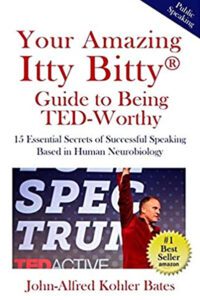
Your Amazing Itty Bitty Guide to Being TED-Worthy: 15 Essential Secrets of Successful Speaking Based in Human Neurobiology
They called what I did fluffy, even though I brought in hundreds of millions with my team. I had a chip on my shoulder and I was frustrated about it. I was going around trying to prove I was valuable. I didn’t think I was. I then went to the TED Conference for the first time in 2009. I saw person after a person gives the most amazing talks I’d ever seen in my life.
To my credit, I remember thinking, “I’ve been a public speaker my whole life but I’ve never done that. That was something else.” I came home and I got involved in the TED and TEDx community and at one of the first-ever TEDx events, which were in Santa Monica. That was TEDx Santa Monica was one of the first TED events but not the first. We had this guy who had all the hard skills. He had the most exciting topic and he was the one I was looking forward to.
When he got up on stage and started to speak, everybody in the room checked out because he was so nervous and awkward, we all thought we were going to throw up. It was unpleasant. I remember thinking how sad that was. I was incredibly sad because I’d seen that so much, often with many other people that I’d worked with.
Somebody who’s smart, has education and so much to offer but can’t quite communicate it. The evil part of me kicked in and I was sitting there going, “Laughing quietly to myself, of course. Hard skills guys blowing it. Calls what I do fluffy.” As I was doing that, my buddy walked over, Michael Weiss and he said, “We got to do something to help people like this.”
I remember it was like the V8 commercial. I could have had a V8. I swear the heaven’s pardon, the angel sang and it hit me like a ton of bricks that if I got over my freaking self, I could totally make a difference for that guy. I went home that night and started working on what I now get to deliver to all those places that I pinched myself when you read in my bio.
What I did differently because of that moment, is I realized if I wanted to talk to that guy and people like that, I would need to base everything I did in human evolutionary biology and human neurophysiology so I could show people, not what works but also why it works based in science. That’s where that all came from was doing public speaking for a long time. Having this epiphany at TED, and then having that moment when I was like, “Let’s look at the science of why this works.” I’m such a soft skills guy. It took me years to realize why this always works and it does always work because it’s based on science and that’s why we like science.
Gravity is gravity. It treats everybody the same. You’ve written a book about this called Your Amazing Itty Bitty Guide to Being TED-Worthy, and there are some secrets in here, as you said, based on human neurobiology. We all know what Biology is from being in school but what’s neurobiology?
Neurobiology is the specific subset of biology that’s like our brains, nerves, how our brain works and how it’s all structured up there, particularly in the brain but we have mirror neurons throughout our bodies. All kinds of things that it’s related to that cognition, mental behavior and how our nerves work.
For those who aren’t sure what mirror neurons are, it’s when you watch a scary movie and everybody in the theater jumps at the same time. We’re in the story. That’s what you want to do when you’re speaking. You want to mirror them. You want them to mirror you and go on the journey with you. You don’t have time to go into all these wonderful secrets. Do you have a favorite one or one that you see people need badly, so they don’t make a certain mistake from your book?
Maybe we could jump into the one you mentioned and we can unpack it a little more. Mirror neurons are neurons and all this neurobiology stuff. There’s always new cutting-edge work that points in different directions. The fundamental workable takeaway doesn’t change whatever the physiology exactly is, and the calcium pathway or whatever pathway. That’s not so important to me.
On some level or another, we have mirror neurons in our bodies. Mirror neurons helped us feel and experience what we see other people going through. If you watch me and I was doing a cooking show and I was chopping up big purple carrots off, and I cut my finger, everybody would jump because they would feel that because we’re human beings and we have mirror neurons.
[bctt tweet=”Being likable is a criterion to being an astronaut at NASA. ” username=”John_Livesay”]
I tell people that this is scientific proof for the fact that you get what you put out. The thing most people don’t think about nearly enough is that they are always mirroring you. When you walk in the door and you’re happy, everybody feels happy. When you walk in the door and you’re sad, everybody, “What’s wrong?” We do that with each other.
I always remind people to think about that person who’s grumpy. The person doesn’t say it out loud, and that person walks in and everybody gets grumpy. They grump around for a while and everybody acts grumpy and then they leave, and the minute they’re gone, we’re all fine again but everywhere they go, they think everyone’s grumpy.
It’s that Charlie Brown character where he’s always walking under a cloud of dirt.
That’s the grumpy person, and they think everybody’s grumpy but it’s not true. Everybody’s grumpy when they’re around because they’re grumpy.
This also applies not to speaking, whether you want to give a TED Talk or not, but also to leadership, because that saying, “One bad apple, causes everything to spoil.” You work with leaders, some of these big companies we talked about earlier. How do you help them get rid of that person whose energy is bringing down the whole group?
That can be dicey depending on where you are and all the things like that but the first thing that I would say with a person like that is if I were working with a leader who had someone like that on the team. First of all, don’t even hire that person. The final test to become an astronaut they told me is, “Are you likable?”
I didn’t know that. We’re going to be stuck in that little container with you.
Apparently, they didn’t necessarily check for that in the earlier days, and it led to some problems. Now the final test for a long time has been, you come up, you sit with the astronauts, you talk with them and when you leave, they all talk about, not only did they like you personally but do they think you are likable? You can pass that entire binder full of tests, and if you don’t pass that, are you a likable test, that final test to become an astronaut, people don’t become an astronaut. That is great for any entrepreneur and any leader. If it works for NASA and the astronauts, why wouldn’t it work for you?
We talk about this in terms of fitting into someone’s culture. Where you’re being interviewed or you’re interviewing people. I wanted to have these people over to my house for dinner, go for a drink or whatever it was. Our mutual friend, Tim Sanders wrote a book on this very topic, The Likeability Factor. There are tons of research on doctors spending more time with patients that they like and all of that stuff.
If someone has a little bit of self-awareness and they are very left-brain, hard skills person and they go, “I would like to be more likable or I would like to not be so negative but my mind is wired to point out all the potential problems all the time.” Is there anything someone can do to not completely alter their personality but move up a little bit on the dial where people would like to hang out with them a little more?
You said one of the keys, which is a little bit of self-awareness. If someone’s got some self-awareness and they want to move up that likeability ladder, which is a very good thing both for their own experience of life and for their career, know thyself. One of the things people can do after they know themselves is to put thyself on the loudspeaker a little bit.
Instead of being all covert about it and not saying it, you can own it. You can say, “I’ve been thinking about it and I was thinking about myself and how I am. I realized that maybe I might seem more negative than other people on this team. What I really think is that it’s my commitment to asking all the hard questions and I’m hoping that brings something. If it’s okay with all of you, I’m going to ask some hard questions.”

Speak Like A Leader: One of the keys to move up the likeability ladder is self-awareness.
Rhyming in that the intent, when you describe the intent of why you’re doing something. Does that completely change the framing of it? We also know how important tone of voice is and you’re an expert on this when someone’s presenting, whether on a TED stage or as a leader. Can you speak a little bit about how important the tone of voice is?
There are studies that show that 60% of all your communication is non-verbal and that includes tone of voice, even though that’s technically verbal. It’s not your message. It’s not what you’re saying. I don’t know 75% of your messages, John. It’s silly to argue about what the percentage is because here’s what I’ve decided.
Your non-verbal, your tone of voice, your facial micro-expressions, your body language, and all that stuff, let’s not think of that as a percentage of your communication. It’s much more powerful to say that is 100% of the context within which your communication gets heard. If I’m looking at you and I say, “John, I care about you. I’d like to make a difference for you,” and I’m sketchy, looking away from you and I can’t make eye contact.
“Give me your wallet because I care about you and I want to make a difference for you.” You’re not going to trust me and that’s going to land one way. If I look you in the eye and I say, “John, I care about you. I want to make a difference. Can you give me your wallet for a moment and watch what I do?” You’re going to be much more likely to hand me your wallet and see what I’m going to do because I looked you in the eye. I came across this trust. Where all that non-verbal stuff was aligned with my message, and if your non-verbal is not aligned with your message, does that damage your message.
That tone of voice and being clear, a big thing is being clear where you’re coming from. For that person who maybe has negative stuff to say at the meeting about every idea. If they come at it like, “Everybody in this room is such an idiot. Here, I have to tell you again like this is so dumb.” That’s one place to come from.
You say all the things that are wrong with the plan but if you’re coming from the point of view of, “Everybody in this room is committed to success. We’ve got a lot of great brainstormers and we’ve got a lot of people with great ideas. Let me be the person to bring the pressure and reality test to this. Here’s what I have to say about it.” You could potentially say the exact same thing but coming from those two different places, it will land 180 degrees different.
The takeaways for all the readers are two things. One, make sure you’re giving some context as to where you’re coming from and then be aware of the tone of voice. Are you coming from a scolding parent? I remember years ago, hearing that people either communicate to you as a parent, an adult or a child and that all very much tone of voice usually.
[bctt tweet=”Bring vulnerability to your talk. ” username=”John_Livesay”]
Being aware that nobody wants to be reprimanded, scolded and nobody wants to be treated like a child. You run a bootcamp for leaders on the necessity to speak like one. Just because you’ve been given the corner office, the title and all the perks that go with it, doesn’t mean people will follow you. I love that definition of a leader that people want to follow them. Can you give us a little behind curtains look at? What do you do in this boot camp that you run for these leaders and what kind of leaders are they?
I’m working with leaders that they’re running big pieces of big companies. What I notice is that the best of them is always looking for the next level of great communication and leadership. The ones who have the trouble or the ones who think they’re already good and don’t need to put the time in on it. In this course, I call it the Speak Like a Leader Bootcamp. Even if you are a leader, there’s always a new level of speaking and communicating like a leader.
What we do in that course and it’s very purposeful for leaders. We go through the experience of creating a TED-like Talk and over the decade of doing that with so many different people from so many different walks of life for TEDx events, for the corporate world and everything. I’ve come to believe that is one of the absolute best leadership exercises anyone could ever go through, whether they’re going to give a TED Talk on a stage or never going to do that. All the things that we go through in that course have leaders step into themselves in a whole new way. You got to be clear with yourself because you can’t be clear with anybody else if you’re not clear with yourself and get inspired by yourself.
If you aren’t inspired by yourself, it’s a lot harder to be inspiring and inspire people. We go through all these steps that I’ve distilled over the years, working with these people on these talks, and it ends up being a great leadership exercise. People come out the other side with whole new levels of courage, confidence, leadership presence, being inspired by themselves and by the people around them. Reinspired is a really fabulous experience.
I know for myself that when I get hired to speak in front of a sales organization, that particular talk has a lot of metrics. Are they learning new skills that are going to help them close more sales? When you give a TEDx Talk, it’s a very different mindset and framework.
Absolutely different animal. People get messed up by that a lot. They walk out on stage, having worked so hard on their eighteen-minute TED Talk but they didn’t get the difference in format, and they walk off stage disappointed. It’s not pleasant.
Some of the stories that you might create for a TED Talk would make your existing business conversations so much more compelling, and part of it is going back to the mirror neurons. If you’re opening up and being a little vulnerable or telling a personal story of when you weren’t always perfect, and things weren’t always easy, people can relate to you in another way that allows others to see the cracks sometimes.
I couldn’t say it better. I might add a little bit but that work that people do in a TED-like Talk is one of the things about TED-like Talk is they’ve got to be vulnerable. It’s one of the TED commandments. When people bring their personal self to this talk and they bring some vulnerability and some insight that they got out of the failure they had, and tell us about the hard times that before the good times, people walk away in love with them. Why wouldn’t you bring that to your sales talk? Why wouldn’t you bring that to your all-hands meeting? What we see modeled in the corporate world in terms of communication, connection, how people speak and everything, I’d say 90% of that is not only not what works best.
I’d say about 80% to 90% of that is the opposite of what works best. People get up in a business talk or a first sales meeting, and they think they need to establish their credibility. You don’t need to establish your credibility. They want to let you in the door if you don’t have credibility. Your credibility is already established. What you need to establish, and this is going to be the title of my next book. I’m coining it.
Instead of establishing your credibility in that first conversation, you need to establish your emotional credibility. Why can they trust you? Why can they believe in you? How can they connect to you? Fundamentally, this is another huge piece of neurobiology and I’ll bullet point it, if you’ve ever had this experience, when you go in and you’d get yes, yes, yes, no. “Yes. We like to borrow that guest. It’s first try. Yes. We think it would make a difference. No. We’re not ready. We want to think about it.” That’s never happened.
What that is, is yes, yes, yes, no. That means no. That means you didn’t get the sale but what’s happening there, people say, “Were they lying to me? What were the three yeses and then a no?” Here’s what happened. Yes, yes, yes, no. That’s logic, logic, logic, emotion. We did not make the emotional. Yes, they want it, of course, it’s a great product. You wouldn’t be selling it if it wasn’t a great product. Logically it’s all there but what we didn’t do is make that emotional connection. Give them a way to connect with us, be in the same tribe with us and all that. That’s what gets what I call the fourth and most important yes.

Speak Like A Leader: Be aware of the tone of your voice.
Partly aware that people buy emotionally, and then back it up with logic instead of pushing out all the facts and figures. I remember working for a publisher who had come from another situation that was very complex. I was asking her about it, and she said, “Yes, there were a lot of moving pieces.” I thought, “What a wonderful framework she has as a leader to not get overwhelmed.” I thought, “Certainly if you’re at NASA, that’s a lot of moving pieces.”
That mindset of what you see working at NASA and how that can be applied to the business world, I thought you might have some insights into some of the skills in addition to the likeability being so key that, talk about staying calm under pressure. Many movies are made about this but when you’re working with those leaders, do you think they have had training in this or is it a personality trait that they screened for?
The first thing that comes to mind is, you got great people working at NASA and there are two big things that come to mind for me around that. One is your most important job as a leader. It is to always be creating, speaking, and reminding people of the empowering context for what you’re up to. We’re not here shoving widgets around. We’re not here moving pieces of metal and machining parts. We’re sending people to the moon.
We’re exploring the frontiers of what’s even possible in reality. NASA has a pretty natural building good empowering context. One of the things about many of the leaders that I’ve talked with there is you’re not going to go to NASA, get the job and work that hard if you’re not inspired by it. They’re inspired by the context of what everyone there is doing. One of the key things NASA gets maybe more than most organizations is, how absolutely impossible anything any of them are doing without everybody else.
They’re talking about admissions. They have the missions that they do, and then we have corporate missions. They are a great example, and you’ve certainly had a front-row seat to it, of implementing that mission and the need to collaborate. John, if people want to reach out to you to learn how to be a better speaker or maybe do a TED Talk or hear more about your Speak Like a Leader Bootcamp, where should they go?
There are two places in there, pretty similar. One is ExecutiveSpeakingSuccess.com. I do one-on-one executive coaching. I do large and small group training, virtually, in-person and all that stuff that you could expect from someone like me. You can find out more about it there. If the idea of creating a TED-like Talk as a leadership exercise sounds, maybe it sounds like something that you would, “That sounds terrifying,” you should go check out Ed, which is for education Ed.ExecutiveSpeakingSuccess.com. We run that course about four times a year. It’s an eight-person cohort. It’s a ten-week class. It’s pretty intense and it is absolutely inspiring, beautiful, fun and amazing. It makes an enormous difference. Not if you want to give a TED-like Talk somewhere or speak on a TEDx stage or something but also if you’re selling.
[bctt tweet=”Stories are like songs. People don’t mind hearing them more than once.” username=”John_Livesay”]
What you teach people about so much, John. You can bring that emotional connection of a TED Talk to anything and why wouldn’t you? Why wouldn’t you bring that to your leadership, your sales, your all-hands meeting and to the board meeting? The things that people create in that course stay with them for a lifetime.
It’s a ten-week investment that will pay back over an entire lifetime. The stories that you choose, craft, and tell in that course will become some of your greatest hits. Stories are like songs. People don’t mind hearing them more than once, and when you get a good story and you can tell it well, keep using that thing. If it’s a new audience, don’t tell a new story, tell that story that you’ve been perfecting and that just you know exactly how it lands and keeps making it better.
I love that quote, “Stories are like songs.” We’ll make that one of our tweets as well. John, thanks for sharing your passion, your insights, your great stories about how NASA decides, whether you get to be an astronaut or not. I love that. I’m looking forward to hearing how many people take you up on your offer to get your book, Your Amazing Itty Bitty Guide to Being TED-Worthy or make the jump and are smart enough to get into your Speak Like a Leader Bootcamp. Thanks again.
Thank you, John.
Important Links
- John Bates
- Your Amazing Itty Bitty Guide to Being TED-Worthy
- Speak Like a Leader Bootcamp
- Ed.ExecutiveSpeakingSuccess.com
- Better Selling Through Storytelling Method Online Course
Wanna Host Your Own Podcast?
Click here to see how my friends at Podetize can help
Purchase John’s new book
John Livesay, The Pitch Whisperer
Share The Show
Did you enjoy the show? I’d love it if you subscribed today and left us a 5-star review!
- Click this link
- Click on the ‘Subscribe’ button below the artwork
- Go to the ‘Ratings and Reviews’ section
- Click on ‘Write a Review’
Love the show? Subscribe, rate, review, and share!
Join The Successful Pitch community today:
- JohnLivesay.com
- John Livesay Facebook
- John Livesay Twitter
- John Livesay LinkedIn
- John Livesay YouTube
How Business Can Build Resilience And Thrive In The Middle Of The Pandemic With Gail Davis
Posted by John Livesay in podcast | 0 comments

Anything can change in a blink of an eye. We cannot dictate what we want to happen in this uncertain world. Join your host John Livesay as he sits down for a conversation with Gail Davis on developing resilience during tough times. Gail has decades of experience in corporate marketing and event management. In this episode, she dives deep into how the pandemic brought changes globally, especially in her business which involves in-person events. She experienced letting go of employees to survive. It was definitely hard, but she believes that the pandemic opened up other opportunities for events in a virtual way. People had to adapt to using the current technologies to help them move forward with their businesses, which paved the way for innovation.
—
Listen to the podcast here
How Business Can Build Resilience And Thrive In The Middle Of The Pandemic With Gail Davis
Our guest is Gail Davis, you might remember, she was a guest back in January 2019. She is here to talk about how she navigated the challenging pandemic, especially to the speaking bureau world where live events were all cancelled. Some great takeaways for us about us for us about how, when you anticipate potential challenges, you are able to respond with an action plan as opposed to reacting from fear. Enjoy the episode.
—
Our guest Gail Davis was on the show in January 2019. Her decades of experience in corporate marketing and event management served as the launchpad for GDA Speakers. Before establishing the company in 1999, she spent years managing the events of the Dallas-based global technology conglomerate, EDS, Electronic Data Systems founded by the famous Ross Perot. While at EDS, she discovered Nando Parrado, a heroic survivor of the 1972 Andes plane crash. He presented an unforgettable speech at the EDS marquee event.
After his successful keynote, he signed an exclusive agreement with Gail. That was her first beginning. We were talking about how much life has changed for everyone in the speaking business and every business around the world since 2019. We had the pleasure of reconnecting in person at Josh Linkner’s event in Detroit. I said, “I would love to have you back on the show. You were such a great guest.” She said, “I would love to come back and talk about what the impact the pandemic has had on my business and how I have pivoted and maybe help some other readers and entrepreneurs do that. Gail, welcome back.
I am glad we made this happen. I feel like I have lived 1,000 lines since we did our first show, which was in early 2019.
It is that whole premise of, we think we have a sense of how the world operates and that we can always get a haircut when we want to. We can go see our friends and family when we have a meal, let alone live events going away. That wasn’t even on our radar of things to prepare for.
[bctt tweet=”Those who act quickly will survive.” username=”John_Livesay”]
That happened to be a leap year. On February 29th, I went to see the Eagles. That is a large concert in an arena, lots of people dancing, singing. The next day, I drove to Oklahoma and I stopped to see my mother. I said, “My business is going so great. 2019 is going to be the best year ever.” I have a fully trained team that has been with me for a long time. I am in a place where I can get away. Everything runs like clockwork.” That was Sunday afternoon, March 1st. On Wednesday, we had our first cancellation. By Friday, we had six and then the tsunami hit.
Let me ask you because so many have that experience of, “This is unraveling. It is no longer a thread in a sweater. This whole thing is coming apart.” At the time, none of us knew how long this was going to last. What was going on in your head? We were both former lifeguards. For me, as a former lifeguard, the training that I had to not panic and stay calm when someone was drowning does kick in sometimes. It can help us in those situations. What was your initial reaction? As a leader and running a big company and having people whose livelihood depends on you and your business, what went through your head? The second question is how did you keep other people from panicking?
I have a very vivid memory of that first weekend in March 2019. One of my colleagues from another bureau called to tell me that an event that was to have played in April of 2019 with Nando Parrado, he was supposed to be in person in Dallas, that client had decided they needed to reschedule. I said, “How are you feeling about all this?” He said, “I’m trying to save the company but I will talk to you tomorrow morning.” That Saturday we spoke. He had been on the phone with one of the sharks from Shark Tank. As he was hanging up, canceling an event, he said, “You have a lot of experience in running a business. What advice do you have?” The advice was those who act quickly will survive.
He told me, “You should run three scenarios with your existing payroll and expenses.” This is March 5th or 6th, 2019 that he is telling me. “Scenario number one, there are no live events between now and May 31st, 2019” I was like, “You have to be kidding. There is no way.” He said, “Scenario number two, no events between now and August 31st, 2019. Scenario number three, no events in 2019.” He was so confident in giving me that advice that I picked up the phone and I called the person that does my bookkeeping and accounting. I said, “I need you to run this for me. We should meet at 8:00 Monday morning to look at the results.” I don’t know prior to that in business, not life, I had seen anything so sober.
I am not willing to go in a hole that deep. What can I do? To answer your second question, I decided at that moment that full transparency and complete honesty was the only way I can handle any of this whether it was talking to a client or my team. I called the team in and I said, “In the last 3 business days, 5 days if you count the weekend, we had 7 events that have been impacted. We don’t know where this is going to go but I want to share with you these 3 scenarios.” That first Monday, I planted the idea. On that day, I let three people go. That is not my style. My style is to try everything under the sun. I almost felt like I was doing him a favor like, “Get down there and get in the unemployment line because the rest of the people are there.”

Resilience: At the start of the pandemic, full transparency and complete honesty was the only way you could handle your business, whether it was talking to a client or team.
I’m happy to say one of those people ended up coming back. PPP came along. We were able to stretch it a little bit longer but we are well into scenario number two. We had to let other people go. Scenario three came and went. To be completely honest with you, 2021 was a tough year. It was better but it was still tough because we are still talking about whether it’s variant D or Omicron. Lockdown or not, we are in a global pandemic and it is impacting this industry. That is what I hope we can dive into because when I sit back and I look back, I have a handle on what the good is that we can take away and some sage advice on how to move forward because the one thing that is cliché but true, we don’t know what we don’t know.
As a sales keynote speaker, I thought to myself, “I have to figure out a way.” I had a client say, “This live event, April 2020 is not happening. I’m going to push it back to August 2020.” When that came, “We are going to make it virtual.” How are you going to keep 300 people entertained on a Zoom call? That is what made me realize I have to do something. Zoom burnout became an issue. There are so many new challenges. The funny thing I thought was interesting is sometimes in these challenging situations, other opportunities come up.
In my case, the client said, “In addition to your keynote and workshop, can you teach my team how to look and sound good on Zoom? They are so uncomfortable being on camera and they don’t know how to frame themselves or like themselves.” I thought, “I’m one chapter ahead of you on that.” Trying to order equipment during the pandemic, there are a lot of people wanting professional lighting and mics. It was interesting that became a new need that never existed before. There is a technology that allows me to do some special effects.
The people whether you are a speaker or a bureau owner like you that say, “I’m not going to offer anything or invest in learning anything new unless I am dragged into it last minute.” I thought, “That is not the speaker I want to be.” If there is some new way to keep people engaged, I want to be at the cutting edge of that. It’s going to cost me some money when money is not coming in like it was to invest, learn and get the equipment. I’m going to do it as opposed to waiting until somebody asks me to do it. I wanted to hear if that resonates with you as a bureau owner.
One hundred percent. I remember a conversation with one former employee. I might qualify her as a slow adapter was, “I’m going to go with virtual. I’m going to wait and I’m going to say my specialty.” Which are in-person events. That would not work well for anyone. I love watching speakers. I feel like there are speakers that got on the front end of the technology. On March 10th, 2019, they were building their in-home studio and they were ready to roll. Others sat back and watched, “Who is doing this well? What can I learn from them?” They came into the game. There are some people I love and respect who still are sitting on the sidelines because they don’t think it works for them.
[bctt tweet=”Cross-train your team to build empathy.” username=”John_Livesay”]
For me, I knew that we had to change. I can think that to my first office in Colleyville, Texas, where we had a wall of VHS videotapes that were out the alphabetical by speakers’ last name. We used to buy blank tape and the box scrolls. We had two VCRs. If somebody wants John Livesay, we go grab your tape. We plug it in. We put a blank and we press record then we send the VHS tape in the mail to the client to watch. That is not how it works these days. Only knowing how to do in-person events is like only having VHS tapes. We had to learn it.
My first thing to my team was, “If you don’t already know Zoom, figure it out. Do you know what Teams is? Has somebody talked to you about StreamYard? I need you to get on there.” There were so many that came in at the beginning. “Everyone, I want you to learn.” The funny thing is you showed me your new toy, which is that Stream Deck. I have been doing this for months and I have never seen Stream Deck. The innovation in our industry is ongoing which is one of the gifts of the pandemic for our industry. You can look at it. People are like, “I want to go back to normal.”
I’m not sure normal is ever going to be the way it was in 2019 but there were so many gifts. Most of our sales calls are via Zoom. Prior to 2019, most of my team probably did not have a Zoom account. There are a lot of gifts. I wrote a blog. I used the line that I borrowed from a friend, Sean Hanks is the IASP President. He said, “Virtual events have become an and versus an instead of.” People who for many years had these three in-person events may now go back to those three in-person events but they may be augmenting with this August 2019 event that is going to be virtual because, in the pandemic, that was a home run.
It makes sense to keep that going. I love that. It’s not like, “We are going back to in-person. Virtual is going away.” Virtual is here to stay. There are instances where it makes sense. With international travel, it may be a long time before every person from every country can travel with this. There are a lot of gifts that have come out.
I did a keynote to a company based out of Israel and their entire sales team is global. One person is in Singapore and one person is here. Instead of having to fly everybody in, I was part of their annual kickoff meeting for the year. When I first came to Austin in March 2020, I was all excited. I had my tickets to South by Southwest. When they canceled that, I thought, “This is not something that is going to be fixed in a few weeks.” Here we are in March 2022 and it is still iffy if that is going to come back.

Resilience: The innovation in our industry is ongoing and which is one of the gifts of the pandemic bark industry. You can look at it.
Elton John was going to have two nights in Dallas. He tested positive. He canceled. There is an uncertainty in making plans that are becoming the reality of how we move forward with just about every personal or business decision.
A new skill is required because when I gave that talk down at the healthcare company in San Antonio, they said, “There are only going to be about 25 people in the room. However, we are streaming you live to 500 people so you have to speak to the room and the camera and not forget that there is an audience out there watching.” It was a fascinating hybrid experience. The fun part for me is when a client embraces the change. He said, “I have been talking about you and your book to my team about Better Selling Through Storytelling.
Instead of the normal way of introducing you by reading this introduction, we are going to put you in a private room next to the conference room. We will keep the door open and I am going to start talking and say I have been wrong about the power of storytelling and sales. We should not try and do this anymore. I want you to come in and interrupt me and say, ‘Cut, don’t listen to him. I’m here.’” I thought, “What a great way to break back into a live event.” Be that playful with your clients. It is the people that are willing to keep rolling with the disruption because that is what our brain craves.
Is this going to be the same old? When you have something new like that, it grabs the audience’s attention. You said that you feel like there have been some good takeaways. I gave an example of a client asking me to train their sales team on how to look and sound good on a Zoom call and not be intimidated if the other person keeps their camera off. It is fascinating what stresses people out. What would you say has been a good takeaway? Is the team closer than they ever have been getting through this?
Yes. I believe the team is incredibly cross-trained. When we did our last show, I had twelve people on my team. At one point in the summer of 2019, I went down to what I lovingly referred to as the core four. Those four can do anything other than run payroll. As we would add that in one person that summer, I remember when I was interviewing her she had prior bureau experience and I said, “I need you to do this. Sometimes I might need you to do this.” She said to me, “You need me to catch what needs to be caught.” I was like, “That is what I need.”
[bctt tweet=”Virtual is here to stay. It just makes sense to keep that going even after the pandemic is over.” username=”John_Livesay”]
She came on. She is super cross-trained. That is a very big gift in terms of the team’s closeness. When you are super solid and you haven’t sat in the seat of your fellow teammate, it is easy to get super irritated with them like, “Why are they aren’t meeting this deadline?” We have some new people that this is not the case but the majority of the people on my team are super cross-trained so there is a lot of empathy and understanding of the competing priorities. That is a positive for the team. In terms of the value that we add to clients, our skill or anticipating things we need to consider in the contract is at an all-time high.
Pre-2019, you want John, you want him in Austin and you want him on this day, contract done. Let’s move on. Now we are asking the question, if something prevents John from being there whether John can’t travel, you decide to go virtual, there is a government restriction implies. There is a new variant. I could go on and on. Let’s go ahead and discuss what that looks like. A lot of times they will say, “We are only going to do it in person.” We say, “Let’s talk about that. Do you want to kick the can down the road or do you want to have a contingency? What are we trying to accomplish?”
Sometimes if you are trying to train your team and keep the momentum on your team going, rescheduling the event to a later date is not necessarily the best. We get into a discussion of, “If he didn’t come in person, would he give us a reduction on the fee for virtual?” We have to navigate that. Anticipating and having the conversations that everybody is so tired of having but making sure we have them, we are better prepared. When I looked at how many events were impacted by the original Coronavirus, I still have 8 things we haven’t resolved out of 200.
You go to the Delta variant, we only had 23 and all the 3 are resolved. We know what we were doing, we are just waiting for a signature. So far, we have only had sixteen on Omicron. It is only two weeks old but about half were already resolved. That directly ties to anticipating, thinking, contingency, covering things in the contract. It is a little bit of a pain because you have to do a quick agenda but you have already thought through it. That is a time-saver to everybody because these variants coming up right before the event and we don’t need to be exploring options. We need to implement options.
That is a true sign of a good leader whether you are leading thousands of people, 10 or 4. Anticipating a need. I remember when I had the Banana Republic as a client and they said, “We want to redefine what luxury is. We are never going to be Neiman Marcus in terms of pricing but what if it was anticipating a need before you knew you needed it?” They put a place where you could get your phone charged in the flagship stores in San Francisco and Manhattan Rockefeller Center. They would say to these people, “Would you like us to charge your phone? We will guard it while you shop.” Unexpected luxury. The sales went up 10% because people kept shopping until the phone was fully charged.

Resilience: There’s an uncertainty to making plans that is sort of becoming the reality of how we move forward with just about every personal or business decision today.
There are all kinds of outcomes by anticipating a need before you know you need it. That separates the Banana Republic and you as a bureau. “I like working with Gail’s team because they think of every potential thing that could go wrong and a contingency plan to solve it.” Back in the day, your plane was late, you would miss a plane. You are great at getting another speaker there at the last minute. The microphone, battery or power bank goes out. Your remote doesn’t work. A hundred and one things can go wrong in a live event and you still have to be able to perform.
I had a situation where we had done little tech rehearsals on virtual in addition to the prep call. They were using a different platform besides Zoom or Microsoft. It had not been tested. They had not tested 300 people coming on at the same time, which caused the bandwidth to stop. They were freezing. Luckily, I had somebody on as my tech backup because as a sales keynote speaker, I’m used to people in the corner running the show. I’m not going to go solo on a tech call.
I have somebody on the call with me going, “Your volumes not all right. Something is off with the camera. Let me fix this. My Zoom call can handle 500 people. Let’s all move over to this Zoom link and we will redo the breakout rooms while you are giving the keynote talk so that the workshop will still work as planned.” The client was so grateful because their whole thing almost crashed because of technology. Is it worth it to pay somebody out of my pocket to be on those calls? You bet.
It is funny talking about the challenges and technology. We added to our team one of our logistics managers. She manages all the logistics. She started in the summer of 2019. One day, we realized, “She has never done an in-person event.” She mentioned that in the olden days, it was all about light planes, snowstorms and speakers’ travel delays. It was comical. It was like trying to show someone the old VHS tape and say, “Here is how you plug it in.” She had no frame of reference. She picked it up quickly. She is a rockstar but it was funny that they are talking about digital data. She was a virtual speaker.
All of us have to continually evolve. What I have learned personally is we can never get too comfortable. We all hear people talk about getting out of your comfort zone but you think, “I have invested in learning this skill. I have got a great brand.” You have been in business a long time. “I have a great reputation. My staff is trained,” and then a pandemic hits. You are like, “I get to see if I’m going to reinvent myself. Look at the three possible scenarios, worst-case scenario, scenario number three.” You are still here, not the case through all the bureaus. This transparency and adaptability. The thing I want to double click on that you said, I have not heard many people talk about this and it is so valuable for the listeners is cross-training your team building empathy. There is The Great Resignation happening.
[bctt tweet=”We don’t know what we don’t know.” username=”John_Livesay”]
A lot of our clients are saying, “How can I keep my team from leaving? I have some superstars. I don’t want to have them leave.” I have found that helping companies not only create case stories to help them win more business but getting individual people to tell their story of origin. What got you into healthcare? What got you into the speaking business? They start to find out things about each other that they never knew. It is fascinating to hear other people’s case stories.
For example, with a healthcare client, they said, “My mom was a nurse. That is what got me into it. I was a microbiologist. I didn’t want to spend my life behind a microscope.” “We worked with you for three years. We never knew that about you.” The management and sales teams are telling me, “We feel like we are losing the bond because we haven’t been able to see our sales team in person.” Now that you have had them put their story of origins together on this repository map with their case stories, they feel seen, heard and appreciated in a whole new way.
It has become an onboarding tool for HR that they say, “Get to know your co-workers, share their stories until you make your first sale but also get to know them as people.” What we live for in the speaking business is if a storytelling speaker can impact a culture that, “I’m hired to help you win more sales but if I can help you break down silos because all these stories live in one place and you can start sharing the stories and make introductions to other divisions, that is the joy of all of this.” What you have done here is a role model for all business owners. You have a culture and from day one you say, “It is not just this job description. If that is your mindset, that is not the culture fit here.” Brené Brown’s latest book talks about that. In her people, she was like, “If you walk by a piece of trash and go, ‘That is not my job. I’m not picking it up. That is not why I worked here.’”
A part of the way we developed empathy during the pandemic is each month we would have what we call the leadership meeting. We might have done it weekly at that point. We did Brené’s book, Dare to Lead. The team got super vulnerable. They do the exercises. They would share. It is your point of getting to know their entire story not just, “This is Susie Q over here doing an account.” It is super important.
We start to remember, “Everyone had some challenges in their life or this is something they have always dreamed of doing.” Like your wonderful story of origin. From EDS to hearing a speaker in that launching. Companies need a story. We all want to connect emotionally. That is what the stories do. You have such a great story. I am so excited and thrilled to hear how successful you are continuing to be. If you have survived this, you can survive anything. Any last thought or piece of advice you want to leave our readers on how to embrace the ongoing disruption and changes that we know are going to be part of life now?

Resilience: We need to watch our language when we hear ourselves. We all want this pandemic to be over. But we can’t control it so we have to reframe our mindset. And we have to look for the gifts. We have to look for the opportunity and we have to take that skill that we’ve developed of anticipating changes.
Once someone gave me a book. It was one of those little flipbooks that you go through but the cover said, “Normal Is Just a Setting on Your Dryer.” There is something to that. We need to watch our language when we hear ourselves. Sometimes I’m so tired, I want this to be over. I wanted to go back to the way it was. I want it to be normal. We have to reframe it. We have to look for gifts and opportunities. We have to take that skill that we have developed of anticipating and anticipate what else can change. How else could we modify this? How else can we take this forward? It’s a shift and muscle we have exercised ad nauseam. We will be well-served if we tend to lean into that.
Imagine if you never worked out and then suddenly you had an emergency where you had to swim, run or something. If you keep that muscle active, I’m adaptable and flexible we will go full circle in the lifeguard analogy again. We had to train. When someone was flailing their arms and you couldn’t throw them a buoy because they were too panicked, you knew, “I’m going to have to go in.” Let’s go and embrace the new world. Thank you so much for sharing your wonderful stories with us.
Thank you. It was great. You are always such a good person to visit with. I love it.
Likewise, Gail.
Important Links
- Gail Davis – Past episode
- GDA Speakers
- StreamYard
- Dare to Lead
- Better Selling Through Storytelling
- Normal Is Just a Setting on Your Dryer
- Better Selling Through Storytelling Method Online Course
Wanna Host Your Own Podcast?
Click here to see how my friends at Podetize can help
Purchase John’s new book
John Livesay, The Pitch Whisperer
Share The Show
Did you enjoy the show? I’d love it if you subscribed today and left us a 5-star review!
- Click this link
- Click on the ‘Subscribe’ button below the artwork
- Go to the ‘Ratings and Reviews’ section
- Click on ‘Write a Review’
Love the show? Subscribe, rate, review, and share!
Join The Successful Pitch community today:
- JohnLivesay.com
- John Livesay Facebook
- John Livesay Twitter
- John Livesay LinkedIn
- John Livesay YouTube
What Is Your Competitive Edge? With Jose Palomino
Posted by John Livesay in podcast | 0 comments

Do you know what your competitive edge is? It’s what sets you apart from your competitors and attracts customers. In this episode, Jose Palomino, CEO of Value Prop Interactive and expert in value proposition, defines what competitive edge and how you can determine what it is for your business! He gives tips on making the most of your operational advantages and turning them into customer magnets. Want to learn more? Jose also discusses The Competitive Edge Program, which walks people through designing, deploying, driving, and getting those incremental wins that set you apart—in less than 12 months. Find out more about Value Prop’s powerful new program and how it can help you win more business!
—
Listen to the podcast here
What Is Your Competitive Edge? With Jose Palomino
Do you know what your competitive edge is? If you want to get some insights on how to define it, then this episode with Jose Palomino, who’s an expert in value proposition, is for you. He said, “Not only do you have to show that you’re saving time and money but you have to show how you’re reducing the hassle of the whole experience as well as reducing the risk.” Enjoy the episode.
—
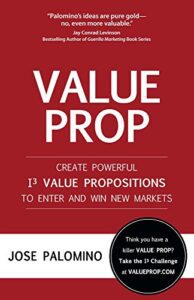
Our guest is Jose Palomino, who’s the CEO of Value Prop. He’s helped over 100 business-to-businesses unlock over $250 million in new growth. He’s got decades of experience helping these business-to-business owners work through and overcome their strategic marketing and sales challenges. He’s also the author of the foundational book Value Prop and host of The Revenue Throughput Podcast. He holds an MBA and teaches candidates strategic marketing management. Welcome to the show.
It’s great to be here, John. Thanks for inviting me.
Let’s go back to your own story of origin, Jose. You can go back to school, college or your youth. How did you get interested in business in general and specifically, finding your niche in B2B?
That’s a long story, so I’ll give you the very short version of it. I didn’t start out knowing I wanted to be in business. I wanted to be a comic book artist. I was a comic book collector. I started taking courses in some of the New York City-based where I was born and raised, art schools like Parsons and FIT to learn anatomy and things like that. I was doing that but meanwhile, I didn’t pay the rent or even buy a bag of chips. I have to figure something out. I started working doing whatever. It led to me working in back-office operations for a major brokerage house.
I had a real affinity for numbers, processes and working hard. I learned at the age of 20, 21, what it meant to bang out work if you had to do it. That became something where I said, “I will never be outworked.” I could be outsmarted maybe, but I won’t be outworked. Everyone wants to say it’s a four-hour workweek, this and that. The reality is most of successful people know how to work hard when they have to work hard. That journey took me into starting a business a couple of years later, notably in selling comics to collectors.
[bctt tweet=”Be innovative, indispensable, and inspirational.” username=”John_Livesay”]
Through that, I had to learn programming to build an inventory system on one of the first IBM PCs that were available. That’s how I got into technology and business entrepreneurship. Since that journey, I ended up mostly going into IT-based companies, ended up working as an analyst working for some large IT companies, including one very large computer manufacturer. That’s when I transitioned to sales and marketing. I moved into sales roles whilst carrying a bag as it were. I didn’t look back from there.
What’s interesting about your background to me, Jose, is you have toggled back and forth between sales and marketing. You were CMO, as well as being a sales director. I don’t see a lot of people doing both. They usually pick a lane and stick with it. Sometimes as you probably know, marketing and sales don’t get along so well at big companies. There is a lot of pointing of fingers. What a wonderful perspective you bring to your clients. What is the big myth that you think is out there those salespeople have about marketing and vice versa?
A lot of them are based on some facts. Maybe it’s not a myth but a real belief. Sales think that marketing is only concerned with aesthetics, the look of the brand, the material, stuff like that. You’ll hear statements like this, “They don’t get it.” Marketing’s thinking like, “We’ve given these guys and gals everything they could need to be successful. Why aren’t they putting points on the board?” You have this sense from both sides, especially those who are in large companies where those things get very siloed shortly. The reason we are not getting to the top of the mountain is because of the other guys.
Success has many fathers. If we’re kicking butt, then everybody’s happy, high fives all around. The stress points are always when things are a little bit not great and you have to figure that out. What’s changing is the move, especially in larger companies. The technology towards what’s being called account-based marketing will come downstream, which is account management for large accounts. They have to give it a new name and so on.
There’s going to be an increasing melding of those disciplines. Things that used to be seen as strictly marketing activities, salespeople have to be good at. The big change there, John, I see is this. Marketing by definition, has a longer time horizon as they look at things. They have to look at a 1-year, 3-year plan or maybe the 6-month plan if they incorporate things like event marketing and things like that. They have a schedule for the future.
Competitive Edge: Value Prop
Your sales team, on the other hand, in a lot of organizations, have to live week by week. I’ve seen multibillion-dollar companies have a weekly stand and deliver calls on the pipeline. A salesperson is thinking, “I got to make this stuff happen now.” The marketing person is saying, “We have to make this thing happen this year.” That’s the disconnect. Until they understand that one feeds the other both ways, that’s when you have that separation. It’s a hard thing to crack.
I’ve worked with companies where within different sales divisions they’re siloed. Marketing is pulling their hair out saying, “Why aren’t we growing an existing client with another division but the other divisions have no clue what the other ones are doing? There are no even intros being made.” That’s B2B and law firms. It’s this lack of cross-selling and marketing. We don’t need to keep spending the same money if we already have a relationship with a client, a hospital or whatever the industry is. I see that as a big problem that I’m guessing you might have some ideas around solving.
It all comes down to this, especially sales, more so than marketing. Marketing folks with formal marketing titles like chief marketing officer, director of marketing, so on usually have some very small or no variable compensation in their package. It’s very negligible if it’s there at all. Gunning for raises is what you’re doing.
Sales is all about variable comp by and large, still in B2B. If you tell me there’s a sister division that has a great product that would be useful for my customer, the first question I’m going to ask because I’m carrying a bag is, “How will I get paid for that introduction?” “You got to be a good corporate citizen.” That’s fine. I agree. I should be a good corporate citizen.
Meanwhile, I tell my boss that when he’s hammering me to hit my goal, unless you’re going to give me a goal and align me to it financially, I’m incentive to ignore it no matter how well you tell it. I’ve seen bosses from the front of the room. “We’re going to bring the year synergy. This is a year we bring it all together. We’re going to deliver the total value to our customers.”
I say, “Yes, but your comp plan doesn’t reflect any of that.” Salespeople are always going to say, “You can tell me whatever you tell me but whatever the comp plan says is what I’m going to do.” In substantial, you want people to be good corporate citizens and high in integrity. Those are the things that you don’t pay for in a general sense.
This is the thing I always emphasize when I probably work with sales teams. In an average selling year, you have at most 220 selling days in a year, 55 selling days a quarter, 17 per month. It’s rough math. If you asked me to use up 2 or 3 of those 17 selling days in a month, you’re cutting into bone. Unless you’re going to give me some either quota relief on the other side say, “We need you to focus 20% of your time here,” reducing your quota, that’s never going to be the way it’s going to go. It goes the other way.
You’re not going to get the behaviors you think you should get. No amount of fist-pounding is going to get a few. You can try to browbeat people. You got to bring alignment and say, “What’s in it for you?” It is the question you have to answer for your customers but you have to answer that for your internal stakeholders as well.
Let’s bust another myth. I see a lot of sales management saying, “These reps are doing well. He or she killed it. They exceeded their quota. Let’s hire another salesperson and break that territory in half, then we’ll get even more.” The rep is furious. The myth is, “Let’s hire more salespeople to get more sales.” You say that’s not true. Tell us what you mean.
[bctt tweet=”Show your offer reduces hassle and risk.” username=”John_Livesay”]
Especially in the mid-market, it’s different if you’re talking about a company that routinely has 100 territory reps like billion-dollar companies. If you’re owner-led or in the mid-market, you’re a $10 million, $20million, maybe a $50 million company, maybe you have 8 sales reps. You are attracted to that kind of thinking because you’re thinking, “I don’t have to be a rocket scientist to say if I have 10 people and add 1 rep, that’s 10% growth. It should be.” The challenge I would say to that leadership team is this. If you hire the right or wrong person, you’re going to be into it for $100,000, $150,000 in costs, all of that, plus the possibility of deflating your top performers.
There are all these negative things that can happen but I’m not saying never hire a salesperson. The reason you’re looking to hire salespeople is because you’re having some struggles and you think you need to increase sales. You say, “I need to have more coverage.” Then I would say, “Take a look at your sales process first and the other moving parts of your sales continuum from the customer’s point of view.”
Are you sharply focused on your right target market? Have you thought through of your value proposition in the last year? Supply chains are still being stretched. That’s very different than what the world looked like years ago. Have you rethought your value proposition in that context? Have you thought through your lead generation? Things are changing. Things that work technique-wise, LinkedIn blasting don’t work anymore. Emails work differently. Trade shows as a strategy. Does your industry still have its trade show?
Until you ask those questions and get at, “Do I have my house in order?” It’s like your house is laid and being built. You say, “I’m going to add some carpenters to it.” Maybe it’s the plumbing that’s holding you up or the electrician. Maybe you’ve had bad weather and having another carpenter means another payroll. That isn’t going to get the house built any faster. You have to get to the root of it before you start designing solutions.

Competitive Edge: “What’s in it for you?” It is the question you have to answer for your customers, but you have to answer that for your internal stakeholders as well.
Also, are your current sales reps doing things the way you think they should have? You look at how they do things. Are they making customers happy? Last but not least is critical, especially where we are where supply chain and expectations are being all over the map. People don’t know what to expect. If you said yes to all of the above, are you delivering successfully on your promises as a company? That will unwind sales. That makes people that were loyal customers go back into the markets and say, “I got to find a different solution.” This happens time and again.
Adding a salesperson could be the exact right thing to do but not until you’ve checked off. It’s a few things, value prop, target market, your marketing programs, are they creating the leads for you? Are you delivering on your promises? Do you have a sales process? If you bring your sales team into a room with a whiteboard and you say, “Draw our process,” if they’re drawing like customer calls, we call back, make proposals, sell the deal, that’s not a sales process unless you’re purely transactional and you’re selling paperclips.
A lot of challenges that I hear lately in the marketplace, especially since the pandemic, in the healthcare industry, where pharmaceutical or medical equipment reps, talk to doctors between surgeries, especially if the rep is allowed in the surgery. Bought by the office, drop off some Starbucks and catch the doctor between patients, that’s gone. I don’t see it returning anytime fast.
These are people that have never been trained on how to formally request an appointment or they have to present on Zoom and not in person. There are all kinds of obstacles that people are having for the first time in their career. Do you have some insights into that? Do you see that happening with your clients?
Here’s the thing. Probably within the first six months of COVID becoming a real thing, from March of 2020 towards the fourth quarter of 2020, there was a sense among many people I talked to that when we get back to where we were. That isn’t happening and we see that with workers not wanting to go back to the office. I talked to one sales team that had huge success. They’ve embraced and leaned right into it. It’s all Zoom all the time. They were like a ten-person team. They saved $500,000 on their travel budget. It’s real money. It’s a big organization that scales.
[bctt tweet=”The reality is most of the successful people know how to work hard when they have to work hard.” username=”John_Livesay”]
Here’s the other thing. A lot of customers are saying like, “It’s okay. I don’t need to spend three hours entertaining somebody when we can have a half-hour call and get to the thing of it.” I’m not saying face-to-face doesn’t matter. Relationships matter. All those things matter. The reality is they mattered at the beginning of a relationship. They matter less over time. Have you ever seen the old Ed Sullivan show? There’s a lot less energy needed to keep the plates going.
You’ve got trust built up. If you’re delivering on your promises, you’re in good shape.
You don’t need to do all of that. I would say to that team, “Whatever it is that’s keeping you from what was normal to you years ago, go with a blank sheet of paper and say, ‘If I landed from Mars and I had to make a living doing this job, what would I say is possible within what I see with my eyes, not with my nostalgic eyes?’” Your eyes will get you in trouble. You’re hoping for something that may never come back.
Always think about it this way. Where are you now? This is very often overlooked, John, but where are your customers? What do they want? How do they want to be dealt with? That’s the thing you have to zero in on. How does the buyer want to buy? We can’t give a buyer a script and say, “When I say this, you say that,” if it were that easy.
The traditional way of a sales funnel is you reach out to somebody, develop a rapport, maybe set up a meeting to do some needs analysis or they send out an RFP that describes what the needs are. I’m hearing more often that clients are less willing to share what their needs are. It’s on the RFP or we’re interested to talk to you but we don’t want to spend any time sharing what our challenges are or our pain points. Is that the lack of time or is it not even a trend? What are your thoughts around that?
It is a very big trend and it depends on the category. For example, if an executive is looking to hire an executive coach, they’re going to open up and have a much more open dialogue because they want to see how they feel about that. That’s one example. Let’s say I’m buying a 3D printer for manufacturing. There are $300,000 machines available from three different manufacturers. My expectation is I can totally investigate, get the specs, see the testimonials, the machine and operation online before I talk to anybody. Further, I expect that a salesperson can look me up on LinkedIn. They can look up my company website and they should know.
Let’s cut to the chase is going to be a more common theme. You’ve hit on something very strong and true, John. Chit-chat is going to be far less. I know that people will say, “How are you going to build a relationship?” You build it through trust. Trust means that you say what you mean, you mean what you say and you deliver on what you promise. That’s what a buyer in an industrial B2B category is most looking for. “Can I count on you?”
From that, you earn the right to say, “I’m glad we got this 3D printer installed. There are some other applications that we’re finding some clients are having success with. Can I ask you a few questions around your situation to see maybe there’s something there that you can use and save 20% of production time?” All of a sudden, a person says, “Sure, because you made me look good.”
Competitive Edge: As much as sales veterans don’t like this, the buyer is increasingly at the wheel of the process.
As much as sales veterans don’t like this, the buyer is increasingly at the wheel of the process. They probably always were but we felt like we could do Jedi mind tricks. We could set up funnels. We’re running through people through stages and stuff. The buyer is saying, “No, I’m not having any of that.” They’re not playing along any longer. Sales teams that adapt to that reality will do well. Those that try to squeeze the buyer back into the nice, neat submarine of stages and stuff like that, you’re going to find a lot of kicking back.
You talk about getting back to some basics, which is making sure that the sales and the marketing messages fit the value proposition. Do you have an example of a company that has a great value prop and maybe one that didn’t? That would be helpful. We can talk about the confusion that can happen with marketing and sales don’t understand it.
I’ll give you two quick examples that might help frame the idea of what value proposition is. At the end of the day, value proposition is the idea that answers the question, “Why should anyone buy X from you at Y price?” It’s not the tagline. The tagline comes from a good value proposition. It’s the actual truth. I always say, “Stay true truth your business or your product line if you have multiple product lines.”
I had one client that delivered home heating oil. That’s a declining market. That’s existentially threatened. There’s nothing you could do about that. You can’t do anything to the oil itself. Automatic delivery of heating oil is done on the basis of a timeworn algorithm that all the oil companies use. It allows them to figure out when Bob McAllister is going to run out of oil out of his 285-gallon tank. There’s no Wi-Fi or anything like that. It’s all done through this algorithm as usage, weather, dewpoint, things like that.
This company, a client of mine, was having a lot of overtime runs because they had to do last-minute runs on a Saturday, so it costs a lot of money. They commissioned a superior algorithm. They spent a lot of money on it. I asked him about it. I said, “How’s that worked out?” He said, “We did 60,000 deliveries.” I said, “How many did you miss?” We’re supposed to be exact. He said, “9 over 60,000.” That’s like 99.999. I said, “Is anyone even close to you?” “No one’s even close.”
We started marketing a no run-out guarantee. We said, “If we let you run out of oil, we will fill the tank for free at our expense.” That’s a big thing. 285 gallons is $4 or $5 a gallon. It’s a lot of money. They were able to do that confidently. What ended up happening is they acquired, as a result, the higher end of that market. Even as the customer said, “I don’t want to tolerate any risk of me having a cold winter night where my oil company lets me run out of oil.” We were able to turn an operational advantage into a marketing and sales advantage.
[bctt tweet=”You have to get to the root of it before you start designing solutions. ” username=”John_Livesay”]
Another company in a totally different category, a pure B2B, made a machine that mixes powder. They’ve had it for years. There are lots of companies that do this, but they have unique technology and they are like the best-kept secret. The person who bought the company did very well, operationalizing, efficiencies and how they build a machine. We realized something talking through it. I said, “This machine does what the alternative technology would require three machines.” You need one to do the same thing and it does it like twice as fast. Those are huge advantages that they have to take forward.
They did a lot with video on their website. They promoted this one-stop-shop advantage and sure enough, the company has grown. It’s done very well. The principle of what makes a good value prop is a lot of things. In my book, Value Prop, I talk about I3. It says, “Is it innovative? Are you bringing something new to your market? Is it indispensable? Is it useful over time? Is it inspirational?” Is your execution something that somebody in the trade would go, “That’s pretty cool how they did that?”
Somebody not at a trade may find that very boring. That looks like steel. They don’t care but somebody in the trade would take it. I’d also say there are four things from a selling to marketing perspective that is essential for any value proposition to be effective in B2B. There are four things that buyers are always going to look for. “Can you save me time? Can you save me money or make me money? Can you reduce my hassle factor?” Especially in times like this, where everything seems like a drag and a hassle. “Can you reduce my risk?”
“I don’t know you and I’m buying you a 3D printer. I’ve never used your model before. What assurances do I have? What if you don’t perform as well as your demo say you do?” You have to look at those four things in your value proposition and your promises to the customer. You have to say, “This is how we’re going to save you time, money, hassle and risk.” If you can do that, you’re going to win a lot of business and at least get an at-bat.
What I love about that is most people are talking about saving time and money. If you’re the one that’s talking about personal issues like what keeps you up at night, the hassle factor is, “I can set it and forget it. I’m done. You’re in.” It’s all that kind of stuff because it’s an emotional buy even if it’s B2B. Those are some emotional solutions that you’re giving to someone. Is this making my life easier or harder?
We’re in the process of shopping for a new refrigerator. We had a built-in. It’s getting old, so we need to replace it. I said, “You’re going to take it out of my house?” They said, “We don’t do that.” I’m thinking like that’s like half the solution. What I want is the new refrigerator in the spot where the old one was. I don’t want to deal with the 250 pounds, all refrigerator, having to dispose it and call people up. Make sure that whatever you’re offering your customers is a complete answer to their question, not half of it. If their thing isn’t quite as good as yours but they solved my whole problem, they’re going to get the business.

Competitive Edge: Make sure that whatever you’re offering your customers, especially now, is a complete answer to their question, not half of it.
You were generous enough to offer a free gift, which is your book to the readers. What websites should people go to get the free book?
Our book has been on Amazon and still on Amazon in hard copy but if they want and I’m happy for them to have a PDF of the book Value Prop, it’s available at ValueProp.com/book. They can download a free copy of our foundational book for our programs Value Prop.
You’re also coming out with something new to give people a Competitive Edge because I’m always dealing with clients that say, “We feel like we’re drowning in a sea of sameness. Everyone sees this as a commodity. “Give us a little hint about what that is.
The Competitive Edge takes value prop to the next level. It’s saying this and it’s a powerful thought, especially in the mid-market, “Not every company is going to be able to create Apple.” They’re not going to be able to create the next Google. It’s reality. You’re a $20 million company making a small machine or apart. You’re not going to be the Apple.
Think about the Olympics. In the Olympics, the winner wins by a fraction of a second but they get the entire gold medal. They don’t get a fraction of the gold medal. They get the whole gold medal. In B2B, especially in the mid-market, when you win the deal, your competitor did not. They don’t make you share the deal.
If you lose, you might get a phone call that sounds like this, “You were close. We liked your proposal.” You try to tell that to your boss, “We were close but you can’t cash.” The Competitive Edge program walks people through how to get those incremental wins that set you apart at a very practical level in your day-to-day competition. To find out more about it, we have a nice page set up to describe the details of this program. It’s at ValueProp.com/edge.
I hear a lot of clients say, “We’re tired of coming in second place when we pitch against our competitors.” Unlike the Olympics, there’s no medal and money for second place. What a great way to frame. Let us all zoom out a little bit and figure out what is the value prop. Put yourself in the other person’s shoes. I know that this book, PDF and this additional edge will help a lot of people start closing more sales and get along with marketing better. Thank you so much, Jose.
It’s my pleasure, John. Thanks for having me.
Important Links
- Jose Palomino
- Value Prop
- The Revenue Throughput Podcast
- ValueProp.com/book
- ValueProp.com/edge
- Better Selling Through Storytelling Method Online Course
Wanna Host Your Own Podcast?
Click here to see how my friends at Podetize can help
Purchase John’s new book
John Livesay, The Pitch Whisperer
Share The Show
Did you enjoy the show? I’d love it if you subscribed today and left us a 5-star review!
- Click this link
- Click on the ‘Subscribe’ button below the artwork
- Go to the ‘Ratings and Reviews’ section
- Click on ‘Write a Review’
Love the show? Subscribe, rate, review, and share!
Join The Successful Pitch community today:
- JohnLivesay.com
- John Livesay Facebook
- John Livesay Twitter
- John Livesay LinkedIn
- John Livesay YouTube