
TSP077 | Mark Bidwell – Transcription
Posted by John Livesay in Uncategorized | 0 comments
John Livesay:
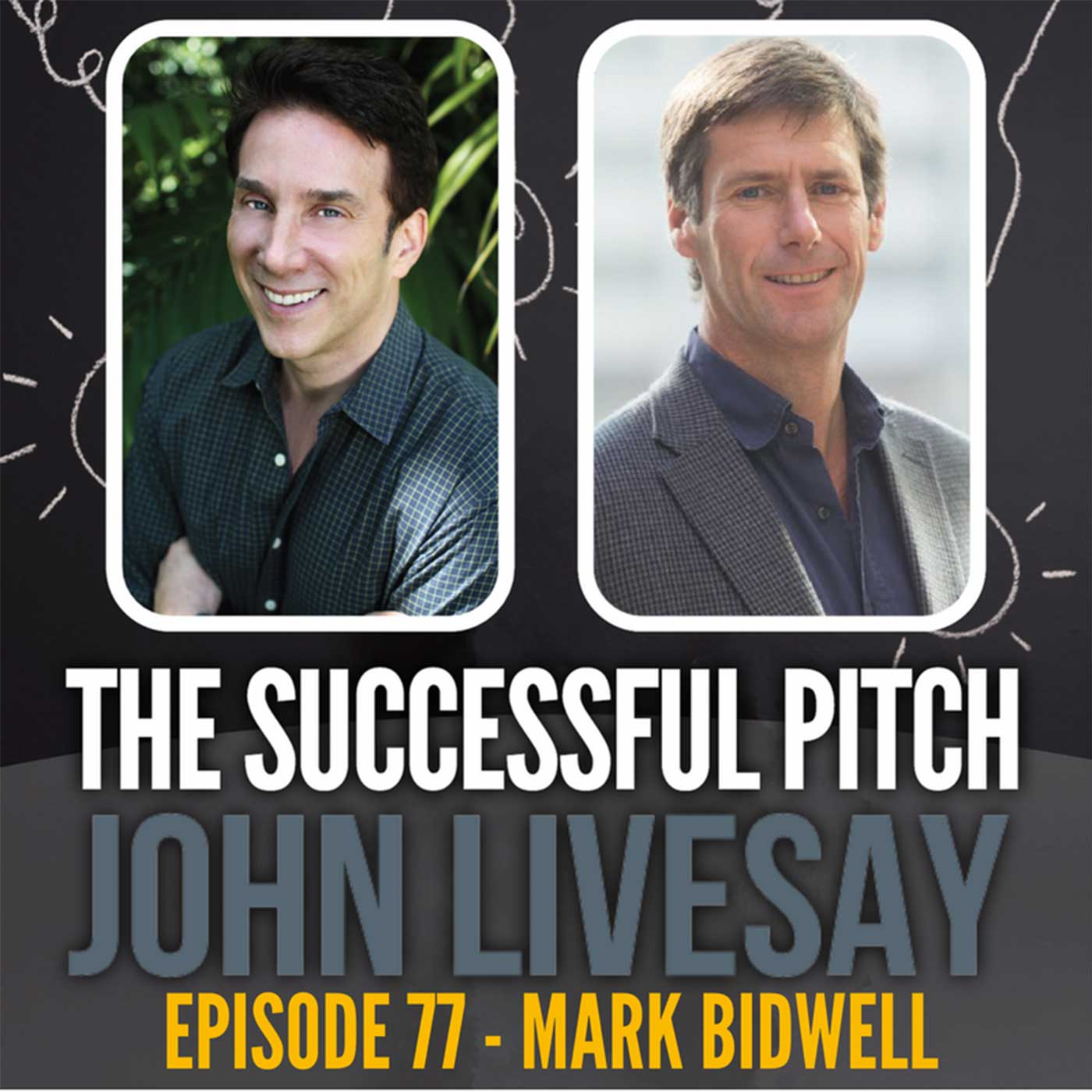
Welcome to The Successful Pitch podcast. Today’s guest is Mark Bidwell. Mark is an innovation expert. He just recently closed a series B round of $15 million, and shares his secrets on how he does it. He said, “The key to getting an investor to say yes to you is to not be intimidated by them, and to ask them how you can help them.” It’s a complete mindset reversal that I think you’ll find very interesting. He said, “Investing is a human business. You need to ask what difference can I make? Is this the right investor for me?” And remember that trust has to be mutual and the “why” of what you’re doing is equally important, if not more so, than the “what” of what you’re doing.
The interview begins in 45 seconds right after this information on how you can get funded fast.
Are you a founder struggling with your investor pitch? Do you need warm introductions to the right investors to get your startup funded? Do you need a funding road map to get you there fast? All of this and more can be found in Crack the Funding Code. Join host, John Livesay, and Judy Robinett, bestselling author of How to Be a Power Connector and board member of Illuminate Ventures, on their free Crack the Funding Code webinar. Simply go to judyrobinett.com – that’s J-U-D-Y-R-O-B-I-N-E-T-T dot com – and click on the webinar tab to see how to tap into their network of investors from around the world. There’s a link in the show notes as well. You’re only one click away from getting funded fast.
Hi, and welcome to The Successful Pitch podcast. I’m thrilled to have today’s guest, Mark Bidwell, on with us because Mark has so much to tell us about innovation, fund raising, pitching. He actually has his own podcast called The Innovation Ecosystem podcast. He spent much of his 20 year career seeking out people and resources to help them innovate and grow businesses. He’s worked at BP, The Hay Group which is part of Korn Ferry, and most recently, Syngenta, where he led the creation and development of a $2 billion specialty crop business unit. He learns from other people’s experience, and with his Innovation Ecosystem podcast, he brings fresh insights and perspectives and tools that you can use to get yourself funded fast. Mark, welcome to the show.
Mark:
Thank you very much, John. It’s a great pleasure to be here.
John:
You are calling in from?
Mark:
From Switzerland.
John:
Switzerland. I love it how global the world has become. Mark, I always ask my guest to take us back to what made you decide to pursue your career. Did you know in college that you wanted to get into business and investing and raising money for startups?
Mark:
Well no. I didn’t actually. I’m an anthropologist by training, and the reason I studied that was because I just love reading books about different cultures and explorers and travelers, and I found once I graduated that it didn’t really qualify me to do anything. So, I followed my father into business. He was in the food business, and I worked for his home delivery supermarket startup in London. This was in 1990, and from there I got approached by British petroleum and I thought startup is good but actually, to get a decent graduate trainee program under my belt with a large corporation, which BP was and still is, would have made a little bit more sense to me. So I joined them, was there for three years, and then I found myself in consulting because consulting, I think is a great way of learning, getting a lot of exposure to a lot of industries and lot of disciplines very very quickly, and I really enjoyed that. That’s where I started getting interested in innovation, business model innovation, because the consulting industry as a business or as an industry isn’t particularly an exciting business model, because to make more money, you either have to work harder or charge more, and you reach a ceiling on both of those.
So I got involved in thinking about what other assets did this company, The Hay Group have that they could make available to their clients, and I’ve found myself launching internet business in the mid 90s in Europe which was quite hard work back then. It’s hard to think of it but it was — 20 years ago the world was very different, and that got me into thinking more about business models, more about technology. I ended up going to work for the CEO in Philadelphia to help drive this program and finally, then, family came along and we relocated from the US back to Europe to Switzerland, and I joined Syngenta to open up their biofuels business. That one thing led to another. I was in the right place, the right time, and continued to help innovate in a number of different roles. So I guess, I’m an accidental executive, to be honest with you John. It was never really my plan but I was continually being offered really interesting opportunities, and that kind of took me to a place where at the end of last year, the end of 2014, I decided there weren’t the kind of opportunities available in that company any longer. So I thought now is the time to go out on my own, that’s when I left set up as an entrepreneur. I became chairman of one company and on the board of another company, and I’m building a business related to, but not specifically around Innovation Ecosystem. But really, helping companies and individuals become more entrepreneurial essentially.
John:
Wow. Well, let’s take a deep dive a little bit, if you don’t mind, because it’s such a fascinating story. This $2 billion Syngenta. Tell us about what that was like because it’s being an intrapreneur, it sounds like to me you’re within this big corporate structure, but you’re being very entrepreneurial within it. Is that accurate?
Mark:
Yeah, absolutely. Absolutely. Syngenta is the largest agri business in the world, and I was fortunate enough to — in the previous role to that, to leading the specialty crops unit, I was looking after a portfolio of products which were coming off patent. I was lucky enough to have a great team and a couple of quite good ideas that we were able to implement which resulted in some really significant value creation for shareholders. Because what normally happens when a product comes off patent is that the price collapses overnight, or in agriculture, it might take a couple of years, but in certain pharmaceuticals it collapses overnight, literally, as the trucks leave the Israeli manufacturing facilities at one minute past 12 full of your product. It’s an extraordinary industry. Now, in our business we are able to change that dynamic completely with a completely different strategy, related to the characteristics of the product we were looking after. As a result, we are able to raise prices for two subsequent years, pack and fill, which was unheard of in the industry. As a result of that, I was lucky enough to be offered an opportunity to form a new business unit and grow that out to a — well, it ended up as about $2.3 billion dollar business unit. So this was servicing or looking after, probably 40 different crops around the world, growing in every part of the planet, essential. It was a hugely exciting challenging scary role for four years. It was a roller coaster, but I learned. What I was able to do John was to take all the previous experiences of creating the conditions for innovation, and apply them across a team of many hundreds of people around the world. We are fortunate enough to generate some quite exciting results as well.
John:
It’s amazing. So, were you solving a particular problem of world hunger with all these crops? Or what was it that caused that kind of incredible growth?
Mark:
Well, I guess what we did was we thought far more about the grower, and what their issues where, and what their problems were, and a lot of these growers were based in subtropical or in tropical environments where they were — In agriculture, I think it’s the largest employer in the world, agriculture. I think it’s something at 17% of the world’s population are directly or indirectly employed by agriculture, or supported by agriculture. A lot of growers — you come from the US, there is some fantastically wealthy industrialized professionalized growers, and they reckon there’s about 100 million professionalized growers around the world. But this something like 500 or 600 million smallholders who are living — not quite hand to mouth, but whose family is in their — extended families rely on crops. So, what we did was we look and try to understand, what are there issues? Their issues really are not often how do they grow their crop, but it’s how do they market their crop. How do they fund the investment in their crop, how do they actually ensure that long-term, they have a business so they can hand over to their children. We took a very holistic view and we are able to then look at what’s available in the market and pull together a number of different solutions, which could be financial solutions. It could be traceability solutions, it could be new business models, and bundle them around our core products, and that enabled us to grow our market share, as well as create more value for the overall value chain.
John:
That’s such a huge takeaway, is you look at something and figure out a way to see it in a different angle, sort of an innovative way to look at something to solve a big problem, it seems like to me. Now, you’ve taken that skillset and that experience and have applied it to other things. Since this is all about how to make a successful pitch and one of the things investors look for is obviously, rapid growth, can you talk to us about your — and congratulations on this 15 — was it billion series B that you’ve just closed? Or 15 million I’m guessing?
Mark:
15 million, yeah. This is in agriculture. It’s an architect company based in Canada, and what we looked at, there are number of different ways that you can look at this industry, and I looked at it with the management team, and we figured out that this is what — the most compelling where I think about this is that as a platform play. So this company and the technology that we have enables other organizations or other products become far more efficacious and successful and perform far better in the field, with an ingredient if you like, which is the technology. So it’s almost like in Intel Inside, and if you look at it that way, you’re able to tell a story to investors which is around — this isn’t about how much product we can actually sell to farmers, but it’s about — actually we can enable a whole new category of products to become far more mainstream in the world of agriculture, literally around the world but starting in North America and moving very quickly to Europe.
So it’s using a different lens, and I think what we did was we look at the pharmaceutical industry and said, “Look, this is really where the biosimilars were ten years ago, which are now a huge business for a lot of big pharmaceutical companies. But ten years ago, they were just a very very small subsegments. So we used another analogy that investors could understand and say, “Look, here we are at the beginning of this curve in this industry.” By the way, this is the $70 or $80 billion industry and there are many companies like ours out there at this stage with this technology, with this potential in front of us.
John:
Well, you did a couple of things there that I want to really summarize for the listeners, which is when you’re pitching, no matter whether it’s a seed round, a series A round, or in this case a series B round for 15 million, you need to paint a picture and not talk about just numbers and how something works, but instead use analogies, see things through a different lens and then talk about how big the market is. What you’re doing is describing something that’s very disruptive, it sounds like to me, but when you talk about it almost being like Intel, right?
Mark:
Yeah absolutely. It does. When you got a huge market opportunity in front of you like we have, it is important to get people of a glimmer of how they can actually take advantage of that in a leveraged way. Because to build out a really significant organization by — with the direct salesforce, with all the standard marketing, it’s going to take an enormous amount of resource. So this is about finding a way to accelerate that growth in scale, like growth leveraging some of the other dynamics in the industry that potentially, some of these investors weren’t necessarily aware of. Because most investors in this space had been looking at drones, they’re looking at precision agriculture, looking at water, and very few of them are actually looking at this space. So they have to bring this space into mainstream and get them a glimpse of how it could grow into something significant, was really what we — and I say, we, that the management team in particular, the CEO did very well to close this funding, and it was probably 40% oversubscribed. So we were very happy with how it developed.
John:
Wow. So you really became irresistible and you had a multiple fear of missing out thing happening, so you were able to select which investors you wanted to work with, right?
Mark:
Absolutely. Now, you and your listeners will know, it’s not easy. It’s getting the first — the lead investor which takes a lot longer than one hopes, but once that group is in place, then a number of others do fall in partly because of the fear of missing out, partly because they don’t want to do a lot of the work associated with being a lead investor, and partly because you get developing more confidence and you are able to communicate with more confidence one you got the first anchor tenant on the term sheet essentially.
John:
Now, were you involved with the previous rounds before you got to the series B?
Mark:
No, I wasn’t.
John:
Got it. Okay.
Mark:
So this is the first institutional round essentially.
John:
Oh okay. Got it. So do you have any tips for the listeners on how to get that first lead investor, with a pitch that makes them feel willing to be the first one? Are there incentives to being a lead investor that you give?
Mark:
Well, I think it does come back to two tips I’ve given. Firstly, be prepared for a lot of knockbacks. So, it’s rather like interviewing for a job I guess. I haven’t done this for a long long time, but I do remember when I did it, that the first few interviews are an opportunity for you to polish your message and to get comfortable and confident, and to hit your stride. I think it’s the same with raising money, you’re going to get a lot of pushbacks and people, for whatever reason, are not interested in you either because of timing, either because of that sectoral focus, either, or because they’re looking at different bite sizes or different stages. So, be prepared, be resilient, be prepared to expand a lot of shoe leather and dialing for these leads.
Then I think the second things is, understand what they’re looking for. So it’s not about you, it’s about them and their issues and how can you actually meet their needs, and give them something that they genuinely want. Because I think, often it’s going in and selling too hard without actually listening, and there’s a reason we’ve got two ears and one mouth, right? It’s important to remember that.
John:
Yes, so it’s all about putting yourself in the investor’s shoes, having empathy for them as opposed to just saying what you need all the time. Is that accurate?
Mark:
Absolutely.
John:
Some of that has to do with your own due diligence, and doing a deep dive on that person’s LinkedIn profile, what are the investments they’ve made, any potential people you might have in common, things like that I think really help get the rapport going, get the trust going which is all needed to get someone to take a leap of faith with you, right?
Mark:
Yeah, absolutely. It’s a human business at the end of the day, and it’s them feeling comfortable with you, but also thinking something very subtle happens here unless you ask them at the beginning. Not necessarily using his words, but unless you are demonstrating an interest in what their needs are, then you can come up with the most compelling pitch, but there’s always going to be something in the back of their minds saying, they’re not really interested in me, they’re just telling a good story. So, I think it’s really important to somehow rather, demonstrate a level of empathy and interest in how can you help them, even though obviously, the dynamic is exactly the other way around. These are — particularly they’re saying, across from that a well funded prestigious venture capitalist, there’s a lot of intimidation going on on the relationship because they feel they hold all the cards. But I think, as you go in looking for money, have the energy that says, “I want to actually help this person.” If helping them means that they’re not going to invest in me, then that’s okay, and it’s very very subtle, but my personal belief is this is a hugely important distinction because it changes how you approach the meeting, how you hold yourself in the meeting, how you actually engage with them, both of them at a physical level, but also the sublinear level as well. Do I make sense?
John:
Oh my gosh, Mark. I love what you just said. No one’s ever said it quite like that. What I hear you saying is you need to think of yourself as a brand and they’re a brand, and you’re equals, that you each have something of value. You may not have the same amount of money in your bank account, but as far as intelligence and integrity and character and vision, you have something to offer to them. I’m guessing that what investors are looking for, in other words, how you can help them is by giving them an incredible opportunity and a return on their investment, in a way that they hadn’t thought of. Will that be something they would want?
Mark:
Absolutely. Let’s be honest, any investor in a fast-growth company is a difficult journey between the management team and the investors. It’s not going to be easy. So, you want people who are locked in for the journey and who have that level of mutual trust. A bad outcome is that you — for whatever reason you raise money, but there isn’t that level of trust because the first opportunity is going to blow up and that’s bad for everyone. So again, a lot of this is how you approach the meeting and it’s got to feel right. It’s not a marriage, but it’s a think about it as a long-term relationship and I think it’s going to make life a lot easier.
John:
Oh that’s fantastic. Now, you also have some insights about pitching for money from large corporations. Is that right?
Mark:
Well, yes. So in my last role with Syngenta, I was looking after a lot of new products and new research and development compounds that cost anything up to a quarter of a billion dollars to get to market. Often they require significant investment in infrastructure and assets. So I kind of got, quite a lot of experience taking big projects with many hundreds and millions of dollars of capital in front of the executives, the leaders, and the boards. So even though you know the individuals and you got a better sense of the politics and the relationships, it is, in many respects the same process. It’s being totally clear in what you want out of the conversation and what their needs are in the extent of which you can match the two. I think the other piece here is that it — I think the “why” is really important as well as just the “whats.” So I think it’s kind of trying to connect with how to paint a picture of what’s possible here or longer term beyond the financials is quite a useful way of thinking about it. Because it makes the conversation a little bit less dry and a little bit more sort of engaging emotionally, because at the end of the day, these decisions for public companies are big decisions and people need to feel they can trust you as an individual.
John:
I love that you said — we’re going to tweet that out. “The why’s is equally important to the what.” Right? So it’s important to have your numbers but you have to paint a picture and get people a sense of why this is important to you and why you’re passionate about it, right?
Mark:
Yeah, absolutely. The Simon Sinek TED talk, which is all about the importance of the why, and it’s easy to forget this because we’re all business people who go and then we talk about numbers and stuff, but in actual fact, comes back to what I said early on, if you can engage people of this sort of, emotional level and get them to understand why you’re doing this, I think is far more powerful than the what. It’s a precursor of this even for the what, but it is actually far more powerful. It moves people John.
John:
Yes. So that begs the question which was, what is your why to start The Innovation Ecosystem podcast?
Mark:
Well, it’s a really good question. So, I’ve been doing this kind of work in large organizations for almost, well probably over 20 years actually John. I’ve made lots and lots of mistakes, learn a huge amount, I got a few scars on my back, but I began to figure out how to do this and I figured it all out for myself in the sense of I didn’t know an overall resources, no go-to people, no places where you can educate yourself in this stuff. Because it’s not easy and it depends on the organization you’re in. So coming out of the corporate world, one of the things that I was very keen to do is to make available these kinds of resources, these kinds of insights, these kinds of experiences to people who are doing these kinds of jobs in organizations as I was. So entrepreneurs in large mature industries with long product life cycles, how can you actually help them move the needle, have an impact beyond what they’re expected to do in their day-to-day jobs because there’s a lot people, particularly as you got millennials coming into the workforce, who have been wanting to leave their mark on organizations. So they’re looking for purposeful work.
So I really wanted to resource these kinds of individuals because there’s a lot of people out there with insights and distinctions and materials. So that’s my why, and so I teamed up with a friend of mine who’s got a business, providing information to corporations and lots of links with business schools. What we’re doing is we’re interviewing a number of thought leaders in the area of innovation, change, leadership, which one of your previous guest, Guy Spier, is an interviewee. Now he runs a hedge fund, but we’re also interviewing a number of high performers, so a hedge fund manager, a concert pianist, we’ve got an explorer on, and then we’ve also got some CEOs and some executives and entrepreneurs, all talking John, about innovation, change and leadership. Then what we’re doing, Europe is not quite as advanced as North America in the podcasting world, so we’re working to create a number of digital assets, so that people can consume this not just verbally of the podcast, but they can download and read transcripts and that they’ve got nice designs. We’re also creating videos of the podcast as well, so people can consume them in multiple ways, such that, if they’ve got a need for this, there’s not a technological barrier, if you like.
John:
Well, it doesn’t surprise me that you’re being innovate in the podcasting world and bringing things to Switzerland and Europe that haven’t been done before by incorporating not just the audio, but the transcript and the video. Good for you. Let me ask you what about your speaking, because I know you’re an incredible speaker. I’ve watched some of your talks online on your website. What are your favorite topics and who’s your ideal audience to speak to?
Mark:
Well, and thanks John. It’s not something that comes easy to me, but I’m getting a bit more practice. What I like doing is, I’ve done a number of talks to organizations and industries that are mature, slow moving regulated. They could be banking, and it could be a banking company of a bank, it could be a glass manufacturer, companies that have similar characteristics to the agricultural business that I came from before. Just helping them understand the journey that we went on over the four years, building out this $2 billion business. One of the relevant topics that they can take away, what are their take aways, and then we’d worked with the leadership teams and start thinking about other certain things that they, as leaders are doing that they’re getting in the way of innovation for instance. So that’s one area.
Then the other one is entrepreneurship. I’m doing a number of talks and I’ve well have given a number, by the time this goes out to your audience on what is a mindset of the entrepreneur? How do you need to think? How do you need to articulate your purpose? How do you need to make decisions? Then secondly, as an entrepreneur or as a leader of entrepreneurs, how do you actually want to create the space for your team to come up with innovative ideas, to explore new concepts in a reasonably safe environment without the fear of failure, which characterizes a lot of innovation in large organizations. So those are two topics, if you like, that I’ve got a lot of energy around.
John:
That’s fantastic. This whole concept of helping people get over the fear of failure whether you’re an intrapreneur or entrepreneur is desperately needed. I’m sure it’s a topic that has everyone riveted to listen to. Mark, what inspires you? What kind of books do you like to recommend to listeners?
Mark:
I do read quite a lot actually John. Let me think. I’m just looking around my office at the moment. I guess, biographies, first of all. The first business book that I ever read was Sam Walton’s Biography, Made in America, which actually oddly enough, I took that book and reread it before I developed the post patent defense for this product I was talking about. Because the way he thinks and the way he executes and the way he identifies his core, a source of differentiation was fundamental for how we transformed this product. So biographies, I read a lot of books on, I suppose, personal development and professional development books. One of the great ones that I’ve read the other day was this book by Cal Newport called Deep Work, which I found really interesting particularly in this always on, overscheduled world that we live in. This is about how do you actually start focusing and do really good work in a way that enables you to really differentiate yourself from the vast majority of people who have multitasking, thinking they can get stuff done. The signs is very clear now. We are not wired for multitasking and you do need to create space and focus to actually dig into stuff, to deliver deep work in a way that is value adding. So those are some examples, but yeah, I’ve got probably more books piled up that I need to read, surrounding me, then I have in any point of my career.
John:
Well, I think that Deep Work is a great suggestion. We’re going to put all your recommendations in the show notes for people to be able to click and buy the book, or look at it. This whole concept of multitasking being a myth is another great message to put out to people. If you want to be productive and focused, pick one thing to get done before you go on to try to complete a bunch of other things. Mark, there’s many ways that people can follow you on social media, and you have multiple websites. Tell us all the ways that people can follow what you’re doing, subscribe to your podcast, et cetera.
Mark:
Well, I’ve just put up a new website which is markbidwell.com, and then the podcast is innovationecosystem.net. By the time this goes out, I think a book project that I’m working on will be pretty mature as well, so hopefully, there’ll be a number of resources that beyond the podcast interviews, that people will be able to get access to and take advantage of, and I guess most importantly, come back with some feedback to us. But I’m also on LinkedIn and I’m on Twitter as well.
John:
What’s your Twitter handle?
Mark:
My handle is @markehb and the other one is @innovecosys. I’ll give those both to you so you could put them in the show notes, so that people can spell them correctly.
John:
Okay, fantastic. Well Mark, it’s been a pleasure. I can’t thank you enough for giving us your insights on how important it is to position yourself from the standpoint of what can you do for the investors instead of being someone who’s just asking for something, and really focusing in on building trust and painting a picture. Thanks again.
Mark:
Not at all John. It’s has been a great pleasure and I love your podcast, and I’m very pleased that we’ve managed to meet, and let me know how I can help in any way.
Thanks for listening to The Successful Pitch Podcast. If you liked the show, please go to iTunes and write a review, and encourage your friends to write reviews too. It really helps get the word out.
You know, people say that the longest distance is between someone’s mouth and their wallet. People can tell you they’re going to invest but when it comes time to write the check, they don’t do it. So, how do you get people to say yes and then follow through? Visualize yourself on the left side of a riverbank and you have to cross the river and on the other side of the river is where the funding happens.
So, first, you make up your idea and then you make it real and then you make it reoccur. Once you start dipping your toe into the water to get to funding, that’s where I can help. I get you across that river faster than you would on your own with a lot less frustration than you will get when you hear a bunch of no’s and you don’t know why. So, if you want some help getting funded faster with less frustration, go to my free funding webinar, sellingsecretsforfunding.com/webinar and sign up and get in depth information on how you can get funded fast. Thanks.
How to Close A 15M Round – Interview with Mark Bidwell
Posted by John Livesay in podcast | 0 comments
Listen To The Episode Here
Episode Summary
Mark Bidwell helps traditional organizations become more innovative and entrepreneurial in the digital economy. He helps to lead intrapreneurial change in market-leading companies such as BP Oil, the Hay Group, Syngenta, and more. Mark is also the co-host of the Innovation Ecosystem podcast, where he interviews thought leaders who are disrupting out-of-date methods, turning them into experiential growth. Mark talks about his work with Syngenta as well as how to get on the investor’s ‘good side’ on this episode.
How to Close A 15M Round – Interview with Mark Bidwell
Hi. Welcome to The Successful Pitch podcast. I’m thrilled to have today’s guest, Mark Bidwell, on with us because Mark has so much to tell us about innovation, fund raising, pitching. He actually has his own podcast called The Innovation Ecosystem podcast. He spent much of his 20 year career seeking out people and resources to help them innovate and grow businesses. He’s worked at BP, The Hay Group, which is part of Korn Ferry.
Most recently, Syngenta, where he led the creation and development of a $2 billion specialty crop business unit. He learns from other people’s experience. With his Innovation Ecosystem podcast, he brings fresh insights and perspectives and tools that you can use to get yourself funded fast.He is here to talk about how to close a 15M round, among other things. Mark, welcome to the show.
Thank you very much, John. It’s a great pleasure to be here.
You are calling in from?
From Switzerland.
Switzerland. I love it, how global the world has become. Mark, I always ask my guest to take us back to what made you decide to pursue your career. Did you know in college that you wanted to get into business and investing and raising money for startups?
No. I didn’t, actually. I’m an anthropologist by training, and the reason I studied that was because I just love reading books about different cultures and explorers and travelers. I found once I graduated that it didn’t really qualify me to do anything. I followed my father into business. He was in the food business. I worked for his home delivery supermarket startup in London. This was in 1990. From there, I got approached by British Petroleum.
I thought startup is good but actually, to get a decent graduate trainee program under my belt with a large corporation, which BP was and still is, would have made a little bit more sense to me. I joined them, was there for three years. Then I found myself in consulting because consulting I think is a great way of learning, getting a lot of exposure to a lot of industries and lot of disciplines very, very quickly. I really enjoyed that.

How to Close a 15M Round: I was in the right place at the right time and continued to help innovate in a number of different roles.
That’s where I started getting interested in innovation, business model innovation, because the consulting industry, as a business or as an industry, isn’t a particularly exciting business model. Because to make more money, you either have to work harder or charge more, and you reach a ceiling on both of those. I got involved in thinking about what other assets did this company, The Hay Group, have that they could make available to their clients?
I’ve found myself launching an internet business in the mid 90s in Europe, which was quite hard work back then. It’s hard to think of it, but it was. 20 years ago the world was very different. That got me into thinking more about business models, more about technology. I ended up going to work for the CEO in Philadelphia to help drive this program.
Finally then, family came along and we relocated from the US back to Europe, to Switzerland. I joined Syngenta to open up their biofuels business. That one thing led to another. I was in the right place at the right time and continued to help innovate in a number of different roles. I guess, I’m an accidental executive to be honest with you, John. It was never really my plan but I was continually being offered really interesting opportunities.
That took me to a place where, at the end of last year, the end of 2014, I decided there weren’t the opportunities available in that company any longer. I thought now is the time to go out on my own. That’s when I left, set up as an entrepreneur. I became chairman of one company and on the board of another company, and I’m building a business related to, but not specifically around Innovation Ecosystem. Really, helping companies and individuals become more entrepreneurial, essentially.
Wow. Let’s take a deep dive a little bit, if you don’t mind, because it’s such a fascinating story. This $2 billion Syngenta. Tell us about what that was like because it’s being an intrapreneur, it sounds like to me. You’re within this big corporate structure, but you’re being very entrepreneurial within it. Is that accurate?
Absolutely. Syngenta is the largest agri business in the world. In the previous role to that, to leading the specialty crops unit, I was looking after a portfolio of products, which were coming off patent. I was lucky enough to have a great team and a couple of quite good ideas that we were able to implement, which resulted in some really significant value creation for shareholders.
What normally happens when a product comes off patent is that the price collapses overnight, or in agriculture, it might take a couple of years. In certain pharmaceuticals it collapses overnight. Literally, as the trucks leave the Israeli manufacturing facilities at one minute past 12 full of your product. It’s an extraordinary industry.

How to Close a 15M Round: I was able to take all the previous experiences of creating the conditions for innovation and apply them across a team of many hundreds of people around the world.
Now, in our business we are able to change that dynamic completely with a completely different strategy, related to the characteristics of the product we were looking after. As a result, we are able to raise prices for two subsequent years, patent, which was unheard of in the industry. As a result of that, I was lucky enough to be offered an opportunity to form a new business unit and grow that out. It ended up as about $2.3 billion dollar business unit.
This was servicing or looking after probably 40 different crops around the world, growing in every part of the planet, essentially. It was a hugely exciting, challenging, scary role for four years. What I was able to do John, was to take all the previous experiences of creating the conditions for innovation and apply them across a team of many hundreds of people around the world. We are fortunate enough to generate some quite exciting results as well.
It’s amazing. Were you solving a particular problem of world hunger with all these crops? Or what was it that caused that incredible growth?
I guess what we did was we thought far more about the grower and what their issues were and what their problems were. A lot of these growers were based in subtropical or in tropical environments where they were … In agriculture, I think it’s the largest employer in the world, agriculture. I think it’s something at 17% of the world’s population are directly or indirectly employed by agriculture or supported by agriculture.

How to Close a 15M Round: Their issues really are not often how do they grow their crop, but it’s how do they actually ensure that long-term, they have a business so they can hand over to their children.
A lot of growers, you come from the US, there are some fantastically, wealthy industrialized, professionalized growers. They reckon there’s about 100 million professionalized growers around the world. There’s something like 500 or 600 million smallholders who are living, not quite hand to mouth, but whose family in their extended families rely on crops. What we did was we look and try to understand, what are there issues?
Their issues really are not often how do they grow their crop, but it’s how do they market their crop, how do they fund the investment in their crop, how do they actually ensure that long-term, they have a business so they can hand over to their children.
We took a very holistic view and we are able to then look at what’s available in the market and pull together a number of different solutions, which could be financial solutions. It could be traceability solutions, it could be new business models, and bundle them around our core products. That enabled us to grow our market share, as well as create more value for the overall value chain.
That’s such a huge takeaway, is you looked at something and figured out a way to see it in a different angle, an innovative way to look at something to solve a big problem, it seems like to me. Now, you’ve taken that skillset and that experience and have applied it to other things. Since this is all about how to make a successful pitch and one of the things investors look for is, obviously, rapid growth. Can you talk to us about your … Congratulations on this fifteen million series B that you’ve just closed.
This is in agriculture. It’s an architect company based in Canada. There are number of different ways that you can look at this industry. I looked at it with the management team and we figured out that this is what … The most compelling way of thinking about this is as a platform play. This company and the technology that we have enables other organizations or other products become far more efficacious and successful and perform far better in the field with our ingredient, if you like, which is the technology.
It’s almost like in Intel Inside. If you look at it that way, you’re able to tell a story to investors, which is around, “This isn’t about how much product we can actually sell to farmers, but it’s about actually we can enable a whole new category of products to become far more mainstream in the world of agriculture. Literally around the world but starting in North America and moving very quickly to Europe.” It’s using a different lens.
[Tweet “How to Close a 15M Round: We used an analogy that investors could understand.”]
I think what we did was we looked at the pharmaceutical industry and said, “Look, this is really where the biosimilars were ten years ago, which are now a huge business for a lot of big pharmaceutical companies.” Ten years ago, they were just a very very small subsegments. We used an analogy that investors could understand and say, “Look, here we are at the beginning of this curve in this industry. By the way, this is a $70 or $80 billion industry.” There aren’t many companies like ours out there, at this stage, with this technology, with this potential in front of us.
You did a couple of things there that I want to really summarize for the listeners, which is when you’re pitching, no matter whether it’s a seed round, a series A round, or in this case a series B round for $15 million, you need to paint a picture and not talk about just numbers and how something works.
Instead use analogies, see things through a different lens and then talk about how big the market is. What you’re doing is describing something that’s very disruptive, it sounds like to me, when you talked about it almost being like Intel, right?
[Tweet “How to Close a 15M Round: you need to paint a picture.”]
Yeah, absolutely. When you got a huge market opportunity in front of you, like we have, it is important to get people of a glimmer of how they can actually take advantage of that in a leveraged way. Because to build out a really significant organization with a direct salesforce, with all the standard marketing, it’s going to take an enormous amount of resource.
This is about finding a way to accelerate that growth and scale that growth, leveraging some of the other dynamics in the industry that potentially some of these investors weren’t necessarily aware of. Most investors in this space have been looking at drones, they’re looking at precision agriculture, looking at water and very few of them are actually looking at this space.
Being able to bring this space into mainstream and give them a glimpse of how it could grow into something significant, was really what we, the management team in particular, the CEO did very well to close this funding. It was probably 40% oversubscribed. We were very happy with how it developed.
[Tweet “Give investors a glimpse of the future with you”]
Wow. So you’ve really became irresistible and you had a multiple fear of missing out thing happening. You were able to select which investors you wanted to work with.
Absolutely. Now, you and your listeners will know, it’s not easy. It’s getting the first, the lead investor, which takes a lot longer than one hopes. Once that group is in place, then a number of others do fall in partly because of fear of missing out, partly because they don’t want to do a lot of the work associated with being a lead investor, and partly because you get developing more confidence and you are able to communicate with more confidence once you got the first anchor tenant on the term sheet, essentially.
Now, were you involved with the previous rounds before you got to the series B?
No, I wasn’t.
Got it.
This is the first institutional round, essentially.
Got it. Do you have any tips for the listeners on how to get that first lead investor with a pitch that makes them feel willing to be the first one? Are there incentives to being a lead investor that you give?
I think it does come back to two tips I give. Firstly, be prepared for a lot of knock backs. It’s rather like interviewing for a job, I guess. I haven’t done this for a long, long time. I do remember when I did it, that the first few interviews are an opportunity for you to polish your message and to get comfortable and confident and to hit your stride. I think it’s the same with raising money.
[Tweet “Be resilient when you pitch”]
You’re going to get a lot of pushbacks and people, for whatever reason, are not interested in you either because of timing, either because of that sectoral focus, or because they’re looking at different bite sizes or different stages. Be prepared, be resilient, be prepared to expand a lot of shoe leather in dialing for these leads. I think the second things is, understand what they’re looking for.
It’s not about you, it’s about them and their issues and how can you actually meet their needs and give them something that they genuinely want. I think, often it’s going in and selling too hard without actually listening. There’s a reason we’ve got two ears and one mouth. It’s important to remember that.
It’s all about putting yourself in the investor’s shoes, having empathy for them, as opposed to just saying what you need all the time. Is that accurate?
Absolutely.
Some of that has to do with your own due diligence and doing a deep dive on that person’s LinkedIn profile, what other investments they’ve made, any potential people you might have in common, things like that I think really help get the rapport going, get the trust going, which is all needed to get someone to take a leap of faith with you.
Absolutely. It’s a human business at the end of the day. It’s them feeling comfortable with you. Something very subtle happens here. Unless you ask them at the beginning, not necessarily using these words, but unless you are demonstrating an interest in what their needs are, then you can come up with the most compelling pitch.
[Tweet “Investing is a human business.”]
There’s always going to be something in the back of their minds saying, “They’re not really interested in me, they’re just telling a good story.” I think it’s really important to, somehow or other, demonstrate a level of empathy and interest in how can you help them, even though obviously, the dynamic is exactly the other way around. Particularly they’re sitting across from a well funded, prestigious venture capitalist.
There’s a lot of intimidation going on in the relationship because they feel they hold all the cards. I think, as you go in looking for money, have the energy that says, “I want to actually help this person.” If helping them means that they’re not going to invest in me, then that’s okay. It’s very, very subtle.
My personal belief is this is a hugely important distinction because it changes how you approach the meeting, how you hold yourself in the meeting, how you actually engage with them. Both of at a physical level, but also at a subliminal level as well, if that make sense.
Oh my gosh, Mark. I love what you just said. No one’s ever said it quite like that. What I hear you saying is you need to think of yourself as a brand and they’re a brand, and you’re equals. That you each have something of value. You may not have the same amount of money in your bank account. But as far as intelligence and integrity and character and vision, you have something to offer to them.
I’m guessing that what investors are looking for, in other words, how you can help them is by giving them an incredible opportunity and a return on their investment in a way that they hadn’t thought of. Will that be something they would want?

How to Close a 15M Round: You want people who are locked in for the journey and who have that level of mutual trust.
Absolutely. Let’s be honest, any investor in a fast-growth company, it’s a difficult journey between the management team and the investors. It’s not going to be easy. You want people who are locked in for the journey and who have that level of mutual trust.
A bad outcome is that you, for whatever reason, you raise money but there isn’t that level of trust because at the first opportunity, it’s going to blow up. That’s bad for everyone. Again, a lot of this is how you approach the meeting and it’s got to feel right. It’s not a marriage, but think about it as a long-term relationship. I think it’s going to make life a lot easier.
That’s fantastic. Now, you also have some insights about pitching for money from large corporations. Is that right?
Yes. In my last role with Syngenta, I was looking after a lot of new products and new research and development compounds that cost anything up to a quarter of a billion dollars to get to market. Often, they require significant investment in infrastructure and assets.
I got quite a lot of experience taking big projects with many hundreds and millions of dollars of capital in front of the executives, the leaders and the boards. Even though you know the individuals and you got a better sense of the politics and the relationships, it is, in many respects, the same process. It’s being totally clear what you want out of the conversation and what their needs are and the extent at which you can match the two.
[Tweet “The why is more important than the what.”]
I think the other piece here, I think the why is really important as well as just the what. I think it’s trying to connect with, trying to paint a picture of what’s possible here longer term beyond the financials is quite a useful way of thinking about it. Because it makes the conversation a little bit less dry and a little bit more engaging emotionally. Because at the end of the day, these decisions for public companies are big decisions and people need to feel they can trust you as an individual.
I love what you said. It’s important to have your numbers but you have to paint a picture and give people a sense of why this is important to you and why you’re passionate about it.
Absolutely. The Simon Sinek TED talk, which is all about the importance of the why. It’s easy to forget this because we’re all business people who go and then we talk about numbers and stuff. In actual fact, comes back to what I said early on, if you can engage people at the emotional level and get them to understand why you’re doing this, I think it’s far more powerful than the what. It’s a precursor obviously for the what, but it is actually far more powerful. It moves people, John.
[Tweet “Engage people at the emotional level. Get them to understand why you’re doing this.”]
Yes. That begs the question, which is what is your why to start The Innovation Ecosystem podcast?
It’s a really good question. I’ve been doing this work in large organizations for almost, well probably over 20 years actually, John. I’ve made lots and lots of mistakes, learned a huge amount, I got a few scars on my back. But I began to figure out how to do this. I figured it all out for myself in the sense of there were no real resources, no go to people, no places where you can educate yourself in this stuff. It’s not easy and it depends on the organization you’re in.
Coming out of the corporate world, one of the things that I was very keen to do was to make available these kinds of resources, these kinds of insights, these kinds of experiences, to people who are doing these kinds of jobs in organizations as I was. Entrepreneurs in large mature industries with long product life cycles, how can you actually help them move the needle, have an impact beyond what they’re expected to do in their day-to-day jobs?

How to Close a 15M Round: I wanted to make available these resources, insights, experiences to people.
Because there’s a lot people, particularly as you got millennials coming into the workforce, who have been wanting to leave their mark on organizations. They’re looking for purposeful work. I really wanted to resource these kinds of individuals because there’s a lot of people out there with insights and distinctions and materials. That’s my why.
I’ve teamed up with a friend of mine who’s got a business providing information to corporations and lots of links with business schools. What we’re doing is we’re interviewing a number of thought leaders in the area of innovation, change, leadership. One of your previous guest, Guy Spier, is an interviewee. Now, he runs a hedge fund.
We’re also interviewing a number of high performers. A hedge fund manager, a concert pianist, we’ve got an explorer on, and then we’ve also got some CEOs and some executives and entrepreneurs, all talking, John, about innovation, change and leadership.
Europe is not quite as advanced as North America in the podcasting world, so we’re working to create a number of digital assets such that people can consume this not just verbally over podcast, but they can download and read transcripts and that they’ve got nice designs. We’re also creating videos of the podcast as well. People can consume them in multiple ways such that if they’ve got a need for this, there’s not a technological barrier, if you like.
It doesn’t surprise me that you’re being innovate in the podcasting world and bringing things to Switzerland and Europe that haven’t been done before by incorporating not just the audio, but the transcript and the video. Good for you. Let me ask you, what about your speaking? Because I know you’re an incredible speaker. I’ve watched some of your talks online on your website. What are your favorite topics and who’s your ideal audience to speak to?
Thanks, John. It’s not something that comes easy to me, but I’m getting a bit more practice. What I like doing is, I’ve done a number of talks to organizations and industries that are mature, slow moving, regulated. It could be a banking company, a bank, it could be a glass manufacturer. Companies that have similar characteristics to the agricultural business that I came from before.

How to Close a 15M Round: What is the mindset of the entrepreneur? How do you need to think? How do you need to articulate your purpose? How do you need to make decisions?
Just helping them understand the journey that we went on over the four years, building out this $2 billion business. One of the relevant topics that they can take away, what are their takeaways? Then we’d worked with the leadership teams and start thinking about other certain things that they, as leaders, are doing that they’re getting in the way of innovation, for instance. That’s one area.
Then the other one is entrepreneurship. I’m doing a number of talks. I will have given a number, by the time this goes out to your audience, on what is the mindset of the entrepreneur? How do you need to think? How do you need to articulate your purpose? How do you need to make decisions?
Secondly, as an entrepreneur or as a leader of entrepreneurs, how do you actually want to create this space for your team to come up with innovation ideas, to explore new concepts, in a reasonably safe environment without the fear of failure, which characterizes a lot of innovation in large organizations. Those are two topics, if you like, that I’ve got a lot of energy around.
That’s fantastic. This whole concept of helping people get over the fear of failure, whether you’re an intrapreneur or entrepreneur, is desperately needed. I’m sure it’s a topic that has everyone riveted to listen to. Mark, what inspires you? What books do you like to recommend to listeners?

Sam Walton, Made in America
I do read quite a lot actually, John. Let me think. I’m just looking around my office at the moment. I guess, biographies, first of all. The first business book that I ever read was Sam Walton’s Biography, Made in America, which actually oddly enough, I took that book and reread it before I developed the post patent defense for this product I was talking about. Because the way he thinks and the way he executes and the way he identifies his core source of differentiation was fundamental for how we transformed this product. Biographies.
I read a lot of books on, I suppose, personal development and professional development books. One of the great ones that I’ve read the other day was this book by Cal Newport called Deep Work, which I found really interesting, particularly in this always on, over-scheduled world that we live in. This is about how do you actually start focusing and do really good work in a way that enables you to really differentiate yourself from the vast majority of people who are multitasking, thinking they can get stuff done.

Deep Work: Rules for Focused Success in a Distracted World
The signs is very clear now. We are not wired for multitasking and you do need to create space and focus to actually dig into stuff, to deliver deep work in a way that is value adding. Those are some examples. I’ve got probably more books piled up that I need to read, surrounding me than I have done at any point in my career.
I think that Deep Work is a great suggestion. We’re going to put all your recommendations in the show notes for people to be able to click and buy the book or look at it. This whole concept of multitasking being a myth is another great message to put out to people. If you want to be productive and focused, pick one thing to get done before you go on to try to complete a bunch of other things.
Mark, there’s many ways that people can follow you on social media and you have multiple websites. Tell us all the ways that people can follow what you’re doing, subscribe to your podcast, etc.
I’ve just put up a new website, which is MarkBidwell.com. Then the podcast is InnovationEcoSystem.net. By the time this goes out, I think a book project that I’m working on will be pretty mature as well.
Hopefully, there’ll be a number of resources, beyond the podcast interviews, that people will be able to get access to and take advantage of. I guess most importantly, come back with some feedback to us. I’m also on LinkedIn and I’m on Twitter as well.
What’s your Twitter handle?
My handle is @MarkEHB and the other one is @InnovEcoSys. I’ll give those both to you so you could put them in the show notes so that people can spell them correctly.
Fantastic. Mark, it’s been a pleasure. I can’t thank you enough for giving us your insights on how important it is to position yourself from the standpoint of what can you do for the investors instead of being someone who’s just asking for something and really focusing in on building trust and painting a picture. Thanks again.
Not at all, John. It’s has been a great pleasure. I love your podcast. I’m very pleased that we’ve managed to meet. Let me know how I can help in any way.
Links Mentioned
The Innovation Ecosystem podcast
J Robinett Enterprises
John Livesay Funding Strategist
Mark Bidwell Website
Syngenta – United States Website
Made in America by Sam Walton
Deep Work by Cal Newport
Crack The Funding Code!
Register now for the free webinar
Fox 11 News Los Angeles John Livesay The Successful Pitch book
Share The Show
Did you enjoy the show? I’d love it if you subscribed today and left us a 5-star review!
-
- Click this link
- Click on the ‘Subscribe’ button below the artwork
- Go to the ‘Ratings and Reviews’ section
- Click on ‘Write a Review’
TSP076 | Dan Weinfurter – Transcription
Posted by John Livesay in Uncategorized | 0 comments
John Livesay:
Hi and welcome to The Successful Pitch. Today’s guest is Dan Weinfurter, the author of Second Stage Entrepreneurship. The other title was going to be How Hard Could It Be?, but then decided not to have that title. He said, “It’s so important to hire smart people. The cost of hiring the wrong person is higher than leaving the position unfilled.” He said, “If you really want to be successful in sales, you must have people happy working for you, by having a culture that resonates for them, and they must like the person they worked for,” and he goes on to say that, “If you want to make a pitch, make sure that it’s targeted and consistent with your branding.” Who are you? What makes you different and better, and how can you prove it? And the best way to prove it is through storytelling. You must build credibility and trust to the stories you tell.
The interview begins in 45 seconds right after this information on how you can get funded fast.
Are you a founder struggling with your investor pitch? Do you need warm introductions to the right investors to get your startup funded? Do you need a funding road map to get you there fast? All of this and more can be found in Crack the Funding Code. Join host, John Livesay, and Judy Robinett, bestselling author of How to Be a Power Connector and board member of Illuminate Ventures, on their free Crack the Funding Code webinar. Simply go to judyrobinett.com – that’s J-U-D-Y-R-O-B-I-N-E-T-T dot com – and click on the webinar tab to see how to tap into their network of investors from around the world. There’s a link in the show notes as well. You’re only one click away from getting funded fast.
Hi and welcome to The Successful Pitch Podcast. Today’s guest is Dan Weinfurter, the author of Second Stage Entrepreneurship. He’s also the founder and CEO of GrowthPlay, which is a sales effectiveness business consulting firm, and Dan consults with many organizations developing and implementing sales and leadership effectiveness, strategies that drive profitable growth. In his 25 years of being a serial entrepreneur, he’s built three, not just one, but three successful companies including Parson Group, his first start-up that landed number one on the coveted Inc. 500. In addition to consulting, speaking, and interim management, he guest lectures at leading business schools, and was a mentor for the Clinton Foundation’s Institute for Entrepreneurial Excellence. Dan, welcome to the show.
Dan:
John, pleasure to be here.
John:
What a great background that you have, and what great experience you have, especially for a podcast like this one called The Successful Pitch. You obviously know how to sell and pitch. Can you take us back to your early career of selling and your first start-up, and how did you know that that’s what you wanted to do?
Dan:
Well, it is probably a two-part question, so I’ll try to answer both singly and then we can go from there. So right out of college I was hired by General Electric, and I went through their sales training program. So that was back in the day where a company would hire a 22 year old and put him through a year of training, with the hope that the 23 year old would be able to sell sophisticated services to executives in big companies. Those days are somewhat gone where companies spend that amount of time and effort bringing young people up to speed. But for me it was really fortunate and has got me started in a career early, even the businesses I’ve started, the common denominator has been the buildup and deployment of an effective sales organization. So, my GE career lasted eight years, and then subsequently GE have now done — this is my fourth, actually, that I’m working are now all in business services, trying to help companies do one thing or another.
John:
Let’s talk about the Parson Group. Did you have to raise outside funding for that, and how did you come up with the idea?
Dan:
So the idea for Parson Group actually came from a business that I was involved with, previous to starting Parson Group that was an information technology staffing business. We watched ourselves grow and we completely, and continuously outran our operational capability which included finance in accounting, and so, we turned to the outside staffing, temporary service providers for help. As we watch what these firms did, we saw that they frankly were terrible and violated all of the things that we thought were responsible for our group at the firm that I was at. And so, the notion was hatched, “Well, what if you took our business model and applied it to the finance and accounting vertical, and you had capital and you built it correctly, what could you do?” And so, after ARC, which was the firm I was at went public, I resigned, wrote a business plan, and raised essentially $4 million on a PowerPoint. We used that to sort of hire five people in Chicago in July 1995, and six years later we had a $90 million business, all organic growth.
John:
Amazing. I bet those investors were happy.
Dan:
Well, we needed to go back to them a couple other times.
John:
Which is fine. That’s expected.
Dan:
Which is fine.
John:
You hit the milestones. You need more money to grow, yeah.
Dan:
We did, and so yeah, they were very happy. It worked well where all parties involved.
John:
Great. Well, let’s talk about this great book of yours. I’ve had the pleasure of reading it cover to cover. It’s just fantastic. How did you come up with the title Second Stage Entrepreneurship?
Dan:
Well, the original title was How Hard Could It Be?, which was not meant to be serious, but that was part of the problem. So, the editor that I was working with didn’t think that that title was right and thought it might offend people, and so as we were working with the publisher which is Palgrave Macmillan, we kicked around a bunch of different ideas, and frankly, the editor at Macmillan gets credit for this, and that she thought that there was this void between how do you start a business and then how do you get it to the next level. Plenty of books on startups, plenty of books on sales, but this whole — what we call “second stage growth”, she thought that there was a void in the market. So we reshaped it a bit through the editorial process, and made it far more broad-based, and then instead of just talking about sales, we talked about all of the things that tend to be important in growing a business from an early stage to what we call the second stage, which is a much bigger business obviously.
John:
One of the key things that’s over and over important is hiring smart people which you talked about in this great book. I know that investors look to that when you’re pitching for money, who’s on your team, and even as you continue to be successful you need higher and higher rounds, one investor told me that the quality of your team has to equally go up. The CEO can’t be the CFO anymore. Can you speak to some of the things you talked about, like how to hire smart people and in specific, I love what you wrote when you said, “intellectual curiosity.” Tell me what that means.
Dan:
So two parts. So, ironically, I think that the hiring process, while it is the most important part of the growth journey for any company. Ironically, my view is that it’s the least disciplined. So you think about what’s involved in hiring a person. So in most cases, it’s a million dollar and up decision that somebody is making, and seldom is that rigor applied for that level of decision-making. So salesperson for example seems fairly routine, it’s at least a million dollar decision, and then I tell people I’ve made it wrong enough times to know that my numbers are right.
John:
That’s great.
Dan:
And in a manager, so if you’re starting a new geography, that’s at least to $15 million decision and I could say the same thing there. I’ve made a mistake enough to know that that number is correct. So, first I try ground people in the fact that these numbers are real, and if you get the right person great things happen, and if you get the wrong person bad things happen. So, what the trick is is that, every role for every company at every stage of growth is different, and so you can’t just take what you’ve done in the past and apply it to the business that you’re a part of today. It might or might not work. It’s a flip of the coin. So I teach a class at Kellogg and I was guest lecturing into this class called Digital Innovation, and one of the things that the professor teach us in that class pointed out which is true is that, in the technology space, and it’s probably no different than anywhere else, the founder hires his or her number two 70% of the time without defining the role and without talking to more than one person.
John:
Really? Not even a — yeah, I can understand that to finding the role because it’s you’re going to do everything, but not talking to more than one person fascinates me.
Dan:
That would be a lack of intellectual curiosity, would it not?
John:
It would. There we go. We’ve got it defined, and you’ve brought it in full circle. I love it.
Dan:
But it’s funny, you talk to people, and this is one of my favorite tricks, is after an interview is almost done, you ask a person, “So, what are you reading today?” And it’s amazing to me how often you get an answer, “Well, I don’t have time to read. Too busy. I don’t really read,” or “I’d look at some magazines and there’s papers but I don’t read any books.” It’s hard for me to imagine how anybody can get the information that they need to do their job correctly without reading, and furthermore, just if you’re curious about life, you ought to be picking up things even if they’re not business related in reading or pick up a novel, pick up a political and non-fiction book. Read something.
John:
Right. I couldn’t agree with you more. Really is, it’s like what you’re putting into your body for fuel, what are you putting into your brain through reading to keep yourself growing. One of the things you say in Second Stage Entrepreneurship is “The cost of hiring the wrong person is higher than leaving the position unfilled.” We’re going to tweet that line out. Can you give us a story around that?
Dan:
Yeah, one of the things that I learned the hard way again is it’s better to have no one in the role than the wrong person, and the theory is there is if you have no one, you do something about it. If you just hope that it’s going to get better, guess what? It doesn’t. So I encourage all people, if you have somebody who’s not correct in the role, move that person along and then go about finding the new person. You’re going to be far better served in the — even in the short run.
John:
And Dan, how long do you give somebody in a new position to prove themselves? Three months? Six months? A year?
Dan:
Well, I’d give you the classic consulting answer, it depends.
John:
Okay. Let’s say if it’s a new salesperson. Let’s say I’m a founder of a startup, I’ve got somebody who obviously needs some training, and come up to speed, how much time do I give them to prove themselves, before I know it’s a wrong choice?
Dan:
If you’re paying attention, it shouldn’t take very long, and again, you have to pay attention. So it’s not so much that you manage it by numbers per se, because the specific numbers can be wildly good or wildly bad based on just luck and timing. But if you’re paying attention and you’re working with that person, you can see the quality of interaction they’re having with others, you can see if they’re doing the right things that are likely to make it work over time. So, be a little bit lax in terms of the specific empirical outputs, but be really rigorous about the quality of the interactions and the qualitative aspects that you know will dictate success for that role over time. That’s the critical thing.
John:
That’s incredibly valuable.
Dan:
That might be — it could be a week, it could be a month, it could be six months, but you just have to be paying attention.
John:
I love that, because so many people just look at the numbers, right? If you don’t meet your quota by this time, “Boom! You’re out.” Like you said, there’s a lot of other circumstances. If the person’s kind of a good work ethic, and is a good culture fit, and like you said, doing what it takes. The number of sales calls, phone calls, emails, whatever it is, to be successful then focus on that. Now, let’s dive into this whole section you have in Second Stage Entrepreneurship about the power pitch. I love your whole philosophy that if you ask five sales people to describe what the company does, five other people who are in sales, and then five trusted customers to describe what the company does, sadly, you would probably get a lot of different answers.
Dan:
You will, and it’s so fundamental and so basic.
John:
That you said, you keep talking about the need to be targeted and consistent with your branding, right?
Dan:
So think about it. Everybody should be able to answer these questions with complete clarity. What do you do for your customers? What do you do that’s different? What do you do that’s better? And be able to demonstrate or prove it. You should be able to do that in very short periods of time. You might only have, literally, 20 seconds to answer the question what do you do, you might have 15, and so people actually — they think it’s easy and so they just wing it. But to get that nailed down with the level of clarity and rigor that’s necessary, actually, involves a lot of practice, and a fair amount of, what I call, “preparation” so that you have different versions of that for different audiences.
If you’re talking to somebody at a cocktail party, it’s probably different than if you’re talking to a CEO or you have a prearranged meeting, and you have that actually, ready to go.
John:
Yes, and most people think they can just wing it, and they are so afraid of sounding robotic or they don’t want to memorize anything. I constantly teach people, “You know what? Tiger Woods doesn’t wing it. Meryl Streep doesn’t wing it. Everybody who is a professional prepares, right?”
Dan:
They prepare, and the only way that I’ve ever gotten people to take it serious is to film them and then actually show them how bad they are at it.
John:
Yes, you really hear the stumbling and how hard it is to follow what they’re trying to say and how few people really understood what they said and all that stuff, right?
Dan:
Well, I go back to my GE days, and we did this every day for my entire first year of training. We need to do these role plays and if you did it badly they play it back three or four times until everybody in the room was laughing. I mean, it was all in good fun with all these people here, but you actually get it nailed down, okay, this stuff all is hard and needs to take practice. That’s where all these started from and it’s how I become part of what I use to be, a critical path for business success, and get nailed it.
John:
Since you’re an expert in sales, and managing sales teams and hiring the right team, one of the things I’d love to have you share with us is how do you get sales people who are so competitive, not only outside of the company but within the company, to start sharing best practices with each other, so that the whole company can benefit?
Dan:
Well, it’s a simple question, but probably a complicated answer. So sales people, they’re competitive with each other, but they also like to be part of the gang. There’s a fair amount of camaraderie, if everybody hates you and you’re a salesperson, that doesn’t work very well because no one will hang out with you. So, effective sales teams that I’ve been part of, while they are competitive, they’re certainly more than willing to talk to their peers about what they do. Many times they will have the point of view of, you probably can’t do it as well as I do, so I have no risk in telling you what I’m to, but I think the sales manager who’s doing his or her job correctly is drawing from the entire group all of the things that can be done that tend to move the meter in work in that particular business. Then bringing the team together so that those best practices are shared amongst the group in a way that they’re digestible or consumable, and most people that I’ve worked with are more than willing to be part of that process.
John:
That’s great. Whether you’re pitching or an investor for money, or pitching for a new client, it’s all the same where you have to be able to describe what you said, “What do you do that’s different and better to be able to prove it?” And the best way I know is through stories, and you write about this is Second Stage Entrepreneurship a lot. Where you have a whole process of, tell a story about a problem another client had and be sure to name that client, and how they tried it without success, without your help, and then how you came up with the solution and then most importantly, which I think most people forget in these kinds of stories, is what kind of ongoing success does the client have from working with you? Can you tell us how you developed such a smart strategic way to tell a story that helps drive sales?
Dan:
Actually, I read a book and this is called What’s Your Story? It’s written by University of Chicago Business School Booth professor by the name of Craig Wortmann, called What’s Your Story? But it actually — some of that goes back before that is was at my GE days, one of the things that we would do is we would build stories about where we had done this work for others in the startup world, and it became a far bigger necessity for success. So if you have a company that doesn’t have a name brand and you’re trying to sell to a Fortune 500 client, you have to build credibility and trust. You can do a little bit of that by how you behave what they’d — in their heart to hearts, they want to also know who else do you this for, and how do I know that I’m not making a career limiting decision by bringing you into my firm. The stories are a great way to build that credibility and trust, especially if you can make them personal, and you name the person that you were working with, and you talk about the impact that it had, not just on their business, but on them personally. Because in the end, almost everybody makes a business decision based on the impact to them personally, and then they back into the business rationale for that decision. It’s not always that way, but it’s almost always that way. Great predictable human nature.
John:
I love that. Everyone thinks if we just do the job you’re asking us to do and there’s RFP, we’ll get the business. It’s like if you tell a story of somebody else hiring you over a competitor, and that person looking so good to their boss that they got promoted, that’s an example of a personal impact, right?
Dan:
Yeah, in fact, it’s rarely RFP away, you’re not going to win it. Unless you have to write it, it’s a waste of time and effort. Spinning your wheels.
John:
We’re going to tweet that out. “Build credibility and trust through stories.” That’s a great line. It really really is. In reading your book, I came across, that we have a mutual friend Paul Rand, who runs his wonderful social media agency in the Midwest in Chicago, my hometown, and he said, “Your brand is not what you say about yourself, it’s what your customers say about you.” Right?
Dan:
Exactly.
John:
I’d love to have you speak to, of that about, not just your brand that you’re working for — you know, how important it is to sell the brand of whatever company you’re working for, but this whole concept of having a personal brand, I think is really essential as a salesperson. Don’t you?
Dan:
It’s not only essential as a salesperson but for any role in life. Think of the politicians that are on the news right now. They all have their personal brands, which in some cases is helping them and then some cases it’s not. But, the other part of this is it takes a lifetime to build a reputation and not very much time in order to wreck it. So, what Paul talks about — and I’ll actually see him on Fridays, is you should live your life as though every day is part of the building of your own personal brand. Again, it’s not so much what you say, it’s people watch what you do, and just living a life where you’re truly your word, and if you say you’re going to do something, you do it. If you’re building a business or you’re part of a business, make sure the business behaves in a very similar way. If you say you’re going to get back to somebody on Tuesday morning, get back to them on Tuesday morning, not Tuesday afternoon.
John:
Dan, you’re singing my song. I mean, that lack of integrity drives me crazy, and sometimes you can set the bar just by doing what you say you’re going to do. If you say you’re going to follow up, follow up, that’s automatically sets you on the top, I don’t know, 10%, sadly, of salespeople who don’t follow up, that 90% that don’t.
Dan:
It’s probably higher than that.
John:
One of the things you talked about is this written monthly review, and a lot of people hate reviews, a lot of people love them, if they get good ones. But I like this whole concept of doing it monthly instead of quarterly or twice a year, and some of the questions that you think people should be is asking is how do you feel about last month? I think what’s really fascinating is to tap into people’s — do you feel proud? Do you feel embarrassed? Do you feel frustrated? And then what didn’t happen that you want? And this for me is the number one thing that made me successful is, what are your top ten accounts and your top ten opportunities? If you just focus on that, I think you will — the 80-20 rule kicks in, don’t you agree?
Dan:
I would agree, because the ones that are on that top list are probably not going to get done. You think about any executive is similar that they can only really act on the top five things on their list of objectives under a given point and time. So if you’re trying to get to them with something that’s not on the list, good luck getting — they might listen but they’re not actually going to take action on it, same as true with driving sales activity.
When I was first told I had to this, this is one of the stories I tell on the book, so I said, “You got to be kidding me. Monthly? Seriously?” I pushed back on it and I thought it was just going to be a time consuming sort of pure credit process but it’s just the opposite, the people have to come in with the knowledge of what they did in the prior months, what they’re going to do in the current months, and then, probably the important part is that the people who are doing really well, get really good reinforcement, and get the help that they need to do even better. Sometimes those conversations just don’t happen with the people that are doing well, and the people that aren’t doing well is sort of a paper trail or on a trail that’s built up over time. We talked about last month, you know, we’re having this same conversation again, it’s just doesn’t feel really good to me.
John:
It’s groundhog’s day, right?
Dan:
Deja Vu all over again as the saying goes.
John:
Right.
Dan:
It doesn’t take very long before you realize that this is not going to work in that point and you don’t have to go through the charade of a performance plan, you can just move on the person because the trail is already built. But the most important thing is it helps the good people do better, because it reinforces the behaviors that they have put in place, that are responsible for their success, and the review forces a conversation that you already need help. One of the big jobs of a sales manager is to really help the team, help the individuals that are part of that team be successful. It’s not to manage and control, that’s what people think, that’s not it. It’s been helpful.
John:
Right. One of the things you have on your GrowthPlay website is how to, not only find great talent but keep them. Can you speak to what your secret sauce is there?
Dan:
It’s probably not change in 30 years, and really, there’s two things that I think are critically important. So one’s the culture of the business, it is the culture and the mission resonate with the people that are part of the team. So if they’re engaged in a business that they don’t really like, I mean, good luck keeping that person over the long haul. So that’s one, and then related to that is who they work for, and part of the most important person is their direct supervisor, but if it’s corrupt or bad at the top, that will engender cynicism and it will end up rotting from the top eventually. There’s people who won’t put up with that over the long haul. So, I mean, the truth is when people quit, they quit their boss or their bosses first and foremost, and everything else follows.
John:
Yes, it’s not for the extra X percent of money, is it? It’s about not feeling appreciated a lot.
Dan:
Well, you just work for a jerk. There was a study in HBR, I just read a few weeks ago, was done by some Gallup researchers and this is almost hard to believe, I think it ran last year, and they pointed out that American businesses hire the wrong person in the first line managerial role, 82% of the time.
John:
Wow. Well, do you think, part of that is, if you’re a great sales person, then you get promoted, and suddenly you’re sales manager and it’s a completely different skill set?
Dan:
Absolutely. They’re in fact, the better the salesperson you are, the more likely it is that you’re not going to be a good sales manager. In fact, we have the science behind this, only 10% of successful sales people have the innate behavioral DNA to be successful sales leaders.
John:
So what’s the solution? Should they go through some training if they want to do that? Or is it just not in their DNA? Doesn’t a sales manager need to have been a sales person to understand what’s required?
Dan:
That is true. In fact, you have to have been a somewhat successful salesperson to be a successful sales leader, but you have to go find the people in your sales organization or who exist elsewhere, who both could sell and can lead people. And it’s a narrow pool of people you’re looking at, but you got to find them or it’s not going to work. Think about it, as a salesperson, it’s all about yourself. So as a sales leader, it’s all about the team. As a sales leader the job is to facilitate an outcome through collaboration. As a salesperson you just take charge and get it done. Much like, if you think about an athlete versus a coach, and it’s the same analogy.
John:
Yes. Got it. Terrific.
Dan:
If you’re really good, you don’t even realize what you’re doing, you just do it naturally. Can you train other people to do that? Maybe, some can.
John:
Yes. Or do you have the patience to train them, right? That’s the other thing you have to realize that — just because you’re on a certain level of expertise, the junior salespeople probably aren’t. They’re going to need some hand-holding and some patience.
Dan:
Very true.
John:
Well Dan, how can people follow you on social media, as well as, obviously, GrowthPlay.com. Tell us the best way to keep track of what you’re doing and how to engage with you.
Dan:
So I’m on Twitter at @danweinfurter D-A-N-W-E-I-N-F-U-R-T-E-R. I’m on LinkedIn, I think it’s danielweinfurter. I have a personal website danweinfurter.com and then we obviously have a company website growthplay.com. So all of those tend to work and work pretty well.
John:
Fantastic. Well, obviously besides the Second Stage Entrepreneurship, which we’re going to put the link in the show notes for people to buy, you also mentioned that great book What Is Your Story?, so we’ll put both of those in there. Dan, any last words or thoughts to leave with the listeners about how to pitch or how to sell?
Dan:
Probably the last thing, sales in my view is one of the last great frontiers that’s still not viewed as a discipline like finance or marketing or engineering, yet, half the people that come out of college end up in a sales role, and any white collared professionals spends a significant portion of his or her time in their occupation of selling, and so I think it pays everybody dividends to actually do what you would do with any discipline which is to study and get good at it, and not just think that you can wing it. There are definite activities and processes that are proven to work in sales, just as they work in other disciplines, and give sales it’s due and to stay in court, because it’s deserving of it.
John:
Fantastic. Dan, thanks again for being on the show. You’ve been a great guest, and everybody, go get this great book, Second Stage Entrepreneurship.
Dan:
John, thanks for having me on the show. I appreciate it.
Thanks for listening to The Successful Pitch Podcast. If you liked the show, please go to iTunes and write a review, and encourage your friends to write reviews too. It really helps get the word out.
You know, people say that the longest distance is between someone’s mouth and their wallet. People can tell you they’re going to invest but when it comes time to write the check, they don’t do it. So, how do you get people to say yes and then follow through? Visualize yourself on the left side of a riverbank and you have to cross the river and on the other side of the river is where the funding happens.
So, first, you make up your idea and then you make it real and then you make it reoccur. Once you start dipping your toe into the water to get to funding, that’s where I can help. I get you across that river faster than you would on your own with a lot less frustration than you will get when you hear a bunch of no’s and you don’t know why. So, if you want some help getting funded faster with less frustration, go to my free funding webinar, sellingsecretsforfunding.com/webinar and sign up and get in depth information on how you can get funded fast. Thanks.