

TSP040 | Brandon Esposito – Transcription
Posted by John Livesay in Uncategorized | 0 comments
John:
Today’s guest on The Successful Pitch podcast is Brandon Esposito. Brandon started his own startup and now he is a VC at PMA Venture Capital group specializing in health, mind and body. His insights on how to pitch what VCs are looking for is quite in depth and very specific to help all the listeners realize that what they’re looking for when you pitch is the way you think. Is it logical? Does what you’re presenting make sense and is it easy to understand? Give him a frame of reference right at the beginning so he knows what you’re talking about and can put everything else into context.
He said you should be poised at all times but also have passion. Finally, the more adaptable you are to their feedback, the more successful you’re going to be. Given that it’s so competitive to get funding, you have to have a great pitch and great numbers and a great idea, but then who you are really comes into play because they want to work with people they like.
Enjoy the episode.
Welcome to The Successful Pitch podcast. Today’s guest is Brandon Esposito who’s the associate at PMA Venture Capital out of Miami, Ft. Lauderdale. He’s got an incredible background, from being the executive chairman at Urban Darling, which we’ll ask him about. Basically he knows everything of every stage that goes into getting funded. We’re extremely excited to have him on the show. Brandon, welcome.
Brandon:
Thank you. It’s great to be here. I’m looking forward to imparting whatever wisdom it is you’d like me to impart.
John:
One of the things I find that listeners really love, because so many people have a job that a lot of people think, “God, that’s a great job. How does someone get that kind of job? How does someone get into that kind of career?” Would you mind taking our listeners back to your passion for VCs and how did you get into this world?
Brandon:
My story is actually somewhat interesting, if not a bit circuitous in terms of how it is that I got into VC. I went to undergrad and I did poly sci and business. Then I went to law school. I had some focus in transactional law, mergers and acquisitions, corporate tax, but the other half of my work was mostly family law. I didn’t really necessarily have a whole bunch of educational background where I was thinking I’m absolutely going to go into VC, in fact. Which is not something that really ever crossed my mind initially, although I did always have a passion for finance and economics
After I graduated I worked in law for a little while and then the opportunity to get involved with Urban Darling, to acquire the company, presented itself. The company was more or less about to close its doors and I was able to acquire it at a value. It needed to be completely revamped so I went ahead and, with a shoestring budget, from the ground up I completely rebuilt the company. I researched how to build a website. Prior to that I had no real knowledge of how to build websites but I gained it in a couple weeks and I built a website.
John:
You’re a fast learner. In two weeks, that’s impressive.
Brandon:
A lot of entrepreneurs out there, and probably a lot of people listening to this podcast, or are going to be listening to it, are no slower learners than I am. When you’re starting something up you’ve got to really do everything by yourself. You either learn quickly or you perish, basically. Yeah, you’ve got to pick things up quickly and if you’re going to be successful you have to not only pick them up quickly but you have to accomplish whatever your objectives are effectively in a very short period of time.
I did that and then I worked on SEO because I figured we’ve got to be top listed on Google for a lot of different search terms if we want people to find us. Now if you Google, I think, virtual styling from it doesn’t matter where you are in the country we should be the first result.
John:
Wow.
Brandon:
Wardrobe styling, we’re probably one of the top three results. Terms like that, we’re way up there, we’re way up at the top. We index very well because I spent a couple months right after building the website focusing entirely on learning how it is that Google indexes pages for search and moves them up the ladder, basically. I don’t know if you’ve seen that movie A Beautiful Mind where Nash is the psycho with all the newspapers on the wall.
John:
Yes, right.
Brandon:
That was me for two months.
John:
SEO is not a simple thing to learn. Creating website, maybe I could grasp somebody getting the basics of that in a couple weeks but I’m sure it was a little more intense to learn how to get Urban Darling at the top of any searches. Your mind has to think like a computer.
Brandon:
Yeah, well Google lays out a pretty comprehensive roadmap. Yeah, there’s a lot of comprehension that goes into creating an effective SEO strategy. Even then, SEO strategy can be relatively simple in terms of knowing what you have to do but then the execution becomes very difficult.
John:
Ah, well there it is, that’s it right there. You’ve already said something really important for the listeners. The same thing is true from investors. When they look at a team, they look at an idea, it’s like, “Okay, this is all good but can you execute it?” That’s everything. Wouldn’t you agree?
Brandon:
Oh, absolutely. The confidence of the team to actually execute the idea is one of the most important things. You can have people who have a great idea, as many people often do, no shortage of great ideas out there, but what makes a person with a great idea different from an actually successful entrepreneur is the ability to make that idea real.
John:
Yes. Great, we’re going to Tweet that out. Execution and confidence are the keys to success.
Brandon:
Yeah, it’s very true.
John:
That’s great. All right, I love the fact that you were in the trenches as an entrepreneur before you became and investor because you really understand what’s required.
Brandon:
Yeah. Actually, I apologize if it was a bit of a long-winded explanation.
John:
No, it’s full of great information.
Brandon:
Yeah, the bottom line is, though, I did all the SEO, built the website. I drafted all of our legal documents because of my legal background. I did all of our PR. We got written up in the Wall Street Journal. I drafted all of our service contracts. It was about eight or nine months, I want to say, into my helming of the company that PMA reached out to me. My initial thought was that they had noticed that Urban Darling had made a fairly substantial turnaround in a very short period of time.
I restored us to profitability within the first 30 days. At that time it was marginal but there was consistent growth. Considering the size of the organization it was enough that I imagine people who were paying attention might notice, and they did notice. My thought was, when they had called me in to talk to me, that they might want to invest.
John:
Right.
Brandon:
I had prepared to deliver all the information about the company. What it actually was was they wanted to assimilate me into their apparatus so that I could do for their portfolio companies what I did for my own company.
John:
Mmm, what a great story.
Brandon:
That’s kind of how it happened. I really didn’t even envision it being something that was going to come to pass. As it so happened, that’s how it panned out.
John:
Did they end up investing in Urban Darling as well as getting you onboard?
Brandon:
No, because it’s not within PMA’s core mission. We only invest in companies that promote health and wellness of mind, body and soul.
John:
Got it.
Brandon:
It could be something like raw organic juice or fast casual healthful food, or something as abstruse as a peptide fragment that has a specific delivery mechanism in the body that causes you to not be hungry, to tamp down your appetite. We might fund the 1 and 2a trials for something like that in order to eventually parcel it out to a pharmaceutical company that has relevant IP. It spans the whole spectrum.
John:
Have you been able to transfer, I’m sure you have but I just want to confirm, the skills that you learned at Urban Darling into helping these health and mind, body clients grow faster than they would have without your help?
Brandon:
Oh, absolutely because the thing is what do I know about wardrobe styling? To be honest, not much, it’s not my area. It was just to sort of take that idea portion and bring it as close to reality as possible. Everything that stood between idea and reality, all that stuff in the middle, it was my job to sort of take care of it. Whether you’re talking about a wardrobe styling company or a health and wellness company, anything that is consumer focused is going to have a lot of the same steps, in terms of building a website, indexing it for search, focusing on marketing, helping with PR, organizing the internal structure of the company, the whole nine yards.
John:
Right. What I really want to dive into is this wonderful blog you wrote called Paring Your Pitch: What a VC Wants to See. First of all, I love the fact that you have an image of Picasso’s bull as an example of how to distill something down to its essence. That’s so eye grabbing right there and is a great example of saying what you mean in very few words with just a simple image. Would you mind walking us through what you think VCs are looking for? You opened up with, “Hit me with one sentence that really says it all.” Do you have any examples of pitches that you’ve heard that you said, “Man, that was memorable and well done”?
Brandon:
It’s not even so much that it needs to be memorable and well done in one sentence. The point of that sentence is not to dazzle me with how much information you can condense into a single sentence. It’s merely just to provide a point of reference so that I can gauge everything else that you’re telling me against it. If you start off with something that is not the entire picture, or if it’s just a piece of the puzzle, or if it’s circuitous or vague, then I don’t quite know what I’m listening to when you start speaking. I want to understand this is an Uber for groceries. Something that simple. Then you can go ahead and flesh it out and I’ll understand what you’re trying to say. The subtleties, obviously, will come out the more we speak.
John:
Right. That’s so important. Tell you right away what it is you’re doing so that I don’t have to be confused. I hear investors tell me sometimes they’ll listen to somebody speak for 10 minutes or more and still don’t know what problem they’re solving or what they’re doing and what this is all about. It’s really important to do that. I love how you talk about what’s the problem. Not only that but who’s problem is it. I love that connection there. It’s so important because a lot of people go, “Well, if I just say what the problem is, that should be obvious who’s problem it is.” Not necessarily, right?
Brandon:
Yeah, no, it isn’t necessarily. Especially if you have, I mention this because we work in the health sphere, especially if you have a situation where there’s a third party that’s paying for something and the third party that’s paying is not the person who’s actually receiving the service. Such as in the case of a health insurance company. You can have a problem that if you step in and you solve it and it makes things so much better for the consumer, in order to implement your fix who’s going to be paying for it? Not the consumer, it’s the insurance company that’s going to pay for it. You don’t have to convince the consumer that it’s a great idea. The consumer’s not connected with the cost of your idea anyway. You have to convince the insurance company.
In a lot of cases people will say this is a great solution to a pressing problem but it’s also very relevant who it is that actually has that problem. Because the problem that you’re trying to solve for the consumer may not actually solve that same problem for the insurance company, which is part of why that’s sort of snaked into what problem are you solving, who’s problem is it and who’s paying you. All those things have to coalesce.
Also, in a more general sense, you can identify a problem but you also want to make sure that this problem has a sufficient demographic where they have enough purchasing power, they have enough influence, they have enough of a voice that they can actually pay you to solve this problem for you. Or that the market is large enough that you can capture enough of a segment of this market where you’re going to be generating some kind of significant revenue when your idea has been fully implemented. If you’ve got a problem where only 9 or 10 people are suffering as a result of it then it’s the problem of these 10 people. That’s great. How much can we possibly hope to return on our investment by just serving these 10 people?
John:
There’s two things I want to ask you about that. One, you talk about what’s the problem? Tell me why your target audience’s life is worse without your product. Do you like to hear people describe what people are currently doing to solve their problem, and why this product is a better solution to it, as a frame of reference?
Brandon:
Where they insert that information, whether it’s immediately preceding or immediately following the first bit, it depends. It depends on the presentation. It depends on what the entrepreneur is trying to get across and how they want to structure their message and whatever makes the most sense for them. Yeah, it is important to explain why the person’s life is worse for not having this amazing solution that you’ve devised. Part of that is to say, using Uber as an example, this person’s life is worse because he’s got to run out into the street, he’s got to hail a cab, he’s got to maybe step through a bunch of puddles to get someone’s attention, he’s got to fight 5 or 10 other people in order to get the cab’s attention.
John:
Right.
Brandon:
Or maybe he’s just the kind of person who’s not very aggressive when it comes to hailing a cab and so he’s not usually successful. All of these things that you’re talking about are simultaneously, with explaining the problem, explaining what the current fix is, or what the current system is for getting people from point A to point B. That’s if you’re someone where there are cabs.
John:
Right.
Brandon:
Often the one will occur simultaneously with the other or someone will mention it before, they’ll mention it after. It’s also good to gauge the entrepreneur’s ability to convey information by determining where did the entrepreneur want to include this information in the course of their presentation. If it makes more sense to include it before and then they say it after, then you recognize that maybe the communication skills of the entrepreneur are not 100%.
Which isn’t always a terrible thing. Often a lot of entrepreneurs, especially very intelligent ones, have trouble communicating. God knows I’m one of the worst. I’m terrible when it comes to going around in circles when I’m communicating. It’s just something to be mindful of.
John:
I like that. How you pitch shows how you think, is really what you’re saying there, which is another Tweetable we can use. That’s great. The other thing you brought up about capturing the size of a market, I’m really curious to hear your insights and thoughts about should people avoid this top down, if we only get 1% of the market? Which is what I hear a lot of investors say, “Oh god, please don’t talk about that.”
Brandon:
Yeah.
John:
Talk about from the bottom up, right?
Brandon:
Yeah, if we only get 1% of the market we’ll be making so much. In a lot of cases, like if you’re talking about these cellular telephone market, or the market for a wireless carrier, it’s a huge market but what are the odds, realistically, that you’re going to even be able to capture 1% of that market? Or overcome the regulatory barriers between you and actually establishing yourself as a wireless? It depends on the market you’re looking at. If you have people saying things like, “Oh, it’s a 10 billion dollar market and all we need to do is capture 1% of it and we’re making hundreds of millions of dollars,” that, in many cases, or at least as far as I’m concerned, demonstrates, maybe, a lack of connection with reality. In terms of either the number of people that your product or service actually appeals to or the nature of the competition in that market.
If you have a market that’s that big usually you’ve got something else at play that’s going to prevent you from just stepping in and soaking up a whole percentage point of that size of market. Either there are a zillion competitors, like in the case of a cosmetics item, or you’re talking the pharmaceutical industry where the amount of money that you have to spend in order to actually get the approval for whatever pharmaceutical compound it is you’re trying to get passed is inordinate. Or, again, in the case of wireless, there are a whole bunch of other regulatory barriers that are in the way. Or maybe the competition that you have is so entrenched and so powerful that it’s unrealistic to assume that you’re going to be able to chisel them out of the position that they’re in.
There are any number of things that are usually involved beyond just saying, “Well, all we have to do is waltz in and capture just 1 in 100 people in this market and we’re going to do well.” If you’re going to say something like that you need to have a very strong foundation to support why you think you’re going to be getting 1% of that market, and it’s got to be good.
John:
The preferred way is to say, “Here’s our marketing strategy of how we’re going to reach this target audience who has this problem. When we get the funding we can spend this to get them to …” Or, “We’ve already done it. We have a few users who are already paying us this and we just need some money to scale it.” Right? That’s the more bottom up philosophy.
Brandon:
Yeah, it’s always better to work on your product and to create a great product and get feedback about the product. Then determine what the users like, what they dislike, to determine how many people you’re converting out of what demographic you’re targeting. How much of that demographic you’ve reached. All of those metrics are important and they can be useful in determining how much of the market you’re going to reach.
If you’re talking to an investor, like a sophisticated investor like someone from VC, they’re going to look at the market size, they’re going to look at who, realistically, your product or service is going to be appealing to. They’re going to, more or less, probably know by the time you sit down and talk to them if they’re going to talk to you at length in that particular sitting. They’re going to have a good idea of all that information.
Realistically, what you were just talking about, in terms of laying out marketing strategy, laying out the fact that you have paying users, that you’ve got a product that you’ve gotten feedback on, that you’ve built up, that’s going to be much more persuasive in convincing this investor that you can grab a share of the market than just saying it’s a huge market, all we need is this much of it. That’s not really valuable information other than to know that it’s a large market and there’s enough of it to grab that we could generate a large multiple, maybe.
John:
Mm-hmm (affirmative). I also really like what you wrote about who’s tried to solve this problem and why have they failed. What a great way to frame the competition. Can you give us an example of any of the clients that PMA handles in the health, mind, body arena?
Brandon:
Okay. I was wondering when you were going to ask that question. Normally it comes up a lot sooner then 20 some odd minutes into the conversation. There are a number of different VC funds out there, obviously. You have most of them operate on the model of limited partners. Where let’s say you have your garden variety venture capital fund, they’ve got 200 million in capital management and that comes from 50 people who all put in 4 million, say. In the case of that structure it makes a lot of sense for the VC to talk about everything that they’ve invested in. To beat their chest about their successes and to talk about how much return they’re generating.
It allows them to, one, gain greater commitments from their existing investors and, two, draw in investors that do not currently have their money with the fund so that the people who are managing the fund can increase the amount of money that they get in terms of having a larger amount of capital under management. That’s why you hear a lot of VCs talking very loudly about their successes.
In our particular case we’re an internally financed fund. We don’t get any money from outside. It does not behoove us to tip our hand and discuss anything in specific terms that we are invested in. That would only draw unwanted attention from competitors.
John:
Got it.
Brandon:
We are very tight lipped about a lot of our activities. Unless there’s an advantage for us to talk about it, we don’t.
John:
Sure. When someone’s pitching you they should definitely know what separates them from their competitors so that you can understand what makes the difference. I love your question in your blog here about not only who is your competition and why aren’t they succeeding but why will you succeed where they haven’t? Then you’re back to selling the team again, right?
Brandon:
Yeah, you’re back to selling the team and you may also be back to selling some aspect of your process that makes it superior. I hate to go back to Uber again but you can go back to Uber and say, “Well there are people who already have cabs and cabs are successful in areas where there’s enough of a demand for your service for people who even care about it.” Then you get back into all of that, the weather, in inclement weather you’re competing with other people for cabs.
You have a problem and you have a partial solution. You’re demonstrating why your solution is more than a partial solution, why it’s a more comprehensive solution, why people are going to be willing to use your service instead of the service that exists to solve their problem. If you are able to very clearly articulate what it is that you’re going to do better than whoever it is that you’re going to be competing against it’s very compelling.
John:
Yes. One of your questions in your blog is what’s your end game. Do you also want to know what someone’s exit strategy is in addition to what the future is?
Brandon:
Yeah, I would like to know that they’ve contemplated exit strategies and that they have an idea of what they believe is going to be the best exit strategy. That doesn’t necessarily mean that they have to be experts on exits. The company can evolve in many different ways. Throughout history, notwithstanding human beings, even before human civilization, the organisms that were the most successful, the ones that thrived, were the ones that were able to adapt to changes in circumstances.
We don’t expect people to go in knowing exactly that they’re going to have an exit that looks exactly like this. We’re going to sell to a prospective competitor, we’re going to have an IPO. It’s good to have an objective like that in mind and to have basically run the numbers on it or to have made some projections about it and to speak to why you think that’s the best strategy. You don’t have to be married to that and you don’t have to be right. It can end up being something different. You don’t have to be 100% right about that. I’m sorry, did I skirt around your question? Ask the original question again. I lost myself.
John:
No, it was all about the end game, how much of an exit strategy should someone have in addition to having a vision for what their future should be. Would you like them to say, “Our goal is in 3 to 5 years to get someone to buy us,” or, “We think we’re going to go IPO”? Those kinds of things.
Brandon:
Yes, I would like to know that they have put some thought into it. Yeah, as I was indicating, they don’t have to be right. They can put some thought into it. I’m more concerned, in that initial phase before we’ve even put a dime into it, that they are capable of sound reasoning and that they have good rationale supporting the decisions that they make. Not like, “Oh, IPO because I saw that on TV and I want the big IPO and I want to be there when they ring the bell.” If they’re talking about that kind of stuff then we’re probably not going to be talking for very long. If they have a well reasoned strategy then I want to hear it.
John:
Got it. A sound reasoning strategy is one of the keys to coming across intelligently. I love that you just said that. One of the things I really think is great is you have this line here, “Make it easy for the VCs to work with you.” Given everything else is even between you and another founder who’s come in with a great idea and pitch and traction and all that other good stuff, then the likability factor comes into play because you’re going to be working with them for a long time. Right? Are they coachable? What other things are you’re looking for in whether you decided whether someone’s easy to work with?
Brandon:
Absolutely, it is a huge factor because if you have people who are trying to work with you then, number one, it shows that they’re respectful of your concerns. It also demonstrates that they’re capable of adapting to other people’s needs. Adaptation, again, is a very powerful ability. The more adaptable they are the better they’re going to be at overcoming obstacles and changing things. Tweaking things along the way in order to respond to things that might otherwise slow other people down or hit them with a wall.
Then, again, yeah, if you have someone else who’s intransigent or who doesn’t want to explain themselves when you ask them a question, or seems, for some reason, personally offended when you have a particularly direct line of inquiry. The person who is more cold about it and more analytical, or more Vulcan, for the Star Trek people out there, is the one that is going to inspire more confidence. They don’t allow things that are irrational to cloud their judgment. They basically are just a lot easier to communicate with and communication is very important.
John:
It’s such an interesting challenge that you have to be left-brain Vulcan, logical but you also have to have right-brain emotional story telling skills and, obviously, passion for what you’re doing at the same time. It’s a mix of both but not an overly emotional person, or someone who can only talk about numbers. It’s this happy medium, I would say.
Brandon:
Yeah, it is important to have passion. It’s also important to be able to convey passion to others even if you’re not necessarily feeling quite that passion at a given point in time. What you’re saying is absolutely true but it’s definitely a very dynamic mix that’s required. Everyone has bad days, everybody.
John:
Right.
Brandon:
The person who is able to comport themselves in a very composed way but also exhibit passion for something when they’re not necessarily having that great day, or they’re having that day when they’re not doing so hot. That’s a person that’s going to be a much more stable visionary, a good person to carry the torch forward. It’s not just about being logical and being passionate and having the balance between those two, it’s also about being stable. It’s about, like you said, having that balance and being able to maintain that balance. Yeah.
John:
You gave us a great Tweet. Passion with poise. I like that. Can you just, finally, walk us through from the time you get a warm introduction to a potential founder and you say, “Okay, send me the pitch deck or come in. I want to have you pitch me and the team,” to actually writing the check? What’s a typical time frame and how many meetings and how many hours of due diligence go into all that?
Brandon:
Oh jeez. Well, a lot of people, they think of VC and they think of shark tank and they think it’s like that whole quick interaction where it’s 1,2,3. The vast majority of it is very not glamorous paperwork and research and looking at everything pertaining to the idea. What could possibly go wrong, whether or not there’s a prospectively competing product in the marketplace or some kind of trademark or service mark or intellectual property that conflicts. Then doing research into the founders themselves.
There’s a lot that goes into it. In some cases there are a lot of things that you can do to try to shorten up the timeline. Oh god. Also it depends, it depends on a lot of things. It depends on the track record of the people that you’re working with. If they have a long history of successes behind them and they are respected and trustworthy then you have to do less due diligence into their background than if you’ve got a random person who is still thirsty, they still haven’t gotten their first success yet.
John:
Right.
Brandon:
It varies. It varies substantially.
John:
What’s an average?
Brandon:
I’m trying to give you a range.
John:
Yeah, like the shortest time and the longest time.
Brandon:
We’ve had documents ready inside a month.
John:
Oh wow. Okay. That’s actually what I thought, yeah.
Brandon:
Then there was another where it was going on for like 6 months and the person managed to snatch a defeat from the jaws of victory at the last possible second.
John:
Okay, that’s very helpful.
Brandon:
It’s variable. Again, it depends on how easy you are to work with.
John:
Yep.
Brandon:
How much you push back against this request or that request. It’s, in a lot of cases, how much is on our plate.
John:
Oh, right, of course.
Brandon:
While we do do VC, obviously, that’s our main focus, VC’s extremely volatile. We, being internally financed, we have a lot more flexibility than people who are just opening a specific fund with a certain lifespan and a certain expected return. We also hedge a lot of our VC investments with real estate private equity. There can be a period of time where there’s a lot of movement in the real estate side of what we do, which is a lot more stable than the extremely volatile VC side of what we do. Occasionally it’ll detract some of our attention from examining new ventures so people will just have to be patient.
The thing is, a lot of entrepreneurs have, I think, in many cases, an unrealistic expectation of how quickly these deals can be hashed out. They’re often dying to get in there and get their funding and get moving with their idea. We absolutely respect that but it’s also part of our job to, one, be very attentive to our existing obligations, our existing portfolio companies, our existing investments that allow us to make these extremely volatile VC investments. Also to allow us to take the time that we need to research everything.
I very much like the entrepreneurs who give us the space that we need to make the decisions. Maybe they’ll occasionally call. If we’re working with someone I’ll give them my cell phone. They can call me whenever it is that they need to call me. It happens very rarely but occasionally I’ll get a call 1:00 in the morning, 2:00 in the morning. I’ll answer it because it’s my job.
John:
Right. I really appreciate you managing those expectations. Fastest case is a month, sometimes up to 6 months. It really helps to hear it right from people like you who can say, “Look, you’re not going to walk out of here with a check after one good meeting.” It’s great.
Brandon:
Yeah.
John:
Is there any book that you recommend founders read? Either about business or life in general.
Brandon:
These days, in terms of my reading, I spend a lot of time reading primary research from the National Institutes of Health. In fact, one of the things I never actually mentioned, part of the reason that this VC also wanted to hire me originally was I’m coauthoring a health science book with a research scientist at Pomona College. When I do reading these days it’s usually, if I’m not reading someone’s pitch deck or some documents relating to a real estate transaction, I’m usually reading research in connection with the book that we’re coauthoring.
When I was with Urban Darling … What did I read? I read a book by, I think it was the CEO of Tom’s the shoes. Start Something That Matters. I like that book.
John:
Great.
Brandon:
It’s a good way to be passionate about what you do and to also be connected with the idea that people respond to a genuine message. People don’t want the antiseptic marketing that they get from a lot of people today. They want something that’s warm and fuzzy that they can be a part of. If they’re participating in whatever it is that you’re offering, whether they’re buying a product or using a service, that they feel like not only are they getting their money’s worth, they’re doing something that they can identify with and that makes the world a better place in a way that is tangible to them.
The ability for startup founders to understand that concept and to implement it in a way that allows them to conduct business such that their consumers are going to feel that way, it’s a very valuable thing to be able to accomplish. I liked that book. It was motivating for me.
John:
I love it. We’re certainly going to put that in our show notes for our listeners to check out and read. If it’s motivating for you I’m sure it’ll be motivating for them. I can’t thank you enough, Brandon, for all your insights and for bringing this wonderful blog to life for us about what are VCs looking for and what they want to see in a pitch. It’s been great having you on the show.
Brandon:
It’s my pleasure and thank you for having me.
Announcer:
Thanks for listening to The Successful Pitch podcast. If you liked the show please go to iTunes and write a review. Encourage your friends to write reviews too. It really helps get the word out. People say that the longest distance is between someone’s mouth and their wallet. People can tell you they’re going to invest but when it comes time to write the check they don’t do it. How do you get people to say yes and then follow through? Visualize yourself on the left side of a riverbank. You have to cross the river and on the other side of the river is where the funding happens.
First you make up your idea. Then you make it real. Then you make it reoccur. Once you start dipping your toe into the water to get to funding, that’s where I can help. I get you across that river faster than you would on your own, with a lot less frustration than you will get when you hear a bunch of nos and you don’t know why. If you want some help getting funded faster with less frustration go to my free funding webinar, Selling Secrets for Funding dot com forward slash webinar. Sign up and get in depth information about how you can get funded fast. Thanks.
TSP040 | Brandon Esposito – What VCs Want To See In A Pitch
Posted by John Livesay in podcast | 0 comments

Listen To The Episode Here
Episode Summary
Brandon Esposito is an associate at PMA Venture Capital Group where he provides operational oversight, strategic management, and direct operational support to PMA’s portfolio companies. Brandon does a deep dive with John on his LinkedIn article, Paring your Pitch: What a VC Wants to See, and follows up on what VCs are looking for in their entrepreneurs.
Key Takeaways
- 00:02:15 – How did Brandon become a VC?
- 00:05:55 – Investors want to know if your team can execute the idea.
- 00:11:50 – Ask yourself: What’s the problem and whose problem is it?
- 00:13:40 – Does the problem affect a large enough demographic?
- 00:23:55 – Entrepreneurs should be thinking about exit strategies.
- 00:26:35 – What does Brandon look for in an entrepreneur?
- 00:29:35 – Brandon shares his investment process.
- 00:33:40 – Brandon recommends the book Start Something That Matters
Tweetables
[Tweet “Passion with poise is what founders need.”]
[Tweet “The more adaptable you are the more investors want to fund you.”]
[Tweet “Execution and competence are keys to getting funded.”]
[Tweet “How you pitch, shows how you think.”]
Links Mentioned
PMA Ventures
Start Something That Matters by Blake Mycoskie
LinkedIn Post – Paring Your Pitch
Want the Transcription?
Share The Show
Did you enjoy the show? I’d love it if you subscribed today and left us a 5-star review!
-
- Click this link
- Click on the ‘Subscribe’ button below the artwork
- Go to the ‘Ratings and Reviews’ section
- Click on ‘Write a Review’
TSP039 | Mark Asquith – Productivity Secrets to Success
Posted by John Livesay in podcast | 0 comments
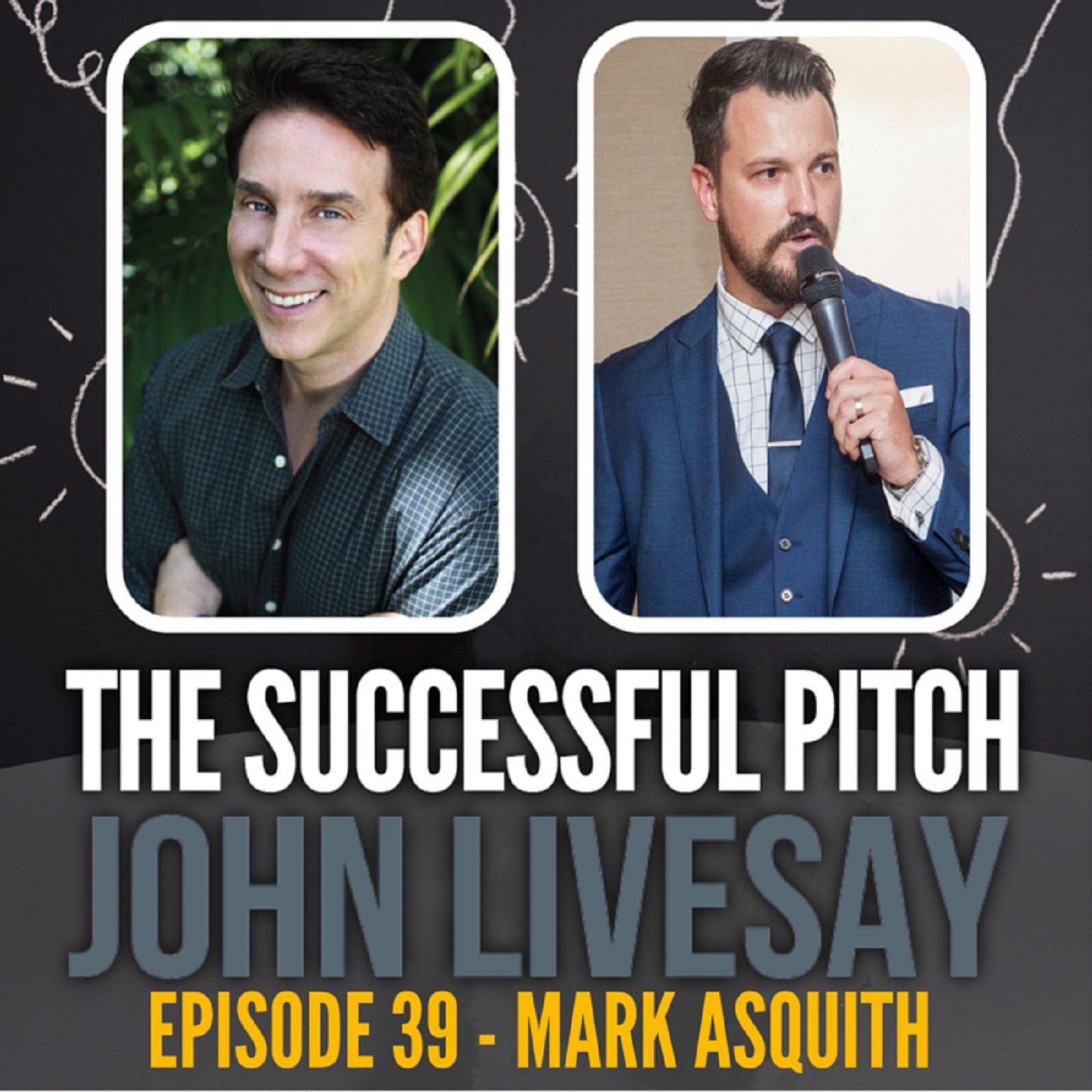
Listen To The Episode Here
Episode Summary
Mark Asquith is the host of the Excellence Expected podcast. His podcast was ranked the 1# small business podcast in the United Kingdom. Mark spells out how entrepreneurs can manage their time better and get more things done. He also shares a little bit about how to prevent burn out and why CEOs are horrible at Twitter.
Key Takeaways
- 00:02:10 – How did Mark get started?
- 00:05:30 – How did Mark come up with the name for the podcast?
- 00:07:25 – You can download a free productivity e-book on Mark’s website.
- 00:08:00 – If you don’t schedule it, then it doesn’t get done.
- 00:09:20 – What’s important, interesting, and integral?
- 00:10:50 – Want to prevent burn out? Be happy.
- 00:12:20 – How can CEOs really use Twitter?
- 00:15:45 – Mark talks about being the captain of your own ship.
- 00:19:50 – You get through the first year just by tackling it day by day.
- 00:20:50 – How many months will it take to break even? Make profit as quickly as you can.
- 00:21:45 – Is it possible to get leads from Periscope and Blab?
- 00:27:10 – Mark recommends the book, The Stranger’s Secret by Earl Nightingale.
Tweetables
[Tweet “Use periscope to make your face something people are used to seeing.”]
[Tweet “Job of founders is to steer the ship.”]
[Tweet “If it doesn’t get scheduled, it doesn’t get done.”]
[Tweet “Is it interesting, important and integral?”]
Links Mentioned
Excellence Expected
The One Thing by Gary W. Keller
Excellence Expected – 5 TWITTER SINS THAT ARE DESTROYING YOUR CREDIBILITY AND HOW TO STOP THEM TODAY
How to Be a Power Connector by Judy Robinett
The Stranger’s Secret by Earl Nightingale
Mark Asquith Twitter
Want the Transcription?
Share The Show
Did you enjoy the show? I’d love it if you subscribed today and left us a 5-star review!
-
- Click this link
- Click on the ‘Subscribe’ button below the artwork
- Go to the ‘Ratings and Reviews’ section
- Click on ‘Write a Review’