

Ownership Is The Ultimate Loyalty Program with Melinda Moore
Posted by John Livesay in podcast | 0 comments

Episode Summary:
Melinda Moore has always wanted to change the world and be in technology, and so every step of her professional career was a step towards understanding how much human information processing and technology was going to impact everything that we do. As a social entrepreneur and a seasoned digital marketer, Melinda likes to create companies that solve real problems. She has a new company out called iConsumer that not only allows people to save money when they shop online, but to become part of the company through consumer stock. She says that ownership is the ultimate loyalty program. She has a new book out, How to Raise Money: The Ultimate Guide to Crowdfunding, where she talks about all the resources and everything you need to know to launch a successful crowdfunding campaign.
—
On this episode on The Successful Pitch, our guest is Melinda Moore. She’s got an amazing story of how she has a successful exit with John Paul DeJoria of John Paul Mitchell Hair Care Systems. She has a new company out now called IConsumer.com that not only allows people to save money when they shop online but become part of the company. She says that ownership is the ultimate loyalty program and she has a new book out on how to demystify equity crowdfunding. You’re going to love her journey, her book and her new equity crowdfunding platform.
Listen To The Episode Here
Ownership Is The Ultimate Loyalty Program with Melinda Moore
My guest is Melinda Moore, who’s a social entrepreneur, a seasoned digital marketer, and a frequent speaker at leading technology conferences with over fifteen years as a startup leader, two successful exits, and a Fortune 500 experience. Melinda combines her passion and experience in health and sustainability, female empowerment, Yahoo! tech and digital media. Her work’s been widely recognized by Digital LA as one of the Top 50 Digital Women in 2015, the Green Business Bureau and the National Association of Women Business Owners. She’s also written a book called How to Raise Money: The Ultimate Guide to Crowdfunding. Melinda, welcome to the show.
Hi, John. Thank you so much for being here. It’s such a pleasure.
We were introduced by a mutual friend, Laura Wagner, at Digitzs, and that’s always the best way to meet people. I find that’s how I get my best guests. That’s how people get their network to grow and you’re a classic example of that with your expertise. Before we get into that, would you mind taking us back? You can start back as far as you want. You can take us back to high school, to college. When did you start saying, “I’m going to be an entrepreneur.”
It’s in somebody’s DNA. I’ve always been very adventurous and curious. When I was at UCLA, I was very fortunate that Peter Guber was running Sony Studios at the time and he had classes on entrepreneurship, motion picture marketing and technology. While I was at UCLA, I took his classes and it absolutely opened me up to how the future was going to be greatly impacted through technology. I decided back at that time I wanted to change the world and be in technology. My very first job out of college was producing educational software for Davidson & Associates, which then sold for $1 billion to the Ascendant Corporation. That was my very first job and it was understanding how much human information processing and technology was going to impact everything that we do.
That was like, “This is easy. I’ll do another company and sell that one.”
Unfortunately for that, when it was my very first job, so I was a producer, it was started by Joanne Davidson and her husband and so she was a teacher, but I essentially got an MBA, got the bug, and then after that I went on to my next company, which I had an exit in. It definitely got me excited and opened up the world of opportunity around entrepreneurship and making a difference.
I want to know about your successful eCommerce site, LovingEco to John Paul Dejoria in 2002. I met him several times. I used to call him in the John Paul Mitchell Haircare for advertising when I was at Condé Nast. He is quite the entrepreneur himself. How did you come up with the idea? How did you get the feeling enough to make him want to buy it?
I was born in Santa Monica, California, so I grew up surfing and hiking. I’m a little bit of a flower child and appreciate the planet. I was working at Rogers & Cowan running the convergence division. I thought to myself, “It’s time for me to get back into entrepreneurship.” I came up with the idea of LovingEco, which I knew women wanted to be healthier but they’re not going to sacrifice on style and they’re not going to sacrifice on price. I saw how successful the Gilt Groupe was at the time and flash sales. I created a green flash sale site called LovingEco. We guarantee that it had the lowest price on the Internet. We curated all the best natural products in beauty, health, fashion, accessories.

Loyalty Program: Most of us don’t fit into the profile, but it doesn’t mean that we can’t be fantastic business owners and create jobs and opportunities for others.
At the time John Paul Dejoria had started a company called JP Selects. LovingEco was started by myself and Justine Lassoff and we now have another company called LOVE GOODLY, which is based in Los Angeles. It’s like The Honest Company meets Bert’s Box. It’s a lifestyle company that gives back to charity and it curates all the best natural products. I’m an advisor to the company. Justine co-founded that company with Katie, who is another person who is on our team at LovingEco. What ended up happening and we were so successful that we got an offer to purchase the company about a year after we started it. We’re live by John Paul Dejoria. He folded LovingEco into JP Selects.
Did you have to pitch to get him to buy it? Did you have to pitch to get a co-founder? Did you have to pitch to get customers? Any pitching stories you have to share along that route?
I’m not Jessica Alba and not The Honest Company, but this was a little bit before that time. I’m always seeing what’s happening next, that’s just a talent that I had. It’s all about protecting the environment, so I thought the fastest growing segment of the beauty division was natural products and organic products and products that didn’t have chemicals because your skin is your largest organ. I knew that women didn’t want to pay extra, so I said, “I’m going to curate, do all the work for them and make it easy and I’m in to guarantee the lowest price.” That worked our cohort analysis, our lifetime value, all of the core metrics were very strong. In the combination of hardcore business metrics with the fact that natural beauty is the fastest growing category, that was the pitch.
When I pitched it to people on Sand Hill Road and as a woman, they’re like, “What do you mean natural products? What do you mean organic jeans and what do you mean you need to use dye?” It was almost as if I was speaking Chinese or a different language, which is partially why I went into crowdfunding and then wrote the book, How to Raise Money: The Ultimate Guide to Crowdfunding. Being an entrepreneur and recognizing that I’m not a male that went to Stanford or Harvard and wears a hoodie and a computer geek, then I wasn’t going to fit into the VC model. In fact, I’ve been a strong advocate for entrepreneurship, but leveraging crowdfunding and other methods to raise money. Because most of us don’t fit into that profile, but it doesn’t mean that we can’t be fantastic business owners and create jobs and opportunities for others.
That’s a nice transition. Usually, whether you’re starting a company or getting inspired to write a book, that’s because you see a problem that needs to be solved. Let’s take a deep dive into your book. How to Raise Money: The Ultimate Guide to Crowdfunding. We’re talking equity crowdfunding versus Kickstarter crowdfunding.
My book, it’s called How to Raise Money: The Ultimate Guide to Crowdfunding, which is available on Amazon for under $10. The book covers what is crowdfunding, what’s the history of it. It covers equity crowdfunding and it covers rewards-based crowdfunding, which is Kickstarter. Kickstarter has raised over $3 billion to date. It’s a huge industry and its surpassed venture capital. It also covers hybrid models. It’s a very comprehensive guide to my book that is available on Amazon, but ultimately, I am very passionate about entrepreneurship and ideas that can change the world. Whether somebody creates a hearing aid that allows somebody to hear for the first time. There’s so many innovations or they’re passionate about, electric bikes or a microbrewery or, in my case right now, I launched a company called iConsumer and I have a live campaign for crowdfunding. I’m very passionate about that, so I wanted to put that into a handbook. At the very end of my book, which is chapter ten, I put a guide of all of the leading platforms, their contacts, the marketing firms, lawyers, accountants so you can just literally, like I say, “Nike, just do it.” After reading my book, all the resources and everything are there to launch a successful crowdfunding campaign.
I’m interested in chapter nine about what works, what’s challenging, and what’s next. Can you give us a sneak peek on that?
What’s always challenging is people think it’s the field of dreams scenario. If I build it and if I take all the time to put a video in my deck and traction points to my business and great rewards, then the people will come. You have to understand that that does work. If you have a big database of existing customers that you can tap into that you can market it to, but you have to come up with an integrated marketing campaign almost as if you’re launching a new company to have a successful crowdfunding campaign, whether that’s rewards or equity. If you are not in a position to do that yourself, then you need to hire a firm, somebody like myself, someone like Darren Marble at CrowdfundX, so that you’re successful with the raise.
What services do you offer? You’ve given us a hint of the problem is. It’s not enough just to build it and expect people to come to it. Are you offering a service of, “Here’s exactly the five things you need to do to get people to want to fund this and share it in their network and make it a viral experience?”
What you need to do is think of it from an integrated marketing perspective. You have to have all the touch points. You have to have the right that you’re selling with the why you’re doing this. You have to have paid and earned media influencers. It goes down to having a fully integrated successful campaign. It’s all of those things.
Can you give us a story? I know that on your website, you have past work with some of your clients you’ve worked for. If you could walk us through what it’s like to have an integrated marketing concept, I think it would very much help people understand, “Don’t try to go this alone,” and that they need someone like you.
For instance, we raised a couple million dollars for Yao Ming, the basketball player. When he came to the states to play, he fell in love with a Cabernet from California and so he created Yao Family Wines. He put up a raise on Crowdfunder and at the time, I was the Chief Marketing Officer. What we did was created a fully integrated campaign. There was a lot of press and got into the Wall Street Journal. We did private dinners, investor dinners. We did a traditional marketing. We had him do marketing on his website. We marketed from the Crowdfunder website. It goes down to the experience and what are the assets that you have. In that case, we had Yao Ming, so to be able to have like a private dinner with the Yao Ming because you’re a shareholder, that has some very unique value. We were raising money for a tasting room, so you would be able to cheers and taste directly with Yao Ming if you put in the minimum of $5,000 into the deal. It comes down to unique experiential marketing.
[Tweet “Ownership is the ultimate loyalty program”]
It goes full circle from you being inspired by Peter Guber running Sony at the time. I believe that’s when that man seems to making these people their own star through crowdfunding. Let’s double click on IConsumer.com. What gave you the idea for that?
After writing the book, How to Raise Money: The Ultimate Guide to Crowdfunding, you have to then prove the model. I had met Rob Grosshandler because I was doing a lot of speaking. He’s the CEO of iConsumer and he approached me to co-found the company with him and be head of marketing to take it to the next level. It’s a massive B2C play. It’s essentially like Ebates or RetailMeNot where you’re getting discounts and cash back for shopping online. Who doesn’t shop online? By 2020, it’s going to be a $500 billion industry. Crowdfunding, there’s still a lot of mysteriousness around it and so you have to demystify it. A big B2C play where, as you’re shopping online, you’re getting cash back, but I’m giving you shares, actual ownership in iConsumer for just shopping online. When you sign up, I’ll give you 50 shares of iConsumer stock. Every time you shop, you’re getting cash back and you’re getting shares in the company.
What we wanted to do is essentially democratize the way companies are created, so we did a regulation tethered raise using equity crowdfunding to fund the company. That is what allows us to use actual equity as an acquisition and a retention tool so that we’re building and owning the company together. I always liked to create companies that solve real problems. What is a problem in the United States? There’s such income inequality. So much of the wealth is concentrated in the 1%. What about the 99%? When I looked at like what Blake did with Tom Shoes in the One for One movement, I said, “Why can’t we do the same thing with equity crowdfunding and prove in a big B2C model that people can be successful if you own the company together and then have people write another book and people copy what we’re doing with equity crowdfunding and what we’re doing with iConsumer so that you’re essentially voting with your wallet and you’re owning a piece of the company?”
It’s almost like saying to someone, “You’re going to be buying things on Amazon or wherever else you go online to buy something.” You might as well get compensated for it, not just like a coupon, but actually own part of a company that’s going to reward you for sharing this and using this. Is that accurate?
That’s exactly right. Our thesis is that ownership is the ultimate loyalty program. You’re already doing something, which is shopping online. You might as well shop smarter and get your share.
Ownership is the ultimate loyalty program. Everybody’s looking for that sticky factor when they get a new customer and it’s certainly investors are looking at that. What is it that keeps people loyal? I see this starting to happen a little bit in the cryptocurrency world that’s evolved out of the crowdfunding world. My guess is you’re going to write a book on that topic.
You now see the ICOs and people are creating platforms and they are rewarding people with cryptocurrency, blockchain. I know that Todd Chief raised like $1.5 billion to do these types of things. You’re seeing a lot of big business leaders moving into blockchain cryptocurrency for exactly what you’re talking about. It’s almost like Wild, Wild West.
If we take a look at IConsumer.com and you finish your round with this equity crowdfunding platform, do you anticipate that that’ll be all the money you need, or do you think, “I’m going to get a series from a traditional venture capitalist eventually?”
We launched the campaign on Crowdfunder, so it’s Crowdfunder.com/IConsumer and within the first 24 hours of the race, we had reached over 50% of our goal to get to a million. We have 50,000 members right now. We need another 200,000 to be cashflow positive, so most likely I will not do another round and most likely I will not include any venture capital. If I do anything else, I would open up another regulation a round. The current minimum investment is $1,000, but I could lower that to $50 or $100, so that our members could get more shares by opening up and allowing them to be investors. The whole goal here is to democratize access to people, being on Wall Street and in owning shares and understanding what that means. Rob, who is the CEO of the company, he also created another property called Shareholder Academy and that’s essentially a blog and a website for startups and for people understanding what equity crowdfunding is, what it means to be a shareholder. He was smart to basically help guide an education platform around shareholders in Shareholder Academy
Traditionally, if I understand Crowdfunder properly, you have to be an accredited investor to invest in that equity crowdfunding. Is that right?
That is correct. With the current raise that we’re doing on Crowdfunder, it is to accredited investors only.
However, if you go to IConsumer.com and sign up via Facebook or however you want to do it, you can start shopping and get 100 shares without being an accredited investor, which is the whole democratization that you’re talking about.
When you sign up, I give you 50 shares just for signing up and then the first time that you shop, because we want you to shop so that you’re using this site and that we’re making money, you’re making money, we give you another 50 shares just for the first time that you shop. If you refer somebody who shops, then we’d give you another 100 shares. I have about 1,700 shares just from shopping.
This earned impressions that’s part of this integrated marketing that makes it crowdfunding campaign successful is that whole sharing. Once you start getting brand ambassadors to promote, “This is the site.” If you’re going to spend the money anyway, you might as well own a little bit of it for that loyalty factor, but that earned impressions, brand ambassadors, word of mouth is the secret sauce.
The numbers are between 30% and 40% a week of our members are coming through referrals. People discover the site, they want to share with their friends, and they also benefit when they share. Definitely through referrals is a very strong way and an efficient way to grow a company and to grow brand awareness.

Loyalty Program: Definitely through referrals is a very strong way and an efficient way to grow a company and to grow brand awareness.
I’m on iConsumer and I see that you have Today’s Hot Deals on Amazon and certain things are for sale that you can buy and get credit for buying it on your site as opposed to the Amazon site, how does someone who is an Amazon vendor get to be considered part of your hot deal? Is it something Amazon decides or can people approach you to be a hot deal?
What we want is we want more small businesses to make sure that they are an affiliate and they’re signed up through iConsumer. That way, we can market the vendors directly. We have 1,700 stores and we’re adding new stores all the time. Amazon is the 800-pound gorilla in this space. I feel like we need to help smaller businesses and local businesses. Once they’re aware of iConsumer, they can sign up to be a vendor and promote their products. One of my girlfriends started Prelise, which is like a smaller skincare makeup line. Prelise is on iConsumer and we did a beauty newsletter and I was able to feature Prelise alongside Ultra Beauty and much larger brands. It’s really important for us to have an array of the big players but also the small players as well.
You’ve hit on something there that you probably take for granted because you’re such an expert at this, which is the co-branding effect. If you’re a small brand and you’re seen with other well-known brands that are much larger than you are, then there’s a little bit of a rub off effect that happens, “If they’re being featured this way, they must be at least as good a quality and maybe they might even be slightly less money. I might try them.”
The beauty of shopping is like discovery. If you do see bareMinerals next to Prelise, or sporting good company next to smaller electronics, people do associate credibility when they see one vendor on the same page or next to somebody else. It’s important too that we vote with our wallet, not for just the big companies out there, like the Amazons of the world, but also just smaller companies that are creating great products as well. They need the exposure.
I also see that you’ve got the hotel on here, which surprises me because I don’t think people normally think of e-commerce and travel as being that connected unless you’re on Expedia. How did that evolve?
Travel is a big vertical for us because the price points are high. If you’re going to go to Hawaii or Europe or New York and you’re spending somewhere between $300 to $1,000, why not get cash back and then earn shares for your ticket? We have Expedia and Priceline on iConsumer. You might as well shop through iConsumer because if you shop direct, you’re not going to get the same benefit as shopping through iConsumer. Part of that is an education process. Ebates is such a large company in that regard, so there are people familiar with Ebates but essentially, we’re Ebates but we give you shares in iConsumer as well.
It’s a double win, not just win-win. It’s getting that message out and you’re certainly incentivizing people to share it with their friends.
Whether you’re booking a hotel or you’re going to book Alamo or Hertz or Priceline, you might as well book it directly through iConsumer. We have Expedia. We make it easy because there’s departments and there’s different categories, so you can go directly to our travel and you can do that either on a mobile phone because we have an iOS as well as an android version and then desktop, so we try to make it as easy as possible for you to shop smarter and earn shares and cash back as you’re just doing what you do normally every day and every week.
I was impressed to see that you have a pet vertical on here because I know that’s a huge market, just like travel.
Pets are huge. It’s a multibillion dollar business. A lot of people don’t have kids and so they treat their pets like they’re kids, buying them toys, beds, clothes, food, and organic food. Pets is a very big area for us. Most people use PetSmart. You might as well use PetSmart or Petco through iConsumer. You go direct to Petco or Petsmart, you’re not going to get the cash back or the shares. You go shop through our mobile app or desktop, our buttoned browser, then you’re going to get 9.6% from PetSmart. You’re saving them as 10%.
[Tweet “There’s nothing more exciting than having an idea and wanting to bring that idea to life.”]
Any final thoughts or words that you want to leave our audience with? If someone’s thinking of starting a campaign, they should read your book. They should consider hiring you to help them so that it doesn’t just get up there and nobody uses it. Are there any life lessons you’ve learned along the way that you would say, “If I could say something to myself ten years ago, here’s the message I give.”
What I would say is there’s nothing more exciting than having an idea and wanting to bring that idea to life. When you’re doing that though, you have to be very methodical, very strategic. It does take planning and it takes money because if you don’t have that database or that existing customer database to market the campaign too. Then you have to figure out how you’re going to get influencers, how you’re going to get marketing to ultimately drive people to the marketing funnel of your deal. What you don’t want to do is just press go on a campaign because you’ve done all the work. It’s better to put a pause on that, either hire a firm that can help you. It goes down to having the right team and the right people and it’s about execution.
I was speaking to Darren Marble from CrowdfundX and he’s done getting Elio motors and big raises. We were saying sometimes people don’t understand how much work it is to be an entrepreneur. You have to make a choice. As an entrepreneur, it’s not a merry go round where you show up and you just attend meetings. It’s much more like a roller coaster. One day, you could have the highest high and you think you’re going to become a multimillionaire and the next day, you literally think you’re going to be broke. Things can swing so quickly. In order to be an entrepreneur, you have to be comfortable with being on a rollercoaster ride. If you’re the type of person that wants consistency and safety, then you need to get yourself onto a Merry-Go-Round and not the rollercoaster route of entrepreneurship. It’s hard work. The hours, the commitment, it’s not to be underestimated in terms of how much work it is. It’s fantastic and I wouldn’t have it any other way, but sometimes you just want to have a breakdown,
That’s so valuable and wonderful of you to let people in because from the outside looking in, it looks like you’ve never had a bad day in your life or even a bad hair day.
Entrepreneurship is sexy. Jessica Alba’s an entrepreneur. Gwyneth Paltrow’s an entrepreneur. Many top people are investing. There are celebrities and stuff, so it’s got this, “This is the next celebrities and stuff,” but what I want to say is it can be painful.
My big takeaway is that hope is not a strategy. If you just hope that people are going to find your equity crowdfunding platform, it’s not going to work. Melinda, how can people follow you? Would you give us your Twitter handle and everything else?
My Twitter handle is @Melinda_Moore. I have a website, which is MelindaMoore.com. That’s an easy way that you can follow me on Instagram. You can find me on Instagram and Facebook. It’s a great way to get more information. It’s been such a pleasure, John. Thank you so much for having me on your show.
You’re a fascinating person and a fascinating guest. I appreciate you sharing all those wonderful stories.
Thank you.
Links Mentioned:
- Melinda Moore
- John Paul Mitchell Hair Care Systems
- IConsumer.com
- How to Raise Money: The Ultimate Guide to Crowdfunding
- Davidson & Associates
- LovingEco
- JP Selects
- Justine Lassoff
- LOVE GOODLY
- CrowdfundX
- Yao Family Wines
- Rob Grosshandler
- Crowdfunder.com/IConsumer
- Shareholder Academy
- Prelise
- bareMinerals
- @Melinda_Moore – Twitter
- MelindaMoore.com
- Melinda Moore’s Instagram
- Melinda Moore’s Facebook
- https://www.amazon.com/How-Raise-Money-Ultimate-Crowdfunding-ebook/dp/B01F7O926G/ref=sr_1_1?ie=UTF8&qid=1506641434&sr=8-1&keywords=melinda+moore
About Melinda Moore
 Melinda Moore is a social entrepreneur, a seasoned digital marketer and a frequent speaker at leading technology conferences.With over 15 years as a start-up leader (two exits) and Fortune 500 experience, Melinda combines her passion and experience in health & sustainability, female empowerment, tech & digital media. Her work has been widely recognized by Digital LA (Top 50 Digital Women in 2015), the Green Business Bureau and the National Association of Women Business Owners’ Hall of Fame.
Her marketing campaigns have been featured by global brands including Ford, LIVESTRONG, Netflix, Obama for America, Orbitz, Sony, USA Networks, and YouTube. She has forgedstrategic partnerships with leading business, media, and entertainment figures including Jimmy Fallon, Laird Hamilton, Dr. OZ, Dr. Phil, Ryan Seacrest and Yao Ming. After co-founding and selling the successful e-commerce site LovingEco to John Paul Dejoria in 2012, she co-founded Tuesdaynights, a hosted invite-only networking organization of female executives andentrepreneurs.
Her growing list of event sponsors include Google, Lifetime and Silicon Valley Bank. While continuing to establish Tuesdaynights as a preeminent network event, Melinda is growing hermarketing and content creation technology practice. Melinda graduated from UCLA with a BA in psychology.
Wanna Host Your Own Podcast?
Click here to see how my friends at Brandcasting You can help
Get your FREE copy of John’s latest eBook Getting To Yes now!
John Livesay, The Pitch Whisperer
Share The Show
Did you enjoy the show? I’d love it if you subscribed today and left us a 5-star review!
-
- Click this link
- Click on the ‘Subscribe’ button below the artwork
- Go to the ‘Ratings and Reviews’ section
- Click on ‘Write a Review’
Selling To The Point With Jeff Lipsius
Posted by John Livesay in podcast | 0 comments
 Episode Summary:
In a field as competitive as sales, earning high commissions is top priority. Jeff Lipsius is the president and founder of Selling to the Point, which is a sales training and consulting umbrella platform. He developed Selling to the Point sales training during his 30 years of sales training experience. Back in the late ‘70s, he pioneered inside selling for the natural foods industry, successfully training the first sales force of this type in that industry. As a result, Jeff’s sales model is now being used by many natural food industry brands. Learn how to cultivate great relationships and enjoy your career as a salesperson – the Jeff Lipsius way.
—
Our guest on The Successful Pitch is Jeff Lipsius, who is the author of Selling to the Point. He has some great insights about internal conversations and internal confidence and internal choices and internal clarity that need to happen because most people are so focused on the external. He says, “What’s going on is they can’t hear you over your sales pitch,” and the best way to stop pitching is to start listening. Once you start listening, you learn by observing and when that happens, you get less distractions and your performance soars.
Listen To The Episode Here
Selling To The Point With Jeff Lipsius
Our guest is Jeff Lipsius, who is the President and Founder of Selling to the Point, which is a book and a sales training and consulting umbrella platform. He developed Selling to the Point sales training during his 30 years of sales training experience. Back in the late ‘70s, he pioneered inside selling for the natural foods industry and trained the first salesforce of this type in that industry. As a result of that success, his sales model is now being used by many natural food industry brands. He’s trained over a hundred sales people, both inside and outside, as well as sales trainers throughout his career, and the sales people that have been trained by Jeff are some of the highest commission earners in their industries. They are also able to cultivate great relationships and enjoy their career as salespeople and having been a former salesperson myself, I know how important it is to enjoy what you’re doing in order to be successful. The thing that stands out for me is that the salespeople who’ve been fortunate enough to be trained by Jeff have cumulatively sold over a billion dollars worth of products. Jeff, welcome to the show.
Thank you, John. Thank you for having me.
I’m always interested to ask my guests to tell us their own story of origin. You’ve been doing this for quite awhile and you weren’t always a sales expert. Would you mind taking us back to the days when you were working as sales and marketing manager for an allergy research group and how did you decide that you are going to become who you are?
Way back when, even in college when I was discovering who I was, the real theme would have to be applying conscious awareness to performance. These days a lot of people are talking about mindfulness and conscious workplace practices, but I was a little ahead of the curve. When I was nineteen years old still in college, I was pursuing a way to be able to be more conscious on the tennis court and play better tennis matches. I was a college team player and what I found was that as I became more conscious, in other words, as I put my state of mind in a more aware place, I was able to play better tennis and actually practice my state of mind to get mentally tougher on the court. Later, in my professional career, I decided to try the same thing. What if I was consciously aware during my sales performances, during my interactions with my customer? It was a mindfulness approach because I’m a mediator. You put the ego mind aside and focus on the customer and the interaction as it was rather than the distraction of, “Is this going well for me? Is this not going well for me? Do they think I’m smart? Do they think like me?” They were all distracting from what’s taking place in the interaction I discovered.
What that revealed was a second conversation taking place at the same time I was talking to my customer. It would affect the relationship. This second conversation is the internal buying conversation between my customers ears and as I would say one thing which is you could say conversation A, my external conversation with my customer, the customer would hear something uniquely different. They would assign a meaning to what I’m saying and come up with a whole different interpretation that I needed to know. Putting my distracting thoughts aside and really paying attention to the customer, I could begin to discern how the customer is receiving what I’m saying and lo and behold, I felt that was much more important because the goal of selling is buying.
[Tweet “Ask intriguing questions to get attention”]
Nobody’s going to give you credit for, “That was an incredible presentation, but nobody bought,” is what you’re saying there.
You, as a salesperson, don’t get a sale unless the customer decides you’re going to get that sale. It’s really the decision process that determines the salesperson’s success. The way I put it is a good salesperson is going to pay more attention to their customers buying performance, their salespersons’ selling performance.
In the world of startups, for example, if you’re pitching an investor and you’re trying to get that investor to “buy your vision and invest in your company,” then you would be smart to do what Jeff is suggesting, which is to look at what other types of companies that investor has “bought into and invested in.” When I was selling ads for Condé Nast, I would call on brands like Lexus and I would look at where else did Lexus by so that I can get a sense of what their past buying performances is as a criteria that might help me decide, “They liked that. If I can come up with something similar to that, then that might help me with their criteria to buy from me.
That helps when you have a background in the prospect’s buying performance, buying patterns, but I’ll take it one step further. You might have all that background and see that there is a certain type of buying style that this customer has, which is great. What I’m saying though is don’t be wedded to it. Don’t try to steer the conversation to mimic what you’ve learned because who knows? Maybe they had a bad cup of coffee that morning and they’re in a horrible mood. They’re not going to act today the way they normally would under other circumstances. You don’t know that until you begin paying attention at the moment to exactly how things are as it is and the awareness is going to allow us to modify what we need to do in order to make what we have to say well-received.
What you’re saying here is that this conscious awareness, being out of our head, we’re worrying about whether we’re liked or not. Trying to figure out what we think they might want, we can do all the due diligence in the world and preparation, which is great, but in the end we should be present in that moment to be able to zig or zag according to what that person is feeling and giving us this feedback.
Don’t let your preparation be a distraction.
Unfortunately, the majority of salespeople don’t even prepare. Let’s not discount the importance of practicing your pitch or your preparation or your sales presentation or whatever it is you want and what you can do to get your confidence up, but we can add to that of now that you’ve prepared almost like an actor. They memorized their lines, but then when the cameras start rolling for a movie, they are in the moment with the other actor and not wed to what all the rehearsals were, but they still rehearse.
That’s a good analogy. That nails it on the head what I’m trying to articulate. The connection between awareness and performance is learning. What you could say is we perform by learning and we learn by observing, by awareness. If we are less distracted, we’re going to be better observers, which will make us better learners, which will make us better performers. This is true in any performance activity, not just selling, but I’m using selling as a metaphor, and this is my greater purpose, is to be able to show people examples of how conscious awareness could be benefit in the workplace and in our performance so that more people can see the value of living life more consciously, ultimately will be the message I’d like to get out there.
Let’s say you as a salesperson are prepared and you’re in the moment and you’re not distracted and you’re willing to learn and perform at your best, what do you do or what suggestions do you have if the person you’re talking to is distracted? They’re constantly checking their phone while you’re talking. They’re clearly not interested in what you’re saying. What tips do you have to counter someone who’s distracted? Even if you’re playing tennis with him, if your tennis partner isn’t present there’s only so much you can do I suppose. I’d love to hear it in the sales analogy.
The main thing is to be asking questions. Salespeople need to be learners, not the teachers. Salespeople need to be great inquisitors, asking good questions because you see, the buying process that customer’s decision making is an internal process. The salesperson doesn’t know that conversation going on inside the customer’s head, but when you ask questions, that’s the salesperson’s window into getting insight. What is this customer’s decision process or what mood are they in? Like you said, in your example of the customer, it just looks distracted. If a customer’s distracted, it indicates that they’re disinterested, it indicates that for whatever reason, you haven’t established value, the value of paying attention to you. As soon as the customer starts paying attention, they’re no longer distracted. What you want to do with a question is steer the customer’s attention into something that’s going to be relevant to the decision to buying your product. When you ask a question that’s intriguing enough, the customer’s attention is going to shift from their iPhone on to you. How do you ask an intriguing question? You learn the customer’s values and priorities and beliefs and that will allow you to create the kinds of questions that are going to direct the attention.
Going back to the Lexus analogy, I knew from my research that Lexus was trying to get people to perceive Lexus as an emotional buy like they do a BMW as opposed to what they currently had, which is Lexus was rational buy. If I was to ask them a question about if we could show you a way to get people emotionally engaged with Lexus like they would BMW, would that be something that would be useful for our conversation? They’re like, “Now you’re talking about something that’s important to me and now I’m going to pay attention to that because that’s what I’m tasked with doing.” In order to ask smart questions, in my opinion, you have to do your research and be in the moment. Ask intriguing questions to get attention. That’s going to be one of the tweets from the episode. That was great. Let’s jump into this wonderful book Selling to the Point. You have a chapter they are called, “They can’t hear you over your sales pitch.” What a great title and since this is all about pitching for anything to get hired, to get people to buy from you, what have you, tell us what’s going on there when you wrote that? What’s happening when people can’t hear us over our sales pitch?
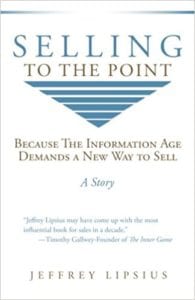
Selling To The Point: Because The Information Age Demands a New Way to Sell
The first thing I want to say overall about my book is consistent with what we’ve been saying so far. My book is one of the first selling books in the form of a fiction novel story. It’s got a plot with romance suspense. The reason I made it a fiction novel instead of a how-to book is because I want to show salespeople how to learn from conversation. I said salespeople are the learners, not the teachers. Where do sales people learn? They learn during the course of interaction, from dialogue. The customers will reveal their beliefs, their values, their priorities, their frustrations. As a salesperson learns his, the salesperson’s able to respond, and of course learning requires awareness, which is getting back to the original skill that I’m saying we need for our performance is good observation, good awareness.
What I was wanting to get across to the salespeople is that you can say whatever you want. If you’re talking to an unreceptive customer, it’s of no use. You could go through all kinds of training at the home office and get your pitch down and talk to the customer and relay all the selling points that you were trained and memorized and got them all out. If the customer is not interested, if the customer’s unreceptive, you haven’t accomplished a thing. Maybe one point that you might consider to be minor or almost irrelevant, you just happen to mention on the side of the customer really grabs on to that. In their own beliefs and values, this is very important. It’s not your pitch, but it’s how your pitch is being heard that’s going to determine whether you get the sale or not. I wanted to get that across in this particular chapter. The best sales pitch is a pitch that’s well received.
That’s also I think with the benefit to the readers of your book is instead of another how to book, you’ve put it into a fiction, so we are entertained while we’re learning as opposed to just learning and that makes it much more interesting and engaging and that’s the main reason for doing this. One of the things in your book and the story along the line is a character, Martin. He writes down that customers make the best buying decisions when they have the three C’s, Internal Confidence, Internal Choice and Internal Clarity. Let’s take a minute and go through each one of those. What is the emphasis on the word ‘internal’ around these three C’s?
The three C’s are what customers need to possess in order to make the best decisions. As a salesperson, you need to be skilled in decision coaching because sometimes you could say all the right things, but the customer still doesn’t buy because they might not be the best decision maker or they have a decision style that might not be optimal for this type of decision. They need to go into a coaching role. You need to shift from salesperson to decision coach, and if you’re going to be a decision coach, you have to gain a higher level of trust, which comes from letting the customer know that your goal is to help them make the best decision. That’s important because usually sales people’s goal is to get the customer to buy the product. The customer doesn’t share that goal. The customer’s own is to make the best decision. If the salesperson and customer are on the same page, then they work together as a team and you can have a coaching relationship.
One of the best things I’ve ever heard people say in the sales conversation is, “This may or may not be a good fit for you, let’s find out together.” That automatically goes, “Then you’re not so attached to me having to buy, that may not be the best decision if you find that I can’t afford it or it’s not what I need or whatever.” That also removes a lot of the pressure.
It does one more thing. It turns the conversation inward. You’re asking me what do I mean by internal with the three C’s and you gave a great example. If the salesperson is urging the customer, “You should buy, because I know this is a great product for you,” that’s outward. That’s about the salesperson’s point of view. If the salesperson says, “I don’t know. Let’s explore this.” Then it becomes more about the customer’s point of view, which is more inner. I’ll give you an example, I’ll start with internal confidence, which is one of my three Cs. If I ask any salesperson about confidence, they’re going to say, “Very important, confidence.” They try to get that, “With every sales call is to have the customer trust me. Customer is confident that what I say is actually what’s going on.” That’s external confidence.
Internal confidence is the customer’s self confidence in their ability as a decision maker. This is primary because the customer’s not going to trust the salesperson unless the customer first trusts themselves to decide if they’re going to trust that salesperson. What I’m trying to get sales people to do with this book and with my courses is turn your thinking around from external, which is about me and my performance to internal, what’s going to make the customers have the best decision performance. If you’re a coach and you’re coaching a customer and that customer has self-doubt in their ability to make a decision, then you’re going to have a compromised buying performance. For example, the customer may make an inappropriately conservative decision because of their self doubt and a salesperson skilled in asking the right questions can prevent this from happening and have the customer make a better decision. That’s internal confidence.
I was talking with someone who was thinking of hiring me to help them as their business coach with their pitch and modeling and they’re in this buyer’s remorse type of thing and it’s exactly what you described. They don’t trust themselves enough to make a good decision because they’re so afraid of making the wrong decision. They said, “On a scale of one to ten, I’m at a nine.” I go, “I’m going to feel so relieved if I get you to help me but then my internal monkey mind kicks in and I’m like, “How do I know he can help me and how does he know he can help me and on and on and on and on.” They just start spinning their wheels in such a crazy way. I have my own way of trying to help them calm that down, I’d love to hear your thoughts on that because that happens so many times no matter what you’re selling.
Ask a coaching question. For example, you could ask the customer, “If my services worked out well, what would you notice happening that would indicate that? Get the customer to start thinking about, “I would have this occurring and my people would be working more as a team with each other and there would be a better communication.” “Really, better communication, how would you measure that? How would you know the communication is better?” Getting them to focus on what they can know. From the scenario you’re describing, that customer is like, “I don’t have a crystal ball.” They want a crystal ball. If you bring it back like a coach would to a tangible, observable things, they realize that, “I can make this decision because I have a handle on the different indicators that would show me if it’s working out well or not.”
[Tweet “Shift from a sales conversation to a decision coach by building trust.”]
It’s future pacing them into things that they can measure, which then allows them to have more confidence in their internal decision process. Let’s jump into this internal choice. Let’s create a scenario. You and I are both keynote speakers. In this situation where the agent has said, “They like what you have to say. They’re just about ready to schedule a time to have a conversation with you before they decide but they think they like another speaker better and if they want to talk to that speaker first and if that doesn’t work out, then they’ll talk to you.” You’re like, “Their internal choice process is not really working in my favor. I have to hope that somebody else’s as opposed to let me get in the game.”
You have to take a little bit deeper dive into, “Why they feel compelled to listen to that person, the next presenters, and as a matter of fact, why don’t they want to hear three presenters, five or six? What’s going on? Typically, the low internal choice is the result of a self-limiting belief. When a customer has a self-limiting belief, it lowers the amount of options they feel they have at their disposal. You say that salespeople are selling options, selling choice. We’re selling solutions that the customer hadn’t previously considered. A lot of the times, it hasn’t been previous considered because there’s a self-limiting belief. An example could be somebody’s going to a company and looking at the org chart and they’re wanting to talk to the highest-ranking executive because they have the most choice, they have the most decision ability. Every salesman knows to do that. You get in front of this VP and start talking to them who extensively has the most choice because they’re ranked so high in the org chart and you hear them say, “I’m pressured by the board and I have regulators are getting in my way now and people are after me so I can’t make any mistakes, the shareholders are angry at me from last quarter so I really don’t want to make any decisions right now.” They have low internal choice even though their external choice, which is their positional power is very high, their internal choice is very low and you’re not going to get the sale.
It was almost like, “My hands are tied.” That’s a low internal choice, right?
Very much so. The self-limiting belief was when the executive said, “People are after me right now, people are wanting to watch me screw up so they could blame me for something.” It’s a self-limiting belief. They feel they don’t have options to choose from when it finds time to look for solutions. Internal choice is also very important to instill in a customer in order for them to make the best decisions. A customer with low internal choice is the most frustrating for salespeople because those are the customers that really liked the product, they really want the product. They think it’s the greatest product, but they won’t buy it because they don’t think they have the option to do so, even though they liked it so much. We all know customers like low internal choice.
Any recommendations on what to do when someone’s who’s got this? Maybe I don’t want to talk to a lot of salespeople. I get overwhelmed by all the choices or what to say?
That’s a perfect lead into my last and third C, which is the most important, which is what I call internal clarity. Internal clarity, if I talk to a salesperson about clarity, “You got to let the customer know about the products, all the features of the product, what it’ll do, how it’s better than the last model we made, and really make them clear.” That’s external clarity. Internal clarity is the customer’s self-awareness. Does the customer know what they need? Are the customers a clear on their goals? Is the customer in touch with priorities and values? If the customer doesn’t know what they need, how in the world can they figure out if your product features will satisfy that need?
I remember helping a real estate agent not waste his time with a bunch of potential buyers who was showing them endless amounts of houses and he hadn’t gotten them to define what would be the ideal house and when they saw it, they would pull the trigger because they didn’t have a criteria. They just go, “They always found something wrong with the house.” I’m like, “We’ve got to figure out the three things that when you see it in one place, you’re going to say yes to.”
The customer has to be clear and the salesperson can help customers get clear. I was talking to a financial planner and he had all these products that he wanted to present to me, but before he did anything, he goes, “What are your needs going to be after retirement?” He started asking me what’s going on with me? Then based on what I said, he was able to pick which product to present. That’s internal clarity. You could be lost, like lost in a mall or lost in a park or something and be looking at the most accurate map. If the map doesn’t have a, “You are here” mark, you’re still lost. You need that internal clarity in order to be able to work with the customer and getting back to your other question, internal clarity also increases internal choice.

Selling To The Point: Internal clarity also increases internal choice.
It’s all connected. Jeff, you have a special gift to offer the audience. Would you please share that?
Anybody that wants to hear more about what I have to say about this, I will have a free fifteen-minute consultation with you over the phone. You can reach me at [email protected]. My Twitter is @JeffreyLipsius. You can reach me anyway. I’ll be glad to talk to you and have a fifteen-minute conversation to see if I could give you any tips to help using the Selling to the Point method.
Who is your ideal audience that you love to give keynote talks to and workshops to?
All kinds of sales, but especially when salespeople have customers that reorder products, reusable products, or the relationship between the customer and the product is really important. That seems to be the sweet spot in terms of companies that really flourish hearing my keynote.
The renewable relationships, not the one-offs. Jeff, I can’t thank you enough for sharing your wisdom, your generosity, and most of all just helping all of us get better with realizing we need to shift from having external thoughts about confidence and clarity and choice to internal and that when we become conscious aware of what’s going on in the moment, it’s going to improve our performance.
Thank you so much, John, for having me on.
My pleasure.
Links Mentioned:
- Selling to the Point
- Selling to the Point – book
- [email protected]
- @JeffreyLipsius – Twitter
Wanna Host Your Own Podcast?
Click here to see how my friends at Brandcasting You can help
Get your FREE copy of John’s latest eBook Getting To Yes now!
John Livesay, The Pitch Whisperer
Share The Show
Did you enjoy the show? I’d love it if you subscribed today and left us a 5-star review!
-
- Click this link
- Click on the ‘Subscribe’ button below the artwork
- Go to the ‘Ratings and Reviews’ section
- Click on ‘Write a Review’
New Heart, New Life with Ava Kaufman
Posted by John Livesay in podcast | 0 comments


Episode Summary:
We’re all being disrupted in our businesses and in our lives, but what happens when we get disrupted in our health? Ava Kaufman was a former dancer who lost almost everything when she suddenly fell ill and ultimately found herself in need of a heart transplant. But she took this negative, turned it around, and created an organization called Ava’s Heart which is a non-profit that helps families of organ transplant patients. Ava shares talks about her new heart and new life in her book, The Transplant Journey, and shares some great insights about how to start a non-profit, the obstacles you have to overcome, and the life lessons you learn when you have a new heart and literally a new start. Find out how she did it and how you can, too.
—
Our guest on The Successful Pitch is Ava Kaufman. She has an incredible story of getting a new heart, a heart transplant. We’re all being disrupted in our business and in our life, but what happens when we get disrupted with our health? She has some great insights about how do you start a non-profit, what obstacles do you overcome and what life lessons do you learn when you have a new heart and literally a new start? Like starting over in your career or starting over and pivoting with your startup. She said, “You’ve got to let go of the small stuff.” She has some real insights in the ability to turn fear into courage. Finally she said, “Your waiting has to turn to patience or you’ll lose your mind.” Find out how she did it and you can too.
Listen To The Episode Here
New Heart, New Life with Ava Kaufman
I have a special guest introduced to me by one of my former guests, Steve Rohr. Her name is Ava Kaufman and Ava is a 60 something year old woman with a seventeen year old boy’s heart, literally. She was living the good life when she suddenly took ill and ultimately found herself in need of a heart transplant. Fortunately, she got one. That’s not always the case for everyone. In the process, Ava who’s a former dancer, she lost almost everything; her successful business, her home, but she took this negative and has turned it around, created an organization called Ava’s Heart, which is a non-profit that helps families of organ transplant patients. It’s AvasHeart.org. This is a great opportunity for everyone who’s listening to deal with whatever disruption you might be experiencing in your personal life and in your business. Ava has literally figured out how to pitch when it gets personal. Ava, welcome to the show.
Thank you so much, John. It’s wonderful to be here. I’m excited to meet you through Steve.
One of my favorite questions to ask my guest is to tell me the story of origin. Paint the picture of where you grew up. You had a dream of being a dancer, which you fulfilled. Take us all the way up until you started to feel ill.
I worked as a professional dancer when I lived in New York. I went to NYU, majored in dance. I toured the world with Gloria Gaynor and Donna Summer and worked in Paris with Johnny Hallyday. I had a wonderful life and then I moved out to California, met a guy, fell in love. He had a small little moving company and we turned it into this mega business, Blue Skies Delivery and Installation, which we sold. I have a beautiful adopted daughter who I adopted at birth. When I was 58 and had just sold our business and I was starting a new business about teen obesity, I developed a rash on my hands. Being the person that I am, I went to dermatologist. She told me I had psoriasis for three months. To make a long story short, I had an autoimmune disease called Dermatomyositis, which went misdiagnosed because no one gave me a blood test.
By the time the disease had progressed and started to weaken my muscles, it came on quickly. I had three months of a rash and then went to my doctor. She did blood work, told me my muscle enzymes were highly elevated. She sent me to a rheumatologist who proceeded to send me for some tests. I was on my way for a test and I dropped dead in my house and ended up at Cedars-Sinai Medical Center with LVAD, a pump and an ECMO machine. I don’t remember any of this at all. I was told I was given days to live and that I would need a heart. That would be the only thing that would save my life because the disease had destroyed all my muscles, including my heart. Because I had been in such good shape before, the muscle weakness of the disease came on quickly. Within two weeks, I put on 35 pounds. While I was in the hospital waiting for a heart, I blew up to 200 pounds. My normal weight is 110. That was a lot.
[Tweet “Fear turns to courage when you know your why.”]
This is all what I’ve been told because I was on life support at the time. They listed me as an experiment because I was at Cedars and they’re a pretty fabulous place. No one ever thought I would live long enough to get a heart and I was too sick to get an LVAD or a mechanical heart, things that they give you now as a bridge to transplant. I ended up getting a heart in ten days on my real birthday.
You literally were considered dead. You dropped dead and they brought you back?
They brought me back with paddles and they put in an LVAD, which is left ventricular advice to keep my left side beating, a pump on the right side, and then an ECMO machine to keep you breathing. Usually, they don’t do a transplant if you’re on ECMO. This was all I’ve got, this was God’s plan. I really feel it was God’s plan because I got a heart so quickly on my birthday. They put me into an induced coma for two months and as I was coming out of the coma I realized that I was trapped in my body and I couldn’t move. I heard people telling me that I had a heart transplant. I was petrified, and I couldn’t communicate anything.
The only thing that I could do was have tears run down my cheeks and then they’d knock me out again. It was one evening, the clock said 6:00 PM but it always seemed like the clock was saying 6:00. I was ready to leave everything. It was too hard, too embarrassing, to debilitating. I literally couldn’t move a finger. I couldn’t move my head, but my mind was clear, and everything was white. The room was white, everything was white. I was dressed in white and I said, “I’m ready to go.” I kept looking for the light, for my mother or my grandmother and nobody was there but the room was white and it was bright lights. I then found myself sitting in this huge palms and I said, “I’d lived a great life but I can’t do this anymore. My mind is going to explode.”
All of a sudden, I smelled my daughter’s dirty hair. She was an equestrian and she used to ride horses. She was eleven and we used to fight over her not washing her hair because she rode every day. I realized that there was no way that I could leave her because we were in the middle of a divorce and many things were going on and she needed me. I knew she needed me. At that moment, I made a deal with God or my higher power, whatever we choose to call what’s there. I said, “If you let me come back to being Jade’s mom again, to being who I was before. To be able to walk, run, and play with her,” because at that moment, I couldn’t move at all and the thought of doing anything was impossible, “I will spend the rest of my life giving back.” At that moment, I didn’t know what that would be, but I say now that that was the beginning of Ava’s Heart.
How long ago was that?
That was eight and a half years ago.
You’ve been having these last eight and a half years be all about helping other people going through your journey because there are a lot of things that have to happen when you need a transplant. Sometimes you’re on a waiting list. What would you say is the biggest lesson you’ve learned over these eight and a half years of having a non-profit charity?
I would say that the only way to get through life is living one day at a time. That life can change on a dime and that you have to look inside of yourself and find out what’s important to you at that time.
Do you find yourself not sweating the small stuff as much as you did before the heart transplant?
That’s exactly perfectly said because if anyone would have told me that I would have started to do something without not without the knowledge of knowing what it was, without the financial backing. I leaped into this without knowing anything and learned along the way.

The Transplant Journey: You have to learn what to say when applying to grants.
That’s what an entrepreneur does. Gather the resources and my passion and vision are strong that I’ll find the right people to support me.
It’s taken me a lot longer than I had anticipated, but that is definitely what’s happening.
What’s the biggest challenge in running a non-profit versus when you had a company that was for profit?
Getting people to believe in what you’re doing, especially because my mission is about something that most people aren’t aware of. They know about it, but they’re not aware of and until your life’s been touched by transplant, you’d had no reason to. I’m a college graduate, my family and my friends are all intelligent, smart people. No one had a clue as to what this journey would be or entail. The doctors tell you so much, but everybody is different.
My personal passion is helping as many people as possible become master storytellers and have a great elevator pitch so that people can instantly get what it is that you’re doing, whether it’s for profit or not. If we’re going to play a little bit, if you’re okay with this, elevator pitch for Ava’s Heart. From what I gather from looking at the beautiful website, we help families find temporary housing so that they can be near their loved ones as well as the person who’s waiting for the heart transplant, who has to be close to the hospital at a moment’s notice to find affordable housing, which is not always easy to do in a place like Los Angeles. Would that be a fair description of what you’re doing?
It would be a partial description of what I’m doing, and a very large part because you cannot get put on the list for a transplant, and I’m not talking about kidneys because kidneys are different, for a liver, for lungs or for a heart, unless you have post-transplant housing. Being that not every hospital is a transplant center and being that Southern California has the best transplant centers in the United States. Cedars is number one in the world for hearts and UCLA does more transplants than any other hospital in the world. Southern California is a destination for people at the end stage of their life and many who had been told to go home and wait, that there was nothing that could be done for them come here because there are special treatments at both of these hospitals, UCLA and Cedars, that had antibody treatments and things that can help people get listed.
You didn’t need this service because you live here, but this is for people who don’t live here, is that correct?
Right.
You need housing if you don’t live in Los Angeles and want to get your surgery in one of these two hospitals, you need to live within fifteen minutes, ten minutes, five miles?
Before transplant, you need to be within three hours. If you live in Nevada, Nevada has no transplant center. Everybody comes here. When you get the call, hop on a plane and you come here. Some people wait at home and some people wait in the hospital.
[Tweet “Let go of the small stuff.”]
The majority is for the post-transplant. How long does that typically take? How long do people need this post-transplant housing?
At least a month or two, they request three. Sometimes if I can’t get someone three months because it is expensive, and my funds are limited, they can stay for two. We have many people from Bakersfield, San Diego, Santa Barbara or Temecula.
That’s painting the picture. I always talk about whether you’re pitching someone to become a client, a customer. You started to get funded or in this case a non-profit, we have to tug at the heartstrings to get people to open their purse strings. We need to tug at some heartstrings here today. Imagine your life was about to end unless you got a heart, but you couldn’t get a heart or even get on the list to get a heart unless you were living close enough to one of these two hospitals and you couldn’t afford the housing. What would you do? This is a big problem that you normally don’t even know exist until you’ve gone through it. We’re asking you to open up your hearts and have compassion for people that you don’t even know who need a place to live so that they can survive the heart transplant.
That’s the beginning of a whole another journey of dealing with the anti-rejection medicine and all kinds of things. It’s not like, “See you later.” There’s a lot of care that’s needed and you can’t stay in the hospital the whole time for that. You need to go on and live your life and build your immune system up. There’s something in the journey and the messaging of literally tugging at heart strings to get a new heart. The kind of person that donates their organ, in your case, it was a seventeen-year-old boy, who made that decision, or his family made that decision that he was willing to give his heart up to someone who could use it like you. It all stems from this concept of sometimes we only want to help people that we can physically see. We’re seeing, “I’m going to go volunteer and serve food,” which is great, but it’s a step above is when the help you’re giving is not someone that you know or probably will ever know.
The other thing that we started to do, we’re helping donor families as well because without the donor families, we have no transplant families. Many of these families are not financially comfortable. There was a sixteen-year-old boy that was shot in a drive-by in downtown LA. His mother was a single mom with four other children. He was a good kid, wanted to go to college. He just was in the wrong place at the wrong time and he got shot. This mother donated his organs and he saved eight lives, and I can’t tell you how many others with tissue and eye donation as well. He was young and strong, had strong lungs and great heart. She did not have the funds to bury him. In my eyes, he’s a hero.
He wasn’t on a battlefield like our vets. He was gunned down in this country in Los Angeles. I feel like he needs to be honored and not even for the world but honored so that his family feels good about what they did. That was the first family that we ever helped and this year, I’m going to announce it at our event on September 14th, we will be starting to help donor families as well. They are the true heroes and I want to thank my donor family right now and every other donor family out there because what you do is heartfelt and amazing. You never know what that person is going to do with that organ. For my donor family, I am passing it forward and I have many other families because you decided to give me a heart.
That’s what inspired you to write your book, The Transplant Journey: A Guide To Transplant: Extraordinary Stories, Hope and Encouragement. What do we find when we buy and read this book?

The Transplant Journey: A Guide to Transplant: Extraordinary Stories, Hope and Encouragement
It’s written by me from my heart. I’m not a professional writer and it’s my thoughts on how fear is such a big part of this whole thing and how I’ve seen it. Not only in myself but in many of the people that I’ve helped, fear really turns to courage. All of these people waiting in hospitals or waiting at home are warriors. They’re courageous warriors and many of them are children. We don’t hear about all that much, but I’ve helped many babies and young children. As a matter of fact, one little girl, her name is Jessica, she’s had two heart transplants and she told me she’s going to take over Ava’s Heart when I get too old, so I shouldn’t worry about it.
She turned thirteen and she’s pretty amazing. We talk and she tells me her outlook on it because it’s different when you’re a child as to when you’re adult. It is the family that we’re helping because it was her parents and her brothers, and you get involved with the families. Fear does turn into courage and it makes you look at life differently because when your life is the thing that’s on the line, you realize how much you want to be here. All of the other things like, “I can’t believe it. I’m waiting here for half an hour and they still haven’t taken me to do my nails. They’re an hour late delivering the sofa. Where are the moving men?” All those little things that bothered people every day, I tried not to let bother me anymore. It doesn’t matter. It doesn’t. Life is such a beautiful gift and once you’ve almost lost it, whether it’d be a transplant or it could be cancer or whatever that you’ve been through, you look at everything differently. The sky’s bluer, the grass is greener, and you don’t sweat the small stuff. Love is the most important thing and friendship. I can say that I decided to live because of the love for my daughter.
What goes into that whole why, which is part of your book. I know it’s this whole concept that whether you’re a startup, working for yourself or working for someone else, you have to do something besides doing it to make money. You have to have a bigger purpose and mission and why you’re here, what you want to do with your life, but also in your business and your customers feel that way as well. When you’re “pitching” someone to support this charity or hire you to do something, if you have a bigger why, let’s say you’re a real estate agent, your bigger why could be I love helping people find their dream home. Something more than, “I just need the commission from selling you a house,” that people then tap into this. You talk about how waiting turns to patience and I want to see if there’s a takeaway that you could give us on how can we all learn to be more patient?
For me, I didn’t have that experience. I got a heart in ten days. I didn’t even know I was getting a heart till after I got a heart. I learnt that from the people that I’ve helped. I’ve gone through two years with some people while they were waiting with artificial hearts or LVADs for a heart or for lungs. That’s how I learned that waiting has to turn to patience. Otherwise, you can lose your mind. It gets back to one day at a time and that whole thing of waiting turns to patience has helped me grow this organization because it’s such a slow process.
[Tweet “Waiting has to turn to patience to stay sane.”]
The experience of waiting for your heart teaches you patience, even if it’s not your own personal experience. You see other people. Then your own patience because everybody, whether you’re working for yourself or another company, profit, non-profit, everybody wants rapid growth. That’s the key criteria for everything. I want to help as many people as possible.
In my life and everything else that I’ve done, I managed a piece, my husband and I built a business together. The growth was fast paced. We were providing a service. I knew how to sell it. It wasn’t as slow as this because number one, you ask for money in a different way. You have to learn what to say when applying to grants. When you’re in the non-profit world and you’re asking people with a lot of money for money, they say, “You don’t have any money, why would I give you money because how do I know you’re going to be able to sustain it?”
It’s similar to what a startup goes through trying to get their initial funding.
I was very fortunate. There’s a family foundation in Orange County called Change A Life Foundation. The gentleman who started it, who no longer is alive, was an amazing man and he wanted to help people make a difference in their lives. He put all this money into this foundation, Change A Life Foundation. They have partners and there are lots of different requirements to being one of their partners. Once you’re a partner, you can then apply for life-saving grants for X amount of people a year. A dear friend of mine who I knew through the horse world with my daughter, after my transplant sent me to this website and said, “Look at it and call Lisa Fujimoto.” I called Lisa Fujimoto who ran it and I told her I was a friend of my friend and we met, and she fell in love with my story. I was starting my 501(c)(3). I didn’t even have a board. She helped me put everything together and I became a partner with Change A Life. That changed my life and the life of the numerous people that we’ve helped throughout the last five years with life-saving grants up to $7,500. With housing, food, guest cards, strollers, baby seats and dental work but mostly housing because that’s what’s needed. My long-term goal is to have housing here in Southern California and also to become the go-to-foundation in this country for transplant patients. As David Foster has a foundation in Canada and he helps every transplant family with whatever they need, whether it’s paying their rent for two months or helping them get back on their feet, that’s what we need in this country and we don’t have it.
You certainly have a big vision, a big passion, and a big heart. If there’s one final thought you want to leave our audience with, what would it be?
Souls go to heaven. Organs don’t.

The Transplant Journey: Souls go to heaven. Organs don’t.
Tell us what that means.
It means to be an organ donor and help save lives because 22 people die every day waiting for life-saving organ. There was a young girl who was waiting for a heart in UCLA. Her mom used to take her into the chapel to pray. One day she looked at her mom and she said, “Am I praying for new heart or am I praying for someone else to die?” No one’s praying for anybody to die but there’s a plan in the universe and things happen. If that does happen to you or someone you love, you can turn that sorrow and that grief into something incredible.
You’ve certainly turned that into something incredible and I’m sure that person whose heart’s beating in you is thrilled to know on the spiritual soul level that it’s going to good work. Thank you so much for sharing your vision, your passion and most of all your story. That’s what we love here at The Successful Pitch.
Thank you so much for having me.
Links Mentioned:
- Ava Kaufman
- Steve Rohr – previous episode
- Ava’s Heart
- AvasHeart.org
- Blue Skies Delivery and Installation
- The Transplant Journey: A Guide To Transplant: Extraordinary Stories, Hope and Encouragement
- Change A Life Foundation
- Lisa Fujimoto
- David Foster
Wanna Host Your Own Podcast?
Click here to see how my friends at Brandcasting You can help
Get your FREE copy of John’s latest eBook Getting To Yes now!
John Livesay, The Pitch Whisperer
Share The Show
Did you enjoy the show? I’d love it if you subscribed today and left us a 5-star review!
-
- Click this link
- Click on the ‘Subscribe’ button below the artwork
- Go to the ‘Ratings and Reviews’ section
- Click on ‘Write a Review’