

Sales Kick Off (SKO) Meetings Statistics: USA 2026
Posted by John Livesay in Research | 0 comments
Sales kick-off meetings have moved beyond being annual pep talks to high-impact moments where strategy is set, teams are aligned, and sales performance is shaped for the year ahead. From leadership involvement and event structure to content priorities, keynote speakers, storytelling, and the growing role of AI, SKOs reveal how organizations are balancing motivation with execution.
To find out what 282,881 opinions of C-Suite leaders in the US were about sales kick off meetings, we utilized AI-driven audience profiling to synthesize insights from online discussions over 12 months, ending on June 10th, 2026, to a high statistical confidence level. These insights highlight how C-suite leaders are rethinking what it takes to engage teams, drive alignment, and turn big-picture strategy into real commercial momentum.
Index
- 36% of C-suite leaders hold formal sales kick off meetings annually, 26% do so quarterly, 21% hold SKOs twice a year, and 18% work on an ad hoc or as-needed basis
- 65% of C-suite leaders’ SKOs are rarely fully virtual, but 35% say that their format varies year to year, indicating a change in preferences depending on current circumstances
- For 91% of C-Suite leaders, over 500 people in their sales team attend their SKO, while for 9%, under 25 people attend, showing a huge variation in team sizes
- C-Suite leaders agree that CEOs are fully responsible for SKO outcomes, and 25% agree that there should be shared responsibility amongst the leadership team; however, 38% agree that individual sales managers should not be responsible for SKO outcomes
- 97% of C-Suite leaders’ involvement in SKO design varies each year, and only 3% delegate fully to sales enablement, pointing to clear trends in required input
- 76% of C-Suite leaders’ top priority for their SKO is to strengthen cross-functional collaboration but for 7% this isn’t a goal at all, 3% are prioritizing introducing new sales methodologies or tools, while 3% agree this is an important goal, and 4% disagree, saying it’s not a goal at all, a further 3%’s top priority for SKOs is to motivate and energize their sales force, while 2% aim to align the sales team on annual targets or strategies
- Keynote speakers or inspirational sessions are the content element that 91% of C-Suite leaders believe is absolutely essential at an SKO as it drives the most value, and 5% agree these add good value, while 3% feel that leadership Q & A and strategy sessions are absolutely essential, and conversations around sales skills training and workshops, product or roadmap updates, and peer-to-peer recognition and awards don’t feature
- For 57% of C-Suite leaders, storytelling is embedded throughout all their SKO sessions, 11% include internal sales leaders sharing customer success stories, 10% rely on an external keynote speaker focused on storytelling, and 5% use structured story frameworks in workshops; however, 18% don’t formally incorporate storytelling into their SKOs
- 35% of C-Suite leaders select external speakers for their SKOs based on industry reputation and speaker bureau referrals, and 22% rely on peer recommendations from other C-suite leaders, but 43% say they rarely use external speakers, giving no indication of how they select them when they do
- Emotional intelligence and buyer empathy are the SKO topics that 56% of C-Suite leaders wish got more attention, while 26% agree it could use more focus, 9% share the same sentiments about AI tools and sales technology, and 6% agree this topic needs much more attention, while 3% feel the same about competitor intelligence and market positioning
- 87% of C-Suite leaders’ organizations usually run their SKO over 3 days, and 12% run it over 2 days, indicating a preference for longer durations rather than shorter time spans
- Keeping attendees engaged throughout is a significant challenge for 94% of C-Suite leaders with their SKOs, while the remaining 6% battle with ensuring that the post-SKO momentum is maintained
- 21% of C-Suite leaders are currently using AI for personalized outreach and content, 1%for forecasting and pipeline management, and 1% for AI-powered prospecting and lead scoring, but 77% have not yet adopted AI in sales The story doesn’t end with the keynote
- For only 10% of C-Suite leaders AI adoption is a core agenda item and major focus of SKOs, and is somewhat included for 8%, compared to the 4% who say it’s not really included, 27% do not include AI adoption at all but agree they should, 2% briefly mentioned it, 21% plan to include this focus topic next year, and 27% say it’s not relevant to their team, so they don’t include it
- 37% of C-Suite leaders rate their last SKOs overall impact as poor, with minimal impact on teams or results, another 37% felt there was below expectations and had low engagement, while only 13% said that their SKOs overall impact was average and had some value, and 13% felt there was strong as their team was energized and focused
- More tailored, team-specific content would help 55% of C-Suite leaders invest more in their next SKO, and 9% say this is a top priority, while 21% list proven link to revenue growth as a top priority, and 15% as something that would help them to invest more
- An evolving SKO model
- About the data
How often do C-suite leaders’ organizations hold formal sales kick off (SKO) meetings?
36% of C-suite leaders hold formal sales kick off meetings annually, 26% do so quarterly, 21% hold SKOs twice a year, and 18% work on an ad hoc or as-needed basis.
The regularity of SKOs varies:

Gartner reported that, in 2023, 46% of organizations planned an in-person SKO, with the leading expected benefit being account-planning sessions that help drive closed won deals.
For our audience of C-suite leaders, the frequency of formal sales kick-off meetings varies, but everyone is holding them at some stage or another. 36% hold an SKO annually, making it the most common approach. A further 26% conduct these meetings quarterly, while 21% bring teams together twice a year.
Meanwhile, 18% take a more flexible route, holding SKOs on an ad hoc or as-needed basis. This could be as often as monthly or as seldom as once a year, and indicates a preference for tailoring sales alignment and training to changing business priorities, market conditions, or major product launches rather than following a fixed schedule.
John Livesay agrees: “In my 20 years of giving keynote talks, the firms that have SKOs twice a year are the ones that have the biggest impact because it keeps the momentum going.”
What format does C-suite leaders’ SKO meetings primarily take?
65% of C-suite leaders’ SKOs are rarely fully virtual, but 35% say that their format varies year to year, indicating a change in preferences depending on current circumstances.
SKOs don’t fit into a single type of format:
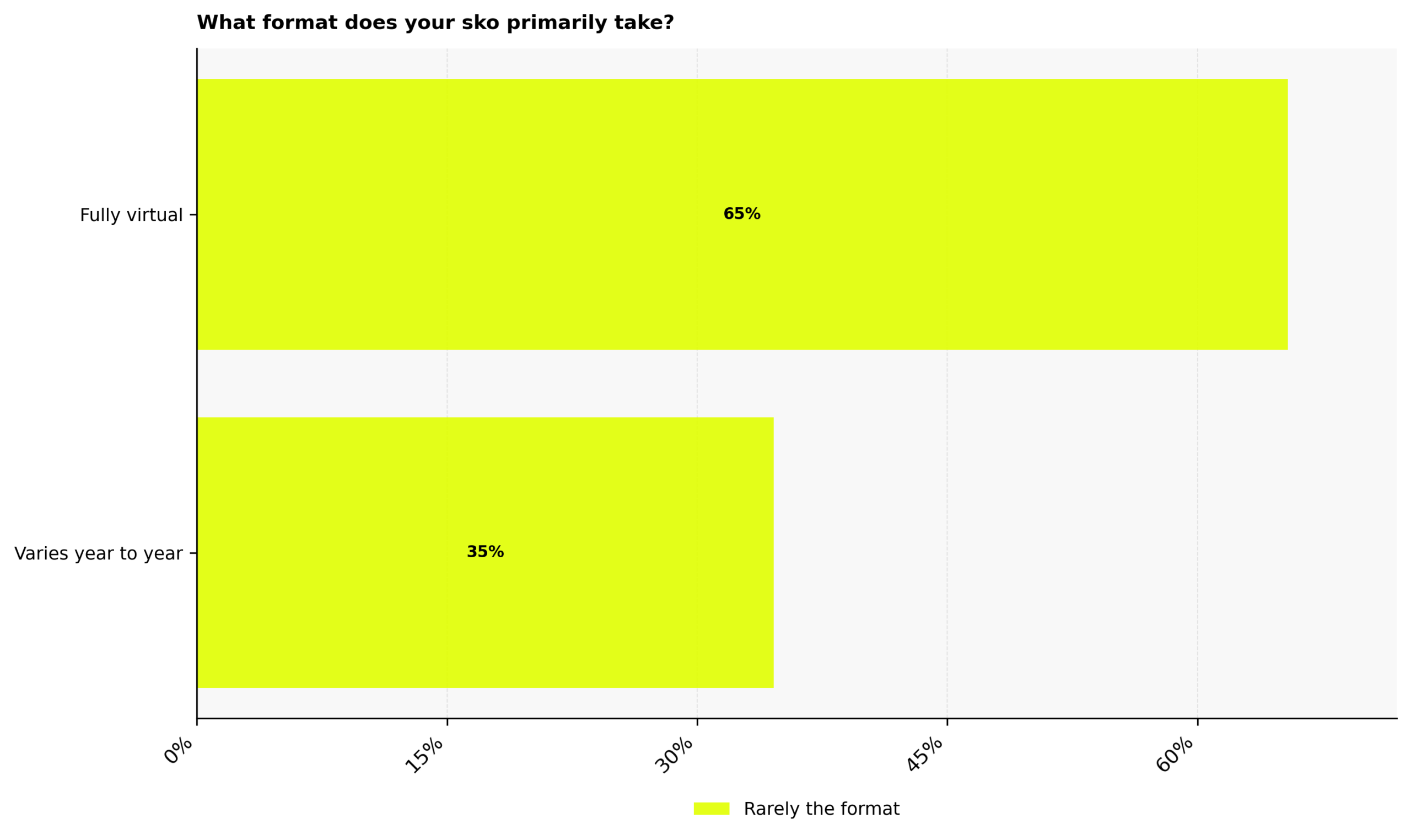
At C-suite-led organizations, SKO meetings are structured in two primary ways. Fully virtual formats account for 65%, though they are rarely used as the default approach. For 35%, the SKO format varies from year to year and is seldom the standard format.
This flexibility ties in with the way many organizations work today. With remote and hybrid working now firmly established, sales teams are increasingly spread across multiple locations. According to Statista’s 2025 report on remote and home-office work, around 1 in 5 US adults works from home regularly. As a result, many organizations are adapting their SKO programs, choosing virtual formats or changing them to best suit their teams, business goals, and working arrangements.
John Livesay disagrees: “Now that the COVID pandemic is over, 95% of the keynotes I give at SKO are live not virtual as corporate leaders value in person connection.”
What size sales team attends SKO meetings at C-suite leaders’ organizations?
For 91% of C-Suite leaders, over 500 people in their sales team attend their SKO, while for 9%, under 25 people attend, showing a huge variation in team sizes
Small and large teams are in attendance:
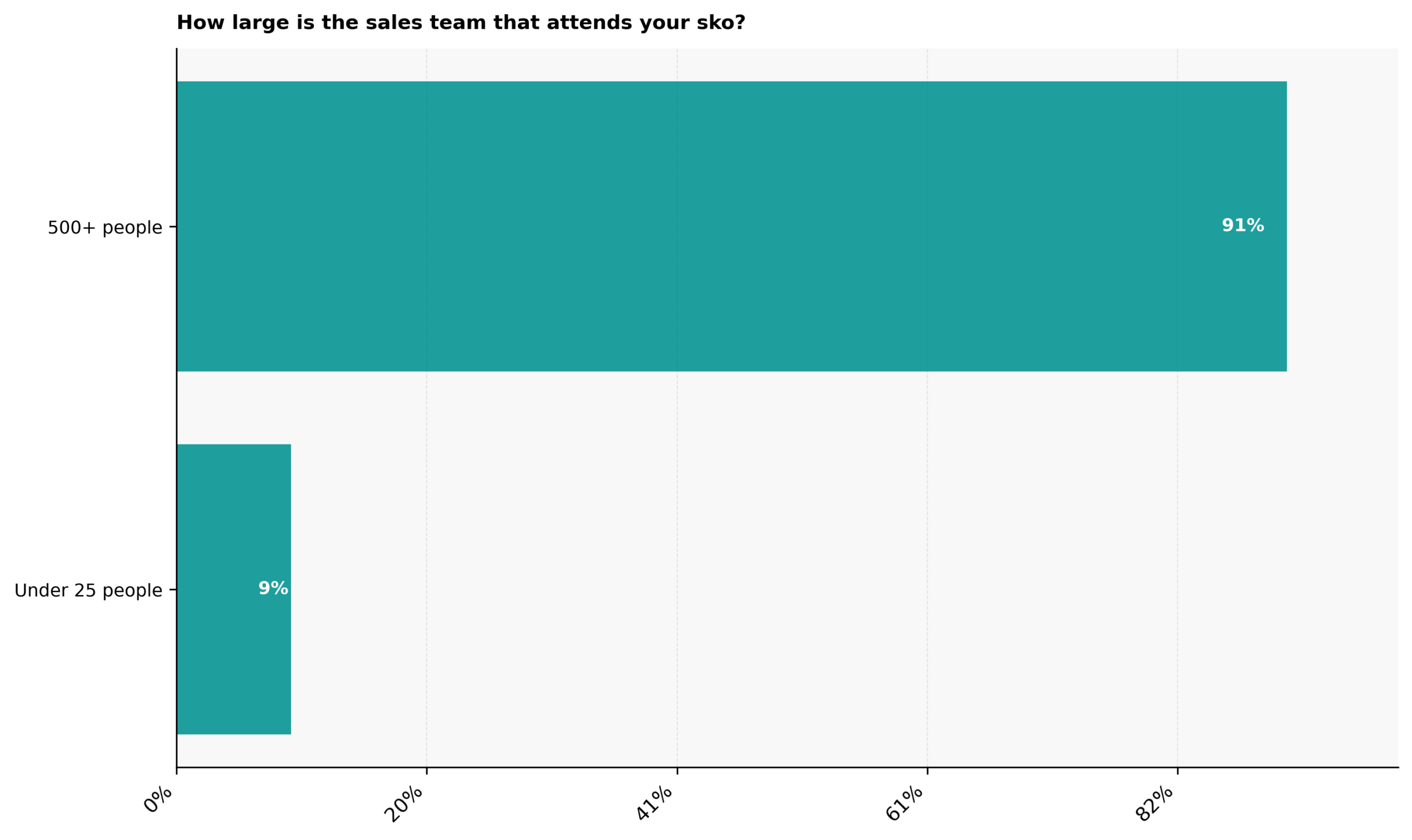
Sales kick-off meetings appear to be large-scale events for most of the organizations in our audience. An overwhelming 91% of C-suite leaders have more than 500 people attending their SKO, while just 9% report sales team attendance of fewer than 25.
While these figures are vastly different, the large attendance is not unexpected given the size of many US organizations. According to the US Census Bureau, the Health Care and Social Assistance sector alone employs more than seven million people across thousands of establishments with 500 or more employees.
Bringing hundreds of sales professionals together simultaneously allows organizations to share strategy, align teams, and reinforce company goals, showing the scale at which many sales organizations now operate.
John Livesay says, “I agree; in my experience, the average size of a keynote audience is 300 people.”
Who is accountable for SKO meetings outcomes in C-suite leaders’ organizations?
C-Suite leaders agree that CEOs are fully responsible for SKO outcomes, and 25% agree that there should be shared responsibility amongst the leadership team; however, 38% agree that individual sales managers should not be responsible for SKO outcomes
Ownership is clear-cut either way:
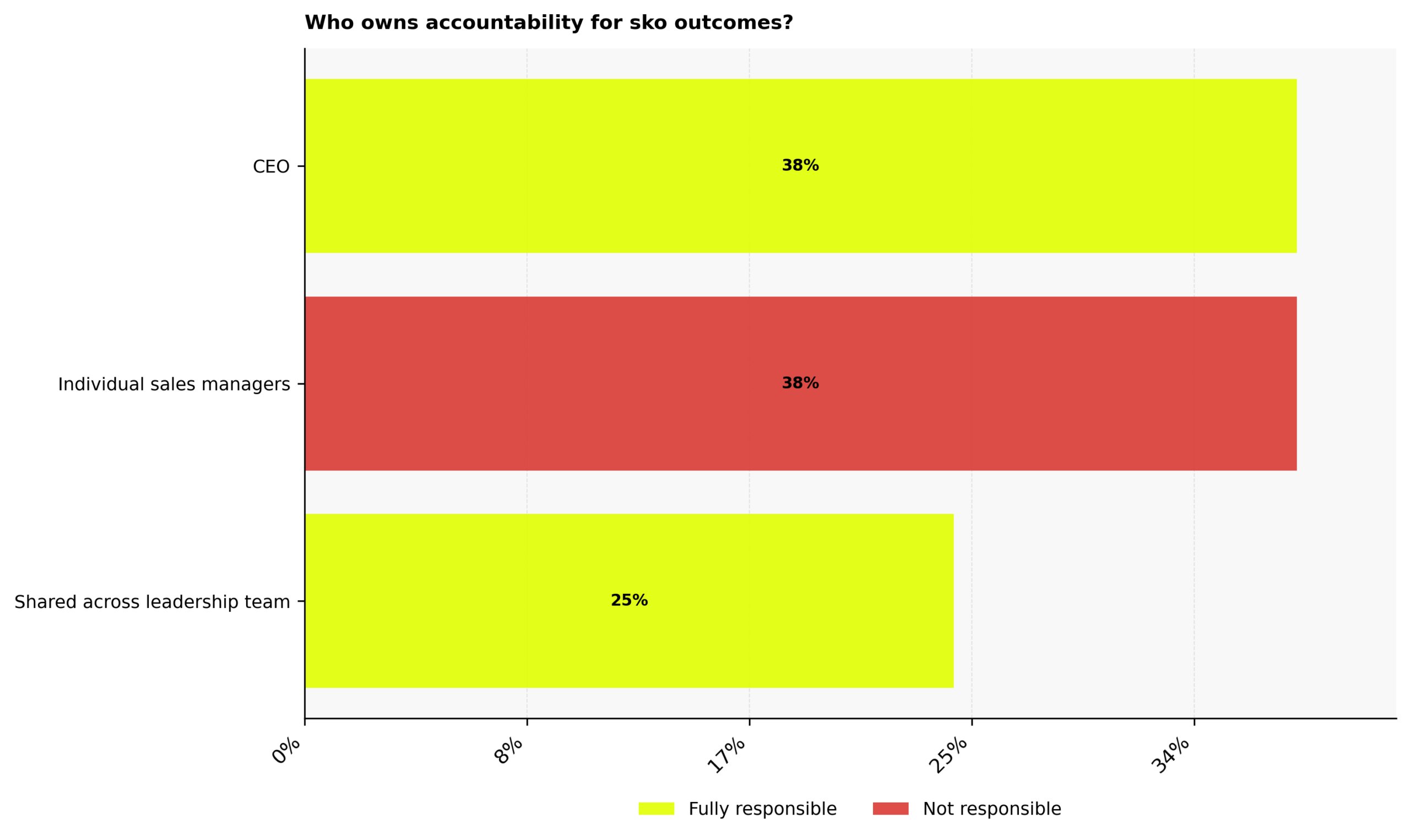
Accountability for SKO outcomes appears to sit primarily at the highest levels of leadership. Among our audience, 38% of CEOs are fully responsible for SKO results, revealing the strategic importance many organizations place on these events. A further 25% report that accountability is shared across the leadership team, suggesting a collaborative approach to planning, execution, and follow-through.
Yet, 38% of individual sales managers are not responsible for overall SKO outcomes. This distinction shows that while sales managers play a key role in implementing strategies and supporting their teams, ownership of event success is often tied to broader organizational goals set by senior leadership. It also indicates that organizations increasingly view SKOs as business-wide strategic initiatives rather than standalone sales department activities.
“When everyone takes ownership for the success of the SKO, including hiring the right speaker who customizes the talk, then the results are stellar!” agrees John Livesay.
How involved are C-suite leaders in SKO meetings design?
97% of C-Suite leaders’ involvement in SKO design varies each year, and only 3% delegate fully to sales enablement, pointing to clear trends in required input
One clear involvement pattern emerges:
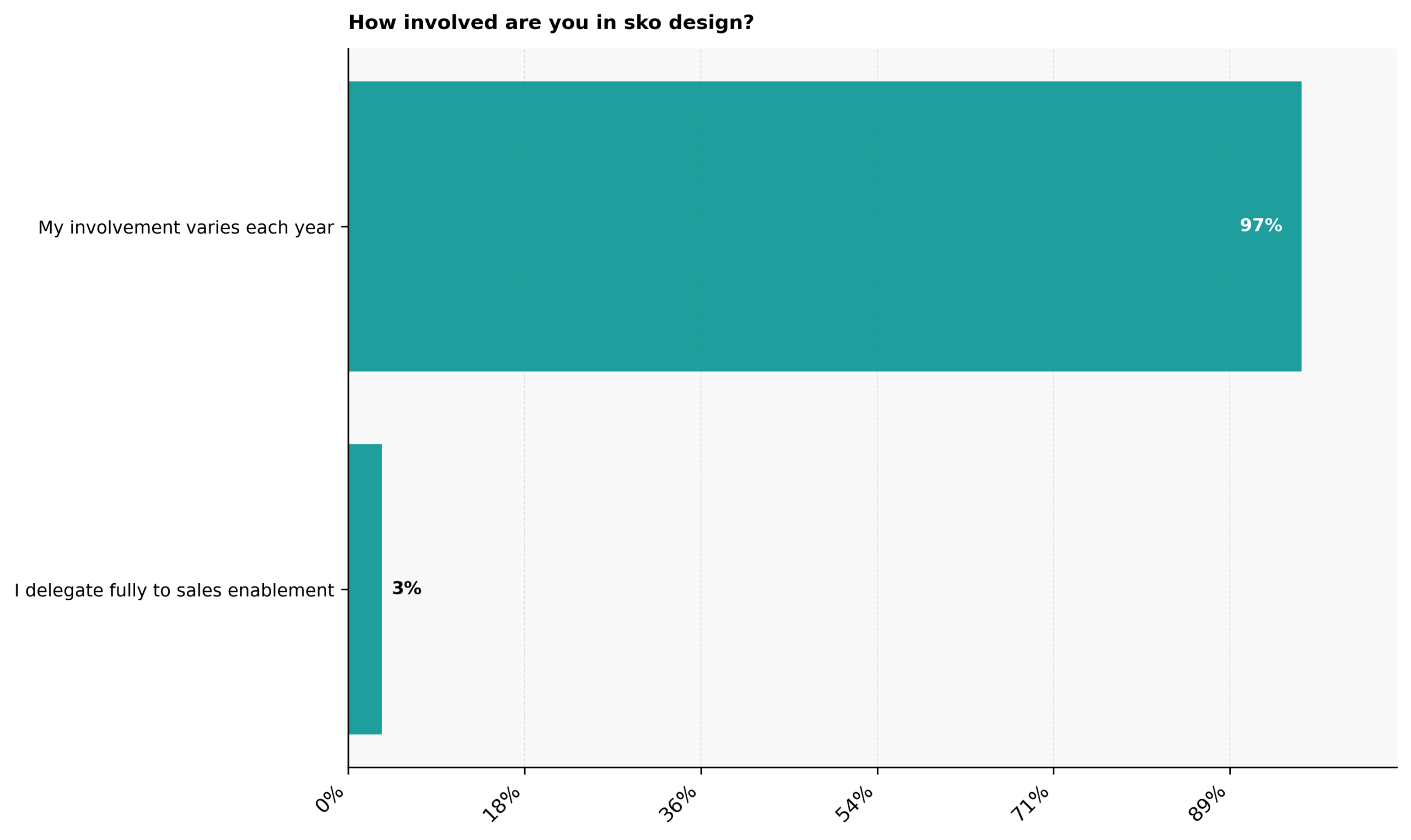
C-suite leaders appear to take a flexible, hands-on approach to sales kick-off design. 97% of our audience have varied levels of involvement from year to year, while just 3% fully delegate responsibility to sales enablement teams.
This is the nature of C-suite leadership, where executives set strategy but adjust their involvement based on business priorities. Rather than taking the same approach year after year or handing ownership to another team, many leaders tailor their participation to each SKO’s goals, helping ensure the event remains relevant and aligned with the organization’s current direction.
John Livesay agrees because the CEO usually introduces him as the keynote speaker. They are very involved in every detail.
What do C-suite leaders want SKO meetings to achieve?
76% of C-Suite leaders’ top priority for their SKO is to strengthen cross-functional collaboration but for 7% this isn’t a goal at all, 3% are prioritizing introducing new sales methodologies or tools, while 3% agree this is an important goal, and 4% disagree, saying it’s not a goal at all, a further 3%’s top priority for SKOs is to motivate and energize their sales force, while 2% aim to align the sales team on annual targets or strategies.
Goals tackle different directions:

One objective stands well above the rest when it comes to sales kick offs. Among our audience, 76% of C-suite leaders identify strengthening cross-functional collaboration as their top priority, while conversely, just 7% feel it is not a goal at all. Research has found that 84% of marketing leaders and employees experience significant “collaboration drag” when working across functions. Understandably, then, many organizations view SKOs as valuable opportunities to break down silos and strengthen teamwork across departments.
Other objectives rank much lower as leading priorities: 3% cite introducing new sales methodologies or tools as their top goal, and another 3% describe it as an important goal. However, new methodologies are not a main focus for approximately 1%, while 4% do not see it as a goal at all.
Also on the lower end of the scale are conversations about motivating and energizing the sales force, which is the top priority for 3%, while 2% place the greatest emphasis on aligning sales teams around annual targets and strategy. Launching new products or services ranks as the top goal for approximately 1%, pointing to the fact that the main focus of most SKOs extends beyond any single initiative.
Remark- Disagree John Livesay Today getting collaboration is not enough. Leaders expect the keynote speaker to not only inspire but give actionable takeaways that move the needle starting right away. That usually includes new mindsets and frameworks on how to tell compelling stories.
Which content element do C-suite leaders believe drives the most value at SKO meetings?
Keynote speakers or inspirational sessions are the content element that 91% of C-Suite leaders believe is absolutely essential at an SKO as it drives the most value, and 5% agree these add good value, while 3% feel that leadership Q & A and strategy sessions are absolutely essential, and conversations around sales skills training and workshops, product or roadmap updates, and peer-to-peer recognition and awards don’t feature.
One content element dominates at SKOs:

When assessing which content element delivers the most value at an SKO, C-suite leaders show a remarkably strong preference for keynote speakers and inspirational sessions. 91% of our audience considers this content absolutely essential, while a further 5% believe it adds good value. By comparison, leadership Q&A and training sessions are viewed as absolutely essential by 3% of leaders.
Other content types receive comparatively limited emphasis as primary value drivers. Less than 1% identify sales skills training and workshops as absolutely essential, and even fewer find they add good value. Less than 1% employ product or roadmap updates as the main driver of SKO value, while peer-to-peer recognition and awards are considered absolutely essential by less than 1%.
The focus of conversations shows how many organizations view SKOs as more than training or information-sharing events. C-suite leaders appear to place the greatest importance on SKO sessions that inspire, align, and energize teams, helping set the tone for the year ahead and reinforcing broader organizational goals.
John Livesay says, “The best keynote speakers make an impact that people reference for the rest of the event.”
How do C-suite leaders incorporate storytelling into their SKO meetings?
For 57% of C-Suite leaders, storytelling is embedded throughout all their SKO sessions, 11% include internal sales leaders sharing customer success stories, 10% rely on an external keynote speaker focused on storytelling, and 5% use structured story frameworks in workshops; however, 18% don’t formally incorporate storytelling into their SKOs.
For most, storytelling is a crucial part of SKOs:
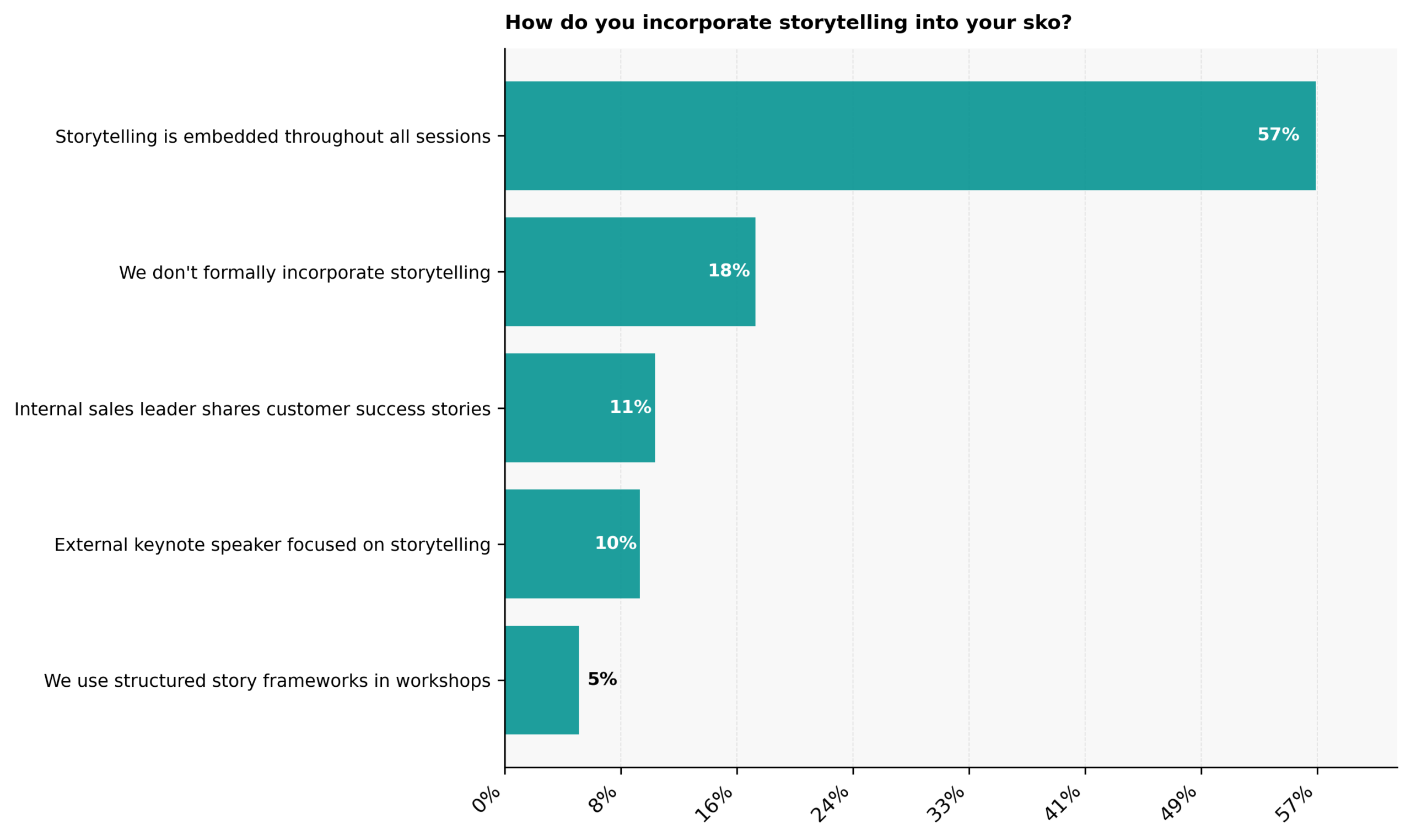
Research has shown that storytelling can help professionals frame business challenges as meaningful journeys, making complex goals more relatable and inspiring. By using this approach, C-suite leaders can strengthen connections in their organization between strategy, customer success, and day-to-day sales activities.
With so many positive benefits, it’s good to see that storytelling plays a significant role in many sales kick-off events, although organizations take different approaches to incorporating it. 57% of our audience embed storytelling throughout all sessions, making it the most common strategy by a wide margin. Meanwhile, only 18% do not formally incorporate storytelling into their SKOs. But this does not mean they don’t include it at all; it just means that it is not included in a formalized format or even done so consciously.
Other approaches include having an internal sales leader share customer success stories (11%), bringing in an external keynote speaker focused on storytelling (10%), and using structured story frameworks in workshops (5%).
It’s evident from this split that many organizations see storytelling as a valuable tool for creating engagement and reinforcing key messages, though the data points to a preference for weaving narratives throughout the event rather than limiting them to a single session.
John Livesay agrees. “Once audiences learn how to tell their own story of origin, the company story and a case story, they become magnetic and memorable.”
How do C-suite leaders select external speakers for their SKO meetings?
35% of C-Suite leaders select external speakers for their SKOs based on industry reputation and speaker bureau referrals, and 22% rely on peer recommendations from other C-suite leaders, but 43% say they rarely use external speakers, giving no indication of how they select them when they do.
Selection is driven by referrals, reputation, and recommendations:
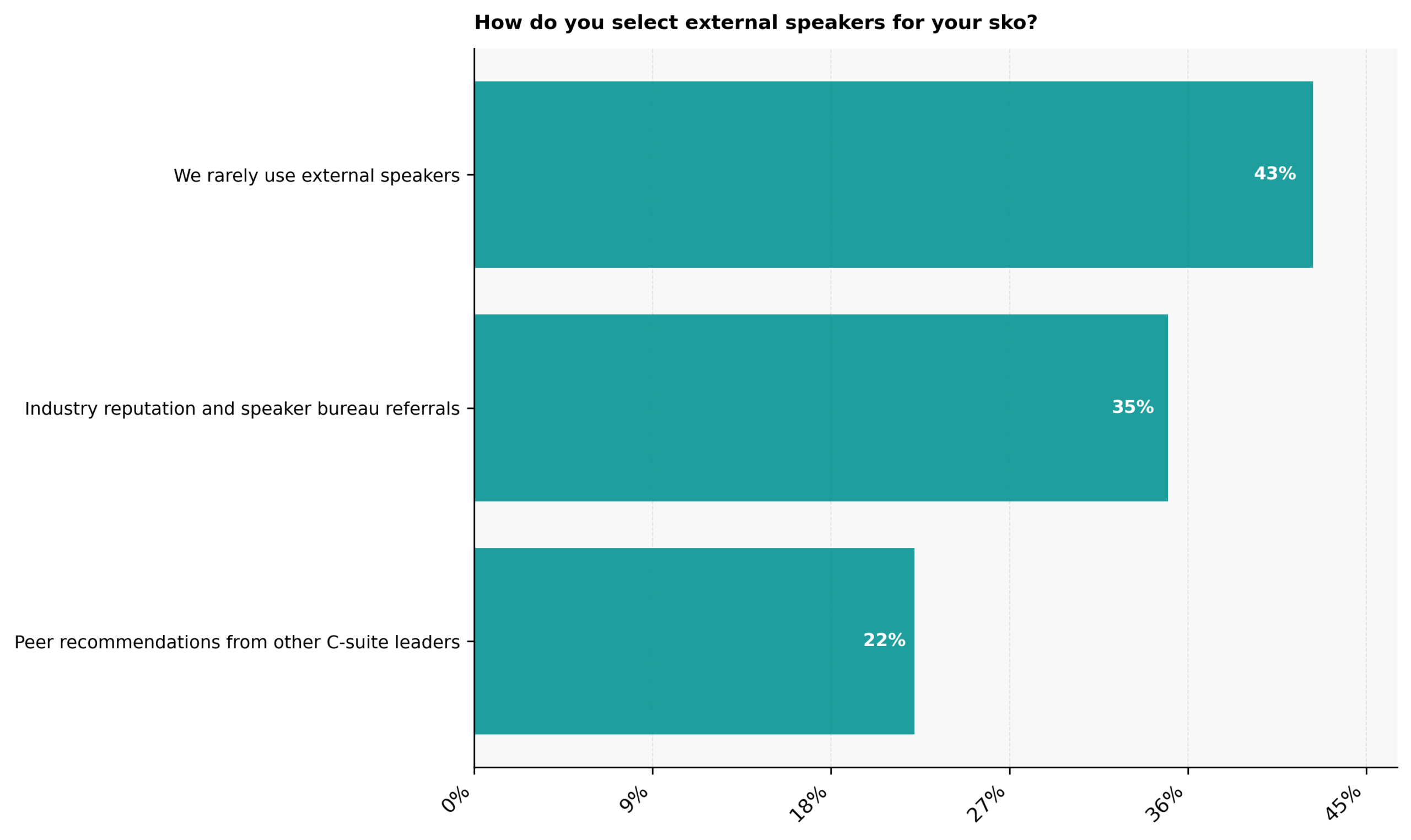
Approaches to selecting external speakers for SKO events vary across organizations, with many leaders choosing not to rely heavily on outside presenters. 43% of C-suite leaders say they rarely use external speakers, and they don’t provide information on where they’d source them from if they did.
However, those that do number over 50%. And for them, industry reputation and speaker bureau referrals are the most common speaker selection methods, cited by 35% of our audience. Another 22% turn to peer recommendations from fellow C-suite executives when identifying potential speakers.
These findings show the enduring strength of the referral, recommendation, and reputation trifecta. A strong industry reputation builds confidence, referrals from speaker bureaus provide a level of vetting, and recommendations from trusted peers offer real-world validation. These three signals reduce uncertainty and make it easier for executives to choose speakers they believe will deliver value and resonate with their teams.
John Livesay disagrees. “The majority of people realize they need an outside expert in the form of a keynote speaker to get their team to change their behavior. Interviewing speakers has become the norm, versus just relying on a referral.”
What SKO meeting topic do C-suite leaders wish got more attention?
Emotional intelligence and buyer empathy are the SKO topics that 56% of C-Suite leaders wish got more attention, while 26% agree it could use more focus, 9% share the same sentiments about AI tools and sales technology, and 6% agree this topic needs much more attention, while 3% feel the same about competitor intelligence and market positioning.
A few topics need to be talked about more:
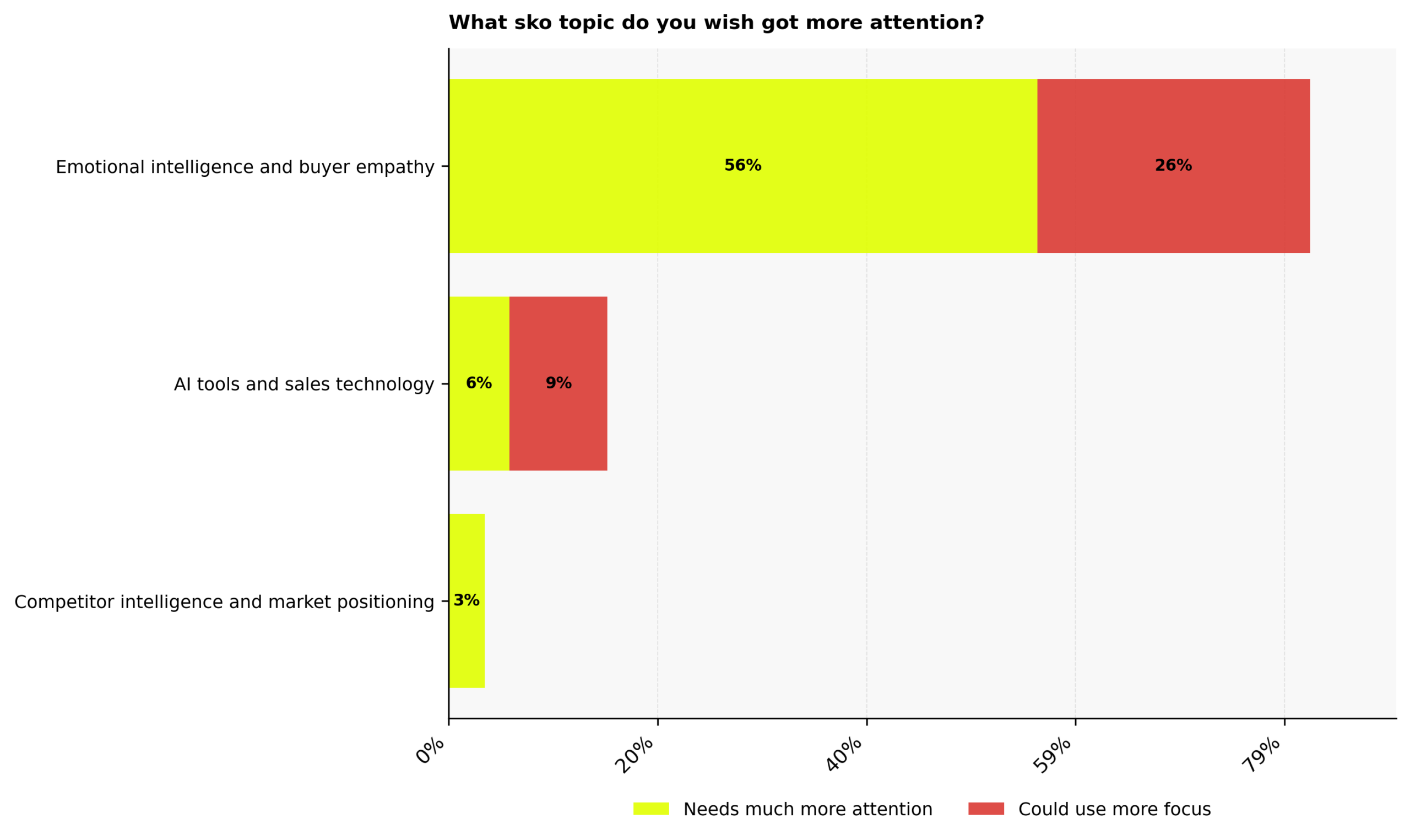
C-suite leaders see a clear opportunity to devote more attention to the human side of selling during sales kick-offs. A whopping 56% of our audience wants to see emotional intelligence and buyer empathy receive more attention at SKOs, while another 26% believe these tactics could use more focus.
By comparison, AI tools and technology are viewed as needing much more attention by 6% of leaders, with a further 9% believing they could benefit from additional emphasis. Competitor intelligence and market positioning rank lower still, with 3% identifying them as topics that need much more attention.
The strong interest in emotional intelligence and buyer empathy may reflect growing recognition of their role in sales success. Research has linked higher emotional intelligence with stronger sales performance, showing that understanding customer pain points, motivations, and concerns can have a meaningful impact on outcomes. This ties in with the findings, indicating that many C-suite leaders are looking beyond technology and products and placing greater value on soft skills that help sales professionals build trust, strengthen relationships, and better connect with buyers.
John Livesay agrees. “In the AI era, showing human empathy is more crucial than ever before.”
How long do SKO meetings typically run for C-suite leaders’ organizations?
87% of C-Suite leaders’ organizations usually run their SKO over 3 days, and 12% run it over 2 days, indicating a preference for longer durations rather than shorter time spans.
Preferences for SKO duration are very similar:
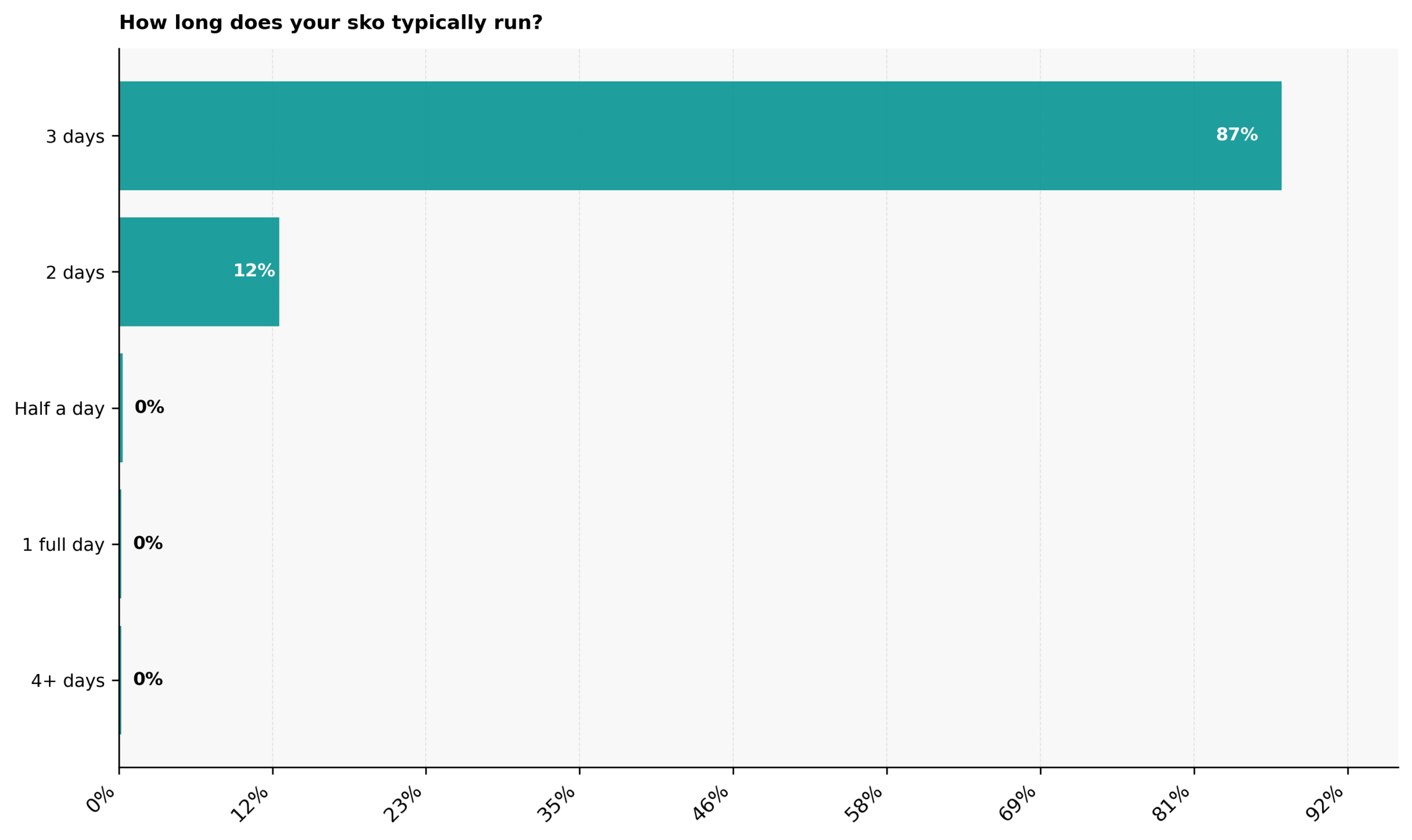
The vast majority of SKOs appear to follow a similar timeline. 87% of C-suite leaders run their SKOs for three days, making it by far the most common format. Another 12% report that their event lasts two days. In contrast, almost no organizations hold SKOs lasting only half a day (0%), one full day (0%), or four days or longer (0%).
The results indicate that many companies view two to three days as the ideal balance between depth and efficiency. A multi-day event provides time for strategy discussions, team-building activities, training sessions, and keynote presentations while still maintaining a practical schedule for sales teams.
John Livesay says, “Most events are between 2 to 3 days to give people enough time to bond and learn.”
What is the biggest challenge C-suite leaders face with SKO meetings?
Keeping attendees engaged throughout is a significant challenge for 94% of C-Suite leaders with their SKOs, while the remaining 6% battle with ensuring that the post-SKO momentum is maintained.
One challenge is the most common:

Keeping attendees engaged throughout the event is the single biggest challenge facing C-suite leaders at SKO meetings, with 94% identifying it as a significant concern. By comparison, only 6% view maintaining momentum after the SKO as their primary challenge. This implies that leaders are increasingly focused on creating meaningful, high-impact experiences during the event itself, recognizing that engagement is the foundation for long-term success.
The emphasis on engagement is understandable given broader workplace trends. American Society of Employers research shows that only 11% of meetings are considered productive, while 45% of workers feel overwhelmed by the number of meetings they attend.
In addition, 55% admit to checking email during virtual meetings, and 47% say meetings are their biggest time waster. Against this backdrop, SKO leaders appear determined to avoid the pitfalls of meeting fatigue by prioritizing participation, interaction, and attention.
John Livesay agrees and says it is crucial to get a keynote speaker who grabs and keeps an audience’s attention.
How is AI currently used in C-suite leaders’ sales processes?
21% of C-Suite leaders are currently using AI for personalized outreach and content, 1%for forecasting and pipeline management, and 1% for AI-powered prospecting and lead scoring, but 77% have not yet adopted AI in sales.
AI sales adoption is low:
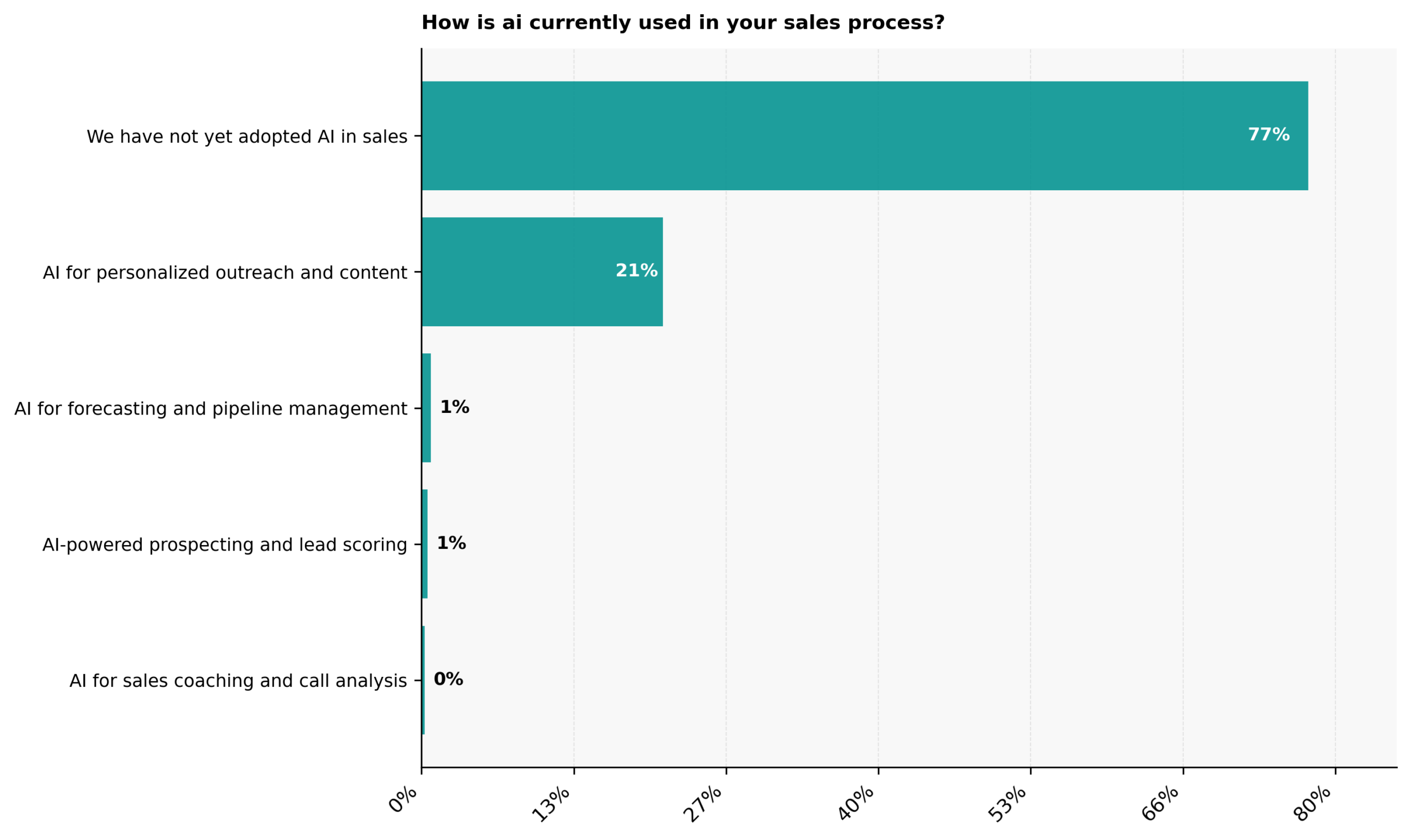
While 81% of sales teams report using AI in some capacity, AI adoption in sales remains limited among the C-suite leaders in our audience. More than three-quarters (77%) have not yet adopted AI in their sales processes.
Among those already using the technology, 21% rely on AI for personalized outreach and content, highlighting a growing interest in tailoring sales communications more effectively. Meanwhile, just 1% use AI for forecasting and pipeline management, and another 1% use AI-powered prospecting and lead scoring.
Notably, none of the leaders currently use AI for sales coaching and call analysis.
This huge contrast with broader industry trends, where AI is increasingly being embedded into core sales functions such as forecasting, enablement, and performance optimization, suggests that many C-suite-led organizations may still be in the early stages of experimentation rather than full-scale adoption.
Remark- John Livesay agrees and says AI can help analyze what went right so you can duplicate it as well as what went wrong so you can avoid repeating it.
Do SKO meetings include AI adoption as a topic at C-suite leaders’ organizations?
For only 10% of C-Suite leaders AI adoption is a core agenda item and major focus of SKOs, and is somewhat included for 8%, compared to the 4% who say it’s not really included, 27% do not include AI adoption at all but agree they should, 2% briefly mentioned it, 21% plan to include this focus topic next year, and 27% say it’s not relevant to their team, so they don’t include it.
AI adoption as a topic isn’t always prioritized:
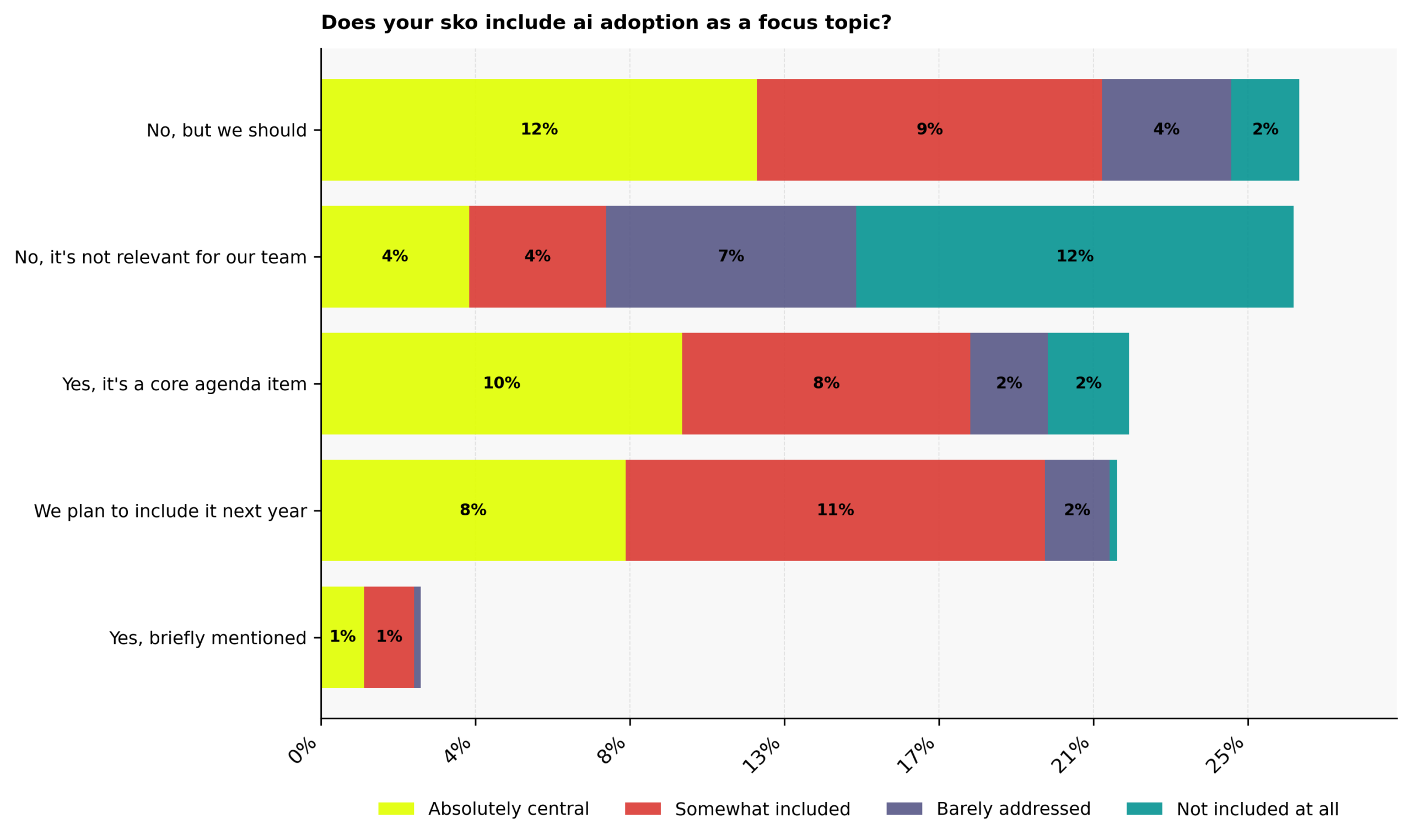
AI adoption takes on different levels of importance at SKO events. Among organizations where AI is not yet a focus topic but is seen as necessary, 12% believe AI is absolutely central to their discussions, 9% report it is somewhat included, 4% barely address it, and 2% do not include it at all.
Meanwhile, 10% have AI as a core agenda item, absolutely central to their SKO, while 8% include it to some extent. Smaller shares report it as barely addressed (2%) or not included at all (2%).
Other organizations are still evaluating AI’s role. Among those planning to include it in the next year, 8% consider it absolutely central, 11% say it is somewhat included, 2% barely address it, and less than 1% include it at all.
For teams that view AI as irrelevant to their team, 4% believe it is absolutely central, and 4% somewhat included, to 7% barely addressed, and 12% not included at all. Finally, 1% consider brief mentions of AI to be absolutely central, another 1% say it is somewhat included, and less than 1% barely address it.
Given that 88% of organizations now use AI in at least one business function, it’s positive to note that many leaders are actively determining how prominently AI should feature in their SKO agendas.
John Livesay agrees. “Human stories are more important than ever as people start to use AI more and more. It not enough to present data but turn that data into stories that people see themselves in.”
How do C-suite leaders rate the overall impact of their last SKO meeting?
37% of C-Suite leaders rate their last SKOs overall impact as poor, with minimal impact on teams or results, another 37% felt there was below expectations and had low engagement, while only 13% said that their SKOs overall impact was average and had some value, and 13% felt there was strong as their team was energized and focused.
Impact ratings of recent SKO events reveal significant opportunities for improvement. 37% of C-suite leaders rated their latest SKO as below expectations with low engagement. An equal 37% rated their events as poor, delivering minimal impact on either team performance or business results. At a whopping 74%, these figures prove that many organizations are still working to find the right balance of content, delivery, and follow-through to make SKOs more effective.
At the same time, there are small yet encouraging signs. 13% of leaders described their last SKO as average, noting that it provided some value while leaving room for improvement. Another 13% reported a strong outcome, noting their teams left energized and focused.
The low positive responses point to the growing importance of creating engaging, action-oriented events. Organizations that successfully align SKO content with team goals may be better positioned to turn inspiration into measurable results throughout the year.
John Livesay offers a virtual follow up to the keynote to maximize the impact.
What would make C-suite leaders invest more in their next SKO meeting?
More tailored, team-specific content would help 55% of C-Suite leaders invest more in their next SKO, and 9% say this is a top priority, while 21% list proven link to revenue growth as a top priority, and 15% as something that would help them to invest more.
Two core elements would drive future SKO investment:

C-suite leaders appear to be seeking a clear balance between relevance and measurable outcomes when deciding whether to invest more in SKO events. More tailored, team-specific content emerged as the most widely supported factor, with 9% of our audience identifying it as a top priority and a further 55% believing it would help justify greater investment. This suggests that leaders value SKOs that address the unique challenges, goals, and responsibilities of their teams rather than relying on a one-size-fits-all approach.
At the same time, demonstrating a proven link to revenue growth remains a powerful motivator. 21% of leaders consider this a top priority, while another 15% believe it would help them decide to invest more.
These findings indicate that both personalization and performance matter. Leaders want events that feel directly relevant to their teams while also delivering tangible business value, helping transform SKOs from annual gatherings to strategic drivers of growth and engagement.
An evolving SKO meeting model
These findings show how sales kick-off meetings continue to play a central role in how C-suite leaders set direction, align teams, and energize their sales organizations. Across formats, structures, and priorities, one theme is consistent. SKOs are evolving into highly strategic events rather than routine gatherings.
While approaches vary widely, leaders are increasingly focused on clarity, collaboration, and impact, ensuring that time spent together translates into meaningful action once teams return to their day-to-day roles. From leadership alignment to storytelling, and from content design to technology adoption, SKOs are becoming more purposeful.
At the same time, the findings highlight a clear opportunity for organizations to refine how they engage teams and measure success, particularly as expectations around effectiveness and outcomes continue to rise.
Clearly, SKOs remain a key moment in the sales calendar, but their value now depends on how well they connect strategy, people, and performance in rapidly changing business environments.
For a practical example, see how John’s Revenue Rockstar sales keynote turns storytelling into action, and why planners choose him to make the impact last beyond the sales kickoff.
About the data
Sourced using Artios from an independent sample of 282,881 opinions of C-suite leaders in the USA across X, Quora, Reddit, Bluesky, TikTok, and Threads. Responses are collected within a 95% confidence interval and 5% margin of error. Results are derived from what people describe online, from opinions expressed, and not actual questions answered by people in the sample.
Book John for your sales kickoff
Planning a sales kickoff? Bring John Livesay’s Revenue Rockstar keynote to your team. Ask about booking John.